Мірскі сельскі Савет, Belarus
30 memories from Мірскі сельскі Савет, Belarus

The image shows a view of Mir Castle Complex in Mir, Belarus. The castle is a UNESCO World Heritage site, and it is located on a hill overlooking a body of water. The castle is a large, white building with red roofs and towers. It is surrounded by a green lawn and trees. The sky is blue with white clouds. The foreground of the image shows a sidewalk and a street, and the side mirror of a car is visible on the right side.
Мірскі сельскі Савет
A POV shot from inside a car traveling on a paved road lined with dense green trees on both sides under a partly cloudy sky. The road has white lane markers. There is a slight glint of light on the wet surface of the road. In the distance, a single car is visible. The sky has wispy white clouds and a visible contrail from an aircraft. The foreground shows the dashboard of the car. The scene appears to be a rural road in the vicinity of Мірскі сельскі Савет, Belarus.
Мірскі сельскі Савет
The image shows a view of Mir Castle Complex in Mir, Grodno Region, Belarus, under a cloudy sky. The castle is a prominent architectural landmark, featuring a complex of red-roofed towers and buildings, with a large dark brick tower on the right. In the foreground, a paved walkway runs parallel to a green lawn bordered by a metal fence. A parking sign is visible on the left side of the image. The overall atmosphere is somber due to the overcast weather.
Мірскі сельскі Савет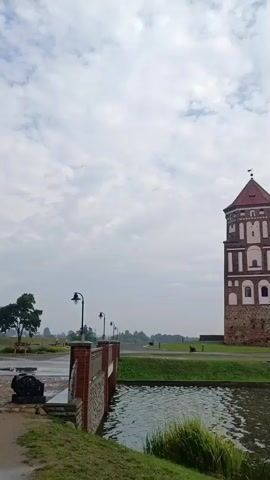
The video pans from left to right, showing a view of Mir Castle complex in Belarus. In the foreground, there is a body of water with green reeds growing along the edge. To the left, a brick wall with lampposts leads to a bridge. The castle itself is visible in the background, with its prominent red-tiled roofs and brick walls. The sky is cloudy.
Мірскі сельскі Савет
An iced coffee drink is presented in a clear plastic cup, sitting on a wooden table. The drink exhibits distinct layers: a white base, a dark brown middle layer, and a lighter brown, frothy top layer with ice cubes. The background is blurred but suggests an indoor setting with a window and greenery visible. The specific location in Мірскі сельскі Савет, Belarus, is not discernible from the visual information provided in the image.
Мірскі сельскі Савет
A bouquet of flowers, including pink coneflowers and asters, is arranged in a vase on a textured fabric runner. The runner is placed on a wooden surface, possibly a table, which shows signs of wear. In the background, a dark wooden object, possibly an antique iron, is visible. To the right of the bouquet, a metal object with a glass component, resembling a salt shaker or spice grinder, sits on a grey, woven placemat. The overall scene is rustic and appears to be indoors. The location is Мірскі сельскі Савет, Belarus.
Мірскі сельскі Савет
The image shows a close-up view of a rustic wooden shelf unit mounted on a textured off-white wall. The shelf unit is painted in a distressed gray finish. A wooden monstera leaf cutout is mounted inside the upper section of the frame. Centered on the monstera leaf is a circular painting on a pink background. This circular painting depicts a yellow envelope with a red wax seal imprinted with a heart, a white piece of paper with a red heart ace of spades card, and three dark red, dried flower petals. The word "LOVE" is written in red cursive script above the painting. A garland of dried green foliage is draped across the wooden shelf. A frayed rope hangs from an object above and to the left of the shelf unit. The scene is located in the city of Mir, Mirsky District, Grodno Region, Belarus.
Мірскі сельскі Савет
The image shows two small, square paintings displayed on a light wooden shelf. The paintings are mounted on miniature wooden easels and are positioned side-by-side. The painting on the left depicts a bouquet of flowers in shades of pink, purple, and blue, with green leaves. The painting on the right shows a field of pink flowers with green grass and a blue sky with clouds. The shelf is rectangular and appears to be made of unfinished wood. It is suspended from the wall by a piece of twine. The wall behind the shelf is textured and painted a light cream color. The overall scene suggests an indoor decorative display, likely in a home or gallery. There are no people or animals visible in the image. The location is specified as Мірскі сельскі Савет, Belarus, which is a rural administrative division.
Мірскі сельскі Савет
An antique, rusted flatiron sits on a wooden surface in front of a window with plants and a decorative pattern on the glass. The flatiron is made of metal with a wooden handle and a small wooden knob on top. The metal shows significant signs of rust and age. The wooden surface appears to be a tabletop or a windowsill. Behind the flatiron, the window reveals lush green leaves and some pink flowers, suggesting an outdoor or conservatory setting. The decorative pattern on the glass is light-colored and floral or abstract in design. The scene is well-lit, likely by natural light coming through the window.
Мірскі сельскі Савет
An antique gramophone sits on a wooden surface. The gramophone is made of wood and has a rusted metal turntable. A tone arm with a needle is positioned over the turntable. There is a small, open compartment on the gramophone's base. The gramophone is located on what appears to be a windowsill, with a view of greenery outside the window. The area is in Мірскі сельскі Савет, Belarus.
Мірскі сельскі Савет
An antique gramophone sits on a wooden surface, positioned in front of a window with plants. The gramophone, made of wood, has a metal turntable and a horn with a needle. The window overlooks a garden with pink flowers and greenery. In the foreground, a white radiator is visible. The overall scene suggests a domestic setting, likely a home or a shop, in the city of Mirski Selski Savet, Belarus.
Мірскі сельскі Савет
The image depicts a close-up view of a museum exhibit featuring a piece of historical armor, likely a Polish winged hussar costume, displayed indoors. The armor is predominantly made of polished metal, adorned with decorative gold accents and intricate patterns. Notable features include a helmet with a visor and heart-shaped cutouts, a chest plate with a cross emblem, and a large wing-like structure composed of numerous brown feathers. The background is dark and slightly out of focus, with hints of structural elements and lighting. This armor is on display at the Mir Castle Complex, located in the Mirsky settlement council (Мірскі сельскі Савет) in Belarus.
Мірскі сельскі Савет
The image depicts a vast, golden wheat field under a clear blue sky. The field stretches horizontally across the frame, meeting a dark green line of trees in the distance. The foreground shows a strip of grassy terrain with some gravelly patches. The scene appears to be a rural landscape, likely in or around the Мірскі сельскі Савет in Belarus, given its typical agricultural terrain. There are no people, animals, or vehicles visible in the image, and no discernible actions or interactions are taking place. The overall impression is one of tranquil, natural beauty on a sunny day.
Мірскі сельскі Савет
The image shows a view from inside a vehicle, looking out through a dusty windshield. Ahead, a straight, paved road recedes into the distance, bordered by flat, grassy terrain. The sky is a pale blue, with the sun shining brightly in the upper right corner, casting a glare and highlighting numerous specks of dust or dirt on the windshield. The foreground is dominated by the blurred dashboard and windshield frame of the vehicle. The scene suggests a drive through a rural or open area, possibly in or around Мірскі сельскі Савет, Belarus, given the flat landscape and the type of road.
Мірскі сельскі Савет
A person's hand is holding a white smartphone with a black and white artistic design. The design features a sketched angel with wings and flowing robes on the left side, and ornate crosses and decorative elements on the right. The background of the phone case appears to be covered in a pattern resembling handwritten script. The phone's camera array is visible in the upper left corner, with four circular lenses. The hand holding the phone has red nail polish. The setting appears to be indoors, possibly a car, given the dark background and the slight blur suggesting movement. There is no visible indication of the location being in Мірскі сельскі Савет, Belarus.
Мірскі сельскі Савет
The image depicts an opulent interior within the Mir Castle Complex, located in Mirsky Sel'sky Sovet, Belarus. The central focus is a grand, dark green polished marble fireplace mantelpiece featuring intricate carved decorative elements, including shells, leaves, and floral motifs. The firebox opening is dark, revealing a light-colored interior panel adorned with a crowned "MR" monogram. Resting on the mantelpiece are three ornate items. In the center is a large, dark-colored mantel clock with extensive gilded bronze ornamentation, including mythological figures and scrollwork. A golden winged figure stands atop the clock. The clock face is round, featuring blue Roman numerals on a white inner ring and a gold center. Flanking the clock are two identical gilded three-branched candelabras, each holding three upright white taper candles. The base of each candelabra features a dark statuette, possibly a putto or cherub. To the right of the right candelabra, a small informational sign written in Cyrillic rests on a miniature wooden easel. Above the mantelpiece is a tall, segmented mirror composed of multiple rectangular panes, framed by a highly ornate, gilded border with elaborate Rococo-style scrollwork and floral designs. The mirror reflects a grand room beyond the immediate view, including multiple crystal chandeliers with numerous lit bulbs, indicating a high ceiling. Also visible in the reflection are two framed portrait paintings: an upper painting of a man in a red hat and a lower painting of a woman in formal attire and a crown. Green drapery is visible to the left of the reflected paintings. A partial reflection of an adult individual, identified by a dark shirt and a hand holding a mobile phone, is visible in the lower right segment of the mirror, suggesting a visitor capturing an image of the scene. The surrounding walls are light-colored, possibly white or cream, adorned with vertical gilded decorative trim and ornate gilded appliqués featuring intricate floral and scroll patterns. The overall scene conveys a sense of historical grandeur and elaborate classical design.
Мірскі сельскі Савет
The image displays an indoor museum exhibit within the Mir Castle Complex, located in Мірскі сельскі Савет, Belarus. Three full suits of historical armor are presented on display. In the immediate foreground, a Winged Hussar armor stands prominently, featuring a large, elaborately feathered wing attached to its back and detailed decorative elements on its breastplate. This armor is supported by a dark wooden base. Two additional suits of plate armor are positioned behind and slightly to the left of the Winged Hussar armor, mounted on metal stands. A red velvet rope, supported by chrome stanchions, defines the exhibit boundary on a light-brown tiled floor. The background to the right features a dark gray wall, upon which a gold-framed historical map and a small white information plaque are mounted. A brick wall is visible further left in the background. Overhead, industrial-style architectural elements are suspended from a light-colored ceiling. The lower right foreground reveals a corner of a clear glass display case, partially containing a light-colored, rounded object. Shadows from the exhibits, notably a distinct feather pattern from the Winged Hussar's wing, are cast upon the dark wall.
Мірскі сельскі Савет
A reconstructed 16th-century "Manifer" (gauntlet) is displayed within a glass exhibition case in a museum setting at the Mir Castle Complex, Мірскі сельскі Савет, Belarus. The metal gauntlet, crafted by V.V. Shevtsov in 2012 using forging, decorative etching, chasing, artificial aging, silver-plating, gilding, and enamelling, features intricate red and black enameled patterns over a gilded and silver-plated surface with etched spiral motifs. It is positioned at an angle, resting on a textured reddish-brown fabric background. A white rectangular information label in Belarusian, Russian, and English, detailing the artifact's reconstruction, author, and materials, is placed in front of the gauntlet. A faint, distorted reflection of a person's upper body is visible on the lower right glass panel of the display case. The background above the exhibit appears to be dark, possibly wooden.
Мірскі сельскі Савет
The image displays a museum exhibit simulating a military dugout or trench, located in Мірскі сельскі Савет, Belarus. Two life-sized mannequins, depicted as soldiers, occupy the wooden-planked interior. The mannequin in the left foreground is seated, wearing an olive-drab uniform with red shoulder boards, a matching cap, and a dark mustache. The second mannequin, positioned in the right background, is crouching and also wears an olive-drab uniform and cap. A dark, metallic machine gun, identified by its ribbed barrel shroud and tripod mount, rests on light-colored sandbags in the lower-center of the frame, pointed towards the right. Additional sandbags are stacked along the lower left. The confined space features rough-hewn wooden planks forming the walls and ceiling. The scene is illuminated by dim, red-orange light emanating from the background.
Мірскі сельскі Савет
A full suit of polished metal plate armor stands upright on a dark wooden display base marked with a white "1" in an interior room of the Mir Castle Complex in Мірскі сельскі Савет, Belarus. The armor includes a closed helmet with a perforated visor, a breastplate, pauldrons, vambraces, gauntlets, faulds, tassets, cuisses, greaves, and sabatons, all secured with dark leather straps and buckles; chainmail is visible at the gorget. Directly behind the armor, a large, intricate tapestry depicting human figures in historical attire (one in blue and gold) and zoomorphic elements, such as lion heads, in muted blues, golds, browns, and creams, hangs on a light-colored wall. To the left, a tall, dark wooden furniture piece with detailed carved floral and vine motifs is partially visible, its base resting near the floor. The floor is covered with terracotta-colored hexagonal tiles, and a light-colored wooden baseboard lines the wall. The scene is illuminated by artificial light, casting subtle shadows on the wall.
Мірскі сельскі Савет
Three antique swords are displayed on a dark wooden chest in an interior room of the Mir Castle Complex in Мірскі сельскі Савет, Belarus. The chest features carved paneling with circular rosette motifs and a beaded border along its top edge. Two straight-bladed swords, possibly rapiers, with ornate metal hilts and wrapped grips (one black, one red), are positioned parallel to each other on the chest. A third sword with a wavy, flamberge-style blade and a simpler hilt is laid diagonally across the other two. The blades show varying degrees of age and discoloration. Behind the chest, a large, multicolored tapestry hangs on a white wall. The tapestry depicts a classical scene, including a blue and white urn, flowing drapery in blue and beige, and a decorative floral border along its lower edge. The floor is partially visible, showing terracotta-colored tiles. No individuals are present.
Мірскі сельскі Савет
The image presents a top-down view of historical weaponry displayed in a rectangular glass museum case with a dark brown wooden frame, situated within the Mir Castle Complex Museum in Мірскі сельскі Савет, Belarus. The interior of the display case features a light-colored, off-white or beige background surface. Four primary objects are arranged within the case. Dominantly positioned diagonally from the upper left to the lower center is a crossbow. It features a wooden stock with ornate gold-colored metal plating, a dark metal bow (prod), and a light-colored, possibly leather-wrapped, grip on the rear section. To the upper left of the crossbow's stock, a smaller, intricate silver-colored metal object, resembling a spur or a crossbow cocking aid, is present. Below the crossbow, a long, slender, silver-colored metal mace with a distinct fluted, spherical head is laid out diagonally. To the lower right, a shorter, pointed metal dagger or stiletto, complete with a hilt and guard, is displayed. Four rectangular white informational placards, bearing text in Belarusian, are distributed strategically within the case, adjacent to the artifacts. Reflections from overhead lighting are visible on the glass surface of the display case. No individuals are depicted, and the objects are static exhibits.
Мірскі сельскі Савет
An elevated photograph captures a detailed architectural scale model of Mir Castle, situated in Мірскі сельскі Савет, Belarus, presented indoors within a museum environment. The model consists of multiple light-toned buildings featuring prominent red tile roofs, a central gateway with an arched entrance, and various towers, including one topped with a silver dome. The central courtyard, depicted with a textured, light-teal surface, hosts numerous miniature figures arranged in a historical battle formation. These figures comprise groups of infantry, cavalry, and artillery pieces (cannons), scattered across the courtyard simulating combat. Several partially visible adult spectators are positioned in the background, observing the exhibit. The surrounding environment includes dark wood display elements, a patterned tapestry on a wall, and red velvet rope barriers.
Мірскі сельскі Савет
An exterior long shot depicts the Mir Castle Complex in Мірскі сельскі Савет, Belarus, under a partly cloudy sky. The prominent structure is a multi-towered castle constructed primarily of red brick with sections of lighter pink/beige stucco or plaster detailing. The largest tower on the right features a stone and brick base, transitioning to predominantly brick with vertical stucco strips and arched window surrounds, culminating in a pyramidal reddish-brown tiled roof topped with a weather vane. A smaller, lighter-colored tower to the left exhibits a similar tiled roof and white stucco facade sections with dark-framed windows. Connecting brick walls are visible between the towers. In the foreground, a gray paved pathway curves from left to right, bordered by a strip of sparse green grass. Approximately ten to twelve individuals, dressed in casual attire, are distributed along the pathway and near the castle walls, appearing to be walking or observing the structure. Ground-level bollards or lights are positioned along the edge of the grass, and a decorative element resembling an antique cannon wheel is visible on the grass to the right.
Мірскі сельскі Савет
The image displays the Mir Castle Complex in Мірскі сельскі Савет, Belarus, under an overcast sky. The foreground features grey interlocking pavers and a low, dark-grey metal fence with circular decorative elements, supported by a short brick pillar on the left. Adjacent to the pillar, a dark, wheel-like decorative metal object is positioned on the pavers. Beyond the fence, a patch of sparse, dry grass is visible, with a set of grey steps ascending on the far right. The Mir Castle dominates the mid-ground and background. On the left, a tall, multi-story tower with a red-tiled conical roof and a finial is prominent. This tower is constructed primarily of reddish-brown brick, accented with lighter pink plaster panels and white trim around its various arched and rectangular windows. Connecting this tower to the central part of the complex is a robust, red brick wall built upon a stone foundation. A black streetlamp stands on the paved area in front of this wall. Further to the right, behind the wall, a white-faced section of the castle palace is visible, featuring multiple dark windows and red-tiled roofs with chimneys. A smaller, white-faced tower with a red-tiled conical roof and finial completes the visible structures on the right. Several individuals are present on the large paved plaza area in front of the castle wall. One person in a light pink jacket and another in dark clothing are walking towards the left-center of the frame. Other figures are faintly visible further back. No explicit interactions between individuals are discernible.
Мірскі сельскі Савет
An outdoor, eye-level, wide shot captures the Mir Castle Complex situated within Мірскі сельскі Савет, Belarus, viewed across a body of water under a partially cloudy, light blue sky. The prominent structure, Mir Castle, occupies the central and right portions of the image, presenting a facade composed primarily of red brick with white rendered sections and a rough-hewn stone base. The castle features multiple towers with reddish-brown tiled, conical roofs topped with finials. The left section displays several multi-story, octagonal towers with decorative white elements, arched window frames, and small rectangular windows. A long, lower brick wall connects these towers to a white-rendered building and a square tower on the far right, which also features a conical roof and a visible clock face with Roman numerals on one side. Small, dark rectangular windows are visible across the castle's various sections. In front of the castle, a paved area separates it from the water. Approximately 20-30 individuals, depicted as indistinct figures, are observed walking or standing on this paved area and a connecting pathway near the castle's base. They appear to be visitors. One individual walks alone towards the right; others are in small groups. The lower half of the frame is dominated by a dark blue-grey body of water, exhibiting small surface ripples. The immediate foreground on the left shows a sloped grassy bank with patches of dry, light brown reeds and some visible rocks at the waterline. Similar dry reeds are visible along the water's edge on the right. The horizon behind the castle appears clear.
Мірскі сельскі Савет
This image depicts a rustic outdoor decorative arrangement located within Мірскі сельскі Савет, Belarus. The scene is dominated by a large, gnarled tree with textured, dark bark and multiple exposed roots, positioned on the left and extending upwards. Behind the tree and to its right stands a reddish-brown brick wall, part of which is covered with dark green ivy on the far right. A narrow, dark-framed vertical window is visible in the brick wall to the right of the tree, reflecting a light-colored outdoor scene. In the midground, a weathered, half-barrel planter with distressed white paint on its rim and metal bands contains dense green foliage and small white flowers. Adjacent to this barrel on the right is a large, greyish-brown wooden wagon wheel with visible spokes and a central hub, leaning against or integrated into a larger, distressed wooden structure. This structure, possibly a cart or chest, exhibits white paint, rusted metal hardware, and a draped light-colored fabric or canvas with a coiled rope. The foreground features an assortment of potted plants and natural elements. A grey, faceted pot on the lower-left contains vibrant green foliage and several small white flowers with purple centers. To its right, a silver-toned, textured pot holds green plants and a tall stalk of bright pink flowers. Further right, another light grey, textured pot displays white and yellow daisy-like flowers. Dark, reddish-brown ground cover is interspersed between the containers. Several irregularly shaped, light grey rocks are positioned among the plants, contributing to the natural, aged aesthetic of the display. No individuals are present in the image.
Мірскі сельскі Савет
The image displays an interior courtyard view of the Mir Castle Complex in Мірскі сельскі Савет, Belarus, under an overcast blue sky. Dominating the scene is a tall, octagonal tower constructed of dark red brick with contrasting lighter arched and rectangular window recesses, crowned by a red-tiled roof and a dark weathervane. An aircraft is faintly visible in the upper left sky. Surrounding structures include brick walls with elevated wooden walkways, festooned with numerous strands of illuminated white icicle-style string lights. The courtyard floor is paved with irregular cobblestones. In the mid-ground, a circular stone well with a detailed, dark metal wellhead is centrally positioned. To the right, a dark metal staircase with wooden treads ascends along a brick wall to an upper doorway; a yellow light illuminates an arched doorway below the stairs. On the left, partially obscured by a dark red canopy, are low stone foundations and several low, rectangular, dark-colored covers. No individuals are present in the scene.
Мірскі сельскі Савет
The image depicts Mir Castle in Мірскі сельскі Савет, Belarus, under an overcast sky. The central subject is a tall, octagonal tower constructed primarily of red brick. Its lower walls and the adjoining castle section are built from rough-hewn stone, transitioning to brickwork. The tower features numerous arched and rectangular windows and, midway up its facade, an illuminated yellow decorative element resembling a clock or pendulum device with hands pointing to approximately 10:10. The tower's peak includes a conical roof with a weathervane, and a significant number of dark birds are perched on its roofline and ledges, with several in flight against the sky. To the left of the tower, a section of the castle wall supports a walkway adorned with illuminated strings of cascading white lights. At ground level, a large, arched double-door wooden gate with diagonal cross bracing is centered below the tower, flanked by smaller arched and rectangular openings in the stone foundation. The ground appears to be paved with cobblestones. The illumination of the decorative lights suggests low ambient light conditions, consistent with dusk.
Мірскі сельскі Савет
A detailed, forensic close-up depicts an aged, vertical wall surface located in Мірскі сельскі Савет, Belarus. The wall is constructed from an irregular mixture of large, rounded to ovate natural stones, ranging in color from dark grey to various shades of brown and beige, interspersed with numerous smaller, reddish-brown bricks. The stones are set within a substantial matrix of light-colored mortar, which exhibits signs of significant wear, erosion, and discoloration, appearing rough, cracked, and partially degraded in many areas. The bricks, often appearing as fragmented or incomplete units, are laid in irregular courses or as infill between the larger stones, contributing to the wall's uneven texture. Portions of the mortar have crumbled, exposing deeper recesses or the edges of the construction materials. The overall scene shows a robust, historical construction with visible material degradation and weathering. No individuals, discernible actions, or external objects are present within the frame, focusing solely on the structural elements and their condition.
Мірскі сельскі Савет