Aghalokpe, Nigeria
30 memories from Aghalokpe, Nigeria
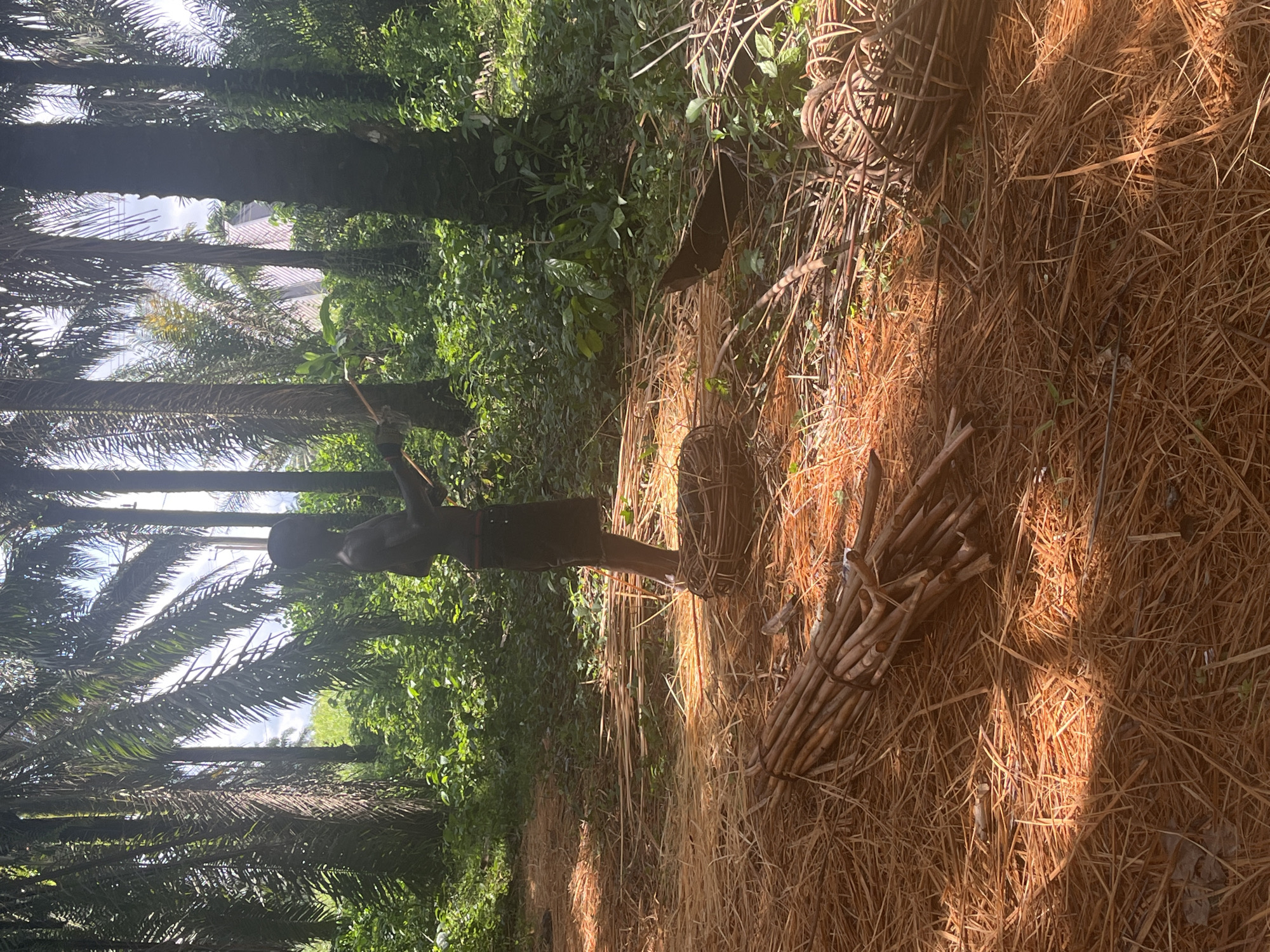
The image presents an outdoor scene under bright, sunny daylight, likely in a rural or semi-rural area of Aghalokpe, Nigeria, characterized by numerous tall palm trees. A significant amount of dry, reddish-brown plant material, possibly dried palm fronds or grass, covers the ground in the foreground and middle, illuminated by warm, golden sunlight that creates distinct shadows. In the center-left, an adult person is standing, facing right, and holding a long pole or stick, suggesting they are engaged in an activity such as clearing, harvesting, or gathering. On the ground in the mid-right, several bundles of light-colored sticks are neatly tied together, alongside a woven basket or coiled material. The scene is framed by tall, slender palm trunks with their fronds extending towards a bright sky. Lush green foliage and undergrowth are visible on both sides of what appears to be a path or cleared area. Through the gaps in the palm fronds, parts of a building's roof are faintly discernible in the distance, indicating human presence beyond the immediate vegetation. There is no visible text in the image.
Aghalokpe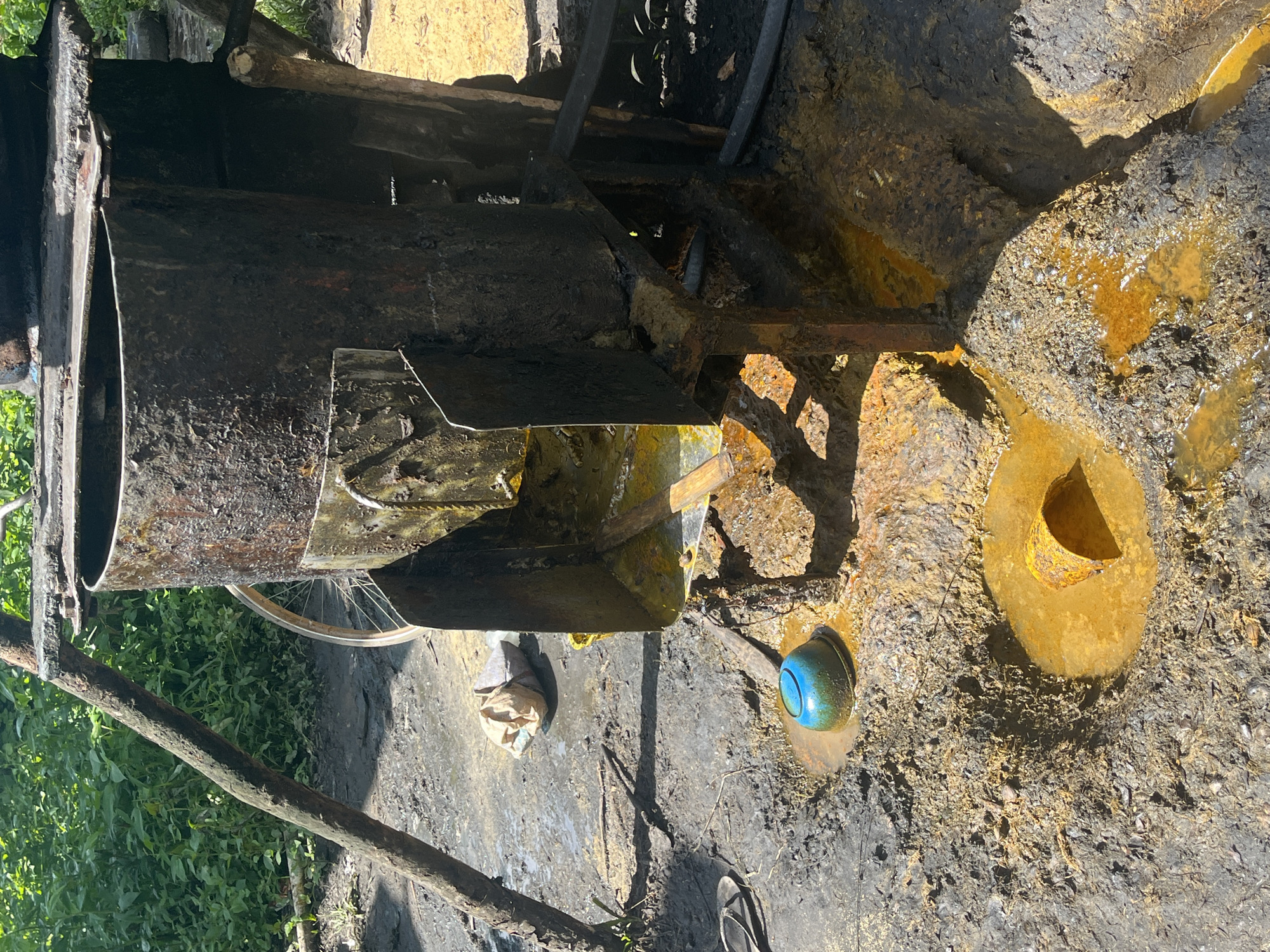
The image displays an outdoor, makeshift industrial scene bathed in bright daylight, consistent with the location context of Aghalokpe, Nigeria. The central subject is a large, dark, and heavily grimy metal cylinder or drum, likely a processing tank, supported by a rusty, rugged metal framework and integrated wooden beams. This setup suggests a small-scale, possibly informal, industrial operation. The ground around the equipment is a mixture of dark soil and gravel, extensively stained and pooled with a viscous, striking yellow-orange liquid. This substance coats the metal structures and forms puddles, indicating the processing or handling of materials such as crude oil, chemicals, or other mineral-rich substances. One puddle on the right contains a small, bright blue bowl-shaped object, while another holds a smaller, open metal pipe or container also filled with the yellow liquid. Hints of human presence include a partially visible bicycle wheel behind the large cylinder, a crumpled light-colored bag on the ground, and a section of a flip-flop sandal near the blue object. Dense green foliage in the background signifies a rural or semi-rural environment. The scene implies an ongoing industrial activity, possibly involving distillation or refining, carried out with rudimentary equipment in potentially hazardous conditions. No visible text is present in the image.
Aghalokpe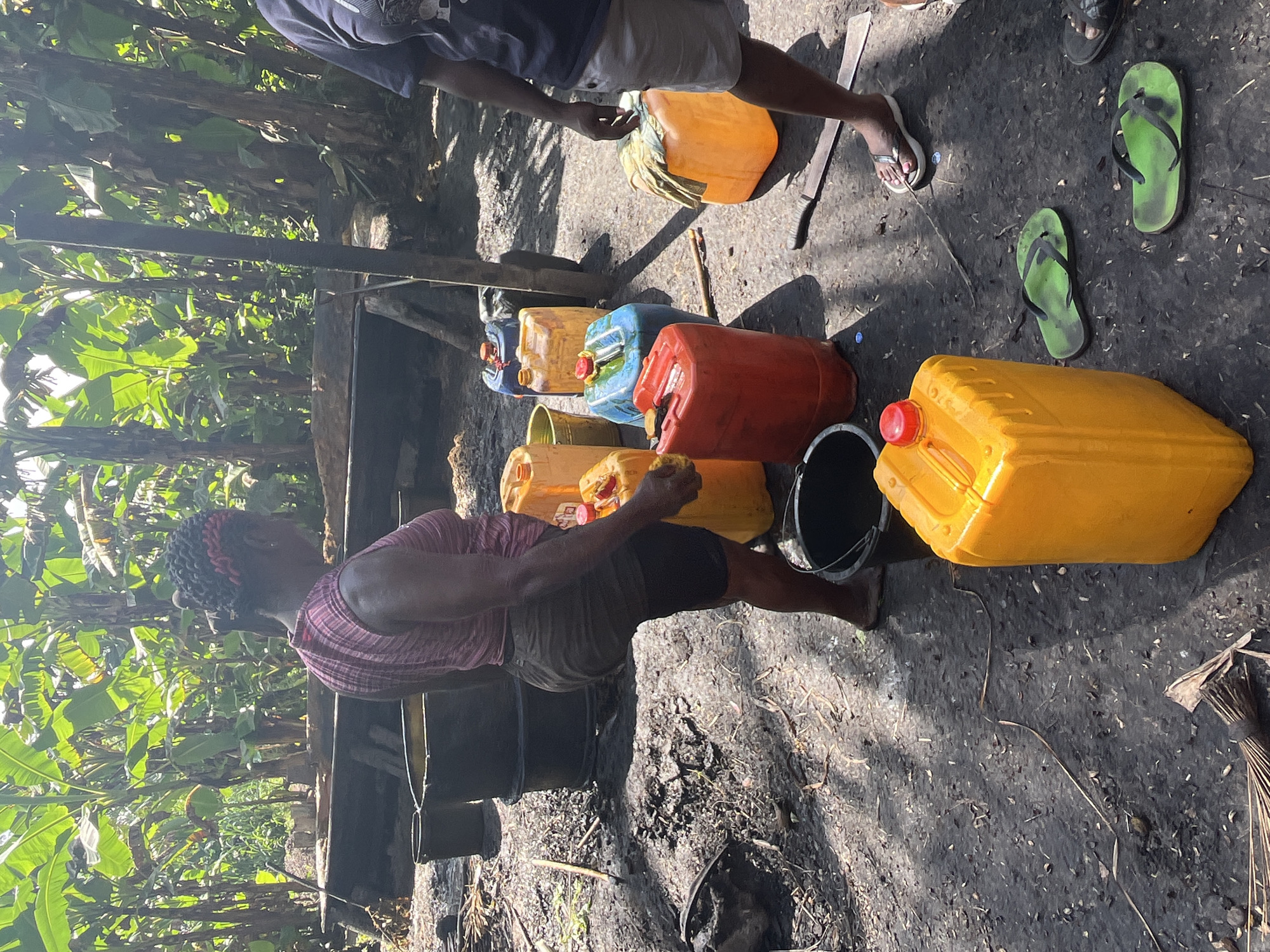
This image depicts an outdoor scene in Aghalokpe, Nigeria, likely related to agricultural processing or commodity handling. In the foreground, a person, possibly female, is seen from the side, wearing a red and white plaid shirt, dark shorts, and a patterned headwrap. They appear to be actively engaged in an task, standing next to a collection of large, colorful plastic jerrycans and black buckets. Another individual is partially visible in the background, wearing a blue t-shirt and light-colored shorts, also surrounded by similar jerrycans. The ground is dark and appears to be a mixture of dirt and possibly residue, with scattered organic debris. Several large plastic jerrycans, in shades of yellow, red, blue, and orange, are prominently featured, suggesting the storage or transport of a liquid commodity, potentially palm oil given the regional context. Empty black buckets are also visible. A machete lies on the ground near some feet, and several pairs of flip-flops, including bright green ones, are scattered on the dark ground. The setting is characterized by lush, dense tropical vegetation, likely banana trees or similar plants, forming a green backdrop. The scene is brightly lit by natural sunlight, casting strong shadows on the ground, indicating it is daytime, possibly midday. Simple wooden structures are present in the background, consistent with a rustic outdoor working area. No visible text can be discerned on any objects or surfaces. The overall impression is one of active labor or processing in a rural, tropical environment.
Aghalokpe
A fire burns vigorously beneath a large, black, rectangular metal container, producing a significant amount of smoke that rises into the air. The fire consists of burning logs and branches laid on the bare ground. The setting is outdoors in what appears to be a rural or village environment, with lush green foliage, including palm trees, visible in the background. The ground is made of dark earth, scattered with small pieces of wood, leaves, and what might be ash or charcoal. A broken coconut shell lies on the ground to the right of the fire. In the distance, a red plastic bucket is barely visible near some excavated earth. The scene depicts the process of charcoal making, with the metal container likely serving as a kiln. The time of day is daytime, under natural light. There are no people visible in the frame, and no visible text. Background music and the sounds of the crackling fire are audible.
Aghalokpe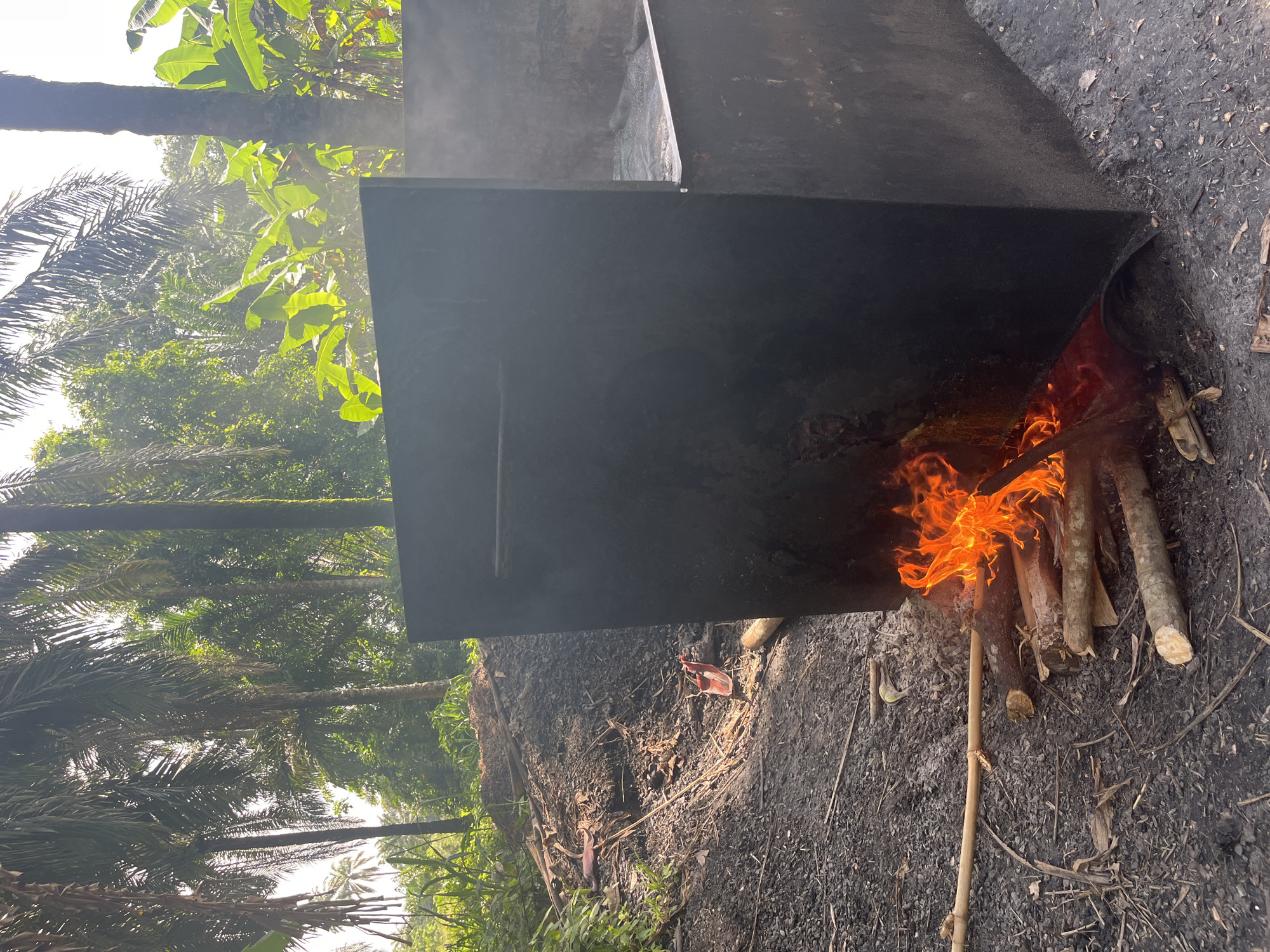
The image, rotated 90 degrees clockwise, captures an outdoor scene in Aghalokpe, Nigeria, under bright daylight. A substantial, black, rectangular metal container or vat occupies a significant portion of the frame. It is positioned horizontally across the image, with a large, bright orange and yellow fire burning intensely against its lower right side. Several pieces of wood, including logs and sticks, fuel the flames, arranged on the dark, uneven ground. The ground is dark and appears to be a mix of soil, ash, and small debris, with some dried plant matter scattered around. A subtle wisp of steam or smoke rises from the container, particularly visible against the brighter background, indicating it is actively being heated. Beyond the container and fire, a lush tropical environment is visible. Numerous tall palm trees, with their characteristic fronds, dominate the background, alongside other broad-leafed green plants, possibly banana trees, some illuminated by direct sunlight. The vegetation suggests a humid, fertile region. The bright light implies it is daytime, likely mid-morning or afternoon. No people or visible text are present in the image. The scene depicts a rural or agricultural heating process using an open fire and a large container.
Aghalokpe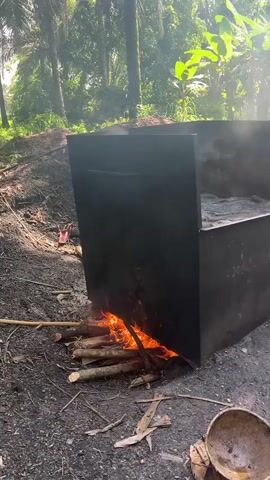
The video captures an outdoor scene under bright sunlight, set in a rural or agricultural environment, consistent with Aghalokpe, Nigeria. The initial view shows a large, dark metal vat or container with a wood fire burning vigorously underneath. Smoke or steam rises from the vat, indicating a heating or processing activity. The ground around the fire is dirt and ash, with small pieces of wood. In the background, dense tropical vegetation featuring tall palm trees and large-leafed banana plants is visible. A discarded coconut shell lies on the ground. As the camera pans, two women are revealed amidst the processing area. One woman, wearing a dark shirt and shorts, is actively bending over, arranging multiple colorful plastic jerrycans (yellow, red, and blue) on the dusty ground. Behind her stands a dark, upright barrel. Nearby, another woman or girl, dressed in a white and black long-sleeved shirt with a graphic design and black shorts, stands facing away from the camera, looking towards the right side of the frame. A pair of green flip-flops and a broom are visible on the ground. The background remains lush with palm and banana trees. The scene depicts a small-scale, open-air operation, likely for processing an agricultural product, possibly palm oil, given the prevalence of palm trees. The individuals appear focused on their tasks. The time of day is sunny, suggesting morning or early afternoon. No discernible text is visible on any objects or clothing.
Aghalokpe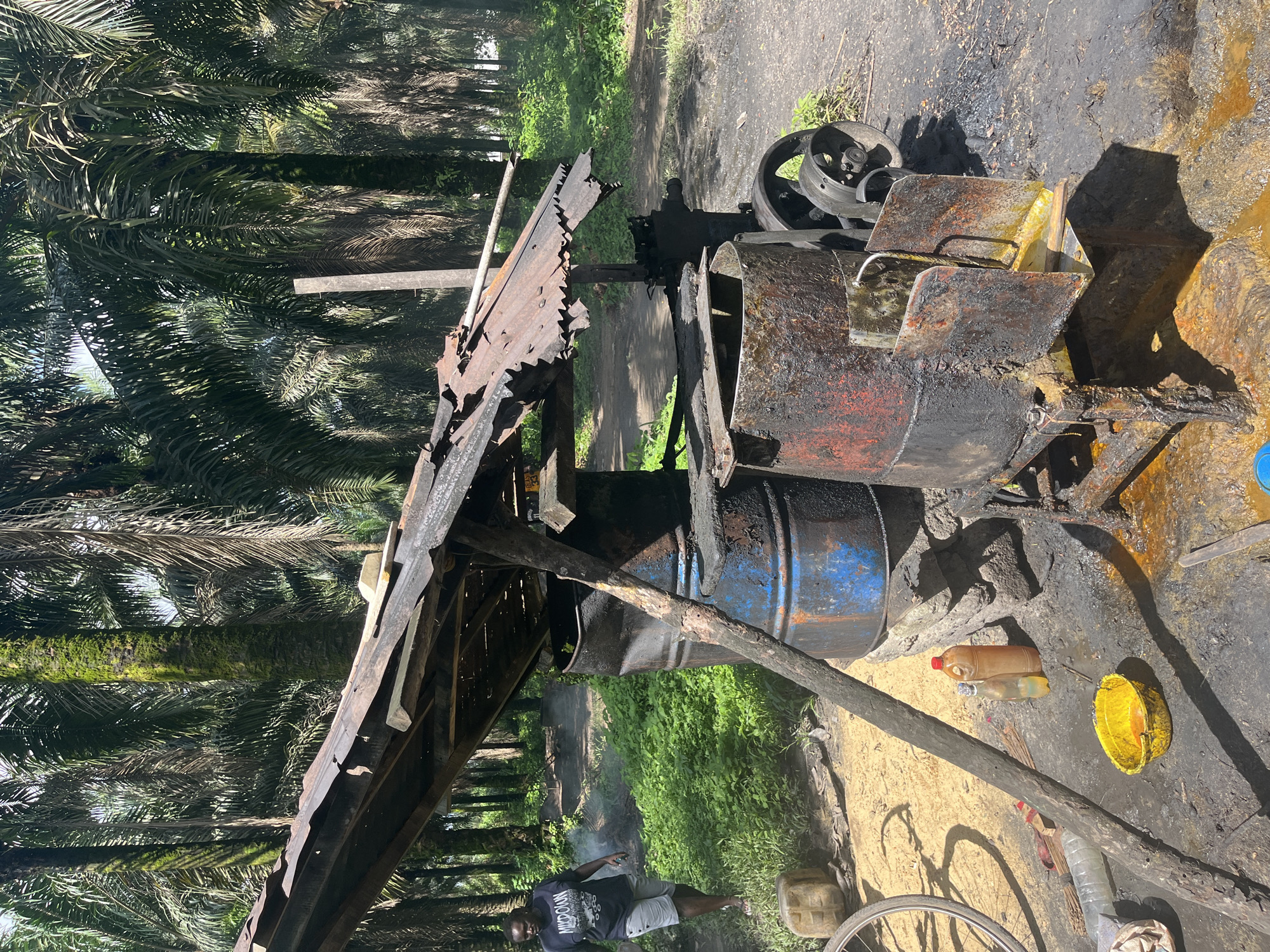
This image captures a rustic, outdoor processing area, likely for palm oil, set within a dense palm plantation in Aghalokpe, Nigeria. The scene features makeshift industrial equipment under a damaged corrugated metal roof, indicative of a small-scale operation. At the center are large, heavily stained metal drums, one blue and another rusty orange, connected to a mechanical engine or press, all appearing well-used and covered in dark, viscous residue, presumably palm oil. Tall oil palm trees surround the area, their fronds filling the background and contributing to the tropical, agricultural setting. Green undergrowth is visible behind the machinery, and the ground is soiled with oil and dirt. A man is standing in the lower left foreground, wearing a dark t-shirt with the word "NOBODY" printed on it, and light shorts. He is looking away from the camera. In the mid-ground, wisps of smoke rise, suggesting a heating or burning process related to the oil extraction. Other objects include several plastic bottles containing liquids, a bright yellow plastic bucket on the ground, and a bicycle wheel leaning against a wooden support. The strong sunlight casts sharp shadows, indicating a midday setting. The overall impression is one of a functional, if rudimentary, industrial activity amidst a natural, rural environment.
Aghalokpe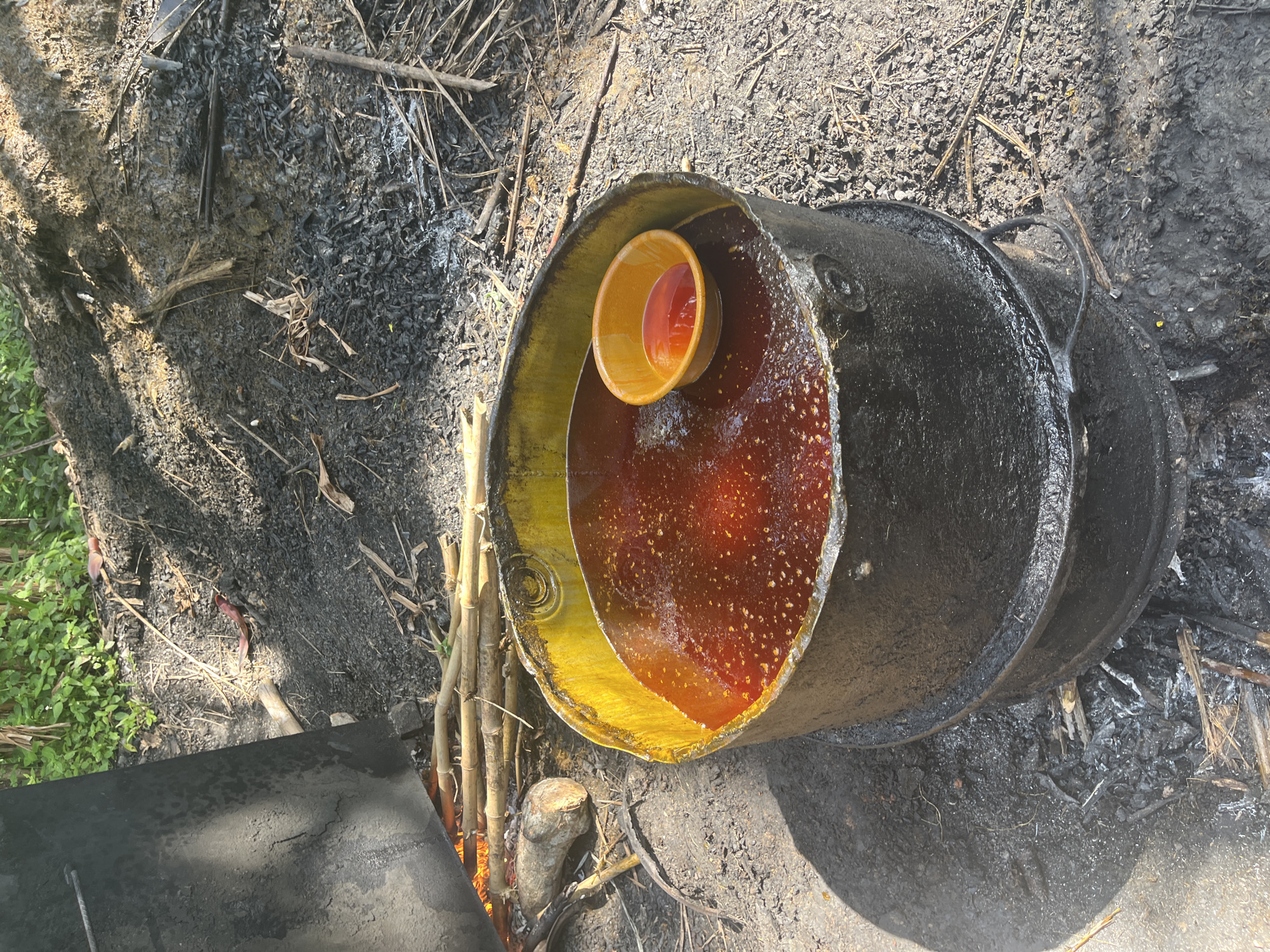
The image captures an outdoor scene centered around a large, black metal drum or pot being used for cooking or processing over an open fire. The drum contains a substantial amount of a reddish-brown liquid, which is bubbling slightly, suggesting it is being heated. Inside the larger drum, a smaller, yellow-orange bowl floats, also holding some of the same reddish liquid. The interior walls of the large drum have a yellowish hue, possibly from residue or paint. The drum is situated on the ground, directly over a fire. Flames are visible at the base of the drum, and slender bamboo-like sticks are stacked nearby, likely serving as fuel. The ground surrounding the cooking setup is covered in dark ash, charcoal, and charred organic debris, indicating an established area for open-fire cooking. Green foliage is visible along the left edge of the frame, suggesting a natural or semi-rural environment. The activity depicted is consistent with traditional methods of processing, such as palm oil extraction, which is common in regions like Aghalokpe, Nigeria. The large pot, open fire, and appearance of the liquid strongly point towards this labor-intensive process, where palm fruit is boiled to separate the oil. The small bowl might be used for skimming impurities or sampling the oil. The scene takes place during daylight hours, indicated by the bright illumination and visible shadows. The weather appears sunny. No individuals are visible in the photograph, and there is no legible text present. The overall impression is one of manual work and traditional methods in a rustic, outdoor setting.
Aghalokpe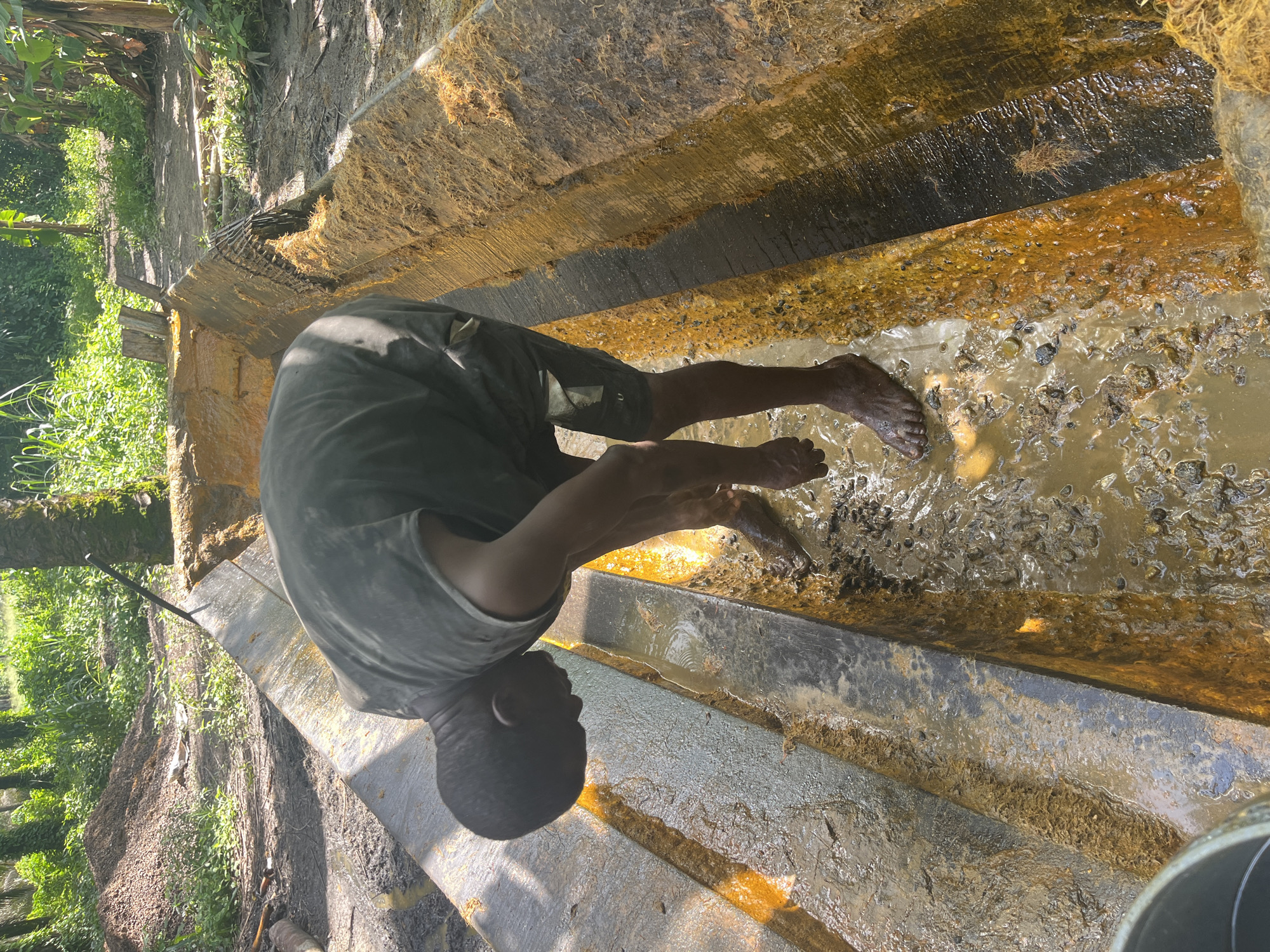
The image captures an individual engaged in manual labor within an outdoor setting. A person, dressed in a dark t-shirt and shorts, is bent over a large, rectangular trough or channel. Their bare feet are immersed in the muddy, yellowish-brown liquid and fibrous debris that fills the bottom of the structure. The trough itself is constructed from robust planks, possibly wood or metal, which are also heavily coated with the same thick, fibrous, reddish-brown substance. The background is dominated by lush, green tropical vegetation, including tall trees and dense foliage, indicating an agricultural or rural environment. The scene is brightly illuminated by natural daylight, suggesting a sunny day. The presence of significant fibrous material and muddy water strongly suggests an activity related to the processing of natural products, likely agricultural. Given the location context of Aghalokpe, Nigeria, this could be related to palm oil extraction, where palm fruit fibers and residue are common. A black bucket is partially visible on the right side of the trough. The person appears focused on the task at hand. There is no visible text in the image.
Aghalokpe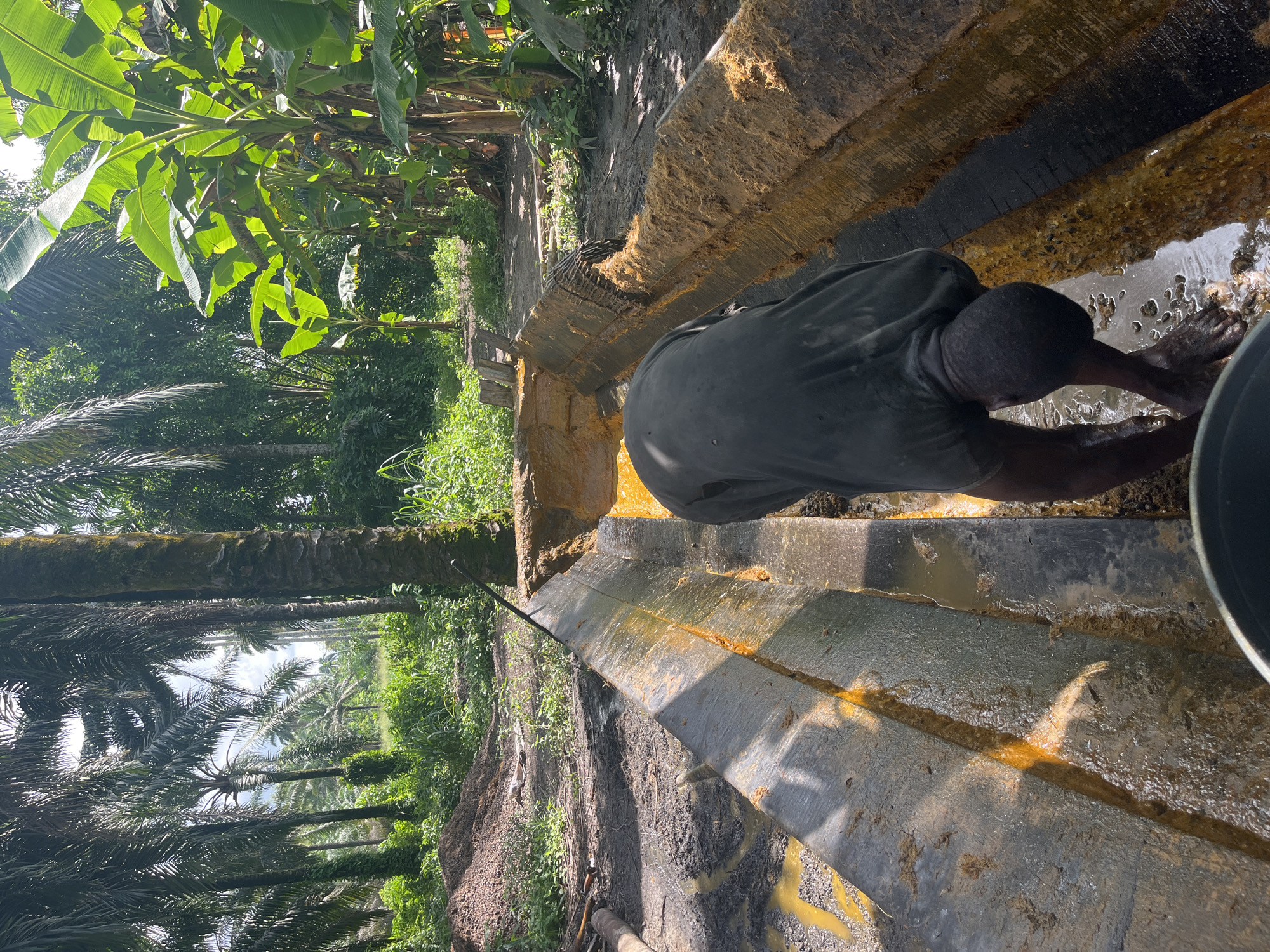
This media file presents an outdoor scene in Aghalokpe, Nigeria, featuring a person engaged in agricultural processing. The central figure, visible from the back, is a person with dark skin and closely cropped hair, wearing a dark grey t-shirt. They are bent over, with their hands submerged in a reddish-brown, sludgy liquid contained within large, rough-hewn wooden troughs. The wooden troughs, which form a significant part of the foreground and midground, are stained with the same reddish-brown, fibrous material, suggesting they are used for processing palm fruit or a similar agricultural product. The ground around the troughs is dirt and appears somewhat muddy, with traces of the reddish-brown substance. The setting is characterized by lush tropical vegetation. Prominent large-leafed banana trees are visible in the upper left, while numerous tall palm trees, likely oil palms, extend across the middle distance and background under a bright sky. The scene is well-lit by direct sunlight, indicating midday or early afternoon, with clear shadows cast by the objects and vegetation. A dark, round container is partially visible on the far right edge of the frame. There is no visible text in the image. The overall impression is one of manual, rustic processing in a tropical agricultural environment.
Aghalokpe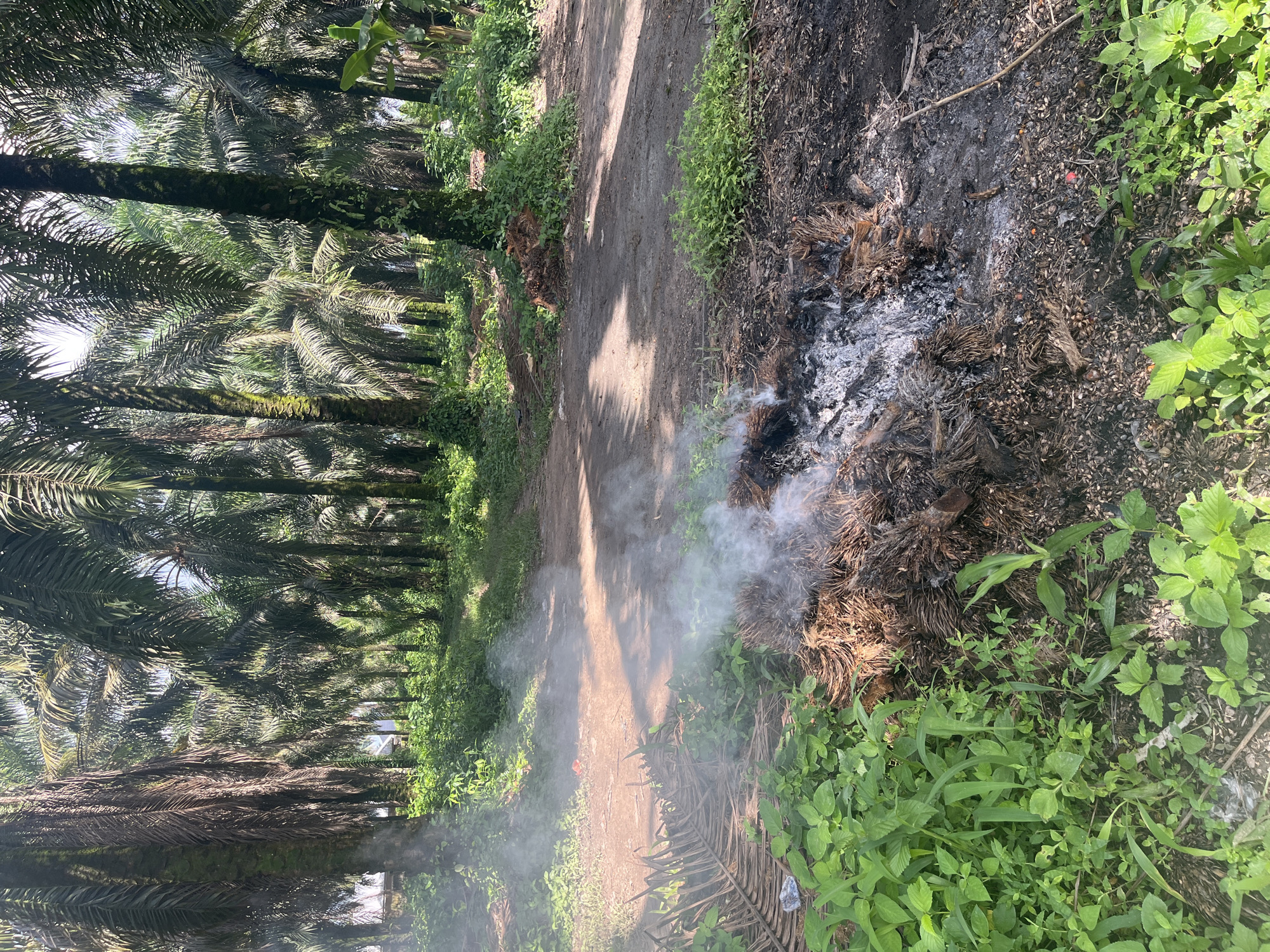
The image depicts an outdoor scene in Aghalokpe, Nigeria, set within what appears to be a palm oil plantation or a similar agricultural area. The scene is oriented vertically, showcasing a dirt path that cuts diagonally across the frame, leading from the lower-left/center towards the upper-right. To the left of the path, a dense and extensive grove of palm trees stands tall, stretching into the distance. Their fronds, a mix of vibrant green and some drier brown hues, create a thick, verdant canopy. Sunlight pierces through the leaves, casting strong patterns of light and shadow on the tree trunks and the ground. On the right side of the path, particularly in the foreground and lower-right quadrant, there is a visible area of recent burning. A pile of charred organic material, likely dried palm fronds or other agricultural waste, is actively smoldering, emitting a distinct plume of white smoke that drifts across the path. The ground around this burning material is covered in black ash, burnt debris, and dark earth, contrasting with patches of bright green ground cover and weeds that grow along the path's edge. The dirt path itself is unpaved and appears well-trodden. Sections of it are brightly illuminated by direct sunlight, while others are in shadow. The primary activity taking place is the burning of agricultural waste, suggesting land clearing or debris disposal. The time of day is clearly daytime, characterized by bright sunlight and visible shadows, indicating clear weather. No people are visible in the image, and there is no discernible text.
Aghalokpe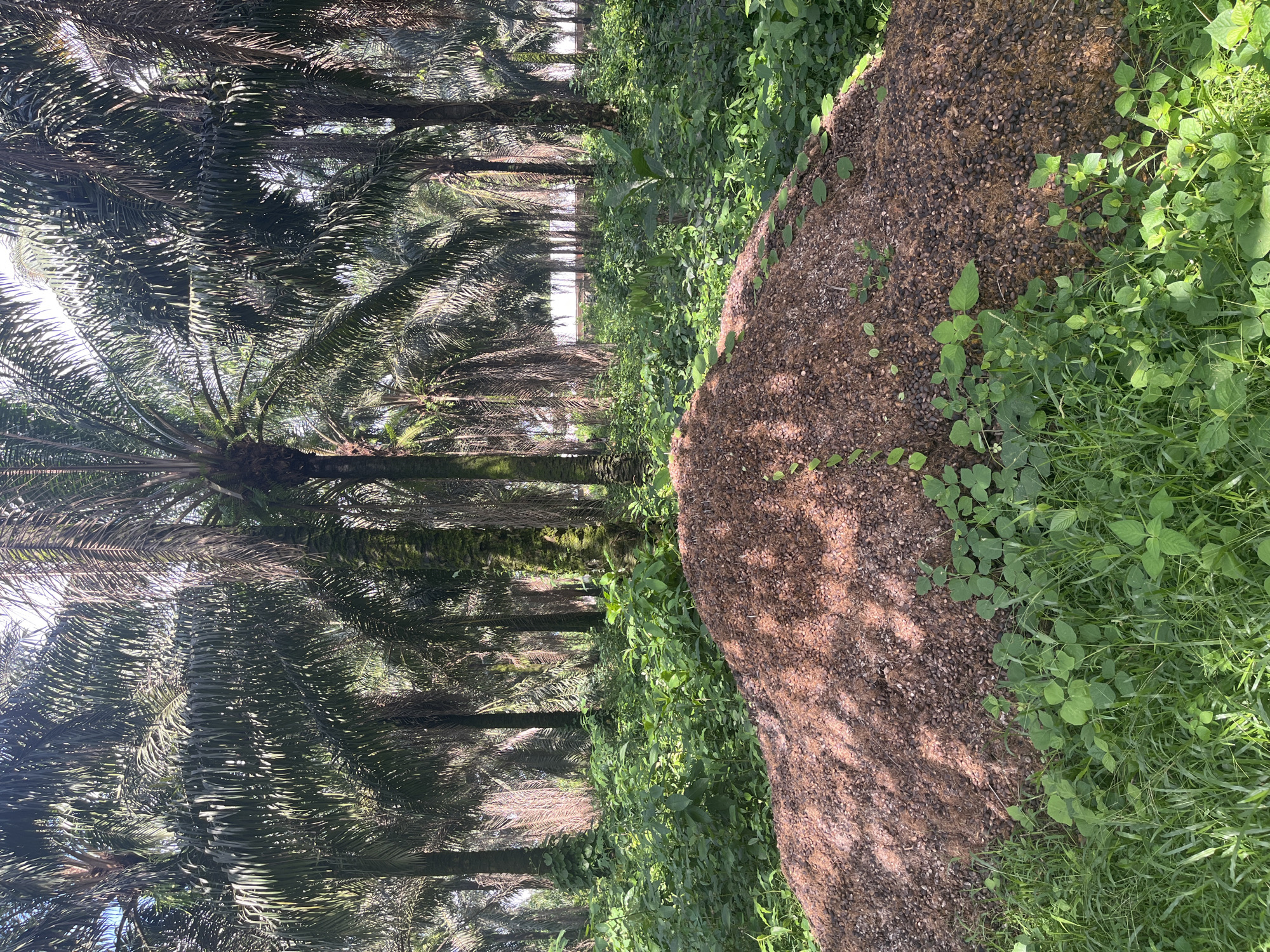
The image displays a sunny palm plantation located in Aghalokpe, Nigeria. Tall, mature palm trees with dense, dark green fronds form neat rows that extend into the background, their trunks providing a vertical structure. Sunlight filters brightly through the leafy canopy, casting dappled patterns of light and shadow across the scene. In the foreground, a prominent, curved mound of reddish-brown, granular material stretches diagonally across the frame. This mound appears to be covered in small, newly sprouted green plants, suggesting it could be composed of soil, compost, or processed palm byproduct. Adjacent to and around the mound, the ground is covered with lush green vegetation, including various grasses and broad-leafed plants. No people or specific activities are visible, but the organized rows of trees and the maintained ground cover indicate an active agricultural setting. The strong lighting and clear shadows suggest it is daytime under bright, sunny weather conditions. There is no visible text in the image.
Aghalokpe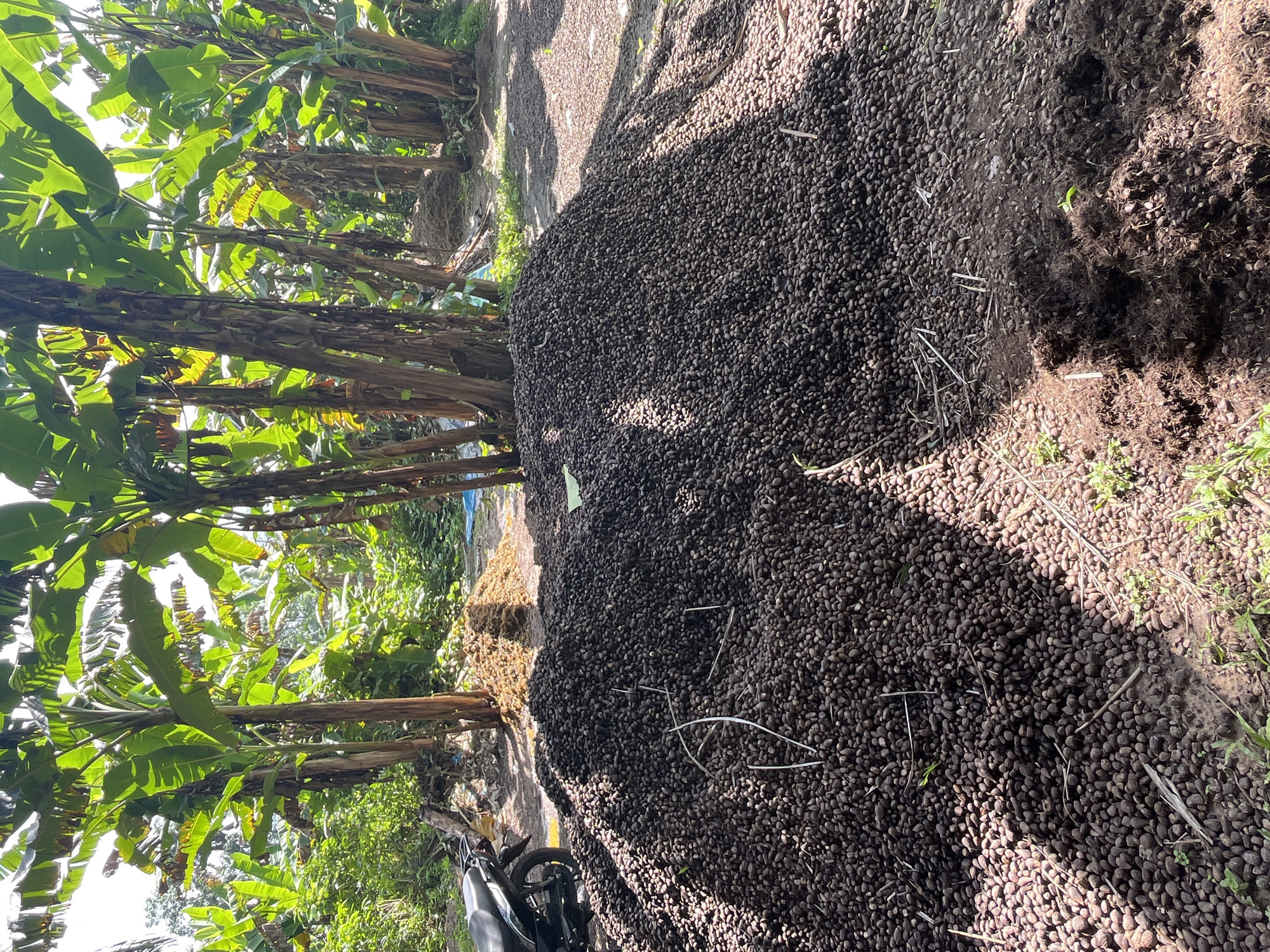
This image captures an outdoor agricultural scene, likely in Aghalokpe, Nigeria, dominated by a very large, dark pile of small, oval-shaped objects spread across the ground. These objects strongly resemble palm kernels or similar harvested produce, suggesting an active processing or drying area. The pile extends from the foreground into the midground, with strong sunlight illuminating parts of it and casting distinct shadows from nearby trees. In the background and along the left side of the frame, numerous banana trees or similar large-leafed tropical plants are visible, creating a lush, green environment. Their tall, slender trunks and broad leaves are well-lit by the bright daytime sun, which filters through the foliage. The ground beneath the pile and around the trees is dirt, with some scattered dry plant material and sparse green sprouts. A small section of a vehicle, possibly a motorcycle or scooter, can be seen in the bottom left corner of the image. The scene suggests a busy agricultural period, possibly harvesting and drying produce in a tropical climate. No people or discernible text are visible. The bright sunlight indicates it is daytime, likely morning or afternoon.
Aghalokpe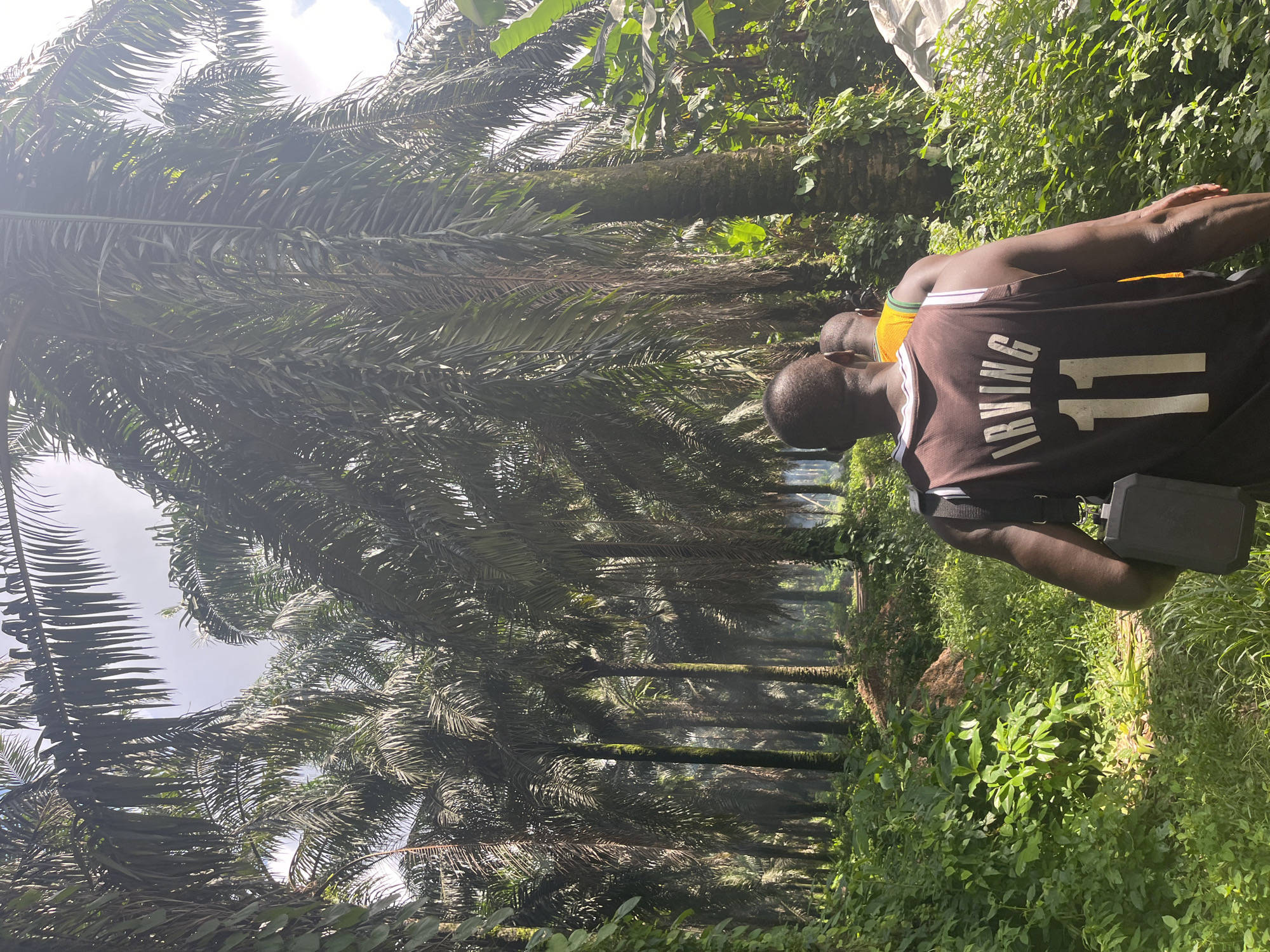
The image captures two individuals walking through a vibrant palm oil plantation in Aghalokpe, Nigeria, on a bright, sunny day. The scene is dominated by numerous tall palm trees with dark green fronds, appearing to be arranged in rows, indicative of a cultivated plantation. Sunlight filters through the dense canopy, creating bright highlights on the leaves and illuminating parts of the undergrowth. In the foreground, an individual is seen from behind, wearing a dark brown sleeveless jersey. The back of the jersey clearly displays the name "IRVING" and the number "11" in white text. A black, rectangular device is strapped to the person's right side. Slightly behind and to the left, another person is partially visible, also viewed from the back, wearing a yellow or green top. The ground and the sides of the path are covered in rich, lush green undergrowth, with various plants and vines adding to the dense tropical environment. Patches of bright sky are visible through the gaps in the tree canopy, confirming it is daytime with clear weather. The overall impression is one of activity within a verdant, agricultural landscape typical of palm oil production.
Aghalokpe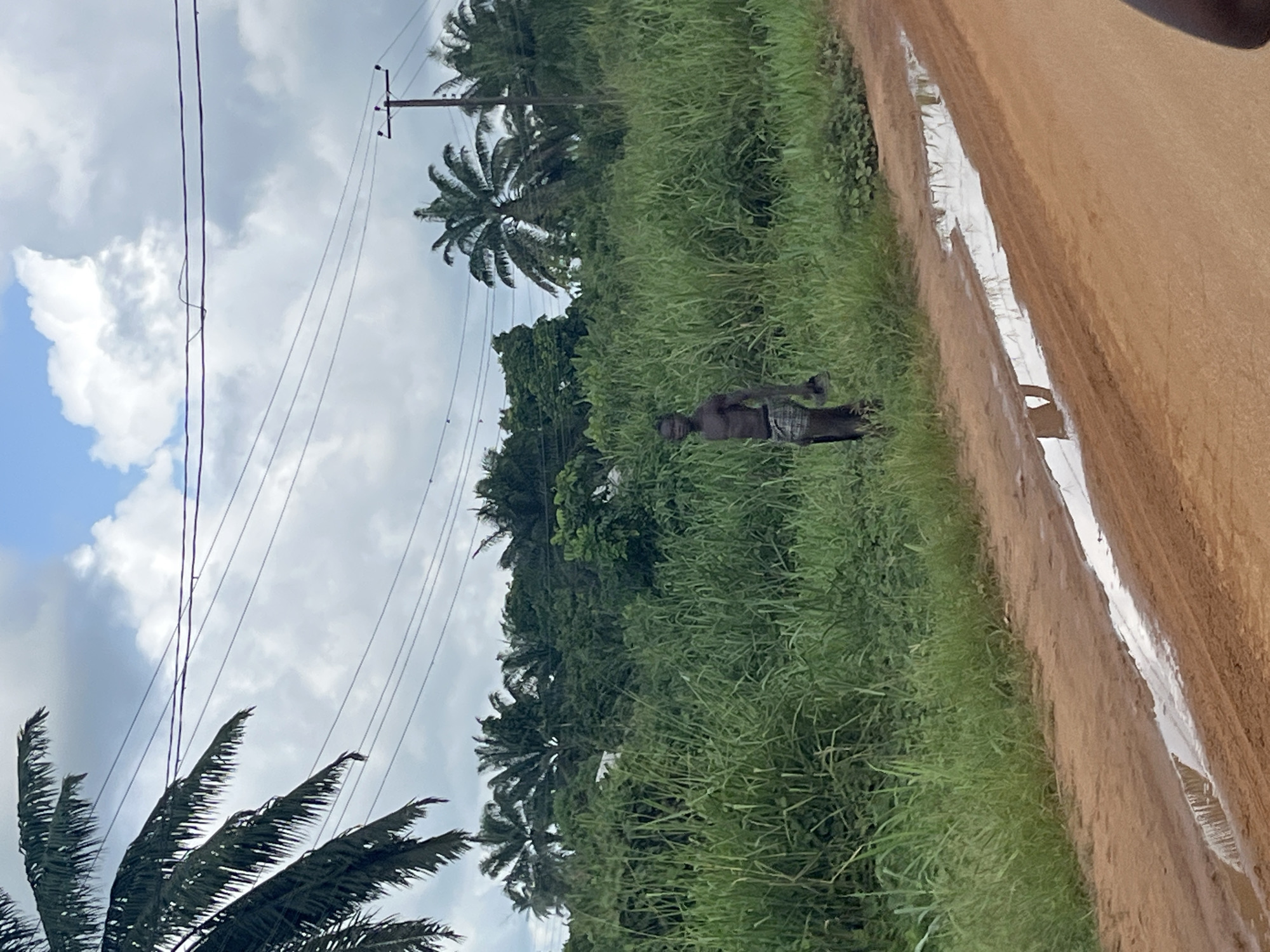
This image captures a daytime scene in a rural or semi-rural environment, consistent with Aghalokpe, Nigeria. The photograph appears to be rotated 90 degrees counter-clockwise. In the mid-ground, a person, likely male, stands partially obscured by tall, dense green grass. He has dark skin, is shirtless, and wears dark shorts or a wrap around his lower body. His left arm is slightly raised, but his exact activity or what he might be holding is unclear. To the right of the person and the grass, a wide, reddish-brown dirt road runs horizontally across the frame. Along the edge of the road, a long, reflective puddle of water or a wet patch is visible, suggesting recent rainfall. The background is filled with lush tropical vegetation, including numerous tall palm trees and other dense green trees, indicative of a warm climate. Above the treeline and across the sky, several utility poles with multiple power lines stretch. The sky is largely overcast with large, fluffy white and gray clouds, though some patches of blue sky are visible, indicating a cloudy but bright day. There is no visible text within the image.
Aghalokpe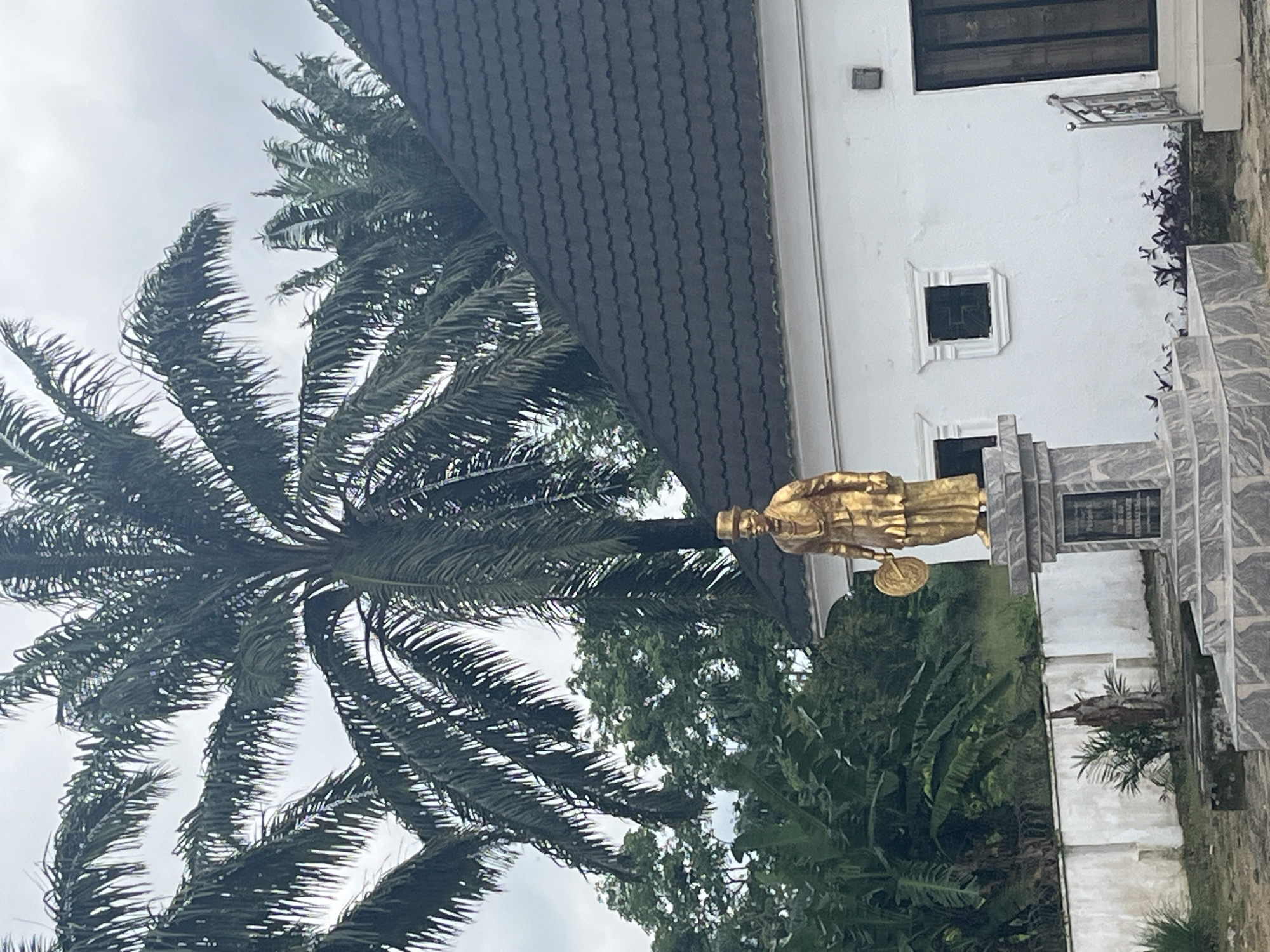
The image, oriented correctly, displays a prominent golden statue positioned centrally. The figure, likely male, is depicted in elaborate traditional attire, including a distinctive hat, and holds a circular object, possibly a ceremonial plate or fan, in their left hand. The statue rests upon a multi-tiered pedestal constructed from grey, patterned stone. A dark plaque is embedded in the front of the pedestal, containing several lines of white text that are not legible due to resolution and distance. To the left of the statue, a large palm tree with numerous green fronds dominates the foreground, its leaves extending towards an overcast, grey sky. Behind the statue and continuing to the left, dense tropical vegetation, including various green trees and large-leaved plants, forms a lush background. On the right side of the image, a white building with a dark, possibly tiled or corrugated, roof is visible. The building features two dark-framed windows: a larger rectangular one at the top and a smaller square one below it, accented by a prominent white decorative trim. Below the smaller window, near the building's foundation, are small plants with dark purple foliage. The ground around the monument and building appears to be a mix of concrete or paved surfaces and natural earth. The scene is a static outdoor shot captured during daytime under an overcast sky, presenting a cultural monument in a tropical environment. The location is Aghalokpe, Nigeria. No specific activity or event is taking place, and no emotions are discernible.
Aghalokpe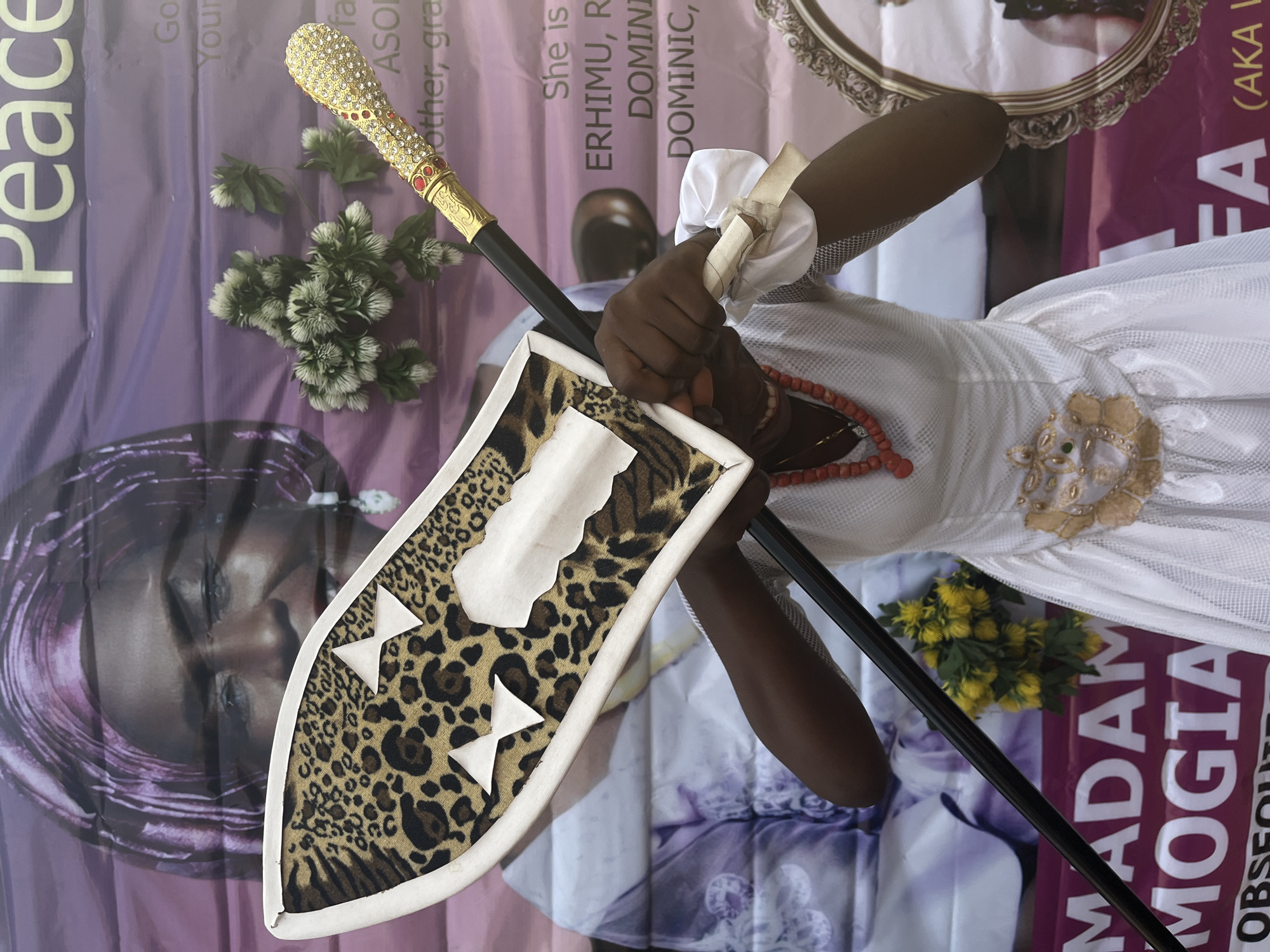
The image presents a close-up view of a person holding ceremonial items against a vibrant banner backdrop. The individual, dressed in a white garment with a sheer overlay and golden embroidery, wears an orange beaded necklace. Their hands are adorned with white ruffled wrist wraps. They firmly grasp a long, dark staff featuring an ornate golden handle intricately embellished with jewels. In the other hand, they hold a shield covered in a distinctive leopard print fabric, accented with white trim and appliqued white bow-tie and cloud-like shapes. The background is a large purple and pink banner or poster, indicating a special event. Visible text on the banner includes "Peace," "Mother, gra" (likely "grandmother"), "She is," "ERHIMU," "DOMINIC," "MADAM MOGIA," and "OBSEQUIAE," strongly suggesting a memorial service or funeral. A large, sideways portrait of a woman wearing a headwrap is printed on the banner, likely the deceased "Madam Mogia." A part of an ornate gold picture frame is also visible on the banner. Small clusters of artificial flowers, light green/white and yellow, are placed around the scene. The setting appears to be an indoor or sheltered outdoor event in Aghalokpe, Nigeria, during the daytime, filled with cultural and symbolic elements for a solemn commemoration.
Aghalokpe
A high-angle, portrait-oriented selfie shows a young Black woman smiling broadly, with the image rotated 90 degrees clockwise as if she is lying on artificial grass. Her dark, braided hair is adorned with white, flower-like ornaments placed near her ears. She has a radiant, wide smile revealing her teeth, and multiple nose piercings: two studs on her right nostril and one on her left. She is dressed in a light pink, long-sleeved top or dress made of delicate lace fabric with a distinct pattern. A gold-colored chain necklace is visible around her neck. A dark, rectangular object, possibly a phone or power bank, is tucked into her lap, connected by a white cable. Her right foot, wearing a sandal with the partially visible text "GUCC", is seen towards the bottom right. The background is dominated by vibrant green artificial turf, with a few dry straw strands scattered on it. Parts of a brown or orange-colored chair are visible beneath her, suggesting she is seated. The bright, clear lighting indicates it is daytime, and her expression conveys joy and happiness. The setting is Aghalokpe, Nigeria.
Aghalokpe
An outdoor portrait features a person, likely a woman, with dark skin, wearing a pink dress adorned with intricate lace patterns. A prominent gold chain necklace is visible around her neck. Her hair or headwear is characterized by numerous thick, white, yarn-like strands that frame and partially obscure her face. Her eyes appear to be closed or looking downward, and she has a nose piercing. A small, white decorative item, possibly a flower, is tucked near her shoulder. The background shows natural elements, including green grass and patches of dirt, suggesting an outdoor location. A small green plastic chair is visible further back in the scene. The lighting indicates daylight conditions. The person seems to be posing for the photograph in a casual setting. No text is visible in the image. The location is Aghalokpe, Nigeria.
Aghalokpe

A close-up, portrait-style photograph, rotated 90 degrees counter-clockwise, depicts a dark-skinned person, likely a woman, outdoors in Aghalokpe, Nigeria. The upper left portion of the frame is dominated by a large, dense arrangement of white fringes, resembling thick yarn or thread, which partially obscures the person's face, covering her forehead and left eye. The person wears a pink lace top or dress with an intricate, open-work pattern. Her hair appears to be styled in dark braids, and a white, rose-shaped decorative element is visible near her right ear. A gold chain necklace adorns her neck. Her expression is neutral, and her gaze is directed slightly downwards. The background elements are mostly out of focus. In the upper left, a corrugated metal roof is visible beneath a bright, overcast sky. Below the person's chin and to the right, green grass and foliage are present. Further back, colorful plastic chairs (blue, green, red) and a reddish-brown wall or building are indistinctly visible. The scene is set during the daytime, under soft, diffused lighting. No text is visible in the image.
Aghalokpe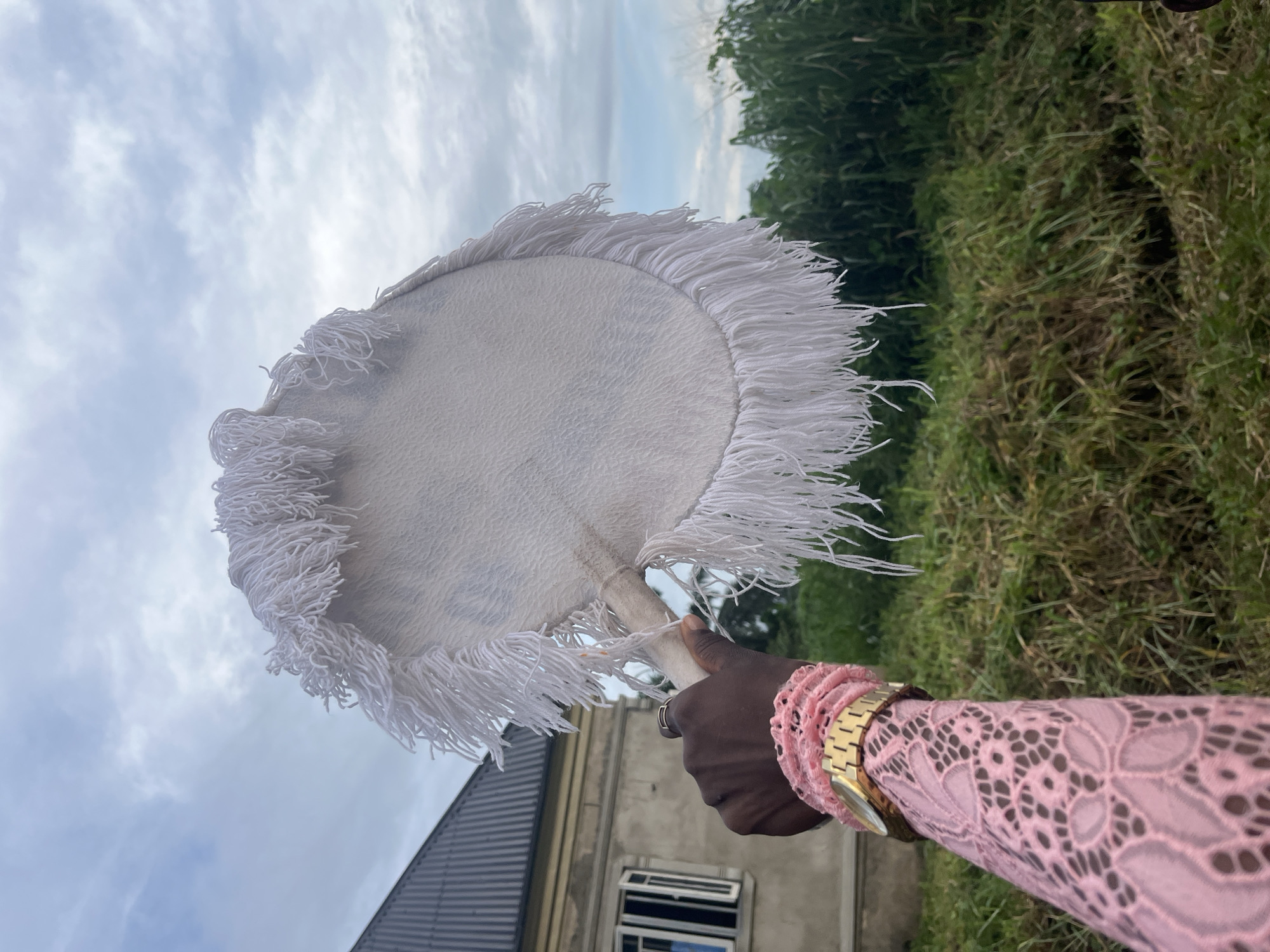
A vertically oriented outdoor photograph captures a dark-skinned hand holding a round, white hand fan against a natural backdrop in Aghalokpe, Nigeria. The fan, serving as the central subject, features a solid white circular surface with long, white, thick fringe details along its entire circumference. The hand grips a light-colored, possibly wooden, handle at the bottom of the fan. The person's arm, adorned with a light pink long-sleeved garment, extends from the right side of the frame. The sleeve is made of a fabric with an intricate lace or cut-out floral pattern, revealing hints of skin underneath. On the wrist, a gold-toned watch with a classic metal link band is visible, alongside multiple stacked pink bracelets, possibly made of beads or crochet. The background presents a cloudy sky, suggesting it is daytime, possibly overcast or late afternoon. Below the sky, lush green grass and dense green foliage are visible, indicating an outdoor, natural environment. To the left, parts of a building can be seen, featuring a dark grey sloped roof and light-colored walls with a window. The overall setting implies a scene from a rural or suburban area in Nigeria. No discernible text is visible in the image.
Aghalokpe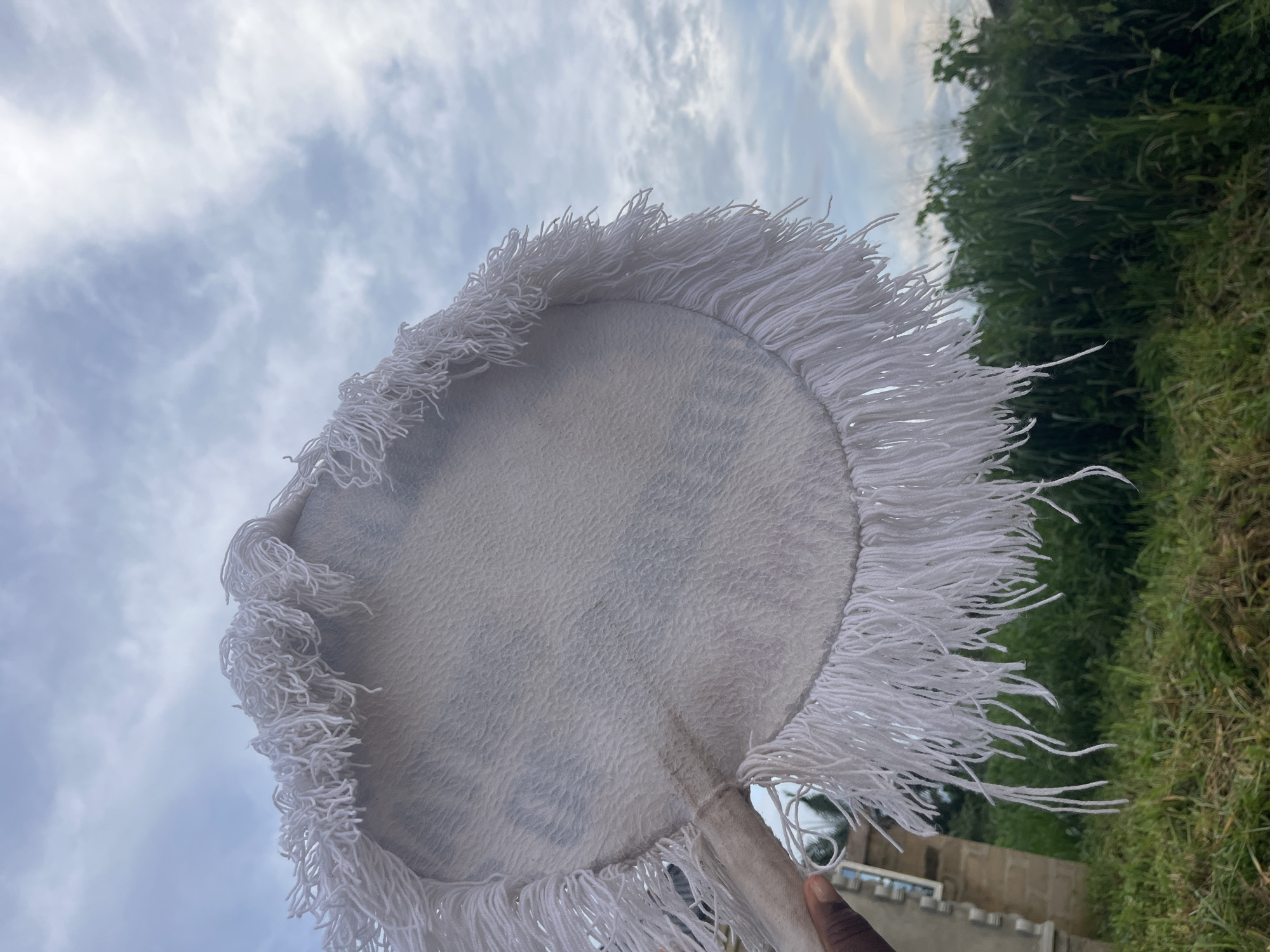
The image, taken in Aghalokpe, Nigeria, features a large, circular textile object, predominantly white with a dense, long white fringe around its entire perimeter. The object appears to be a ceremonial fan or a decorative hand fan, as a fabric-wrapped handle is visible at its base. A hand with dark skin is seen in the lower right corner, holding this handle, positioning the object upwards against the sky and natural surroundings. The main surface of the white textile has a textured appearance and shows faint, light grey or blue patterning that is not discernible as specific text or symbols. The background reveals an outdoor setting on what appears to be a cloudy day, providing soft, diffused lighting. The upper and left portions of the background show a light blue sky with scattered white clouds. The right and lower parts of the background are filled with lush, green vegetation, consistent with tall grass or dense bushes. A small section of a concrete building structure is also visible near the bottom right, behind the foliage. The perspective of the photograph looks upwards, emphasizing the fringed object against the natural backdrop. No specific activity beyond holding the object is depicted, and no emotions are discernible.
Aghalokpe
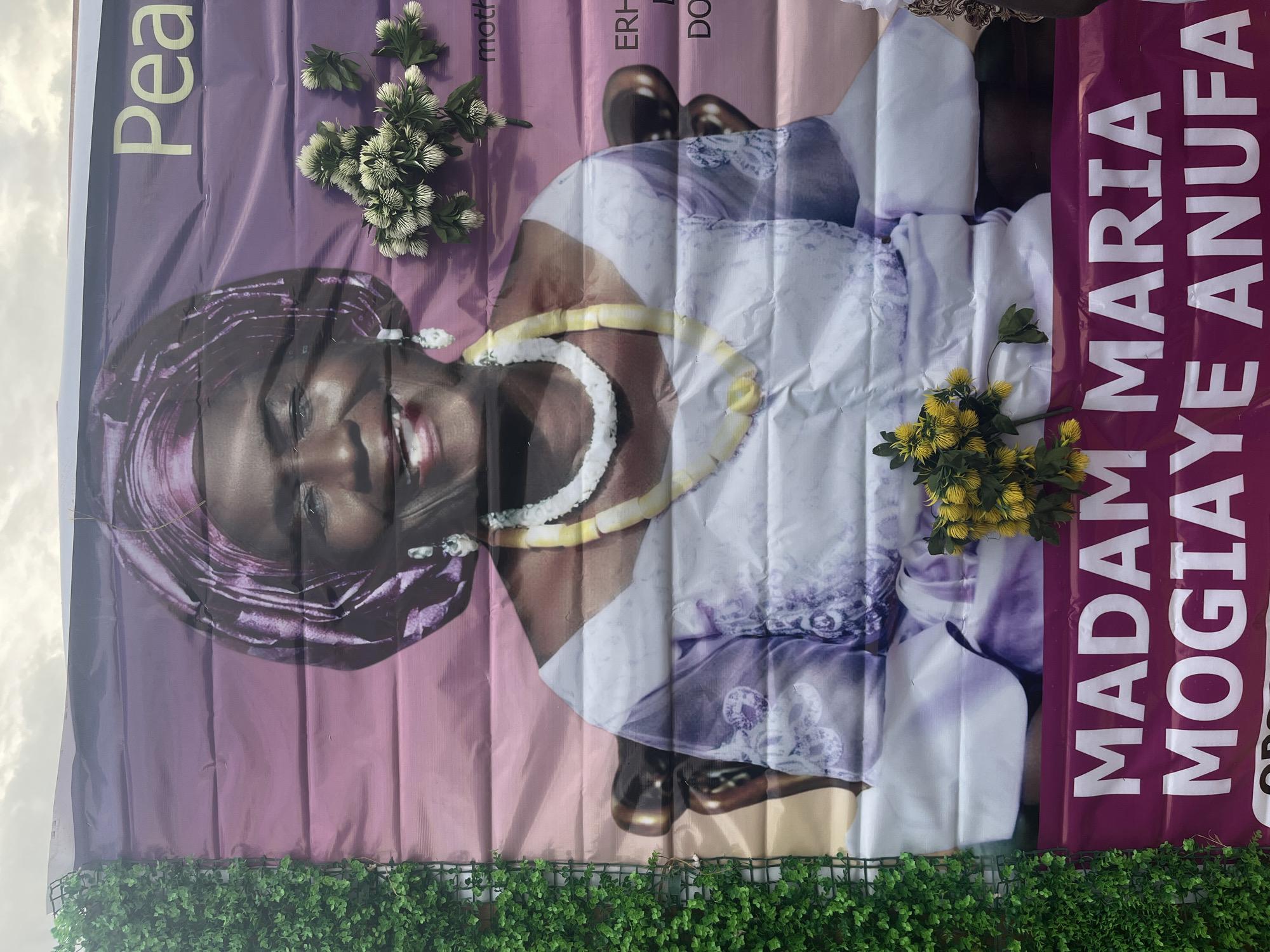
A large, creased banner, oriented vertically, dominates the frame, featuring the vibrant image of a smiling woman. The woman, depicted from the waist up, wears a purple headtie (gele) and traditional attire, adorned with a white and yellow beaded necklace and earrings. Her expression is warm and welcoming. The banner is a commemorative piece, indicated by the visible text and decorative elements. To the top left, the word "Peace" is partially visible in a large, light-colored font. Further down, other partial words like "moth" (likely "mother"), "ERH", and "DO" (likely "daughter") can be seen. A prominent dark red strip on the right side of the banner displays the full name "MADAM MARIA MOGIAYE ANUFA" in bold white capital letters. Attached to the banner are artificial flower arrangements: a cluster of white and green flowers near the top left, and a bunch of yellow flowers towards the bottom right. The bottom edge of the banner is lined with a strip of artificial green foliage, resembling a hedge. Above the banner, a cloudy daytime sky is visible, suggesting an outdoor setting. The creases in the banner material indicate it is made of a flexible fabric like vinyl, and has likely been rolled or folded. The overall presentation suggests a memorial service, funeral, or celebration of life for Madam Maria Mogiaye Anufa in Aghalokpe, Nigeria.
Aghalokpe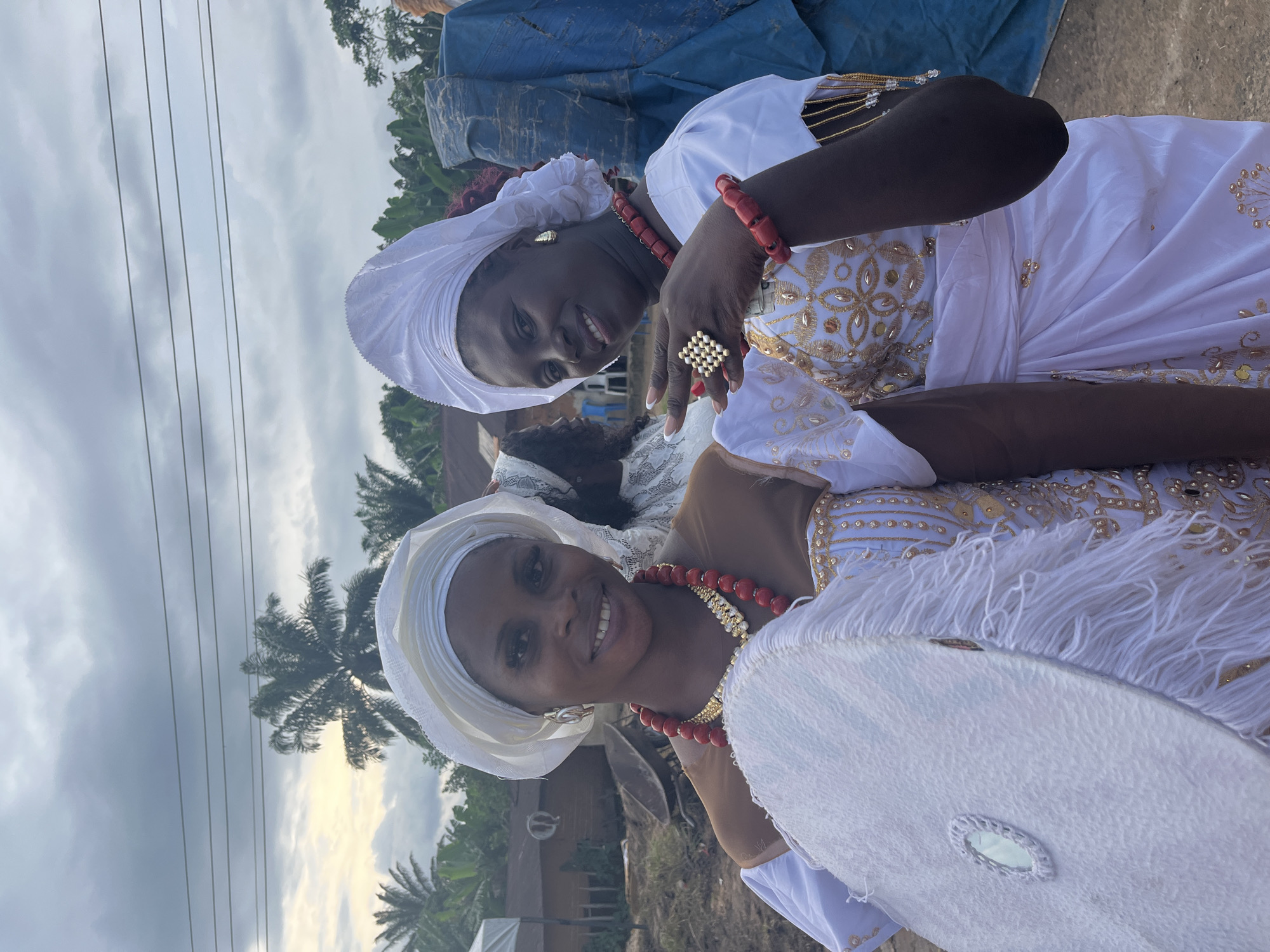
This image captures two women in traditional attire, smiling and posing for a photograph outdoors in Aghalokpe, Nigeria. Both subjects are dressed in elegant white garments, featuring intricately embroidered gold patterns on their dresses and matching white headwraps (gele). The woman in the foreground wears a multi-strand red coral bead necklace with gold details, a red coral bead bracelet, and a prominent square-patterned ring on her right hand. She holds a large, round white accessory, possibly a feathered fan or ceremonial object, which has white fringes around its edge and a small mirror embedded in its center. The woman positioned slightly behind her is similarly adorned with a red coral bead necklace and bracelet, and a large ring. Both women are smiling broadly, conveying a sense of happiness and warmth. The setting appears to be an outdoor gathering or celebration, possibly under an overcast sky, as indicated by the cloudy background. Tall palm trees are visible in the distance, characteristic of the tropical landscape in Nigeria. Power lines traverse the upper portion of the sky, suggesting an area with some infrastructure. The lighting suggests it is daytime, possibly late afternoon given the soft quality of light. No discernible text is visible.
Aghalokpe
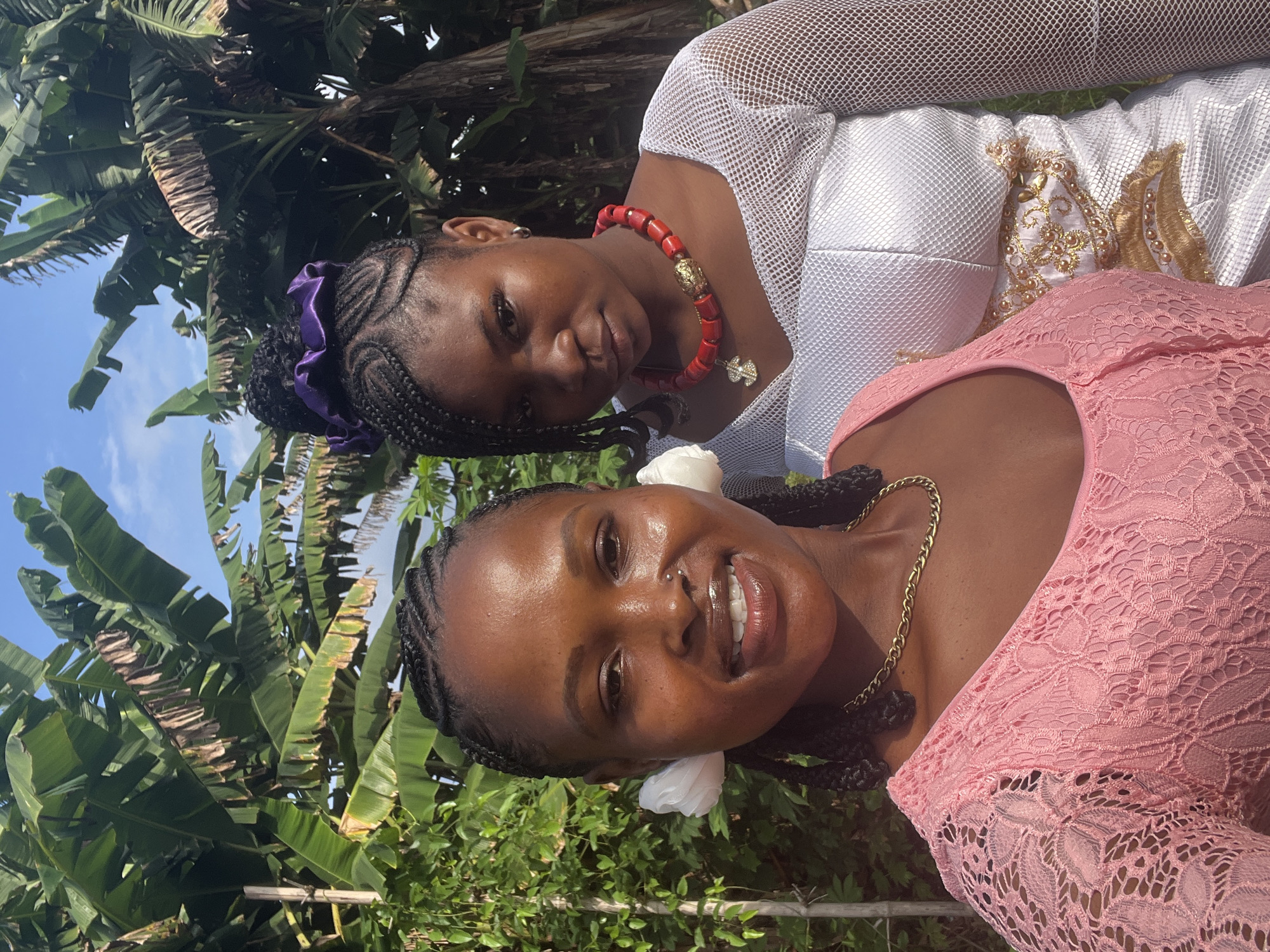
This outdoor portrait features two young Black women posing against a backdrop of lush green foliage and a clear blue sky, likely in Aghalokpe, Nigeria. The scene is brightly lit by natural sunlight, indicating daytime. In the foreground, a woman with braided hair smiles warmly at the camera. She wears a pink lace top with long sleeves and a prominent gold chain necklace. She has a small stud nose piercing and appears to have light makeup on. Behind and slightly to her left, the second woman looks directly at the viewer with a serene expression. Her braided hair is pulled back, held by a purple scrunchie. She wears a striking red beaded necklace adorned with a gold cylindrical bead and a small gold charm. Her attire consists of a white garment, possibly a top or dress, featuring a mesh-like texture and elaborate gold embroidery over the chest area. The background is dominated by large, vibrant green leaves, characteristic of banana plants, with other dense greenery below. The clear blue sky with a few wispy clouds completes the natural setting. The women appear to be enjoying the sunny weather. No visible text is present in the image.
Aghalokpe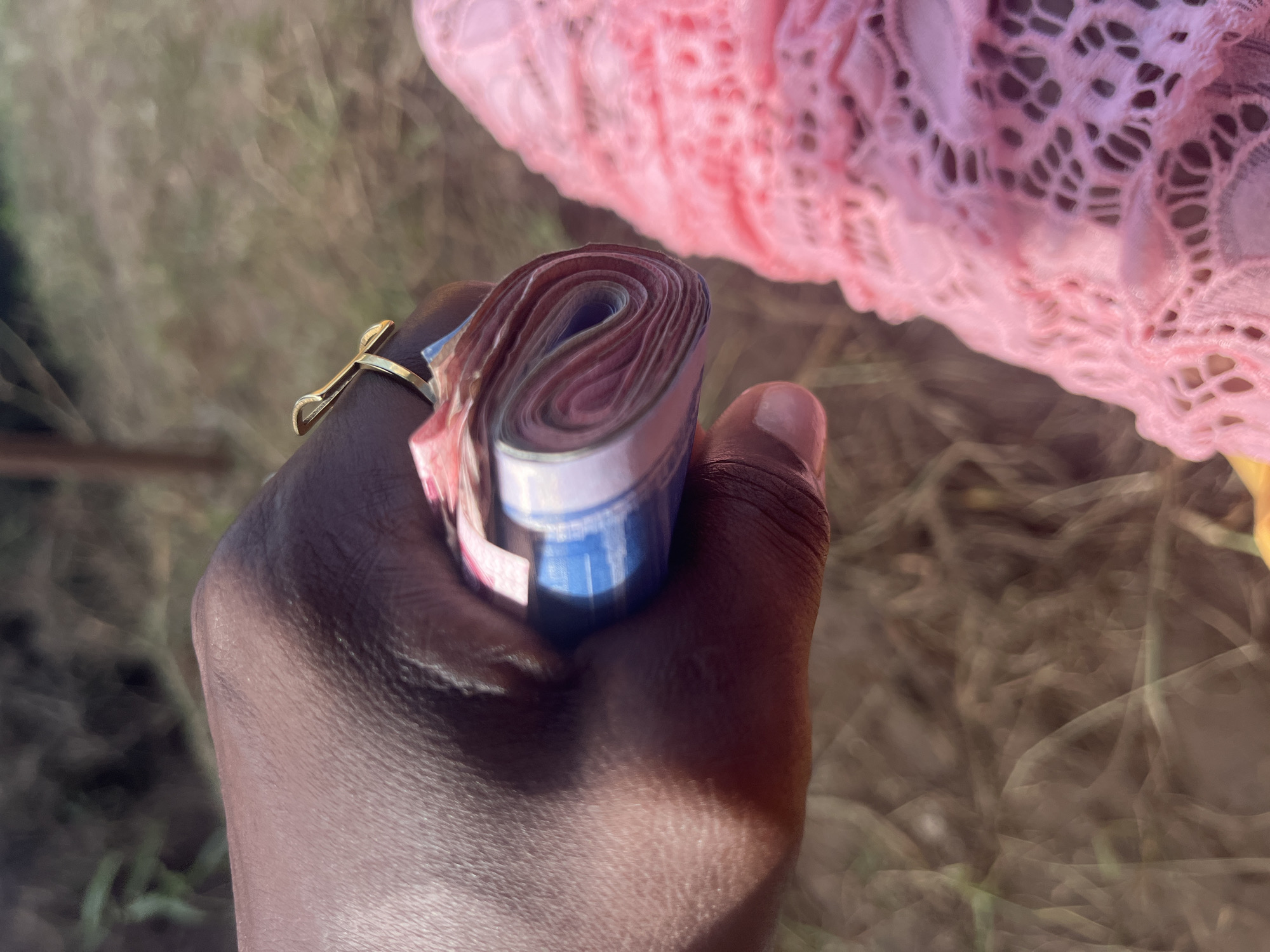
The image presents a close-up, high-angle view of a person's hand holding a substantial roll of banknotes, set outdoors in Aghalokpe, Nigeria. The main subject is a person's hand, characterized by its dark skin tone. A distinctive gold-colored ring, featuring a cross-like design, is worn on one of the fingers. The hand is firmly grasping a thick bundle of currency, rolled tightly into a cylindrical shape. While specific denominations or text on the banknotes are not discernible due to their rolled state and partial blur, colors such as blue, red, and purple are visible on the edges. In the upper right background, a soft pink, lacy fabric with an intricate, open-work pattern is partially visible. This fabric appears to be part of clothing or an accessory belonging to another individual or item in the scene. The rest of the background is heavily out of focus, depicting muted tones of green and brown, suggesting an outdoor environment with natural elements like grass or dirt. The scene is illuminated by bright daylight, casting a discernible shadow across the holding hand, indicating sunny weather. The act of holding such a roll of money implies a potential transaction, a display of wealth, or preparation for expenditure. No specific text is visible on the currency, the ring, or the background elements.
Aghalokpe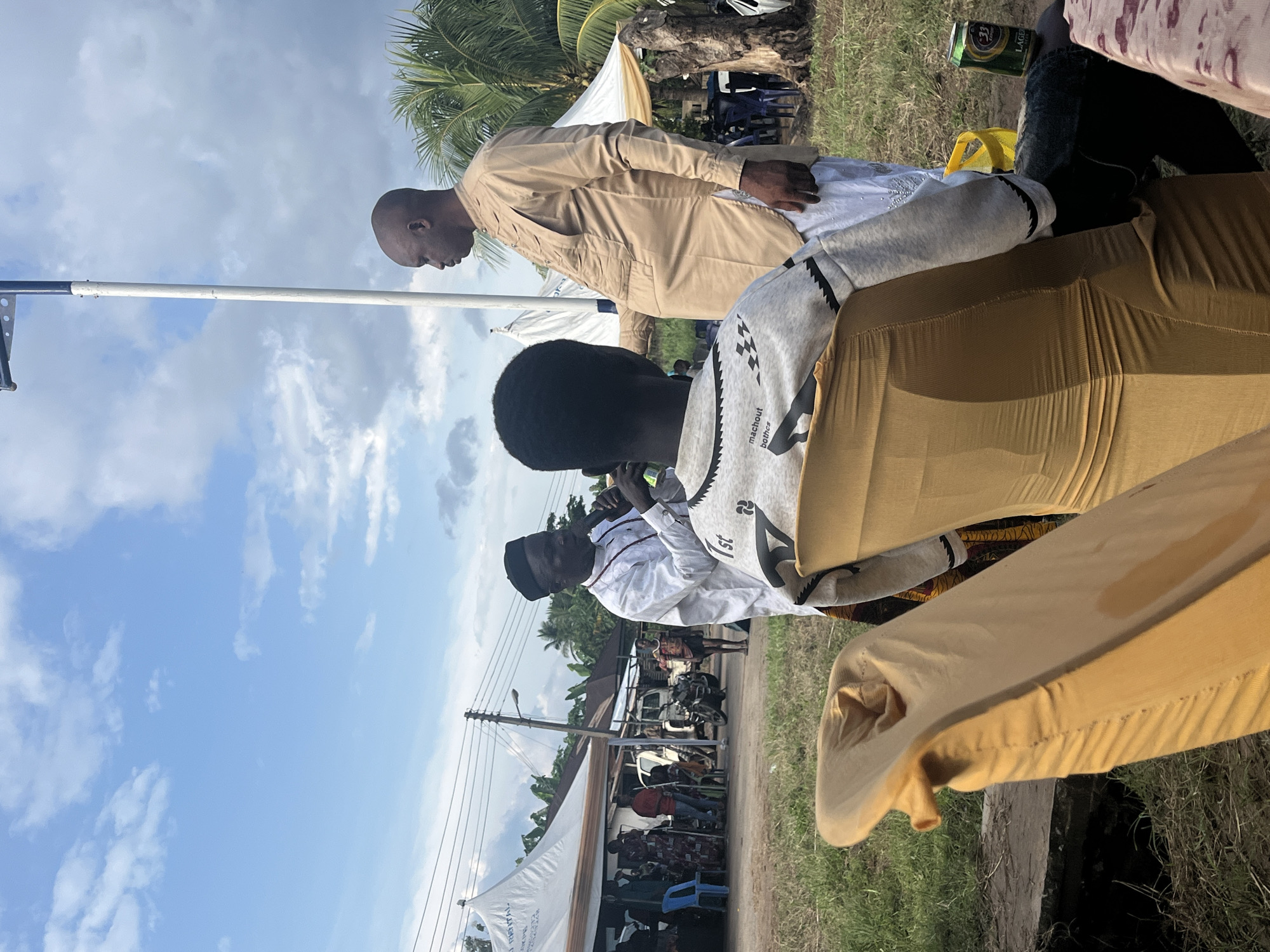
An outdoor community gathering is captured in a portrait-oriented shot, featuring several individuals and event infrastructure under bright daylight. In the immediate foreground, a person's back is visible, draped in a flowing gold-colored garment. Adjacent, another individual is seated, seen from behind, wearing a grey hoodie adorned with black and white geometric patterns, and the text "machout bothcs" and "1st" on the back. Further into the mid-ground, a person wearing a white long-sleeved shirt and a black cap is actively speaking into a microphone. To their left, a man in a tan/light brown traditional garment over white trousers stands, observing the event. The background reveals more attendees seated on blue plastic chairs under white tents. The setting appears to be a rural or semi-urban area, characterized by a dirt and grass ground, lush palm trees, and other green foliage. Utility poles with power lines run along the left side, and a simple building complex with parked motorcycles and a white truck is visible in the distance. The sky is bright blue with scattered white clouds, indicating clear weather. A green "33 LAGER" beer can and a yellow plastic item are on the ground near the seated figures. The overall scene suggests a public address or social event taking place in Aghalokpe, Nigeria.
Aghalokpe