Akola, India
30 memories from Akola, India
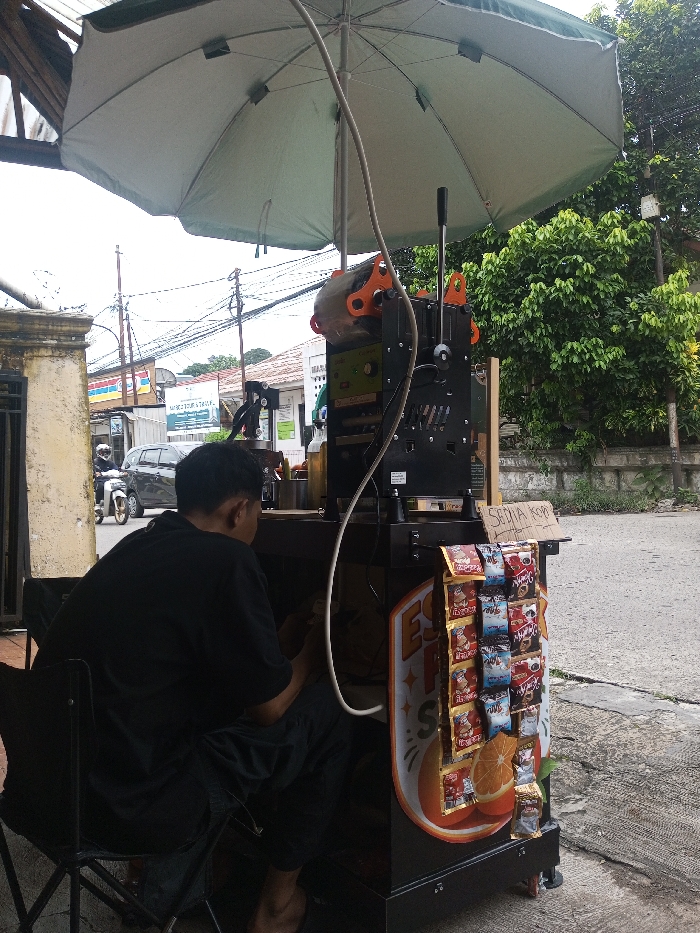
Under a large green umbrella, a man in a black shirt and pants sits at a mobile beverage stand. The stand features a sealing machine, a display of single-serving drink mixes, and an orange graphic. The stand is parked on a sidewalk near a road with visible traffic and buildings. The background includes green trees and power lines.
Akola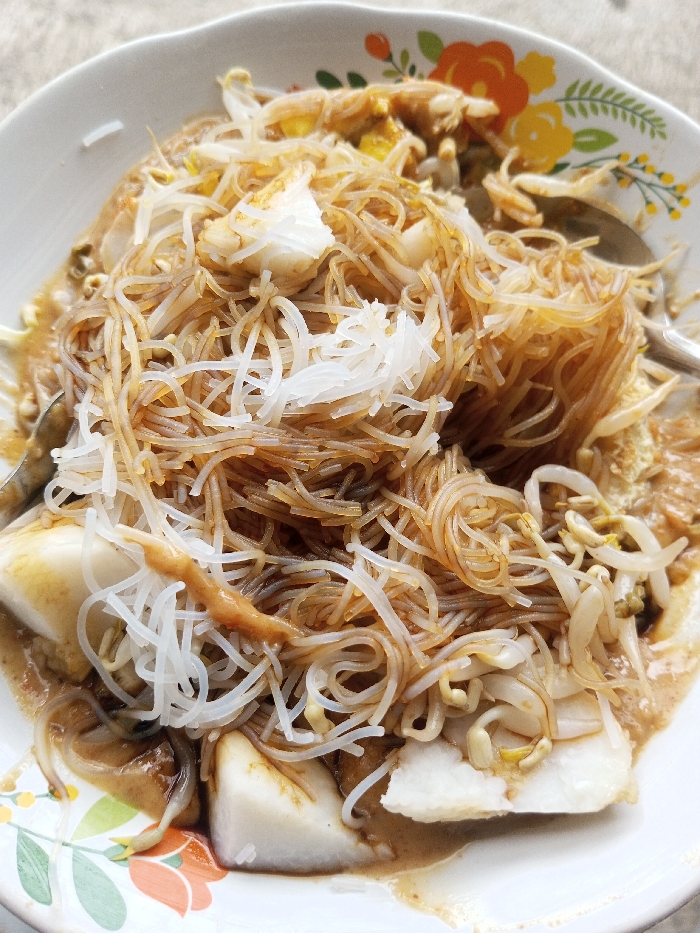
A plate of Indonesian cuisine, likely Ketoprak, features bean sprouts, rice vermicelli noodles, and white tofu cubes. A creamy peanut sauce heavily coats the ingredients, and there is also some thinner white noodle topping. The plate has a floral pattern around the edge with orange, yellow, and green flowers. A silver spoon rests in the dish near the top right.
Akola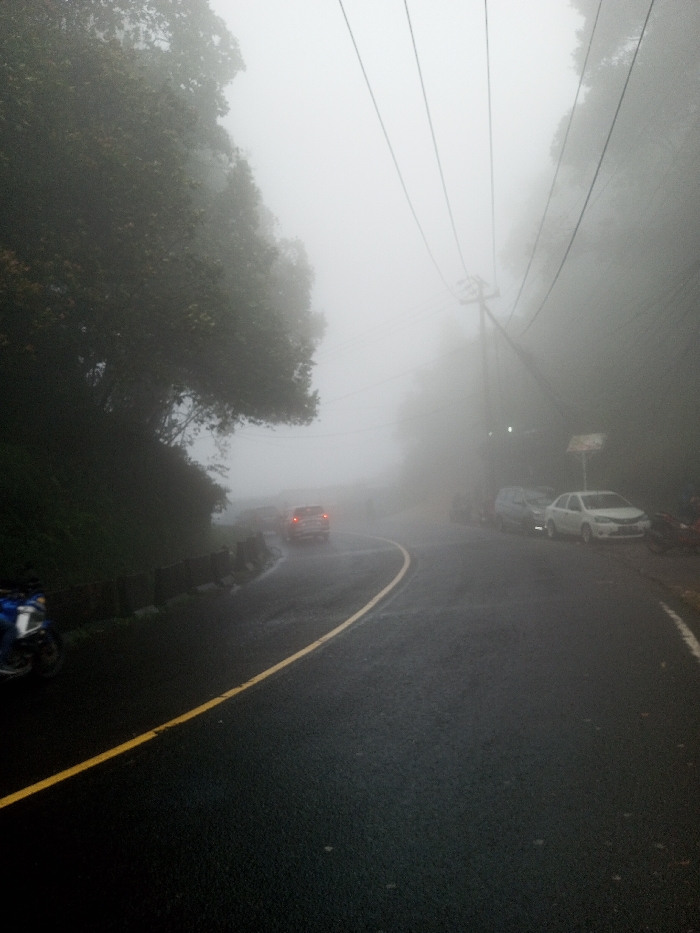
A foggy, winding road is the focus of the image. A yellow line marks the edge of the road, leading around a bend where a vehicle's headlights are visible. Several parked cars are on the roadside. Trees line the left side of the road, disappearing into the fog-laden backdrop. An electrical pole stands amidst the fog with power lines above. A motorcycle is seen on the bottom left.
Akola
The video shows a wet, black paved road shrouded in thick fog. A yellow line divides the road, with green foliage visible on either side. A motorcycle with two occupants travels along the road away from the viewer, followed by a red car and a white van. Visibility is significantly reduced due to the dense fog.
Akola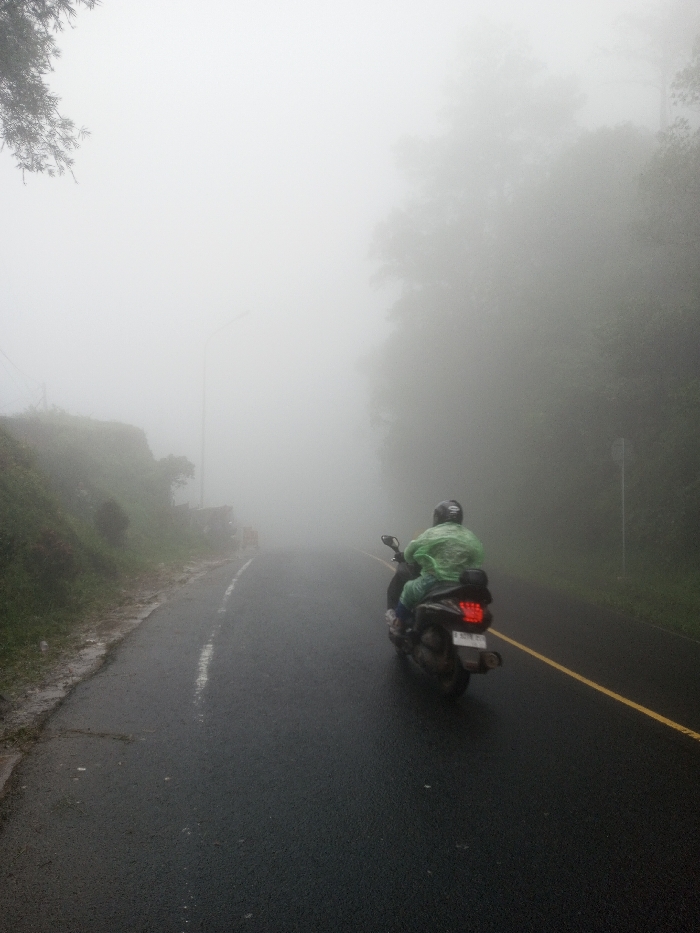
A motorcyclist wearing a green rain poncho navigates a winding road shrouded in dense fog. The asphalt is wet and shiny, reflecting the limited light. A yellow line marks the edge of the road on the right. Lush greenery clings to the hillside on the left, fading into the heavy mist. Visibility is severely restricted, creating an atmosphere of uncertainty and mystery.
Akola
The video depicts a person, appearing to be an older male with short gray hair, squatting next to a white and black scooter. The person is wearing a dark brown long-sleeved shirt, black pants, and dark sandals. They are focused on the area beneath the seat and side panel of the scooter, seemingly working with their hands and possibly a small tool to detach or adjust something. Various tools, including a plier-like tool and a socket wrench, are scattered on the gray and red brick-patterned ground around them. The scooter is parked on the brick surface, with its rear tire visible in the background. The overall environment suggests an outdoor or semi-outdoor workspace, potentially a garage or driveway.
Akola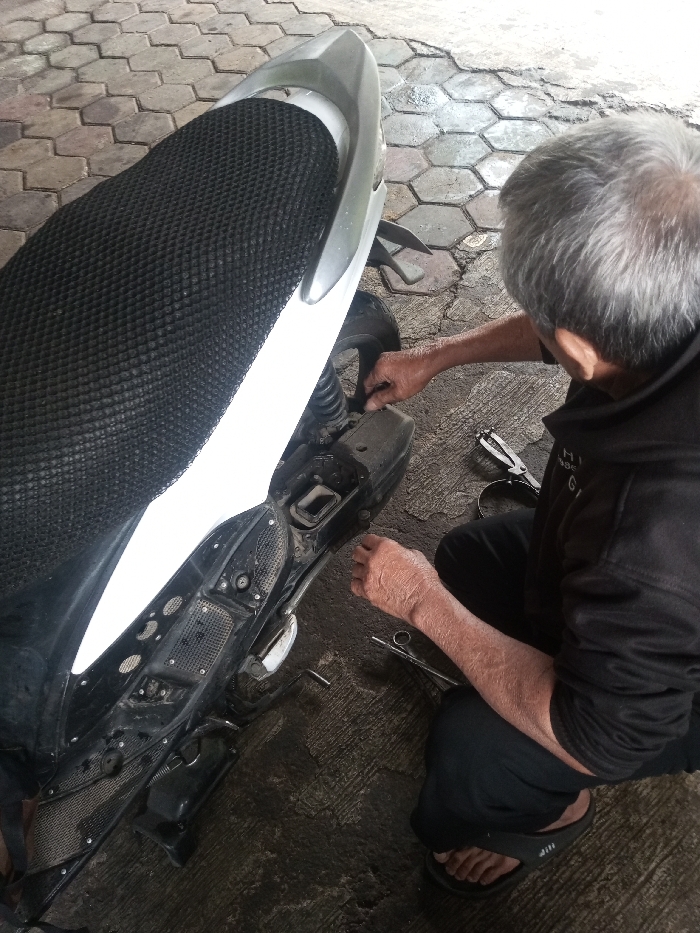
An older man with grey hair kneels beside a disassembled scooter, working on its mechanics. He wears a black hoodie and dark pants with sandals. His hands are engaged near the scooter's rear, with tools like pliers and wrenches scattered around. The scooter's seat is black and the body mostly white and black, resting on a paved surface. The scene conveys a sense of repair or maintenance activity.
Akola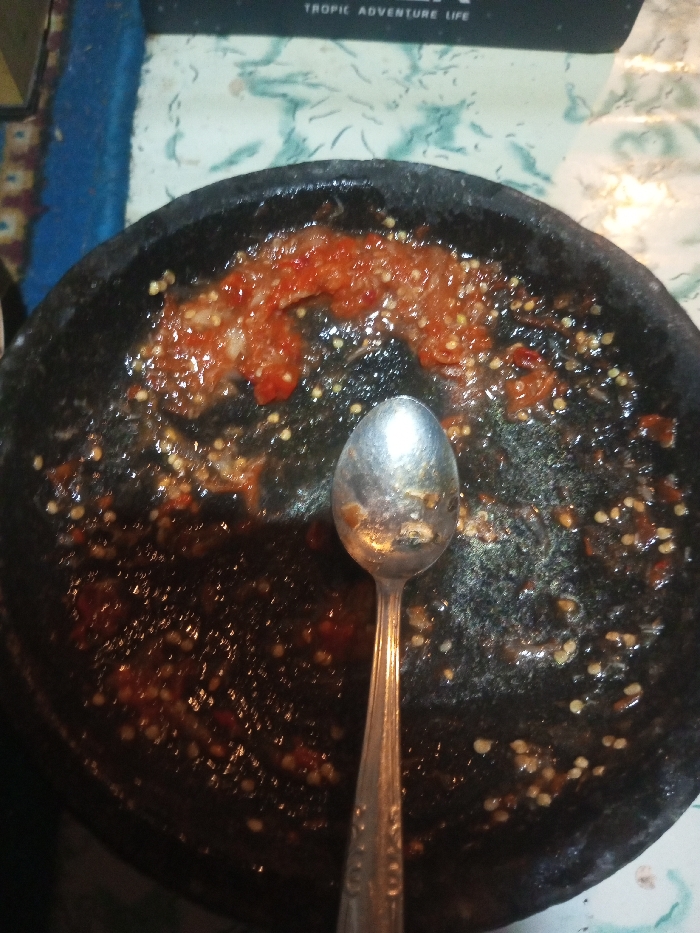
The image presents a close-up, top-down view of a black, circular stone mortar filled with a vibrant red chili paste or chutney. The paste appears glossy and oily, containing numerous small, pale chili seeds and finely chopped pieces, possibly garlic or shallots. It is spread unevenly across the mortar, indicating it has either been freshly ground or partially consumed. A silver metal spoon rests within the mortar, partially submerged in the chili paste, with its handle extending towards the bottom of the frame. Reflections are visible on the spoon's surface. The mortar is placed on a light-colored, possibly white or grey, patterned surface. In the upper left corner, a blue object and a textured, dark patterned fabric are subtly visible. In the background, above the mortar, a dark rectangular object with white text is present. The words "TROPIC ADVENTURE LIFE" are discernible on this object. The lighting appears dim, creating a somewhat intimate setting for the food. The scene strongly suggests the preparation or serving of a spicy condiment, common in Indian cuisine.
Akola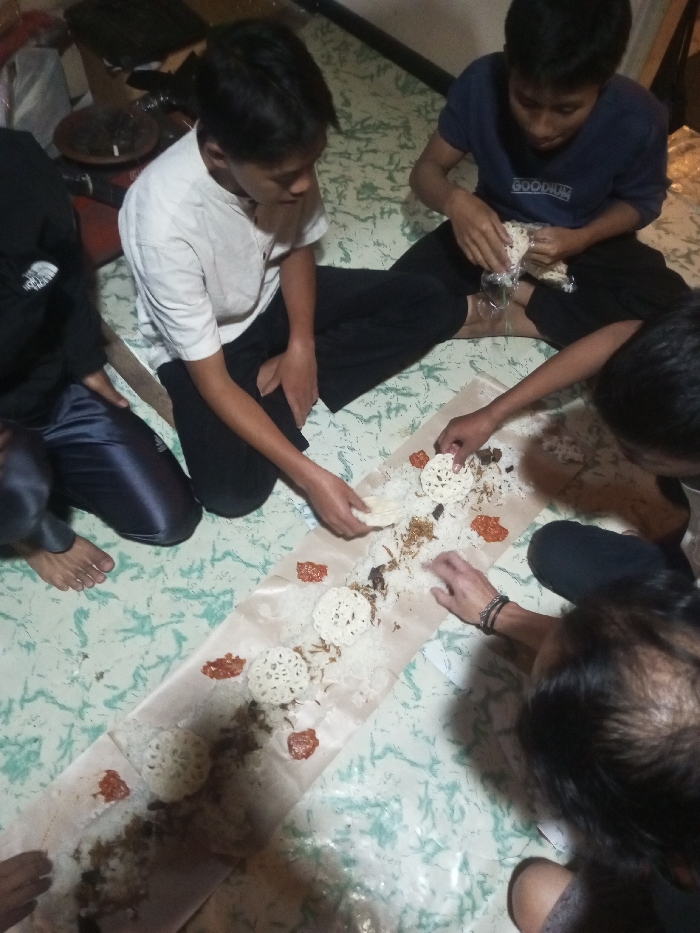
A group of at least five young males is gathered for a communal meal, seated on a patterned linoleum or tiled floor in what appears to be an indoor setting. The lighting is dim, suggesting it might be evening or night. The central focus of the image is a long strip of brown paper, possibly wax paper or banana leaf, laid directly on the floor, serving as a shared platter for the food. Piles of white rice are spread along the paper, interspersed with several round, white, perforated crackers (resembling krupuk or pappadum), dollops of a reddish condiment (likely chili paste or sambal), and portions of other dark, shredded ingredients, possibly fried anchovies or dried meat. The individuals are actively engaged in eating with their hands. One boy, dressed in a white t-shirt and black pants, is reaching for the food. Beside him, another boy in a dark blue t-shirt with "GOODDA" visible text is holding a transparent plastic bag containing more of the white crackers. Other hands are visible reaching into the food spread. One person on the left wears a black long-sleeved top and dark shiny pants, with bare feet visible. Another person on the bottom right has dark hair and a visible wristband. The atmosphere appears informal and focused on the shared meal. In the background, on the left, some household items or clutter are visible, including what looks like a dark, possibly woven, tray or pot. The scene depicts a common tradition of communal dining directly from a shared surface.
Akola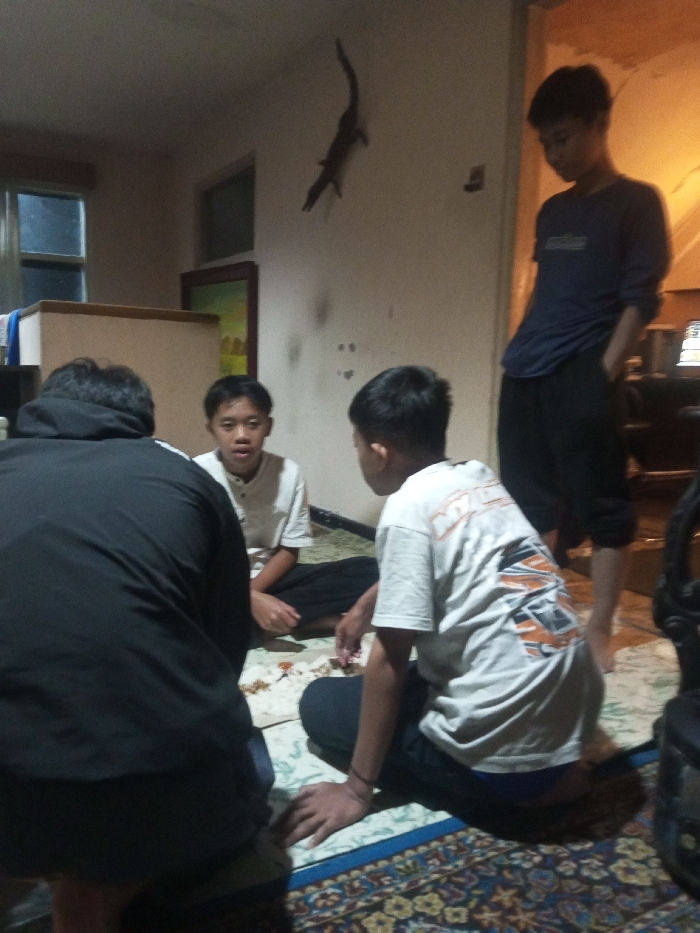
The image depicts an indoor scene with four young males engaged in a casual gathering, likely during an evening or nighttime setting due to the dim lighting. Three of the individuals are seated on the floor around food, possibly rice or grains, spread on a light-colored mat or paper. One boy, seen from the back in a black top, occupies the foreground. Another boy, facing the camera, wears a white collared shirt and sits cross-legged, displaying a neutral expression. The third seated boy, with his back to the viewer, wears a light-colored t-shirt with an orange and black graphic on the back, possibly including the letters "MX". A fourth boy stands on the right side of the frame, wearing a dark blue long-sleeved shirt and dark pants, with his hands in his pockets. The room features light-colored walls, with a dark, elongated, reptile-like decoration (resembling a lizard or small crocodile) mounted high on one wall. A window is visible on the left wall, alongside a framed doorway or opening. A patterned rug partially covers the floor where the boys are seated. The overall atmosphere is informal and relaxed, consistent with a domestic setting in Akola, India. No discernible text is clearly visible on any objects or clothing.
Akola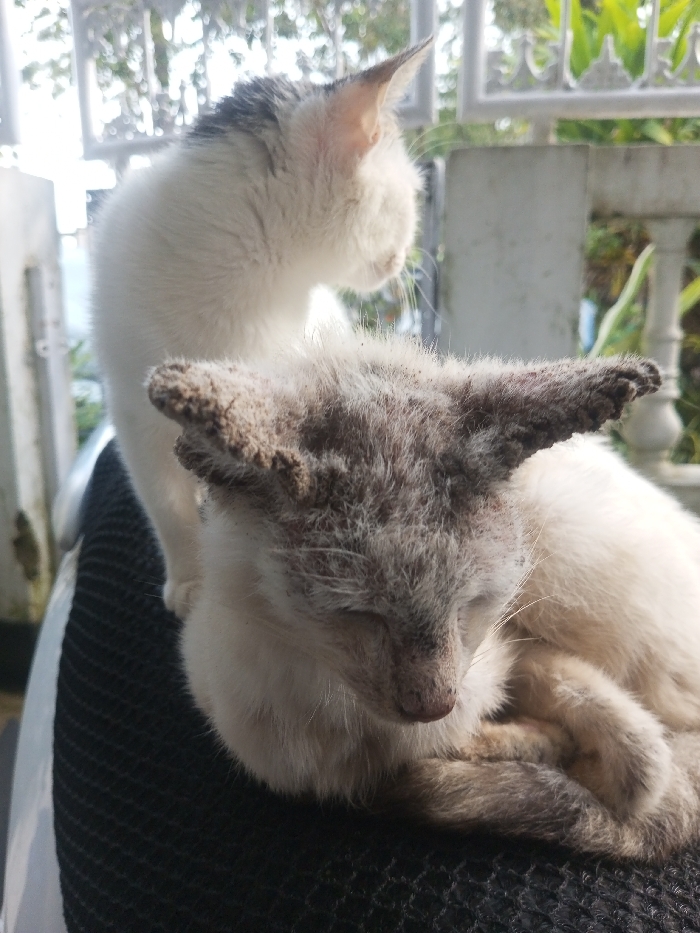
The image captures two domestic cats in an outdoor setting in Akola, India. In the foreground, a light-colored cat with cream and pale tabby fur is resting on a black, textured surface, possibly a seat. This cat's eyes are closed, and its fur, particularly around its ears and face, appears heavily soiled with dark, granular dirt or debris, exhibiting a matted appearance. Numerous small dark specks are visible on its coat. Positioned behind and slightly to the left of the front cat, a second cat, primarily white with grey markings on its head and back, is seated upright and looking towards the right side of the frame, away from the viewer. The background is brightly illuminated and out of focus, revealing white-painted balusters or railing elements, suggesting a balcony or porch, with green foliage visible beyond. The scene is under natural daylight.
Akola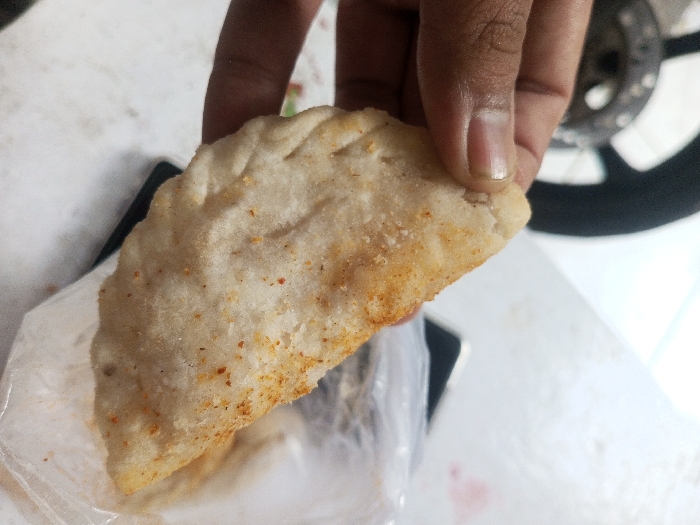
In Akola, India, a medium-dark skinned human hand is depicted holding a single, crescent-shaped pastry. The pastry, light beige in color, exhibits a slightly textured, uneven surface dusted with sparse reddish-orange seasoning specks. It is partially enveloped by a clear plastic film. The hand grasps the pastry by its upper edge using the thumb and index finger. The background consists of a blurred white surface, upon which a dark, rectangular object is partially visible beneath the pastry. A section of a metallic vehicle brake disk and caliper assembly is present in the upper right background.
Akola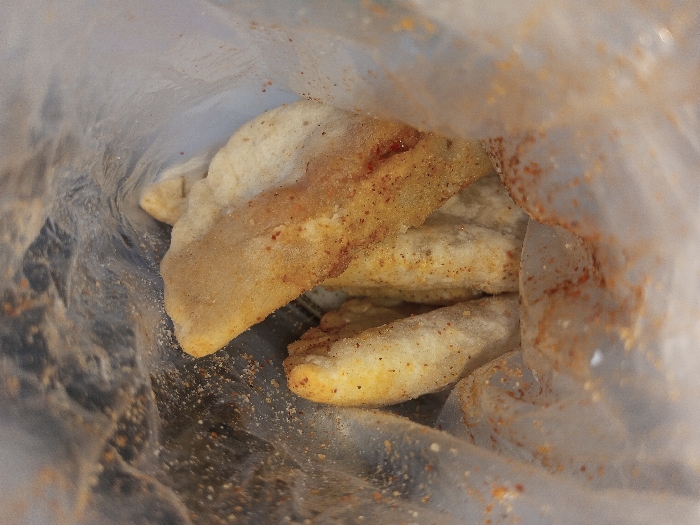
The image displays a close-up, downward-looking perspective into an open, transparent plastic bag containing multiple irregularly shaped, fried dough pieces. These pieces are light tan to golden brown in color, with a noticeable coating of reddish-orange and darker brown spice granules, indicating seasoning. Several pieces are visible, stacked and overlapping within the confines of the bag, which is also dusted internally with loose spice particles. The plastic bag exhibits folds and crinkles, particularly towards the bottom and sides, creating varied light and shadow patterns. No people, actions, or direct interactions are visible. The environment is limited to the interior of the plastic bag, with an indistinct, darker background suggesting an indoor setting. This scene is located in the city of Akola, India.
Akola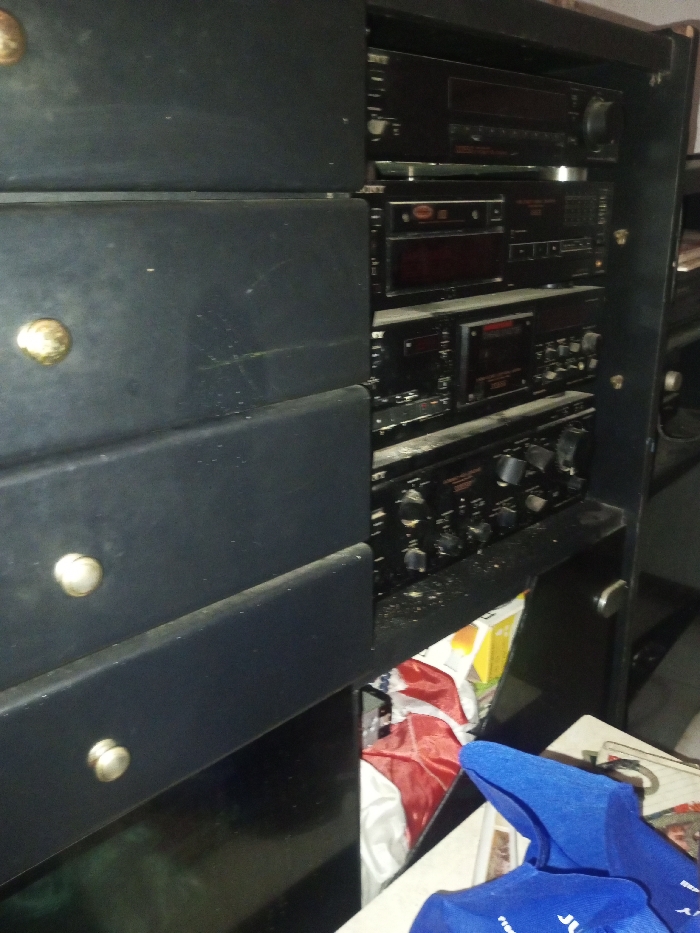
A black audio rack stands open, revealing multiple stacked electronic devices. Each unit features displays, buttons, and dials. Dust and debris accumulate on the surfaces. To the left, a series of black drawers with round metal knobs partially obstructs the view. Below the rack, a cluttered space contains items including a red and white patterned fabric, a yellow box, and a blue garment.
Akola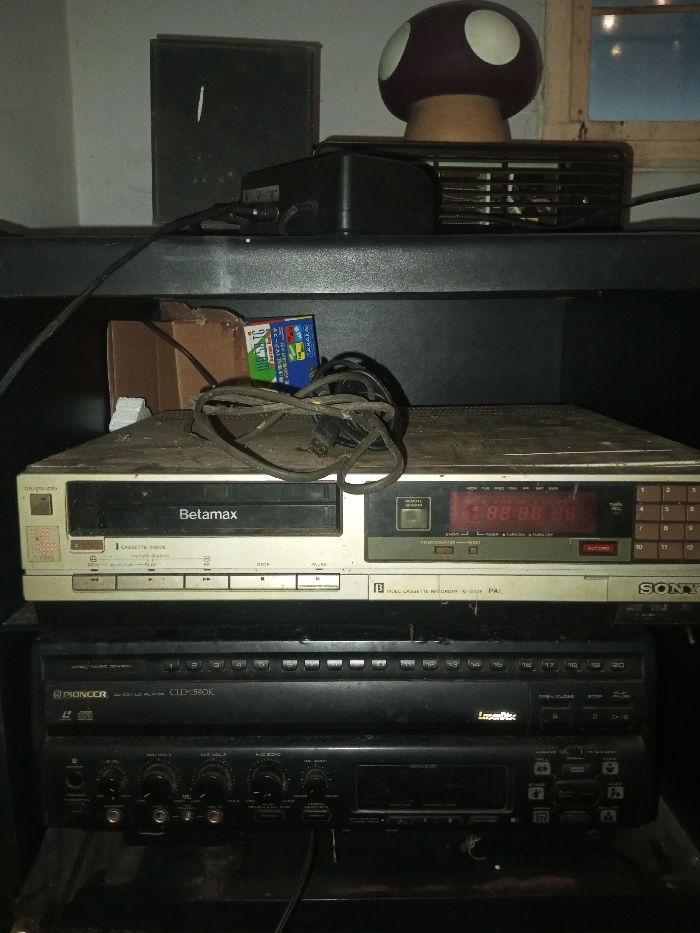
The image features a stack of dusty, vintage electronics. A Sony Betamax VCR is prominently displayed in the middle, with a digital display reading "18:88:88". Above it is a mushroom shaped decorative item. A Pioneer CD/LD player is situated below the VCR. A tangled power cord rests on top of the Betamax. The equipment is in a dark and cluttered setting, suggesting it has been stored away for some time.
Akola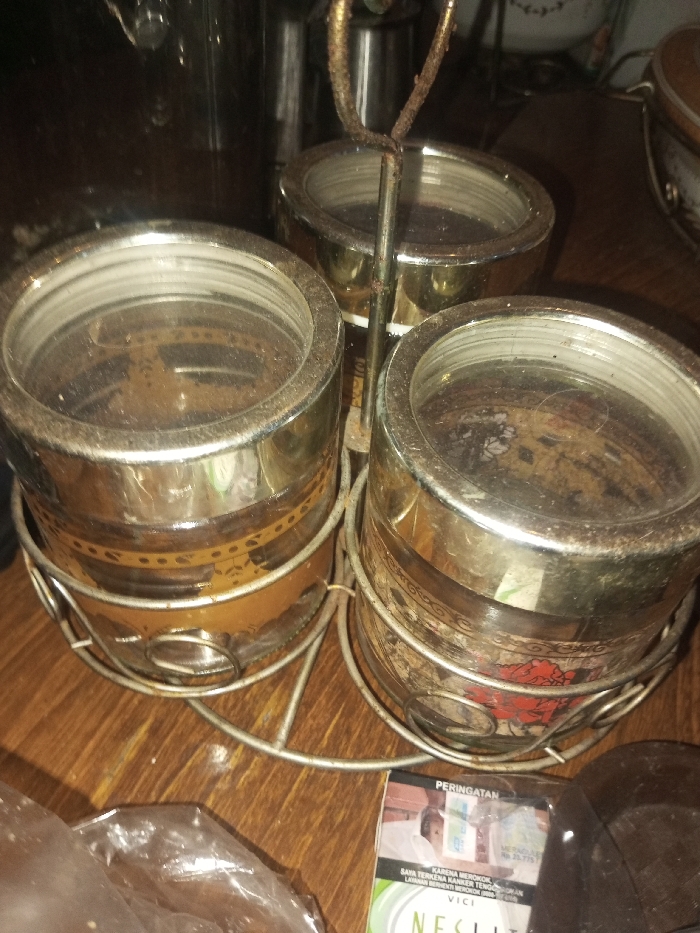
Three metallic containers, held in a metal wire frame with a vertical rod, sit on a wooden surface. The containers are cylindrical with clear lids and are likely meant for spices. They are dusty and have residue inside. Next to the containers, there is a pack of cigarettes. A plastic bag lies partially visible in the lower left corner.
Akola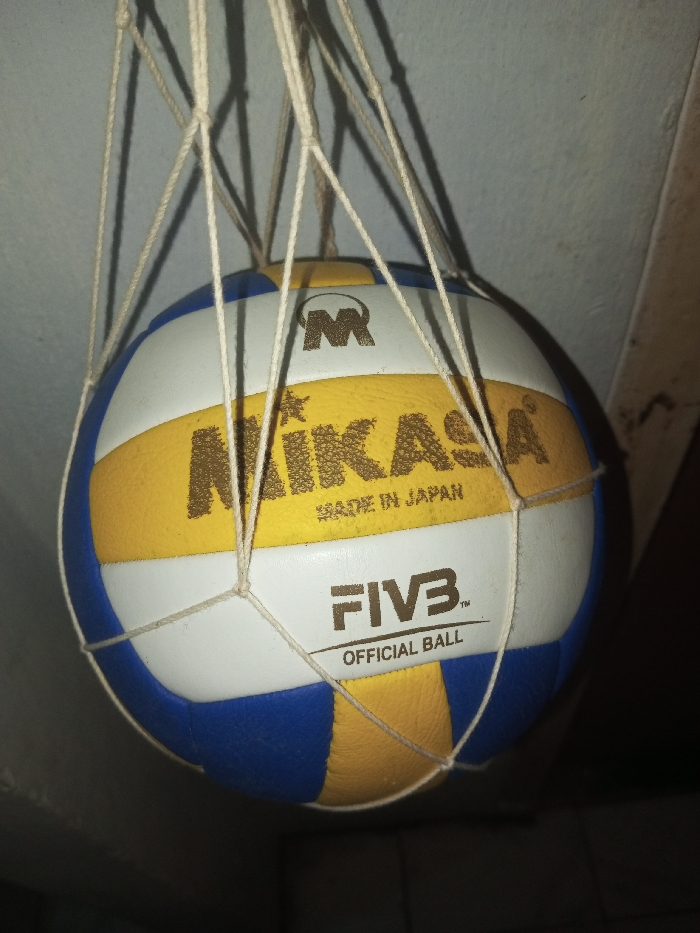
The image displays a Mikasa brand volleyball suspended within a light-colored string net. The volleyball is designed with alternating panels of white, blue, and yellow. Prominently featured on a yellow panel are the gold-colored, somewhat distressed letters "MIKASA," positioned below a stylized "M" logo and above the text "MADE IN JAPAN." A lower white panel bears the inscription "FIVB™ OFFICIAL BALL" in brown lettering. The ball exhibits signs of wear consistent with use. The net, made of knotted cords, holds the ball and extends upwards out of the frame. The background consists of a light-colored, possibly white, surface in the upper portion, exhibiting distinct shadows cast by the net's strings, suggesting an overhead light source. The lower portion of the background is dark and indistinct. The scene is located in Akola, India.
Akola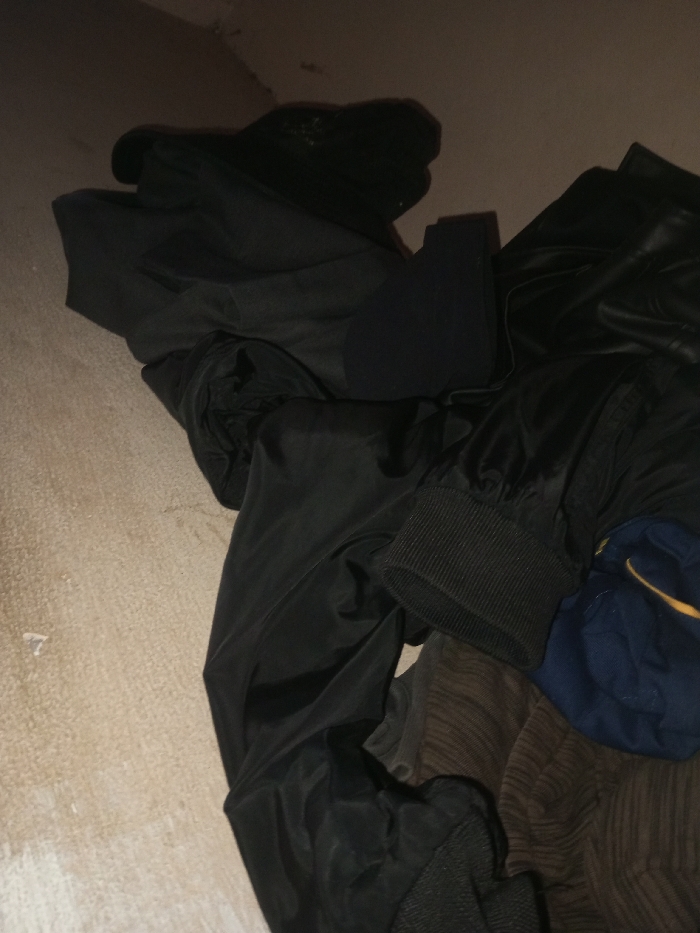
This image depicts a cluster of various clothing items resting on a light-colored floor, adjacent to a wall corner, within an indoor location in Akola, India. The floor surface is light beige or off-white, consistent with concrete or a light-toned tile, showing minor textural imperfections and some debris. The scene is under dim illumination, creating soft shadows. The predominant items are dark-colored garments, primarily black. A black garment resembling a jacket or outerwear, featuring a distinct black ribbed cuff, is visible in the lower right section. Adjacent to it, another crumpled black fabric item, consistent with a pair of trousers or similar legwear, is present. Beneath these items, a section of dark brown textile with subtle linear patterns is discernible. In the lower right foreground, a dark blue item, possibly a cap or small textile bag, with a yellow stripe, is partially visible. Towards the upper left, another darker black object, potentially a folded garment or footwear, rests near the junction of the wall and floor. No individuals are present, and no actions or interactions are observed within the frame.
Akola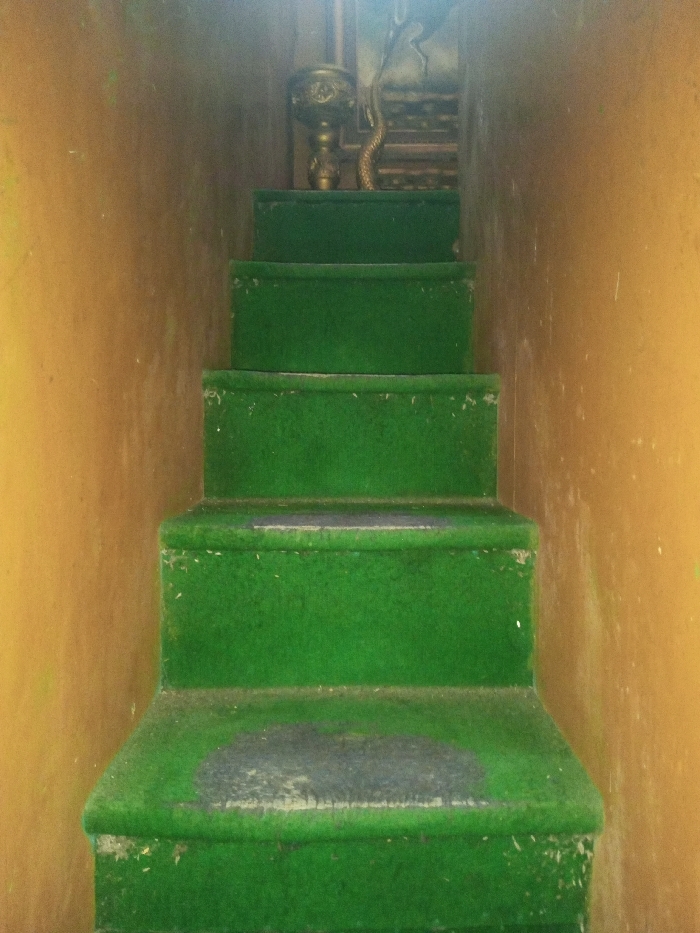
A narrow indoor staircase ascends within an unspecified building in Akola, India. The walls flanking the stairwell are coated in a faded, dirty orange-yellow paint, exhibiting numerous scuff marks and areas of discoloration. The seven visible steps are covered in a worn, soiled green carpet or felt. Each stair tread displays varying degrees of wear, with a prominent dark, irregular patch indicating significant material degradation on the lowest visible step. At the uppermost visible landing, a decorative, brass-toned object resembling an urn or chalice rests on a raised surface. Adjacent to this object, on the right side of the landing, a curvilinear, serpentine-like metallic ornament is partially visible. The area at the top of the stairs is dimly lit, revealing blurred outlines of a darker background structure. No individuals are present, and no actions are occurring.
Akola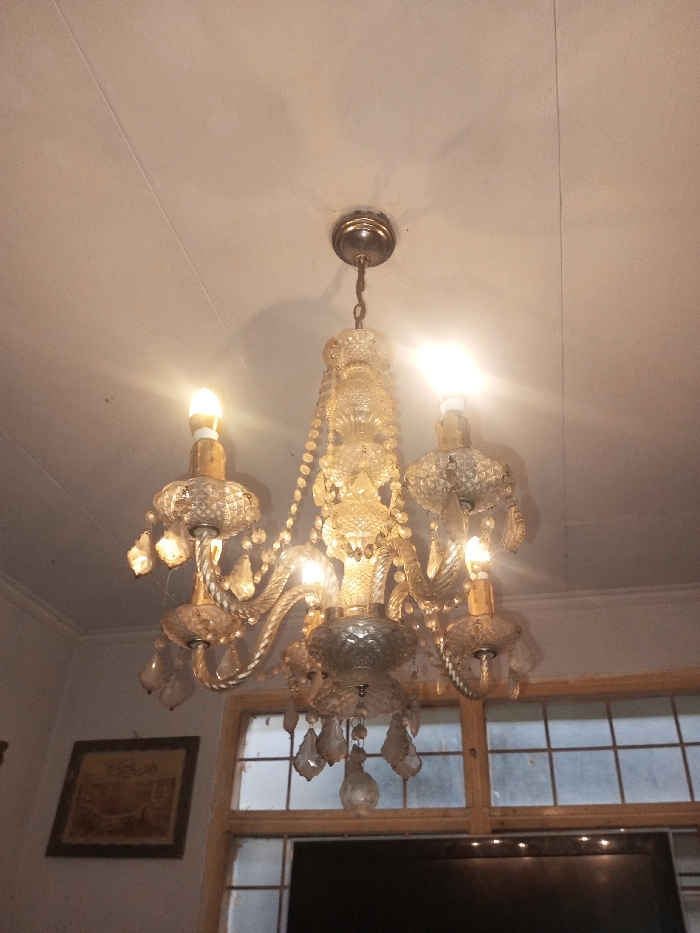
An ornate chandelier, constructed from molded glass elements and gold-toned metallic components, is suspended from an off-white ceiling. Four candelabra-style bulbs within the fixture are illuminated, emitting bright light. The chandelier features multiple arms, beaded chains, and tear-drop shaped pendants. The ceiling displays visible panel seams and minor surface marks. Below the chandelier, a multi-pane window with a light-colored wooden frame obstructs the external view. On the left wall, a dark-framed picture with indiscernible content is partially visible. A dark, reflective surface, consistent with a television screen, is positioned beneath the window, showing reflections of the chandelier's lights. This indoor scene is located in Akola, India.
Akola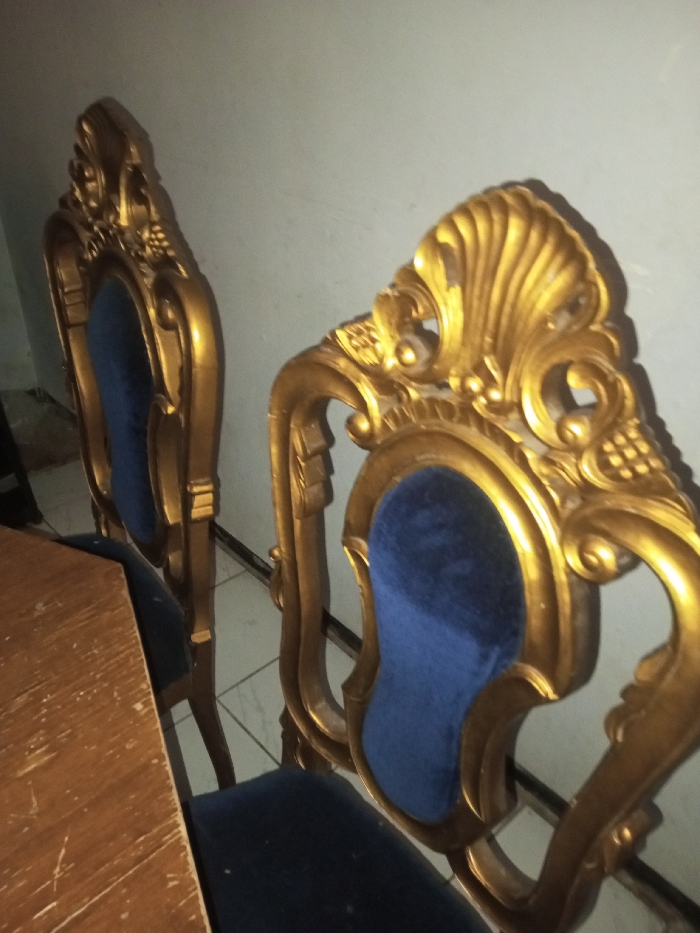
The image depicts an interior scene in Akola, India, featuring two ornate chairs positioned around a wooden table. The chairs are characterized by gilded, highly decorative frames with elaborate scrollwork and shell-like crests, upholstered in deep blue velvet on both the backrests and seats. The chair in the foreground on the right displays significant detail in its golden ornamentation. A light brown wooden table, exhibiting visible surface wear and scratches, occupies the lower-left foreground, partially obscuring the seat of the nearest chair and the lower portion of the second chair. The background consists of a plain, light-colored wall. A tiled floor with light-colored tiles and dark grout lines is visible beneath the furniture. No individuals or dynamic actions are present in the scene.
Akola
A person wearing olive green sweatpants and matching slides stands on white tile. The slides are a simple, slip-on style with an open toe. The floor is clean and brightly lit, with a grid pattern from the tiles. The person's feet are visible within the slides. The overall image has a casual, relaxed feel.
Akola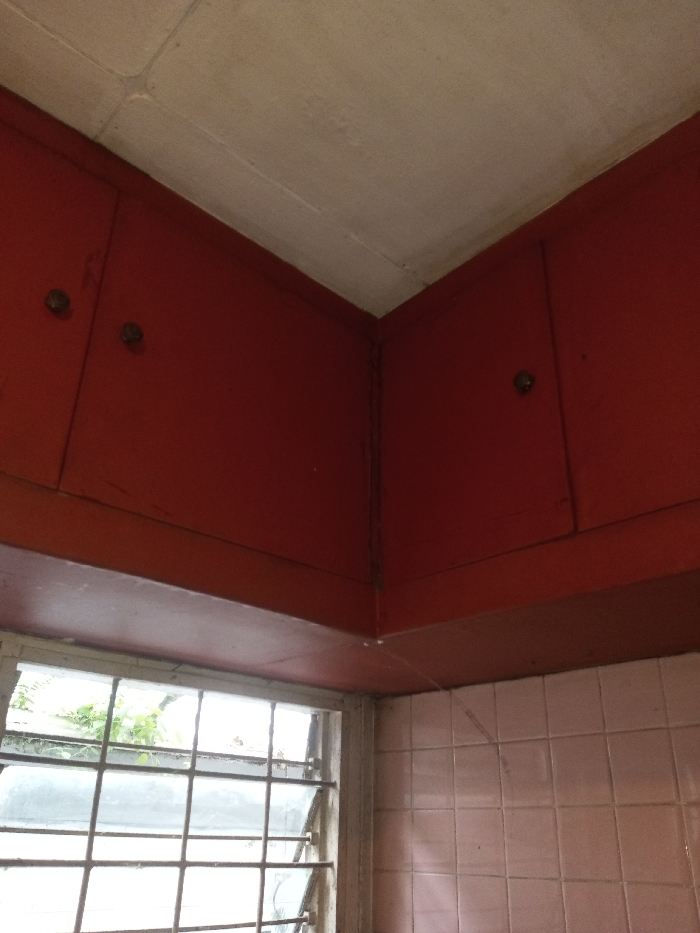
A corner of a room features old red wooden cabinets under a white ceiling. One cabinet has two doors, the other has one. The wall beneath the right cabinet is covered in small pink tiles. A window with a metal frame is visible under the left cabinet, offering a glimpse of greenery outside. A gap exists between the cabinets, revealing the wall behind.
Akola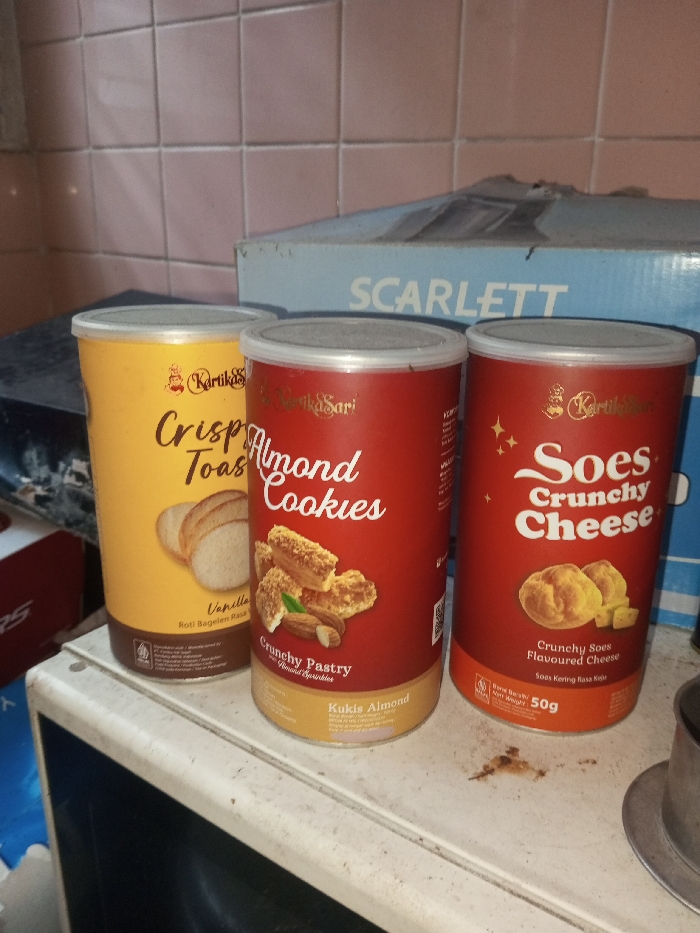
The image showcases three cans of Kartika Sari cookies. From left to right, they are "Crispy Toast" with a vanilla flavor, "Almond Cookies," labeled as "Crunchy Pastry," and "Soes Crunchy Cheese," described as "Crunchy Soes Flavoured Cheese." The Soes Crunchy Cheese can indicates a net weight of 50g. A Scarlett box is visible in the background, and the cans are placed on a surface with some visible dirt.
Akola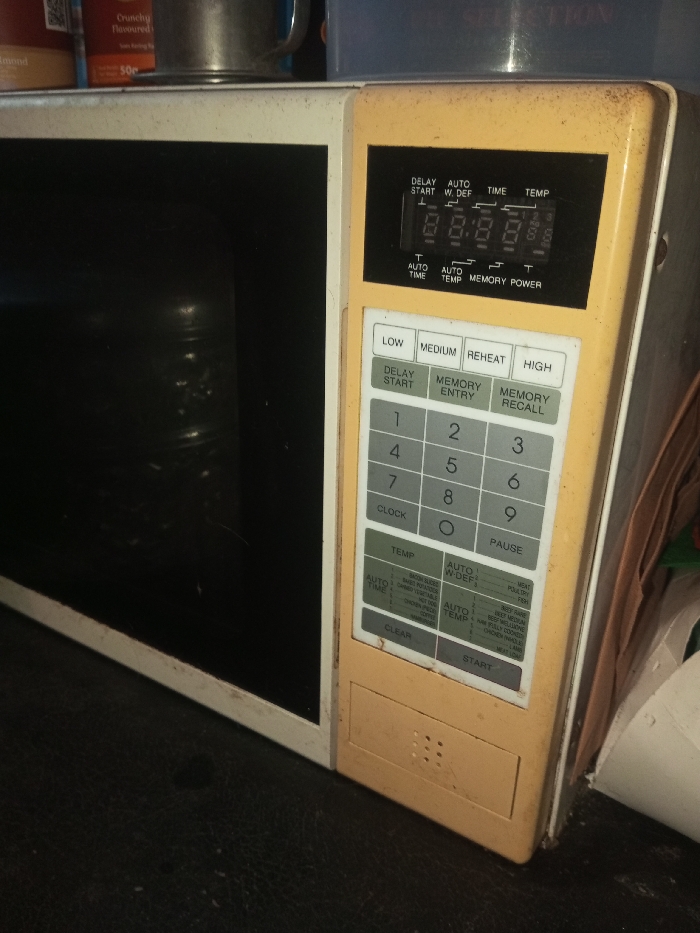
An old, yellowed microwave oven is shown, partially obscured by objects on the side. The control panel features a digital display showing "88:88", buttons for power levels (LOW, MEDIUM, REHEAT, HIGH), numbered keypad, and function buttons like DELAY START, MEMORY ENTRY, MEMORY RECALL, CLOCK, PAUSE, TEMP, AUTO W-DEF, AUTO TEMP, CLEAR, and START. Labels detail automatic cooking functions like bacon, baked potatoes, canned vegetables, and frozen dinners. The oven's exterior exhibits signs of wear and age.
Akola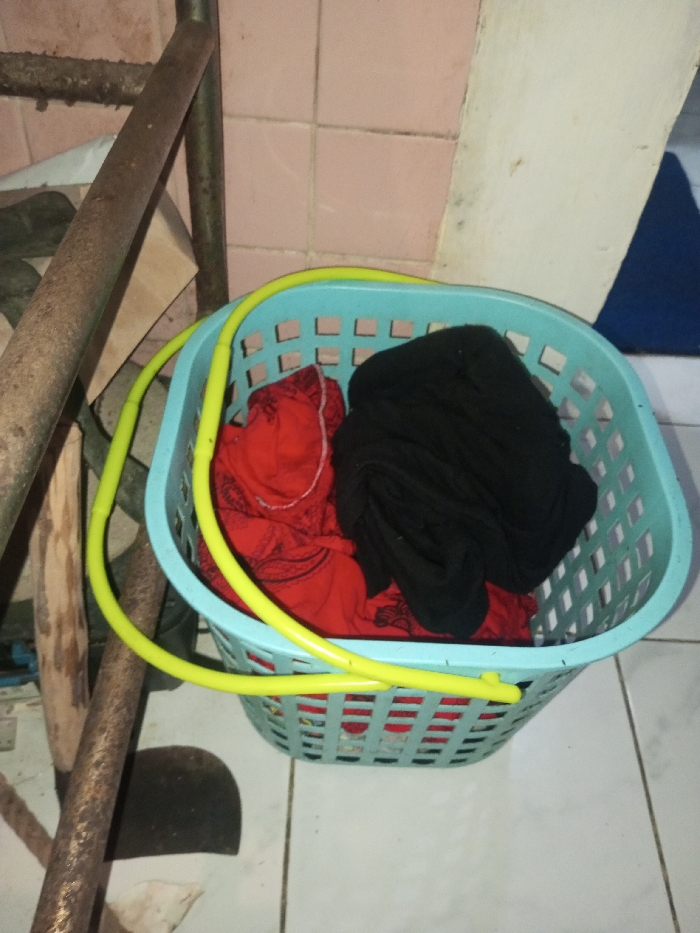
A light blue laundry basket with a yellow ring around its opening sits on white tiled floor. Inside the basket are crumpled piles of red and black clothes. To the left, a rusty metal structure stands beside the basket. The background features pink tiled walls, white walls, and a glimpse of a blue object. The scene suggests a laundry area or utility room.
Akola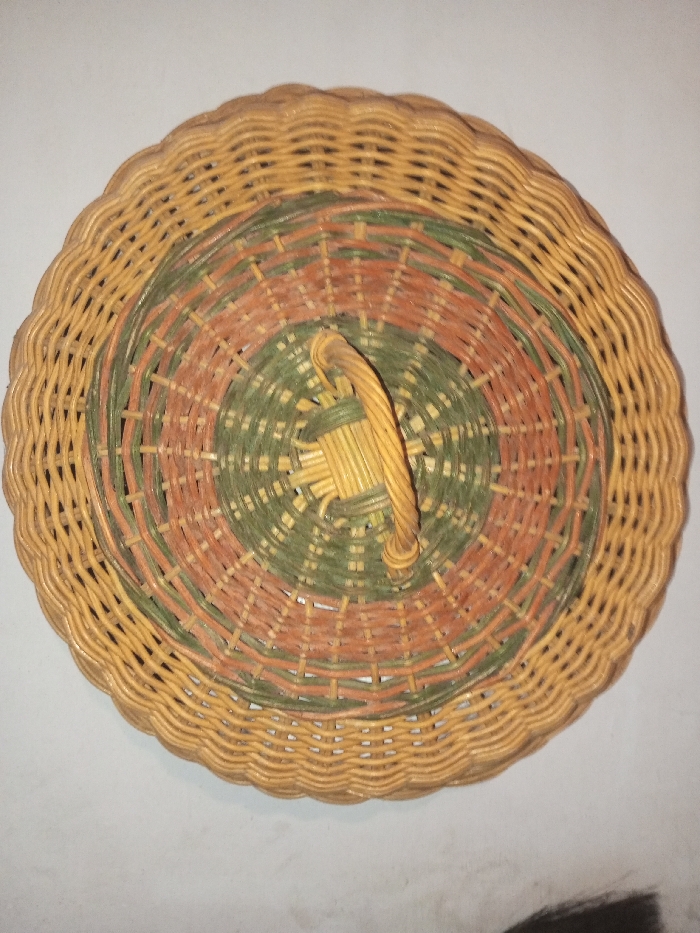
A round wicker basket lid with a handle in the center. The lid has concentric circles of woven wicker in alternating colors of green and brown. The outer rim of the lid is a lighter tan color and features a scalloped edge. The handle is also woven in the same light tan wicker, secured in the center of the lid. The overall impression is of a handcrafted and rustic item.
Akola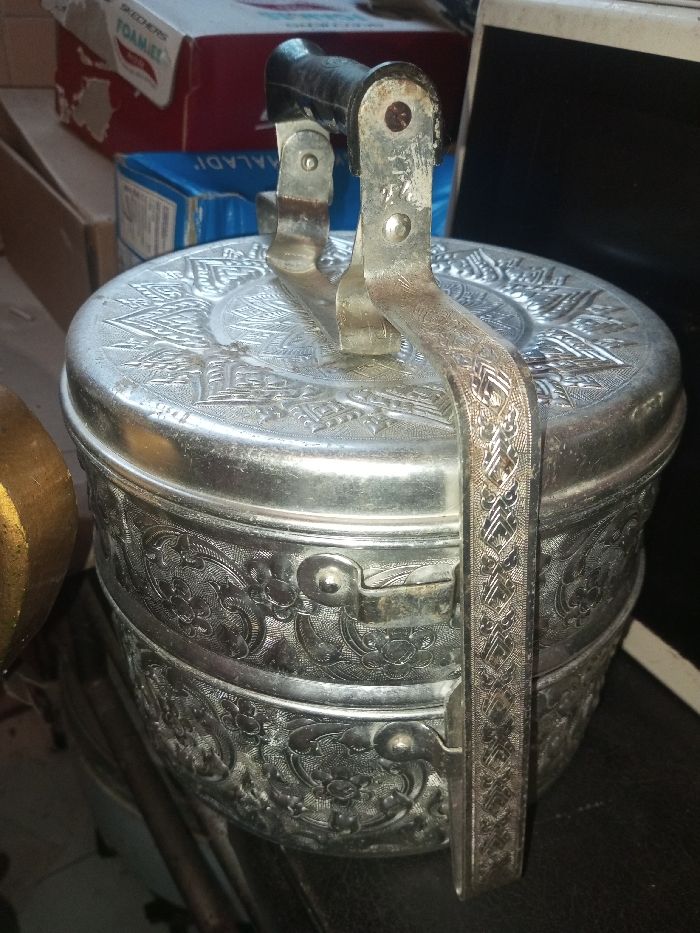
A tiered, ornate silver tiffin carrier with a black handle sits prominently. The tiffin has detailed floral and geometric engravings. Oxidization is visible, giving it an antique appearance. The carrier is secured by a silver handle. Partially visible are cardboard boxes and a tablet. The overall scene suggests a storage area or a cluttered household setting.
Akola
An overhead shot displays a tiered, conical metal object, resembling a retro-futuristic tower or decorative piece. The object is tarnished, showcasing age and wear. A black power cord and a black electrical component are visible to the left. A clear glass textured bowl sits in the background, along with another shiny metallic object. A glimpse of a gold, ornate item is also visible at the bottom.
Akola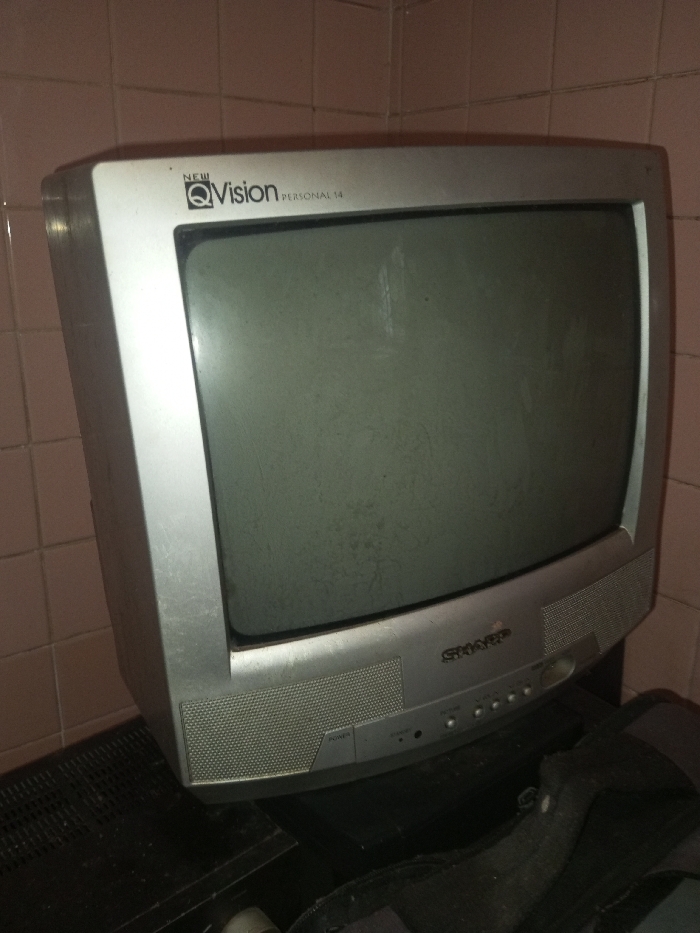
An old, dusty silver CRT television rests on a dark surface. The television, labeled "New Vision Personal 14," features a rectangular screen and a lower panel with speaker vents and several small, round buttons. The screen appears gray and dirty. The background features a tiled wall with light pink tiles. The overall setting looks worn and dated. A portion of a dark object is visible below the TV.
Akola