Alicante/alacant, Spain
30 memories from Alicante/alacant, Spain
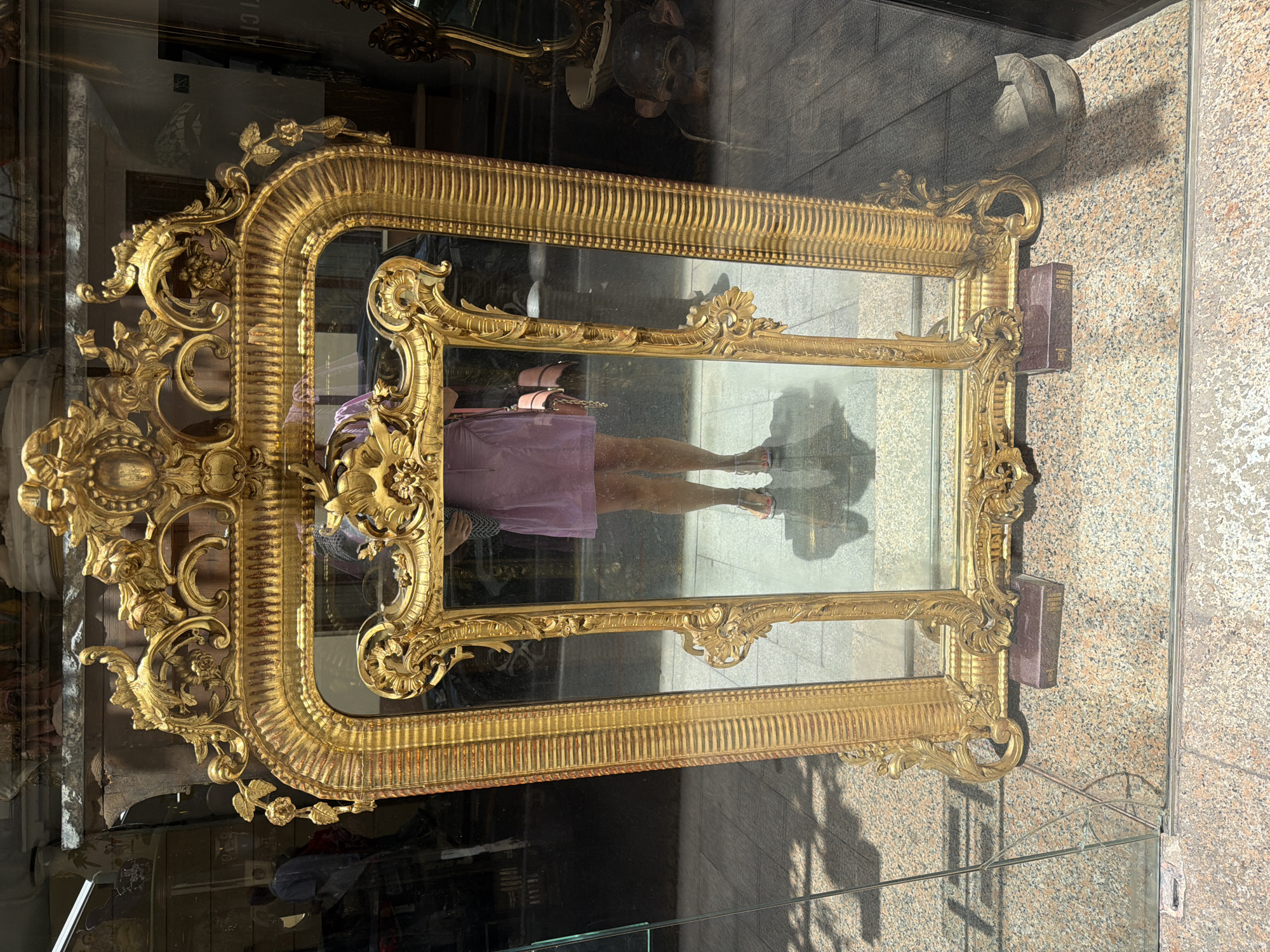
An ornate, gilded antique mirror is displayed in the window of a shop on a street in Alicante, Spain. The mirror has a complex, highly decorative frame featuring scrolls, floral motifs, and a central crest. Reflected in the mirror is a person wearing a pink dress and sandals, holding a handbag. The street outside is paved with granite-like tiles and shows reflections of buildings and what appears to be people walking by. The shop's interior is visible through the glass, with other antique items such as furniture and decorative objects. The mirror itself is elevated slightly by two dark-colored books placed underneath its base.
Alicante/alacant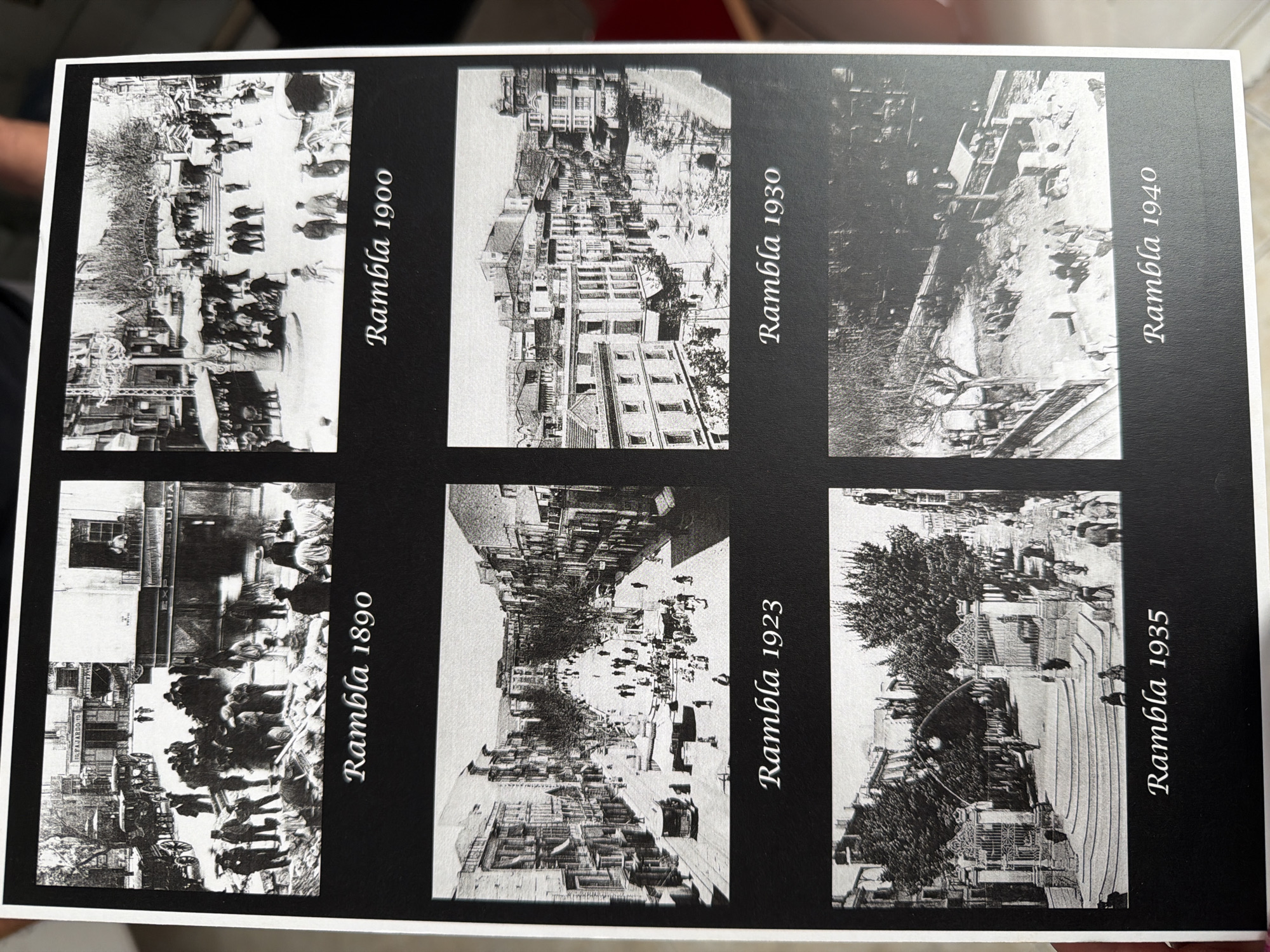
The image displays a grid of six black and white historical photographs, each captioned with "Rambla" followed by a year, indicating a chronological progression. The photographs appear to depict scenes from a street or avenue, likely a prominent one given the consistent naming convention. The top row features two images. The left image, labeled "Rambla 1890," shows a busy street scene with horse-drawn carriages and numerous pedestrians in period attire. Buildings with shops line the street, and awnings are visible. The right image, "Rambla 1900," presents a more open square or intersection, also populated with people and market stalls or kiosks. A decorative lamppost or structure stands centrally. The middle row also contains two photographs. "Rambla 1923" shows a long, tree-lined avenue with buildings on either side. A tram or trolley is visible on the street, and people are walking along the sidewalks and in the center of the avenue. "Rambla 1930" depicts a similar avenue with buildings, but with fewer visible trees. The architecture suggests a European urban setting. The bottom row has the final two images. "Rambla 1935" showcases a wide entryway with ornate gates and stone steps leading up to an area that appears to be a park or plaza. People are seen walking through the gates and on the steps. "Rambla 1940" offers a more aerial or elevated view of a street scene, with people and some structures visible. The image is darker and less distinct than the others. The captions strongly suggest these photographs document the evolution of a specific location identified as "Rambla" over a 50-year period. Without further information, pinpointing the exact city is challenging, but the style of architecture, clothing, and modes of transport are consistent with urban scenes in Spain during the late 19th and early 20th centuries. Given the prompt, this location is identified as the Rambla de Méndez Núñez in Alicante, Spain.
Alicante/alacant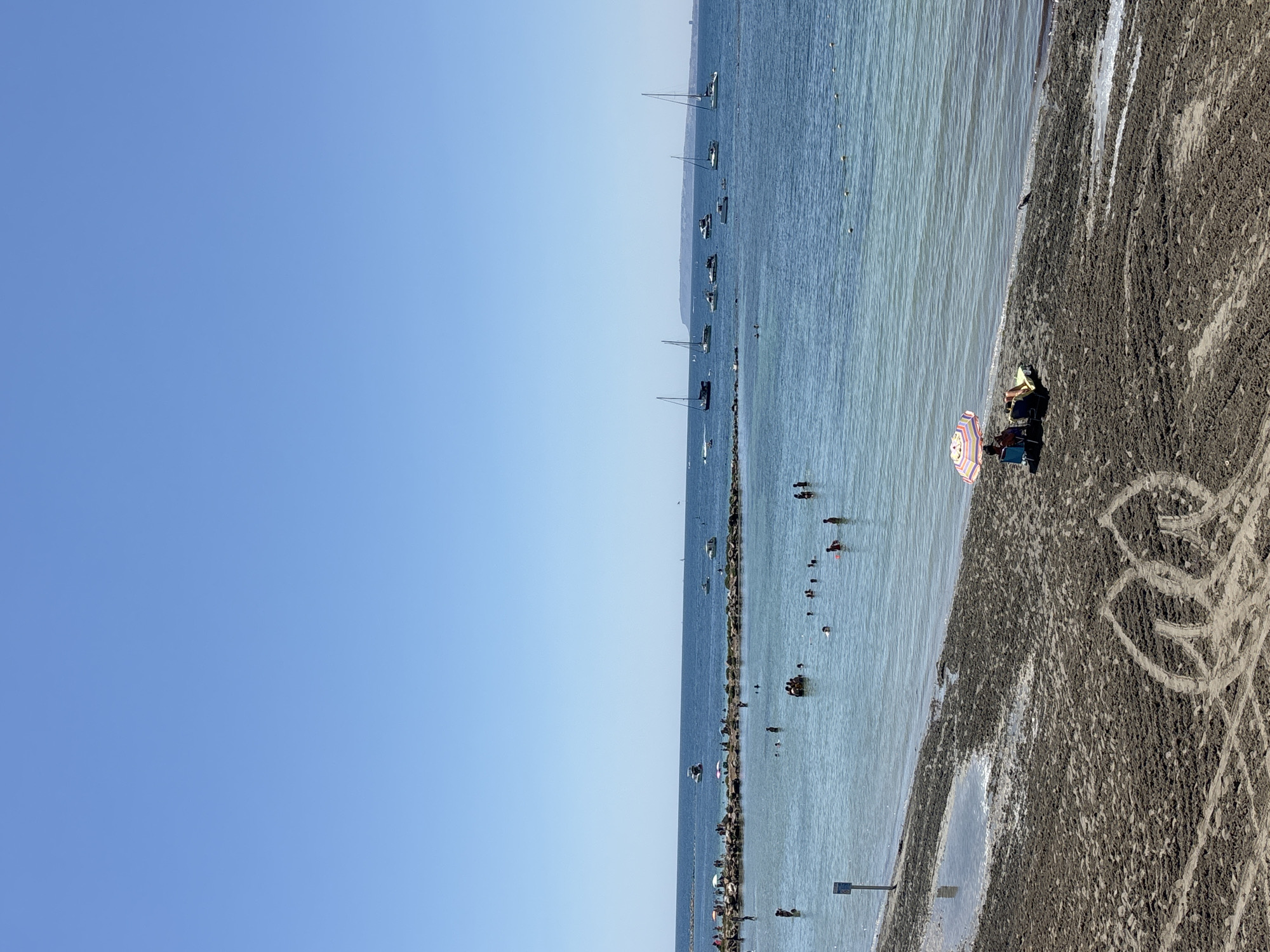
A wide shot captures a beach scene with a clear blue sky and calm water under bright sunlight. In the foreground, dark, wet sand is marked with what appear to be drawings of large hearts, possibly made with a rake or stick. A small puddle of water is visible on the sand. Further back, a few people are relaxing on beach chairs under a colorful umbrella. A bird stands near the water's edge. The water is a bright, translucent blue, with a few buoys marking a boundary. Several people are wading and swimming in the shallow water. A stone breakwater extends into the sea, with more people gathered on it. Beyond the breakwater, numerous sailboats and motorboats are anchored or cruising on the horizon. The distant coastline appears as a hazy, light-colored landmass. The overall impression is a sunny, leisurely day at the beach. This image appears to be taken at a beach in Alicante, Spain, likely the Postiguet Beach or a nearby coastal area, given the presence of sailboats and the general Mediterranean atmosphere.
Alicante/alacant
The image depicts a casual indoor scene, likely a living room, with a focus on a meal and entertainment. In the foreground, a round pizza is placed on a light-colored wooden table, cut into eight slices, with melted cheese and tomato sauce visible. To the left, a large bottle of Coca-Cola with its distinctive red label stands upright. Partially visible to the left of the Coca-Cola bottle is a clear glass with some liquid and writing on it, possibly a beverage container. A black, round object, potentially a plate or placemat, is also on the table. In the background, a television screen displays a colorful image featuring two people, one wearing glasses and a cap, engaged in an activity. Above the television, shelves are mounted on the wall, holding various items. The room appears dimly lit, suggesting it might be evening. The overall impression is one of a relaxed setting, possibly a home in Alicante/Alacant, Spain, where someone is enjoying a meal while watching television.
Alicante/alacant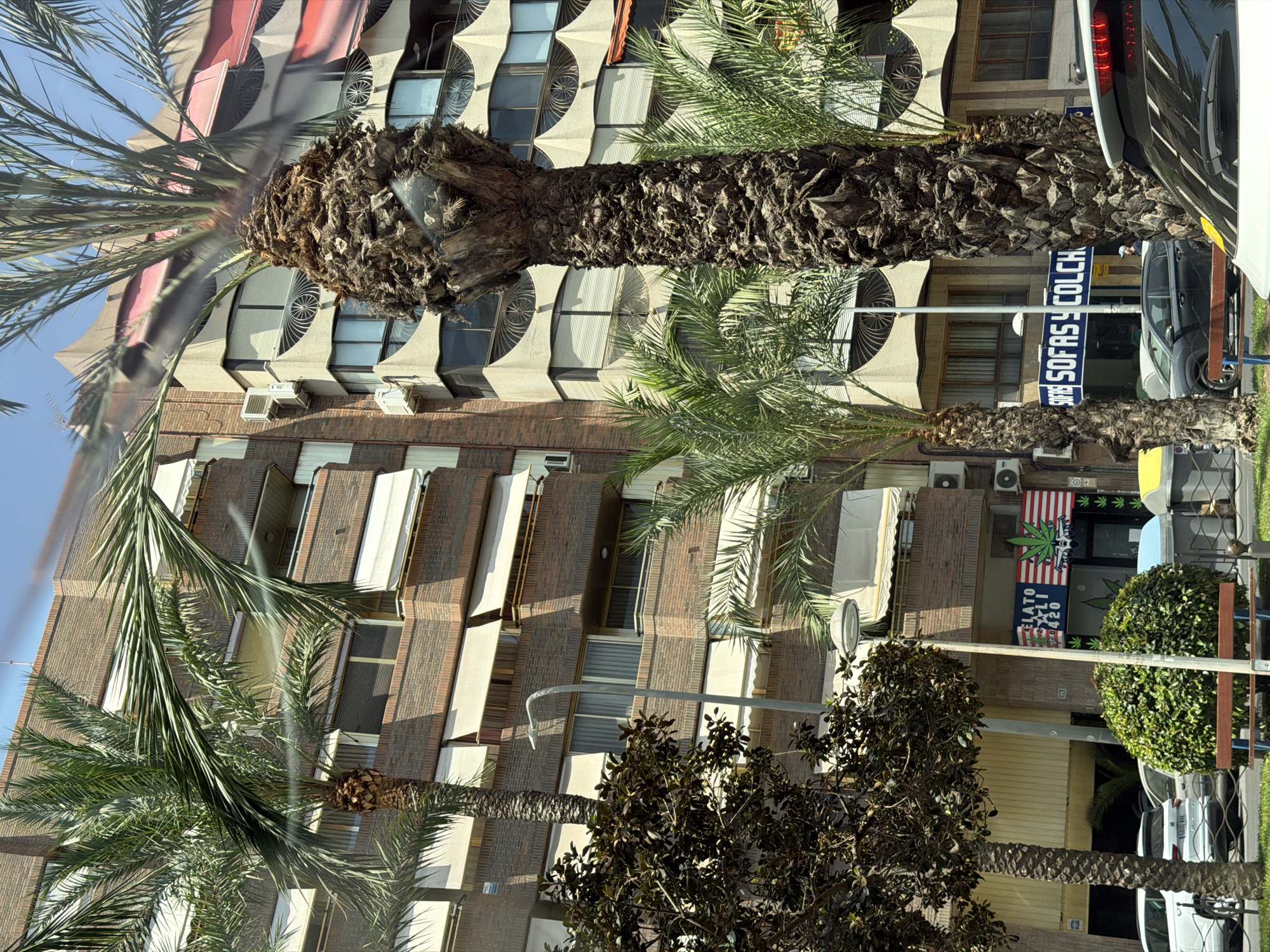
The image captures a street scene in Alicante, Spain, likely near a commercial area, characterized by a multi-story building with a brick facade and distinctive curved concrete architectural elements. Palm trees are prominently featured, with one large, mature palm tree dominating the right side of the frame and another to the left. The building has multiple levels with balconies and windows covered by beige awnings. On the ground floor, visible through the palm trees, are storefronts. One storefront has a sign with "SOFAS Y COLCH" which translates to "SOFAS AND MATTRESSES," indicating a furniture store. Another sign, partially obscured by the large palm tree, displays "GELATO" alongside an American flag motif incorporating a cannabis leaf, suggesting a business selling ice cream and potentially related products. In the foreground, a white car is partially visible on the right, and a dark SUV is parked on the left, with a white car behind it. A street lamp and a decorative spherical bush with a bench in front of it are also present on the sidewalk. The sky is clear and blue.
Alicante/alacant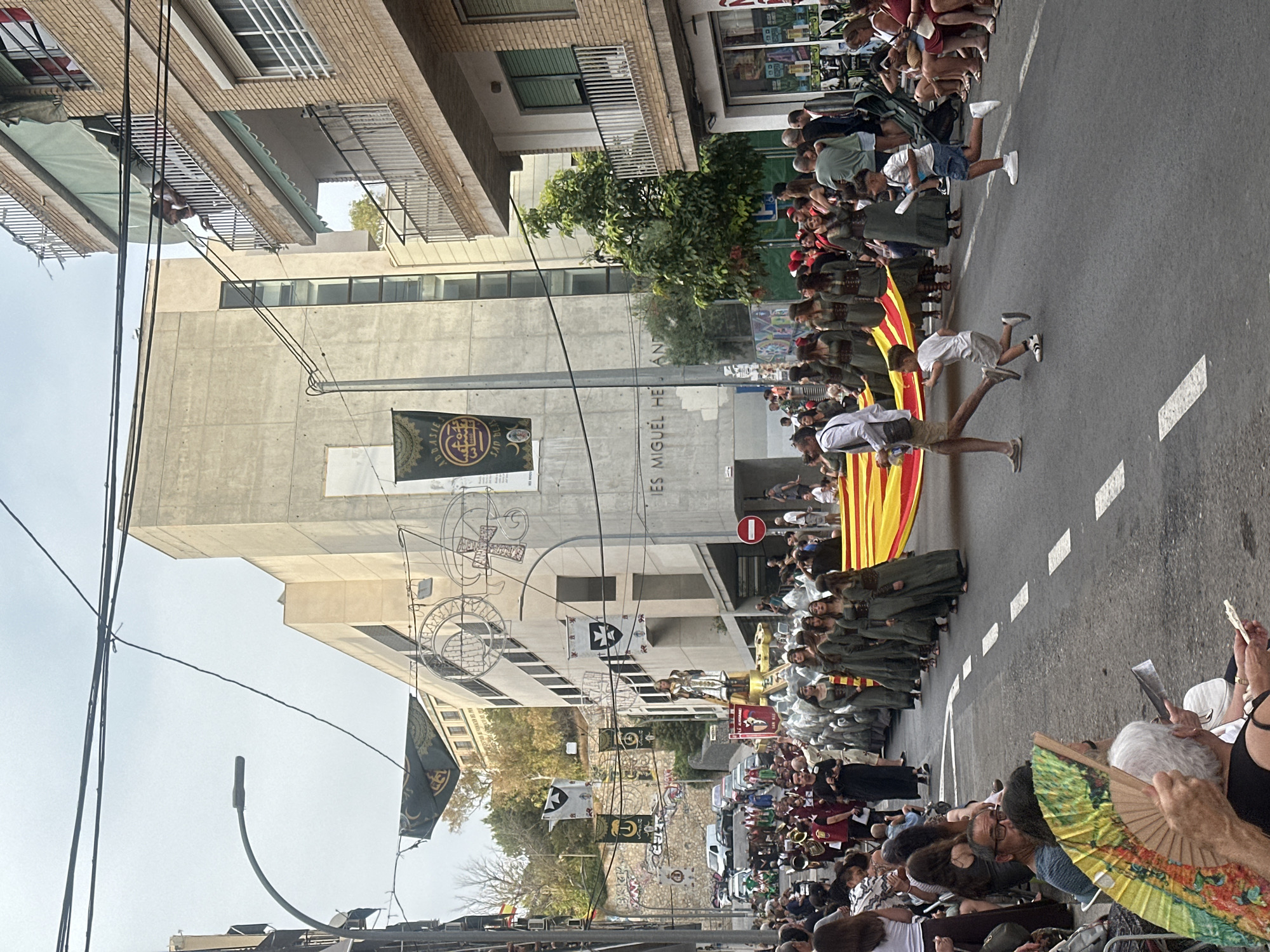
The image depicts a street procession in Alicante, Spain, likely a festival or parade. In the background, a large, modern concrete building with the words "IES MIGUEL HERNÁNDEZ" is visible, indicating the location as a public institution, possibly a school. The street is lined with spectators seated on chairs and standing. A procession is moving down the street, featuring people in historical or traditional costumes, including women in long, dark green dresses and men in maroon garments. A large yellow and red striped flag, possibly the Senyera (flag of Catalonia or Valencia), is being carried by several people. Two young boys are running alongside the flag. In the foreground, spectators are watching the procession, with one person holding an open fan. The scene is outdoors, with overhead wires and a lamppost visible.
Alicante/alacant
A woman with long brown hair is taking a mirror selfie in what appears to be a retail store. She is wearing a red and white patterned dress and holding a green smartphone in her right hand. A cream-colored purse is slung over her shoulder. In the background, shelves are stocked with merchandise, including shoes and bags. Another woman, with her back to the camera, is also visible in the reflection of the mirror. The scene is brightly lit, suggesting an indoor commercial setting. The presence of a clothing rack and display shelves indicates this is likely a clothing or shoe store. There is no specific visual information in the image that places this scene in Alicante, Spain.
Alicante/alacant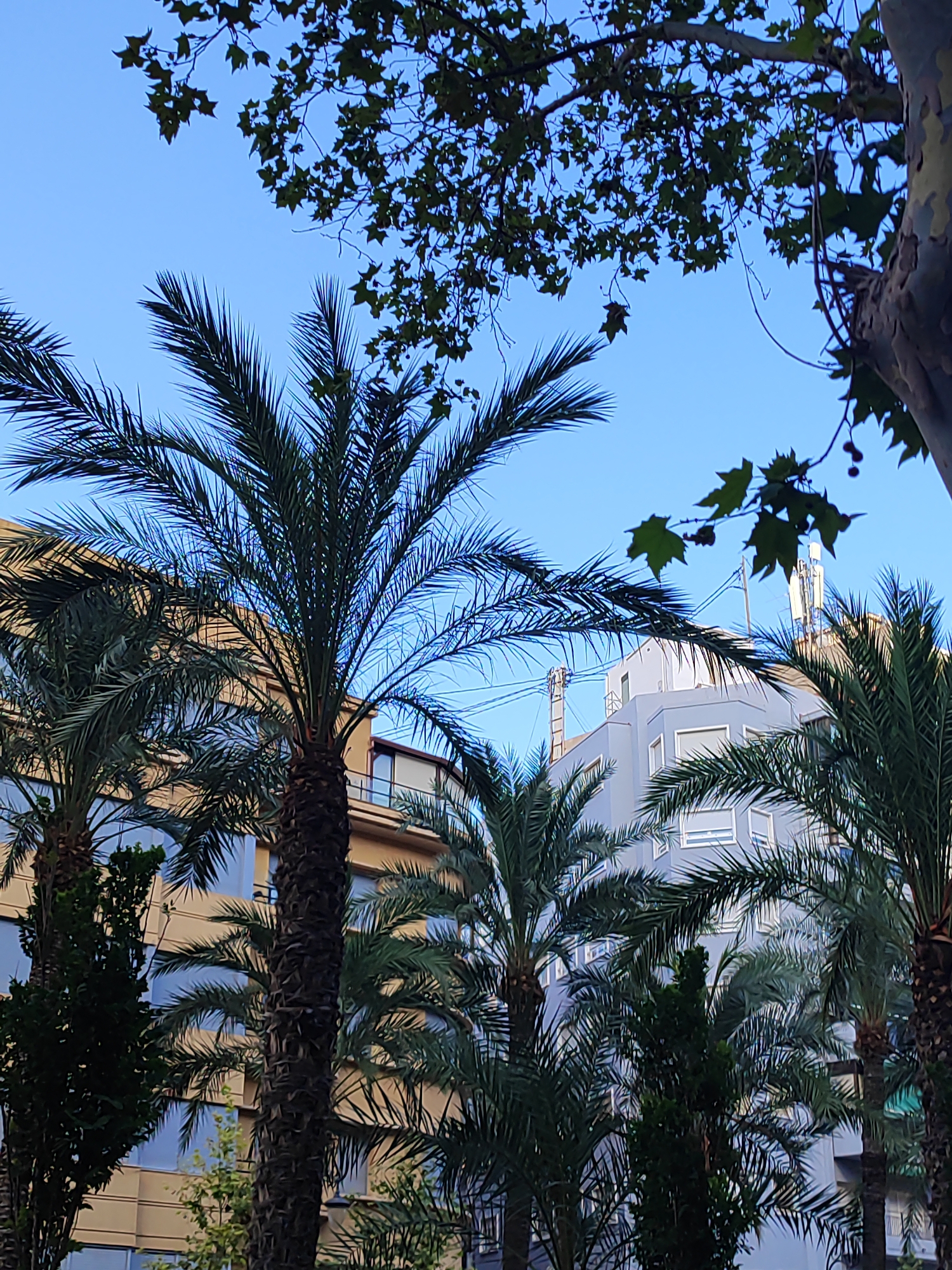
This is an outdoor, eye-level, medium shot of palm trees in front of buildings against a clear blue sky. The palm fronds are dark green and fill the foreground and mid-ground. Behind the palm trees, there are buildings. The building on the left is light brown with large, reflective blue windows and some brown balconies. To its right is a light blue building with white-framed windows. Several communication towers are visible on top of a building in the background. The image appears to have been taken on a sunny day. The foliage of a large tree with textured bark and leaves is visible in the upper right corner, with some leaves hanging down. The scene is typical of a Mediterranean coastal city like Alicante, Spain.
Alicante/alacant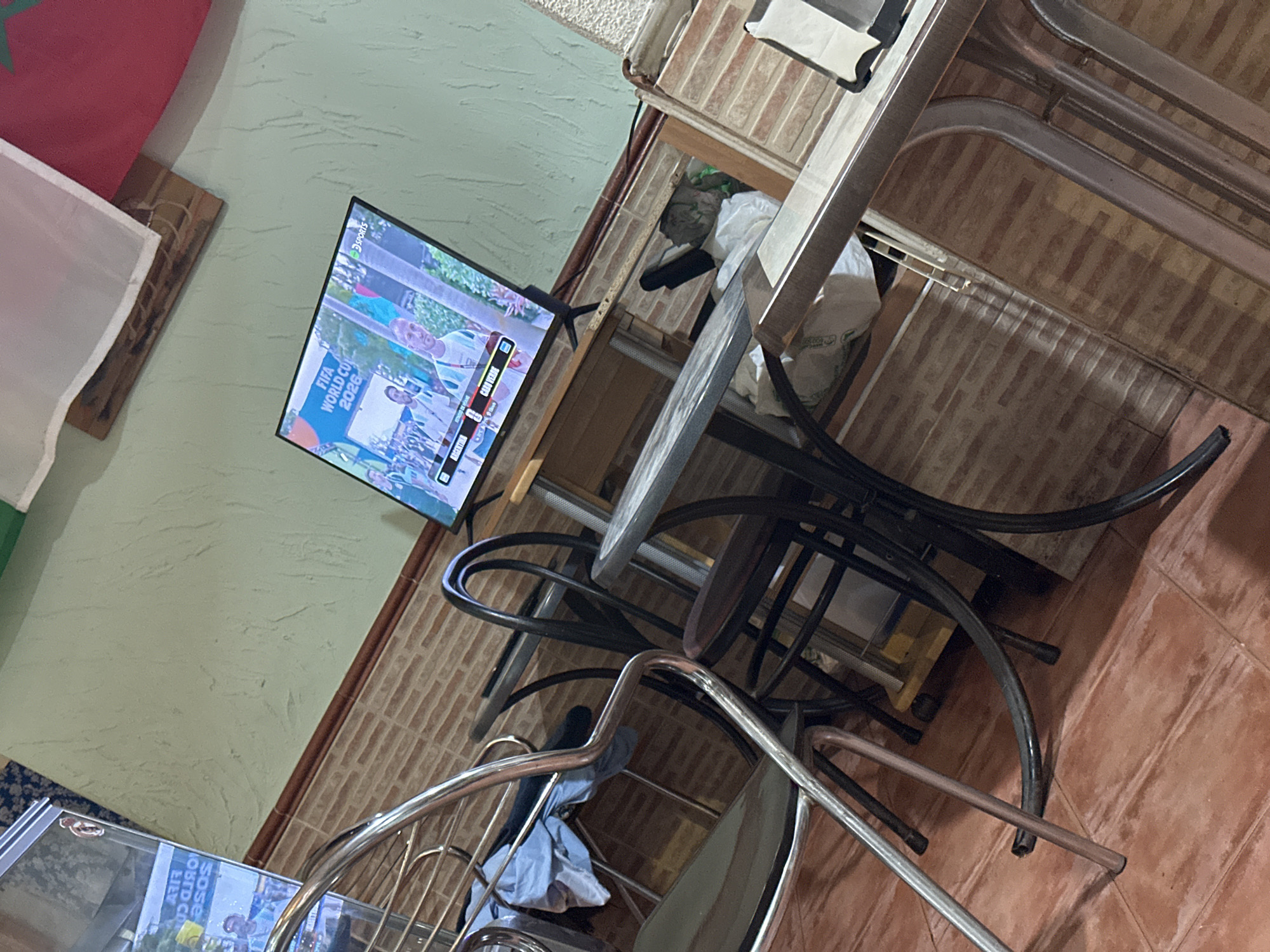
The image shows a television screen displaying "FIFA WORLD CUP 2026" with players in uniform. The television is on a stand in a room with tiled walls and floor. There are several chairs around a table in the foreground, some appearing to be metal and others black. A blue garment is draped over one of the chairs. The room is lit, and the overall impression is that of a casual indoor setting, potentially a cafe or restaurant. There is no visible indication of the city of Alicante/Alacant, Spain.
Alicante/alacant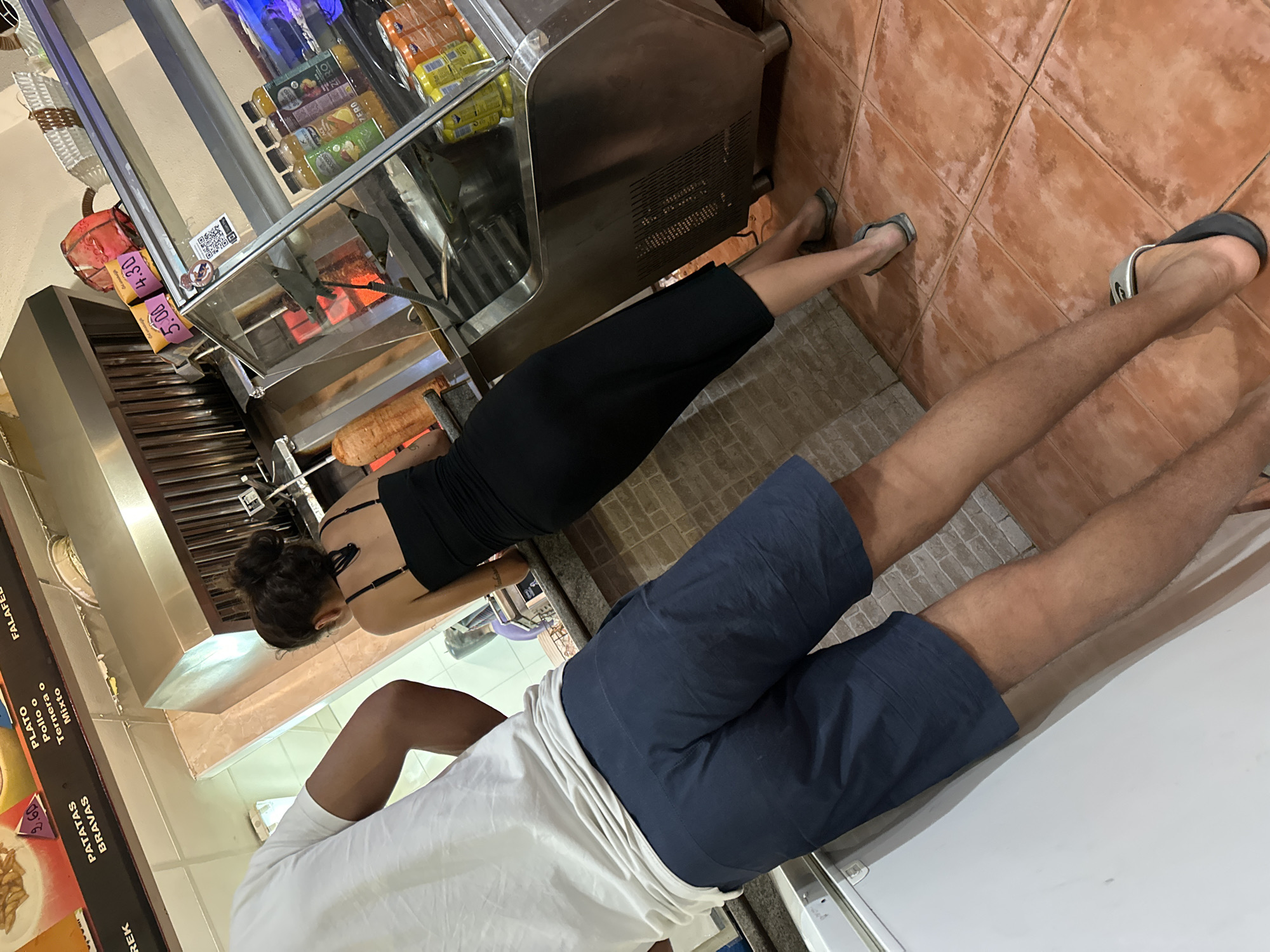
In Alicante, Spain, at a kebab shop, a man and a woman stand near a food display. The man, facing away from the camera, wears a white t-shirt and dark blue shorts, with his legs and feet visible. The woman, also facing away, is dressed in a long black dress and gray flip-flops. Behind them, food items are displayed in a refrigerated case, and a vertical rotisserie with meat is visible. A price list for menu items like "PATATAS BRAVAS" and "POLLO O TERNERA O MIXTO" is mounted above the display, with prices such as "5.00", "4.30", and "2.60" marked on items. The environment includes tiled flooring and stainless steel fixtures.
Alicante/alacant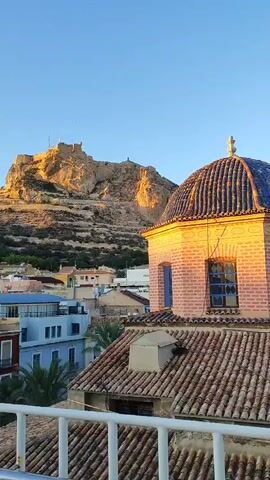
This video shows a cityscape at sunset. In the foreground, there is a rooftop with terracotta tiles and a white railing. To the right, a portion of a building with a dome is visible. The building is made of brick and has arched windows. In the background, there are several colorful buildings and a large mountain with a castle on top. The sky is clear and blue, with the sun casting a warm glow on the landscape. The overall scene is tranquil and picturesque.
Alicante/alacant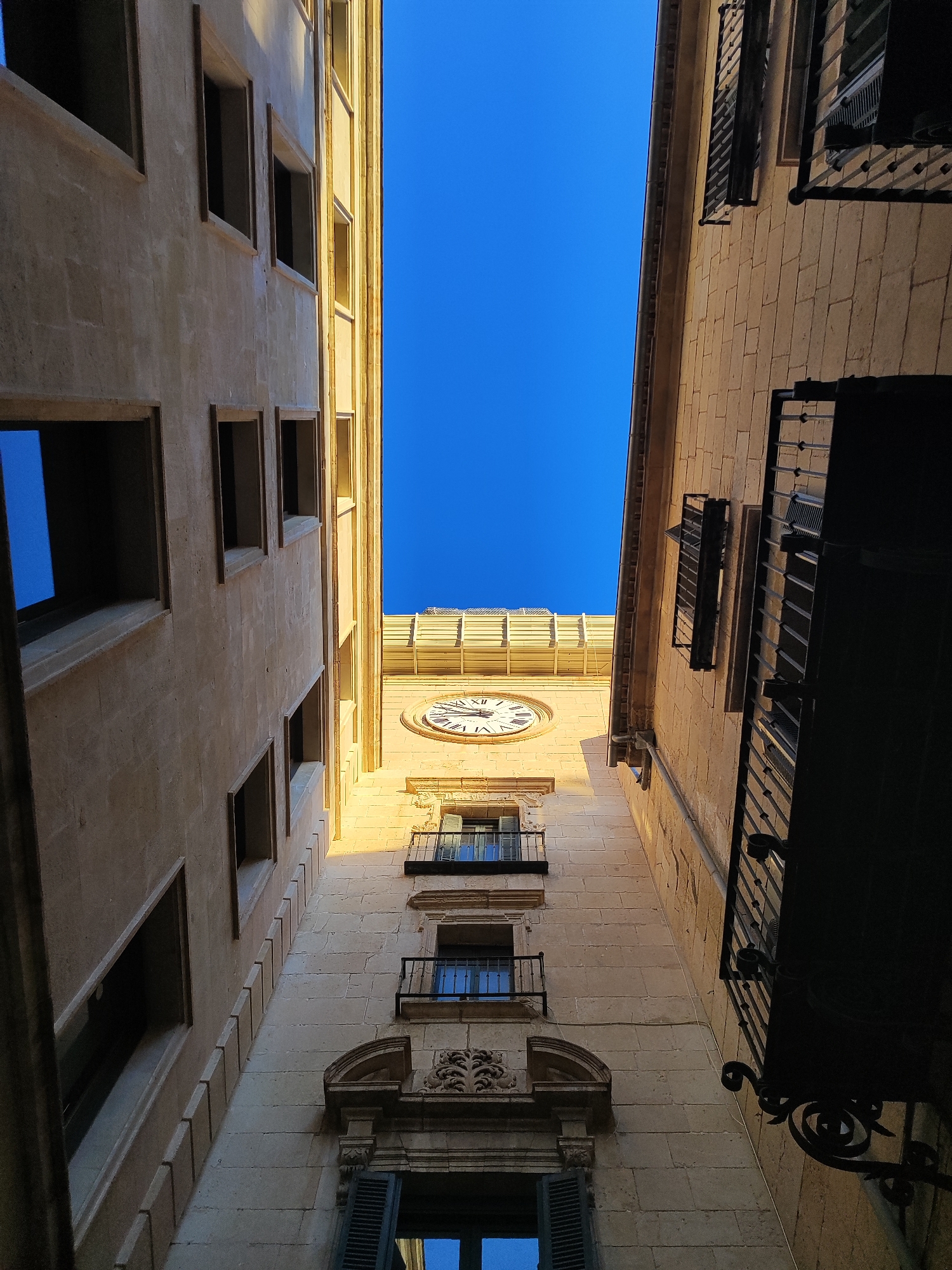
The image shows a perspective shot looking upwards between two old stone buildings towards a clear blue sky. The building on the left is lighter in color and has many rectangular, empty window frames. The building on the right is made of tan stone blocks and features several wrought-iron balconies. In the distance, at the top center of the image, a clock tower with Roman numerals is visible, illuminated by sunlight. The architecture suggests a historic European city. Based on the clock tower and architectural style, this location is likely the Clock Tower of Alicante, located in Alicante, Spain. The scene is devoid of people and captures the exterior of these buildings in daylight.
Alicante/alacant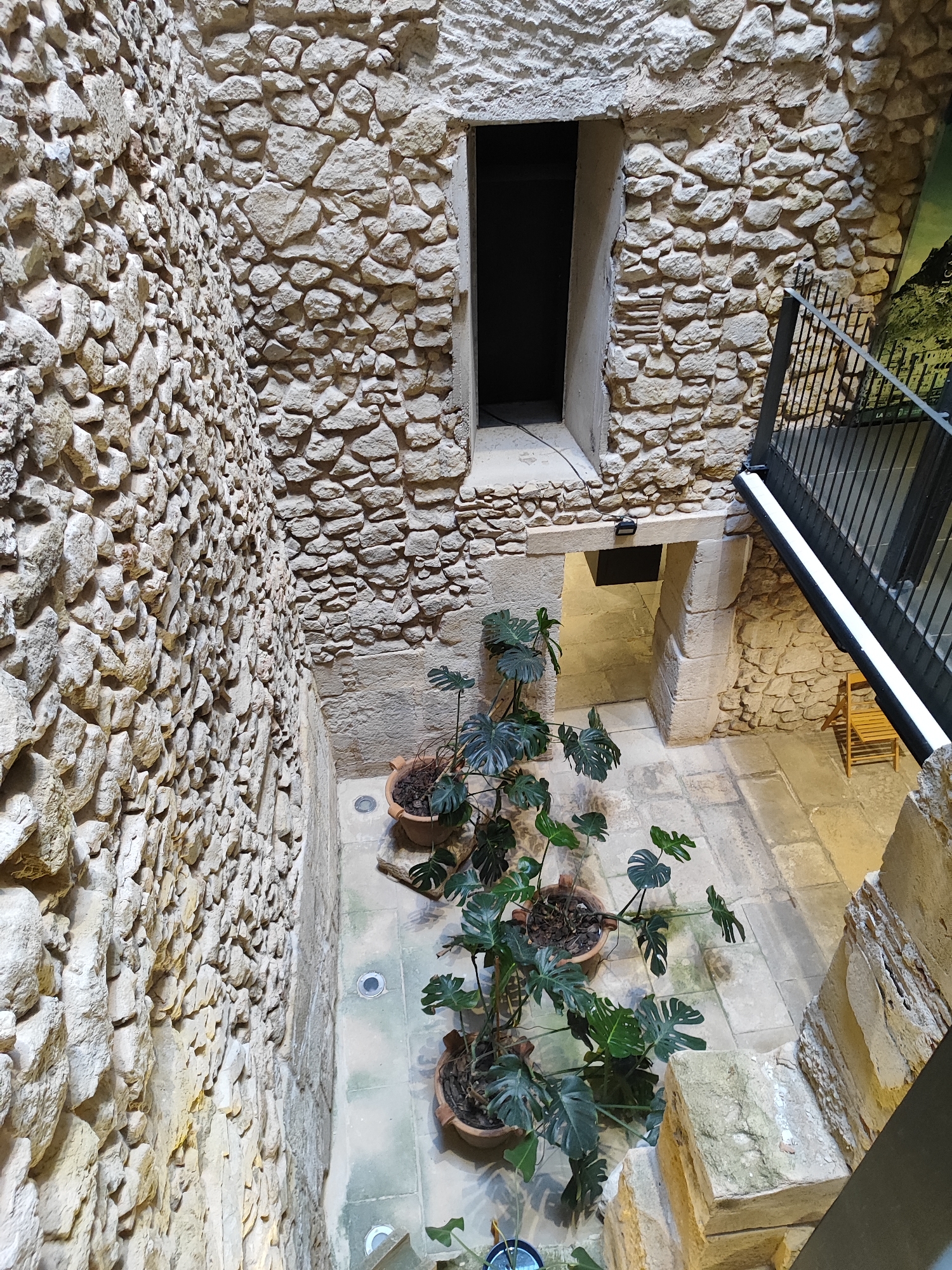
The image depicts an interior courtyard or atrium with rough-hewn stone walls. In the foreground, two large potted plants with broad, split leaves are visible. The plants are situated on the stone-tiled floor. To the right, a black metal railing and a portion of a staircase ascend along the wall. Beyond the plants, a doorway leads into a darker interior space, framed by rough stone. The architecture suggests an old building, possibly a historical site. A single wooden chair is visible through the doorway. The overall impression is of an ancient, well-preserved structure. This image was taken at the Castillo de Santa Bárbara in Alicante, Spain.
Alicante/alacant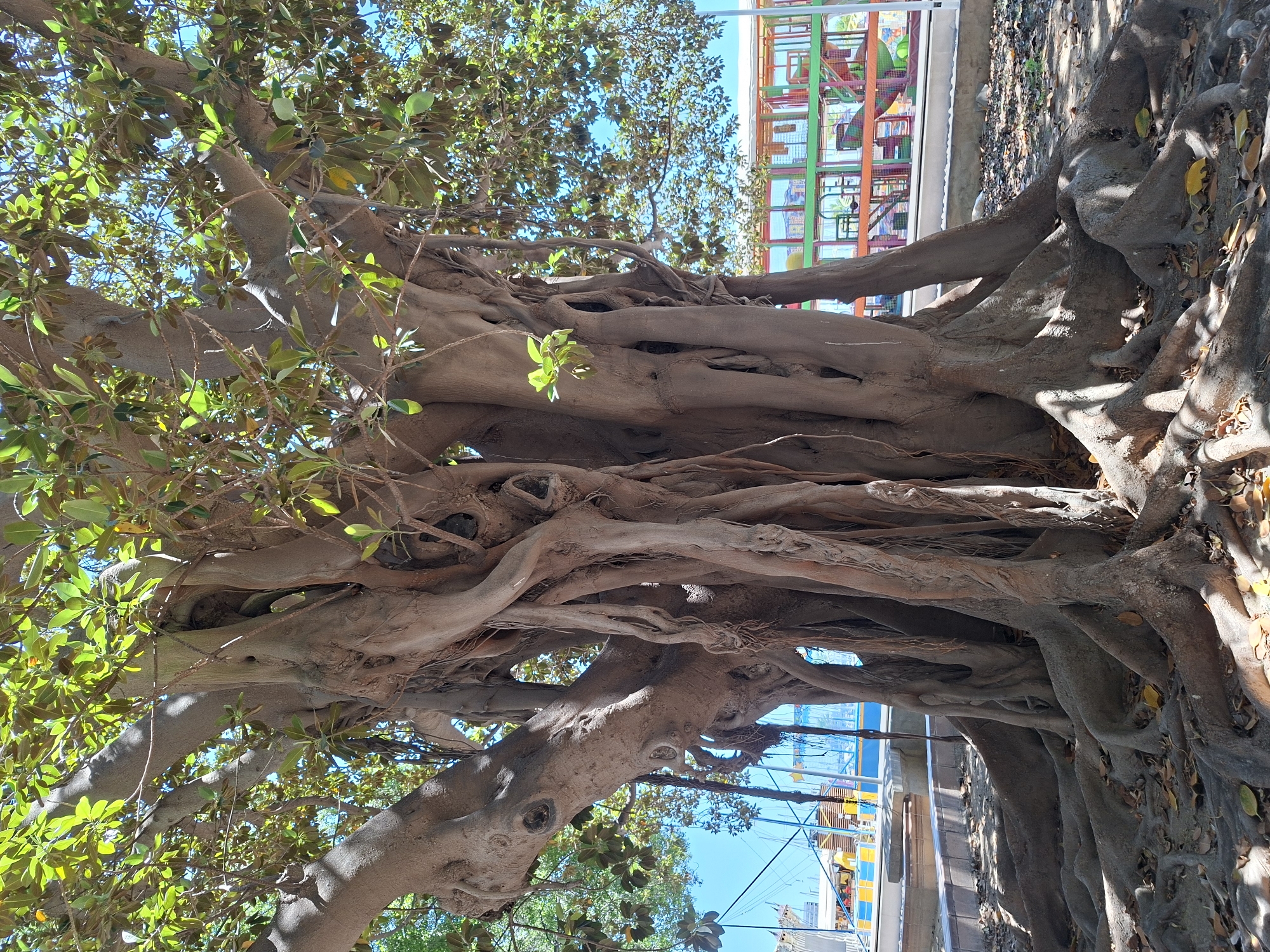
The image shows a large, mature Ficus tree with thick, gnarled roots exposed on the ground. The tree has a complex trunk structure with multiple intertwining branches and aerial roots hanging down. The leaves are green and dense, providing shade. In the background, a colorful children's playground structure is visible, along with a body of water and masts of boats. The scene is outdoors, under a clear blue sky, suggesting a sunny day. The environment appears to be a public park or waterfront area within the city of Alicante, Spain. There are no people visible in the image.
Alicante/alacant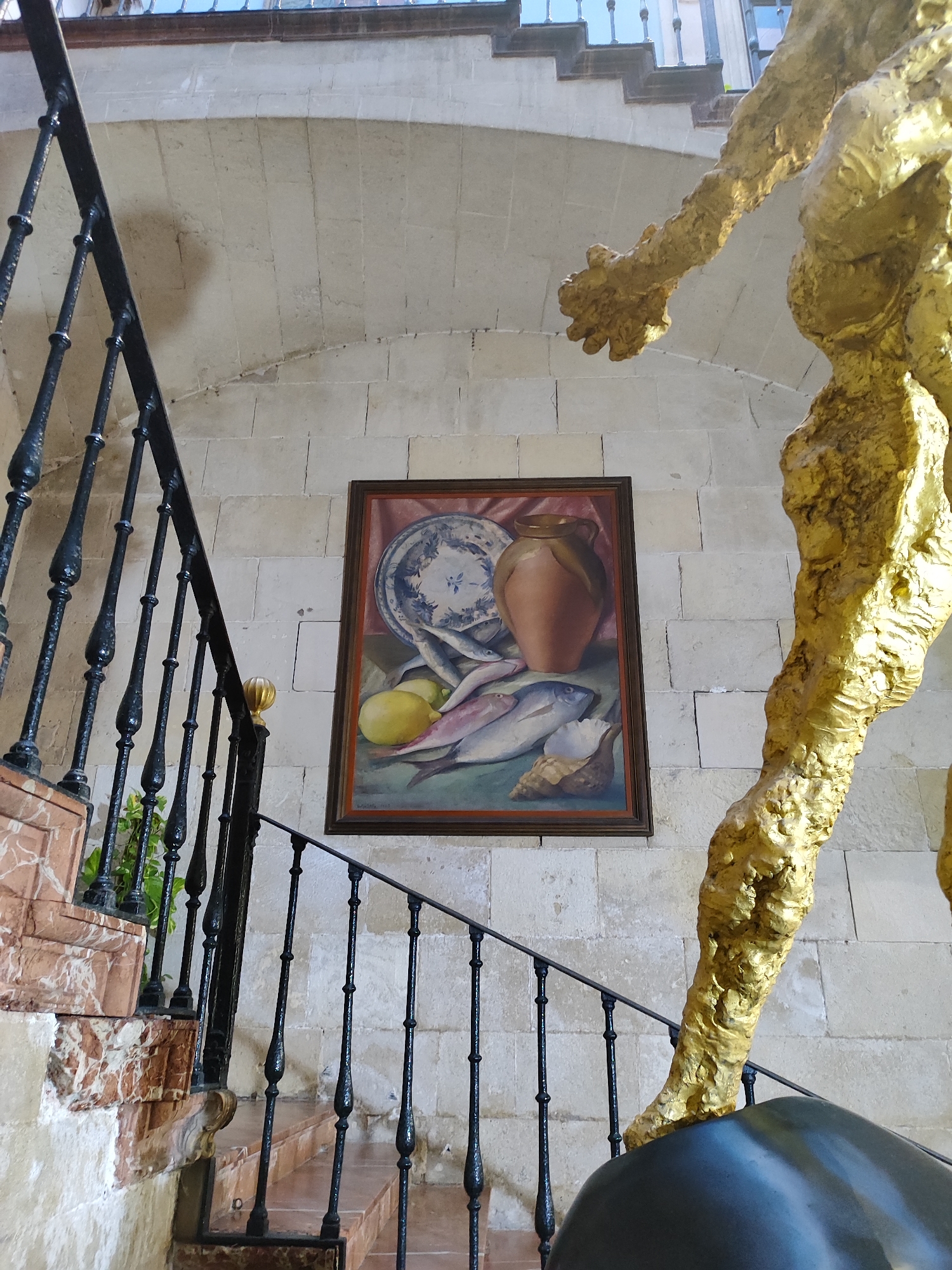
The image shows a still life painting of fish, lemons, a pitcher, and a shell, displayed on a stone wall. To the left of the painting, a marble staircase with black wrought-iron railings ascends. To the right, the lower part of a large, textured gold sculpture of a human figure is visible. The scene is indoors, likely in a public space like a museum or cultural center, given the presence of art and architectural features. The context provided indicates this is the Museum of Contemporary Art in Alicante, Spain.
Alicante/alacant
This image depicts an outdoor scene at night, likely a patio or garden area with a wooden structure resembling a small building or bar. The structure has a gabled roof and wooden walls. A fluorescent light fixture and a heater are visible inside the structure. String lights are draped through the branches of a large tree, casting a warm glow. Lush green foliage hangs from the branches and along the side of the wooden structure, interspersed with some red flowers and a woven hanging basket. The background is dark, suggesting it is nighttime, and a bright light source is visible in the upper right corner, possibly an outdoor lamp. While the image is rich in detail about the ambiance, it does not contain any elements that would specifically place it in Alicante/Alacant, Spain. There are no landmarks, signs, or other identifying features to confirm the location.
Alicante/alacant
A static, eye-level shot looks into a waiting room. Four blue, plastic chairs with white accents are lined up against a gray wall. Two colorful drawings are tacked to the wall above the chairs: one of Frankenstein's monster and another of a fairy. A bulletin board with papers is above the drawings. In the foreground, a small potted plant with green and maroon leaves sits on a dark table. To the left of the plant is a clear plastic cup. The flooring is a speckled gray linoleum.
Alicante/alacant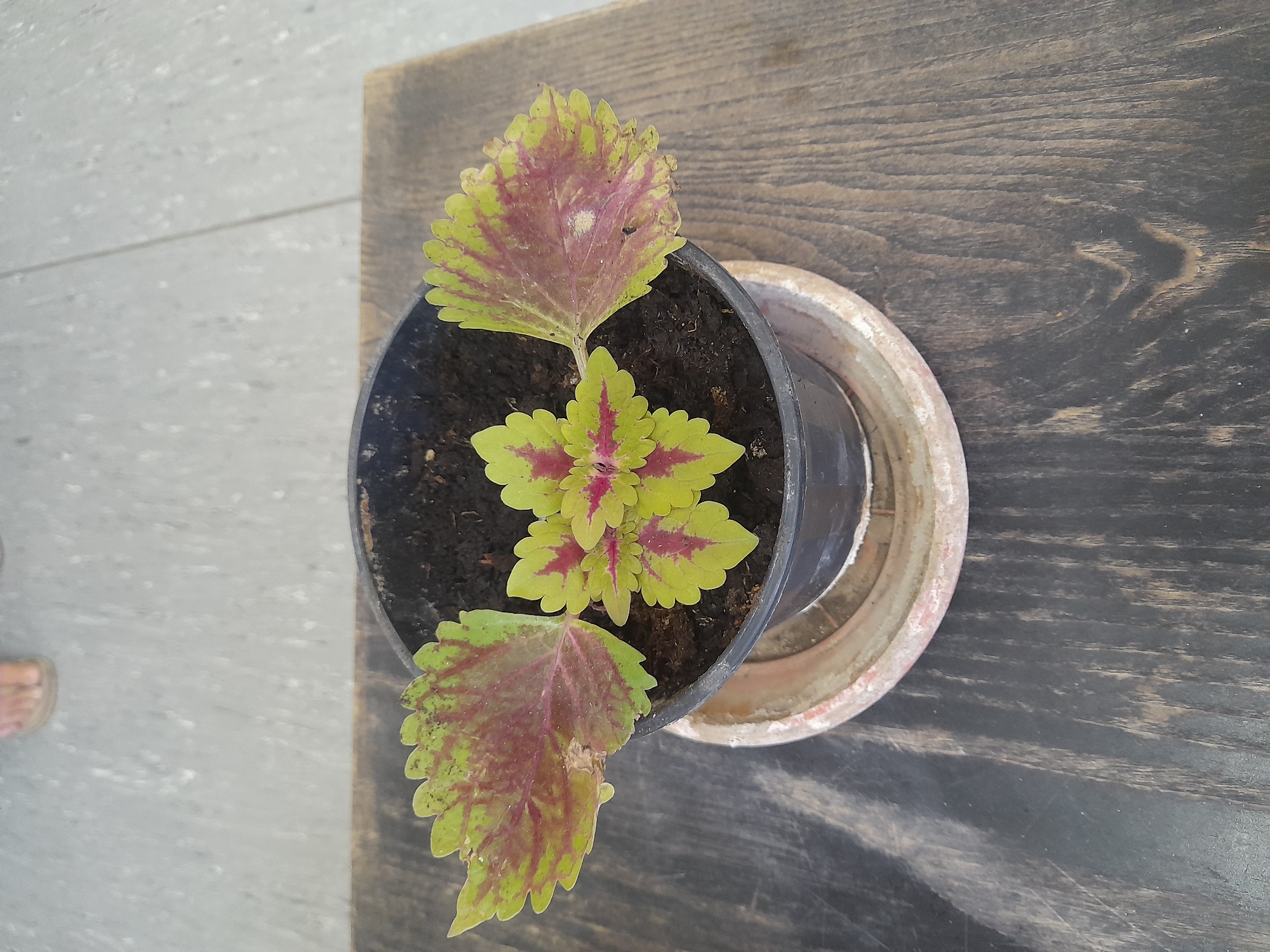
A potted coleus plant with green and burgundy leaves sits on a wooden surface. The plant is in a black plastic pot, which rests on a light-colored saucer. The wooden surface appears to be part of a table or bench, with visible wood grain. In the background, a portion of a person's feet wearing sandals is visible on a grey, textured surface that resembles pavement or concrete. The scene is likely outdoors.
Alicante/alacant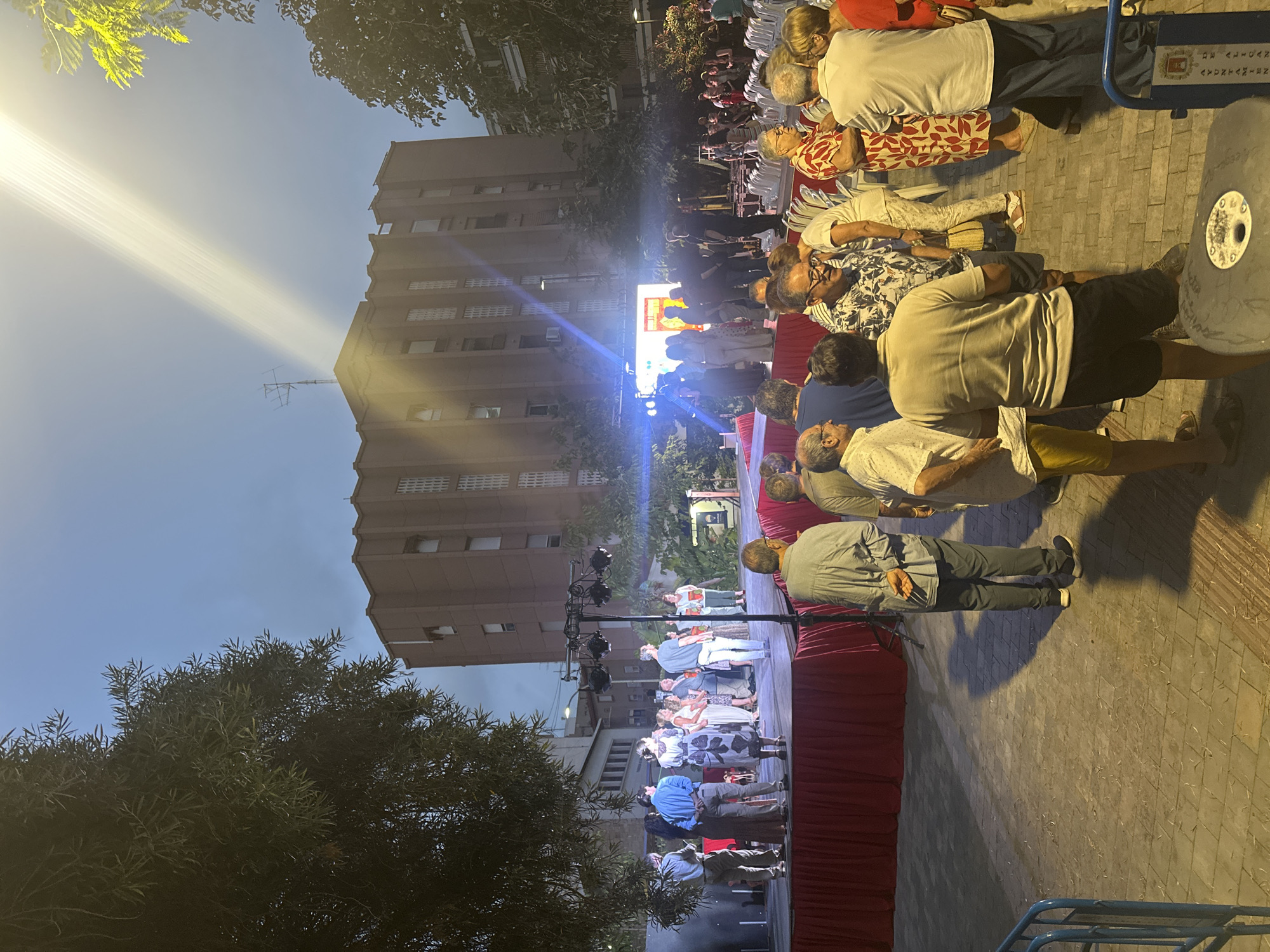
The image shows a group of people gathered outdoors, likely for an event or performance. Several individuals are seated in chairs, while others stand. The scene appears to be a street or plaza, with buildings visible in the background and trees lining the area. A stage with bright lights is set up, suggesting a performance is underway or about to begin. The lighting and attire of the people suggest it is evening or late afternoon. The overall atmosphere seems casual and social. There is a blue cart with text on it, partially visible, which may indicate a specific venue or organization. The location is identified as Alicante/Alacant, Spain.
Alicante/alacant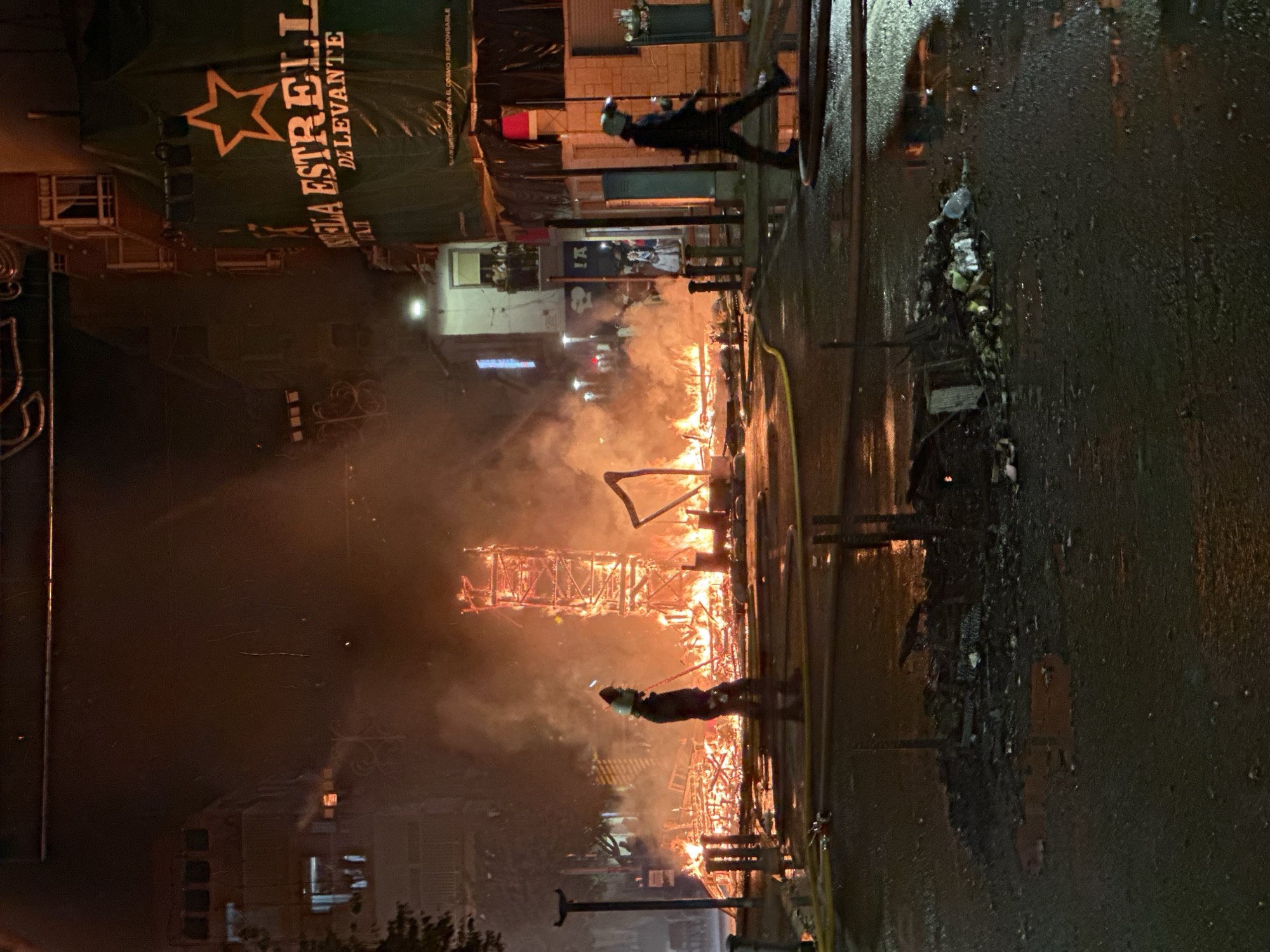
The image captures a scene at night in Alicante, Spain, during a significant fire. In the foreground, the wet asphalt reflects the surrounding light and flames. Debris, including plastic bottles and other refuse, is scattered on the ground. A yellow hose lies across the wet surface, suggesting ongoing firefighting efforts. Further back, a large structure, appearing to be made of wood and possibly part of a "Falla" monument, is engulfed in intense flames, sending thick smoke into the dark sky. The fire illuminates the surrounding buildings. Two individuals, presumably firefighters, are visible. One, in the mid-ground to the left of the burning structure, wears protective gear including a helmet and stands facing the fire. Another individual, to the right, also in protective gear, walks away from the camera, also appearing to be a firefighter. On the right side of the image, a building is draped with a large green banner bearing a prominent star and text, partially obscured by smoke and the angle, but clearly visible is "ESTRELLA DE LEVANTE," indicating a prominent local brewery. Above this, balconies on a building show people observing the scene. The overall environment suggests a public area in Alicante experiencing a dramatic event.
Alicante/alacant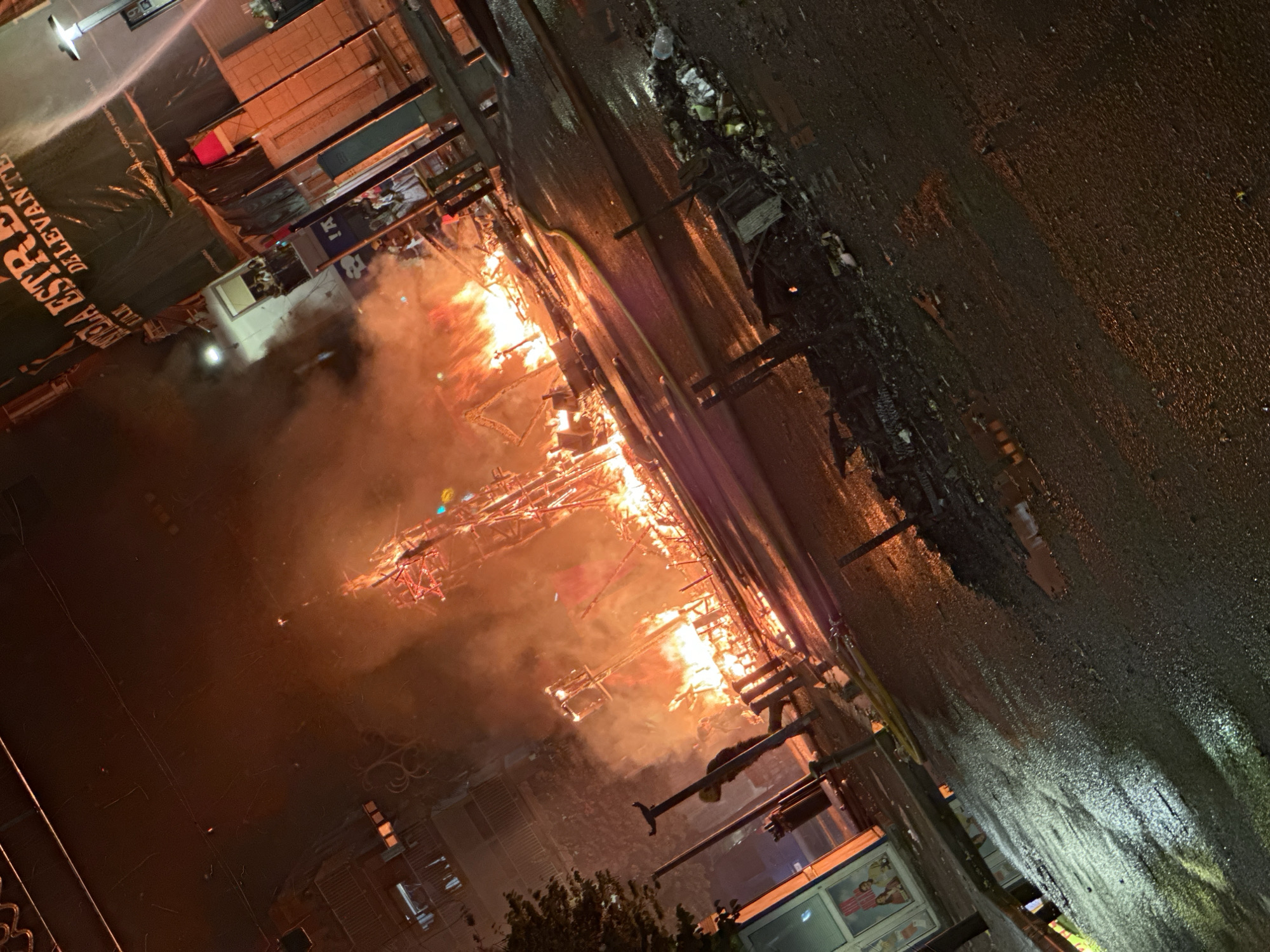
The image depicts a scene of widespread fire and destruction in what appears to be an urban environment at night, likely Alicante, Spain, based on the presence of a banner with text that appears to be Spanish. A large structure, possibly a temporary construction or monument, is engulfed in flames and smoke, with debris scattered on the wet street below. The street is reflective, indicating recent rain or water use, possibly from firefighting efforts. In the foreground, the street surface is dark and wet, with puddles and patches of standing water reflecting the orange glow of the fire. Debris, including what looks like burnt materials and possibly trash, is scattered across the roadway. A yellow hose is visible snaking across the street, suggesting active firefighting or its aftermath. There are several poles and street furniture, some of which appear damaged. In the mid-ground, the main subject is a large, multi-tiered structure that is almost entirely consumed by fire. Flames are erupting from various levels, and thick smoke billows upwards and outwards, obscuring parts of the surrounding buildings. The structure has a skeletal appearance, with exposed wooden or metal framework visible through the fire. In the background, buildings line the street. One building has a large dark green banner with white lettering, which appears to read "ESTRELLA DE LEVANTE". There are windows visible in the buildings, and in one, several people are seen looking out, observing the scene. Another building has illuminated signage and what looks like a storefront. The overall lighting is dominated by the fire, casting an orange and red hue over the entire scene. The image conveys a sense of chaos and destruction.
Alicante/alacant
The video depicts a street scene at night, illuminated by a large fire in the center. The fire appears to be consuming a structure, possibly a temporary installation or float, given the presence of an arched entryway and what looks like decorative elements. Smoke billows into the night sky. The street is wet, with reflections of the fire on the asphalt, suggesting it may have rained or been recently cleaned. Several figures, appearing to be people, are visible in the background, silhouetted against the flames, some seemingly observing the event. Buildings line both sides of the street, some with lit windows or signs, adding to the urban nighttime atmosphere. A banner with text and a star logo hangs from one of the buildings to the right of the fire. The overall impression is one of a dramatic event, possibly a festival or a controlled burn, taking place in a public urban space.
Alicante/alacant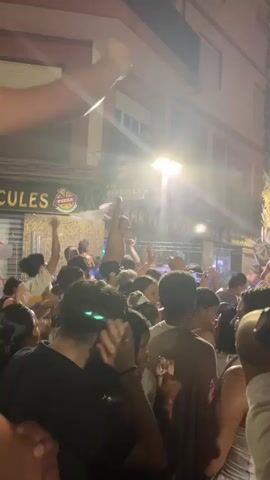
A nighttime outdoor street party is in progress. A crowd of people, densely packed, are visible from the chest up. Many are holding up their phones, suggesting they are recording or photographing. Some individuals are dancing and appear to be celebrating, with hands raised. Water is being sprayed into the air and onto the crowd, creating a misty atmosphere. In the background, buildings with windows and signs are illuminated. One sign reads "JULES". Another sign is partially visible with illuminated letters. The lighting is a mix of streetlights and neon, creating a vibrant, energetic, and somewhat chaotic scene.
Alicante/alacant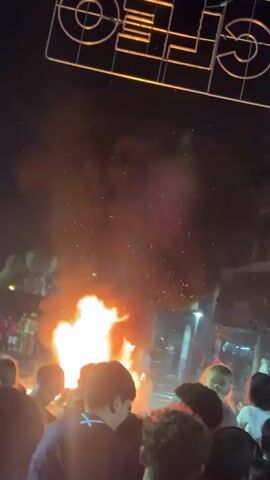
A nighttime street scene shows a large bonfire with flames erupting upwards and sparks scattering. In the foreground, the backs of several people are visible, some holding up mobile phones. Above the fire, a large illuminated sign with abstract geometric shapes and letters, possibly spelling out "OLEG", is suspended. In the background, there are blurred lights and shapes that suggest buildings and possibly other structures or decorations. The overall atmosphere appears to be festive or ceremonial, despite the intensity of the fire.
Alicante/alacant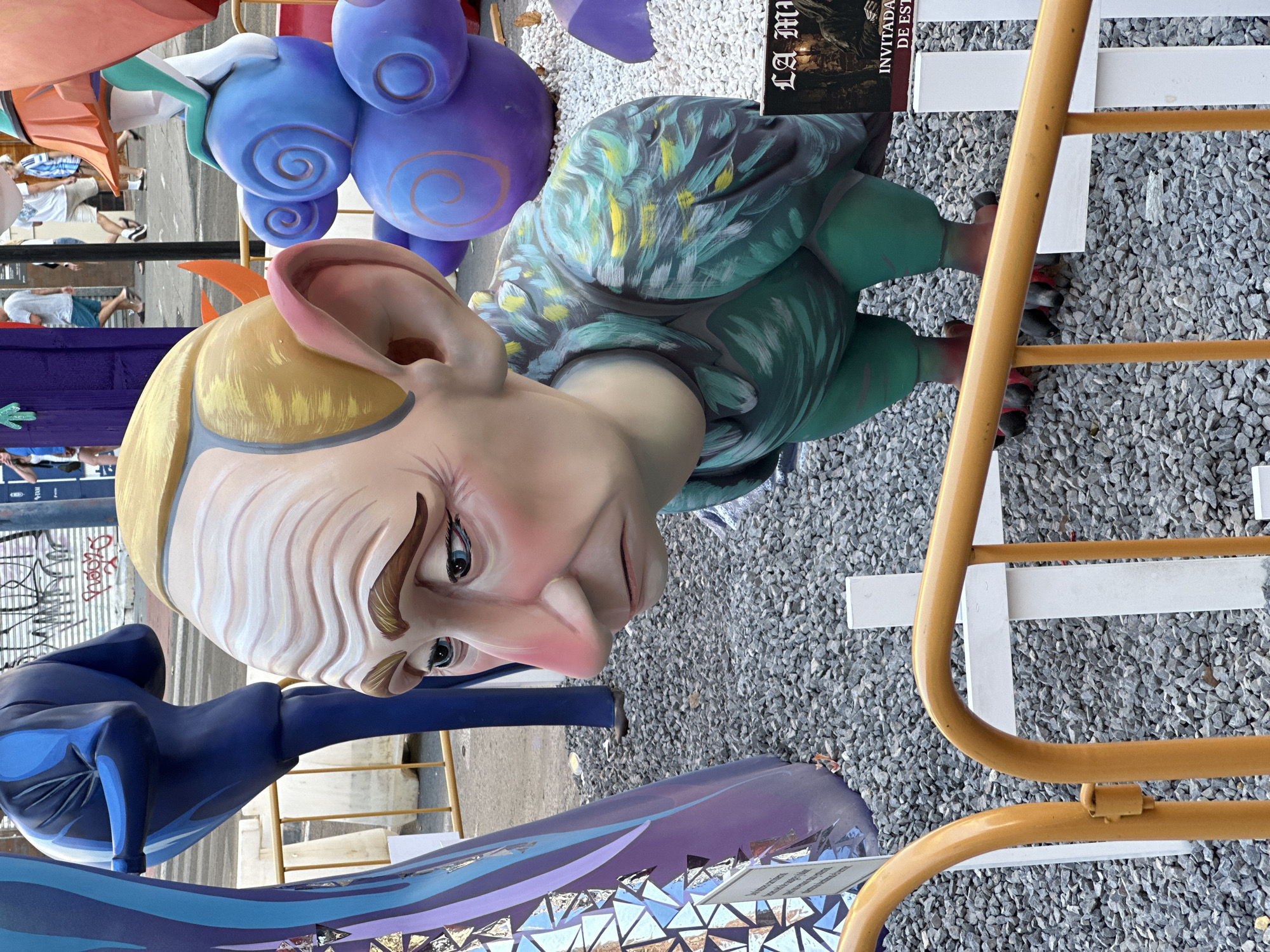
The image depicts a street scene featuring elaborate, oversized figurative sculptures, typical of a Fallas festival, likely in Alicante, Spain. The primary subject is a large, stylized head of a person with exaggerated features, including large ears, prominent nose, and wrinkled skin rendered in pale tones with rosy cheeks. The figure's blond hair is painted, and its eyes are a piercing blue. Behind and to the left of the main head, other colorful sculptures are visible. These include a large, coiled, purple shape resembling a cloud or a character, and parts of other figures in orange and blue. The sculpture in the foreground, on the right, is a torso covered in a green and yellow painted patterned fabric, with red accents on its feet. The sculptures are set against a backdrop of gravel and a white picket fence, with a bright yellow metal railing in the foreground. In the background, parts of other figures and structures can be seen, as well as some people observing the displays. The lighting suggests it is daytime, possibly sunny, casting shadows. A small sign is visible attached to the green sculpture, featuring some text in what appears to be a gothic font. The visible text reads "LA MAN" followed by "INVITADA DE EST". The overall impression is one of a festive, public display of art and cultural tradition.
Alicante/alacant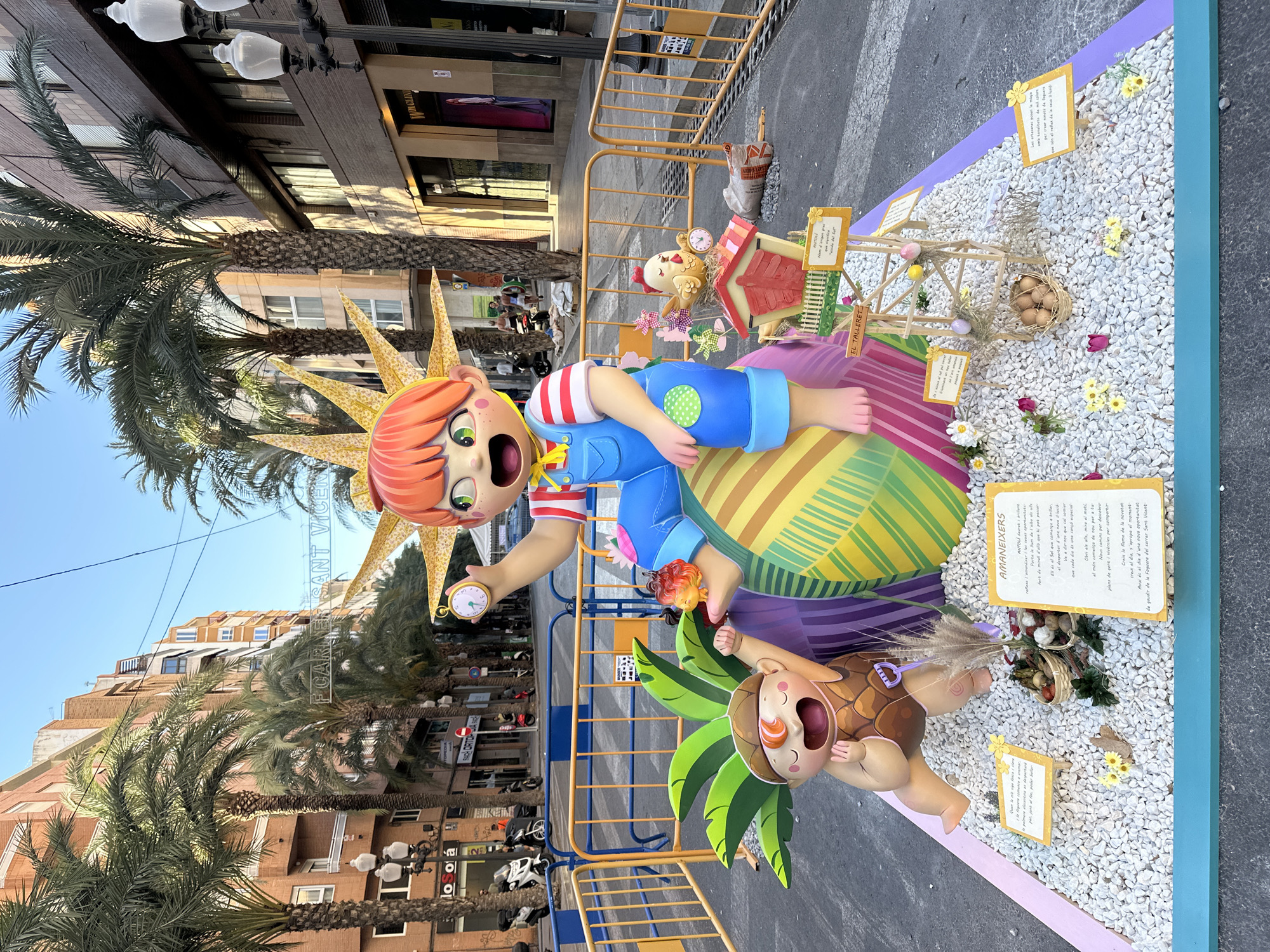
This is a vertical, medium shot of a large, colorful, street art display, likely a "falla" from the Valencian Community, Spain. The subjects are two cartoonish figures, one larger with orange hair and a yellow sunburst headdress, wearing a blue outfit with red and white striped sleeves, and holding a pocket watch. The other figure is smaller, lying on a bed of white pebbles, with brown hair and a shell-like headdress, wearing a brown outfit. The display is on a street, with buildings and palm trees in the background. There are also decorative elements like a small wooden structure with Easter eggs and flowers, and small signs with text in Spanish and Catalan. The scene appears to be set up outdoors during the daytime, with clear blue skies visible. The overall mood is festive and playful, indicated by the exaggerated expressions of the figures and the vibrant colors of the display. Signs visible include "FCARNER SANT VICEN", "EL TALLERET", and some handwritten text in Spanish and Catalan.
Alicante/alacant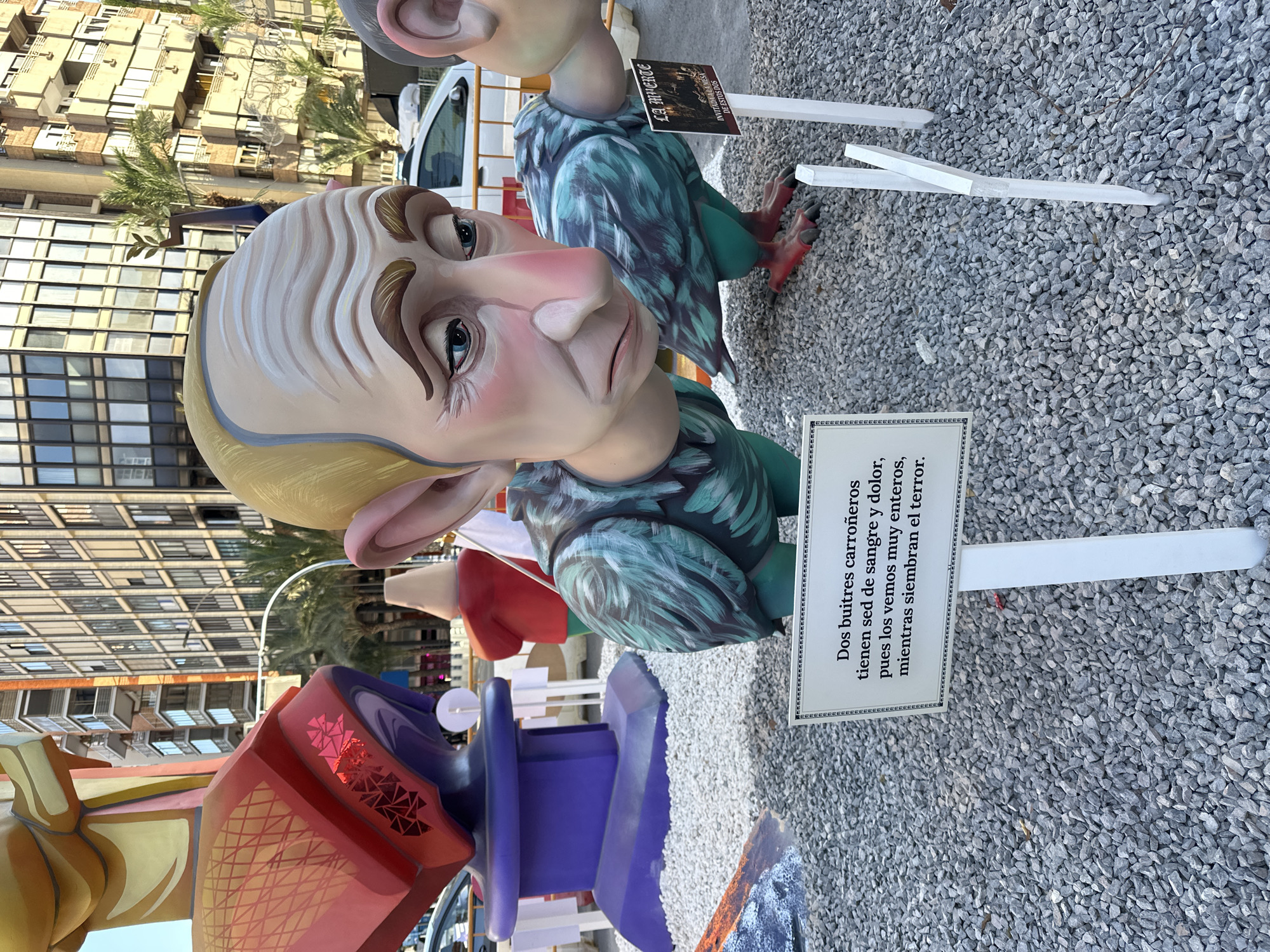
The image shows a large, colorful sculpture of two figures with human heads and bird-like bodies, situated outdoors on a bed of gray gravel. The figure in the foreground has a distinctly pained expression on its face, with wrinkled skin and downturned eyes, and appears to be composed of segmented, feathered wings. A sign in front of this sculpture reads in Spanish, "Dos buitres carroñeros tienen sed de sangre y dolor, pues los vemos muy enteros mientras siembran el terror." This translates to "Two scavenger vultures are thirsty for blood and pain, as we see them very whole while they sow terror." To the right of the main sculpture, a smaller sign depicts a skeletal figure and the word "LA MUERTE," meaning "DEATH." In the background, modern buildings and palm trees suggest an urban setting. The overall scene is likely part of a "Fallas" festival, a traditional celebration held in Valencia and other parts of the Valencian Community, including Alicante, in March, characterized by the construction and public burning of large, satirical sculptures called "ninots."
Alicante/alacant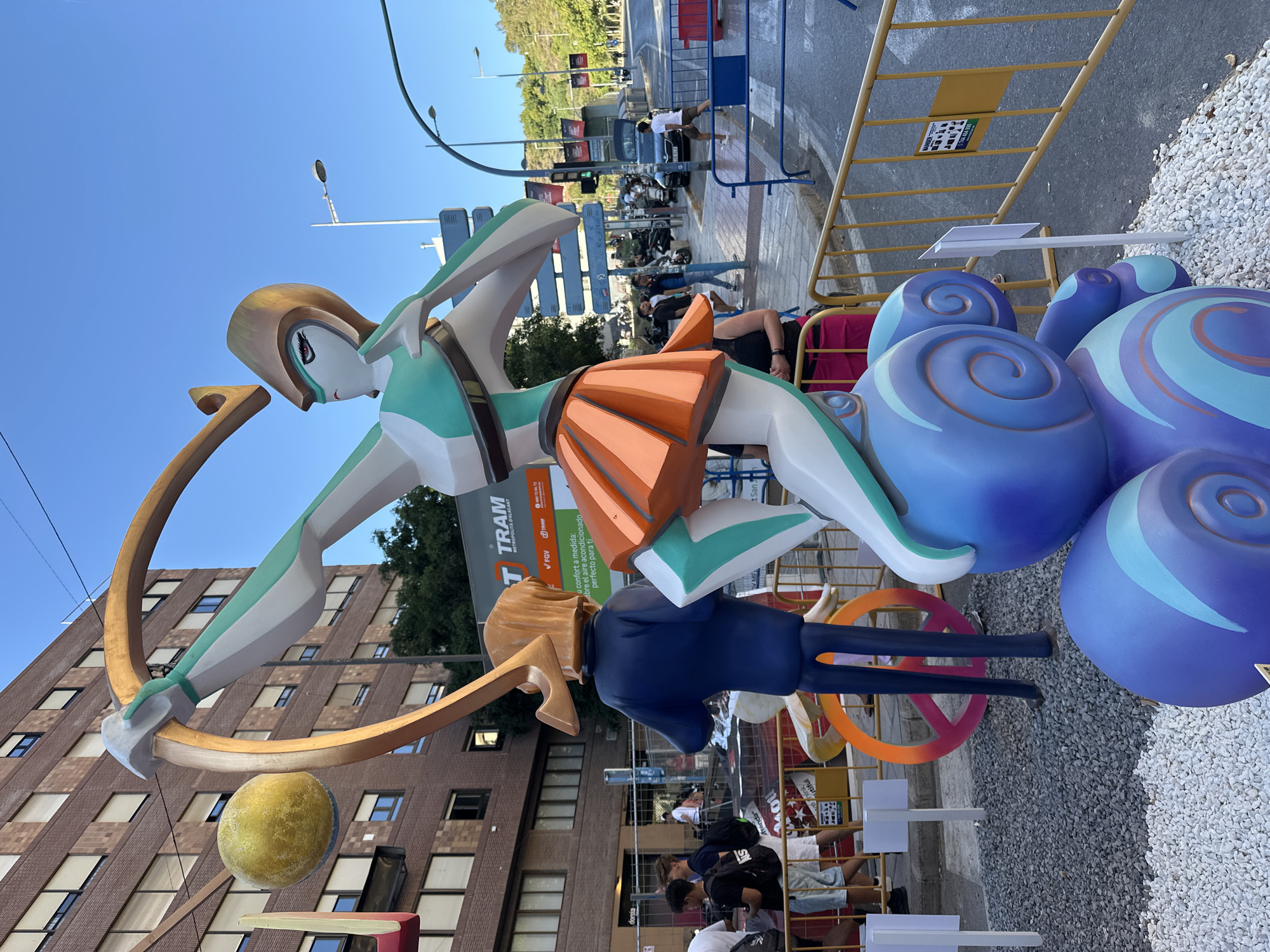
This is a medium shot, outdoors, low-angle photo taken in what appears to be a city street. The main subjects are two large, stylized figures that are part of a street art installation. The figure in the foreground is a woman with a golden helmet, wearing a teal and white outfit and an orange skirt. She is holding a large golden bow and arrow, with a yellow sphere suspended below it. Behind her, a second, smaller figure is dressed in a dark blue outfit. Both figures are made of brightly colored, geometric shapes. The figures are set against a backdrop of a multi-story brick building on the left and a street with cars, people, and barriers on the right. The sky is a clear, bright blue, suggesting it is a sunny day. The time of day appears to be late morning or early afternoon. The scene is likely part of a festival or public art display, given the scale and elaborate nature of the figures and the presence of temporary barriers. Visible text includes "dorsia," "frenda," "nink," "utiful," and a logo for "T TRAM METROPOLITA D'ALACA" with "FGV" and "TRAM" brands. There are also phone numbers and advertising-like text in Spanish. The location context of Alicante/Alacant, Spain, is given. The overall mood is vibrant and festive, with the bright colors and dynamic poses of the figures.
Alicante/alacant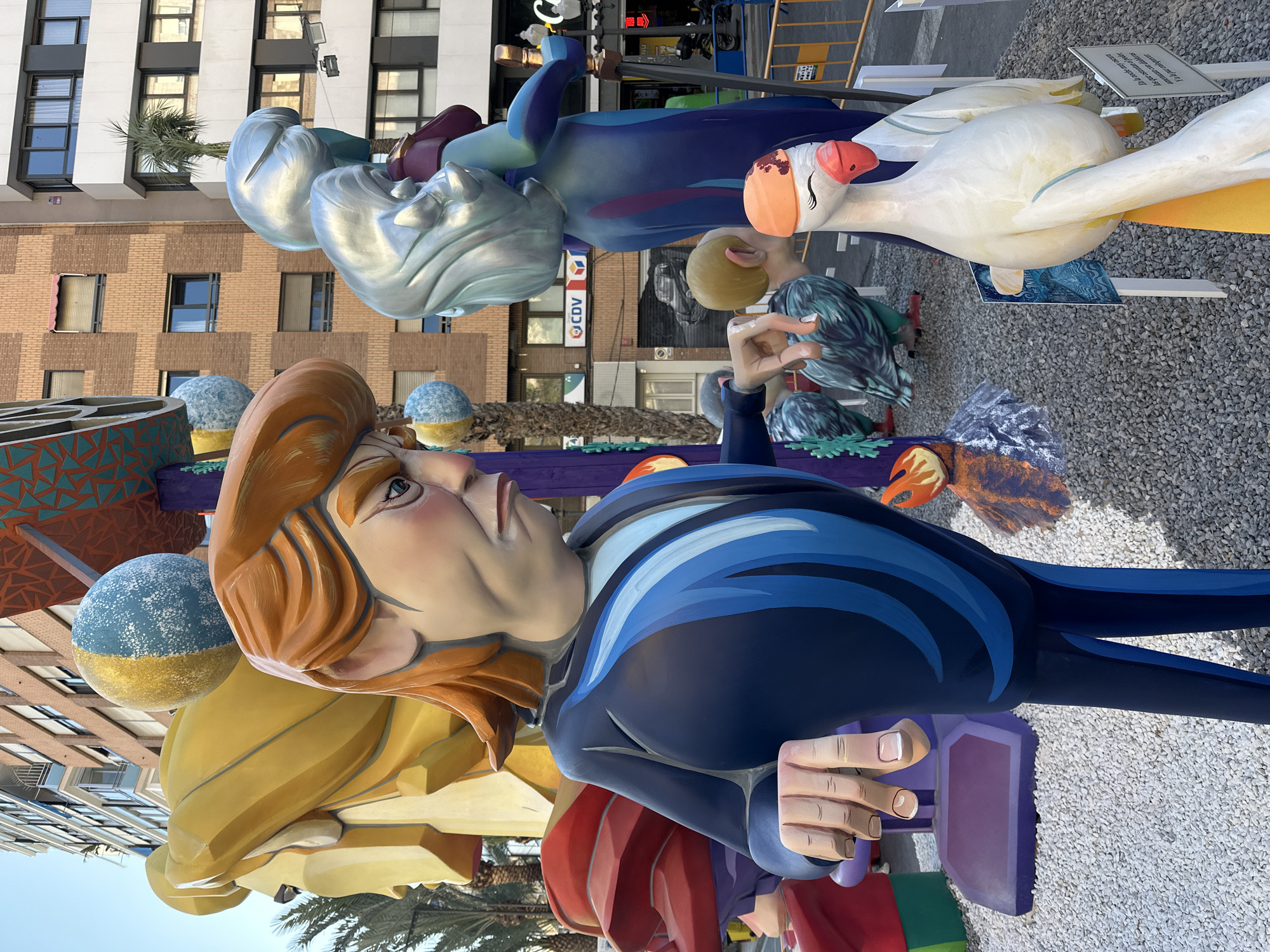
This is a vertical, eye-level, medium shot of a large, colorful artistic installation outdoors. The sculpture features stylized figures with exaggerated features and bright colors. In the foreground, a large, cartoonish figure with ginger hair, a blue jacket with blue stripes, and tan skin is prominently displayed. The figure's left hand is extended, holding a purple object. Behind this figure, a large yellow shape representing hair or clothing is visible. In the mid-ground, other sculpted elements are present. One is a large, white bird-like figure with a pink beak and cartoonish eyes, perched on a blue body. Further back, a silver-colored abstract sculpture resembles a face or headdress. Other smaller, spherical blue sculptures with gold accents are also visible. The figures are set against a backdrop of a building with a brick facade and white upper floors, featuring numerous windows. The scene appears to be an outdoor event, possibly a festival or exhibition. The ground is covered in small white pebbles. The lighting suggests it is daytime, with bright sunlight casting shadows. The overall impression is one of vibrant art and festivity. There are no explicit time-of-day or weather cues beyond the general brightness. The location is implied to be Alicante, Spain, as indicated by the context. A small sign with text is visible in the upper right corner, but the text is too small to read. Another sign with text is visible on the white bird-like sculpture. The installation appears to be a large-scale piece of public art, possibly part of a larger display.
Alicante/alacant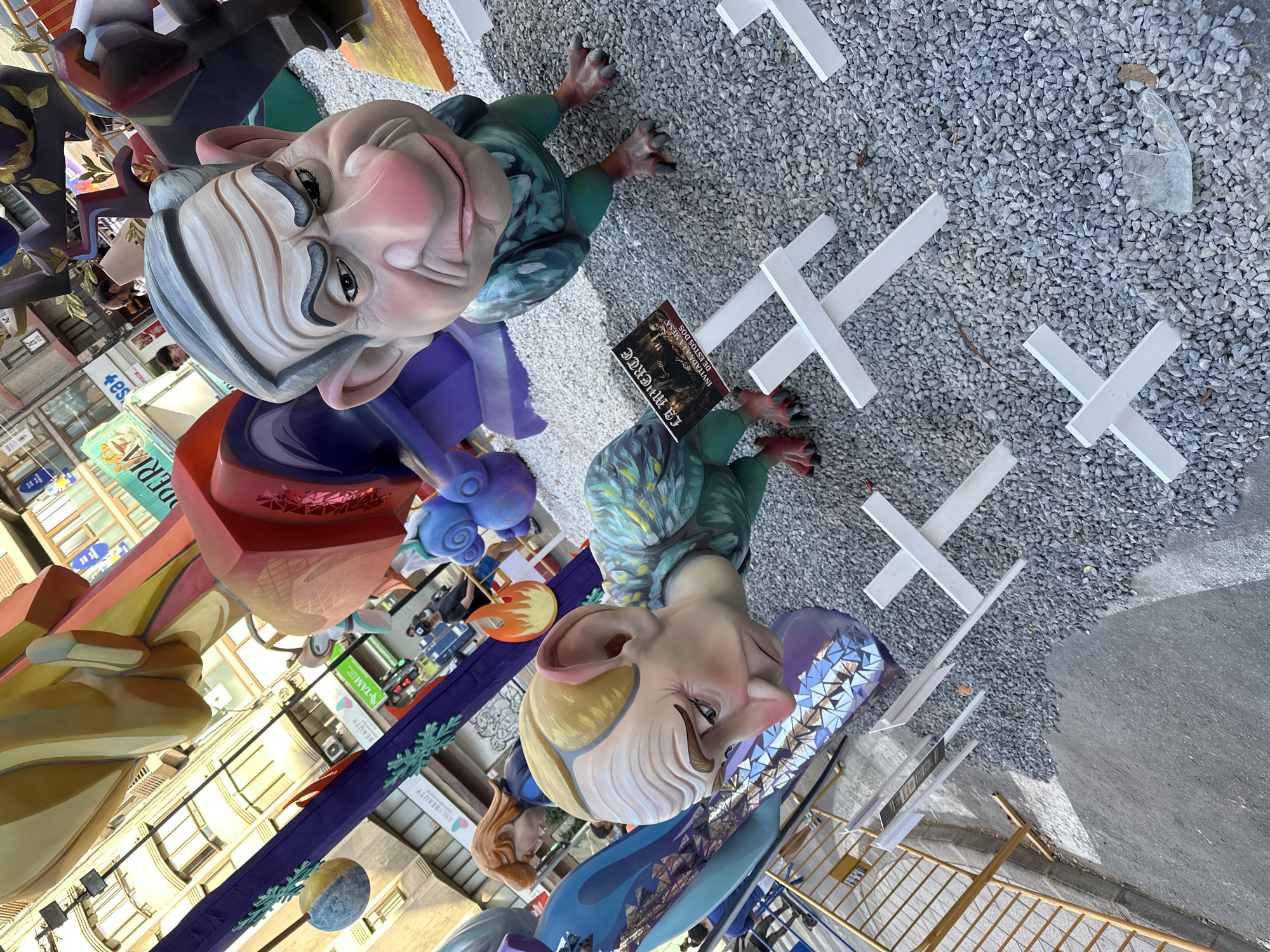
This image captures a scene in Alicante, Spain, featuring large, colorful, caricature-like figures that appear to be part of a street festival or display, possibly a "Falla" celebration, given the context of Alicante. The figures are exaggerated and whimsical, with one depicting an older man with grey hair and a stern expression, and another a creature-like figure with large ears and a smiling, slightly mischievous face. They are made of vibrant materials, with detailed sculpting and painting, suggesting they are handcrafted works of art. The figures are positioned outdoors, set against a backdrop that includes buildings with visible storefronts and signage, indicating an urban setting. The ground is covered in gravel and asphalt, with several white cross-like structures placed around the figures, possibly as part of the display or for crowd control. In the background, glimpses of people can be seen, suggesting the presence of an audience or participants in the event. A notable detail is a small, black sign held by one of the figures, which contains text in what appears to be Spanish. The text is difficult to read clearly in the main image but appears to be "29 MARZO INVITAN A LA MESA DE ESTOS DOS". This suggests a specific date, "March 29th," and an invitation to "the table of these two," possibly referencing the figures or a related event. The overall atmosphere seems festive and lively, typical of a Spanish cultural celebration. The lighting suggests it might be daytime, with overcast conditions or shadows from surrounding structures.
Alicante/alacant