Amaghu, Armenia
7 memories from Amaghu, Armenia
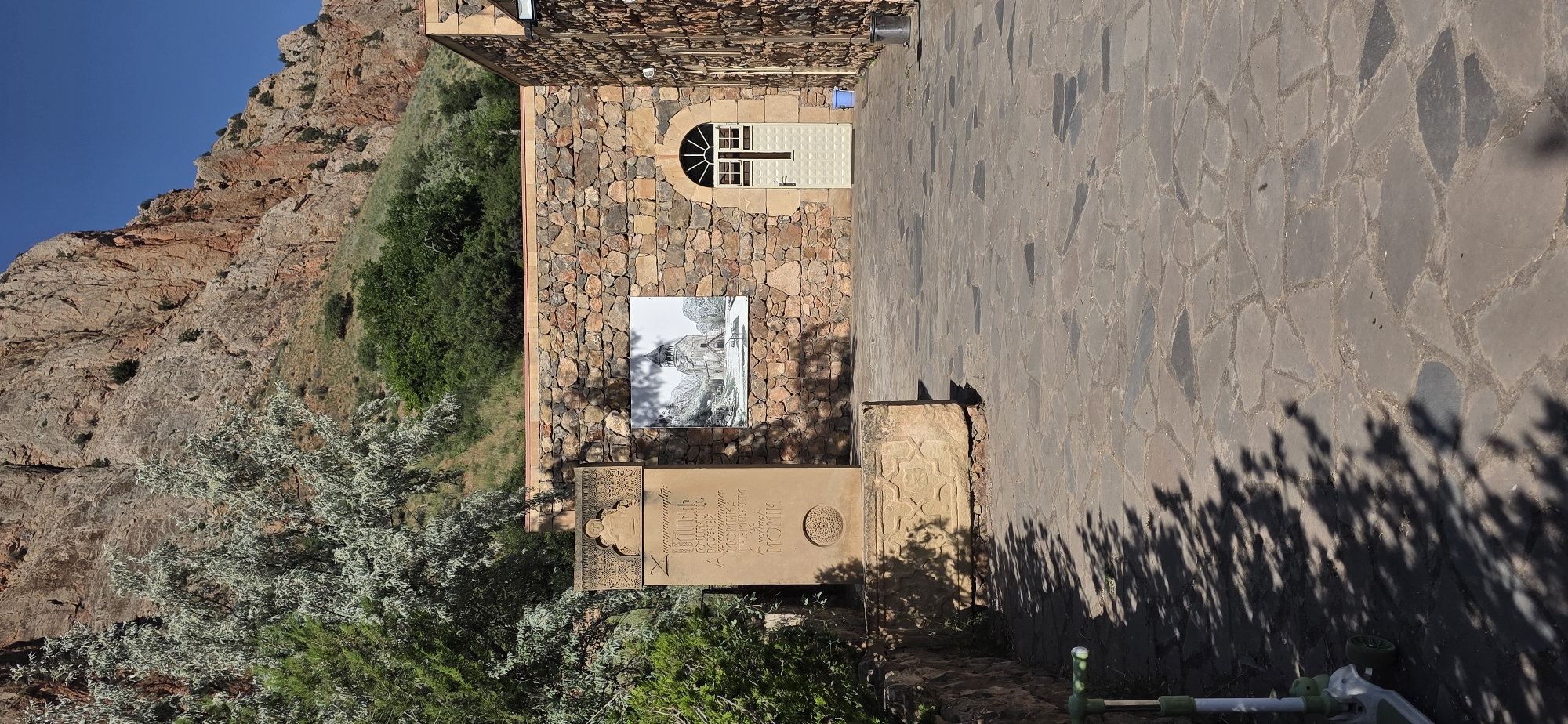
The image shows an outdoor courtyard paved with irregular stone slabs. In the background, a rugged, reddish-brown cliff face rises steeply under a clear blue sky. To the left, a large tree with silvery-green foliage casts shadows on the ground. A stone monument stands to the left of center, featuring engraved text and a decorative carving at the top. Adjacent to the monument is a stone base with geometric carvings. The wall of a building, constructed from rough-hewn stones, runs across the middle ground, displaying a large black and white framed image of a church. To the right of this image, a light-colored door with a distinct cross-shaped handle is set into the stone wall, next to a window with arched panes. Further to the right, another section of the stone building is visible. A small green and white scooter is positioned on the left side of the paved area, partially in shadow. This scene is located in Amaghu, Armenia, likely at the Noravank monastery complex, given the architectural style and the presence of the Momik sculpture.
Amaghu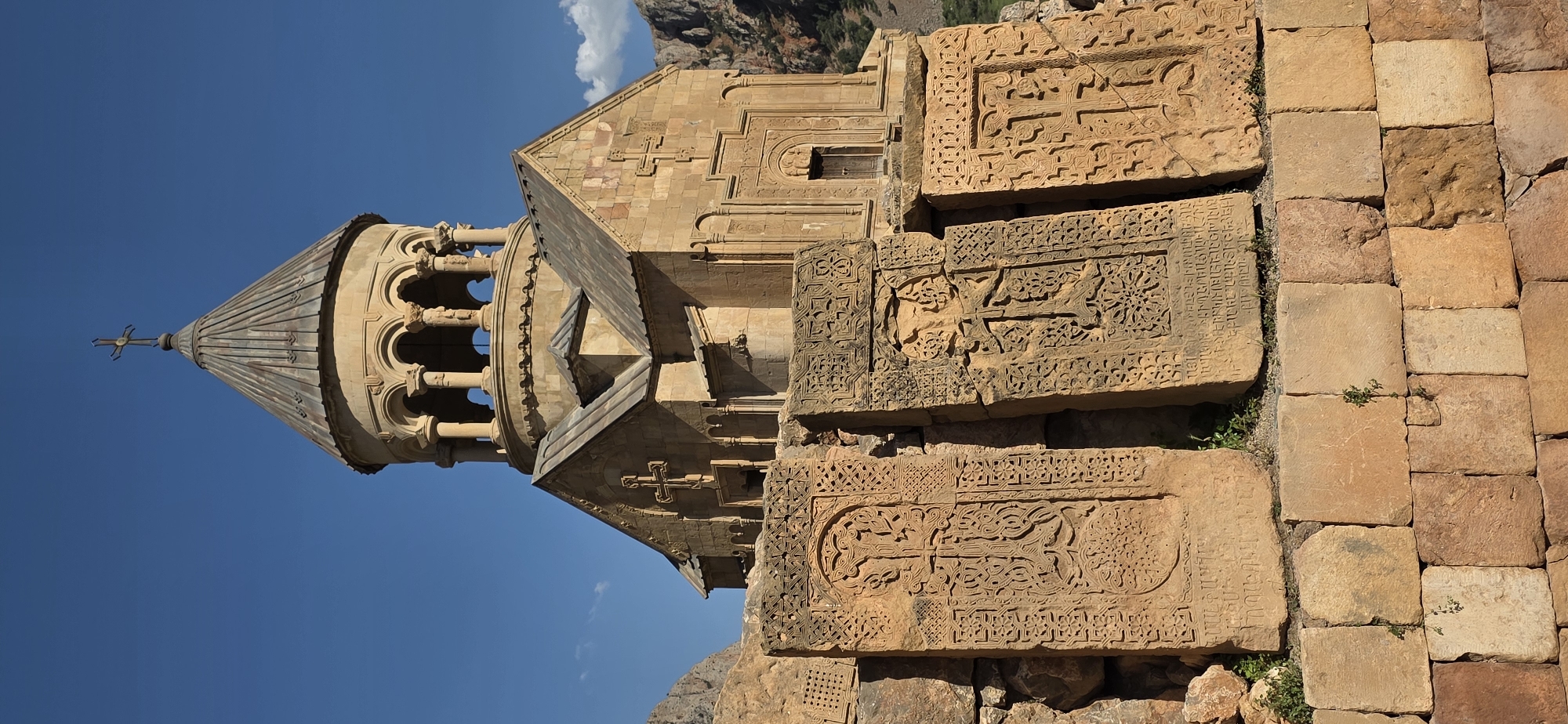
The image displays the Noravank Monastery complex located in Amaghu, Armenia. In the foreground, three large, intricately carved stone slabs, known as khachkars, stand upright. These khachkars are ancient Armenian cross-stones, each adorned with elaborate knotwork and Christian symbols. Behind the khachkars, the monastery building is visible, characterized by its weathered sandstone construction. The main structure features a conical dome topped with a cross, supported by an octagonal drum with arched openings. The facade of the building is embellished with crosses and decorative carvings. The surrounding environment includes rocky hills and a clear blue sky.
Amaghu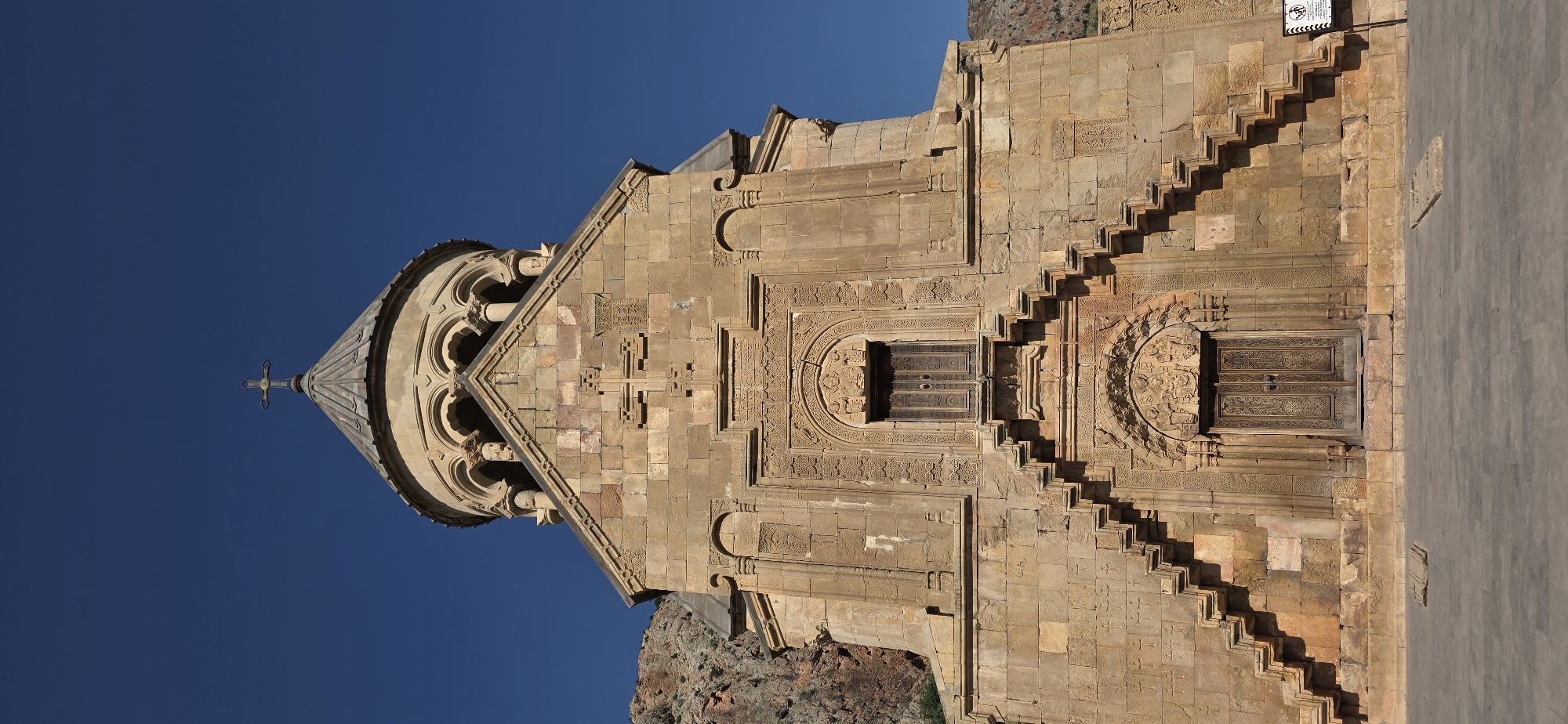
The image shows a low-angle, full frontal view of the Noravank Monastery church facade, located in the city of Amaghu, Armenia. The church is constructed of ochre-colored stone and features a prominent, conical dome topped with a cross. The facade is intricately carved with religious motifs, including a large cross above a decorative arched window with wooden doors. Below this window, a steep, zigzagging stone staircase leads to another set of ornate wooden doors, above which is a carved tympanum depicting figures. The church is situated against a backdrop of rugged, rocky cliffs under a clear blue sky. To the right of the entrance, a small, square sign with symbols is visible. The foreground consists of a paved courtyard. No people are present in the image.
Amaghu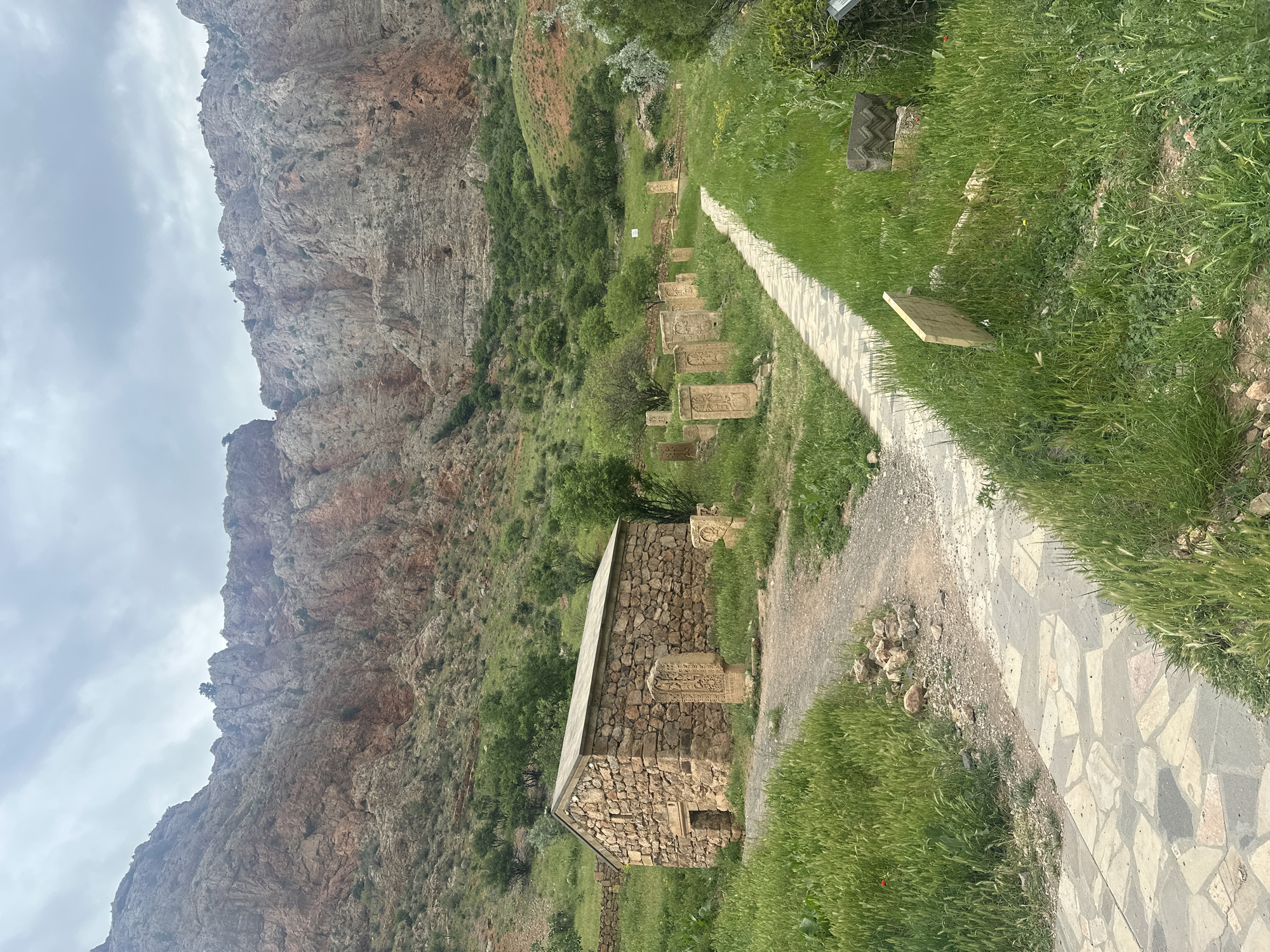
This image depicts a historical site located in Amaghu, Armenia, under an overcast sky. The scene is dominated by a rugged mountainous backdrop composed of grey and reddish-brown rock formations, with sparse green vegetation on its lower slopes. In the mid-ground, a small, rectangular stone building stands on the left. It is constructed from irregular, light brown and grey stones and features a dark grey, slightly pitched roof. A recessed, arched doorway and a small window are visible on its facade. To the right of the building and extending into the background, a series of upright stone monuments, likely Khachkars (Armenian cross-stones), are arranged within a vibrant green grassy field. These monuments are made of light-colored stone and display carved patterns. Two pathways traverse the scene. A dirt path curves towards the stone building from the foreground. Parallel to this, a paved pathway, constructed from irregularly shaped grey and beige flagstones, extends straight back into the distance, bordered by the grassy area and several more monuments on its right side. The ground is covered with lush, tall green grass, interspersed with small trees and shrubs, particularly evident in the mid-ground. No people are visible in the scene. The lighting is soft and diffused, indicative of a cloudy day.
Amaghu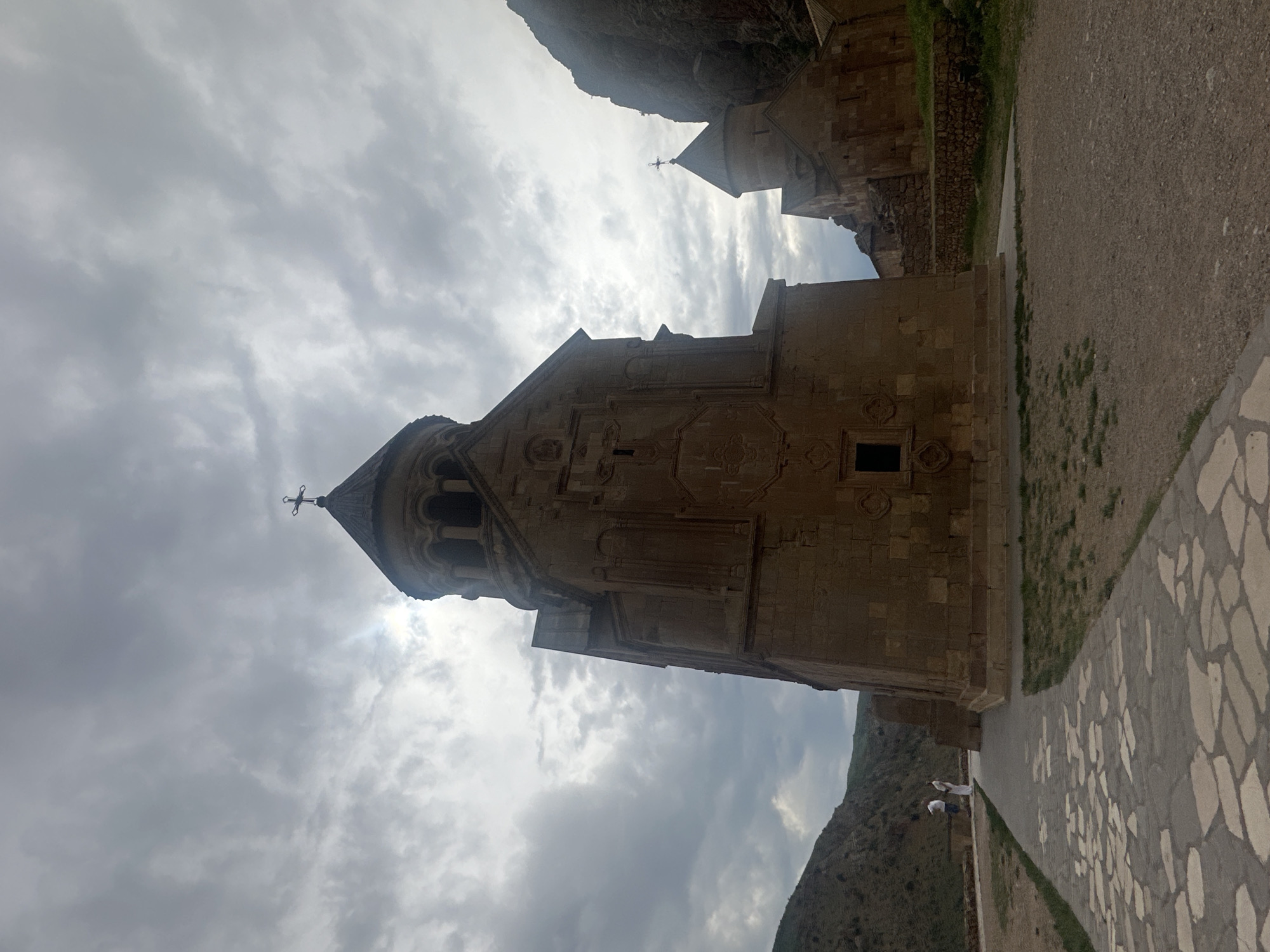
The image displays the Noravank Monastery complex located near the village of Amaghu (as specified, "city of Amaghu") in Vayots Dzor Province, Armenia. The central subject is a large, light-brown stone church, likely Surp Astvatsatsin, featuring a prominent conical dome capped with a Latin cross. The dome rests on an octagonal drum with arched windows. The church's facade exhibits carved stone details, including rosettes and geometric patterns. To the right and behind this main structure, a smaller stone church with a similar conical roof and cross, likely Surp Karapet, is visible, situated against a steep, dark rock face. The surrounding landscape includes arid, vegetated hills on the left and a dramatic rocky cliff on the right. The sky is heavily overcast with grey clouds, showing brighter areas where sunlight penetrates from behind the main church, creating a backlit effect. A paved pathway of irregular flagstones leads towards the central church from the lower left. The ground consists of dry earth, sparse grass, and gravel. Two individuals are present on the left, standing near a low wall; one wears a light shirt and dark trousers, and the other wears a long, light-colored robe, both observing the scene.
Amaghu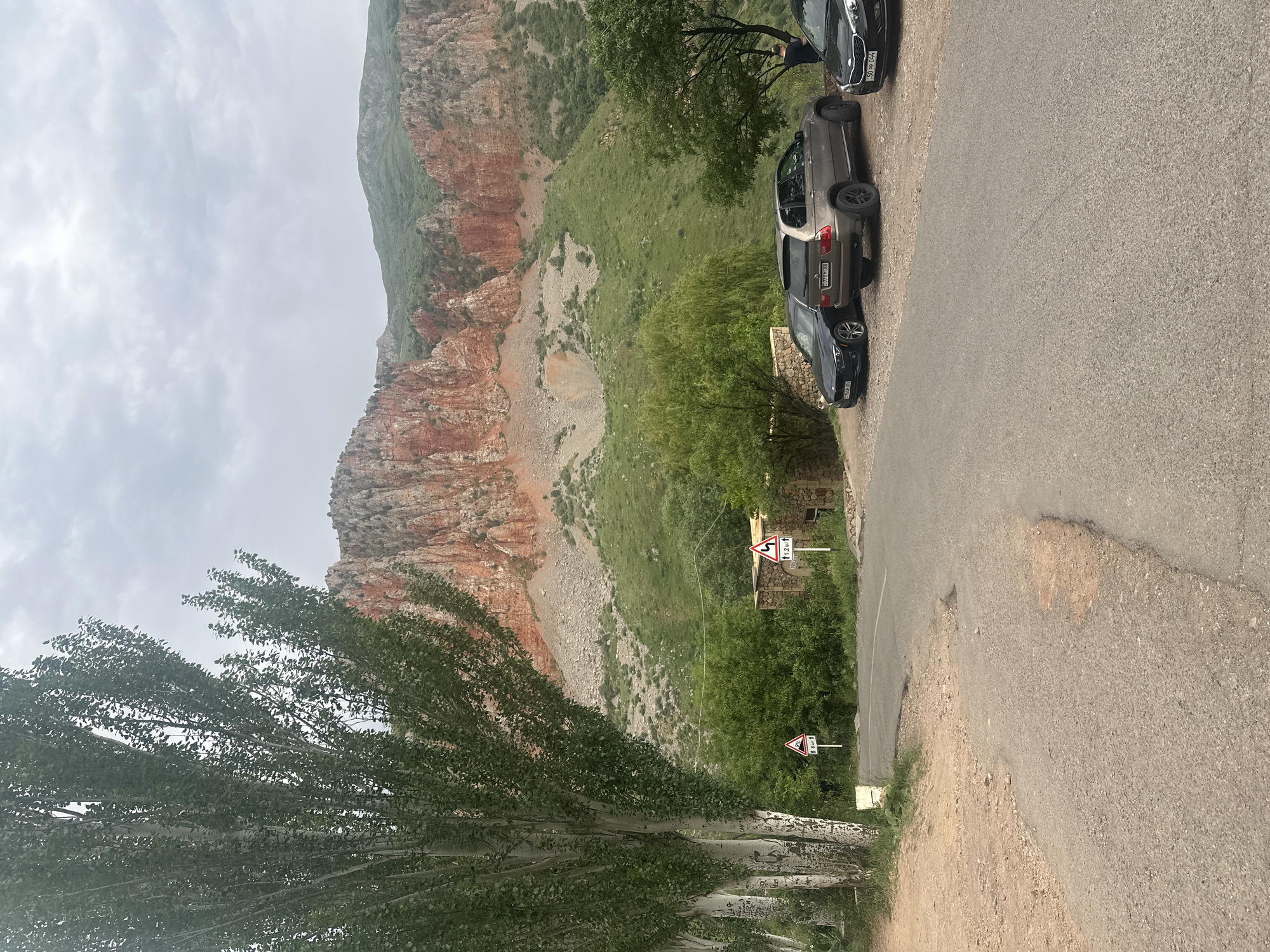
The image depicts a mountainous landscape in the vicinity of Amaghu, Armenia, under an overcast sky. In the immediate foreground, a weathered asphalt road occupies the lower portion of the frame, showing signs of distress including potholes and uneven surfaces. To the left of the road, a dirt shoulder is visible, alongside a row of tall, slender trees with light-colored bark and dense green foliage. Several tree trunks exhibit visible markings or graffiti. A white rectangular marker post stands near the base of the leftmost trees. Moving into the midground, the road appears to curve slightly to the right. Two triangular warning signs with red borders and white backgrounds are present on the right side of the road. The left sign displays a black upward-pointing arrow with a percentage symbol, indicating a steep gradient, and the Armenian text "8 անց" (8 units). The right sign shows a black winding arrow, indicating a series of curves, with the text "1.2 կմ" (1.2 km). Behind these signs, partially obscured by green foliage, a small stone structure with a yellowish roof is discernible. Further to the right, adjacent to the road, three vehicles are parked on a gravel/dirt area. From left to right: a dark blue/black sedan with Armenian license plate "76 LU 076"; a beige/gold BMW X5 SUV (E53 generation) with Armenian license plate "77 EM 088"; and a dark grey/black sedan/hatchback with Armenian license plate "50 PP 044". A person, clad in dark attire, is visible standing near the rear of the rightmost parked vehicle, partially obscured by a tree. The background is dominated by a dramatic mountainous terrain. Steep, reddish-brown rock cliffs and formations are prominent, showing exposed strata and rocky scree at their base. The lower and middle slopes of these mountains are covered in vibrant green vegetation and scattered rocks. In the far background, additional mountains, appearing softer and entirely green, rise under a uniformly grey, overcast sky. The overall light is diffuse, characteristic of cloudy conditions.
Amaghu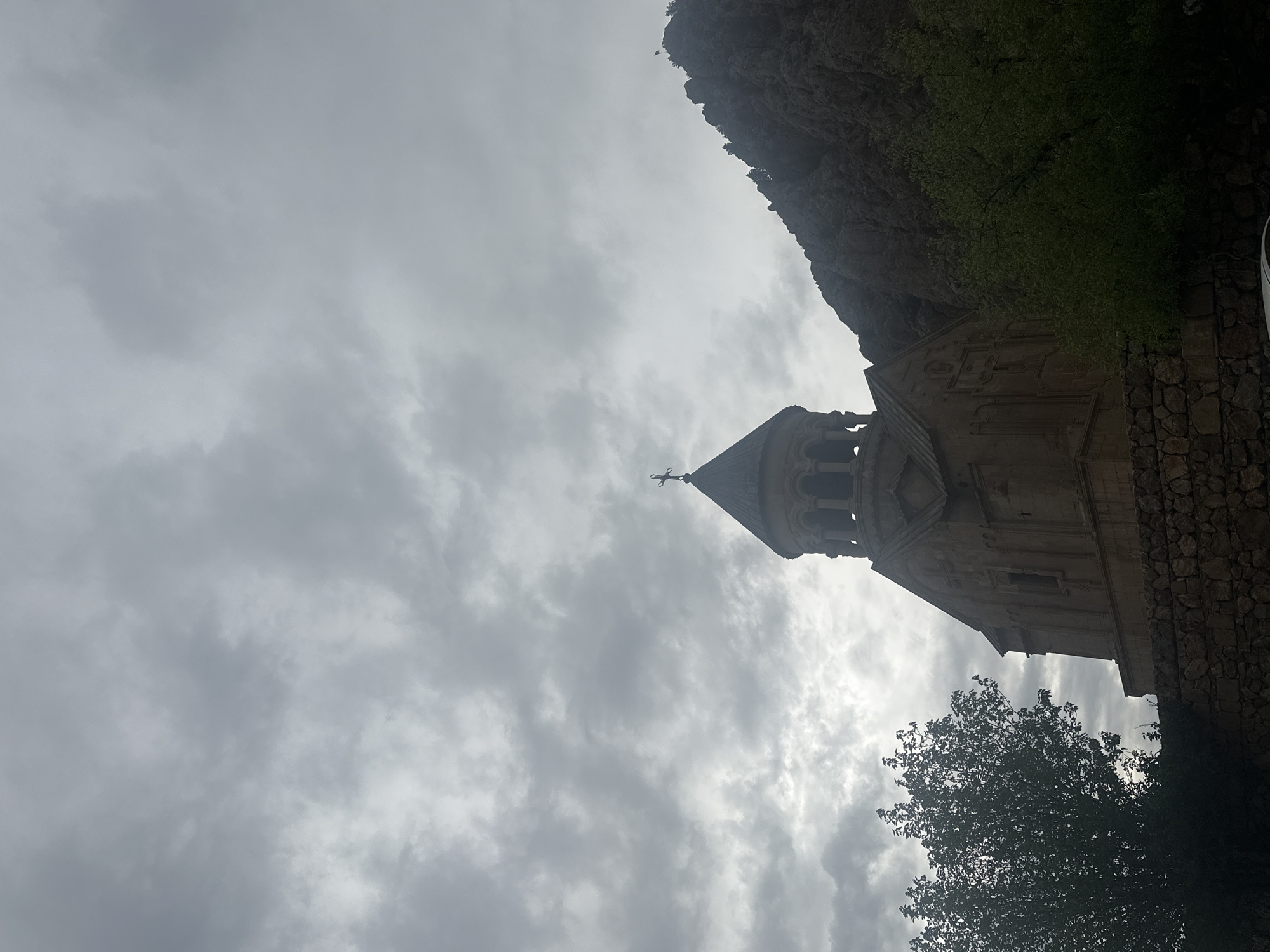
This image depicts a historical stone church, identified as located in the city of Amaghu, Armenia, framed against an overcast sky and rugged terrain. The church occupies the central midground, featuring a distinct domed cupola surmounted by a cross at its apex. The structure is constructed from light-colored stone, appearing somewhat darkened by shadow, with visible architectural details on its facade. To the immediate right and extending into the background, a steep, dark mountainous or rocky formation rises sharply. A small flag or marker is discernible near the peak of this formation on the far right. The left foreground and midground are partially occupied by a dark, leafy tree, obscuring the lower portion of the church and a stone wall. This stone wall, composed of irregular, rough-hewn stones, stretches across the lower section of the image, forming a base for the structures and vegetation. The sky is entirely covered by dense, grey clouds, creating a diffused and somewhat somber illumination across the scene. No individuals or active interactions are present.
Amaghu