Ambarita, Indonesia
14 memories from Ambarita, Indonesia
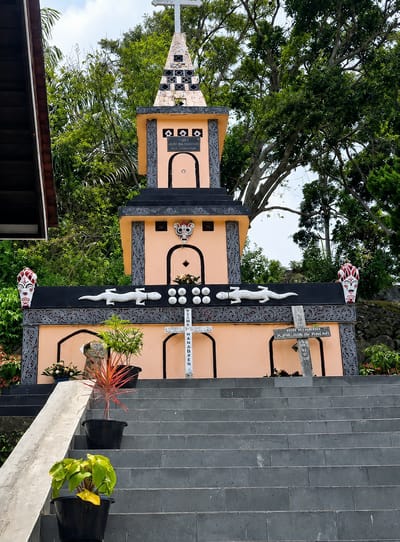
The image shows a tall, peach-colored monument topped with a cross, situated in a lush green outdoor environment. The monument features intricate decorative elements, including what appear to be stylized lizard figures and ornamental borders. There are carved archways and small circular indentations on the structure. Two crosses, one white and one grey, are placed in front of the monument. Several potted plants, including one with red foliage and another with yellow-green leaves, are visible on a dark grey tiled staircase leading up to the monument. A portion of a dark-colored building or roof is visible in the upper left corner. The monument is identified as located in Ambarita, Indonesia, suggesting it might be a religious or historical site. The sky is partly cloudy.
Ambarita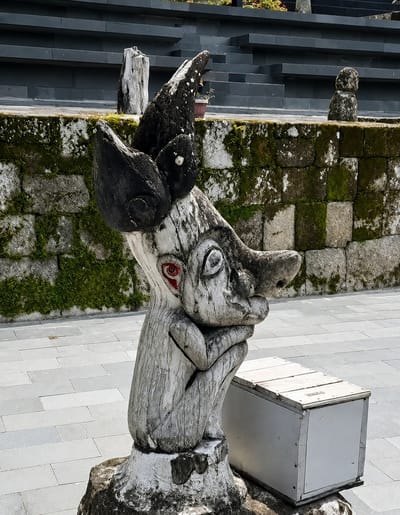
A weathered wooden sculpture of a creature with a long snout and red eyes sits on a stone base in Ambarita, Indonesia. The sculpture is positioned next to a simple wooden bench. Behind the sculpture, a moss-covered stone wall is visible, with a dark, multi-tiered structure in the background. The ground is paved with light-colored rectangular stones.
Ambarita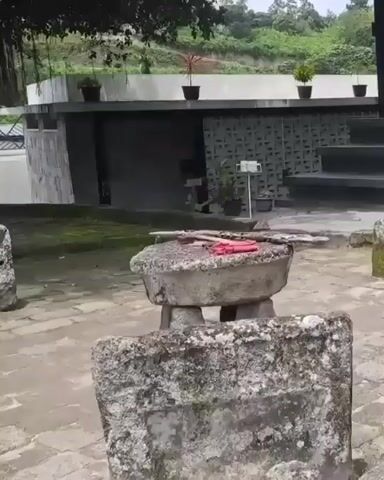
The video shows an outdoor scene with ancient stone structures and a modern building in the background. In the foreground, a large, round, flat-topped stone rests on three large, irregular stone supports, resembling a table. On top of this stone table are two wooden sticks and a folded red cloth. To the left and right of the stone table are other large, rough-hewn stones, some appearing to be upright slabs. The ground is paved with flagstones. In the background, a low-slung modern building with a flat roof and concrete walls is visible. The building has several potted plants on its roof. The overall environment appears to be an archaeological site or historical landmark.
Ambarita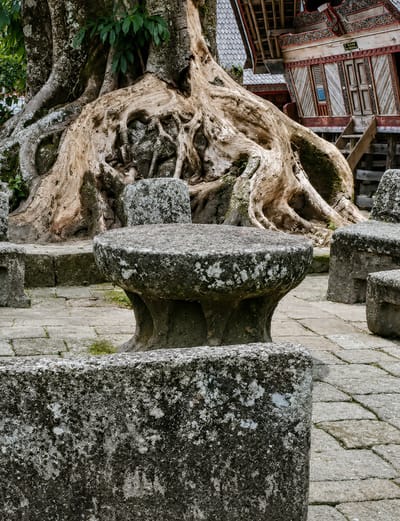
The image shows an outdoor scene in Ambarita, Indonesia, featuring a massive banyan tree with thick, exposed roots. In the foreground, a large, weathered stone table with a pedestal base sits on a paved stone surface. To the left and right of the table are more rough-hewn stone blocks, some appearing to be parts of a low wall or seating area. The texture of the stone is rough and covered in patches of lichen. Behind the tree, a traditional Batak house, known as a "Rumah Bolon," is visible. It has an ornate, saddle-shaped roof with colorful decorations and intricate wooden carvings. The house is elevated on stilts, and stairs lead up to its entrance. The overall atmosphere is one of ancient history and cultural significance, likely within a historical or ceremonial site. There are no people visible in the image.
Ambarita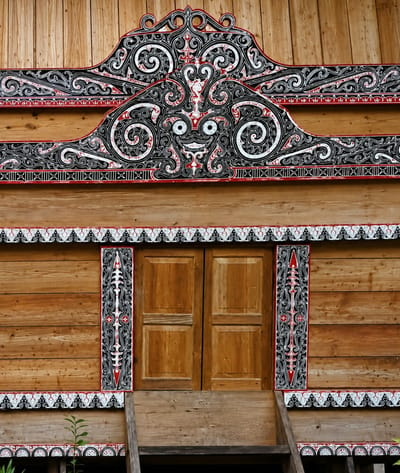
The image shows the ornate wooden facade of a traditional house in Ambarita, Indonesia. The structure features intricate carvings and decorative patterns in black, white, and red against the natural wood grain. A prominent, stylized face-like motif is central to the upper decorative element. Below this, a set of double wooden doors are flanked by vertical carved panels. Decorative borders with geometric and swirling patterns run horizontally above and below the doors and along the lower edge of the visible structure. Wooden steps lead up to the doors. The overall impression is of rich cultural heritage and detailed craftsmanship.
Ambarita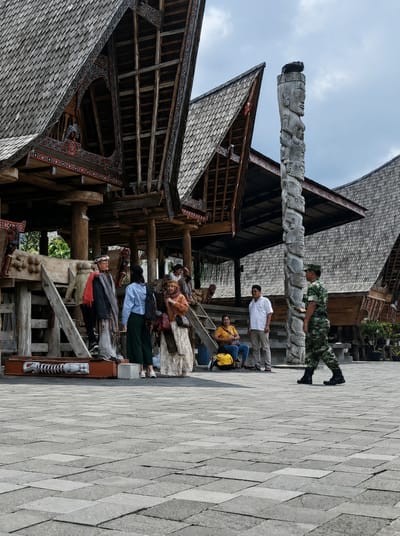
In Ambarita, Indonesia, a group of people are gathered in an open courtyard in front of traditional Batak architecture. The buildings feature distinctive, high-pitched roofs covered in wooden shingles and ornate, dark wood trim. A tall, carved stone totem stands prominently to the right of the frame, depicting a series of human faces stacked vertically. In the foreground, the ground is paved with large, grey square tiles. Several individuals are interacting or observing the surroundings. On the left, a mannequin dressed in traditional attire stands near a carved wooden object. Two women are standing near the mannequin, one in a blue top and dark pants, the other in an orange headscarf and a patterned dress. Further back, a man in a white shirt and tan pants stands, and a woman in a yellow shirt sits with a yellow bag beside her. To the right, a soldier in camouflage uniform walks away from the camera, his back facing towards the viewer. The overall atmosphere appears to be a cultural or historical site.
Ambarita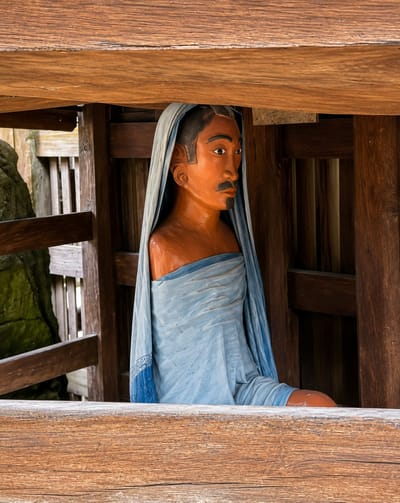
A carved wooden statue of a man, with orange skin and a blue cloth draped around him, is seated within a wooden structure. The man has a stern expression, with dark hair styled with a comb-like pattern, and a thin mustache and goatee. The statue is positioned under a wooden beam and in front of vertical wooden planks. To the left of the statue, a large, moss-covered rock is partially visible, along with a wooden fence. The overall scene appears to be an outdoor setting within the historical village of Ambarita, Indonesia, likely part of the Ambarita Stone Chairs site, which is known for its ancient Batak stone furniture and artifacts.
Ambarita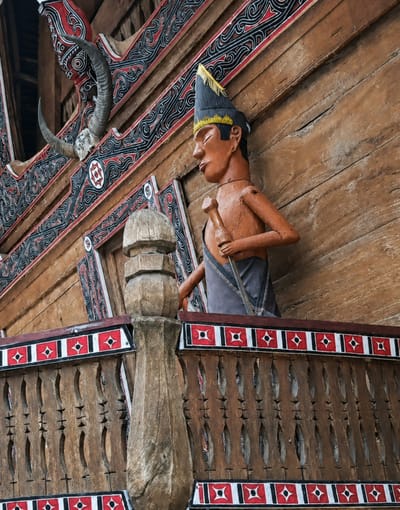
The image captures a close-up view of a traditional wooden building in Ambarita, Indonesia, likely part of a Batak cultural complex. The building features intricate geometric patterns in red, black, and white along its eaves and decorative panels. Prominently displayed on the upper left of the frame are a pair of large, curved water buffalo horns mounted on the wall, a common decorative and symbolic element in Batak architecture. In the foreground and to the right, a carved wooden effigy of a person stands on a balcony or raised platform. The effigy is depicted with a conical hat adorned with yellow fringe, and it holds a slender object in its hands, resembling a staff or spear. The wooden figure has articulated arms and a visible neck joint. The balcony itself is constructed of carved wooden railings with a repeating decorative motif of red and white squares containing black diamond shapes, set against a wooden background with carved, elongated openings. A large, weathered wooden post is visible on the left side of the balcony, adding to the rustic aesthetic. The overall scene is one of cultural heritage and traditional craftsmanship.
Ambarita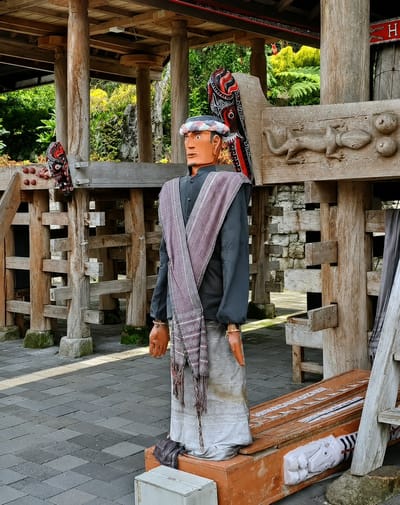
The image depicts a life-sized mannequin dressed in traditional Indonesian attire, standing in what appears to be an outdoor cultural exhibit. The mannequin is positioned in front of wooden structures, possibly part of a heritage site. It wears a dark long-sleeved shirt, a patterned sash draped over its shoulders, and a long, light-colored skirt. The mannequin also has a patterned head covering and orange gloves. Behind the mannequin, a wooden carving of a lizard and circular motifs are visible on a larger wooden structure. Various wooden posts and fencing surround the area, with lush green foliage in the background. The ground is paved with grey interlocking stones. The scene is likely located in Ambarita, Indonesia, given the context of traditional Indonesian clothing and architecture.
Ambarita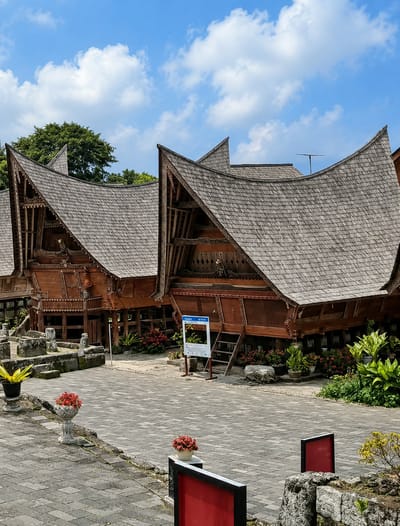
In Ambarita, Indonesia, a traditional Batak house, known as a Rumah Bolon, stands under a blue sky with scattered white clouds. The house features a distinctive, steeply pitched roof covered in weathered wooden shingles, rising to a dramatic peak resembling buffalo horns. The exterior is constructed of dark wood, with intricate carvings visible along the eaves and walls. The house is elevated on stilts, with a wooden staircase leading up to the entrance. In front of the house, a paved courtyard is laid with grey interlocking bricks. A few potted plants with green and yellow foliage are placed around the courtyard, along with stone elements that appear to be part of a historical site. A white sign with blue and black text stands near the entrance of the house. The surrounding area is lush with greenery, suggesting a well-maintained park or historical complex. The overall scene conveys a sense of cultural heritage and architectural distinctiveness.
Ambarita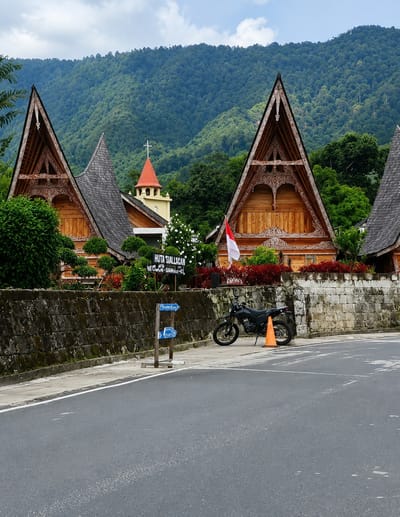
The image captures a scenic view in Ambarita, Indonesia, featuring traditional Batak architecture set against a lush, forested mountain backdrop. In the foreground, a paved road runs alongside a low stone wall. A black motorcycle is parked on the sidewalk next to the wall, with an orange traffic cone beside it. Two blue directional signs are mounted on wooden posts near the motorcycle, indicating "PARKING" to the left and an arrow pointing to the right. Behind the wall, several wooden houses with distinctive triangular roofs, adorned with intricate carvings, are visible. The Indonesian flag is displayed on one of the houses. A church steeple with a red roof and a white cross rises above the houses. The surrounding area is filled with greenery, including trees and red foliage. The sky is partly cloudy, and the mountains in the distance are covered in dense forest.
Ambarita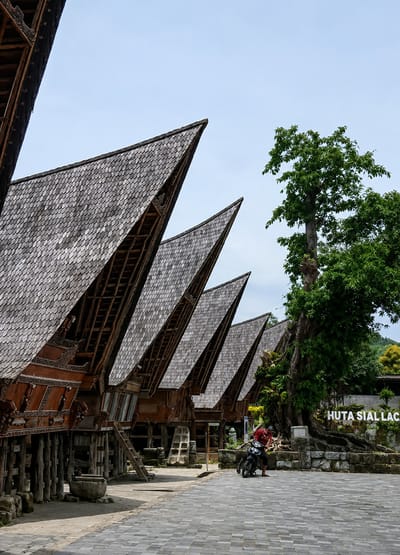
The image captures a row of traditional houses with distinct saddle-shaped roofs in Ambarita, Indonesia. The roofs are covered with grey, overlapping shingles. The houses are elevated on stilts and feature ornate wooden carvings on their facades. A paved walkway runs in front of the houses. In the foreground, a person wearing a red shirt and dark pants is standing next to a motorcycle. To the right of the houses, a large tree with dense green foliage stands prominently. In the background, stone structures are visible, with a sign that reads "HUTA SIAL LAC." The sky is clear and blue.
Ambarita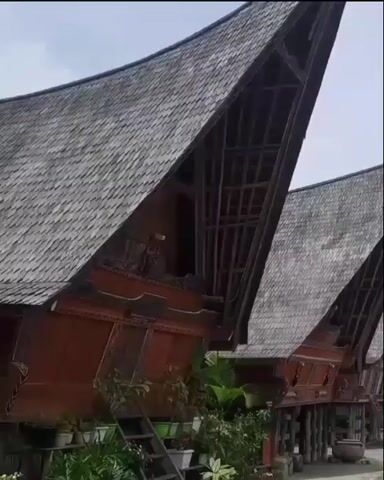
The video shows the side view of several traditional houses with distinctive saddle-shaped roofs, covered in gray shingles. The houses are elevated on stilts, and the lower portion is made of dark red wood with intricate carvings. A wooden ladder leads up to one of the houses. Numerous potted plants are arranged in front of the houses, adding greenery to the scene. The overall environment appears to be an outdoor setting, possibly a village or a cultural heritage site. The sky is visible in the background and appears overcast. The camera slowly pans across the scene, focusing on the architectural details of the houses and the surrounding vegetation. There are no people visible in the video.
Ambarita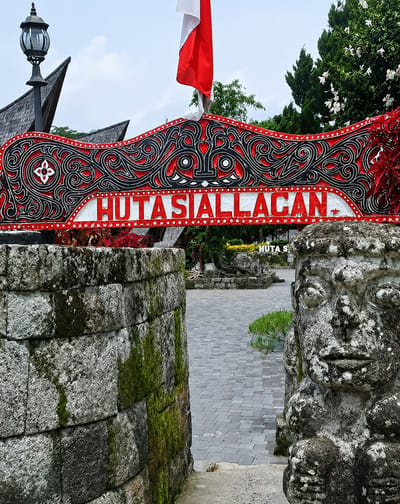
The image depicts the entrance to Hutasiallagan in Ambarita, Indonesia. A decorative red and black archway with white lettering spelling "HUTASIALLAGAN" spans the foreground. To the left, a stone wall covered in moss stands beside a lamppost and a portion of a traditional roof. To the right, a weathered stone statue with a human-like face is partially visible, also showing signs of moss growth. Beyond the archway, a paved courtyard is visible, leading further into the site, with trees and foliage in the background. A red and white flag is prominently displayed above the archway. The sky is overcast with clouds.
Ambarita