Aschaffenburg, Germany
30 memories from Aschaffenburg, Germany

A young woman is taking a mirror selfie in what appears to be a fitting room or a small, private space. She is wearing a tan suede jacket with a zippered front and a collared neckline, paired with distressed denim shorts. Her hair is pulled back, and she is wearing a small earring in her left ear and rings on her fingers. She is holding a light purple phone with a speckled case to take the picture. Behind her, to the right, are several garments hanging on a rack, including a white and black jacket and a gray garment. The walls of the space are a muted brown color. There is a clear plastic cup on the floor to the left of the woman. No specific location within Aschaffenburg, Germany can be identified from the image.
Aschaffenburg
The image shows a young woman in a gray athletic outfit standing in a dressing room, taking a selfie in a mirror. She has her hair pulled back and is wearing a ring on her left hand and earrings. Her outfit consists of a long-sleeved zip-up top with thumbholes and matching leggings. A price tag is attached to her leggings. In the background, clothing items are hanging on a rack. On the floor, there are a pair of black and cream Puma ballet flats, white socks, a plastic cup, and some crumpled white paper. The dressing room appears to be in a retail store. There is no information in the image that suggests it is located in Aschaffenburg, Germany.
Aschaffenburg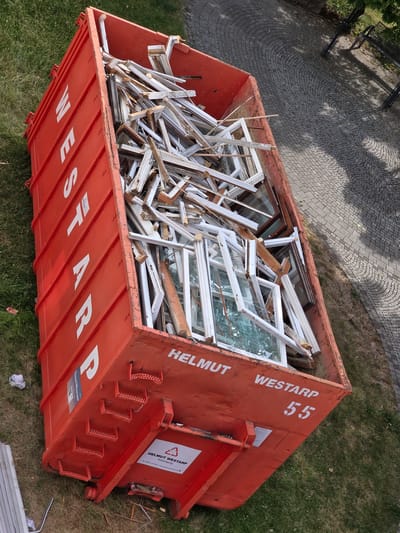
The image shows an aerial view of a large, orange dumpster filled with dismantled window frames and broken glass. The dumpster is situated on a grassy area next to a paved walkway made of cobblestones. The dumpster has white lettering on its side that reads "WESTARP" vertically and "HELMUT WESTARP Entsorgung 55" horizontally. There is a recycling symbol with a triangle and arrows on a white label on the side of the dumpster. The scene appears to be outdoors, possibly in a residential or construction area, given the presence of the dumpster and the surrounding grass and paving. The time of day seems to be daytime, as indicated by the shadows cast by the trees and the overall lighting of the scene. The location is Aschaffenburg, Germany.
Aschaffenburg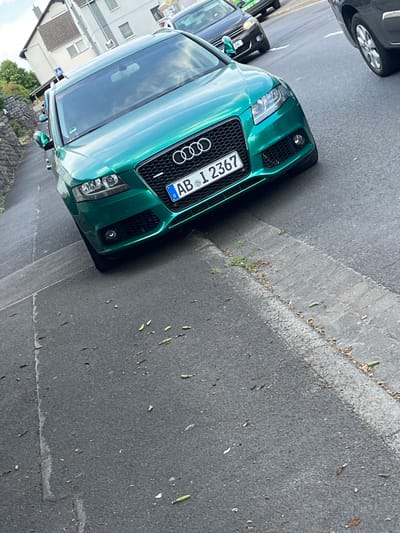
The image shows the front of a green Audi R8 parked on a street in Aschaffenburg, Germany. The car is facing towards the right of the frame, with its headlights and grill clearly visible. The license plate reads "AB 12367". It appears to be daytime, and the weather is fair. The street is paved with asphalt and has a curb made of concrete. There are some fallen leaves and debris on the ground next to the curb. In the background, there are some buildings and trees, suggesting an urban or suburban setting. The image is taken from a slightly elevated angle, looking down at the car. The car appears to be the main subject of the image. There are no people visible in the frame.
Aschaffenburg
The image is a first-person perspective, taken from inside a Ford vehicle, looking through the windshield. The windshield is wet with raindrops. A double rainbow is visible in the sky. The road ahead is a multi-lane street with other vehicles. On the right side of the road, there are buildings. On the left side of the road, there is a tall industrial structure and a blue building. The steering wheel of the car is in the foreground, with the Ford logo clearly visible. The car's dashboard is also visible, showing the speedometer indicating 37 km/h and the tachometer. The overall scene suggests a drive through a city during or after a rain shower, with a beautiful natural phenomenon in the sky. The specific location is identified as the city of Aschaffenburg, Germany.
Aschaffenburg
The image shows a black BMW M2 Competition with a large rear spoiler and quad exhaust pipes, parked in traffic on a city street. The license plate reads "OBB XF 87". In the background, there is a white box truck with "PHÖNIX" logo and "Gepäcktransport & Umzüge" written on it, which is a company based in Aschaffenburg, Germany, as indicated by the address "Reisingerstraße 17 (63741) Aschaffenburg" visible on the truck. There are other vehicles, traffic lights, and trees visible in the background, suggesting an urban environment. The overall scene depicts a moment captured in a street in Aschaffenburg, Germany, with the BMW being the central focus.
Aschaffenburg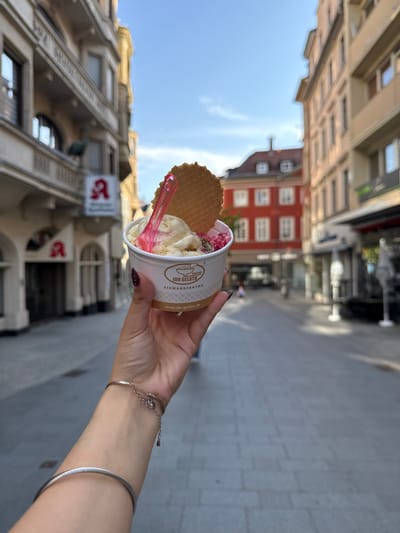
A street scene shows a person holding a cup of gelato with a wafer and a pink plastic spoon. The gelato is from "Ido Gelato Eismanufaktur" and is held out against a backdrop of buildings in a European city, identified as Aschaffenburg, Germany. One sign with a red "A" is visible, indicative of a pharmacy ("Apotheke" in German). The buildings are various colors, with a red building in the middle distance. The street is paved, and other people can be seen walking in the distance. The person's hand and wrist, adorned with a silver bracelet and bangle, are in the foreground. The image appears to be taken from the perspective of the person holding the gelato.
Aschaffenburg
The scene is a top-down view of a table at a restaurant, likely outdoors. The location is indicated to be Aschaffenburg, Germany, though this is not visually evident in the photograph. Two people are present, one on the left wearing black clothing and using chopsticks to eat from a bowl of pasta, and another on the right wearing a blue and white striped shirt and a silver bracelet. On the table, there are two bowls of food: one with pasta and the other with ramen containing corn, eggs, and greens. Additionally, there is a bottle of water, a glass, cutlery and chopsticks, a flower pot, a glass of champagne, a smartphone with a fan on top, and a mason jar filled with a dark liquid with mint leaves and a striped straw. The table itself is dark gray.
Aschaffenburg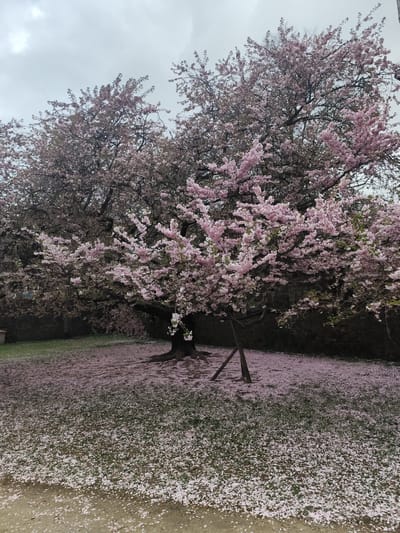
A large flowering tree, presumed to be a cherry or ornamental apple, stands prominently in a park or garden setting within Aschaffenburg, Germany. The tree, centered and to the right, displays an extensive canopy covered in numerous light pink blossoms, with some bare branches visible. Its thick trunk features visible roots extending into the ground. A support structure, composed of two dark wooden poles, props up a lower branch on the right side of the main tree. The ground directly beneath and surrounding the tree is thickly blanketed with fallen light pink petals, covering the grass and a dirt path in the foreground. A second, larger flowering tree with similar blossoms is partially visible behind and to the left of the main tree. In the background, a dark, textured stone wall stretches horizontally. A small, light-colored rectangular structure is partially visible against the wall on the far left. The sky is overcast and uniformly grey, indicating diffused lighting. No individuals or animals are present.
Aschaffenburg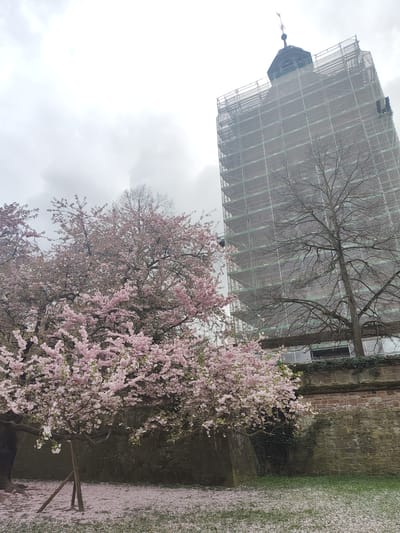
The image depicts a spring scene in Aschaffenburg, Germany, featuring a prominent architectural structure and abundant flowering trees under an overcast sky. The primary subject is a tall, multi-story building, likely a church tower, extensively enveloped in metal scaffolding and white protective netting, indicating active renovation. The visible apex of the building reveals a dark, hexagonal belfry surmounted by a conical spire and a weather vane. In the mid-ground and foreground, multiple deciduous trees are in full bloom, adorned with dense clusters of light pink blossoms. A significant carpet of fallen pink petals covers the green grass beneath these trees. One specific flowering tree in the immediate foreground has its trunk supported by two angled wooden stakes. To the right of the flowering trees, a bare deciduous tree with intricate, leafless branches stands partially obscuring the scaffolded building. A substantial stone wall, constructed from irregularly shaped, light brown and grey blocks, forms a horizontal barrier across the lower third of the image. Sections of this wall exhibit growth, including ivy and moss. The sky above is uniformly grey and cloudy. No individuals are present in the scene.
Aschaffenburg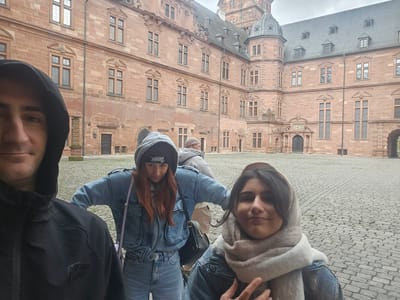
Four individuals are positioned within the cobblestone courtyard of Schloss Johannisburg in Aschaffenburg, Germany, under an overcast sky. A male is visible in the extreme foreground, cropped on the left, showing the left side of his face and upper torso, clad in a black hooded jacket. He appears to be holding the camera. Behind him and slightly to the right, a female with reddish-brown hair wears a grey hoodie under a light blue denim jacket, blue jeans, and a black beanie with a white graphic. She carries a small black backpack and looks downwards. To her right, another female with dark hair wears a light blue denim jacket and a light-colored scarf wrapped over her head and neck. She looks directly towards the camera, her right hand partially visible near her chest. In the background, partially obscured between the two females, a second male in a light grey hooded jacket and light beanie faces away from the camera, looking towards the left of the scene. The dominant background features the multi-story, red sandstone architecture of Schloss Johannisburg, showcasing numerous rectangular windows with decorative lintels and sills, multiple roof sections with dormer windows, and a prominent octagonal tower with a conical roof on the right. An arched entryway is visible on the far right. The entire ground surface of the courtyard is uniformly paved with light grey cobblestones.
Aschaffenburg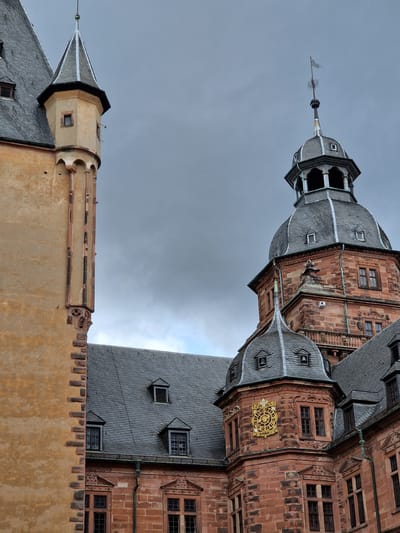
The image displays an architectural view of a historic building in Aschaffenburg, Germany, under an overcast sky. The scene is dominated by two distinct sections of a large structure. On the left, a tall, slender, round tower or turret features a faded yellow-ochre plastered exterior. Its upper portion culminates in a dark grey conical slate roof, beneath which a small, rectangular window is visible. The right edge of this tower exhibits decorative vertical reddish-brown stone elements with carved detailing near its base, transitioning to a dark grey slate roof of an adjacent building section. The right side of the image showcases a prominent section of a building constructed from reddish-brown sandstone blocks. A large, multi-tiered dome-shaped slate roof crowns a central tower, topped by a finial featuring ornate scrollwork and a small, pennant-like banner. Below the dome is an open belfry or observation level with arched openings. Further down, multiple rectangular windows with dark frames are set into the sandstone facade, which is adorned with intricate stone carvings and cornices. A golden, ornate shield or clock-like emblem, displaying radial lines and the inscription "1619" with an additional character, is mounted on a corner turret of this sandstone structure. Dark grey slate roofs with dormer windows are visible across various sections of the building. Greenish patina is present on some metallic architectural elements, suggesting copper. The sky is a uniform, heavy grey, indicating overcast conditions. No people, animals, or active interactions are present in the frame.
Aschaffenburg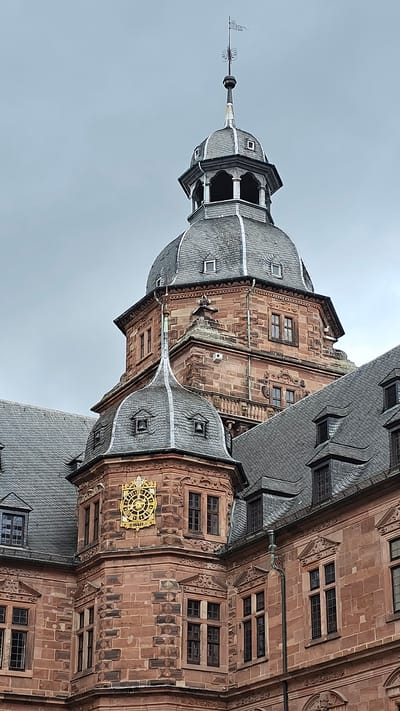
The image displays an upward, close-angled view of a section of Schloss Johannisburg (Johannisburg Palace) in Aschaffenburg, Germany, under a uniformly overcast, light grey sky. The structure is constructed from reddish-brown sandstone blocks, exhibiting precise masonry and carved details. In the background, a prominent tower rises, capped by a large, multi-tiered dome covered in dark grey slate tiles. Above this dome, an open lantern structure with arched apertures supports a conical spire, which culminates in a finial topped by a small, banner-like weather vane. The stone sections beneath the dome feature rectangular windows with dark frames. In the midground and foreground, a lower, intricate turret projects from the main palace structure, also clad in reddish-brown sandstone. This turret is topped by a smaller, pointed dome, similarly covered in dark grey slate, and features multiple dormer windows; one dormer clearly reveals a small bell. Centered on the turret's sandstone facade is a distinct, ornate golden clock face with a radial sunburst design, depicting Roman numerals, and the inscription "HORIS" directly below. Numerous multi-paned, dark-framed windows are set into the surrounding sandstone walls, which display rustication and decorative friezes. Portions of other steeply sloped, dark grey slate roofs with various dormers are visible in the composition. No individuals, vehicles, or other movable objects are present within the scene.
Aschaffenburg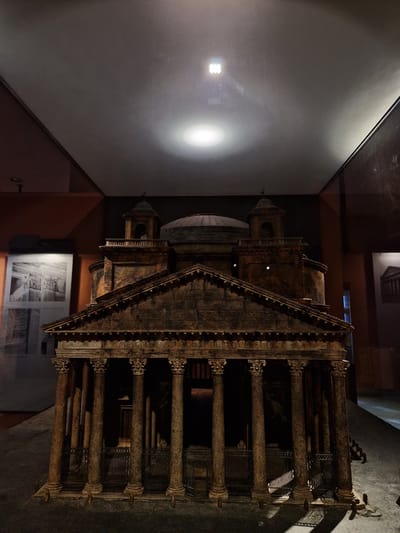
An intricate, dark bronze-toned architectural model of a classical Roman building is centrally displayed in a dimly lit indoor exhibition space in Aschaffenburg, Germany. The model features a prominent multi-columned portico with Corinthian capitals and a triangular pediment bearing a faint inscription, "M.AGRIPPA.L.F.COS.TERTIVM.FECIT." A dark metal railing or fence stands in front of the portico's columns. Behind the portico rises a large, domed rotunda, flanked on the roof by two smaller, square, multi-tiered bell-tower-like structures, each topped with a cross. The model rests on a dark, flat base. Overhead, a circular spotlight illuminates the model, casting reflections on what appears to be a glass ceiling or protective enclosure, where a grid of square light sources is also reflected. To the left of the model, a partially visible informational panel displays black-and-white architectural photographs and text against a darker wall. The environment is static, with no individuals present or active interactions depicted.
Aschaffenburg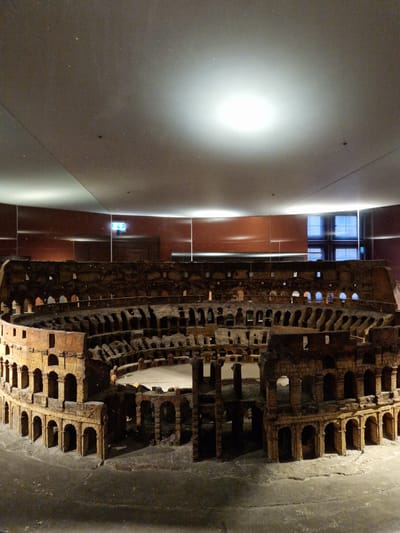
The image depicts a large, intricately detailed architectural model of the Roman Colosseum, located within an indoor exhibition space in Aschaffenburg, Germany, specifically at or in association with the Pompejanum. The model occupies the central and foreground portions of the frame, presented from an elevated perspective looking down into its interior. It is constructed from a reddish-brown material, simulating aged brick or stone, and accurately replicates the multi-tiered arcaded structure, including visible internal hypogeum elements within the arena. The model exhibits intentional distress and partial ruin, reflecting the Colosseum's current state. It rests on a flat, light grey display platform that extends into the foreground. The surrounding environment features a high, light grey ceiling with a prominent, bright circular light source reflecting off its smooth surface, positioned towards the upper right. The walls are a dark reddish-brown, possibly curved, forming the background. On the left wall section, a green illuminated exit sign with a white running figure pictogram is visible. In the distant background, centered horizontally, are large, multi-paneled windows displaying a cool blue light, suggesting an exterior view or distinct lighting. The overall illumination is subdued, with areas of deep shadow beneath the model's arches and within its interior, contrasting with the brighter ceiling and windows. No individuals are present in the scene.
Aschaffenburg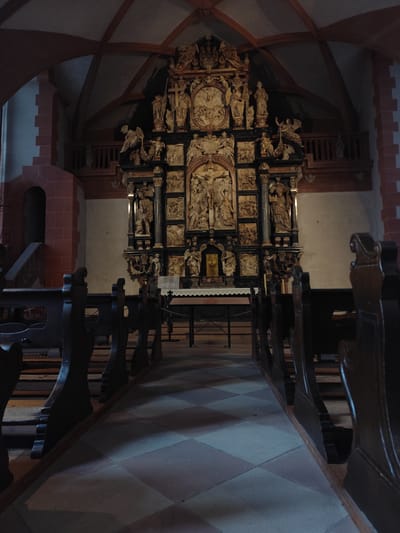
This image depicts the interior of a historic church, located in Aschaffenburg, Germany. The view is from the rear of the nave, looking forward along a central aisle towards the main altar and altarpiece. In the foreground, dark, ornately carved wooden pews line both sides of the aisle. The floor is paved with a checkerboard pattern of light grey and darker reddish-brown square tiles. No individuals are present in the pews or aisle. The midground is dominated by a large, multi-tiered altarpiece, constructed from dark wood or stone, positioned centrally. The altarpiece is intricately carved, featuring numerous sculpted figures and relief panels. A prominent crucifixion scene is visible in the central upper section. Below this, numerous figures of saints and angels, along with narrative scenes, are arranged in various niches and panels. A small, golden tabernacle-like structure is visible at the very bottom center of the altarpiece, resting on an altar table covered by a white, lace-edged cloth. The background reveals the church's architectural elements. The walls are predominantly light-colored, with structural elements composed of dark red sandstone or brick, forming robust pillars and arches on the left and right. On the far left, a high, dark arched recess or doorway is visible within the red stone wall, accompanied by a short flight of stairs. Above, the ceiling is vaulted, characterized by dark wooden ribs supporting lighter, likely plastered, infill panels. Wooden balconies with railings are visible high above the nave on both the left and right sides. The scene is devoid of people, activity, or interactions. The lighting is dim and atmospheric, casting shadows that emphasize the architectural and sculptural details.
Aschaffenburg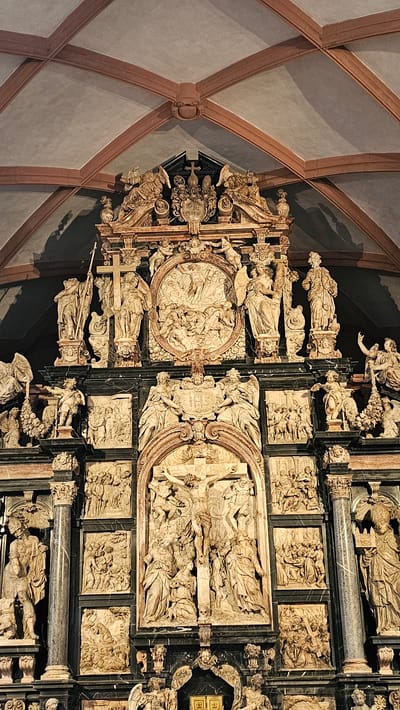
This image depicts the highly ornate High Altar, also known as the Epitaph of Archbishop Johann Schweikhard von Kronberg, located in the Collegiate Church of St. Peter and Alexander (Stiftskirche St. Peter und Alexander) in Aschaffenburg, Germany. The altarpiece is a multi-tiered sculptural monument composed of contrasting light-colored stone, primarily for the figures and reliefs, and dark, polished marble for architectural elements such as columns, pilasters, and cornices. The structure extends vertically towards a vaulted ceiling, characterized by light grey plaster with reddish-brown ribbed arches. At the uppermost section, a prominent central coat of arms or crest, surmounted by a cross and a crown, is flanked by two reclining winged figures (angels). Below this crest, a circular relief depicts a dense gathering of figures, including putti, in what appears to be a celestial scene. This circular relief is flanked by standing figures: on the left, a robed figure holds a tall staff topped with a cross; next to him, a winged angel. On the right, a winged angel holds an unidentified object, followed by another standing robed figure. The middle tier features a large central arched niche containing a detailed relief of the Crucifixion. Christ is depicted on the cross, surrounded by multiple figures at its base, including draped individuals representing Mary and John, among others. This central relief is framed by dark marble columns. To the left and right of the Crucifixion, the dark marble surfaces are adorned with multiple rectangular relief panels, each depicting various biblical or devotional scenes involving multiple figures in active poses, such as gatherings, processions, or moments of interaction. Above the Crucifixion arch, a smaller central panel displays the "IHS" monogram, flanked by two kneeling angels. Numerous smaller putti and decorative carvings are integrated throughout the structure, connecting the different tiers and panels. The figures exhibit detailed drapery and varied postures, characteristic of Baroque sculpture. The entire monument is illuminated, casting some shadows on the upper ceiling vaults.
Aschaffenburg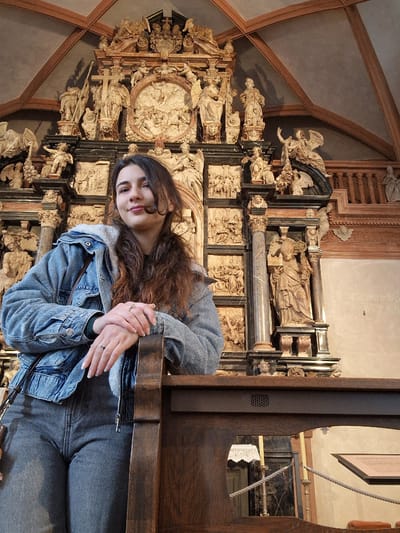
An interior scene captured in the Stiftskirche St. Peter und Alexander (Collegiate Church of St. Peter and Alexander) in Aschaffenburg, Germany, displays a young woman posing in the foreground against a backdrop of a highly ornate Baroque high altar. **Person:** A single individual, a young woman, is positioned slightly right of the frame's center. She possesses long, wavy, dark brown hair with visible reddish undertones, extending past her shoulders. Her face is turned slightly upwards and to the viewer's left, exhibiting a subtle smile. Her eyes are dark, and her eyebrows are defined. Her hands are clasped and rest on the top edge of a dark wooden structure. She wears a silver-toned ring on the ring finger of her left hand and a similar ring on the middle finger of her right hand. Her fingernails are manicured with a light polish. **Attire:** The woman is dressed in a light-blue denim jacket, which features a white, sherpa-like fleece lining visible at the collar and cuffs. The jacket has silver-toned buttons and breast pockets. A dark garment, possibly green or black, is visible underneath the jacket at the neck. She wears dark grey or black jeans. A dark brown shoulder bag strap is visible over her right shoulder. **Objects/Environment:** * **Foreground Object:** A dark, polished wooden structure, likely the backrest of a pew or a barrier railing, occupies the lower portion of the image. Its top edge, approximately horizontal, serves as a resting point for the woman's hands. * **Background Altar:** Behind the woman, the monumental High Altar of the Stiftskirche St. Peter und Alexander dominates the scene. This multi-tiered Baroque altar is composed of contrasting dark marble columns and pedestals with light-colored, intricately carved stone or stucco sculptures. * **Central Feature:** A large, oval-shaped relief sculpture depicting a religious scene, identified as the Assumption of Mary, occupies the central position of the altar's main tier. It shows multiple figures ascending amidst clouds. * **Sculptures:** Numerous free-standing figures of saints, apostles, and angels are distributed across the altar's various levels. One prominent figure to the viewer's left of the central oval holds a staff surmounted by a cross. Numerous putti and winged angels are integrated into the architectural and decorative elements. * **Relief Panels:** Below the main sculptures, multiple rectangular relief panels depict various narrative biblical scenes. * **Architectural Detail:** The altar incorporates multiple pairs of dark, fluted marble columns with ornate capitals. Abundant sculpted foliage, garlands, and other classical motifs decorate the entire structure. * **Ceiling:** The upper background reveals a vaulted ceiling with a light grey or cream-colored surface intersected by exposed dark wooden beams forming a diagonal grid pattern. * **Side Wall:** To the viewer's right of the altar, a plain, light-colored wall is visible, faintly displaying part of a German inscription, "Nächste Vo...", suggesting a public announcement or schedule. * **Lighting:** The interior is well-illuminated, highlighting the details of the altar and the woman. **Actions/Interactions:** The woman is directly facing the camera, suggesting she is posing for a photograph. Her hands are clasped and rest upon the wooden structure in front of her. No other individuals are visible interacting with her or within the immediate foreground.
Aschaffenburg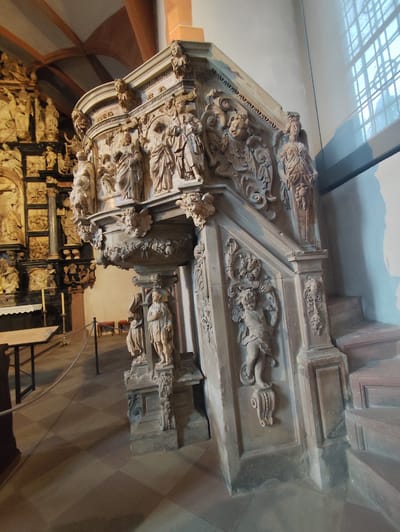
The image displays an intricately carved stone pulpit and its integrated staircase, positioned within a large religious edifice, specifically the St. Peter and Alexander Collegiate Church in Aschaffenburg, Germany. The pulpit, constructed from light-colored stone, likely sandstone, features extensive Baroque-style sculptural decoration. Its multi-faceted body is adorned with numerous carved figures, depicting individuals in ecclesiastical or historical attire, religious scenes, angels, and cherubs, interspersed with floral and architectural motifs. The base of the pulpit is supported by standing carved figures. An attached staircase, equally ornate, descends to the right, exhibiting further carvings of figures and decorative elements along its balustrade. The stairs themselves are plain, solid blocks. In the background to the left, a large, multi-tiered altarpiece or reredos, also heavily carved with numerous figures and golden accents, is visible. The floor is covered with a checkerboard pattern of alternating light and dark square tiles. A plain wooden table with a white cloth and two yellow candles is visible near the altarpiece, cordoned off by a dark rope barrier. The room features a high vaulted ceiling with visible structural elements in the upper left. A large rectangular window with a grid pattern is present on the right wall, admitting natural light and casting shadows on the wall and floor. No individuals are present in the scene.
Aschaffenburg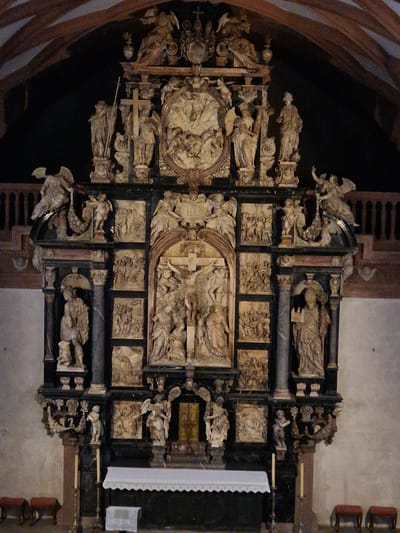
An elaborate, multi-tiered altarpiece, identified as a prominent feature within the St. Peter and Alexander Collegiate Church in Aschaffenburg, Germany, occupies the central frame. The altarpiece is composed of dark, polished stone or wood structural elements framing numerous lighter, carved limestone or alabaster figures and relief panels. The structure is architecturally complex, featuring columns, arched niches, and pedestals across multiple vertical and horizontal sections. The central focal point is a large crucifixion scene, with Christ on the cross flanked by figures at its base, set within an arched recess. This central element is surrounded by multiple rectangular and circular relief panels depicting detailed biblical narratives with numerous figures in dynamic poses. Large, standing figures, likely saints, are positioned within niches to the left and right of the central crucifixion. Higher tiers feature additional standing figures, including numerous winged angels and putti, integrated into decorative elements and further relief compositions, culminating in a richly sculpted crowning element at the very top. At the base of the altarpiece, a dark altar table is covered with a white, scalloped cloth. Two slender, white candles in metal holders flank the altar. On the floor in front, two pairs of dark red, upholstered stools are positioned to the left and right. The surrounding environment consists of light-colored walls in the lower sections, transitioning to a darker background behind the upper altarpiece. A dark wooden balustrade, indicative of an upper gallery, is partially visible on both sides in the background, beneath a dark, possibly coffered or beamed, arched ceiling. No individuals are present in the immediate vicinity of the altar.
Aschaffenburg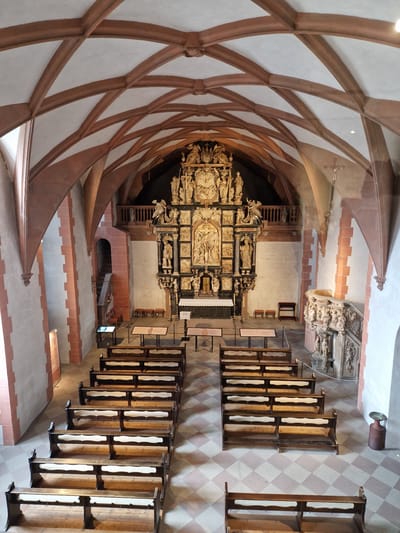
This high-angle photograph depicts the interior of the Collegiate Church of St. Peter and Alexander in Aschaffenburg, Germany, viewed from the rear gallery looking towards the altar. The scene is devoid of people. The ceiling features a prominent ribbed vaulting system composed of light plaster infill and robust reddish-brown sandstone ribs forming an intricate pattern. The side walls are predominantly light-colored stucco, contrasting with vertical reddish-brown pilasters and arch structures. The floor is tiled with a checkerboard pattern of alternating light beige and reddish-brown square tiles. The focal point is a large, highly elaborate, multi-tiered wooden altarpiece (reredos) at the far eastern end. It is richly carved with numerous figures, architectural elements, and narrative scenes, appearing in dark, possibly ebonized wood, with lighter, possibly gilded, carved sections. A simple white altar cloth drapes a table in front of the reredos, flanked by two candles. To the right, an ornate carved stone pulpit with multiple sculptural reliefs is attached to the wall. The nave is furnished with two symmetrical blocks of dark wooden pews, each featuring light-colored seat pads or cushions. These pews are arranged in rows, creating a central aisle leading directly to the altar. In the foreground and mid-ground, several dark metal display tables, some holding informational materials, are positioned along the side aisles. On the upper left, above the altar area, a wooden gallery with a dark balustrade is visible. A recessed arched doorway with an internal staircase is visible on the left wall further back. A tall, cylindrical, dark-colored container with a metallic basin top stands against the far right wall. The space is illuminated by a combination of diffused natural light and discrete ceiling fixtures.
Aschaffenburg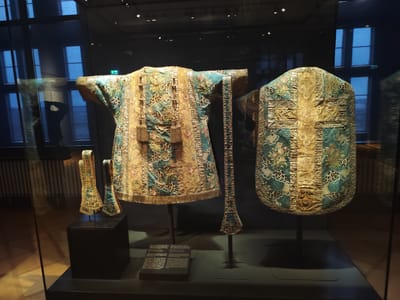
The scene captures three richly embroidered ecclesiastical vestments displayed within a clear glass case inside a museum in Aschaffenburg, Germany, likely the Stiftsmuseum der Stiftskirche St. Peter und Alexander. The central subjects are a dalmatic or tunic and a chasuble, accompanied by two smaller fabric liturgical pieces. The garment on the left is a dalmatic, a short-sleeved vestment with open sides, displayed on a dark, slender stand. It is made of intricate fabric featuring vertical gold-embroidered bands adorned with tassels and floral motifs, interspersed with teal-blue sections patterned with a leopard-spot design and additional floral embroidery. A gold fringe borders its lower edge. To its right, the chasuble, a rounded, poncho-like outer vestment, is displayed from the rear, also on a dark stand. Its back features a prominent gold-embroidered cross design, richly decorated with floral and geometric patterns, set against the same teal-blue and leopard-spot fabric. To the left of the dalmatic, two smaller, similarly ornate fabric strips, possibly manipules or stoles, are presented on miniature dark stands. All items are set against a dark background within the display case. A dark rectangular information plaque, with white text partially visible (referencing "Orden der Monsignore..." and "1779"), rests on the dark display base in front of the dalmatic. Reflections on the glass display case reveal a large, multi-paned window with internal blinds or coverings, a green emergency exit sign, and general ambient light from the museum environment. No individuals are depicted as subjects in the scene, nor are any actions or direct interactions observable.
Aschaffenburg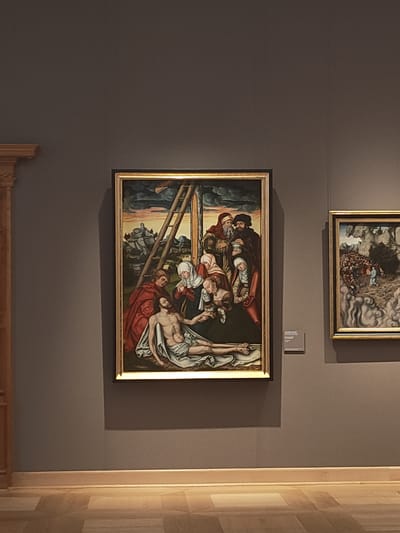
The image depicts an interior view of an art museum in Aschaffenburg, Germany. The scene is dominated by a large, vertically oriented framed painting centered on a dark gray wall. This painting, presented in an ornate gold frame, portrays a multi-figure religious scene, likely a Lamentation or Deposition of Christ. A pale, deceased male figure, partially clad in white drapery and exhibiting wounds on hands and feet, lies horizontally in the foreground. He is surrounded by at least six other figures, primarily women in various states of grief and support, dressed in period robes of red, white, green, and dark colors. One female figure cradles the head or upper torso of the deceased, while another kneels near his feet. In the background, a wooden ladder leans against an upright beam, under a dramatic, cloudy sky. Distant hills and a structure resembling a fortified building or castle are visible on the left. To the right of the main painting, a smaller, horizontally oriented framed painting is partially visible, also in a gold frame. This artwork depicts a dense crowd of small figures within a rugged, hilly landscape featuring trees and rocky formations, under a similarly overcast sky. The museum wall is a uniform dark gray. A light wooden baseboard runs along the bottom of the wall, meeting a patterned wooden or tiled floor composed of light-toned rectangular and square segments. On the far left, a vertical wooden architectural element, possibly part of a doorway or furniture, is partially visible. No human visitors are present in the immediate museum space captured in the image.
Aschaffenburg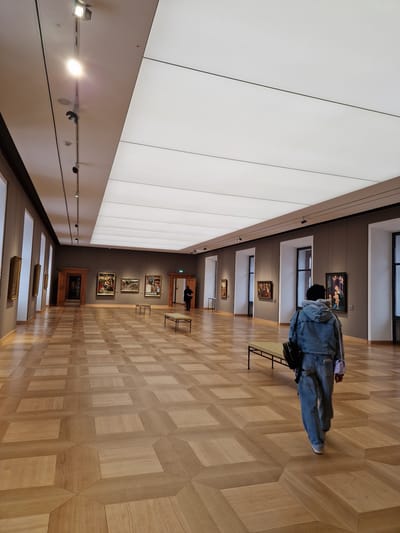
The image depicts an interior view of a long, rectangular art gallery hall within the Staatsgalerie at Schloss Johannisburg in Aschaffenburg, Germany. The hall features a polished light-brown wooden parquet floor arranged in a geometric, cube-like pattern. The walls are painted a neutral grey-brown and display multiple framed Old Master paintings. In the foreground, a person is observed from behind, walking towards the distant end of the hall. This individual wears a light-blue denim jacket over a grey hooded garment, blue jeans, and light-colored shoes. They carry a black backpack on their left shoulder and a small light-purple bag in their right hand. Further down the hall on the right side, a second person, dressed in dark clothing, stands near a wooden doorway. The ceiling features a combination of lighting elements: a track lighting system with multiple spotlights runs along the left side, and a large central rectangular panel provides diffused white light. Several framed paintings of various sizes are visible on both the left and right walls. The right wall also shows two elongated, backless benches with light-colored cushioned tops and dark metal frames. Architectural features include recessed vertical sections, possibly windows or niches with dark frames, along both side walls, and two ornate wooden doorways in the background, leading to other rooms.
Aschaffenburg
An individual with long, dark, wavy hair, approximately 18-25 years of age, is depicted in a half-profile selfie, smiling directly at the camera. She wears a grey denim jacket and a light beige knitted scarf. The background consists of a wall displaying multiple framed oil paintings, indicating an art museum or gallery. The frames are ornate and gold-colored, with sections of dark red wall visible between them. To the upper left, an oval-framed portrait shows a fair-skinned infant or young child with blonde, curly hair, held by an unseen figure. To the upper right, a larger rectangular painting portrays a multi-figure religious scene, consistent with a Lamentation or Deposition of Christ, featuring a pale, deceased male figure on a white sheet, surrounded by several draped individuals, including a kneeling male and a standing female. A smaller, partially visible landscape painting is also present in the lower-left background. This scene is located within Schloss Johannisburg (Johannisburg Palace), specifically the Staatsgalerie Aschaffenburg, in Aschaffenburg, Germany.
Aschaffenburg
The image displays two individuals, a woman and a man, captured in a casual indoor setting, likely seated side-by-side. The image itself is oriented ninety degrees clockwise. The woman is positioned on the left side of the frame (if viewed upright), with her face closer to the viewer. She has long, straight, dark brown hair that flows over her shoulders and chest. She is wearing a black long-sleeved top, which features a strap detail visible on her shoulder. Her expression is characterized by slightly pursed or "pouty" lips, with her dark eyes looking directly at the camera. A metallic, rectangular tag is visible on her black clothing near her shoulder, with the text "KUEBLER" written horizontally and "WORKWEAR" written vertically below it, alongside a stylized "K" logo. Her right hand is visible, resting on what appears to be the man's arm or lap. The man is seated next to the woman, on the right side of the frame (if viewed upright). He has short, dark hair and light stubble on his face. He is wearing a light beige or off-white long-sleeved sweater with a ribbed crewneck collar. He has a gentle, closed-mouth smile, and is also looking towards the camera. On his left hand, a silver-colored ring is visible on his ring finger. His left forearm displays a distinctive tattoo, which depicts a landscape scene featuring mountains and trees, rendered in a black-and-grey shaded style that fades out towards his wrist. The background behind the woman consists of a vibrant red wall with a distinct horizontal corrugated or paneled texture. Behind the man, there is a wooden wall made of horizontal planks, possibly stained a dark color. Below the man, a portion of a colorful, textured painting or artwork is visible, featuring abstract shapes and broad brushstrokes in shades of blue, yellow, and hints of red. The overall mood appears relaxed and intimate, suggesting a shared moment between the two individuals.
Aschaffenburg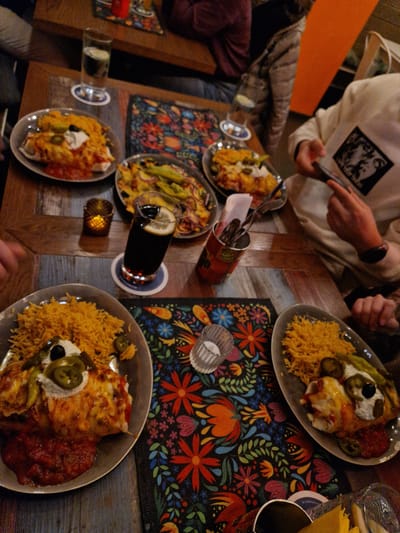
The image depicts an indoor dining scene at a restaurant in Aschaffenburg, Germany, characterized by warm, dim lighting. A rustic wooden table with a distressed panelized surface is prominently featured, covered with colorful placemats displaying elaborate floral and leaf patterns in red, orange, blue, and green hues. Several individuals are gathered around the table, though only partially visible. On the right, a person wearing a white hoodie with a black square graphic is holding a smartphone with both hands, appearing to interact with it or take a photo. Another person's arm is visible on the left side of the table. A third individual in a dark garment is partially visible in the upper left background. The table is laden with multiple dishes of food and beverages. In the foreground, two plates each contain a large, cheese-covered burrito or enchilada, topped with sour cream, sliced green jalapeños, and a black olive, accompanied by a generous portion of yellow rice and a side of red salsa. Towards the center, a tall glass of a dark beverage with a lemon slice rests on a coaster. Adjacent to it is a small, lit tea light candle within a golden, perforated holder. Another plate further up contains what appears to be nachos or a similar dish with melted cheese, sliced green peppers, and red onions. In the upper left, a glass of water with a lime slice is visible on a coaster, next to another plate of food resembling the enchiladas. A red metal container filled with forks and knives stands in the middle of the table. A transparent empty glass is also present. An orange wall is visible in the background on the right.
Aschaffenburg
The image displays an overhead view of a dining table within a restaurant in Aschaffenburg, Germany. The specific address or name of the establishment within Aschaffenburg is not identifiable from the visual content. The table surface is composed of distressed wooden planks exhibiting varying tones, including grey, brown, and light blue. Two dark fabric placemats, patterned with vibrant floral and foliage designs in colors such as orange, blue, green, and pink, are laid out. Five plates of food are arranged on the table. Four plates each contain two cheese-covered rolled items, consistent with enchiladas, alongside a mound of yellow rice, a portion of red salsa, a dollop of white cream, sliced green jalapeños, black olives, and whole pickled green peppers. A fifth plate holds a large serving of nachos, topped with melted cheese, red onion rings, black olives, green jalapeños, and a substantial quantity of guacamole. Beverages include two glasses with a dark liquid and a lemon slice, placed on blue and white coasters, and two clear glasses of water, each with a lemon slice, also on similar coasters. Two small, decorative votive candle holders, each containing a lit candle, are positioned on the table, emitting a warm light. A container filled with assorted cutlery and a napkin dispenser are also present. Portions of at least four individuals are visible around the table, indicating a group dining. One person in the upper left wears a blue denim jacket. Another individual in the upper center, wearing black pants and a white t-shirt, holds a red-cased smartphone and exhibits a visible tattoo on their forearm. Hands and arms of other diners are discernible in the lower left and lower right sections of the frame. The scene captures a social dining event.
Aschaffenburg
The scene depicts a dining experience in a restaurant located in Aschaffenburg, Germany. Three plates of Mexican-style food are presented on a dark-stained, multi-planked wooden table. In the foreground, a grey plate holds a cheese-covered enchilada or burrito, topped with a dollop of white cream, a single black olive, several slices of green jalapeño peppers, and one whole green pickled pepper. To its left is a mound of orange-colored rice, and to its right, a portion of red salsa. Centrally positioned, a second grey plate contains a large serving of nachos. These tortilla chips are covered with melted cheese, chopped red onions, black olives, green zucchini pieces, and a generous layer of green guacamole, garnished with two whole green pickled peppers. Partially visible in the background, a third grey plate presents a dish identical to the foreground plate. Two individuals are partially visible in the upper portion of the image. The person on the left wears a white long-sleeved top. The person on the right wears a light beige knitted sweater, with a dark tattoo visible on their right forearm. The table features a rectangular fabric placemat with a vibrant floral pattern in red, orange, green, and blue. On the right side of the table, a red cylindrical decorative item with an illustration is partially visible, alongside an amber-colored, textured glass candle holder emitting a soft glow. A silver utensil handle is also partially visible in the upper right. The environment is indoors, characterized by warm, artificial lighting.
Aschaffenburg
The scene, located indoors in Aschaffenburg, Germany, depicts two adults seated at a wooden table. On the left, a female subject with long dark hair, wearing a black long-sleeved top featuring a criss-cross cut-out design on the left shoulder, is smiling and gazing towards the male subject. On the right, a male subject with short dark hair and light facial stubble, wearing a light cream, high-neck sweater, exhibits a faint smile while looking downwards and to his right; his left arm is positioned behind the female subject. His right forearm displays visible tattooing. In the foreground, centered on the table, is a dark amber, diamond-patterned glass candle holder emitting a warm orange light from an internal source, resting on a dark mat adorned with a colorful, abstract floral pattern. A white booklet with a partially visible 'R' on its cover is also present on the table's left side. The background consists of a vertical corrugated red wall behind the female subject, transitioning to a vertical wooden plank wall behind the male subject.
Aschaffenburg