Ashipa, Nigeria
30 memories from Ashipa, Nigeria
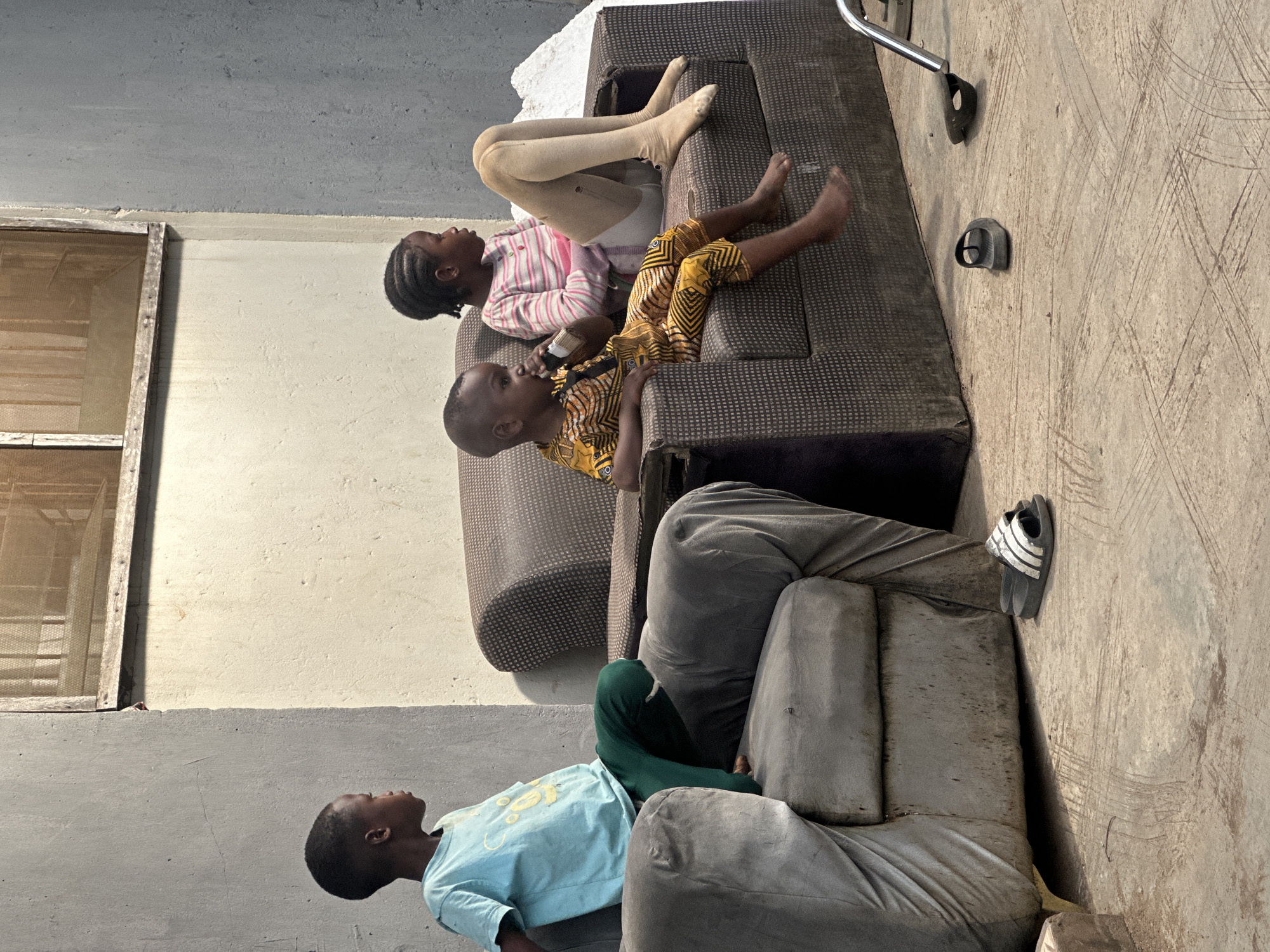
Three children are seated on two worn, upholstered sofas positioned outdoors in front of a textured concrete wall. The sofa on the left is a dark gray, while the one on the right is a darker brown with a woven pattern. On the left, a young boy in a light blue t-shirt and green pants sits facing left. In the center, a younger boy in a vibrant yellow and black patterned outfit sits on the right sofa, holding a small white object to his mouth. To his right, a girl wearing a pink and white striped long-sleeved shirt and light-colored stockings sits with her legs extended. The ground is a concrete surface with visible cracks and tire marks. A pair of dark flip-flops is on the ground near the left sofa, and another pair of dark sandals is near the right sofa. A metal vacuum cleaner hose is visible in the lower right corner of the frame. The background wall has a recessed window with wooden framing and a mesh cover. The environment appears to be an outdoor courtyard or patio, possibly in Ashipa, Nigeria, given the context.
Ashipa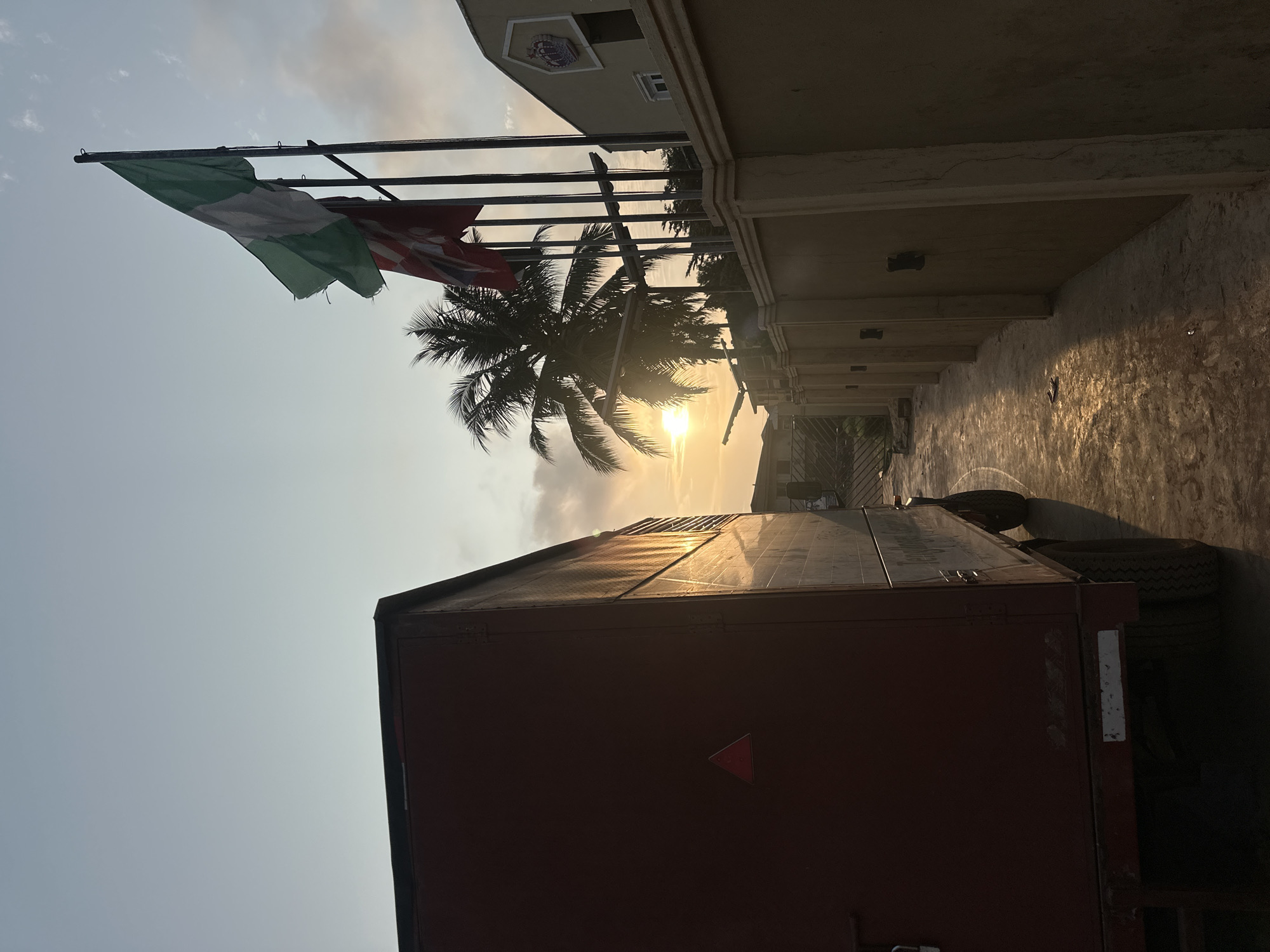
A low-angle, full shot captures a street scene at sunset in Ashipa, Nigeria. The foreground is dominated by the rear of a large, dark red truck. The truck is parked at an angle, with its rear wheels visible and resting on a textured, paved surface. A small, red triangular reflector is affixed to the side of the truck. To the right of the truck, a narrow walkway runs alongside a tall, beige-colored wall. The wall is segmented by vertical pillars and has a textured surface. A line of dark, rectangular fixtures are embedded within the wall. Above the wall, a bright orange sun is setting, partially obscured by the silhouette of a palm tree. Three flags fly from poles on the other side of the wall, with the Nigerian flag being the topmost and most visible. Behind the flags and palm tree, a building with a light beige facade and a dark, crest-like emblem is visible. The sky is a pale blue, transitioning to a softer hue near the horizon, with wisps of clouds catching the sunset's light. The ground reflects the warm glow of the setting sun.
Ashipa
A man wearing a black baseball cap and a black t-shirt with white lettering is looking at the camera. The man is seated in a dimly lit room. To his left, a section of a wall is lit with a purple light. The man appears to be speaking or reacting to something off-camera.
Ashipa
The video shows a close-up of a tablet screen displaying a scene from a show. Two women are visible, standing indoors. The woman on the left wears a yellow shirt and the woman on the right wears a black tank top. They appear to be in conversation, with the woman on the left gesturing with her hands. Subtitles are displayed at the bottom of the screen. The scene transitions briefly to show a third woman in a red and white polka dot top standing between the first two women, all three looking surprised. The scene then returns to the first two women.
Ashipa
This is a close-up, first-person perspective video. The focus is on a man in the foreground wearing a tank top. He is lying down and looking towards the camera with a slight smile. Behind him, also lying down, is a person whose face is not clearly visible due to the low lighting and angle. The environment appears to be indoors, possibly a bedroom, with dim lighting and a pillow visible. The man's arm is extended in front of him, and there is a suggestion of another person's arm or body behind him. The video is shaky, indicating it was likely recorded by someone moving the camera.
Ashipa
The image is a close-up selfie of a dark-skinned man lying on his back. He is wearing a sleeveless shirt with a brown and white striped pattern. The background appears to be a dimly lit room with pillows and what looks like a wooden ceiling. The man's head is tilted towards the camera, and his eyes are open. He has a neutral expression on his face. The lighting is soft, casting shadows on his face and body. The image quality is moderate, with some graininess. The location in the city of Ashipa, Nigeria, is not discernible from the image itself.
Ashipa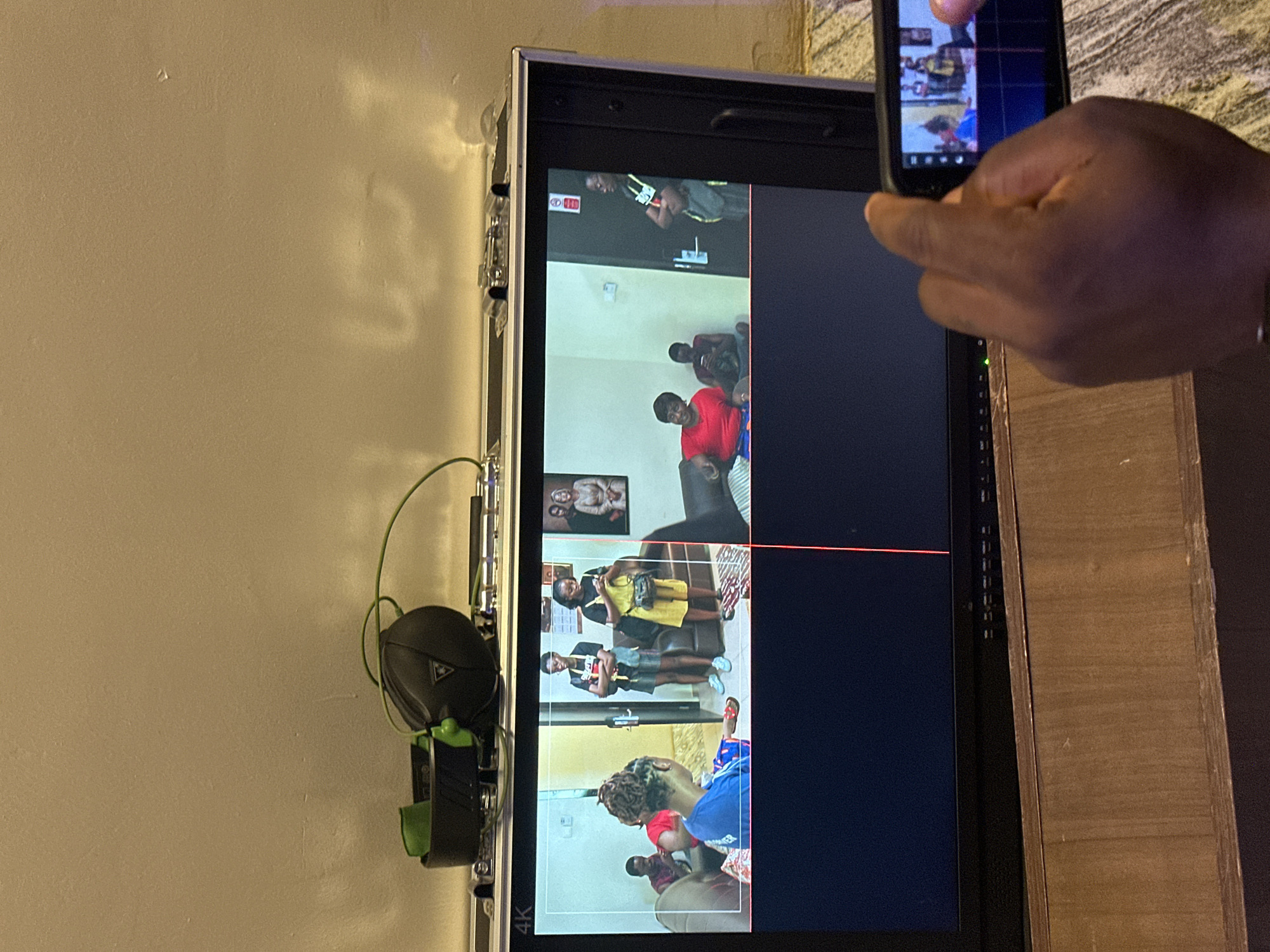
In Ashipa, Nigeria, a person's hand is holding a smartphone, capturing a video feed displayed on a large monitor. The monitor shows a divided screen, with the left side displaying three individuals seated, two women standing, and a woman in blue facing away from the camera. The right side of the screen shows three individuals seated and a man standing with his arms crossed. The monitor is positioned on a wooden surface, and a headset is visible above it. The wall behind the monitor is textured and light-colored.
Ashipa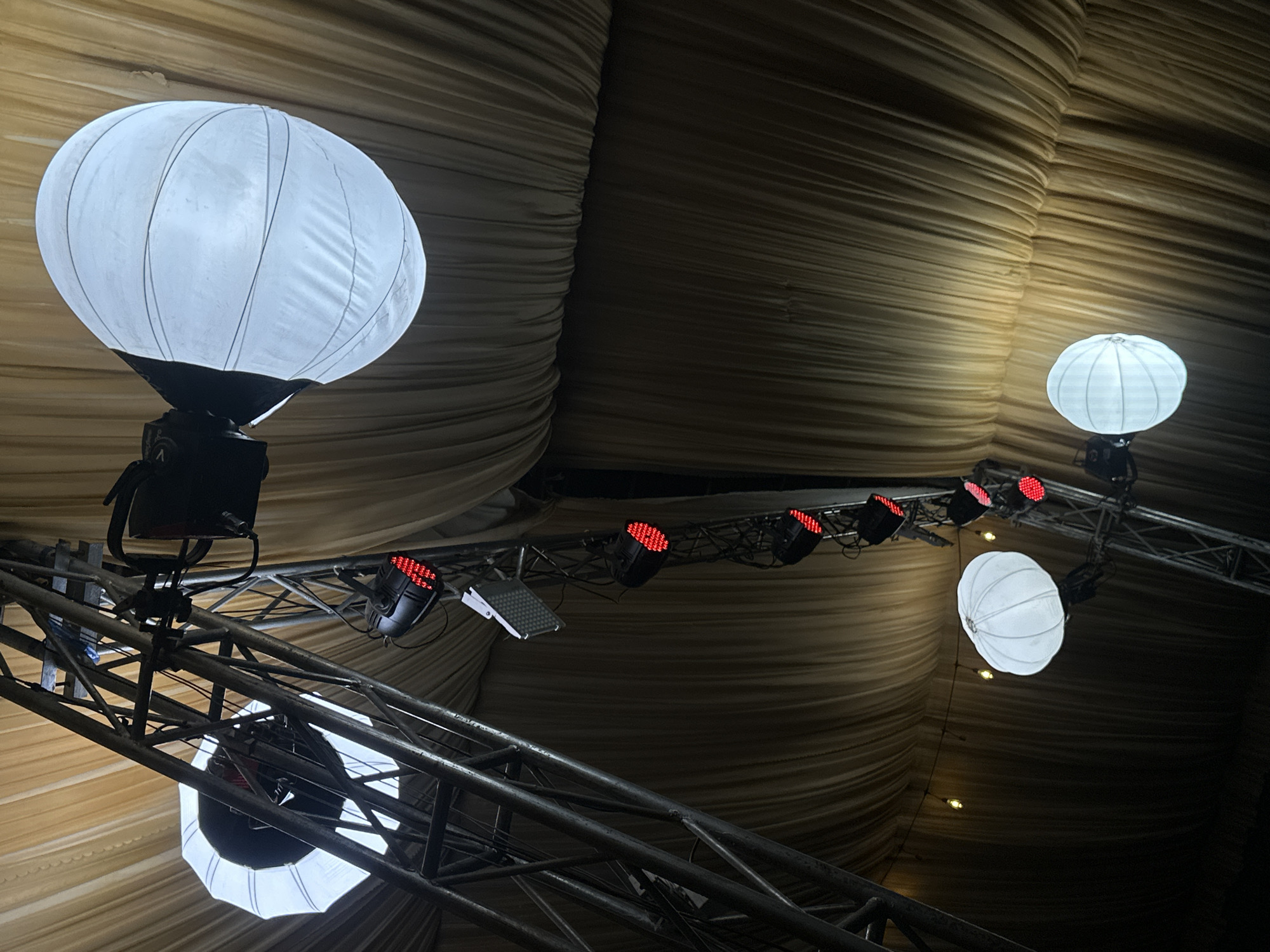
The image shows an indoor scene, possibly a tent or a venue with draped fabric walls and ceiling. There are several lights suspended from a metal truss structure. Two large, white spherical softbox lights are prominently visible, one towards the top right and another towards the bottom left. A string of small, incandescent bulbs hangs horizontally in the background. Additionally, several smaller, black stage lights, some with red LEDs illuminated, are attached to the truss. The overall lighting suggests a dimly lit environment with focused illumination from the stage lights. The fabric appears to be a neutral, possibly beige or tan color, and is draped in vertical folds, creating texture. The scene is devoid of people and any specific landmarks that would indicate the city of Ashipa, Nigeria.
Ashipa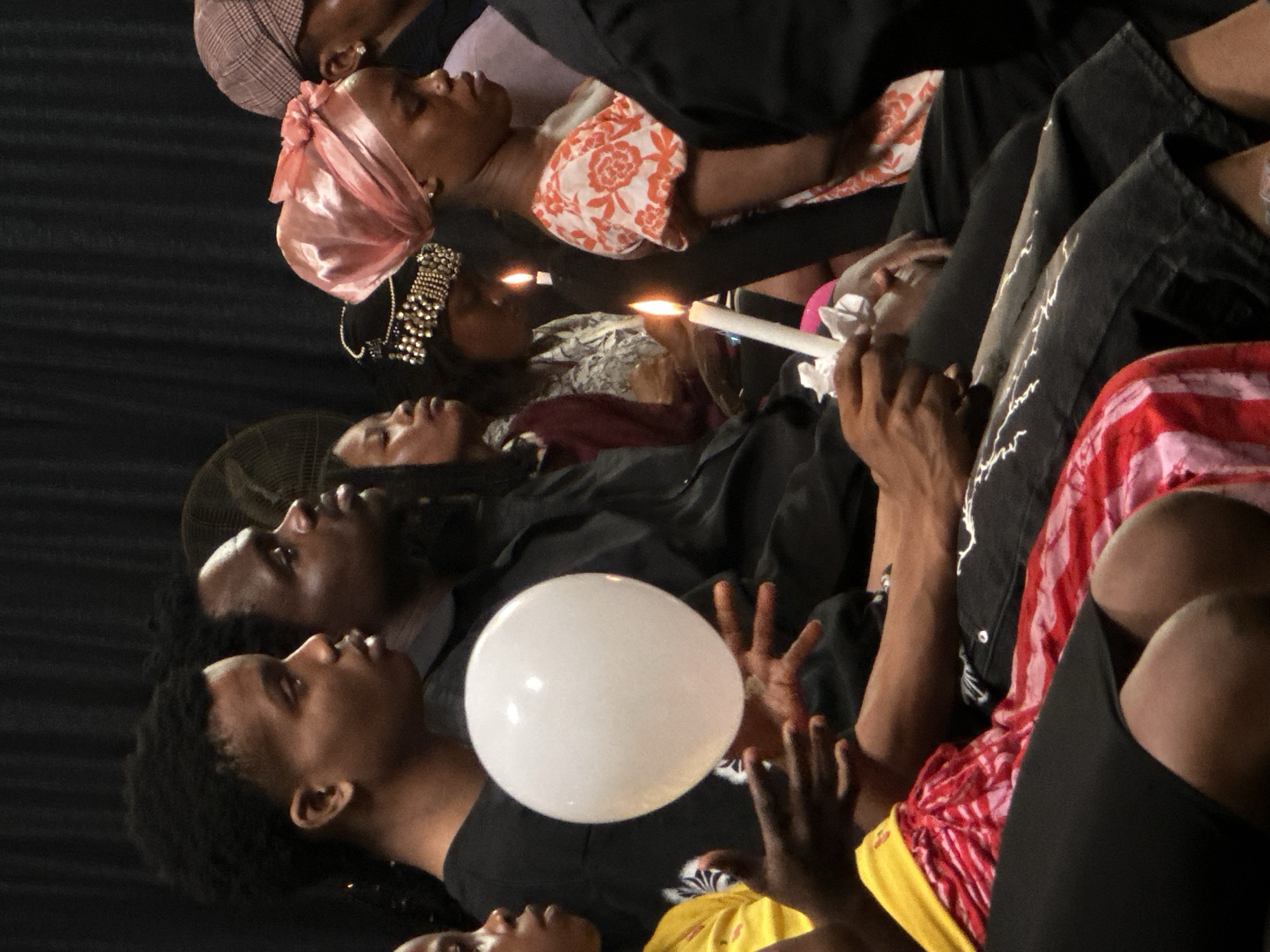
The image captures a solemn gathering of people in Ashipa, Nigeria, likely a memorial or vigil. Several individuals are seated in rows, facing forward, with a dark curtain as the backdrop. The focal point is a white balloon held by a person in the foreground, who also holds a lit candle. Other lit candles are visible among the attendees, casting a warm glow. The individuals are dressed in a variety of attire, from casual to more formal, including head wraps and patterned clothing. Some people have their eyes closed, suggesting a moment of reflection or prayer. The overall atmosphere appears somber and contemplative.
Ashipa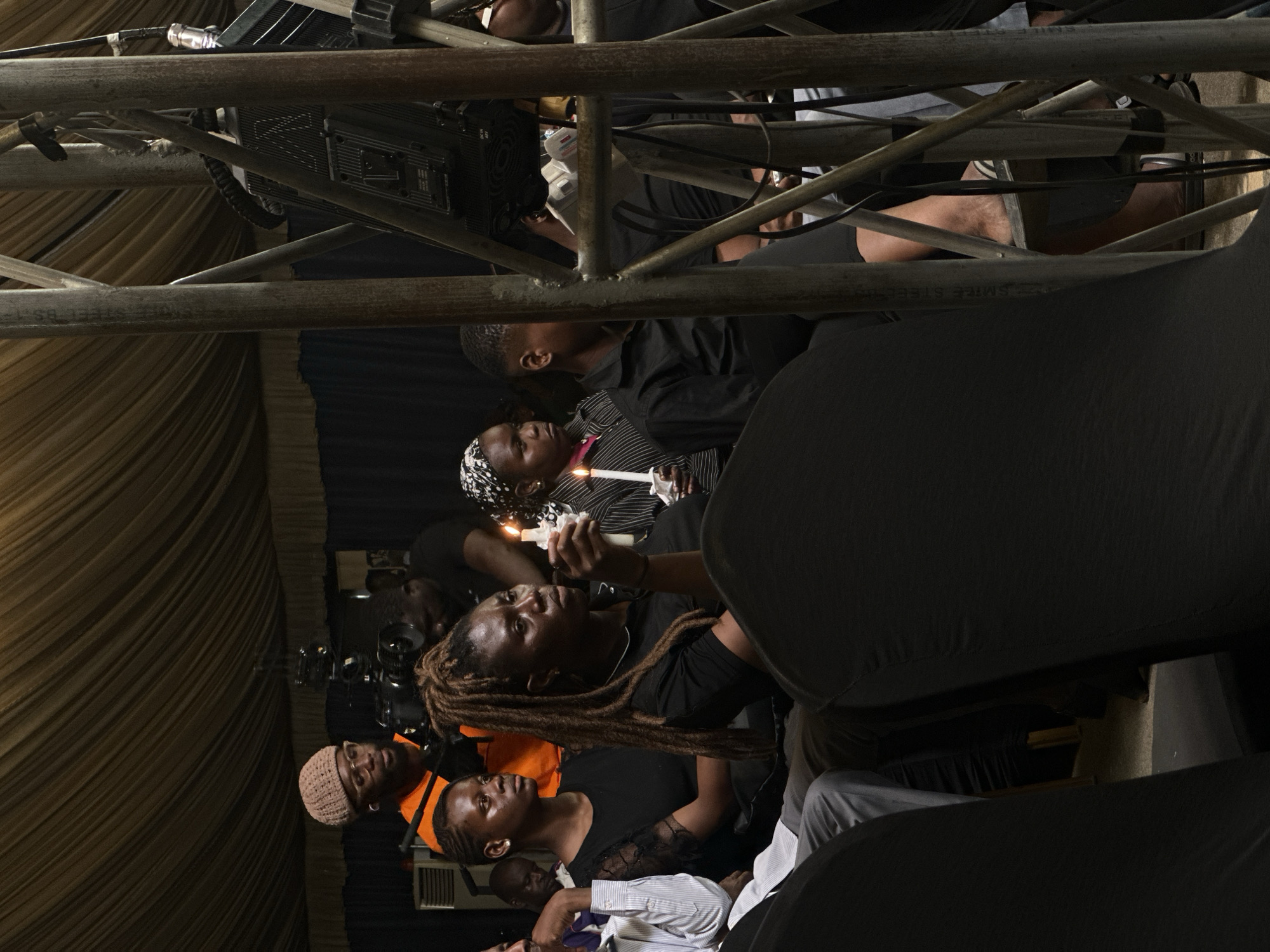
The image depicts a gathering of people, some holding lit candles, in what appears to be an indoor event space. The environment is dimly lit, with fabric draping the ceiling and dark curtains forming the backdrop. In the foreground, several individuals are seated, facing towards an unseen focal point. A person wearing an orange shirt and a knitted cap is visible in the mid-ground, seemingly operating a camera. The overall atmosphere suggests a solemn occasion, possibly a vigil or memorial service. The exact location within the city of Ashipa, Nigeria, cannot be determined from the visual information provided.
Ashipa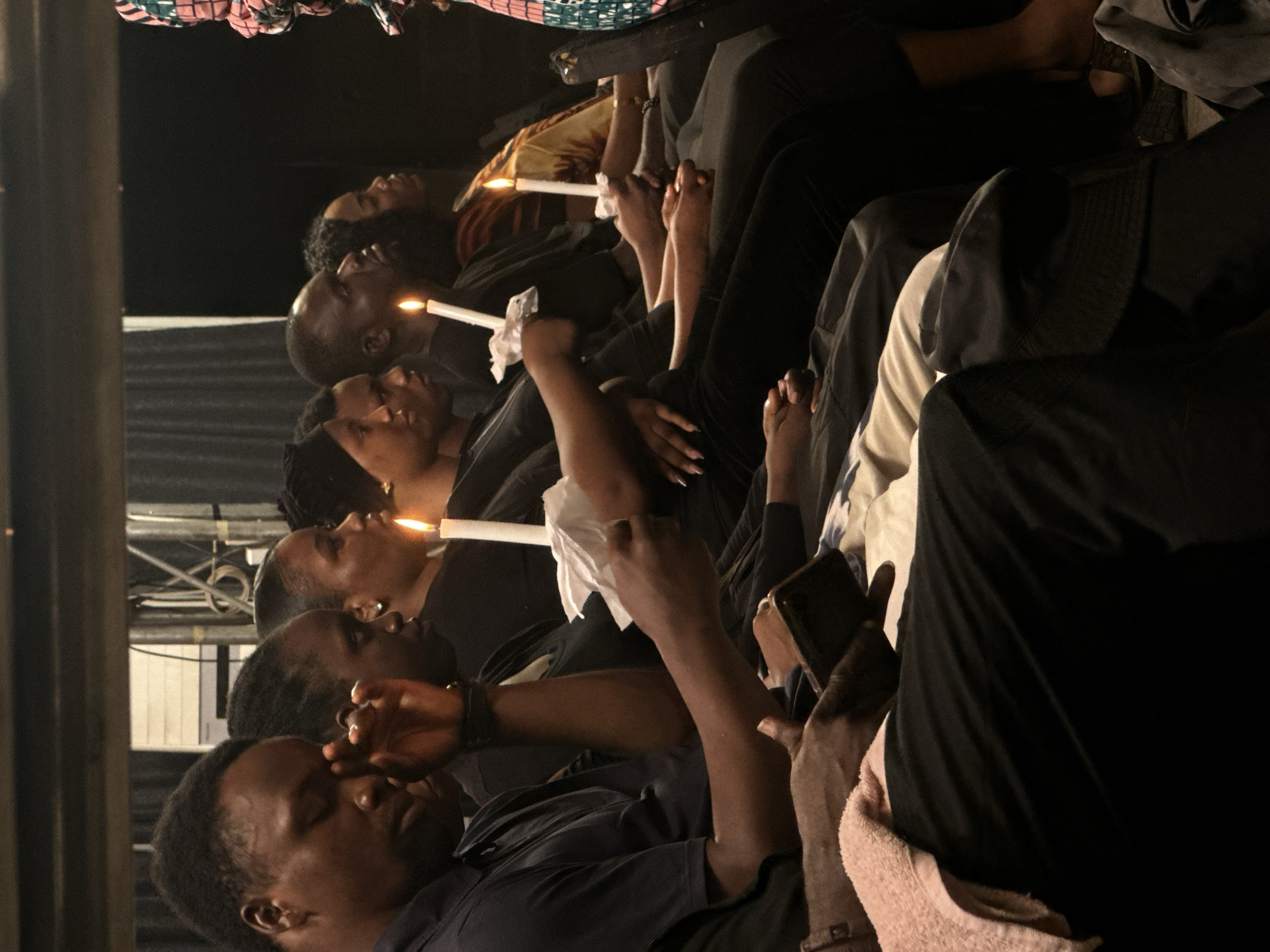
The image shows a group of Black individuals sitting in what appears to be an indoor setting, possibly a church or community hall in Ashipa, Nigeria. Most individuals are holding lit white candles. The lighting is dim, with the primary illumination coming from the candles and some overhead fixtures. The people are seated in rows, and their expressions suggest a somber or reflective mood. One person in the foreground is wiping their eye, and another is holding a tissue. There are various clothing styles visible, predominantly dark colors. The background is indistinct, with dark curtains or walls. The overall atmosphere is one of a memorial service or vigil.
Ashipa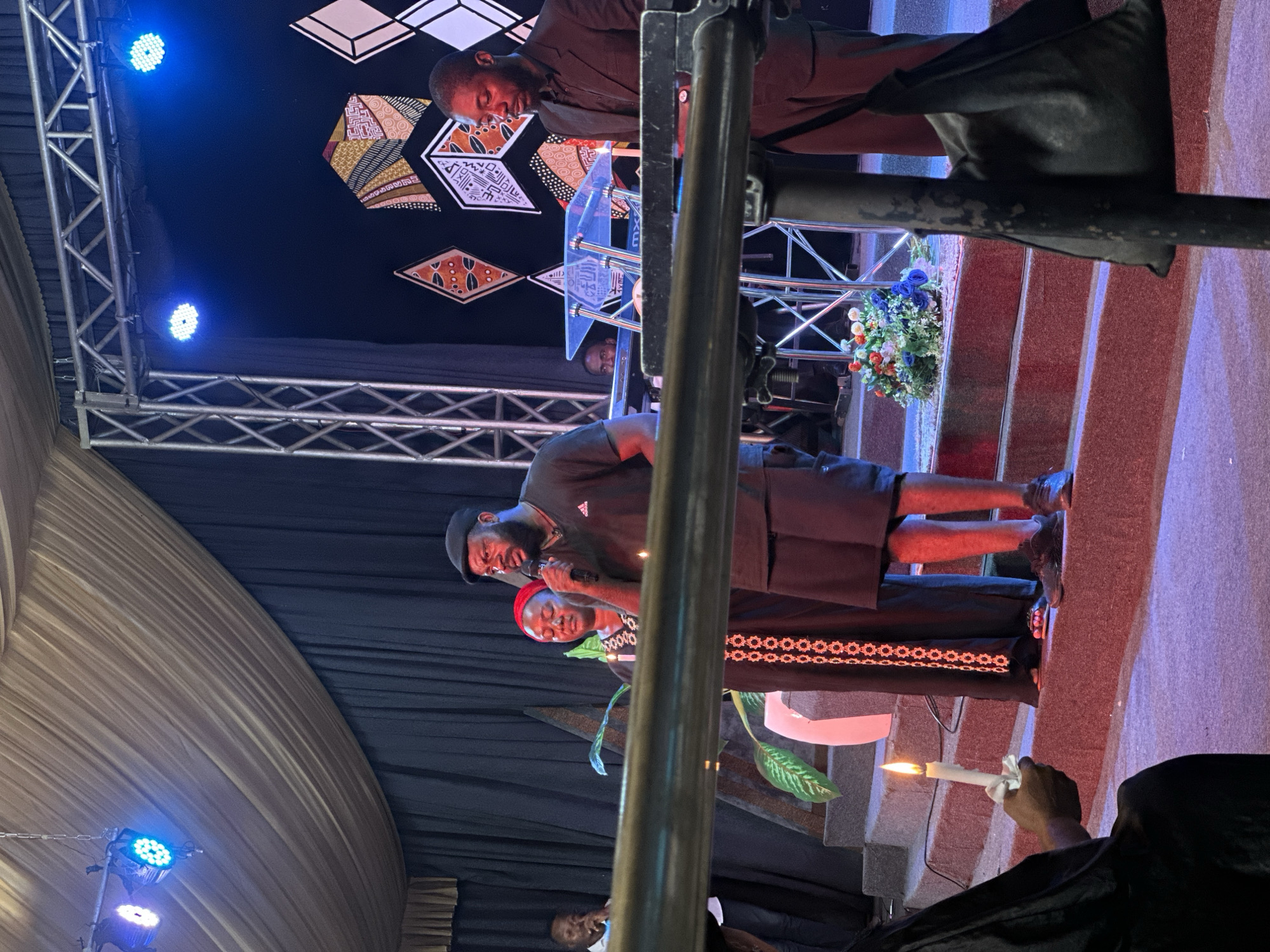
The image depicts a gathering in Ashipa, Nigeria. The scene appears to be an indoor event, possibly a service or ceremony, taking place on a stage. In the foreground, on the left, a person in black clothing is holding a lit candle. To the right of this person are three individuals standing on elevated steps. The central figure is a man wearing a black t-shirt and shorts, holding a microphone and speaking. To his left is a woman wearing a traditional black dress with red and white embroidery, and a red headscarf. She is also holding a lit candle. To the right of the man with the microphone, a portion of another man in a black suit is visible. Behind the main group, there's a stage with black curtains. A floral arrangement sits on the steps. The background features a decorative wall with geometric patterns in shades of brown, yellow, and white. Stage lighting, including blue spotlights, illuminates the area. A metal truss structure is visible above the stage. On the right side of the stage, there's a transparent podium. The overall impression is one of a formal gathering, with elements of reverence suggested by the candles and the solemn expressions of some individuals.
Ashipa
A group of people are sitting in an indoor venue. In the foreground, a young person in a yellow shirt sits with their arms crossed, holding a white balloon. To their left, a woman in a black dress is also seated. Behind them, several other individuals are visible, some looking forward. The environment appears to be a seated audience area, possibly for an event or performance, with a fabric ceiling visible above.
Ashipa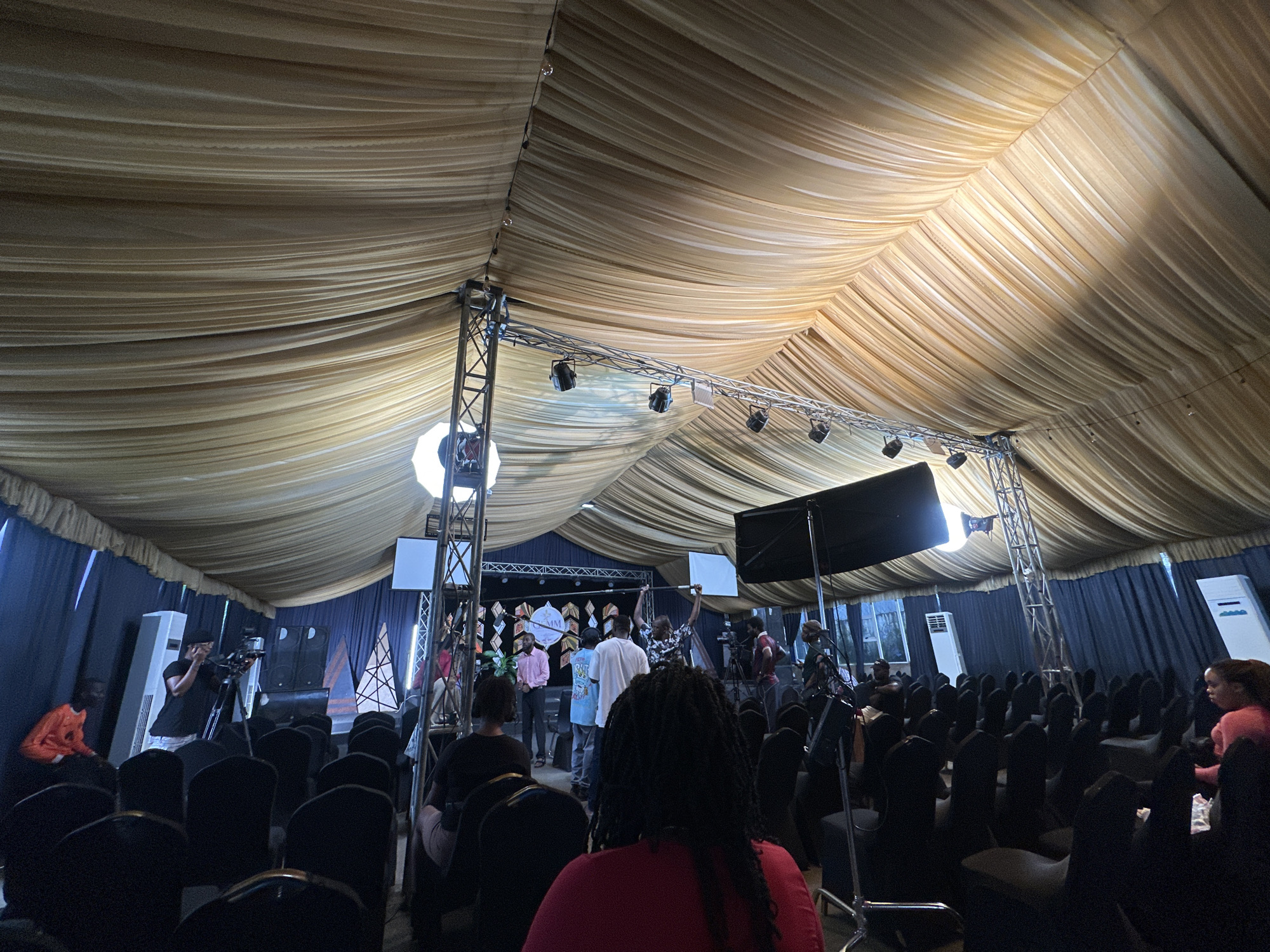
The image depicts an indoor event, possibly a conference or performance, taking place under a large, draped tent ceiling. The tent's fabric is a light beige or gold color, with numerous pleats creating a textured, wavy appearance. Several lighting rigs and metal truss structures are visible, supporting spotlights and other lighting equipment, casting bright beams onto the fabric. In the foreground, rows of dark, upholstered chairs are arranged, facing towards a stage area at the back of the tent. Some chairs are occupied by people, primarily seen from behind, with their backs and heads visible. The attendees are dressed casually. The stage area is set up with a backdrop of dark blue fabric. There are lighting elements and possibly screens or displays on the stage. Several individuals are present on and around the stage, some appearing to be part of a production crew, operating cameras and equipment. One person is actively filming with a camera on a tripod. Another individual stands with their arms raised, holding a piece of equipment, likely a light or reflector. To the left of the stage, there are tall, white air conditioning units. Decorative triangular structures are placed behind the stage. In the far left of the image, an individual in an orange garment is partially visible, seated near some equipment. On the far right, a person in a pink top is seated. The overall impression is of an active event with a focus on production and audience engagement within a temporary structure. The scene is brightly lit in some areas due to the stage lighting, while other parts are more dimly lit, creating a contrast. Based on the provided context, this event is located in Ashipa, Nigeria.
Ashipa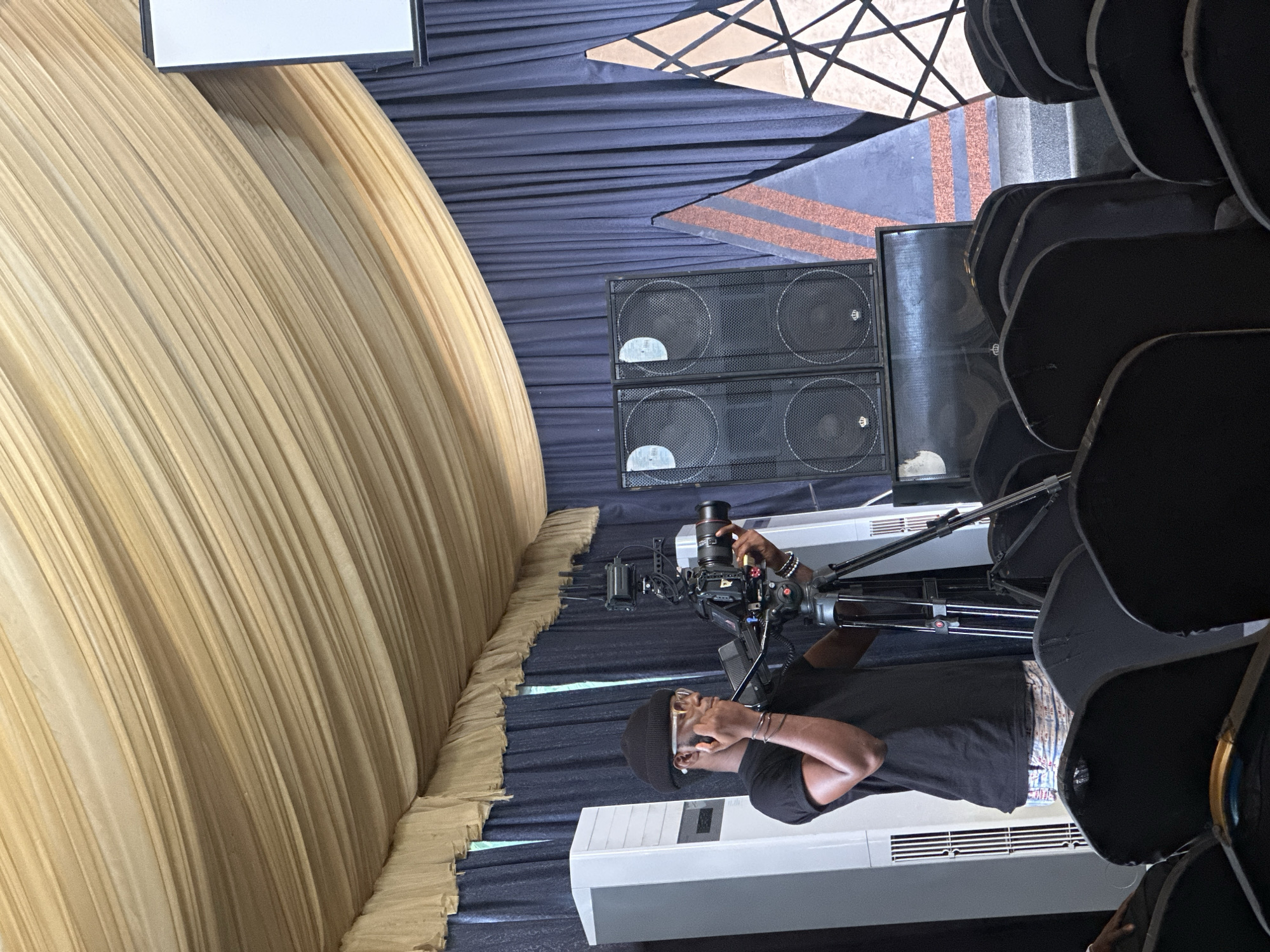
A person, wearing a black beanie, glasses, and a black t-shirt with patterned shorts, operates a professional video camera mounted on a tripod. The individual is positioned in front of a dark blue curtain backdrop, with a tan, pleated fabric draped overhead. To the left of the person is a tall, white air conditioning unit. Behind the person, stacked black speaker cabinets are visible. To the right of the speakers, there are two triangular decorative elements with geometric patterns. In the foreground, rows of black chairs with dark upholstery are arranged. The scene appears to be an indoor event space, potentially a hall or conference room, located in Ashipa, Nigeria.
Ashipa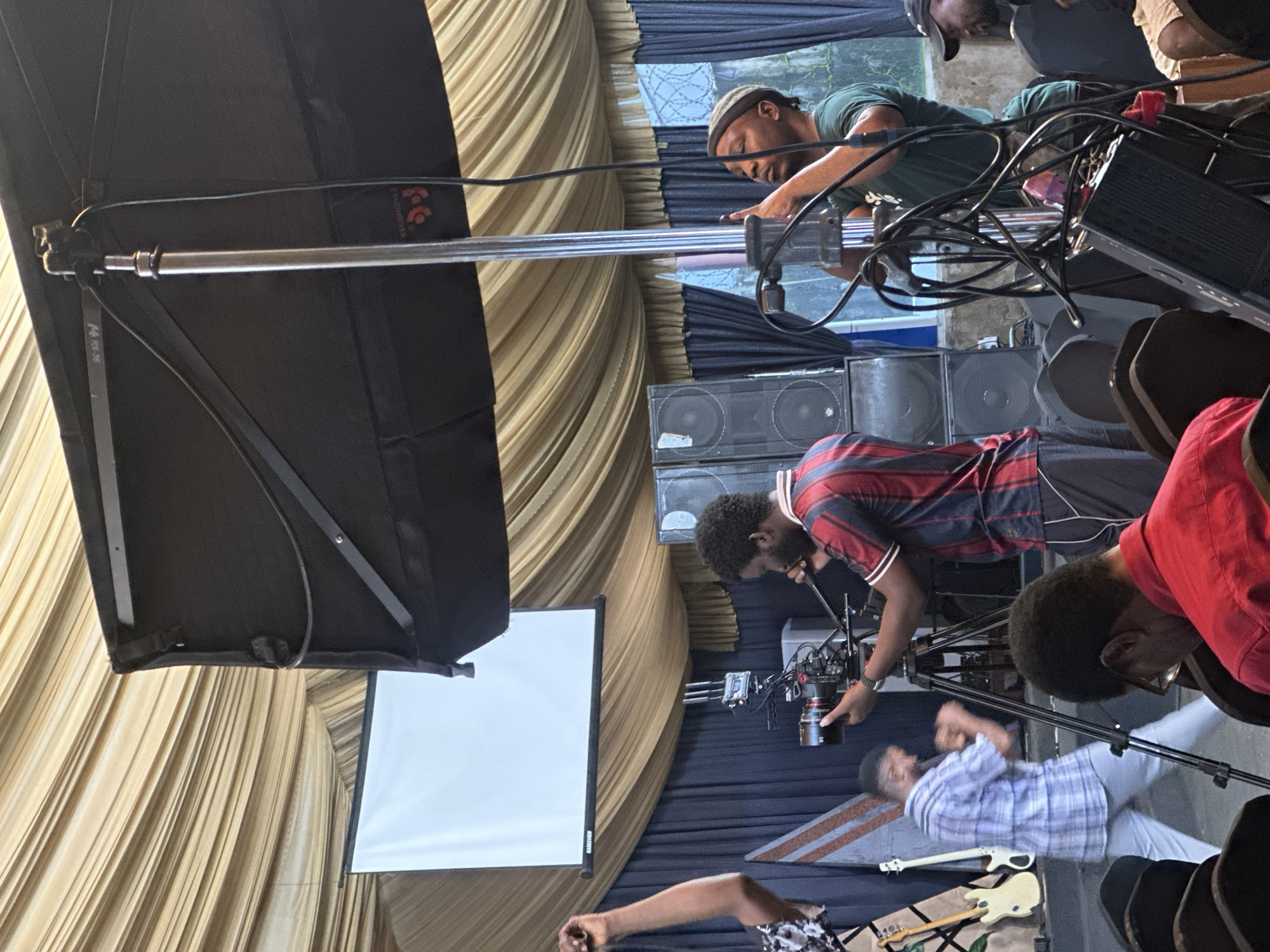
The image shows an indoor event setup, possibly a performance or presentation, in Ashipa, Nigeria. A large softbox light is suspended from a stand, dominating the upper portion of the frame. Beneath it, a videographer operates a camera mounted on a tripod, focusing on a man in a blue and white plaid shirt who appears to be moving or dancing. To the right, another man in a green t-shirt adjusts the light stand. In the background, stacks of speakers and two guitars on a stage are visible, draped with gold and blue fabric. A white projection screen hangs on the left side of the frame. Several individuals are seated in the foreground. The overall scene suggests a live production or recording in progress.
Ashipa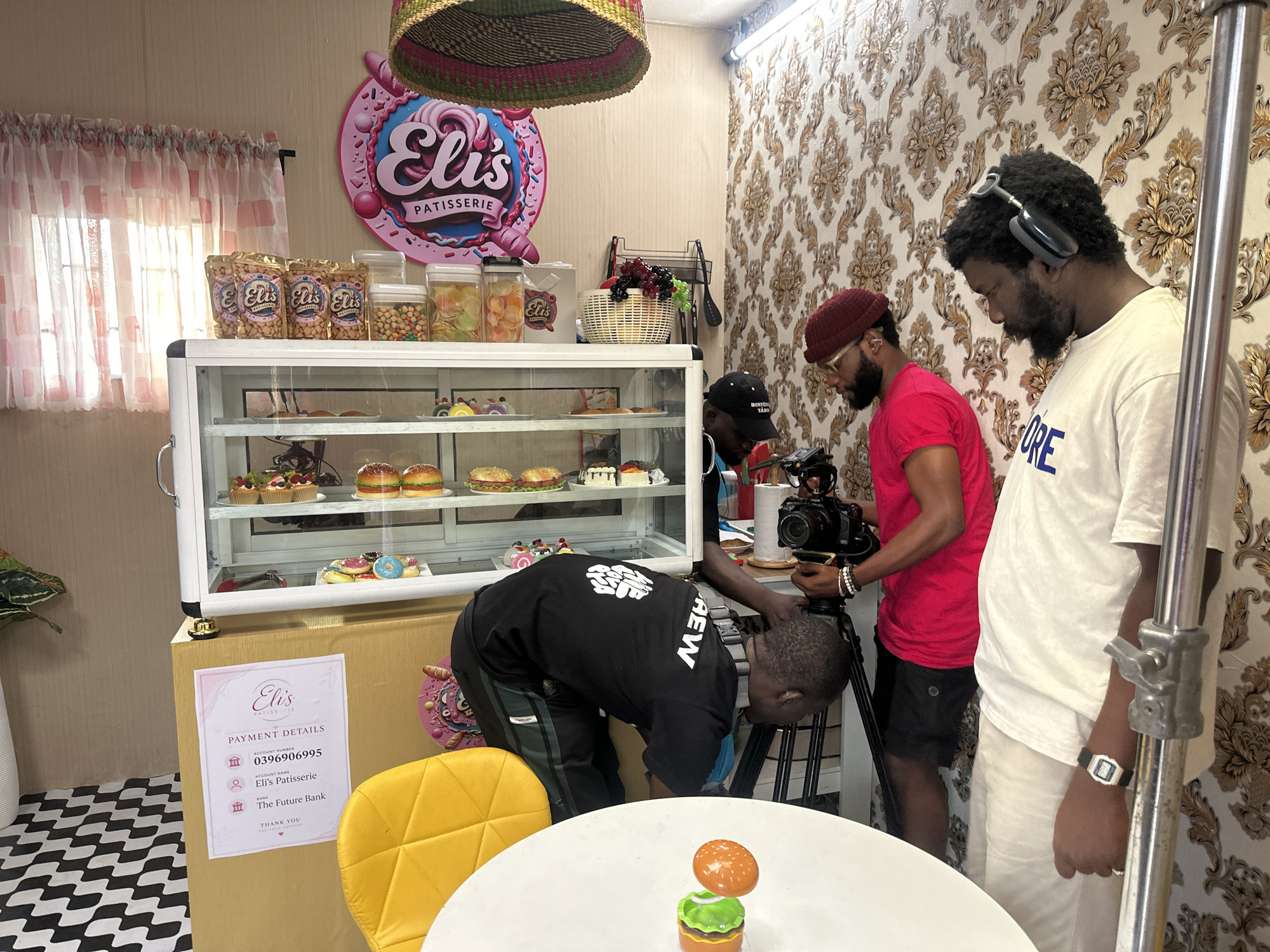
In the city of Ashipa, Nigeria, a patisserie is being filmed. Three men are present. One man in a red shirt and black beanie is operating a video camera mounted on a tripod, his attention focused on the task. To his right, another man wearing a white t-shirt and headphones is also looking down, possibly reviewing footage or preparing for his role. A third man, dressed in a black t-shirt with white lettering on the back, is bent over, his head obscured as he works with equipment near a display case. The display case is filled with various pastries, including what appear to be donuts, cakes, and burgers. Above the display, a sign reads "Elis Patisserie" in pink and blue lettering, surrounded by a pastel graphic. Bags of snacks labeled "Elis Patisserie" are also visible on top of the display. The room's walls are decorated with a patterned wallpaper, and a patterned curtain hangs over a window on the left side of the frame. A yellow chair is positioned to the right of the display case, and a white table with a miniature burger toy on it is in the foreground. A white stand, likely for lighting or audio equipment, is to the right of the frame. A payment details sign for "Elis Patisserie" is affixed to the front of a golden counter.
Ashipa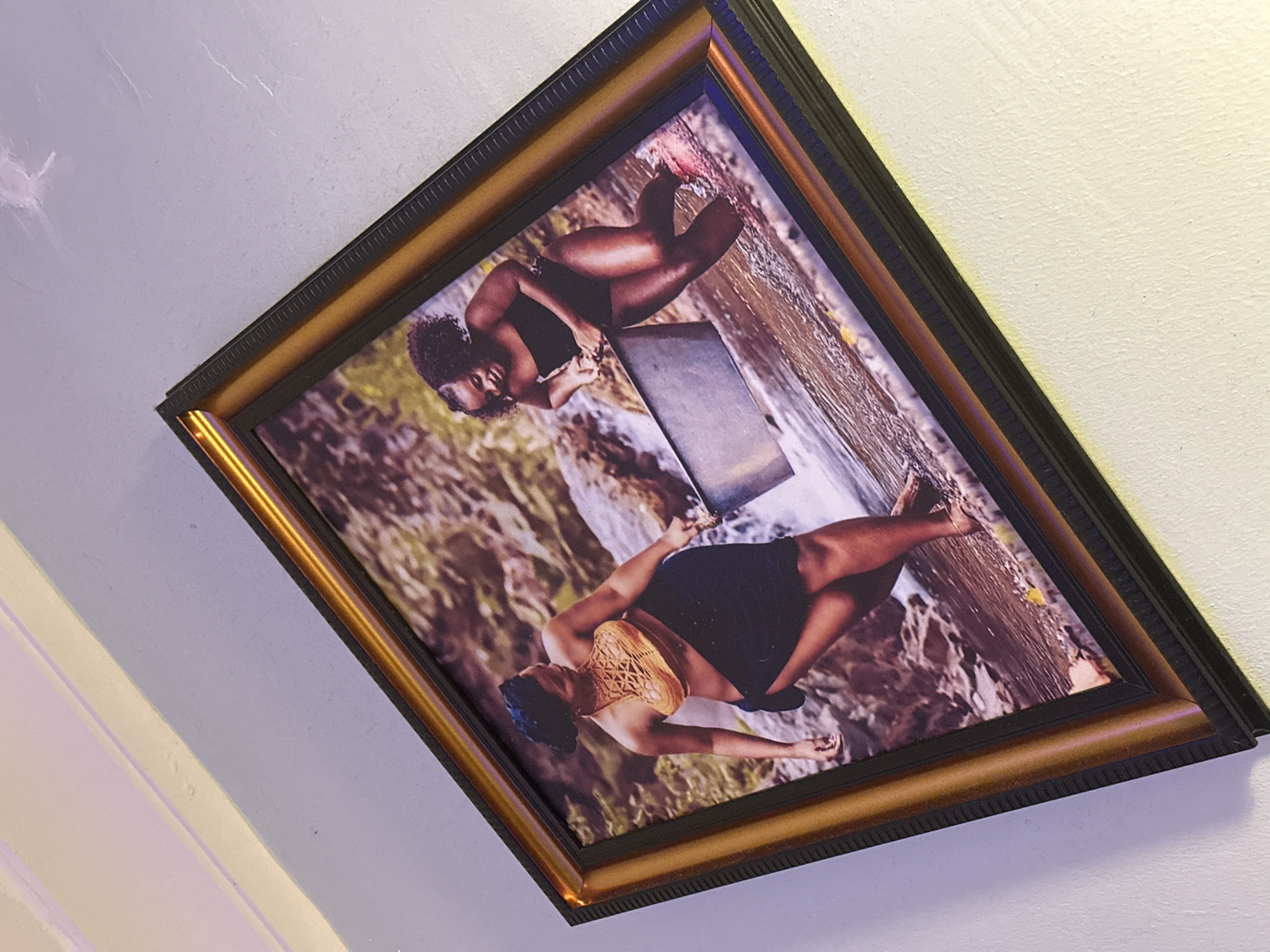
In the city of Ashipa, Nigeria, a framed photograph depicts two women by a river. The woman on the left, wearing an orange crochet top and a black skirt, carries a bucket. The woman on the right, in a black bathing suit, is positioned near the riverbank. The background features rocky terrain and foliage, with a flowing body of water in the foreground. The photograph is enclosed in a black and gold frame, which is tilted on a white textured wall.
Ashipa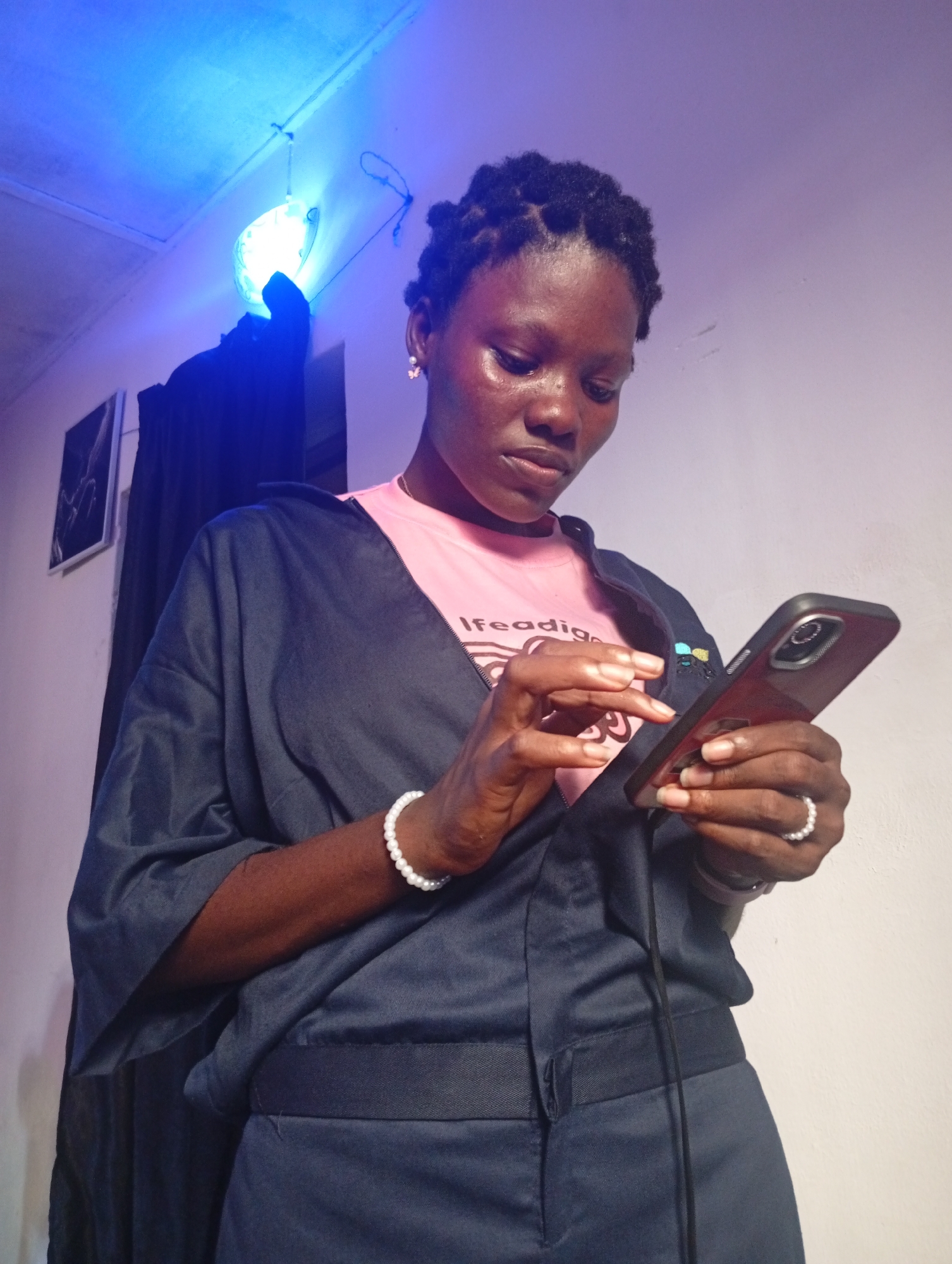
A young Black woman with braided hair is looking down at her smartphone, which she is holding in her hands. She is wearing a pink t-shirt, a dark blue open jacket, and dark blue pants. She has a white beaded bracelet on her left wrist and a pearl ring on her right ring finger. A blue light illuminates the scene from above. To the left of the woman, a framed picture is visible on the wall. The environment appears to be an indoor space, possibly a room in a home or a small shop in Ashipa, Nigeria. The overall lighting suggests it is nighttime or a dimly lit interior space.
Ashipa
The video is a close-up, high-angle shot of a person with dark skin and braided hair, wearing a pink shirt and a dark blue jumpsuit. The person is looking down and appears to be engaged in an activity. There is a black earbud in their left ear and a silver earring. In the lower left corner of the frame, a black fan with a red circular element is visible, along with what appears to be a black object with a circular opening. The lighting is dim, with a light-colored wall in the background. The video is characterized by its shaky camera movement and lack of clear focus.
Ashipa
This media file captures a moment with two individuals, likely men, seated and engaged in conversation. The setting appears to be indoors, possibly a church or a formal gathering space, given the presence of what looks like a stained-glass window in the background and a decorative wooden paneling. The lighting suggests it's daytime. The primary focus is on the man in the foreground, who is looking to his right and appears to be speaking. He has short, light-colored hair and is wearing a white garment, possibly a clerical robe or a uniform of some sort. His facial expression conveys animation, and his mouth is open as if he is mid-sentence. His right hand is slightly raised and clenched, suggesting emphasis or gesturing during his speech. To his left, another man is partially visible. He is bald, wears dark-rimmed glasses, and is also wearing a similar white garment. His head is turned slightly away from the camera, and he seems to be listening or also speaking. His mouth is also open, indicating participation in the conversation. The overall mood appears to be one of lively discussion or a sermon. There are no visible signs of the time of day or weather conditions. The location context provided, Ashipa, Nigeria, adds a cultural layer to the scene, suggesting it might be a religious or community event within that region. No text is visible in the media file.
Ashipa
A group of people in white attire are gathered indoors, possibly in a church or event hall. Some are holding microphones and appear to be singing or speaking. The person in the foreground is wearing sunglasses and a patterned white top, holding a microphone. To their right, another person is also holding a microphone and smiling. The lighting is bright, and the background is blurred, suggesting a focus on the central figures. The overall atmosphere appears to be celebratory or religious.
Ashipa
The video shows a man in a red shirt speaking into a microphone. He is seated behind a wooden podium. To his right is a large red banner with a circular emblem and the word "HOPE" printed vertically. The emblem appears to be a crown over an image with a sword and a motto. The background shows wooden paneling. The lighting is reddish and seems to be from stage lights. The man gestures with his right hand as he speaks. The overall scene appears to be a public address or performance.
Ashipa
The video displays an indoor event, possibly a religious service or a gathering. Several people are visible, many wearing white attire and head coverings, suggesting a uniform or specific dress code. In the foreground, to the left, a man with glasses is looking forward. To his right, a person in a white veil and glasses is facing away from the camera. To the right of that person, another individual in a white veil is partially visible. The background reveals a stage or raised platform area. A man in a red, long-sleeved shirt is standing at a podium, speaking into a microphone and looking down at papers. Behind him, a banner with red and white patterns and text that appears to read "BCS HOPE LOVE" is displayed. Floral arrangements are present on the platform, with white and yellow flowers. More people in white are visible in the background, some appearing to be seated and others standing. The environment seems to be decorated with white fabric draped from the ceiling. The lighting is somewhat dim, contributing to a soft, ambient atmosphere. The overall impression is one of a formal gathering with a speaker addressing the attendees.
Ashipa
The video shows a group of people, mostly men and women, dressed in white robes and head coverings, gathered in what appears to be a religious or ceremonial setting. The camera focuses on several individuals, including a man in the foreground who is coughing or touching his face, and a woman holding a microphone. The lighting is dim, and the scene is somewhat blurry due to movement and image processing. Multiple overlapping images of people suggest a fast-paced or disorienting visual effect. The overall impression is that of a spiritual or emotional gathering, possibly a church service or a similar event.
Ashipa
A man with a beard and short hair, wearing a black sweatshirt with a teddy bear graphic, stands in a room. He is looking to his left and appears to be speaking. Two pendant lights hang in the background. A logo for "THE CHIOMA CHUKWUKA TV" is visible in the upper right corner. The bottom of the screen has a watermark that says "The Chioma Chukwuka TV".
Ashipa
The video shows a man with a beard, wearing a light blue and white collared shirt and a lanyard, sitting at a table in a cafeteria. He is holding a black container and what appears to be a plastic fork or utensil. He is looking down at the food container and the utensil. In the background, there are other people standing in a line at a counter, and some are wearing masks. The cafeteria appears to have white tables and chairs, and a counter with food service equipment. The lighting is bright and appears to be from overhead fluorescent lights.
Ashipa
The video shows a scene with two people. On the left, a woman with dark hair pulled back is wearing a light-colored, textured top and dark pants. She is looking towards the right. On the right, a young Black man with curly hair is wearing a gray t-shirt with a pink graphic. He is looking towards the left. The background appears to be an outdoor urban setting with some fencing and buildings. Subtitles are visible at the bottom of the screen. The first subtitle reads "What is it?". The second subtitle reads "It's Daddy".
Ashipa
A woman with dark hair pulled back and wearing large, clear-rimmed glasses is looking down intently, her lips slightly parted. She is wearing a bright green shirt. The text "UCHE MONTANA TV" is overlaid on her chest. The text "Very precise." appears at the bottom of the screen. The scene then cuts to a woman with dark hair, wearing a light-colored patterned top and gold earrings, smiling slightly as she looks down at a sewing machine. To her right, a portion of a red, sequined fabric is visible. The text "The design." appears at the bottom of the screen.
Ashipa
This video begins with a close-up of two individuals, one wearing a pink and white floral patterned garment and a light blue headscarf, kneeling over another person whose face is obscured. The first individual appears to be speaking to the person on the ground, saying "Daddy Monica stand up" and "Why are you doing this to me." The scene then transitions to an aerial view of a bustling city street, featuring tall buildings, a large church, and numerous cars and buses. The text "UCHE MONTANA" is visible in the top right corner of the screen.
Ashipa