Asokoro, Nigeria
14 memories from Asokoro, Nigeria
The video captures a night scene from a moving perspective, likely from a vehicle such as a motorcycle or scooter, given the view of handlebars and the sound of an engine and music. The camera's orientation shifts from an initially tilted vertical to a clear vertical (portrait) view, and then briefly to a horizontal (landscape) orientation before returning to vertical. On the left side of the frame, numerous artificial lights are visible. These lights, predominantly bright white and blue, with some occasional orange or yellow hues, appear as streaks and blurred spots due to motion. They likely represent streetlights, lights from other vehicles, or buildings lining the street. These lights create a bright, dynamic streak along the left edge of the video. The right side of the frame is dominated by a large, dark, and mostly featureless wall or building. Its texture is somewhat visible, suggesting concrete or similar material, but the darkness prevents clear identification. In the foreground, particularly at the beginning of the video, parts of a vehicle's handlebars and the top of a front wheel or dashboard are dimly visible, reinforcing the first-person perspective from a moving vehicle. The overall lighting is dim, characteristic of nighttime conditions, with the primary illumination coming from the artificial light sources themselves. The scene conveys the experience of traveling at night, with the surrounding environment largely obscured except for the prominent lights.
Asokoro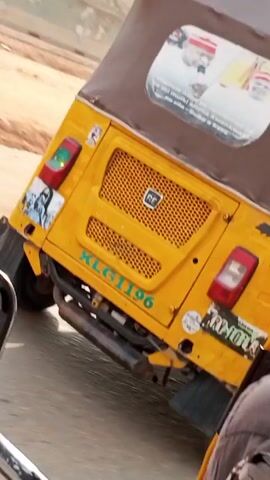
The camera is inside a yellow three-wheeled vehicle, possibly a tuk-tuk or auto-rickshaw, driving along a paved road. Outside the vehicle, the landscape features a substantial amount of red-orange dirt or soil. Concrete barriers and building debris are scattered along the roadside. Other vehicles, including a maroon minivan and a white sedan, are visible driving in the opposite direction. The weather appears overcast and bright. The vehicle is moving forward, and the view shifts slightly as it progresses along the road.
Asokoro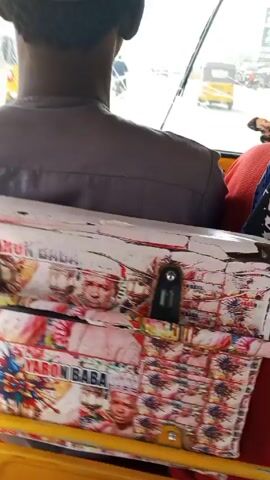
The video shows the interior of a moving vehicle, likely a three-wheeled auto rickshaw, with two passengers visible. The person in the front is wearing a brown top and a patterned cap, while the person in the back is wearing a red outfit with a colorful scarf. A decorated container with images and the phrase "YARON BABA" is placed in the vehicle's interior, with some wear and tear visible. Through the front windshield, other auto rickshaws and pedestrian movement can be observed, suggesting a busy street scene. The windshield appears to be cracked.
Asokoro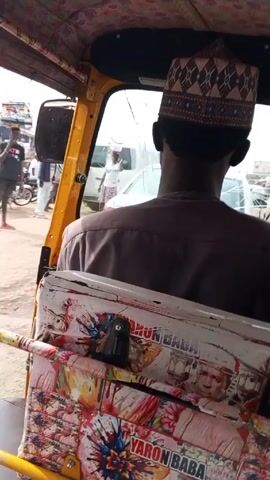
The video shows a ride in a yellow motorized tricycle, commonly known as a keke or rickshaw, through what appears to be a crowded market area in Nigeria. The view is from inside the vehicle, behind the driver. The driver is wearing a brown shirt and a patterned kufi cap. The back of the driver's seat is decorated with images and the words "Yaron Baba." Outside, people are walking and motorcycles are moving in the street. Some individuals are carrying items on their heads. There is a white van with a cracked windshield visible in the background. The road is unpaved and dusty. The keke moves slowly through the congestion. The sound of the keke's horn is heard frequently.
Asokoro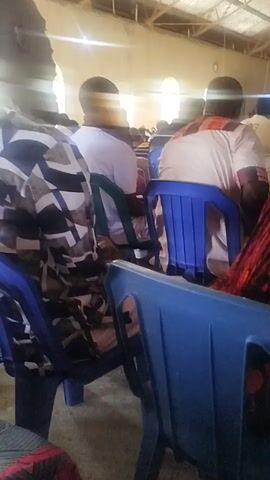
The video shows a gathering of people sitting on blue plastic chairs inside what appears to be a large hall or auditorium. The camera is positioned from behind, focusing on the backs of the attendees. Most of the people are facing forward, with their heads visible. The clothing of the individuals is varied. Several people are wearing headwraps or head coverings. The hall has a high ceiling, and natural light is entering through windows or openings on one side, creating a bright, somewhat diffused light. The building structure seems simple, with a roof made of corrugated metal or a similar material. The video is slightly shaky.
Asokoro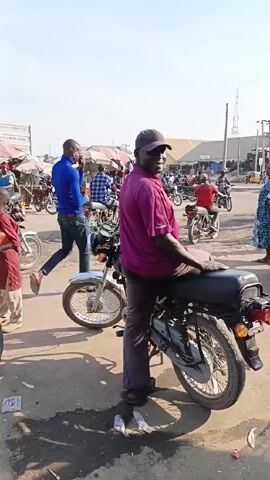
The video shows a busy street scene in what appears to be a market area. Several people are visible, including men and children, with some standing near motorcycles. The man in a purple shirt and cap is sitting on a motorcycle, looking towards the camera. Other men are riding motorcycles through the scene. Market stalls with umbrellas are visible in the background, suggesting a commercial activity. The ground is paved, with some debris and shadows visible. Overall, the video captures a typical day in a bustling market environment.
Asokoro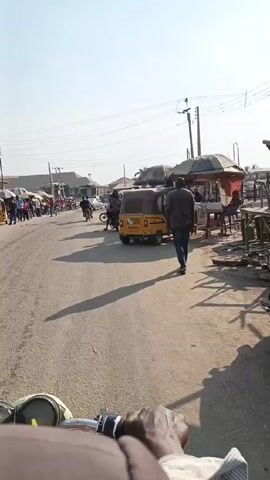
The video shows a street scene in what appears to be a busy market area. The camera is mounted on a motorcycle, providing a rider's point-of-view. The road is paved and lined with motorcycles parked on both sides. People are seen standing and walking around the motorcycles and small shops. A yellow tricycle taxi is also visible. Overhead are power lines and the sky is clear. The rider slowly drives forward, navigating through the crowd of people and parked motorcycles.
Asokoro
Two women are washing clothes outside. One woman wears a blue and orange patterned dress, while the other wears a light-colored t-shirt and dark shorts. Both women sit on low stools, with metal basins of water and clothes in front of them. They scrub and wash the clothes by hand. A white pickup truck is parked in the background. The ground appears to be dirt or gravel.
Asokoro
A woman is holding up a plate of cubed food to the camera. She wears a black hair bonnet with a white pattern and a black t-shirt. She is smiling and talking. The background shows a wall painted off-white and white-tiled floors.
Asokoro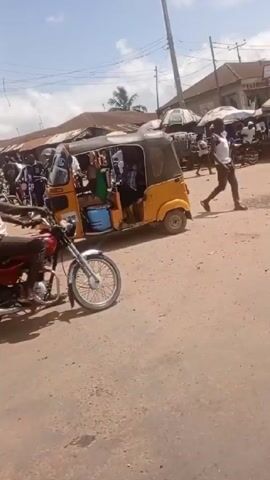
The video shows a street scene in what appears to be a developing country, possibly Africa. Several yellow auto-rickshaws, also known as "keke" or "tuk-tuks," are visible, with passengers inside. One person wears a blue shirt with a black jacket, holding a book. The rickshaws are parked near a street with other people, motorcycles, and open-air stalls. A beat-up white minibus is also visible, parked close to the rickshaws, with faded paint and a damaged front bumper. Passengers are visible inside. The overall impression is that of a bustling transportation hub in a busy urban area.
Asokoro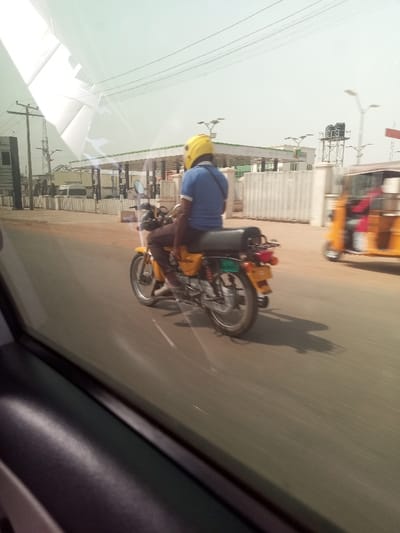
A daytime photograph, taken from inside a moving vehicle, captures a person riding a yellow motorcycle on a road in what appears to be an urban or semi-urban area. The motorcyclist, seen from behind, wears a bright yellow helmet, a blue short-sleeved polo shirt, and dark trousers. A strap, possibly from a bag, crosses his back. The yellow motorcycle has a black seat and a rear rack. In the background, a gas station canopy is visible with what seems to be service pumps underneath. Beyond the station, white walls or fences line the roadside, and several utility poles with power lines stretch across the frame against a bright, hazy sky. To the far right, a blurry yellow motorized rickshaw, commonly known as a Keke Napep, is also in motion, suggesting traffic on the road. The bright sunlight indicates a clear day, casting shadows of the motorcycle and rider onto the pavement. The foreground shows parts of a car's interior, including the dark dashboard and window frame, from which the picture was captured. Reflections on the car window are evident, particularly in the upper left, slightly obscuring parts of the distant background. No legible text is visible on any signs or vehicles. The scene depicts everyday transport in an active setting, consistent with the provided context of Asokoro, Nigeria.
Asokoro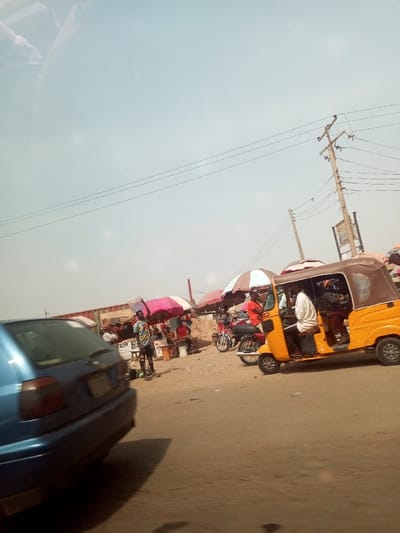
The image depicts a dynamic street scene, likely in Asokoro, Nigeria, under a bright, clear daytime sky. The setting appears to be a bustling roadside area with a mix of commercial activity and vehicle traffic. In the foreground on the left, the rear of a blue car is partially visible, suggesting movement on the dusty road. To the right, a prominent yellow tricycle, known locally as a keke napep, is seen with passengers inside, indicating public transport activity. Adjacent to it, a motorcycle is parked near a cluster of informal stalls. These roadside stalls are characterized by vibrant, open umbrellas, including pink and brown-and-white striped ones, providing shade for vendors and their goods. A person in a striped shirt stands near one of these stalls. In the background, a large red metal container, possibly repurposed as a shop, adds to the commercial landscape. Visible on one of the stalls is the number "200", which likely denotes a price. Overhead, multiple utility poles support a network of power lines, typical of an urban or semi-urban environment. The overall atmosphere conveys a sense of daily commerce and movement in a lively community setting.
Asokoro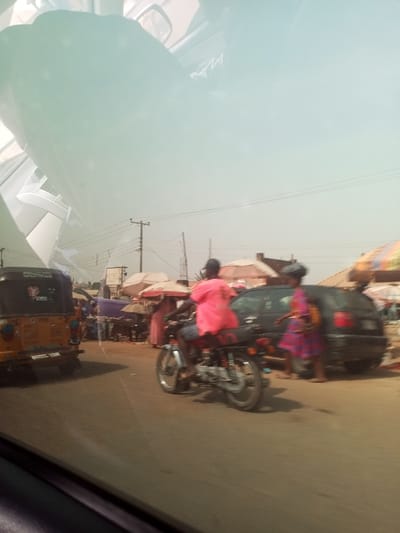
This image presents a vibrant, sunlit street scene, likely captured from the interior of a moving vehicle, evidenced by the reflections of the car's dashboard and windshield in the upper part of the frame. The setting appears to be a bustling market or commercial area in Asokoro, Nigeria. In the mid-ground, a person wearing a bright pink or red top is seen riding a motorcycle, facing away from the camera. Their left foot is on the ground, suggesting they are either halted or navigating slowly through the street. To the immediate left, the rear of a yellow or orange three-wheeled auto-rickshaw, commonly known as a Keke Napep in Nigeria, is visible. Some indistinct text, possibly "TVC," can be faintly made out on its back. On the right side of the frame, another individual, possibly a woman, is walking or standing near a dark-colored car. She is dressed in a patterned garment with purple, pink, and yellow colors and appears to be carrying an item on her head or in her hands. The background is filled with numerous market stalls shaded by umbrellas of various colors, indicating a lively trading environment. Power poles and overhead lines are visible against the bright, slightly hazy sky. The general activity depicts a typical busy day with vehicles and pedestrians moving through the street. The bright lighting confirms it is daytime. Due to distance and slight motion blur, specific emotions are not discernible, and aside from possible vehicle branding, no other readable text is clear.
Asokoro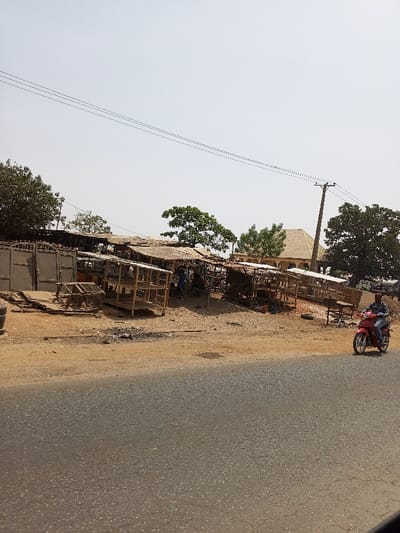
This daytime photograph captures a roadside scene in Asokoro, Nigeria, under a bright, clear sky. In the foreground, an asphalt road stretches horizontally, showing some minor cracking. To its left, a dusty, unpaved shoulder separates the road from a collection of informal structures. The midground features numerous makeshift market stalls or shelters, constructed primarily from wooden frames and covered with various materials like corrugated metal or tarpaulins. Many of these structures are designed as multi-tiered shelves or cages, hinting at the sale of goods or small animals. Several indistinct figures can be seen moving or standing among these stalls, suggesting ongoing activity. On the far left, large, possibly metal, gates are visible next to some foliage. In the background, a light-colored building with a distinctive reddish-brown roof stands amidst more trees, particularly prominent on the right side. A tall, wooden utility pole with several power lines extends vertically on the right, contrasting against the pale sky. On the road, in the lower right portion of the image, a person wearing a blue shirt is riding a red motorcycle. The overall scene suggests a busy, informal commercial area alongside a road. The weather appears dry and sunny. No visible text is present in the image.
Asokoro