Bern, Switzerland
30 memories from Bern, Switzerland
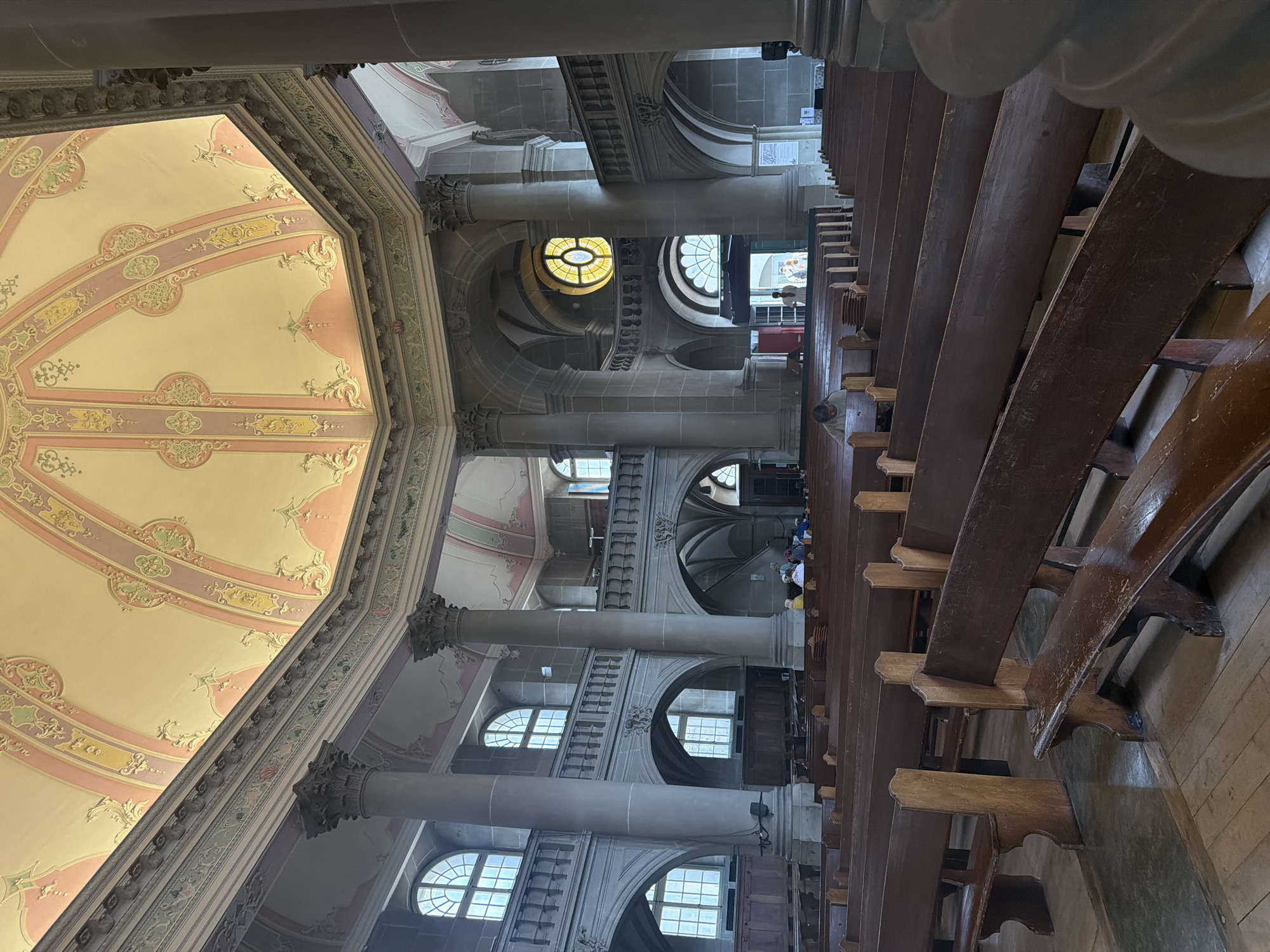
This image shows the interior of the Bern Minster (Münster), a Protestant church in Bern, Switzerland. The view is directed towards the dome, featuring intricate ornate paintings in pink, yellow, and green hues. Large stone columns support the upper levels, which are adorned with arched windows and balconies. Rows of dark wooden pews occupy the main floor, with a few individuals seated or walking in the distance. The flooring is made of light-colored wood. A prominent circular stained-glass window with yellow and orange tones is visible above a passageway in the background.
Bern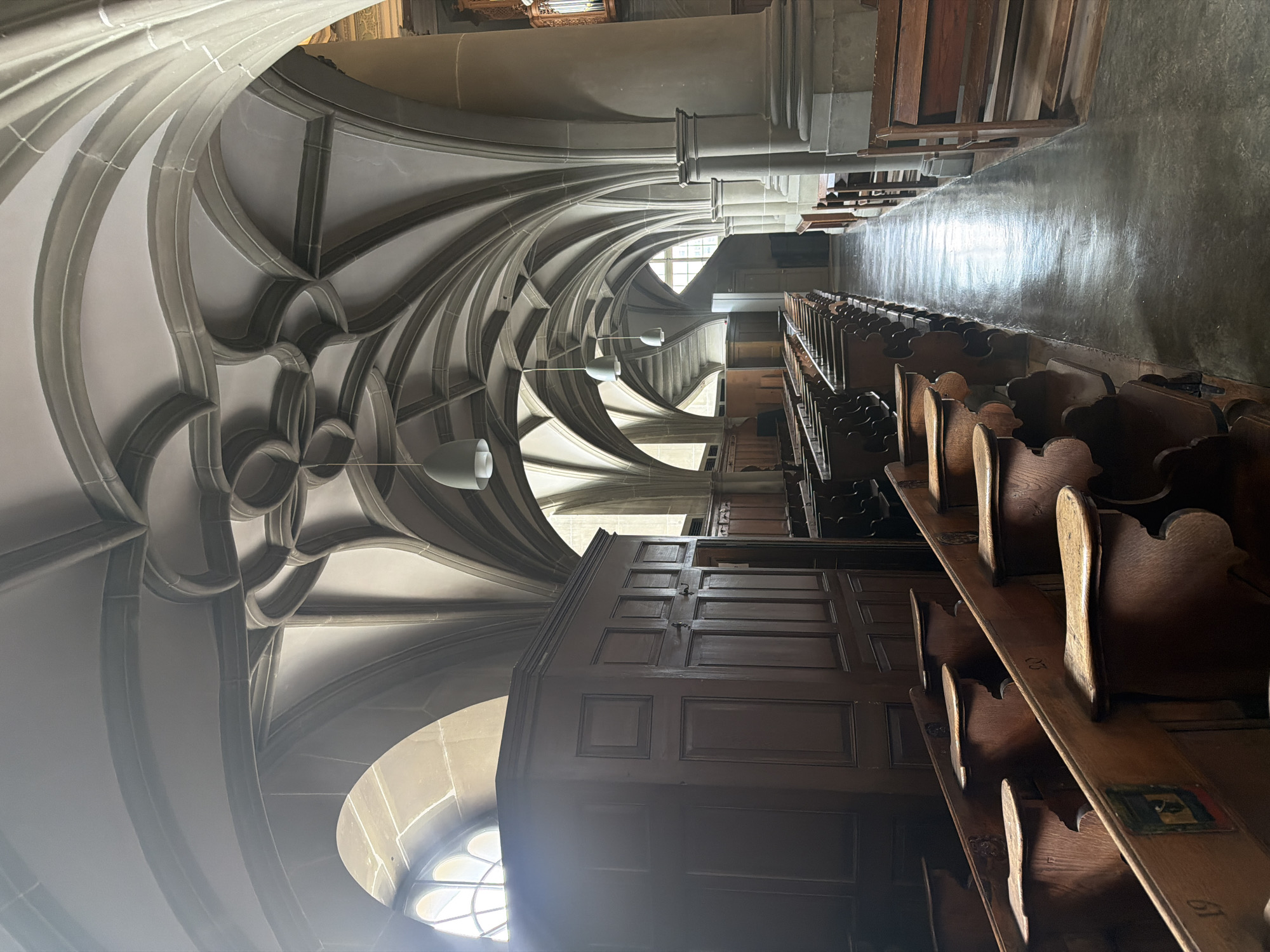
The image shows the interior of a long hall with rows of wooden pews on either side, leading towards a dimly lit area. The hall features a Gothic vaulted ceiling with intricate stone ribbing. Large arched windows with segmented panes are visible on the left side, letting in diffused natural light. The pews are dark wood, with carved details and numbered labels on some of them. There are also wooden panels lining the walls. The floor is concrete and reflects the light. Hanging pendant lights are suspended from the ceiling. In the background, there are more rows of pews and glimpses of a pipe organ on the right. The overall impression is one of solemnity and historical architecture. This scene is located in the Münster (Cathedral) of Bern, Switzerland, specifically in the choir stalls. There are no people visible in the image.
Bern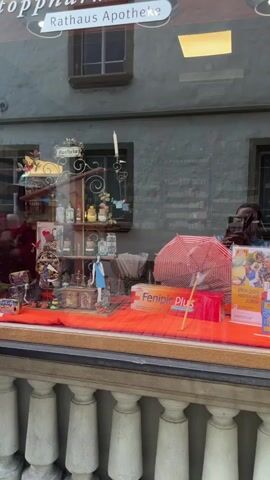
A reflection in a shop window shows a person holding a phone, seemingly taking a video. The shop appears to be a pharmacy, indicated by the sign "Rathaus Apotheke." The window display features various items, including small bottles, miniature figures, a red umbrella, and boxes of medicine. The exterior of the building is grey stone. A decorative railing runs along the bottom of the frame.
Bern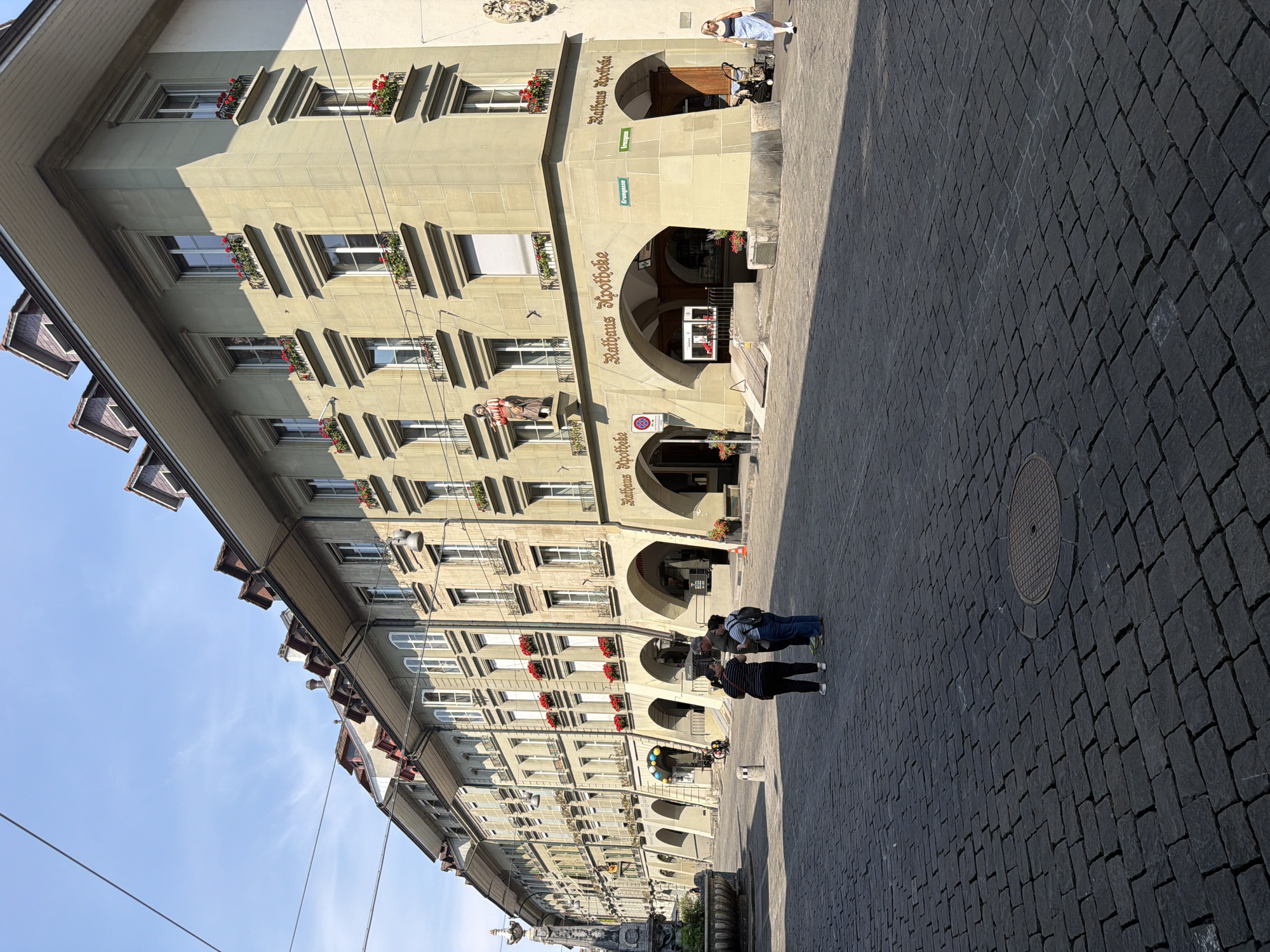
This image shows a street scene in Bern, Switzerland, specifically the Kramgasse in the Old Town. A long, pale yellow building with arched ground-level entrances lines the right side of the cobblestone street. Red flowers in window boxes adorn the upper floors of the building. In front of the building, three people are standing and talking. To the right, a woman is walking away from the camera. The street is paved with dark cobblestones, and shadows from the building stretch across the ground. The sky is clear blue with a few wispy clouds.
Bern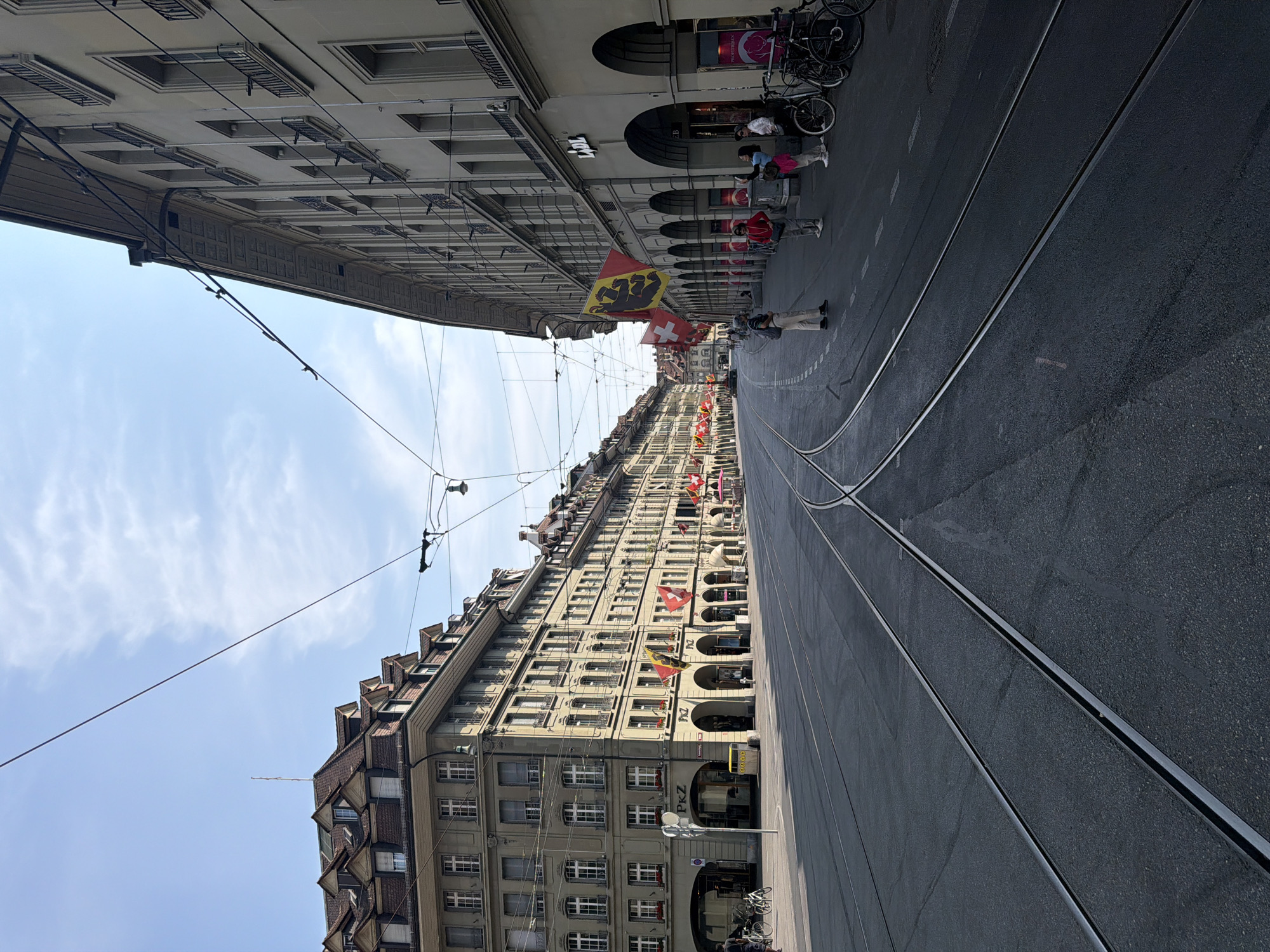
The image depicts a wide, empty street in Bern, Switzerland, with tram tracks dominating the foreground. The street is lined with multi-story buildings featuring arcades on the ground floor. Flags, some appearing to be Swiss flags, are hung from the buildings. On the left side of the street, a large building with a Mansard roof and numerous windows is visible. A sign that reads "PKZ" is mounted on this building. Across the street, on the right, another long building with arcades is seen. Signs for "Lidl" and "Profi-Boutique" are identifiable on this building. Several people are present on the sidewalk on the right side of the street. Some are standing, while others appear to be walking or taking photos. Bicycles are parked on the right sidewalk. The sky is partly cloudy, and overhead wires for what are likely trams crisscross the scene. The overall impression is that of a quiet, historic city street in Bern.
Bern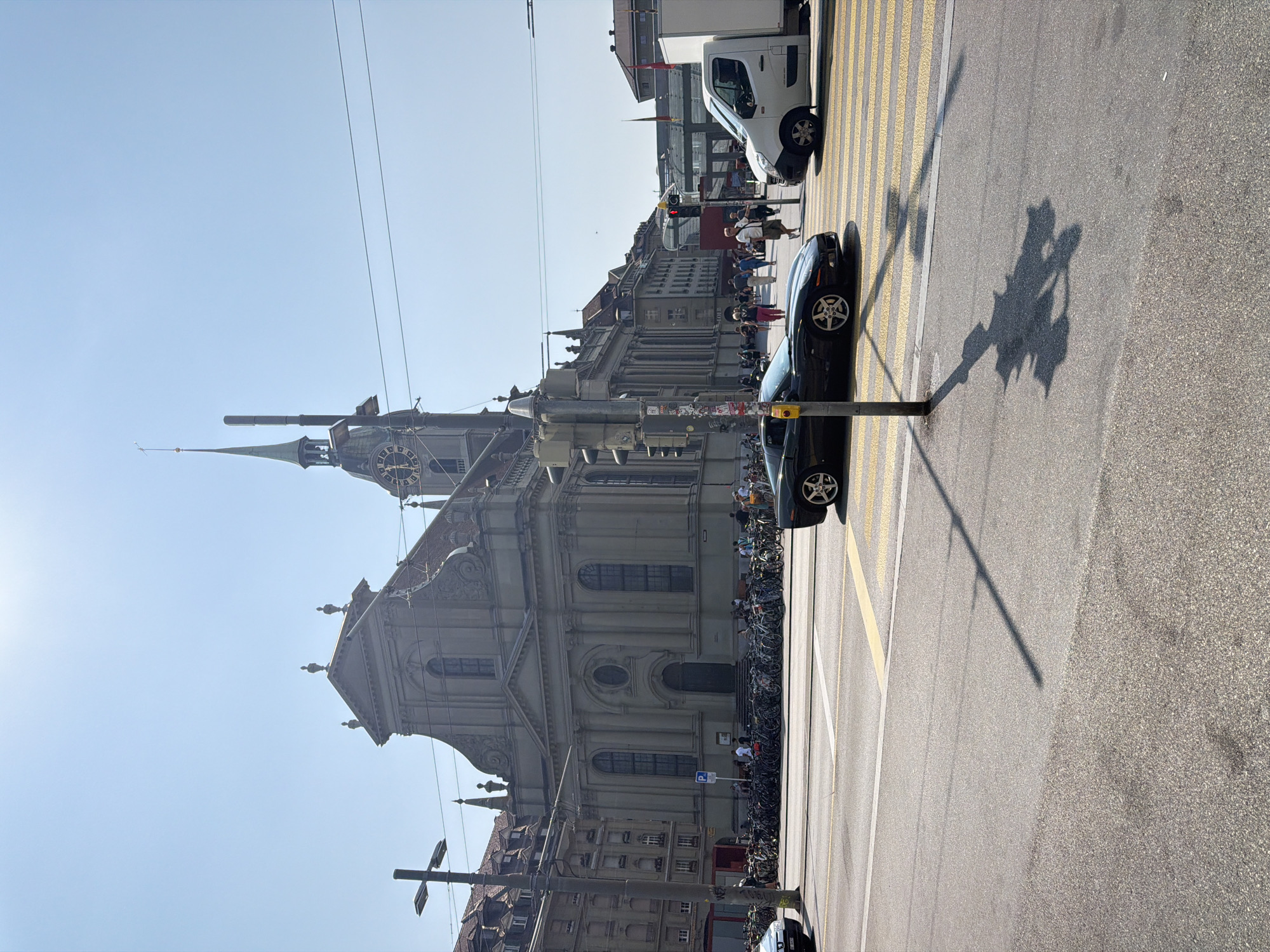
The image depicts a street scene in Bern, Switzerland, with a prominent church building in the background. The church, likely the Bern Minster, features a large clock tower with a spire. In the foreground, a black sports car is stopped at a pedestrian crossing. To the right, a white van is also at the crossing. Several people are visible walking on the sidewalks and crossing the street. A large number of parked bicycles are lined up in front of the church. The sky is clear and blue, indicating a sunny day. The street is paved with asphalt and marked with yellow and white lines for the pedestrian crossing and traffic lanes. Streetlights and power lines are also visible.
Bern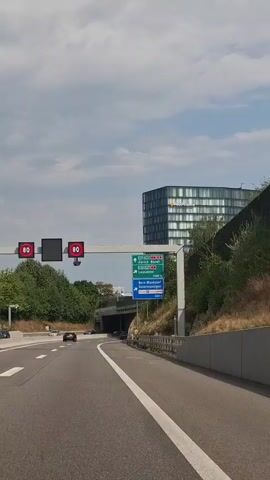
The video shows a view from a vehicle driving on a highway. Overhead signs indicate speed limits of 80 and provide directions to Zurich, Basel, Lausanne, Bern-Wankdorf, and Ostermundigen. A modern, glass-fronted building is visible on the right, behind a sound barrier and vegetation. The sky is cloudy.
Bern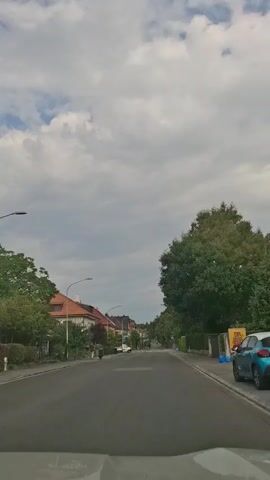
The video shows a view from inside a car driving down a tree-lined street in a residential area. The street is paved and has painted lane lines. On the left side of the street are houses with orange tile roofs and well-maintained gardens. On the right side, there is a row of hedges and trees, with a trash can visible near the curb. The sky is cloudy with patches of blue. A person and a black dog are walking on the sidewalk on the left side of the street. A white van and other cars are parked or driving on the street. The overall impression is of a quiet, suburban neighborhood on a cloudy day.
Bern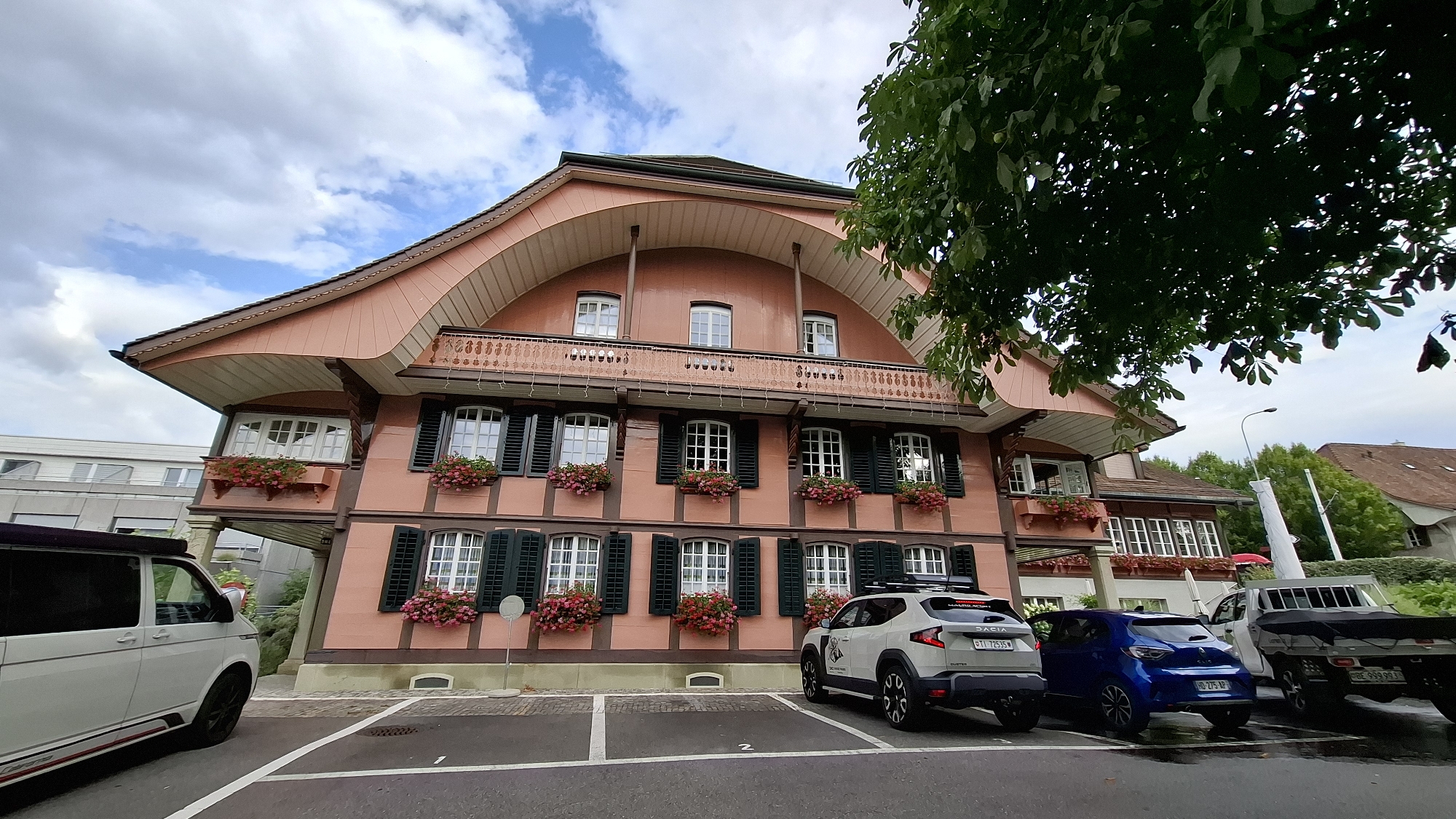
The image shows a multi-story building with a distinctive curved roofline, painted in a pale pink color. The building has numerous windows, many of which are adorned with dark green shutters and flower boxes filled with red flowers. A balcony with ornate railings runs across the second story. In front of the building, several cars are parked. On the left, a white camper van is partially visible. To its right, a white SUV is parked, followed by a small blue electric car. Further to the right, a white pickup truck with a flatbed is parked. The ground in front of the building appears to be a paved area with parking lines. Trees with green foliage overhang the scene from the right, and a cloudy sky is visible above. The architecture suggests a location in Switzerland, and given the prevalence of similar buildings and the overall aesthetic, the location is likely within the canton of Bern, Switzerland, potentially in a town or village rather than the immediate city center, considering the style of the building and the surrounding greenery.
Bern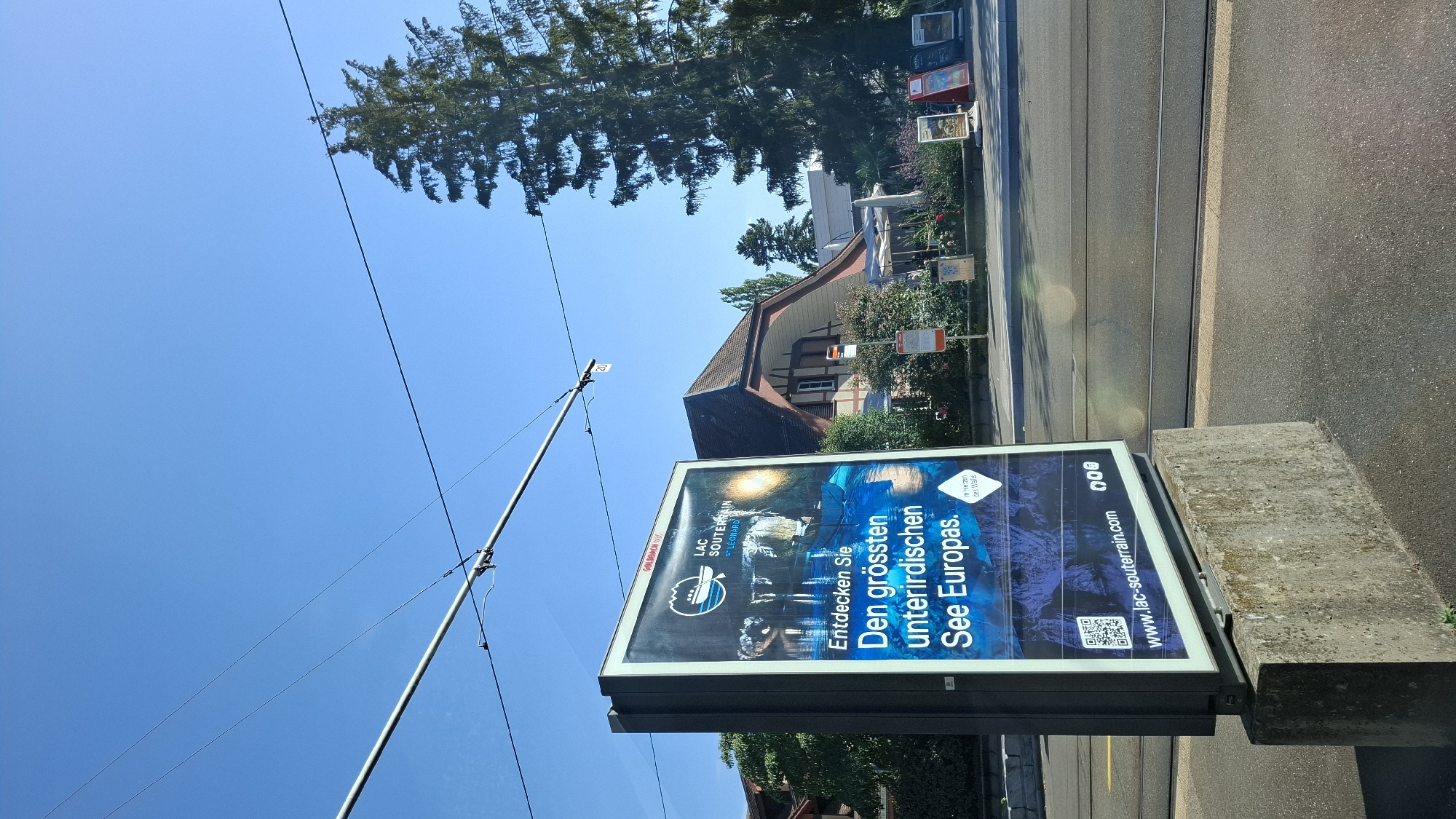
The image captures an outdoor advertising display featuring an advertisement for "LAC SOUTERRAIN ST. LEONARD," which translates to "underground lake St. Leonard." The text on the billboard, in German, reads "Entdecken Sie Den grössten unterirdischen See Europas," meaning "Discover Europe's largest underground lake." Below this, a QR code and the website "www.lac-souterrain.com" are visible. The billboard is situated on a concrete base at a roadside, likely near a public transportation stop as indicated by the signage in the background. The scene is set under a clear blue sky with overhead power lines, characteristic of an urban environment where trams or trolleybuses operate. A large evergreen tree stands prominently to the right of the billboard. In the background, a building with a distinctive gabled roof and a cafe or restaurant with outdoor seating can be observed. The overall setting appears to be a sunny day. The image does not provide specific visual cues that pinpoint the exact location within the city of Bern, Switzerland, beyond the context implied by the language on the advertisement and common urban infrastructure.
Bern
A person is operating a vehicle in a city street. The street is lined with trees on both sides, casting shadows on the road. A tram is visible in the distance, moving in the same direction as the vehicle. There are also several cyclists on the road, and a bird is flying in the sky. The weather appears to be clear and sunny.
Bern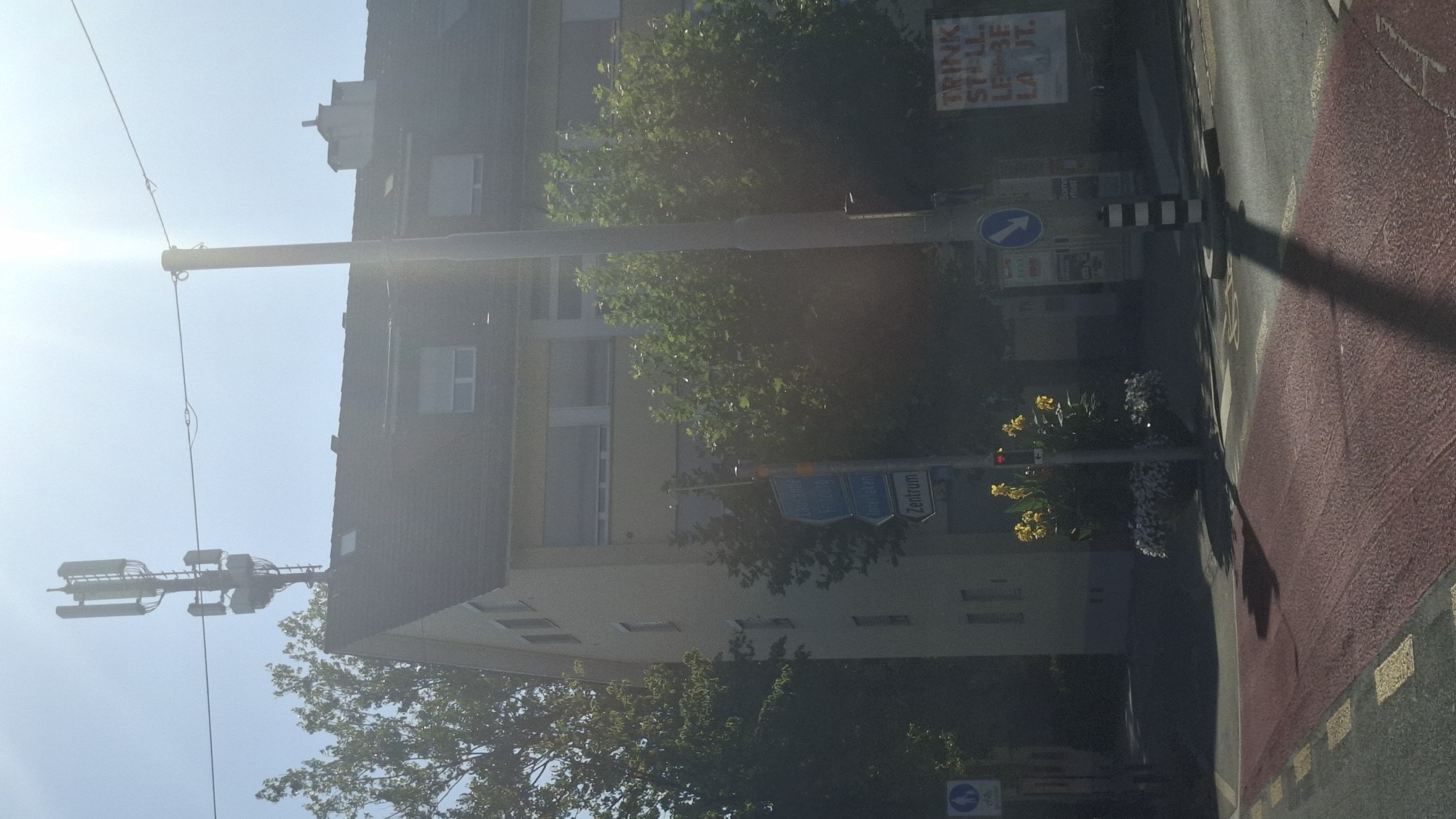
The image shows a street scene in Bern, Switzerland. In the foreground, there is a pedestrian crossing with red pavement and yellow dashed lines. A street lamp with a black and white striped base is visible on the right side of the image, next to a sign with a blue arrow pointing left. Further back, a multi-story building with yellow siding is seen, with several windows on each floor. A telecommunications tower with multiple antennas is located on the roof of the building. Trees and vegetation are present throughout the scene. A signpost with directional arrows indicating "Lausanne", "Fribourg", "Interlaken", and "Zentrum" is visible on the left side of the building. There are no people clearly visible in the image, but the presence of traffic signals and pedestrian crossings suggests a public area. The sky is clear and bright, with a strong sunlight glare obscuring some details. A poster with text in German, likely advertising a drink, is partially visible on the building to the right.
Bern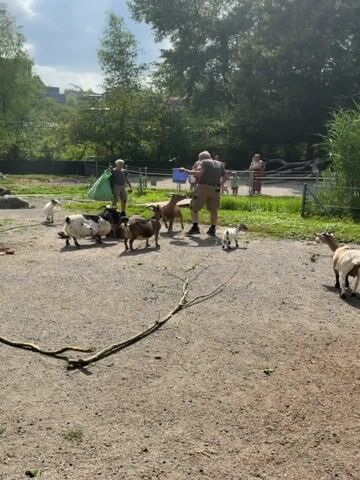
In an outdoor enclosure, a group of goats are gathered around a person who is feeding them from a blue bucket. The person is wearing a gray t-shirt and beige shorts, and appears to be interacting with the goats, possibly holding out food for them. Several goats are close to the person, with some eating from the bucket. Another goat stands slightly apart to the right. In the background, a few other people are visible, observing the scene. A child wearing a hat and a green bag is also present on the left side of the enclosure. The ground is covered in gravel and dirt, with a few scattered branches. Tall green plants are visible in the background, along with trees and a fence. The sky is partly cloudy, suggesting it is daytime. The scene appears to be a petting zoo or an area where visitors can interact with farm animals.
Bern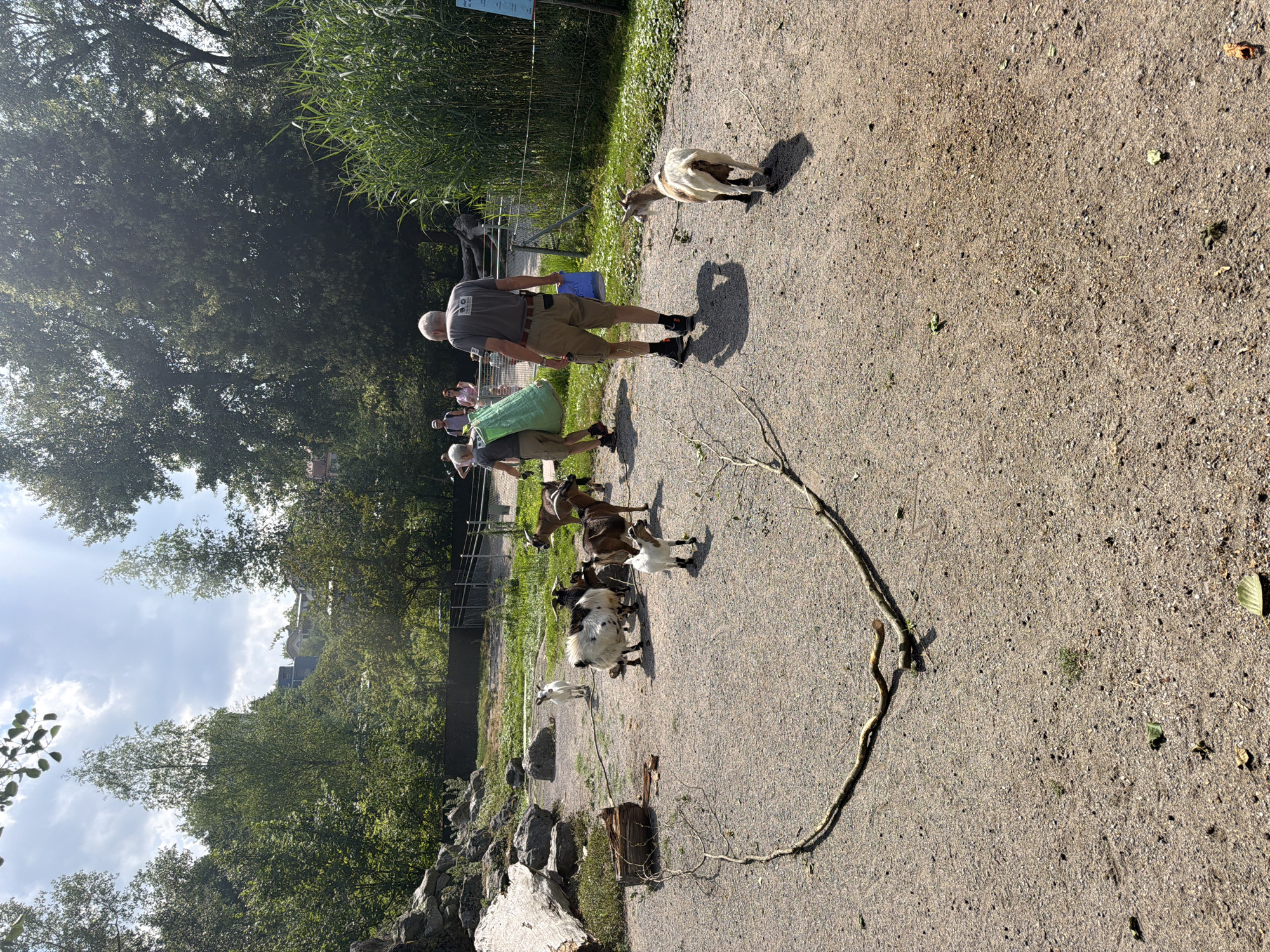
The image depicts an outdoor enclosure, likely at a zoo or animal park in Bern, Switzerland. The ground is covered with gravel and dirt, and large rocks are visible on the left. A heart-shaped arrangement of branches lies on the ground in the foreground. Several goats of varying sizes and colors are scattered throughout the enclosure. One goat stands alone in the upper left quadrant, looking towards the viewer. In the center, a group of four goats is clustered together. To the right, another goat is moving away from the viewer. A single goat is positioned in the lower right portion of the image. Two individuals are present in the background, walking away from the viewer. The person on the left is carrying a large green bag over their shoulder, and the person on the right is carrying a blue container. Both are dressed in casual clothing. Other figures, possibly visitors, are faintly visible further in the background. Lush green foliage, including tall reeds on the right and trees on the left and in the background, frames the scene. The sky is partly cloudy. Structures, possibly buildings, are visible through the trees in the distance. The overall impression is of a sunny day in an animal enclosure designed to simulate a natural habitat.
Bern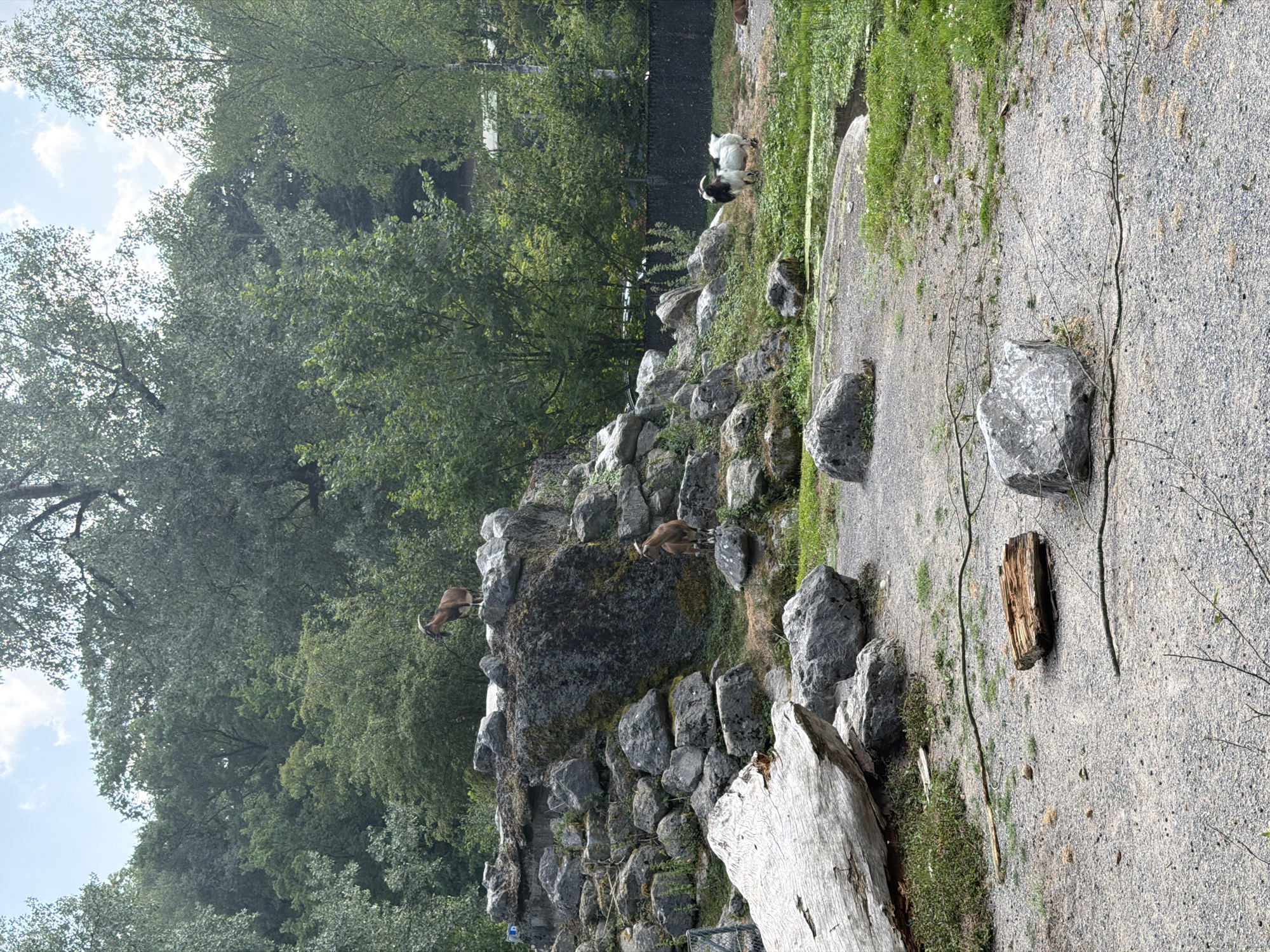
The image depicts an outdoor enclosure, likely a zoo exhibit, featuring several goats in a rocky and vegetated environment. In the middle ground, two brown goats with curved horns are perched on a large rock formation. One goat is standing on a higher ledge, looking to the left, while the other is on a lower ledge, facing the right. In the background, to the right, a white and black goat with short horns is standing in a grassy area. The enclosure includes numerous large rocks, some covered in moss, and patches of green grass and foliage. A large, weathered log lies on the ground in the left foreground, accompanied by several smaller rocks and scattered branches. The background is filled with lush green trees, suggesting a naturalistic habitat. A black fence is visible in the far background. The sky is partly cloudy. The scene appears to be captured during daylight hours. The presence of the goats and the constructed rocky habitat are indicative of an animal enclosure within the Bern Animal Park (Dählhölzli Zoo), located in Bern, Switzerland.
Bern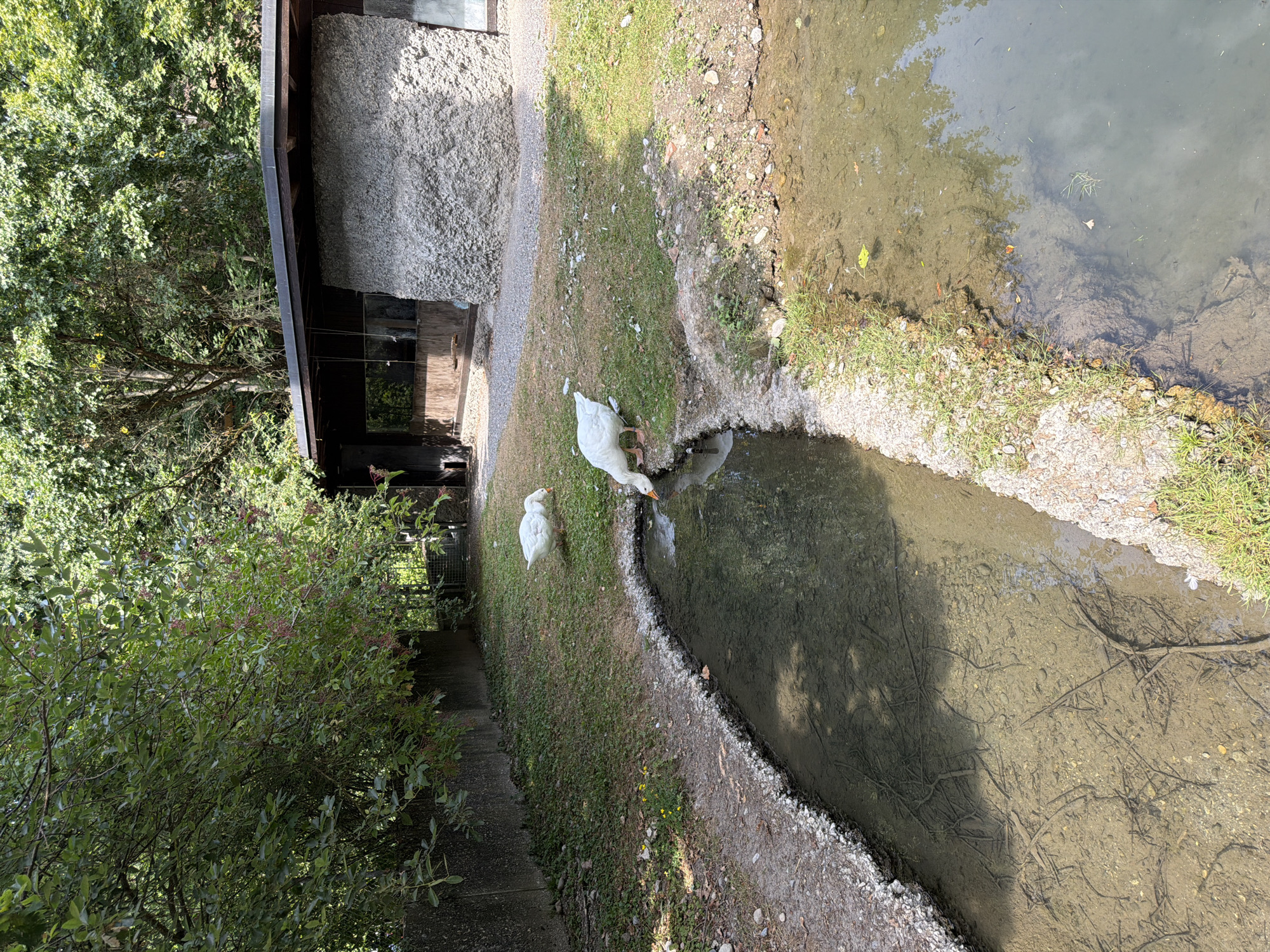
The image depicts an outdoor scene with two white geese near a body of water. One goose is positioned on the grassy bank, bending its neck to drink from the water. The other goose is standing further back on the grass. Behind the geese, there is a low, modern-style building with a rough, stone-like exterior and a dark, sloped roof. The surrounding environment includes a concrete wall, lush green trees, and a gravel path. The water appears murky, with visible sediment and submerged branches. The overall setting suggests a zoo or park enclosure. The location is the Gurten Park in Wabern bei Bern, Switzerland.
Bern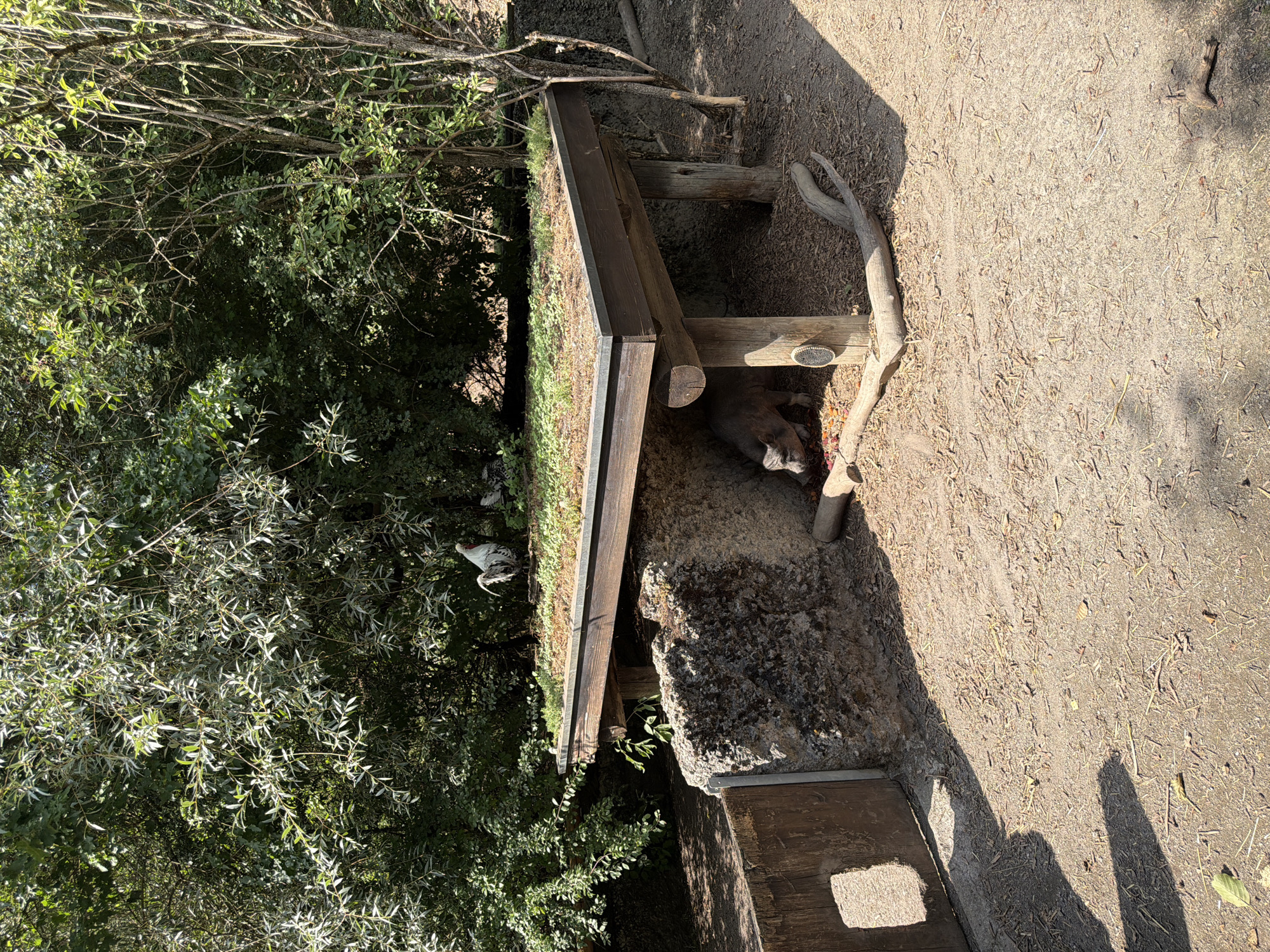
A domestic pig is eating from a pile of food under a wooden structure with a green roof in an outdoor enclosure. The enclosure is dirt with scattered debris and dried vegetation. To the left of the structure is a large rock. Behind the rock is a wooden gate with a square opening. Two chickens are standing on the roof of the wooden structure. The scene appears to be in an urban zoo or animal park.
Bern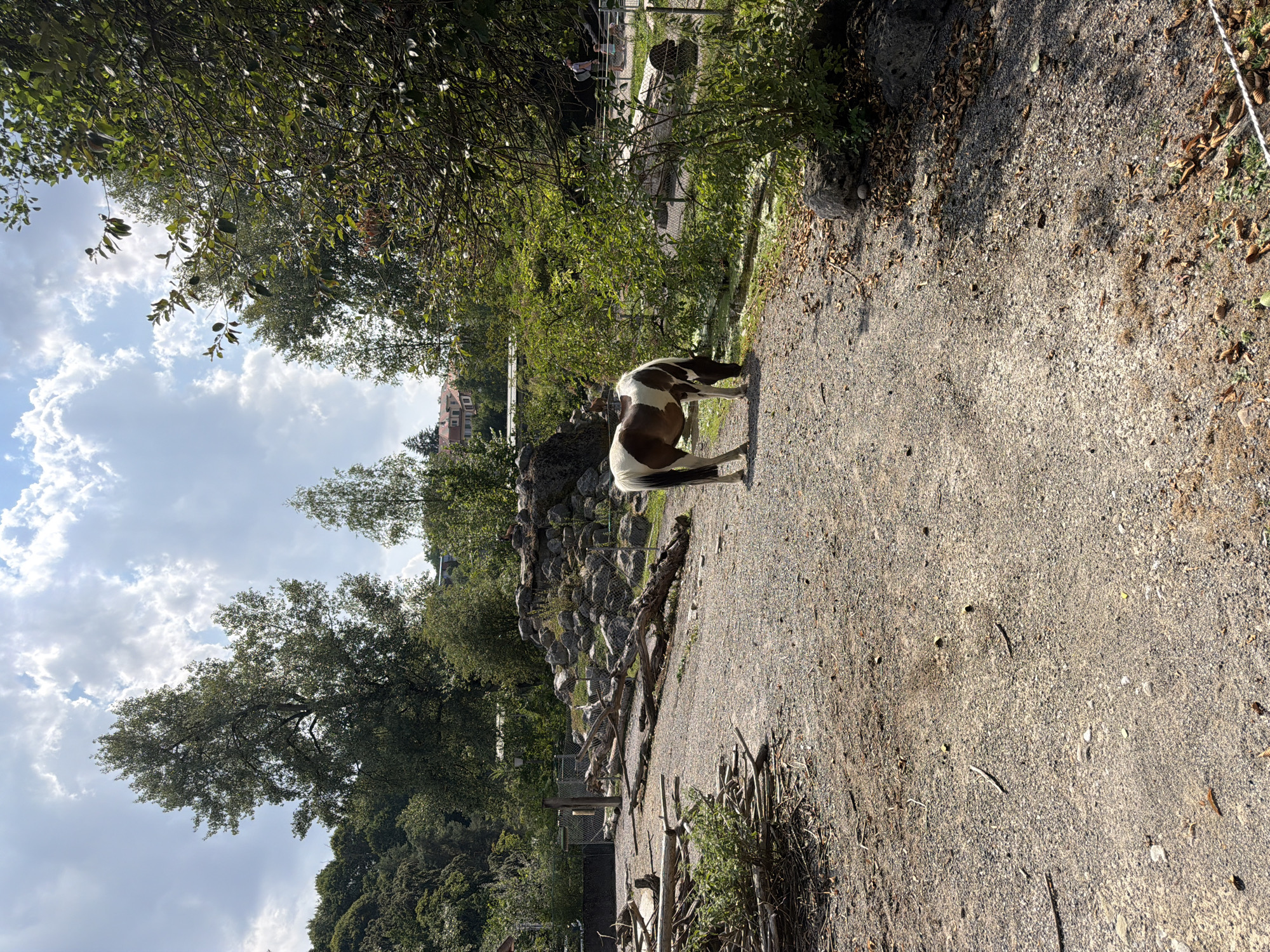
A brown and white pony grazes near a body of water in an outdoor enclosure. The enclosure appears to be a zoo or animal park, with a gravel path, rocks, fallen logs, and fencing visible. Lush green trees and foliage surround the area, and a cloudy blue sky is overhead. In the background, two individuals can be seen walking along a path behind a fence, and some buildings are visible on a distant hillside, suggesting an urban or suburban setting. The scene is likely from the Tierpark Dählhölzli in Bern, Switzerland, given its known features and typical enclosures.
Bern
A clear stream flows over rocks and a muddy bottom. Several small fish swim in the water. The stream appears to be shallow. Reflections of trees and vegetation are visible on the surface of the water.
Bern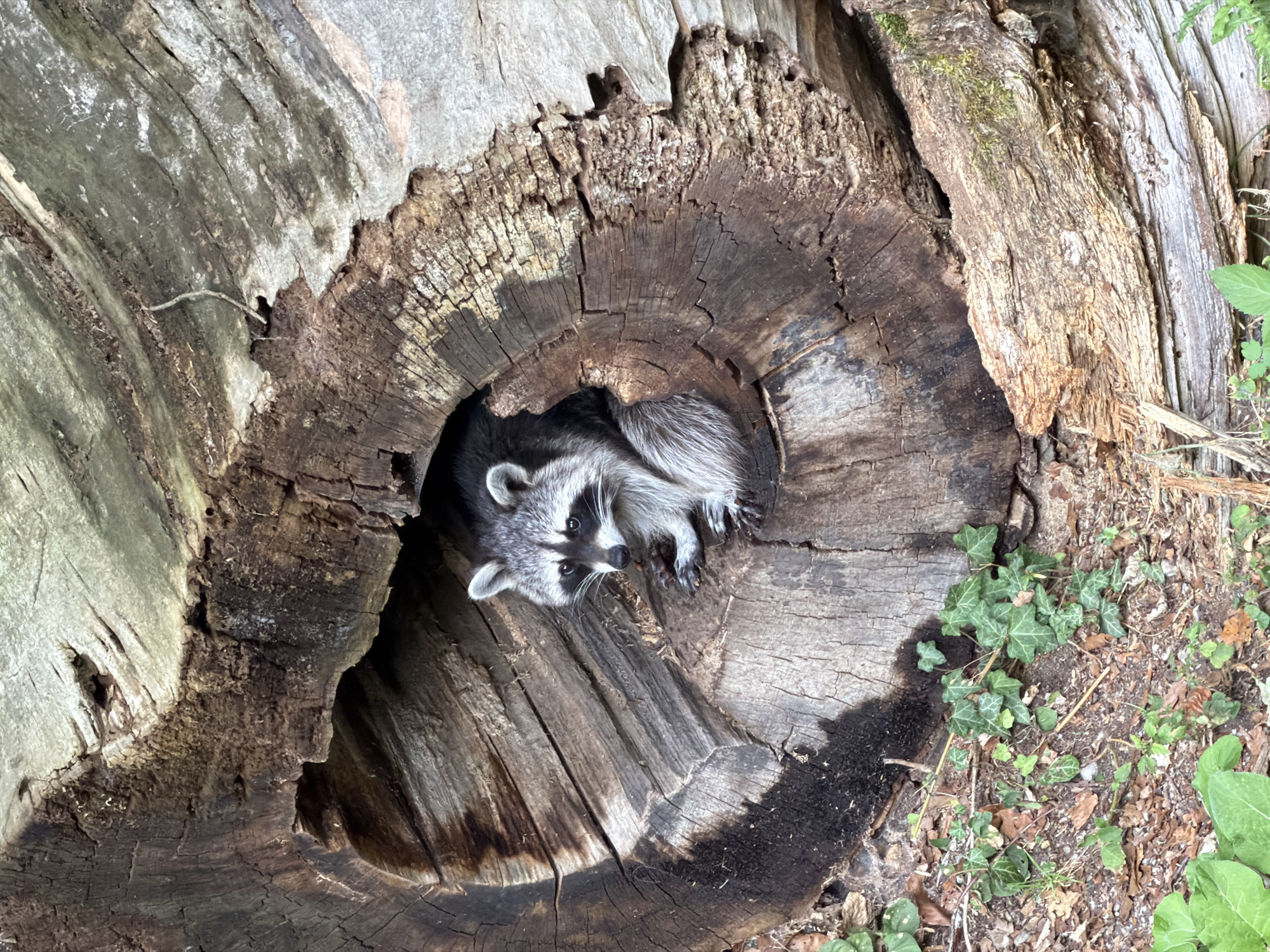
A raccoon is nestled in a hollowed-out section of a large, weathered tree trunk. The raccoon, facing the viewer, has distinctive black markings around its eyes and a ringed tail. Its fur is a mix of gray and black. The tree trunk is rough and textured, with visible growth rings and signs of decay. The surrounding ground is covered in fallen leaves, twigs, and some green ivy plants. The image is taken outdoors, likely in a natural or park setting, with the lighting suggesting it is daytime. The precise location in the city of Bern, Switzerland, cannot be determined from the image alone.
Bern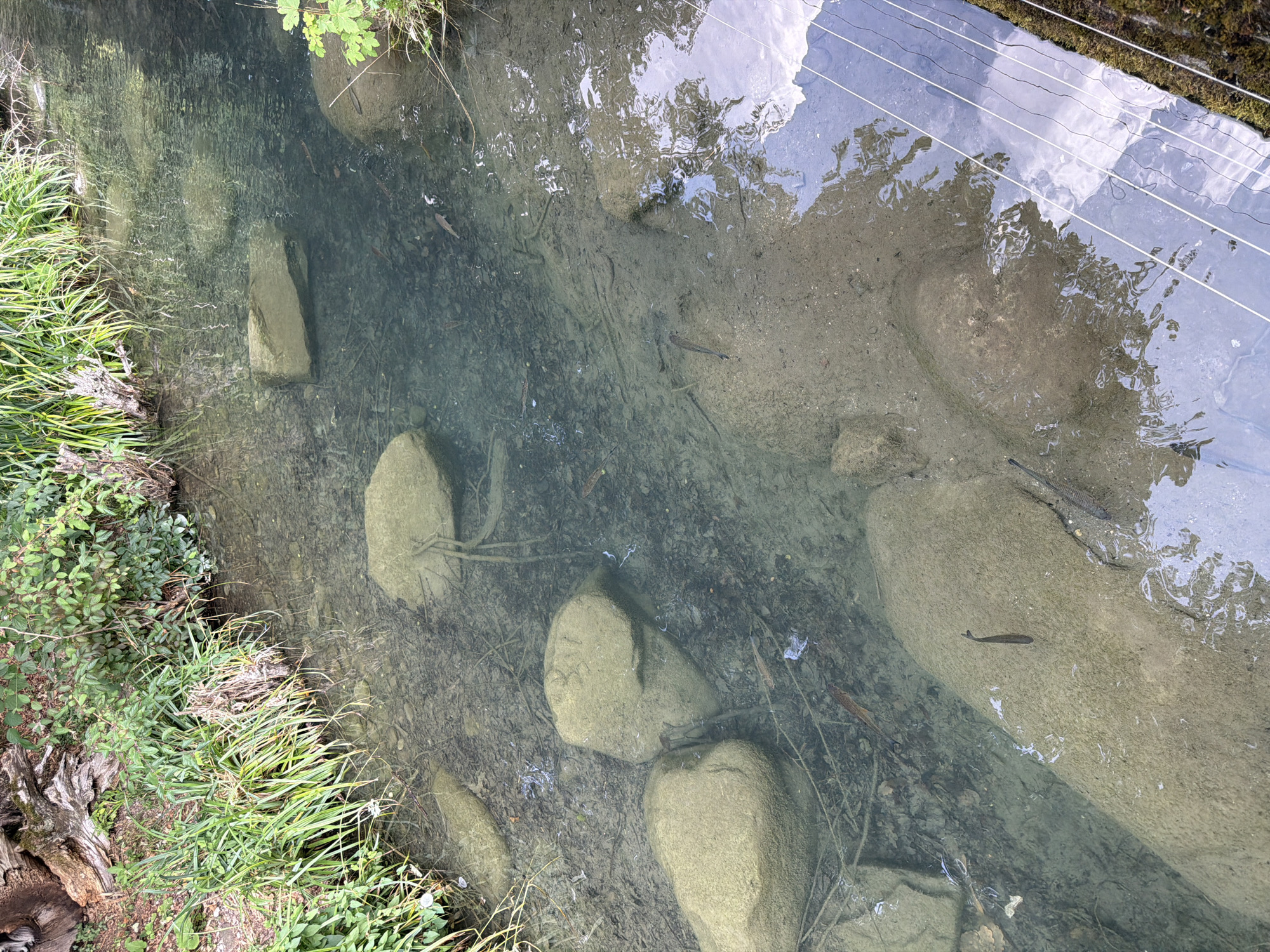
The image shows a clear, shallow stream with a rocky bottom. Several small fish are visible swimming in the water. The stream is bordered by lush green vegetation on the left bank and what appears to be a stone wall or embankment on the right, with some wire or string running across the surface of the water. The water is clear enough to see the stones and debris on the streambed. Reflections of the sky and clouds are visible on the water's surface. The scene is natural and peaceful. This stream is likely located in the Gurten Park in Bern, Switzerland, given its typical landscape and the presence of streams with fish and surrounding vegetation.
Bern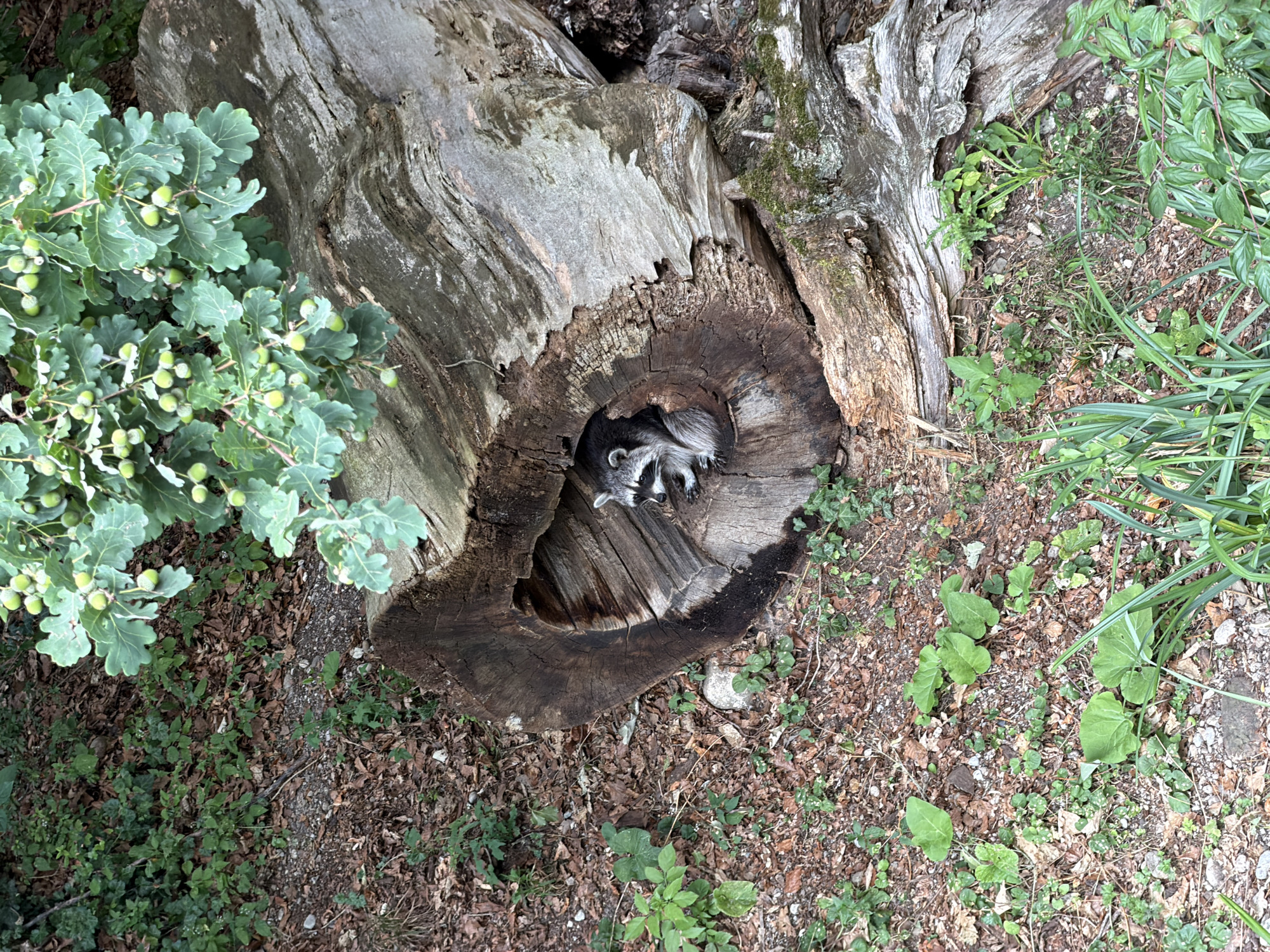
A raccoon is nestled in the hollow of a large, fallen tree trunk. The trunk is weathered and appears to be old, with rough bark and visible wood grain. The raccoon is facing forward, with its distinctive mask-like facial markings visible. It is sitting upright, with its paws tucked in. The surrounding environment is a forest floor, with dry leaves, dirt, and scattered green foliage. Oak leaves and acorns are visible on a branch hanging over the top of the tree trunk. The scene appears to be in a natural, outdoor setting. There is no information provided that indicates the location is in the city of Bern, Switzerland.
Bern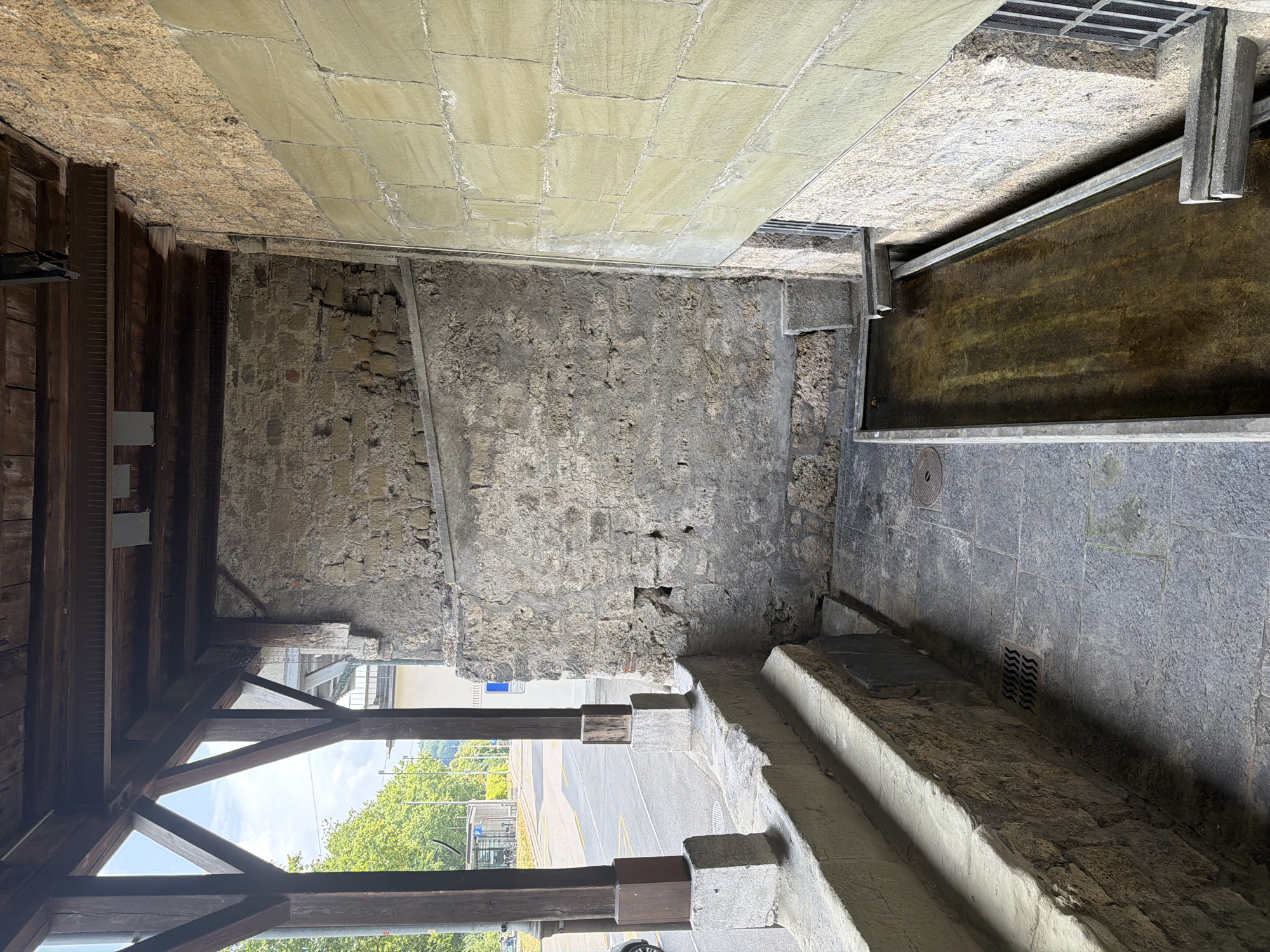
The image depicts an outdoor covered walkway with stone and wooden construction. The floor is paved with dark, irregular stones. To the left, there is a stone bench with steps leading up to it, and a drain grate visible on the floor. The walkway is bordered by a textured stone wall on the right, which transitions to a smoother, lighter-colored stone facade higher up. A long, shallow stone trough filled with murky water is positioned against the wall on the right. In the background, through an opening on the left, a street with cars and trees is visible. The architecture suggests a historical or public utility space. This scene is located in Bern, Switzerland, specifically in the Bärengraben (Bear Park) area, where the trough likely served as a water source or drainage system for the former bear enclosures. There are no people or animals visible in the image.
Bern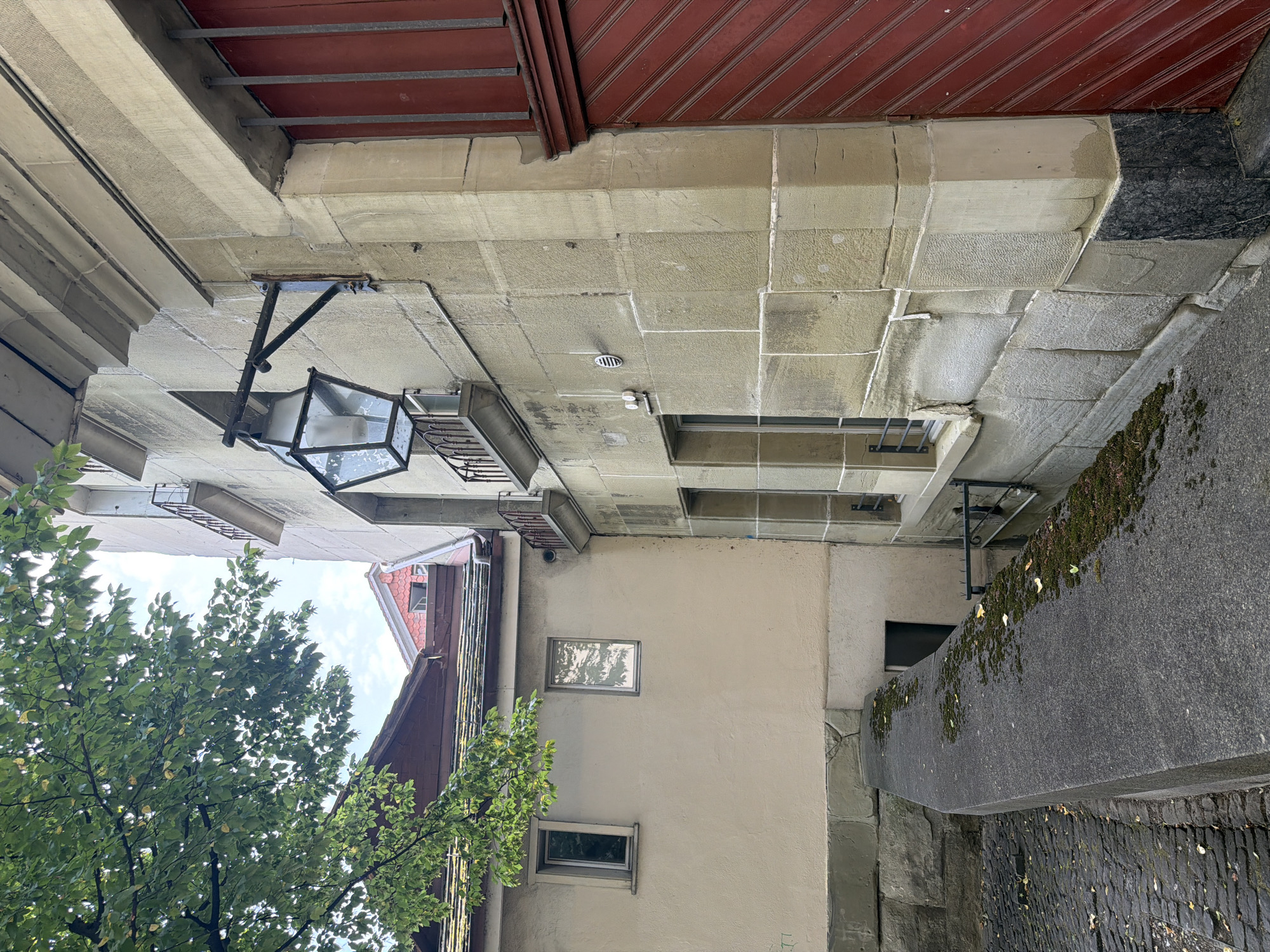
The image captures a narrow cobblestone street in Bern, Switzerland, bordered by a stone wall. A large, ornate lantern with a hexagonal glass body is mounted on the exterior wall of a building, which is constructed of large, light-colored stone blocks. A red double door with vertical planks is visible on the right side of the frame. The building has several windows, some with metal gratings, and small balconies with railings. Trees with green leaves overhang the scene from the left. The sky is cloudy.
Bern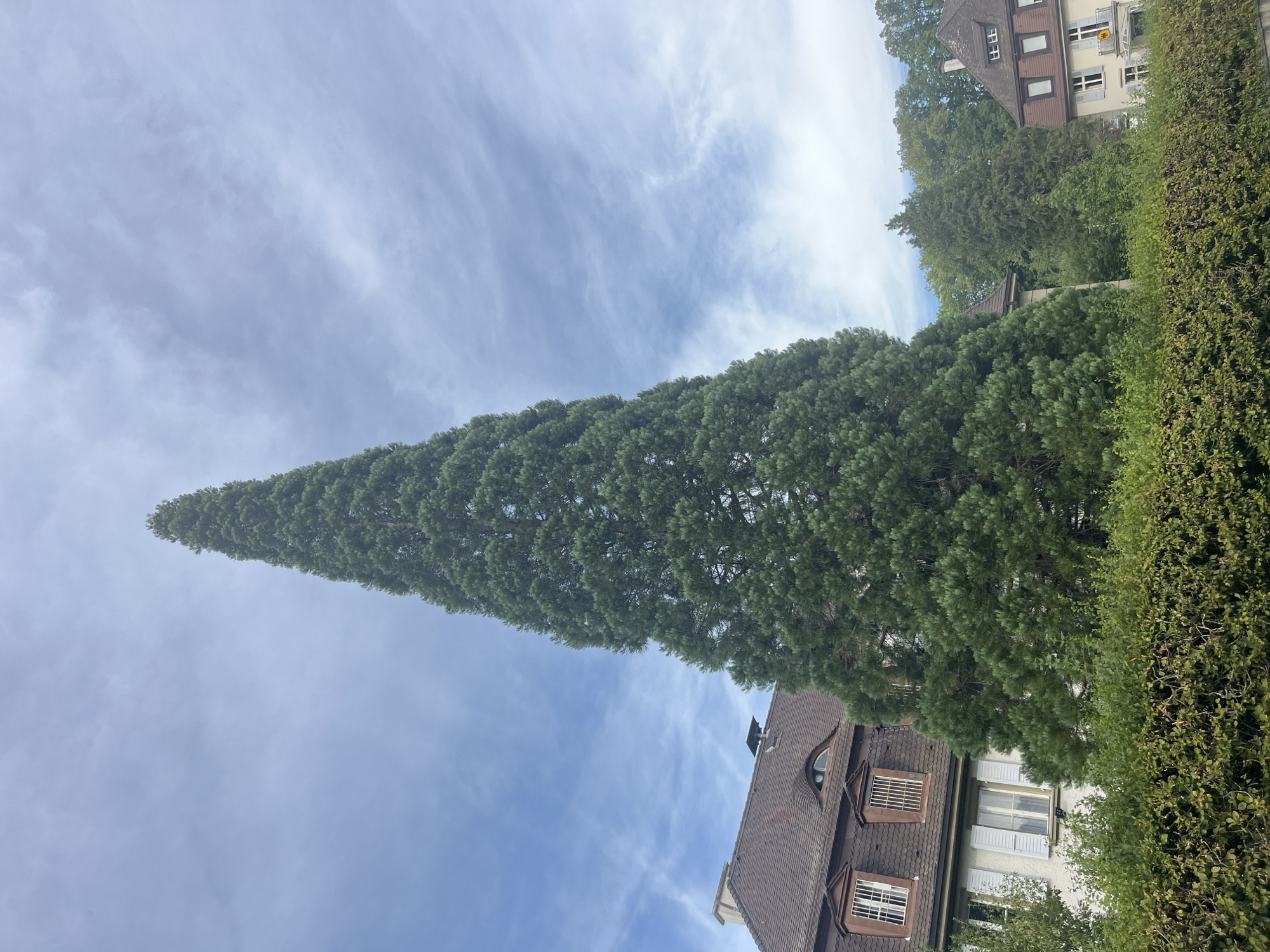
The image shows a very tall, conical evergreen tree in the foreground, dominating the frame. The tree has dense, green foliage. Behind the tree, on the left, is a multi-story building with a dark, sloped roof, dormer windows, and white shutters. To the right of the tree, further in the background, are other buildings and more trees. The sky above is partly cloudy with streaks of white clouds against a blue background. The presence of buildings with European architectural styles, specifically the mansard roof and window designs, suggests the location is likely within a city in Europe. Given the prompt's reference to Bern, Switzerland, this scene could be within that city. There are no people or animals visible in the image. The overall impression is a mature, urban or suburban setting with a prominent natural element.
Bern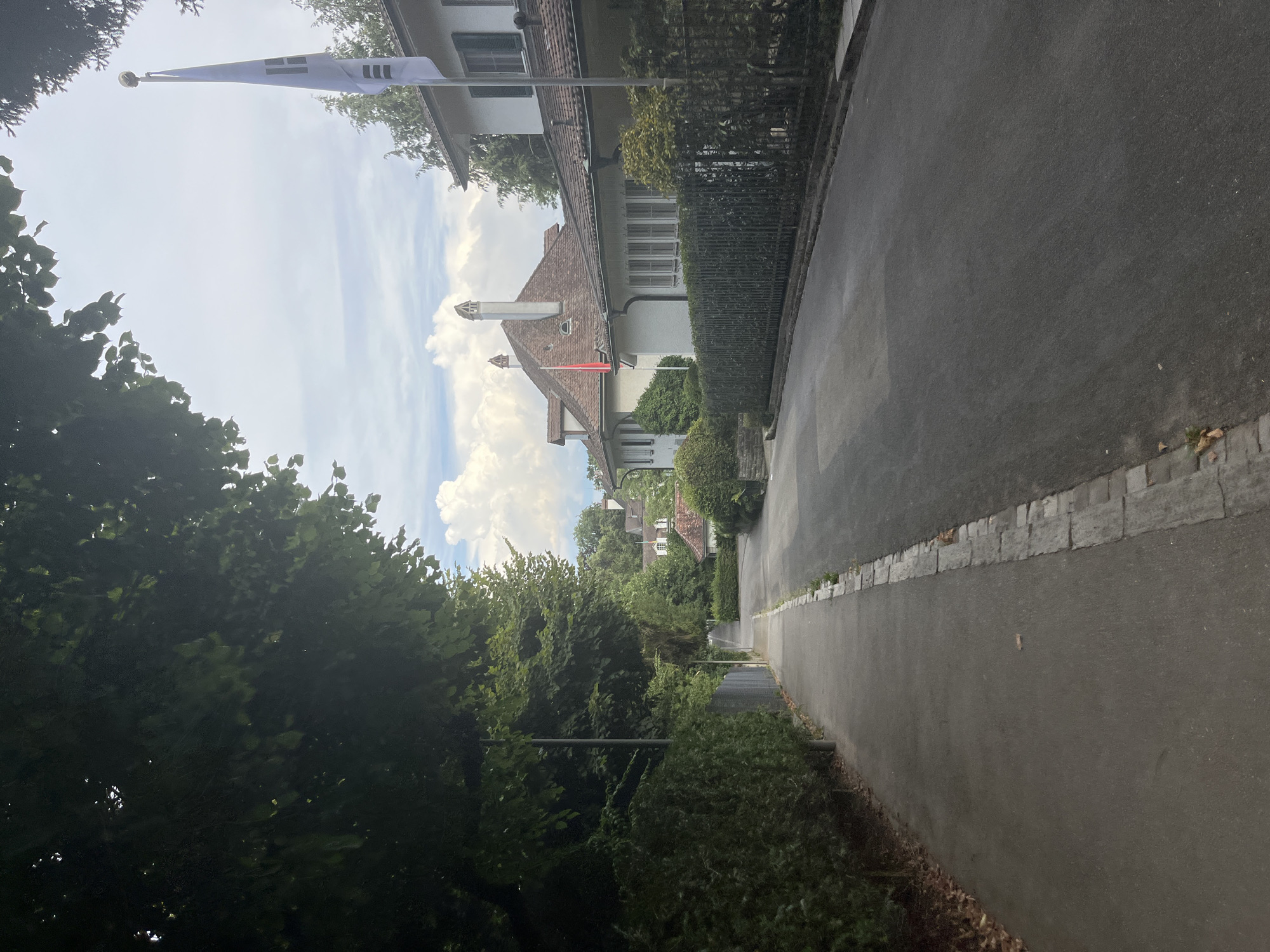
The image depicts a street scene in Bern, Switzerland, likely in a residential area. On the left, a sidewalk runs alongside a dense green hedge and mature trees that cast shadows. The sidewalk is paved with asphalt and bordered by cobblestones. A street light is visible on a pole to the left. The asphalt road curves gently to the right, lined on the right by a black metal fence and manicured hedges in front of a white building with a red-tiled roof. A tall white flag with a black emblem is planted on a flagpole in front of this building. Further down the street, another white building with a red-tiled roof has a small red flag visible. The background features more trees and houses, with a cloudy sky overhead.
Bern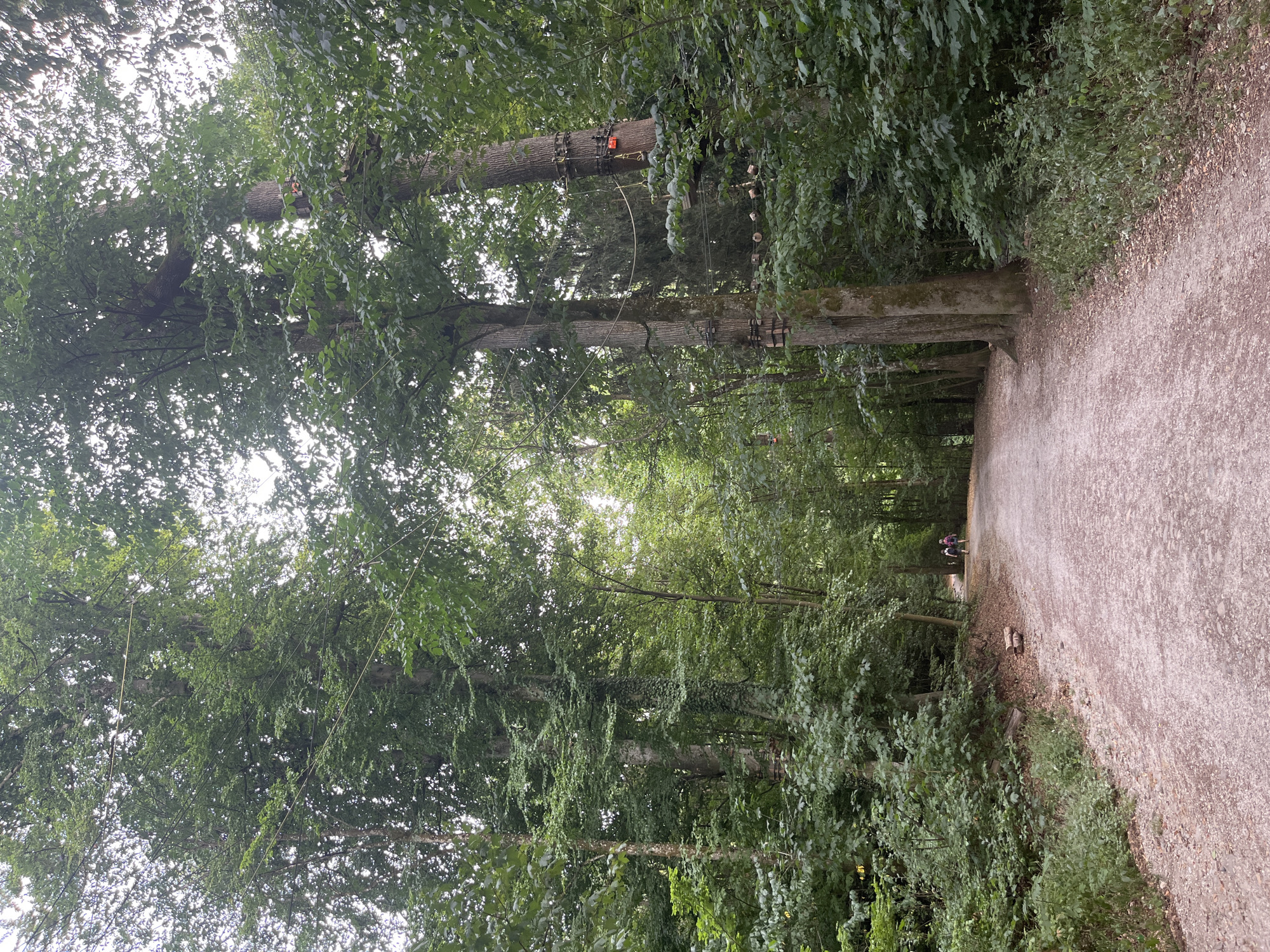
A dirt path winds through a dense, green forest, with tall trees flanking both sides. The canopy overhead is thick with leaves, allowing only dappled sunlight to filter through. In the distance, two individuals can be seen walking away from the camera on the path. On the right side of the path, several trees have ropes and platforms attached to them, indicating an adventure park or a similar recreational facility. The overall atmosphere is serene and natural. The image does not contain any specific landmarks or indicators that would allow for its precise location within the city of Bern, Switzerland.
Bern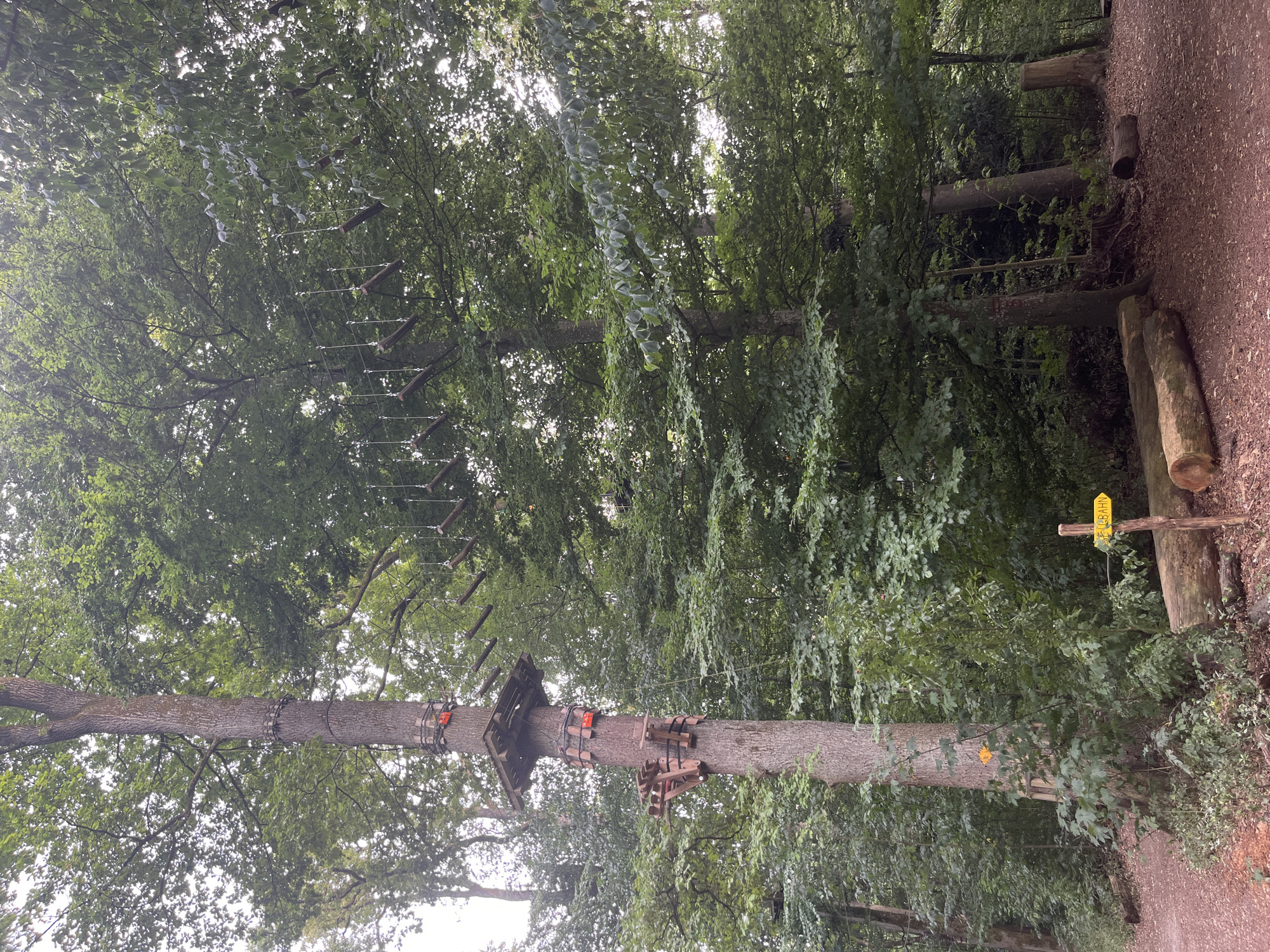
The image depicts an outdoor adventure park situated in a forest. A tall, thick tree trunk dominates the center-left of the frame, with multiple wooden platforms and obstacles constructed around it, suggesting a ropes course. These structures include square platforms and angled wooden steps or perches. Several of these wooden elements are attached to the tree trunk by metal bands. Hanging from cables suspended between trees in the background are rows of cylindrical wooden logs, likely part of the adventure course. The surrounding environment is a dense forest with abundant green foliage from various trees. The ground is covered with a reddish-brown path and fallen leaves. Two yellow directional signs are visible; one on the main tree trunk and another on a wooden post near the ground, pointing to the right. The sign on the post has text that appears to be "SEILBAHN" (German for "cable car" or "zip line"). In the lower right corner, several large logs are resting on the ground, appearing to serve as seating or part of the park's infrastructure. The overall scene suggests a recreational area designed for outdoor activities within a natural wooded setting.
Bern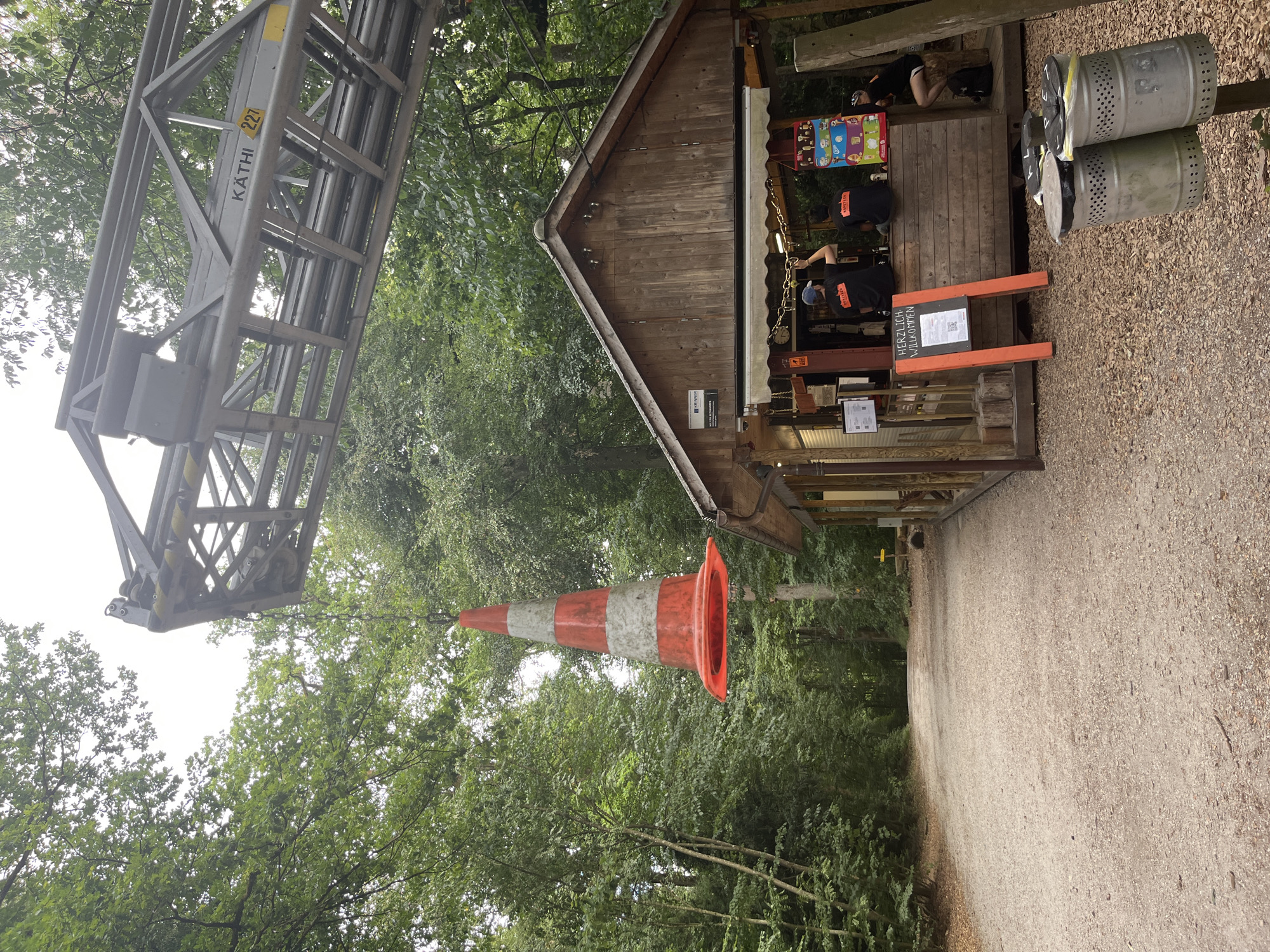
The image depicts an outdoor scene with a gravel path leading into a wooded area. In the foreground, a rustic wooden kiosk with a pitched roof is situated to the right. This kiosk appears to be a small shop or food stand, with patrons visible behind the counter. Two individuals in black t-shirts are standing behind the counter, and another person is seated to the far right. A sign on the kiosk reads "HERZLICH WILLKOMMEN." Above and to the left of the kiosk, a large orange and white striped traffic cone is suspended in mid-air, attached by a chain to a metal structure that extends from the top of the frame. This metal structure appears to be part of a larger apparatus, possibly a crane or lifting mechanism, with the text "KÄTHI 227" visible on it. Two large metal trash cans with perforated sides and black lids are positioned in front of the kiosk. The background is dominated by lush green trees and foliage, suggesting a natural or park-like setting. The lighting indicates an overcast day. The scene is consistent with an outdoor recreational area, possibly a park or a tourist attraction within the city of Bern, Switzerland, given the presence of the German language on the sign.
Bern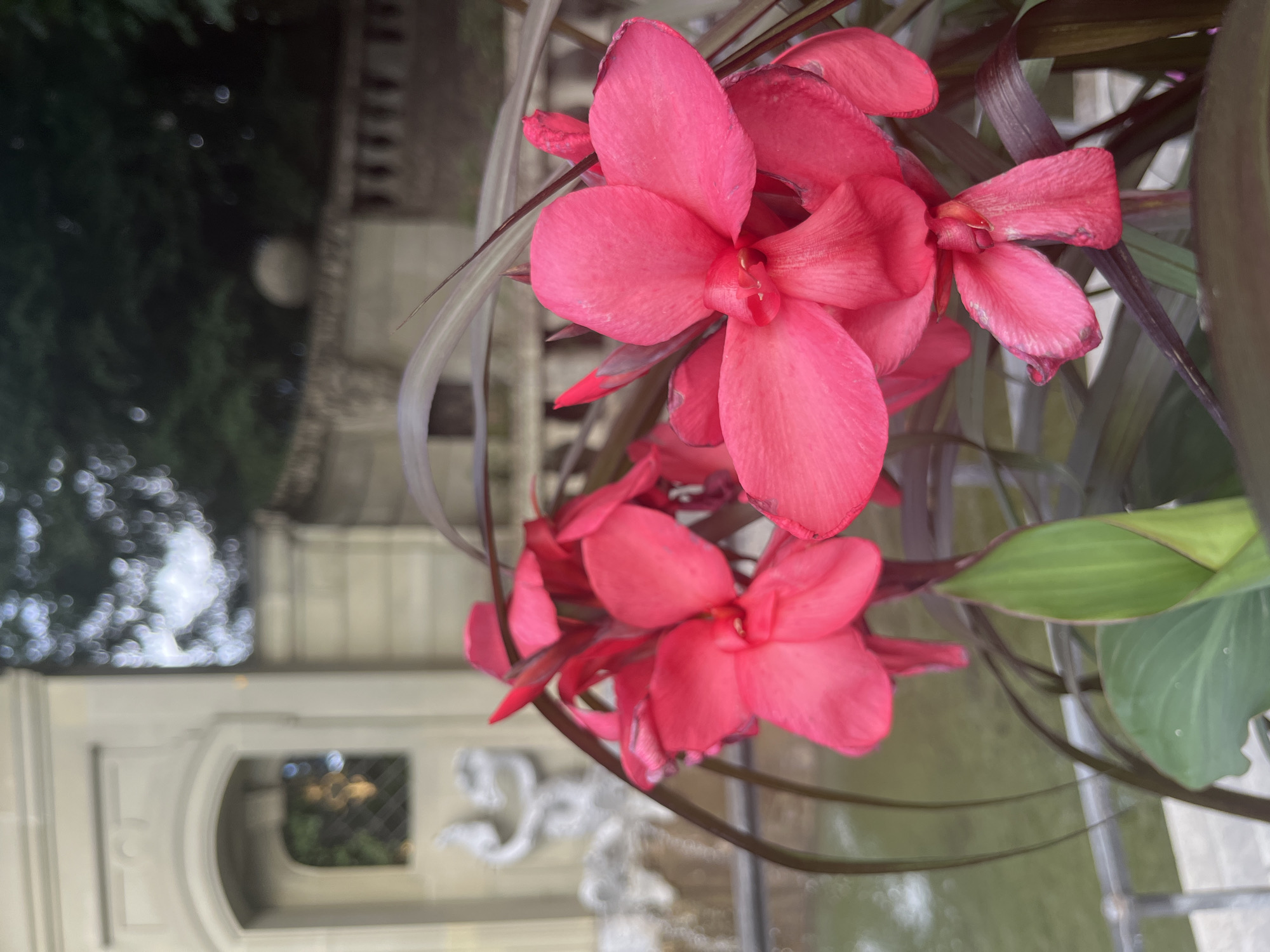
A close-up, low-angle outdoor photograph features vibrant pink canna lily flowers in the foreground. The flowers are lush and in bloom, with dark, slender leaves and stems peeking through. In the softly blurred background, a stone fountain with a sculpted figure can be seen, and beyond that, a stone wall and trees. The scene suggests a garden or park setting. This image was likely taken in the rose garden (Rosengarten) in Bern, Switzerland, known for its beautiful flora and views of the city and the Alps.
Bern