Boj-Cătun, Romania
11 memories from Boj-Cătun, Romania
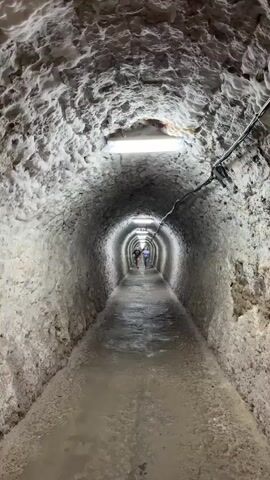
The video shows a perspective from inside a long, dimly lit, rough-hewn tunnel. The walls and ceiling of the tunnel appear to be made of rock or salt, with a rough, uneven texture. Fluorescent lights are mounted at intervals along the ceiling, providing the primary illumination. The floor of the tunnel is wet and appears to be made of concrete or compacted earth. Two individuals, a younger person in a dark t-shirt and shorts and an older person in a blue shirt and jeans, are walking away from the camera towards the end of the tunnel. Further down the tunnel, other figures can be seen in the distance, also walking. The tunnel extends into the distance, appearing to curve slightly.
Boj-Cătun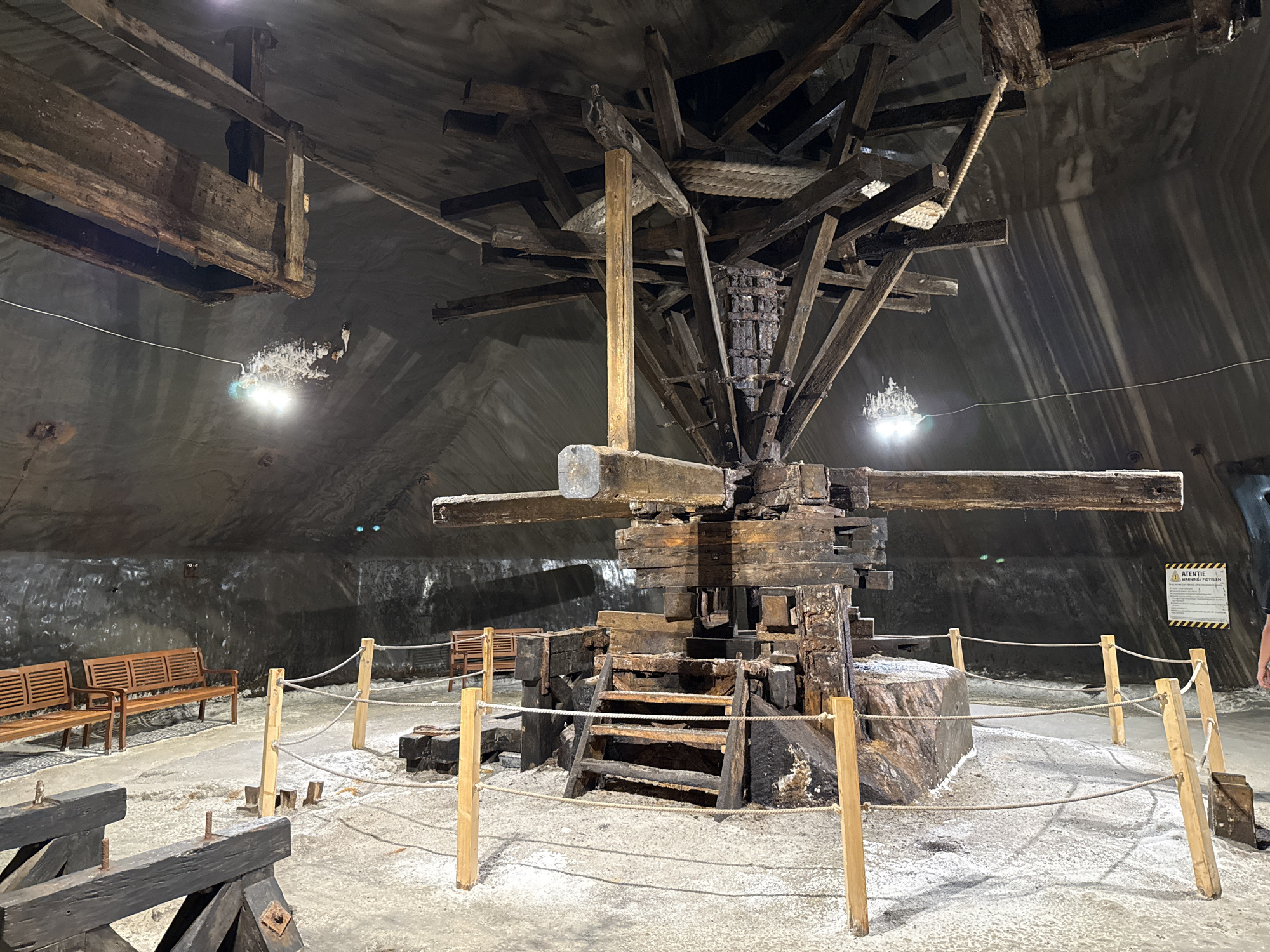
The image shows a large, wooden mechanical apparatus suspended from the ceiling of a cavernous space, likely a salt mine, in Boj-Cătun, Romania. The apparatus consists of a complex arrangement of beams, gears, and what appears to be a hoist mechanism. It is situated in the center of the space, with ropes and wooden posts forming a barrier around it. The walls of the cavern are rough and textured, suggesting a natural rock formation. In the background, there are wooden benches and a sign that reads "ATENTIE WARNING / FIGTELEM". The floor is covered in a white, crystalline substance, consistent with salt. The lighting is artificial and somewhat dim, with some spotlights illuminating the apparatus and the surroundings. There are no people clearly visible in the image, though a person's arm is visible on the far right edge of the frame. The overall impression is of a historical exhibit showcasing early mining technology.
Boj-Cătun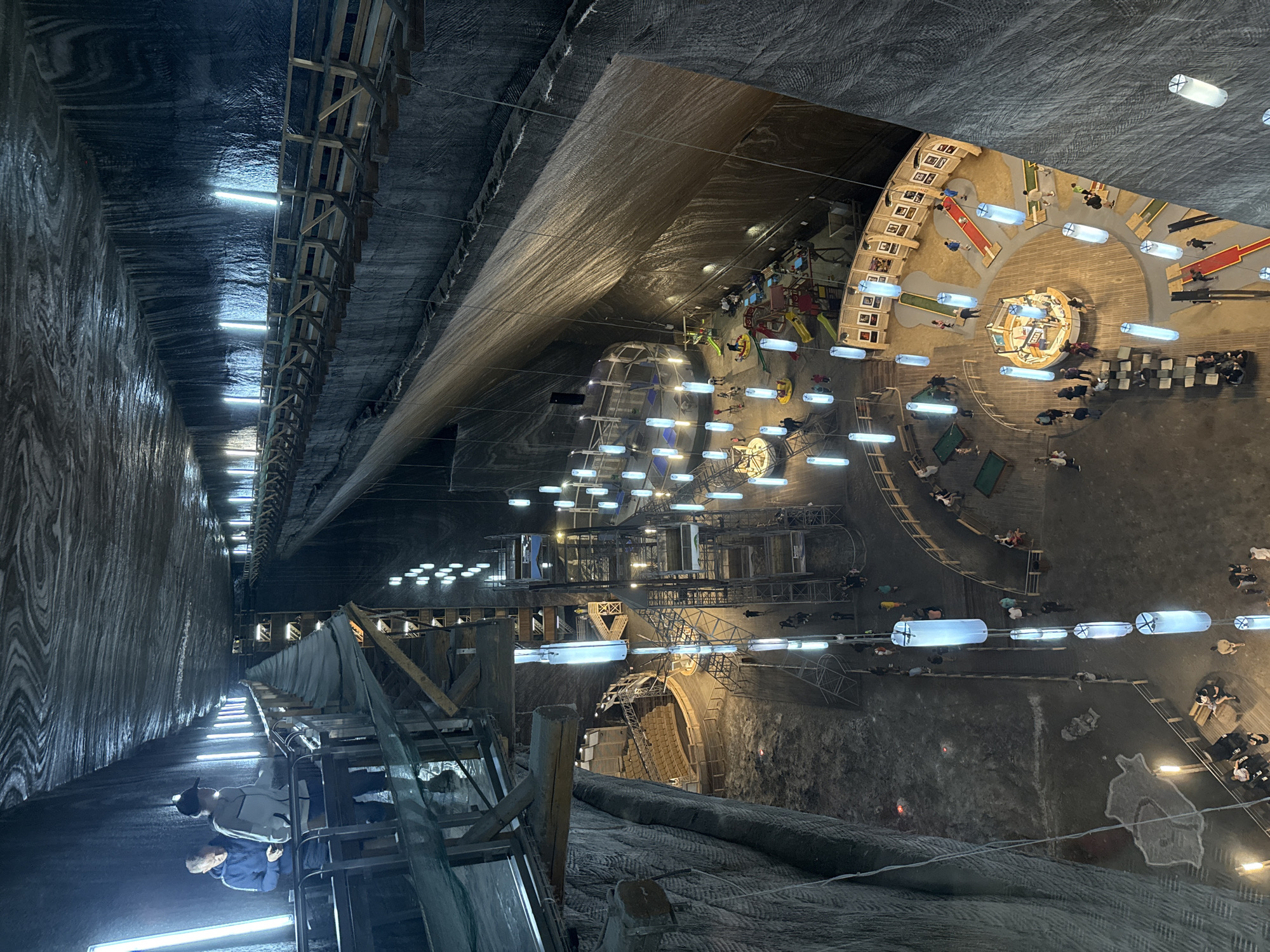
The image depicts the interior of the Turda Salt Mine in Boj-Câțun, Romania, a vast underground cavern transformed into a tourist attraction. The scene is viewed from a high vantage point, looking down into the cavern. The rough, textured salt walls of the mine dominate the periphery, illuminated by numerous vertical, blue-tinted lights. In the foreground, a metal railing runs along a walkway where two individuals are standing and looking out over the cavern. Below them, a complex network of metal scaffolding, wooden walkways, and platforms descends into the mine. Further down, the cavern opens up into a recreational area. People are scattered throughout this space, which includes a mini-golf course with red and green turf, pool tables, seating areas with tables and chairs, and children's play structures like slides and swings. Several cylindrical, blue lights hang from the ceiling, illuminating the activity. A central circular structure appears to be a display or information booth. The floor of the recreational area is a light brown, possibly compacted earth or sand. The overall impression is of a cavernous space repurposed for leisure and entertainment, with the raw, geological features of the salt mine contrasting with the modern additions. The lighting creates an ethereal, somewhat surreal atmosphere.
Boj-Cătun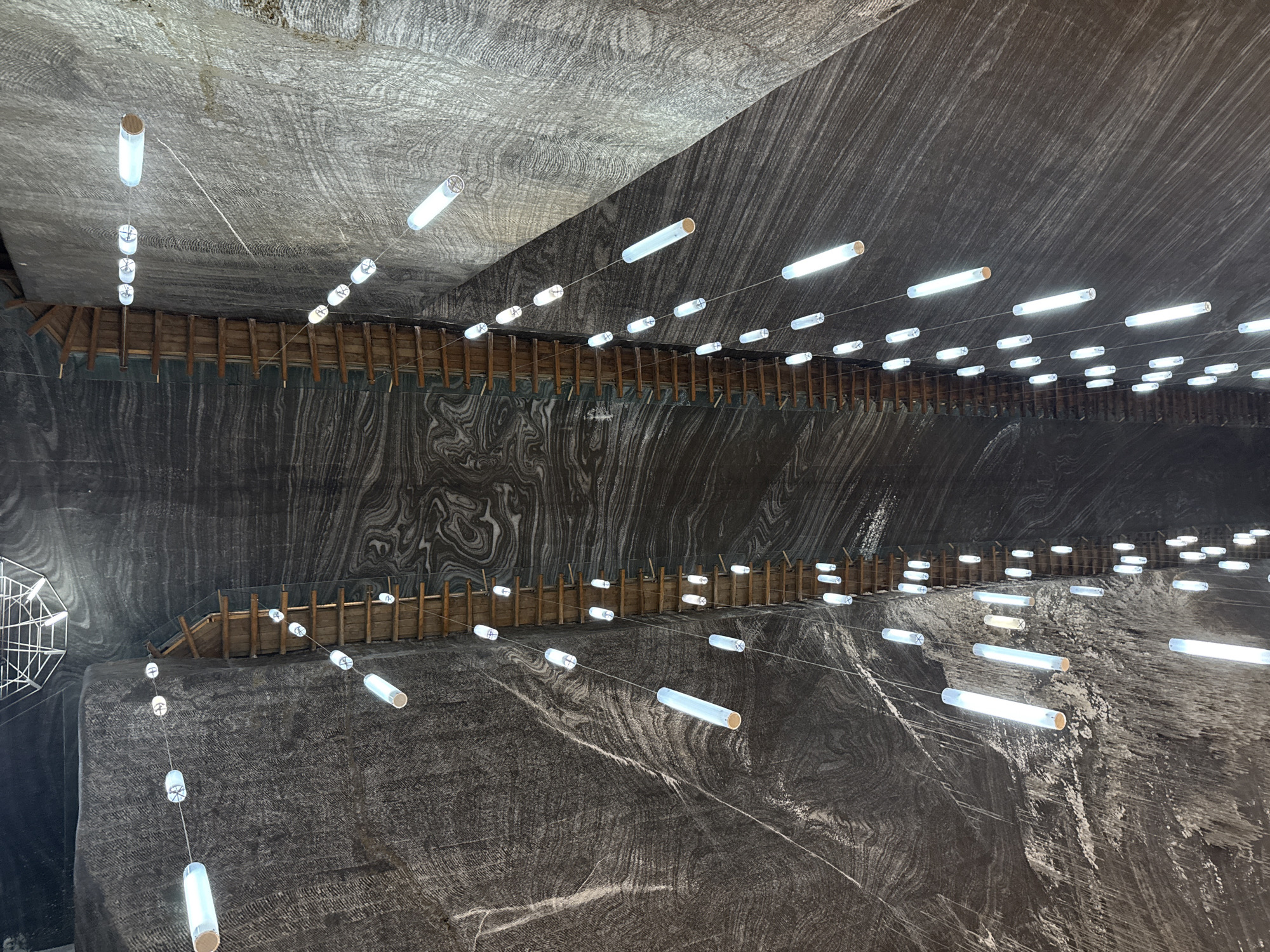
The image shows an interior view of the Salina Turda salt mine in Boj-Cătun, Romania. The vast, dark, and textured salt walls rise steeply on either side, creating a cavernous environment. Suspended from the ceiling by thin wires are numerous cylindrical, translucent lights. These lights are arranged in vertical lines, descending towards the viewer. Some lights appear to be white or blueish, while others are less illuminated or off. In the upper part of the image, a portion of a large, geometric metal structure is visible, likely part of the mine's infrastructure or a decorative installation. The textures of the salt walls are varied, with distinct layers and swirling patterns, some appearing smoother and others more rough or fractured. The overall impression is one of immense scale and a dramatic interplay of light and shadow within a natural, subterranean setting.
Boj-Cătun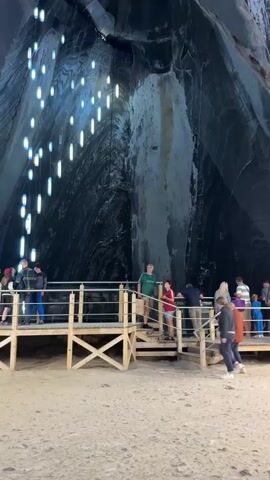
The video shows an underground cavern with people standing on a wooden walkway. The cavern walls are dark and appear to be made of rock or salt. Numerous lights are strung along the left wall, casting a glow. Some people are walking on the walkway, while others are standing and looking around. The cavern has a large, open space at the top, with a dark opening visible. There is a significant amount of white, powdery material on the right side of the cavern wall, possibly salt deposits or dust. The overall impression is a large, man-made or naturally occurring underground space that has been made accessible to visitors.
Boj-Cătun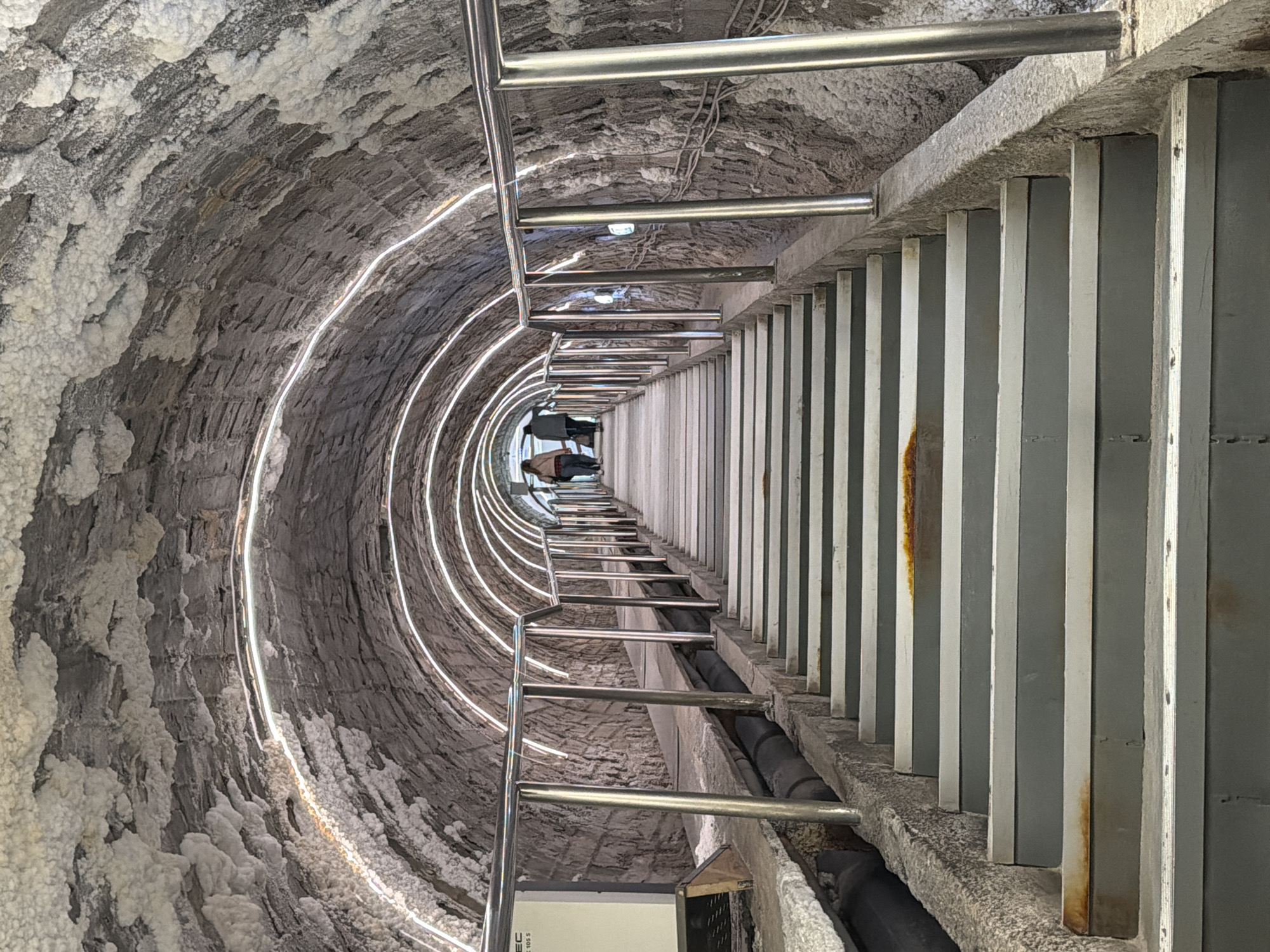
The image shows an interior perspective of a tunnel in Boj-Cătun, Romania, featuring a walkway flanked by railings. The tunnel's walls are textured with a gray, rocky material that appears to be naturally formed or hewn, with white, crystalline deposits along the surface. Illuminated rings follow the curve of the tunnel. The walkway is composed of gray panels or slabs. Two individuals are visible at the far end of the tunnel. The railings are constructed of silver-colored metal bars. Pipes or conduits run along the base of the walkway. The lighting within the tunnel is a combination of the illuminated rings and natural light filtering through the tunnel.
Boj-Cătun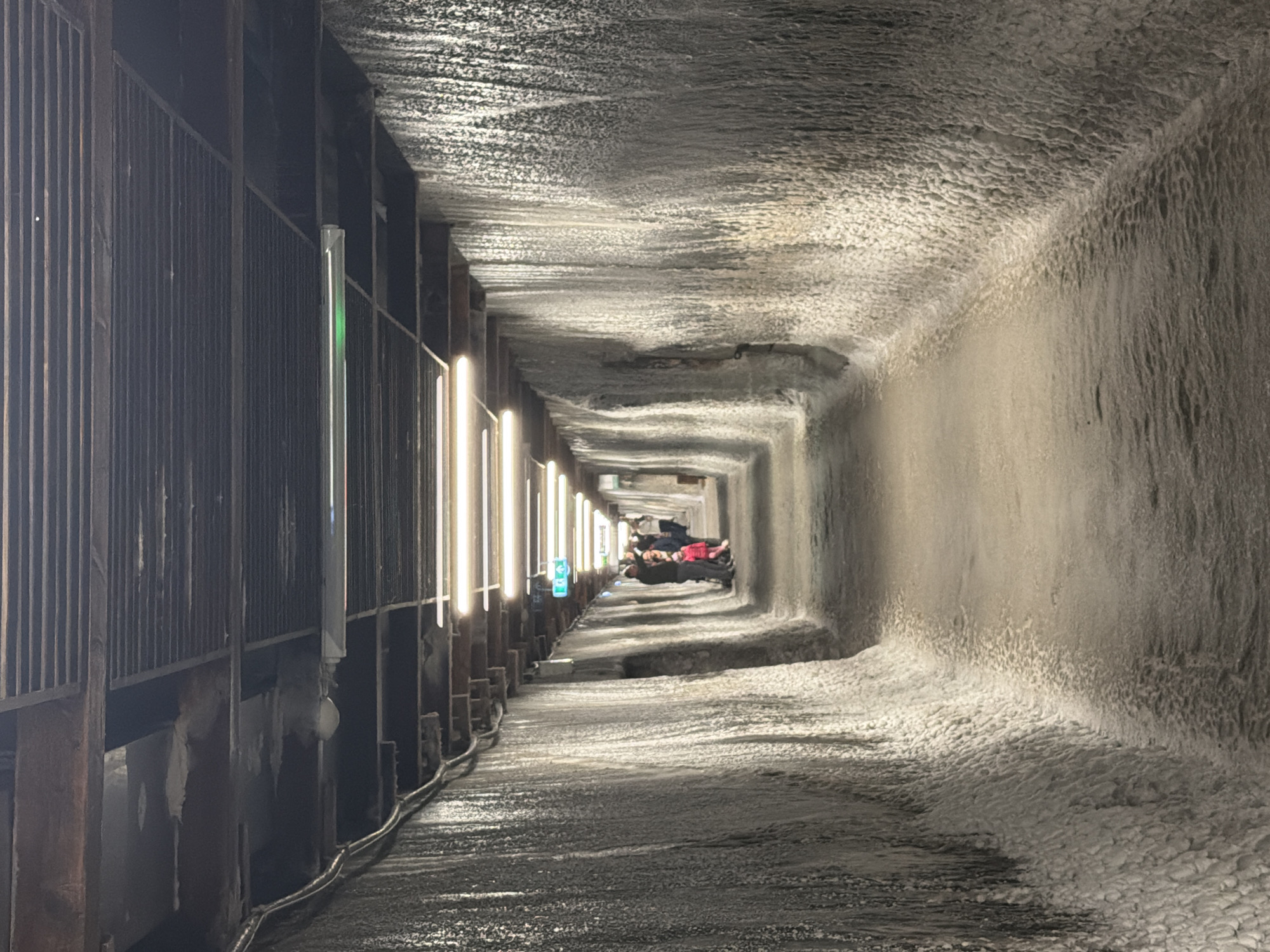
The image depicts a passageway within Salina Turda, a salt mine located in Boj-Cătun, Romania. The passageway has rough, textured walls and ceiling that are predominantly white in color, likely due to salt deposits. The floor is dark and appears wet or damp. Along the left side of the passageway is a wooden structure with a metal railing. Vertical lights are mounted to the structure at regular intervals. In the distance at the end of the passageway, several figures are lying down.
Boj-Cătun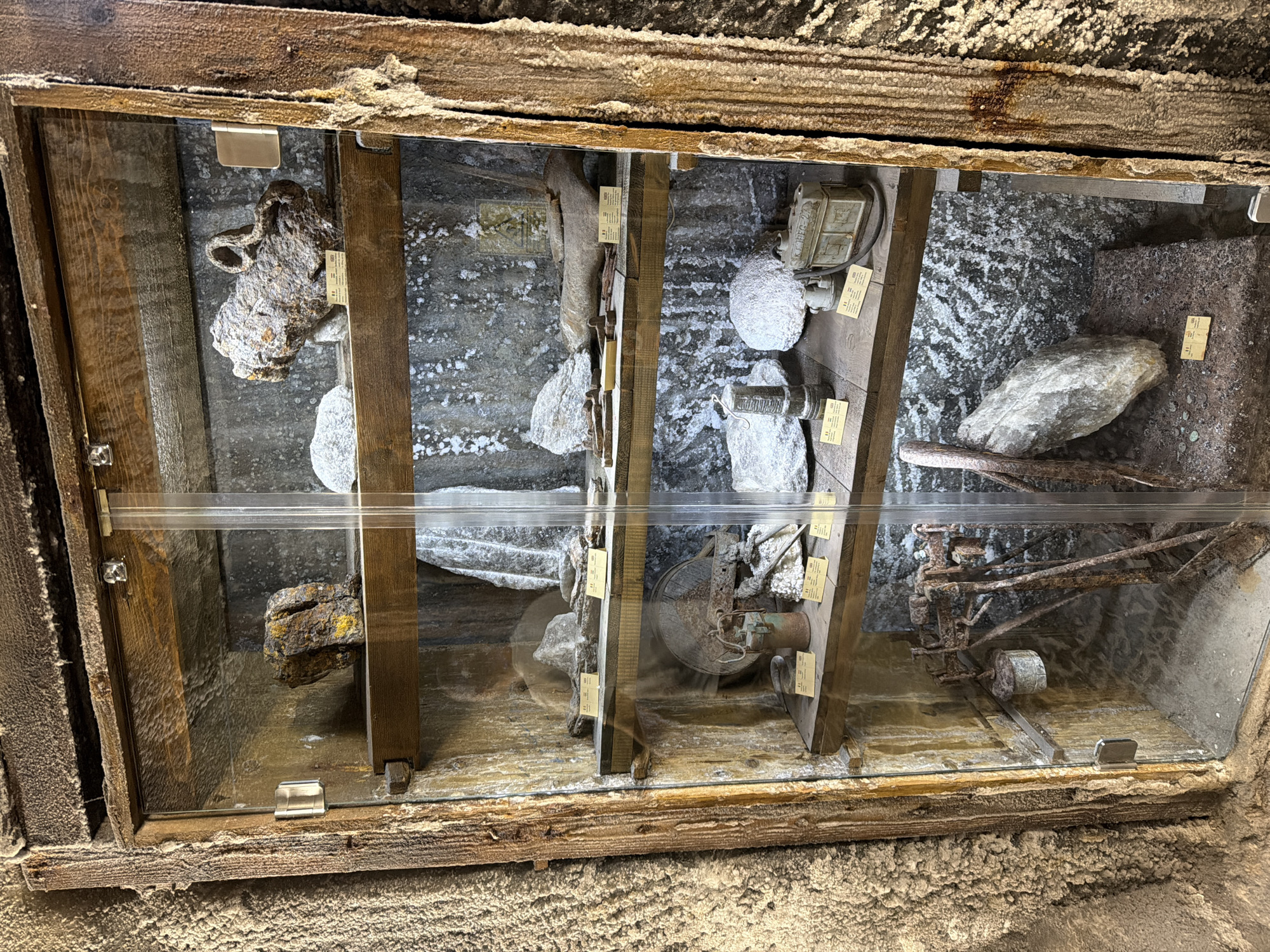
The image shows a wooden display case, likely in the Turda Salt Mine, located in Boj-Cătun, Romania. Inside the case, there are several old mining artifacts and rock samples arranged in three separate compartments. The artifacts include rusted metal objects like pipes, a fan, and what appears to be a portion of a mining cart or machinery. There are also stones and what appear to be salt formations. The back of the case, which serves as the background for the artifacts, shows a rough, textured surface that resembles the mine walls. The display case is encased in salt formations.
Boj-Cătun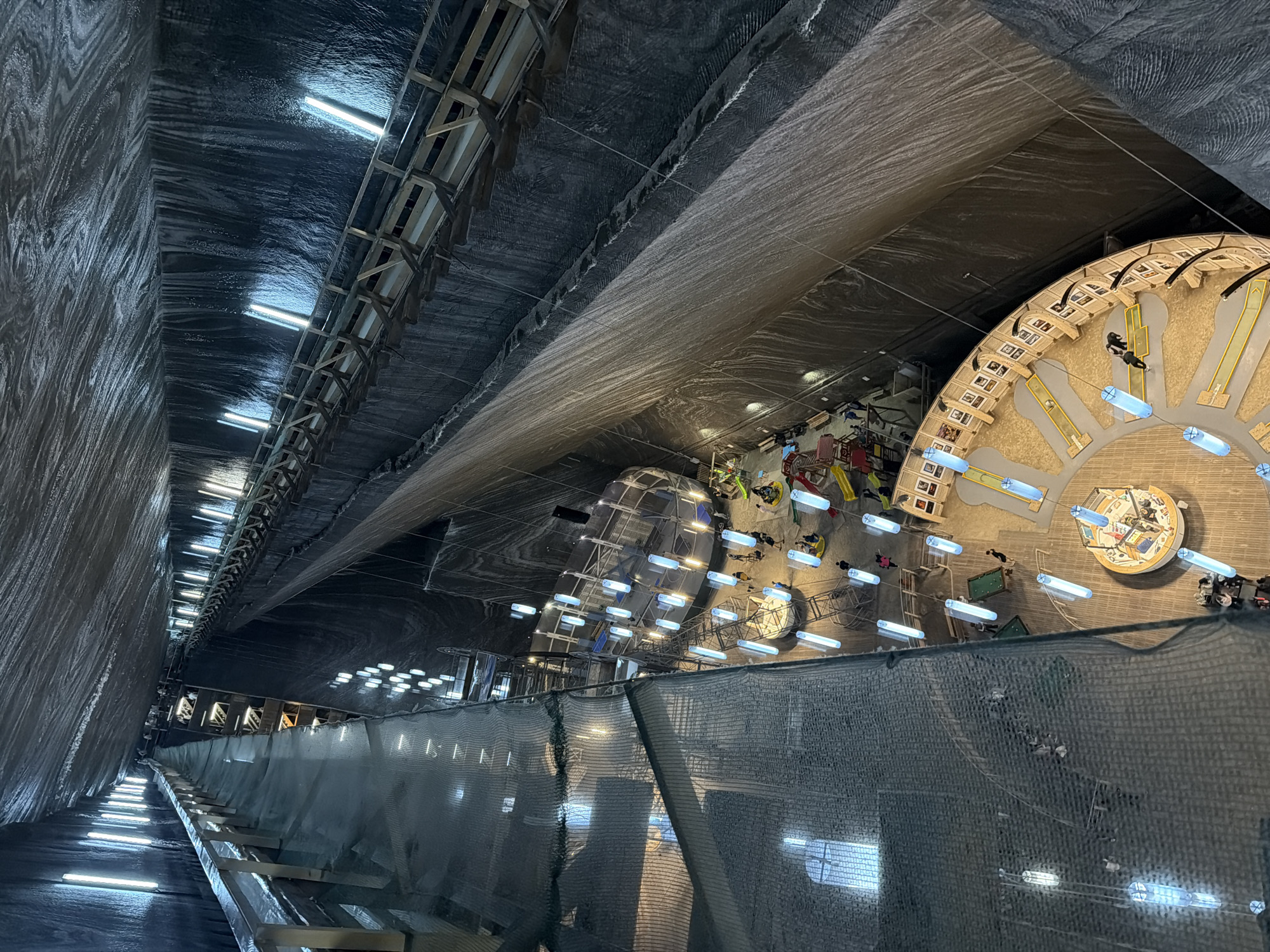
The image shows a deep, industrial underground space, likely a former salt mine turned into a tourist attraction. The location is inferred to be in Boj-Cătun, Romania, based on the context. The walls and ceiling exhibit a layered, textured appearance, characteristic of salt deposits. A vertical shaft or passage is visible, with fluorescent lights illuminating its length. Below, a viewing platform or walkway is partially obscured by a safety net. Further down, the space opens up to reveal a recreational area with various activities, including a carousel-like structure and other installations. People are present in the recreational area, interacting with the facilities. Artificial lighting is used throughout to illuminate the subterranean environment.
Boj-Cătun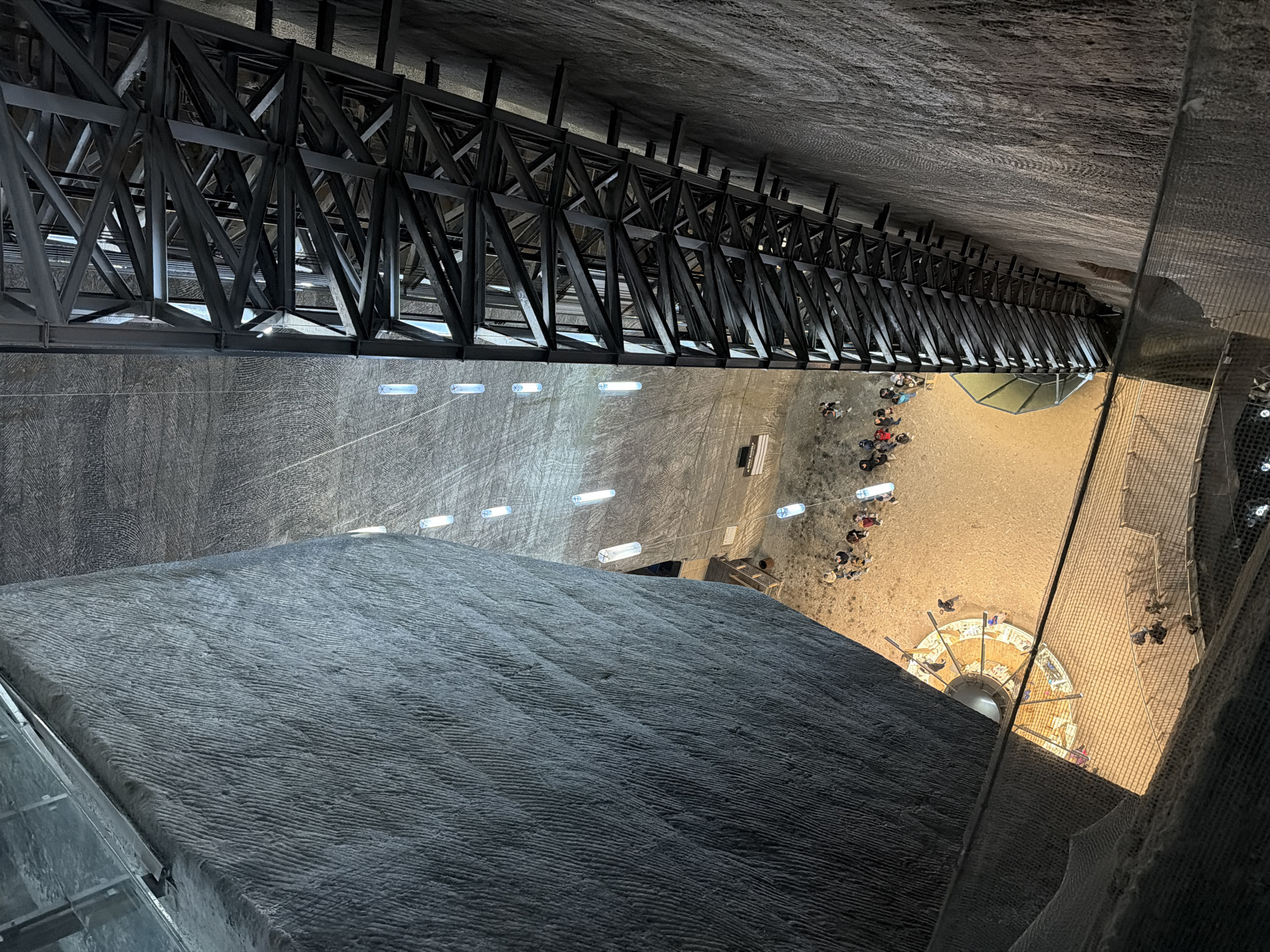
A high-angle view inside Salina Turda, a salt mine in Boj-Cătun, Romania. The photo shows the rough-textured, salt-carved walls of the mine, illuminated by artificial lights. A large metal structure with a geometric pattern is attached to the upper part of the mine. Below this structure, a lower level of the mine is visible, with groups of people and a central feature, possibly a well or shaft, enclosed by a structure. A safety net is visible on the right side.
Boj-Cătun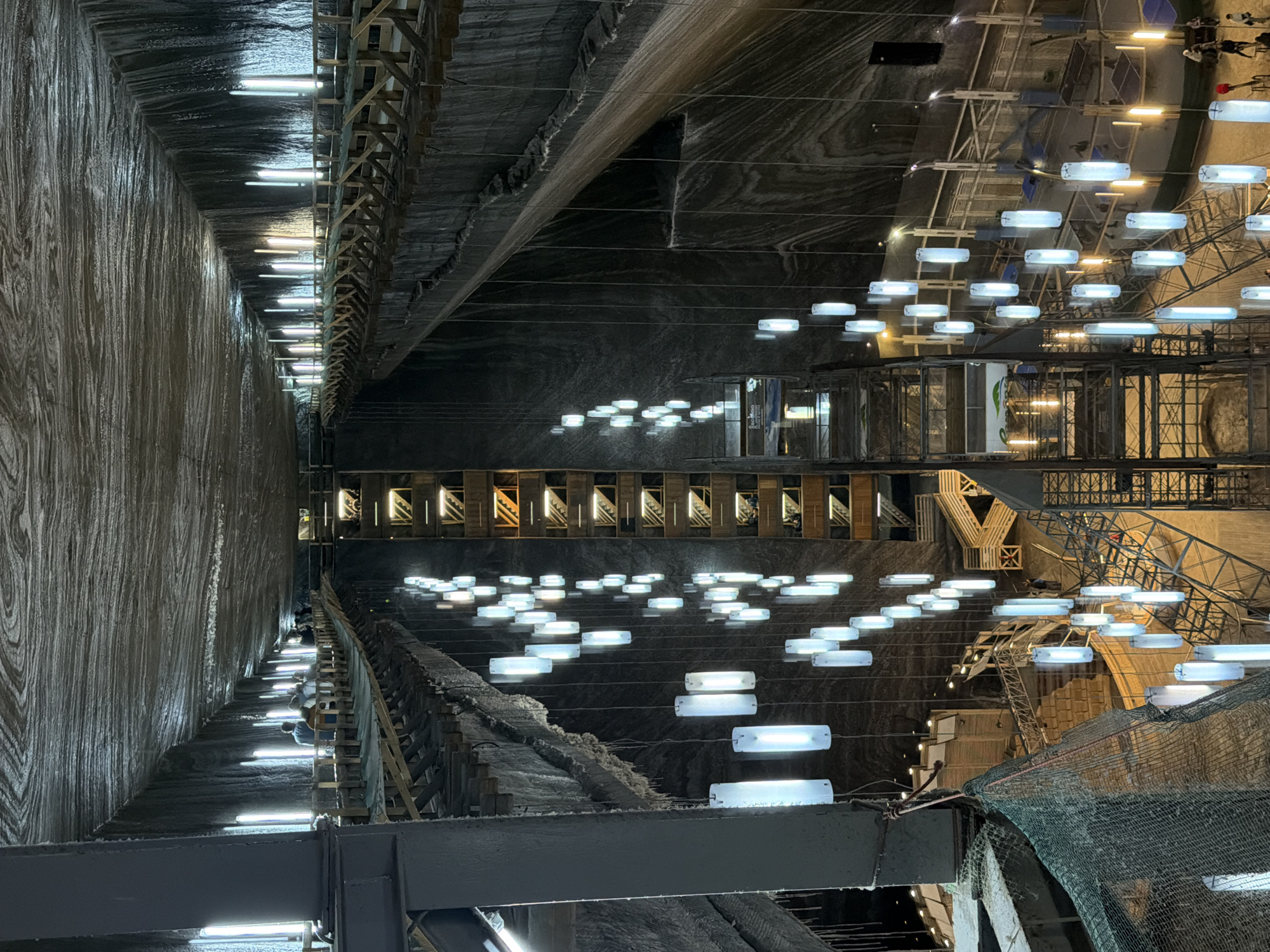
The image depicts the interior of the Turda Salt Mine in Boj-Cătun, Romania. The mine's rough-hewn walls are visible, illuminated by rows of fluorescent lights along the upper reaches. Suspended below are platforms and structures adorned with numerous horizontally-oriented light fixtures resembling glowing oblongs. Some platforms appear to have metal scaffolding. A green mesh netting is visible in the foreground. The mine's interior appears vast and multi-tiered.
Boj-Cătun