CM:

ATTN

Get the app

Buñol, Spain

30 memories from Buñol, Spain
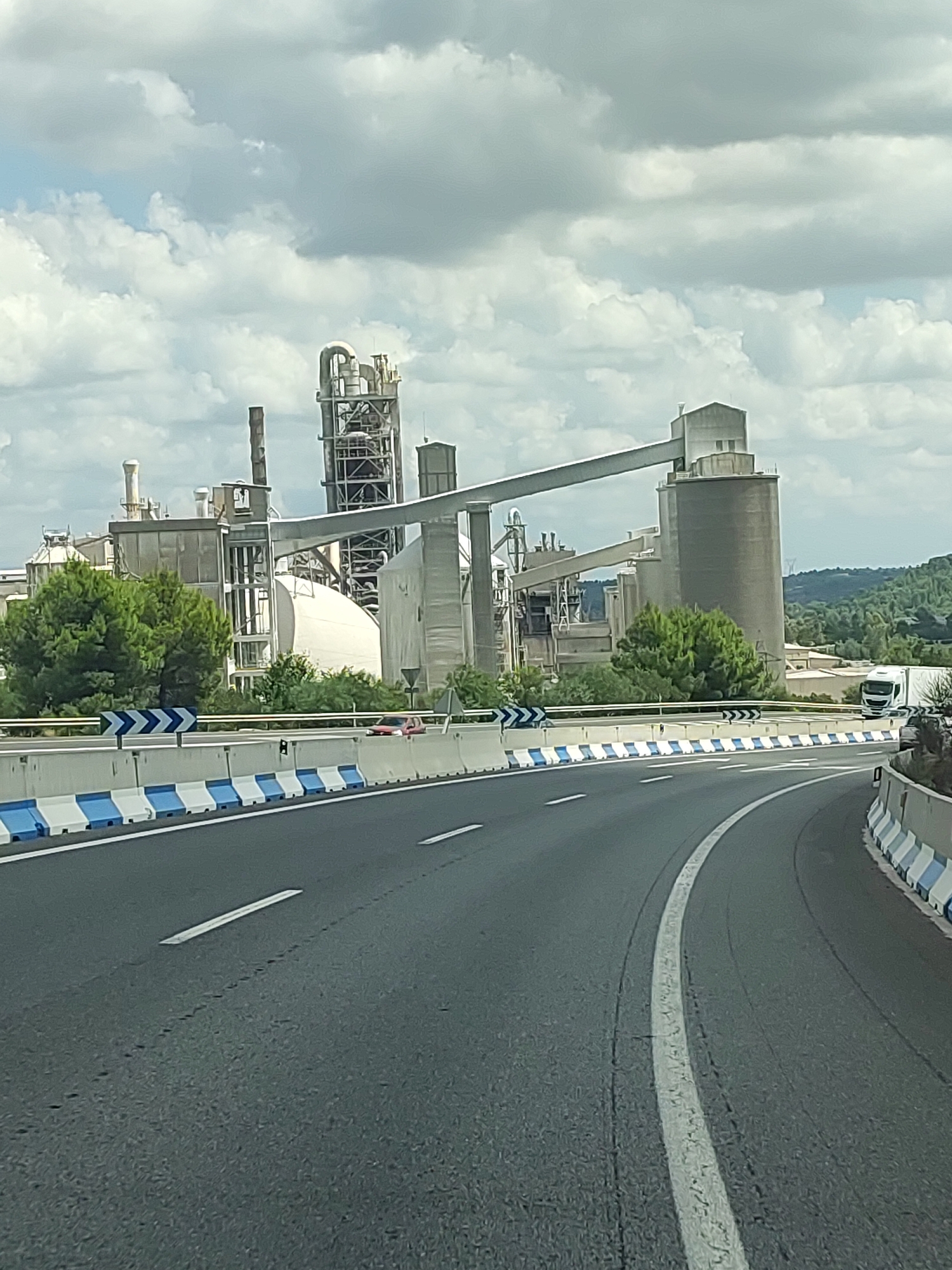
The image displays a railway area in Buñol, Spain, under a partially cloudy daytime sky. In the foreground and midground, several parallel railway tracks with gravel ballast and sparse green vegetation are visible. Two black and white rectangular railway signs, each indicating "A 80 m," are positioned upright between different sets of tracks. To the left, a large deciduous tree with predominantly bare branches and nascent leaf buds stands prominently, flanked by a dense line of darker evergreen trees. A metal chain-link fence runs along the treeline, and a small, light-colored utility box is situated near the fence. In the background to the right, two identical Renfe commuter trains, colored red, white, and grey, are stationary on a track. Behind the trains, a multi-story residential building with light-colored walls and terracotta-colored balconies/trim is visible. No people are present in the scene.

The image displays a railway area in Buñol, Spain, under a partially cloudy daytime sky. In the foreground and midground, several parallel railway tracks with gravel ballast and sparse green vegetation are visible. Two black and white rectangular railway signs, each indicating "A 80 m," are positioned upright between different sets of tracks. To the left, a large deciduous tree with predominantly bare branches and nascent leaf buds stands prominently, flanked by a dense line of darker evergreen trees. A metal chain-link fence runs along the treeline, and a small, light-colored utility box is situated near the fence. In the background to the right, two identical Renfe commuter trains, colored red, white, and grey, are stationary on a track. Behind the trains, a multi-story residential building with light-colored walls and terracotta-colored balconies/trim is visible. No people are present in the scene.

Buñol
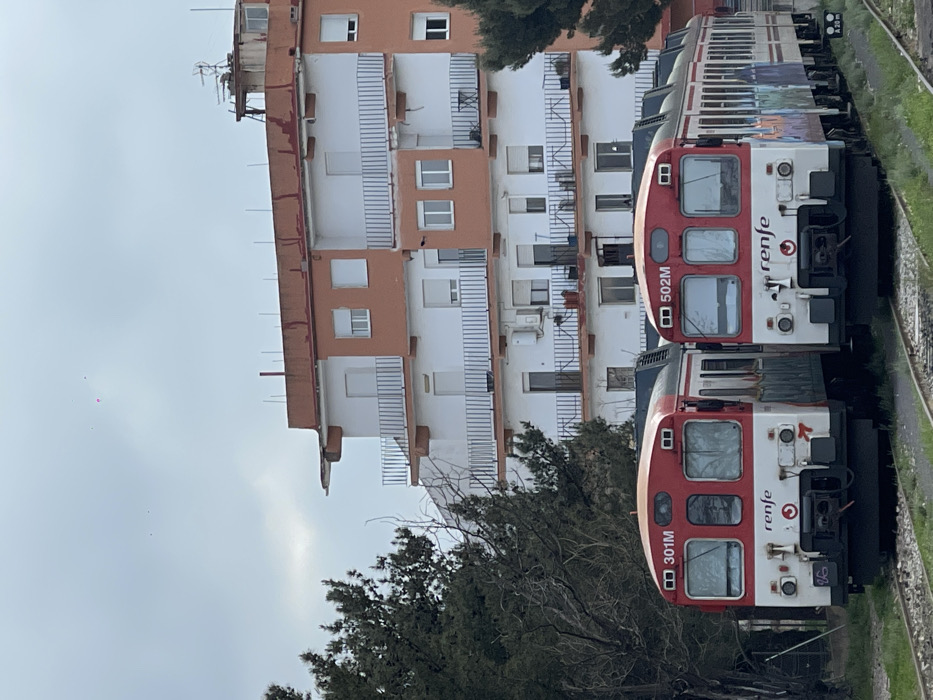
The image displays two stationary Renfe commuter trains on parallel railway tracks in Buñol, Spain, positioned in front of a multi-story residential building under an overcast sky. The foreground features two red and white train cars. The train on the left is numbered "301M" on its destination board, while the train on the right is numbered "502M." Both units exhibit the "renfe" logo on their lower front sections. The side of the 502M train is adorned with multicolored graffiti, and the side of the 301M appears weathered with minor graffiti. Green vegetation, including grass and weeds, grows between the railway sleepers and tracks.

Behind the trains and partially obscured by sparse trees on the left, a six-story residential building is prominent. The building features predominantly white facades with horizontal bands of terracotta-orange trim, particularly on the upper levels and around balconies. Multiple balconies with white metal railings extend from each floor. Numerous rectangular windows, some with closed shutters, are visible across the building's face. Exterior air conditioning units are mounted below some windows. The flat roof of the building hosts an antenna array and a small, elevated utility structure. The sky above is uniformly grey and overcast. Several small, pink, irregularly shaped objects are visible in the upper central portion of the sky.

The image displays two stationary Renfe commuter trains on parallel railway tracks in Buñol, Spain, positioned in front of a multi-story residential building under an overcast sky. The foreground features two red and white train cars. The train on the left is numbered "301M" on its destination board, while the train on the right is numbered "502M." Both units exhibit the "renfe" logo on their lower front sections. The side of the 502M train is adorned with multicolored graffiti, and the side of the 301M appears weathered with minor graffiti. Green vegetation, including grass and weeds, grows between the railway sleepers and tracks. Behind the trains and partially obscured by sparse trees on the left, a six-story residential building is prominent. The building features predominantly white facades with horizontal bands of terracotta-orange trim, particularly on the upper levels and around balconies. Multiple balconies with white metal railings extend from each floor. Numerous rectangular windows, some with closed shutters, are visible across the building's face. Exterior air conditioning units are mounted below some windows. The flat roof of the building hosts an antenna array and a small, elevated utility structure. The sky above is uniformly grey and overcast. Several small, pink, irregularly shaped objects are visible in the upper central portion of the sky.

Buñol
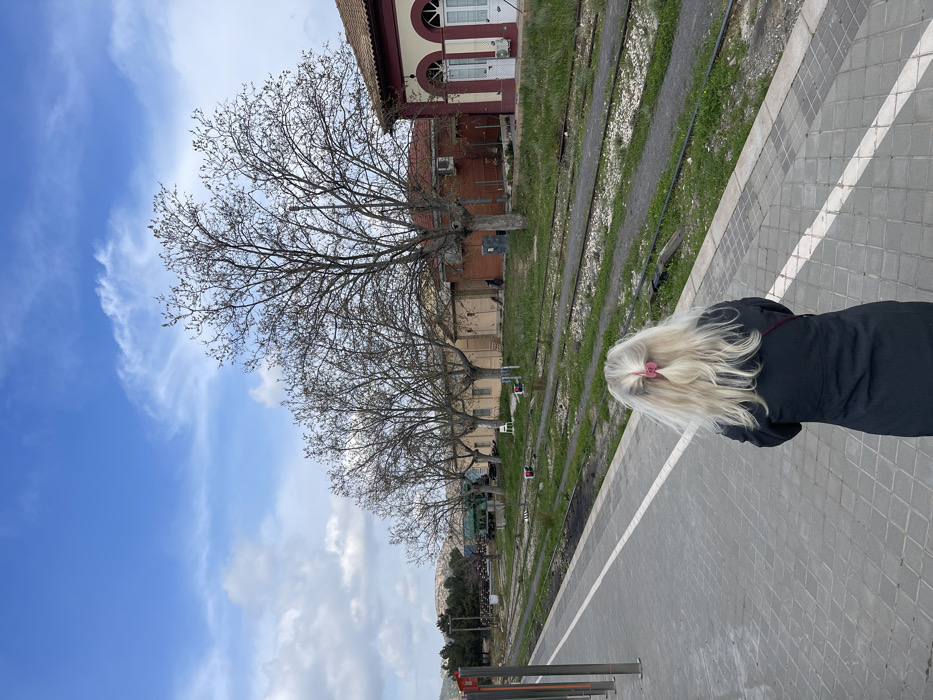
The image depicts a train station in Buñol, Spain, observed from a platform looking down the tracks. In the foreground, a single individual is positioned with their back to the viewer, standing on a gray tiled platform with a white safety line. This individual has long, wavy blonde hair secured with a pink hair clip and is wearing a dark, long-sleeved coat or jacket, with a dark strap visible over their right shoulder.

Parallel to the platform, multiple sets of train tracks are visible, embedded in gravel and partially overgrown with green vegetation. Across the tracks, a series of structures stand. To the immediate right, a building with a red-tiled roof, light-colored walls, and distinctive red trim around two arched windows or doors is present, possibly the main station building. An external air conditioning unit is mounted on its side. Further down the tracks, a line of single-story buildings with light brown walls and dark roofs are visible, interspersed with bare deciduous trees suggesting late winter or early spring. One white plastic chair is discernible near one of these buildings. In the far distance to the left, low hills or mountains are under a partially cloudy blue sky with scattered white clouds.

The image depicts a train station in Buñol, Spain, observed from a platform looking down the tracks. In the foreground, a single individual is positioned with their back to the viewer, standing on a gray tiled platform with a white safety line. This individual has long, wavy blonde hair secured with a pink hair clip and is wearing a dark, long-sleeved coat or jacket, with a dark strap visible over their right shoulder. Parallel to the platform, multiple sets of train tracks are visible, embedded in gravel and partially overgrown with green vegetation. Across the tracks, a series of structures stand. To the immediate right, a building with a red-tiled roof, light-colored walls, and distinctive red trim around two arched windows or doors is present, possibly the main station building. An external air conditioning unit is mounted on its side. Further down the tracks, a line of single-story buildings with light brown walls and dark roofs are visible, interspersed with bare deciduous trees suggesting late winter or early spring. One white plastic chair is discernible near one of these buildings. In the far distance to the left, low hills or mountains are under a partially cloudy blue sky with scattered white clouds.

Buñol
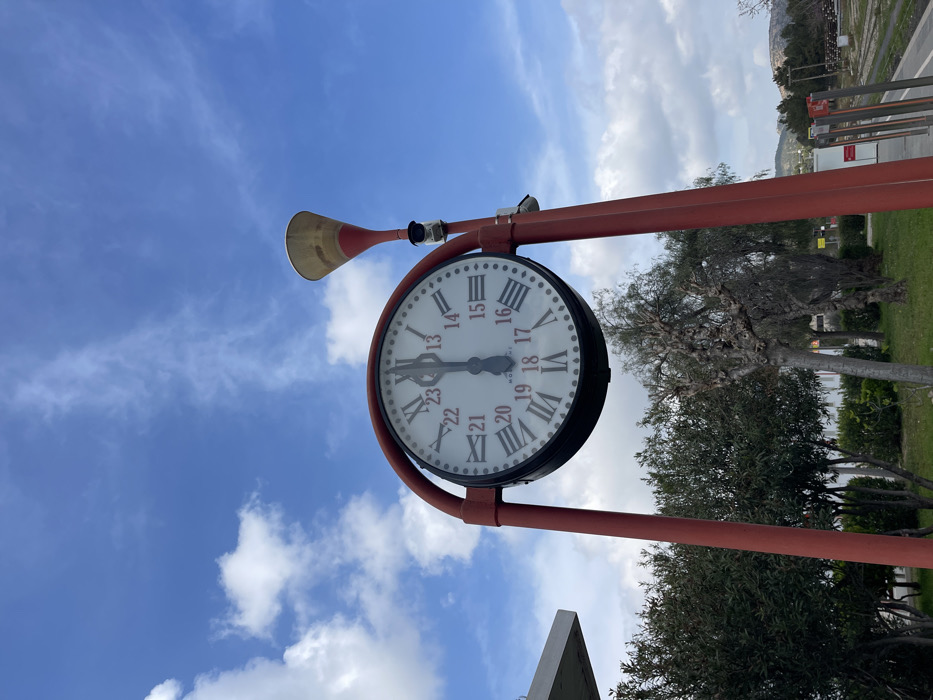
The image displays an outdoor public clock situated at a railway station in Buñol, Spain. The central object is a large, circular clock with a white face, featuring black Roman numerals (I-XII) and an inner ring of red Arabic numerals (13-23). Both the hour and minute hands are positioned vertically, indicating 12:00. This clock is supported by a red, arched metal frame, which rests on two vertical red poles. Attached to the upper section of the right pole is a two-toned, conical public address speaker, red at its base and fading to a lighter color at its wider opening, with a small dark camera or sensor mounted directly beneath it.

To the left of the clock, a partial view of a light-colored overhead structure, possibly an awning or building extension, is visible. The ground area beneath and between the poles is covered with green grass, interspersed with various green bushes and several trees, some with dark foliage and others appearing deciduous with gnarled, bare branches. To the right, a paved platform with discernible markings extends into the midground, beyond which multiple railway tracks are visible running horizontally. The background features rolling hills with sparse vegetation, set against a bright blue sky scattered with white cumulus clouds. No individuals or active events are present in the scene.

The image displays an outdoor public clock situated at a railway station in Buñol, Spain. The central object is a large, circular clock with a white face, featuring black Roman numerals (I-XII) and an inner ring of red Arabic numerals (13-23). Both the hour and minute hands are positioned vertically, indicating 12:00. This clock is supported by a red, arched metal frame, which rests on two vertical red poles. Attached to the upper section of the right pole is a two-toned, conical public address speaker, red at its base and fading to a lighter color at its wider opening, with a small dark camera or sensor mounted directly beneath it. To the left of the clock, a partial view of a light-colored overhead structure, possibly an awning or building extension, is visible. The ground area beneath and between the poles is covered with green grass, interspersed with various green bushes and several trees, some with dark foliage and others appearing deciduous with gnarled, bare branches. To the right, a paved platform with discernible markings extends into the midground, beyond which multiple railway tracks are visible running horizontally. The background features rolling hills with sparse vegetation, set against a bright blue sky scattered with white cumulus clouds. No individuals or active events are present in the scene.

Buñol
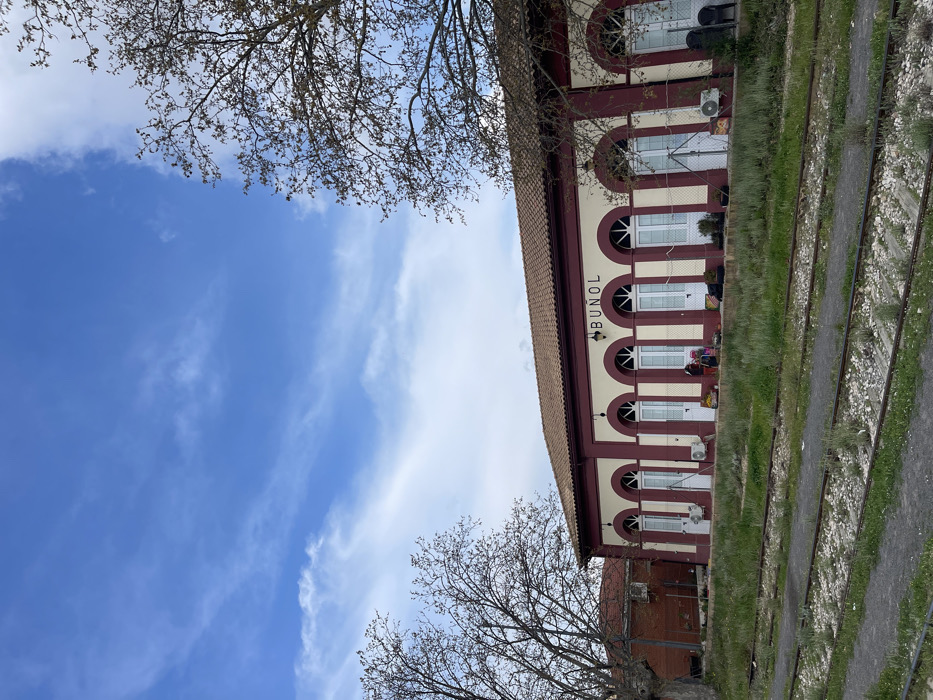
The image depicts the train station building in Buñol, Spain, viewed from across multiple railroad tracks. The sky overhead is bright blue with scattered white, wispy cirrus clouds. On the left, a tree with bare branches and sparse budding foliage partially obscures a brick-colored building in the background. Another similar tree with emerging leaves frames the right side of the image, extending into the sky.

In the foreground, three parallel sets of railroad tracks run horizontally across the lower section of the image. The tracks are embedded in gravel ballast, with green grass and weeds growing between the sleepers and rails. A strip of unkempt grass separates the tracks from the station building.

The station building is a single-story structure with a terracotta tiled hip roof. Its facade features a cream-colored base with dark red trim outlining the roofline and framing six prominent arched doorways or windows. The word "BUNOL" is visible in dark lettering above the central arched entrance. Each arched opening contains tall, white double doors, some with arched transoms. Several white exterior air conditioning units are mounted on the facade below the windows. Near the third arched entrance from the left, a partially obscured individual in colorful clothing is visible, along with several objects including what appear to be potted plants and bags. A dark chair is positioned near the rightmost entrance. Some doorways are fronted by security gates or fencing.

The image depicts the train station building in Buñol, Spain, viewed from across multiple railroad tracks. The sky overhead is bright blue with scattered white, wispy cirrus clouds. On the left, a tree with bare branches and sparse budding foliage partially obscures a brick-colored building in the background. Another similar tree with emerging leaves frames the right side of the image, extending into the sky. In the foreground, three parallel sets of railroad tracks run horizontally across the lower section of the image. The tracks are embedded in gravel ballast, with green grass and weeds growing between the sleepers and rails. A strip of unkempt grass separates the tracks from the station building. The station building is a single-story structure with a terracotta tiled hip roof. Its facade features a cream-colored base with dark red trim outlining the roofline and framing six prominent arched doorways or windows. The word "BUNOL" is visible in dark lettering above the central arched entrance. Each arched opening contains tall, white double doors, some with arched transoms. Several white exterior air conditioning units are mounted on the facade below the windows. Near the third arched entrance from the left, a partially obscured individual in colorful clothing is visible, along with several objects including what appear to be potted plants and bags. A dark chair is positioned near the rightmost entrance. Some doorways are fronted by security gates or fencing.

Buñol
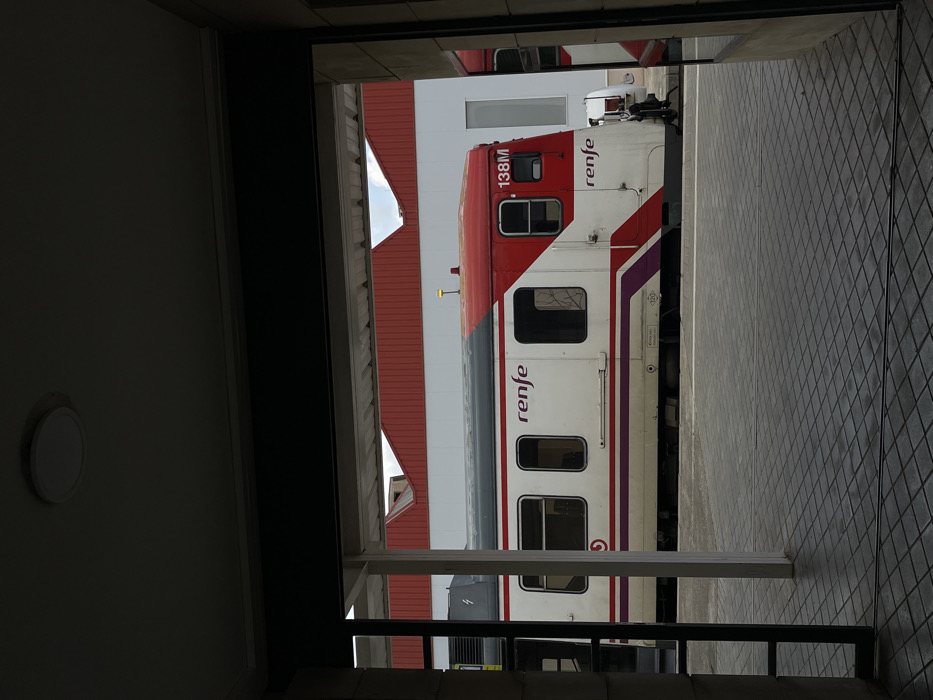
The image displays a Renfe commuter train at a railway station in Buñol, Spain, viewed from within a darkened interior space. The foreground consists of a dark ceiling with a circular light fixture, dark overhead framing, and a grey tiled floor with a grid pattern. A white vertical column is visible on the left side of the frame.

The central subject is a Renfe train car, predominantly white with red and purple diagonal accents. The word "renfe" is visible on its side in purple lettering, and the identification "138M" is clearly marked on the front-facing section of the car. The train features multiple rectangular windows along its side and a dark grey roof with a small yellow antenna-like object. It rests alongside a grey tiled platform, which transitions from the interior flooring.

In the background, beyond the train, are several white buildings topped with distinct red corrugated roofs, exhibiting a sawtooth profile. A narrow, vertical rectangular window is visible on one of the white structures. A small segment of pale blue sky with white clouds is visible between the rooflines. No individuals are present in the scene, and no discernible actions or interactions are occurring.

The image displays a Renfe commuter train at a railway station in Buñol, Spain, viewed from within a darkened interior space. The foreground consists of a dark ceiling with a circular light fixture, dark overhead framing, and a grey tiled floor with a grid pattern. A white vertical column is visible on the left side of the frame. The central subject is a Renfe train car, predominantly white with red and purple diagonal accents. The word "renfe" is visible on its side in purple lettering, and the identification "138M" is clearly marked on the front-facing section of the car. The train features multiple rectangular windows along its side and a dark grey roof with a small yellow antenna-like object. It rests alongside a grey tiled platform, which transitions from the interior flooring. In the background, beyond the train, are several white buildings topped with distinct red corrugated roofs, exhibiting a sawtooth profile. A narrow, vertical rectangular window is visible on one of the white structures. A small segment of pale blue sky with white clouds is visible between the rooflines. No individuals are present in the scene, and no discernible actions or interactions are occurring.

Buñol
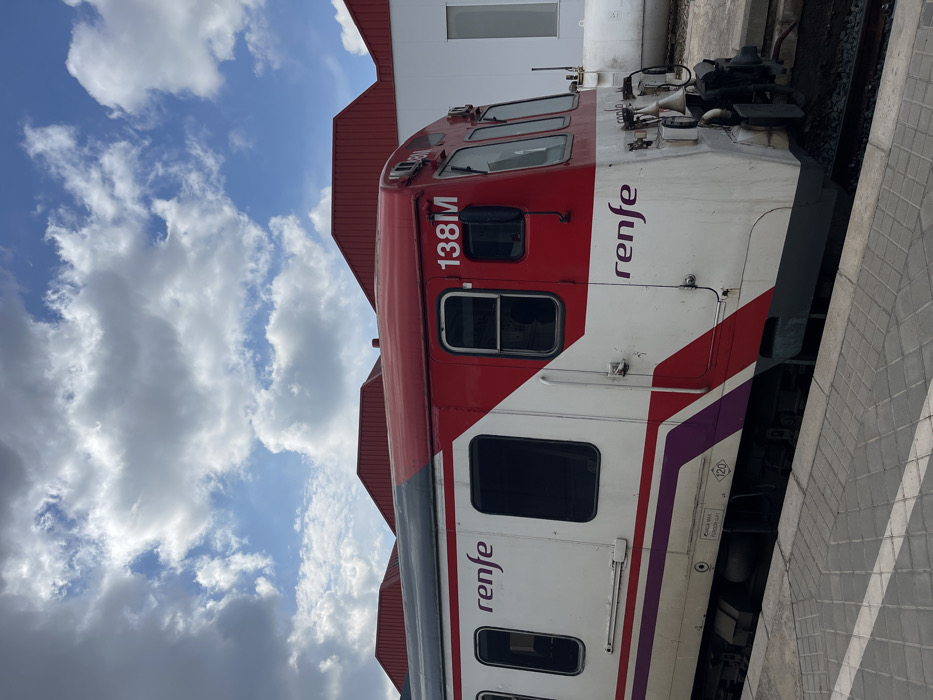
A stationary RENFE train is depicted at a railway station or siding in Buñol, Spain. The train unit, predominantly red and white with a purple stripe along its lower side, displays the "renfe" logo prominently on its side and the designation "138M" on the front cab section. The lower body of the train exhibits wear and dirt. It rests on a set of tracks adjacent to a grey-tiled platform. In the background, a white industrial-style building is visible, with multiple red, gabled roofs extending above it to the left. A large white horizontal pipe lies on the ground behind the train, near the white building. The sky is partially cloudy with significant white cumulus clouds and patches of clear blue. No individuals are present in the scene.

A stationary RENFE train is depicted at a railway station or siding in Buñol, Spain. The train unit, predominantly red and white with a purple stripe along its lower side, displays the "renfe" logo prominently on its side and the designation "138M" on the front cab section. The lower body of the train exhibits wear and dirt. It rests on a set of tracks adjacent to a grey-tiled platform. In the background, a white industrial-style building is visible, with multiple red, gabled roofs extending above it to the left. A large white horizontal pipe lies on the ground behind the train, near the white building. The sky is partially cloudy with significant white cumulus clouds and patches of clear blue. No individuals are present in the scene.

Buñol
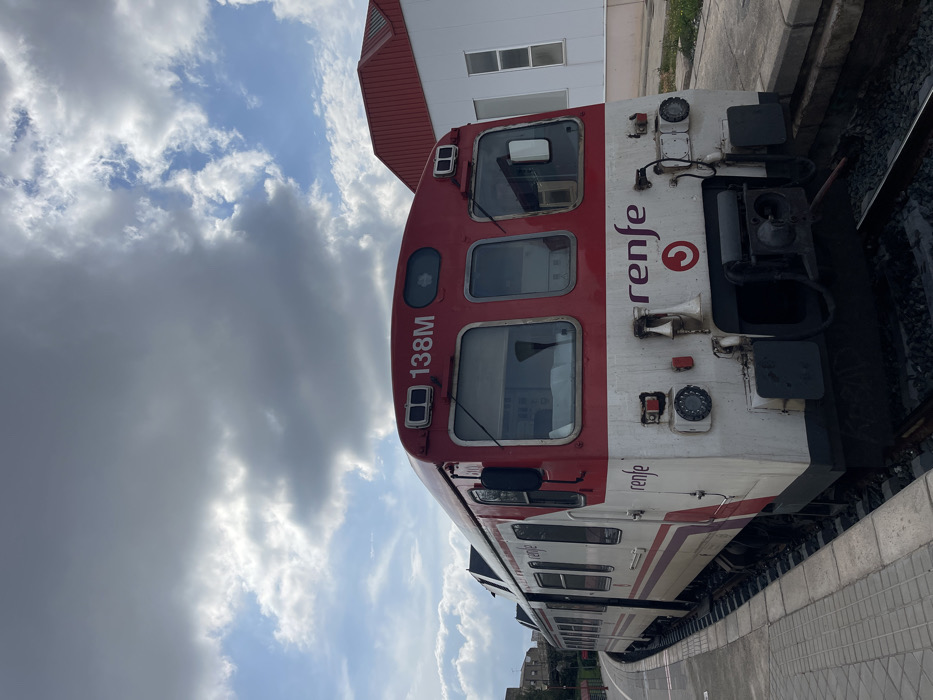
A stationary Renfe commuter train, identified by the marking "138M" on its upper red facade and the "renfe" logo in purple on its white lower front, is positioned on railway tracks at what is identified as the Buñol train station in Buñol, Spain. The train's front features two rectangular windshields, a central coupling apparatus, horns, and various light fixtures; the white section of its exterior displays visible dirt and wear. The train rests alongside a light-colored, tiled platform. To the left, the tracks curve into the distance, paralleled by an elevated embankment where obscured structures are faintly visible. To the right, a white building with a distinct red-pitched roof and several rectangular windows stands. The scene is outdoors, illuminated by daylight under a sky with significant coverage by large, scattered grey clouds, interspersed with areas of clear blue sky. No individuals are present in the frame, and no actions or interactions are depicted.

A stationary Renfe commuter train, identified by the marking "138M" on its upper red facade and the "renfe" logo in purple on its white lower front, is positioned on railway tracks at what is identified as the Buñol train station in Buñol, Spain. The train's front features two rectangular windshields, a central coupling apparatus, horns, and various light fixtures; the white section of its exterior displays visible dirt and wear. The train rests alongside a light-colored, tiled platform. To the left, the tracks curve into the distance, paralleled by an elevated embankment where obscured structures are faintly visible. To the right, a white building with a distinct red-pitched roof and several rectangular windows stands. The scene is outdoors, illuminated by daylight under a sky with significant coverage by large, scattered grey clouds, interspersed with areas of clear blue sky. No individuals are present in the frame, and no actions or interactions are depicted.

Buñol
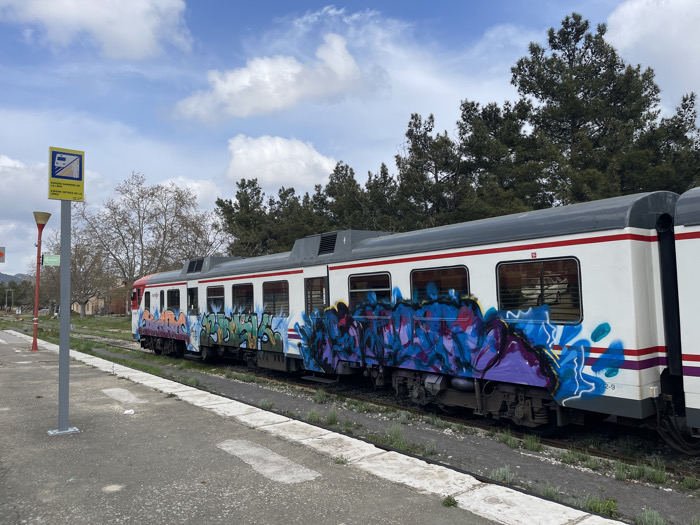
A passenger train is stopped on railway tracks next to a concrete platform at a train station in Buñol, Spain, under a partly cloudy sky. The train, predominantly white with a grey roof and a red horizontal stripe, is heavily adorned with multi-colored graffiti in various shades of blue, purple, green, orange, and black, which covers portions of its windows and lower body across at least two cars. The train car visible on the right displays the number 592-0. In the immediate foreground to the left, a tall grey pole supports a rectangular yellow sign featuring an icon of a person crossing tracks with a diagonal line through it, indicating "NO TRESPASSING." Spanish text on the sign reads "PASO PROHIBIDO CRUZAR LAS VIAS. SANCION." and also identifies the location as "CENTRO DE LA TOMATINA." The concrete platform shows wear, and weeds are visible growing along its edge and between the train tracks. Bare deciduous trees and dense evergreen trees form the background. No individuals are present in the scene.

A passenger train is stopped on railway tracks next to a concrete platform at a train station in Buñol, Spain, under a partly cloudy sky. The train, predominantly white with a grey roof and a red horizontal stripe, is heavily adorned with multi-colored graffiti in various shades of blue, purple, green, orange, and black, which covers portions of its windows and lower body across at least two cars. The train car visible on the right displays the number 592-0. In the immediate foreground to the left, a tall grey pole supports a rectangular yellow sign featuring an icon of a person crossing tracks with a diagonal line through it, indicating "NO TRESPASSING." Spanish text on the sign reads "PASO PROHIBIDO CRUZAR LAS VIAS. SANCION." and also identifies the location as "CENTRO DE LA TOMATINA." The concrete platform shows wear, and weeds are visible growing along its edge and between the train tracks. Bare deciduous trees and dense evergreen trees form the background. No individuals are present in the scene.

Buñol
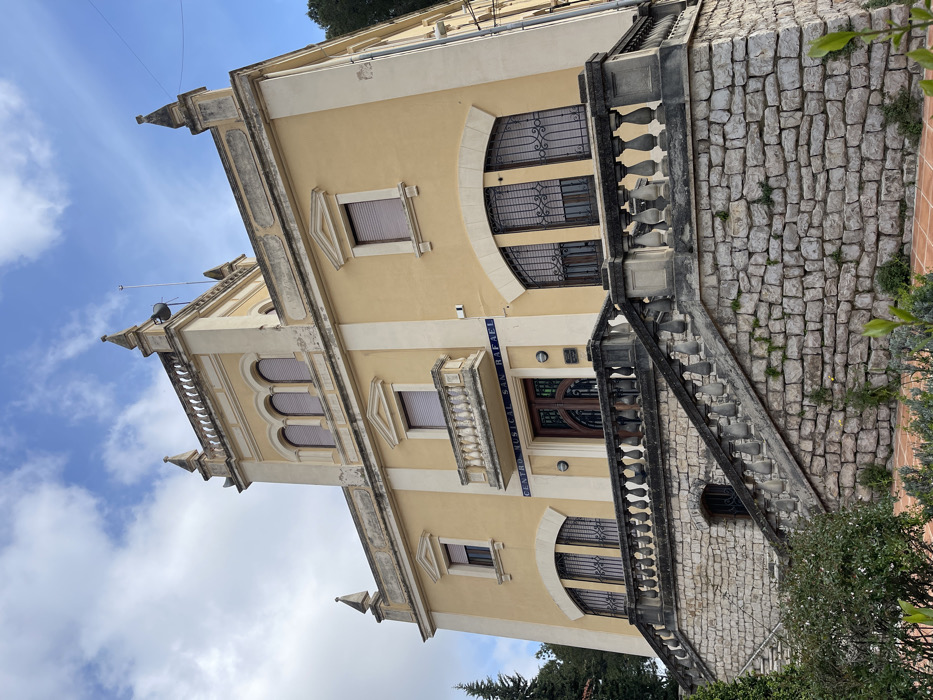
The image depicts the Centro Musical San Rafael, located in the city of Buñol, Spain. The building is a multi-story structure with a pale yellow facade and white architectural trim, set against a partially cloudy blue sky. It features an eclectic or neoclassical architectural style with decorative elements.

The main entrance is positioned centrally on the second level, accessible via a broad, symmetrical stone staircase with balustrades. The staircase is built on a rough-hewn stone retaining wall. Above the entrance, a blue sign with white lettering reads "CENTRO MUSICAL SAN RAFAEL." Directly above this sign and the entrance, a small balcony with a white balustrade protrudes from the facade. The entrance itself consists of ornate dark wood double doors.

Windows on the lower and upper levels vary in shape, including rectangular and arched designs. Most windows are fitted with closed internal blinds and some, particularly on the lower level, are protected by decorative black iron grilles. The building features white pilasters and cornices, and a prominent central tower-like projection above the main section of the roofline. This projection contains three arched windows with closed blinds. The roofline is adorned with multiple pointed finials or pinnacles, and a small satellite dish and an antenna mast are visible on the roof.

To the left of the building, a mature pine tree is visible, extending above the roofline. In the foreground, at the base of the stone staircase and retaining wall, there are landscaped garden beds with green bushes and low-growing vegetation. A terracotta-colored tiled pathway or ground surface is visible at the very bottom of the frame. No individuals are present in the scene. Two small white security cameras are mounted on the facade near the main entrance.

The image depicts the Centro Musical San Rafael, located in the city of Buñol, Spain. The building is a multi-story structure with a pale yellow facade and white architectural trim, set against a partially cloudy blue sky. It features an eclectic or neoclassical architectural style with decorative elements. The main entrance is positioned centrally on the second level, accessible via a broad, symmetrical stone staircase with balustrades. The staircase is built on a rough-hewn stone retaining wall. Above the entrance, a blue sign with white lettering reads "CENTRO MUSICAL SAN RAFAEL." Directly above this sign and the entrance, a small balcony with a white balustrade protrudes from the facade. The entrance itself consists of ornate dark wood double doors. Windows on the lower and upper levels vary in shape, including rectangular and arched designs. Most windows are fitted with closed internal blinds and some, particularly on the lower level, are protected by decorative black iron grilles. The building features white pilasters and cornices, and a prominent central tower-like projection above the main section of the roofline. This projection contains three arched windows with closed blinds. The roofline is adorned with multiple pointed finials or pinnacles, and a small satellite dish and an antenna mast are visible on the roof. To the left of the building, a mature pine tree is visible, extending above the roofline. In the foreground, at the base of the stone staircase and retaining wall, there are landscaped garden beds with green bushes and low-growing vegetation. A terracotta-colored tiled pathway or ground surface is visible at the very bottom of the frame. No individuals are present in the scene. Two small white security cameras are mounted on the facade near the main entrance.

Buñol
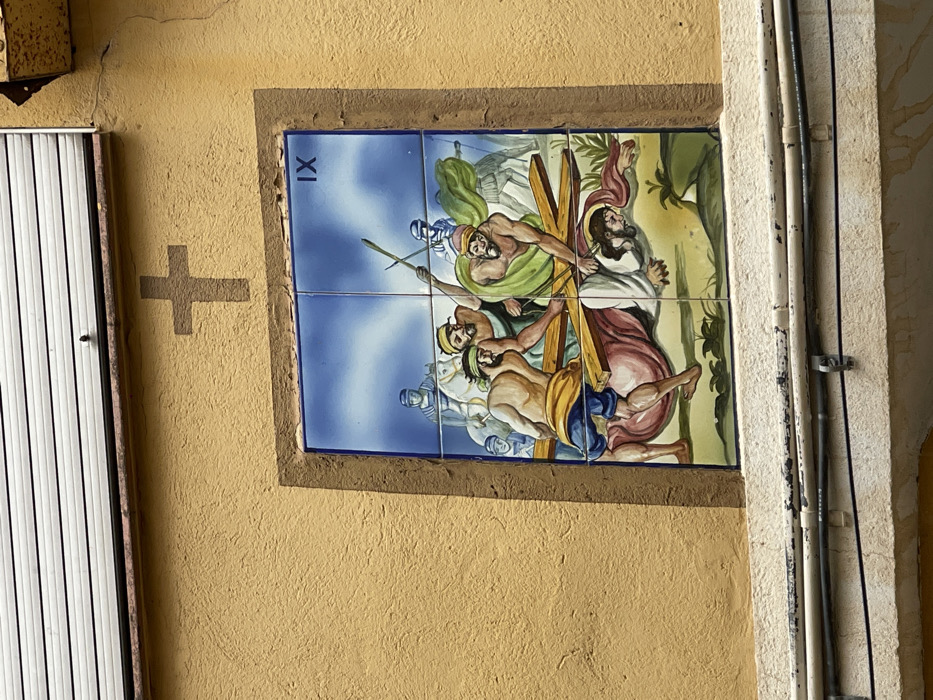
An outdoor image taken in Buñol, Spain, depicts a religious ceramic tile mosaic embedded within a textured, yellow-ochre stucco wall. The mosaic, composed of six rectangular tiles arranged in a 2x3 grid, illustrates the Ninth Station of the Cross, indicated by the Roman numeral "IX" in the top right tile.

The central scene portrays a figure resembling Jesus, clad in a reddish-pink robe, fallen on his hands and knees under the weight of a large wooden cross. Two bearded, muscular men assist him; one on the left, bare-chested with a yellow waist wrap and blue pants, lifts the horizontal beam of the cross from the left side. Another man on the right, wearing a green robe, also supports the cross, appearing to use a stick for leverage. In the background, under a blue sky, several figures are visible, including at least two men on horseback wearing blue helmets and white garments, possibly Roman soldiers. The ground below the figures is green and brown with some foliage.

Above the mosaic, a simple, dark brown cross symbol is painted directly onto the stucco wall. Directly above this, a white horizontal roller shutter with multiple slats spans the upper portion of the wall. Below the mosaic, a chipped white painted concrete or stone ledge supports two black electrical cables secured by white clips, with a thinner white conduit running parallel above them.

An outdoor image taken in Buñol, Spain, depicts a religious ceramic tile mosaic embedded within a textured, yellow-ochre stucco wall. The mosaic, composed of six rectangular tiles arranged in a 2x3 grid, illustrates the Ninth Station of the Cross, indicated by the Roman numeral "IX" in the top right tile. The central scene portrays a figure resembling Jesus, clad in a reddish-pink robe, fallen on his hands and knees under the weight of a large wooden cross. Two bearded, muscular men assist him; one on the left, bare-chested with a yellow waist wrap and blue pants, lifts the horizontal beam of the cross from the left side. Another man on the right, wearing a green robe, also supports the cross, appearing to use a stick for leverage. In the background, under a blue sky, several figures are visible, including at least two men on horseback wearing blue helmets and white garments, possibly Roman soldiers. The ground below the figures is green and brown with some foliage. Above the mosaic, a simple, dark brown cross symbol is painted directly onto the stucco wall. Directly above this, a white horizontal roller shutter with multiple slats spans the upper portion of the wall. Below the mosaic, a chipped white painted concrete or stone ledge supports two black electrical cables secured by white clips, with a thinner white conduit running parallel above them.

Buñol
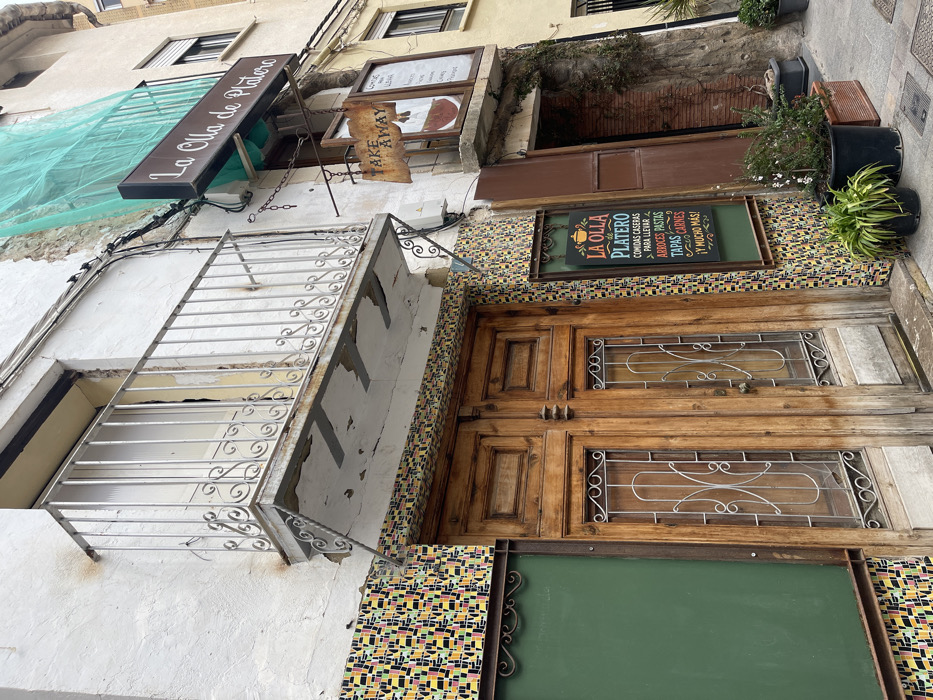
The image displays a street scene in Buñol, Spain, focused on the exterior of a building identified as "La Olla de Platero" restaurant. The ground floor entrance features a double-leaf, dark brown wooden door with glass panels and decorative metal grilles. The facade immediately surrounding the entrance is clad in a mosaic of small, multi-colored rectangular tiles in hues of yellow, red, black, and green. To the right of the door, a vertically oriented black chalkboard sign with a green background displays "LA OLLA de PLATERO" and lists menu items such as "ARROCES, PASTAS, TAPAS, CARNES" in colorful text. A large, blank green board is mounted to the left of the door.

Above the entrance, a white metal balcony with an ornate scrollwork railing is affixed to the building; its underside shows visible wear, including peeling paint and exposed concrete, with rust stains evident on the white stucco wall below. Higher on the facade, a rectangular dark sign with "La Olla de Platero" in white text is positioned above a green awning. Below this, a rustic, irregular-shaped wooden sign proclaiming "TAKE AWAY" hangs by chains. Exposed electrical conduits run along the white stucco wall. To the right, a section of the building's upper wall is partially covered by a light green construction net, and an adjacent cream-colored building with dark-framed windows is visible. Several potted plants are arranged on the light-colored paving stone sidewalk in front of a dark, recessed doorway on the far right. No individuals are present in the depicted scene.

The image displays a street scene in Buñol, Spain, focused on the exterior of a building identified as "La Olla de Platero" restaurant. The ground floor entrance features a double-leaf, dark brown wooden door with glass panels and decorative metal grilles. The facade immediately surrounding the entrance is clad in a mosaic of small, multi-colored rectangular tiles in hues of yellow, red, black, and green. To the right of the door, a vertically oriented black chalkboard sign with a green background displays "LA OLLA de PLATERO" and lists menu items such as "ARROCES, PASTAS, TAPAS, CARNES" in colorful text. A large, blank green board is mounted to the left of the door. Above the entrance, a white metal balcony with an ornate scrollwork railing is affixed to the building; its underside shows visible wear, including peeling paint and exposed concrete, with rust stains evident on the white stucco wall below. Higher on the facade, a rectangular dark sign with "La Olla de Platero" in white text is positioned above a green awning. Below this, a rustic, irregular-shaped wooden sign proclaiming "TAKE AWAY" hangs by chains. Exposed electrical conduits run along the white stucco wall. To the right, a section of the building's upper wall is partially covered by a light green construction net, and an adjacent cream-colored building with dark-framed windows is visible. Several potted plants are arranged on the light-colored paving stone sidewalk in front of a dark, recessed doorway on the far right. No individuals are present in the depicted scene.

Buñol
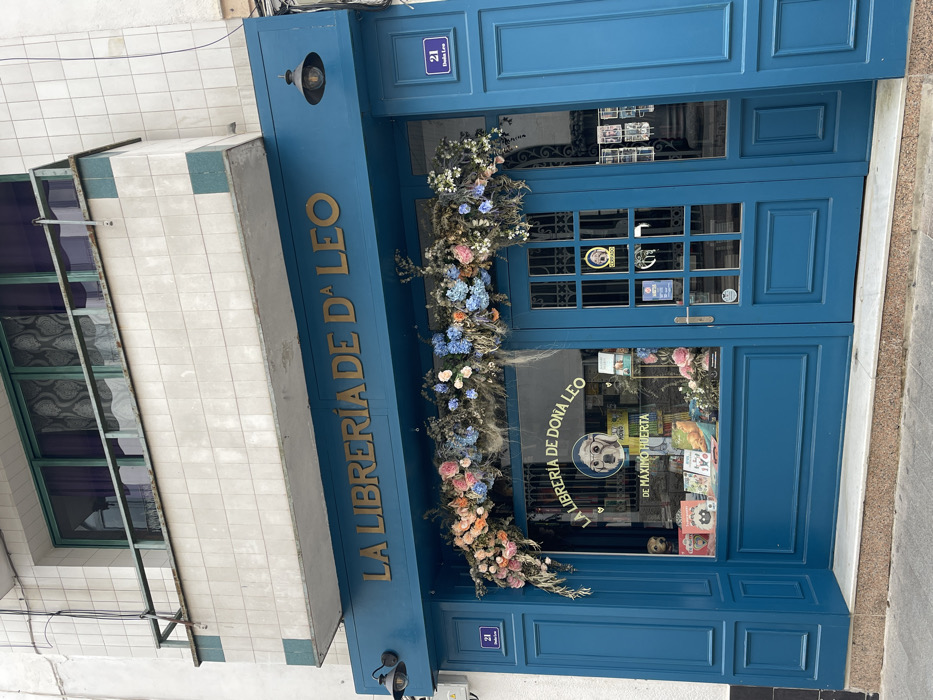
The image displays the teal-blue storefront of "LA LIBRERÍA DE Dª LEO," a bookstore located at number 21 in Buñol, Spain. The name of the shop is rendered in raised gold letters above the main facade. Two black, industrial-style lamps are mounted symmetrically on the blue facade. A vibrant, ornate floral arrangement of pink, blue, and white flowers, interspersed with dried foliage, drapes across the top of the large display window and the double entrance door.

The left side of the storefront features a display window showcasing various books, including one by Máximo Huerta. A prominent circular logo depicting a white dog wearing glasses, with "LA LIBRERÍA DE DOÑA LEO" inscribed around it, is visible on the window glass. A small, light-colored dog figure is positioned in the lower-left corner of this window. The entrance, a double door with glass panes on the left leaf, displays a "CERRADO" sign and other informational stickers.

Above the storefront, a balcony with a rusty metal railing extends from the building. The wall directly above the bookstore's sign and below the balcony is faced with light-colored square tiles, accented by intermittent teal tiles. On the floor above the balcony, three green-framed sliding windows are visible, behind which purple sheer curtains are drawn. White conduits or pipes run vertically on the left side of the building. The storefront opens directly onto a light-colored paved area, under an overcast sky. No individuals are present in the scene.

The image displays the teal-blue storefront of "LA LIBRERÍA DE Dª LEO," a bookstore located at number 21 in Buñol, Spain. The name of the shop is rendered in raised gold letters above the main facade. Two black, industrial-style lamps are mounted symmetrically on the blue facade. A vibrant, ornate floral arrangement of pink, blue, and white flowers, interspersed with dried foliage, drapes across the top of the large display window and the double entrance door. The left side of the storefront features a display window showcasing various books, including one by Máximo Huerta. A prominent circular logo depicting a white dog wearing glasses, with "LA LIBRERÍA DE DOÑA LEO" inscribed around it, is visible on the window glass. A small, light-colored dog figure is positioned in the lower-left corner of this window. The entrance, a double door with glass panes on the left leaf, displays a "CERRADO" sign and other informational stickers. Above the storefront, a balcony with a rusty metal railing extends from the building. The wall directly above the bookstore's sign and below the balcony is faced with light-colored square tiles, accented by intermittent teal tiles. On the floor above the balcony, three green-framed sliding windows are visible, behind which purple sheer curtains are drawn. White conduits or pipes run vertically on the left side of the building. The storefront opens directly onto a light-colored paved area, under an overcast sky. No individuals are present in the scene.

Buñol

The image displays a close-up, high-angle view of a textured grey concrete ground in Buñol, Spain. Scattered across the surface are approximately 15-20 small, vibrantly red objects. Most of these objects are irregular in shape, consistent with crumpled or folded artificial petals, possibly made of fabric or paper. One distinct object in the lower right quadrant is a flat, perfectly heart-shaped red cutout. The concrete shows visible cracks and seams, with small clusters of green grass growing out from these fissures, notably near the center of the frame. The scene is static, devoid of human presence or active interactions.

The image displays a close-up, high-angle view of a textured grey concrete ground in Buñol, Spain. Scattered across the surface are approximately 15-20 small, vibrantly red objects. Most of these objects are irregular in shape, consistent with crumpled or folded artificial petals, possibly made of fabric or paper. One distinct object in the lower right quadrant is a flat, perfectly heart-shaped red cutout. The concrete shows visible cracks and seams, with small clusters of green grass growing out from these fissures, notably near the center of the frame. The scene is static, devoid of human presence or active interactions.

Buñol
The scene depicts a section of a concrete paved sidewalk in Buñol, Spain. The ground is composed of grey, rectangular concrete paving stones laid in a grid pattern, exhibiting minor stains and wear. Scattered across the entire visible paved area are numerous small, bright red, synthetic or fabric petals, consistent in size and shape, resembling either heart or teardrop forms.

To the left, a low, curved retaining wall or planter box, approximately waist-height, is visible. This wall is adorned with a mosaic composed of irregularly shaped black, various shades of grey, and white tiles. Green foliage is partially visible above the top edge of this mosaic wall.

To the right, a plain, vertical wall, finished in white plaster, occupies the remainder of the background. This white wall shows signs of wear, including dark streaks of dirt or moisture near the base, minor peeling paint, and scuff marks. A dark brown, vertical rectangular object, possibly part of a door frame or a fixture, is partially visible along the extreme right edge of the frame, adjacent to the white wall. No individuals, animals, or direct actions are present within the captured scene. The lighting suggests an outdoor daytime setting.

The scene depicts a section of a concrete paved sidewalk in Buñol, Spain. The ground is composed of grey, rectangular concrete paving stones laid in a grid pattern, exhibiting minor stains and wear. Scattered across the entire visible paved area are numerous small, bright red, synthetic or fabric petals, consistent in size and shape, resembling either heart or teardrop forms. To the left, a low, curved retaining wall or planter box, approximately waist-height, is visible. This wall is adorned with a mosaic composed of irregularly shaped black, various shades of grey, and white tiles. Green foliage is partially visible above the top edge of this mosaic wall. To the right, a plain, vertical wall, finished in white plaster, occupies the remainder of the background. This white wall shows signs of wear, including dark streaks of dirt or moisture near the base, minor peeling paint, and scuff marks. A dark brown, vertical rectangular object, possibly part of a door frame or a fixture, is partially visible along the extreme right edge of the frame, adjacent to the white wall. No individuals, animals, or direct actions are present within the captured scene. The lighting suggests an outdoor daytime setting.

Buñol
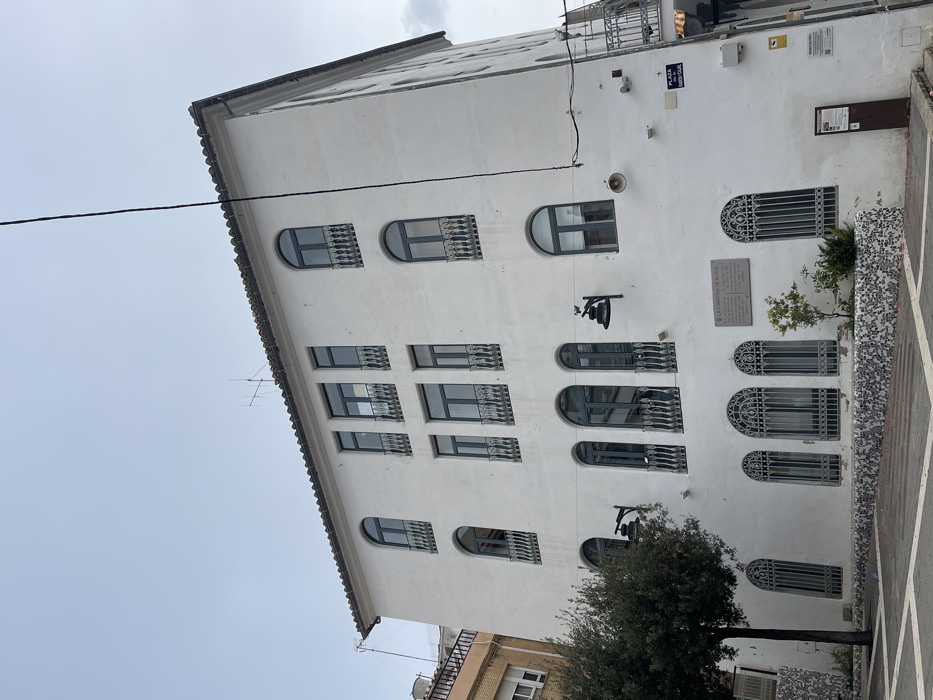
The image depicts a multi-story white building situated in a public square in Buñol, Spain. The building features a tiled roof and three visible upper floors above a ground floor. The facade is predominantly white with several windows.

On the ground floor, four arched windows are secured with ornate vertical wrought-iron grilles. Above these, on the first floor, are four similarly arched windows, each with dark frames and individual wrought-iron balconies. Two black, wall-mounted lantern-style light fixtures are positioned between these first-floor windows.

The second floor presents a central section with three rectangular windows, each equipped with a dark frame and a wrought-iron balcony, flanked by two arched windows with dark frames and balconies. The third floor mirrors this pattern with a central group of rectangular windows and outer arched windows, all featuring dark frames and wrought-iron balconies.

A large rectangular commemorative plaque, bearing text including "LA TOMATINA DE BUÑOL," is affixed to the white wall between the first and second floors, above small green bushes planted at the base. To the right of the building, a street sign reads "PLAZA DEL P... GUSI-OVAL," indicating a public square. A white loudspeaker and two small security cameras are mounted on the right side of the facade. A dark electrical cable runs vertically down the right wall. An antenna is visible on the rooftop. A partial view of a metal balcony with vertical bars is seen on the far right.

The immediate foreground consists of a paved pedestrian area with white and dark geometric patterns. A medium-sized tree with dark green foliage stands on the left side of the frame. An information stand with printed materials is located on the far right of the scene. An adjacent beige building is partially visible on the left. The sky is overcast and light grey. No individuals are present in the scene.

The image depicts a multi-story white building situated in a public square in Buñol, Spain. The building features a tiled roof and three visible upper floors above a ground floor. The facade is predominantly white with several windows. On the ground floor, four arched windows are secured with ornate vertical wrought-iron grilles. Above these, on the first floor, are four similarly arched windows, each with dark frames and individual wrought-iron balconies. Two black, wall-mounted lantern-style light fixtures are positioned between these first-floor windows. The second floor presents a central section with three rectangular windows, each equipped with a dark frame and a wrought-iron balcony, flanked by two arched windows with dark frames and balconies. The third floor mirrors this pattern with a central group of rectangular windows and outer arched windows, all featuring dark frames and wrought-iron balconies. A large rectangular commemorative plaque, bearing text including "LA TOMATINA DE BUÑOL," is affixed to the white wall between the first and second floors, above small green bushes planted at the base. To the right of the building, a street sign reads "PLAZA DEL P... GUSI-OVAL," indicating a public square. A white loudspeaker and two small security cameras are mounted on the right side of the facade. A dark electrical cable runs vertically down the right wall. An antenna is visible on the rooftop. A partial view of a metal balcony with vertical bars is seen on the far right. The immediate foreground consists of a paved pedestrian area with white and dark geometric patterns. A medium-sized tree with dark green foliage stands on the left side of the frame. An information stand with printed materials is located on the far right of the scene. An adjacent beige building is partially visible on the left. The sky is overcast and light grey. No individuals are present in the scene.

Buñol
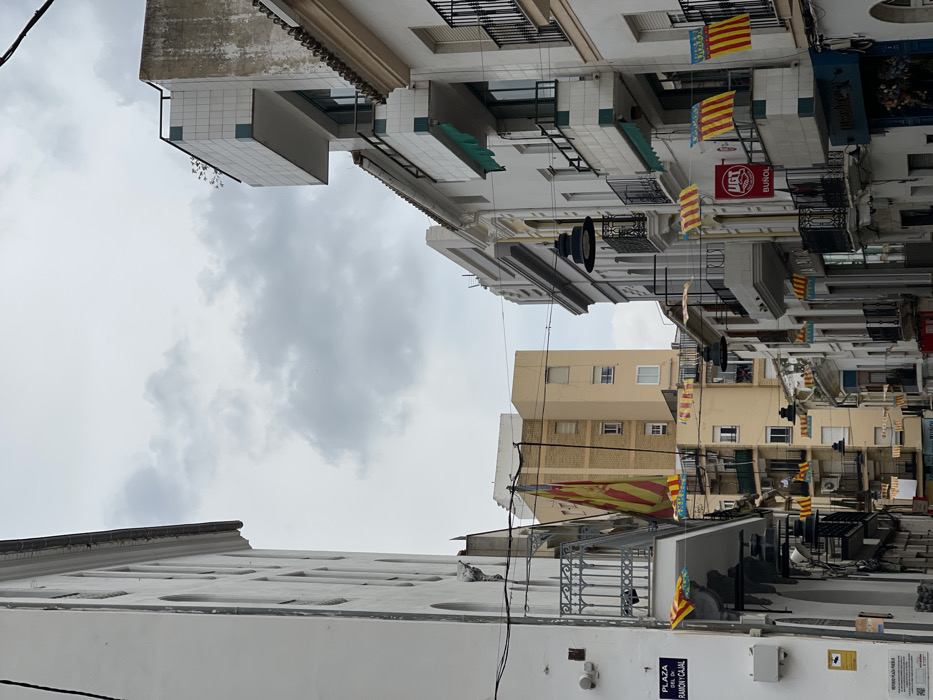
The image depicts a street scene from Plaza del Dr. Ramón y Cajal in Buñol, Spain, under an overcast sky. The view looks down a street flanked by multi-story buildings.

On the left, a tall, white building with a classical facade features several arched indentations and a prominent cornice. Below, a gray-painted metal balcony with intricate railings extends from an upper floor. A white street sign on this building reads "PLAZA DEL DR. RAMONYCAJAL". Below it, a smaller black and yellow sign with a padlock icon is visible.

On the right, a sequence of multi-story buildings features white facades, some adorned with balconies featuring black metal railings and teal-colored tiled accents. One building displays a dark green retractable awning above a balcony. Further down, a red banner with "UGT BUÑOL" in white text is affixed to a building. Overhead, ornate black street lamps are suspended, and electrical cables crisscross between structures.

Numerous Valencian flags, characterized by red and yellow stripes with a blue stripe and crown, are strung horizontally across the street at varying heights, indicating a festive or celebratory atmosphere. A taller, light-tan building with multiple windows is visible in the mid-ground, further down the street. No individuals are prominently visible. The sky is largely covered with gray clouds.

The image depicts a street scene from Plaza del Dr. Ramón y Cajal in Buñol, Spain, under an overcast sky. The view looks down a street flanked by multi-story buildings. On the left, a tall, white building with a classical facade features several arched indentations and a prominent cornice. Below, a gray-painted metal balcony with intricate railings extends from an upper floor. A white street sign on this building reads "PLAZA DEL DR. RAMONYCAJAL". Below it, a smaller black and yellow sign with a padlock icon is visible. On the right, a sequence of multi-story buildings features white facades, some adorned with balconies featuring black metal railings and teal-colored tiled accents. One building displays a dark green retractable awning above a balcony. Further down, a red banner with "UGT BUÑOL" in white text is affixed to a building. Overhead, ornate black street lamps are suspended, and electrical cables crisscross between structures. Numerous Valencian flags, characterized by red and yellow stripes with a blue stripe and crown, are strung horizontally across the street at varying heights, indicating a festive or celebratory atmosphere. A taller, light-tan building with multiple windows is visible in the mid-ground, further down the street. No individuals are prominently visible. The sky is largely covered with gray clouds.

Buñol
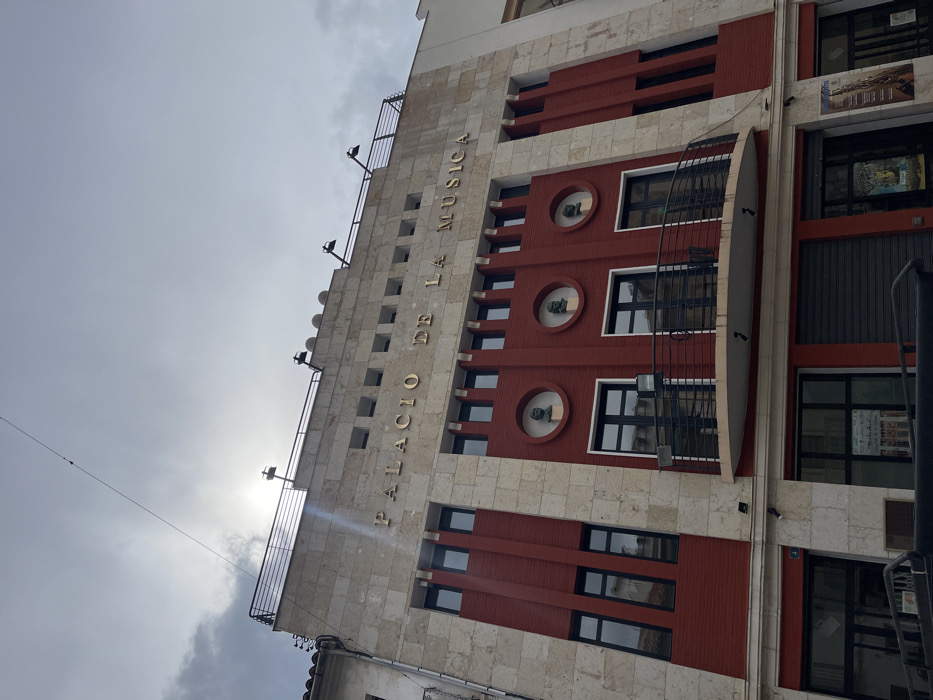
The image depicts the "Palacio de la Música" (Palace of Music) building, located in Buñol, Spain. The structure features a multi-story facade constructed with light-colored, possibly beige or off-white, stone cladding and prominent reddish-brown sections.

The upper portion of the building displays the golden lettering "PALACIO DE LA MUSICA" horizontally across the stone facade, beneath a row of small, rectangular windows. Above this, a flat roofline is visible, topped with a dark metal railing and several black outdoor light fixtures.

The middle section of the facade is primarily reddish-brown with vertical architectural elements and dark-framed windows. Three circular recesses on this level each contain a dark, weathered bust, facing forward. Below these busts, a curved balcony with a black metal railing extends outward, situated in front of a pair of dark-framed double doors. Additional dark-framed windows are present on either side of this central section.

The ground level features dark roll-down shutters covering storefronts, along with glass doors and display windows containing visible posters. A dark metallic structure, possibly a railing or part of an entrance ramp, is partially visible at the bottom left of the frame.

The sky overhead is largely overcast with significant cloud cover, but a bright sunspot is visible behind the clouds, creating a slight glare. A thin, dark wire with a small, indistinguishable object attached to it spans diagonally across the upper left portion of the sky. No individuals are present in the scene.

The image depicts the "Palacio de la Música" (Palace of Music) building, located in Buñol, Spain. The structure features a multi-story facade constructed with light-colored, possibly beige or off-white, stone cladding and prominent reddish-brown sections. The upper portion of the building displays the golden lettering "PALACIO DE LA MUSICA" horizontally across the stone facade, beneath a row of small, rectangular windows. Above this, a flat roofline is visible, topped with a dark metal railing and several black outdoor light fixtures. The middle section of the facade is primarily reddish-brown with vertical architectural elements and dark-framed windows. Three circular recesses on this level each contain a dark, weathered bust, facing forward. Below these busts, a curved balcony with a black metal railing extends outward, situated in front of a pair of dark-framed double doors. Additional dark-framed windows are present on either side of this central section. The ground level features dark roll-down shutters covering storefronts, along with glass doors and display windows containing visible posters. A dark metallic structure, possibly a railing or part of an entrance ramp, is partially visible at the bottom left of the frame. The sky overhead is largely overcast with significant cloud cover, but a bright sunspot is visible behind the clouds, creating a slight glare. A thin, dark wire with a small, indistinguishable object attached to it spans diagonally across the upper left portion of the sky. No individuals are present in the scene.

Buñol
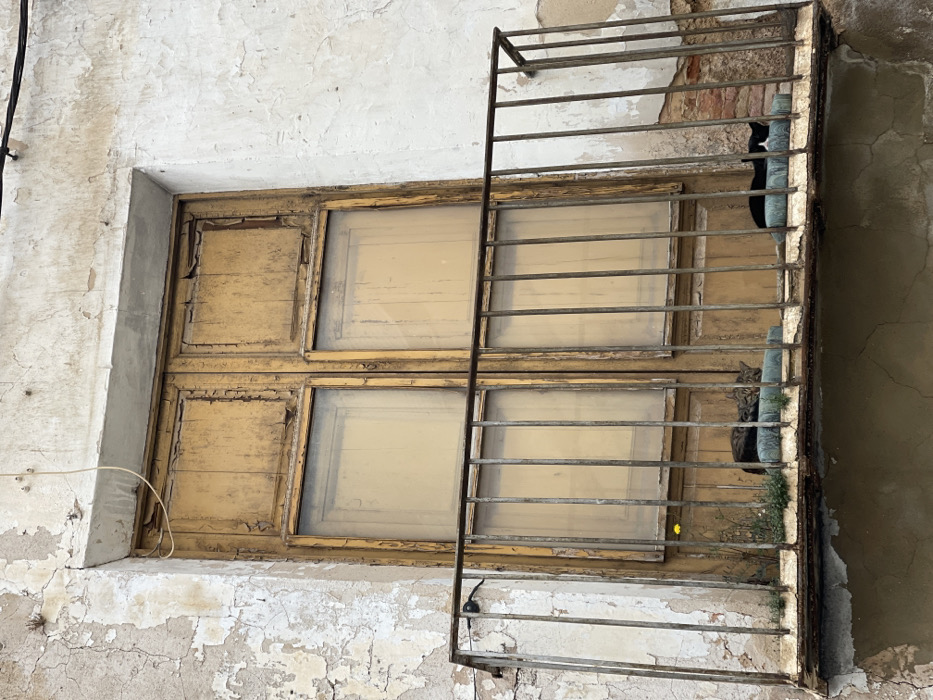
A weathered building facade in Buñol, Spain, displays a balcony on an upper floor. The off-white wall exhibits extensive peeling paint, cracks, and exposed plaster. Centered on the facade is a double-paneled wooden door, painted faded yellow-ochre with chipped paint, featuring four opaque rectangular glass inserts. Below, a rusty, dark metal railing with vertical bars defines the balcony. On the balcony floor, which shows signs of wear, two domestic cats are resting on separate, faded turquoise-blue cushions. A tabby cat lies on the left cushion, facing slightly right, while a black and white cat rests on the right cushion, facing left. Small green vegetation, including a single yellow flower, is visible growing on the balcony floor to the left of the left cat. A white electrical wire runs vertically down the upper left section of the wall.

A weathered building facade in Buñol, Spain, displays a balcony on an upper floor. The off-white wall exhibits extensive peeling paint, cracks, and exposed plaster. Centered on the facade is a double-paneled wooden door, painted faded yellow-ochre with chipped paint, featuring four opaque rectangular glass inserts. Below, a rusty, dark metal railing with vertical bars defines the balcony. On the balcony floor, which shows signs of wear, two domestic cats are resting on separate, faded turquoise-blue cushions. A tabby cat lies on the left cushion, facing slightly right, while a black and white cat rests on the right cushion, facing left. Small green vegetation, including a single yellow flower, is visible growing on the balcony floor to the left of the left cat. A white electrical wire runs vertically down the upper left section of the wall.

Buñol
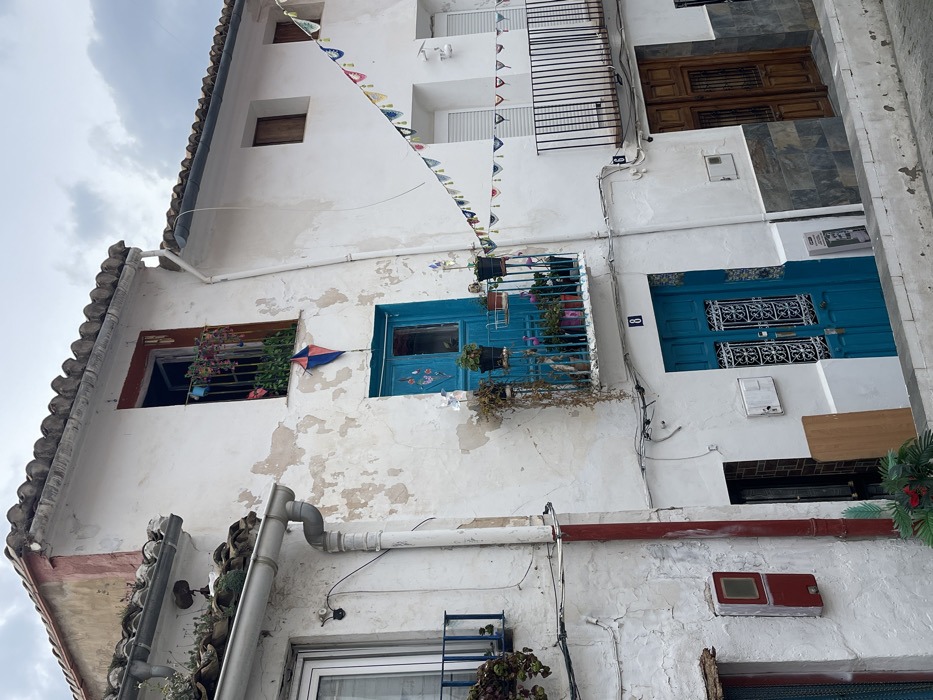
The image depicts a narrow street scene in Buñol, Spain, featuring three multi-story buildings under an overcast sky.

The central building, bearing the number '8' below its middle-floor balcony, has a weathered white facade with peeling paint and a terracotta tiled roof. The top floor features an open window with a red frame and a window box containing green foliage and several colorful pinwheel decorations. Directly below this window, a small red and blue diamond-shaped kite is affixed to the wall. The middle floor has a teal-blue double door with decorative grille work, opening onto a small balcony with a black metal railing. This balcony holds numerous potted plants, some with pink blooms, and two white pinwheel decorations. A white vertical drainpipe runs down the left side of this building, turning red at its lower section. The ground floor presents another teal-blue double door with similar decorative grille work. To the left of this door, a light-colored wooden board leans against the wall, and a red electrical box is mounted further left.

To the right, a multi-story building marked with the number '6' on its ground floor. Its upper section has a white facade, transitioning to dark grey, slate-like tiles on the lower half. The top floor features two small, dark-framed windows. The middle floor has two windows with closed white shutters and a balcony with a black metal railing, devoid of plants. The ground floor has a brown wooden double door with a small grille. A string of colorful, crescent-shaped fabric bunting hangs diagonally across the street, connecting the central building to this building on the right.

To the far left, a partially visible white building features a window with a blue metal balcony containing potted plants. No people are visible in the scene. The street surface is partially visible at the bottom, suggesting a curb or low wall in the foreground.

The image depicts a narrow street scene in Buñol, Spain, featuring three multi-story buildings under an overcast sky. The central building, bearing the number '8' below its middle-floor balcony, has a weathered white facade with peeling paint and a terracotta tiled roof. The top floor features an open window with a red frame and a window box containing green foliage and several colorful pinwheel decorations. Directly below this window, a small red and blue diamond-shaped kite is affixed to the wall. The middle floor has a teal-blue double door with decorative grille work, opening onto a small balcony with a black metal railing. This balcony holds numerous potted plants, some with pink blooms, and two white pinwheel decorations. A white vertical drainpipe runs down the left side of this building, turning red at its lower section. The ground floor presents another teal-blue double door with similar decorative grille work. To the left of this door, a light-colored wooden board leans against the wall, and a red electrical box is mounted further left. To the right, a multi-story building marked with the number '6' on its ground floor. Its upper section has a white facade, transitioning to dark grey, slate-like tiles on the lower half. The top floor features two small, dark-framed windows. The middle floor has two windows with closed white shutters and a balcony with a black metal railing, devoid of plants. The ground floor has a brown wooden double door with a small grille. A string of colorful, crescent-shaped fabric bunting hangs diagonally across the street, connecting the central building to this building on the right. To the far left, a partially visible white building features a window with a blue metal balcony containing potted plants. No people are visible in the scene. The street surface is partially visible at the bottom, suggesting a curb or low wall in the foreground.

Buñol
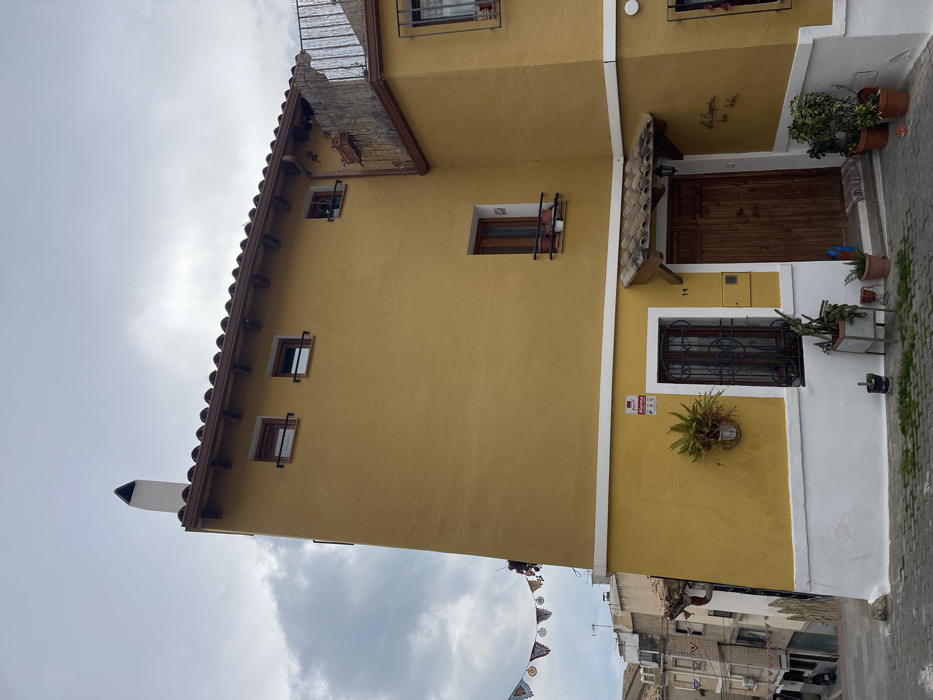
The image depicts the exterior of a three-story building in Buñol, Spain, under an overcast sky. The building features a prominent mustard-yellow facade with a white painted base. Its roof is tiled with reddish-brown semicircular barrel tiles, from which a white, rectangular chimney with a pointed top ascends on the left side. Dark brown wooden beams support the roof overhang.

The building's left section presents a series of vertically aligned windows: two small, rectangular windows on the top floor, a taller rectangular window on the middle floor, and a large rectangular window on the ground floor. All visible windows feature dark brown frames and external dark brown metal railings; the middle-floor window holds two small potted plants, and the ground-floor window is covered by vertical metal grilles and has a decorative wrought iron cage containing a green fern attached below.

The main entrance, located towards the center, consists of a double-leaf, dark brown wooden door with a small, gabled canopy of terracotta tiles overhead. A small, patterned mat lies at the doorstep. The house number "14" is affixed to the wall to the right of the ground-floor window, beneath a yellow utility box. A red and white "Alarma PTS" sign is mounted on the wall to the left of the ground-floor window. Numerous potted plants, including terra cotta and grey planters, are arranged around the main door and ground-floor window.

To the right of the main facade, a recessed section of the building includes a balcony with a metal railing and a bamboo screen, and a window below it. The ground in front of the building is paved with light grey, irregular flagstones. To the left, a narrow, uphill street is visible, flanked by other residential buildings of various heights. A string of colorful, patterned banners hangs across the street in the upper left background. No people are visible, and no actions or interactions are depicted.

The image depicts the exterior of a three-story building in Buñol, Spain, under an overcast sky. The building features a prominent mustard-yellow facade with a white painted base. Its roof is tiled with reddish-brown semicircular barrel tiles, from which a white, rectangular chimney with a pointed top ascends on the left side. Dark brown wooden beams support the roof overhang. The building's left section presents a series of vertically aligned windows: two small, rectangular windows on the top floor, a taller rectangular window on the middle floor, and a large rectangular window on the ground floor. All visible windows feature dark brown frames and external dark brown metal railings; the middle-floor window holds two small potted plants, and the ground-floor window is covered by vertical metal grilles and has a decorative wrought iron cage containing a green fern attached below. The main entrance, located towards the center, consists of a double-leaf, dark brown wooden door with a small, gabled canopy of terracotta tiles overhead. A small, patterned mat lies at the doorstep. The house number "14" is affixed to the wall to the right of the ground-floor window, beneath a yellow utility box. A red and white "Alarma PTS" sign is mounted on the wall to the left of the ground-floor window. Numerous potted plants, including terra cotta and grey planters, are arranged around the main door and ground-floor window. To the right of the main facade, a recessed section of the building includes a balcony with a metal railing and a bamboo screen, and a window below it. The ground in front of the building is paved with light grey, irregular flagstones. To the left, a narrow, uphill street is visible, flanked by other residential buildings of various heights. A string of colorful, patterned banners hangs across the street in the upper left background. No people are visible, and no actions or interactions are depicted.

Buñol
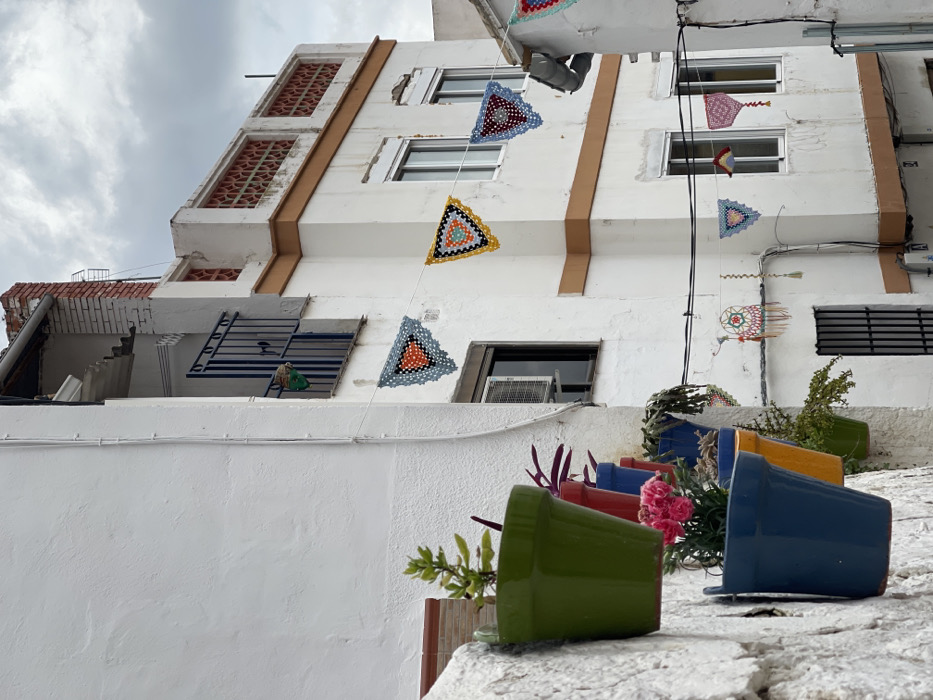
The image depicts a narrow urban street in Buñol, Spain, viewed from a slightly upward angle under an overcast sky. Two multi-story buildings, predominantly white with textured plaster facades, flank the scene.

On the left, a section of a white building features a vertical arrangement of five wall-mounted flower pots. From top to bottom, these are a green pot with a small green plant, a red pot with a purple-leafed plant, a blue pot containing a pink flowering plant, an orange pot with a succulent, and a partially visible green pot with a trailing plant. A white conduit runs vertically along this wall.

The larger building on the right is also white, distinguished by horizontal orange-brown bands at the first and second-story levels. The first story displays two windows with white frames; an external air conditioning unit is mounted beneath the left window. A small balcony with a dark metal railing is visible, with a green fabric item draped over it. The second story features a decorative parapet with a series of rectangular openings containing reddish-brown lattice work. Towards the top-left, a brick chimney with a television antenna is present against the sky. A dark, possibly grated, window or door is visible at the lower right.

Two lines of decorative, triangular crocheted banners are strung horizontally across the street between the buildings. The upper line includes triangles in light blue/orange/gray, yellow/black/light blue/gray, and maroon/blue/gray patterns. A lower line displays smaller, diverse yarn decorations, including a circular, multicolored piece with tassels. Black electrical wires are also strung across the street, some attached to the buildings. A gray downspout is visible on the far right building. No people are present in the scene.

The image depicts a narrow urban street in Buñol, Spain, viewed from a slightly upward angle under an overcast sky. Two multi-story buildings, predominantly white with textured plaster facades, flank the scene. On the left, a section of a white building features a vertical arrangement of five wall-mounted flower pots. From top to bottom, these are a green pot with a small green plant, a red pot with a purple-leafed plant, a blue pot containing a pink flowering plant, an orange pot with a succulent, and a partially visible green pot with a trailing plant. A white conduit runs vertically along this wall. The larger building on the right is also white, distinguished by horizontal orange-brown bands at the first and second-story levels. The first story displays two windows with white frames; an external air conditioning unit is mounted beneath the left window. A small balcony with a dark metal railing is visible, with a green fabric item draped over it. The second story features a decorative parapet with a series of rectangular openings containing reddish-brown lattice work. Towards the top-left, a brick chimney with a television antenna is present against the sky. A dark, possibly grated, window or door is visible at the lower right. Two lines of decorative, triangular crocheted banners are strung horizontally across the street between the buildings. The upper line includes triangles in light blue/orange/gray, yellow/black/light blue/gray, and maroon/blue/gray patterns. A lower line displays smaller, diverse yarn decorations, including a circular, multicolored piece with tassels. Black electrical wires are also strung across the street, some attached to the buildings. A gray downspout is visible on the far right building. No people are present in the scene.

Buñol
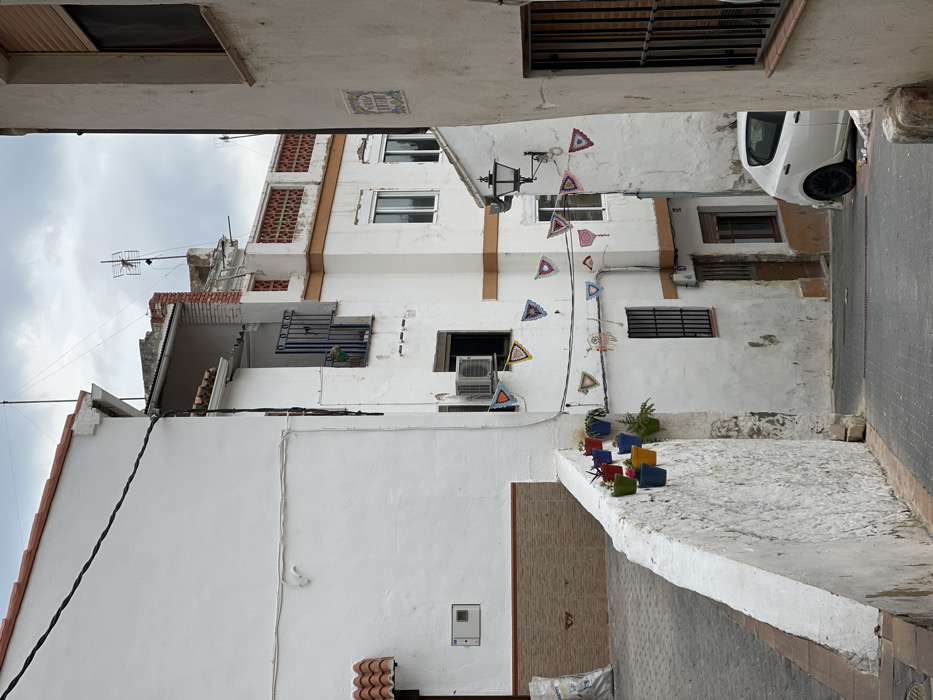
This image depicts a narrow, sloping street in Buñol, Spain, characterized by closely packed, predominantly white stucco buildings under an overcast sky.

In the foreground on the left, a whitewashed, sloped stone or concrete retaining wall runs parallel to the viewer, adorned along its top edge with a series of approximately nine brightly colored plastic flower pots (red, green, blue, yellow, purple, black, teal) containing small green plants. Behind this wall, an upward-sloping paved area is visible, leading to the base of a building where a large white sack (possibly containing construction material) rests. The leftmost building features a clean white facade with a red-tiled roofline and a lower section clad with light brown tiles. A dark electrical cable stretches across its upper wall horizontally, then vertically downwards, and a white utility box is mounted on its lower section.

The street itself is paved with dark grey asphalt. Towards the center, multiple white buildings line the descending street. One prominent building on the left features a second-story balcony with blue vertical bars and a potted plant. Below this, an open window has an external air conditioning unit mounted above it. A string of colorful, triangular, crochet-style pennants or bunting, some with circular, dreamcatcher-like patterns, is strung across the street, attaching to this building and extending to the right. Further down the street, another window with dark vertical bars is visible on the same building, alongside a dark brown wooden door.

On the right side of the street, a light-colored building with a textured facade features a window with dark vertical bars. A ceramic tiled street sign or plaque with blue lettering is affixed to its wall. An ornate, dark-colored street lamp with a frosted glass globe is mounted on a building wall further back on the right. Above this, a building exhibits a decorative terracotta-colored lattice pattern along its rooftop, and various rooftop antennae are visible against the grey sky.

A white compact car, possibly a SEAT Ibiza, with black wheels is parked on the right side of the descending street, facing away from the viewer, partially obscured by the foreground building on the right. No people are visible within the scene. The overall impression is a quiet, residential urban environment.

This image depicts a narrow, sloping street in Buñol, Spain, characterized by closely packed, predominantly white stucco buildings under an overcast sky. In the foreground on the left, a whitewashed, sloped stone or concrete retaining wall runs parallel to the viewer, adorned along its top edge with a series of approximately nine brightly colored plastic flower pots (red, green, blue, yellow, purple, black, teal) containing small green plants. Behind this wall, an upward-sloping paved area is visible, leading to the base of a building where a large white sack (possibly containing construction material) rests. The leftmost building features a clean white facade with a red-tiled roofline and a lower section clad with light brown tiles. A dark electrical cable stretches across its upper wall horizontally, then vertically downwards, and a white utility box is mounted on its lower section. The street itself is paved with dark grey asphalt. Towards the center, multiple white buildings line the descending street. One prominent building on the left features a second-story balcony with blue vertical bars and a potted plant. Below this, an open window has an external air conditioning unit mounted above it. A string of colorful, triangular, crochet-style pennants or bunting, some with circular, dreamcatcher-like patterns, is strung across the street, attaching to this building and extending to the right. Further down the street, another window with dark vertical bars is visible on the same building, alongside a dark brown wooden door. On the right side of the street, a light-colored building with a textured facade features a window with dark vertical bars. A ceramic tiled street sign or plaque with blue lettering is affixed to its wall. An ornate, dark-colored street lamp with a frosted glass globe is mounted on a building wall further back on the right. Above this, a building exhibits a decorative terracotta-colored lattice pattern along its rooftop, and various rooftop antennae are visible against the grey sky. A white compact car, possibly a SEAT Ibiza, with black wheels is parked on the right side of the descending street, facing away from the viewer, partially obscured by the foreground building on the right. No people are visible within the scene. The overall impression is a quiet, residential urban environment.

Buñol
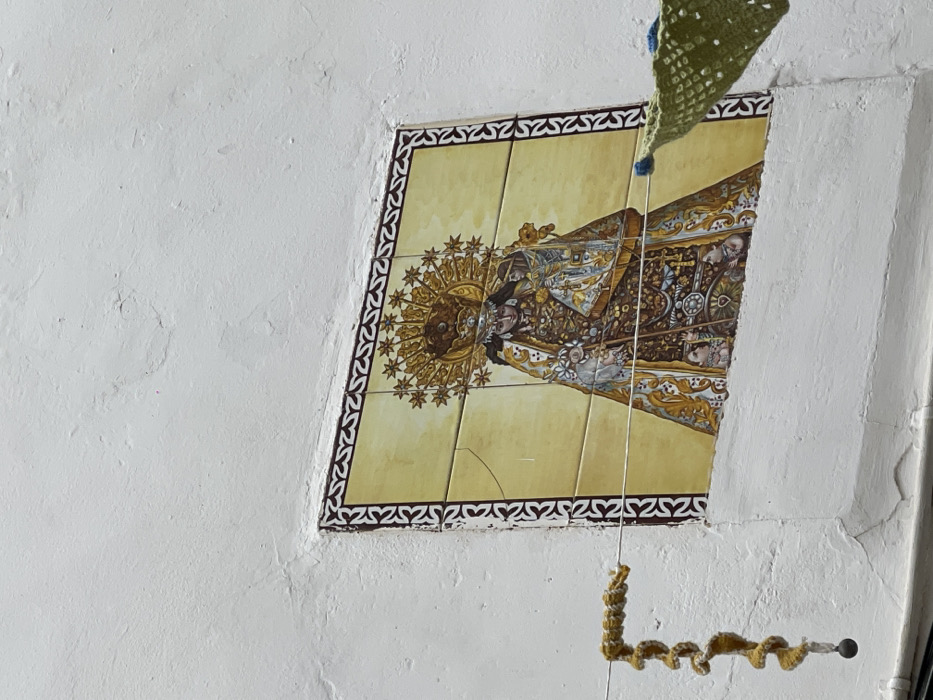
The image captures a weathered white stucco building wall in Buñol, Spain, featuring a rectangular ceramic tile panel embedded in its surface. The panel depicts a crowned female figure, likely the Virgin Mary, holding a smaller crowned figure, presumably the infant Jesus. Both figures are adorned in richly detailed robes with gold, brown, white, and blue accents. A prominent golden sunburst halo with radiating points encircles the main figure's head, set against a light yellow background. The tile panel is framed by a repeating dark brown patterned border. Multiple vertical and horizontal cracks are visible across several tiles within the panel. Two thin horizontal wires, likely clotheslines, stretch across the lower portion of the scene in front of the tile panel. From the left wire hangs a coiled, yellow-beige knitted or crocheted ornament, terminating in a small dark sphere. A section of a green, loosely woven or crocheted fabric item, possibly a decorative flag or garment, hangs from the right wire, partially visible on the right edge of the frame. The white wall exhibits minor cracks and texture variations, indicating its age and exposure. No individuals are present in the scene.

The image captures a weathered white stucco building wall in Buñol, Spain, featuring a rectangular ceramic tile panel embedded in its surface. The panel depicts a crowned female figure, likely the Virgin Mary, holding a smaller crowned figure, presumably the infant Jesus. Both figures are adorned in richly detailed robes with gold, brown, white, and blue accents. A prominent golden sunburst halo with radiating points encircles the main figure's head, set against a light yellow background. The tile panel is framed by a repeating dark brown patterned border. Multiple vertical and horizontal cracks are visible across several tiles within the panel. Two thin horizontal wires, likely clotheslines, stretch across the lower portion of the scene in front of the tile panel. From the left wire hangs a coiled, yellow-beige knitted or crocheted ornament, terminating in a small dark sphere. A section of a green, loosely woven or crocheted fabric item, possibly a decorative flag or garment, hangs from the right wire, partially visible on the right edge of the frame. The white wall exhibits minor cracks and texture variations, indicating its age and exposure. No individuals are present in the scene.

Buñol
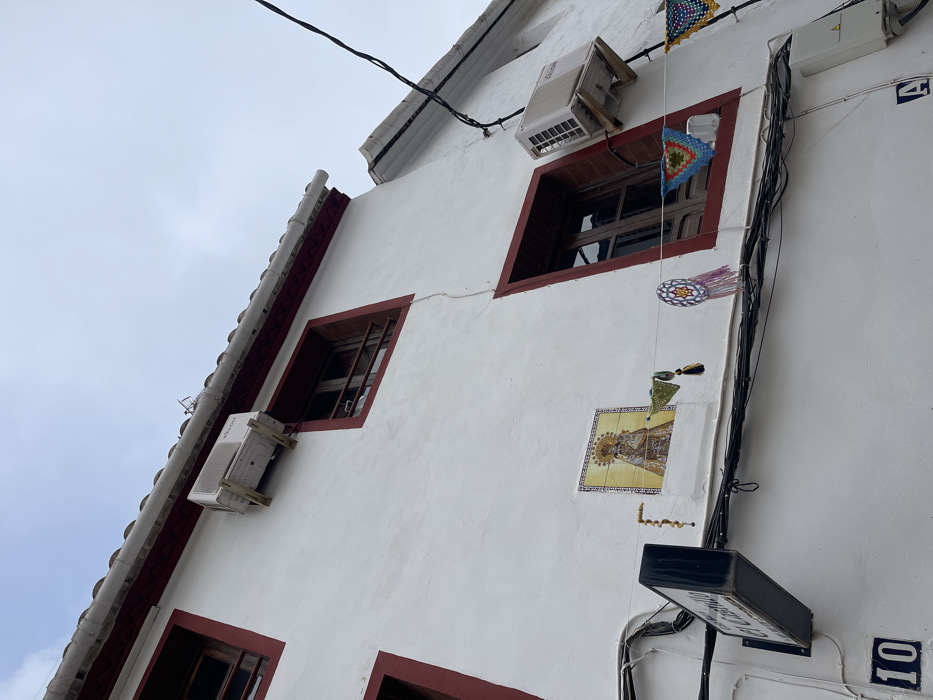
A low-angle exterior view depicts the white-stucco facade of a multi-story building in Buñol, Spain, likely near "El Castillo" as indicated by a prominent street sign. The building features dark red trim around its windows and along the roofline, which is topped with white, possibly terracotta, tiles. A light grey, overcast sky occupies the upper portion of the frame.

Three visible rectangular windows possess dark brown wooden frames; one in the upper left, one in the upper right, and a larger, open window in the mid-right. Two white Kosner brand outdoor air conditioning units are mounted on the facade with wooden brackets; one is positioned above the upper-right window, and another is to the right of the mid-right window. A vertical hairline crack extends down the white wall between the upper and lower sections.

Centered on the lower-mid facade is a rectangular ceramic tile mosaic depicting a crowned and haloed religious figure, likely the Virgin Mary, holding a child, set against a golden background with a yellow border. Below this mosaic, on the left, a dark-colored, rectangular sign bearing the white text "El Castillo" extends from the wall. The house number "10" is affixed below this sign, and the letter "A" is visible further right, below a dense bundle of black utility cables that traverse the facade horizontally. Various decorative elements hang from these cables and window frames: a string of light-colored beads to the left of the tile mosaic, a green crocheted triangular element with tassels, a circular multi-colored (purple, white, blue) crocheted ornament with tassels, and a blue, green, and red crocheted square draped across the mid-right open window. Another yellow and green crocheted item is partially visible on the far right.

A low-angle exterior view depicts the white-stucco facade of a multi-story building in Buñol, Spain, likely near "El Castillo" as indicated by a prominent street sign. The building features dark red trim around its windows and along the roofline, which is topped with white, possibly terracotta, tiles. A light grey, overcast sky occupies the upper portion of the frame. Three visible rectangular windows possess dark brown wooden frames; one in the upper left, one in the upper right, and a larger, open window in the mid-right. Two white Kosner brand outdoor air conditioning units are mounted on the facade with wooden brackets; one is positioned above the upper-right window, and another is to the right of the mid-right window. A vertical hairline crack extends down the white wall between the upper and lower sections. Centered on the lower-mid facade is a rectangular ceramic tile mosaic depicting a crowned and haloed religious figure, likely the Virgin Mary, holding a child, set against a golden background with a yellow border. Below this mosaic, on the left, a dark-colored, rectangular sign bearing the white text "El Castillo" extends from the wall. The house number "10" is affixed below this sign, and the letter "A" is visible further right, below a dense bundle of black utility cables that traverse the facade horizontally. Various decorative elements hang from these cables and window frames: a string of light-colored beads to the left of the tile mosaic, a green crocheted triangular element with tassels, a circular multi-colored (purple, white, blue) crocheted ornament with tassels, and a blue, green, and red crocheted square draped across the mid-right open window. Another yellow and green crocheted item is partially visible on the far right.

Buñol
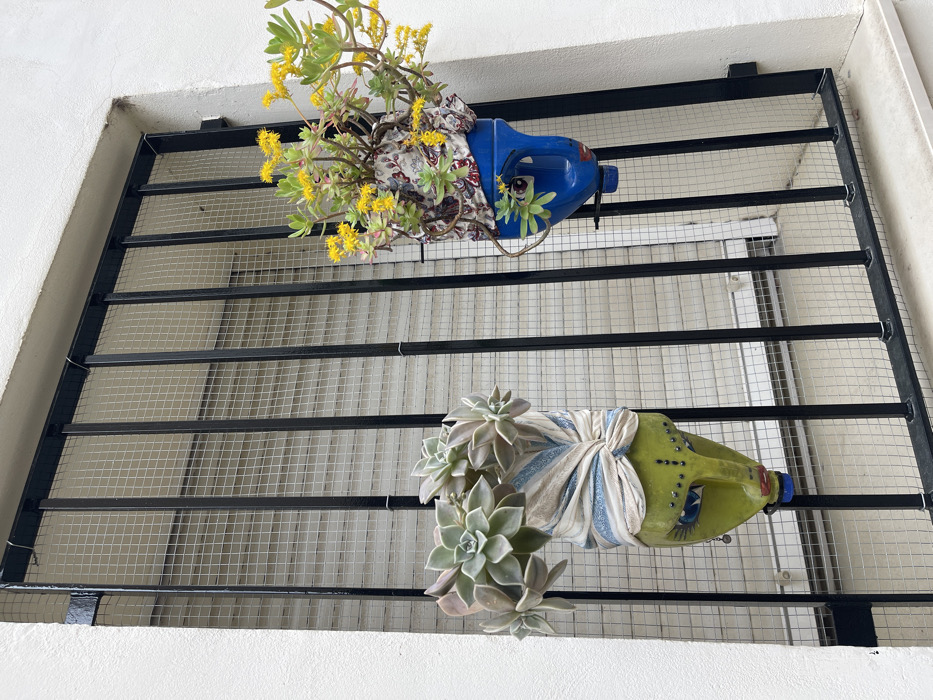
The image displays an exterior view of a building in Buñol, Spain, centered on a window recessed into a white, textured plaster wall. A black metal security grate, consisting of seven visible vertical bars and horizontal top and bottom supports, covers the window opening. A fine, light-colored square mesh screen is affixed to the interior side of the metal grate. Behind the grate, a light-toned roller shutter (persiana) with horizontal slats is visible.

Two decorative planters, fashioned from repurposed plastic containers and stylized as faces, are suspended from the black grate by wire hooks. The planter on the left is a light green container featuring blue painted eyes, black eyeliner, red lips, and multiple silver studs on its 'face.' A beige and light blue striped fabric is tied around the top, resembling a turban. This planter holds several succulent plants characterized by fleshy, greenish-grey rosettes. The planter on the right is a blue container with white painted eyes, black pupils, a small red mouth, and a small green plant emerging from its side. A colorful fabric with a dark background and red, white, and blue patterns is wrapped around its upper portion. This planter contains a plant with numerous small, bright yellow flowers and green, fleshy leaves. Natural daylight illuminates the scene.

The image displays an exterior view of a building in Buñol, Spain, centered on a window recessed into a white, textured plaster wall. A black metal security grate, consisting of seven visible vertical bars and horizontal top and bottom supports, covers the window opening. A fine, light-colored square mesh screen is affixed to the interior side of the metal grate. Behind the grate, a light-toned roller shutter (persiana) with horizontal slats is visible. Two decorative planters, fashioned from repurposed plastic containers and stylized as faces, are suspended from the black grate by wire hooks. The planter on the left is a light green container featuring blue painted eyes, black eyeliner, red lips, and multiple silver studs on its 'face.' A beige and light blue striped fabric is tied around the top, resembling a turban. This planter holds several succulent plants characterized by fleshy, greenish-grey rosettes. The planter on the right is a blue container with white painted eyes, black pupils, a small red mouth, and a small green plant emerging from its side. A colorful fabric with a dark background and red, white, and blue patterns is wrapped around its upper portion. This planter contains a plant with numerous small, bright yellow flowers and green, fleshy leaves. Natural daylight illuminates the scene.

Buñol
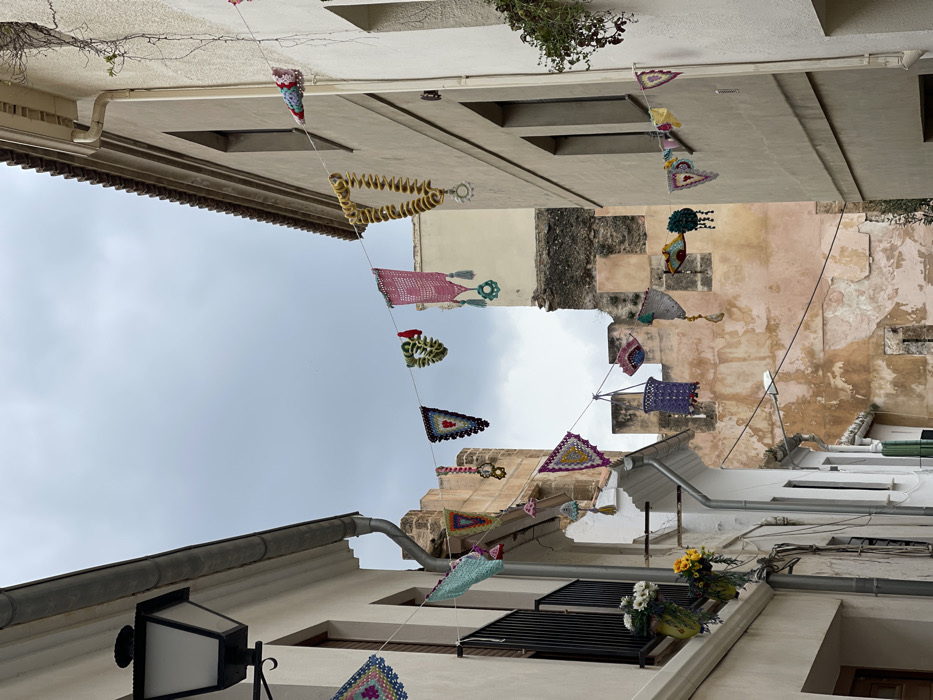
The image displays a narrow street or alleyway in Buñol, Spain, flanked by multi-story buildings under an overcast sky. The street is festively decorated with numerous multi-colored crocheted items strung between the buildings at various heights. These decorations consist of diverse shapes including triangular flags, squares, circular motifs, bell-shaped elements, and a distinctive long, coiled yellow piece, all exhibiting intricate patterns and vibrant colors such as pink, teal, purple, yellow, and green.

On the left side, a light-colored building features a black, ornate street lamp mounted high on the wall, a metallic rain gutter and downspout system, and a window with a black metal balcony railing. Two green hanging containers beneath the balcony hold artificial white and yellow flowers.

The building on the right, also light-colored with a slightly darker tiled roof edge, has a vertical downspout and a vine growing down its wall. Windows with dark frames are visible on both structures.

In the background, at the terminus of the street, a weathered, light reddish-brown stone wall, indicative of an ancient fortification or castle, rises prominently. This structure presents sections of darker stone and visible crenellations. The sky is uniformly grey and cloudy, providing diffuse light to the scene. No individuals are present in the depicted area.

The image displays a narrow street or alleyway in Buñol, Spain, flanked by multi-story buildings under an overcast sky. The street is festively decorated with numerous multi-colored crocheted items strung between the buildings at various heights. These decorations consist of diverse shapes including triangular flags, squares, circular motifs, bell-shaped elements, and a distinctive long, coiled yellow piece, all exhibiting intricate patterns and vibrant colors such as pink, teal, purple, yellow, and green. On the left side, a light-colored building features a black, ornate street lamp mounted high on the wall, a metallic rain gutter and downspout system, and a window with a black metal balcony railing. Two green hanging containers beneath the balcony hold artificial white and yellow flowers. The building on the right, also light-colored with a slightly darker tiled roof edge, has a vertical downspout and a vine growing down its wall. Windows with dark frames are visible on both structures. In the background, at the terminus of the street, a weathered, light reddish-brown stone wall, indicative of an ancient fortification or castle, rises prominently. This structure presents sections of darker stone and visible crenellations. The sky is uniformly grey and cloudy, providing diffuse light to the scene. No individuals are present in the depicted area.

Buñol
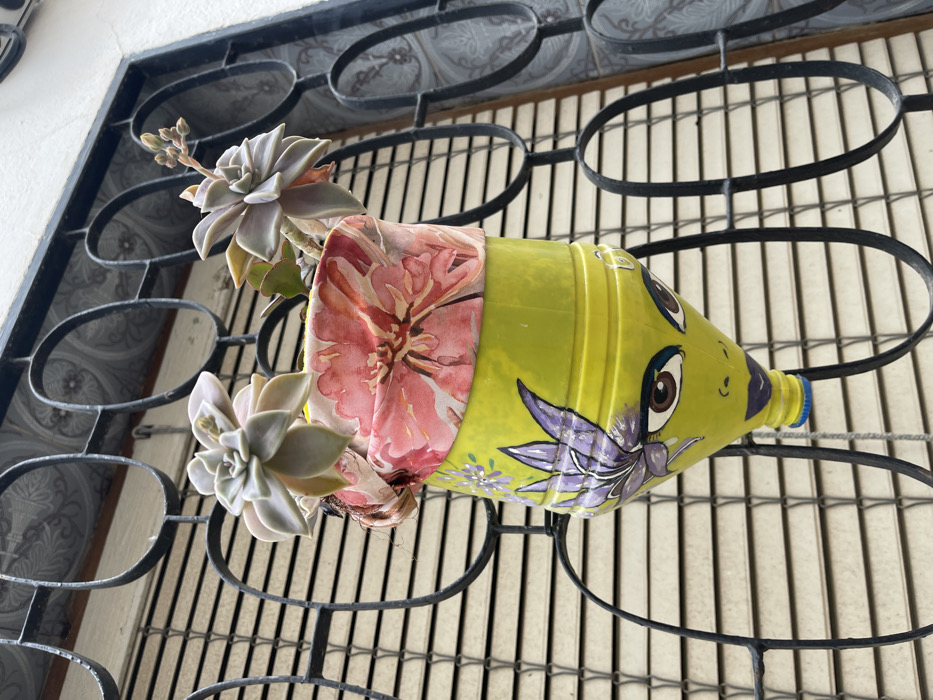
An inverted, repurposed plastic bottle, painted bright lime green, serves as a planter hanging from a black metal grate in Buñol, Spain. The bottle's conical base, pointing downwards, is painted with two wide-set brown eyes, dark pupils, white highlights, and a small purple mouth. Above the eyes, purple and green stylized floral patterns adorn the bottle's side, with small light blue flower dots towards the top left. A patterned fabric strip, featuring large pink, red, and orange floral designs on a light background, is wrapped around the bottle's cut upper rim, partially covering the green paint. Inside, several succulent plants, characterized by thick, rosette-shaped leaves in shades of pale green and grey-purple, are visible. One succulent on the right displays a developing flower stalk with multiple small buds. The black metal grate, composed of vertically aligned oval loops and connecting bars, is positioned against a light-colored window or door covered by horizontal blinds or shutters. A plain white wall is visible in the upper background, with faint patterned tiling or texture to the far right. No individuals are present, and no active interactions are depicted.

An inverted, repurposed plastic bottle, painted bright lime green, serves as a planter hanging from a black metal grate in Buñol, Spain. The bottle's conical base, pointing downwards, is painted with two wide-set brown eyes, dark pupils, white highlights, and a small purple mouth. Above the eyes, purple and green stylized floral patterns adorn the bottle's side, with small light blue flower dots towards the top left. A patterned fabric strip, featuring large pink, red, and orange floral designs on a light background, is wrapped around the bottle's cut upper rim, partially covering the green paint. Inside, several succulent plants, characterized by thick, rosette-shaped leaves in shades of pale green and grey-purple, are visible. One succulent on the right displays a developing flower stalk with multiple small buds. The black metal grate, composed of vertically aligned oval loops and connecting bars, is positioned against a light-colored window or door covered by horizontal blinds or shutters. A plain white wall is visible in the upper background, with faint patterned tiling or texture to the far right. No individuals are present, and no active interactions are depicted.

Buñol
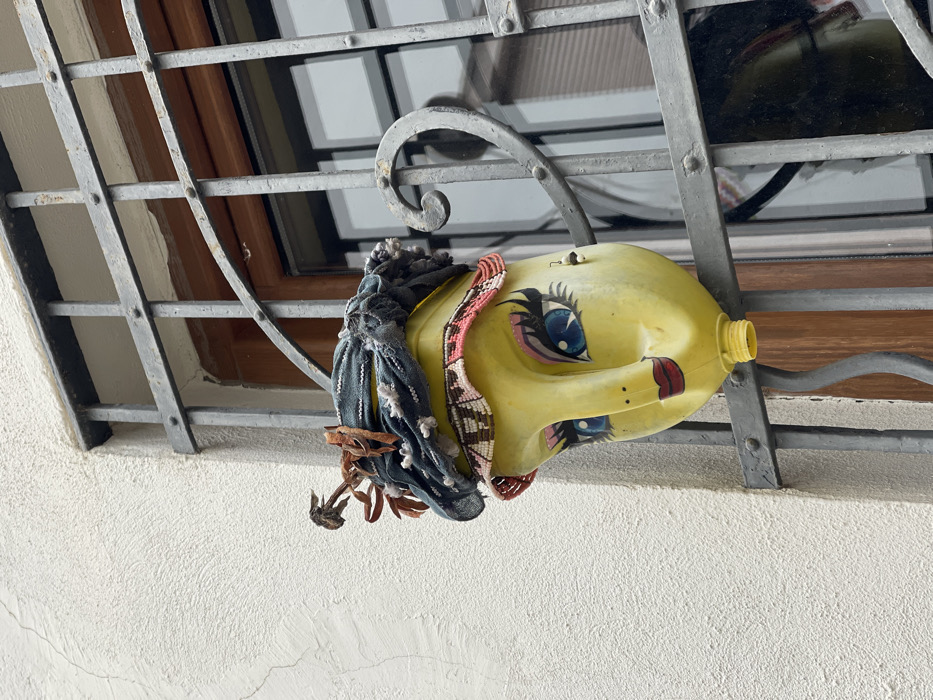
A stylized human face, crafted from an inverted yellow plastic container, is suspended from an ornate dark grey metal security grate on a building's exterior in Buñol, Spain. The face features painted blue eyes with prominent black eyelashes and pink eyeshadow, red lips, and two black dots for nostrils, with the container's spout forming the chin. The upper part of the 'head' is adorned with a dark grey fabric containing small white tufts, a band of pink and white beads across the forehead, and several dried brown plant elements protruding from the top. A single light-colored bead hangs as an earring from a small hole on the right side of the face. The metal grate, secured with rivets, covers a wooden-framed window whose glass reflects ambient light. To the left of the window, the building's facade is a textured, light-colored stucco wall with minor surface cracks.

A stylized human face, crafted from an inverted yellow plastic container, is suspended from an ornate dark grey metal security grate on a building's exterior in Buñol, Spain. The face features painted blue eyes with prominent black eyelashes and pink eyeshadow, red lips, and two black dots for nostrils, with the container's spout forming the chin. The upper part of the 'head' is adorned with a dark grey fabric containing small white tufts, a band of pink and white beads across the forehead, and several dried brown plant elements protruding from the top. A single light-colored bead hangs as an earring from a small hole on the right side of the face. The metal grate, secured with rivets, covers a wooden-framed window whose glass reflects ambient light. To the left of the window, the building's facade is a textured, light-colored stucco wall with minor surface cracks.

Buñol
The image captures a detailed view of the Castle of Buñol in Buñol, Spain, under an overcast sky. The central feature is a tall, imposing rectangular stone tower, prominently positioned on the right side. This tower exhibits a crenellated top with distinct merlons and embrasures, and its rough-hewn stone facade displays various shades of brown, beige, and dark gray, indicative of age and weathering. A small, square, dark opening is visible on the upper half of the tower's main wall.

To the left of the main tower, a robust, lower stone wall extends horizontally, featuring a series of approximately nine rectangular, vertically oriented openings, resembling arrow slits or embrasures, evenly spaced along its length. Below this wall, a more complex section of ancient stone masonry forms the foreground, characterized by irregular stone blocks and a prominent, rounded archway in the lower-center. This archway leads to a shadowed passage with a visible paved path.

Sparse green vegetation, including small plants and scattered yellowish blooms, grows organically from the crevices and ledges of the stone walls, particularly above the archway and along the base of the lower wall. In the lower-left corner, a dark, rectangular planter box contains a small, leafy green shrub. The immediate ground in the foreground is paved with an irregular pattern of light-colored stones. The upper portion of the image is dominated by a uniformly gray, cloudy sky, indicating an overcast atmospheric condition. No human figures or discernible actions are present in the scene.

The image captures a detailed view of the Castle of Buñol in Buñol, Spain, under an overcast sky. The central feature is a tall, imposing rectangular stone tower, prominently positioned on the right side. This tower exhibits a crenellated top with distinct merlons and embrasures, and its rough-hewn stone facade displays various shades of brown, beige, and dark gray, indicative of age and weathering. A small, square, dark opening is visible on the upper half of the tower's main wall. To the left of the main tower, a robust, lower stone wall extends horizontally, featuring a series of approximately nine rectangular, vertically oriented openings, resembling arrow slits or embrasures, evenly spaced along its length. Below this wall, a more complex section of ancient stone masonry forms the foreground, characterized by irregular stone blocks and a prominent, rounded archway in the lower-center. This archway leads to a shadowed passage with a visible paved path. Sparse green vegetation, including small plants and scattered yellowish blooms, grows organically from the crevices and ledges of the stone walls, particularly above the archway and along the base of the lower wall. In the lower-left corner, a dark, rectangular planter box contains a small, leafy green shrub. The immediate ground in the foreground is paved with an irregular pattern of light-colored stones. The upper portion of the image is dominated by a uniformly gray, cloudy sky, indicating an overcast atmospheric condition. No human figures or discernible actions are present in the scene.

Buñol