Budhanilkantha, Nepal
24 memories from Budhanilkantha, Nepal
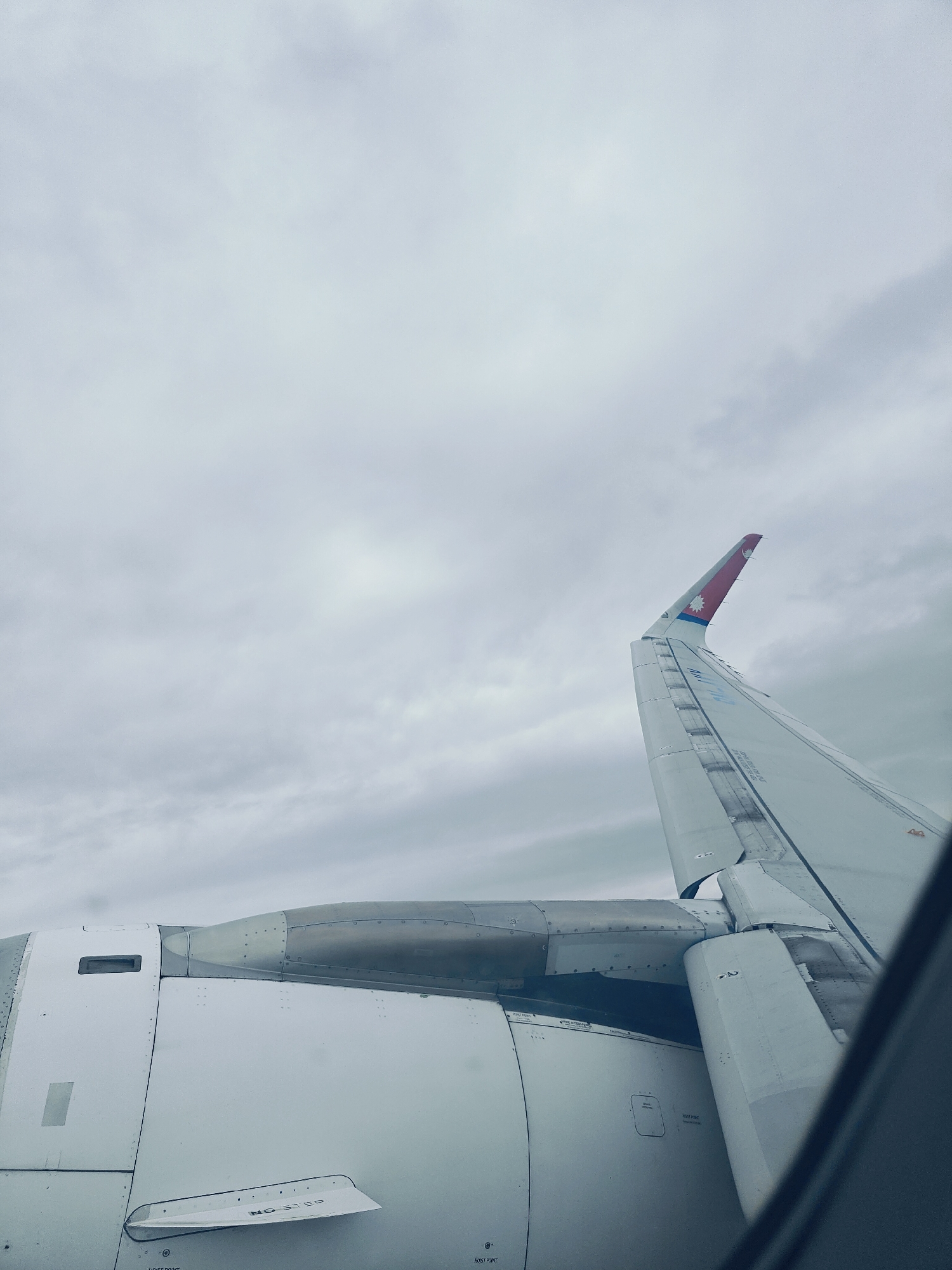
An aerial view from an airplane window shows a cloudy sky and the wing of the aircraft. The wing is white with red and blue markings on its tip, which resemble the flag of Nepal. In the foreground, the engine nacelle of the airplane is visible, also in white. The scene captures a moment during a flight, likely over or near Budhanilkantha, Nepal, given the aircraft's livery. There are no people or other identifiable objects in the image.
Budhanilkantha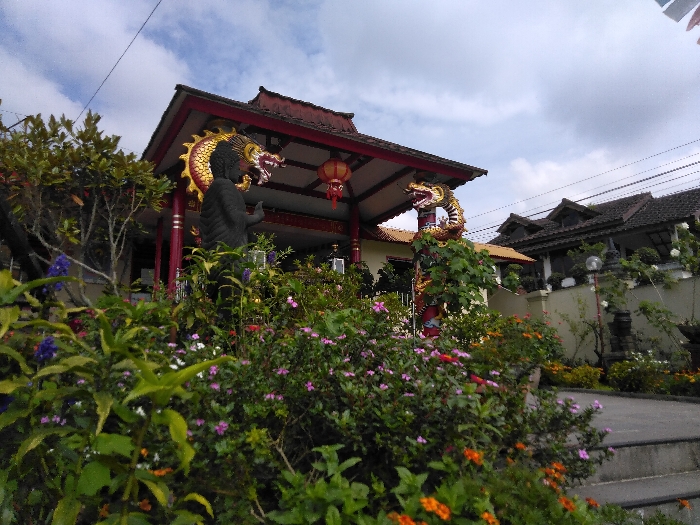
This image depicts a temple or shrine area in Budhanilkantha, Nepal, under an overcast sky. The foreground is densely populated with a variety of flowering plants, including vibrant purple, pink, orange, and white blossoms, partially obscuring the lower right section of a concrete pathway or steps. In the midground, a pavilion-style structure with a red-tiled, multi-tiered roof and white eaves is visible, supported by prominent red pillars. A dark-colored Buddha statue, positioned with its back facing the viewer and its right arm raised, stands under the left side of this roof. Two large, ornate golden dragon sculptures, detailed with red accents, are affixed to the structure; one is prominent on the left near the Buddha statue, and another is on the right, both appearing to guard the entrance. A single red lantern hangs centrally beneath the roof. Behind this primary structure, additional buildings with light-colored facades and darker, traditional Nepalese multi-gabled roofs are visible. The background on the right reveals residential structures with dark roofs and lighter walls. Overhead, utility lines traverse the upper right portion of the frame. No individuals are present in the scene.
Budhanilkantha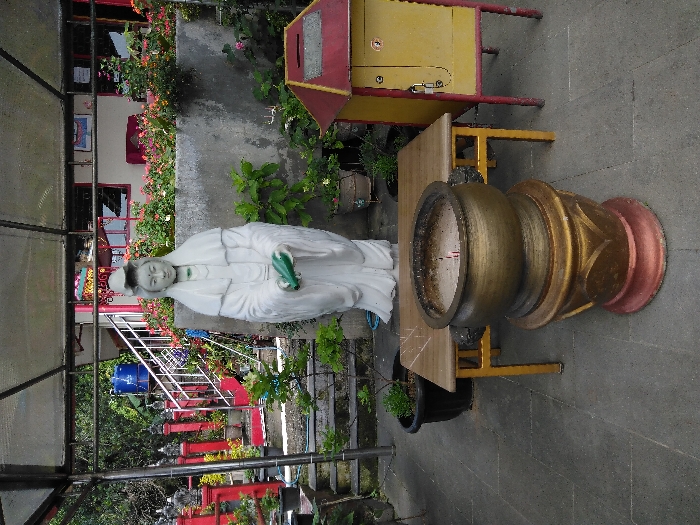
The scene depicts an outdoor shrine area in Budhanilkantha, Nepal, situated under a corrugated transparent roof supported by black metal framing. A central, white-robed statue of a female deity with a distinct headpiece holds a green vessel or offering in her hands. Directly in front of the statue, a large, ornate bronze censer filled with ash contains multiple burning incense sticks, positioned on a decorated pedestal with a red base. Behind the censer, a simple wooden table is visible. To the right, a yellow wooden offering box with a red pitched roof is secured by a silver padlock. The statue stands before a concrete planter wall topped with a variety of flowering plants, including visible roses, and green foliage. Behind this wall, a building with red-framed windows and a white facade is partially visible. To the left, a set of outdoor stairs with a metal railing and red balusters ascends, with a blue water tank situated near the top. The ground is paved with grey tiles, and numerous potted plants are arranged around the shrine area. No individuals are present.
Budhanilkantha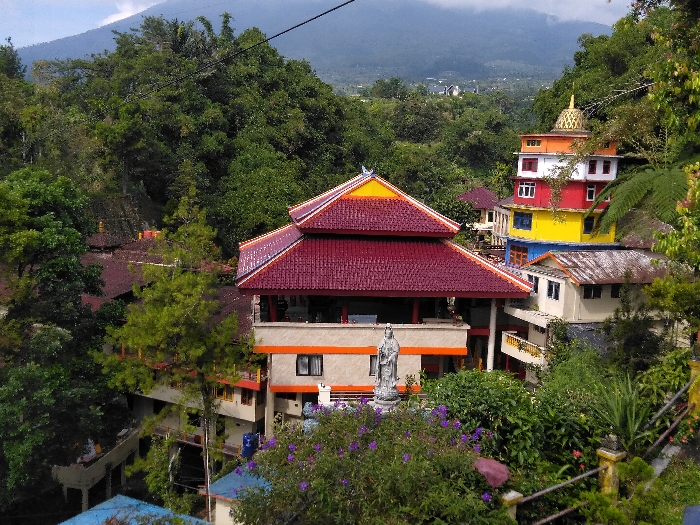
The image displays a religious complex situated on a densely vegetated hillside in Budhanilkantha, Nepal. In the center, a multi-story building features a prominent maroon-tiled, multi-tiered hip roof with yellow trim, atop cream and orange colored facades. A white, standing statue, likely a Bodhisattva, is positioned on a landscaped terrace in front of this building, surrounded by green shrubs and purple flowering plants. To the right, a taller, multi-story structure exhibits distinct horizontal color bands of blue, yellow, red, white, and orange, culminating in a golden, onion-shaped dome or stupa element. Additional buildings with brown roofs are interspersed among the dense green trees and vegetation across the scene. A mountain range, partially obscured by haze, forms the distant background under a blue sky with scattered white clouds. A thin black utility line is visible across the upper portion of the frame. No human figures are discernible.
Budhanilkantha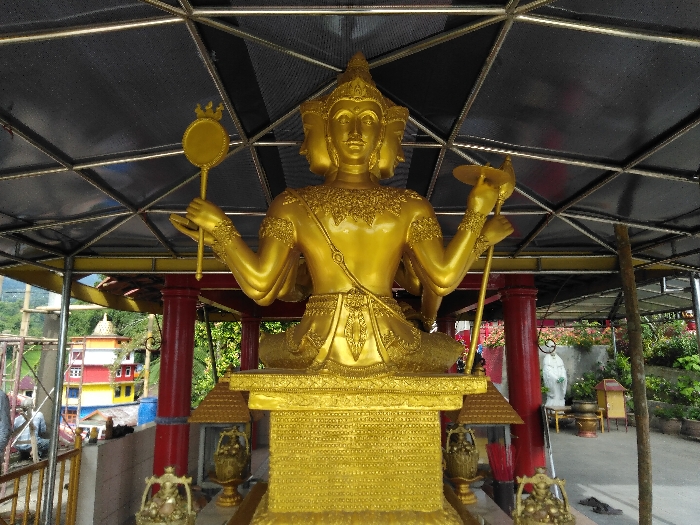
A large, gold-colored statue of a four-faced, four-armed deity stands centrally under a dark, geometrically framed canopy in Budhanilkantha, Nepal. The deity, likely Brahma, holds a golden mirror-like object with a crown design in its front left hand and a circular ceremonial object on a stick in its front right hand; two additional arms extend upwards, each holding a staff. The statue is intricately decorated with relief patterns and rests on a multi-tiered golden pedestal. The canopy is supported by red cylindrical pillars. At the base, smaller golden shrine-like structures and offerings are present. To the right, a white statue is visible next to a pair of dark sandals. The background on the left features colorful multi-story buildings (red, yellow, blue) amidst green foliage and mountainous terrain, with some scaffolding structures.
Budhanilkantha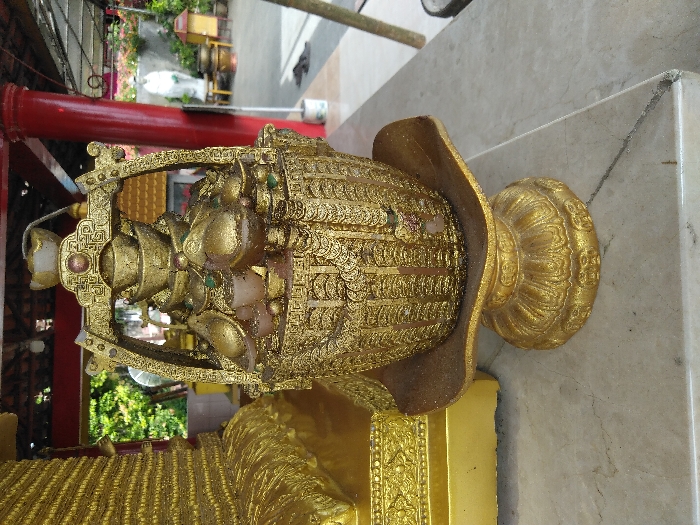
The image displays a golden, ornate decorative object, resembling a basket overflowing with gold ingots (yuanbao) and stacked golden bowls or coins, surmounted by an arching handle structure. The object, appearing to be made of gilded metal or painted resin, sits on a matching golden, intricately patterned pedestal, which rests on a light-colored, possibly marble, horizontal surface. To the left and partially obscured, a large golden, textured structure, possibly part of a shrine or statue base, extends horizontally. The scene is set within a sheltered area characterized by robust red support columns and a visible dark ceiling structure with red-brown tiled roofing elements beyond. In the background, green foliage is visible through the open-air structure. Further in the deep background to the right, a tall, white standing statue is discernible amidst more greenery and a smaller yellow shrine-like structure. Black footwear is visible on the ground near the white statue. The overall environment suggests a temple or shrine complex in Budhanilkantha, Nepal. No individuals are visible, and no active interactions or actions are depicted. The lighting is bright and even, indicating daytime conditions.
Budhanilkantha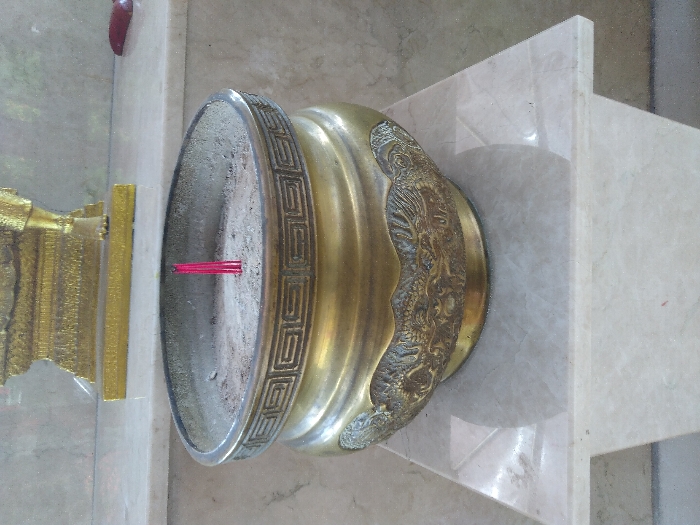
A large, ornate brass incense burner, filled with white ash and containing two unlit red incense sticks, occupies the center foreground. The burner's upper rim displays a repeating geometric fret pattern, while its mid-section is decorated with a raised relief depicting dragons. This incense burner rests on a light-colored, polished marble pedestal or table. In the background, positioned on a higher, light-colored marble surface, the lower leg and foot of a golden statue or figurine, set upon a golden base, are partially visible. A small, reddish, elongated object lies on the upper marble surface to the right. The background wall consists of light-colored stone or plaster. No individuals are present in the scene, which is situated in Budhanilkantha, Nepal.
Budhanilkantha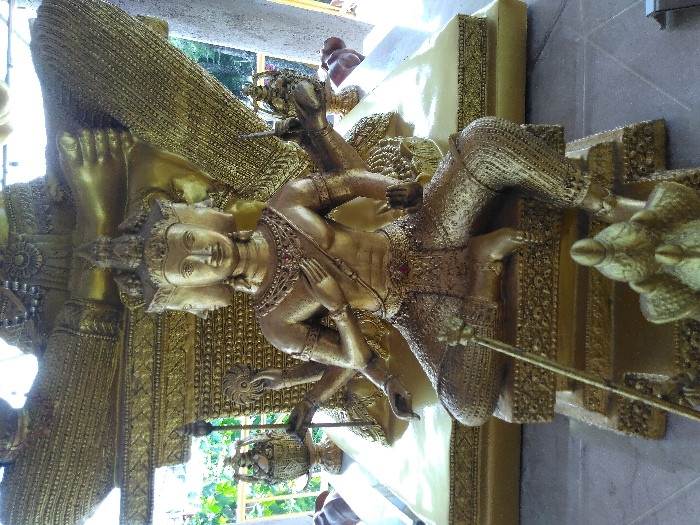
A golden, multi-headed, multi-armed statue of a deity, likely Brahma, is centrally positioned within a shrine in Budhanilkantha, Nepal. The figure, facing forward, displays four distinct faces and at least eight arms, adorned with elaborate golden jewelry, a crown, and patterned garments. Its left foreground hand holds a long, slender golden staff extending downwards, while another left hand grasps a serrated disc-like object. The right foreground hand rests on the figure's chest, and a higher right hand holds a small ornate vessel. The deity is seated in a relaxed cross-legged posture on a patterned golden pedestal. Behind the main statue, a larger, partially visible golden structure or deity, showing only its lower body and feet, is present. In the immediate foreground, a smaller, intricate golden object rests on the light-colored floor, aligned with the staff held by the main figure. The environment includes a concrete pillar on the right and green foliage visible through an opening in the background, indicating an outdoor area beyond the sheltered shrine.
Budhanilkantha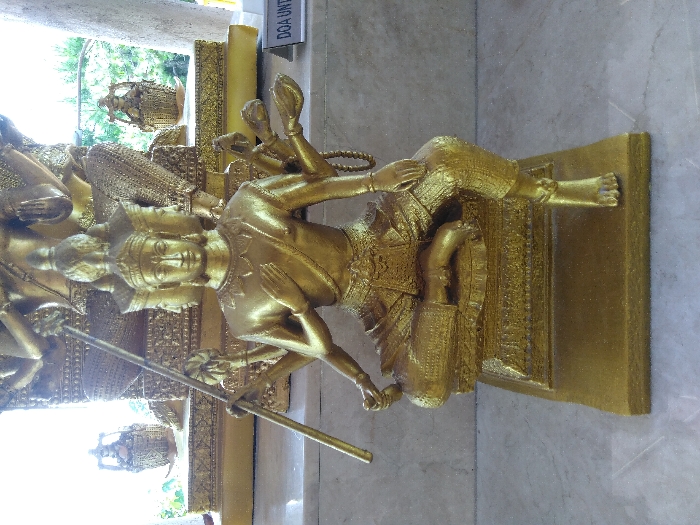
The image displays a golden, multi-headed, multi-armed deity statue in a religious complex located in Budhanilkantha, Nepal. The central figure is seated on a multi-tiered golden pedestal and a rectangular golden base, with its right leg crossed and left foot flat on the ground. It possesses at least four visible faces and multiple arms; one left hand rests on the chest, another left hand holds a golden staff, and a right hand holds a small golden bowl-like object. The statue is adorned with ornate golden garments, necklaces, armbands, and anklets. The figure is positioned on a light grey, possibly marble, floor. In the background, a larger, partially visible golden deity sculpture occupies a raised golden platform. On the same platform, further back, are two smaller golden figures, each contained within a decorative golden vessel. Behind the platform, green foliage and trees are visible through an opening, indicating an outdoor or semi-open setting. A white architectural pillar is present on the right side. A white sign with partial black text reading "DOA UNT" is visible on the right side of the raised platform. The scene is illuminated by natural light.
Budhanilkantha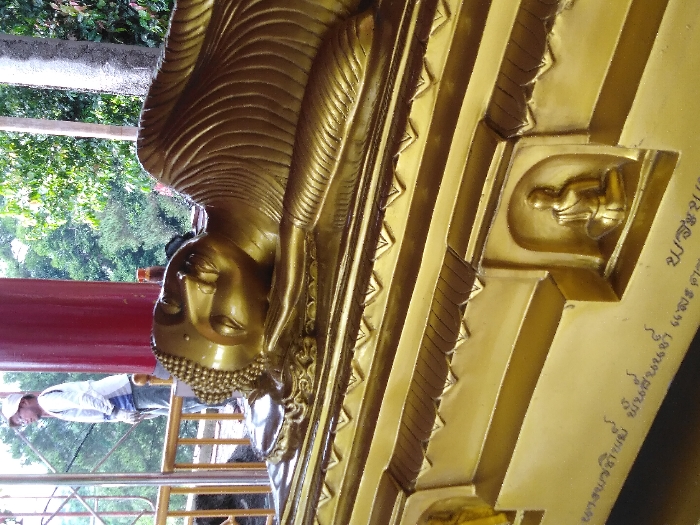
The image displays a gilded reclining Buddha statue, situated in the city of Budhanilkantha, Nepal. The Buddha lies on its right side, with its head resting on its right hand, exhibiting closed eyes, an urna on the forehead, elongated earlobes, and tightly coiled hair forming an ushnisha. Its body is draped in robes with distinct, parallel folds. The statue is positioned on an ornate, multi-tiered gilded pedestal, which incorporates recessed arched niches, each containing a smaller golden meditating Buddha figure. The lower visible edge of the pedestal features dark-colored inscriptions in a script resembling Thai or Lao. In the upper left background, a male individual, appearing Asian, stands near a golden railing, partially obscured by a red cylindrical pillar. He wears a white cap, a white long-sleeved shirt, and blue trousers, facing left, away from the camera. Lush green foliage and a tree trunk are visible in the background, indicating an outdoor or semi-open-air setting.
Budhanilkantha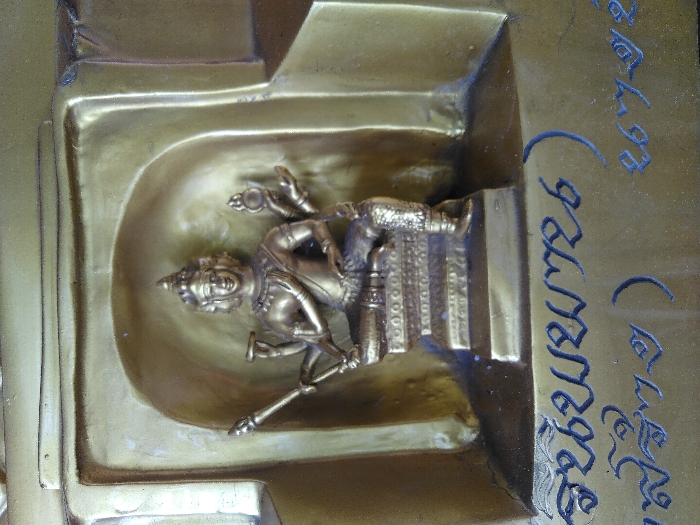
The image displays a golden metallic statue of a multi-headed and multi-armed deity, situated within a golden, recessed niche in Budhanilkantha, Nepal. The deity is seated in a relaxed, royal-ease posture on an ornate, multi-tiered golden pedestal. Three distinct heads are visible, each adorned with a pointed crown. Six arms are present: the upper left arm holds a staff-like object; the middle left arm is raised with an open palm; the lower left arm rests on the bent leg. The upper right arm holds a small, round object resembling a water pot; the middle right arm is raised with an open palm; and the lower right arm rests on the bent leg. The figure is elaborately adorned with necklaces, armbands, and earrings. The niche is arched at the top, formed by contoured golden surfaces. Below the pedestal and niche, dark blue or black Thai script is inscribed directly onto the flat golden surface, detailing text and the Buddhist Era year 2562, corresponding to 2019 CE.
Budhanilkantha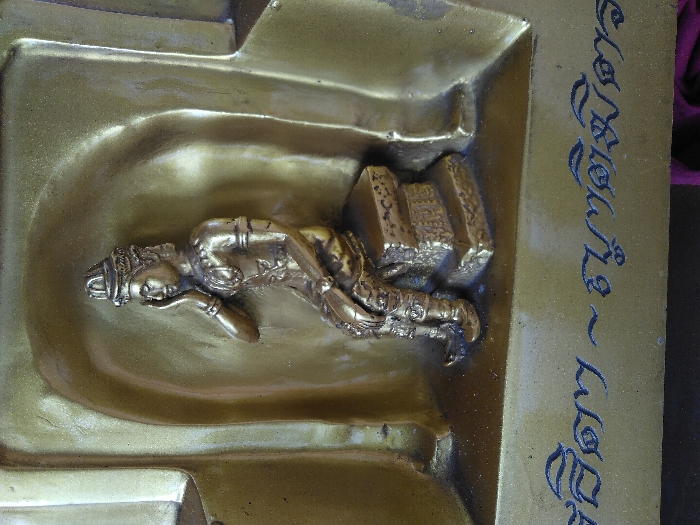
The image displays a close-up view of a golden relief panel, likely situated in Budhanilkantha, Nepal. A small, golden-finished metallic figurine is prominently featured, seated within a deep, U-shaped golden recess. The figurine portrays a figure adorned with an elaborate crown, intricate neck and chest jewelry, bracelets on its arms, and detailed leg coverings. The figure is posed with its right leg bent, foot resting on a multi-tiered golden pedestal, and its left leg tucked beneath. Its right hand is raised with fingers touching the right side of its face, while the left hand rests on its left thigh. Below this recessed area, dark, stylized script is inscribed across the flat golden surface of the panel. The entire golden surface exhibits a textured, slightly uneven finish.
Budhanilkantha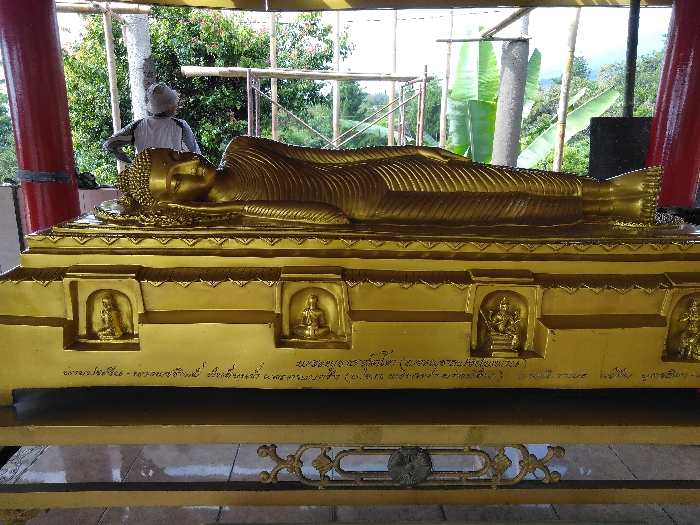
The image depicts a large, golden reclining Buddha statue within a semi-open structure in Budhanilkantha, Nepal. The statue, the primary subject, lies on its right side, supported by its right arm with the head resting on a raised platform, and the left arm extended along its body. It features prominent earlobes, a cranial protuberance (ushnisha), and defined drapery folds. The statue rests on an elaborate, multi-tiered golden pedestal. The pedestal's front surface displays several recessed niches, each containing a smaller golden figure in a seated or standing posture. Below these niches, a line of inscription in an Asian script is present. The lower part of the pedestal includes decorative golden scrollwork. In the upper left background, one individual is visible, facing away from the camera. This person wears a light-colored long-sleeved shirt and a light-colored hat, standing with hands on hips, looking towards the left side of the frame. The environment comprises red structural pillars on the left and right, supporting an overhead framework, possibly a roof. The background features dense green foliage, including large, broad leaves resembling banana plants. A construction scaffold, likely made of bamboo or light poles, is visible among the trees. Distant hills or mountains are discernible through the vegetation. The ground beneath the pedestal is a dark, reflective surface, possibly tiled.
Budhanilkantha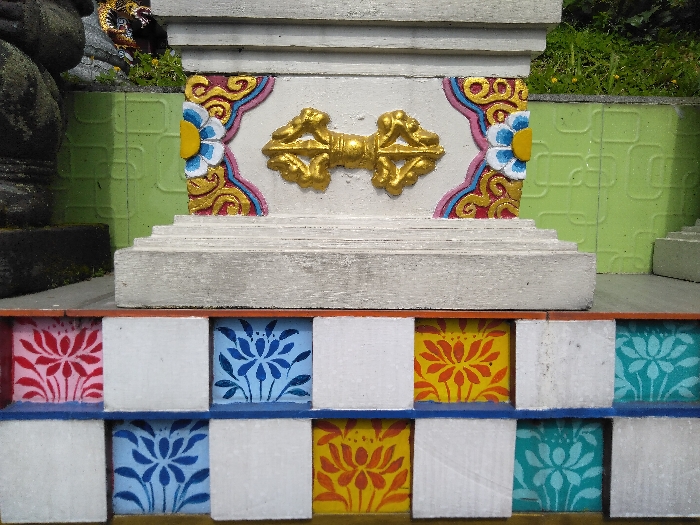
The image displays a close-up, head-on view of a multi-tiered, ornate architectural detail located in Budhanilkantha, Nepal. The central upper element is a white panel featuring a horizontal golden vajra (dorje) emblem. This panel is framed by intricate, symmetrical scrollwork in gold, pink, and blue, with stylized blue and yellow flowers at the corners. Below this, the structure's base consists of several light grey concrete or stone tiers. Below the tiered base, a lower decorative section is present, comprising two horizontal rows of square panels. These panels alternate between solid white and colored squares that contain stylized lotus flower designs. The lotus designs are rendered in red, blue, yellow, and teal. A thin orange horizontal line defines the top edge of this lower section, and a thin blue line separates the two rows of panels. The background to the right reveals a light green wall or panel with a faint raised geometric pattern, topped by green vegetation including small yellow flowers. To the left, a dark, textured stone object is partially visible, topped by a fragment of a gilded, multi-colored religious figure, possibly a mythical creature, partially obscured by foliage. No individuals or specific actions are depicted.
Budhanilkantha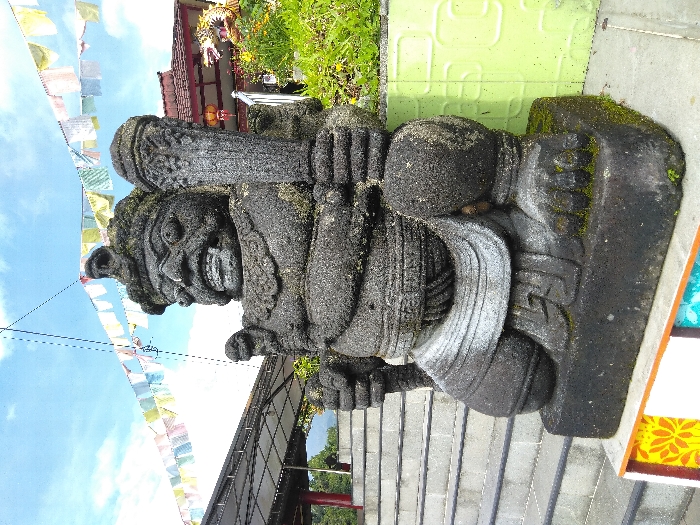
The image displays a large, weathered dark grey stone statue of a fierce guardian figure, positioned outdoors at a temple complex in Budhanilkantha, Nepal. The statue, coated in moss and lichen, features a wide, grimacing mouth with visible teeth, prominent eyes, and a topknot. It is depicted in a kneeling or seated posture, holding a large, ornate club in its right hand, while its left hand rests on its knee or thigh. The statue stands on a dark stone pedestal, which is situated atop a low, multi-colored sign in the immediate foreground. In the background to the left, a flight of grey concrete stairs ascends alongside a structure featuring a white canopy roof supported by dark pillars. Beyond this structure, distant green hills are visible. To the right of the statue, a building with a reddish-brown tiled roof and white walls is partially seen, adorned with a red lantern and a vibrant, multi-colored dragon statue perched on a green, grassy mound. Lush green vegetation and yellow flowers surround this building. A bright lime-green wall with a textured pattern is directly to the right of the guardian statue. Colorful prayer flags, strung horizontally across the upper portion of the frame, are visible against a clear blue sky with scattered white clouds.
Budhanilkantha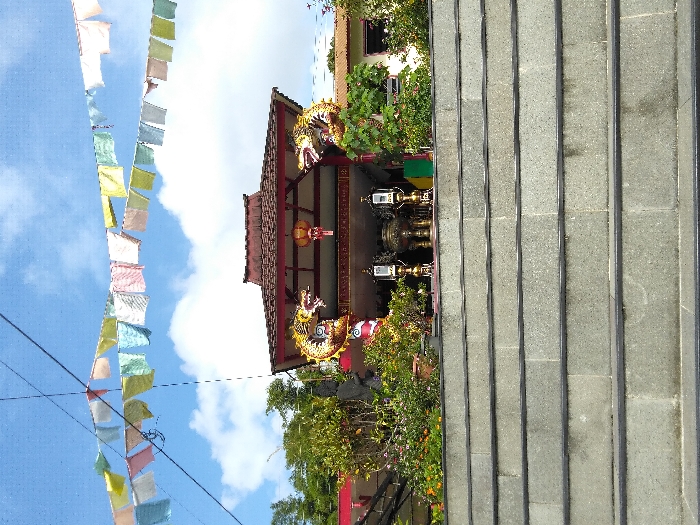
The scene depicts a multi-tiered grey stone staircase leading upwards to a religious structure in Budhanilkantha, Nepal. The structure, likely a temple or monastery, features a dark red, gabled roof with a traditional East Asian architectural style. The main entrance is adorned with two large, detailed golden dragon head sculptures, positioned symmetrically on either side with open mouths and red eyes. A single red lantern hangs centrally within the entrance. Inside the entrance area, a large, ornate golden incense burner or ceremonial vessel is prominent, flanked by two tall, dark lanterns on golden stands. Lush green foliage and flowering plants surround the base of the building. Overhead, multiple strands of colorful rectangular prayer flags (including white, pink, light blue, yellow, light green, and orange) are strung horizontally across the upper portion of the frame, set against a bright blue sky with scattered white clouds. Two dark utility wires are visible traversing the sky above the structure and below the prayer flags. No people are present in the image.
Budhanilkantha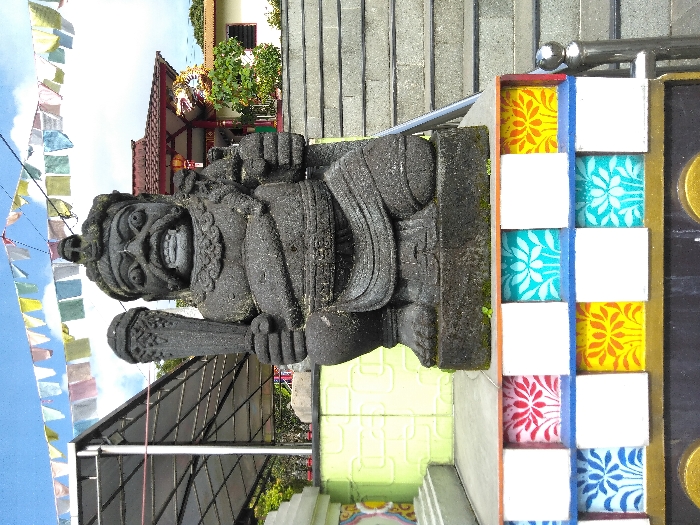
An outdoor, eye-level shot captures a weathered, dark grey stone statue, approximately 1.5 meters tall, depicting a squat, muscular deity with an angry facial expression, prominent fangs, wide eyes, and a mustache. The figure wears an elaborate headpiece and loincloth, holding a club-like weapon in its right hand. It rests on a multi-tiered pedestal; the immediate base is a rough, dark stone. Below this, the pedestal features a decorative frieze composed of alternating white squares and colorful squares with stylized floral patterns (red, blue, yellow, turquoise) on a blue and orange border, above a dark, possibly metallic, lower section. Behind the statue, to the left, is a light green wall with geometric relief patterns, partially obscured by the pedestal. Further back on the left, a modern-looking structure with a light-colored, possibly translucent, sloped roof supported by dark framing is visible. To the right of the statue, a set of grey stone steps ascends towards a traditional Nepali-style temple building with a prominent red-tiled roof and white walls, adorned with a golden dragon sculpture near its entrance. Colorful rectangular prayer flags are strung overhead against a partly cloudy blue sky, spanning from the left of the frame to the right, above the main statue. Sparse green foliage is visible near the temple structure. The scene is located in Budhanilkantha, Nepal.
Budhanilkantha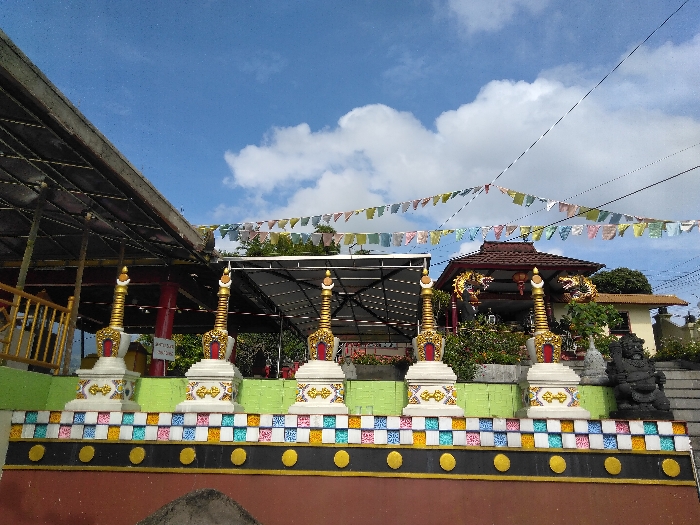
The image depicts an exterior view of a religious complex in Budhanilkantha, Nepal, under a clear blue sky with scattered white cumulus clouds. In the immediate foreground, a multi-tiered decorative wall is present. The lowest visible section is reddish-brown with a black horizontal band featuring circular gold motifs. Above this, a black band displays a checkerboard pattern composed of white, light blue, pink, and yellow squares, topped by a vibrant green tier. Positioned atop the green tier are five uniformly spaced, ornate stupa-like structures. Each structure is primarily white and gold, with a prominent red and gold patterned band around its midsection. Above these structures, multiple strings of multi-colored prayer flags (blue, white, red, green, yellow) are horizontally strung across the scene, intersecting with several dark utility wires traversing the sky. To the left, a partial view of a building with a dark, sloping roof and a yellow metal railing is visible. Centrally, further back, a prominent building with a multi-tiered, dark brown tiled roof features an ornate entrance flanked by two large, golden dragon sculptures. Below these dragons, red lanterns are discernible. To the right of this central building, a dark, weathered stone statue resembling a seated deity is situated on a stone base. Further to the right, another building with a light-colored wall and a brown roof is partially visible. Green foliage, including shrubs and potted plants, is distributed around the buildings and behind the foreground structures. No individuals or discernible actions are present within the frame.
Budhanilkantha