Cambridge, United States
10 memories from Cambridge, United States

The video shows a landscape with icebergs floating on water under a colorful sky with hues of blue, orange, and yellow. The water reflects the colors of the sky, creating a vibrant and mirrored effect. There are several icebergs scattered across the water, some larger than others. The overall scene appears serene and picturesque. The video is shot from a static viewpoint.
Cambridge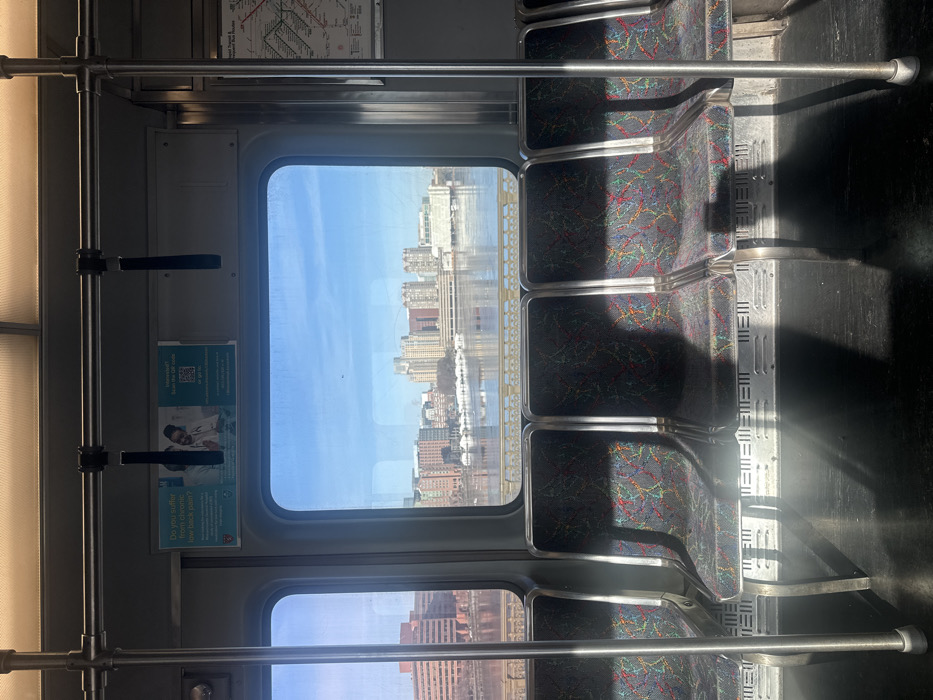
Inside a train car, rows of empty seats line up next to a window. The seats have a dark, patterned upholstery. Light streams in through the window, illuminating the seats with bright patches. Outside the window, a cityscape is visible, with buildings reflected in the water. A handrail runs along the length of the seats. Advertisements are placed on the wall between the windows.
Cambridge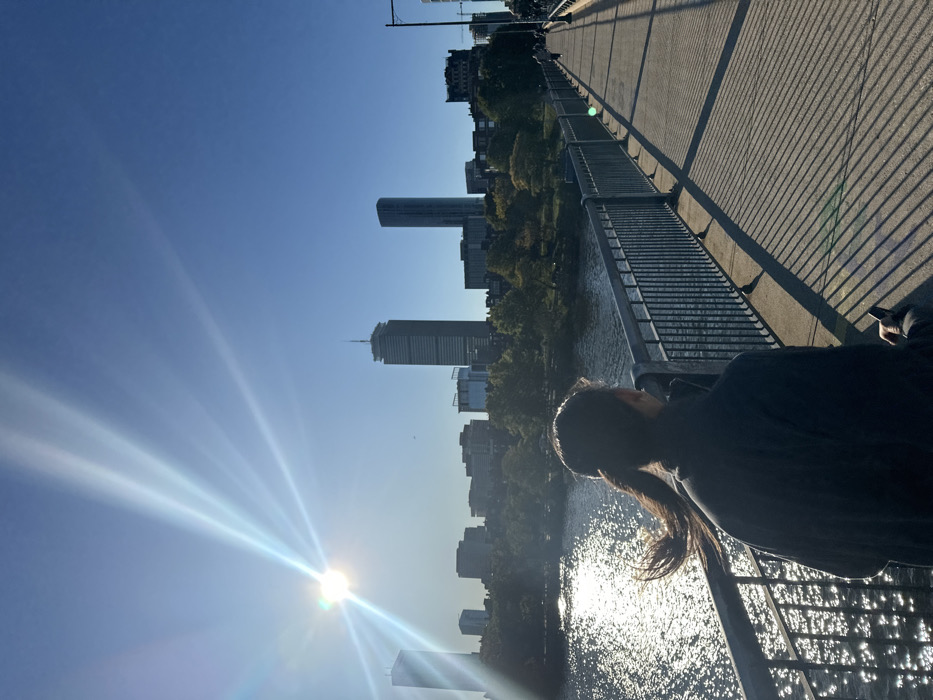
The image depicts a bright, sunny urban scene captured on the pedestrian walkway of the Harvard Bridge (Massachusetts Avenue Bridge) in Cambridge, Massachusetts, looking southeast towards the Boston skyline. In the foreground, a person with dark hair tied in a windswept ponytail, wearing a dark jacket, is viewed from behind, standing or walking and observing the distant cityscape. Their right hand holds a dark, rectangular object. To the person's left, the Charles River exhibits strong sunlight reflections, creating shimmering patterns. Metal railings separate the walkway from the water. Long, diagonal shadows from these railings extend across the concrete pathway on the right, indicating a low sun angle. The Boston skyline dominates the background under a clear blue sky, prominently featuring the Prudential Tower (tall, tapered, with an antenna) and 200 Clarendon Street (formerly John Hancock Tower), with other buildings and distant trees lining the riverbank. The sun, positioned in the upper left, generates significant lens flare and bright rays. Faint silhouettes of other pedestrians are visible further along the bridge on the right.
Cambridge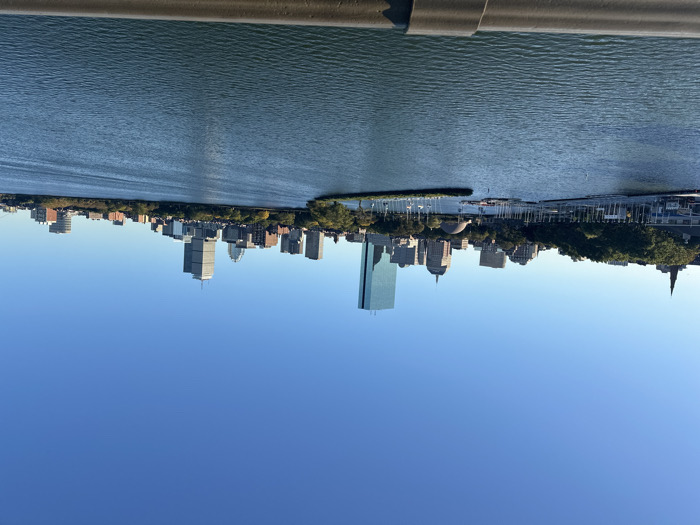
This image depicts a wide panoramic view of the Boston skyline across the Charles River, observed from an elevated position in Cambridge, Massachusetts, likely from the Longfellow Bridge. A dull grey metal railing occupies the lower portion of the foreground. The Charles River fills the midground with calm, rippled, deep blue-green water. On the left bank, numerous white sailboats are moored in a marina, backed by buildings with dark roofs and dense green foliage. A prominent dark steeple rises above the trees on the far left. A small, tree-covered island is visible in the river slightly to the right of the image center. The background showcases the Boston skyline under a clear, cloudless light blue sky. Key structures include the reflective blue-green John Hancock Tower (200 Clarendon Street) and the lighter-colored Prudential Tower, along with numerous other high-rise and mid-rise buildings. The distinct grey dome of the MIT Great Dome is partially visible on the left side of the Boston bank amidst trees and other structures. No people or discernible actions are visible in the scene.
Cambridge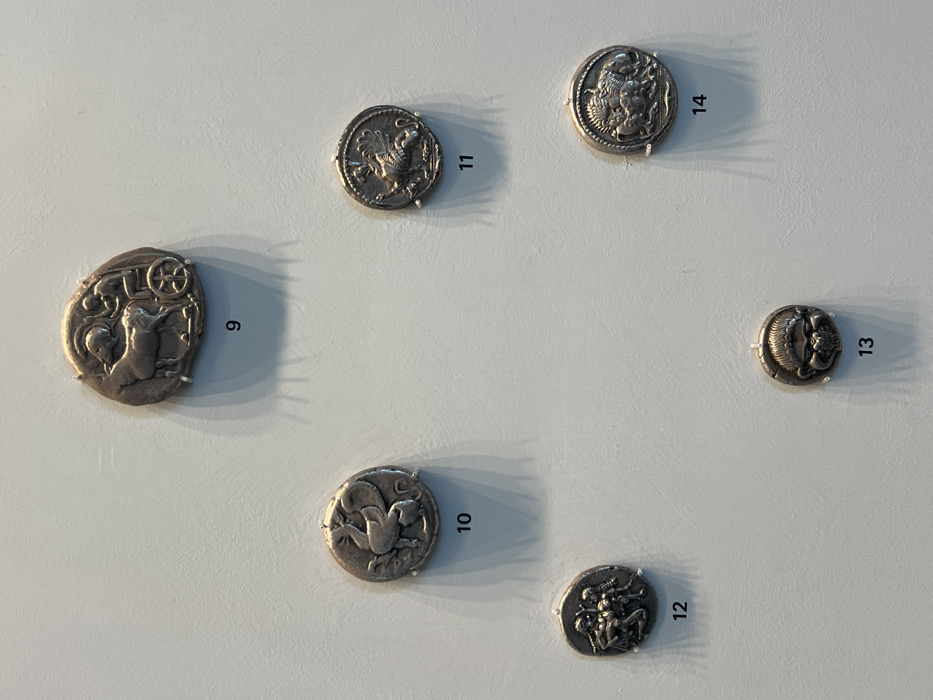
Six ancient silver coins, numbered 9 through 14, are displayed against a plain, light gray vertical surface, secured by small, transparent clips. Shadows indicate an overhead light source. Coin 9, located at the top center, is an irregularly shaped silver piece depicting a bull or ox pulling a two-wheeled chariot, with a figure seated within the cart. Coin 10, positioned mid-left, is a circular silver coin featuring a winged griffin or mythical creature facing left. Coin 11, at mid-right, is a circular silver coin showing a standing winged lion with a raised paw, facing left. Coin 12, situated at the bottom-left, is a circular silver coin illustrating two figures, possibly human, in an interactive or combative pose. Coin 13, centered at the bottom, is a circular silver coin presenting a frontal, stylized mask-like face. Coin 14, at the bottom-right, is a circular silver coin depicting a scene of two animals, likely a lion attacking another large animal such as a bull. This exhibit is located within the Harvard Art Museums in Cambridge, Massachusetts, United States.
Cambridge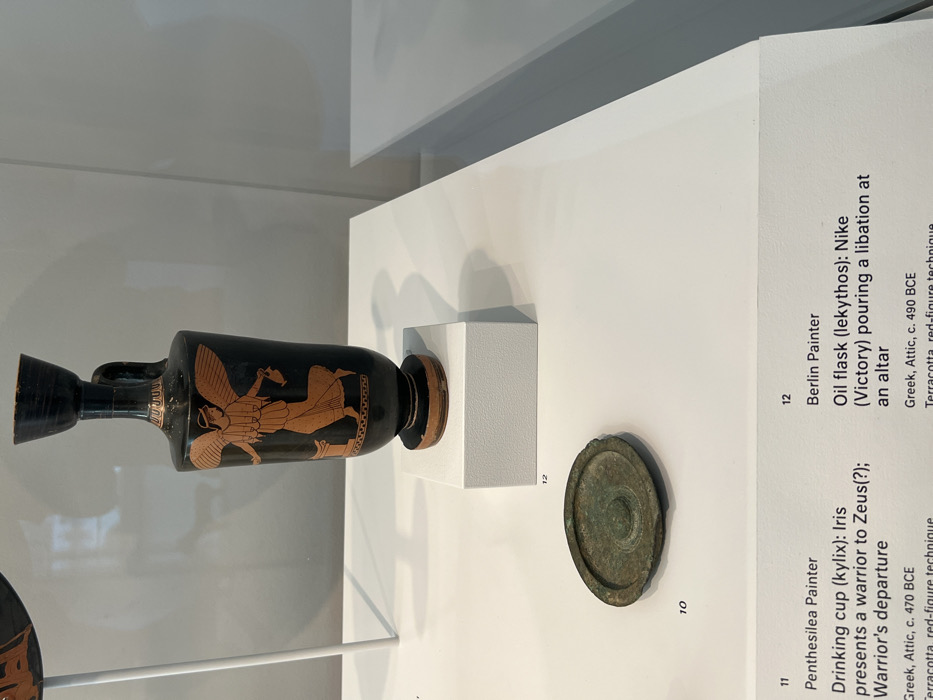
The image displays a museum exhibit at the Harvard Art Museums in Cambridge, Massachusetts. The central focus is an ancient Greek Attic terracotta oil flask (lekythos) dated approximately 490 BCE, attributed to the Berlin Painter. This black-ground vessel, featuring a red-figure technique, depicts a winged figure identified as Nike (Victory) pouring a libation at an altar. The lekythos rests on a small, white rectangular pedestal situated on a larger white display surface. Below and to the left of this pedestal, a circular, patinated bronze object with a central raised boss, possibly a mirror or dish, lies directly on the white surface. At the upper left, the curved rim of another ancient Greek artifact, identified by an adjacent label as a red-figure terracotta drinking cup (kylix) by the Penthesilea Painter (c. 470 BCE), is partially visible. The background consists of plain light gray walls and white display structures, with a thin white vertical support rod visible on the left. Item numbers "10", "11", and "12" are printed on the lower white display surface, identifying the artifacts.
Cambridge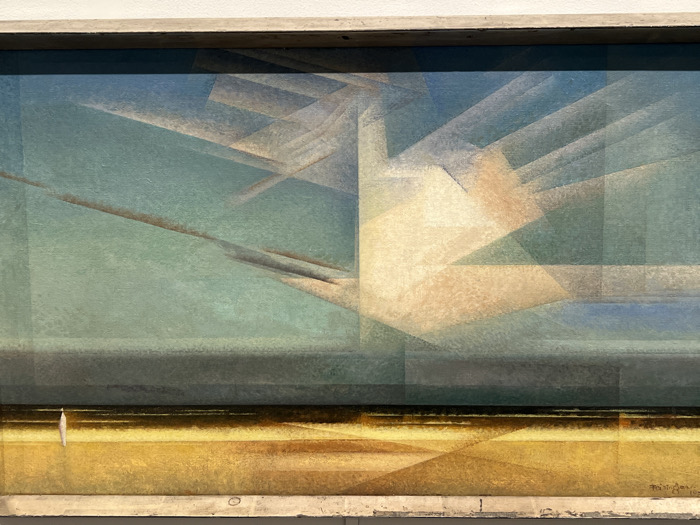
The image displays a framed painting titled *Sailboat on the Sea (No. 2)* by Fritz Glarner, dated 1923, exhibited at the Harvard Art Museums in Cambridge, Massachusetts, United States. The artwork, an oil painting, depicts a stylized marine landscape through geometric abstraction. The composition is horizontally divided into three primary sections: a sky, a horizon/sea, and a foreground. The upper section, representing the sky, consists of layered geometric planes in shades of light blue, teal, and beige, with an emphasis on diagonal and angular forms suggesting light refraction or clouds. A narrow, dark blue-grey horizontal band forms the horizon line. On the far left of this band, a small, upright white shape represents a sailboat. The bottom section, comprising approximately one-third of the canvas, depicts the foreground in varied golden and ochre tones, also rendered with geometric segments, suggesting a beach or sand dunes. The painting is enclosed within a light-colored, possibly wooden, frame, which is partially visible at the top and bottom edges of the photograph. The scene contains no human figures.
Cambridge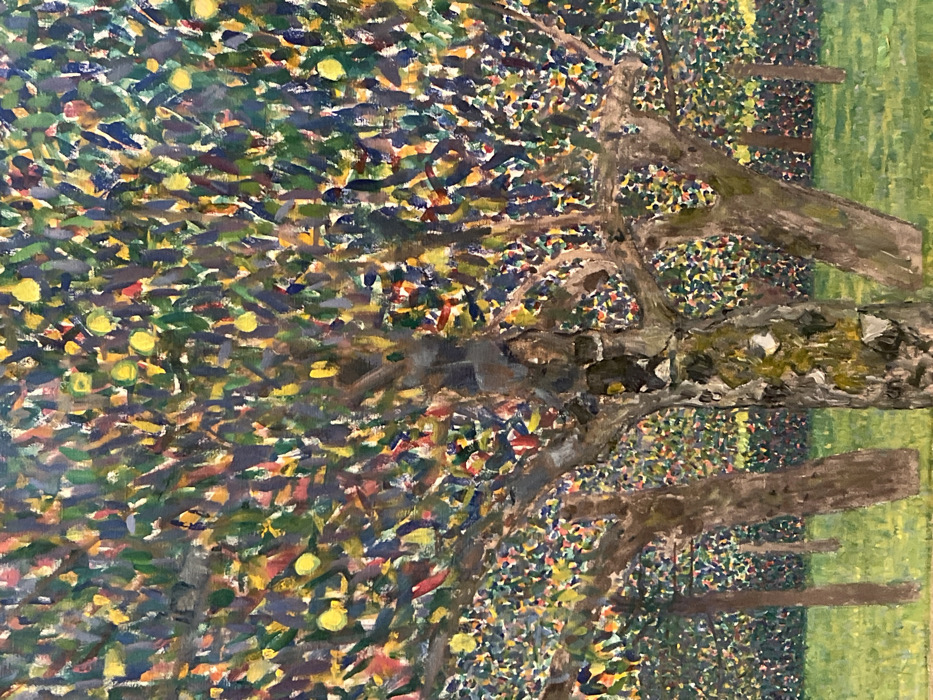
This image is a vibrant, vertically oriented oil painting depicting a dense orchard of fruit trees, likely lemon trees, rendered in a Post-Impressionistic style with distinct, varied brushstrokes. The artwork is located in Cambridge, United States. In the foreground, three prominent tree trunks rise from a strip of bright green grass. The central trunk is rugged and textured, displaying shades of light brown, grey, and patches of mossy green. Two additional, darker, and more slender tree trunks are positioned to its left and right, partially obscured by the foliage. Above the trunks, a dense canopy of leaves fills the majority of the frame, created using a mosaic of greens, blues, yellows, and hints of red and orange, imparting a shimmering, dappled light effect. Numerous small, bright yellow, ovoid fruits are interspersed throughout the vibrant foliage. In the midground and background, additional trees with similar dense, fruit-laden canopies extend the orchard scene, appearing as darker, less defined forms. The overall lighting suggests a bright, sunny day. No people, actions, or interactions are depicted within the scene; the focus is solely on the natural environment of the fruit grove.
Cambridge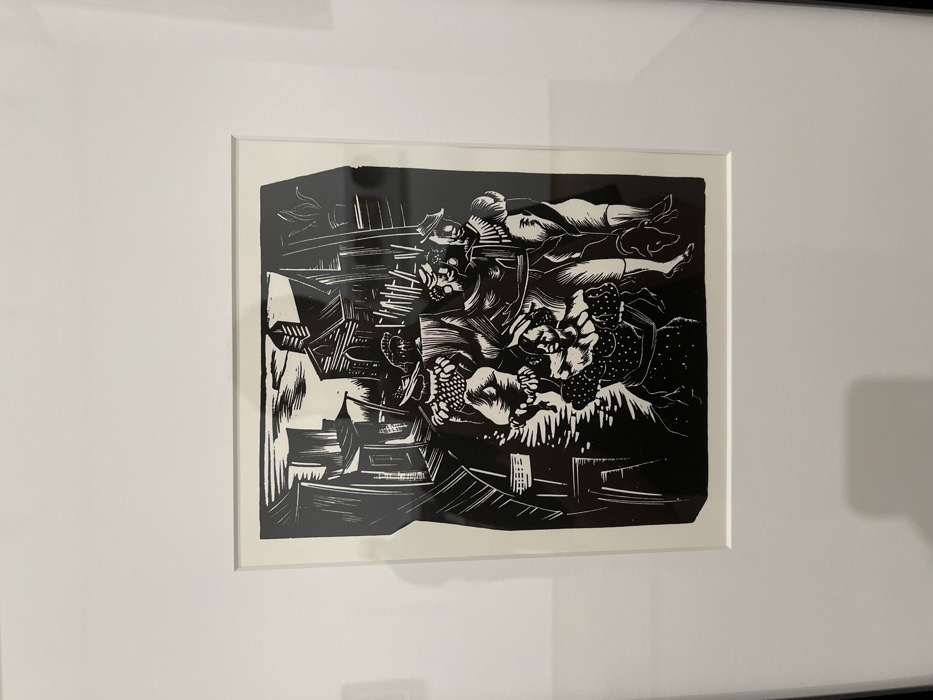
A framed, monochromatic artwork, likely a woodcut or linocut print, is displayed on a white wall. The print, characterized by stark black and white contrast and bold lines, depicts a dynamic urban scene populated by at least five figures. These figures are rendered in elaborate, possibly theatrical or period, attire, featuring ruffled collars, hats, and patterned clothing. In the foreground, a figure wearing a polka-dotted dress with puffy sleeves kneels or crouches, looking upward. Other central figures stand, one holding a staff-like object, engaged in apparent interactions. A small, dark animal, possibly a dog, is visible near the feet of figures on the right side. The background features a densely packed array of angular buildings, including a prominent structure resembling a church with a steeple on the upper right. Fences, a basket, and other architectural and environmental elements fill the remaining space. This artwork is on display in a location within Cambridge, United States.
Cambridge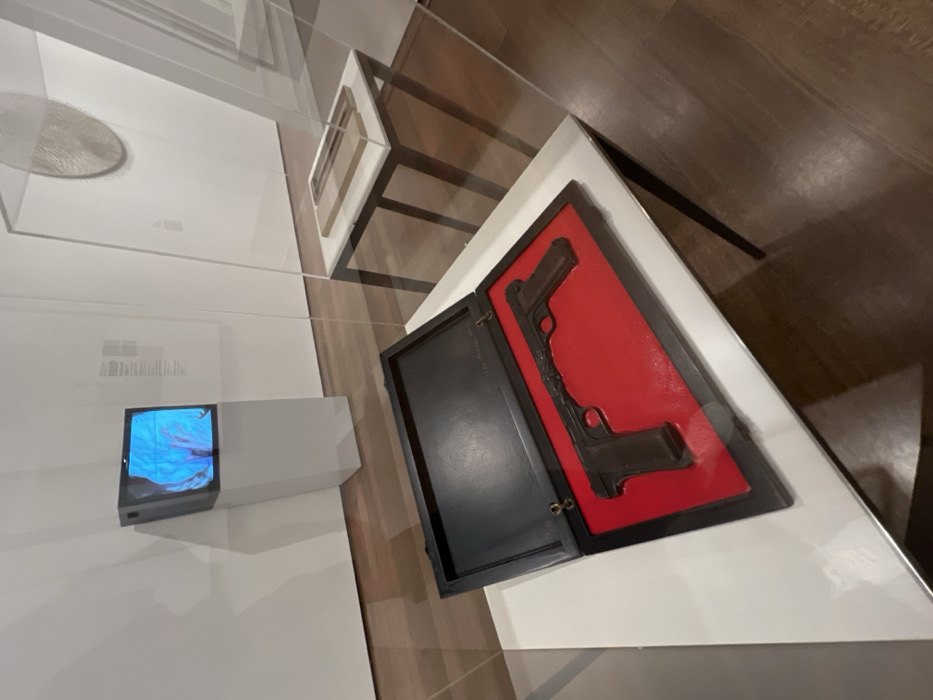
This image depicts an interior view of an art gallery or museum exhibit located in Cambridge, United States. The primary subject is a dark, open presentation case resting on a white rectangular display pedestal, enclosed within a clear acrylic vitrine. Inside the case, two dark brown, stylized pistol-shaped objects are set against a bright red, molded interior lining. The two pistols appear to be fused at their barrels, forming a single, horizontally oriented piece. In the background to the left, an angled white pedestal supports a vintage-style cathode-ray tube (CRT) television displaying a dynamic, abstract image predominantly featuring blue and purple hues. Further back on the right, another white pedestal holds a light-colored, flat rectangular object contained within a second clear display case. A large, circular or oval, textured white artwork is partially visible on the far right wall, behind a clear partition. The gallery features plain white walls and a polished dark wood floor. No individuals are present in the frame.
Cambridge