Cambron-Casteau, Belgium
30 memories from Cambron-Casteau, Belgium
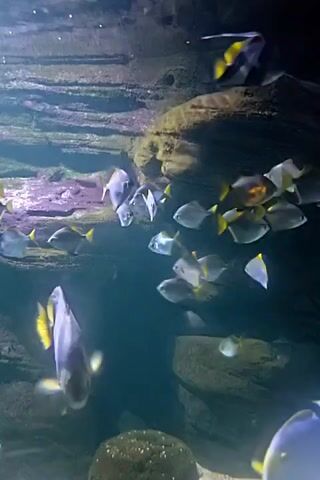
A school of silver fish with yellow fins swims in an aquarium. The fish are in the center of the frame, moving from right to left. A larger, darker fish with purple and yellow markings swims in the foreground, facing the viewer. The background consists of rocky structures and a blue, murky environment.
Cambron-Casteau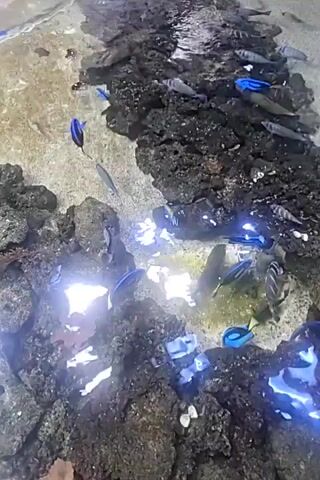
The video shows an overhead view of a shallow aquarium or natural pool with numerous fish swimming among rocks and dark debris. The water is clear, and the bottom appears to be sandy in some areas and rocky in others. Several brightly colored blue fish are visible, along with some gray and yellow fish. The lighting in the tank creates bright reflections on the water's surface. The fish are actively swimming and interacting with their environment.
Cambron-Casteau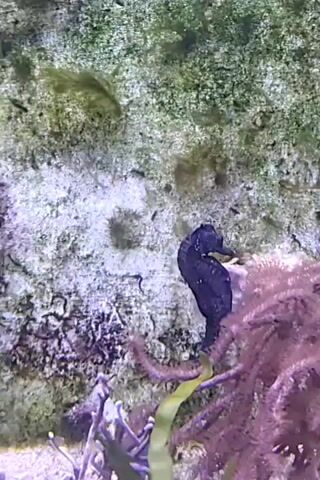
A black seahorse stands upright on a pink coral branch in an aquarium. The seahorse faces left and its tail is curled around the branch. The background is a rough, textured wall covered with green algae and white patches.
Cambron-Casteau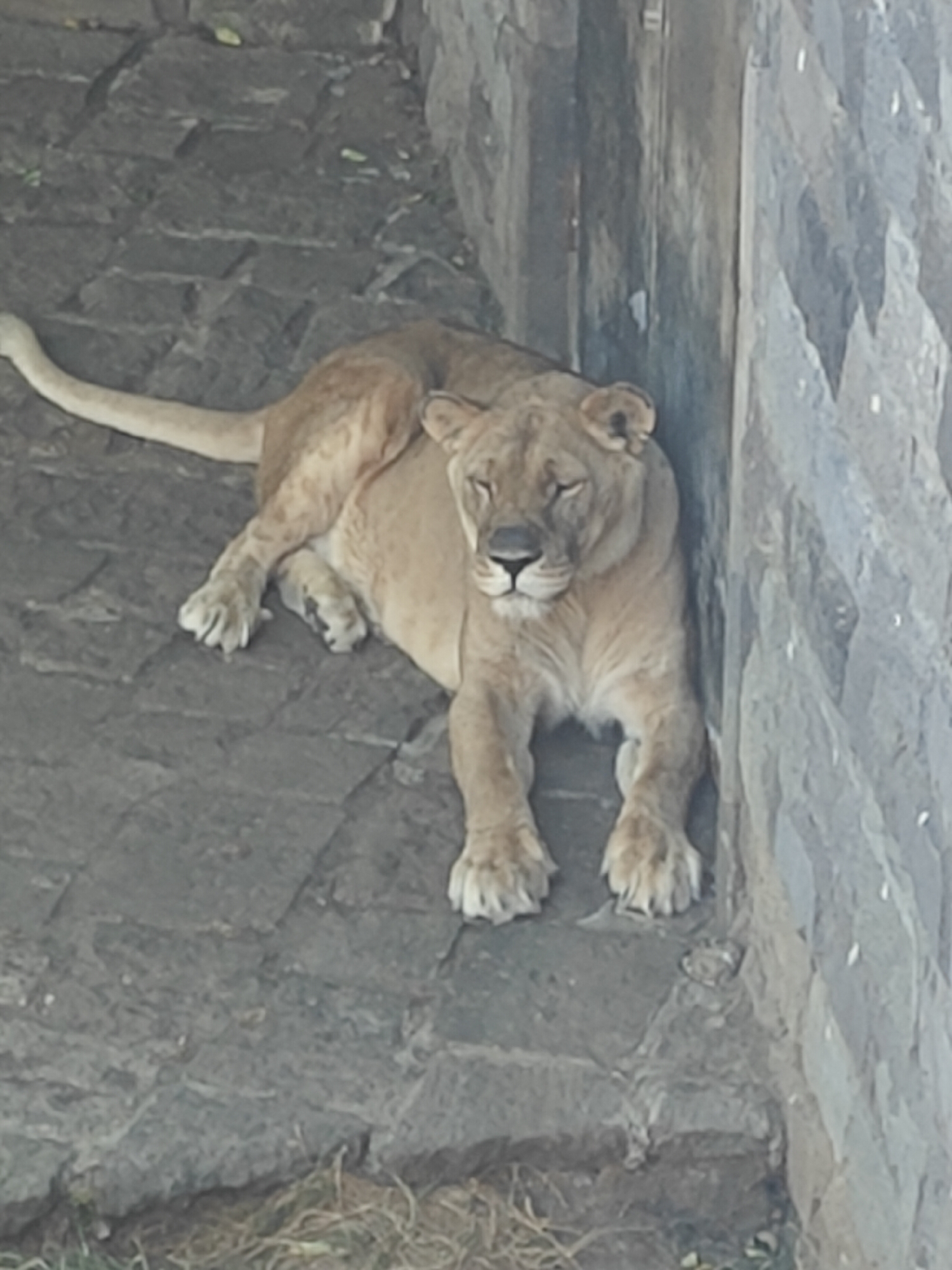
A lioness is lying on a stone surface next to a wall in the zoo of Cambron-Casteau, Belgium. The lioness is light brown with dark markings around its eyes and nose. Its eyes are closed, and its head is resting on its paws. The stone surface is uneven and appears to be made of large, dark gray rocks. The wall is also made of stone, with a rough texture and varying shades of gray and brown. The lioness is positioned in a relaxed pose, taking a rest. The overall scene is one of tranquility in a zoo enclosure.
Cambron-Casteau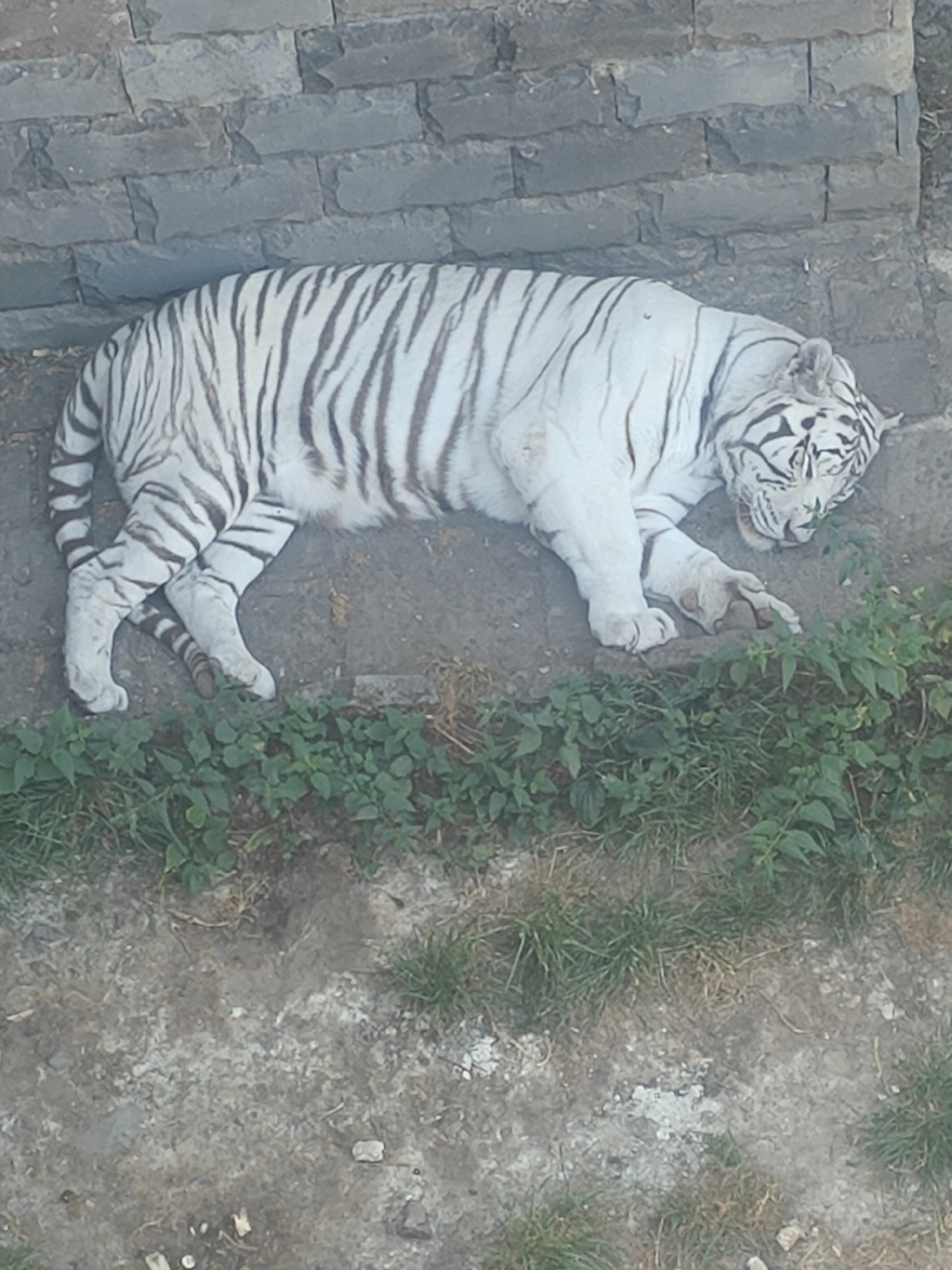
A white tiger with black stripes is lying on its side in an outdoor enclosure. The tiger is positioned on a dirt and stone ground. Behind the tiger, there is a wall constructed of dark gray stone blocks. In front of the tiger, there is a patch of green vegetation. The tiger appears to be resting or sleeping, with its eyes closed and its head turned to the side. The image was taken in the city of Cambron-Casteau, Belgium.
Cambron-Casteau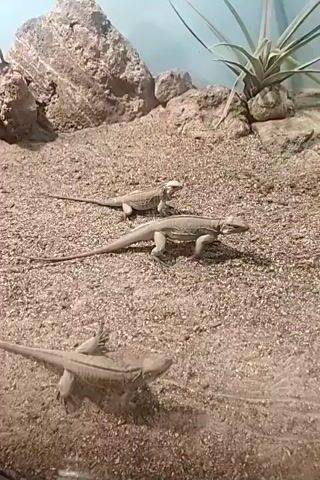
Three lizards are visible on a sandy substrate in an enclosure. The enclosure contains rocks and a plant. The lizards are light brown in color and have long tails. One lizard is in the foreground, facing away from the camera and to the left. Another lizard is in the middle ground, facing towards the right and appears to be walking. The third lizard is in the background, also facing towards the right. The lighting suggests an artificial environment.
Cambron-Casteau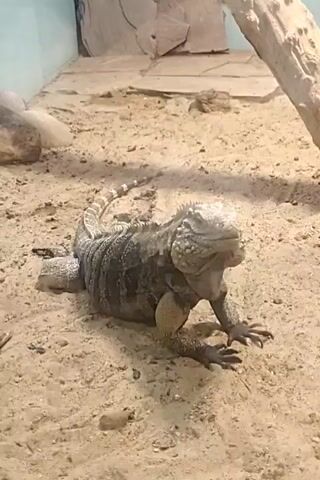
A rhinoceros iguana is lying on a sandy substrate within an enclosure. The reptile is a muted gray and black color with prominent dorsal spines running along its back. Its head is facing forward, and its mouth is open. The iguana is positioned in the center of the frame, with its legs splayed out. The enclosure appears to be a zoo exhibit, with a rocky backdrop and a wooden element visible in the upper right quadrant. The lighting is subdued, casting shadows on the sand.
Cambron-Casteau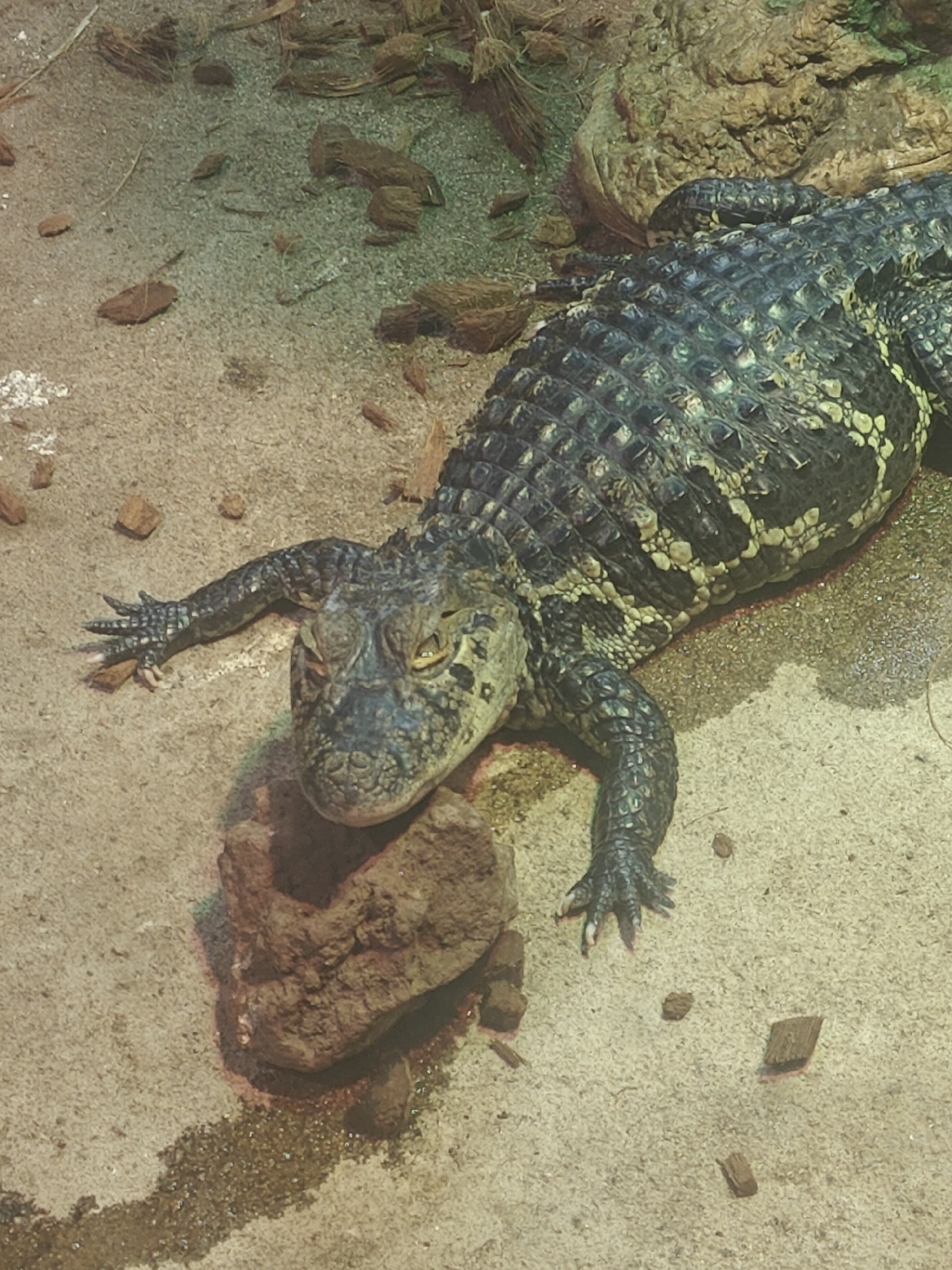
An alligator rests on a sandy surface with scattered wood chips and rocks. The alligator is dark green and black with yellow markings, and it is positioned diagonally across the frame, facing left. Its head is on a rock, and its body extends to the right. Its front left leg is visible and extended, with sharp claws. In the background, there are larger rocks and more wood chips, suggesting an enclosure at an animal park or zoo. This scene is consistent with an exhibit at Pairi Daiza in Cambron-Casteau, Belgium.
Cambron-Casteau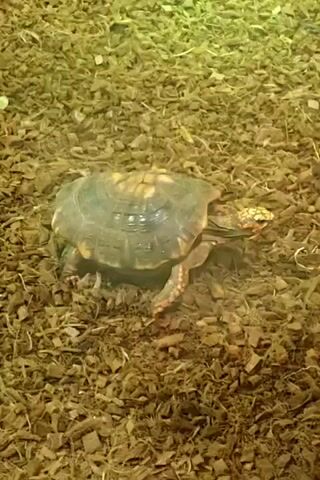
The video shows a close-up, slightly shaky shot of a small turtle walking across a surface covered with brown, textured material, resembling wood chips or mulch. The turtle has a dark shell with yellow markings and visible legs and head. The lighting appears to be artificial, casting a yellowish glow on the scene, especially in the upper portion of the frame. The turtle is moving from left to right across the frame.
Cambron-Casteau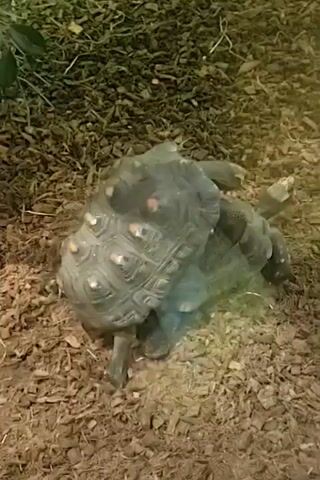
A close-up shot shows two tortoises on a substrate of wood chips and vegetation. The tortoise in the foreground is larger and has a darker shell with reddish-orange markings. Its shell is domed, and its head and legs are mostly retracted. The second tortoise is positioned behind and slightly above the first, appearing to be on top of it. Its shell is also dark and appears to be in contact with the first tortoise's shell. The tortoises' legs are visible, and they seem to be interlocked. The lighting suggests an indoor enclosure, possibly a terrarium. The scene is static, with no discernible movement from either animal.
Cambron-Casteau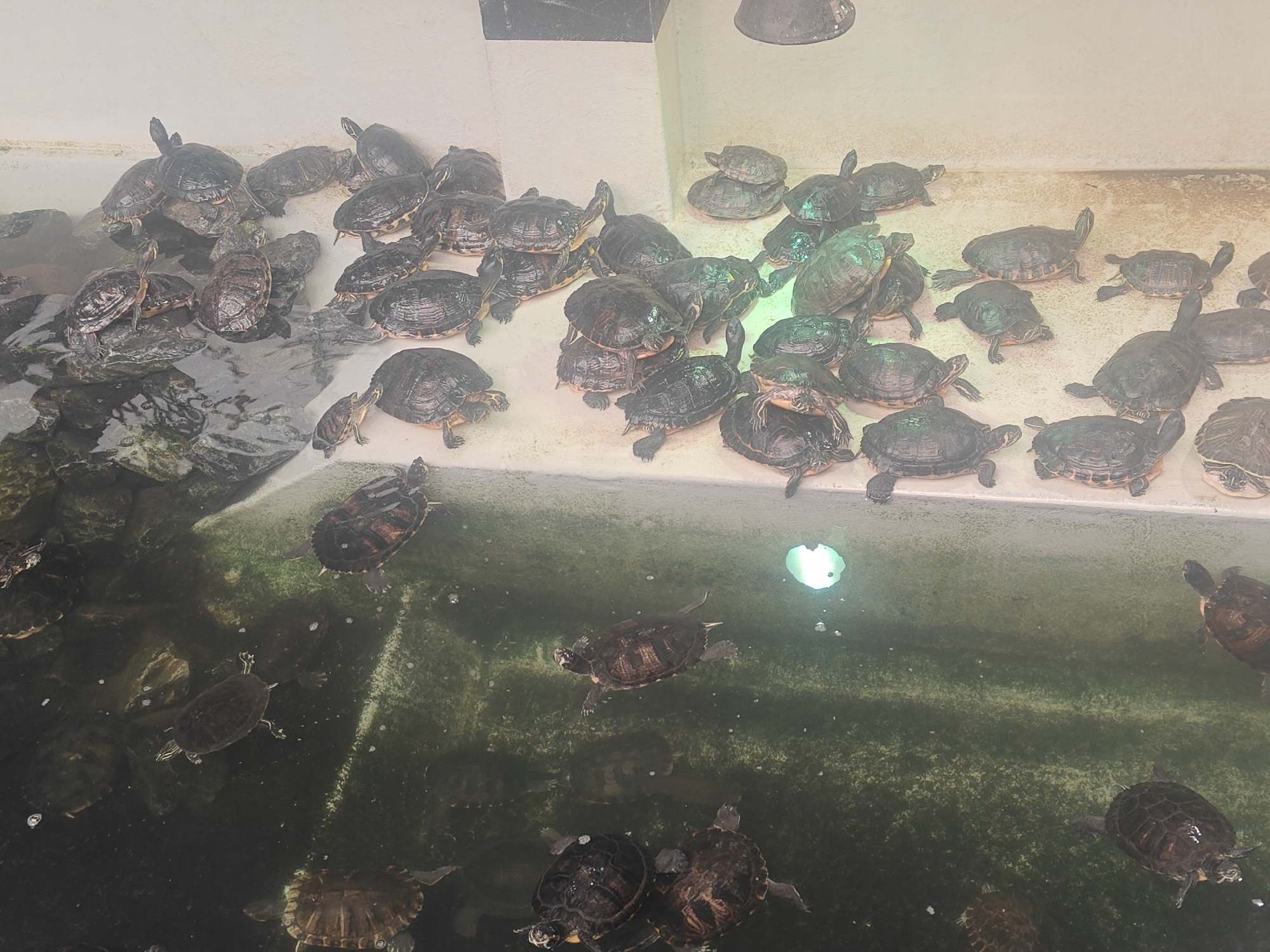
This image shows a large group of red-eared slider turtles in a shallow, murky tank. Many turtles are basking on rocks and the edge of the tank, while others are swimming in the water. The tank appears to be in an indoor enclosure, possibly a zoo or educational facility, given the artificial lighting visible at the top of the image. The water is green with algae, and there are some small bubbles visible. The turtles are varied in size, with some appearing to be juveniles and others adults. The scene is located in Cambron-Casteau, Belgium.
Cambron-Casteau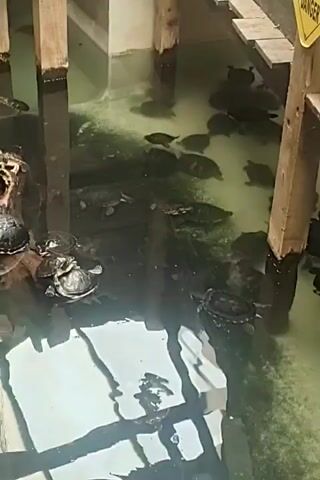
A group of turtles are swimming and basking in a shallow pool of murky green water. The pool has wooden supports and platforms surrounding it. Some turtles are clustered together on a piece of driftwood, while others are scattered throughout the water. The lighting suggests an indoor environment, possibly a zoo or aquarium exhibit.
Cambron-Casteau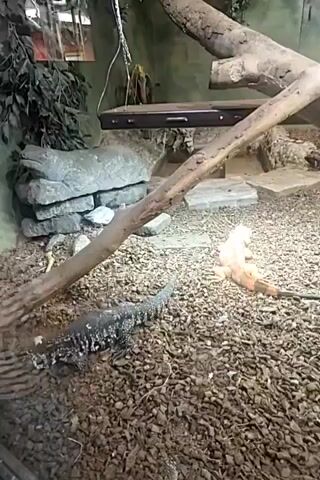
The video shows two lizards in an enclosure. One lizard is black and white and appears to be moving towards the left. The other lizard is orange and is located to the right, near a large branch. The enclosure has a gravelly floor, rocks, and a log. There are also some plants in the background.
Cambron-Casteau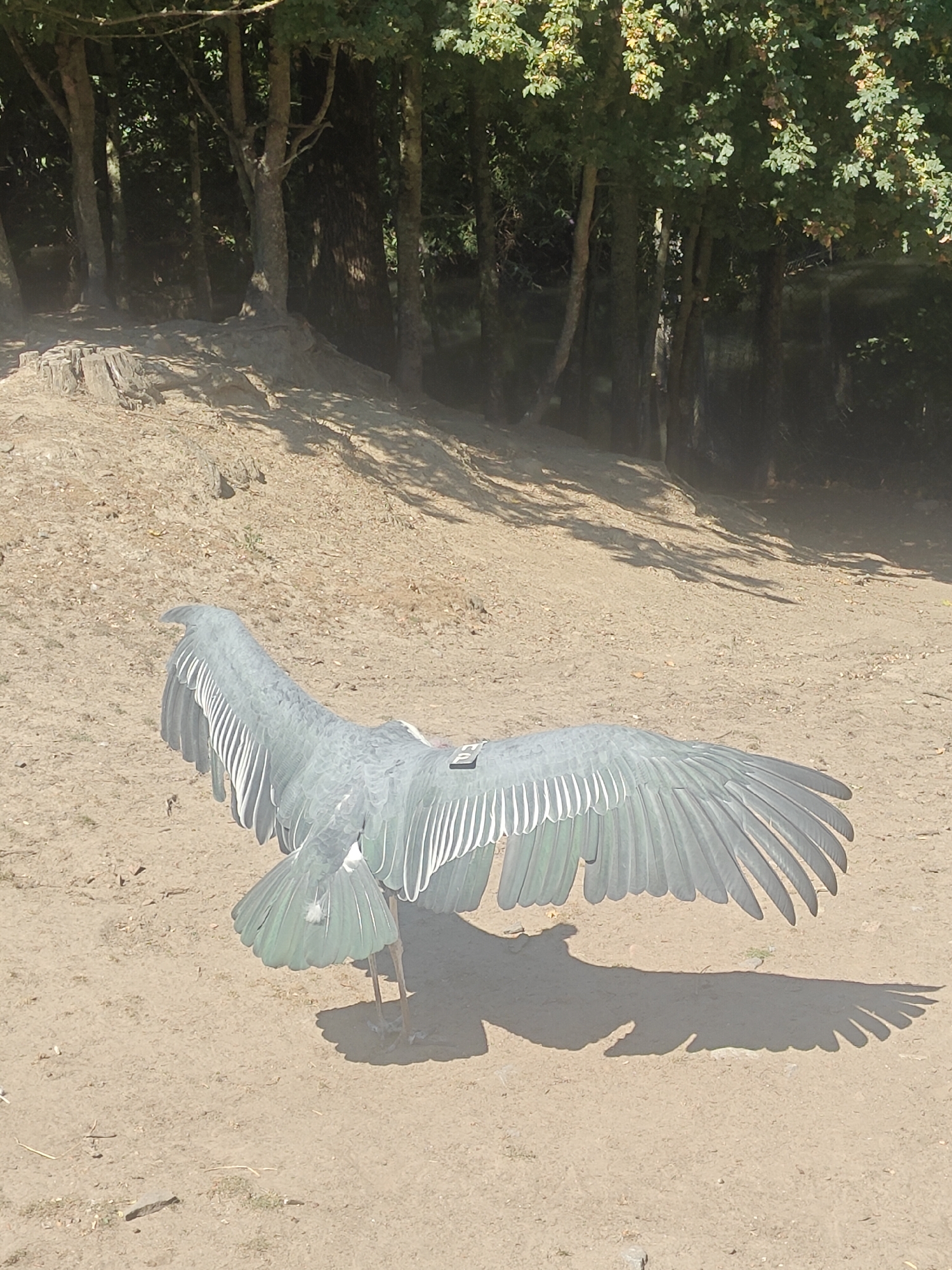
The image depicts a marabou stork with its wings outstretched, standing on a sandy, uneven ground. The bird's plumage is primarily dark grey and black, with white flight feathers forming a stark contrast. A small, dark tag is visible on the bird's back, likely for identification or tracking. The background features a dense cluster of trees with dark trunks and green foliage, suggesting a wooded area or park. Sunlight casts shadows across the ground, indicating a bright, possibly sunny day. The overall scene appears to be an outdoor enclosure, possibly within a zoo or wildlife sanctuary in Cambron-Casteau, Belgium, given the context provided.
Cambron-Casteau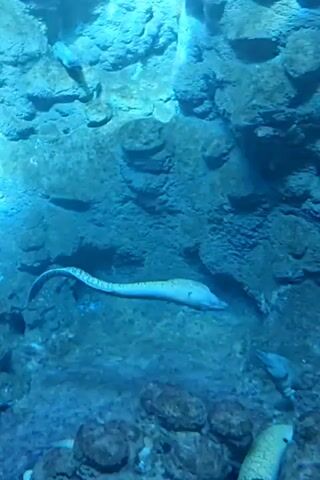
In this video, a slender moray eel with a spotted pattern swims gracefully through clear blue water. The eel is the main subject, with its long, serpentine body and distinctive markings being the focus. It navigates a rocky underwater environment, with large, textured rocks forming the backdrop. The lighting suggests an aquarium setting, as the water is illuminated with a bright, artificial light that casts a blue hue over the scene. The activity is simply the eel's movement and exploration within its habitat. There are no people visible, and the objects consist of the natural elements of the underwater environment – rocks and the eel itself. The setting is clearly aquatic, likely an aquarium tank designed to mimic a reef or rocky seabed. Notable details include the clear visibility of the water, which allows for a detailed view of the eel's features and the texture of the rocks. The blue lighting creates a serene and almost ethereal atmosphere. The eel appears to be actively swimming, not just resting, suggesting it is either foraging or simply moving around its territory. There is no indication of time of day or weather, as expected in an indoor aquarium. No text is visible in the media. The overall impression is one of observing the natural beauty and movement of marine life in a controlled environment.
Cambron-Casteau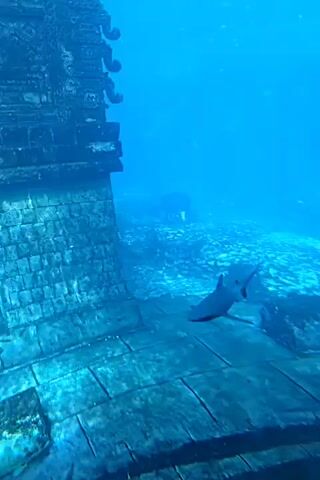
A shark swims in front of an underwater stone structure. The structure resembles ancient ruins, with large, rectangular blocks and decorative elements visible. The shark is a medium-sized, dark gray fish with a streamlined body. It is swimming from left to right in the frame, passing by an opening in the stone structure. The water is clear and blue, with some light filtering down from the surface. In the background, the seafloor is visible, covered in sand and some scattered rocks. There is also a hint of another diver or person in the distance, further back in the underwater scene.
Cambron-Casteau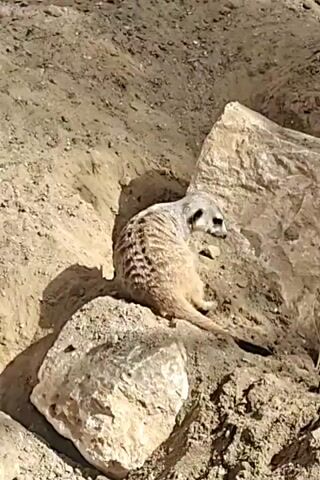
A meerkat emerges from a burrow in a sandy environment. The meerkat is light brown with dark stripes on its back. It is partially covered by a large rock. The meerkat moves its head and appears to be sniffing the ground. The surrounding area is dry and dusty, with sparse vegetation and rocks. The camera angle is high, looking down at the scene.
Cambron-Casteau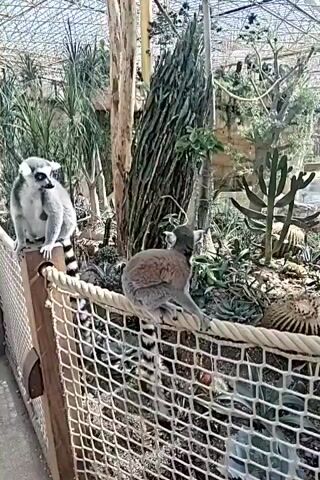
The video shows two ring-tailed lemurs in an enclosure at a zoo or sanctuary. The enclosure appears to be a greenhouse or aviary, with a transparent roof and abundant plant life, including palm trees, succulents, and cacti. A net fence with a rope railing runs along the bottom of the frame, separating the viewer from the lemurs. In the foreground, on the left, a ring-tailed lemur is perched on the top of a wooden fence post. It is facing to the right, with its characteristic black and white ringed tail hanging down. Its fur is gray and white, and its eyes are dark with white rings around them. To the right of this lemur, and further back, another ring-tailed lemur is also perched on the rope railing of the fence. This lemur is facing away from the camera, and its tail is also visible, showing its ringed pattern. A young girl, wearing a pink and white floral dress, is standing on the left side of the frame, behind the fence. She is looking towards the lemurs. The lemurs appear to be relaxed and accustomed to the presence of visitors. The overall environment is bright and green, suggesting a well-maintained habitat for the animals.
Cambron-Casteau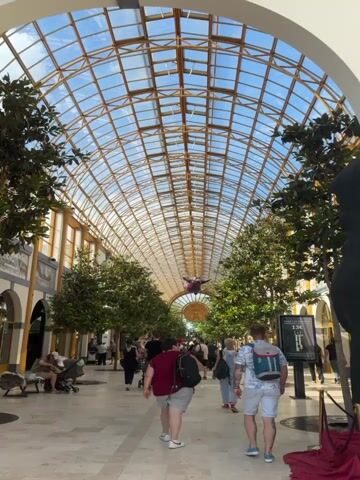
The video shows a well-lit, indoor walkway with a high, arched glass ceiling. The ceiling structure is a network of golden metal beams. Sunlight filters through the glass, illuminating the walkway. On either side of the walkway are rows of tall, leafy artificial trees, creating a canopy effect. Several people are walking in both directions along the walkway. Most of them are seen from behind, dressed in casual summer clothing. Some individuals are carrying backpacks. In the foreground, two men are walking away from the camera. One is wearing a white t-shirt, shorts with a floral pattern, and a backpack with blue accents. The other man is wearing a maroon t-shirt, dark shorts, and a black backpack. Further ahead, more people are visible, including a woman pushing a stroller. On the right side of the walkway, a vertical sign with illuminated numbers, "13," is mounted on a pole. On the left side, there are buildings with arched entrances and some decorative elements. Suspended from the ceiling, in the middle of the walkway and high above the people, is a large, purple, balloon-like inflatable object shaped like a mythical creature or a cartoon character. It appears to be a focal point or decoration within the space. The overall atmosphere appears to be that of a bustling indoor public space, possibly a shopping mall or a conservatory.
Cambron-Casteau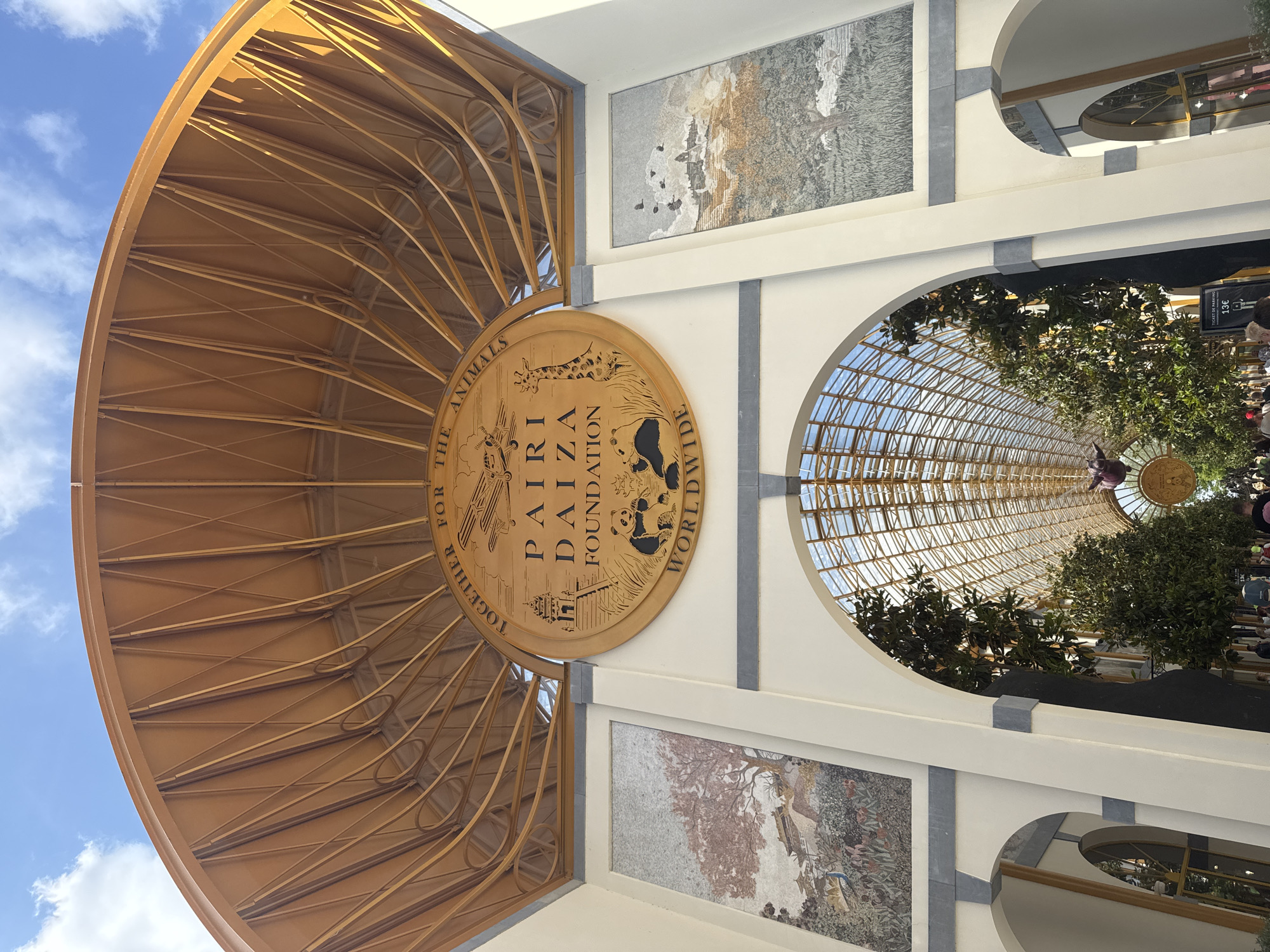
The image shows the entrance to Pairi Daiza Foundation in Cambron-Casteau, Belgium. A large, circular wooden sign with "TOGETHER FOR THE ANIMALS PAIRI DAIZA FOUNDATION WORLDWIDE" inscribed on it is prominently displayed. The sign features illustrations of a panda, a giraffe, an airplane, and a pagoda. Flanking the sign are two mosaic panels. The left panel depicts a tree with pink blossoms and traditional Asian architecture. The right panel shows a landscape with birds in flight above a tree and hills. Above the entrance is a curved, wooden structure with a lattice-like design, supporting a portion of the building. The entrance itself is an arched walkway, covered by a glass and metal roof, extending into the distance and lined with tall trees. The sky above is blue with scattered white clouds. Below the arched entrance, people are visible walking through the pathway, suggesting a public space or attraction. The overall scene conveys an architectural entrance with artistic elements and a sense of greenery within a covered walkway.
Cambron-Casteau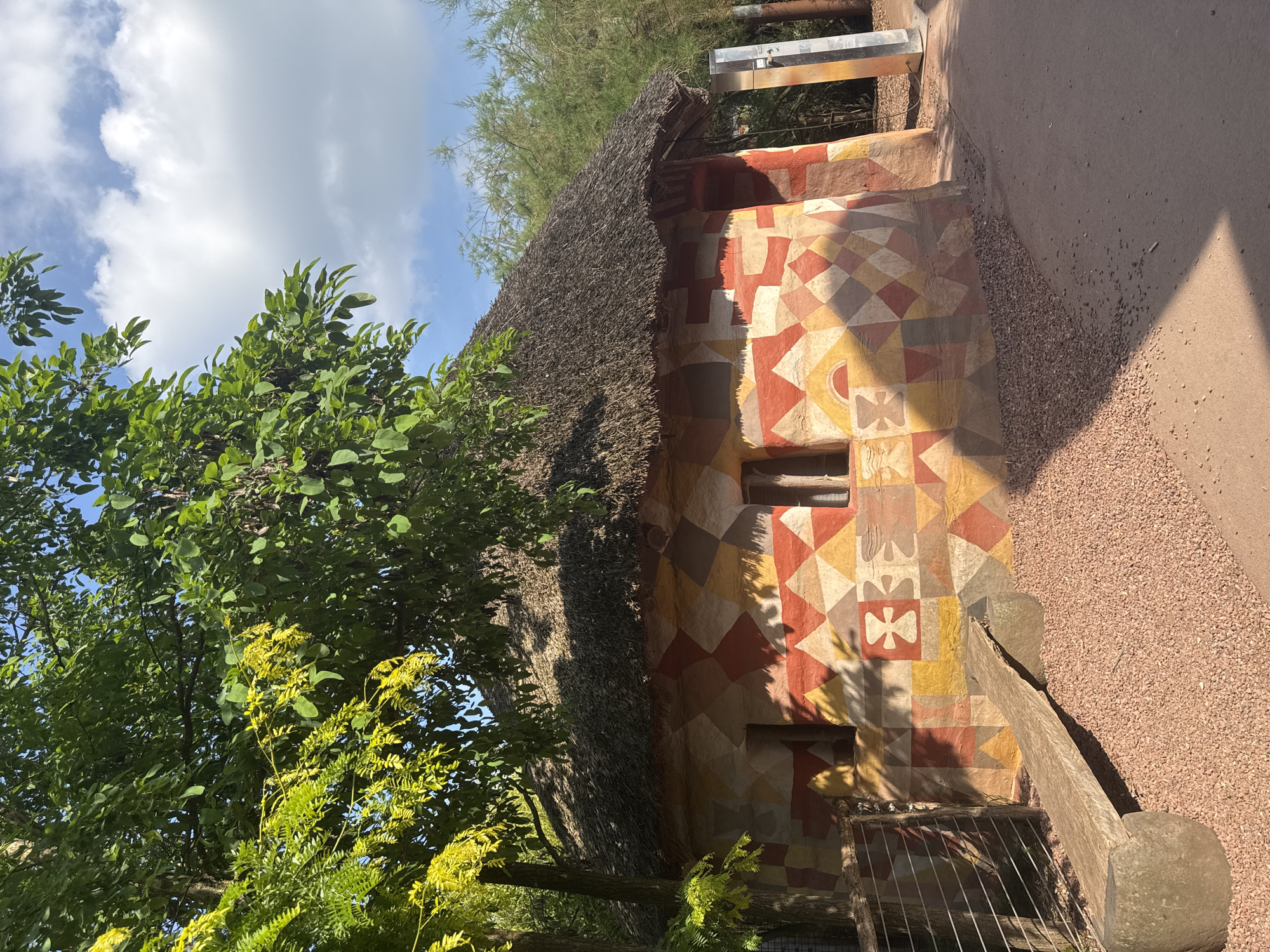
This is an outdoor, eye-level, medium shot of a brightly painted, round hut with a thatched roof, located in the Pairi Daiza zoo in Cambron-Casteau, Belgium. The hut's exterior walls are adorned with a geometric pattern of colorful rhombuses and triangles in shades of red, yellow, and beige, with some areas featuring stylized symbols. There are two small, dark windows on the side of the hut facing the camera. A wooden ramp leads up to an opening on the left side of the hut. In front of the hut is a rustic stone bench supported by two large, rounded stones, placed on a bed of reddish-brown gravel. A wire fence with wooden posts is visible to the left of the bench. Lush green trees with dappled sunlight filtering through their leaves partially obscure the top of the hut and extend into the background, where more trees and a bright blue sky with scattered white clouds are visible. A tall, grey metal structure stands to the right of the hut. The ground in front of the hut is a mixture of gravel and dirt path.
Cambron-Casteau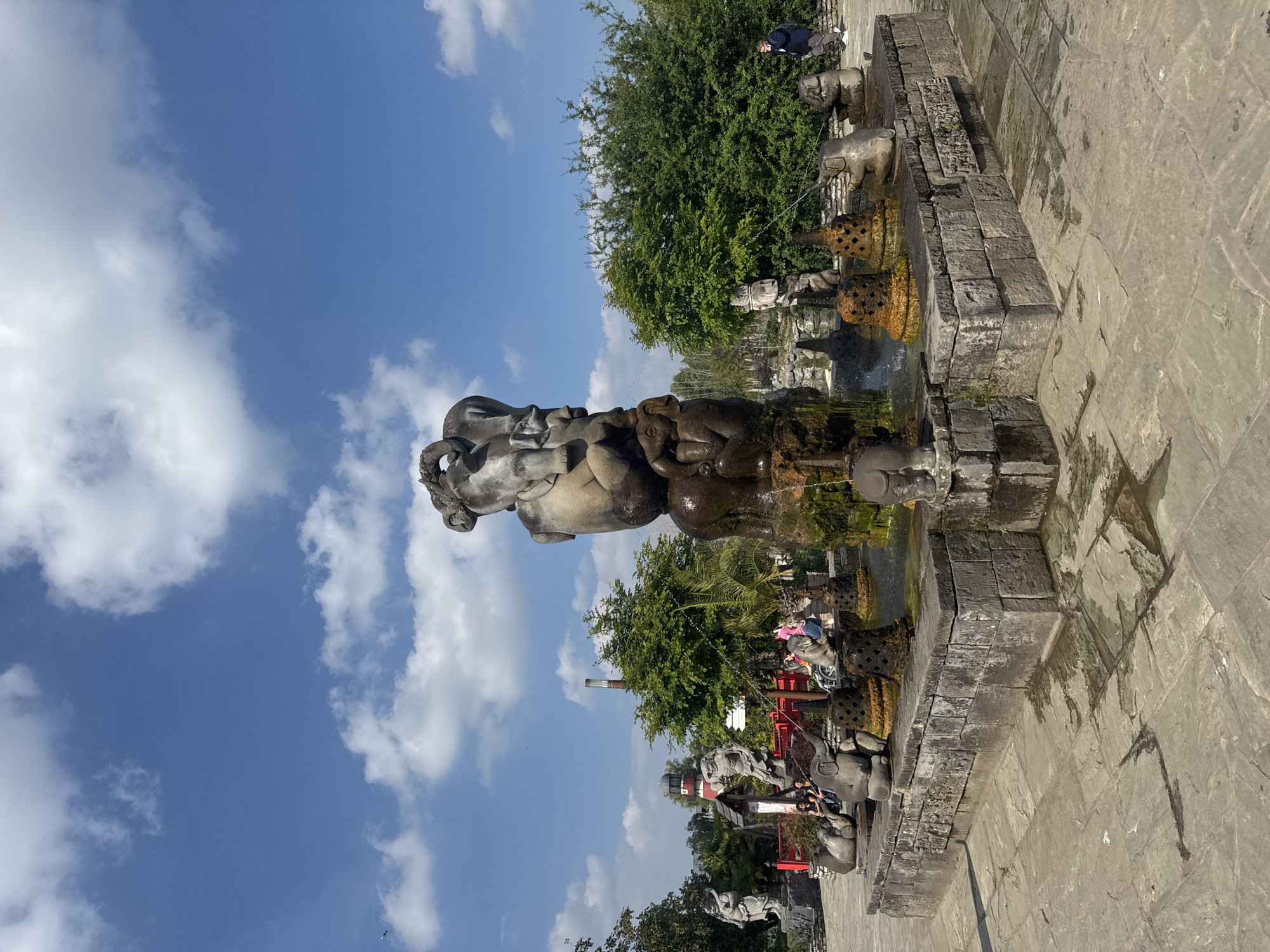
In Cambron-Casteau, Belgium, a large stone fountain stands as the central feature of an outdoor plaza. The fountain itself is a multi-tiered sculpture of stacked, anthropomorphic figures, with water cascading down its sides. Around the base of the fountain, a square, stone-lined pool is adorned with smaller sculptures, including several elephant figures, and ornate, conical structures that appear to be spouting water. The plaza is paved with large, irregular stone slabs, some of which are wet, suggesting recent water activity. To the left of the fountain, a red bridge can be seen, with several people seated and standing on or near it. Further left, a lighthouse-like structure and a statue of a standing figure are visible. Behind the fountain and to the right, lush green trees and foliage provide a natural backdrop. In the distance, a tall industrial chimney with red and white bands is present. On the right side of the frame, a person in a dark jacket and light-colored pants stands, appearing to be looking at their phone. The sky above is a bright blue, dotted with fluffy white clouds. The overall impression is of an outdoor decorative installation, likely a park or garden attraction, with a mix of artistic sculptures and natural elements.
Cambron-Casteau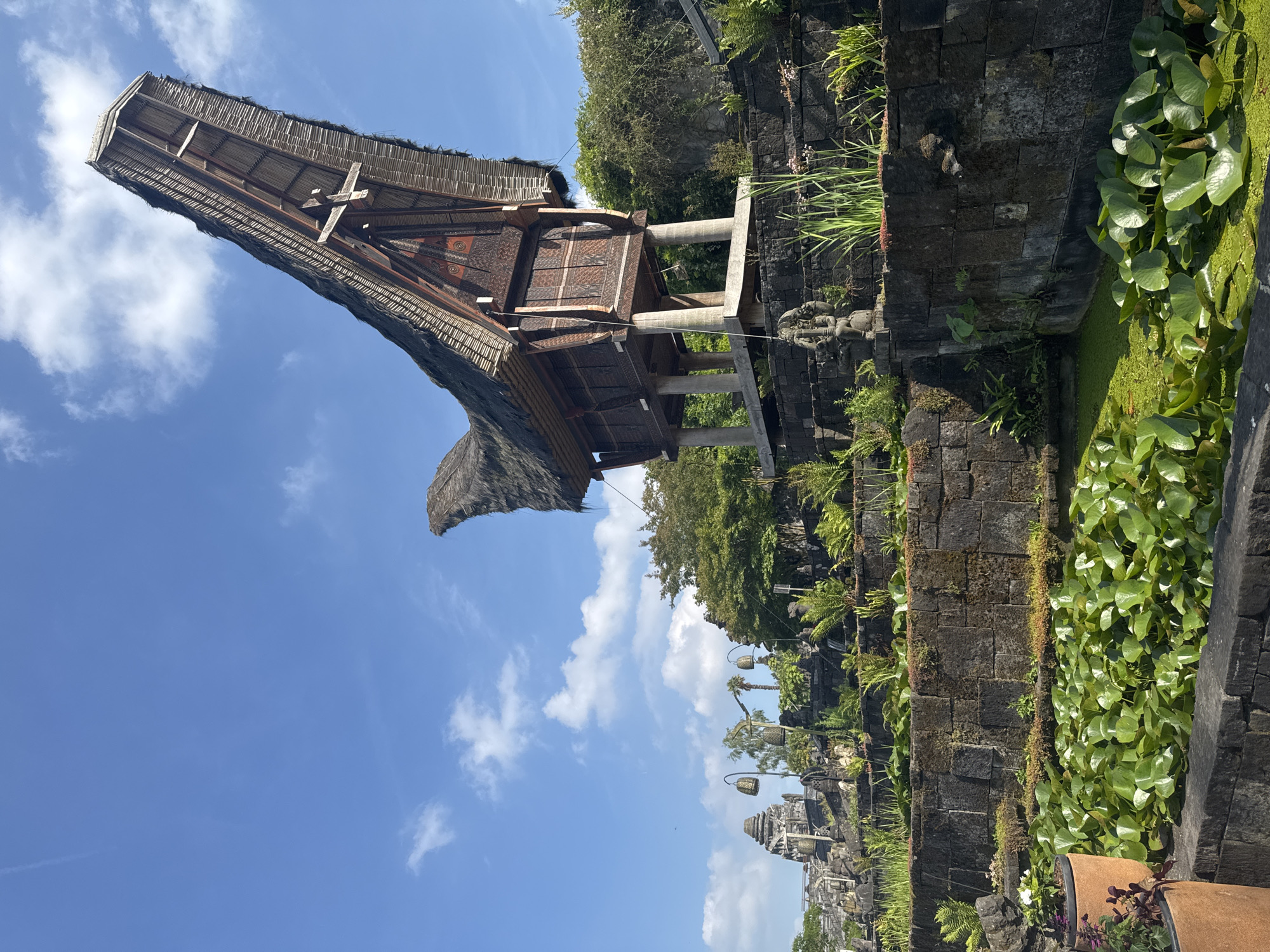
The image depicts a traditional Tongkonan house, a vernacular architectural style from Toraja, Indonesia, elevated on stilts and featuring a distinctive saddleback roof. This structure is situated in a landscaped garden environment. In the foreground, a pond filled with lily pads and lush green aquatic plants is visible. Behind the pond, a stone retaining wall creates tiered garden levels. Various plants, including ferns and grasses, grow along these terraces. A stone statue of a figure is positioned on one of the upper levels of the wall. In the background, other stone structures and landscaping elements are present, including ornate lamp posts. The sky above is blue with scattered white clouds. The scene suggests an outdoor setting designed to showcase architectural and botanical elements, likely within a park or botanical garden. This specific Tongkonan house replica is located at Pairi Daiza, a zoo and botanical garden in Cambron-Casteau, Belgium.
Cambron-Casteau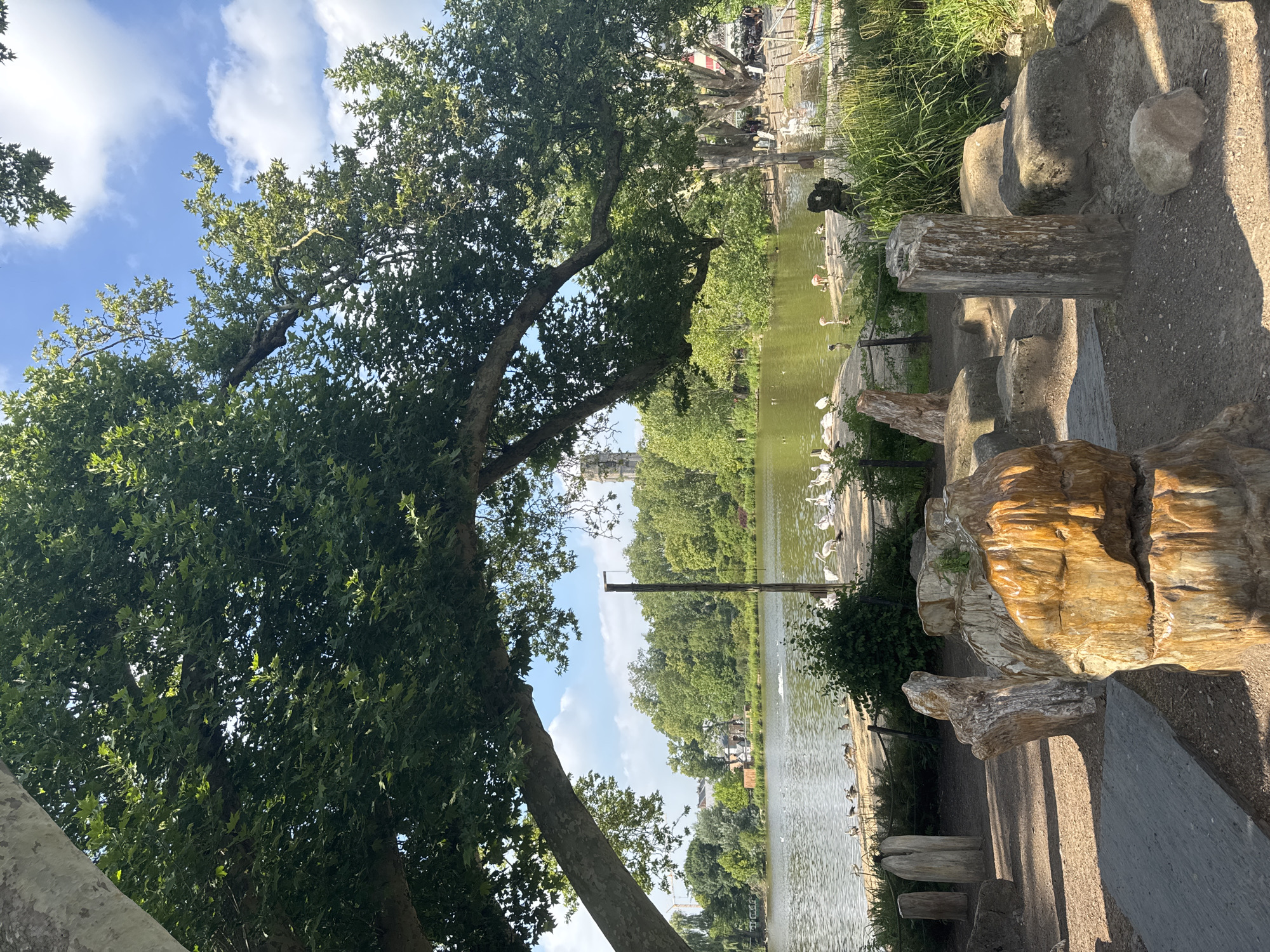
The image depicts a zoo enclosure at Pairi Daiza in Cambron-Casteau, Belgium, featuring a large pond and a variety of birds. In the foreground, several large, weathered wooden stumps and rocks are arranged on the sandy ground, creating a naturalistic play area or seating arrangement. A large tree with sprawling branches and lush green leaves dominates the upper portion of the frame, casting shadows. Beyond the foreground, the pond stretches across the middle ground, its surface reflecting the sky. Along the edge of the pond, a group of pelicans and other white birds are visible, some standing on the sandy bank and others in the water. A flock of smaller birds, likely ducks, are also present on the bank. In the background, a dense line of trees forms a natural backdrop to the enclosure, with buildings and a tall structure, possibly a tower or part of an exhibit, visible among the trees. The sky is blue with scattered white clouds, indicating a sunny day. The overall scene suggests a peaceful and naturalistic environment designed for both animals and visitors.
Cambron-Casteau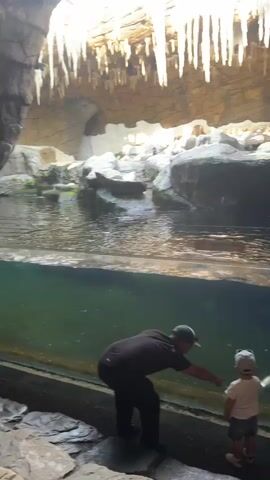
A man and a child are standing in front of a large aquarium exhibit. The exhibit appears to be designed to resemble a rocky, icy environment with water. The man is crouched down, gesturing towards the water, while the child stands beside him, looking intently. Below the water's surface, several penguins are swimming and interacting. One penguin is actively swimming underwater, while another appears to be jumping into the water from the surface. Above the water, on the rocky ledges of the exhibit, several penguins are standing. The exhibit also features icicle-like formations hanging from the ceiling.
Cambron-Casteau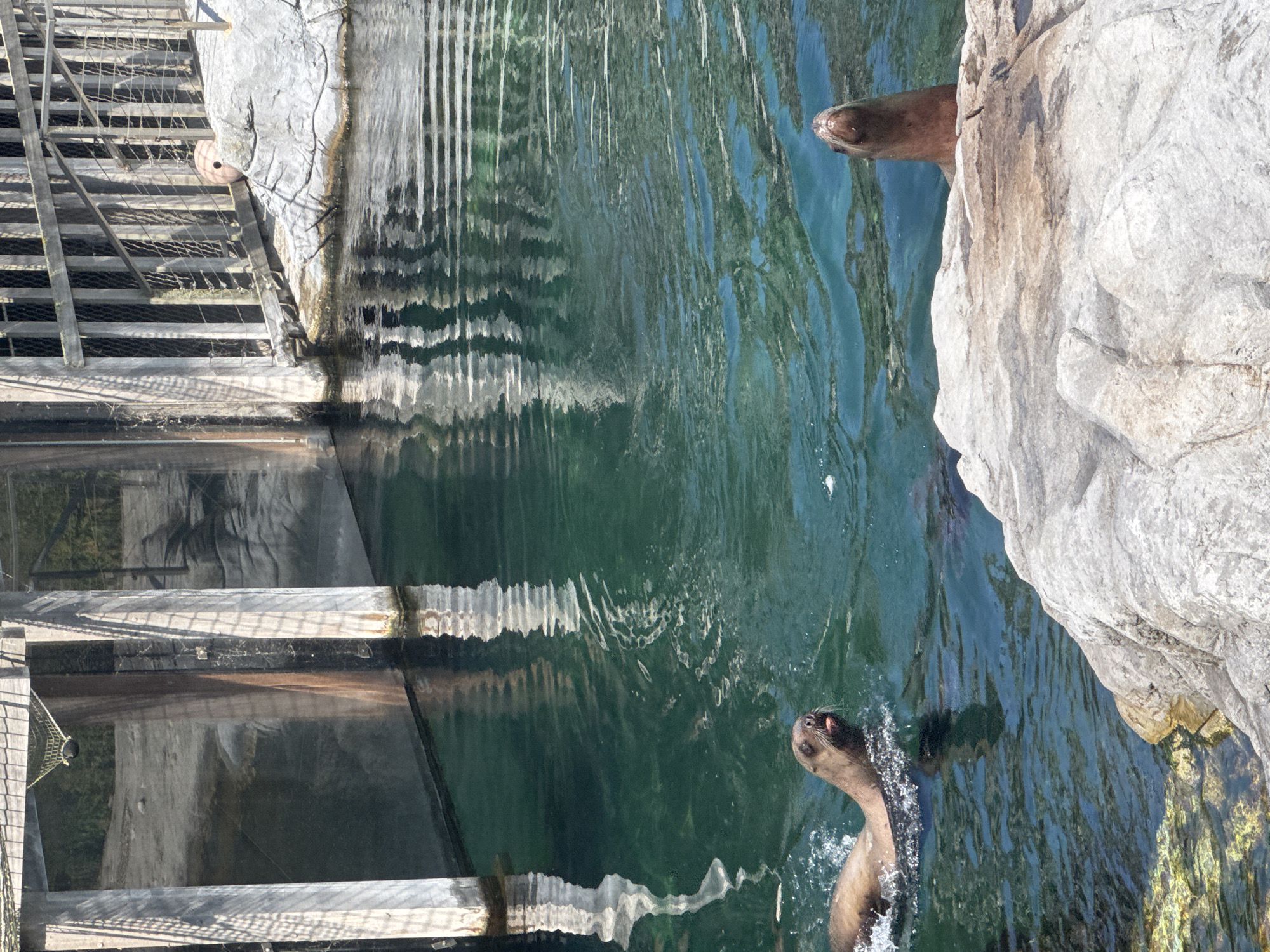
The image depicts a zoo enclosure at the Parc Animalier de Cambron, Belgium, featuring two sea lions swimming in clear turquoise water. In the foreground, a large, light-colored rock formation juts out of the water. To the left, a sea lion with its head above water is actively swimming, creating ripples. Further back and to the right, another sea lion's head and neck are visible, peering out of the water. The enclosure also includes a wooden structure with vertical beams and a fence, casting shadows on the water. The background shows a rocky embankment and the zoo's infrastructure, indicating a controlled habitat for the animals.
Cambron-Casteau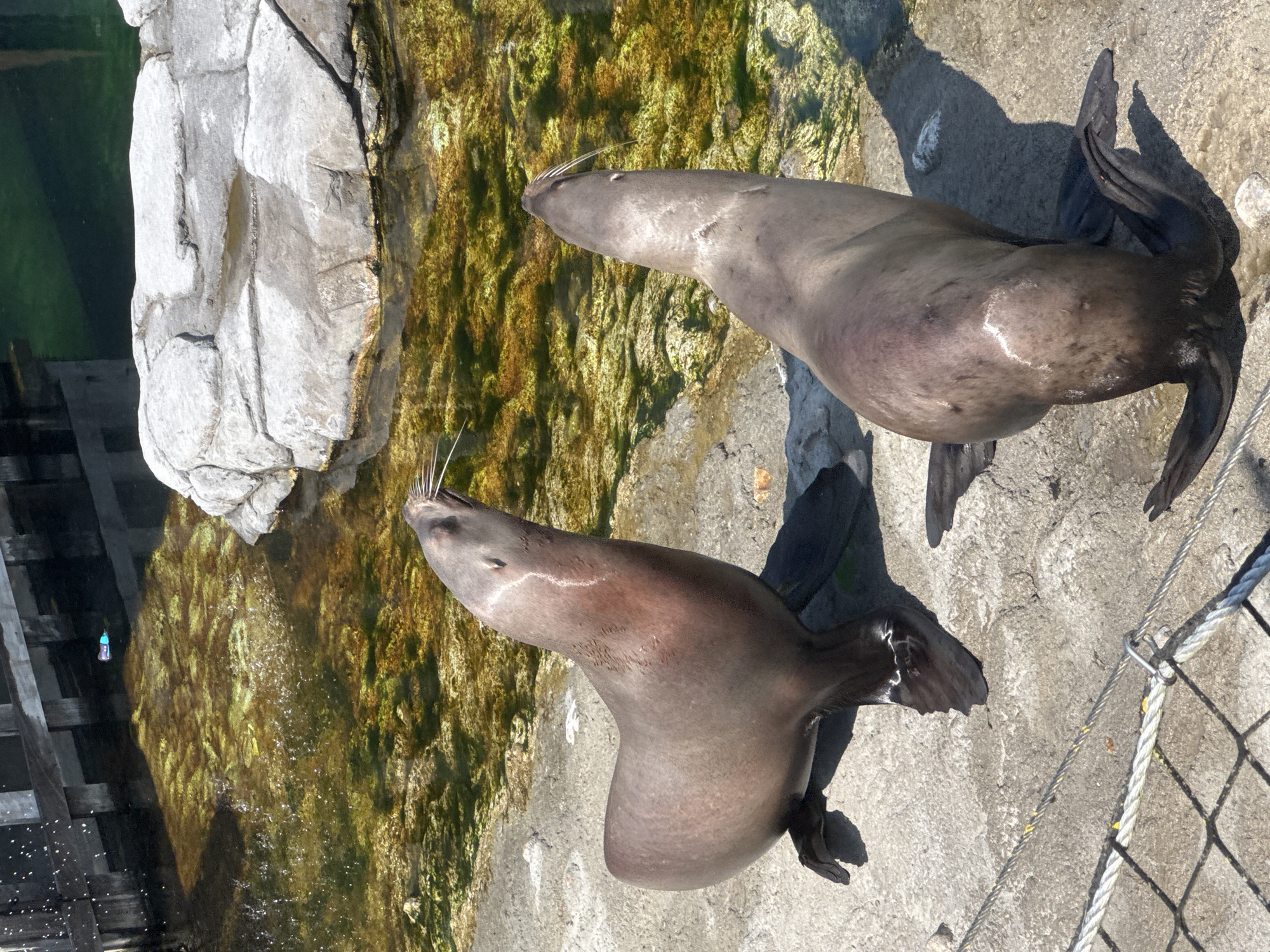
The image depicts two sea lions resting on a concrete embankment beside a body of water. The sea lion on the left is standing on its hind flippers, with its head tilted upwards. The sea lion on the right is lying down, facing away from the camera. The water is murky and appears to have algae growing in it. In the background, a wooden structure and a large rock are visible. The scene is likely part of a zoo or marine park, possibly the Pairi Daiza park in Cambron-Casteau, Belgium, which is known for its marine animal exhibits.
Cambron-Casteau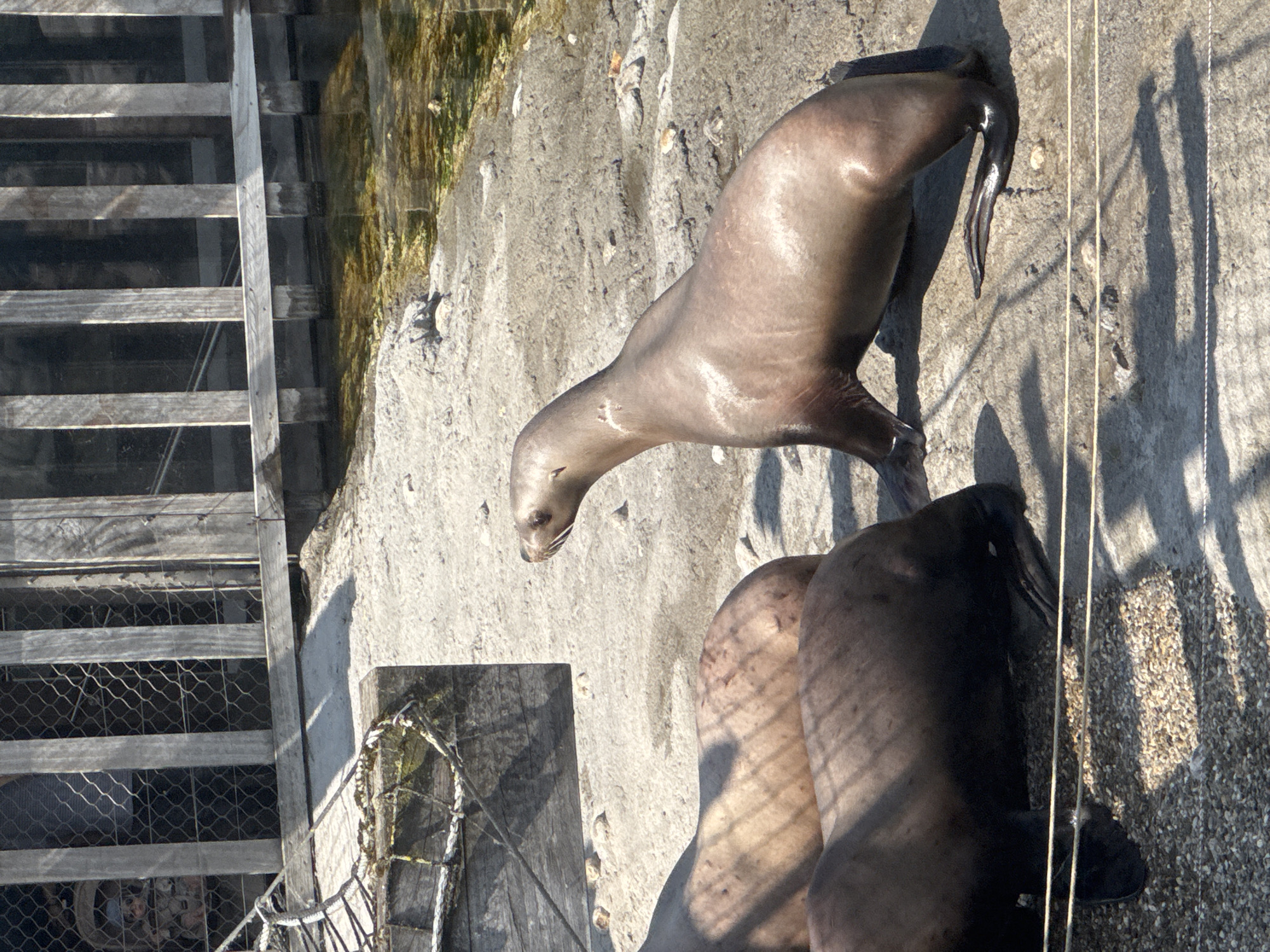
In Cambron-Casteau, Belgium, at a zoo or wildlife park, three sea lions are visible on a sandy, rocky area near a body of water. One sea lion is lying on its side in the foreground, its dark fur a stark contrast to the lighter colored sea lions behind it. Another sea lion is partially visible behind the first, its light brown fur showing. The third, a light brown sea lion, is standing and looking to the right. Behind the sea lions, a wooden fence with vertical planks and wire mesh encloses an area where a person is partially visible. The water is a murky green, suggesting algae or sediment. The ground is a mix of sand and small pebbles, with scattered rocks.
Cambron-Casteau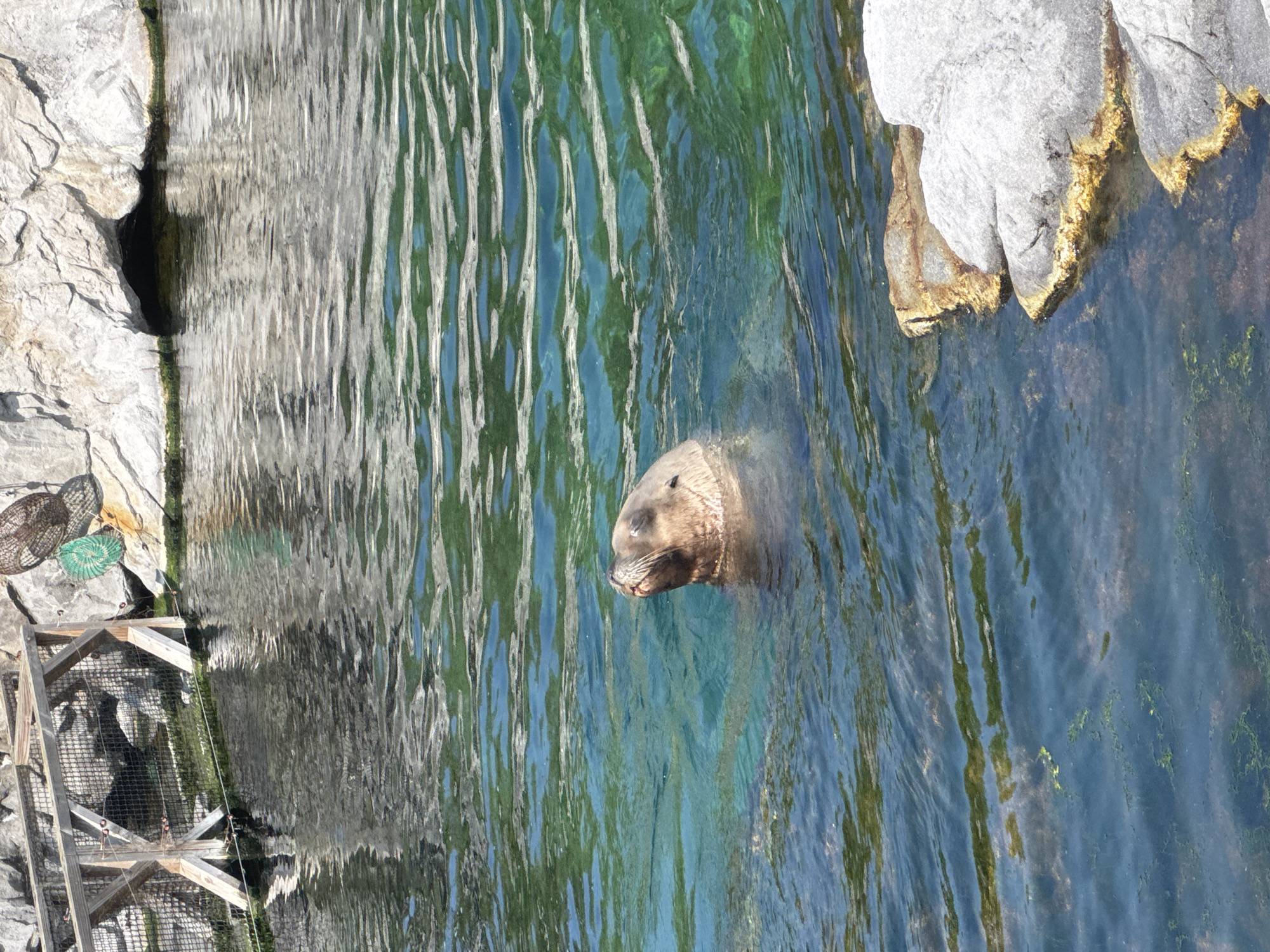
In Cambron-Casteau, Belgium, a sea lion is visible in clear, blue-green water. The sea lion, with its head above the surface, appears to be looking upwards. The background features a rocky enclosure with a wooden structure and netting. The water's surface is rippled, and there are some green aquatic plants visible. The scene suggests a habitat designed for marine animals, possibly within a zoo or wildlife park.
Cambron-Casteau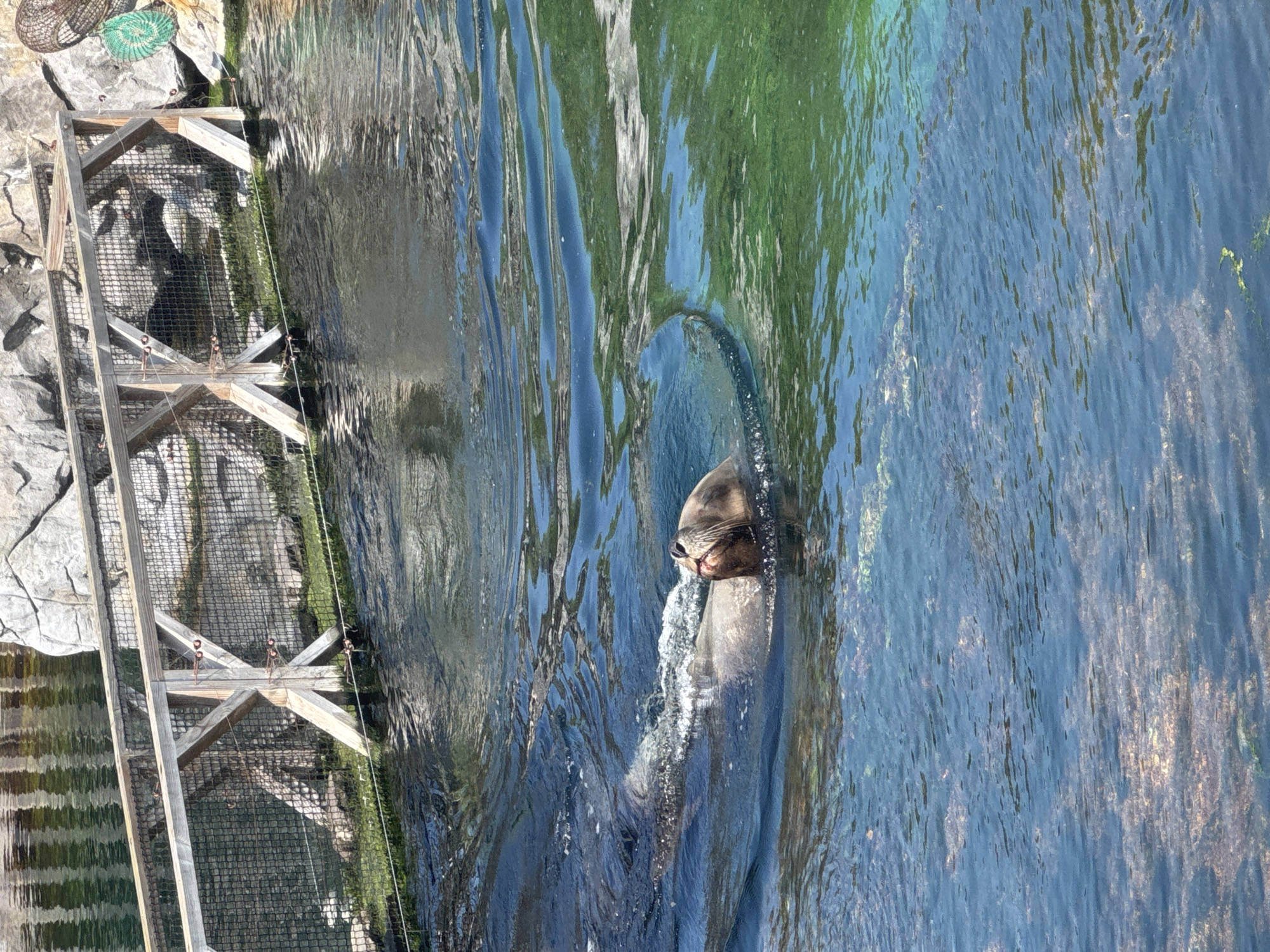
In the city of Cambron-Casteau, Belgium, a seal is swimming in a body of water. The seal's head and part of its body are visible above the water's surface. The water is clear and blue with some green algae visible beneath the surface. In the background, there is a wooden fence with a mesh covering, and beyond that, large rocks and green vegetation. The overall scene suggests an outdoor enclosure, possibly a wildlife park or zoo.
Cambron-Casteau