Campo Grande, Brazil
16 memories from Campo Grande, Brazil
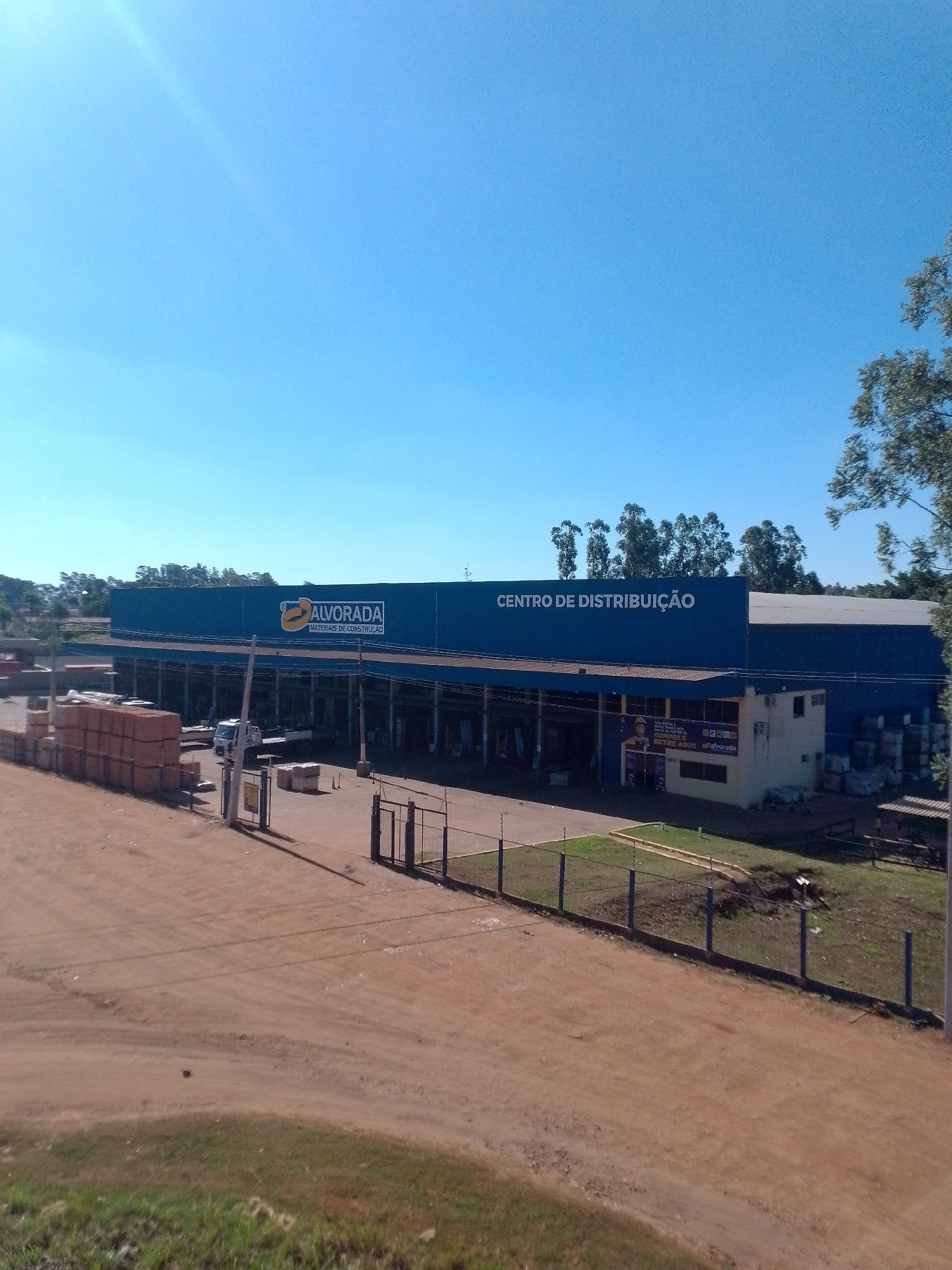
This is an exterior, high-angle, wide shot of a large, blue commercial building in Campo Grande, Brazil. The building appears to be a distribution center for construction materials, as indicated by the signage that reads "ALVORADA MATERIAIS DE CONSTRUÇÃO" and "CENTRO DE DISTRIBUIÇÃO". The building has a long, flat roofline and is supported by multiple blue pillars along its facade. Stacks of reddish-brown bricks and other building materials are visible outside the structure, particularly on the left side of the image. A white truck with a flatbed trailer is parked in front of the building. The surrounding area is a mix of dirt, grass, and a few trees. The sky is clear and blue. A chain-link fence with barbed wire runs along the perimeter of the property, and a metal gate is visible on the right side of the image. The scene suggests a sunny day at a commercial facility.
Campo Grande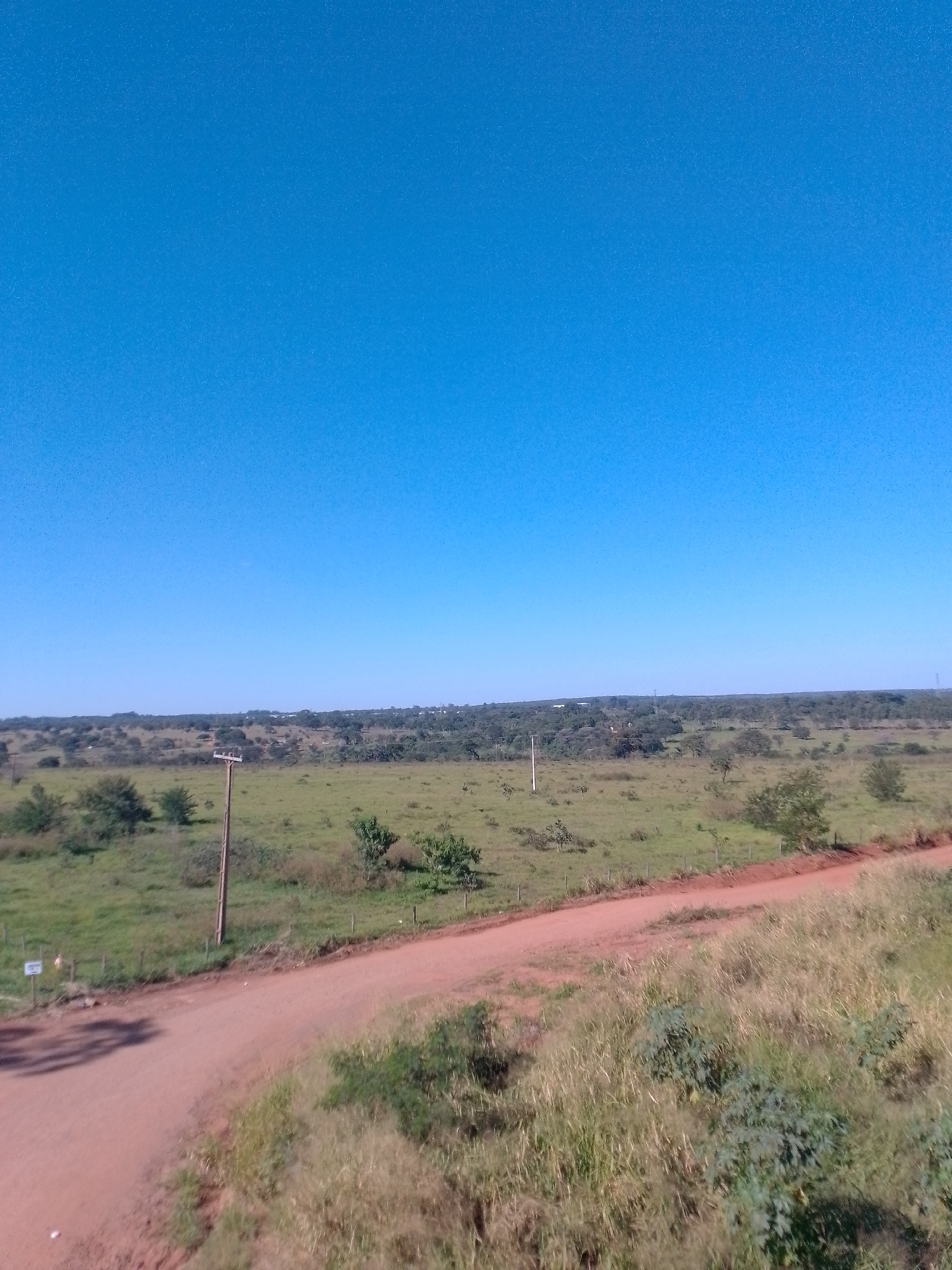
The image captures a rural landscape under a clear blue sky. In the foreground, a reddish-brown dirt road curves from the bottom left towards the right side of the frame. The road is bordered by dry, golden grasses and some green bushes. Beyond the road, a vast expanse of green grassland stretches out, dotted with scattered trees and shrubs. In the middle ground, a single wooden utility pole stands prominently in the grassy field, with thin wires extending from it. The background features a distant tree line with more foliage, and beyond that, a hazy horizon suggesting a settlement or more developed area. The overall scene is one of a quiet, undeveloped rural area, likely on the outskirts of Campo Grande, Brazil, characterized by open fields and a dirt road typical of the region's rural or semi-rural outskirts. There are no people or animals visible in the image.
Campo Grande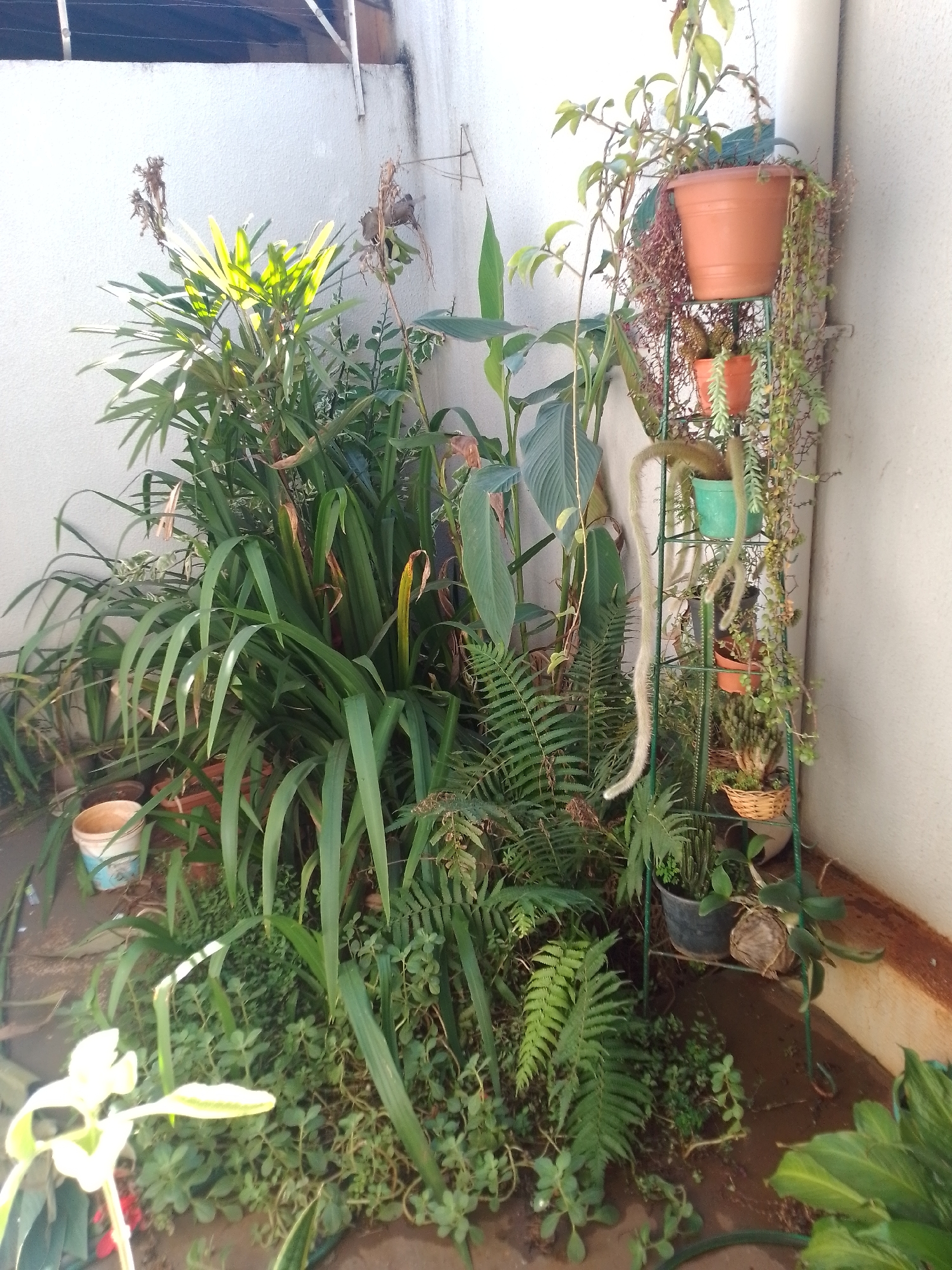
The scene depicts an outdoor corner in Campo Grande, Brazil, formed by two intersecting light-colored, textured stucco walls. The ground consists of exposed soil, which appears damp in various sections, interspersed with loose debris. A white and blue plastic bucket is positioned on the ground in the lower left quadrant. The area is densely populated with a diverse collection of foliage plants. Prominently featured are tall plants with bright green, fan-shaped leaves in the upper left, receiving direct sunlight. Numerous plants with long, strap-like leaves occupy the mid-ground, some exhibiting brown tips. Large-leafed tropical plants are visible in the left and central areas, along with various ferns particularly in the lower-center. A low-growing, small-leafed ground cover spreads across the soil. On the right side of the frame, a multi-tiered green metal plant stand holds several potted plants. The top tier supports a large terracotta pot containing a bushy, trailing plant. Below this, a smaller orange terracotta pot holds a trailing succulent. Two distinct pots on the stand feature long, pendulous, furry cacti, identifiable as 'Monkey Tail' cacti (*Hildewintera colademononis*). Additional pots on lower tiers contain a variety of cacti and succulents, with one plant placed within a woven basket. A segment of a green garden hose lies on the ground in the lower right. The environment is illuminated by bright natural light, creating distinct highlights on the foliage. No human or animal subjects are present, and no specific actions are occurring.
Campo Grande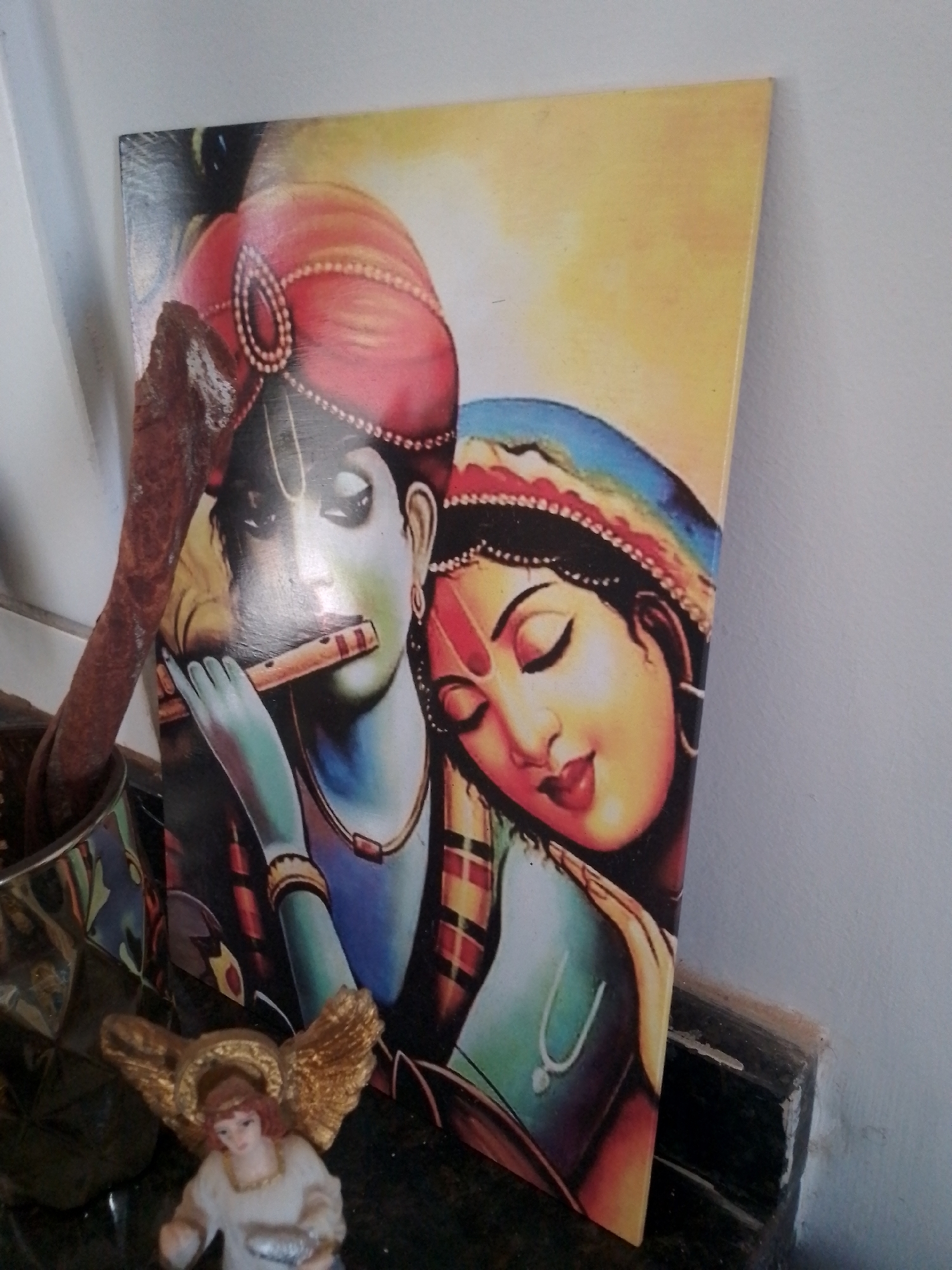
An indoor scene in the city of Campo Grande, Brazil, features a rectangular canvas print leaning against a light-colored wall. The print depicts the Hindu deities Krishna and Radha. Krishna, on the left, has blue-green skin, a red turban with beaded ornamentation, and a 'U'-shaped tilak on his forehead. He is shown playing a wooden flute with his hands. Radha, on the right, has fair skin, a blue head covering, and a red bindi on her forehead, with her eyes closed, leaning her head on Krishna's shoulder. In the bottom-left foreground, a metallic faceted container holds a dark, textured, irregular object that extends upwards, partially obscuring the top-left portion of the print. To the right of the container, a small figurine of an angel with golden wings, fair skin, and reddish-brown hair, wearing a white robe and holding a small silver object, rests on a dark, reflective surface. The wall to the right of the print is plain and off-white. The bottom-right foreground reveals a dark, chipped, and dusty ledge or surface.
Campo Grande
A static, eye-level shot of a projector screen on a light-colored wall is shown. The screen displays a logo featuring a striped circle above the word "MORENA." Below the projected image, a dark shelf holds various items including a white router with antennas, several trophies or decorative objects, a straw hat, a black fedora, and a silver stereo system. At 0:03, the projected image abruptly disappears, leaving the wall blank, while the camera remains still. The lighting in the room is dim.
Campo Grande
The image depicts an indoor scene, likely a living room or entertainment area, in Campo Grande, Brazil. A white or light-colored wall serves as a projection screen for a video or movie, displaying the Portuguese word "DESRESPEITO" (meaning "disrespect" or "lack of respect") in white letters. The projected image shows two individuals; one on the left is partially visible wearing an orange garment, while the person on the right is more clearly depicted from the chest up, wearing a light-colored helmet or headgear and a harness, with their mouth open, suggesting an intense or vocal action. Below the projected image, a dark brown or black table with silver metal framing is positioned. On the table's surface, from left to right, are a white Wi-Fi router with multiple vertical antennas, a small collection of dark stones, a small framed picture, a light brown fedora-style hat with a black band, a black wide-brimmed hat, and a rustic straw hat. The area beneath the table reveals various objects: on the far left, a dark, partially obscured object (possibly a cushion or bag), followed by a clear glass tumbler, a small wooden statuette, an unidentified white container, a silver Oscar-like trophy, another wooden object, and a small framed item. To the right of the table, on a separate gray stand, are two stacked electronic devices: an LG-branded silver soundbar or media player on top, and a silver DVD player or similar entertainment unit below, featuring a disc tray and a control knob. An electrical outlet is visible on the wall behind these devices. Partially visible on the far right is a light-colored backpack or bag. The floor consists of light-colored tiles with visible grout lines. The overall lighting suggests an indoor setting with ambient light, possibly subdued for projection viewing.
Campo Grande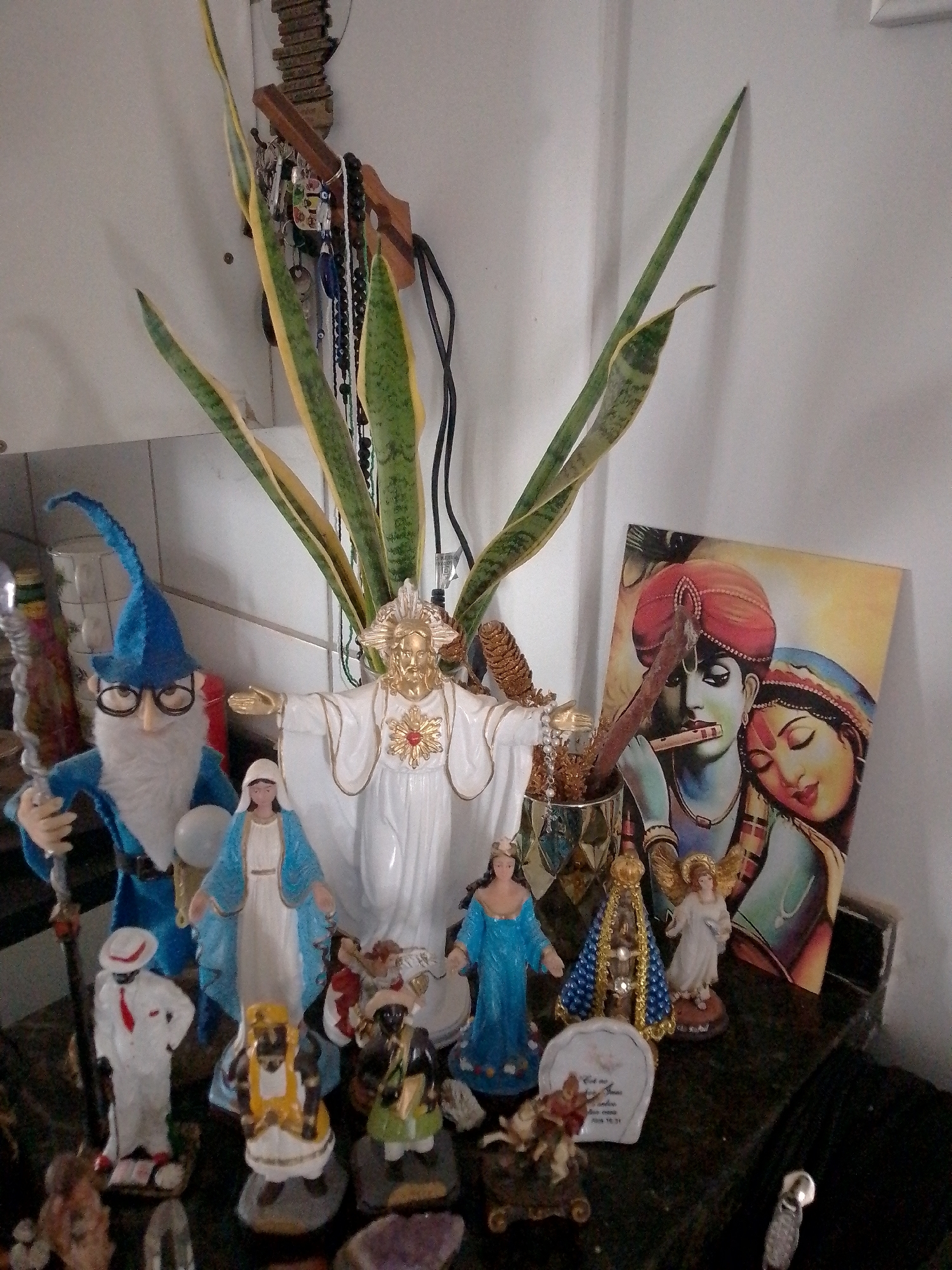
This image, captured in the city of Campo Grande, Brazil, displays an indoor setting, likely an altar or shelf, featuring a diverse collection of religious and decorative figurines. A prominent white statue of Jesus Christ with open arms, adorned with a golden headpiece and a red and gold Sacred Heart emblem on its chest, stands centrally. To its immediate left, a blue-clothed gnome or wizard figurine, complete with a white beard, glasses, and a staff, is positioned. Adjacent to the Jesus statue on the right, a golden, ornate figurine of Our Lady of Aparecida, embellished with small lights or jewels, is visible, flanked by a blue-robed female figurine and a cream-colored angel figurine with golden wings. Additional smaller figurines are arranged on the dark surface in the foreground, including a white-suited figure with a red tie, a yellow and white-robed figure, and a dark-skinned figure in green attire. A framed print or canvas depicting Krishna playing a flute alongside Radha, who rests her head on his shoulder, leans against the white wall on the right side of the display. A metallic vase or pot containing dried decorative elements is situated to the left of the print. In the background, a tall, variegated green and yellow snake plant (Sansevieria) ascends against the white wall. Above and behind the plant, a wooden rack or hook system is mounted on the wall, from which various necklaces and keychains, some featuring evil eye charms, hang. Electrical cords are visible behind the plant on the upper right. The display rests on a dark, possibly polished, surface. Pieces of purple amethyst crystals are visible in the bottom right corner of the frame.
Campo Grande
This severely motion-blurred indoor photograph captures a collection of objects arranged on a dark surface against a light-colored wall, located in Campo Grande, Brazil. A prominent snake plant (Sansevieria trifasciata) in a pot occupies the central upper portion of the frame, with its green and yellow-edged leaves extending upwards. Below and surrounding the plant is an array of numerous small, indistinct figurines or statues. Recognizable forms include a blue-hatted gnome or wizard figure on the left, several light-colored figures possibly representing religious or angelic subjects, and a figure in blue, potentially the Virgin Mary. To the far right, a rectangular object, likely a framed print or painting, displays blurred warm colors, predominantly reds, oranges, and yellows. The overall scene suggests a decorative display on a table or shelf.
Campo Grande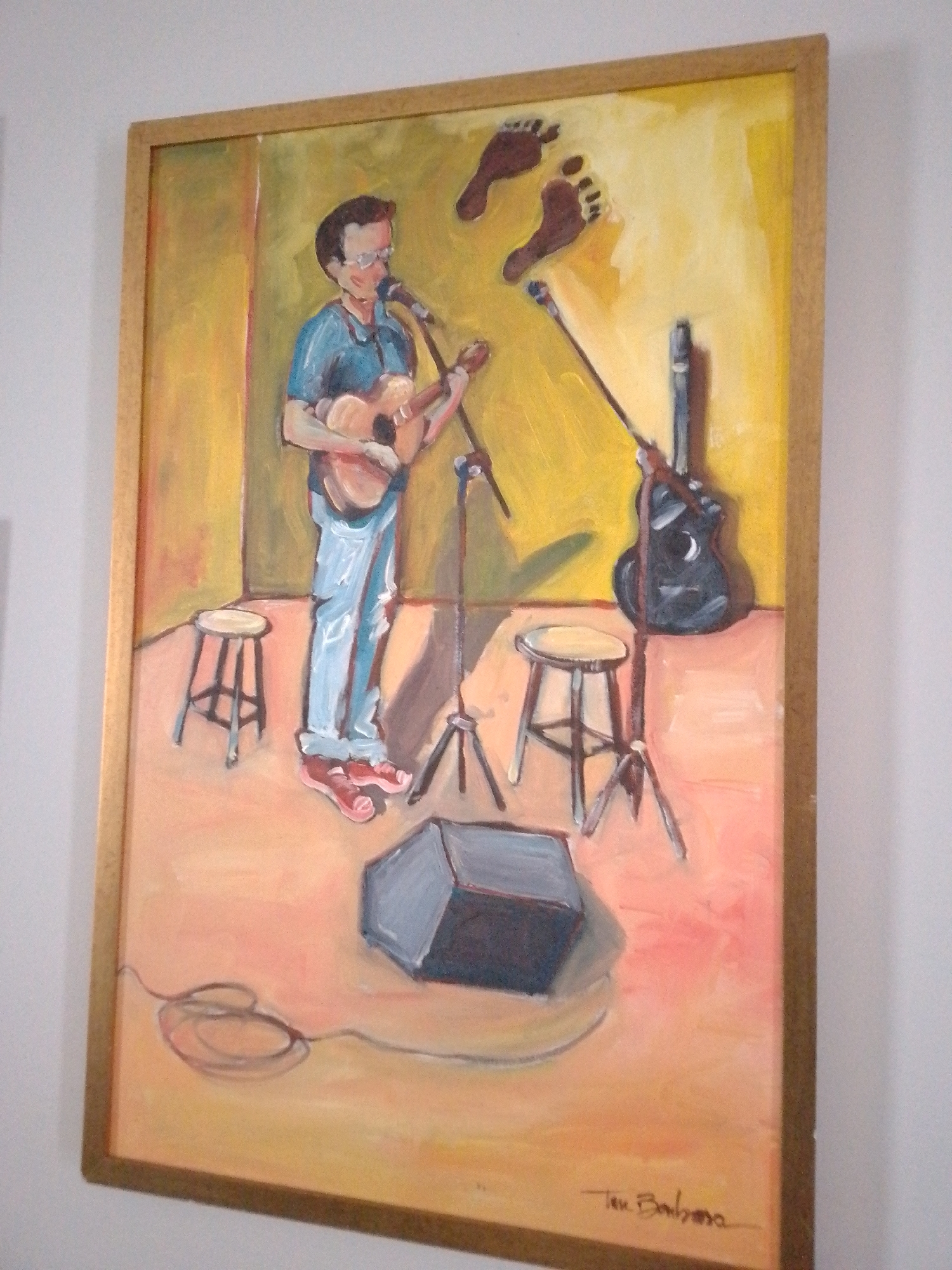
The image displays a vertically oriented, framed oil painting mounted on a plain white wall in Campo Grande, Brazil. The painting, rendered with visible brushstrokes, depicts a male musician performing on what appears to be a stage. The central figure, a light-skinned male with short dark hair and glasses, stands slightly left of center. He is wearing a blue polo shirt, light blue jeans, and red shoes. He is actively playing a light-brown acoustic guitar and singing into a silver-colored microphone mounted on a black stand directly in front of him. On the stage floor, two light-colored wooden stools are present: one to the musician's left and another to his right. A second black microphone stand is positioned on the right side of the stage, against which a black acoustic guitar leans vertically. In the foreground, a dark gray rectangular speaker or amplifier box rests on the stage floor, connected to a coiled cable visible in the lower-left portion of the painting. The background of the stage consists of a yellow wall, with the floor painted in shades of orange and pink. Two stylized, dark brown human footprints are depicted on the upper-right section of the yellow wall, appearing to float above the scene. The artist's signature, "Teca Balbina," is visible in dark script in the bottom right corner of the painting. The painting is enclosed within a simple, light-colored wooden frame.
Campo Grande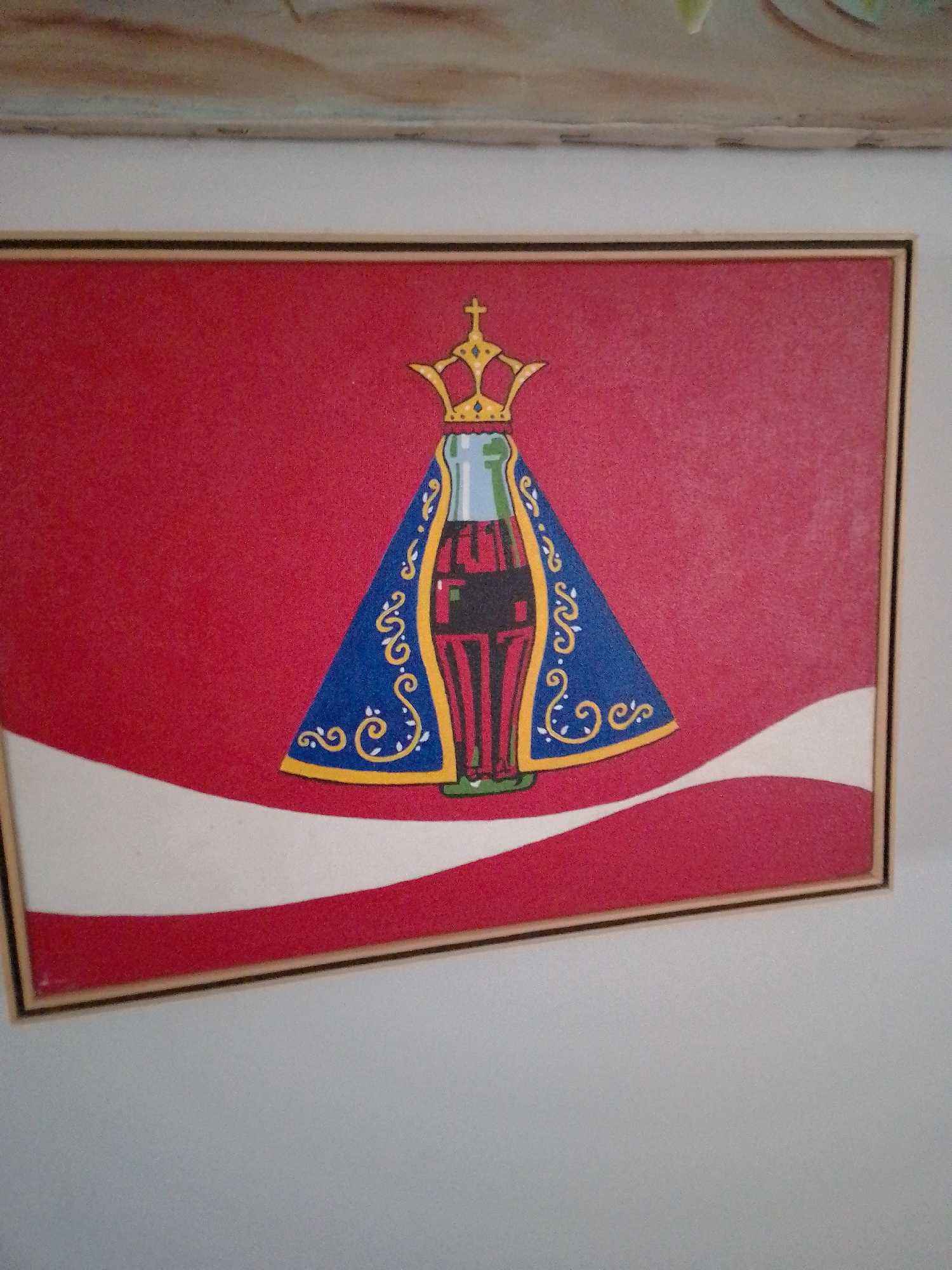
The image displays a framed piece of artwork mounted on a light gray wall in Campo Grande, Brazil. The artwork features a stylized depiction of a Coca-Cola bottle transformed into a religious figure, likely a Marian image. The bottle, rendered in green glass with a red label partially visible as "Coca-Cola" in black, is adorned with a golden crown topped by a cross. A blue mantle, decorated with intricate golden and white scrollwork, drapes over the bottle, extending to its base. The background is predominantly red, incorporating a curved white stripe and a lower red stripe, emblematic of the Coca-Cola brand's visual identity. The artwork is enclosed within a thin, light-colored frame with a black inner border. Above the frame, a textured portion of another object or artwork, exhibiting earthy tones of brown, green, and light blue, is partially visible.
Campo Grande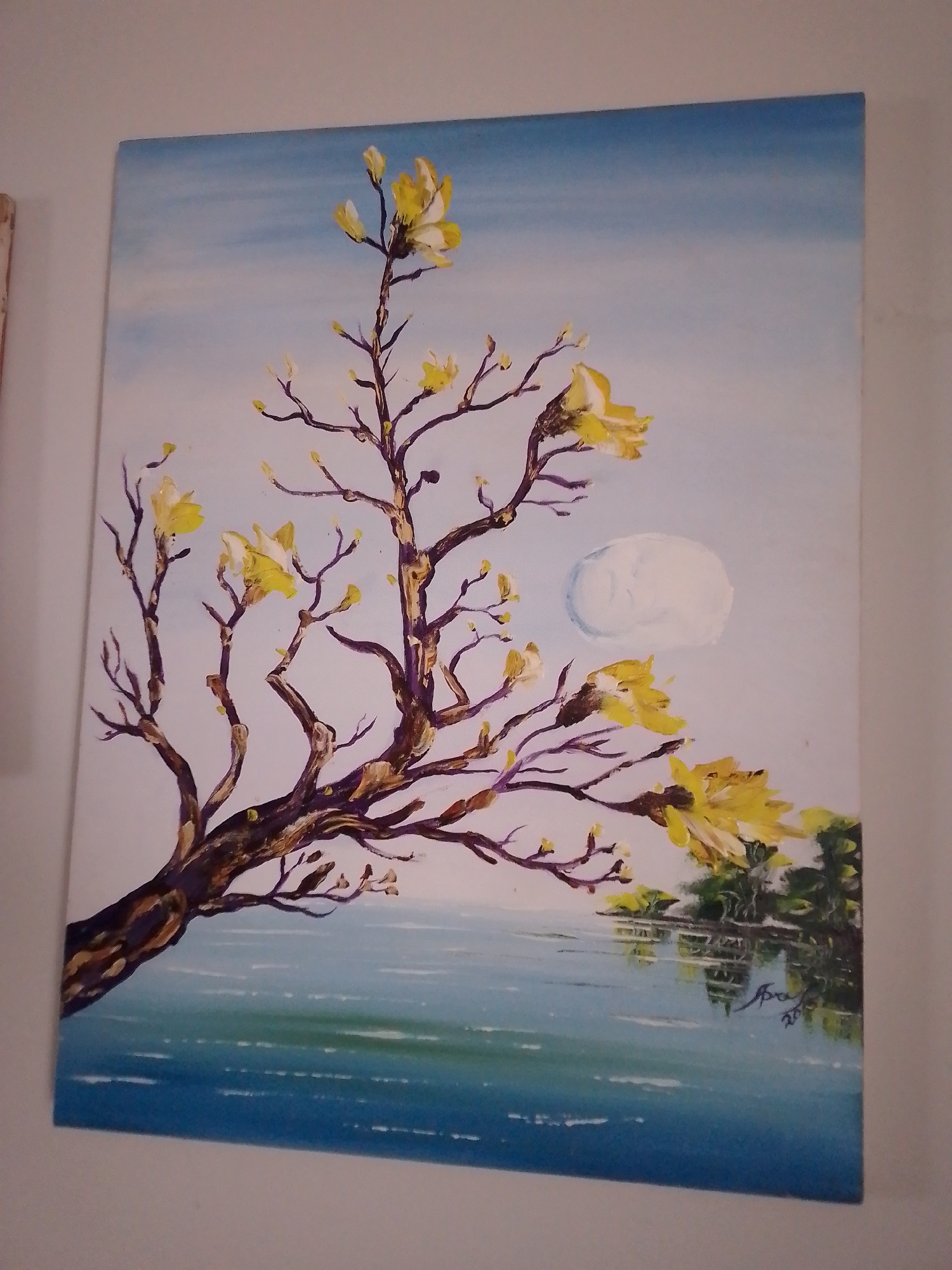
A photograph captures an oil or acrylic painting displayed on a light-colored wall. The painting depicts a serene landscape, possibly located in or inspired by the environment of Campo Grande, Brazil. A large, gnarled tree with textured dark brown branches and vibrant yellow blossoms or buds extends from the bottom-left foreground, diagonally across the center, towards the upper-right. The sky transitions from light blue at the top to a paler hue towards the horizon. A distinct, impasto-rendered white circular object, resembling a moon or stylized cloud, is positioned in the upper-right sky. The lower half of the painting illustrates a calm body of water, rendered in blue and green tones, reflecting a distant shoreline with small clusters of green foliage on the right. A dark, calligraphic artist's signature is visible in the lower-right area, within the water's reflection. No people are present, and no direct actions are depicted.
Campo Grande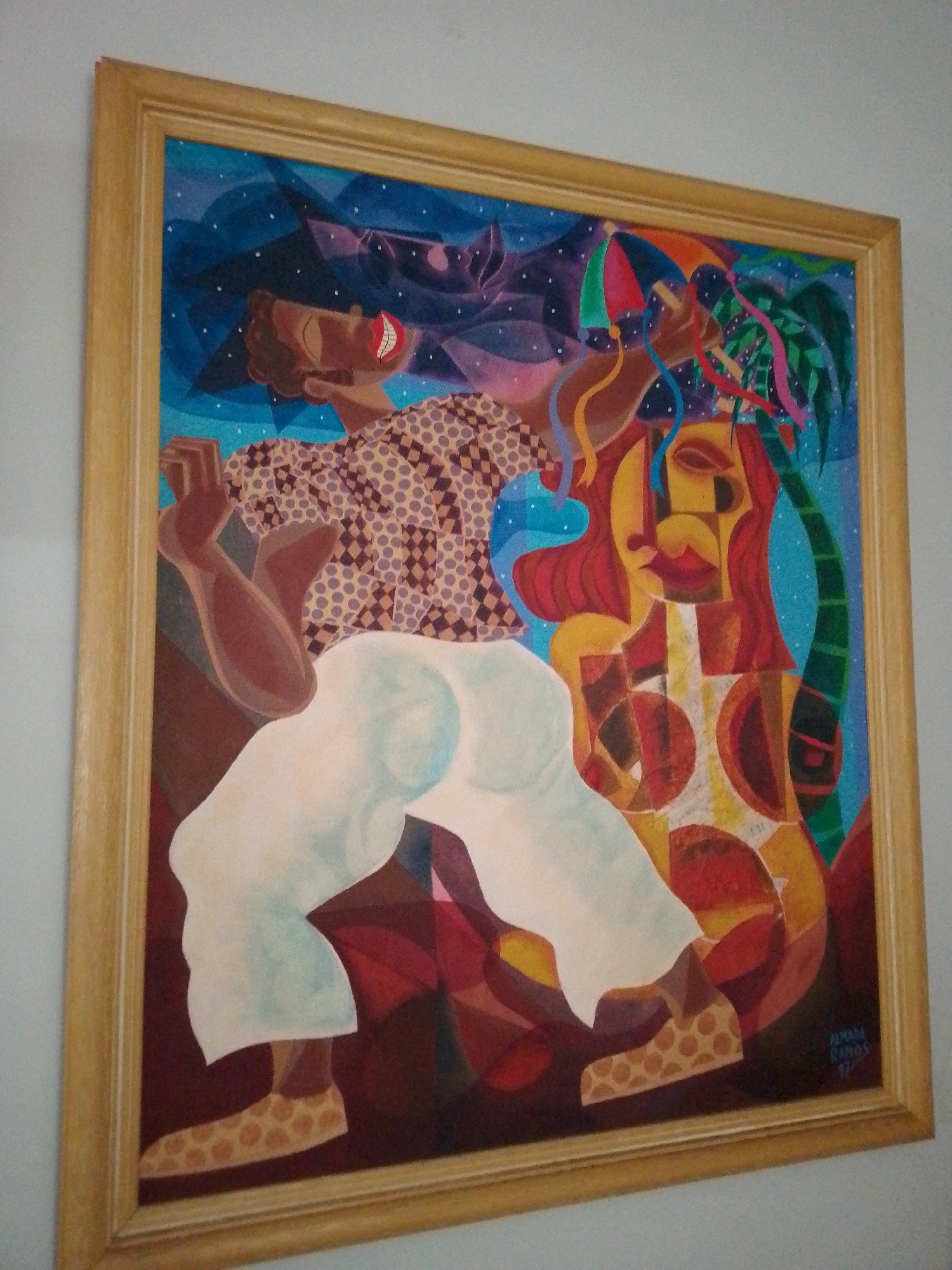
The image displays a vibrant, colorful painting enclosed in a light wooden frame, hanging on a plain, light-colored wall. The painting depicts a stylized male figure actively dancing or posing in a celebratory manner, characteristic of a Carnival or festive scene. The central figure, with dark skin, wears a patterned shirt featuring both polka dots and diamond shapes in muted tones, and loose-fitting white pants. His shoes are also patterned with polka dots. He has a wide, joyful smile with bright red lips and prominent white teeth. His right arm is bent, seemingly holding a small, multi-colored parasol, while his left arm extends forward with colorful ribbons or streamers flowing from it. The background is a dynamic composition of geometric shapes and colors. The upper left features a dark blue area speckled with white dots, suggesting a night sky with stars or confetti. To the right of the central figure, a more abstract, anthropomorphic shape in shades of red, yellow, and orange with distinct red lips and dark eyes, possibly representing another figure or a musical instrument, is visible. A green palm tree or tropical plant stands on the far right. The overall color palette is rich and lively, dominated by blues, reds, yellows, and greens. In the bottom right corner of the painting, a signature reads "ALMIRA RAMOS 17", indicating the artist and potentially the year 2017. The physical setting of the painting itself is a plain, light-colored wall. No specific environmental cues within the photograph indicate its precise location in the city of Campo Grande, Brazil, beyond the assumption provided in the prompt.
Campo Grande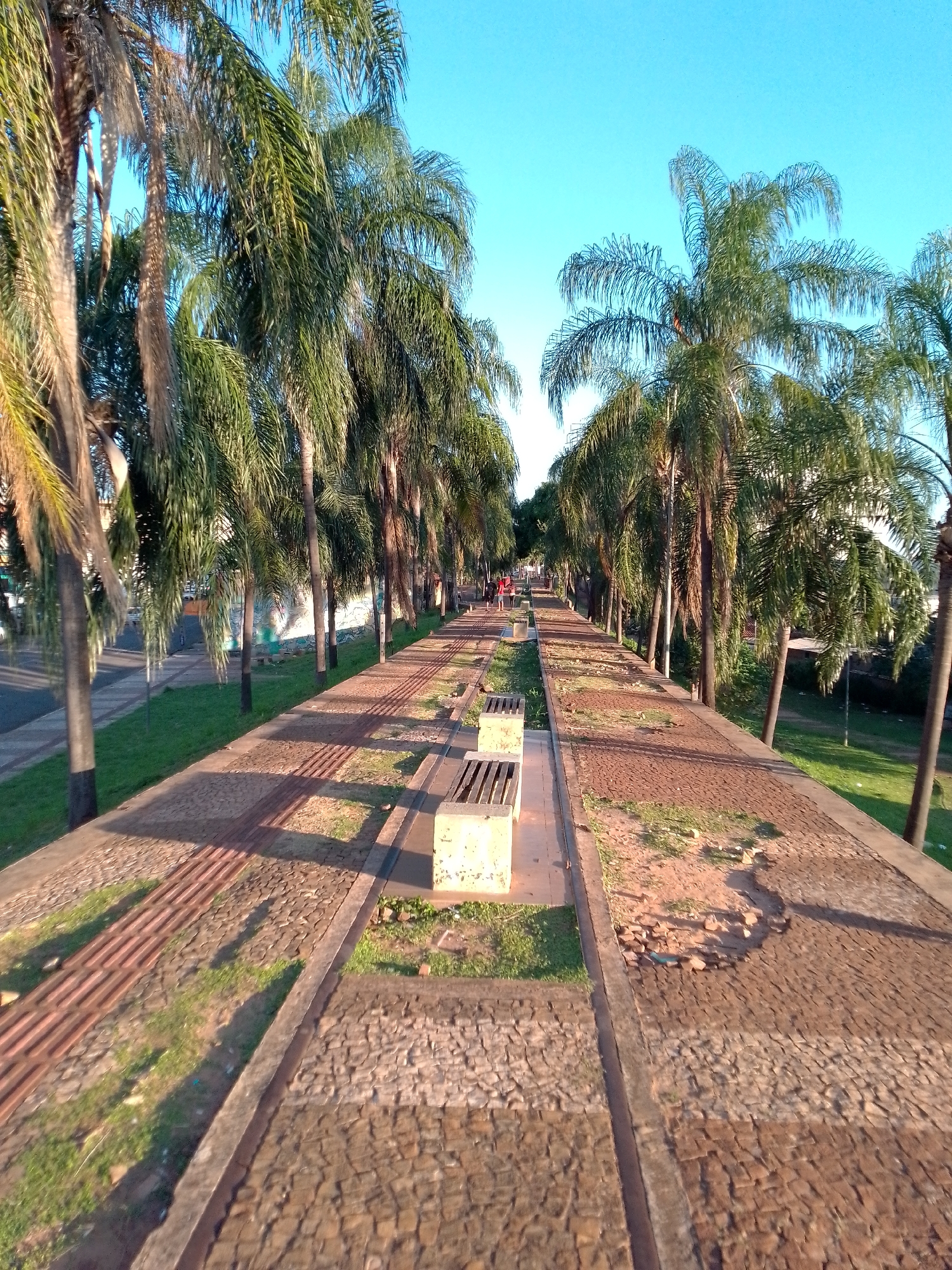
This image captures a long, tree-lined urban pathway in Campo Grande, Brazil, viewed from an elevated perspective looking down its length. The scene is illuminated by low-angle direct sunlight, casting distinct, elongated shadows across the ground, characteristic of early morning or late afternoon. The pathway is bordered on both sides by numerous tall palm trees with green and some brown fronds. The central pedestrian area features a wide, paved surface primarily composed of reddish-brown cobblestones or pavers, with occasional patches of exposed dirt and sparse green grass. A narrow concrete curb divides the pathway longitudinally. Embedded within the paved surface, particularly along the central divide, are rectangular sections of reddish, ribbed material, consistent with tactile paving or drainage elements. Two light-colored concrete benches with slatted tops are visible on the left side of the central pathway, oriented perpendicular to the path's direction. In the far distance along the pathway, several indistinct human figures are discernible, with one individual clearly wearing a red upper garment, walking away from the camera. To the left of the pathway's palm trees, an asphalt road with visible vehicles runs parallel to the path. Beyond the road and partially obscured by trees, a building wall displays colorful graffiti or mural art. To the right of the pathway's palm trees, the ground slopes downwards into a grassy area, where a light pole is visible in the mid-ground. The sky above is uniformly clear and light blue.
Campo Grande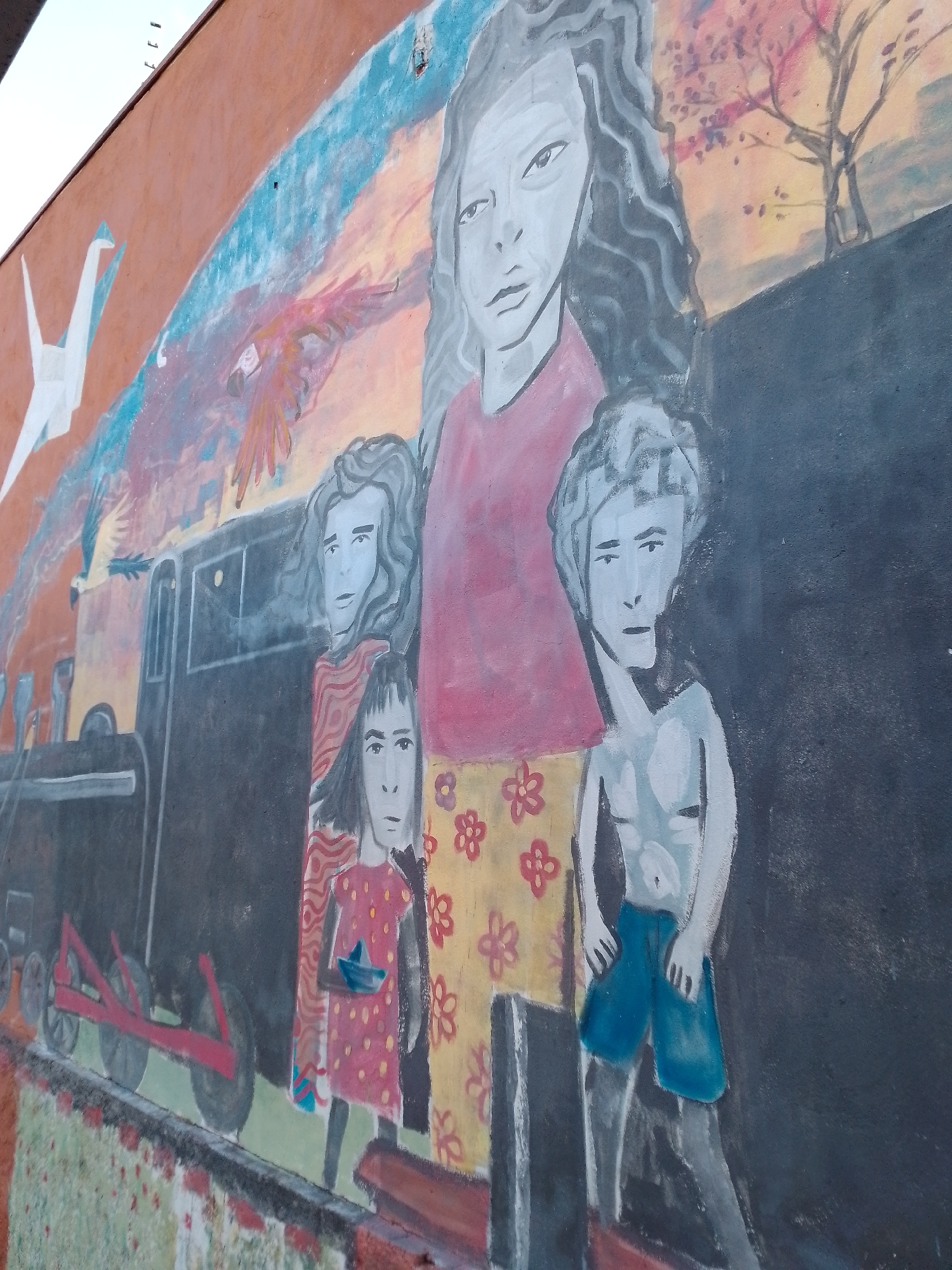
This is a large, colorful mural painted on an outdoor wall, located in Campo Grande, Brazil. The mural depicts a stylized scene featuring multiple human figures and elements of nature and transportation. The central figure is a female with pale skin, dark eyes, and long, wavy dark hair, wearing a red short-sleeved top and a yellow skirt adorned with red floral patterns. To her immediate left stands another female figure with similar pale skin and dark, wavy hair, dressed in a red and white striped garment. Partially in front of this figure is a smaller girl with straight, dark hair, wearing a red dress with yellow polka dots and holding a small blue origami boat in her hands. To the right of the central female figure, a boy with short, light-colored wavy hair is depicted bare-chested, wearing blue shorts. Behind the figures and extending to the left, a dark-colored train engine and tender are illustrated on railway tracks. The ground beneath the train and figures is textured with patterns of green and red, suggesting grass or foliage. The upper portion of the mural features a sky transitioning in color from reddish-orange on the left to a darker blue on the right. In the upper left, a white origami crane is shown in flight. Below it, a large, reddish-orange bird with outstretched wings soars. A broad, light blue, abstract band arcs across the upper part of the sky, with a small, dark sailing ship faintly visible within it in the upper right corner. Further to the right, stylized trees with pink or red blossoms are depicted against a yellowish-orange background. The artistic style is illustrative, with distinct outlines and flat color application.
Campo Grande
Located in Campo Grande, Brazil, the scene depicts a large, dark-colored steam locomotive sculpture angled dramatically upwards on a steel display structure. The historic-style locomotive, predominantly black with red-painted pilot and connecting rods, rests on a section of elevated railway tracks made of steel and wooden sleepers, ascending sharply towards the upper right. The entire structure is supported by a substantial dark-colored base. In the left background, a multi-story white building with rectangular windows and graffiti on its lower facade is partially obscured by trees. To the right, large green palm fronds partially frame the locomotive. The sky above is uniformly clear and blue. The foreground consists of a grassy area featuring exposed, derelict railway tracks, alongside a paved pathway exhibiting long, geometric shadows. A paved street runs parallel beyond the tracks, and a modern street light is visible on a pole in the upper right background. No people are present in the scene.
Campo Grande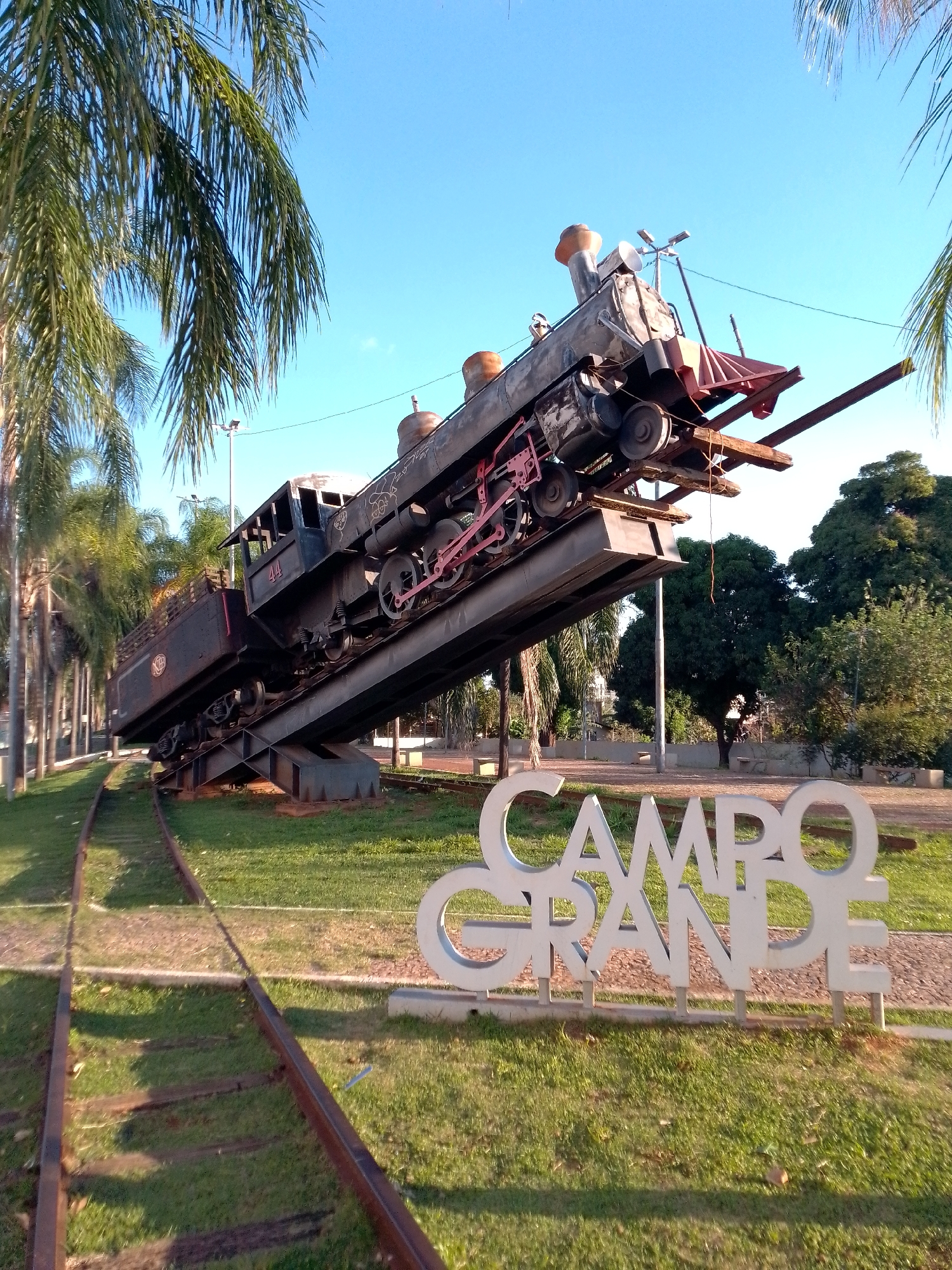
This image depicts a public monument featuring a black steam locomotive and its tender displayed on an elevated, angled metal structure, giving the impression of the train tipping upwards. The train, bearing the number "44" on its cab and a "NRB" logo on its tender, is positioned over a grassy area with actual railway tracks curving into the foreground on the left. In the bottom right foreground, large white letters spell out "CAMPO GRANDE," confirming the location as Campo Grande, Brazil. The scene is set under a clear blue sky with bright sunlight, casting shadows. To the left, a row of tall palm trees stands, and in the background to the right, various deciduous trees and a lamppost are visible. A single individual is discernible in the distant right background near the trees.
Campo Grande