Canela, Brazil
19 memories from Canela, Brazil

The primary subject of the image is a massive, white and black multi-stage rocket, resembling a Saturn V, seen against a clear, deep blue sky. Although the original image is oriented vertically and then rotated 90 degrees clockwise, the rocket itself is an upright structure. Its pointed nose cone is visible near the top, while its main body extends downwards, occupying the right side of the frame. Prominent text and logos are visible on the rocket's exterior: the classic circular blue "NASA" emblem is near the top section, followed by the words "UNITED STATES" written vertically. Further down, the letters "USA" are partially visible. The sky is a uniform, intense blue, devoid of clouds, indicating bright, sunny daylight. A subtle lens flare or sun glint can be observed near the rocket's tip, hinting at the sun's position. In the bottom right corner, a white architectural structure with an open, lattice design is partially visible. Etched into this structure are the words "SPACE ADVENTURE," clearly identifying the location as a space-themed attraction. No individuals are present in the frame, allowing the monumental scale of the rocket to dominate the scene. This outdoor display is situated at the Space Adventure museum in Canela, Brazil, presenting an impressive homage to space exploration under a vast, open sky. The overall atmosphere conveys awe and technological achievement.
Canela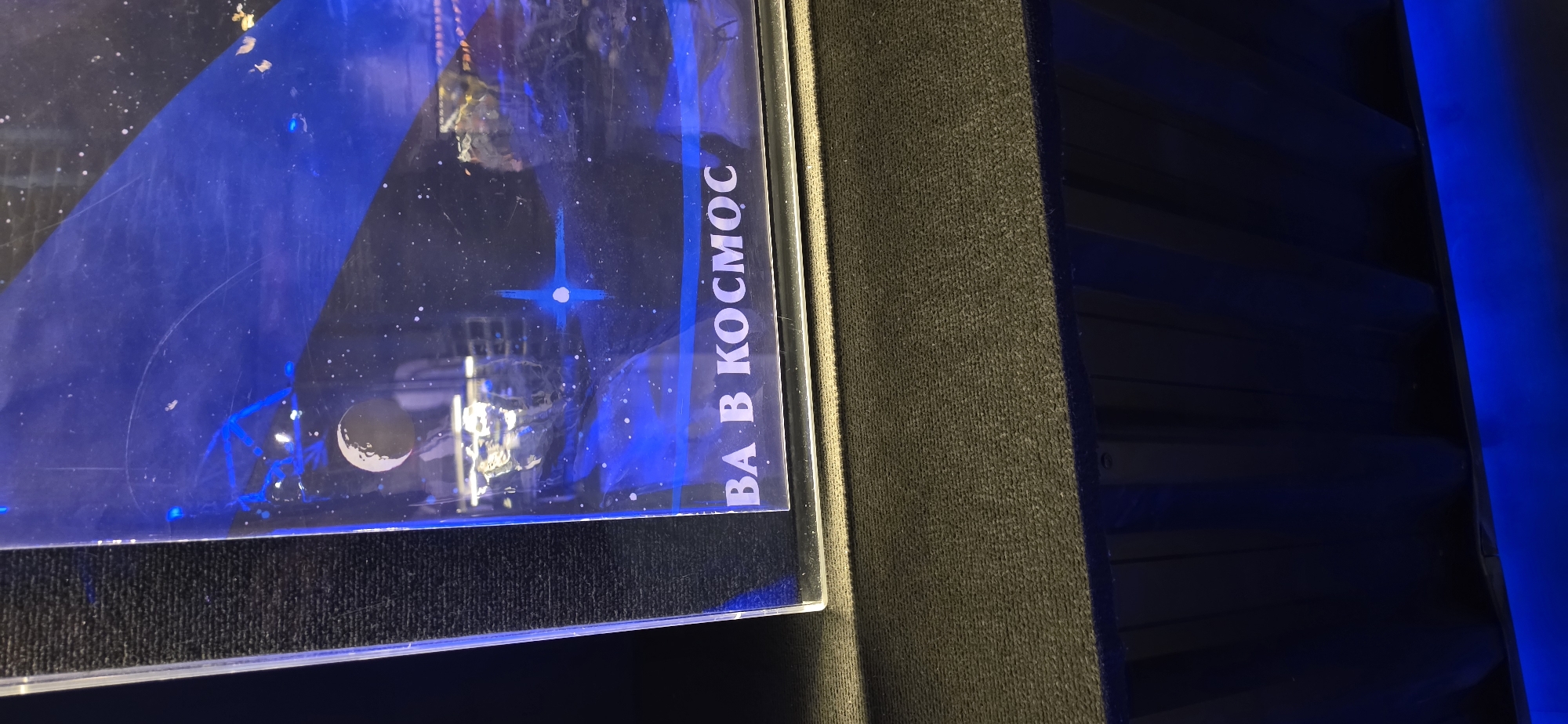
A close-up photograph shows a framed exhibit with artwork depicting space. The artwork features blue tones, celestial bodies, and possibly a rocket or spacecraft design. The Russian text "ВА В КОСМОС" (meaning "Into Space") runs vertically along the right edge of the frame. The exhibit is displayed next to what appears to be a dark gray or black textured surface, possibly part of a larger display case or wall. To the right, a shelf or layered structure is visible, illuminated by a blue light source. The city of Canela, Brazil is not identifiable as the location of this image.
Canela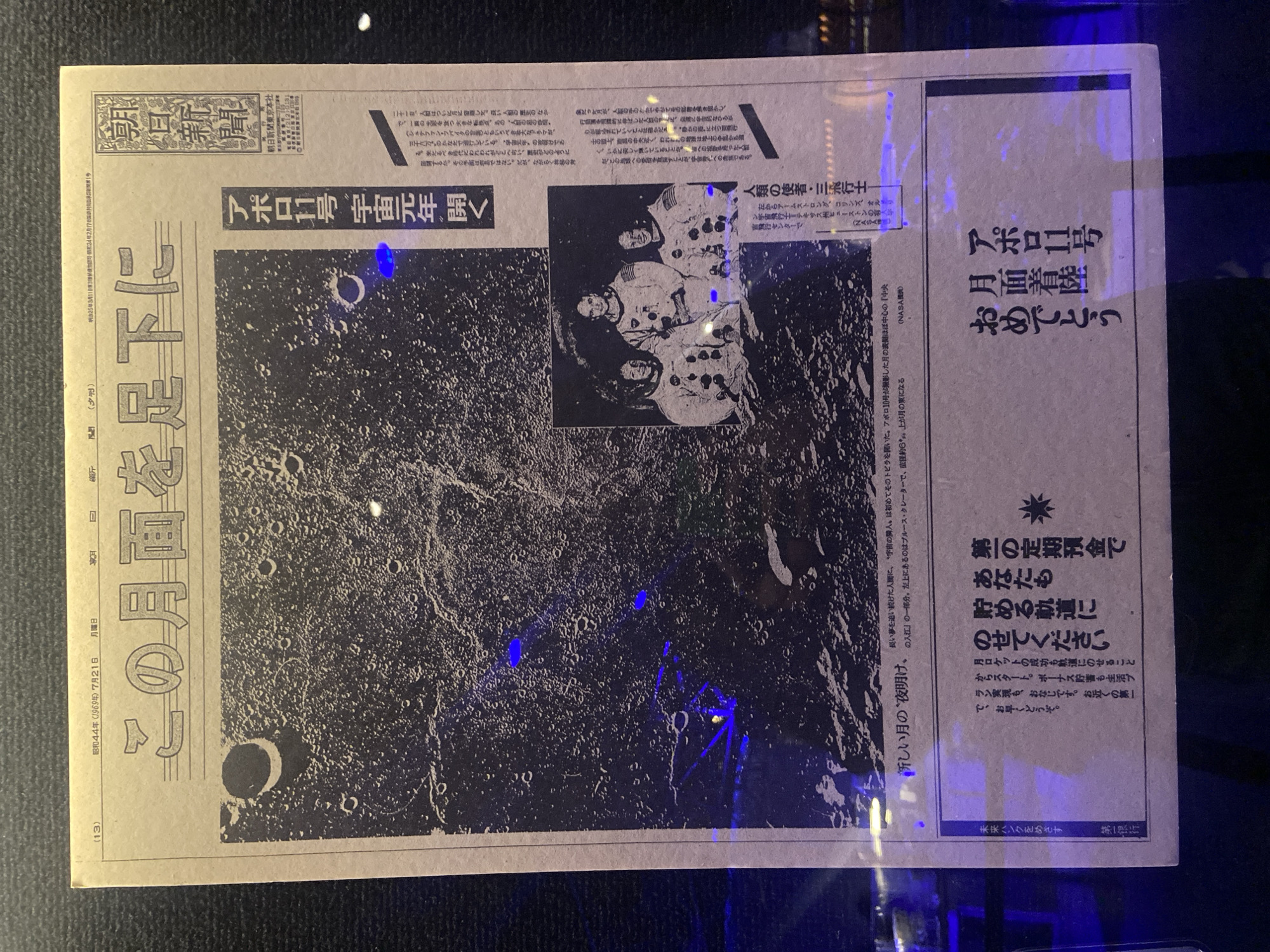
The image shows a framed Japanese newspaper article about the Apollo 11 moon landing. The article features a grainy, black and white photo of the moon's surface with craters, alongside a picture of the three astronauts: Armstrong, Collins, and Aldrin. The newspaper title and other text are in Japanese. The print is encased under glass that has reflections and glare on it, obscuring portions of the print.
Canela
The video shows a circular object against a black background that appears to be changing from a blue-purple rendition of the Earth to a purple moon with craters. The moon's appearance is rough and heavily textured with many small indentations. The scene is dimly lit.
Canela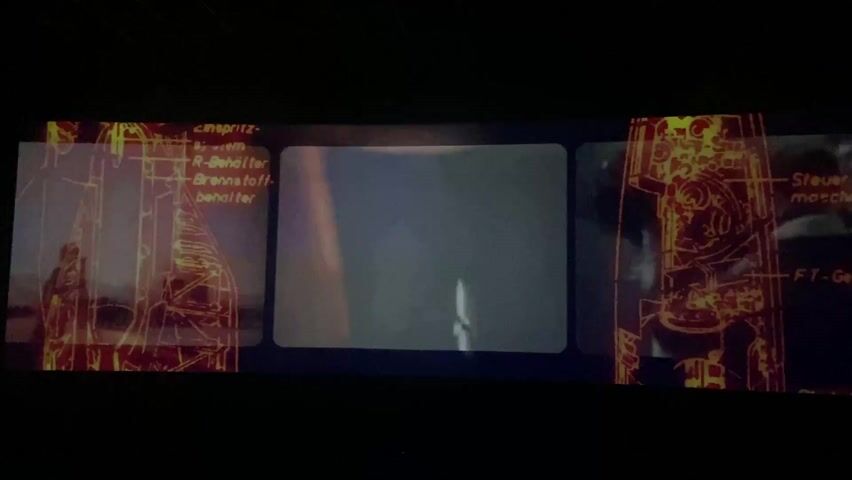
The video shows a screen in a dark room. First, a vintage newspaper is displayed with the headline "SPACE MAN ENTERS SPACE." The headline is surrounded by pictures of early astronauts. Then, the video shows a man in a white coat working on a space rocket in a hangar.
Canela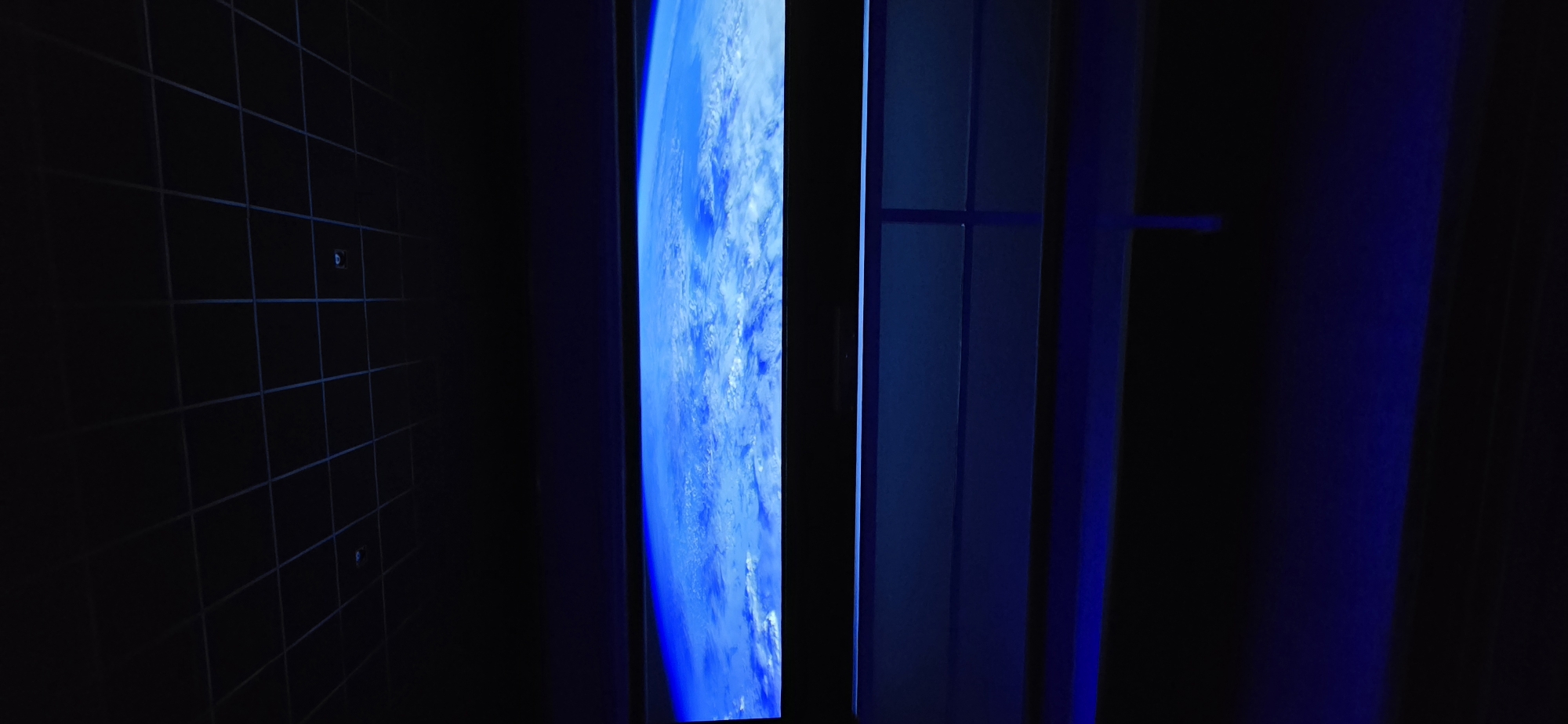
The image appears to be an indoor shot, predominantly dark with blue lighting. On the left, a wall with a grid pattern is visible. In the center, there is a screen displaying an image of Earth from space, with prominent blues and whites representing oceans and clouds. To the right of the screen, vertical panels are visible, seemingly part of a doorway or architectural structure. A handle is visible. Due to the lack of context, the location in Canela, Brazil cannot be confirmed.
Canela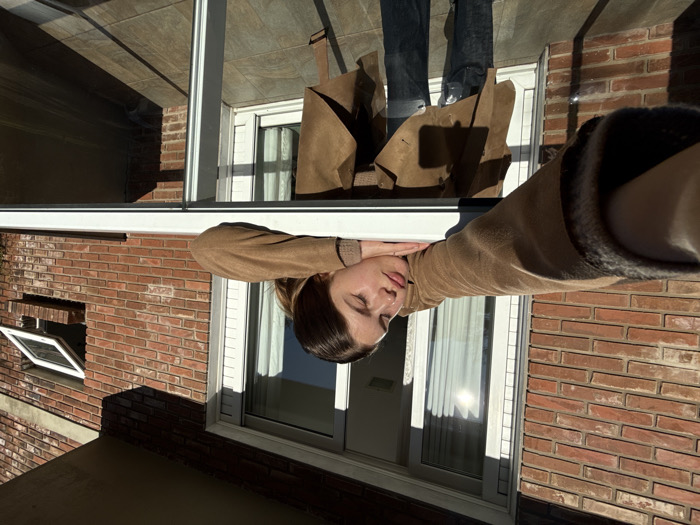
One light-skinned female subject, approximately 18-25 years old, is depicted in a selfie taken on a balcony in Canela, Brazil. She is dressed in a brown, possibly suede, jacket with a knit layer visible underneath, and dark trousers. The subject leans forward, resting her forearms and head on the white top rail of a balcony railing, with her eyes closed or partially shut, appearing to face strong sunlight. Her left arm extends towards the camera. The immediate background features a reddish-brown brick wall. Directly behind the subject is a white-framed double glass door or window unit reflecting intense sunlight. To the right, a white-framed casement window is partially open on an adjacent brick facade. The balcony floor is tiled. Strong, direct sunlight from the left casts distinct shadows across the scene.
Canela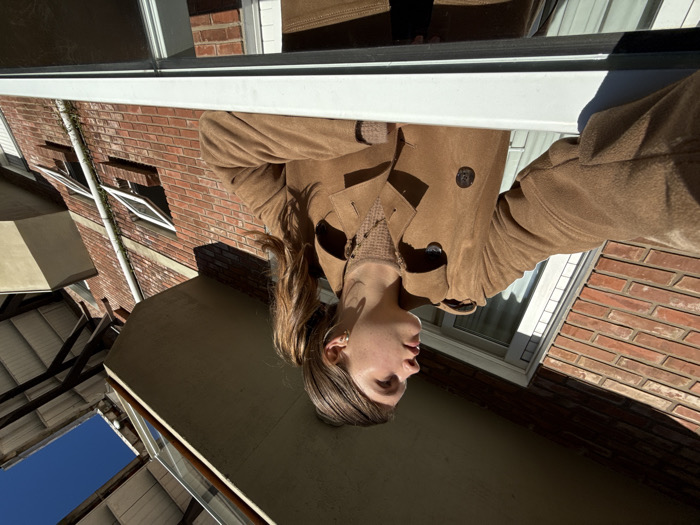
A low-angle, outdoor image depicts a young individual, appearing female, with light brown hair in a ponytail, looking upward and to the right. She wears a tan trench coat over a textured brown sweater. Her right arm extends forward, with a hand visible near the left edge of the frame, appearing to hold a device for photography. She is leaning over a prominent white horizontal railing or window frame in the foreground. Behind her, a multi-story building constructed of red bricks is visible. Two windows with white frames are open, tilted outwards from the bottom. A white vertical downspout runs along the brick wall. Above the subject, a concrete balcony structure projects outwards, casting a shadow. Further right, a section of a building with a light-colored roof supported by exposed wooden beams is present. A clear, bright blue sky is visible in the upper right portion of the frame. The scene is located in the city of Canela, Brazil.
Canela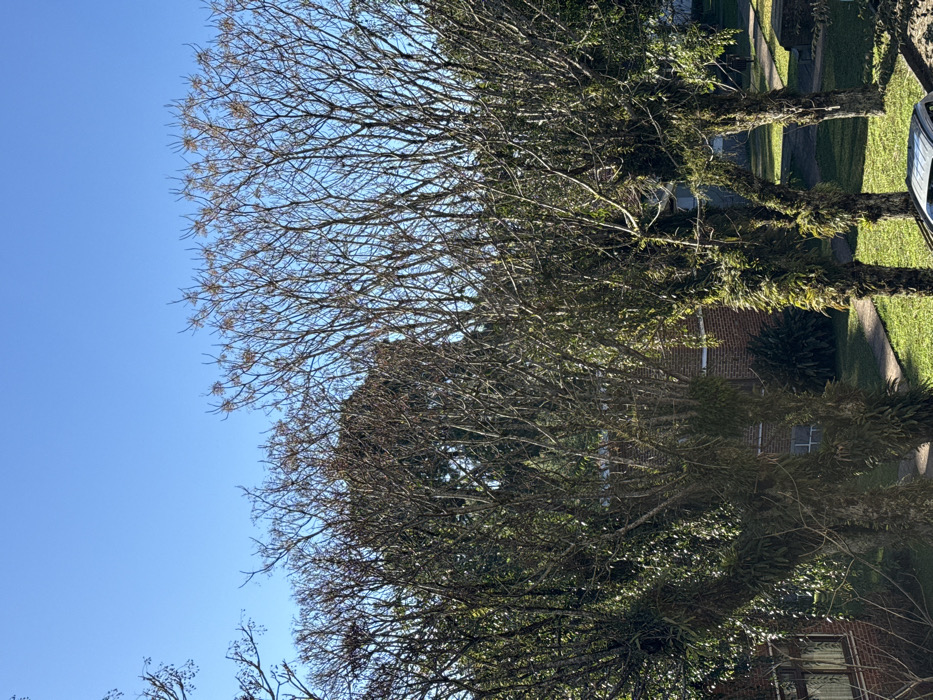
The image displays an outdoor scene in Canela, Brazil, under a clear, unobstructed blue sky. The foreground and midground are dominated by several mature trees, exhibiting mostly bare, intricate branch structures, suggesting a dormant or deciduous state. The trunks and numerous branches of these trees are heavily covered with dense green epiphytic growth, primarily ferns and mosses. In the background, visible through and between the trees, are portions of red-brick buildings with visible windows, indicative of residential or urban structures. Ground level elements include manicured green grass areas and sections of concrete pathways. A small portion of a light-colored vehicle is visible in the lower right corner of the frame. No individuals are present, and no actions or interactions are depicted.
Canela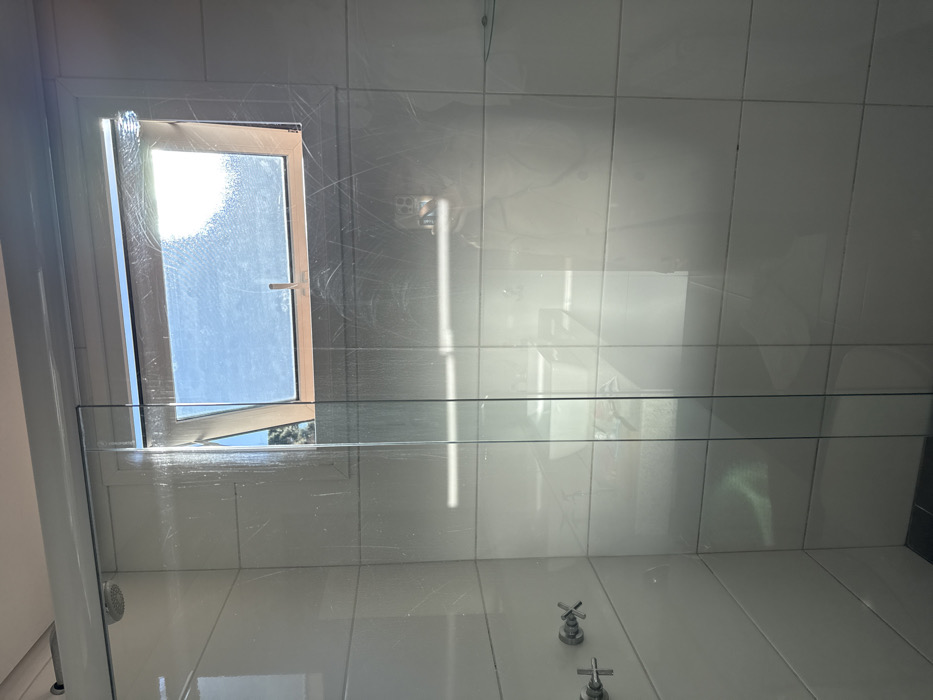
This forensic description details a bathroom shower area located in Canela, Brazil. The scene is dominated by a transparent glass shower enclosure, which features numerous visible water streaks, smudges, and faint scratches across its surface. To the left, within the shower, the walls are covered in rectangular white tiles, upon which a chrome-finished shower head is mounted in the upper left corner, and two chrome cross-shaped faucet handles are visible on the lower left. Above the shower enclosure, a top-hinged window with a light-colored frame is partially open, revealing a clear blue sky and distant green foliage, indicating an outdoor view. Bright sunlight streams through this window, creating strong reflections on the glass. Through the glass, on the lower right side, a reflection of a white bathroom sink or vanity with a faucet is discernible, positioned behind the camera's viewpoint. A clear reflection of a person holding a smartphone, the likely photographer, is also evident on the right side of the glass enclosure. The floor within the shower appears to be a dark color. No other individuals or direct interactions are visible in the scene.
Canela
A female subject is depicted in a bathroom, identified as being located in the city of Canela, Brazil, taking a mirror selfie. The subject, visible from the chest up, has light brown hair and is wearing a tan double-breasted coat over a light brown knitted sweater. She accessorizes with gold hoop earrings, a pendant necklace, and multiple rings on her right hand. She holds a gold-colored smartphone with a clear case in her right hand, with a blue card visible within the case. The background consists of white tiled walls with a chrome towel rack on the left holding folded and draped white towels. Below the towel rack, a white heating radiator is visible. The foreground features the white reflective surface of a bathtub rim or counter, with part of a glass shower enclosure visible on the far right. Natural light from the right casts shadows across the subject and the tiled wall.
Canela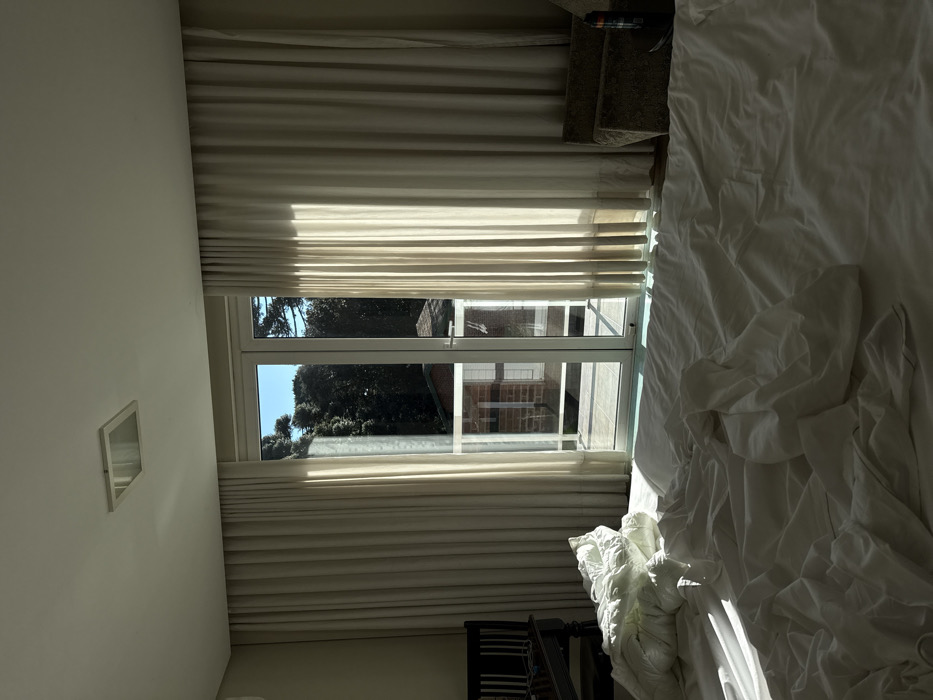
The image displays the interior of a room, located in Canela, Brazil. A large bed in the foreground is covered with disheveled white sheets and a duvet. Strong natural light enters through a tall, white-framed glass double door, positioned centrally in the background, which leads to an outdoor tiled balcony. Floor-to-ceiling light-colored curtains are partially drawn back on either side of the glass door. To the left of the bed, a dark wooden chair is partially visible. To the right, a light-colored armchair with a dark bottle on an adjacent surface is present. Beyond the balcony, a red-brick building with a brown roof is visible, partially obscured by dense, dark green trees. A clear blue sky is visible above the trees. The room has a light-colored ceiling with a square, recessed light fixture. No individuals are present in the scene.
Canela
The image displays a prominent spiral galaxy, characterized by a luminous, yellowish-white central core from which intricate spiral arms, adorned with bright blue and white star clusters and dark lanes of interstellar dust, coil outward against the deep black canvas of space. The environment is purely cosmic, featuring sparsely scattered individual stars across the background. This scene is devoid of any discernible terrestrial features, human subjects, man-made objects, or any actions or interactions. The visual content presented is astronomical in nature, providing no identifying markers for a specific location within the city of Canela, Brazil.
Canela
The image displays an interior view of a dark, domed projection space, likely a planetarium, located in Canela, Brazil. The environment is dimly lit, illuminated solely by the projected imagery. The central subject is a projection of a cosmic scene featuring a deep blue to purple background with numerous white and faint blue point light sources representing stars. Swirling, diffuse formations in shades of muted green, brown, and light orange, indicative of nebulae, are prominent across the mid-section. Bright, concentrated light clusters are visible within the projection. The lower portion of the image reveals the curved, paneled surface of the projection dome, characterized by faint vertical lines indicating structural seams. Scattered across the entire projected image are numerous irregularly shaped, opaque specks, varying in size, consistent with dust particles or condensation on a camera lens or the projection surface; some appear roundish, while others are elongated or tear-drop shaped. No individuals, specific objects beyond the projection and dome structure, or observable actions/interactions are present in the scene.
Canela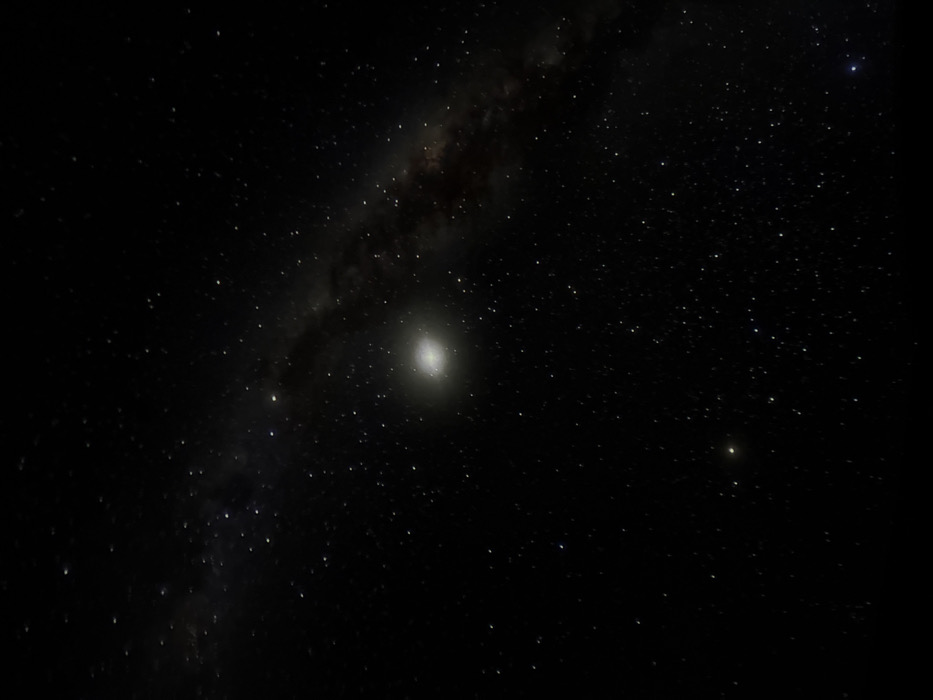
The image is a vertical astrophotograph of the night sky, captured from a location near Canela, Brazil. It features a prominent, bright elliptical galaxy with a concentrated luminous core, positioned slightly above the vertical center. Numerous individual stars of varying magnitudes are scattered across the dark expanse. Faint, diffuse dark lanes, consistent with interstellar dust or nebulosity, extend diagonally from the upper right to the lower left. A single, less luminous star is visible in the lower left quadrant. The environment depicted is deep space, observed under clear night conditions, devoid of terrestrial elements, people, or artificial light sources.
Canela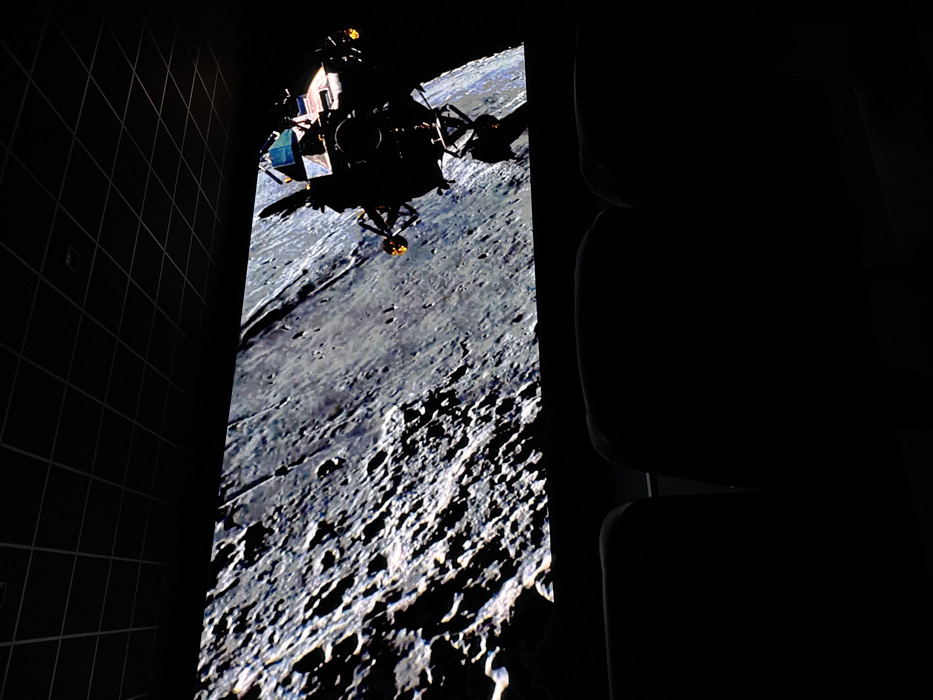
The image captures a forensic view inside an immersive theater or planetarium, specifically the Space Adventure Canela in Canela, Brazil. The dominant feature is a wide, large projection screen displaying a detailed, monochrome depiction of the heavily cratered lunar surface, which occupies the upper two-thirds of the frame. In the upper right quadrant of the screen, the silhouette of a Lunar Module (LM) is visible against the lunar backdrop, its complex structure, landing gear, and antennae clearly discernible. Faint, localized orange-yellow glows are present near the ends of some of the LM's protrusions, possibly indicating thruster activity or reflective surfaces. The room is almost entirely dark, with illumination provided solely by the screen's projection. In the lower third of the image, the dark, featureless silhouettes of two upholstered theater-style seats are visible from a rear perspective, positioned for viewing the screen. The ceiling above is dark with a distinct grid pattern, characteristic of acoustic ceiling tiles in a public venue. No individuals are present or visible within the scene. The overall environment suggests an immersive educational or entertainment experience focused on space exploration.
Canela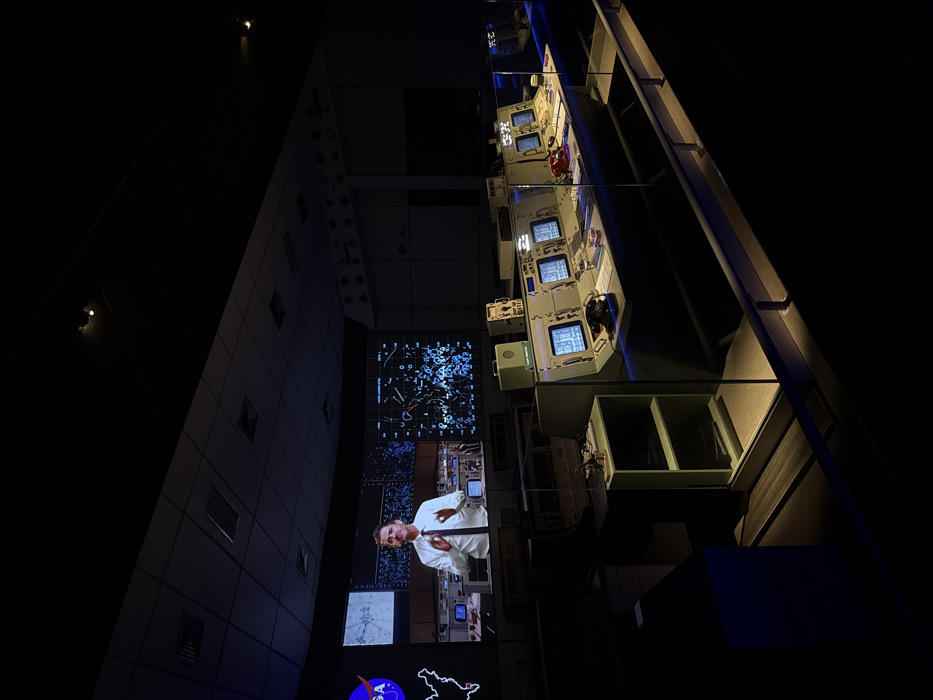
The image depicts a dimly lit, simulated mission control center, specifically located within an exhibition in Canela, Brazil. The scene features a large projection screen on the rear wall displaying a male presenter in a white collared shirt and dark tie, gesturing with both hands, flanked by graphical data, including a NASA logo and complex charts. In the midground and foreground, a series of vintage-style control consoles, light gray in color, are arranged. Each console is equipped with multiple square CRT monitors displaying blue graphical information. Objects on the consoles include a black rotary telephone, a red push-button telephone, and stacks of papers. A clear glass barrier separates the viewer's area from the control consoles. Overhead lighting fixtures are visible on the dark ceiling, casting focused illumination onto the consoles and creating reflections on the glass barrier. The overall environment suggests a museum exhibit designed to recreate a historical space operations setting. There are no live individuals present within the frame beyond the projected image.
Canela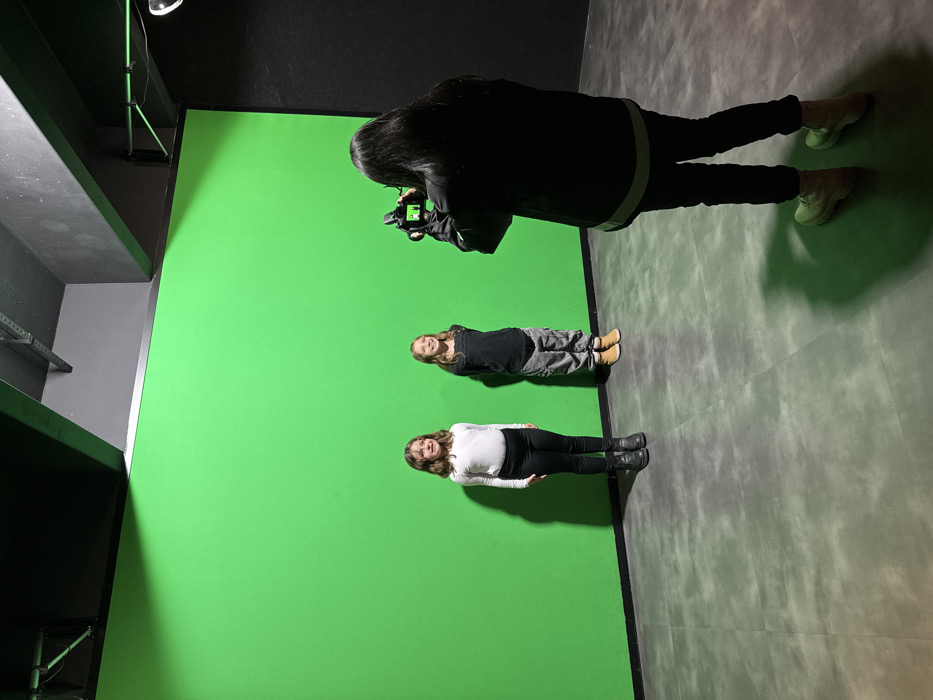
This image depicts an indoor photography session in a studio located in Canela, Brazil. Two children, appearing pre-adolescent, stand side-by-side facing forward in front of a large, illuminated green screen that extends from floor to ceiling. The child on the left wears a white long-sleeved shirt, black pants, and dark boots. The child on the right wears a dark long-sleeved shirt, grey patterned cargo pants, and light brown boots. Both children are smiling faintly. In the foreground, an adult, viewed from the back, holds a black DSLR camera aimed at the children. This adult wears a dark jacket with a white band at the lower hem, dark pants, and light-colored boots. The studio environment features dark, possibly black, walls and ceiling, with visible dark structural elements and pipes overhead. The floor is composed of large, mottled grey square tiles. Shadows from the subjects are cast onto the tiled floor directly in front of the green screen.
Canela
Two young girls stand in front of a green screen in a studio with a gray floor and a black ceiling. Initially, they are a few feet apart, with each girl placing a hand on her head. Then, they cross their arms and turn to face each other. Finally, they stand back to back, still with crossed arms. Throughout, they look toward the camera. The girl on the left wears a white shirt with black leggings and black boots. The girl on the right is wearing a black top with gray camouflage pants and tan boots.
Canela