Caserta, Italy
14 memories from Caserta, Italy
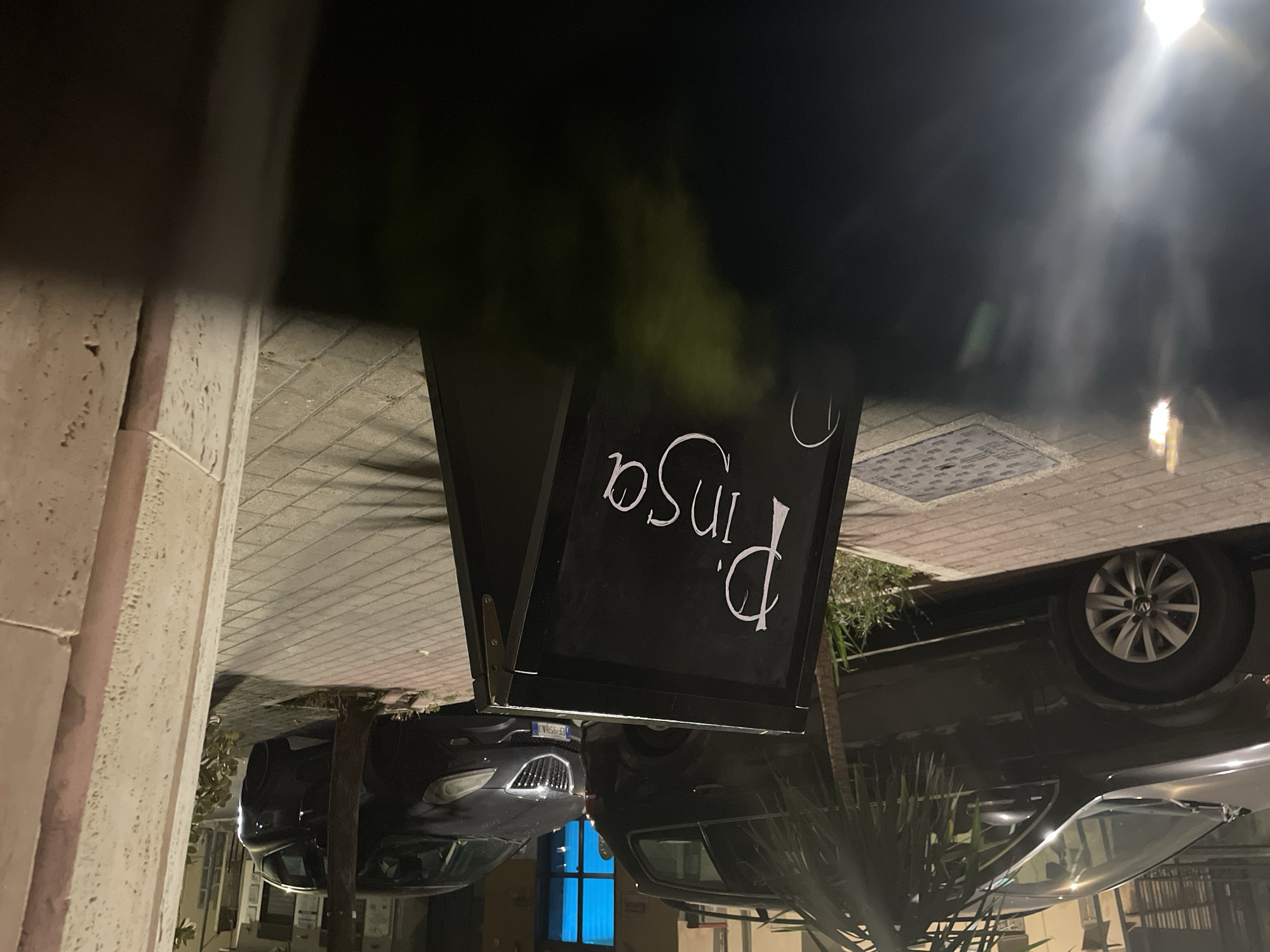
A street-level outdoor nighttime photograph captures a scene in the city of Caserta, Italy. In the foreground, a black A-frame sandwich board sign displays the word "Pinsa" in white, stylized lettering. To the left of the sign, a dark-colored sedan is partially visible, showing its front wheel and part of its body. Beyond the sedan, a dark-colored SUV is parked. The ground is paved with light-colored cobblestones. Further in the background, buildings with illuminated windows are visible, suggesting an urban environment. The overall lighting is dim, indicative of nighttime conditions.
Caserta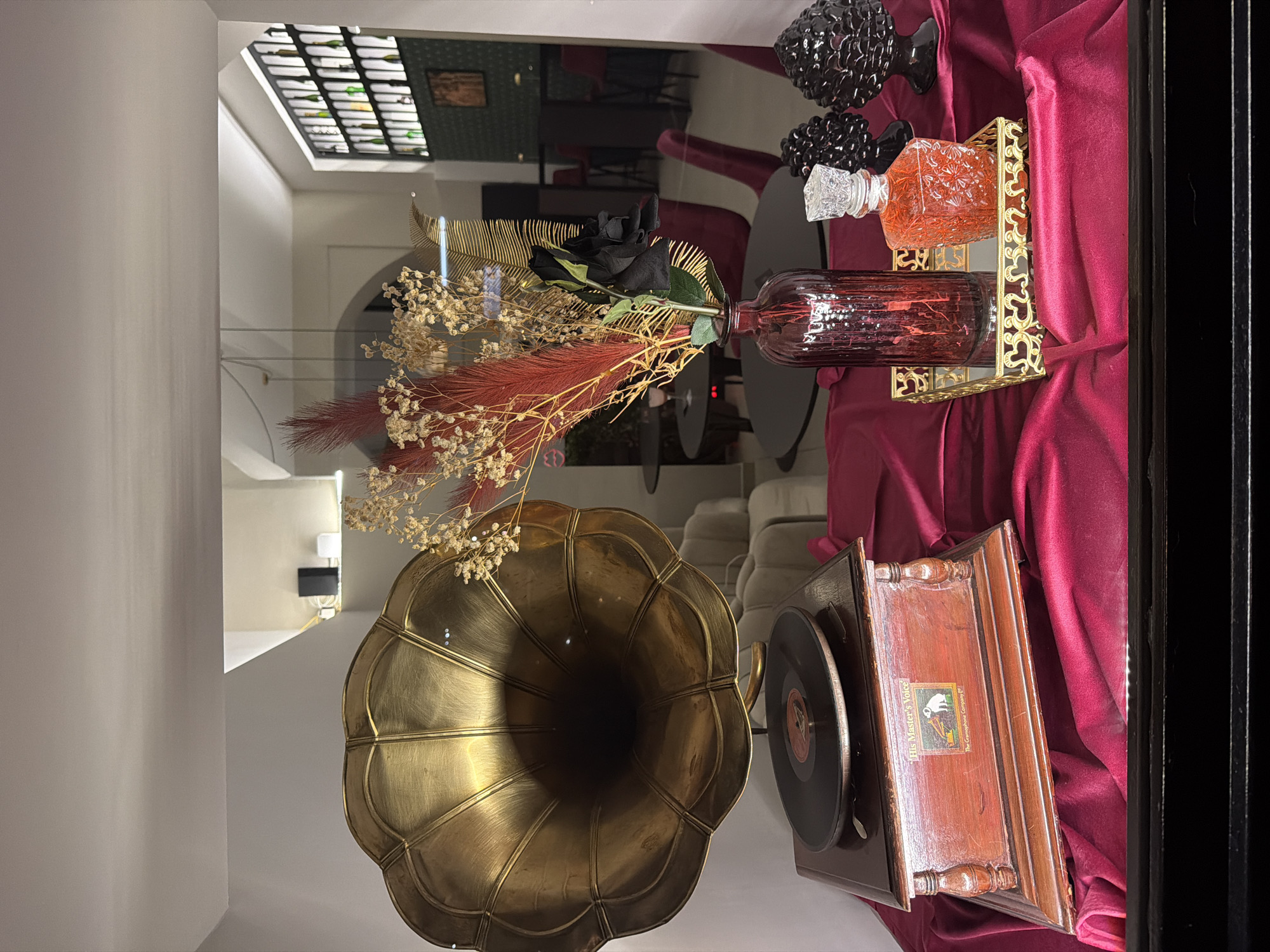
The image shows a display window with a vintage gramophone on the left, featuring a large brass horn and a wooden base with a record. To the right, a small bouquet of dried flowers and a black rose sits in a red glass vase on a golden tray. Next to the vase is an ornate glass decanter filled with amber liquid and a crystal stopper. Two dark, textured objects resembling pinecones are placed further to the right. The display is set against a deep red velvet cloth. The background visible through the window suggests a bar or restaurant interior with tables, chairs, and a wall adorned with bottles. The overall scene evokes a retro or vintage aesthetic. This display is located in the city of Caserta, Italy.
Caserta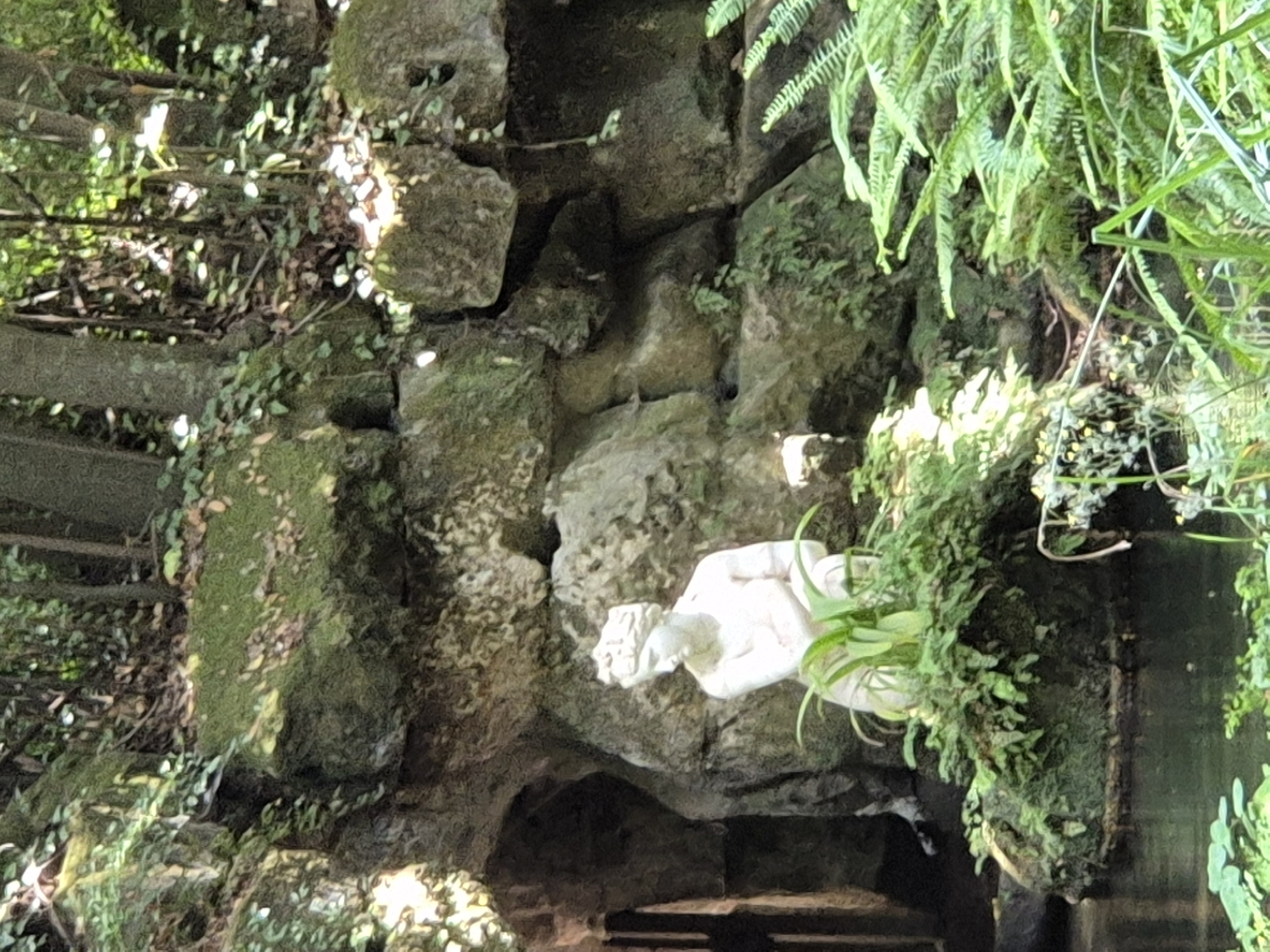
The image depicts a serene garden scene, likely within the historic grounds of the Royal Palace of Caserta, Italy. In the foreground, a white marble statue of a woman is positioned amidst lush greenery and moss-covered rocks. The statue appears to be kneeling or sitting, with her head slightly bowed. She is adorned with a crown or intricate hairstyle. Surrounding the statue, dense ferns and other verdant plants grow, some of which are partially submerged in the dark, still water of a pond or stream that occupies the lower left portion of the frame. Behind the statue, a large rock formation creates a natural grotto-like backdrop. This rock face is weathered and covered in patches of moss and climbing ivy, suggesting age and integration with the natural environment. Sunlight filters through the dense foliage of trees that overhang from above, casting dappled light and shadows on the scene, particularly on the rock face and the statue. The overall impression is one of a tranquil, somewhat secluded, and classical garden setting.
Caserta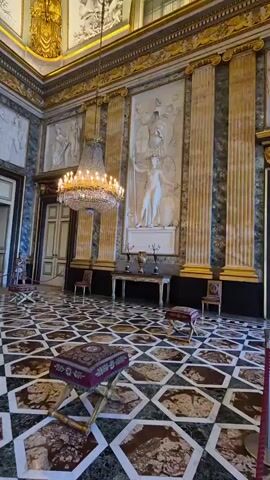
The video pans across a grand, opulent room with a high ceiling. The walls are adorned with intricate bas-relief sculptures, featuring classical figures and architectural elements, framed by gilded columns. A large, ornate crystal chandelier hangs from the center of the ceiling, casting a warm glow. The floor is a striking mosaic of geometric patterns in contrasting colors. In the foreground, several small, upholstered stools with ornate golden legs are placed around the room. In the middle ground, a long, narrow table with decorative accents stands against the wall, topped with a vase and candelabra. The overall impression is one of historical grandeur and luxury. No people are clearly visible in the frame.
Caserta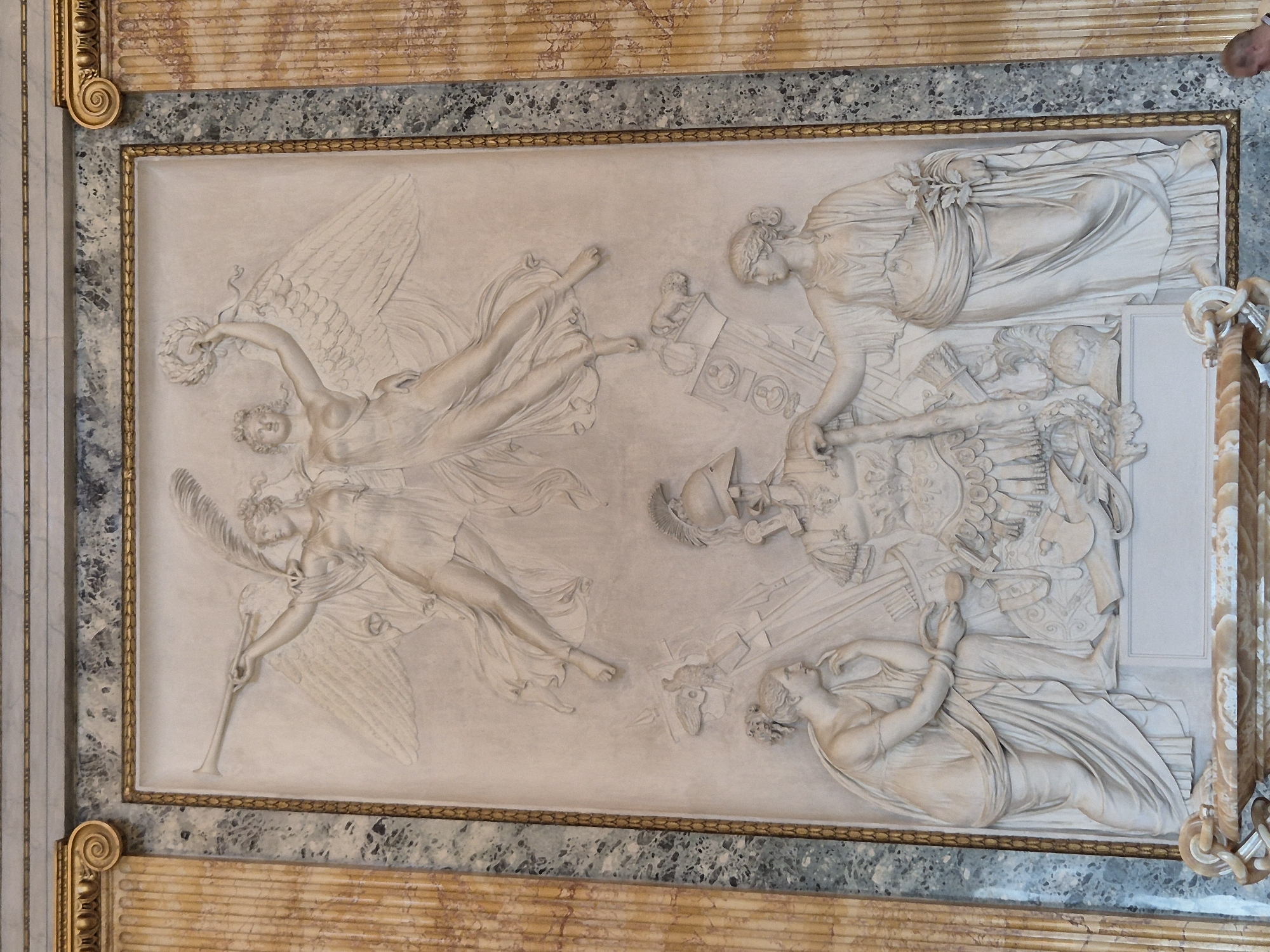
This is a photograph of a detailed bas-relief sculpture adorning a ceiling, likely within a grand interior space in Caserta, Italy. The artwork depicts a mythological or allegorical scene featuring several figures. On the left, two winged figures, possibly nymphs or goddesses, are shown in dynamic poses. One is in flight, holding a wreath, while the other appears to be reaching out. Their drapery flows elegantly, suggesting movement and ethereal qualities. On the right side of the relief, a group of figures is arranged around a central, armored figure, likely a warrior or a deity. One figure reclines below, seemingly receiving attention or possibly in a state of defeat or slumber, holding an object, possibly a mirror or a jewel. The overall composition suggests a narrative of victory, tribute, or a celestial event. The sculpture is rendered in a classical style, with an emphasis on musculature, idealized forms, and flowing drapery. The figures are depicted in various stages of action and repose, creating a sense of depth and drama. The material appears to be plaster or stucco, painted a uniform off-white, which highlights the intricate details of the carving and the play of light and shadow. The relief is framed by an ornate border featuring gilded scrollwork and decorative patterns, further emphasizing its placement within an opulent architectural setting. Above and below the relief are bands of textured marble or stone, and further decorative elements indicative of a palatial or significant building. The lighting appears to be ambient interior light, suggesting the image was captured during the daytime within the building. No visible text is present in the artwork itself.
Caserta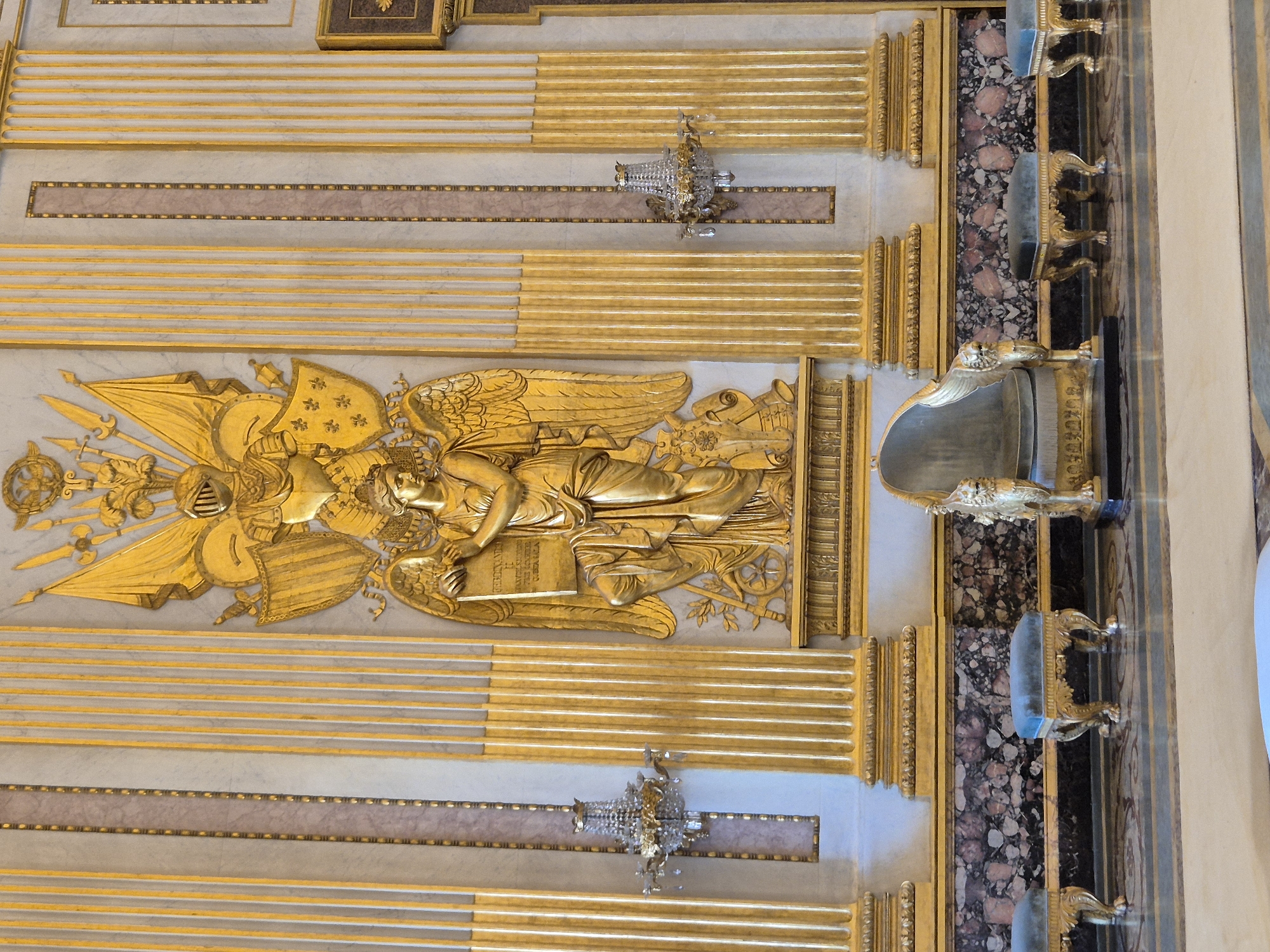
The image shows a gilded sculpture of an angel holding a scroll, set against a wall adorned with vertical gold-colored fluted columns. The sculpture is part of a larger decorative panel featuring a knight's helmet and other heraldic elements. In the foreground, there is a plush, light-blue upholstered throne with ornate gold detailing, flanked by two similar, smaller upholstered stools. The wall behind the throne is decorated with a marble frieze featuring a dark pink and grey veined pattern. Two crystal chandeliers hang from the wall on either side of the central sculpture. This opulent setting is located within the Royal Palace of Caserta in Caserta, Italy.
Caserta
The video shows a wide shot of the interior of a grand building, likely a palace or museum, with ornate marble walls and a high ceiling. In the foreground, a woman with blonde hair, wearing a black top and white pants, walks down a marble staircase. She is descending from right to left. In the background, there are several statues. On the left, a standing male figure in regal attire is in a niche. In the center, a seated female figure, wearing a crown and draped in cloth, is depicted with a lion beside her, also within a niche. Another male figure is visible in a niche on the far right. Several other people are seen standing and observing the art and architecture. The lighting is dim, with spotlights illuminating the statues.
Caserta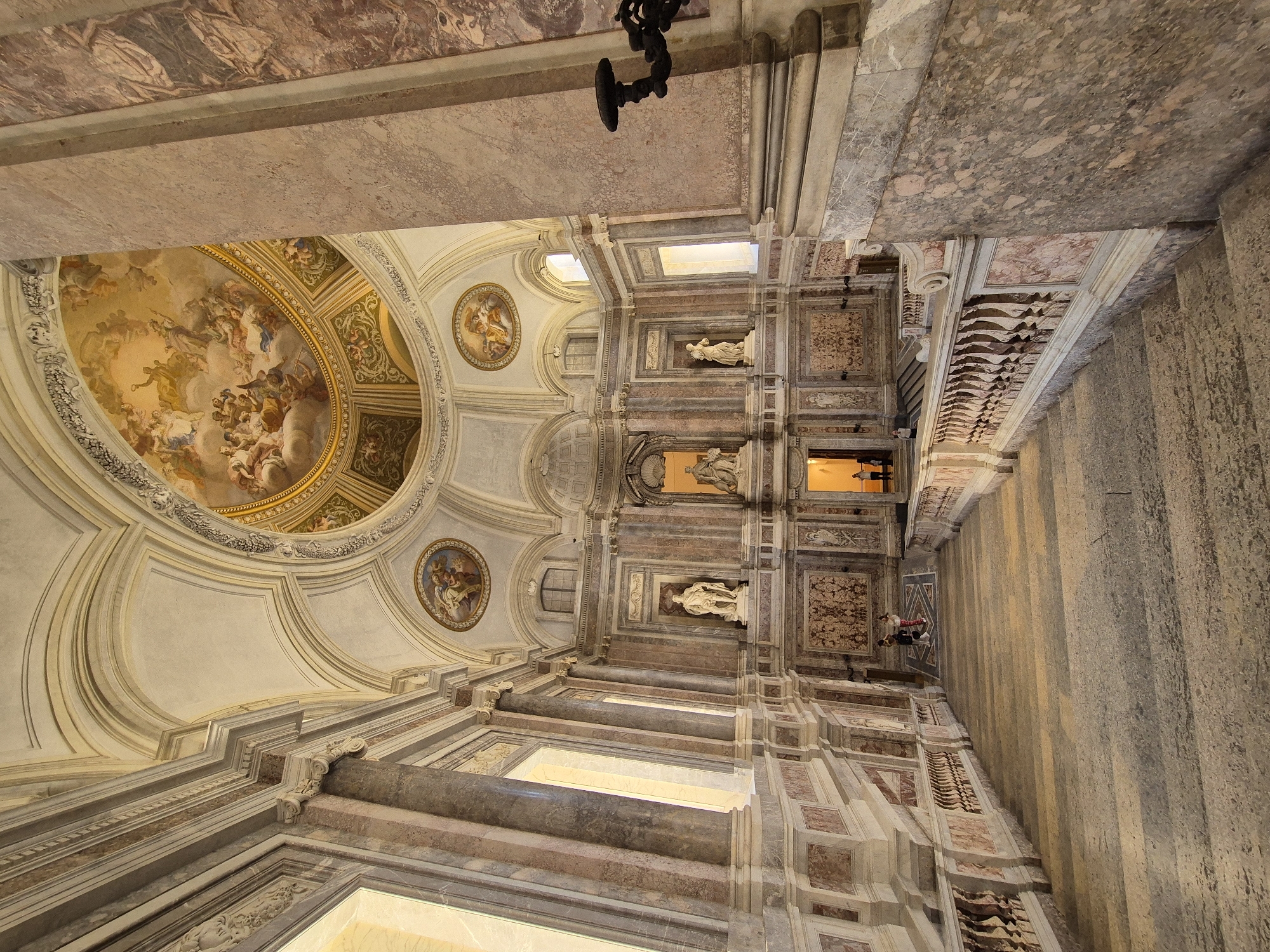
The image shows the grand staircase within the Royal Palace of Caserta, Italy. The staircase, made of stone, is wide and descends from the upper levels of the palace. It is flanked by ornate marble balustrades with intricately carved spindles. The walls of the palace are adorned with marble panels and bas-reliefs. Above, a large dome ceiling is painted with a fresco depicting celestial scenes and figures. Several statues are placed in niches along the upper levels of the staircase. Sunlight streams in from large windows, casting shadows across the steps. Two individuals, appearing to be tourists, are visible standing on a landing partway down the staircase, looking towards the ornate walls. Another person is visible further down the staircase. The scene conveys a sense of opulence and historical grandeur characteristic of the Royal Palace of Caserta.
Caserta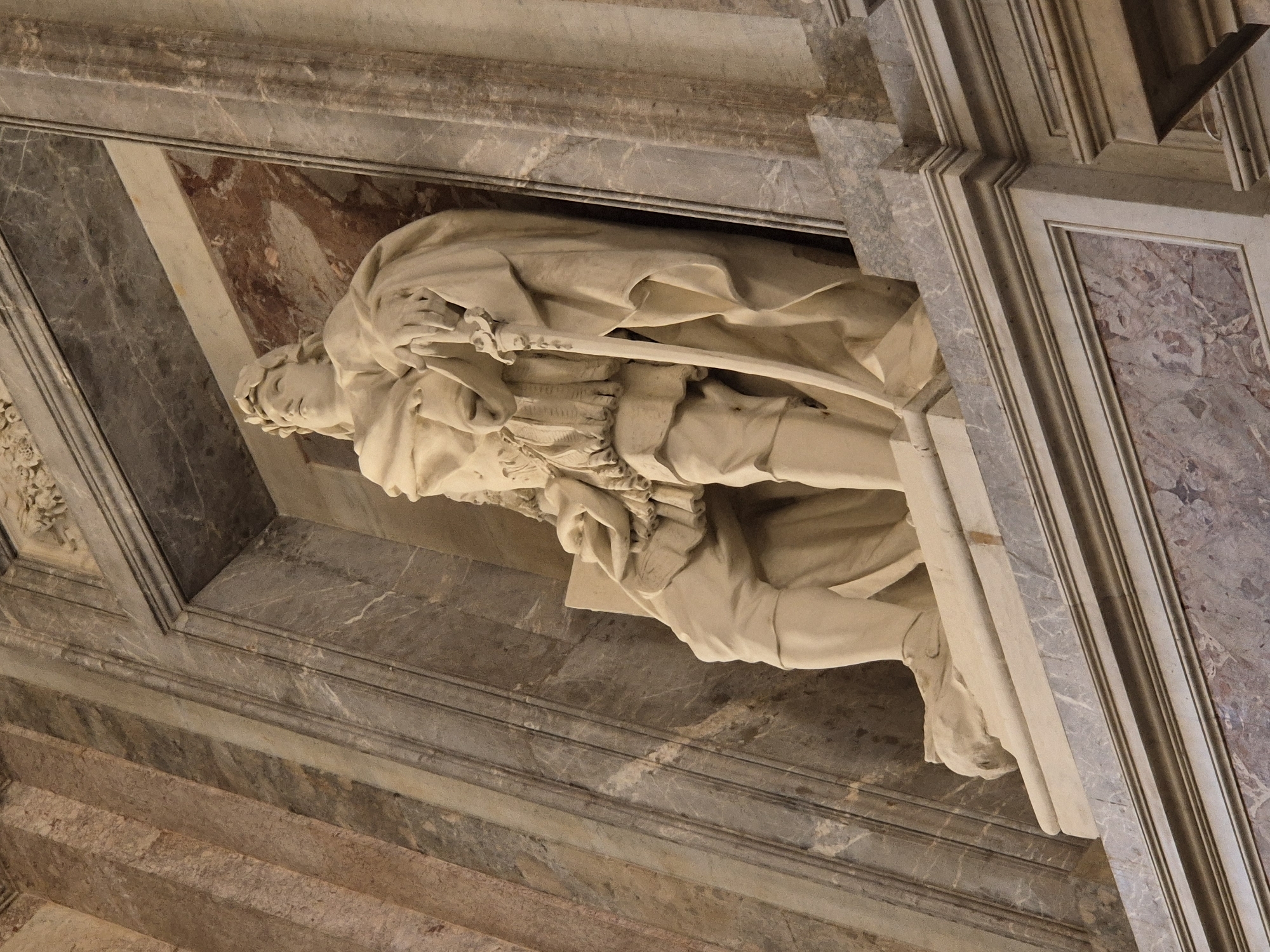
This media file showcases a detail of a sculpture of a person, possibly a man in historical attire, lying down or in a recumbent pose. The sculpture appears to be made of light-colored stone or marble. The figure is draped in flowing robes, with a sword held across its body. The head of the sculpture is visible, tilted downwards with closed eyes, suggesting a state of rest, sleep, or perhaps death. The detailed rendering of the fabric folds and the facial features are notable. The sculpture is set within an architectural context, framed by marble elements. The surrounding stonework features intricate detailing and veined marble in shades of grey, white, and pinkish-brown. The texture of the marble suggests a grand, possibly historical, indoor setting, consistent with a tomb, monument, or a richly decorated architectural space. The lighting in the scene is subdued, casting soft shadows that accentuate the sculpture's form and the surrounding architectural details. There is no visible text in the image. The orientation of the image is landscape and the photo appears to be taken from a low angle looking upwards. Given the location context of Caserta, Italy, this sculpture could be part of the Royal Palace of Caserta or a related historical site, a location known for its opulent architecture and art.
Caserta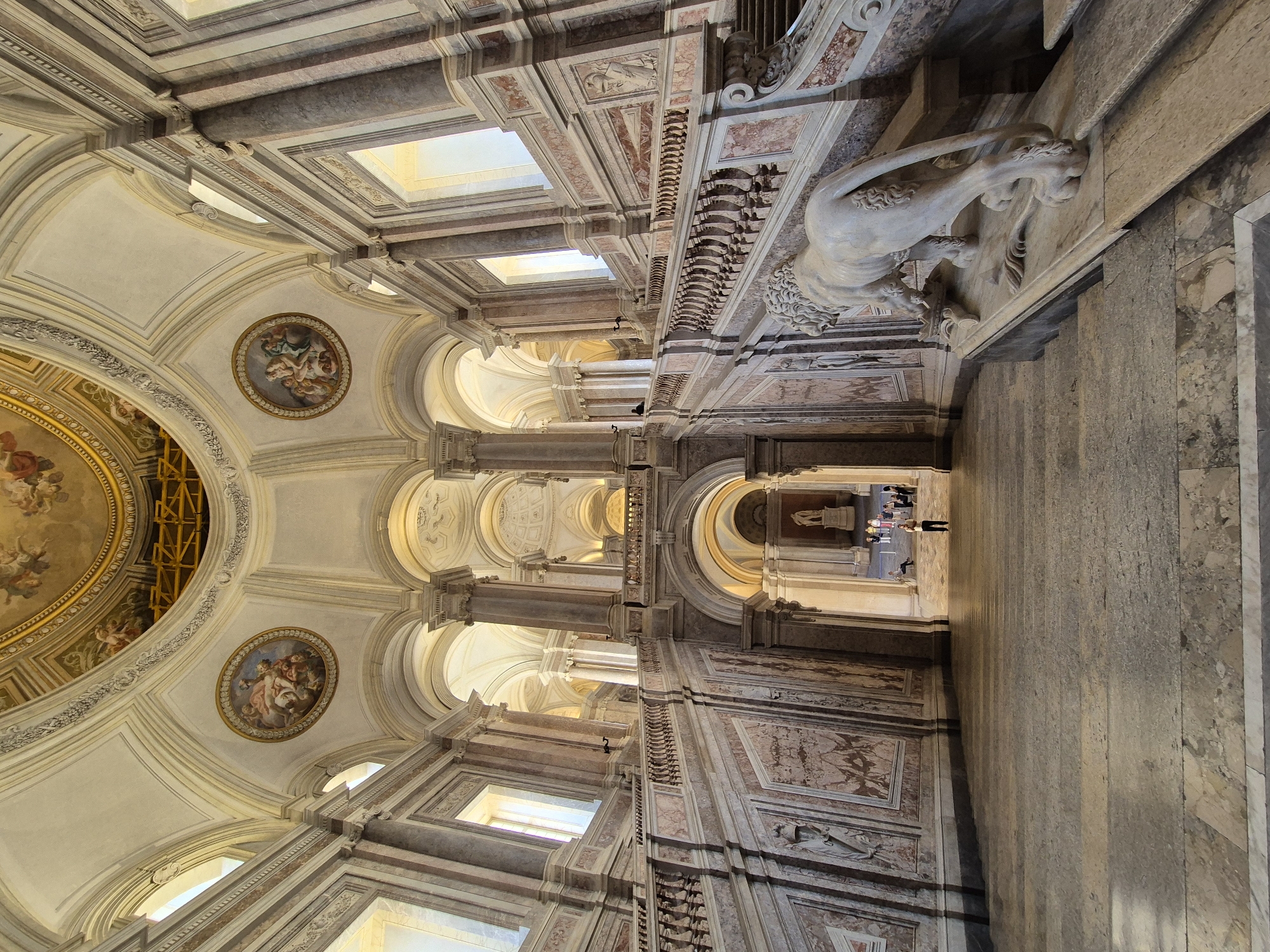
The image shows an interior view of a grand, ornate building, possibly a palace or a museum, characterized by its high ceilings, elaborate marble work, and detailed architectural features. The perspective is angled upwards, emphasizing the scale and verticality of the space. In the foreground and midground, the viewer is presented with towering marble columns and intricately decorated walls, featuring panels with bas-relief carvings and inlaid marble. A prominent sculpture of a winged lion, with a detailed mane and outstretched paws, is visible on a ledge. The ceiling is a marvel of architectural design, with a large central dome adorned with frescoes of angelic figures. Smaller circular frescoes depicting mythological or religious scenes are strategically placed on the vaulted sections of the ceiling. Rectangular skylights punctuate the upper portions of the ceiling, allowing natural light to filter into the space, suggesting it is daytime. In the background, a long corridor or hall extends into the distance, lined with more architectural elements. At the far end of the hall, a few people can be seen standing, providing a sense of scale to the vastness of the interior. They appear to be observing something in the distance, perhaps a statue or an exhibit. The overall atmosphere is one of awe and grandeur, typical of historical and culturally significant Italian landmarks. The scene depicts a moment of quiet exploration within a magnificent architectural space. The lighting suggests it is daytime, and the polished marble surfaces reflect the light, adding to the opulent feel. The location is identified as Caserta, Italy, which likely refers to the Royal Palace of Caserta, known for its similar Baroque and Neoclassical architectural styles, extensive frescoes, and grand interiors. There is no visible text in the image.
Caserta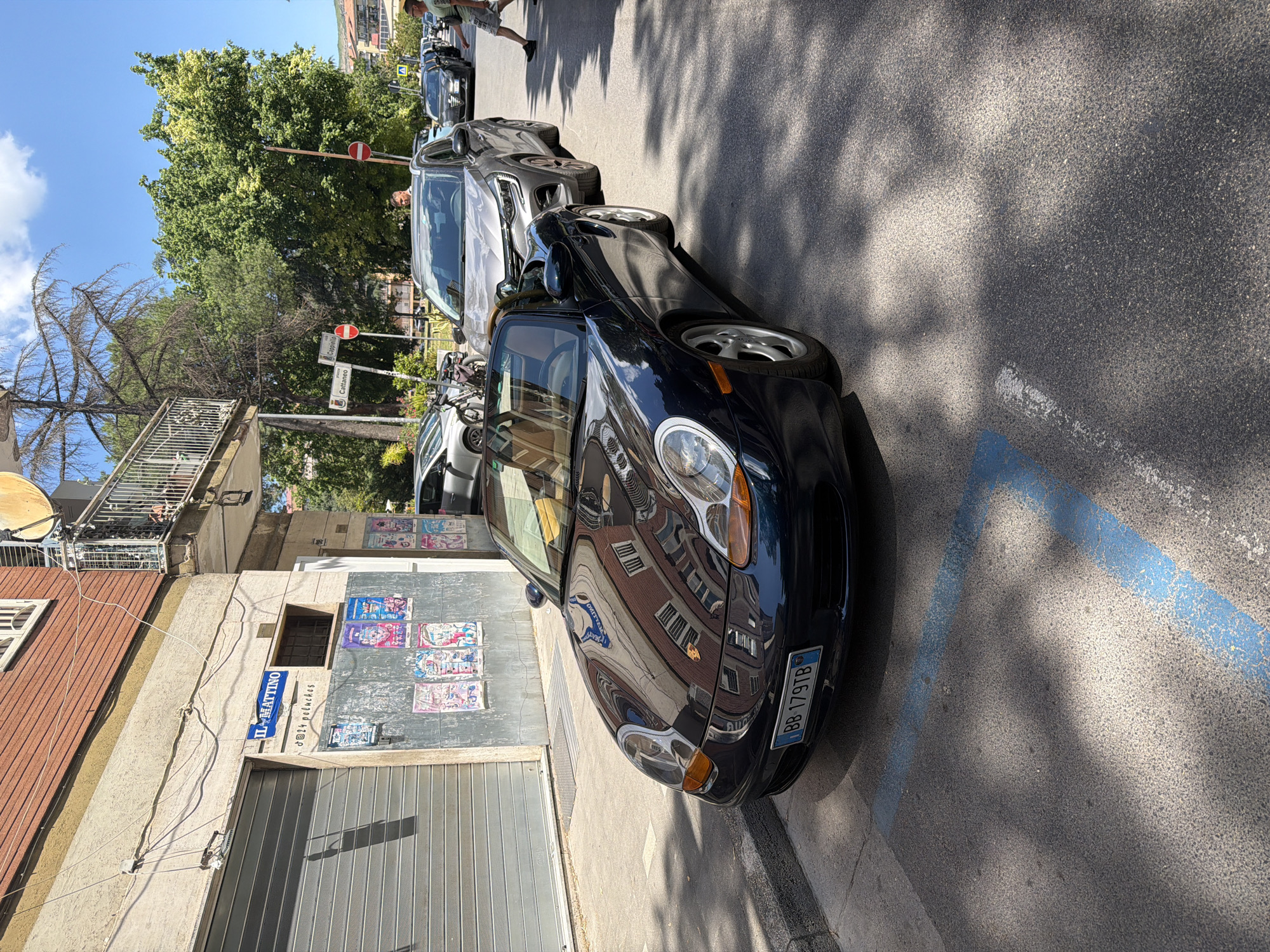
This image depicts a sunlit street scene in Caserta, Italy, specifically at or near the intersection of Via Cattaneo and Via Cappiello. The time of day is approximately midday or early afternoon, characterized by bright sunlight and strong, dappled shadows cast across the asphalt pavement from overhead trees. The sky is clear blue with sparse white clouds. In the foreground, a dark blue Porsche Boxster convertible (986 generation) is parked on the left side of the street, partially within a faded blue-lined parking space. Its front Italian license plate, "BB 179TB," is clearly legible. The car's highly reflective hood and windshield show inverted reflections of the opposite buildings and street elements, including a sign that reads "IL MATTINO." The interior appears to have light-colored (tan/beige) upholstery. To the left of the Porsche, a concrete curb separates the street from a sidewalk. Further left, a multi-story building features a reddish-brown tiled upper facade and a lighter, textured ground floor. A large, closed grey metal roll-down garage door occupies a significant portion of the ground floor. Above the garage door, a blue rectangular sign reads "IL MATTINO" with "Solo pubblicità" written beneath it. Several colorful posters are affixed to the wall below this sign. Wires run along the exterior wall of the building. To the right of this building, another structure with balconies and a satellite dish is visible. Behind the Porsche, a silver-grey Renault Captur SUV is parked, facing in the same direction. Further down the street, a line of dark-colored cars, possibly Alfa Romeos, are either parked or moving. A silver car and a bicycle with a basket are also partially visible parked on the far left. Two white street signs indicating "Via Cattaneo" and "Via Cappiello" are visible in the mid-ground, alongside two red circular "Do Not Enter" signs. Two adult males are present on the right side of the frame. One man in a light-colored shirt is standing partially obscured behind the silver SUV. Another man in a light-colored T-shirt and shorts is seen walking towards the right edge of the frame. The background features various trees, including some with dense green foliage and others with bare, dry branches, under the clear sky. Distant residential buildings are visible on a hillside in the far background.
Caserta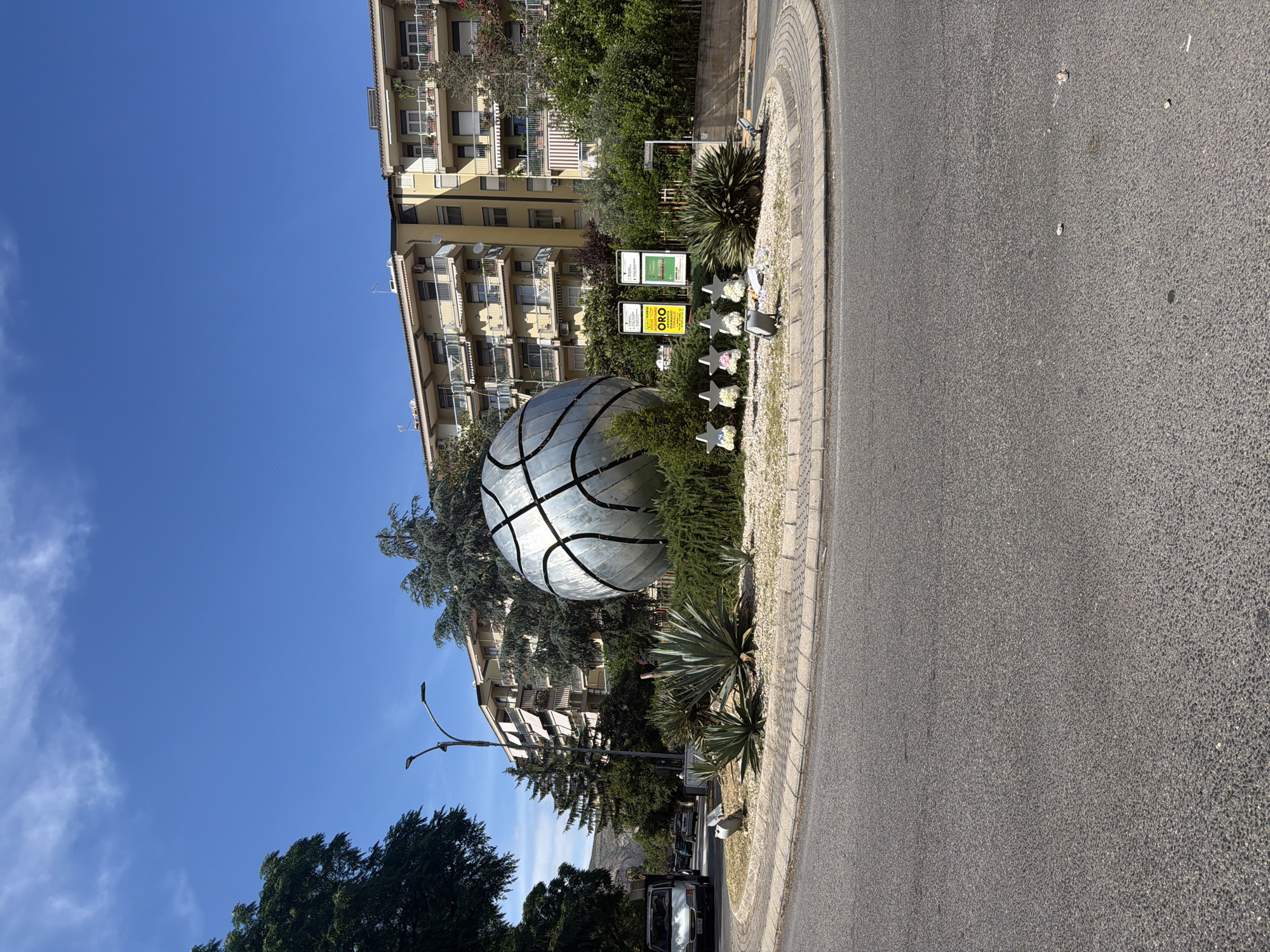
This image depicts an outdoor street scene in Caserta, Italy, on a bright and sunny day with a clear blue sky. The main subject is a large, metallic basketball sculpture, silver with black lines, prominently displayed in a planted island or roundabout. The sculpture is surrounded by various trees and plants, including tall conifers, shrubs, and succulents. In the background, multi-story apartment buildings with light-colored facades, numerous balconies, awnings, and air conditioning units line the street. Adjacent to the basketball sculpture, a series of small, white, star-shaped objects are arranged on the gravel, some with white flowers, suggesting a memorial or decorative display. Several signs are also present in the planted area. A prominent yellow sign clearly displays the Italian text "ORO DAMASCO" and "100%", along with other smaller, less legible text. Other green signs are also visible. The scene includes an asphalt road and a paved curb. A white van or truck is partially visible in the background on the street. No specific human activity is taking place; the scene is static. The time of day appears to be morning or early afternoon, indicated by the strong sunlight and clear shadows.
Caserta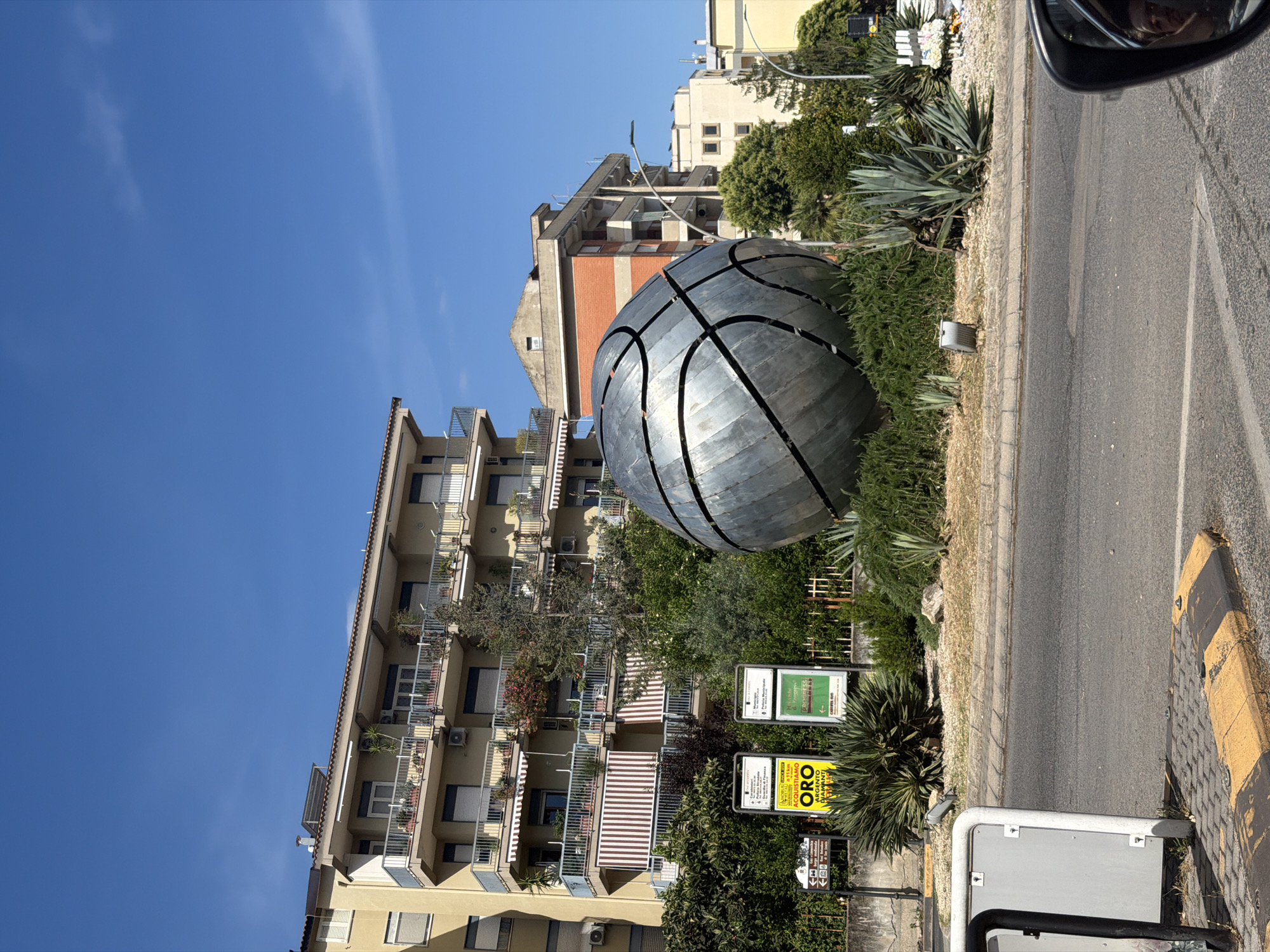
This image, taken in Caserta, Italy, captures a vibrant street scene on a bright, sunny day with a clear blue sky. The focal point is a large, metallic sculpture of a basketball, dark gray or silver in color, prominently displayed amidst lush green vegetation in a roadside median. To the left and in the background stand multi-story residential buildings, likely apartment blocks, featuring numerous balconies. Many balconies are adorned with awnings and potted plants, suggesting a lived-in environment. Some buildings are concrete with visible brick sections, while others are painted in lighter tones. On the right side of the image, a paved asphalt road runs parallel to the median, bordered by a concrete curb painted yellow. The perspective suggests the photo was taken from inside a vehicle, as evidenced by a partial view of a car's side mirror in the upper right, reflecting a person's head. Amidst the greenery in the median, several signs are visible. A yellow sign clearly advertises "ORO ACQUISTIAMO ARGENTO DIAMANTI," indicating a business that buys gold, silver, and diamonds. Another green informational sign includes directional arrows and text mentioning "COMMISSARIATO PS" (Police Station) and "CARCERI" (Prisons), with "CASERTA" also visible, confirming the location context. No specific human activity is depicted; the scene is a static street view. The strong sunlight casts clear shadows, suggesting it's mid-morning or afternoon.
Caserta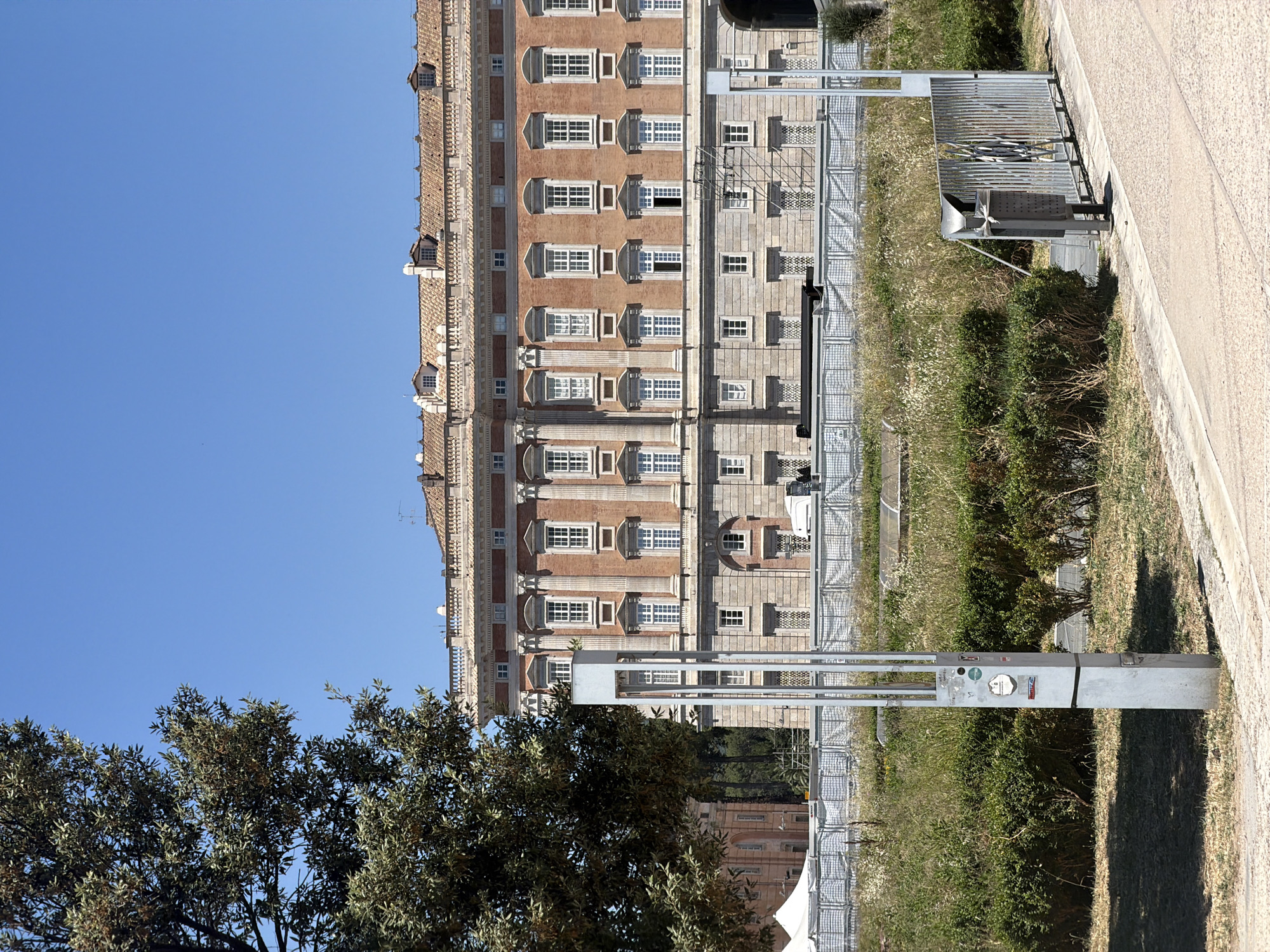
The image shows a side view of the Royal Palace of Caserta, Italy. The facade of the palace is visible on the left, with multiple rows of windows and a light-colored exterior. To the right of the palace is a fenced area with a small structure and vegetation. In the foreground, there's a tree on the left and a paved area on the right. The sky is clear blue.
Caserta