Castrocielo, Italy
30 memories from Castrocielo, Italy
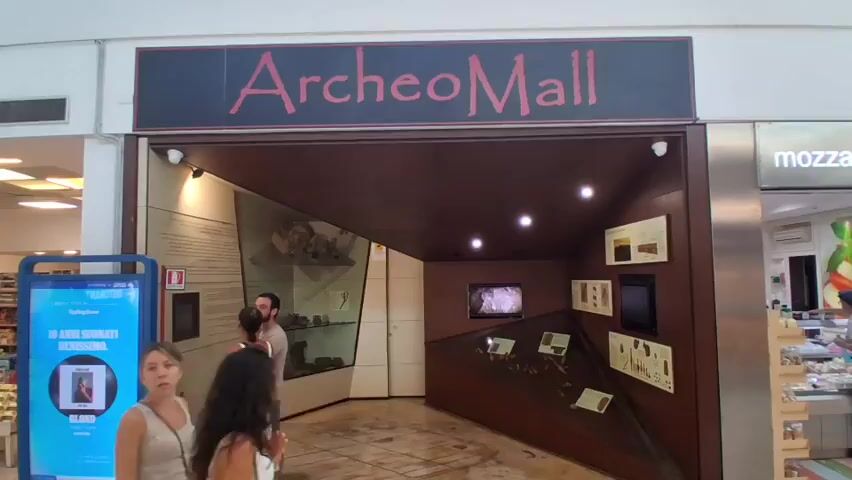
The video shows the exterior of a store called "ArcheoMall". There are people standing outside the store entrance, looking in. Inside the store, there are displays of artifacts and a video playing on a screen. A digital kiosk is also visible outside the store. The environment appears to be a shopping mall with tiled floors and lighting.
Castrocielo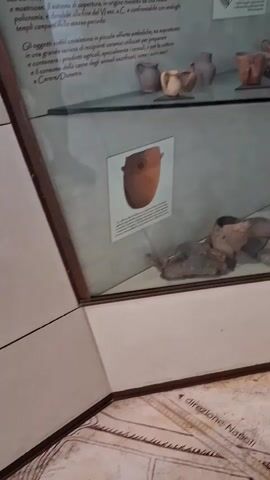
The video pans across a museum display case containing ancient pottery and artifacts. The display case has a glass front and is illuminated by overhead lighting. The artifacts appear to be made of clay and vary in size and shape, with some being intact and others fragmented. Some of the pottery items are bowls, while others are smaller vessels. There are also what appear to be grinding stones or tools made of stone. In the background, behind the main display, there is another shelf with more pottery. The floor in front of the display case is tiled, and a portion of a map or document with the words "direzione Napoli" is visible on the floor. The overall impression is of an archaeological exhibition showcasing ancient ceramic and stone objects.
Castrocielo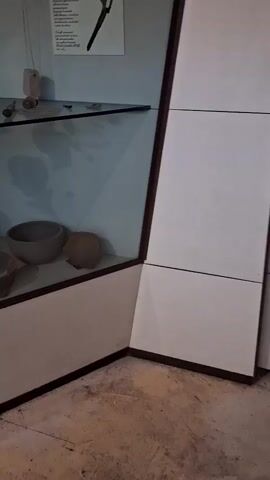
A museum display case contains ancient pottery. The pottery is on shelves behind glass. The display case is lit from above. The pottery is various sizes and shapes. Some pieces are broken. There is a text label next to one of the pottery pieces. The text is in Italian. The pottery is made of terracotta. The display case is made of wood and glass. The floor is tiled.
Castrocielo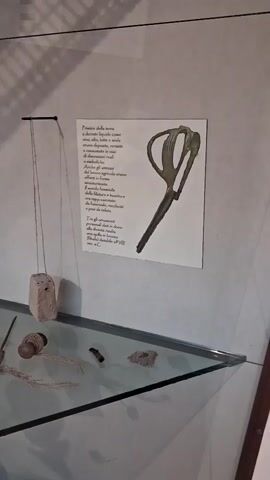
The video displays a museum exhibit. In the foreground, a glass shelf holds various small, rough-hewn objects, possibly artifacts. Among these objects are pieces of twine, a small wooden spool, and what appears to be a small, dark, cylindrical object. Behind the shelf, on the wall, is a framed text and an image of a stylized bronze tool, resembling scissors or shears. The text, written in Italian, discusses early agricultural tools and women's crafts, referencing a bronze fibula dated to the 8th century BC. To the left of the framed exhibit, a thin string hangs from the ceiling, suspending a small, weathered stone object. The overall lighting suggests an indoor, possibly dimly lit museum environment, with shadows cast on the wall from the exhibit elements.
Castrocielo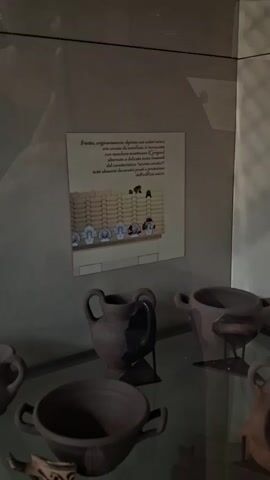
A digital photograph displays a museum exhibit featuring ancient pottery. In the foreground, several terracotta vessels with handles and wide openings are visible, arranged on a reflective surface, likely a glass shelf. The vessels are dark brown, some appearing intact and others with visible damage or missing pieces. Behind the pottery, on the wall, is a framed informational plaque. The plaque features an illustration of a tiled roof with decorative antefixes, which are ornamental architectural elements. These antefixes appear to be terracotta and depict faces, some stylized and some resembling masks. The illustration is accompanied by text in Italian, likely describing the architectural features or the origin of the artifacts. The lighting in the museum appears to be ambient, creating soft shadows and highlighting the objects. The overall impression is one of historical preservation and display.
Castrocielo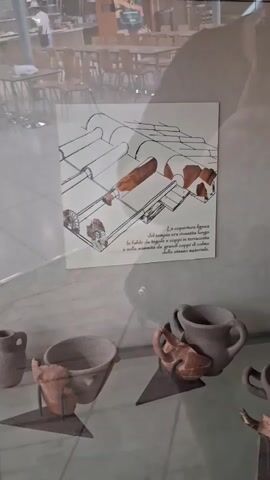
The video pans across a display case containing ancient pottery fragments and a framed illustration. The illustration depicts a cross-section of a tiled roof, showing the arrangement of terracotta tiles and coping stones. Text below the illustration, in Italian, describes the roof covering of a temple. The pottery fragments in the display case appear to be shards of various vessels, including bowls and possibly a jug. The environment suggests a museum or exhibition setting, with a muted background and lighting focused on the display.
Castrocielo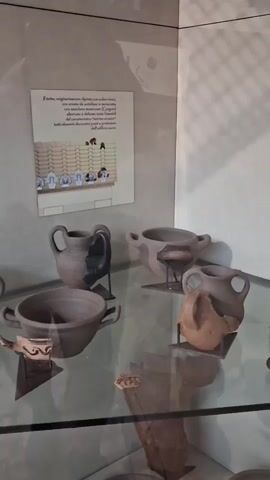
The video shows a museum display case with various ancient artifacts. The display case has a glass top and is filled with pottery fragments, tools, and what appear to be weights or spools. On the wall behind the display case are two informational plaques with text and images, one depicting what looks like a manuscript or illustration and the other showing a pair of bronze scissors. The lighting in the museum is dim, with shadows cast on the wall. The camera is positioned to capture a close-up view of the artifacts within the display case.
Castrocielo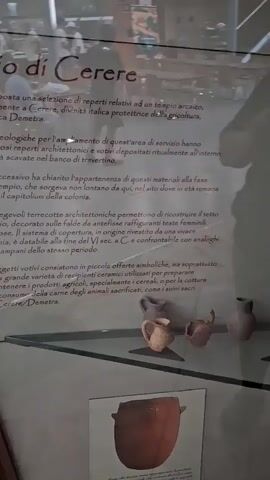
The video shows a display case in a museum, with artifacts and informational panels visible. In the background, blurred figures of people can be seen in what appears to be a larger open space, possibly a cafe or exhibition hall. The display case itself contains various pottery fragments and complete ceramic vessels, along with some illustrations and text. The lighting suggests an indoor environment.
Castrocielo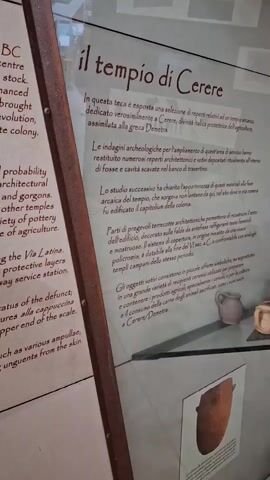
The video shows a display case with text in Italian and some ancient artifacts. The text on the right, under the heading "il tempio di Cerere," describes the temple of Ceres. The display case contains pottery fragments and small terracotta figures. There are also illustrations of architectural elements and pottery. The background is blurred, but appears to be an indoor setting, possibly a museum.
Castrocielo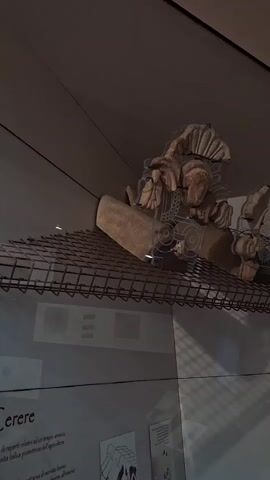
The video pans across an exhibit in a museum. The primary objects are ancient terracotta architectural fragments, possibly roof tiles or decorations, displayed on a wire shelf behind a glass barrier. These fragments feature sculpted faces and decorative motifs, some with remnants of paint. In the background, there are information panels with text and illustrations. The lighting is dim, characteristic of a museum setting. The perspective suggests the camera is moving horizontally from left to right, capturing different pieces of the artifact.
Castrocielo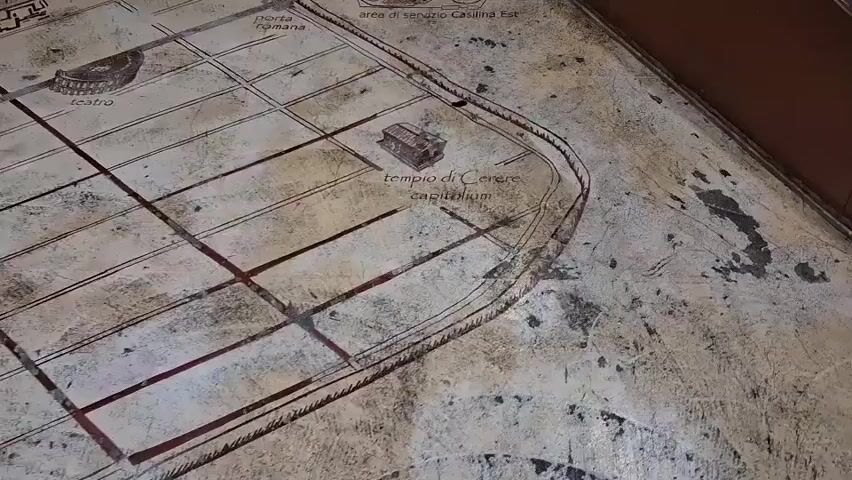
The video shows a close-up, oblique, panning shot of a worn, textured surface displaying a map of an ancient Roman settlement. The map is rendered in a faded brown and red ink with lines and text in Italian. Visible elements include a depiction of a theater, a Roman gate labeled "porta romana," a temple labeled "tempio di Cerere Capitolino," and an area marked "area di servizio Casilina Est" which includes a small circle labeled "voi siete qui" indicating the viewer's current location. There is also an arrow pointing in the direction of Rome, labeled "direzione Roma." The surface itself appears to be stone or a similar material with visible wear and dirt. The background is out of focus, showing a brown, wooden-like edge of the display or enclosure.
Castrocielo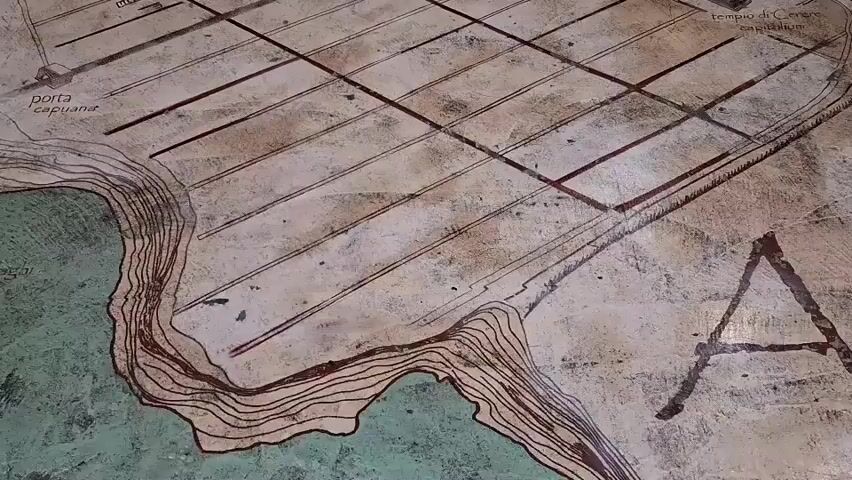
The video shows a close-up view of an ancient map, likely etched or painted onto a stone surface. The map depicts a city with a grid-like street layout, suggesting Roman urban planning. Prominent features include structures resembling an amphitheater and a theater, along with labeled areas such as "Porta Capuana," "Via Latina," and "Porta Romana." Contour lines indicate varying terrain, and a body of water, possibly a river or coastline, is visible along one edge of the map. The map itself appears weathered and aged, with some areas showing signs of wear and tear. The lighting is somewhat dim, with the light source creating shadows that highlight the texture of the map. The camera slowly pans across different sections of the map, allowing viewers to observe the intricate details of the ancient cartography.
Castrocielo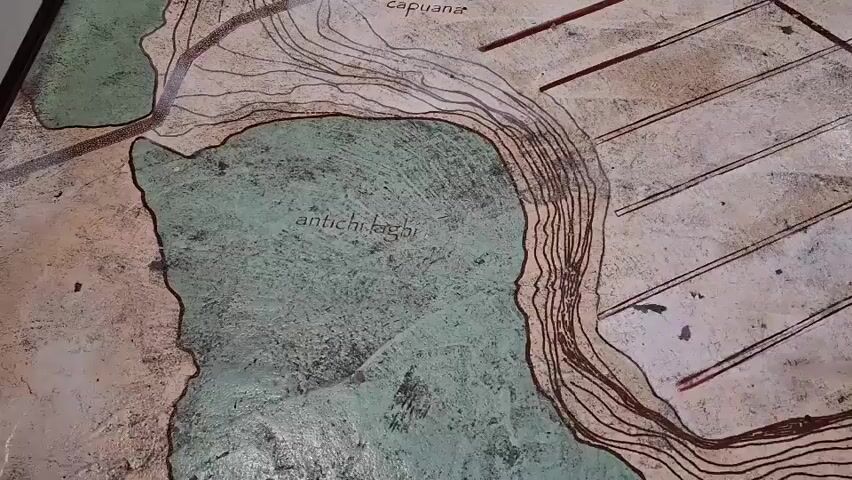
The video shows a close-up, panning view of a detailed map, likely etched or painted onto a surface. The map depicts an ancient city or settlement, featuring contour lines suggesting varied topography and bodies of water labeled as "antichi laghi" (ancient lakes). Several structures, roads, and entrances, including "Porta Capuana" and "Via Latina," are clearly marked. The map's color palette consists of muted earth tones with green accents for the water. The camera moves slowly, allowing for a detailed examination of the map's features. The lighting is somewhat diffuse, suggesting an indoor environment. There are no people visible in the video, and the focus remains solely on the map itself.
Castrocielo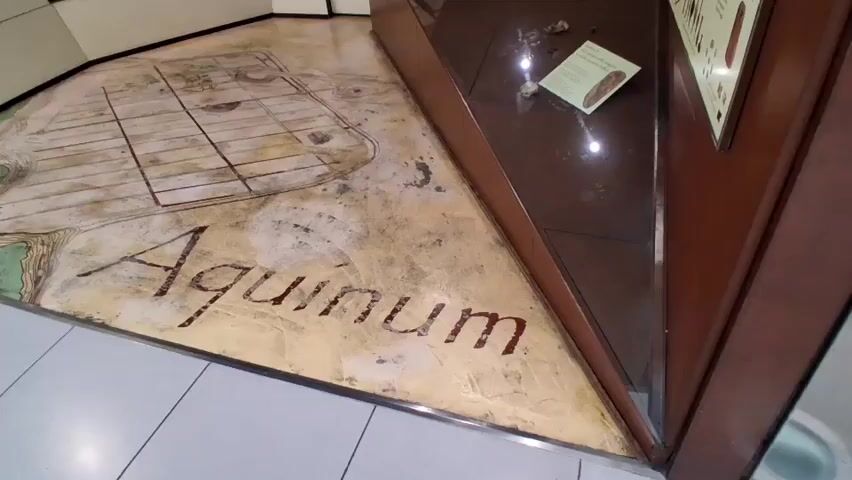
The video shows a floor map of an ancient city or settlement, labeled "Aquinum". The map is detailed, with outlines of buildings and structures, and is colored with green for areas of vegetation or water, and earthy tones for the ground. The map is inlaid into a tiled floor, with a wooden display case or partition at an angle to the right. The display case contains some objects and a pamphlet. The lighting in the room is somewhat dim, with some bright spots on the map and in the display case. The camera is panning slowly across the map.
Castrocielo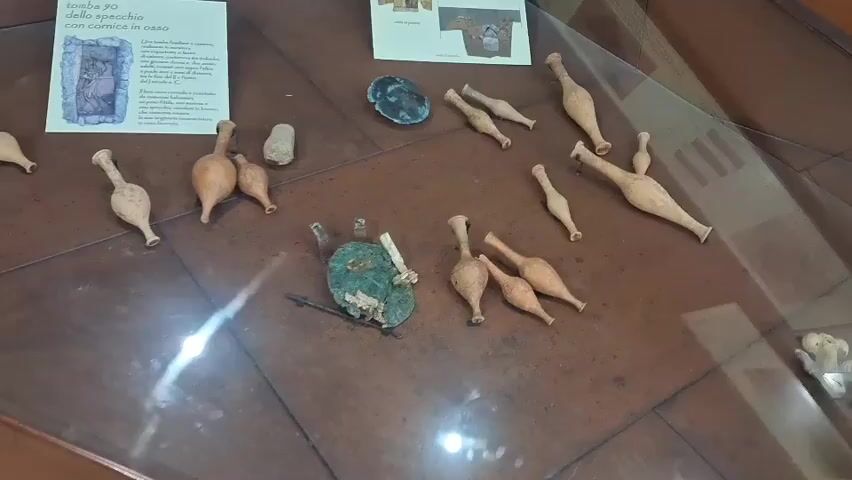
The video shows an archaeological display case with various artifacts. The case has a brown, textured surface, possibly wood, with a glass top. Several small, terracotta-colored vessels of various shapes and sizes are arranged on the surface. Some appear to be amphorae or oil lamps. In the center of the display, there is a greenish, circular object with some remnants of organic material and a metal spike. To the left of this object, there are two more small vessels and a small, gray stone. There is also a flat, dark gray object. Further to the left, a white informational placard is displayed. The placard features an illustration of a sarcophagus or tomb and text in Italian. In the upper right corner of the display, there are additional small terracotta vessels. The lighting in the case is bright, with some reflections visible on the glass surface. The overall impression is that of a museum exhibit showcasing ancient artifacts.
Castrocielo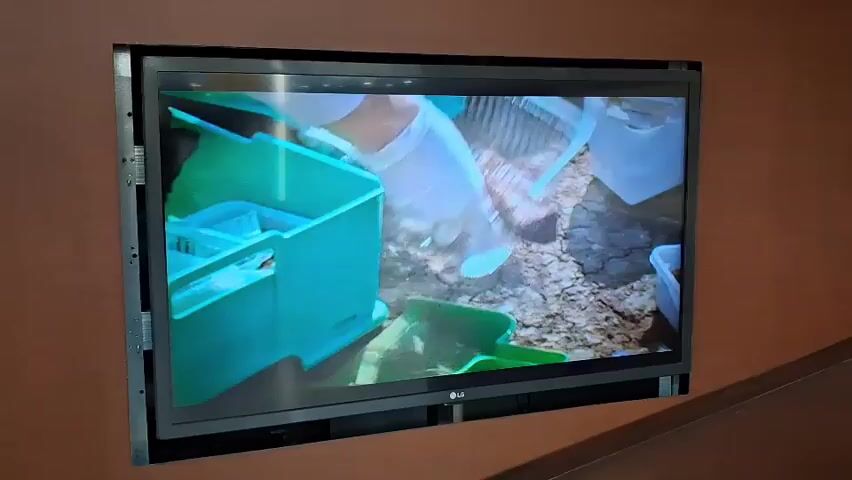
A video displays a close-up of a television screen embedded in a brown wall. The television shows a scene with a person wearing white gloves handling what appear to be artifacts, possibly bones or tools, from a bright blue plastic container. The camera then shifts to a closer view of the screen, showing a person's hand writing on a piece of paper with some text in Italian. The video captures the overall scene of the television and its surroundings.
Castrocielo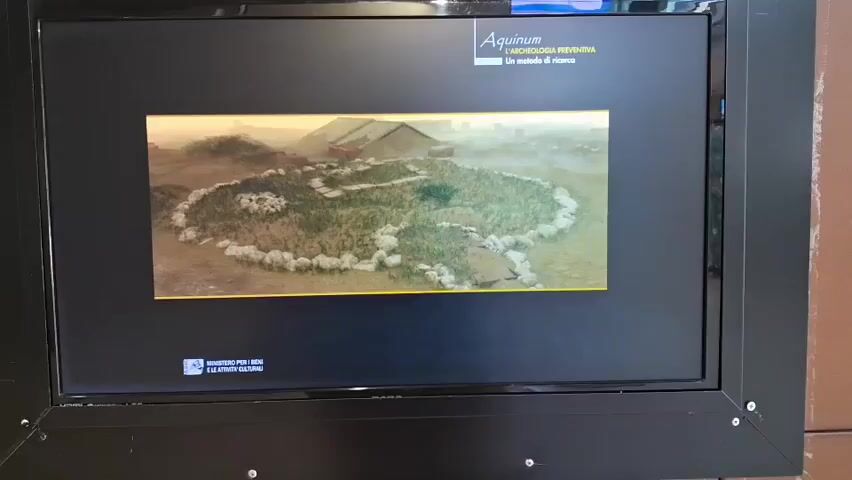
The video displays a digital screen with an image of a circular ancient settlement, surrounded by a stone wall and featuring several huts within. The background shows a misty landscape with hills and more structures. The screen also has text overlays. At the top right, the word "AQUINUM" is visible, followed by "L'ARCHAEOLOGIA PREVENTIVA" and "Un metodo di ricerca". At the bottom left, a logo with "MINISTERO PER I BENI E LE ATTIVITA CULTURALI" and "SOPRINTENDENZA ARCHEOLOGICA" is present. The video transitions to a new screen displaying text about the archaeological process, stating that individual testimonies (tombs, burials, traces of centuriation) are inserted into a single scheme to reconstruct lost scenarios. The text is presented in white against a dark background with a yellow border. The overall scene appears to be an exhibit or presentation, possibly in a museum or cultural institution. There are no people visible in the video.
Castrocielo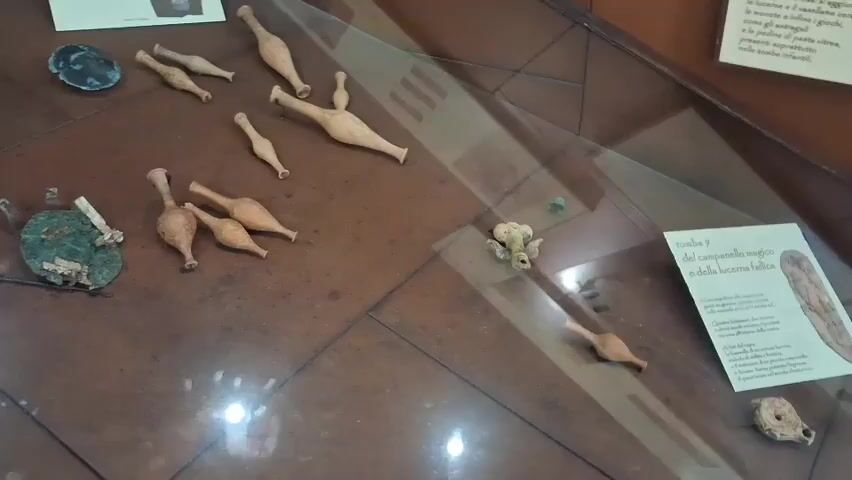
The video shows a museum display case containing ancient artifacts. The objects are primarily small, terracotta vessels, some with long necks and bulbous bases, others with multiple spouts. There are also some metallic objects, one of which appears to be a circular bronze mirror with a green patina, and another small, irregular piece of metal. A larger, lighter-colored stone object is also visible. One section of the display includes a small, light-colored object that resembles a carved figure or fragment, possibly of an animal. A descriptive plaque with Italian text and illustrations is positioned near some of the artifacts. The display case has a glass top, reflecting the lighting and surroundings. The overall impression is of an archaeological exhibition of ancient pottery and other small finds.
Castrocielo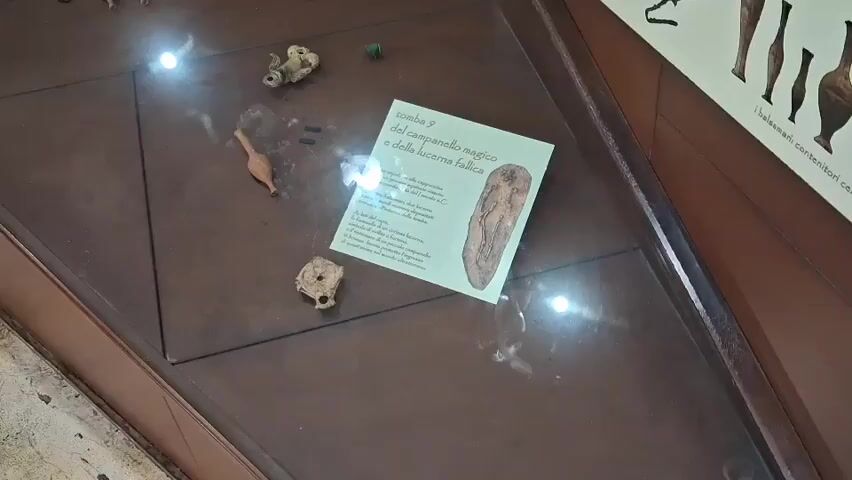
The video shows a museum display case with archaeological artifacts. The display case has a brown surface and is illuminated by overhead lights that cause reflections. On the surface are several small, ancient-looking objects, some appearing to be pottery fragments or small tools. A prominent item is a white informational card with Italian text and an image of what appears to be a phallic-shaped object. The text on the card mentions "tomba 9" and "campanello magico e della lucerna fallica," suggesting it relates to tomb number 9 and a magic bell and phallic lamp. Several small pottery pieces, a green bead, and what looks like a small wooden tool are also visible. The lighting creates glare on the glass surface, obscuring some details. The overall environment appears to be an indoor museum exhibit.
Castrocielo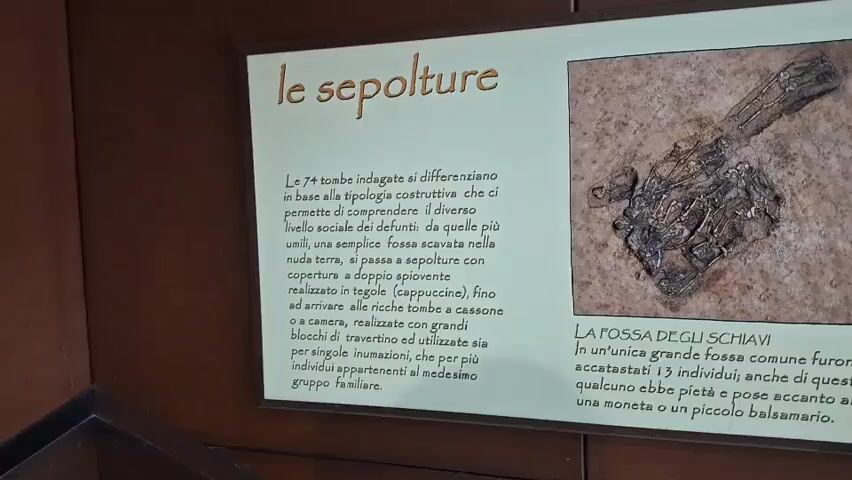
The video shows a close-up of a museum exhibit with text and images about ancient burials. The exhibit has a light-colored background and a darker brown frame. The text is in Italian. On the left side, there is a description of different types of burials, including simple pits, burials with tile coverings, and burials in stone chambers. The text discusses how these variations can help understand the social status of the deceased. An image of a fossilized skeletal remains, possibly of an animal, is displayed next to the text. To the right, there is a section titled "LE FOSSA DEGLI SCHIAVI" (The Slave Pit). This section describes a common pit where 13 individuals were buried, with some found with coins and small balsamaries. An image depicts the arrangement of these remains. Further to the right, another section details "Le tombe alla cappuccina" (Capuchin Tombs), which are described as the most common in the Roman world. Images show how these tombs were constructed using tiles to form the burial place and the roof. The text also mentions that the bodies were covered with earth and sometimes accompanied by signs made of wood or tiles to indicate their position. The video pans across the exhibit, showing the different sections and images. The overall environment appears to be a museum or an exhibition space, with muted lighting and a focus on the educational display.
Castrocielo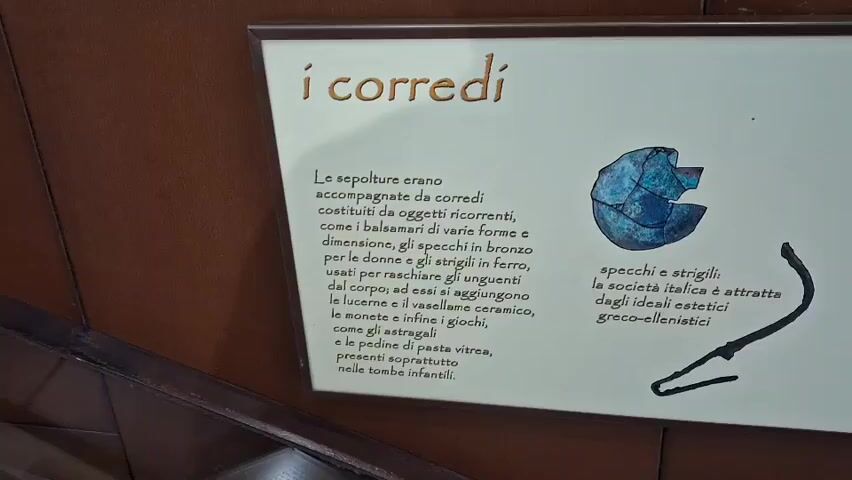
The video pans across a museum exhibit display. The display is a large, horizontal rectangular plaque with text and images. The title of the exhibit is "i corredi". The text on the left describes grave goods found with burials, listing items like balsamaria, bronze mirrors, strigils, lamps, ceramic vessels, coins, astragali, and glass paste beads. Images on the right show some of these artifacts: a broken blue ceramic vessel, a black curved metal object that appears to be a strigil, a series of ceramic vessels of varying sizes and shapes, and a cluster of small, rounded objects that appear to be beads or small stones. The video continues to pan to the right, revealing more images and text. One section discusses how the strigils and mirrors reflect the Italic society's attraction to Greco-Hellenistic aesthetic ideals. Another section shows a small blue fragment of what might be glass or pottery, described as coins accompanying the great journey. Further to the right, there are images of what appear to be dice made from bone or stone, described as astragali, and a reddish-brown stone object. The exhibit is displayed on a wall, with a wooden frame and a dark wooden shelf or display base visible in the foreground. The lighting in the exhibit appears to be neutral. No people are visible in the video.
Castrocielo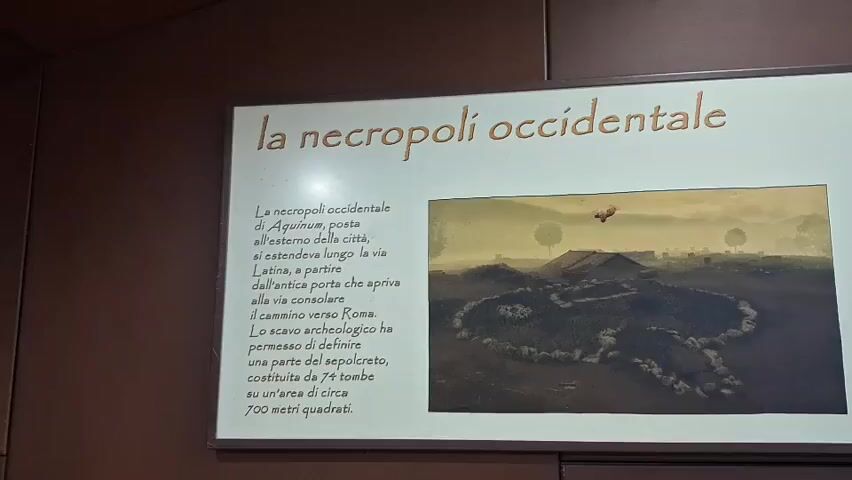
The video shows a close-up shot of a museum exhibit. The exhibit features a large rectangular display board with text and images. On the left side of the board, there is text in Italian, with the title "la necropoli occidentale" (the western necropolis) at the top. Below the title is a paragraph of text describing the necropolis. To the right of the text is a painting depicting an archaeological site with some circular stone structures and what appear to be ancient buildings or tombs. On the right side of the display board, there is a diagram showing different layers of soil and what appears to be a cross-section of an archaeological excavation. The diagram includes labels in Italian, such as "livelli di protezione" (protection levels), "suolo antico" (ancient soil), "terre rosse" (red earths), and "travertini" (travertine). Below these labels, there are representations of tombs, labeled "Tomba 6 del letto funerario" (Tomb 6 of the funerary bed) and "Tomba 7 della lastrona italica" (Tomb 7 of the Italic slab). Further to the right, there is a drawing of an "AUTOGRILL" sign and some trucks, suggesting a connection between the ancient site and modern infrastructure. The lighting in the video is somewhat dim, and there are some reflections on the display board. The background of the exhibit appears to be a dark, wooden panel. No people are visible in the video.
Castrocielo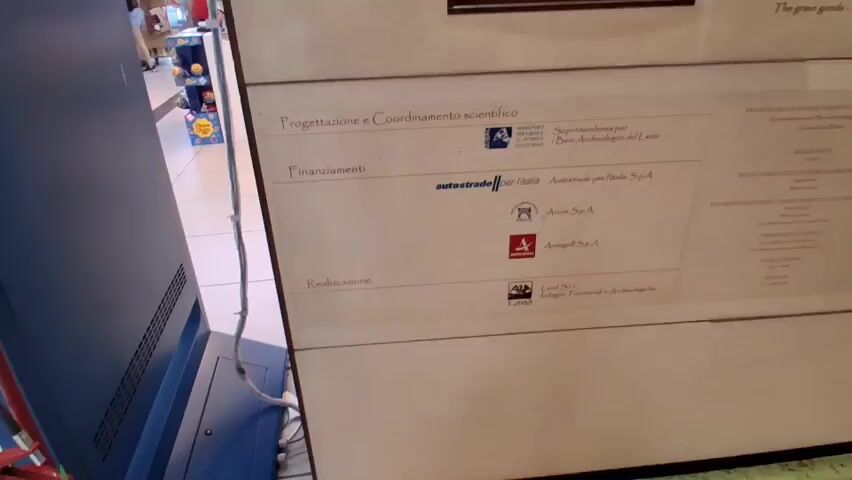
A wide-angle shot focuses on a white informational panel. The panel is divided into sections with text and logos. The top section, titled "Progettazione e Coordinamento scientifico," lists "Ministero per i Beni Culturali e Ambientali" and "Soprintendenza per i Beni Archeologici del Lazio" with their respective logos. The next section, "Finanziamenti," features the "Autostrade per l'Italia" logo and "Autostrade per l'Italia SpA," followed by the logos and names of "Arca SpA" and "Anas SpA." The third section, "Realizzazione," shows the "Land Sci" logo and "Land Sci - Servizi Territoriali e Archeologici." To the right, another column of text lists similar information, including "Direzione Progettazione Scientifica e Coordinamento," "Realizzazione," "Progettazione Architettonica e Direzione Lavori," "Redazione Testi e Progettazione Allestimenti e Trine," "Comunicazione Grafica," and "Modellistica." The panel is mounted on a darker background, possibly a wall, and a portion of a blue electronic device with cables is visible on the left side of the frame. The environment appears to be indoors, possibly a museum or public exhibition space, with hints of displays or merchandise in the blurred background.
Castrocielo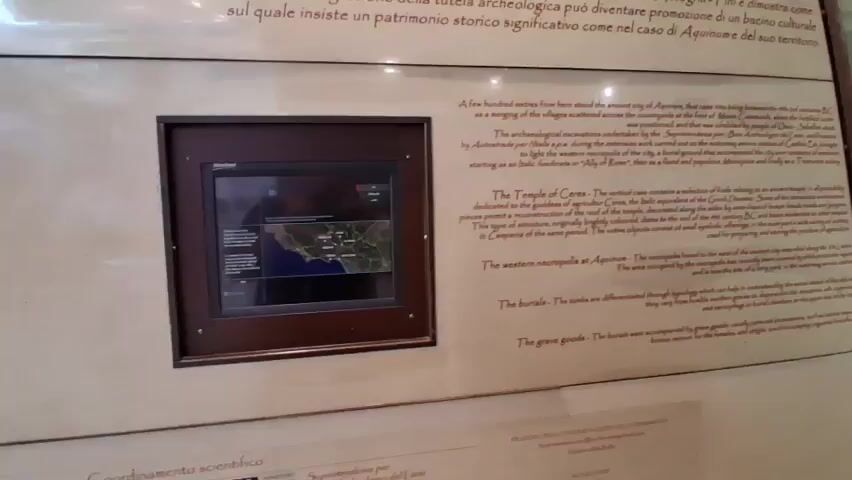
The video shows a close-up shot of a museum display case. The display case contains information about an ancient city. There is a screen on the left side of the display case that shows a map of an area. The text on the display case is in English and Italian. The text is about the ancient city of Aquinum, the Temple of Ceres, and the western necropolis at Aquinum. The video pans across the display case, showing more of the text and the screen.
Castrocielo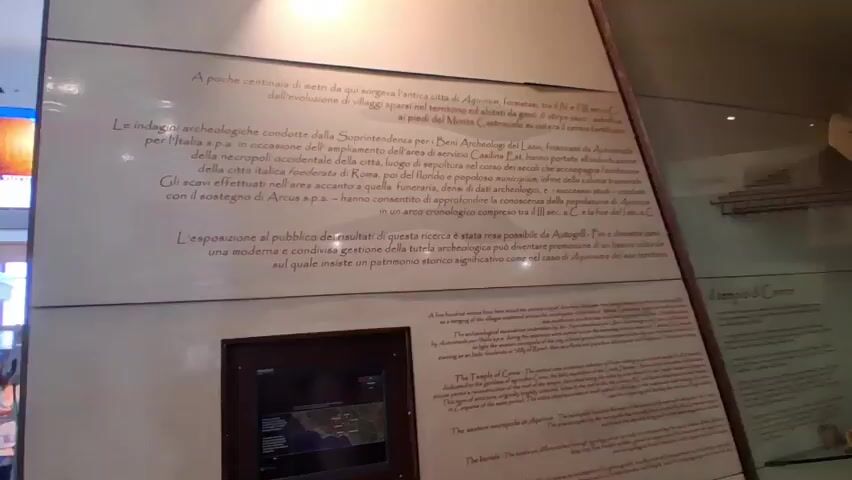
A video showcases a wall with text panels in both Italian and English. The Italian text, written in a light brown font, is displayed prominently on a large, white panel. Below this, a smaller section of the wall features English text in a similar font. The overall environment appears to be an indoor exhibition space. In the foreground, a dark-framed monitor is visible, displaying a map or informational graphic. To the far left of the frame, a person in a white top is partially visible, facing away from the camera. The camera is angled upwards, capturing the lower portion of the wall display.
Castrocielo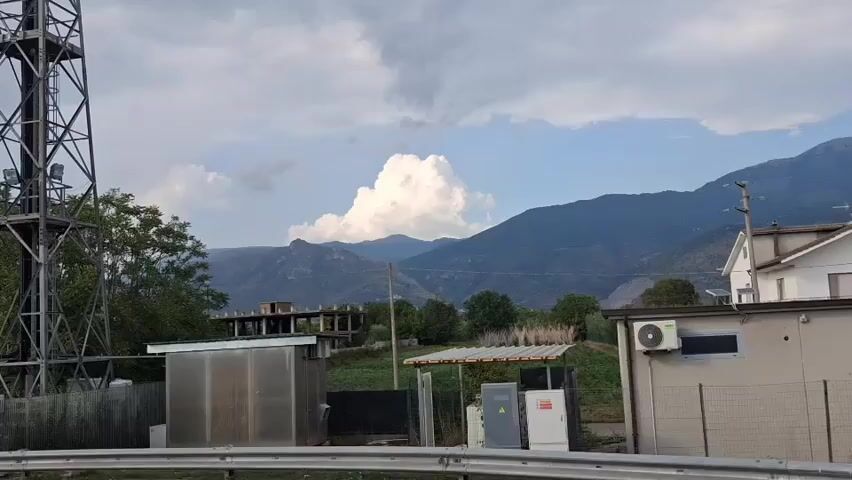
The video shows a cloudy sky above a mountainous landscape. In the foreground, there is a metal tower on the left, a construction site with a building frame in the middle, and a building with an air conditioning unit on the right. There are also some smaller utility boxes and a fence. The overall scene suggests an outdoor, possibly rural or industrial setting.
Castrocielo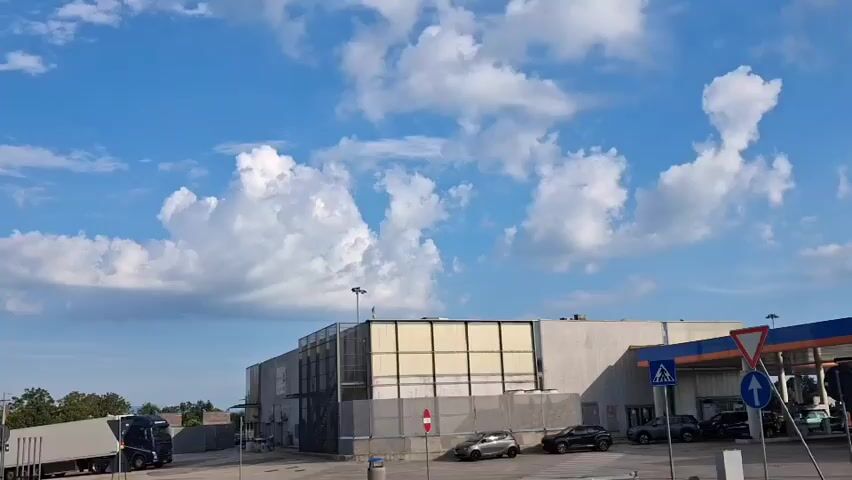
The video pans across a landscape under a bright blue sky with fluffy white clouds. In the foreground, a building with a grey facade and a white roof is visible, along with several parked cars. To the left, a large truck is parked. The background features rolling hills and mountains, with some trees and smaller buildings scattered throughout. A cell tower is also visible on the left side of the frame. The scene appears to be a mix of industrial and residential areas, with natural landscapes in the distance.
Castrocielo
The video shows a cloudy sky with the sun peeking through. The clouds are dark and dramatic, with rays of light shining through them. There are trees visible in the foreground, silhouetted against the sky. The video appears to have been filmed outdoors, possibly on a breezy day.
Castrocielo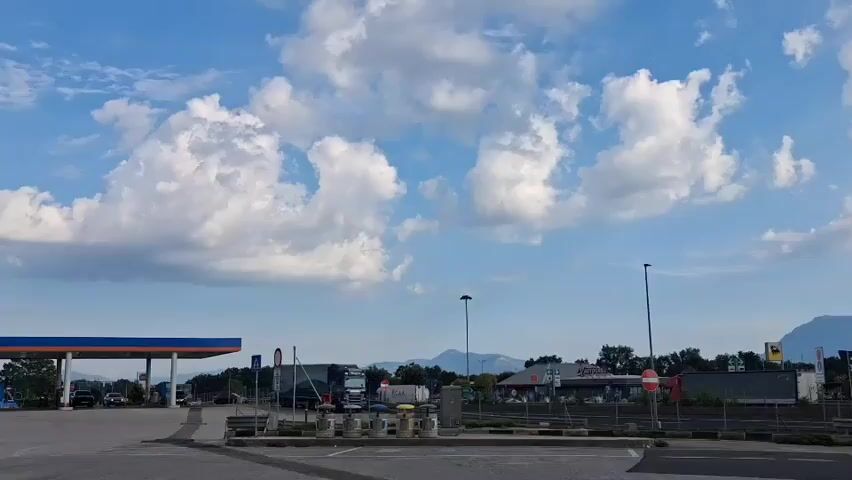
The video shows a time-lapse of a cloudy sky over a somewhat industrial or commercial area. In the foreground, there are paved areas with some planters and what appear to be barriers, suggesting a parking lot or a designated waiting area. In the background, there are buildings, possibly shops or businesses, with signage visible. A gas station canopy with blue and orange accents is present on the left. There are also streetlights and some trees scattered throughout the scene. Beyond the immediate area, distant mountains are visible under the shifting cloud cover. The sun intermittently breaks through the clouds, creating beams of light. One of the buildings in the background has visible text that appears to read "AGRO LOGISTIKA".
Castrocielo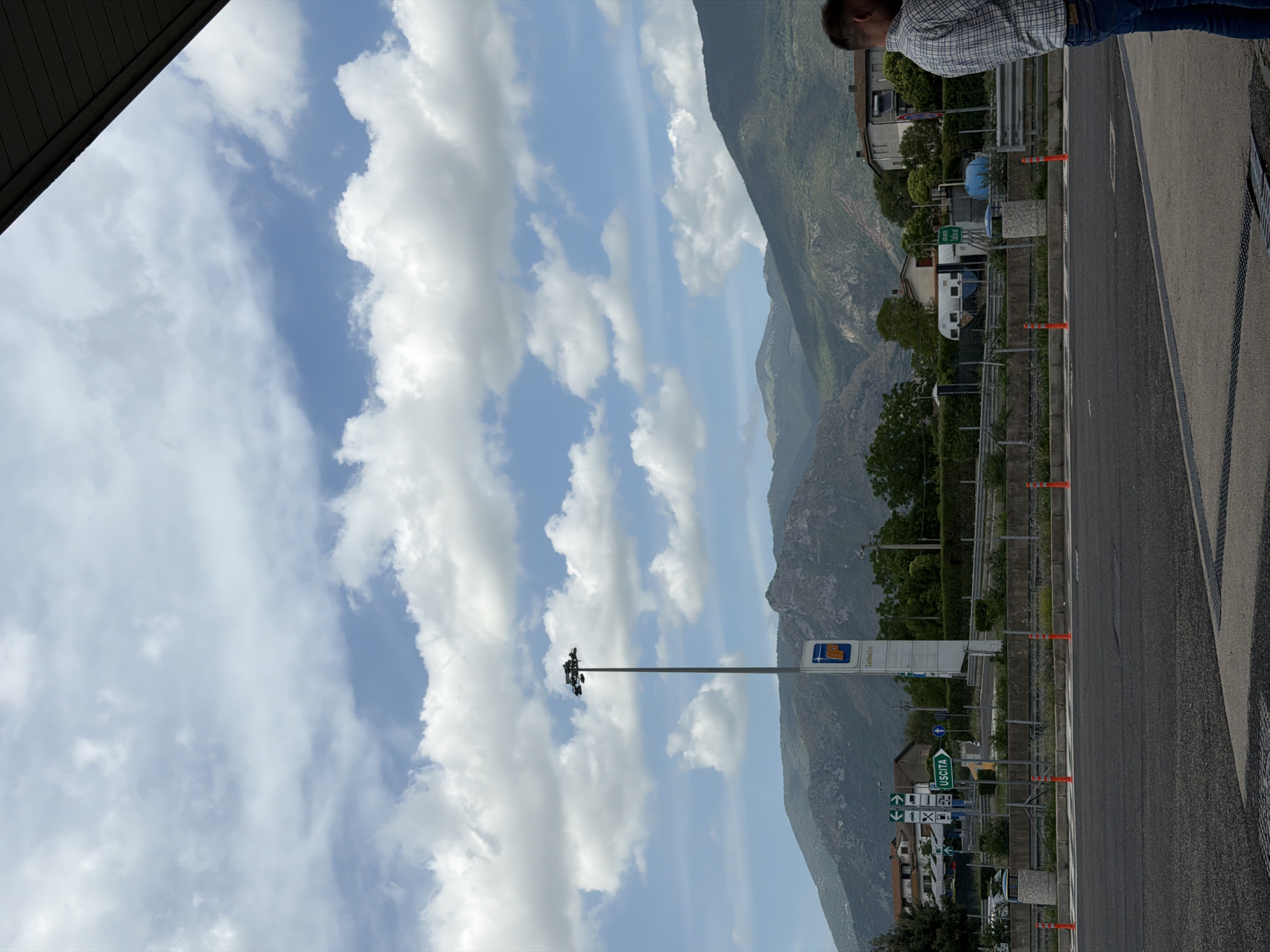
This image captures a bright daytime scene at a roadside location in Castrocielo, Italy, set against a dramatic mountainous backdrop. The photograph is oriented vertically (rotated 90 degrees clockwise from its likely original capture). In the foreground, a paved road or shoulder occupies the lower right portion of the frame, bordered by a series of orange traffic cones. A person, visible from the chest up, stands on the far right, wearing a blue and white plaid shirt and blue jeans, looking towards the left side of the frame. The mid-ground features a tall, grey light pole with multiple fixtures at its top, positioned centrally. To its right, a prominent white sign with a blue and orange logo is visible, bearing the text "Q8 Easy" and partially "Caldaie & Co", indicating a fuel station or service area. Below this, a green road sign provides directions, displaying an arrow pointing right and the Italian word "USCITA" (Exit), along with pictograms for services such as a car, truck, and possibly an electric vehicle charging point. Several buildings with light-colored walls and numerous trees and green foliage are scattered between the road and the distant mountains. The background is dominated by imposing, rugged mountains covered in varying shades of green, suggesting a verdant landscape. The sky above is partially cloudy, with patches of clear blue interspersed with large, fluffy white clouds. The scene conveys an impression of a well-maintained service area amidst a scenic, natural environment.
Castrocielo