Chengguan District, China
30 memories from Chengguan District, China
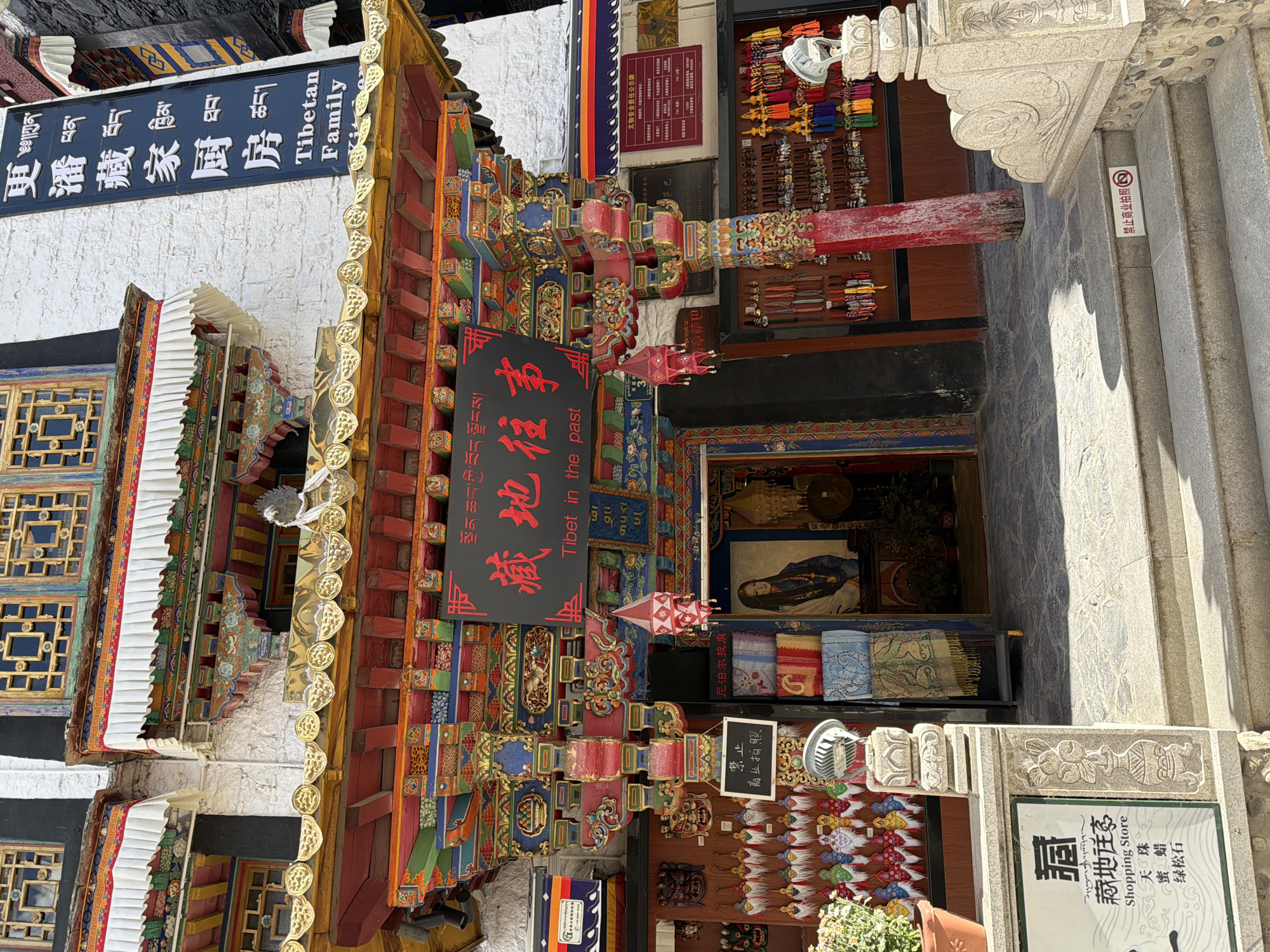
This image presents a vibrant street scene featuring the entrance to a traditional Tibetan-style building, likely in Chengguan District, China. The structure is characterized by richly carved and painted wooden elements in a palette of reds, blues, greens, and gold, adorned with intricate patterns. Above a shop entrance, a prominent black sign reads "藏地往事" (Zàngdì wǎngshì), translated as "Tibet in the past," accompanied by Tibetan script "སྔོན་ཆད་ཀྱི་བོད་ལྗོངས།". To the left, a large blue sign on a white wall displays "藏家厨房" (Zàngjiā Chúfáng), translated as "Tibetan Family." The entrance itself leads to an area displaying various merchandise, including colorful textiles, possibly shawls or scarves, and smaller decorative items. Inside, a framed portrait is visible. A stone pillar on the right side of the frame features a sign for a "藏地往事 Shopping Store," listing items such as "天珠" (Dzi beads), "蜜蜡" (Amber), "绿松石" (Turquoise), and "尼泊尔披肩" (Nepalese Shawl). Two distinct white signs with a red circle and slash explicitly state "禁止商业拍照" (No commercial photography), indicating restrictions on photography for commercial use. A smaller red sign high on a wall also mentions a "文物安全责任公示牌" (Cultural Relics Safety Responsibility Public Notice Board). The scene is illuminated by bright daylight, casting noticeable shadows on the stone steps and ground, suggesting a clear, sunny day. The combination of traditional architecture, diverse merchandise, and multilingual signage points to a cultural and commercial hub.
Chengguan District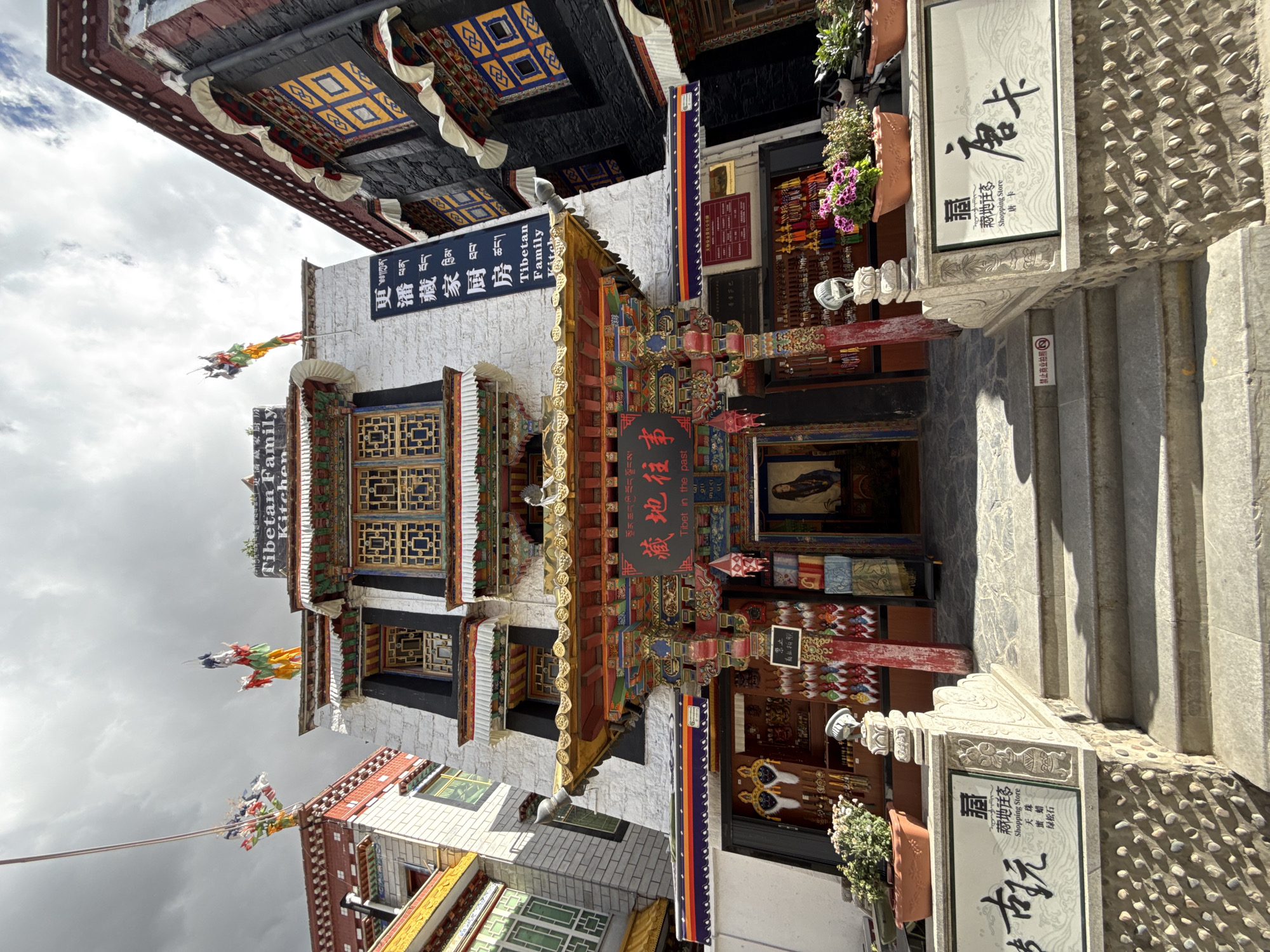
This image captures a vibrant street scene in Chengguan District, featuring buildings with distinct Tibetan architecture under an overcast sky. The setting appears to be a commercial area, likely a street lined with shops and eateries. The buildings showcase intricate details, including colorful painted wooden eaves with geometric patterns and ornate window frames. The facades are primarily white stucco or stone. Numerous prayer flags, in traditional colors, are strung across the street and affixed to the buildings, adding to the cultural atmosphere. Several signs are visible. A prominent white sign on a building reads "Tibetan Family Kitchen" in English and "更潘藏家厨房" (Gengpan Tibetan Family Kitchen) in Chinese. Another building features a sign with "藏地往事" (Tibet in the past) in Chinese and English, marking a shop. Below it, a white rectangular sign further identifies it as "藏地往事 Shopping Store," listing "天珠 蜜蜡 绿松石" (Dzi beads, beeswax, turquoise) and "唐卡" (Thangka) as items sold. Flower pots with purple blooms adorn the entrances, adding a touch of natural beauty. The ground features stone paving, with some areas having embedded pebbles, and a set of stone steps leads up to an entrance on the right. Small red signs with a white symbol and Chinese characters "禁止商业拍照" (No commercial photography) are visible, indicating restrictions on commercial picture-taking. No people are explicitly visible, suggesting the focus is on the architecture and streetscape. The diffuse light indicates daytime under cloudy conditions.
Chengguan District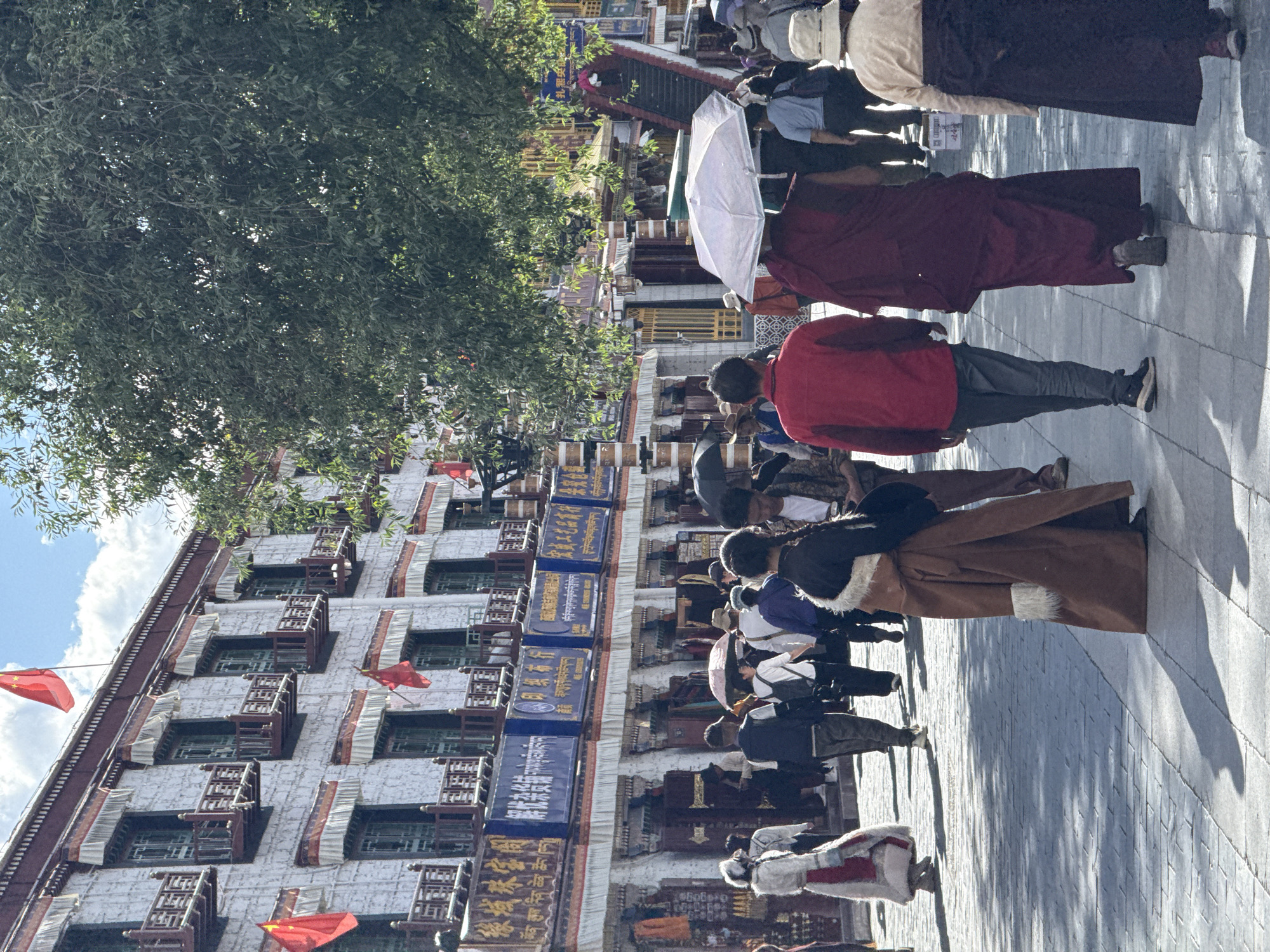
This image captures a vibrant street scene in what appears to be a Tibetan cultural area, likely Chengguan District, China, under bright daylight. On the left, a traditional multi-story building with white walls, dark window frames, and ornate wooden structures dominates the background. Several red Chinese flags, each adorned with five yellow stars, are visible hanging from the building. Below these, a series of rectangular blue signs are affixed to the wall, displaying text in both Tibetan script and Chinese characters. One such sign clearly reads "中国农业银行" (Agricultural Bank of China). A large, leafy green tree partially obscures the upper left portion of the building and filters sunlight. The right side of the image features a bustling paved street or walkway filled with numerous people. Many individuals are dressed in traditional attire, including long robes and distinctive headwear, while some wear more contemporary clothing. Among the crowd, a person in dark red monastic robes stands out, as does another individual in a bright red jacket and grey trousers. One person holds a white umbrella, providing shade. The strong, direct sunlight creates prominent shadows on the ground, indicating a clear, sunny day. The scene depicts a mix of daily activity and cultural or religious presence, possibly pilgrims or locals engaged in their routines.
Chengguan District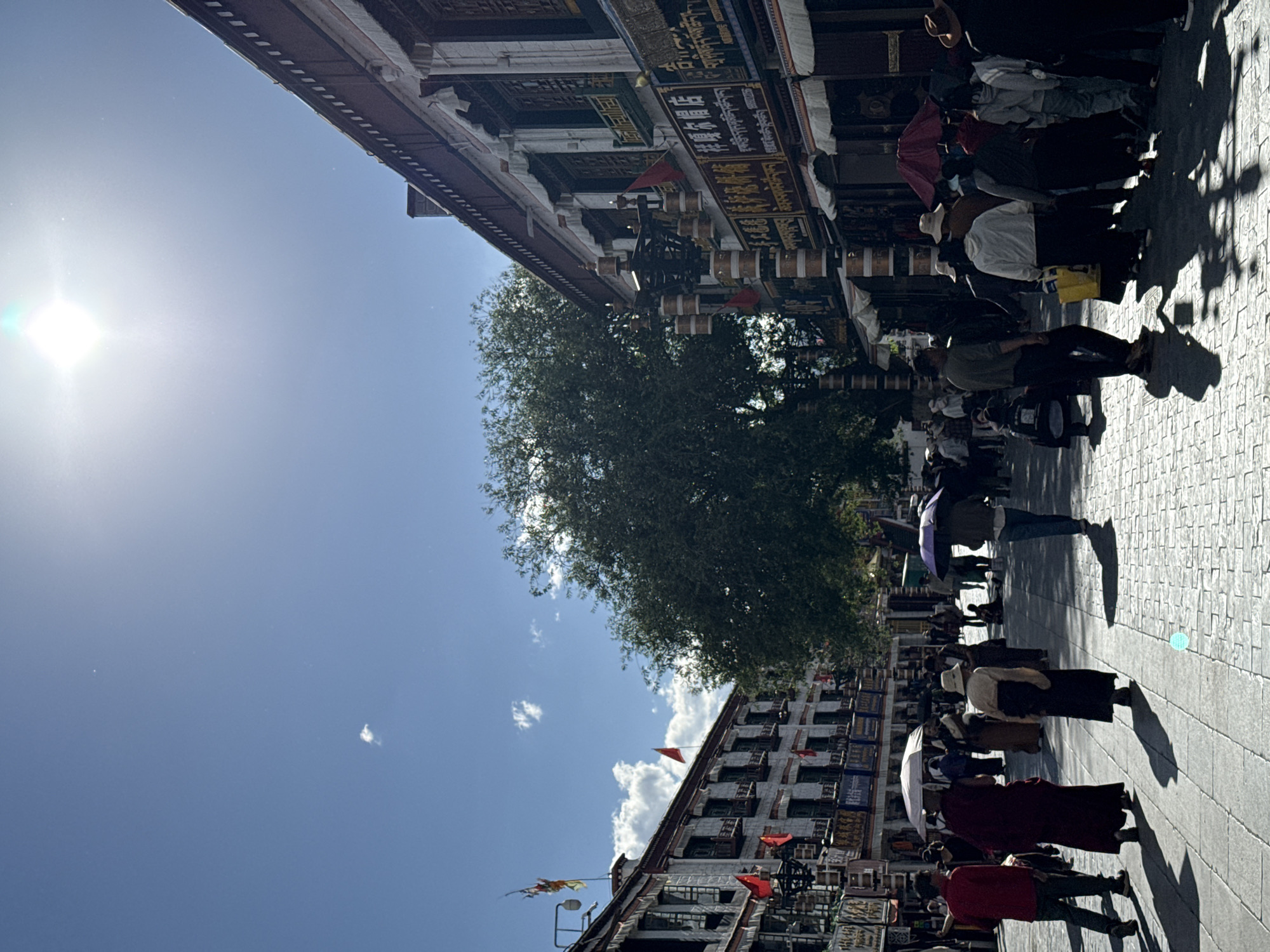
This image captures a vibrant, sunlit street scene in what appears to be a Tibetan cultural area, specifically Chengguan District, China. The perspective is from the street level, looking down a bustling thoroughfare flanked by traditional buildings. **Subjects & Scene:** Numerous people are visible walking along the paved street, which features light-colored interlocking stones. The crowd consists of a mix of individuals, some wearing traditional maroon robes, possibly monks or devotees, and others dressed in modern casual clothing. Several people carry umbrellas, likely for sun protection. On either side of the street stand multi-story buildings showcasing distinct Tibetan architecture, characterized by ornate wooden balconies, intricate window frames, and decorated facades. The building on the right (when viewing the image in its correct upright orientation) is particularly notable for its many cylindrical prayer wheels mounted along the lower level, interspersed with small red flags. A large, leafy green tree stands prominently in the middle of the scene, its foliage contrasting with the architectural elements. **Activity or Event:** The primary activity involves people walking and congregating along the street, suggesting a busy daily life, possibly mixed with commercial or religious activities, given the presence of prayer wheels. The overall scene conveys a sense of peaceful movement and cultural immersion. **Notable details:** The time of day appears to be mid-morning or early afternoon, marked by exceptionally bright sunshine that creates a strong sunflare on the upper left and casts long, distinct shadows of the people and buildings onto the pavement. The sky is a clear blue with a few small white clouds. The traditional architecture, prayer wheels, and cultural attire are strong indicators of the location's unique identity. **Visible text:** The facades of the buildings are adorned with decorative panels and signs featuring text in a script that strongly resembles Tibetan. While specific words are not decipherable due to the resolution and distance, the presence of this script contributes significantly to the scene's cultural context.
Chengguan District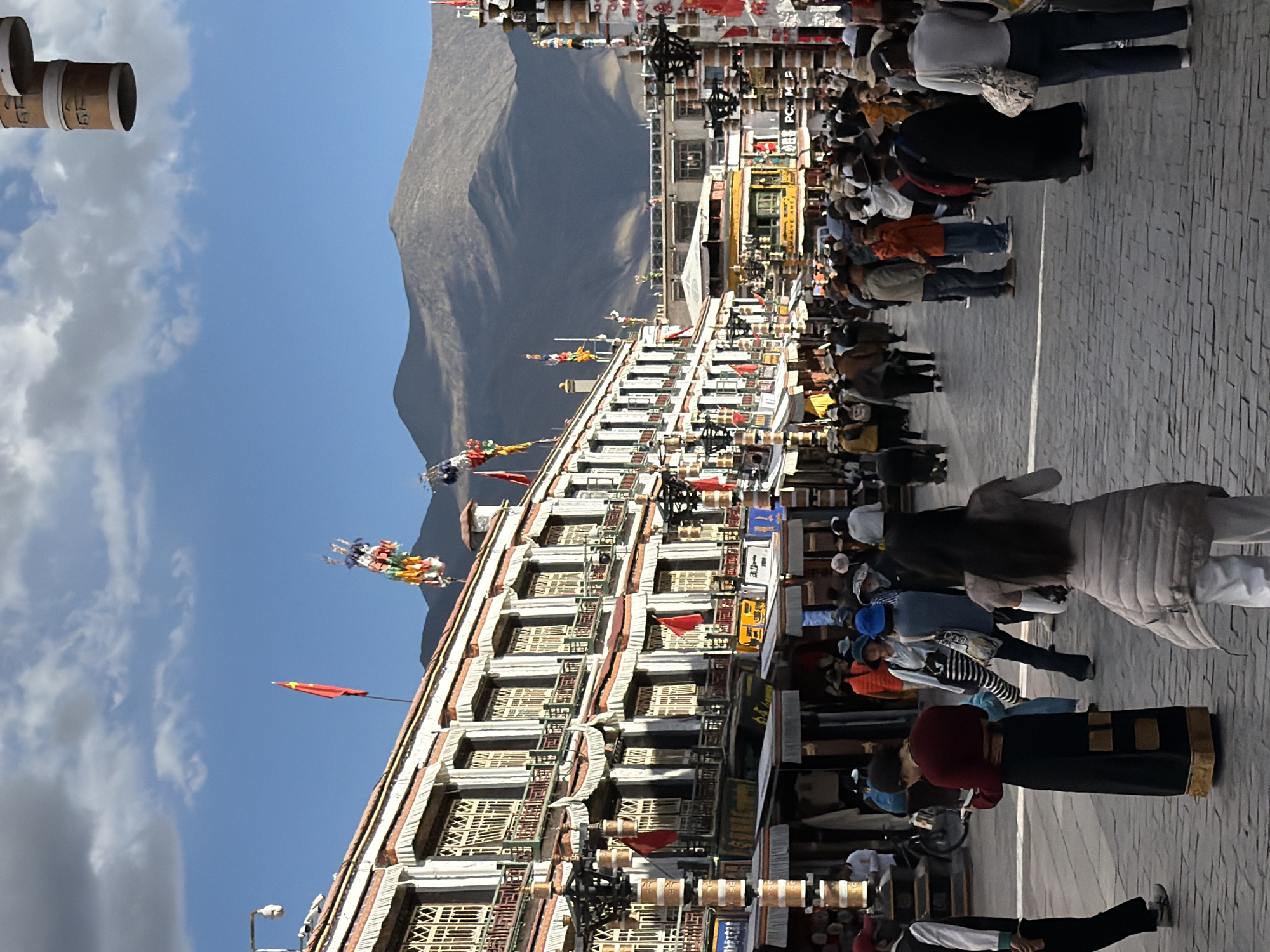
The image captures a bustling street scene in Chengguan District, China, characterized by traditional Tibetan architecture and a vibrant flow of people. The perspective looks down a paved street lined with multi-story buildings, backed by a large, barren mountain under a clear blue sky with scattered clouds. The main subjects are numerous people walking along the street, many of whom appear to be engaged in a procession or pilgrimage. They are dressed in a mix of traditional and modern attire. Along the side of the street, attached to the buildings, are rows of cylindrical prayer wheels. Several individuals are seen actively turning these prayer wheels as they move, indicating a religious or cultural practice. The buildings exhibit distinctive Tibetan architectural elements, with white facades, dark-framed windows, and decorative cornices. Colorful prayer flags, typical of Tibetan culture, are strung up in various locations, adding to the cultural atmosphere. A red flag, possibly featuring a single star, is also visible flying from a pole on one of the buildings. Visible text includes characters on some of the prayer wheels. On one set, Chinese characters like "右" (yòu - right) and "上" (shàng - up) are discernible. On other prayer wheels, Tibetan script, including what appears to be "ཀ་" and "ཁ་", can be seen. Signs with illegible text are also present on the building facades. The scene takes place on a bright, sunny day, likely in the late morning or early afternoon, given the clear illumination and the quality of the shadows. The majestic mountain range in the background firmly places the setting in a high-altitude, mountainous region, consistent with the Tibetan Plateau.
Chengguan District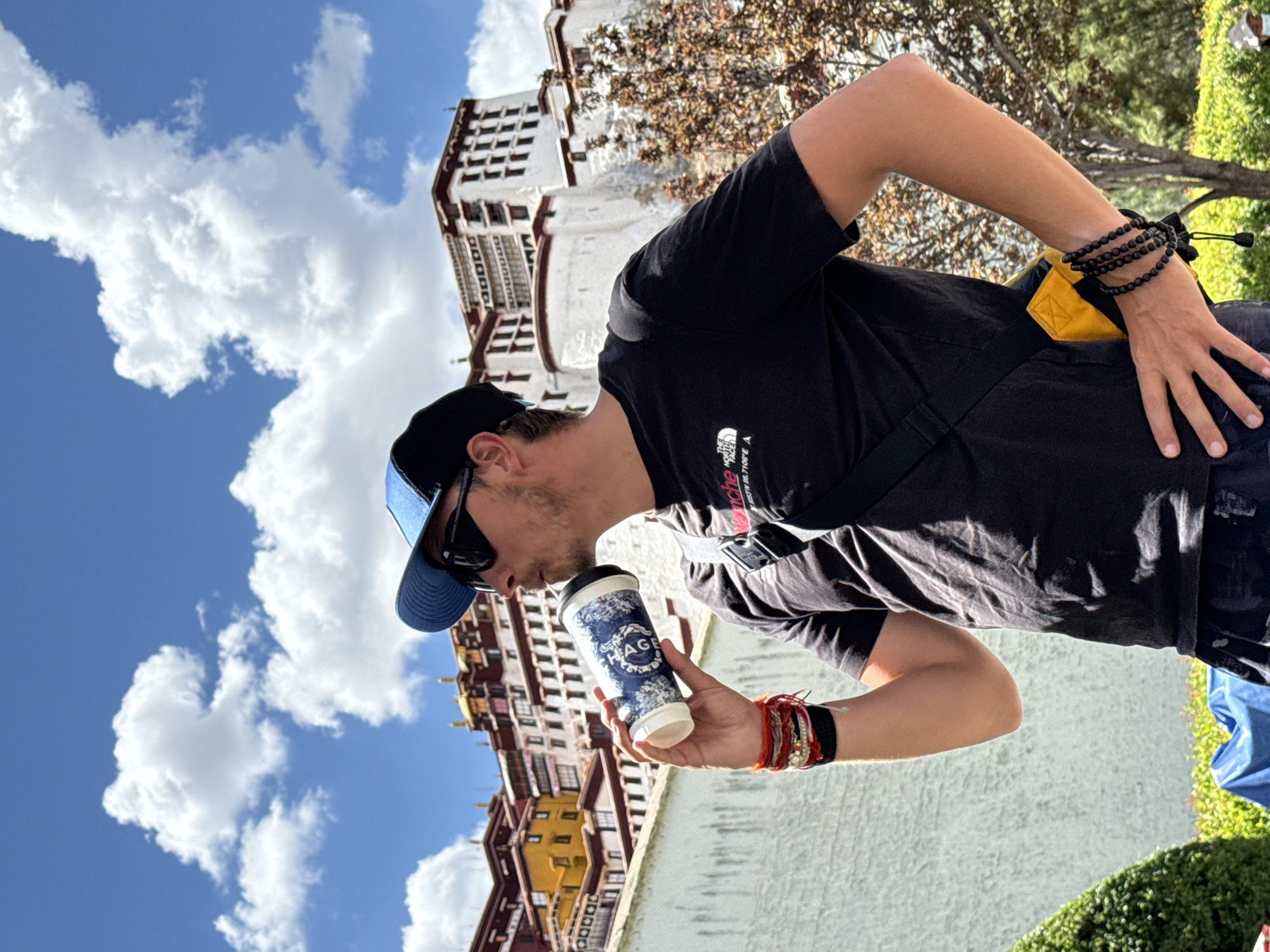
A person is captured in a sunlit outdoor scene, holding a white and blue disposable coffee cup to their lips, appearing to take a sip. The individual is positioned on the right side of the frame, seen from the waist up, and is wearing a black short-sleeved t-shirt, a blue baseball cap, and sunglasses. Their right wrist is adorned with multiple red and orange string bracelets and a wider black one, while their left wrist features several black beaded bracelets. A small yellow pouch with a black strap is visible near their left hip. In the background, a majestic, multi-story building, characteristic of the Potala Palace, rises prominently. It features distinct white walls, red and yellow sections, and numerous windows, suggesting an ancient and grand architectural style. Lush green foliage and trees are visible around the building and in the foreground. The sky overhead is a vibrant blue, dotted with fluffy white clouds, indicating clear weather. The activity appears to be a casual moment of refreshment or relaxation, with the person enjoying a beverage amidst significant historical surroundings. The time of day is clearly daytime, with bright sunshine. Visible text includes a logo on the person's black t-shirt which reads "THE NORTH FACE" along with "NEVER STOP EXPLORING" and coordinates "N°39.87106°E" and "N°116.39758°E". On the coffee cup, a circular logo displays the word "AGE" centrally, surrounded by a blue and white decorative pattern. Given the architectural style and the provided location context, the scene is undoubtedly set in Chengguan District, China, with the Potala Palace as a prominent backdrop.
Chengguan District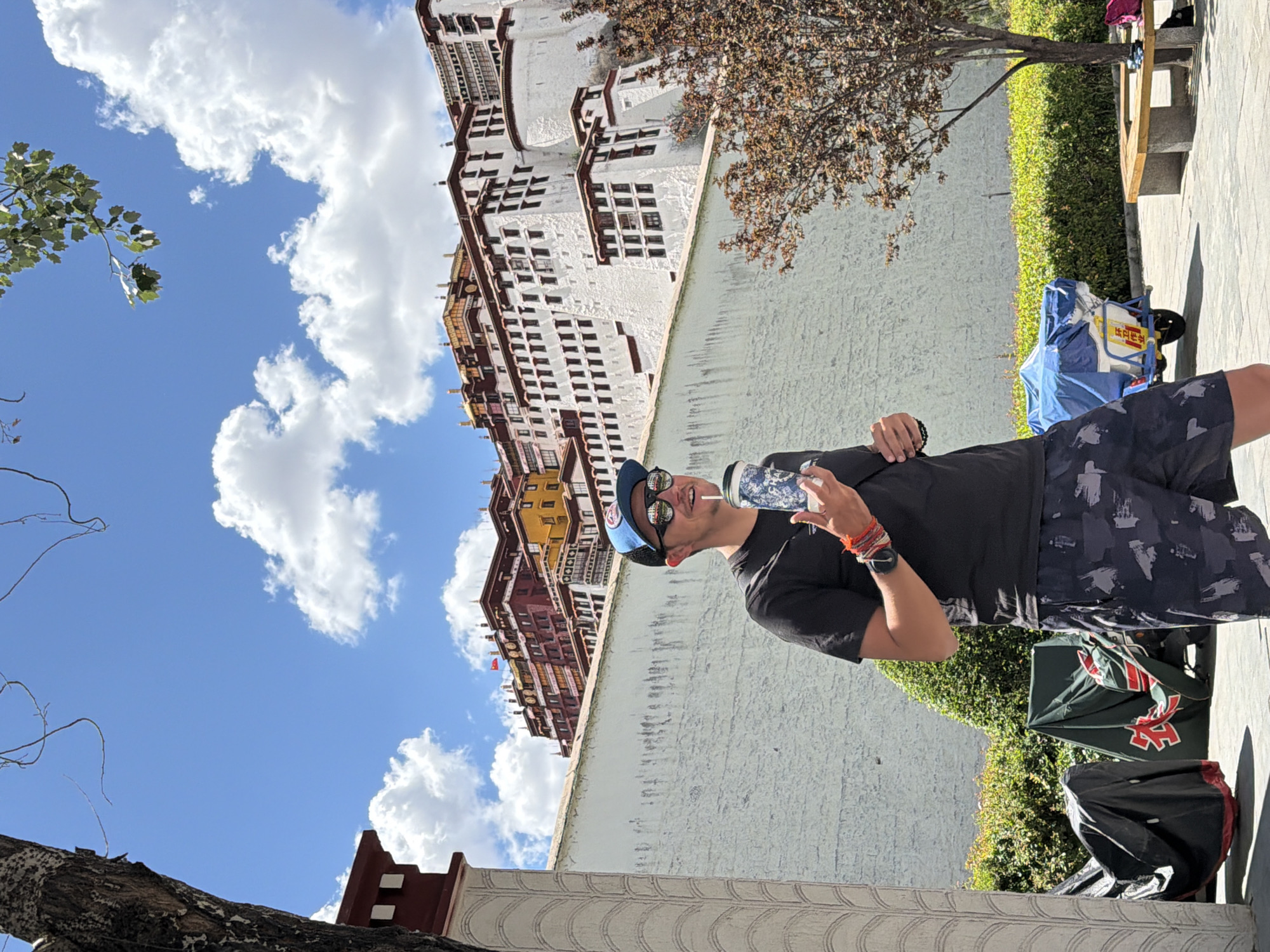
This outdoor image captures a bright, sunny daytime scene with a clear blue sky dotted with fluffy white clouds. The main subject is a man standing in the foreground, positioned slightly to the right of the frame. He is wearing a black t-shirt, patterned black and grey shorts, a blue baseball cap, and sunglasses, and he holds a patterned water bottle in his right hand. He has a slight smile on his face. Colorful bracelets and a watch are visible on his left wrist. Behind the man, a light-colored wall runs horizontally across the mid-ground. Beyond the wall, a strip of vibrant green bushes and a tree with brown, autumn-like leaves are visible. To the left, a large, majestic building with distinct Tibetan architecture dominates the background. This multi-storied structure is predominantly white with red and dark brown sections, featuring many small, dark windows. Its appearance strongly suggests it is the Potala Palace in Lhasa, consistent with the Chengguan District, China location. Another tree with green foliage is visible in the upper left corner of the sky. On the paved ground near the man's feet, to his right, are several items including a blue and white bag or piece of luggage, on which Chinese characters are visible, including "藏" (Zàng), a common character for Tibet. A black bag is also present nearby. Further to the right, a wooden bench is visible. The overall scene depicts a tourist enjoying a sunny day at a historic landmark.
Chengguan District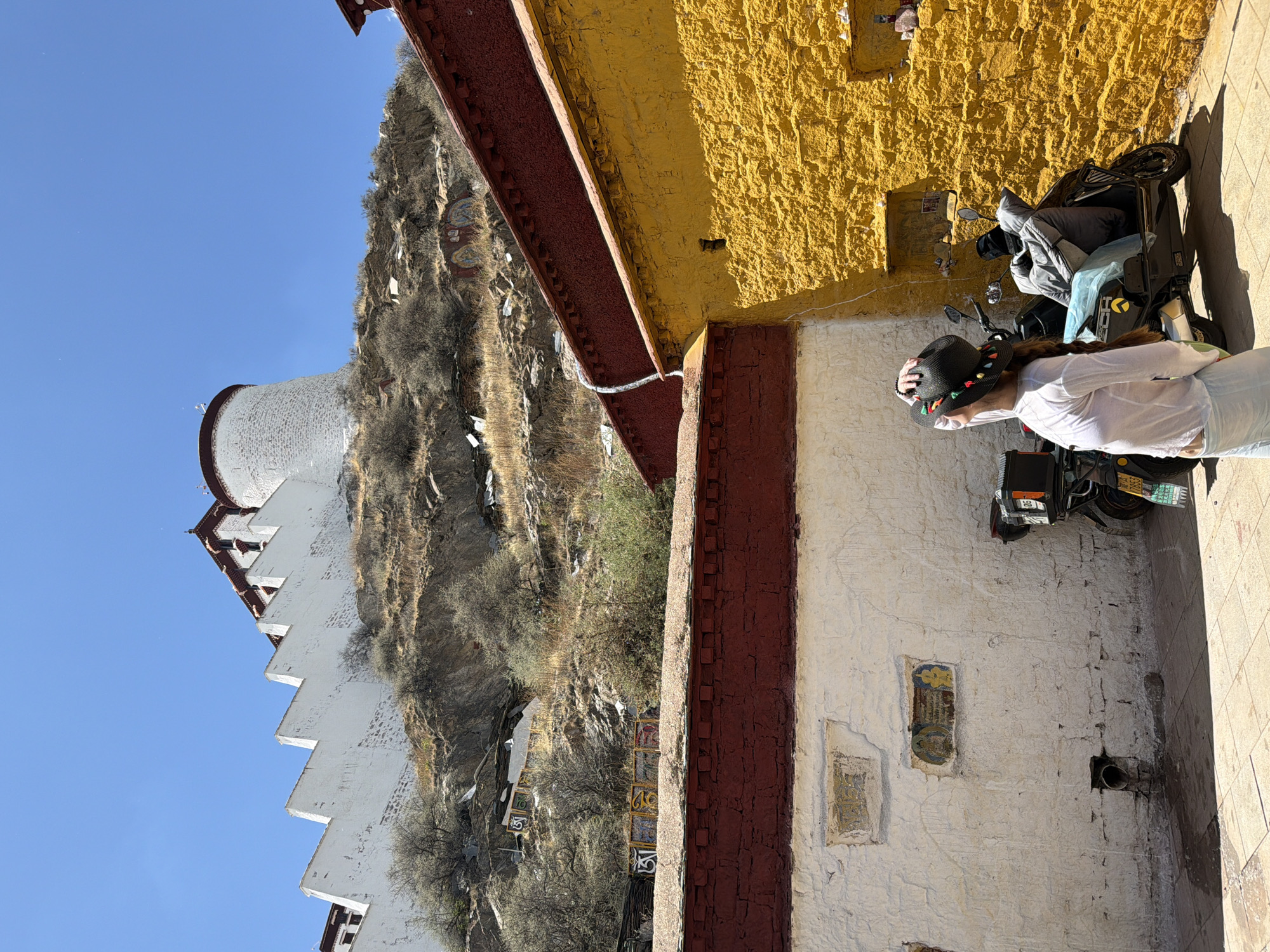
The image depicts a bright, sunny outdoor scene in Chengguan District, China, showcasing distinctive architecture and natural landscape. The main subject is a person standing near a black scooter. The individual, seen from behind and side, wears a white long-sleeved shirt, light-colored pants, and a black straw hat decorated with colorful tassels. They appear to be observing the scene to their right. The setting features traditional Tibetan-style architecture. In the foreground, there's a building with a textured bright yellow upper wall and a white lower wall, separated by prominent dark red beams and columns. Both wall sections have recessed areas with faint, colorful painted artwork. The ground is paved, and strong sunlight suggests it is midday with a clear blue sky. Behind the foreground building, a steep, rocky hillside rises, covered in sparse, dry vegetation. Large, colorful painted or carved symbols, resembling Tibetan mantras like "Om," are visible on the hillside, along with numerous white square prayer flags or offerings. Dominating the left side of the scene is a majestic multi-story white building, possibly part of a monastery or palace complex, featuring stepped tiers, many windows, and a distinctive round, white-domed top, resembling a stupa, against the clear blue sky. The black scooter parked beside the person has a license plate visible at the rear, bearing the characters "西藏" (Xizang, meaning Tibet) followed by "A" and some numbers/letters, partially obscured. The overall atmosphere is peaceful and culturally rich.
Chengguan District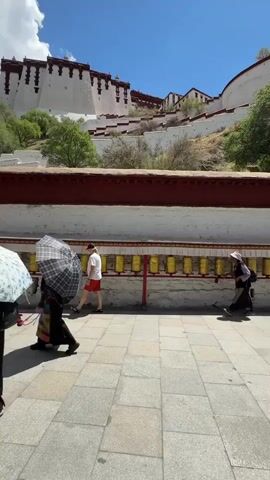
The video captures a bright, sunny outdoor scene featuring people walking along a stone-tiled pathway. In the foreground, a low white wall with a red top edge and a row of golden prayer wheels separates the path from a grassy slope. Several individuals are visible: one person in a white t-shirt and red shorts walks past the prayer wheels, while another person carrying a checkered umbrella walks towards the left of the frame. To the right, two people walk together, one holding a light-colored umbrella, and another person in traditional attire is also seen. In the background, a majestic, large white and red architectural complex, likely a palace or temple, is prominently situated on a hillside under a clear blue sky with some scattered clouds. Trees and shrubs dot the hillside below the grand structure. The people appear to be either visitors or worshippers, with some possibly engaging with the prayer wheels as they pass. The overall atmosphere is peaceful, set against the backdrop of a significant cultural or religious site.
Chengguan District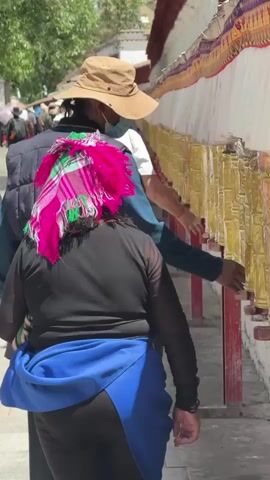
A group of people walks outdoors alongside a long white wall lined with numerous golden prayer wheels. The wall has a red base and colorful decorative banners or fabrics running above the prayer wheels. The person in the foreground, seen from behind, wears black clothing, a bright pink and green patterned headscarf, and a blue fanny pack or draped fabric around their waist. Ahead of them is another person wearing a brown hat and a dark vest. Further down the path, a person in a white top and a red baseball cap is visible. Most of the individuals are using their right hands to spin the prayer wheels as they pass, engaging in a common Buddhist ritual. The scene is brightly lit by sunlight, indicating daytime. Trees and more distant buildings can be seen in the background.
Chengguan District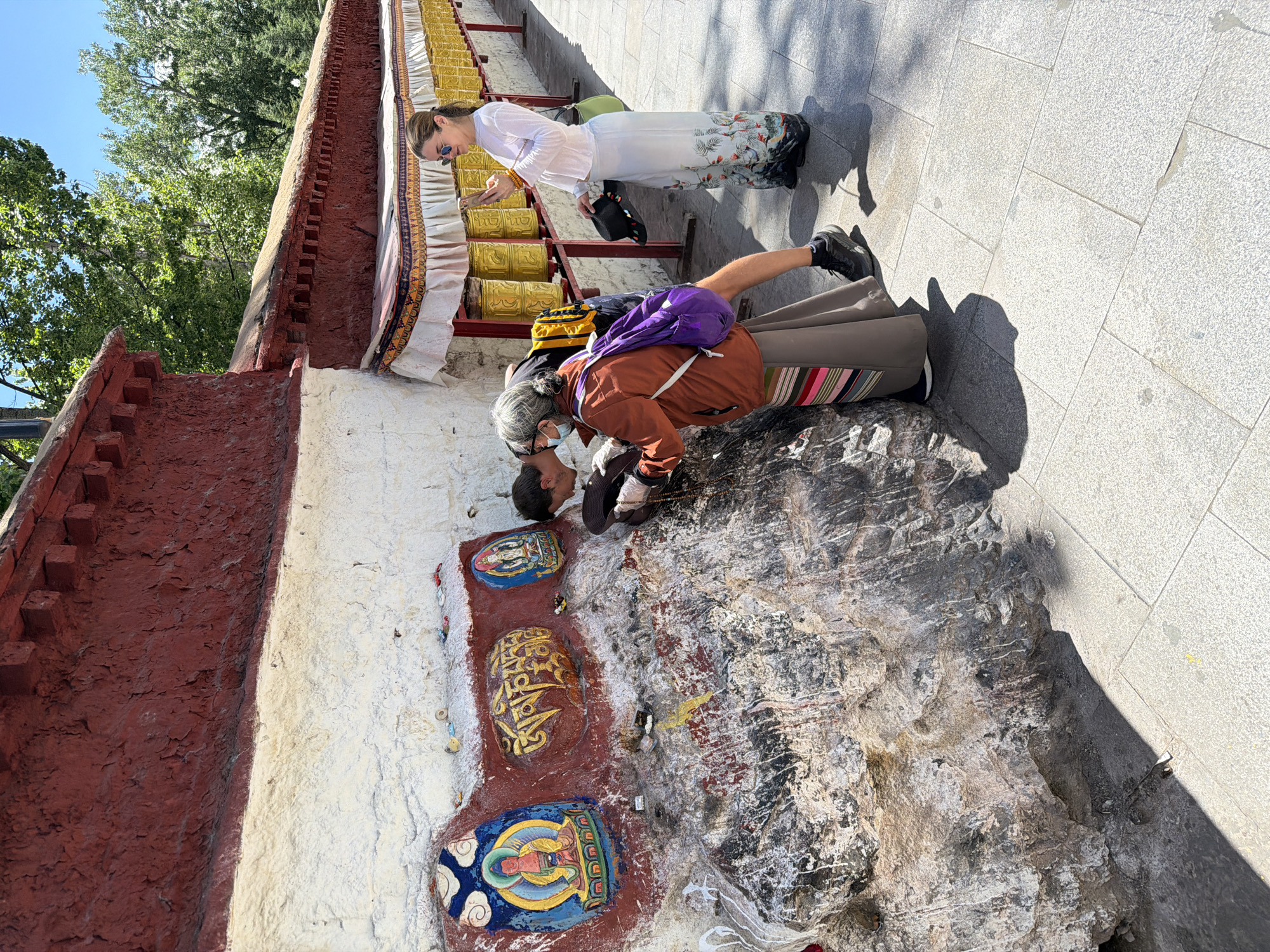
The image captures an outdoor scene on a bright, sunny day, likely at a Tibetan Buddhist site. Two individuals are present on a light grey tiled walkway next to a building or wall adorned with religious elements. One person, appearing older with grey hair, is seen from behind, leaning forward intently towards a painted section of the wall. They are wearing a brown jacket, grey trousers with a colorful striped design at the hem, a purple backpack, and a face mask. Their hands are positioned near the base of the wall, where there are three colorful, painted or carved images. The central image clearly displays the Tibetan mantra "Om Mani Padme Hum" in golden script on a red background, flanked by two other painted figures resembling Buddhas or Bodhisattvas. The person's posture suggests a moment of contemplation, prayer, or veneration. Standing slightly behind and to the right is another individual, dressed in a long-sleeved white top and a long white skirt with an elaborate floral and bird pattern at the bottom. They are wearing sunglasses and are positioned near a row of golden prayer wheels that line the wall. Their left hand appears to be resting near the prayer wheels, while they hold a black hat in their right hand. The scene is illuminated by strong sunlight, casting distinct shadows on the ground. In the background, vibrant green trees are visible against a clear blue sky, indicating an outdoor, natural setting. The overall atmosphere suggests a moment of cultural or religious observance.
Chengguan District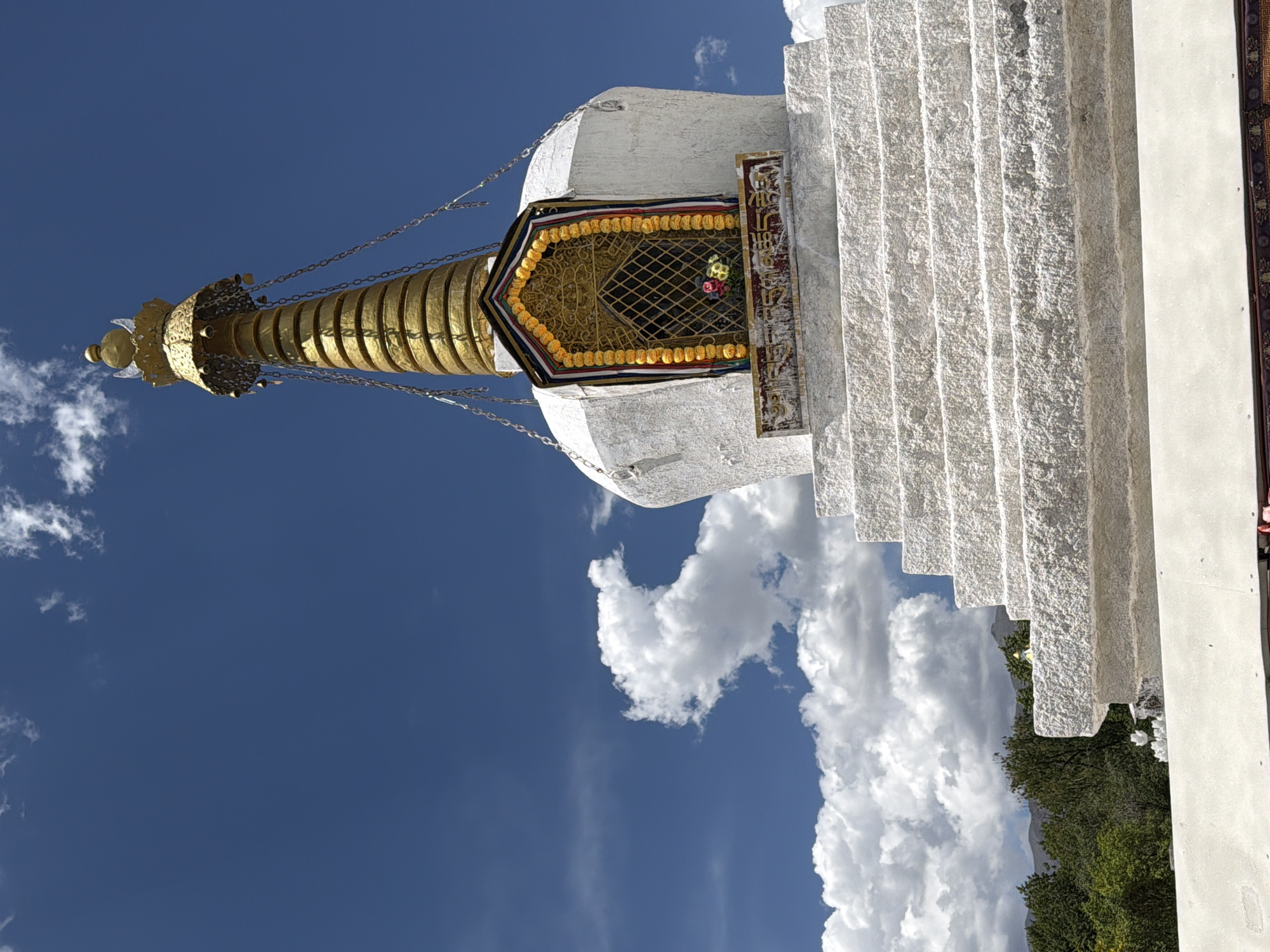
This low-angle, vertically oriented image captures a majestic white stupa, a Buddhist monument, against a brilliant blue sky interspersed with scattered white cumulus clouds. The stupa's base is composed of textured, light-grey stone blocks arranged in horizontal tiers, resembling steps. Its main body is smooth and pristine white. Crowning the stupa is a prominent golden spire, known as a chattrāvalī, which consists of multiple stacked, disc-like elements tapering upwards to a finial. Delicate chains, possibly adorned with small bells, hang from the spire, connecting to the stupa's upper structure. Below the spire, a richly decorated rectangular section, likely the harmika, features intricate golden lattice work. This section is bordered by bright yellow garlands, possibly marigolds, and contains small clusters of colorful flowers (red, pink, and white) placed within the golden grid. To the right of this ornate panel, a vertical rectangular slab bears text in an ornate script, which appears to be Tibetan. The bright sunlight indicates a clear daytime setting with pleasant weather. Some green foliage from trees or bushes is visible at the bottom right, suggesting a natural or landscaped environment surrounding the monument. The architectural style, particularly the golden spire and the presence of Tibetan script, strongly indicates a Tibetan Buddhist cultural site, aligning with the provided location context of Chengguan District, China. No human activity or specific event is depicted; the image focuses on the grandeur and intricate details of the sacred structure.
Chengguan District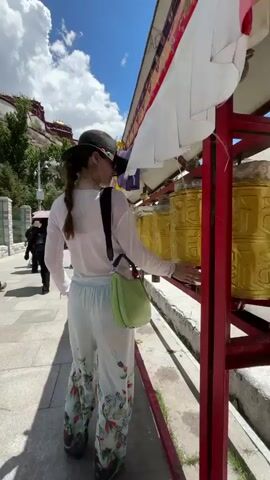
A young woman is seen walking along a paved path on a sunny day, engaging with a row of Tibetan prayer wheels. She is dressed in a white long-sleeved top, wide-leg pants with a bird and foliage print, and a black hat. A light green handbag hangs from her shoulder. With her right hand, she gently spins the golden prayer wheels, which are adorned with carvings. Colorful prayer flags flutter above the prayer wheels. In the background, under a bright blue sky with scattered clouds, the iconic white and red structure of the Potala Palace is visible on a distant hillside, indicating the location is Lhasa, China. Other people can be seen walking in the background. The woman appears calm and focused on the activity of spinning the prayer wheels.
Chengguan District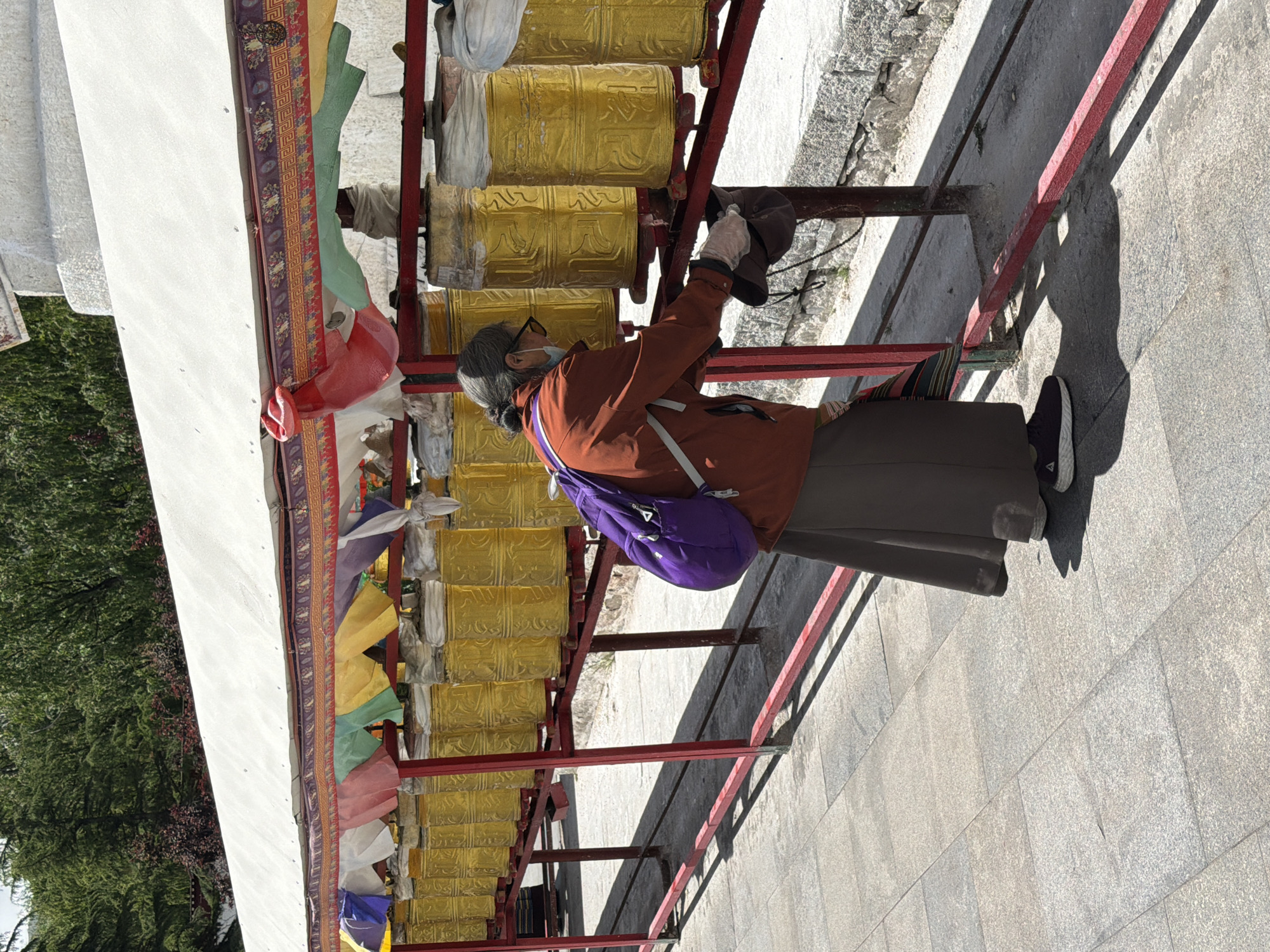
An elderly person is captured in an outdoor, eye-level shot, actively engaging with a row of prayer wheels under bright, clear sunlight. The subject, likely a woman, has grey hair pulled back and is dressed in an orange-brown jacket, a dark long skirt, and dark athletic shoes with white soles. She wears sunglasses, a light blue face mask, and white gloves on her hands, and carries a purple backpack over her left shoulder. She is depicted turning one of the golden prayer wheels, which are intricately embossed with Tibetan script or symbols. These prayer wheels are systematically arranged in multiple rows within a sturdy red metal frame. Above the prayer wheels, a line of colorful prayer flags in red, yellow, green, white, and blue hangs down from a rich, patterned decorative strip that runs along the top of the structure. The ground is paved with light-colored stone, and strong, defined shadows cast by the metal frame indicate direct and bright sunlight, suggesting it is midday or early afternoon. In the background to the left, a white wall-like structure and lush green trees are visible. The presence of numerous prayer wheels and prayer flags strongly identifies the location as a Tibetan Buddhist religious or cultural site, consistent with the given context of Chengguan District, China.
Chengguan District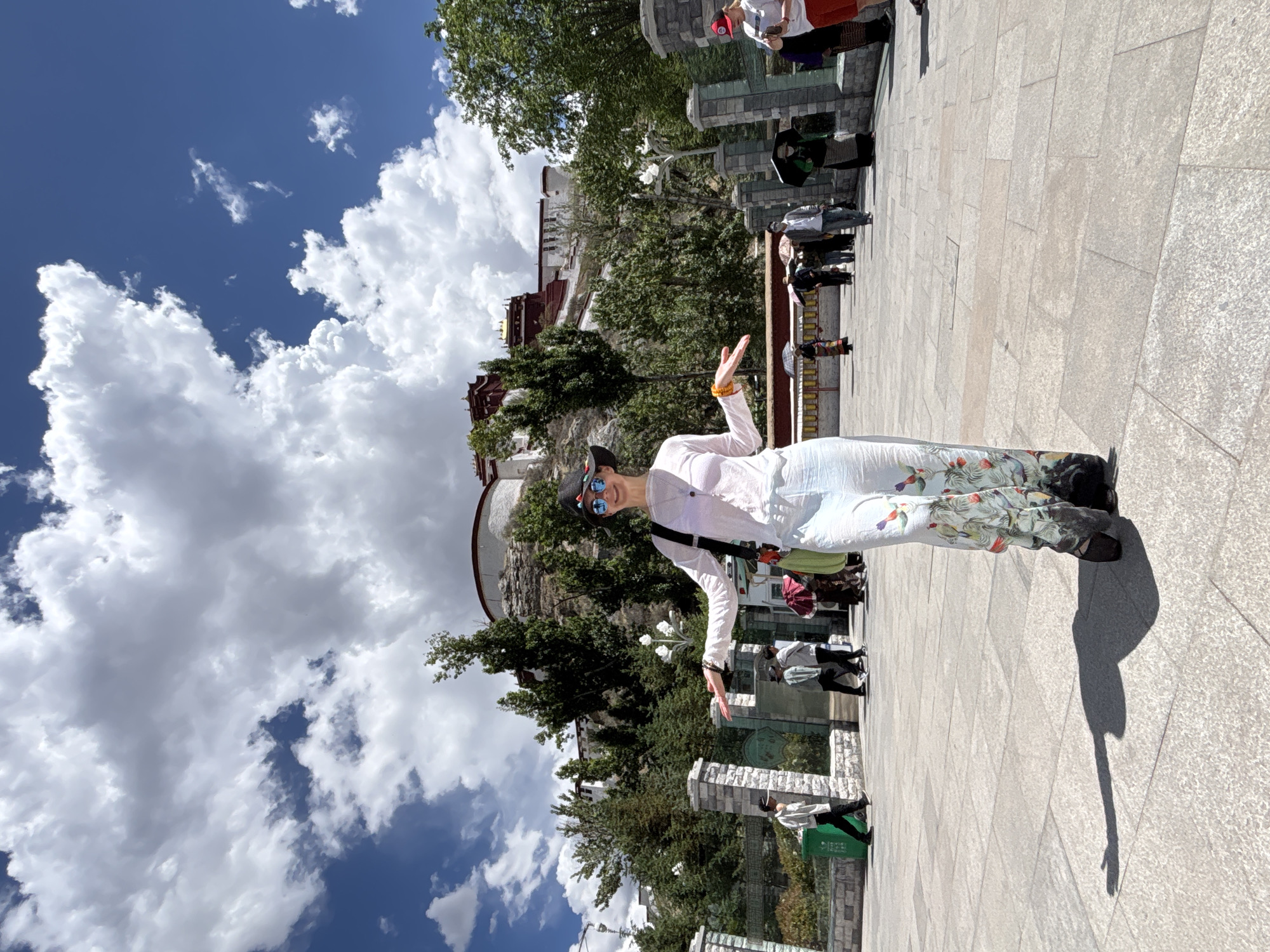
The image displays an outdoor scene on a bright, sunny day, featuring a woman posing in the foreground against the backdrop of a grand building complex. The image is oriented vertically but is presented on its side. In the immediate foreground, a woman, likely the main subject, is captured mid-pose, smiling broadly at the camera with her arms outstretched. She wears a white long-sleeved top, light-colored pants or a long skirt with a vibrant floral and bird pattern, sunglasses, and a dark hat. A yellow bracelet adorns her right wrist, and she carries a shoulder bag. Her elongated shadow, clearly showing the outline of her arms, stretches across the paved ground to her right. Behind her, majestically situated on a rocky hill covered with green trees and foliage, stands a large, multi-tiered building complex. This iconic structure, with its distinctive white walls, red sections, and smaller gold-colored roofs, is identifiable as the Potala Palace. The ground in front of the palace is a spacious, light gray paved plaza made of stone tiles. Several other individuals, appearing to be tourists, are scattered across the mid-ground, some walking and others standing near stone pillars or low walls that delineate sections of the plaza. A green trash can is partially visible in the lower left background, bearing Chinese characters that translate to "Recyclable Waste" (可回收物). The upper part of the image shows a clear blue sky dotted with large, fluffy white cumulus clouds, suggesting pleasant weather. The strong sunlight casts crisp shadows, confirming it is daytime. The overall scene depicts a lively tourist location in the Chengguan District, China, with the woman expressing visible cheerfulness.
Chengguan District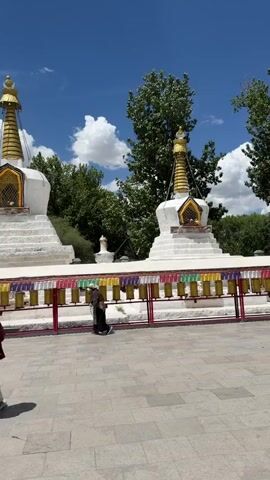
The video captures an outdoor scene on a bright, sunny day with a clear blue sky and some white clouds. In the foreground, several people are walking across a paved area from left to right. One person in the middle of the frame, dressed in dark clothing, appears to be engaging with a row of colorful prayer wheels, possibly spinning them. Dominating the background are two large white stupas with tiered bases and ornate golden spires, characteristic of Buddhist architecture. They are positioned behind the prayer wheels. Beyond the stupas, lush green trees are visible, and in the distance, a hazy mountain range can be seen. The overall setting suggests a temple or monastery grounds in Chengguan District, China. The atmosphere appears peaceful and calm.
Chengguan District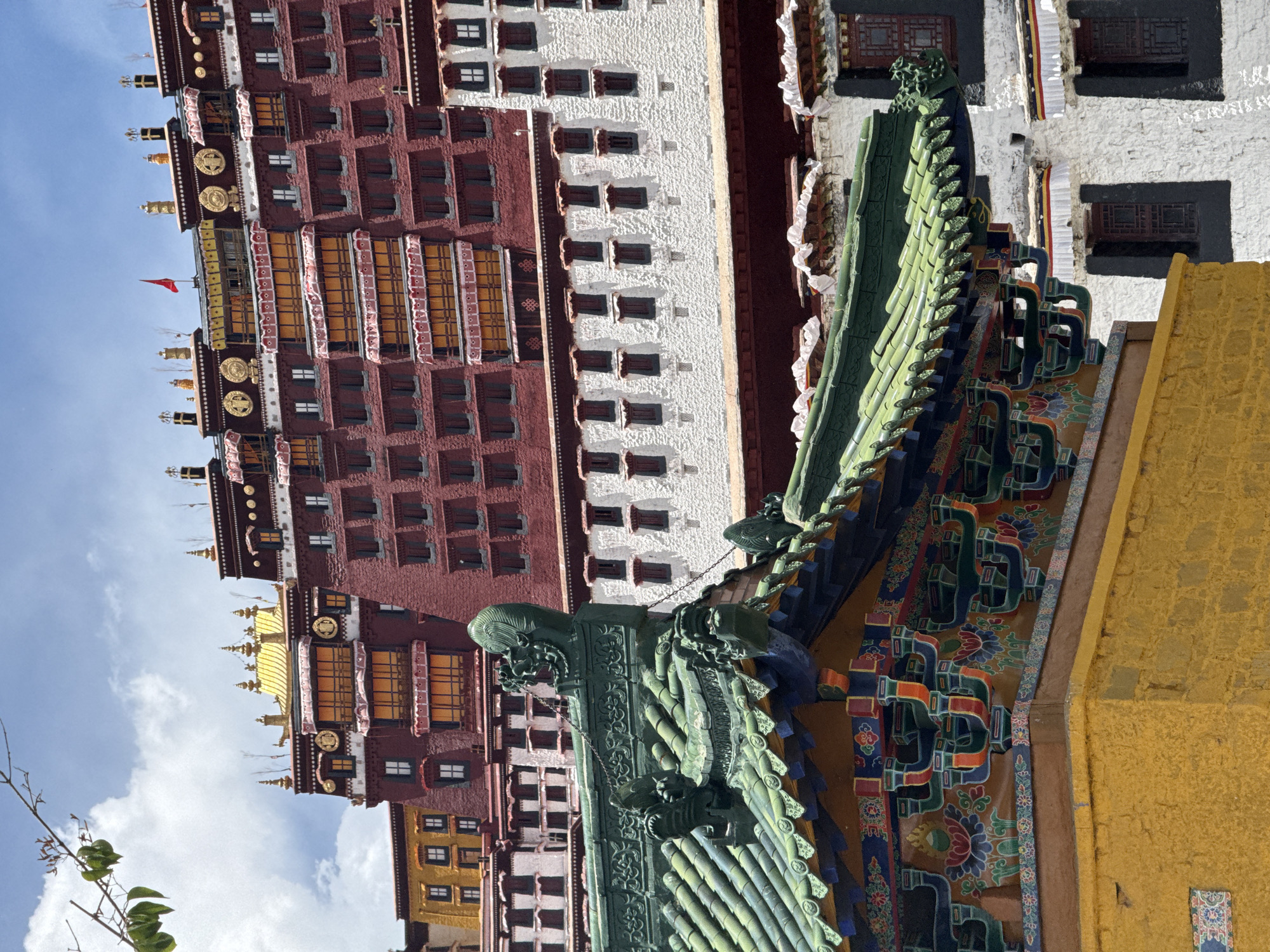
The image captures a detailed view of a grand architectural complex, strongly resembling the Potala Palace in Lhasa, Chengguan District, China, under a bright blue sky with sparse white clouds. The main structure features a striking contrast between its deep red and white sections. The predominantly red section, visible on the left and in the background, is characterized by numerous rectangular windows, many highlighted with golden frames, and topped with ornate golden roof ornaments. A small red flag can be seen flying from one of its upper terraces. Adjacent to this, a white building section, textured and with smaller, dark-framed windows, stretches across the middle ground. In the foreground, an elaborate green-tiled roof takes prominence on the right. This roof displays intricate patterns of ridged green tiles and features ornate decorative figures, possibly mythical creatures or gargoyles, along its ridge and at its corners. The eaves beneath the green roof are adorned with vibrant, multi-colored paintings showcasing traditional patterns in blue, red, green, and yellow. To the far right, a textured yellow wall or building facade is partially visible. A few leafy branches extend into the bottom-left corner of the frame, hinting at nearby vegetation. The bright, clear lighting indicates a daytime shot, likely midday or early afternoon. There are no visible people, activities, or text in the image.
Chengguan District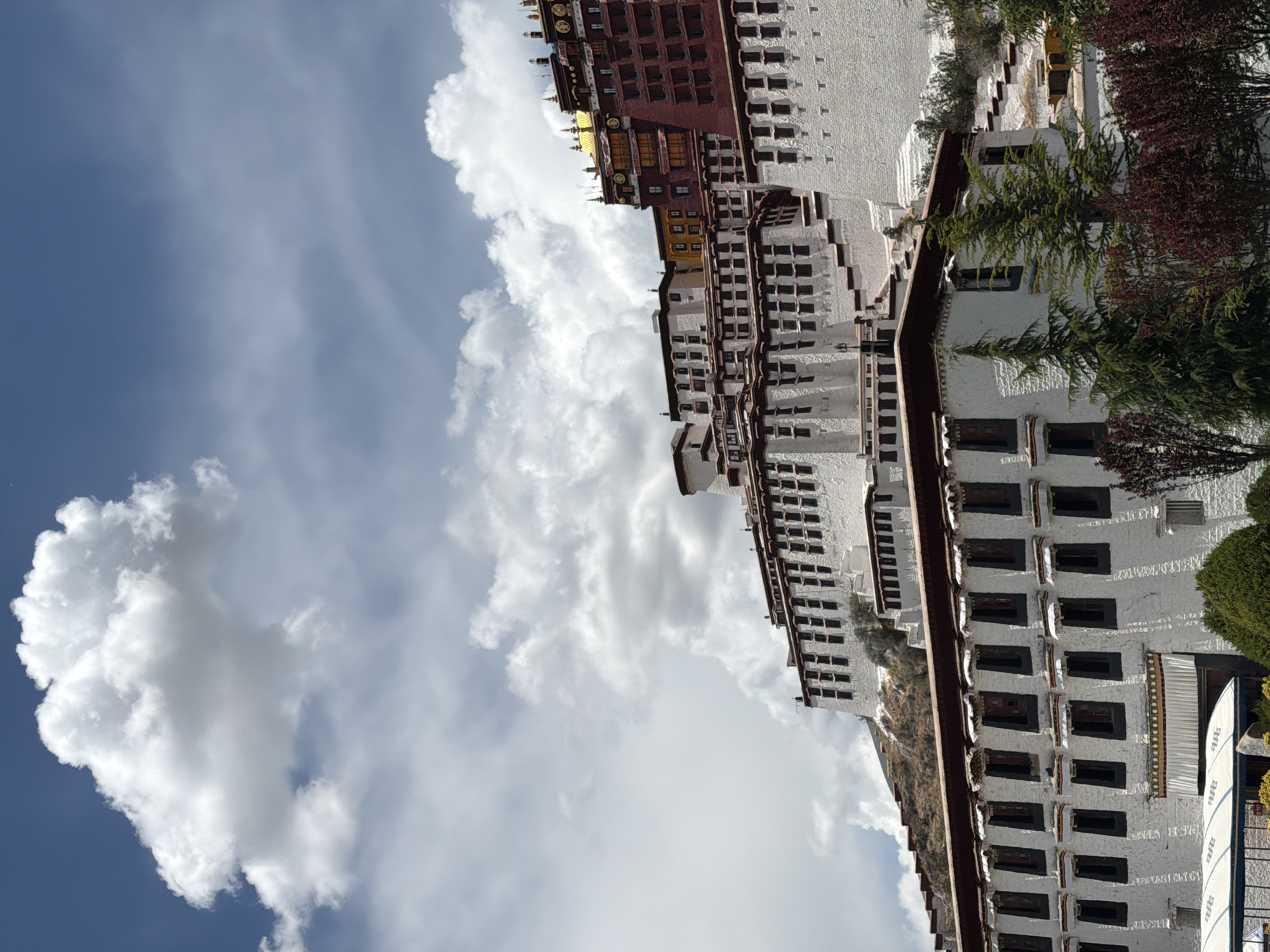
The image displays a majestic architectural complex, widely recognized as the Potala Palace, set against a vibrant blue sky dotted with white clouds. The palace dominates the right side of the frame, showcasing its iconic tiered structure. The lower and central sections of the palace are predominantly white, characterized by numerous windows with dark frames, creating a striking contrast. The upper part of the building is a deep reddish-brown, also featuring many windows, and crowned with ornate golden roof elements that shimmer under the sunlight. These golden details are particularly prominent on the rooftops of the red section. The left and upper portions of the image are filled with a clear, bright blue sky, adorned with scattered cumulus clouds. Some clouds are large and voluminous, while others appear as softer wisps. The bright, even lighting indicates it is daytime, likely midday or early afternoon, contributing to the clear visibility of the architectural details and the natural environment. Around the base and within the grounds of the palace, various trees and bushes are visible. Some foliage is a vibrant green, while other sections feature reddish-brown leaves, suggesting either specific plant types or the season. No people are discernible in the photograph. On the far right, near the base of the palace, what appear to be white banners or temporary structures with blue graphics are visible, though any specific text on them is not legible. The scene conveys a sense of grandeur, historical significance, and serene beauty.
Chengguan District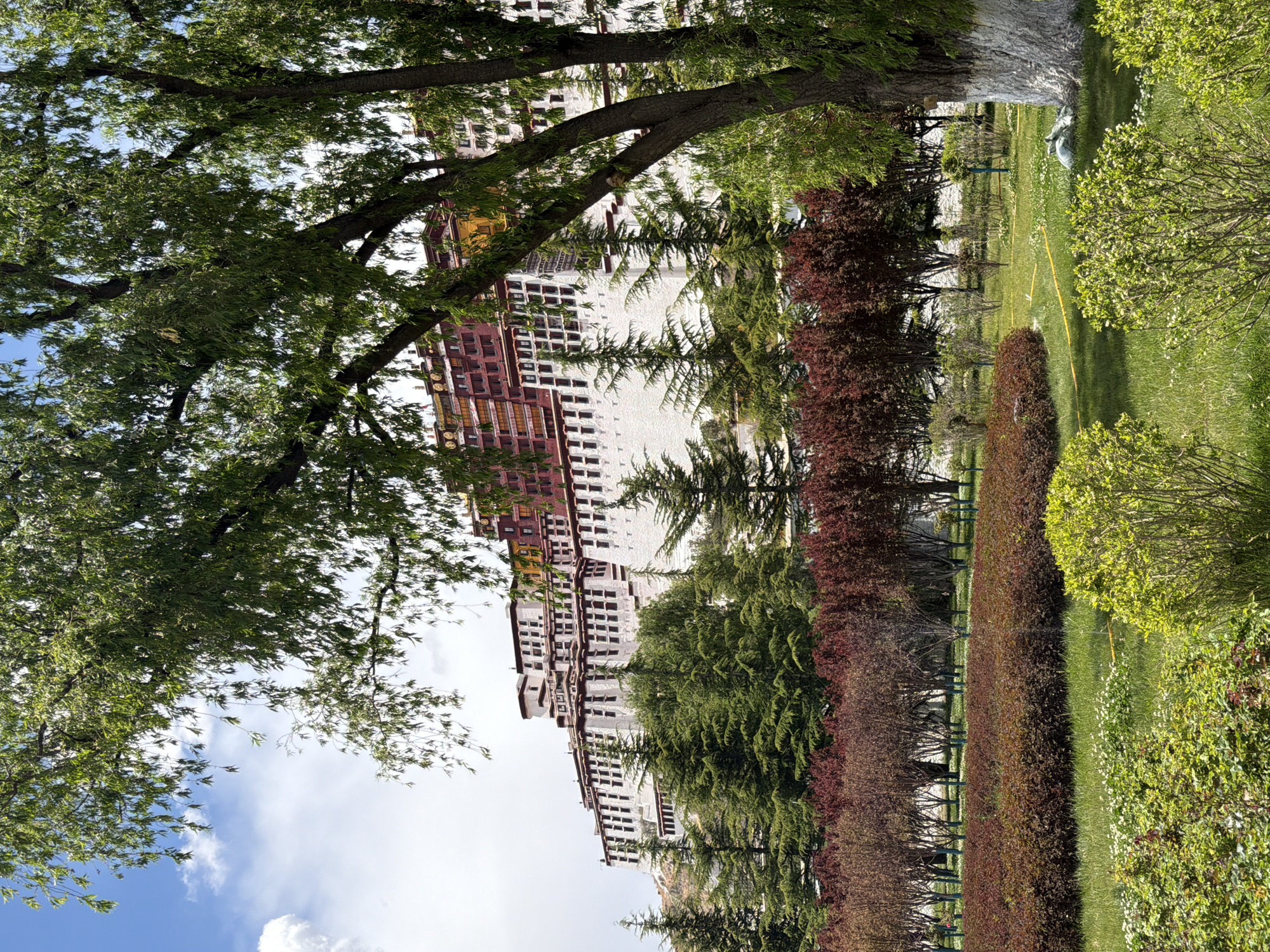
This image captures a scenic view of a majestic multi-tiered palace, likely the Potala Palace, nestled amidst lush greenery and vibrant landscaping under a bright sky. In the background and to the left, the grand palace stands prominently, characterized by its towering white walls, numerous dark windows arranged in rhythmic patterns, and distinct red upper sections crowned with golden-hued roofs. The complex architectural style suggests a significant historical and cultural site. The foreground and midground are dominated by a diverse array of trees and bushes. A large, leafy green tree with thick branches frames the left side of the composition, its foliage partially obscuring parts of the palace and the sky, creating a natural frame. Extending from the midground to the right foreground are rows of meticulously maintained hedges and bushes; some display rich burgundy or reddish-brown foliage, while others are bright green, adding texture and color to the landscape. Further back, evergreen trees stand tall, providing a contrasting deep green against the palace's facade. A wide expanse of vibrant green grass, dotted with small white flowers, fills the lower right portion of the image. A yellow line or rope is visible traversing the grassy area, and some white covers or objects lie on the grass near a light-barked tree trunk on the far right. The sky above is a clear blue with scattered white clouds, indicating a bright, sunny day. The scene appears tranquil, with no visible people or specific events taking place, emphasizing the serene and historic atmosphere of the location, which appears to be a well-maintained park or garden in the Chengguan District, China.
Chengguan District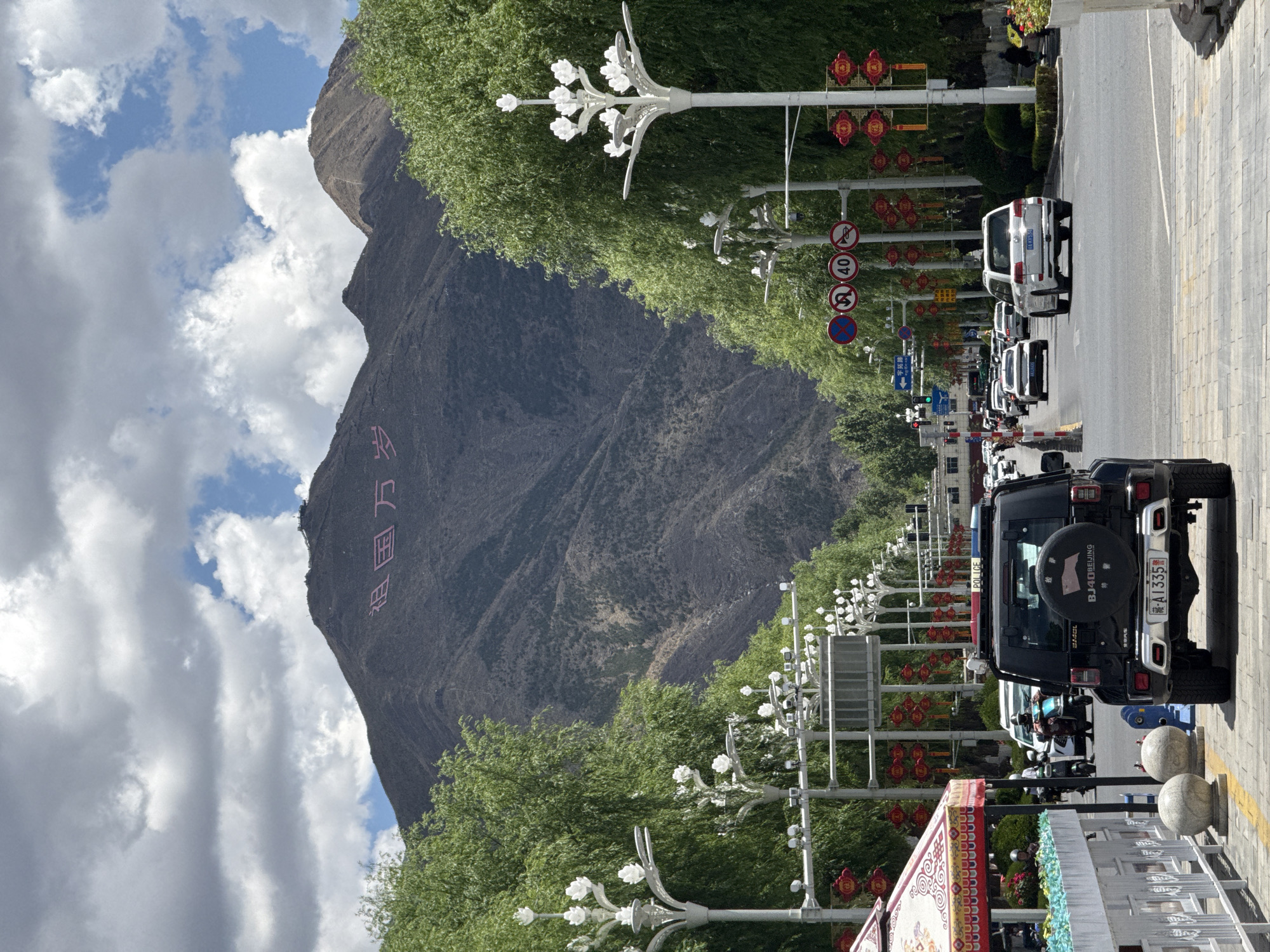
The image captures a street scene in what appears to be a town or city, with a large mountain dominating the background under a partly cloudy blue sky. The paved street extends from the foreground into the distance, lined on both sides by green trees and ornate white lampposts designed with multiple petal-like lights. Red decorative lanterns or banners are visible hanging along the roadside, adding a cultural touch. Various traffic signs are present, including a circular sign indicating a "40" km/h speed limit and other regulatory signs. A line of vehicles, primarily SUVs and cars, is visible on the right side of the street. In the immediate foreground, a black SUV is parked, featuring a spare tire cover with "BJ40 BEIJING" printed on it and a small "POLICE" text on its rear window. The license plate of this vehicle reads "陕A1335S". Further down the road, a white SUV is visible with the license plate "蒙A0MS60". The prominent mountain in the background has large red characters inscribed on its face, which read "祖国万岁" (Zǔguó wànsuì), translating to "Long live the Motherland." The scene is illuminated by bright daylight, suggesting it is late morning or afternoon. The overall impression is one of a developed area situated against a dramatic natural landscape.
Chengguan District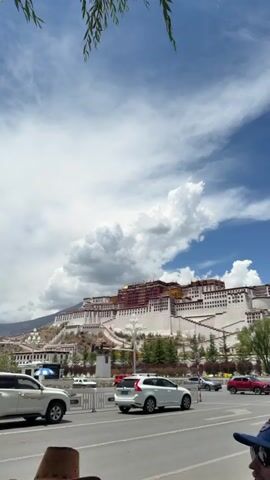
The video captures a wide shot of the majestic Potala Palace in the background, set against a bright blue sky with large, puffy white clouds. The palace features its distinctive white lower sections and red and gold upper structures, rising impressively on a hillside. In the foreground, a busy city street is visible with multiple lanes of traffic. Several cars, including a white Volvo SUV and a white SUV (possibly another Volvo), are driving or parked on the road. Lush green trees line parts of the street and are also seen on the lower slopes of the palace hill. Streetlights and traffic lights are also present. The top of a person's brown hat is visible at the very bottom of the frame, suggesting the video is shot from a pedestrian's perspective. The scene is brightly lit, indicating daytime. The specific location is Chengguan District, China, consistent with the Potala Palace in Lhasa. There is no discernible text.
Chengguan District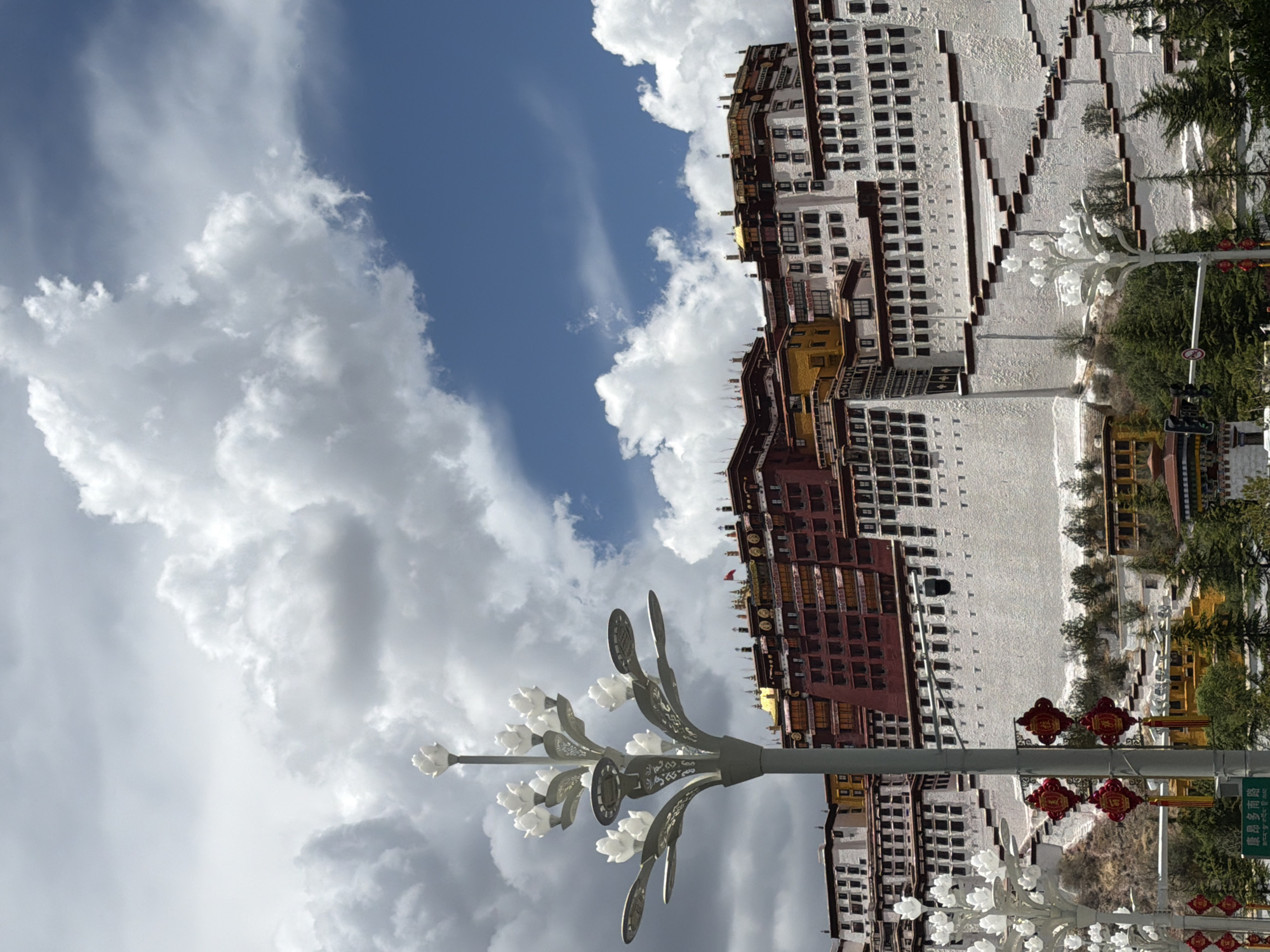
The image displays a majestic daytime view of the Potala Palace in Chengguan District, China, under a bright, partly cloudy sky. The imposing palace, built on a hill, is the central subject, showcasing its iconic red and white sections with numerous small, dark windows. Glimmers of golden roofs are visible on the upper structures of the palace. In the foreground, a tall, decorative street lamp adorned with white, flower-like lights and intricate metalwork extends upwards from the left. Further to the right, red ornamental lanterns hang from another pole, adding vibrant cultural detail. Green foliage and trees are scattered around the base of the palace and along the hill, providing a natural contrast to the architecture. The sky above is a clear blue, interspersed with large, fluffy white and grey clouds. A green street sign is partially visible, displaying Chinese characters that read "琼瑶多岗路" (Qiongyao Duogang Road), indicating a specific location. A traffic sign, possibly denoting a restriction, is also partly visible. The scene captures the grandeur of the historic site on what appears to be a pleasant, sunny day. No people are discernible in the frame, emphasizing the monumental scale of the palace.
Chengguan District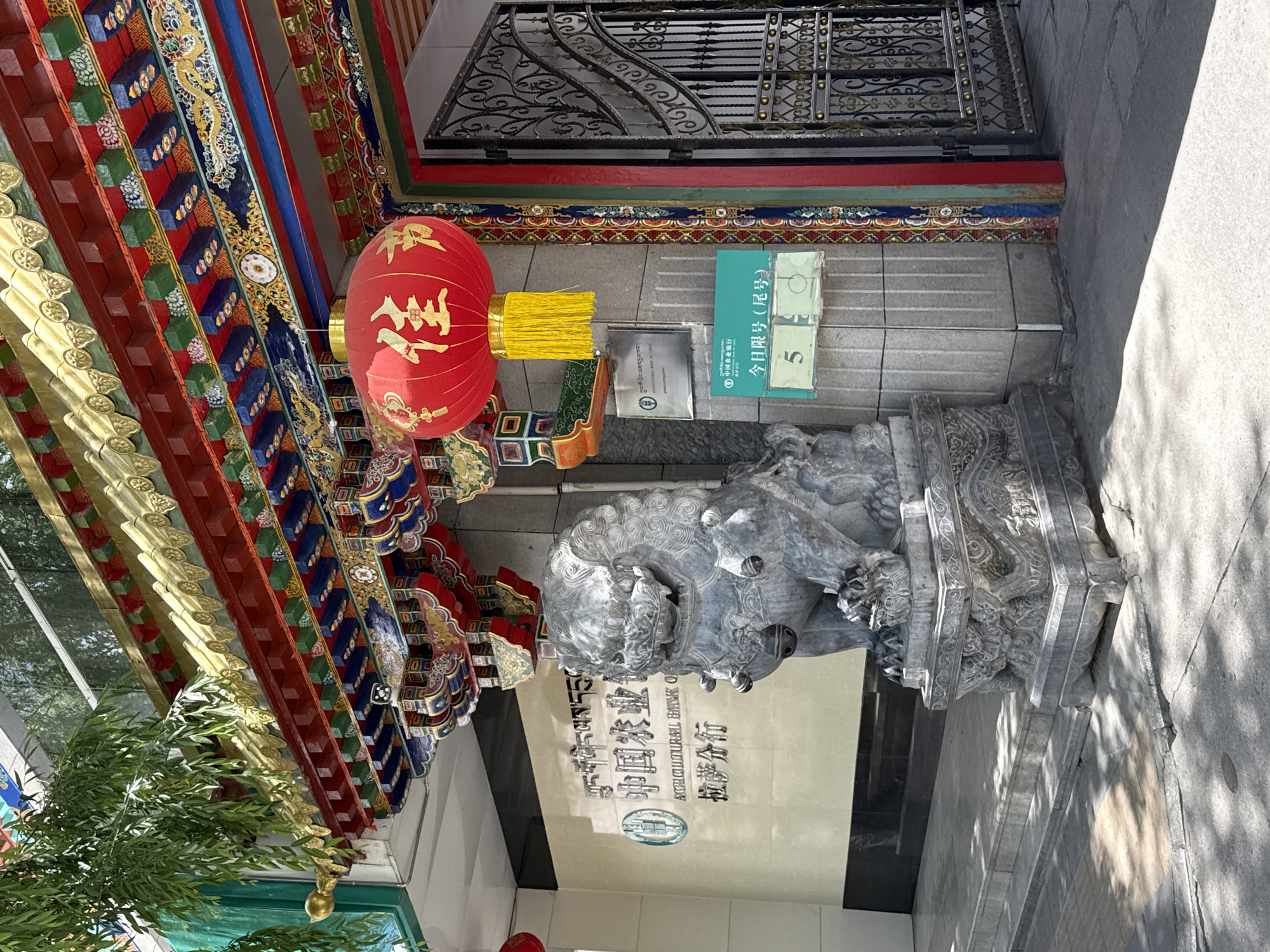
The image captures the vibrantly decorated entrance of the Agricultural Bank of China, Lhasa Branch, located in Chengguan District, China, under bright daylight. No people are present in the scene. The building entrance features traditional Chinese architectural elements, including an elaborate overhead structure with richly painted eaves in red, gold, blue, and green, adorned with intricate patterns and golden accents. A large, spherical red Chinese lantern hangs from these eaves, displaying the gold characters "招財進寶" (Zhāo cái jìn bǎo), which convey wishes for ushering in wealth and prosperity. Two imposing, intricately carved stone guardian lions (foo dogs) stand on ornate pedestals, flanking the entrance. Above the main entrance, a prominent sign for the bank is visible, displaying "中国农业银行" (Agricultural Bank of China) in Chinese, "AGRICULTURAL BANK OF CHINA" in English, and "拉萨分行" (Lhasa Branch), along with its Tibetan script equivalent. To the right of the entrance, a green sign provides information: "今日限号(尾号)" (Today's restricted number (last digit)) followed by the number "5," suggesting a specific queue or service restriction. This sign also features the Agricultural Bank of China logo and Tibetan text for "Agricultural Bank." A smaller gray sign is also visible. The ground is paved with stone tiles, and the clear, distinct shadows cast by the building and objects indicate a sunny day. Green foliage, possibly bamboo, is visible on the left side of the frame, adding natural contrast to the ornate structure. A decorative metal gate or grille is seen above the entrance area.
Chengguan District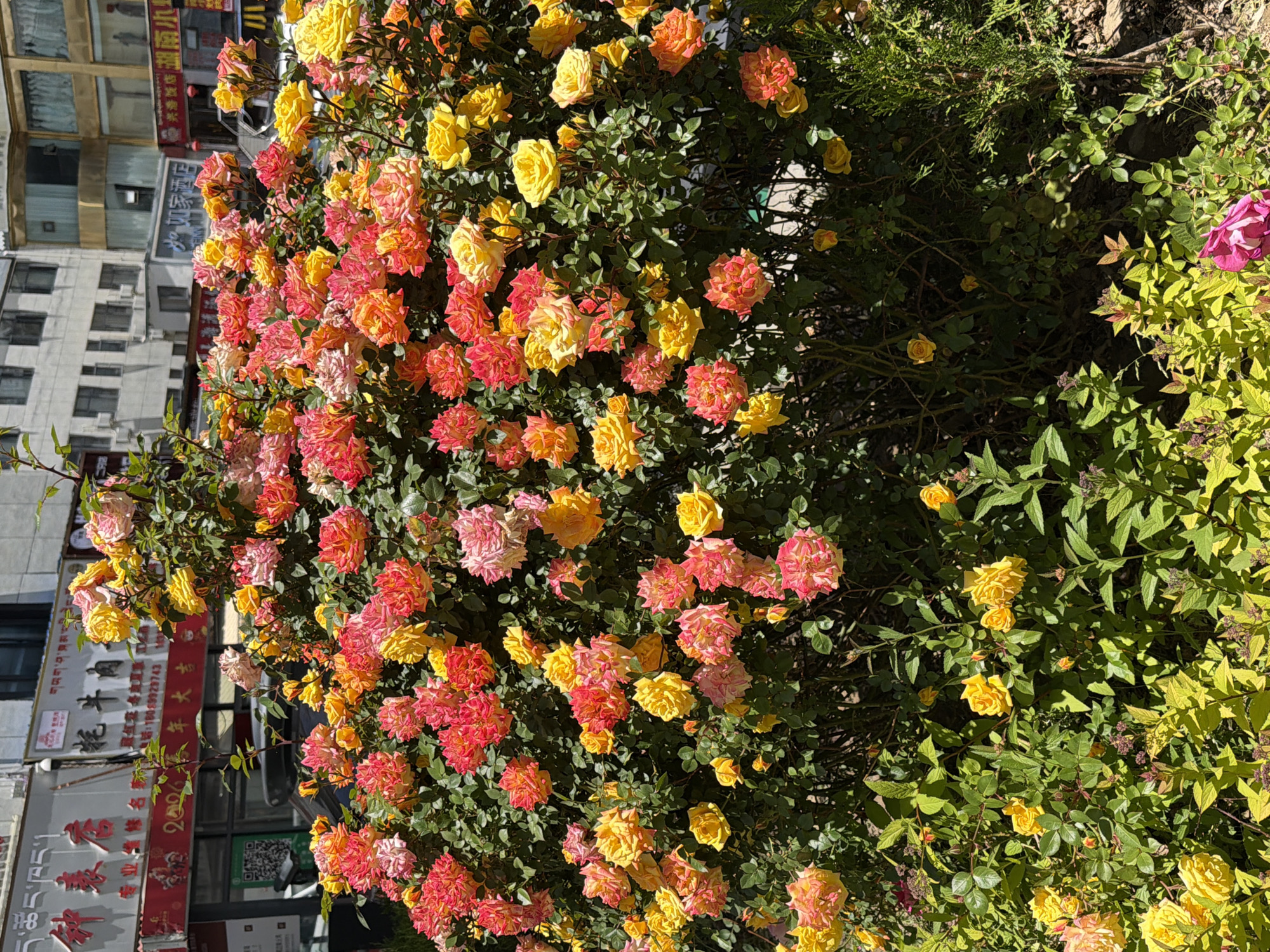
The image features a vibrant rose bush heavily laden with blossoms, serving as the central subject in an urban setting. The roses display a rich mix of colors, predominantly bright yellow, along with striking combinations of pink and red, some appearing bi-colored or multi-toned, transitioning from pink/red to orange/yellow. The bush's lush green foliage fills much of the foreground and midground. In the background, multi-story urban buildings are visible, characterized by their light-colored facades and numerous windows, suggesting a commercial or residential area. Several signs with Chinese and some Tibetan text are prominently displayed on these buildings. Visible Chinese text includes "专业修名:18059923743" (Professional repair name and phone number), "2000萬年大吉" (a phrase wishing great auspiciousness), "如如家酒店" (Ruru Home Hotel), "兴清饭店" (Xingqing Restaurant), and "湖南小里" (Hunan Xiaoli, likely a business name). Tibetan script reads "ད་ཚོང་ཁང་།" (possibly "Shop") and "གཡག་ཤ་སྐམ་" (possibly "Yak meat"). A QR code is also discernible on one of the signs. The scene is illuminated by bright sunlight, indicating daytime and clear weather conditions, casting distinct shadows and enhancing the vivid colors of the flowers. No specific human activity is depicted. The overall impression is a cheerful display of nature integrated into an urban environment in Chengguan District, China.
Chengguan District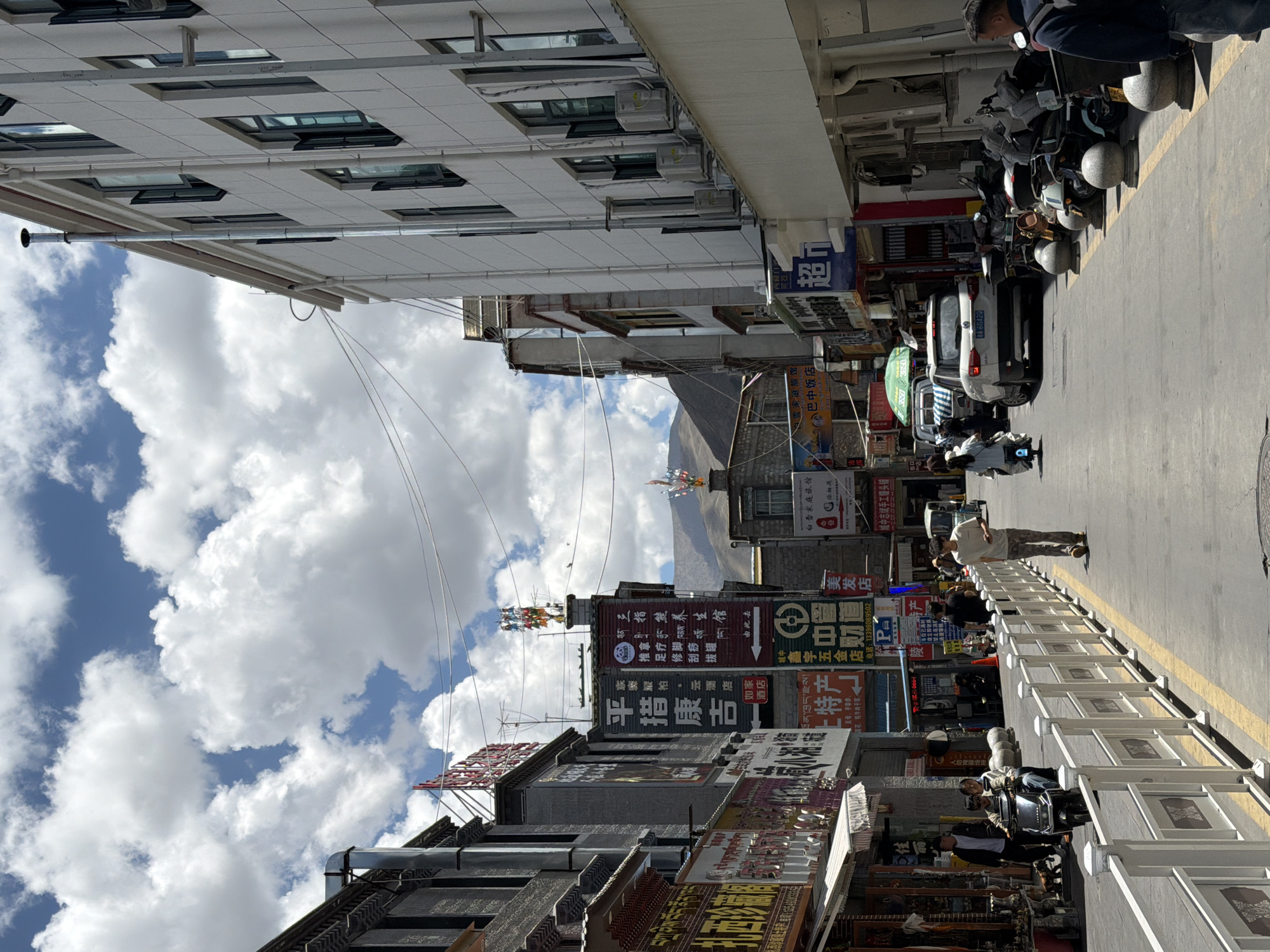
This image captures a lively street scene in what appears to be a bustling town or city, likely in Chengguan District, China, with mountainous terrain visible in the background. The photo is taken during bright daylight, indicated by the clear blue sky adorned with fluffy white cumulus clouds. The street is lined with multi-story buildings of varying architectural styles, some appearing more modern with grid-patterned facades and numerous windows, while others have a more traditional look. Many of these buildings host a multitude of businesses, indicated by the array of colorful commercial signs hanging outside. A paved road, marked with a yellow dividing line, runs through the center, with a white, low barrier fence separating it from the sidewalk or storefronts on the right. Several people are visible in the scene: a person walking on the street in the middle distance, another individual on the far right near parked vehicles, and people seated on or near motorcycles and scooters. A significant number of motorcycles and scooters are parked along the street, and a white car with the license plate "A-66420" is also visible further down. Overhead, a tangle of power lines and cables crisscrosses the street, adding to the urban feel. Traditional decorative elements, possibly prayer flags, can be seen atop some distant buildings, hinting at the cultural context of the region. Visible text from the numerous signs includes "Three-Finger Health Preservation Hall," "Pintso Kangji," "Jiale Pai. Yun Hotel Home Store" (possibly a hotel), "Baixiang Family Hostel," "Bazhong Hotel," "Hair Salon," "Zhongxinyu Hardware Store," and a "Handmade Steamed Bun Shop." Other signs advertise "specialty products" such as "yak jerky," and Tibetan script (ཁྲོན་ཁྱད་རྫས།) is also visible, reinforcing the location's cultural identity.
Chengguan District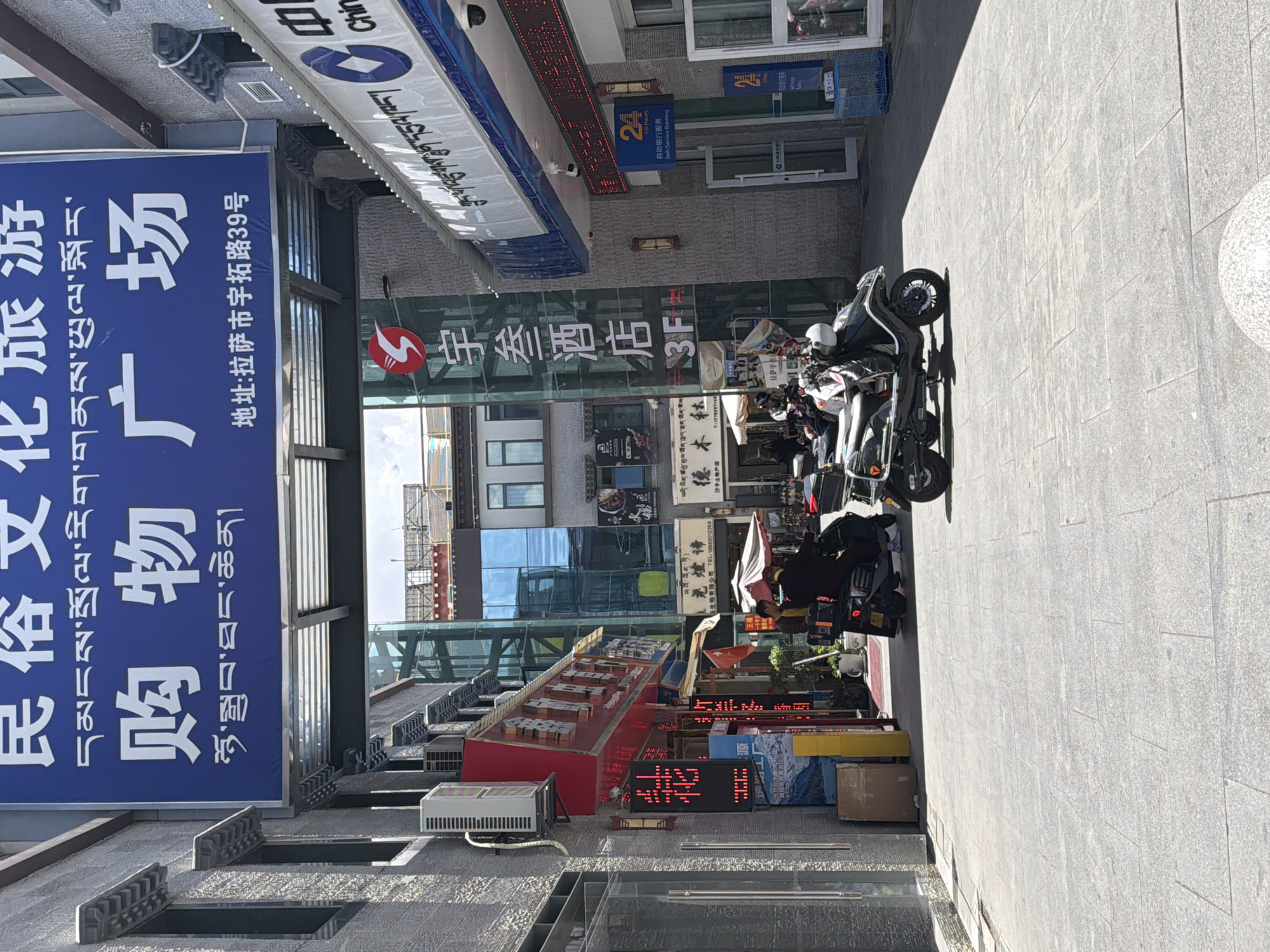
This daytime photograph captures a commercial street scene in Lhasa, China, specifically at No. 39 Yutuo Road, as indicated by visible signage. The perspective looks down a paved street lined with multi-story buildings on both sides. The bright sunlight casts sharp shadows, suggesting clear weather. On the left, a large blue banner, featuring both Chinese and Tibetan script, advertises a "Folk Culture Tourism Shopping Plaza." Below it, an air conditioning unit is mounted on the building. The right side of the street features several parked motorbikes or scooters, some with white helmets. A few people are visible near these vehicles, with another person under an umbrella further down the street. The buildings display various signs, including an overhead banner partially showing "Chin" (likely part of "China"). A prominent red LED sign above a banking facility indicates "24 Hours Self-Service Banking" in both English and Chinese. Another sign identifies "Yucan Hotel 3F." Other businesses advertised include "Demulin Sand Local Specialty Store," with names and phone numbers in both Chinese and Tibetan scripts. A red LED sign on the ground reads "源" (Source/Origin). The pervasive use of both Chinese and Tibetan languages serves as a strong location cue.
Chengguan District
Two cartoon-like statues of children are depicted, appearing to lie side-by-side. The image is oriented vertically, so the figures are arranged one above the other in the frame. The upper statue has bright yellow hair and light-colored skin, with large blue eyes and a cheerful smile. It wears blue shorts featuring a green circular emblem. Its body shows noticeable cracks and wear. The lower statue has dark hair and tan skin, with similar large blue eyes and a gentle smile. It wears yellow shorts adorned with a red circular emblem. This statue also exhibits significant surface cracks and deterioration. Both figures have their arms bent, with the upper figure's right hand (as viewed from the top of the statue) resting against a white, cylindrical base or pillar that supports both figures. The lower figure's feet also rest against this cylindrical base. The background shows reflections of modern architectural elements, primarily glass windows of buildings, indicating an urban outdoor setting, possibly a commercial area. The lighting suggests it is daytime. The statues appear to be part of a public art installation or display, possibly mascots, and their weathered appearance indicates exposure to the elements over time. No legible text is visible on the statues themselves or their immediate bases. The overall scene conveys a sense of whimsical public decoration.
Chengguan District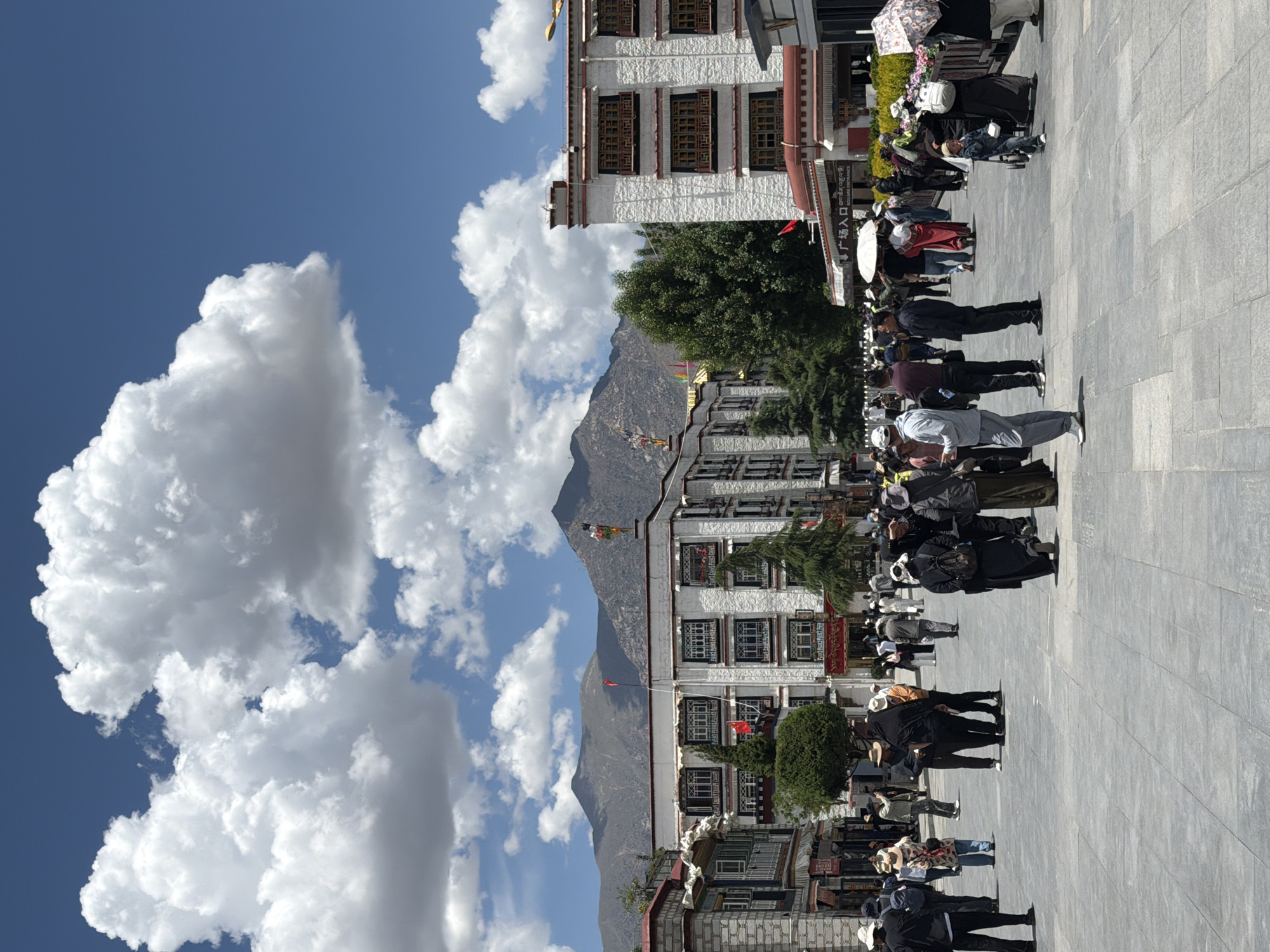
This image captures a vibrant public square or street scene in Chengguan District, China, under a clear, bright blue sky with large, fluffy white cumulus clouds. The strong sunlight and visible shadows suggest it is midday or early afternoon. The scene is populated by numerous people walking, standing, and gathering across a wide, paved stone square. Individuals are dressed in a variety of casual clothing, with some carrying umbrellas, likely for sun protection. Their activities suggest everyday movement and congregation in a public space. To the right of the square, a row of multi-story buildings showcases traditional Tibetan architectural elements, characterized by white-textured walls and dark-framed windows with intricate designs. Green trees are strategically placed near these structures, adding to the landscape. Colorful prayer flags are visible, draped from buildings and on the distant mountainside, serving as a prominent cultural cue. In the background, a range of majestic, rugged mountains extends under the expansive sky. A red flag is seen flying from one of the buildings. A significant textual detail is a sign on a building that reads "广场入口" (Guǎngchǎng rùkǒu), which translates to "Square Entrance." The overall impression is one of a busy yet serene environment, reflecting the daily life and cultural richness of the area.
Chengguan District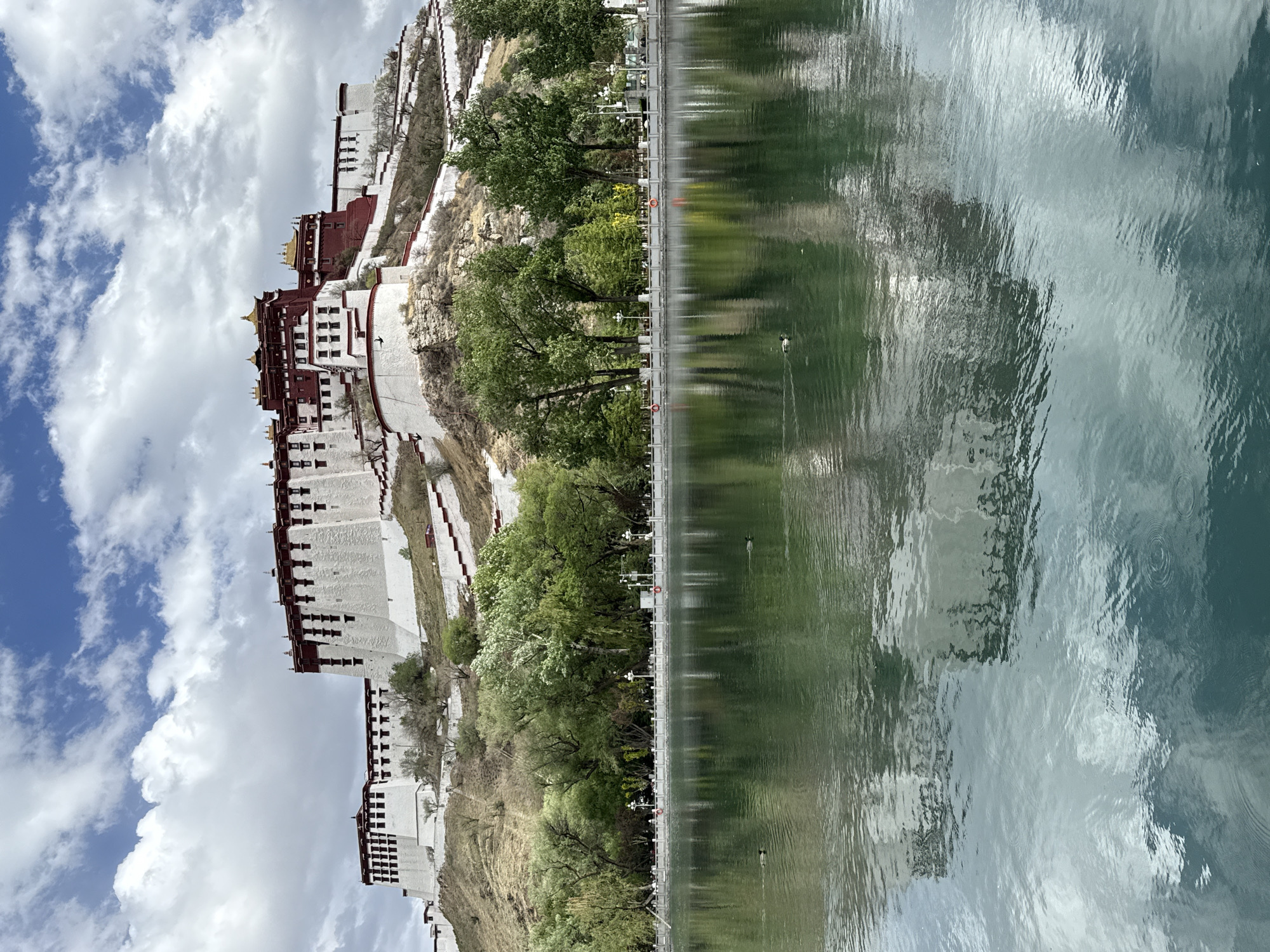
The image shows the Potala Palace in Lhasa, Chengguan District, China, reflected in a body of water. The palace, white and red, is on a mountainside against a blue sky with clouds. Trees and foliage line the base of the mountain. The water surface is rippled, creating a distorted reflection. A series of poles and barriers runs along the water's edge.
Chengguan District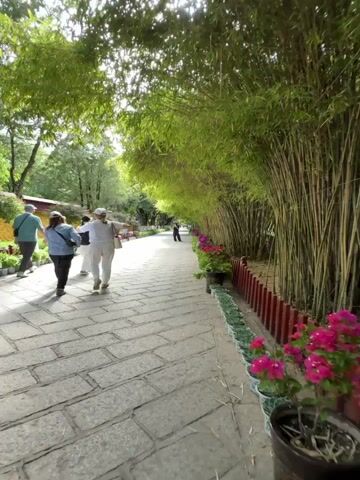
The video shows a stone-paved walkway in a park or garden. A group of people is walking away from the camera down the path. On the right side of the path, there's a row of tall, thin bamboo stalks that create a natural tunnel-like effect over the path. Along the base of the bamboo are various potted plants, including some with pink flowers and others with succulents. A low red fence runs alongside the path, separating it from the plants. On the left side of the path, there is a building with a yellow wall in the distance, and additional trees and greenery. The scene is bright, with sunlight filtering through the trees.
Chengguan District