Covilhã, Portugal
7 memories from Covilhã, Portugal
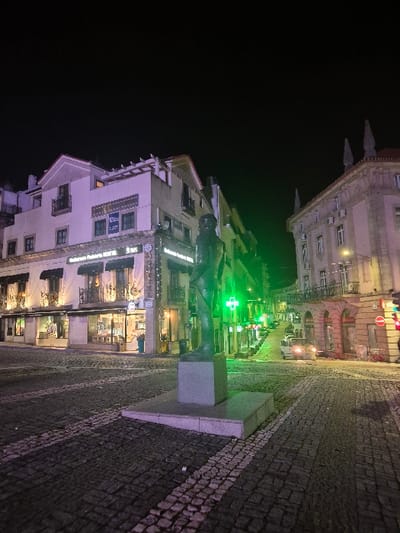
This image presents a nighttime street scene in Covilhã, Portugal, characterized by architectural illumination and artificial light sources. In the foreground, a bronze-colored statue of a standing male figure is centrally positioned on a two-tiered rectangular grey stone pedestal. The ground is paved with dark cobblestones interspersed with white cobblestone stripes, forming linear patterns. To the immediate left, a multi-story building with light-colored facades displays "Restaurante Pizzeria HOTEL" and "3.ES" on an illuminated sign at ground level. Its ground-floor windows are lit with warm-toned light, revealing interiors. Balconies with dark railings are visible on upper floors. To the right, another multi-story building, appearing older with distinct architectural details and multiple windows, features balconies on its upper levels. A red traffic signal is partially visible on the far right. An uphill street recedes into the background, flanked by buildings. A prominent green illuminated cross, indicative of a pharmacy, is visible on the left side of this street, positioned above other illuminated signs. Further up the street, at least one white van with headlights activated is visible. The sky is uniformly dark, and no human figures are present in the scene.
Covilhã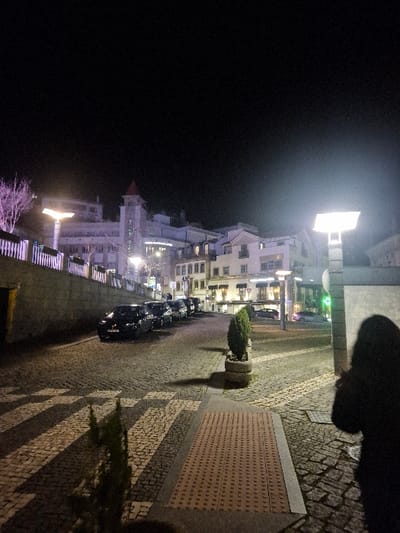
The image captures a nighttime urban street scene in Covilhã, Portugal. A cobblestone street, featuring a zebra-patterned pedestrian crossing, extends from the foreground into the mid-ground. Along the left side of the street, a line of at least five dark-colored sedans is parked diagonally. A low stone retaining wall with a white railing runs parallel to the parked vehicles. In the background, a row of multi-story buildings with traditional Portuguese architecture is visible; one prominent building features a red-roofed tower. Several windows in these buildings are illuminated. Overhead, the sky is dark. Artificial illumination is provided by streetlights, including one on the far left casting a purple light on a leafless tree, and another bright, square-headed streetlight prominently positioned on the right foreground. On the foreground sidewalk, a rectangular section of red tactile paving is present. A dark, indistinct human silhouette, appearing to wear a hooded garment, is partially visible on the far right edge of the frame.
Covilhã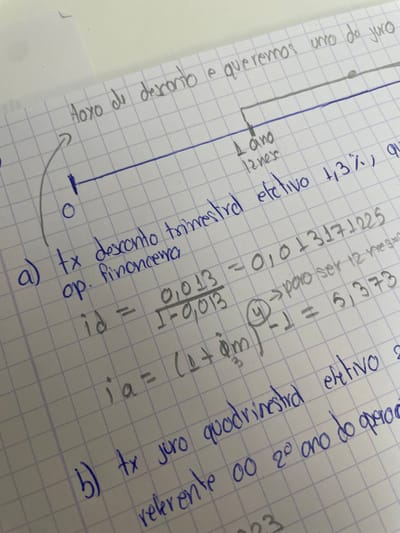
A close-up, angled photograph captures a page from a white, blue-lined grid notebook containing handwritten Portuguese text and mathematical equations. The writing is primarily in blue ink, with some numerical calculations and annotations in a lighter gray ink. The content focuses on financial mathematics, specifically dealing with discount and interest rates. Visible elements include: * A heading in gray ink: "Taxa de desconto e queremos uma do juro" (Discount rate and we want one of the interest). * A timeline diagram drawn in blue ink, featuring a horizontal line with vertical markers labeled "0" and "1 ano / 12 meses" (1 year / 12 months), and a curved arrow indicating a period. * Problem "a)" with blue ink text: "tx desconto trimestral / op. financeira" (quarterly discount rate / financial operation). * Equations in gray ink: "id = 0,013 / 1-0,013 = 0,013171225" and "ia = (1 + dm)^4 - 1 = 5,373", with a small circled "4" and an annotation "-> para ser 12 meses" (to be 12 months). * Problem "b)" in blue ink text, partially visible: "tx juro quadrinestral / efetivo 2 / referente oo 2º ano do quad..." (quadrennial interest rate / effective 2 / referring to the 2nd year of the quad...). The page is resting on a light-colored, flat surface, possibly a desk, with a faint white object visible in the upper left corner, potentially another sheet of paper or a part of the notebook binding. No individuals are present in the image. The image itself does not contain any visual information to determine the specific city of Covilhã, Portugal.
Covilhã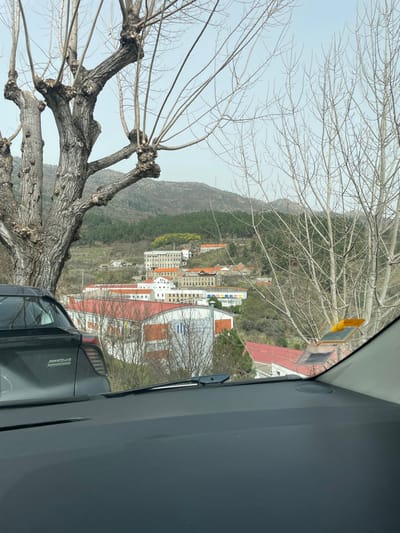
The image depicts a panoramic view of the city of Covilhã, Portugal, observed from the interior of a stationary vehicle. The foreground is occupied by the dark gray dashboard and lower portion of the windshield, with two windshield wipers visible. A partially obscured yellow sticker or permit is affixed to the right side of the windshield. To the immediate left, a large, bare deciduous tree with prominent gnarled, pollarded branches dominates the left side of the frame. Its trunk is thick and textured. To the right of the large tree, a cluster of slender, bare deciduous trees with finer branches is visible. A dark gray MG4 Electric hatchback vehicle is parked ahead and to the left of the viewpoint, with its rear section and "MG4 ELECTRIC" badging partially visible above the dashboard. Beyond the immediate foreground, the terrain descends, revealing a landscape of buildings typical of Covilhã's hilly structure. Numerous structures with red or orange-tiled roofs are present, along with several larger multi-story buildings featuring white or cream-colored facades. One prominent multi-story building with numerous windows and a classical architectural style is visible in the mid-distance, likely a former textile factory or university building. Other buildings appear to be of industrial or residential character. The background is dominated by a range of hills and mountains, heavily forested with evergreen trees. The sky above is a pale, hazy blue. No individuals are visible within the frame, and no specific actions or interactions are depicted. The scene suggests a late winter or early spring setting due to the bare deciduous trees.
Covilhã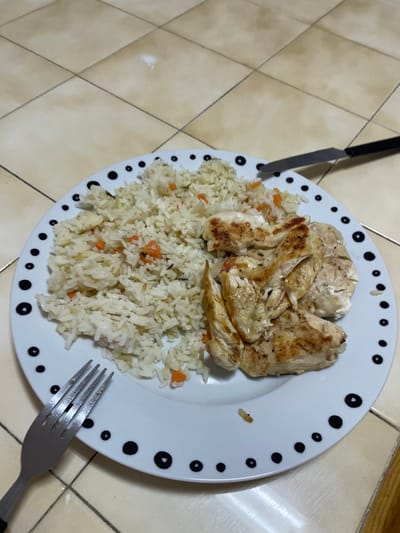
The image displays a close-up view of a meal served on a white circular plate with a black-dotted rim. The plate holds a portion of white rice mixed with diced orange vegetables, consistent with carrots, and minor green specks, occupying the left side. To the right, several pieces of cooked chicken breast are arranged, exhibiting light browning and char marks from grilling or searing. A silver-colored dinner fork with a black handle is positioned in the lower-left, partially resting on the plate's rim and the underlying surface. A matching silver-colored dinner knife with a black handle is visible in the upper-right, also partially on the plate's rim and the surface. The surface beneath the plate and cutlery consists of light tan or beige square ceramic tiles, laid in a diagonal pattern relative to the camera, with darker grout lines. A faint white mark is present on one of the upper tiles. No individuals are depicted, and no explicit actions are occurring. The specific location within the city of Covilhã, Portugal, cannot be determined from the visual information presented in the image.
Covilhã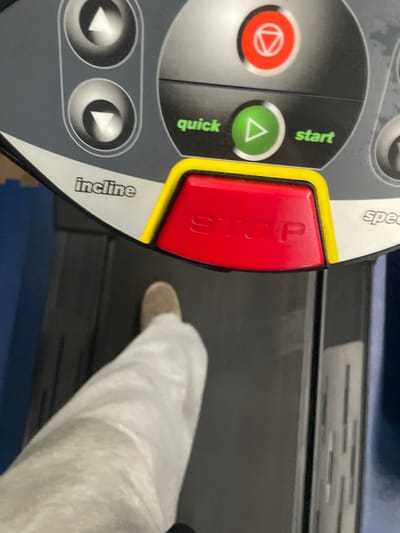
The image depicts a close-up, high-angle view of a person's lower left leg and foot on a treadmill, with a significant portion of the treadmill's control panel visible in the upper half. The individual is wearing light-colored, possibly white or light grey, loose-fitting pants and a light brown or tan shoe on their left foot, which is positioned on the black running belt of the treadmill. The control panel is grey and black, featuring several buttons and labels. Prominently displayed is a large red "STOP" button with a yellow border. To its right, a green triangular "start" button is labeled "quick" and "start." Above these, a red circular button with a white geometric symbol is present. On the left, two grey circular buttons with up and down arrows are positioned above the label "incline." The term "speed" is partially visible on the right side of the panel. A blue floor mat or covering is discernible at the top left and bottom right corners of the frame. The scene is located within the city of Covilhã, Portugal.
Covilhã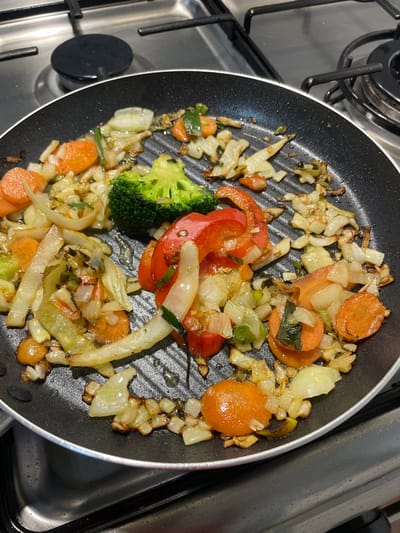
The image displays a close-up, high-angle view of various sautéed vegetables in a black non-stick grill pan, positioned on a stainless steel gas hob. The vegetables, distributed unevenly across the pan's ridged surface, include sliced carrots, chopped white and red onions, a distinct floret of broccoli, and sliced red bell pepper. Some vegetables exhibit browning and caramelization, indicating partial cooking, and residual oil droplets are visible in the pan's grooves. In the background, sections of two black cast-iron burner grates and a black burner cap are discernible on the stainless steel surface of the stovetop. The scene is located in a kitchen in Covilhã, Portugal.
Covilhã