Cuiabá, Brazil
30 memories from Cuiabá, Brazil
A first-person perspective video captures a view of a paved road with a clear blue sky above. The road has multiple lanes, and streetlights are visible along the right side. There is sparse vegetation and trees on either side of the road. Several vehicles are driving on the road. The camera appears to be moving along the road.
Cuiabá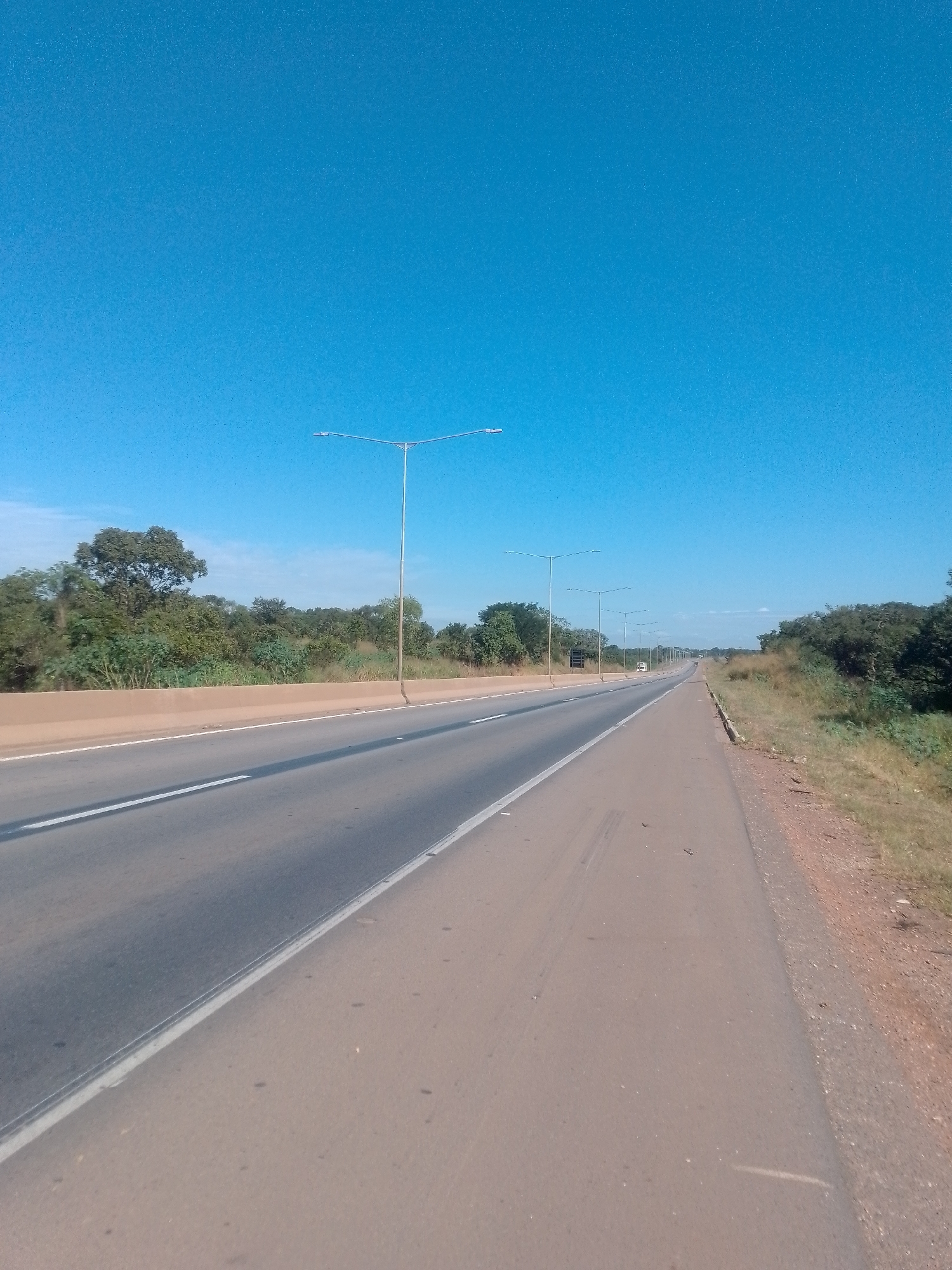
A photograph shows an empty, two-lane highway stretching into the distance under a clear blue sky. The highway is bordered by green trees and vegetation on both sides. Along the left side of the highway, a concrete barrier is visible. Several tall lampposts are spaced out along the median of the highway, indicating it is likely a highway designed for higher speeds or nighttime travel. The road surface appears to be asphalt and is in good condition. There are no vehicles or people visible in the image, suggesting a quiet and uninhabited stretch of road. The overall scene is one of a modern highway passing through a natural, rural landscape.
Cuiabá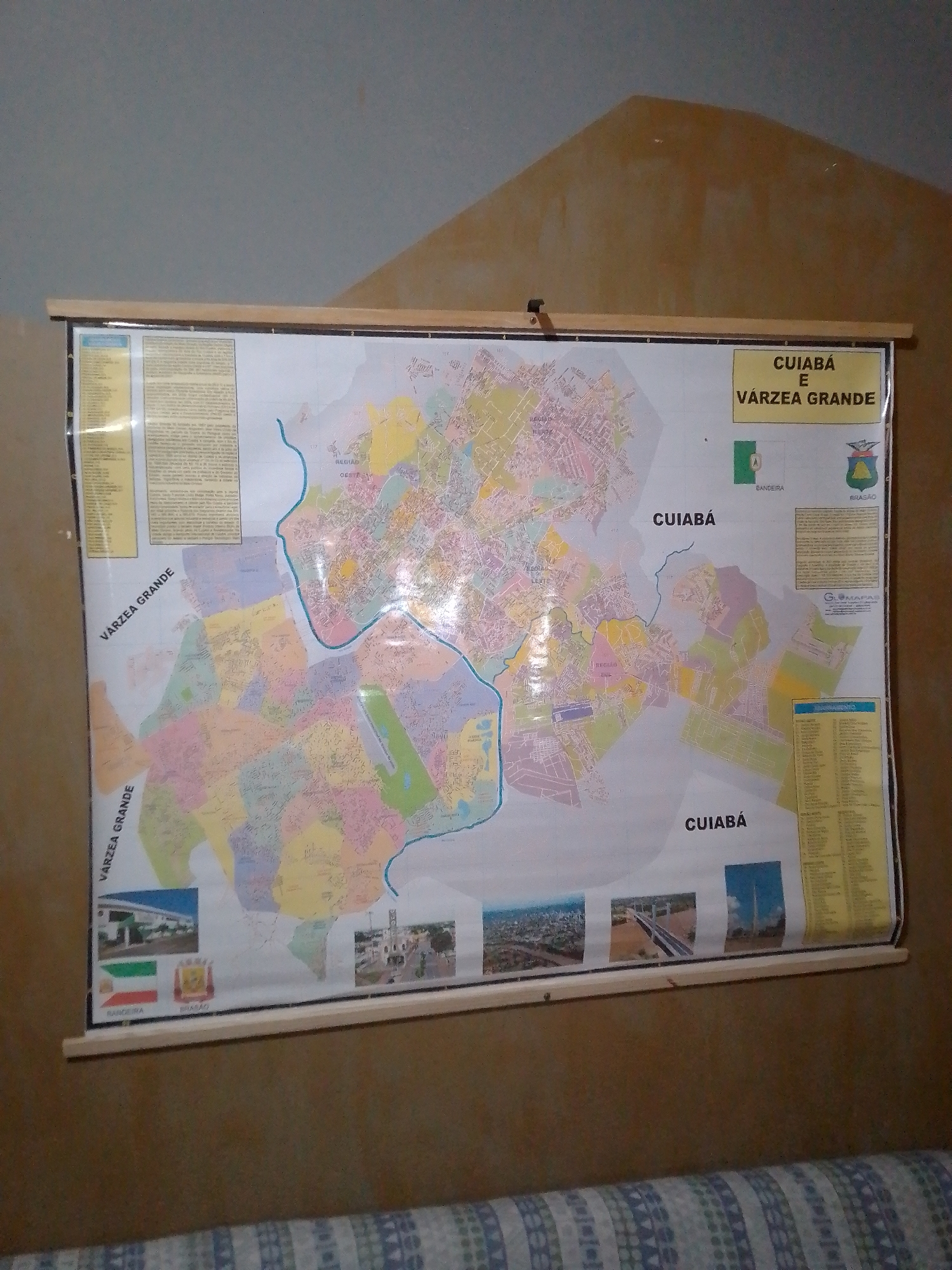
An overhead map of Cuiabá and Várzea Grande, Brazil, is displayed on a wall. The map is bordered by wooden strips at the top and bottom, with a metal rod at the top holding it. Text at the top right of the map reads "CUIABÁ E VÁRZEA GRANDE." The map is detailed, showing streets, neighborhoods, and bodies of water, with various areas color-coded. Several small images are placed along the bottom edge of the map, depicting landmarks, infrastructure, and symbols of the region, including flags and coats of arms. The wall behind the map is a textured, light brown. The bottom of the image shows a portion of a patterned sofa or bed.
Cuiabá
The image shows a wooden bench in front of a wall. A framed picture of a tropical beach scene hangs on the wall above the bench. The bench is made of polished wood and has a slatted backrest. The wall is painted a neutral color and appears to be slightly damaged in some areas. The floor is tiled. The lighting suggests it is indoors, possibly in a residential or commercial setting. No people are visible in the image. The specific location in Cuiabá, Brazil, cannot be determined from the image alone.
Cuiabá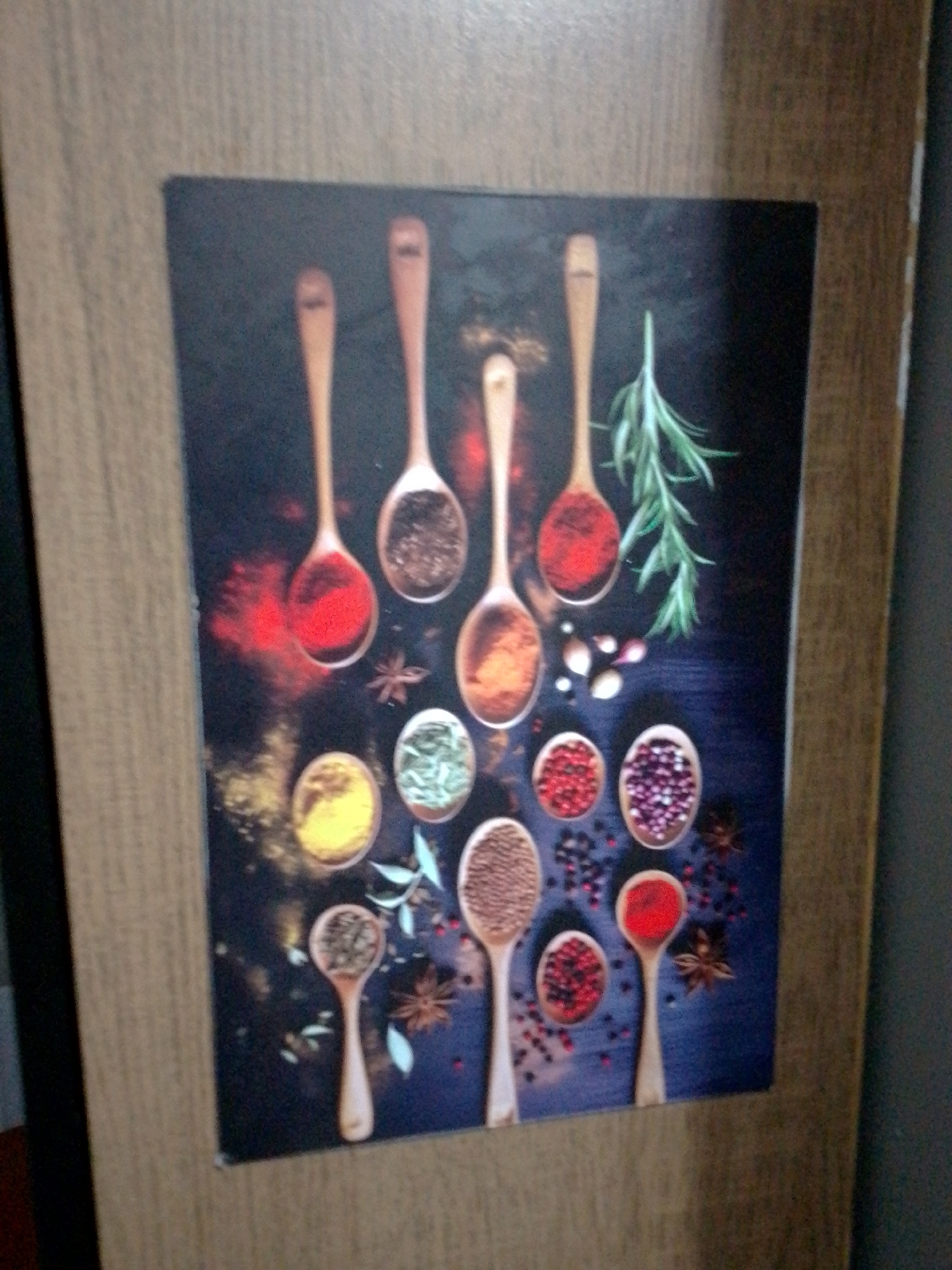
The image is a close-up, slightly angled shot of a framed decorative print featuring an assortment of spices in wooden spoons and small bowls. The print is set against a dark, textured background, likely a wooden surface, with some bokeh effects creating a blurred atmosphere around the spices. The arrangement includes several wooden spoons, each holding a different spice. From top left, going clockwise: a spoon with red powder (likely paprika or chili powder), followed by a spoon with brown powder (perhaps cinnamon or ground coffee), then a spoon with dark brown specks (possibly ground pepper or a spice blend). Below these, a spoon holds a light brown powder, and another contains a dark, granular spice. There are also small round bowls filled with yellow powder (turmeric), green herbs (like dried parsley or dill), red peppercorns, and purple peppercorns. A sprig of rosemary is visible towards the top right. Scattered amongst the spices are whole peppercorns and star anise. The frame of the print is a light brown wood grain. The overall impression is one of culinary richness and visual appeal, common in home decor for kitchens or dining areas. While the image depicts a decorative print, there is no information within the image itself to suggest its location in Cuiabá, Brazil. The description is therefore limited to the visual content of the print and its immediate surroundings as depicted.
Cuiabá
A woman with dark, curly hair and a white t-shirt is holding a mobile phone. She is smiling and looking at the viewer. On the phone screen, there is a WhatsApp chat. The woman is holding what appears to be a credit card or a transit card in her left hand. The advertisement is green and white. A phone number, "(65) 99983-9200", is displayed prominently on the ad. Below the phone number, it says "Recarregue seu cartão TEM pelo WhatsApp. Quando e onde estiver!". There is also a QR code in the bottom right corner. The advertisement is likely placed on public transportation, possibly a bus, as indicated by the yellow handle at the top of the image. The background shows a slightly blurred view of a street with cars and buildings, suggesting an urban environment. The context of the phone number format and the brand "TEM" strongly indicates the location is Cuiabá, Brazil, where the "Cartão TEM" (Transporte em Metrô) is a common public transport card.
Cuiabá
A video shows a street scene with cars and trucks driving on a wet road under a cloudy sky. A person is walking on the sidewalk on the left side of the road. A green trash can is visible on the sidewalk. There are trees and buildings in the background. A large red truck with "ÁGUIA SUL" written on its side is driving in the right lane. Several other vehicles are visible on the road, including cars, a white pickup truck, and a white van. The overall lighting suggests it is daytime, possibly late afternoon or early morning.
Cuiabá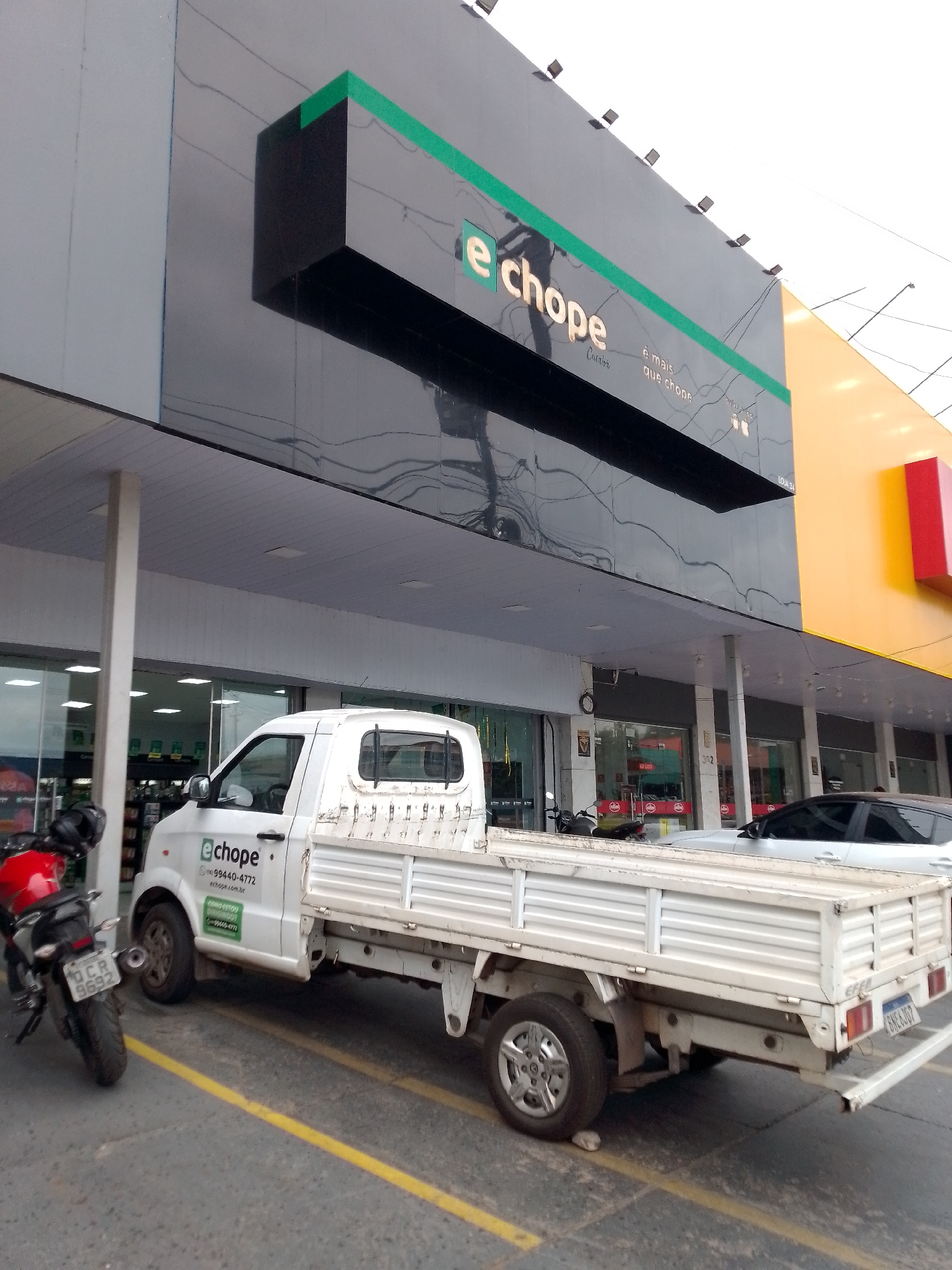
A white flatbed truck is parked on a street in front of a commercial establishment in Cuiabá, Brazil. The truck has "e chope" logo and phone number on its side door. A red motorcycle is parked to the left of the truck. The commercial establishment features a black facade with a green stripe and a large illuminated sign that reads "e chope". The establishment also has a yellow facade and a red rectangular accent on its right side. The sky is overcast.
Cuiabá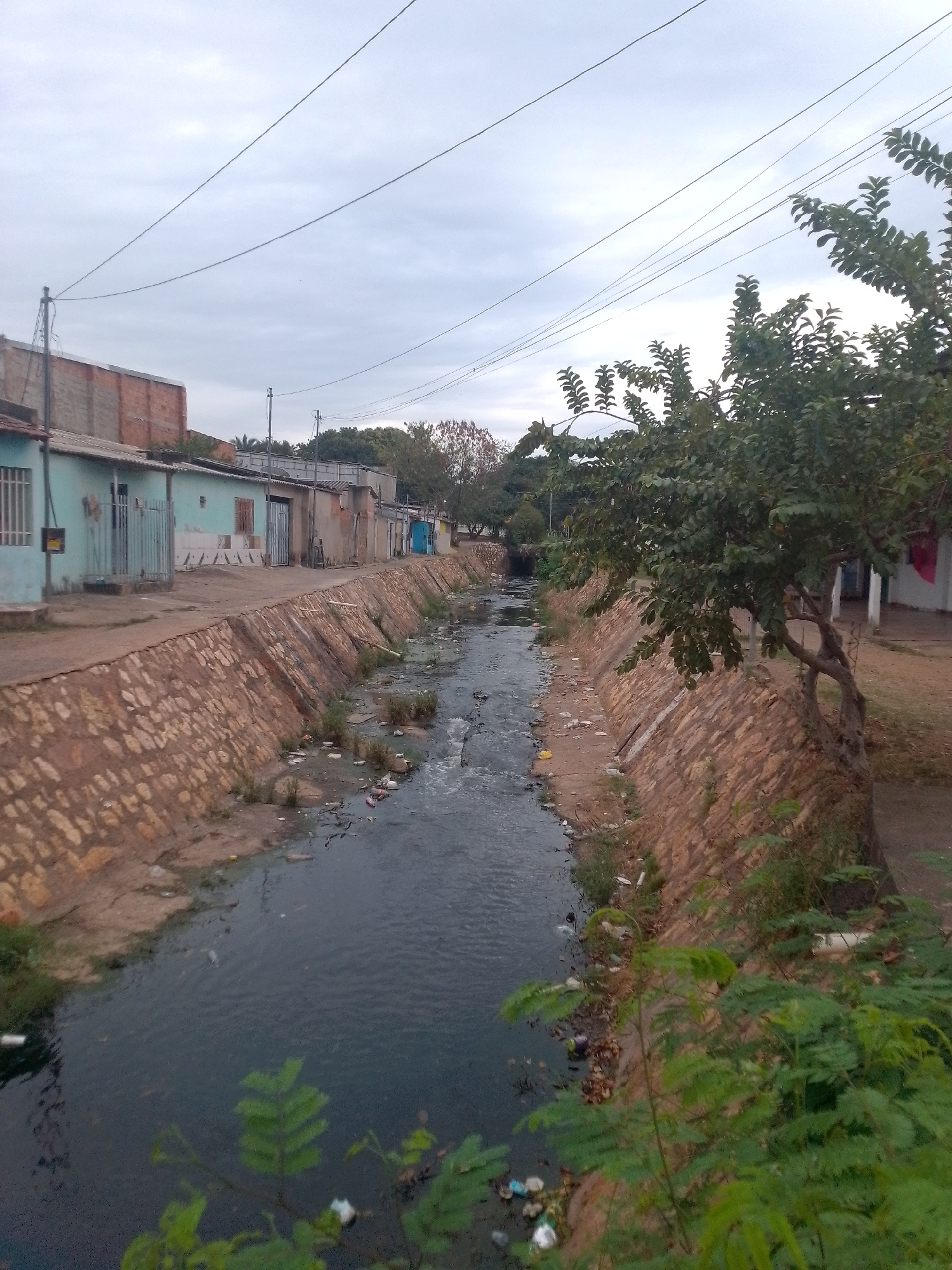
The image depicts a dirty canal running through a residential area in Cuiabá, Brazil, under an overcast sky. The canal is lined with a stone wall on the left and a dirt embankment on the right, both of which show signs of neglect and accumulated trash. The water in the canal appears murky and polluted, with visible debris floating on its surface and along its banks. On the left side of the canal, a row of modest, single-story houses painted in light blue and beige are visible. These houses have simple facades with barred windows and metal doors. The ground in front of them is a dusty, unpaved area. On the right side of the canal, the embankment is covered with dry vegetation and scattered litter. A large tree with dense green foliage stands prominently, its branches extending over the embankment and towards the canal. Behind the tree, parts of more houses or buildings can be seen, including some with white walls and dark roofs. Overhead, several electrical wires are strung across the sky, supported by poles. The overall impression is one of an urban environment facing challenges with sanitation and infrastructure. The scene suggests a working-class neighborhood where the canal likely serves as a drainage channel, but its condition indicates a lack of proper waste management.
Cuiabá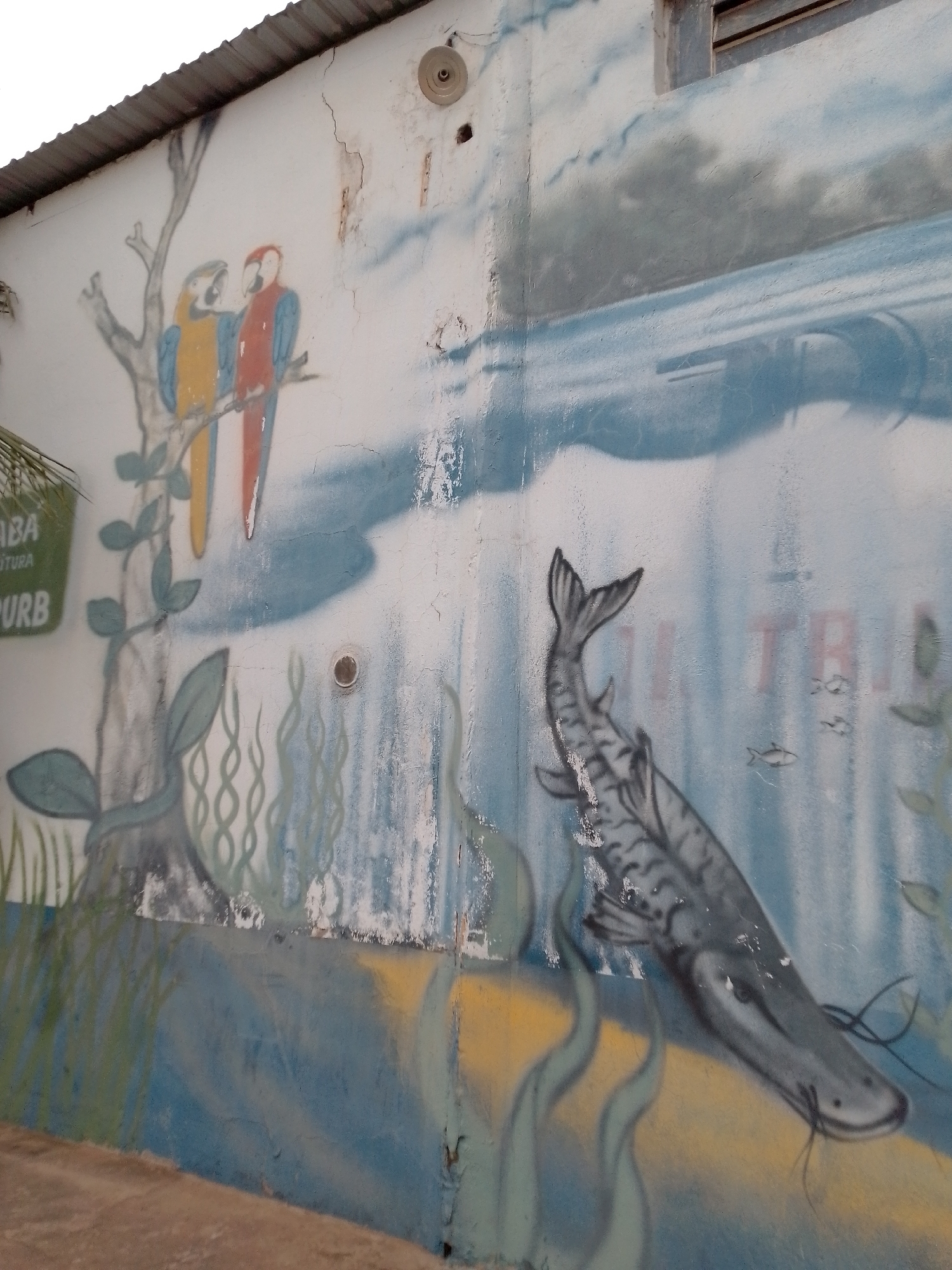
The image depicts a mural painted on the exterior wall of a building, likely in an urban setting in Cuiabá, Brazil, given the style and subject matter. The mural features a natural scene with vibrant colors. In the upper left, two parrots are perched on a tree branch. One parrot is yellow and blue, and the other is red and blue. The tree has green leaves and a grey trunk. Below the parrots, there are stylized representations of aquatic plants, painted in various shades of green and blue. In the lower right portion of the mural, a large, grey fish with dark stripes is depicted swimming in blue water. The fish has prominent whiskers and a dark eye. In the background, there are blurry images of clouds and possibly the suggestion of text on the wall, though it is illegible. The wall itself shows signs of wear and tear, with cracks and fading paint. A corrugated metal roof is visible along the top edge of the image, and a palm frond hangs in from the left side. The overall scene suggests a tropical or subtropical environment.
Cuiabá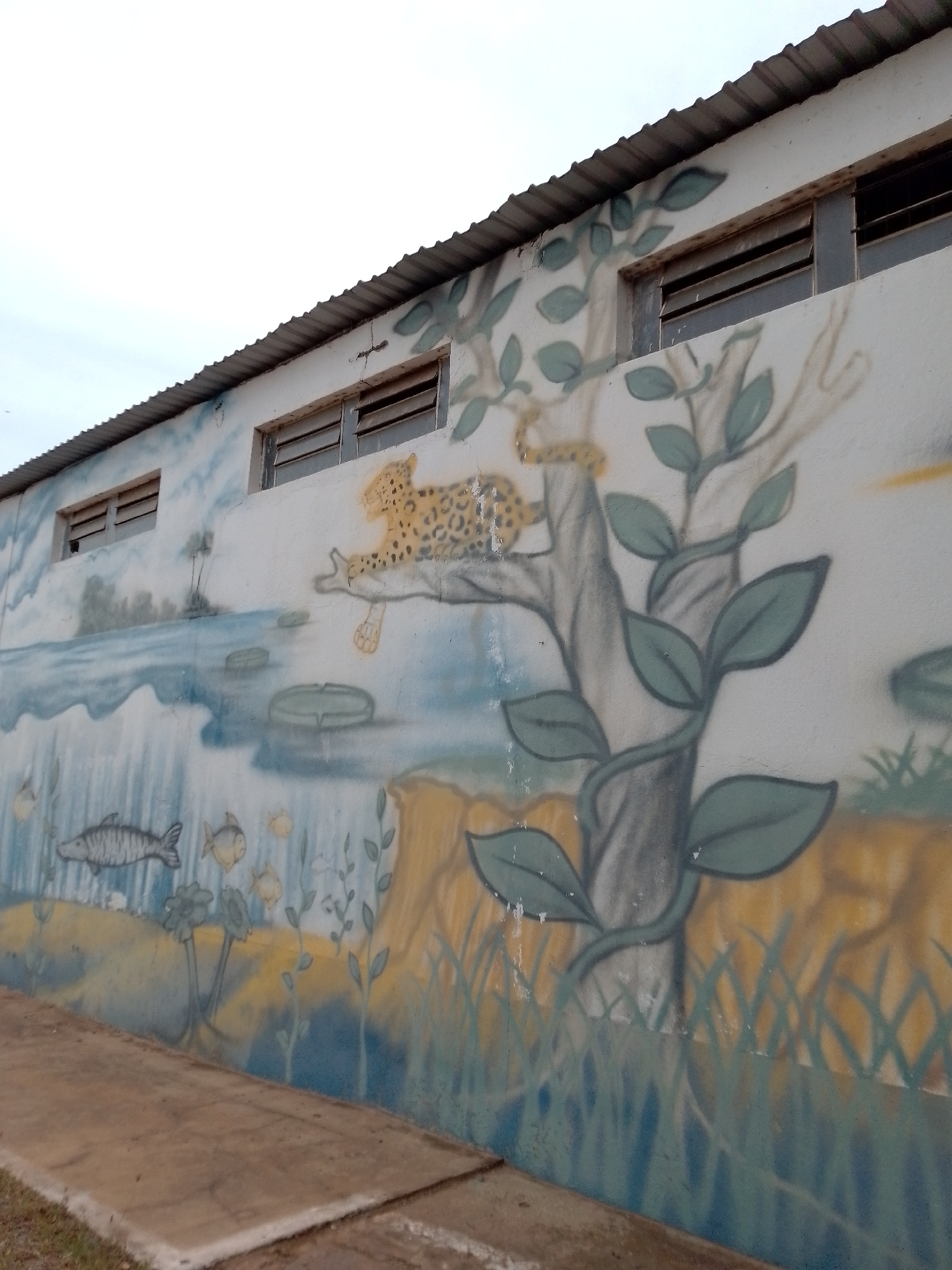
The image shows a mural painted on the exterior wall of a building. The mural depicts a natural scene with a leopard perched on a tree branch, a body of water with fish, and vegetation. The building appears to be a simple structure with a corrugated metal roof and windows. The area in front of the building is paved and appears to be a walkway or outdoor space. The style of the mural suggests it is a decorative element for the building. Without further information or context, it is impossible to pinpoint its exact location within Cuiabá, Brazil.
Cuiabá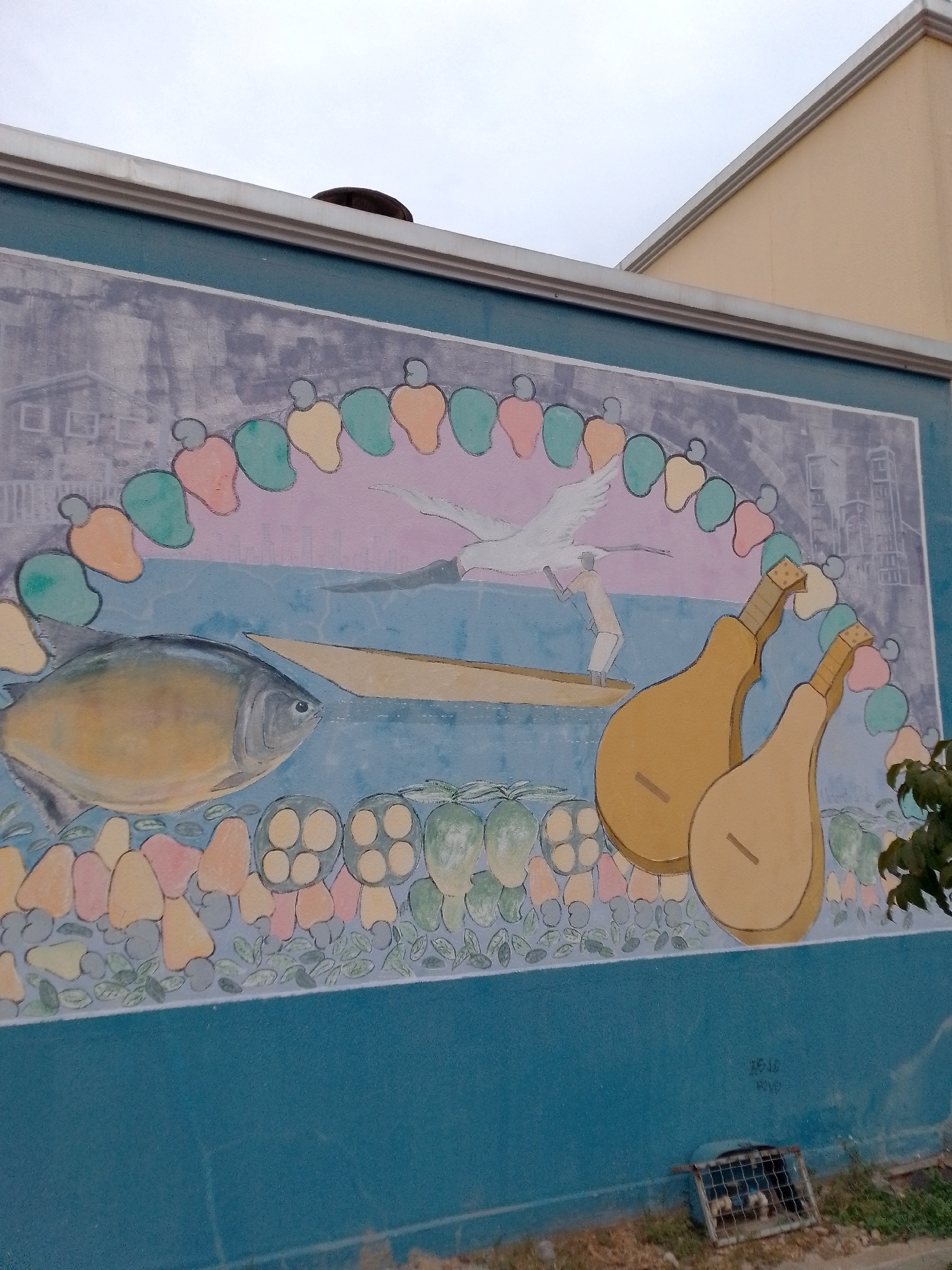
A mural is painted on a teal-colored wall. The mural depicts a coastal scene with a large fish on the left, a person in a boat with a bird flying overhead in the center, and two stringed instruments on the right. The background of the mural features a gray, urban landscape with buildings and a curved border of colorful fruit or vegetable shapes. The sky in the mural is a soft pink and blue. In front of the teal wall, a metal grate covers a drainage opening on the ground. The wall itself has some graffiti or markings near the bottom right. The mural is located on the side of a building, with part of a yellow building visible above the mural on the right side. The sky above is overcast.
Cuiabá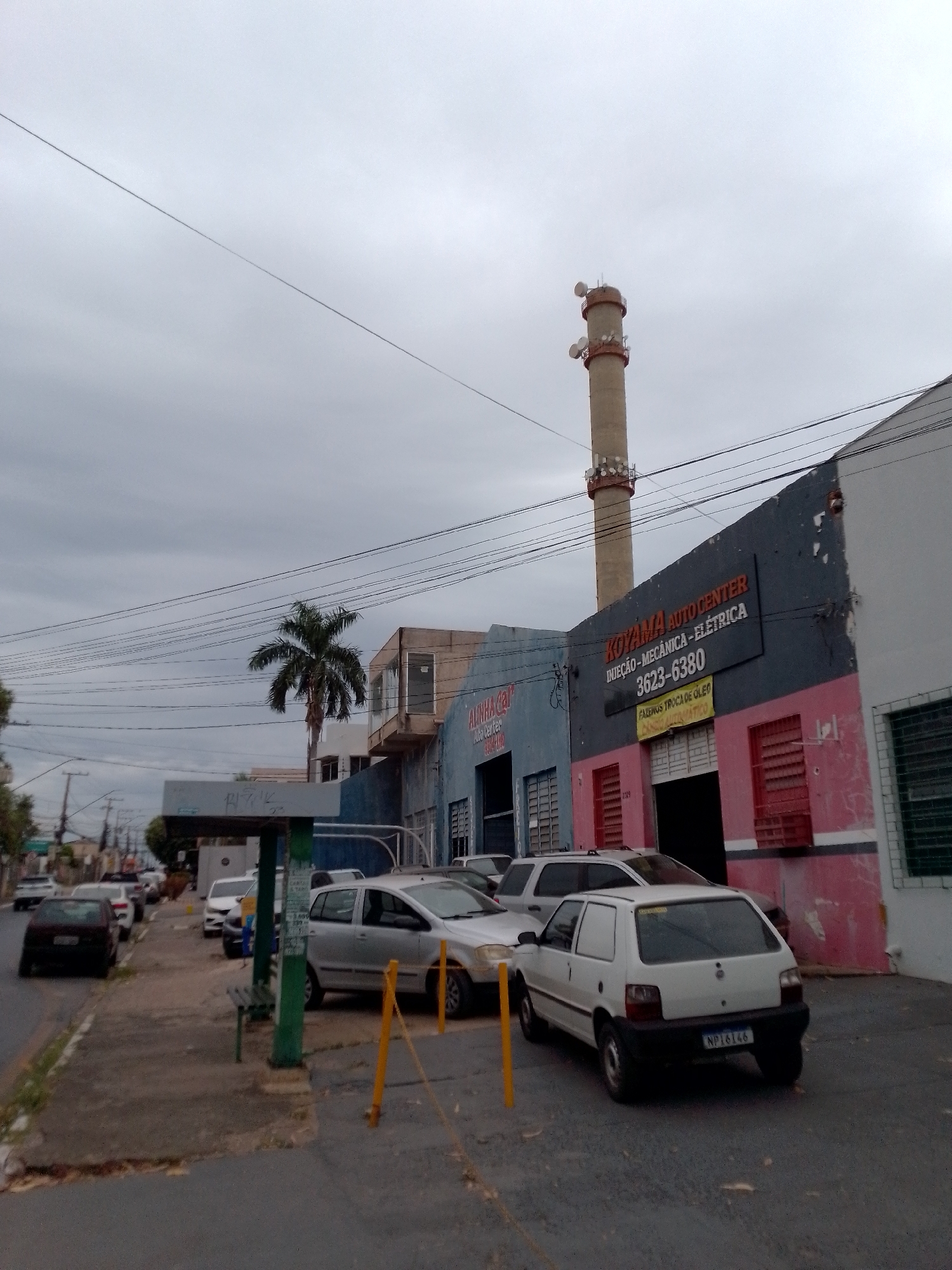
The image depicts a street scene in Cuiabá, Brazil, under an overcast sky. The foreground shows a paved road with a sidewalk and a bus stop shelter. Several cars are parked along the street, including a dark-colored sedan, a silver SUV, and a white hatchback. Dominating the background is a commercial building with a facade painted in shades of gray, pink, and blue. A prominent sign on the building reads "KOYAMA AUTO CENTER INJEÇÃO, MECÂNICA, ELÉTRICA 3623-6380". Below this, another sign advertises "FAROL, TROCA DE ÓLEO, CÂMBIO AUTOMÁTICO". The building appears to be an auto repair shop. Further in the background, a tall industrial chimney with multiple antennas or antennae protrudes into the sky. A palm tree is visible to the left of the chimney, situated between buildings. Utility wires are strung across the scene, contributing to the urban landscape. No people are clearly visible in the image.
Cuiabá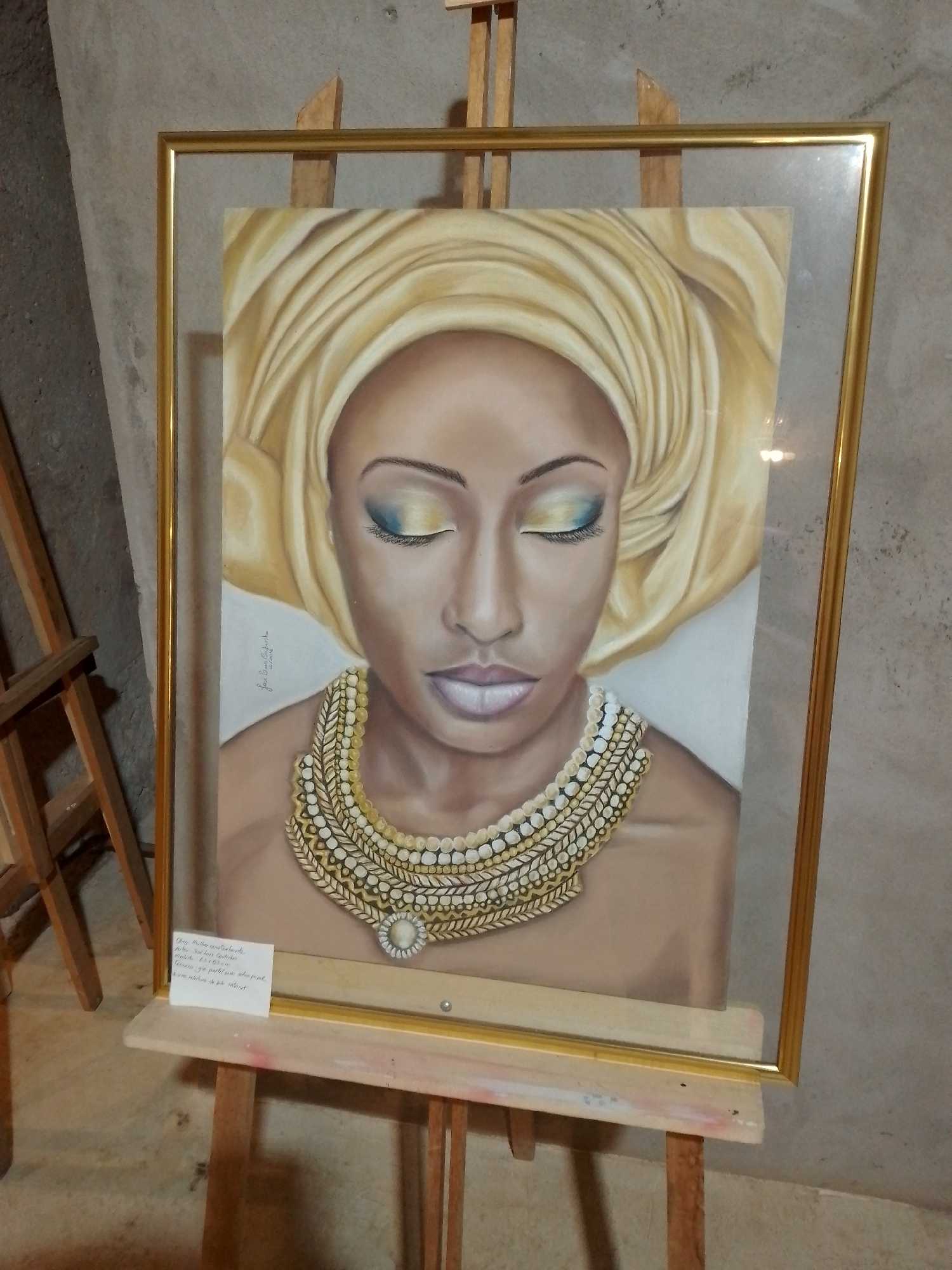
A framed painting of a woman wearing a yellow headscarf and a decorative necklace is displayed on an easel. The painting features the woman's face with closed eyes, highlighted by blue and yellow eyeshadow. A handwritten note is attached to the bottom left corner of the frame. The background appears to be a textured wall. The overall scene is set indoors, likely in an art gallery or exhibition space, given the presence of the easel and the presentation of the artwork. The painting itself is the central focus, with details of the subject's attire and facial features clearly visible.
Cuiabá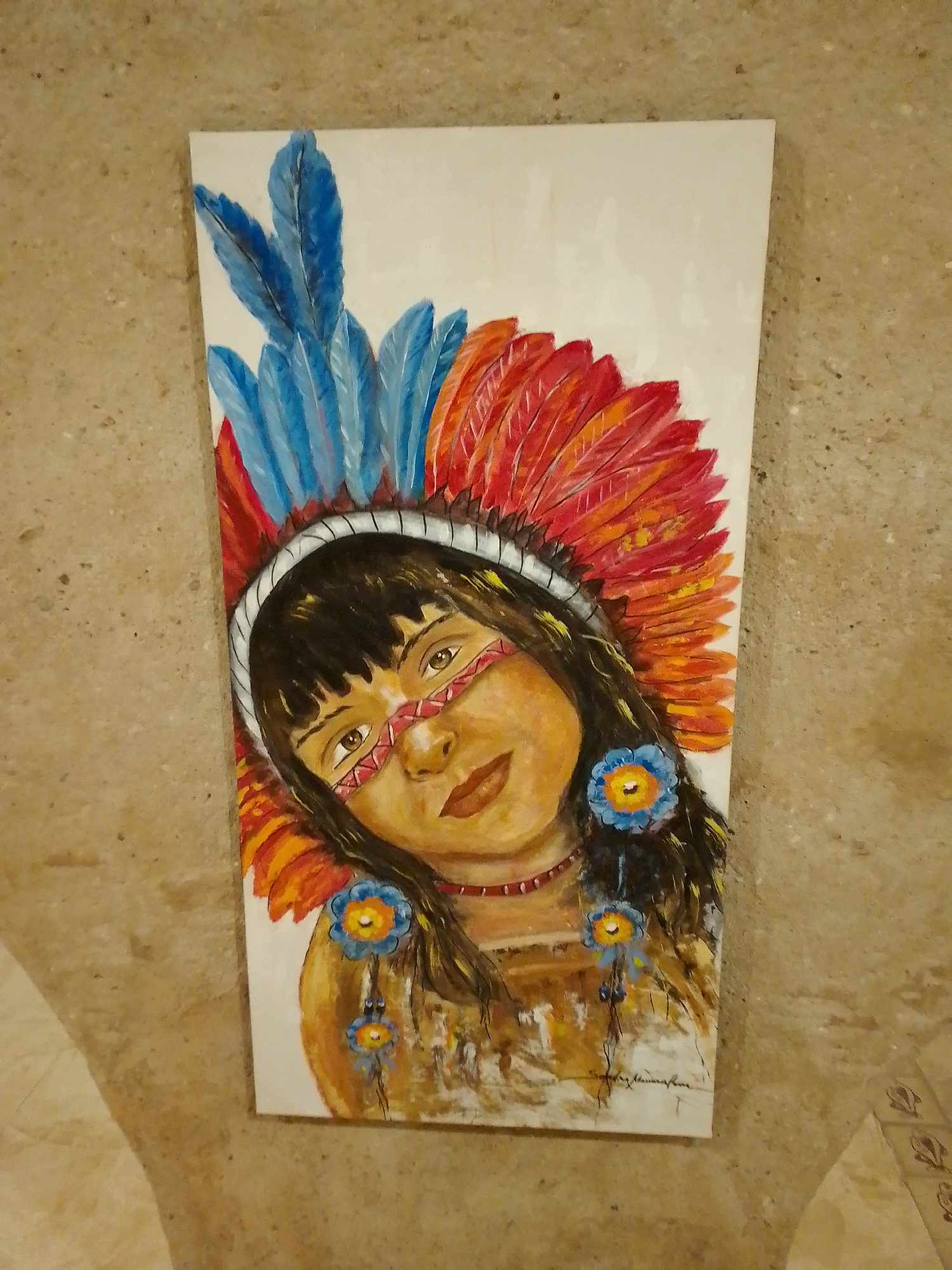
A vertical, full-body painting of a young Indigenous girl wearing a feathered headdress adorns a beige, textured wall in Cuiabá, Brazil. The girl has dark hair, brown eyes, and is adorned with face paint and a necklace. The headdress features blue and red feathers, and she wears blue flowers in her hair. The background of the painting is white, and the artist's signature is visible at the bottom right. The wall appears to be part of an outdoor or semi-outdoor space, possibly a courtyard or alleyway, with tiled flooring visible in the lower right corner.
Cuiabá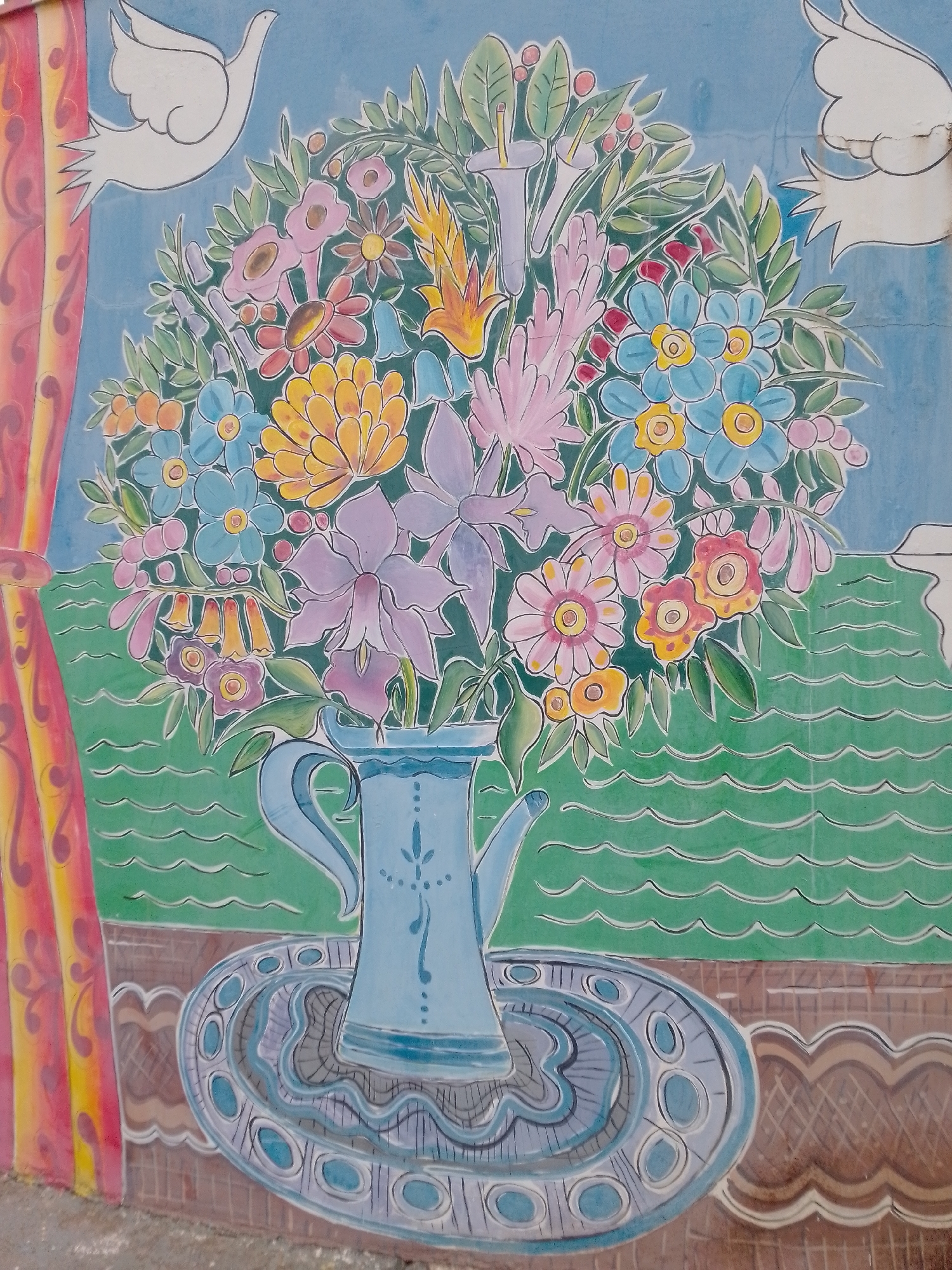
This is a ceramic mural located on the exterior wall of the Public Market of Cuiabá, Brazil. The artwork depicts a vibrant, stylized floral arrangement in a blue pitcher, placed on a decorative blue and grey platter. The flowers are rendered in a variety of bright colors, including pink, blue, yellow, orange, and purple, with green leaves and accents. Behind the bouquet, a light blue background suggests a sky, with two white doves in flight, one on the upper left and another on the upper right. A red and yellow curtain is visible on the far left of the mural. The foreground shows a textured brown surface with a wavy pattern, and green wavy lines representing water.
Cuiabá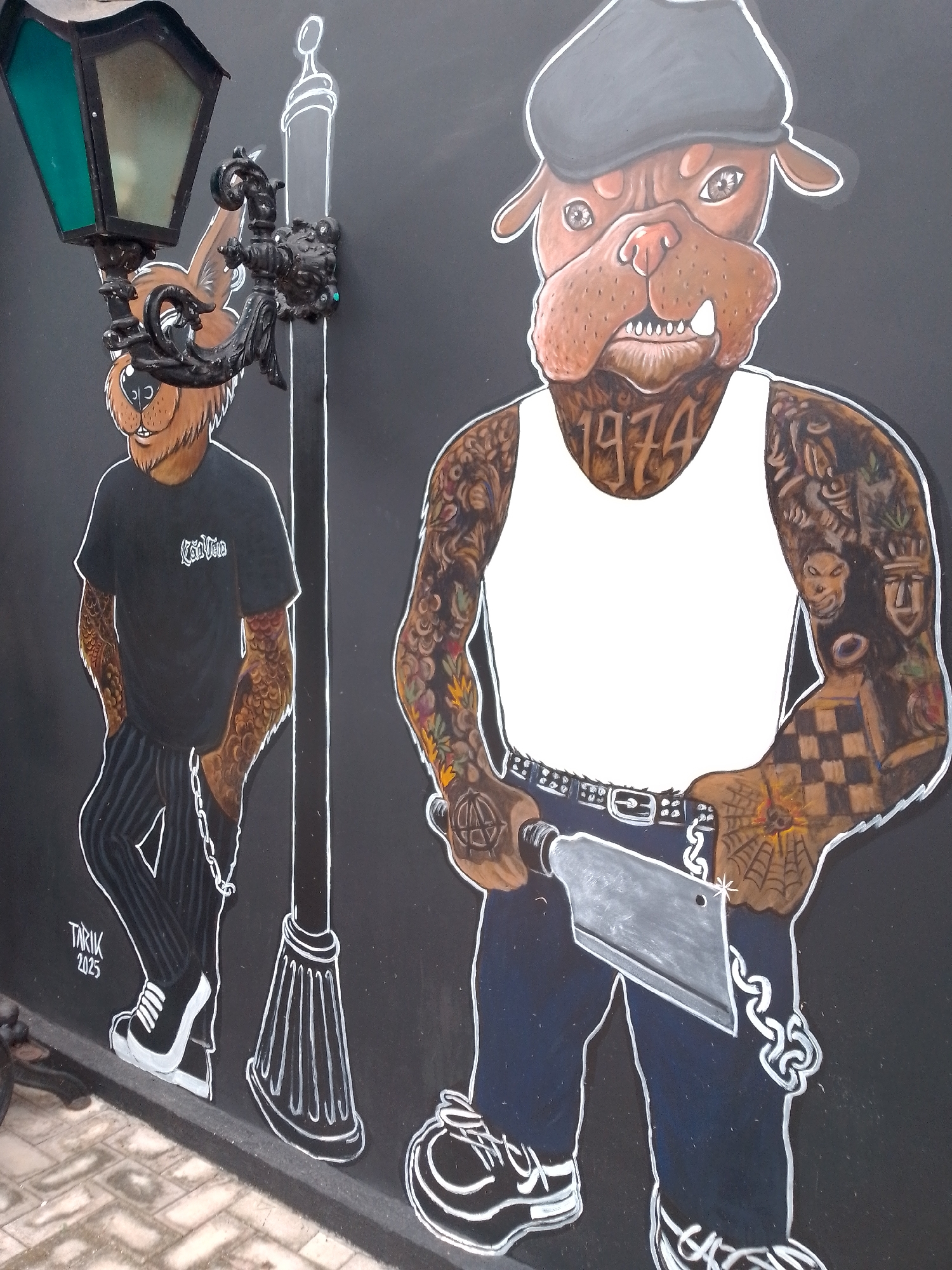
The image is a mural on a black wall, depicting two cartoonish anthropomorphic dogs in a street art style. The mural is located on a wall in Cuiabá, Brazil, likely in an urban setting. On the left, a dog with a brown, furry face, wearing a black t-shirt with a white logo, dark pinstripe pants, and white sneakers, stands leaning against a lamppost. A silver chain hangs from the belt loops of its pants. The lamppost itself is depicted in black and white, with a black wrought-iron decorative element holding a green-paned lantern. The name "TARIK" and the year "2025" are written in white at the bottom left of this figure. To the right of the lamppost, a larger dog, possibly a bulldog, is depicted wearing a grey cap, a white tank top, and dark pants. This dog has numerous tattoos covering its arms and neck, including the number "1974" on its throat. It is holding a large, silver cleaver in its right hand. The cleaver has a distinct checkered pattern on the blade. A belt with a buckle is visible around its waist. Both dogs have their outlines in white. The background is a solid black wall. The ground in front of the mural is a paved area with light-colored stones. The lighting suggests an outdoor environment.
Cuiabá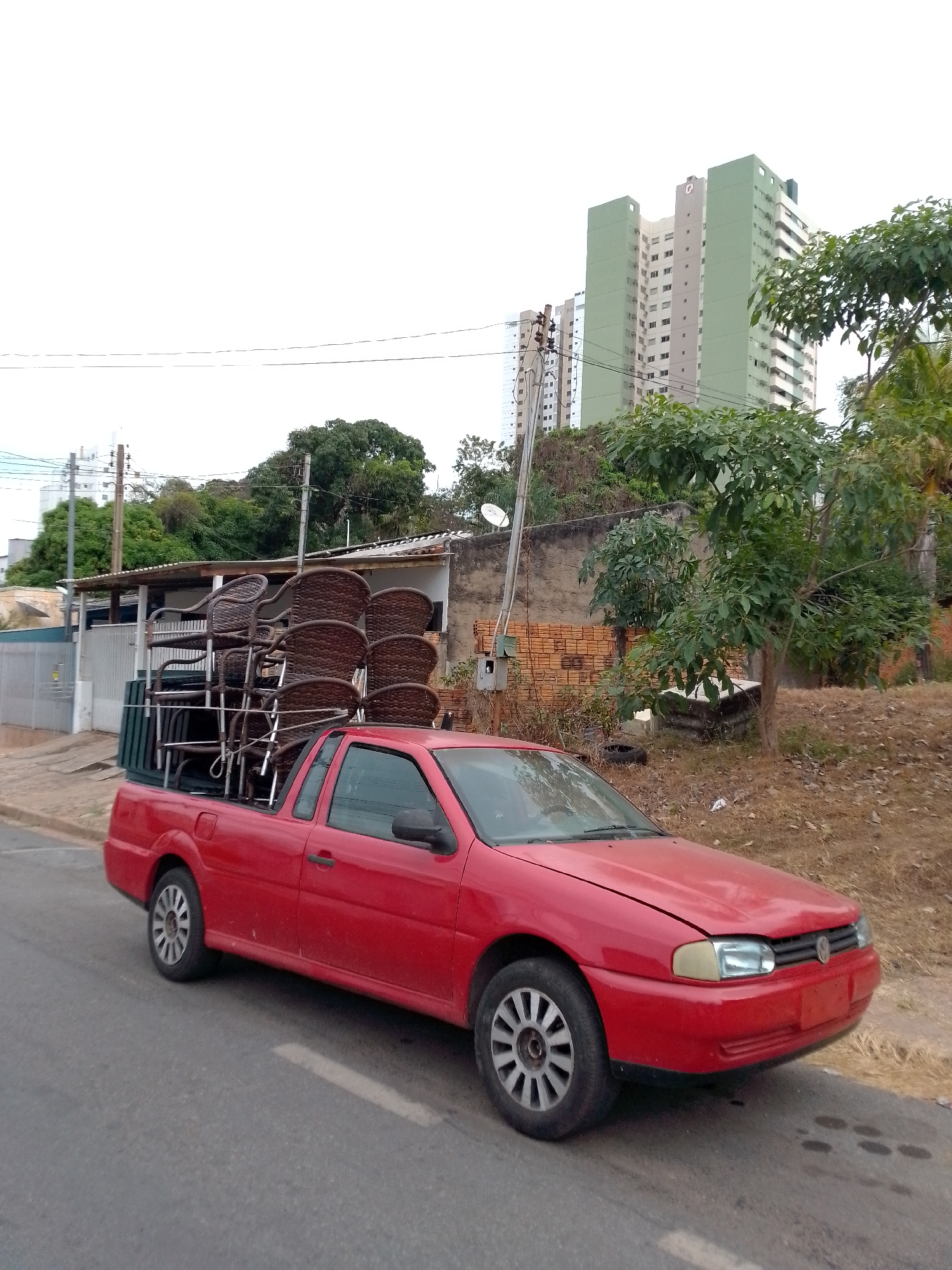
A red pickup truck is parked on a paved road in Cuiabá, Brazil, with a stack of brown wicker chairs in its cargo bed. The truck is facing towards the right side of the image. In the background, there are several buildings, including a tall, multi-story building with green accents and many windows. Trees and vegetation are visible around the buildings, and a brick wall and stacks of bricks are present in the midground. The sky is overcast and white. The scene appears to be in an urban or semi-urban environment.
Cuiabá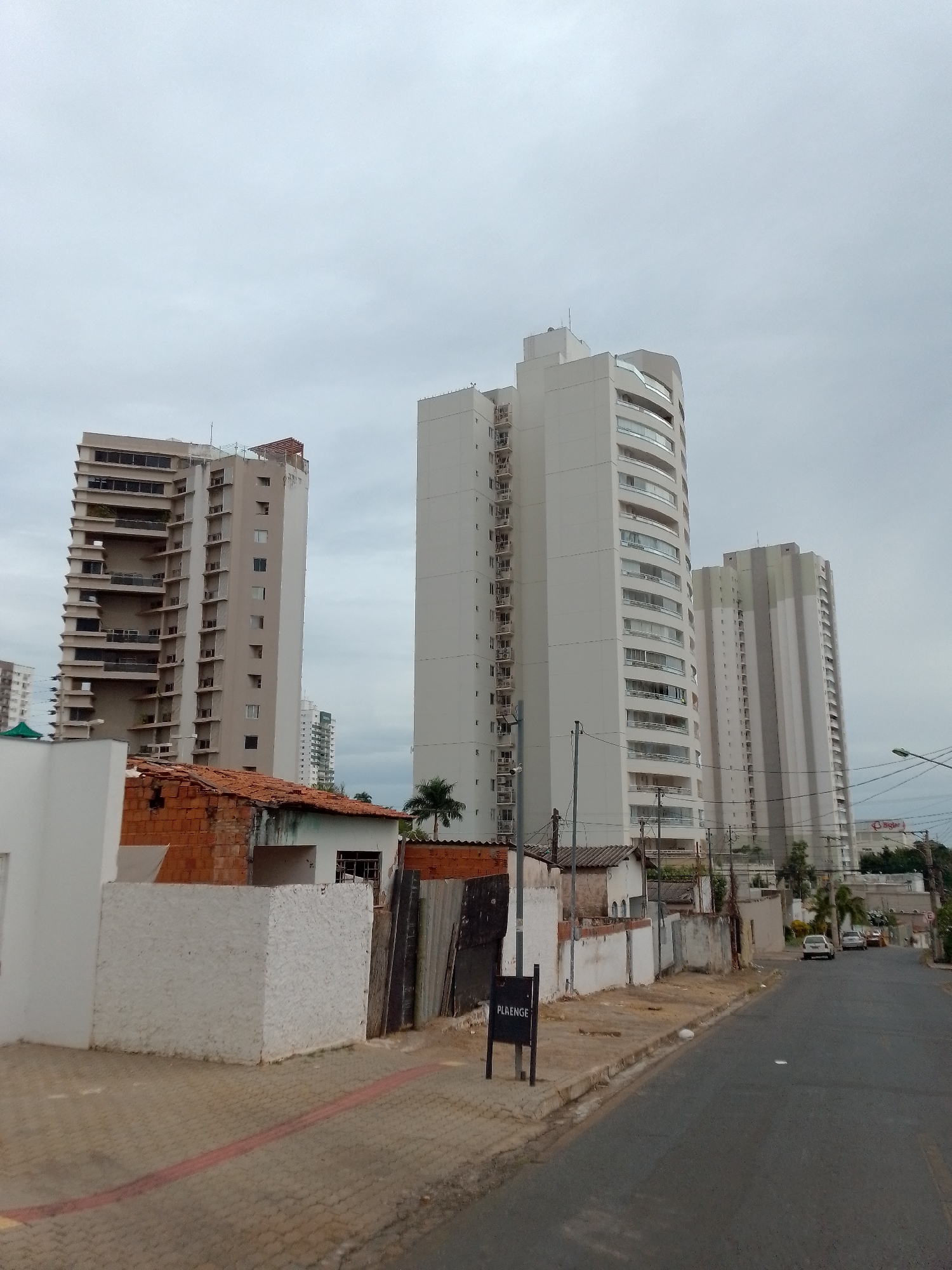
The image depicts a street scene in Cuiabá, Brazil, under an overcast sky. In the foreground, a paved sidewalk borders an asphalt road. A white, textured wall with a red stripe runs along the sidewalk. A small, dark sign with white text, possibly a street sign or directional marker, stands on the sidewalk. Behind the wall, a low-rise structure with a red-tiled roof and brick walls is visible, appearing to be under construction or in disrepair. Dominating the background are several tall, modern residential buildings. The tallest building, on the left, is a light-colored high-rise with numerous balconies and staggered architectural elements. To its right are two more slender, light-colored high-rise apartment buildings, one with curved balconies. Further in the distance, other buildings and trees are discernible, hinting at a developed urban environment. A few cars are parked along the street, and power lines are strung between utility poles. The overall impression is of a residential neighborhood in a Brazilian city.
Cuiabá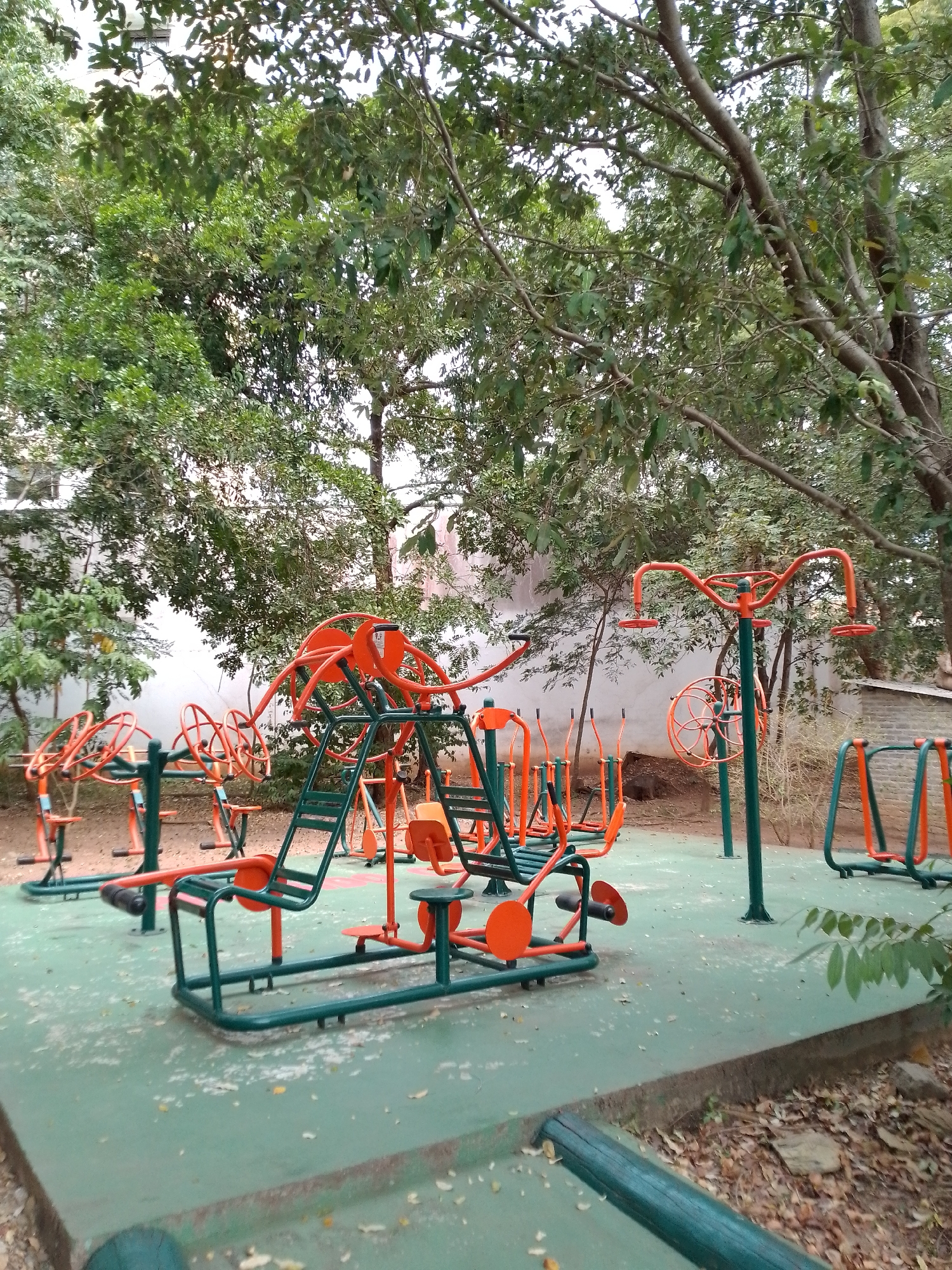
The image shows an outdoor fitness park in Cuiabá, Brazil, with various exercise machines situated on a green rubberized surface. The machines are predominantly orange and green, with some metal components. In the foreground, several pieces of equipment are visible, including what appears to be a leg press machine and an elliptical trainer. In the background, more fitness equipment is scattered throughout the park, with trees and foliage providing shade. The ground is covered with a light green surface, and fallen leaves are present on the ground around the park. The overall impression is of a public space designed for outdoor exercise and recreation.
Cuiabá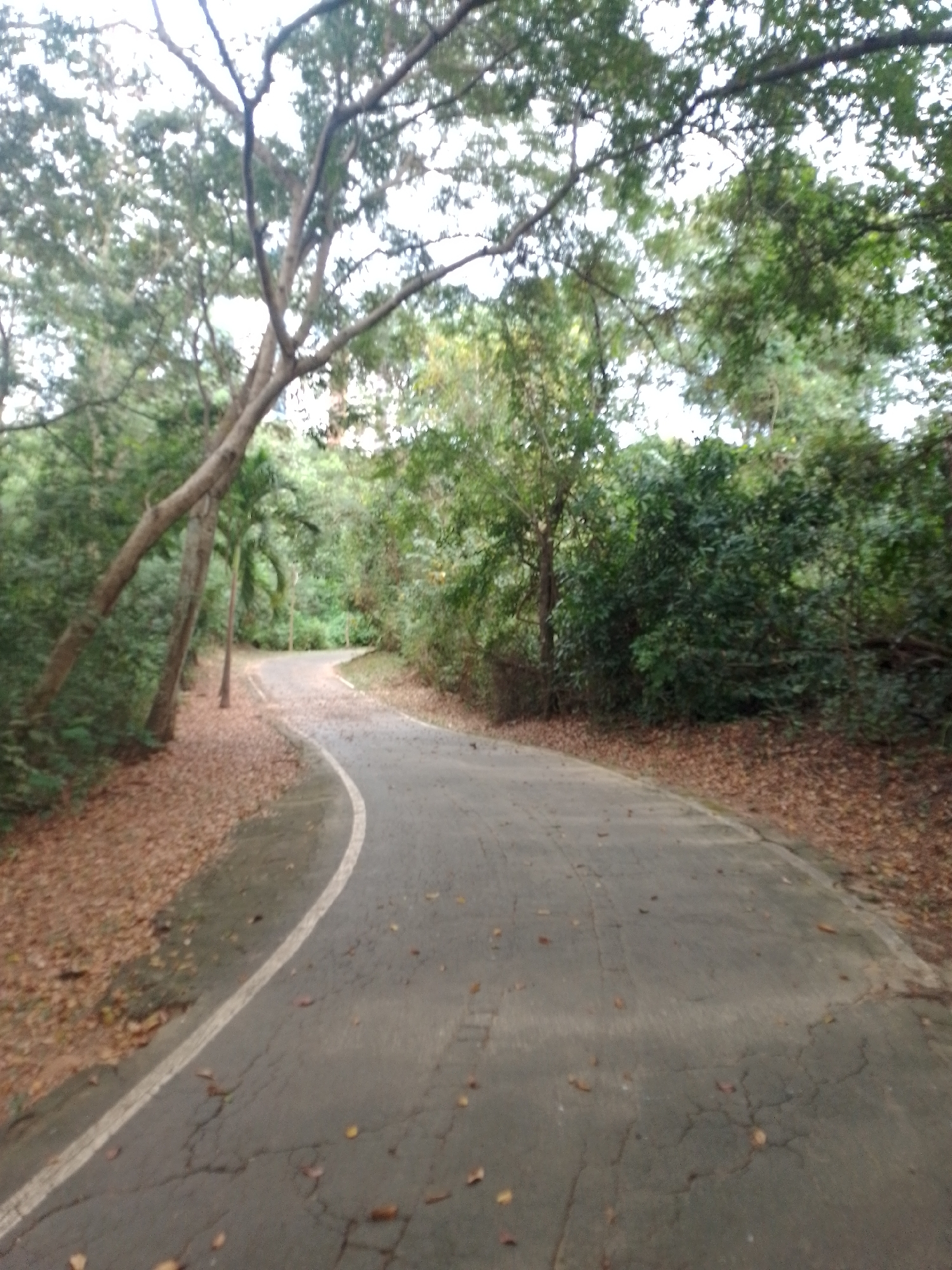
The image shows a paved road curving through a wooded area. The road is cracked and has scattered brown leaves on its surface. A white line marks the edge of the road on the left side. On the left of the road, there are fallen brown leaves scattered on the ground and several trees, one of which leans significantly over the road. A palm tree is also visible amongst the trees. The background consists of dense green foliage and trees, suggesting a natural or park-like environment. The sky above is overcast and bright. The scene is consistent with a road within a park or natural reserve, possibly in a tropical or subtropical climate given the palm tree. This location is identified as being in Cuiabá, Brazil.
Cuiabá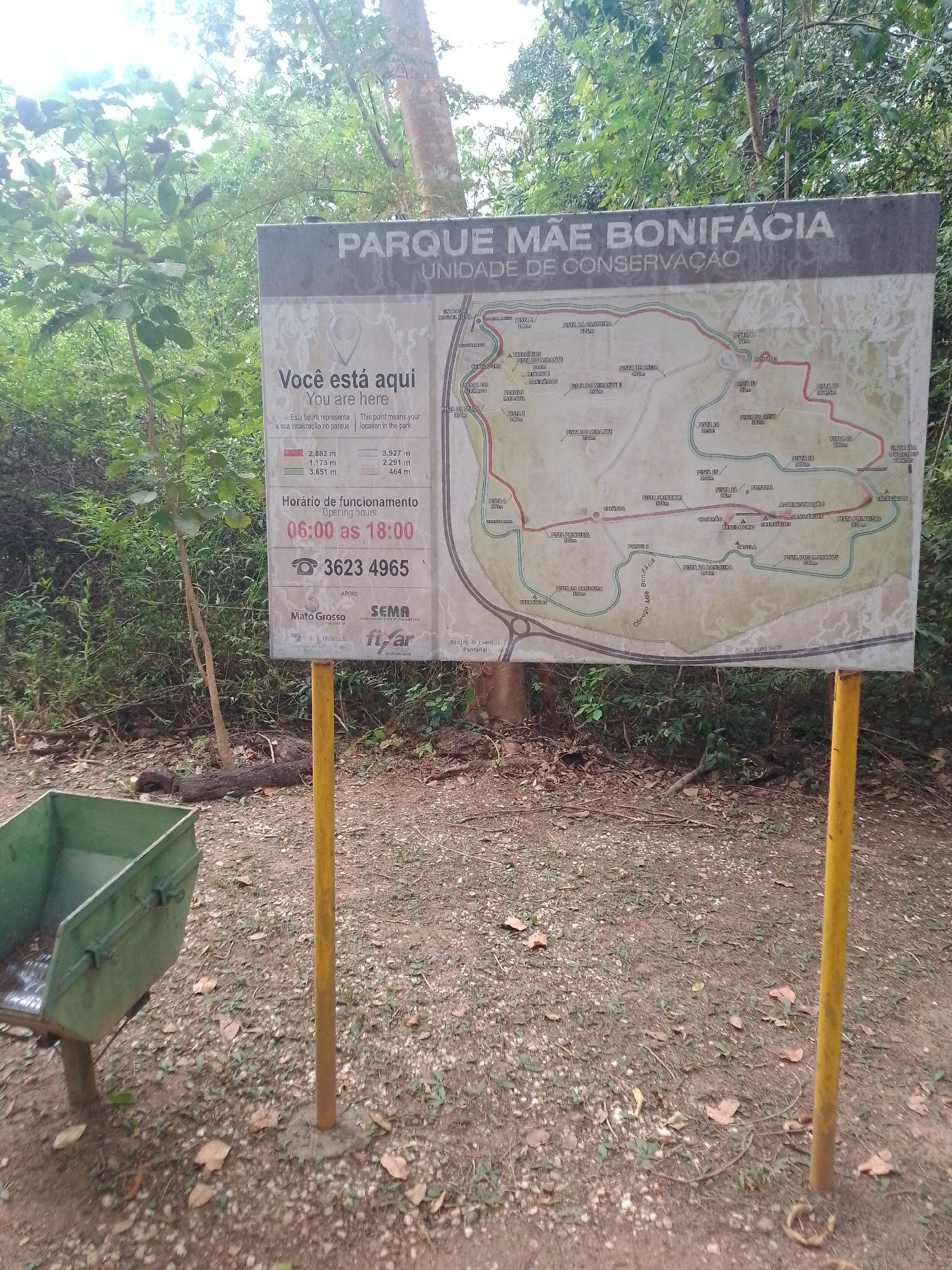
The image depicts a park map at Parque Mãe Bonifácia in Cuiabá, Brazil. The sign is a large, rectangular informational board with a map of the park's trails and points of interest. Text on the sign is in Portuguese, with some English translations. Below the map, there is information about operating hours, a phone number, and logos of organizations such as "Mato Grosso" and "SEMA." The sign is supported by two yellow posts, one of which is partially visible in the foreground. To the left of the sign, there is a green metal trash bin. The ground is covered with dirt, fallen leaves, and small stones. The background consists of lush green trees and foliage, suggesting a natural, outdoor environment. The lighting indicates it is daytime. There are no people visible in the image.
Cuiabá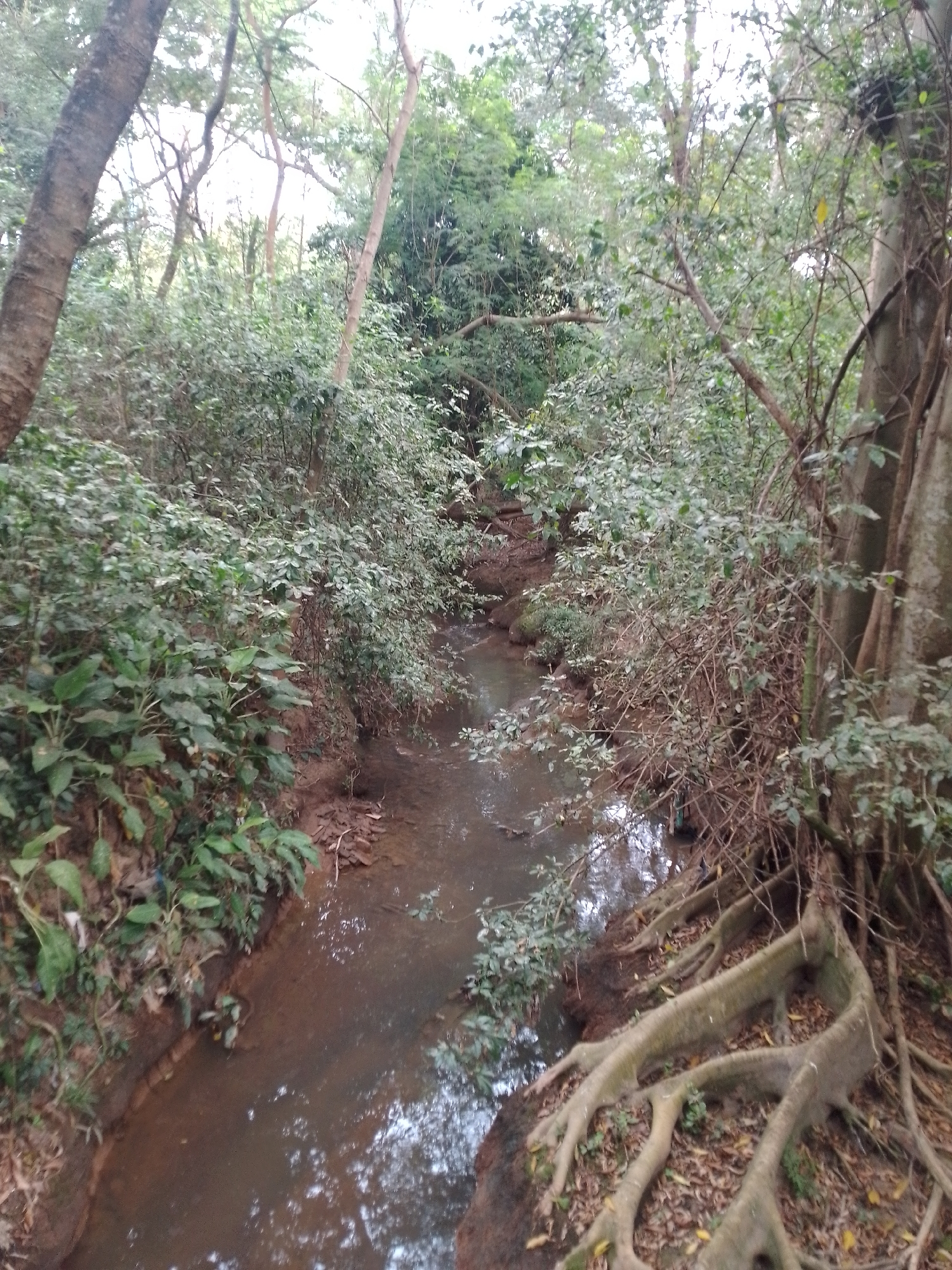
The image depicts a narrow, shallow stream flowing through a densely vegetated forest area. The water is murky brown and reflects the surrounding foliage. The banks of the stream are lined with rich, reddish-brown soil and are covered with lush green plants, small bushes, and fallen leaves. Large, exposed tree roots, characteristic of a fig tree, are prominently visible on the right bank, snaking across the ground and extending towards the stream. The forest canopy is thick, with various trees and dense undergrowth creating a shaded environment. Sunlight filters through the leaves, creating dappled light on the water and forest floor. The scene appears to be a natural, undisturbed setting within a tropical or subtropical environment. Without specific landmarks or urban features, it is not possible to definitively pinpoint this location within Cuiabá, Brazil, but the vegetation suggests a natural park, riparian zone, or remnant forest fragment within or on the outskirts of the city. There are no people, animals, or discernible structures in the image.
Cuiabá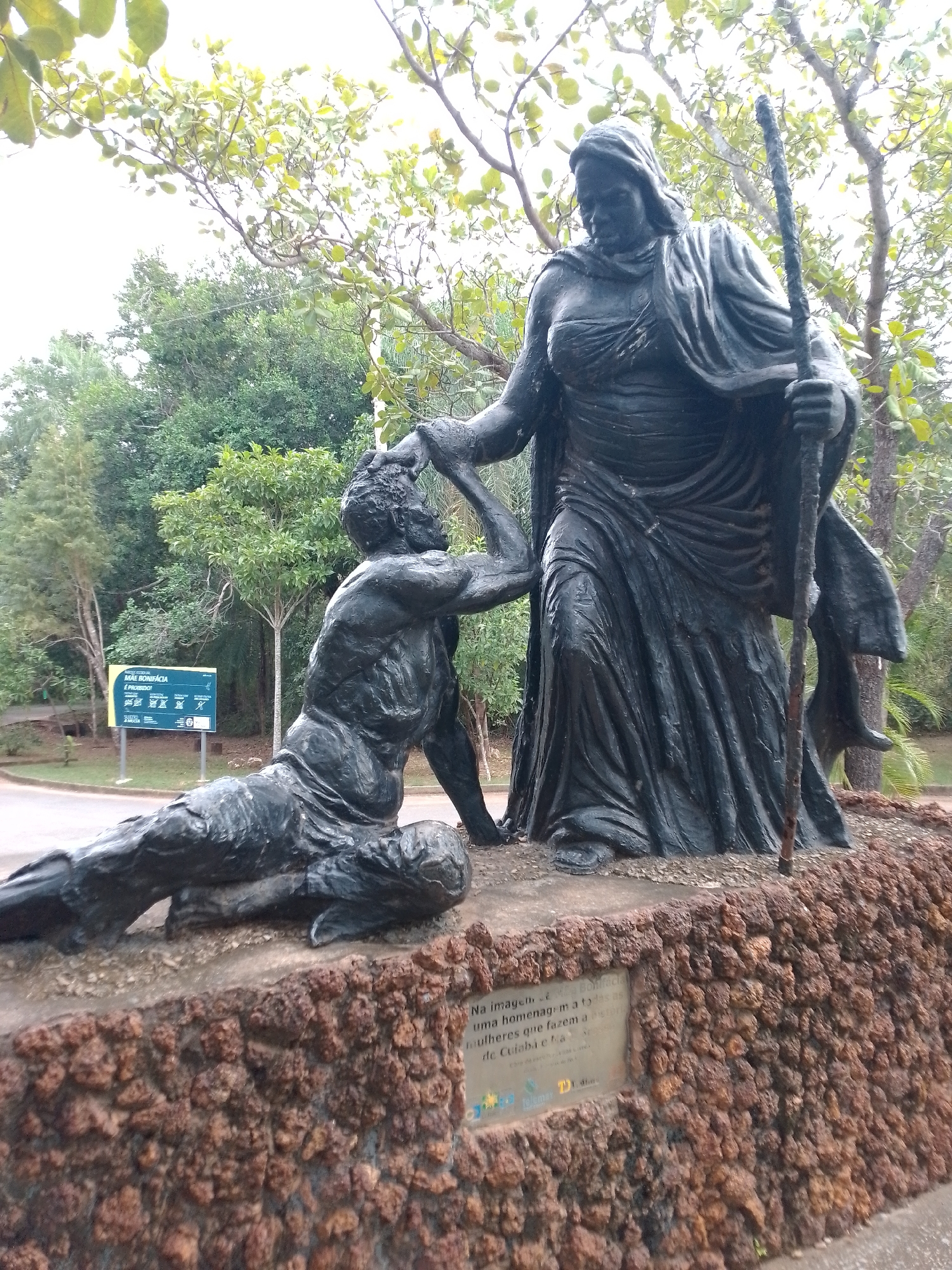
The image shows a bronze statue of two figures in an outdoor setting. One figure, appearing as a woman, stands tall and is draped in a flowing robe, holding a staff. Her hand rests on the head of the second figure, a man who is kneeling and reaching up towards her. The statue is situated on a rough-hewn stone base, with the background featuring trees, foliage, and an overcast sky. A sign in Portuguese is visible to the left of the statue, with the text "PARQUE ESTADUAL MÃE BONIFÁCIA" and other park regulations. This indicates the location is likely the Mãe Bonifácia State Park in Cuiabá, Brazil. The statue depicts a scene of connection or blessing between the two figures.
Cuiabá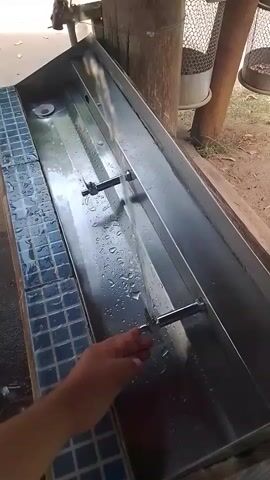
A first-person perspective shot shows a hand reaching for a faucet attached to a metal trough. Water flows from the faucet into the trough, creating ripples and splashes. The trough is long and rectangular, with a tiled border along the left side. Two metal spigots are positioned along the center of the trough. In the background, a wooden post supports a structure and a mesh bin is visible. The ground appears to be dirt or gravel.
Cuiabá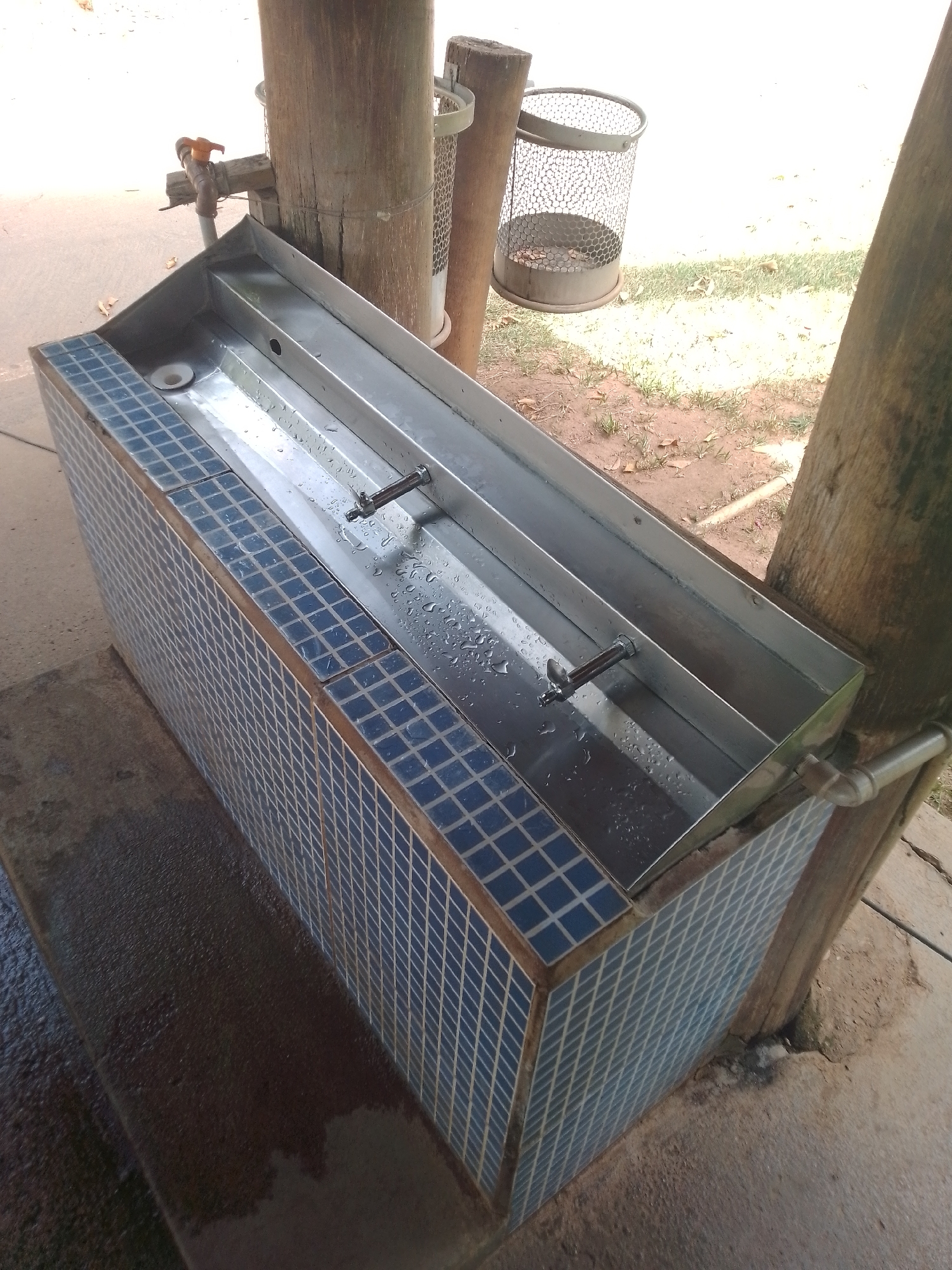
This is a photograph of a tiled, outdoor water trough with two metal spigots and a drain, situated next to a rough-hewn wooden post. A wire mesh trash can is also visible attached to the post behind the trough. The trough itself appears to be made of stainless steel and has a few water droplets on its surface. The tiling is a pattern of small, dark blue squares. The ground around the trough is concrete, and there is dry grass and dirt in the background. The overall impression is of a utilitarian public facility, possibly a drinking fountain or wash station, located in an outdoor setting. Given the context of Cuiabá, Brazil, this could be found in a park, public square, or recreational area.
Cuiabá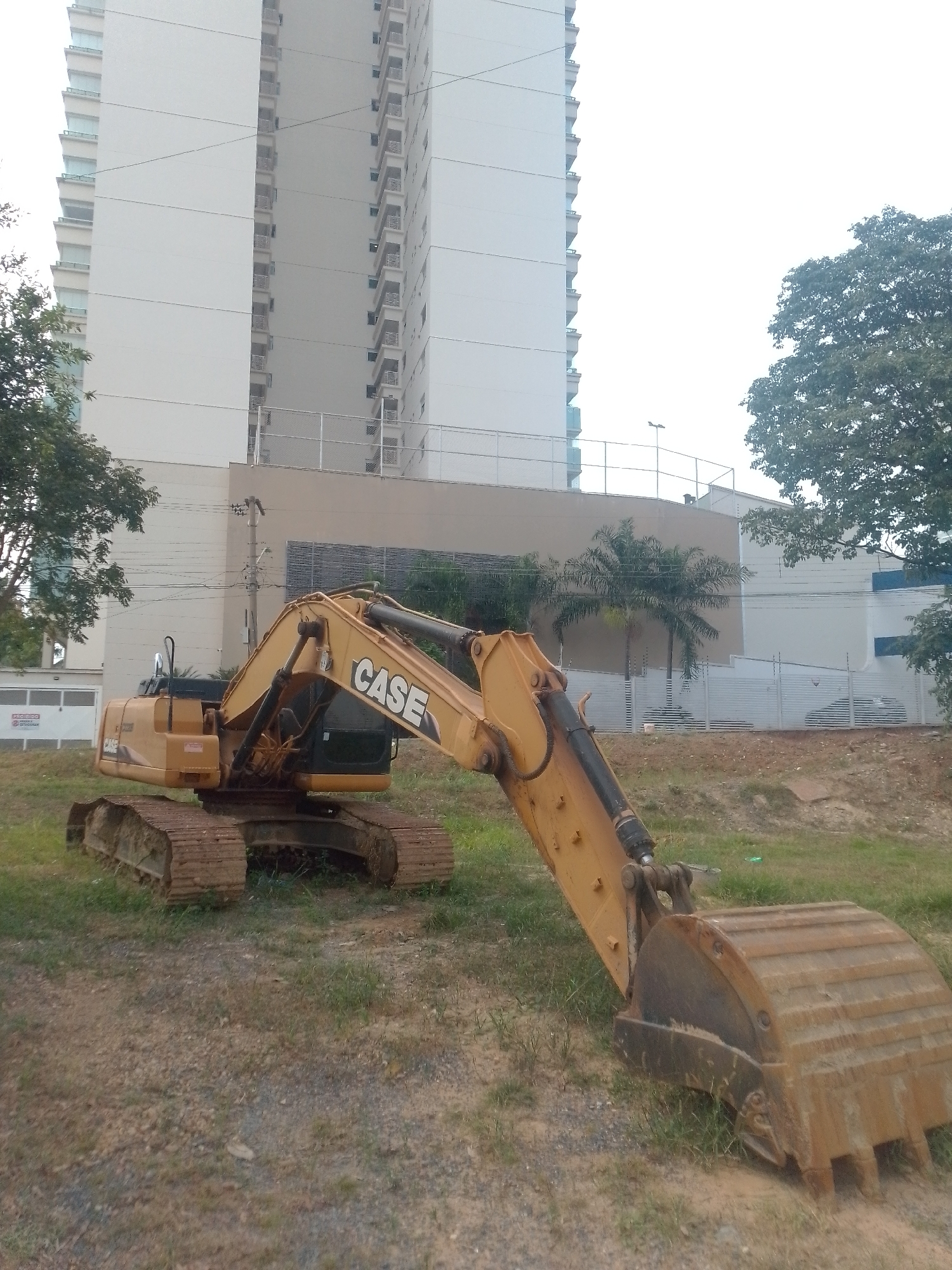
An outdoor, medium-angle, eye-level shot captures a yellow CASE excavator parked on a patch of dirt and grass in front of a tall, modern, white building in Cuiabá, Brazil. The excavator is positioned in the foreground, with its tracks resting on the ground and its bucket at an angle, partially lowered. The building, which appears to be an apartment or office complex, dominates the background with its numerous balconies and windows. Trees frame the scene on the left and right, and a few palm trees are visible near the building's base. Power lines are strung between poles in the middle ground. The sky is overcast and bright, suggesting a daytime scene, possibly with humid weather typical of Cuiabá. There are no people visible in the image.
Cuiabá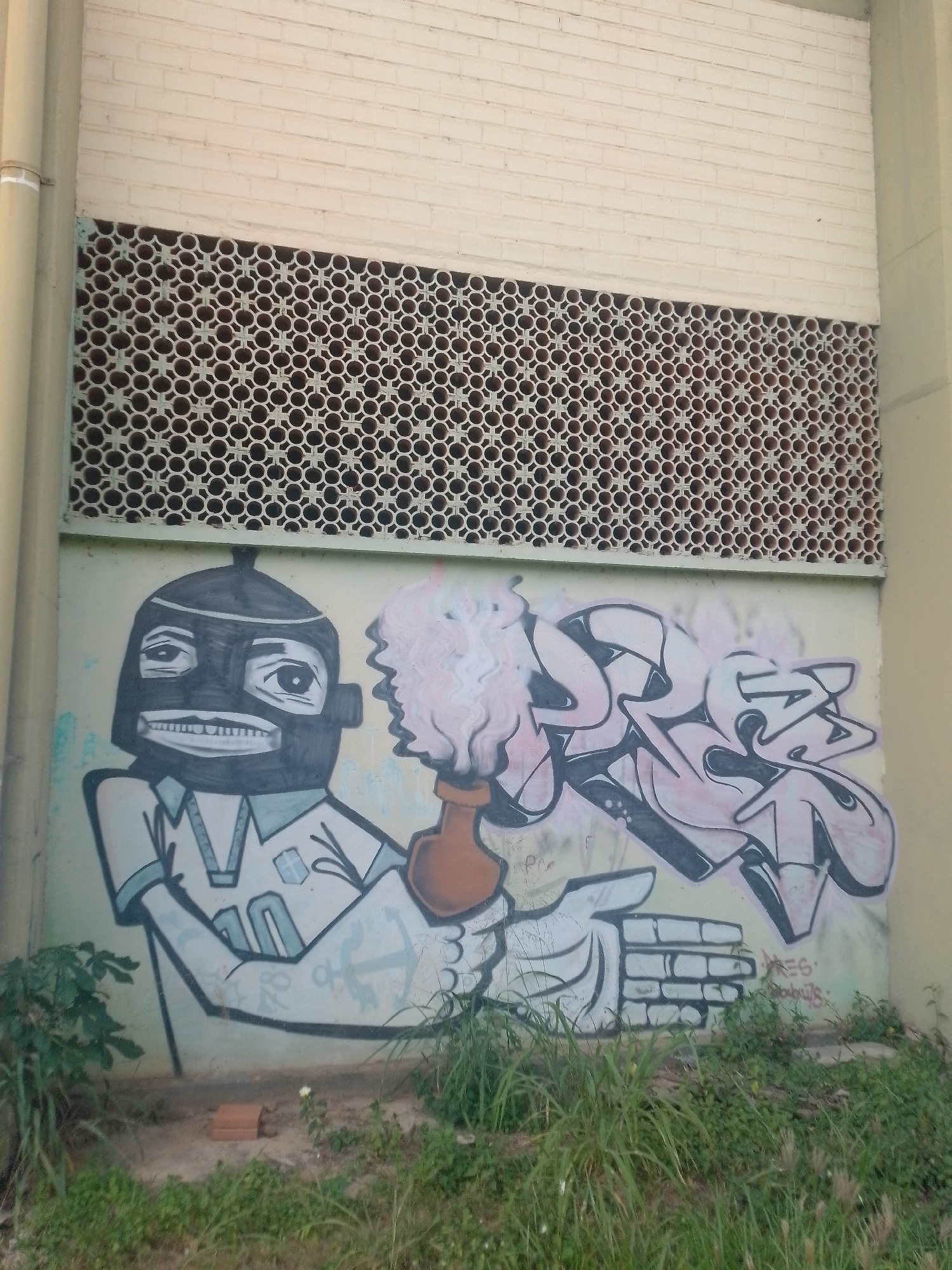
In Cuiabá, Brazil, this image captures a section of an outdoor wall adorned with graffiti. The wall is divided into three horizontal bands. The uppermost section consists of white brickwork. Below this is a rectangular lattice made of repeating circular openings, providing a visual screen. The lower portion of the wall is painted a light yellow-green and serves as the canvas for graffiti art. The graffiti depicts two figures. On the left is a character with a dark, mask-like face, large eyes, and a wide, toothed grin. It wears a collared shirt. This character is holding a brown object, possibly a vase or jug, from which stylized pink and white smoke or flames emanate. To the right of this figure is a spray-painted word in a graffiti style, rendered in pale pink and outlined in black. The word is complex and stylized, typical of tag art. Below the graffiti, the ground is covered with patchy green grass and weeds. A small red brick lies on the ground near the bottom left of the image. A vertical pipe runs along the left edge of the wall. The overall scene suggests an urban environment where public art has been applied to a building's exterior.
Cuiabá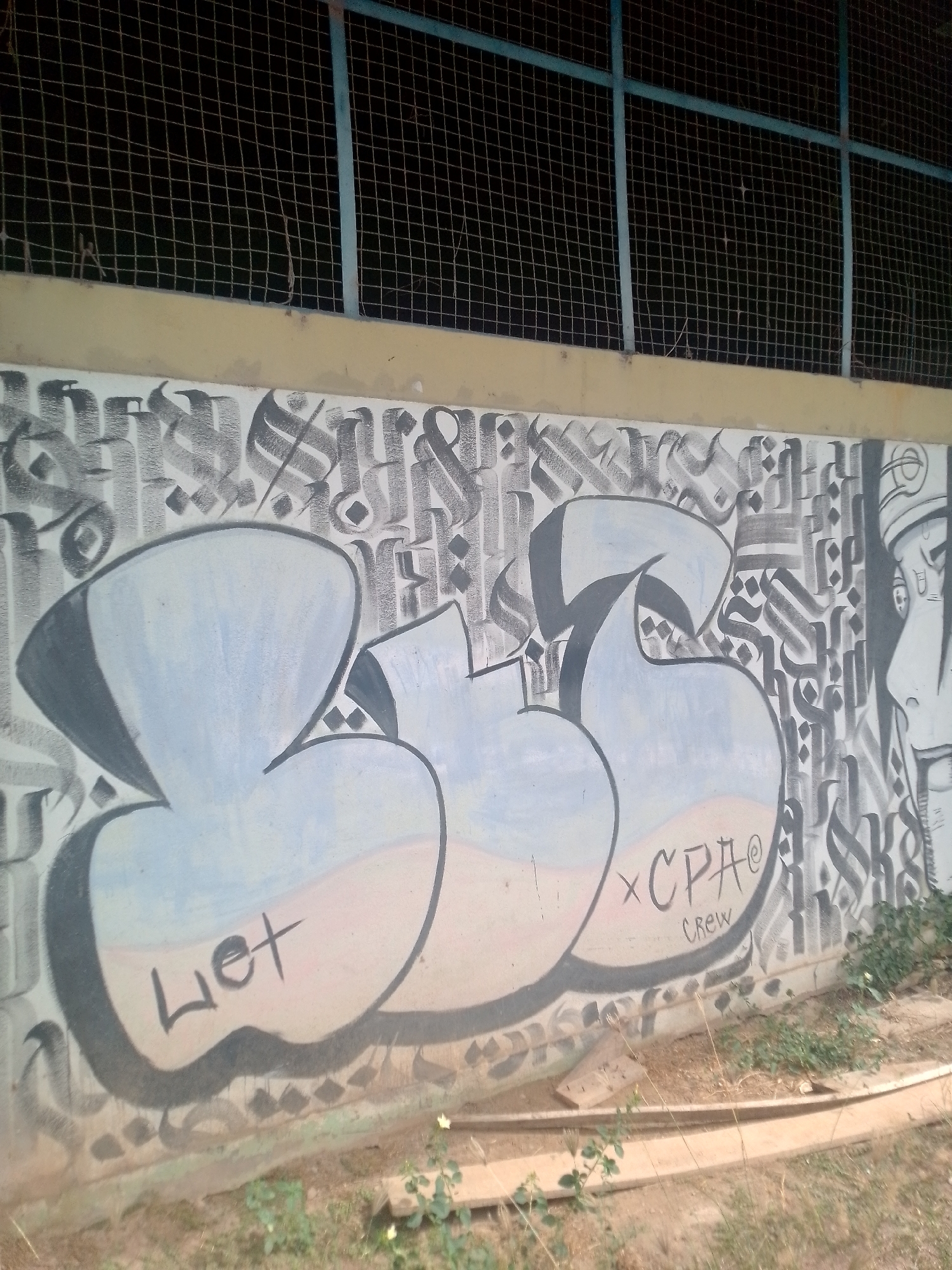
The image depicts graffiti art on a concrete wall, likely an outdoor public space. The graffiti style is characterized by large, bubble-like letters in light blue and grey, with black outlines. Smaller black lettering and symbols are also present, including what appears to be "x CPA@" and "CREW". In the background, a metal mesh fence is visible above the wall, supported by blue metal poles. The ground in front of the wall is covered with dry earth, grass, and some scattered pieces of wood. The scene suggests an urban environment, possibly a park, a sports facility, or a public walkway. There are no people visible in the image. The lighting indicates it is daytime, with shadows present. Based on the provided information that the image is from Cuiabá, Brazil, this location could be a wall adjacent to a sports field, a perimeter wall of a public building, or an area designated for street art.
Cuiabá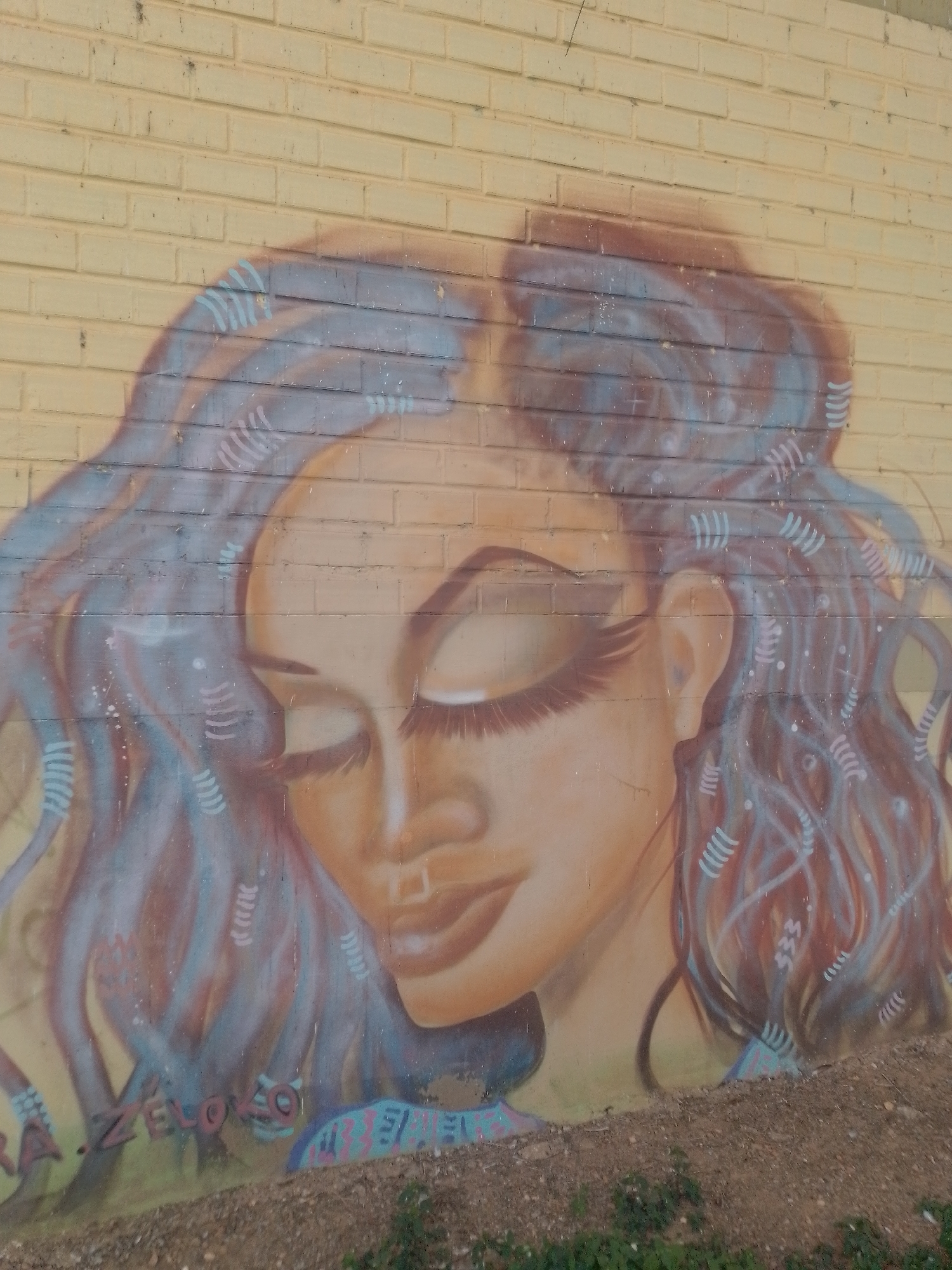
The image shows a mural painted on a yellow brick wall. The mural is a portrait of a woman with her eyes closed, depicted in profile. She has long, flowing hair with blue and pink highlights, adorned with decorative patterns that resemble stylized sound waves or DNA strands. The woman's face is rendered in soft, muted tones of peach and brown. Her eyelashes are long and emphasized. The background wall has a textured, brick pattern. The mural appears to be located outdoors, near ground level, with a dirt and gravel embankment in the foreground. Some greenery is visible on the embankment. Faint graffiti, possibly a tag or artist's signature, is visible at the bottom of the mural. The overall aesthetic is artistic and somewhat ethereal. The graffiti itself, a stylized portrait, is the primary subject. There is no specific indication of human activity beyond the creation of the mural. The environment suggests an urban setting, likely an exterior wall exposed to the elements.
Cuiabá