Dachau, Germany
30 memories from Dachau, Germany
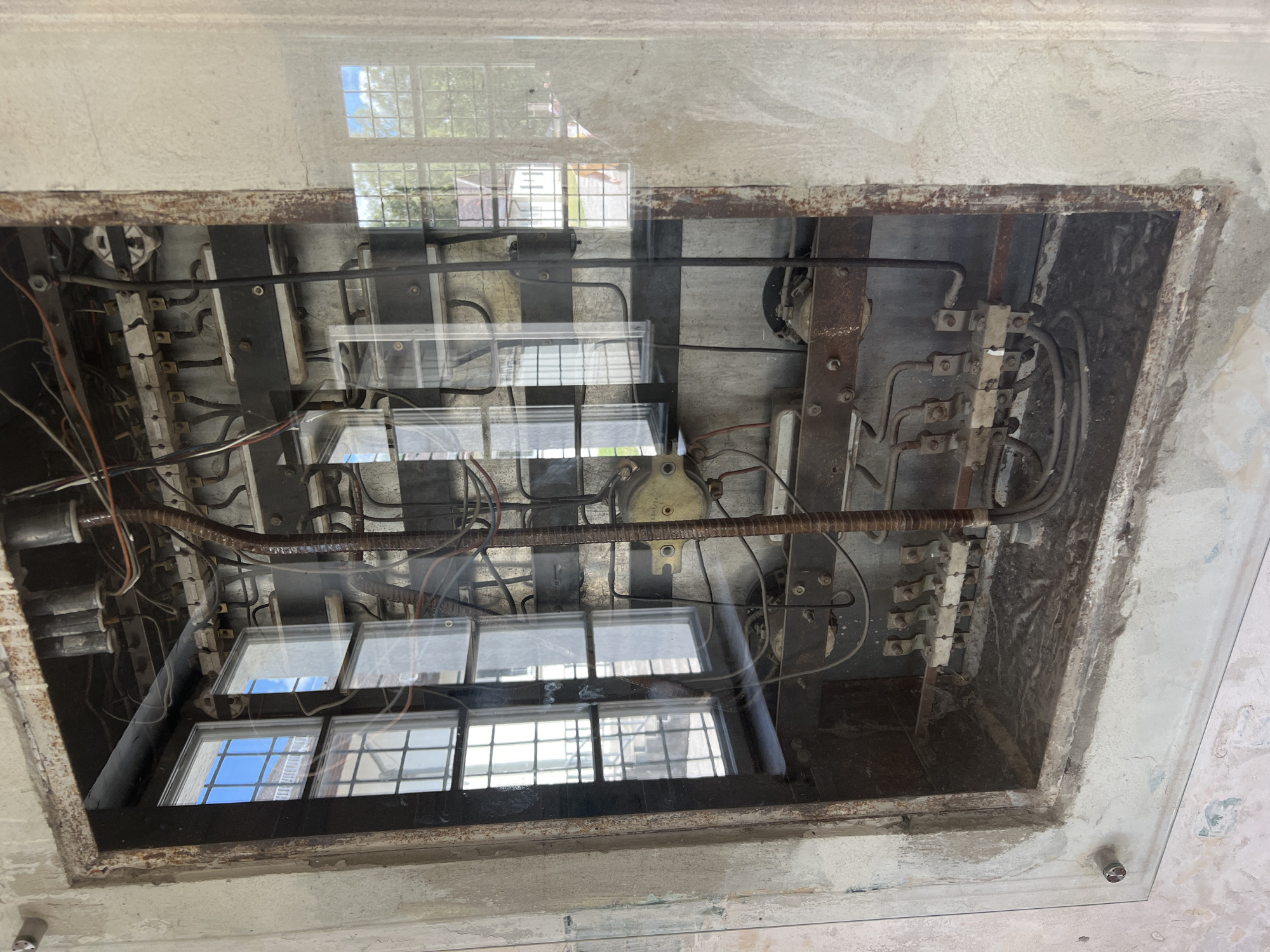
The image shows a close-up view of an electrical distribution panel encased behind glass. The panel appears old and rusted, with numerous wires, circuit breakers, and other electrical components. The panel is mounted within a wall, and through the glass, windows can be seen in the background, revealing a building and a blue sky with clouds. The surrounding wall is rough and textured, showing signs of age and wear. This electrical panel is located in the former Dachau concentration camp, specifically in the exhibition at the former administrative building, also known as the "Appellplatz" building. The exhibition is designed to preserve and interpret the history of the camp. The panel is a preserved artifact from the camp's history. There are no people visible in the image.
Dachau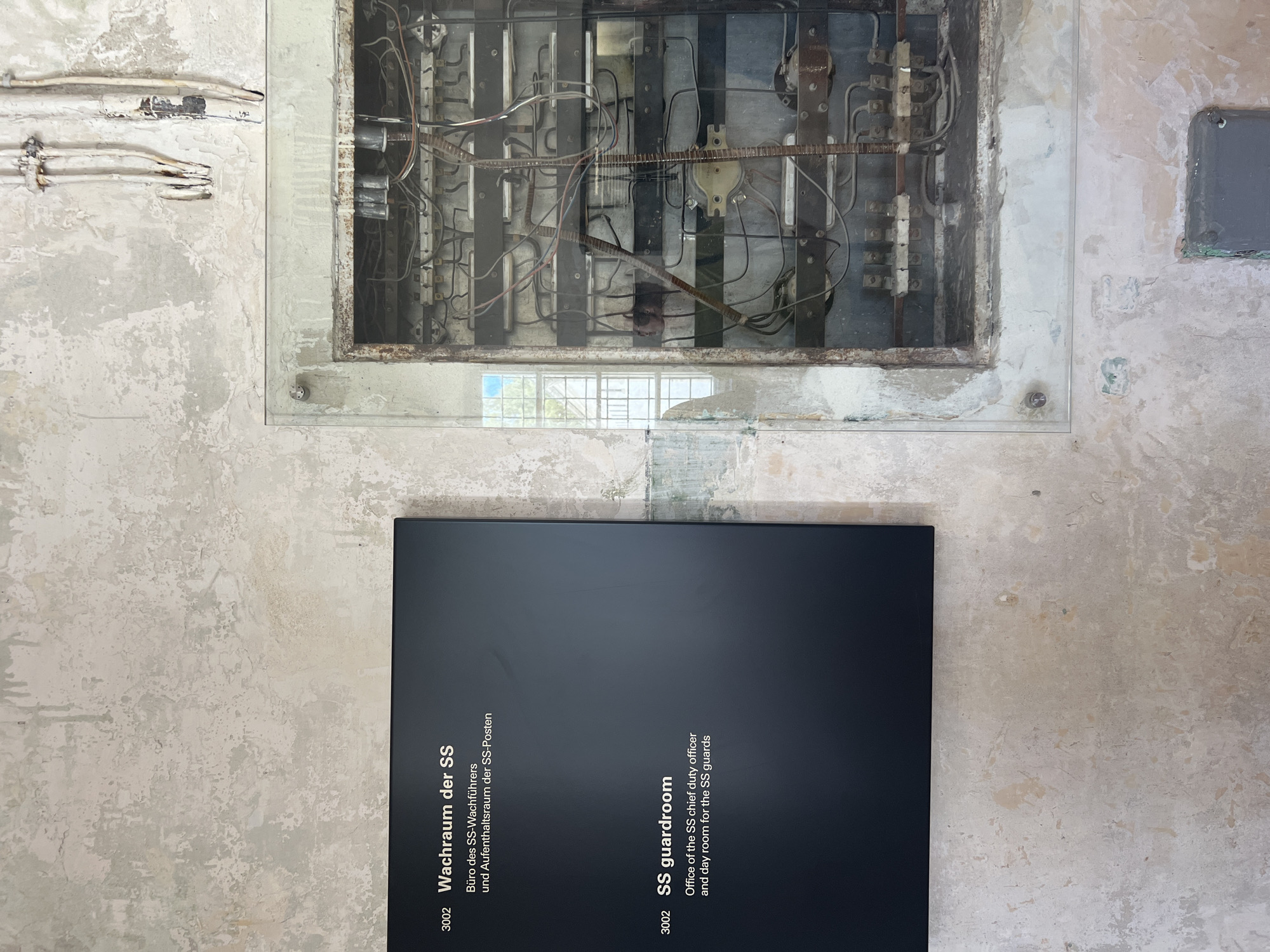
The image shows a section of a wall in the Dachau Concentration Camp Memorial Site in Dachau, Germany. On the left, a black informational plaque is mounted on a textured, peeling concrete wall. The plaque contains text in German and English, indicating "3002 Wachraum der SS" (SS Guardroom) and "3002 SS guardroom Office of the SS chief duty officer and day room for the SS guards." To the right of the plaque, a large, exposed electrical panel with numerous wires and fuses is visible behind a protective glass pane, also mounted on the textured wall. The electrical panel appears old and rusted. Above the panel, electrical conduit with exposed wiring runs along the wall. The overall impression is one of historical preservation within a former utilitarian structure.
Dachau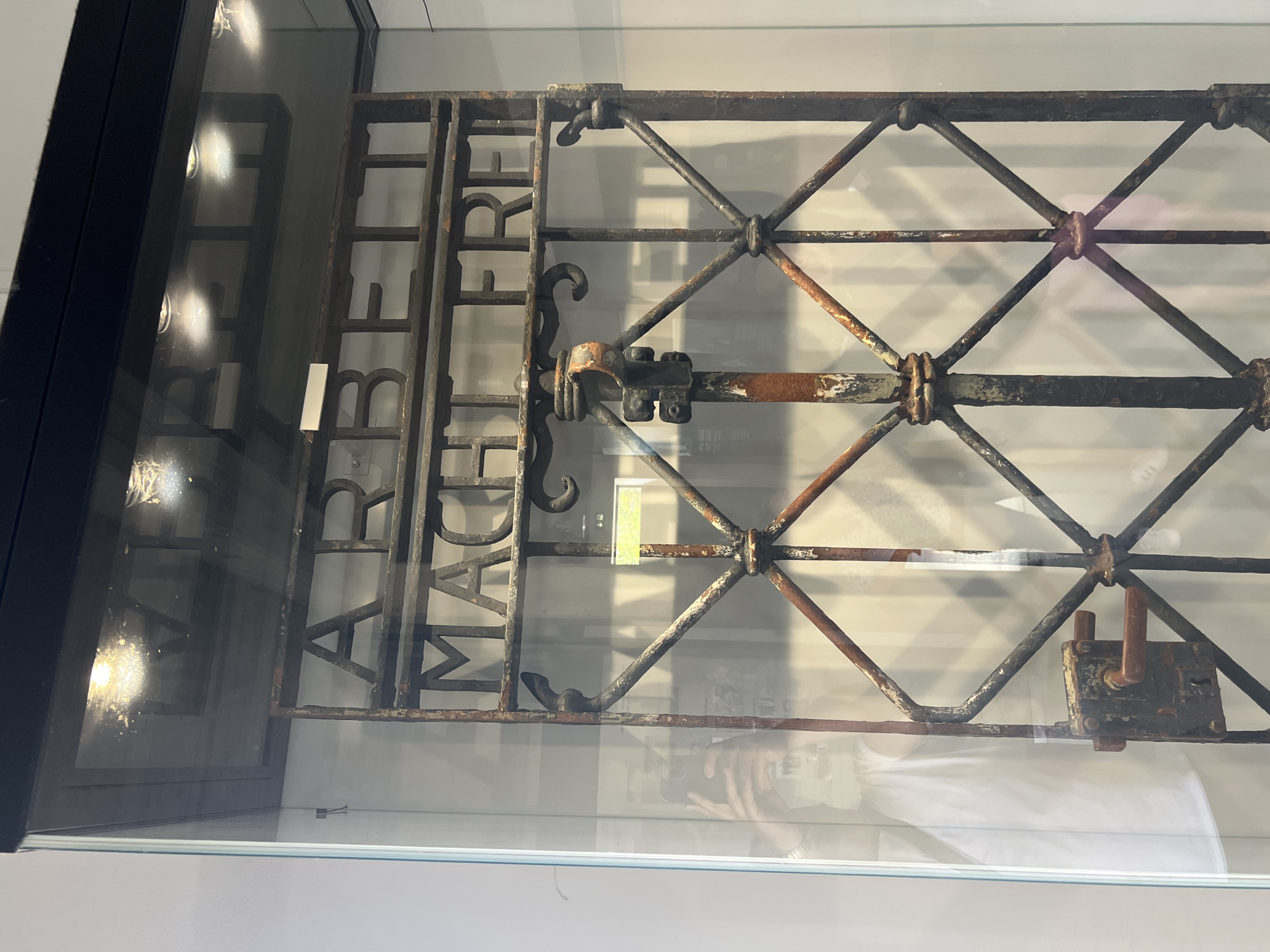
A wrought-iron gate with the inscription "ARBEIT MACHT FREI" is displayed behind glass, likely in a museum or memorial. The gate is oxidized and weathered, with rust visible on the metal. The inscription, in German, translates to "Work Sets You Free." The gate is part of the preserved entrance to the former Dachau concentration camp, located in Dachau, Germany. In the background, a reflection of a person holding a phone to take a picture is visible on the glass, and the interior of the exhibit space can be seen, including display lighting and white walls. The overall scene depicts a historical artifact presented for remembrance and education.
Dachau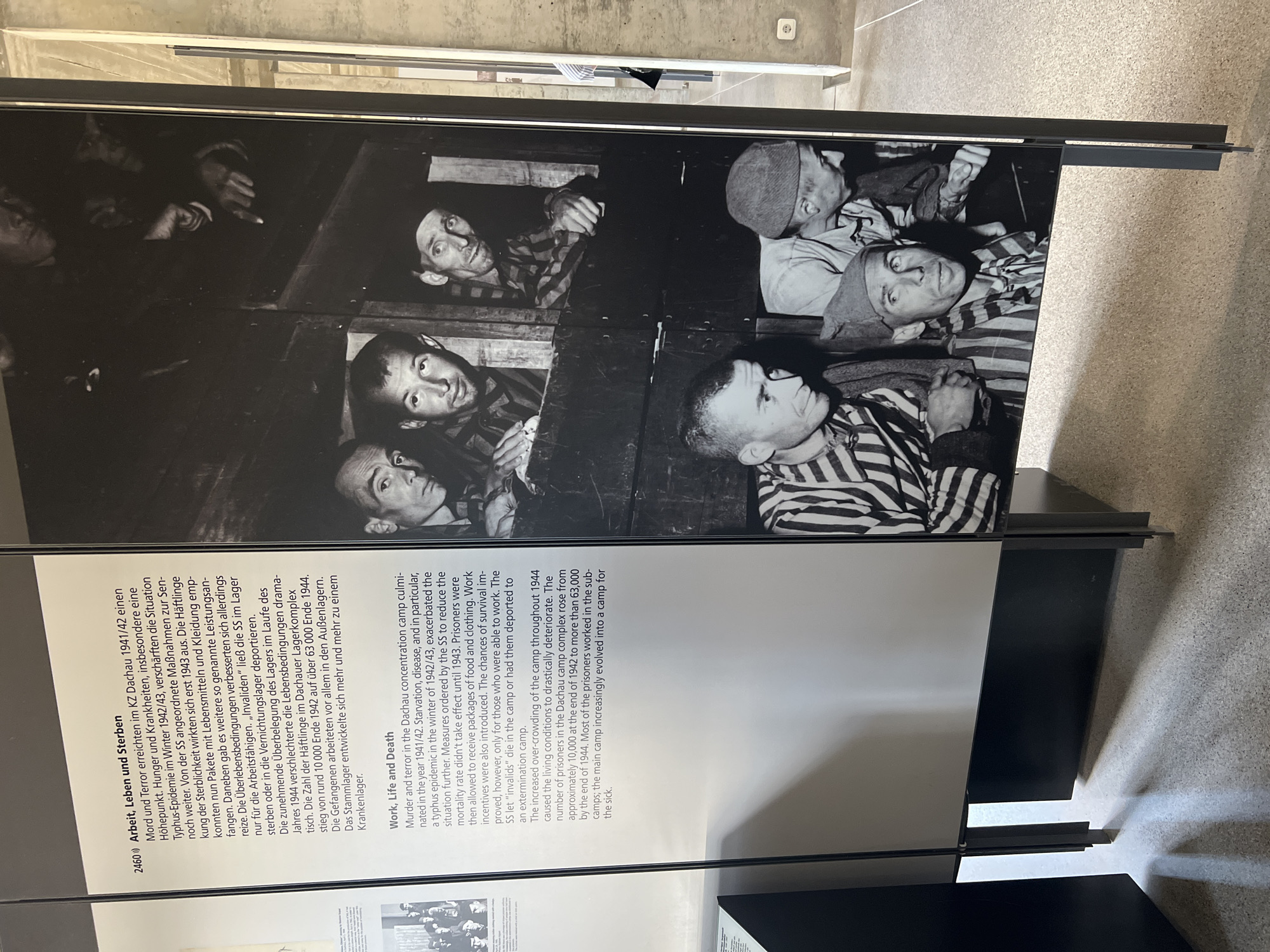
The image shows a display panel with text and a photograph. The text, in German and English, describes "Work, Life and Death" in the Dachau concentration camp between 1941 and 1942. It details the dire conditions, including murder, terror, hunger, disease, and a typhus epidemic, exacerbated by SS measures. The text mentions that prisoners were allowed food and clothing packages and that work incentives were introduced, but the mortality rate did not decrease until 1943. It also states that by the end of 1944, the number of prisoners in the Dachau complex rose from approximately 10,000 at the end of 1942 to over 63,000. The photograph is a black and white image of several emaciated men in striped prison uniforms, some of whom appear to be looking out of small openings, possibly in barracks or transport vehicles. Their faces show signs of hardship. The display is located in a museum or exhibition space, with a textured floor and a concrete wall visible in the background. The city of Dachau, Germany, is referenced in the text as the location of this concentration camp.
Dachau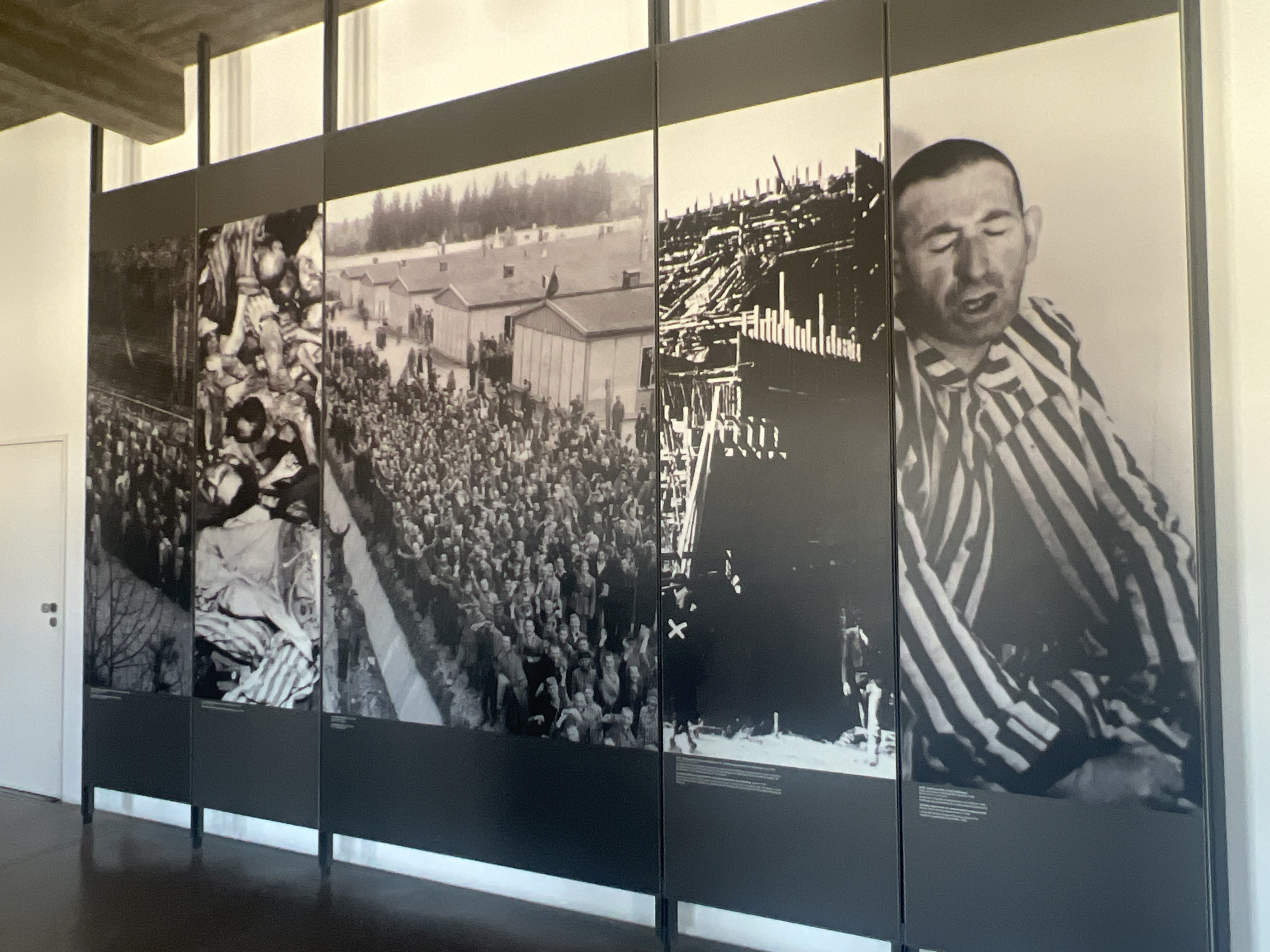
The image displays a section of an exhibition in Dachau, Germany, featuring a series of large black and white photographs mounted on dark panels. The photographs depict historical scenes, likely related to the Dachau concentration camp. The leftmost panel shows a close-up of many people in striped uniforms, their bodies tightly packed together. The next panel reveals rows of barracks with people gathered outside and in front of them, set against a backdrop of trees and a forest. This panel appears to show a wider view of a camp or settlement. The third panel from the left shows a dense crowd of people in what appears to be an outdoor area, possibly a gathering or assembly. The fourth panel features a close-up portrait of a man in a striped uniform with his eyes closed and mouth open, appearing to be in distress. The rightmost panel is a close-up of the man's striped uniform. The exhibition is housed in a well-lit indoor space with a polished dark floor. The panels are arranged in a line, forming a continuous display. White walls are visible to the left of the exhibition, and a door with a handle is also present on the far left. The ceiling features exposed beams and lighting fixtures. The overall presentation is somber, reflecting the historical nature of the images.
Dachau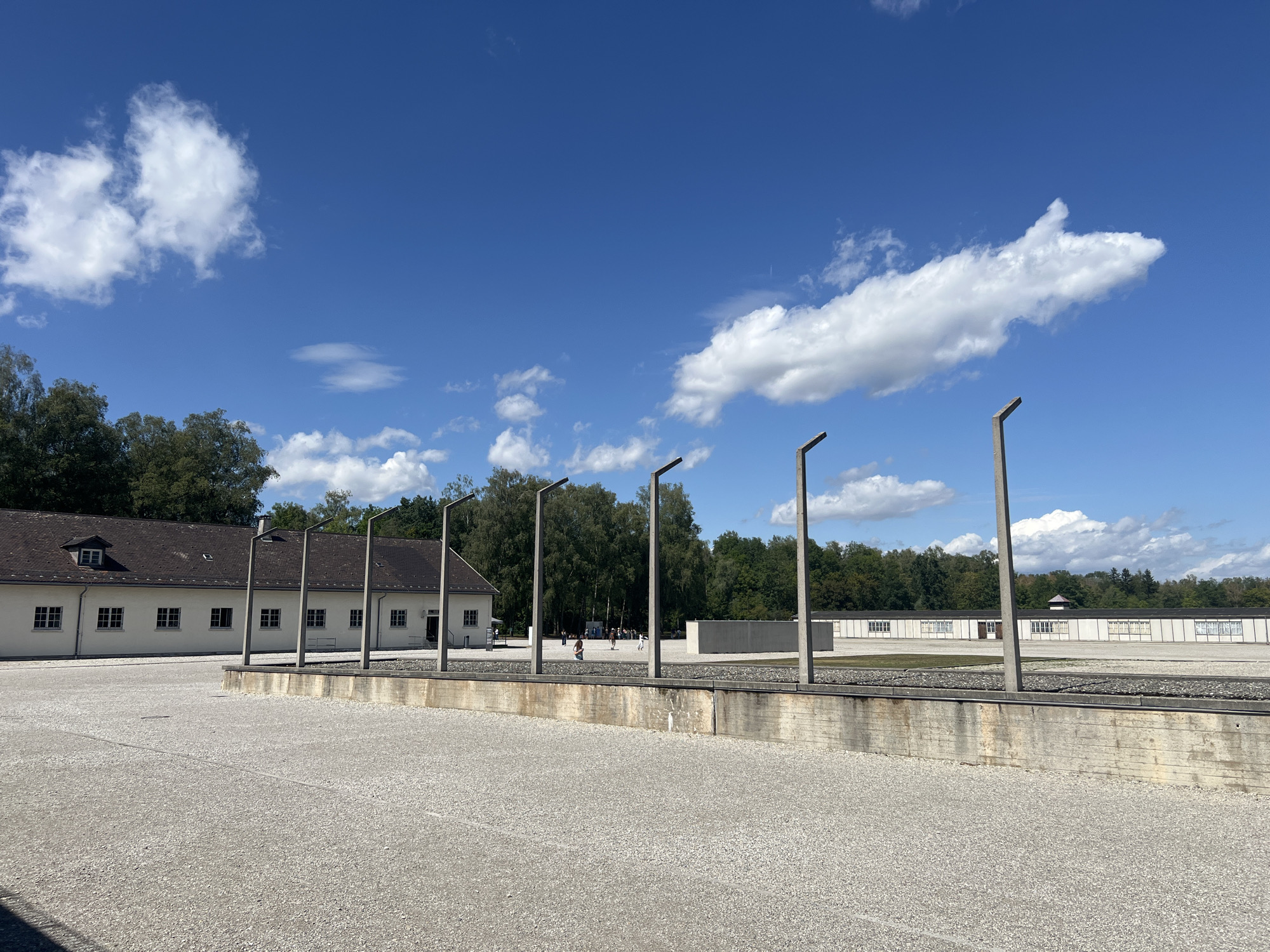
The image depicts an outdoor scene at the Dachau Concentration Camp Memorial Site in Dachau, Germany. In the foreground, there is a large, gravel-covered area with a concrete retaining wall. Several tall, slender metal poles, presumably remnants of a former structure, are visible in the middle ground. Beyond the retaining wall, there are several long, white buildings with dark roofs and numerous windows. These buildings are situated on a gravel-covered ground. In the distance, a line of trees forms the background, with a bright blue sky and scattered white clouds above. Several people can be seen walking in the middle ground, between the buildings and the poles. The overall atmosphere appears somber and reflective.
Dachau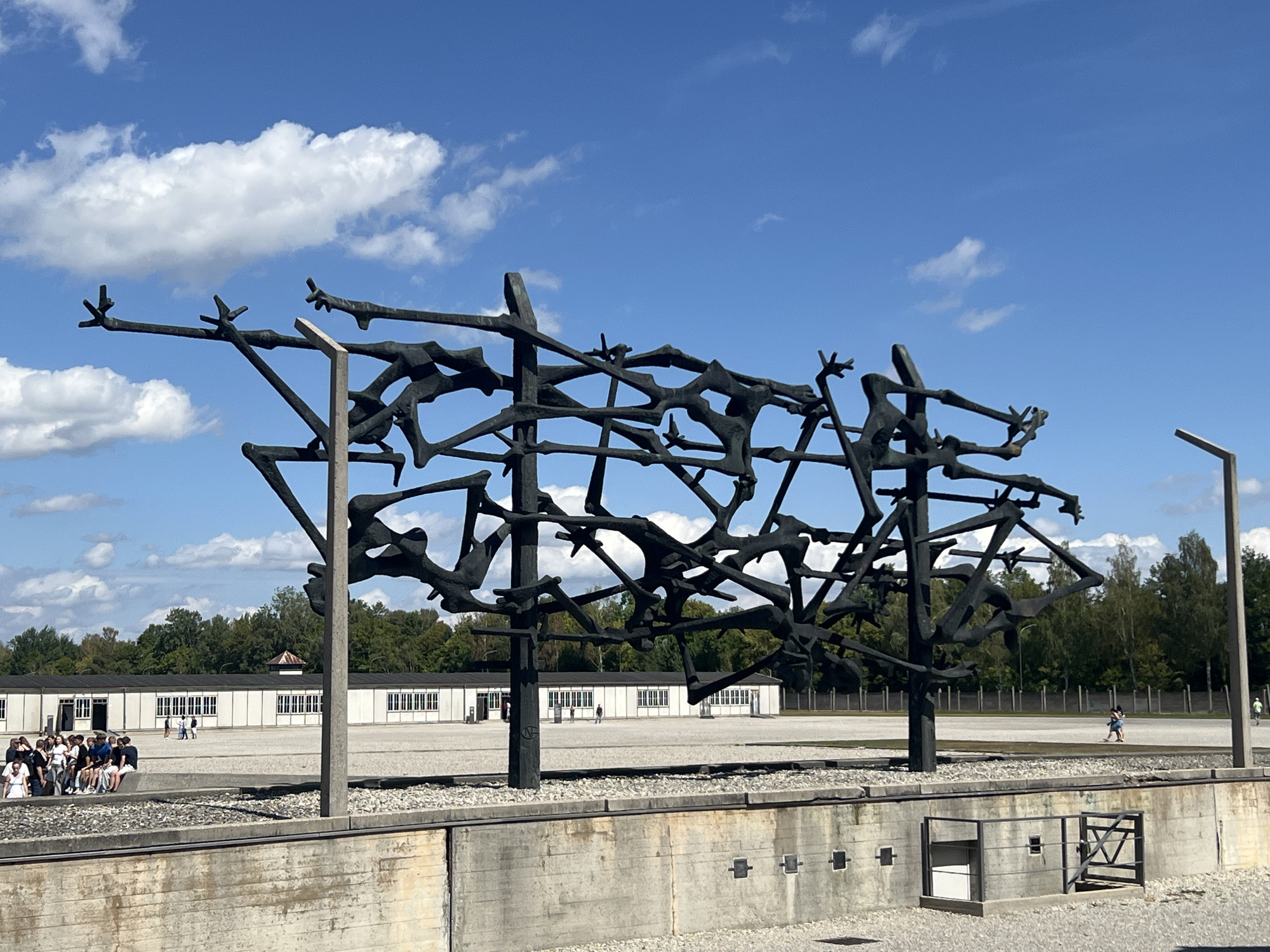
The image depicts the Memorial of the Dachau Concentration Camp in Dachau, Germany. In the foreground, a large, abstract black sculpture, consisting of intertwined human-like figures, stands prominently. This sculpture is situated in front of a concrete wall with gravel on the ground. Behind the sculpture, a vast, open, gravel-covered area stretches towards several identical, long, white barracks with dark-paned windows, characteristic of former camp structures. A line of trees forms the background, with a clear blue sky dotted with white clouds above. On the left side of the image, a group of visitors, appearing to be students, are seated on a low concrete barrier, observing the memorial. Other individuals are sparsely scattered across the open area, walking or standing. The overall scene conveys a sense of solemnity and remembrance within a historical site.
Dachau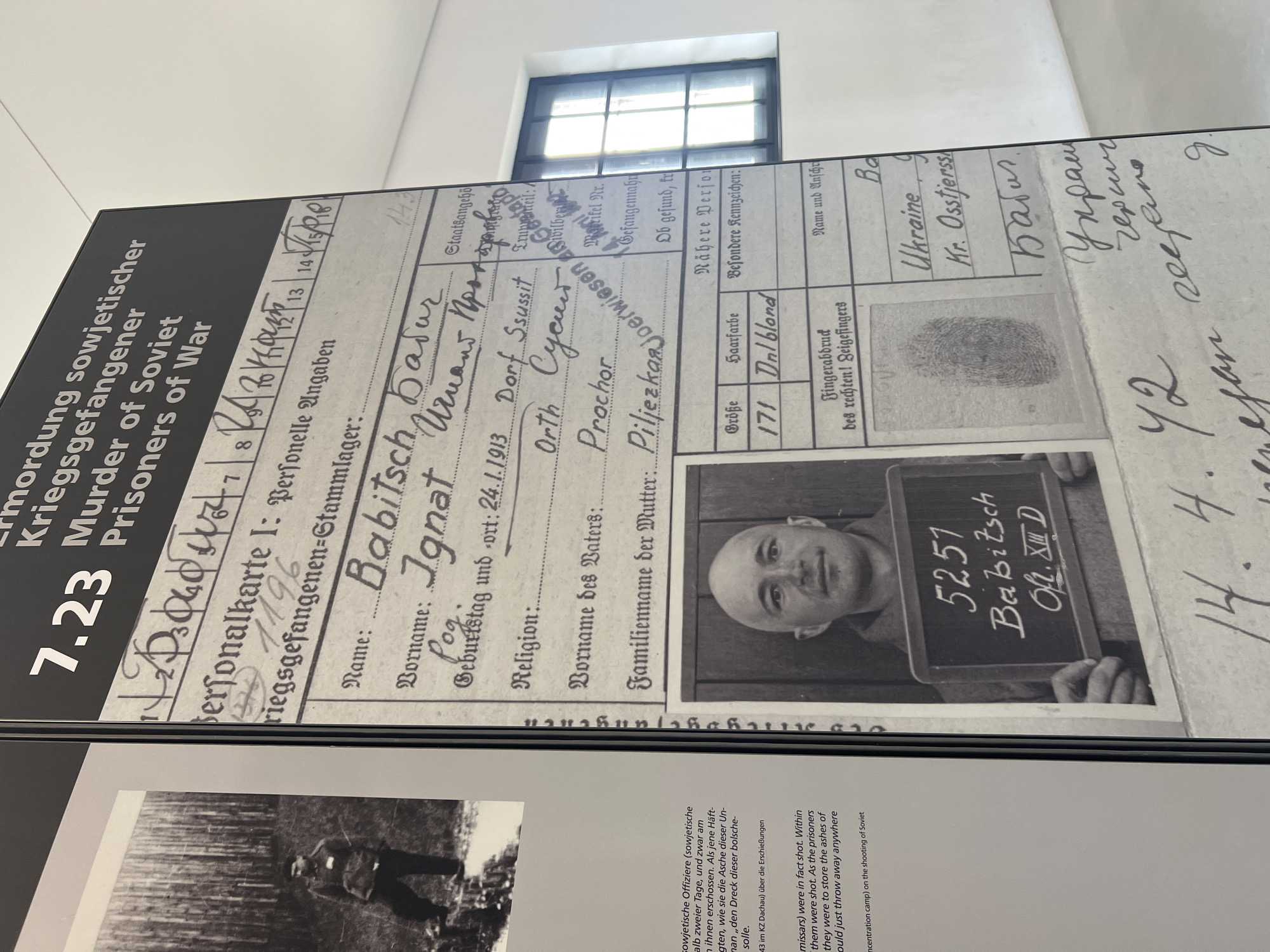
This image shows a display at the Dachau Concentration Camp Memorial Site in Dachau, Germany. The display features a large black panel with text and a photograph. The text at the top reads "7.23 Ermordung sowjetischer Kriegsgefangener Murder of Soviet Prisoners of War". Below this is a black and white photograph of a man holding a chalkboard with the number "5251", the name "Babitzsch", and "OH. XIII D" written on it. The photograph is overlaid on a document that appears to be a personal record, with fields for name, birth date, religion, and other details. The document has handwritten entries in a language that appears to be German and possibly Russian. There is also a fingerprint sample and other handwritten text on the document. To the left of the main display is a black and white photograph of a person in a uniform standing in a wooded area. The background of the display appears to be a wall, and a window with light streaming through it is visible to the right of the display.
Dachau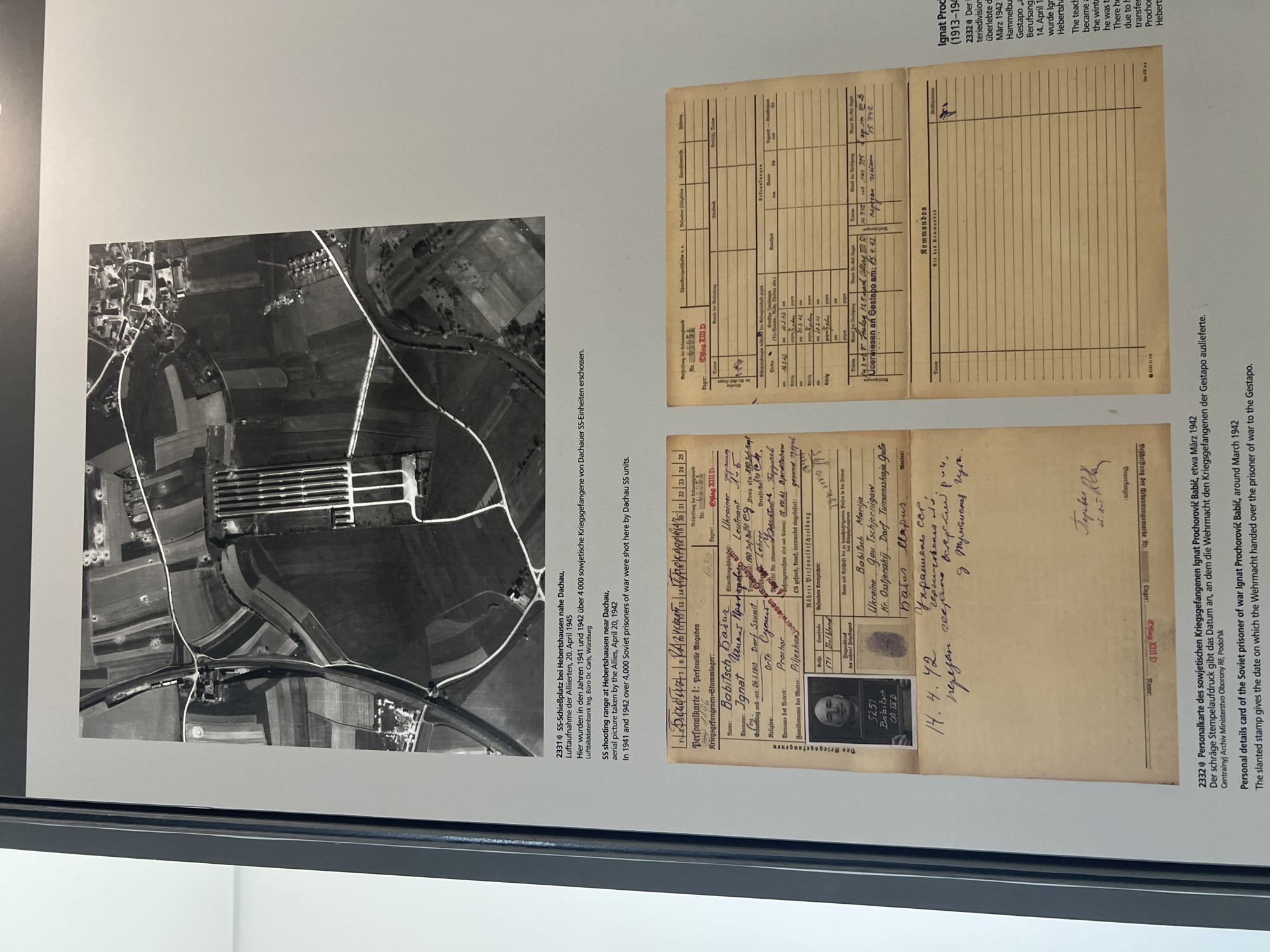
The image displays a black and white aerial photograph of a rural area with a concentration camp. The photograph is captioned with details about an SS shooting range at Hebertshausen near Dachau, Germany, and mentions that over 4,000 Soviet prisoners of war were shot there by Dachau SS units in April 1945. Below the aerial photograph is a personal detail card of a Soviet prisoner of war named Ignat Prochorovich Babič. The card, dated March 1942, contains his personal information, including his name, rank, profession, religion, and parents' names. It also includes a photograph of the prisoner and details about his transfer and release. The card is stamped and signed, and there is a handwritten note at the bottom. Another section of the card lists "Kommandos" which is partially visible. The overall scene depicts historical documentation related to World War II and the atrocities committed at the Dachau concentration camp.
Dachau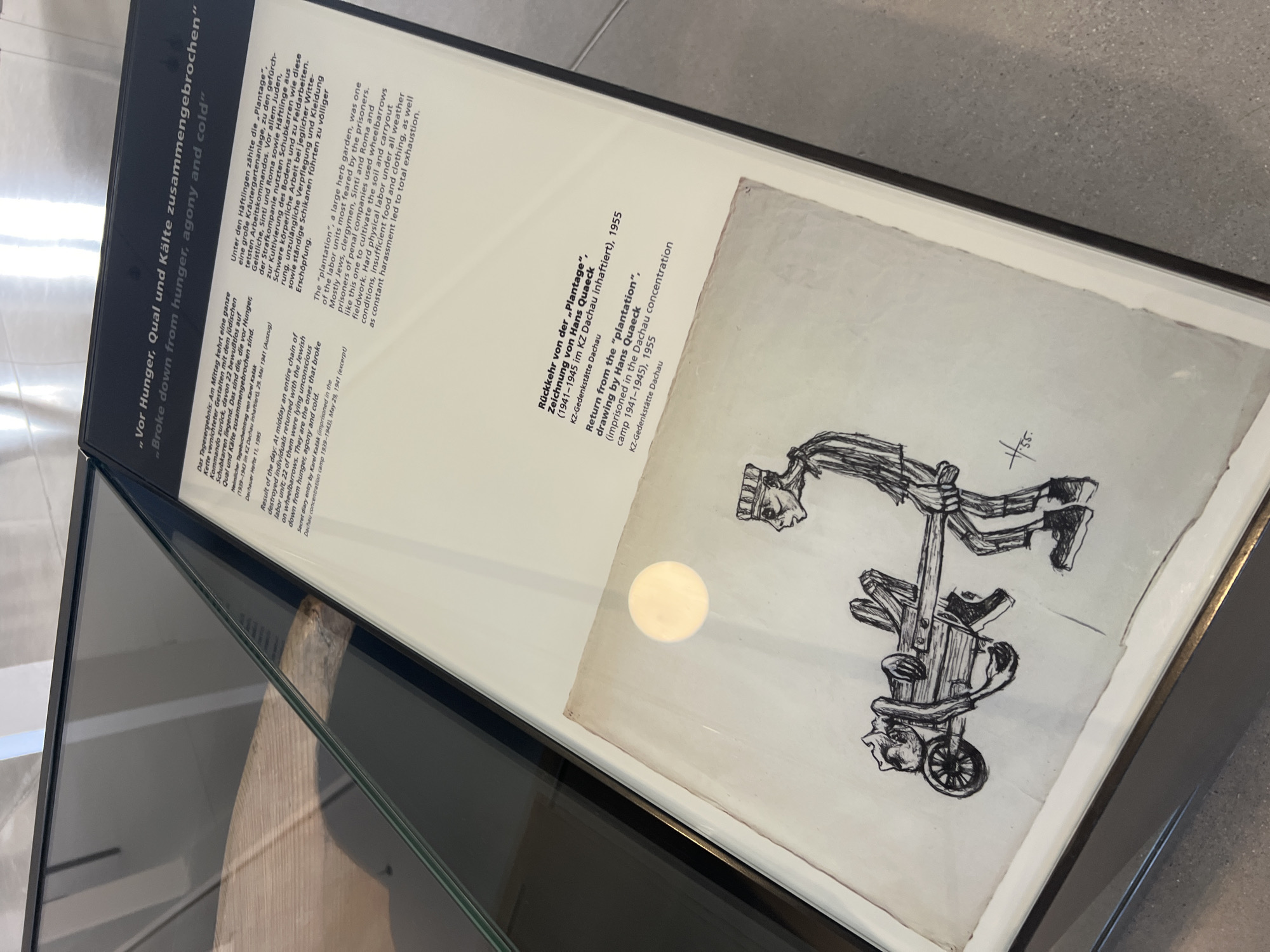
The image shows a display case containing a historical exhibit. The exhibit features a framed drawing and accompanying text. The drawing depicts a skeletal figure being pushed in a wheelbarrow by another emaciated figure. Both figures are rendered in a stark, dark style. The text, presented in both German and English, discusses the "plantation" and its impact on prisoners. The German text is titled "„Vor Hunger, Qual und Kälte zusammengebrochen" and the English translation is "Broke down from hunger, agony and cold." The text describes a large herb garden at the concentration camp where prisoners, including Jews, Roma, and Sinti, were forced to cultivate the soil and work in the fields under harsh conditions. The drawing is identified as "Rückkehr von der „Plantage“" (Return from the "plantation") by Hans Quack, created in 1955. It is noted that Hans Quack was imprisoned in the Dachau concentration camp from 1941-1945. The exhibit is located at the KZ-Gedenkstätte Dachau, which translates to the Dachau Concentration Camp Memorial Site, located in the city of Dachau, Germany.
Dachau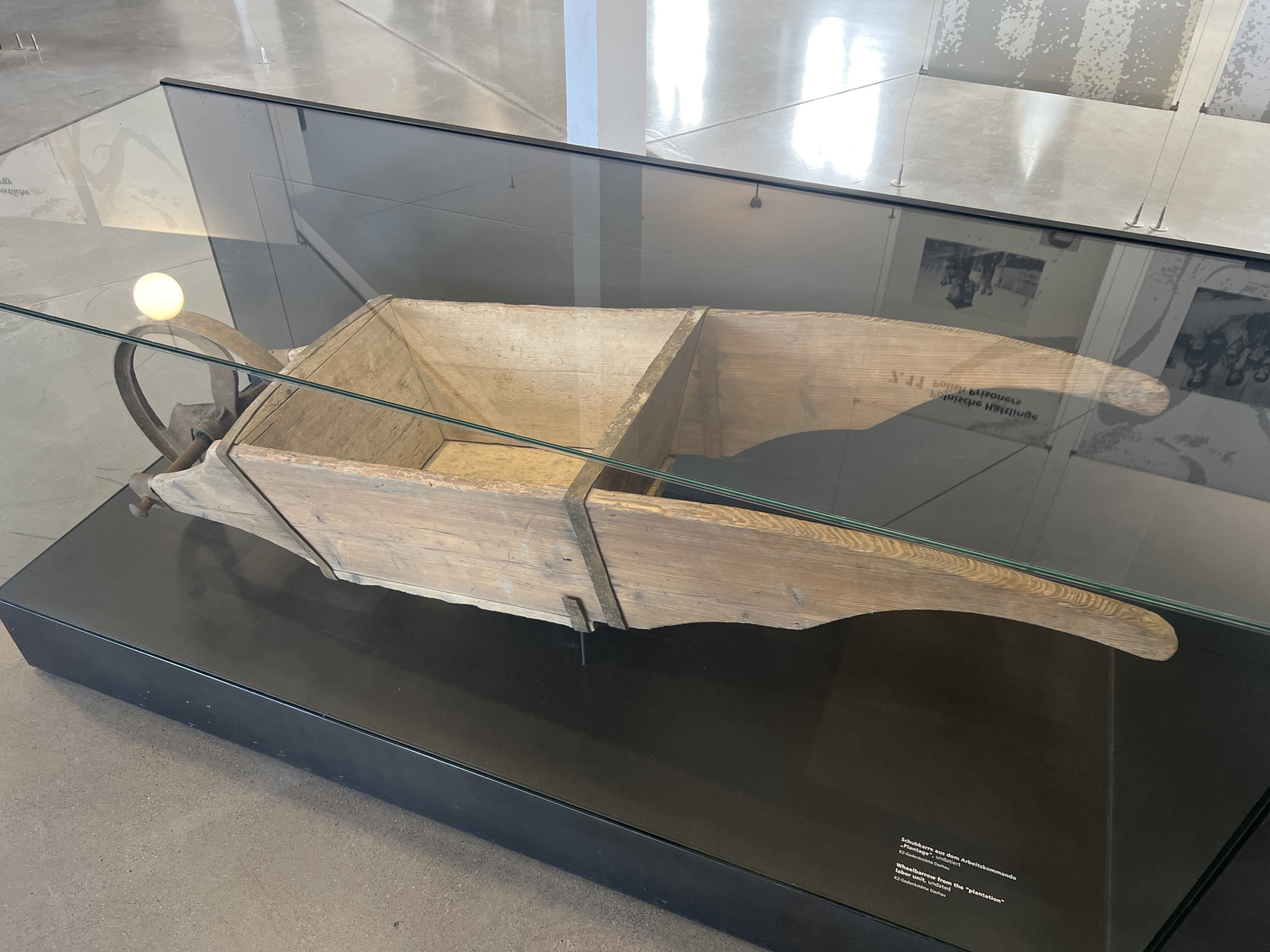
An exhibit, possibly in the Dachau Concentration Camp Memorial Site, features a wooden wheelbarrow displayed in a glass case. The wheelbarrow is weathered and has two compartments. A metal wheel is attached to the front, and handles extend from the back. A lightbulb is visible above the wheel. In the background, enlarged black and white photographs are displayed on a wall. A descriptive plaque is affixed to the interior of the glass case, providing information about the wheelbarrow and its origin, with text in both German and English, identifying it as a "Wheelbarrow from the 'plantation'" and mentioning it is from the "labor unit, undated" at the "KZ-Gedenkstätte Dachau". The flooring of the exhibit space appears to be polished concrete.
Dachau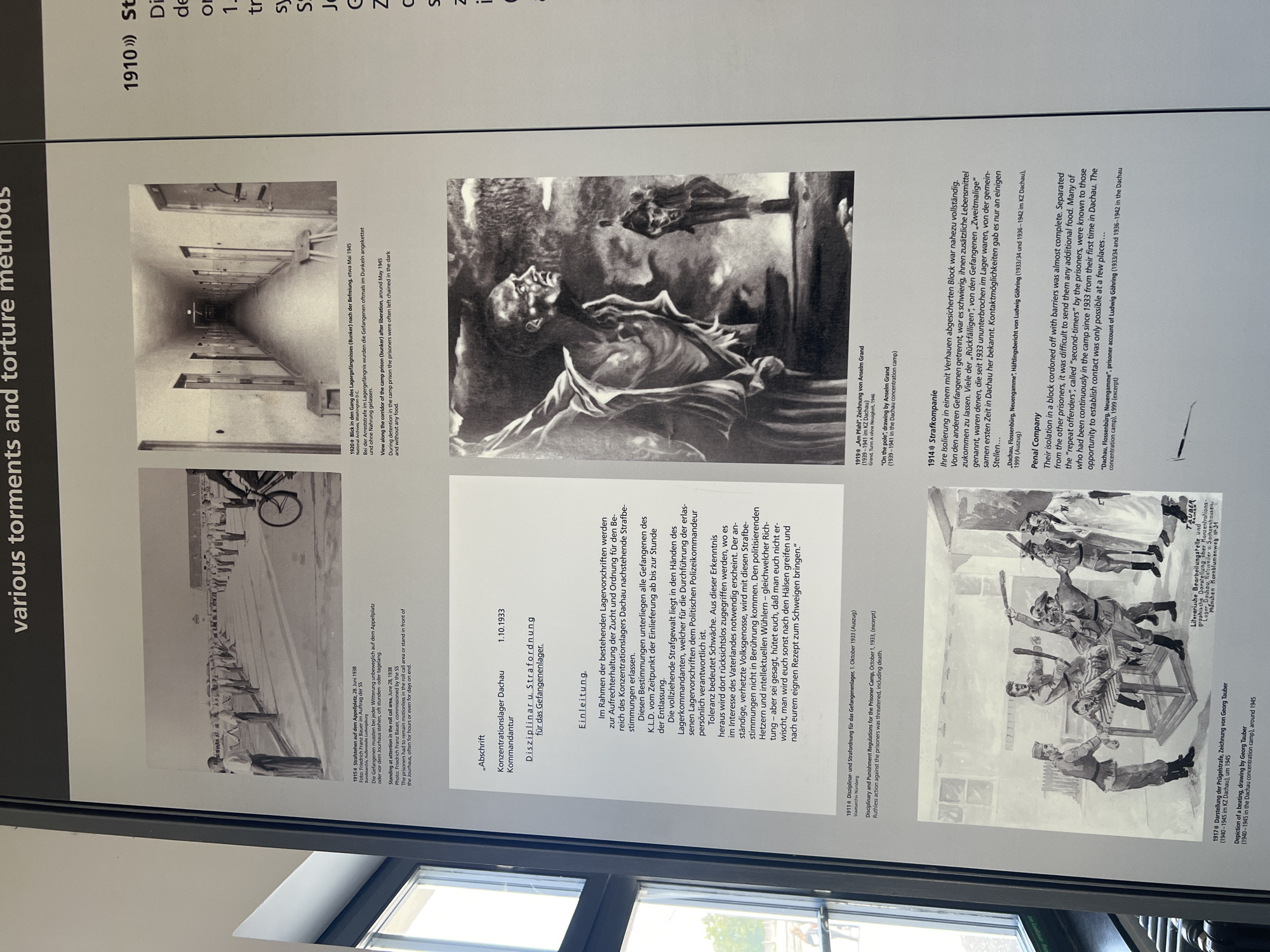
The image is a display panel at the Dachau Concentration Camp Memorial Site in Dachau, Germany. The panel features historical photographs and text related to various torments and torture methods employed at the camp. One photograph, dated June 28, 1938, shows prisoners standing in formation on an outdoor roll call area. Another photograph, dated May 1945, depicts a long, dark corridor within the camp's prison, known as the "Bunker," after its liberation. This image shows barred cells and a sense of confinement. The panel also includes a reproduced document, a "Disciplinary and Punishment Regulations for the Prisoner Camp," dated October 1, 1933. This document outlines rules and disciplinary actions within the camp. Further down, there is a drawing titled "On the Pole" by Anselm Grand, created between 1939 and 1941, depicting a emaciated figure. Below this is a drawing by Georg Tauber, titled "Depiction of a beating," showing uniformed guards assaulting a prisoner on a wooden frame. Finally, there is a text block describing the "Penal Company," detailing the isolation and conditions faced by prisoners in this unit. The overall display aims to document the harsh realities and systematic persecution experienced at the Dachau Concentration Camp.
Dachau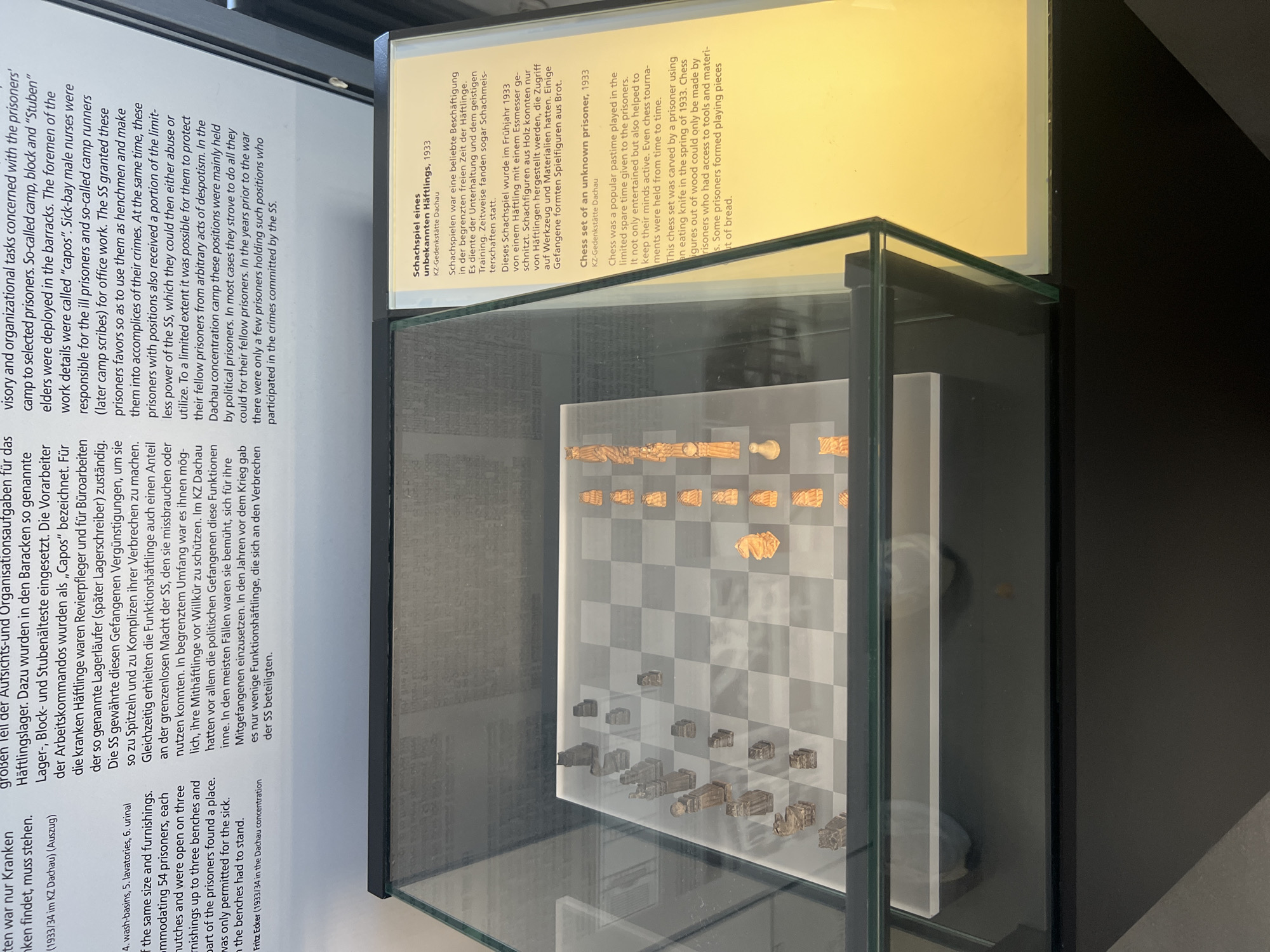
The image shows an exhibit at the Dachau Concentration Camp Memorial Site in Dachau, Germany. The exhibit features a glass case displaying a chess set. The chess set is made of carved wood, with some pieces appearing darker and others lighter. The chess board is a checkered pattern. Text panels are visible to the left and right of the glass case, providing information about the exhibit. The panel on the right, titled "Chess set of an unknown prisoner, 1933," states that the chess set was carved by a prisoner in the spring of 1933 using an eating knife. The text further explains that chess was a popular pastime for prisoners, helping to entertain them and keep their minds active, and that some prisoners formed playing pieces out of bread. The background of the exhibit appears to be a wall with text.
Dachau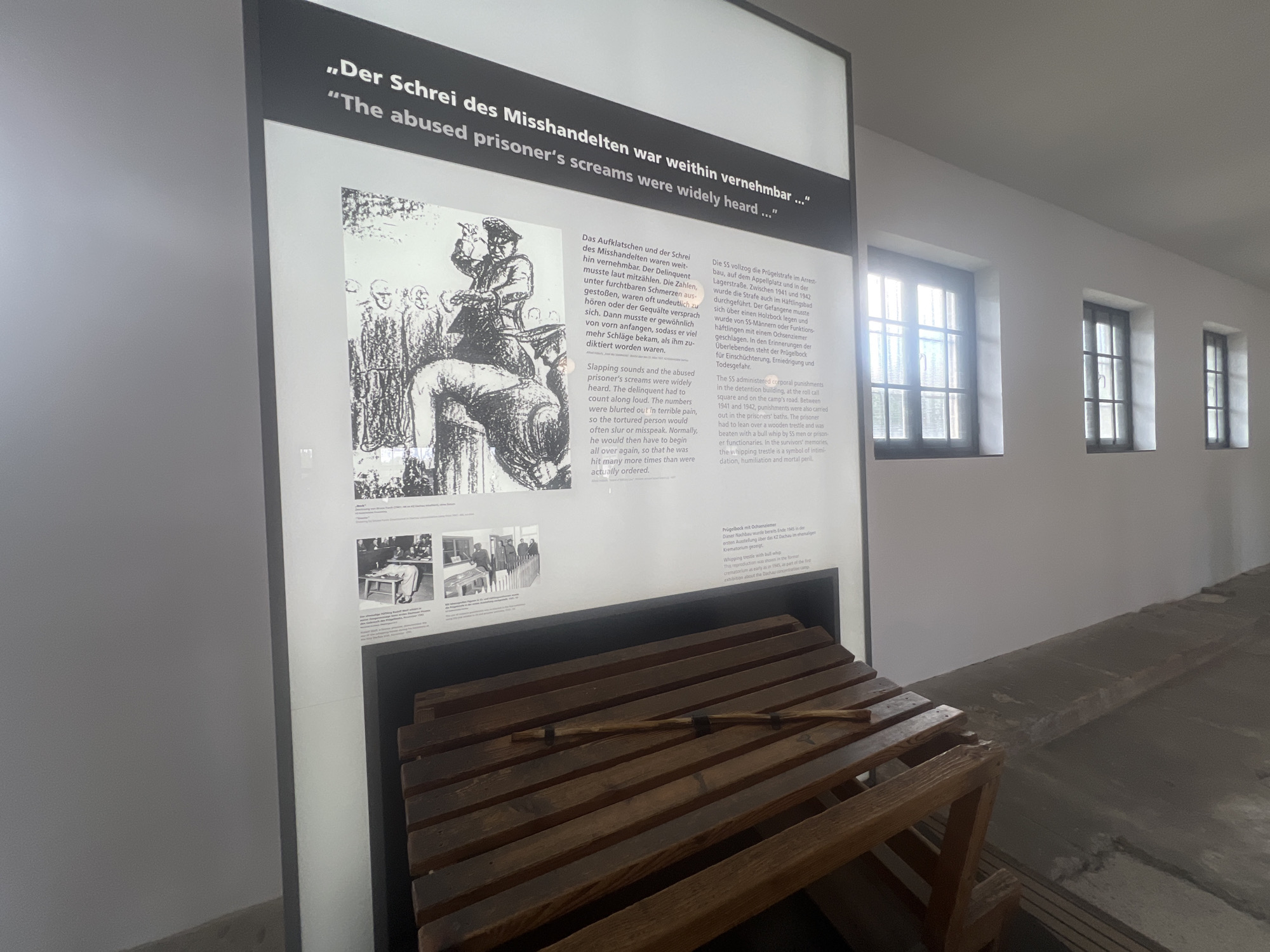
The image depicts an exhibit within the Dachau Concentration Camp Memorial Site in Dachau, Germany. The primary focus is a large, vertical display board with text in German and English. The German text at the top reads, "„Der Schrei des Misshandelten war weithin vernehmbar...“" and the English translation below is, "„The abused prisoner's screams were widely heard...“". To the left of the text is a black and white illustration depicting a historical scene of punishment, showing a figure standing over a person on the ground, surrounded by onlookers. Below this illustration are two smaller black and white photographs. The top photograph shows a line of people in what appears to be a roll call or assembly area. The bottom photograph shows an individual bending over a table with other people in the background. In the foreground, a wooden exhibit is placed. It consists of a sloped wooden structure made of slats, with a thin wooden stick, possibly a whip or a baton, resting horizontally across it. This exhibit appears to be designed to represent an instrument of punishment or an object related to the depicted historical events. The background of the image shows a section of a building with white walls and three large windows with dark frames. The windows are divided into multiple panes, and light is filtering through them, creating reflections on the wall. The floor appears to be a light gray concrete. The overall environment suggests an indoor exhibit space within a historical memorial.
Dachau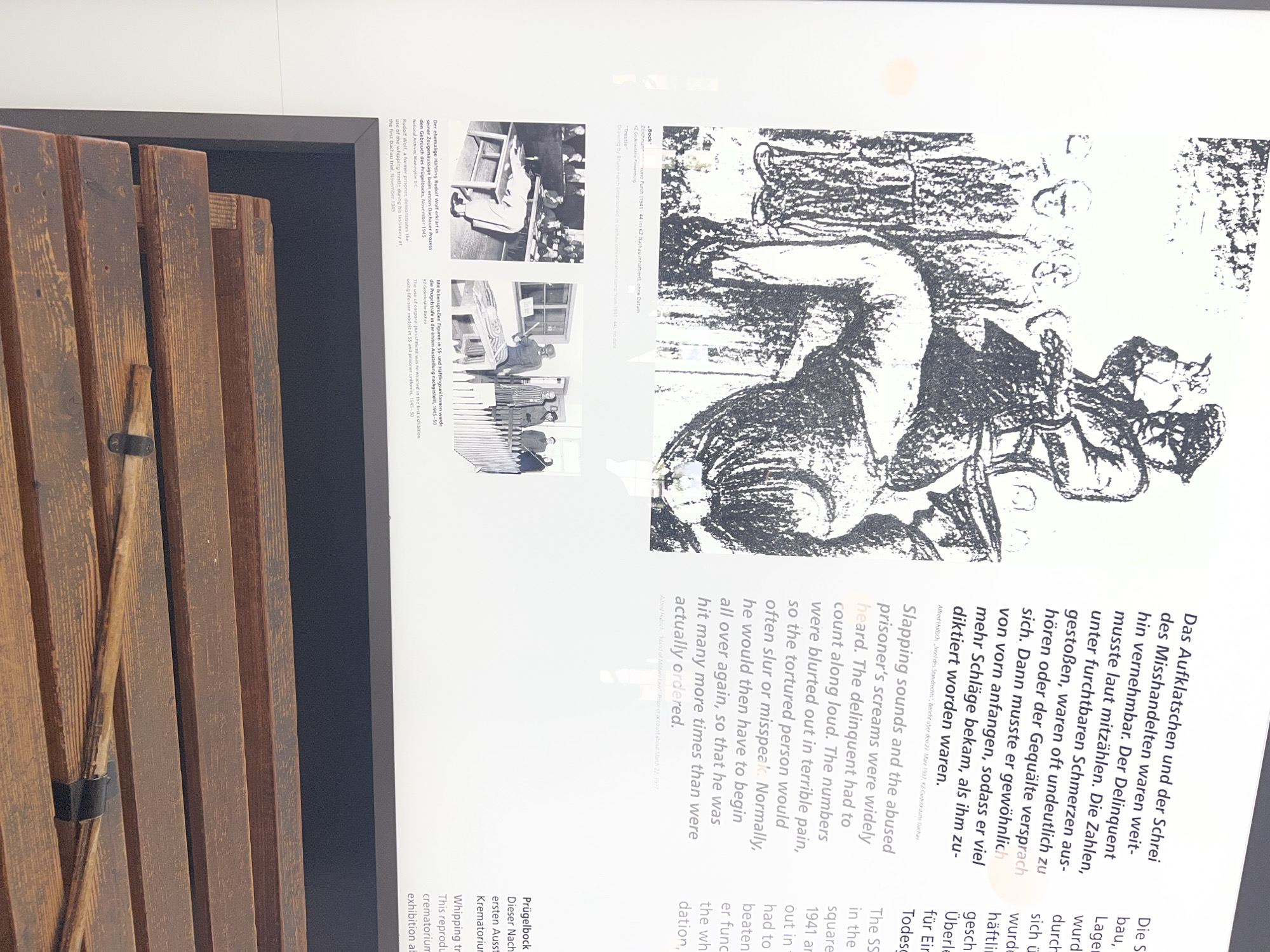
The image displays an exhibit in a museum, likely related to the Dachau concentration camp. The top portion features a black and white illustration depicting a man in a cap and uniform wielding a whip over another person who is bent over. Several other figures in uniform stand behind the victim, observing. Below the illustration, text in both German and English describes the brutality of the mistreatment, including the requirement for victims to count aloud during beatings and the potential for slurred speech due to pain. The middle section presents two black and white photographs. The left photograph shows a person bent over a wooden structure, with other individuals in the background, suggesting a judicial or disciplinary proceeding. The caption identifies this as a former inmate, Rudolf Wolf, testifying about the use of a whipping trestle during the first Dachau trial. The right photograph depicts a recreated scene with figures in SS and inmate uniforms standing near a wooden trestle. The caption explains this is a re-enactment of corporal punishment in the first exhibition of the crematorium. The bottom portion of the image shows a close-up of a wooden structure with horizontal slats, resembling the whipping trestle mentioned in the captions. This object is placed in the foreground, suggesting it is part of the exhibit. The overall context points to the exhibit being located at a memorial or museum in or related to Dachau, Germany, and it focuses on the corporal punishment and judicial processes associated with the former concentration camp.
Dachau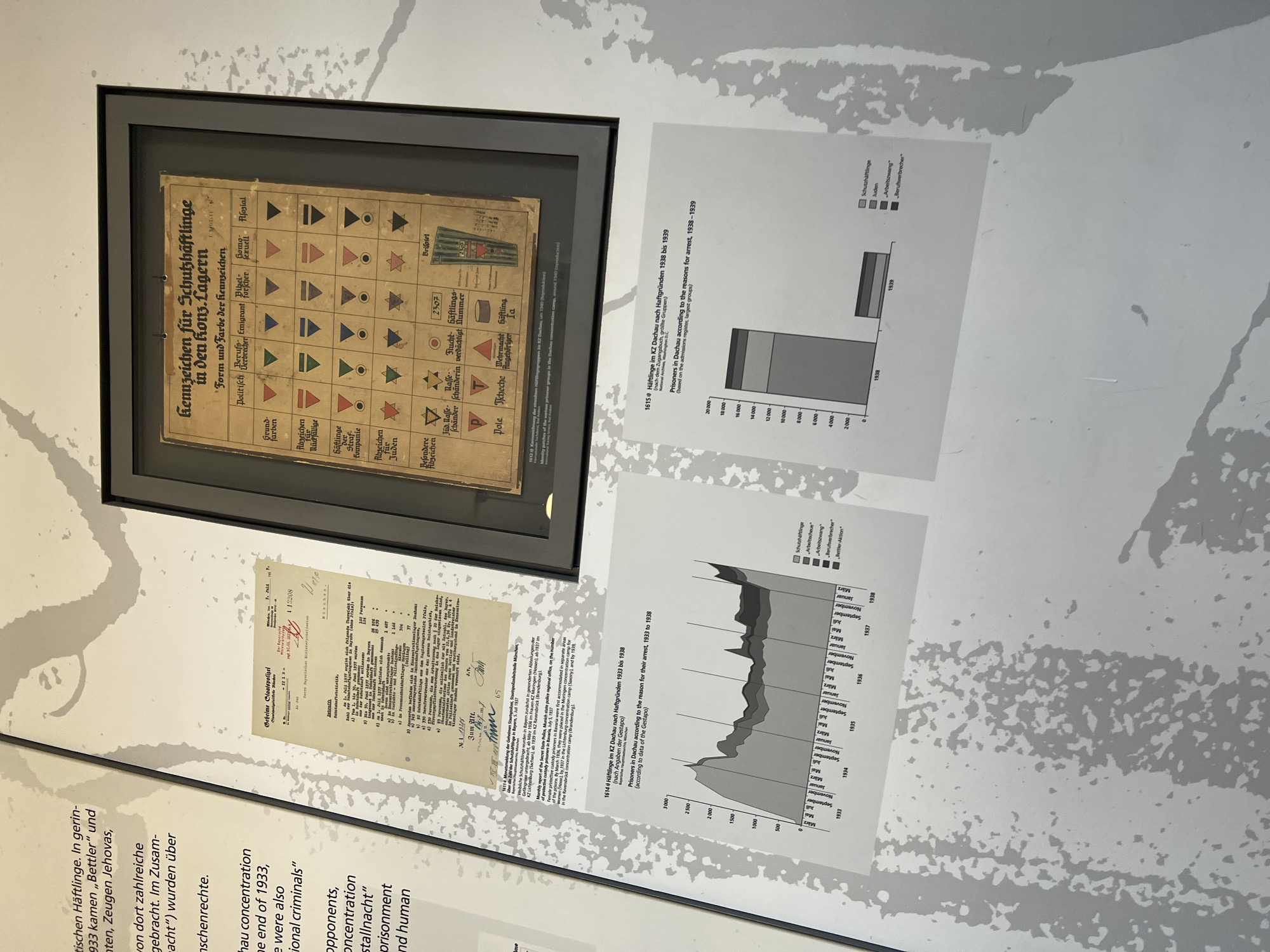
The image shows an exhibit in the Dachau Concentration Camp Memorial Site, located in Dachau, Germany. The exhibit features a display of historical documents and graphics related to the persecution of individuals in concentration camps. In the center of the frame, a framed document is displayed with the title "Kennzeichen für Schutzhäftlinge in den konz. Lagern" (Insignia for Protective Custody Prisoners in the Concentration Camps). This document, a chart with colored triangles and stars, categorizes prisoners based on their alleged offenses or identities, such as political prisoners, criminals, emigrants, Jehovah's Witnesses, homosexuals, and Jews. Below this chart, a smaller, faded document is visible, appearing to be a report or official correspondence. To the left of the framed insignia chart, a wall displays text detailing the categories of prisoners and their treatment. This text mentions the Dachau concentration camp and its early years. Below the framed insignia chart and to the right, two charts are displayed. The first chart, a line graph, illustrates the number of prisoners in the Dachau concentration camp from March 1933 to March 1938, categorized by reasons for arrest, such as "Schutzhäftlinge" (protective custody prisoners), "Asoziale" (anti-social elements), "Arbeitszwang" (forced labor), and "Berufsverbrecher" (professional criminals). The second chart, a bar graph, shows similar prisoner categories for the years 1938 and 1939. The labels on these graphs indicate that the data is based on records from the Gestapo or admission registers. The overall environment appears to be an indoor exhibition space with muted lighting, focusing the viewer's attention on the presented historical materials. The wall behind the exhibit has a distressed, textured pattern.
Dachau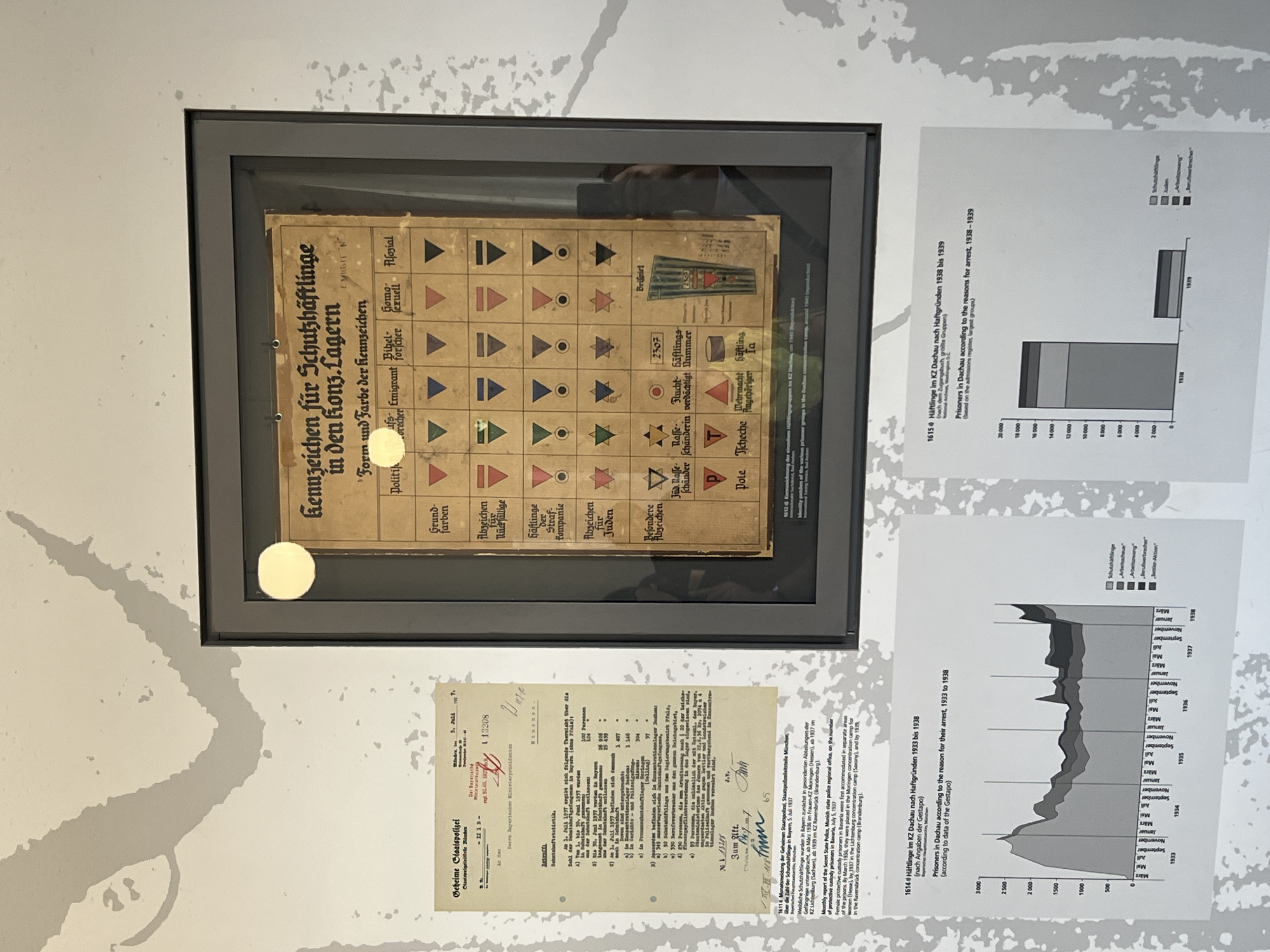
The image shows a museum exhibit focusing on the Dachau concentration camp. In the center, a framed poster displays a chart of identification symbols used for prisoners in Nazi concentration camps. The chart includes categories like "Politik," "Beruf," "Emigrant," "Bibel-forscher," "Homo-sexuell," and "Rassial," with corresponding colored triangles and other symbols. To the left of the poster is a document, possibly an official police report, with German text. Below the framed exhibit are two graphs illustrating prisoner statistics in Dachau. The top graph is a line graph showing prisoner numbers from 1933 to 1938, broken down by reason for arrest. The bottom graph is a bar chart showing prisoner numbers for 1938 and 1939, also categorized by reason for arrest. The background of the exhibit is a textured wall with abstract grey markings. The overall scene depicts historical documentation and analysis of the Dachau concentration camp, located near the city of Dachau, Germany.
Dachau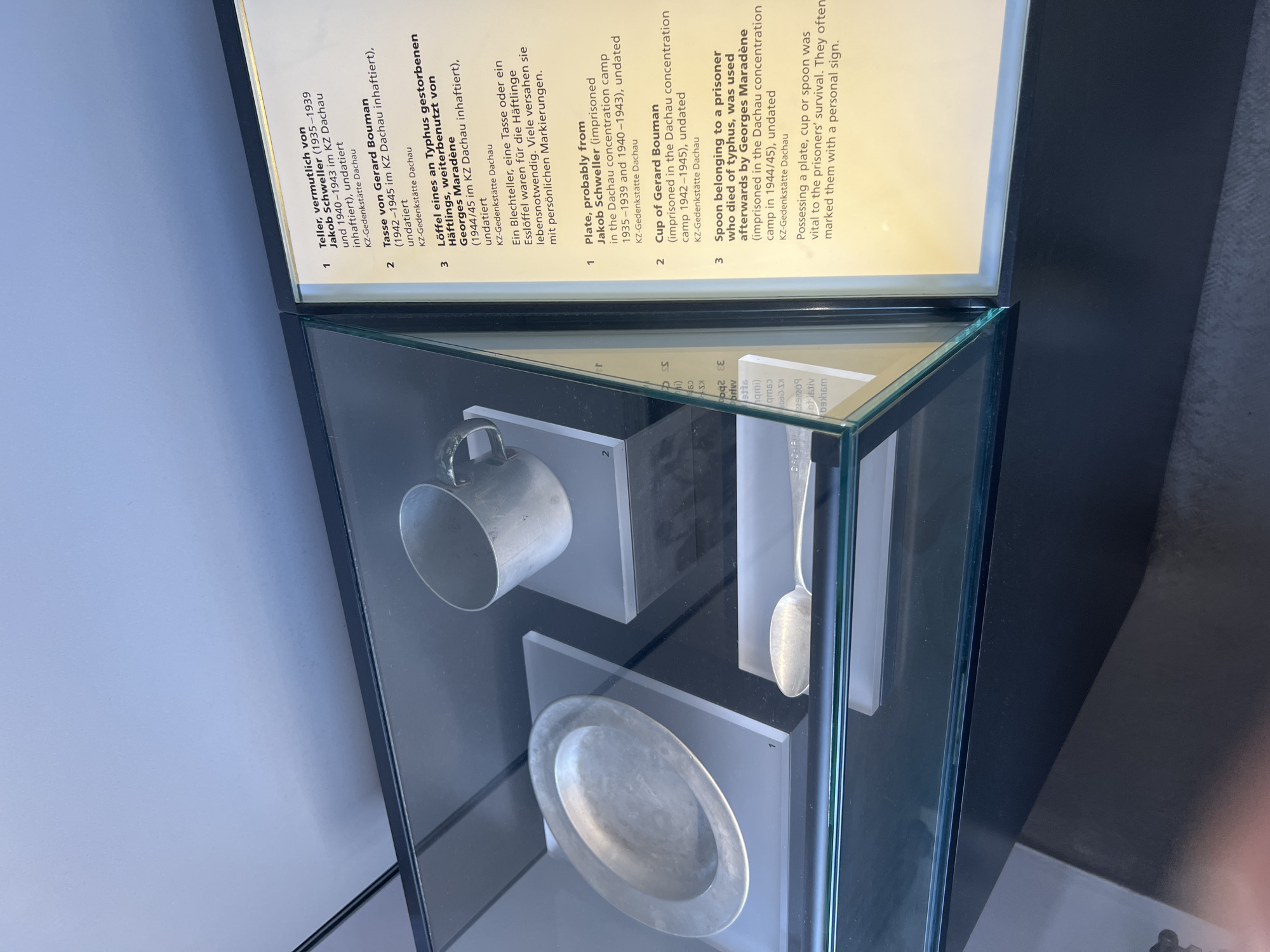
The image shows a display case in the Dachau Concentration Camp Memorial Site in Dachau, Germany. Inside the case are three items: a plate, a cup, and a spoon. A descriptive plaque next to the display case provides information about each item. The plaque is divided into two columns. The left column is in German and the right column is in English. The German text is as follows: 1. Teller, vermutlich von Jakob Schweller (1935-1939 und 1940-1943 im KZ Dachau inhaftiert), undatiert. KZ-Gedenkstätte Dachau. 2. Tasse von Gerard Bouman (1942-1945 im KZ Dachau inhaftiert), undatiert. KZ-Gedenkstätte Dachau. 3. Löffel eines an Tyhus gestorbenen Häftlings, weiterbenutzt von Georges Maradène (1944/45 im KZ Dachau inhaftiert), undatiert. KZ-Gedenkstätte Dachau. Ein Blechteller, eine Tasse oder ein Esslöffel waren für die Häftlinge lebensnotwendig. Viele versahen sie mit persönlichen Markierungen. The English text is as follows: 1. Plate, probably from Jakob Schweller (imprisoned in the Dachau concentration camp 1935-1939 and 1940-1943), undated. KZ-Gedenkstätte Dachau. 2. Cup of Gerard Bouman (imprisoned in the Dachau concentration camp 1942-1945), undated. KZ-Gedenkstätte Dachau. 3. Spoon belonging to a prisoner who died of typhus, was used afterwards by Georges Maradène (imprisoned in the Dachau concentration camp in 1944/45), undated. KZ-Gedenkstätte Dachau. Possessing a plate, cup or spoon was vital to the prisoners' survival. They often marked them with a personal sign. The plate is a simple, shallow metal dish. The cup is a cylindrical metal mug with a handle. The spoon is a standard metal spoon. All three items appear to be made of aluminum or a similar lightweight metal. They are displayed on white risers inside a glass-fronted display case. The lighting in the display case is consistent, illuminating the artifacts without harsh shadows. The background of the display case is dark, helping to highlight the items. The plaque is positioned to the right of the display case and is illuminated by ambient light. The overall environment suggests a museum or memorial exhibition.
Dachau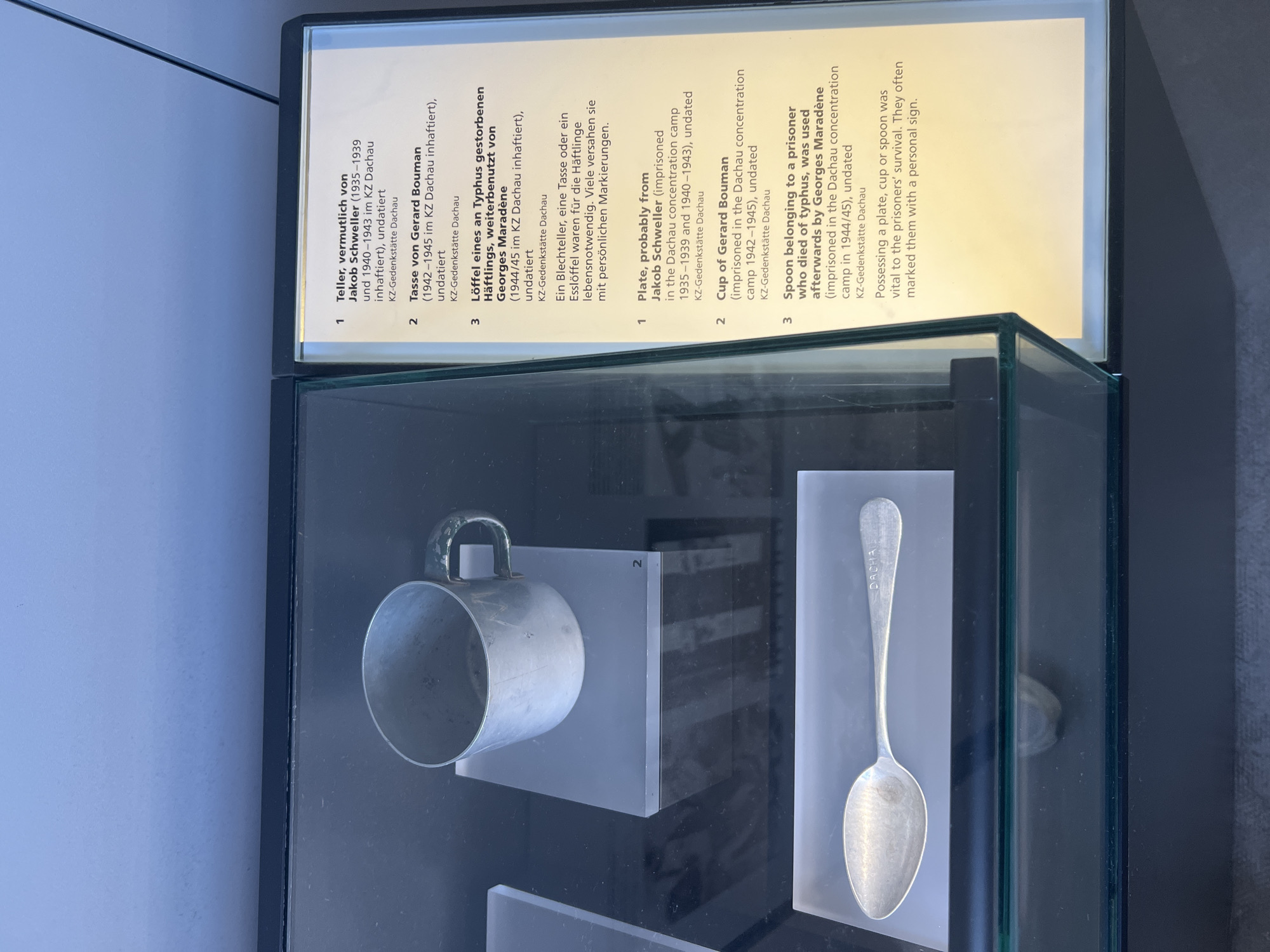
The image shows a display case containing a metal spoon and a metal mug, possibly from a concentration camp. The display is accompanied by a text panel that describes three items. The first item is a plate, likely from Jakob Schweller, who was imprisoned in the Dachau concentration camp from 1935-1939 and 1940-1943. The second item is a cup belonging to Gerard Bouman, who was imprisoned in the Dachau concentration camp from 1942-1945. The third item is a spoon that belonged to a prisoner who died of typhus and was later used by Georges Maradène, who was imprisoned in the Dachau concentration camp in 1944/45. The text further explains that possessing a plate, cup, or spoon was vital for the prisoners' survival, and they often marked these items with personal signs. The spoon in the display case has the word "DACHAU" inscribed on it. The text panel is in German and English. The location is the Dachau Concentration Camp Memorial Site in Dachau, Germany.
Dachau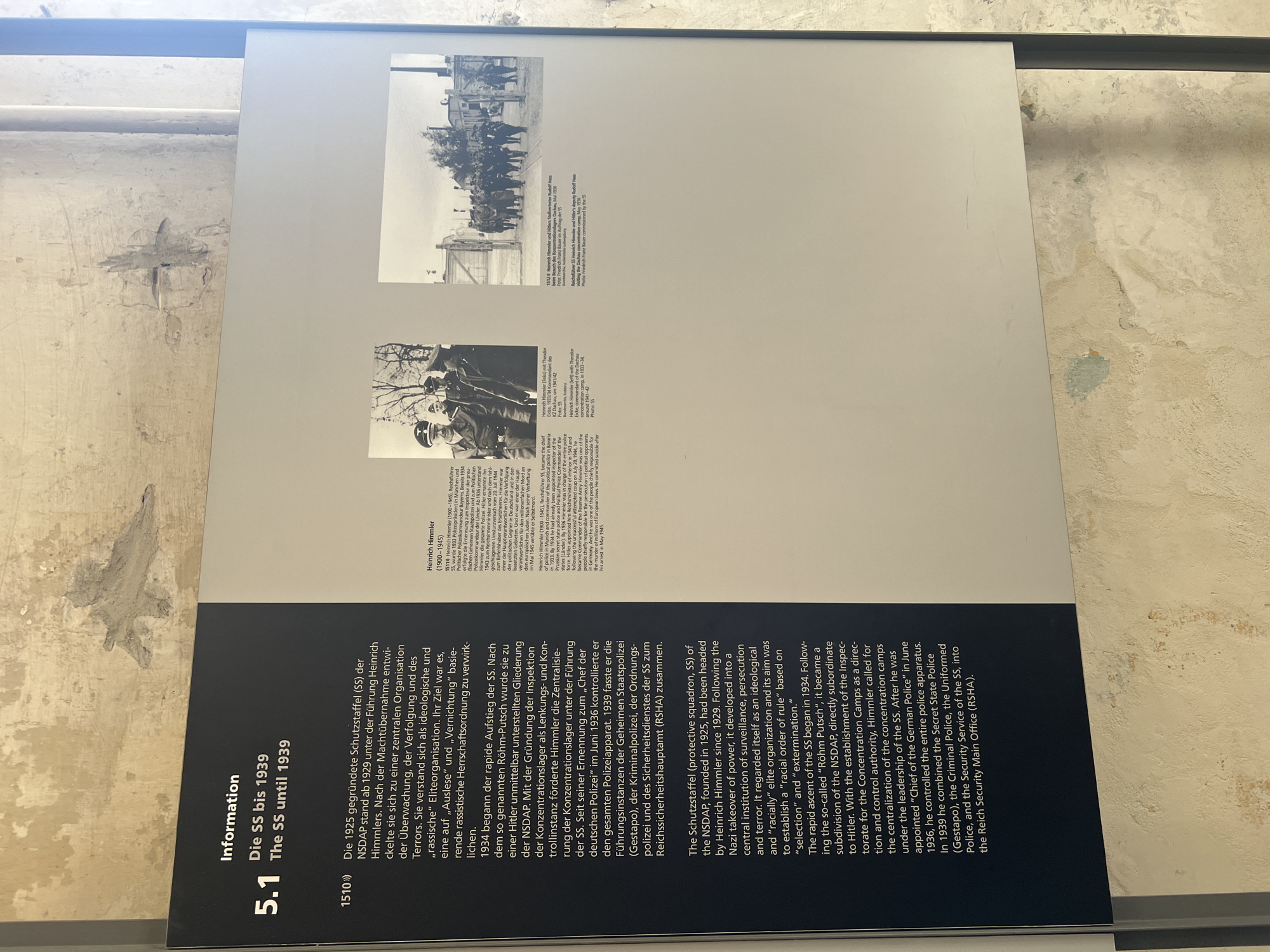
The image shows a display panel inside a museum, likely at the Dachau Concentration Camp Memorial Site, given the context of the text and images. The display has a heading "Information" and a section titled "5.1 Die SS bis 1939 / The SS until 1939." The panel includes text in German and English describing the rise of the SS from 1925 to 1939, its leadership under Heinrich Himmler, and its transformation into an organization focused on surveillance, persecution, and control, leading to the establishment of concentration camps. To the right of the text, there are two black and white photographs. The first photograph, captioned "Heinrich Himmler (Links) mit Theodor Eicke, 1933/34 Kommandant des Konzentrationslagers in Dachau, Mai 1936", shows Heinrich Himmler on the left, wearing a uniform with a cap, smiling. Beside him are two other men in similar uniforms, one of whom is identified as Theodor Eicke. The background appears to be an outdoor setting with some trees. The second photograph, captioned "1932/3 Heinrich Himmler und Hitler's deputy Rudolf Hess visiting the Dachau concentration camp, May 1936. Foto: Friedrich Franz Bauer commissioned by the SS", shows a group of men, presumably prisoners, walking in a line towards a gate. Heinrich Himmler and Rudolf Hess are also present, observing the prisoners. The architecture in the background includes buildings and fences, consistent with a concentration camp setting. The overall environment depicted in the photographs is stark and somber. The display panel itself is mounted on a rough, textured wall, possibly the original structure of a building at the memorial site.
Dachau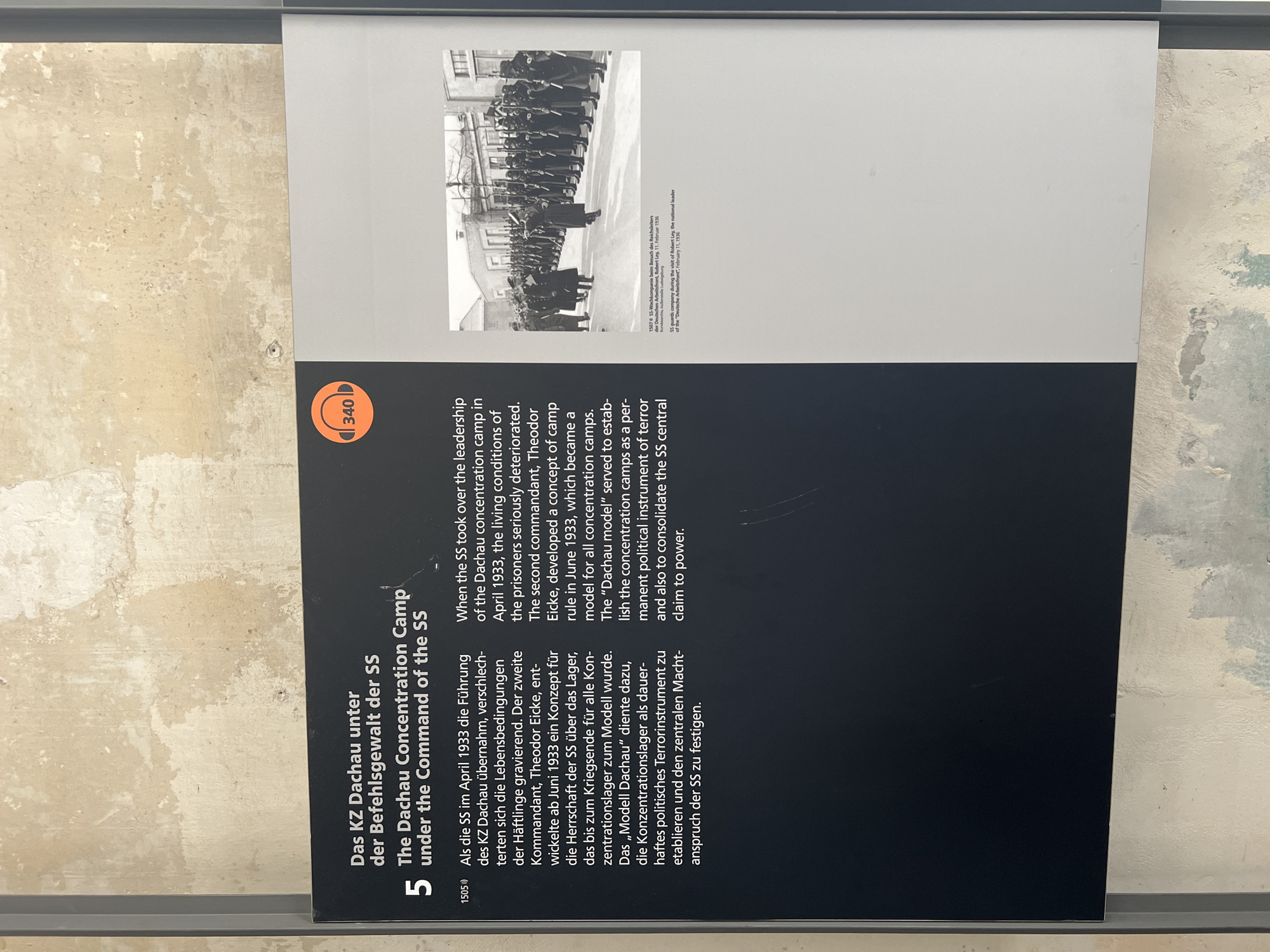
The image shows a panel from a museum exhibit about the Dachau Concentration Camp. The panel features text in both German and English, detailing the camp's operation under the SS. The heading reads "Das KZ Dachau unter der Befehlsgewalt der SS" and "The Dachau Concentration Camp under the Command of the SS." A large number '5' is also prominently displayed. Below the heading, two paragraphs of text describe the SS taking over leadership in April 1933, the deteriorating conditions, and the development of the "Dachau model" as a tool for political terror. To the right of the text, there is a black and white photograph. The photograph depicts a group of SS guards in uniform, standing in formation with rifles, saluting. In the foreground, several SS officers are visible, with one appearing to be inspecting the troops. A building with a barred window is visible in the background. Below the photograph, there is a caption in German and English that identifies the image as "SS-Wachkompanie beim Besuch des Reichsleiters der Deutschen Arbeitsfront, Robert Ley, 11. Februar 1936" and "SS guards company during the visit of Robert Ley, the national leader of the 'Deutsche Arbeitsfront,' February 11, 1936." An orange circular icon with the number '340' in white is visible in the upper right corner of the text area, suggesting it might be an audio guide marker or exhibit number. The background of the exhibit panel appears to be a textured wall, possibly depicting aging plaster or stone. The exhibit is likely located in Dachau, Germany, given the subject matter.
Dachau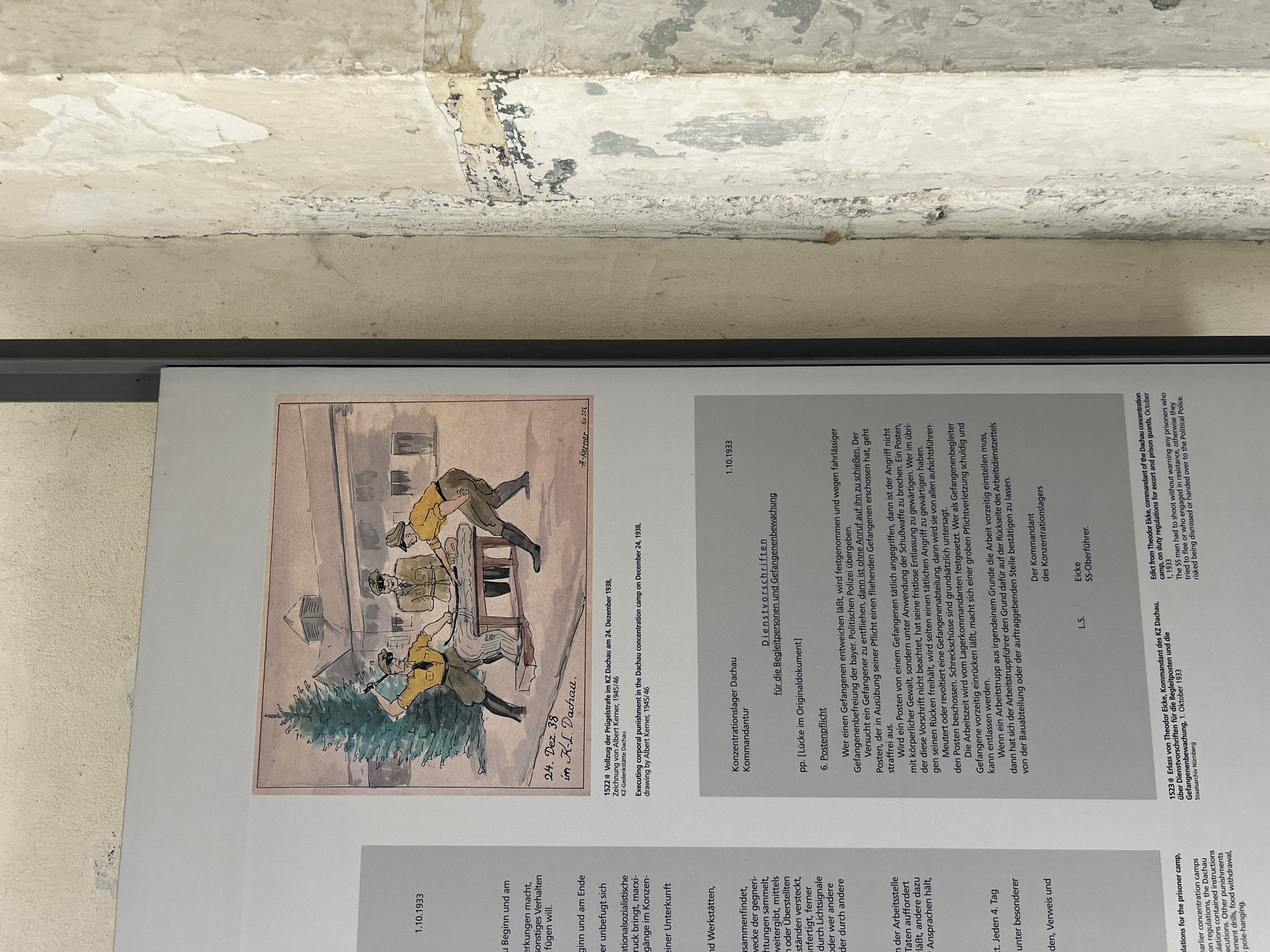
The image displays a framed historical document with an illustration of an outdoor scene depicting the Dachau concentration camp. The illustration shows three figures in uniform, two of whom appear to be guards, holding a bound prisoner. One guard is raising a whip over the prisoner, who is lying on a wooden structure. A Christmas tree stands to the left of the scene, and a building with a steeple is visible in the background. The document includes German text, a date of "24. Dez. 38," and the inscription "in K.L. Dachau." Below the illustration, there is more German text, including a caption that translates to "Executing corporal punishment in the Dachau concentration camp on December 24, 1938, drawing by Albert Kerner, 1945/46." The surrounding text provides context about the concentration camp's regulations and administration. The overall image captures a disturbing historical record of events at the Dachau concentration camp, located near the city of Dachau, Germany.
Dachau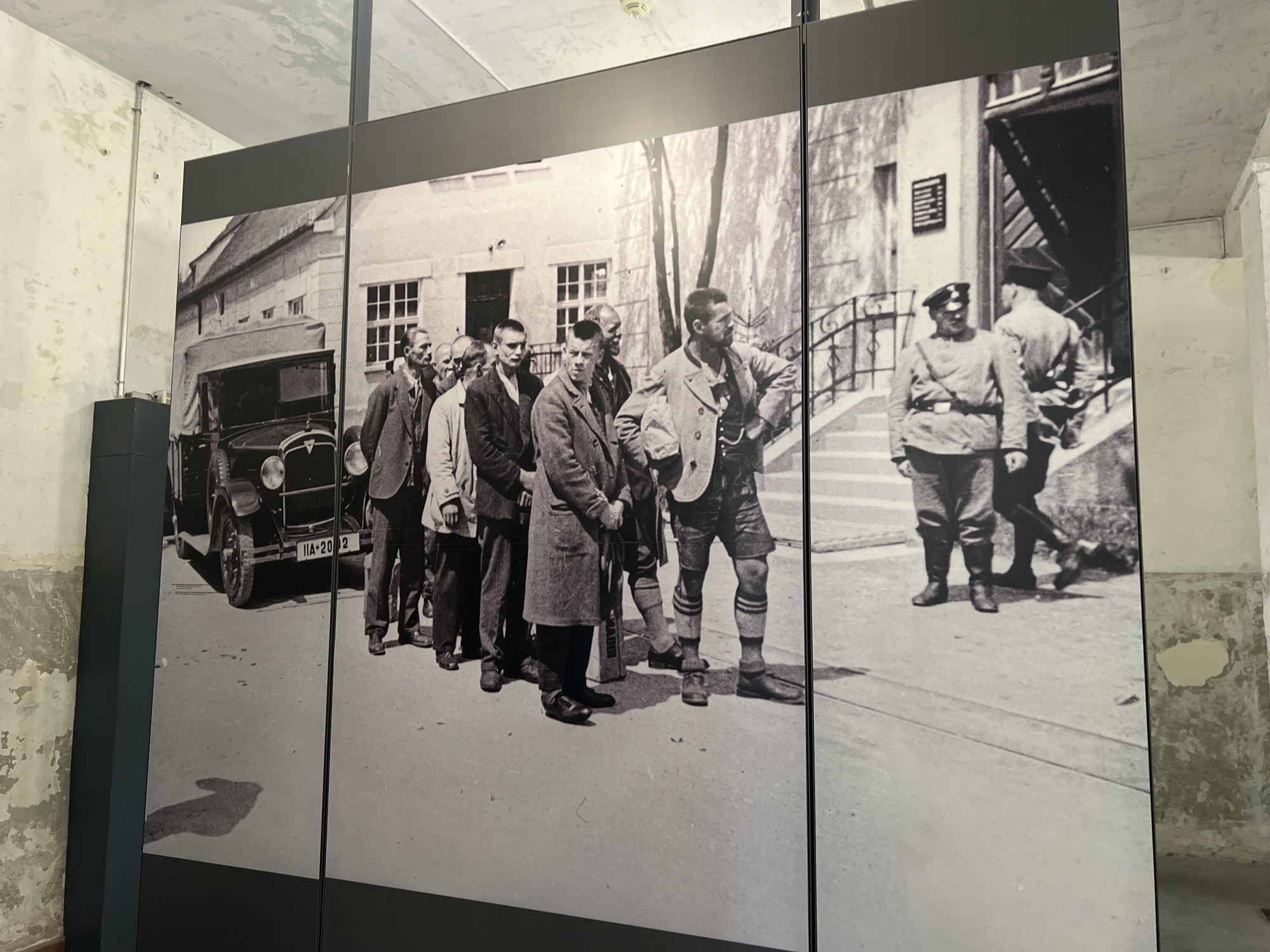
The image depicts a large black and white photograph displayed in a museum setting, likely a former prisoner barracks or an associated building within the Dachau Concentration Camp Memorial Site in Dachau, Germany. The photograph shows a group of men, some in civilian clothing and others in what appear to be uniforms, standing in a line on a paved area outside a building with an entrance and steps. A vintage automobile is parked to the left of the frame. The men are facing in various directions, with some looking towards the building and others looking away. The overall scene is grim and appears to document an event related to the history of the concentration camp. The surrounding environment within the museum shows rough, unpainted concrete walls and ceiling.
Dachau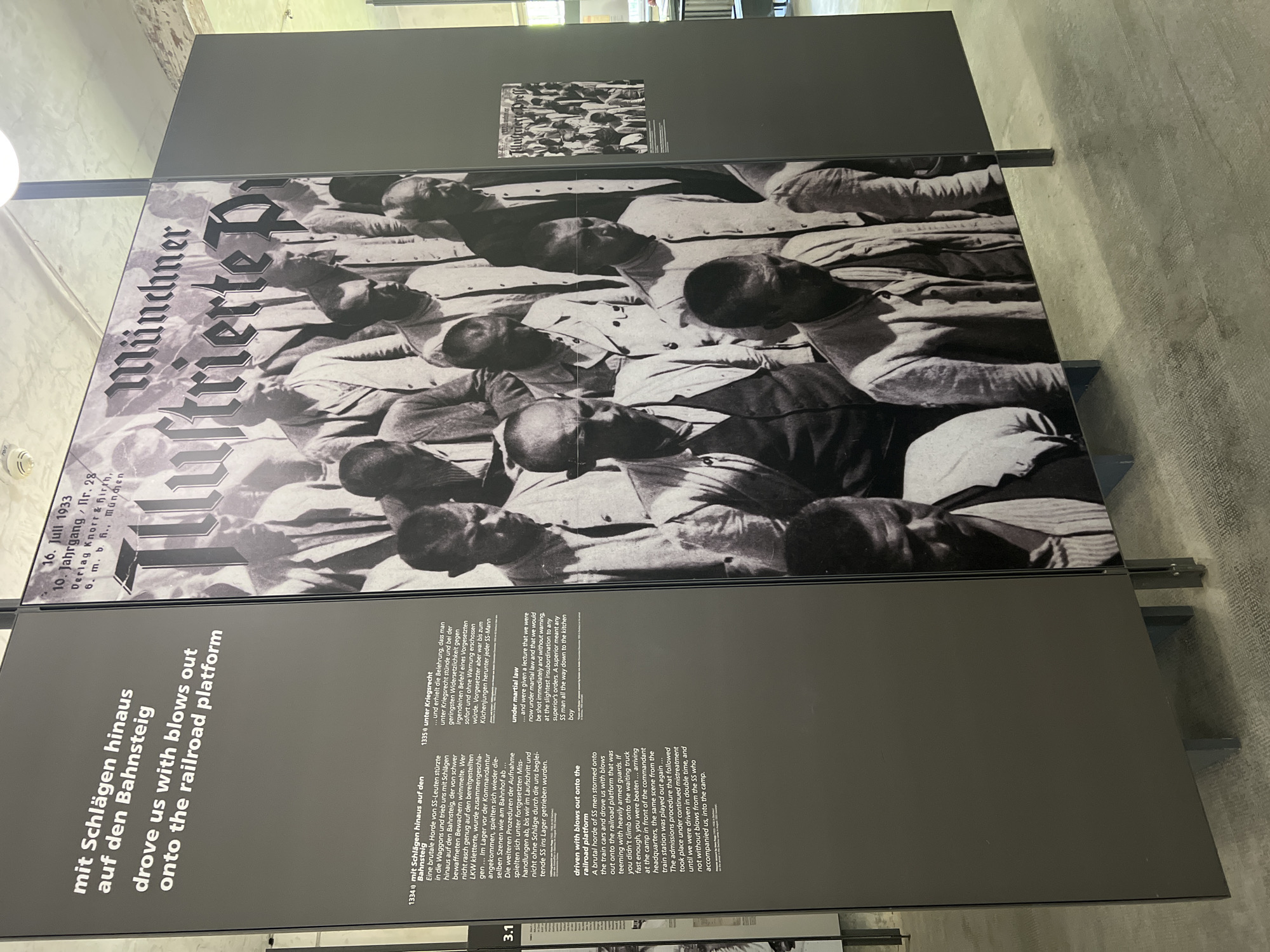
The image displays an exhibit at the Dachau Concentration Camp Memorial Site. The exhibit features a large black and white photographic mural depicting a group of men, likely prisoners, wearing civilian clothing. The mural is accompanied by text panels in German and English. The English text, titled "driven us with blows out onto the railroad platform," describes a brutal experience of being forced out of wagons onto a railroad platform by SS men. It recounts the chaotic arrival at the camp, the intimidating presence of armed guards, and the subsequent admissions procedure. To the right of the mural, a smaller black and white photograph shows a group of men, possibly the same individuals or similar in context, with a newspaper headline visible above them that reads "Münchner Illustrierte Presse," dated "16. Juli 1933." This suggests the larger mural might be a reproduction or an artistic interpretation related to historical documentation from that period. The overall environment appears to be an indoor exhibition space, with modern display panels and lighting. The floor is a patterned carpet. The display is designed to convey historical information and personal experiences from the Dachau concentration camp.
Dachau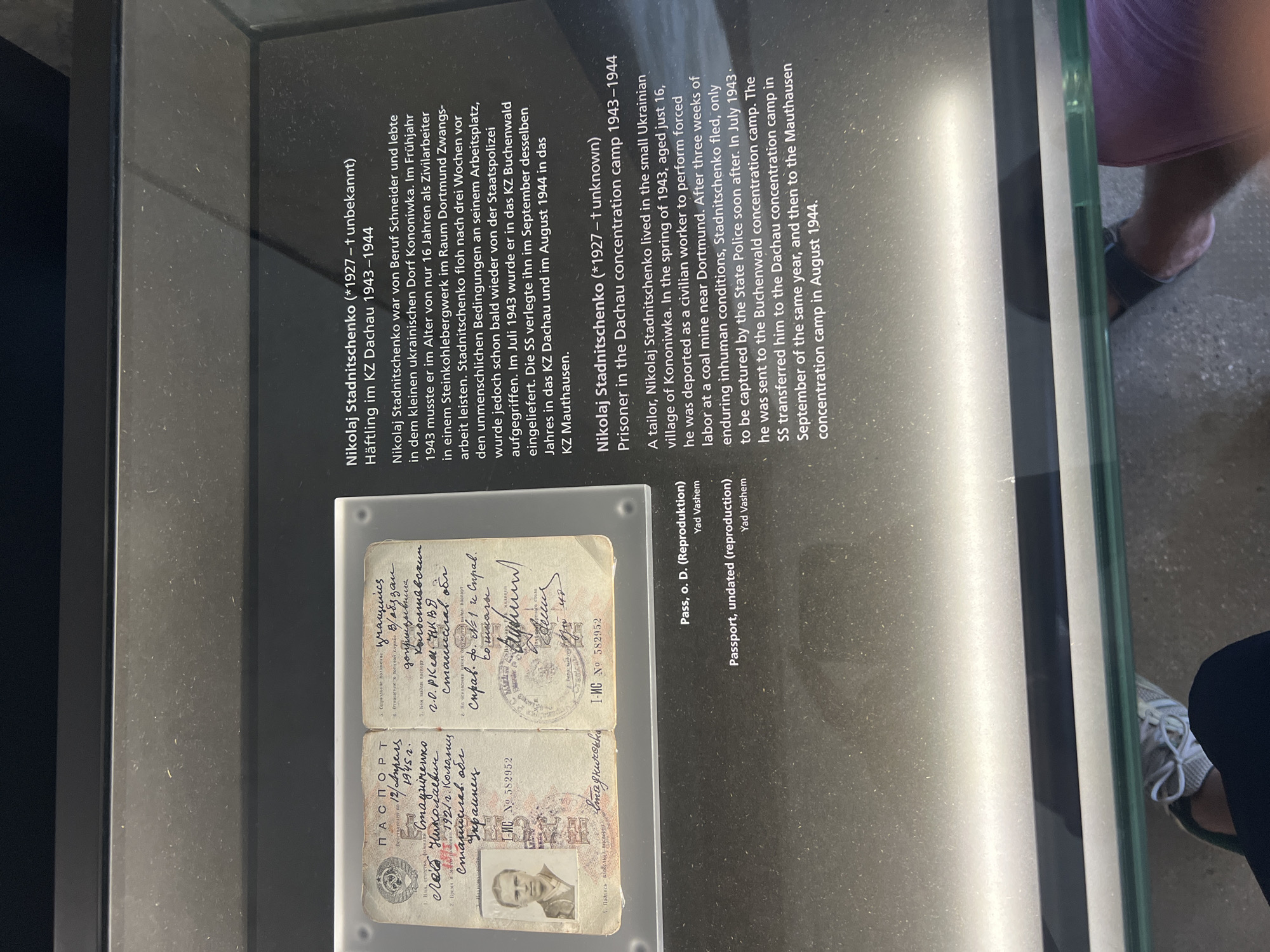
The image shows a display case with historical documents and text panels. In the foreground, a glass-covered display contains an open passport with a photograph of a young man. The passport is partially obscured by reflections. Behind the passport, a text panel in German and English provides biographical information about Nikolaj Stadnitschenko, a prisoner in the Dachau concentration camp from 1943-1944. The text describes his life in a Ukrainian village, his deportation as a forced laborer, his escape and recapture, and his transfer to Dachau and then Mauthausen concentration camps. The text panels and display case are situated within what appears to be a museum or exhibition space. The background is dark and blurred, with some lighting fixtures visible. The scene suggests a historical exhibit focused on the Holocaust or World War II.
Dachau
A model sailboat is displayed on a windowsill in front of a window. Outside the window, trees, buildings, and vehicles are visible. To the left of the sailboat, a white banner with the text "MNI SERVICE" is partially visible. The scene appears to be located in Dachau, Germany.
Dachau
A television displays a man holding a flashlight in an indoor setting. A brown leather purse hangs from a shelf, beside bottles of alcohol and a potted plant. In the foreground, a bed and a chair are visible. The scene is illuminated by natural light and fairy lights, suggesting an evening or dimly lit environment. The location is not explicitly identifiable as Dachau, Germany.
Dachau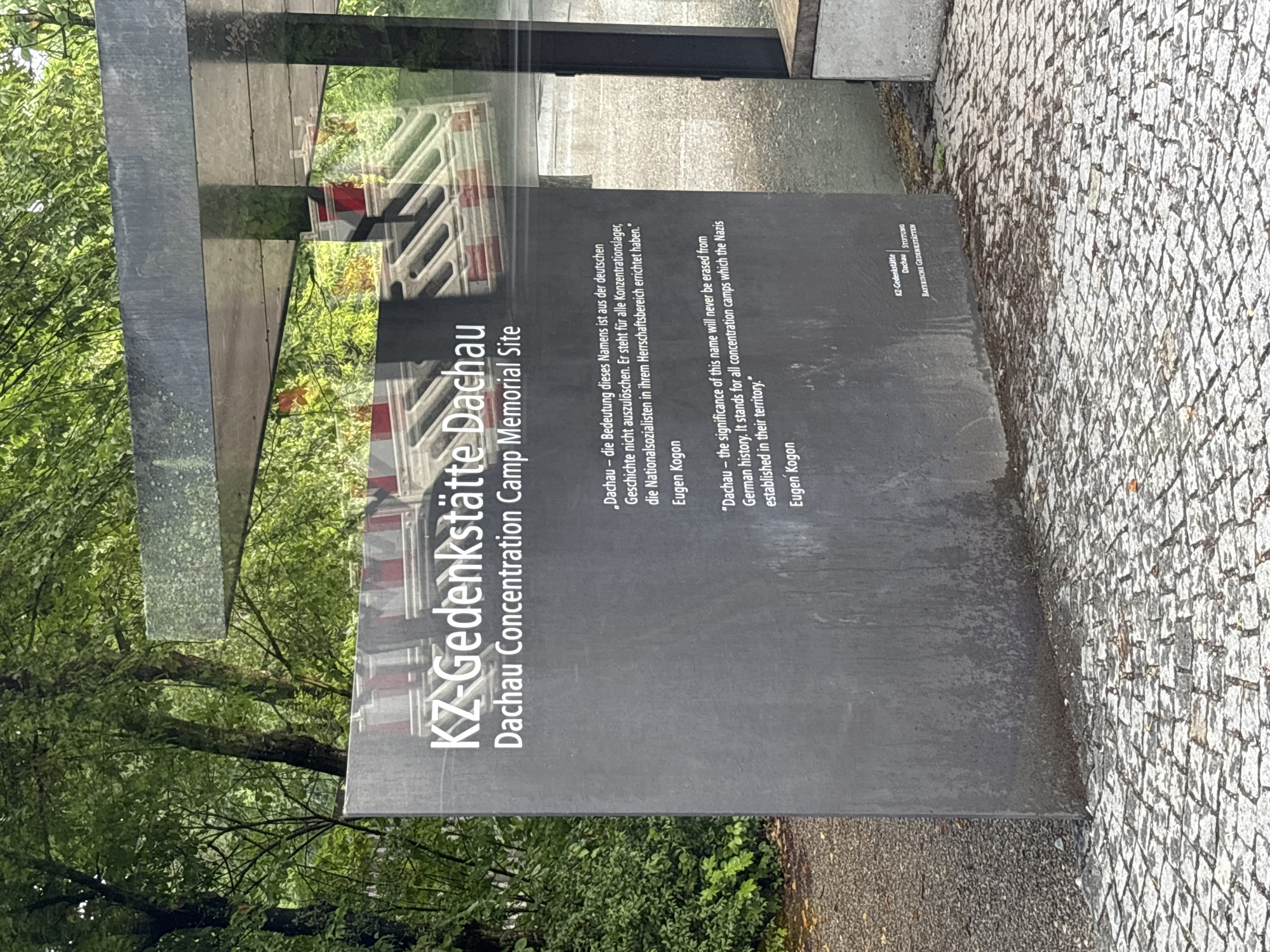
This is a medium-shot, eye-level, outdoor photograph of the KZ-Gedenkstätte Dachau, the Dachau Concentration Camp Memorial Site, located in Dachau, Germany. The primary subject is a large, dark grey, rectangular monument with white text. The text at the top of the monument reads "KZ-Gedenkstätte Dachau" and below it, "Dachau Concentration Camp Memorial Site". Below this, there are two quotes, one in German and one in English. The German quote, attributed to Eugen Kogon, translates to: "Dachau – the significance of this name is from the German history. It stands for all concentration camps which the Nazis established in their territory." The English quote, also attributed to Eugen Kogon, is identical to the German translation. Reflected in the glass canopy above the monument, there are images of what appear to be construction barriers or scaffolding. The background consists of lush green trees and foliage. The ground in front of the monument is paved with cobblestones. A small sign is visible in the lower right corner of the monument, which reads "KZ-Gedenkstätte Dachau Stiftung Bayerische Gedenkstätten". The overall lighting suggests an overcast day, and the monument appears slightly weathered. There are no people visible in the image.
Dachau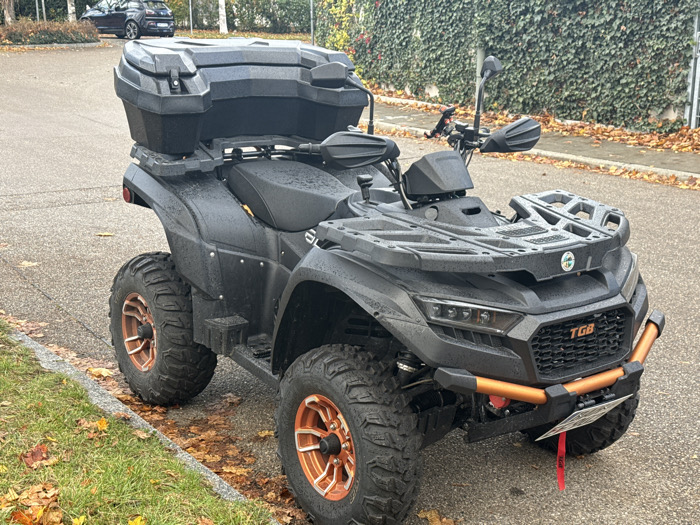
The image displays a dark grey TGB All-Terrain Vehicle (ATV) parked on a paved surface. The ATV features copper-orange six-spoke wheel rims and a matching copper-orange front bumper bar. It is equipped with a large black storage box on its rear rack and a smaller cargo rack at the front. Multi-element headlights are visible, flanking a black honeycomb grille bearing the "TGB" logo. A partially obscured European-style license plate is mounted below the front bumper, from which a red recovery strap hangs. The ATV's surfaces are covered in water droplets, suggesting damp conditions. To the left of the ATV, a concrete curb separates the paved area from a strip of green grass sparsely covered with fallen brown and orange autumnal leaves. The paved surface underfoot also exhibits scattered leaves. In the background, a dark-colored SUV is parked in a wider paved area to the left. To the right, a wall densely covered in dark green ivy forms a backdrop, with bare or lightly foliated trees visible above it. The scene is illuminated by soft, diffused daylight. The location is in Dachau, Germany. While the European license plate format is consistent with German registration, no specific street names, landmarks, or precise coordinates within Dachau are discernible from the image; it depicts a general paved street or parking area environment.
Dachau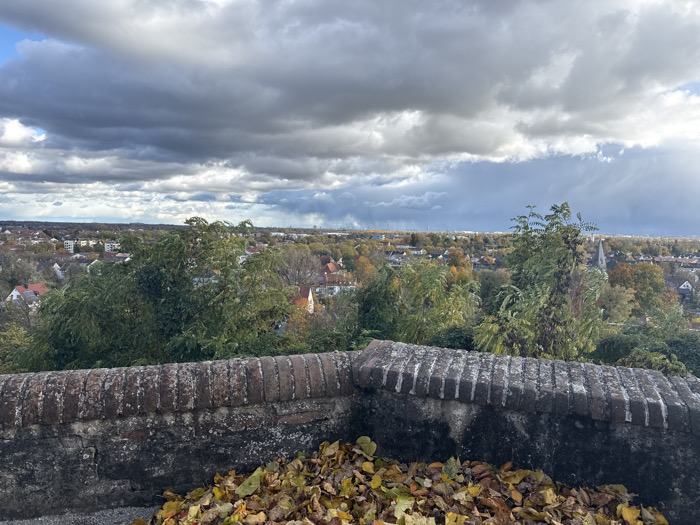
The image depicts a panoramic view over the city of Dachau, Germany, likely taken from the elevated grounds of Dachau Castle, overlooking the old town. In the foreground, a weathered, low brick wall or parapet extends across the lower portion of the frame. It is constructed from irregular, dark red-brown bricks, topped with a flat coping course. The wall exhibits signs of age, including discoloration and some organic growth. At the base of the wall, a scattering of dry, yellow-brown autumn leaves is visible on the ground. Immediately beyond the wall, a dense canopy of trees and bushes, primarily green with some yellowing autumn foliage, partially obscures the urban landscape. A slender, light-colored church spire with a pointed roof rises above these trees to the right of the center. The midground and background present a sprawling residential area characterized by numerous houses with predominantly red-tiled roofs, interspersed with additional trees showing autumnal colors. In the far distance, several wind turbines are discernible against the horizon. The sky occupies the upper third of the image, dominated by heavy, dark grey clouds indicative of unsettled weather. Towards the right side of the frame, a brighter area of sky suggests sunlight breaking through the cloud cover, illuminating parts of the distant landscape. No people or animals are visible in the scene.
Dachau