Dogon Nama, Nigeria
5 memories from Dogon Nama, Nigeria
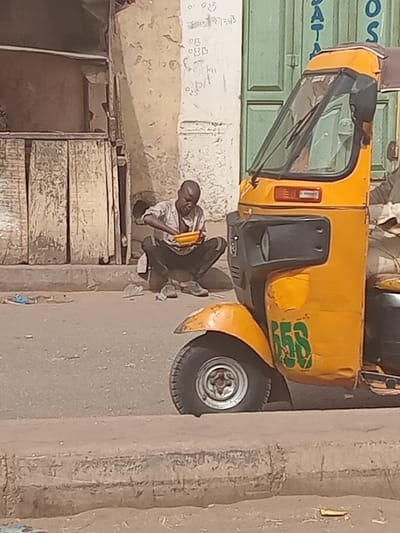
In Dogon Nama, Nigeria, a daylight street scene shows an adult male squatting on the edge of a paved surface. He is wearing a light-colored, short-sleeved collared shirt and dark trousers, with dark shoes visible near his feet. The man holds a bright yellow bowl in his left hand and appears to be scooping food from it with his right hand, his gaze directed at the bowl. To his immediate right, on the paved road, is a yellow three-wheeled motorized vehicle, an auto-rickshaw, with "655" painted in green on its front fender. The vehicle's front windshield, wipers, and the top portion of its cabin are visible, along with its front tire and silver hubcap. In the background, a light-colored, weathered building wall features a section of vertical wooden panels to the left. To the right, green double doors are partially visible, with faint script and partial English words "DATA" and "OS" on the adjacent wall and door. The ground consists of a light-colored paved road and a raised curb, with scattered debris.
Dogon Nama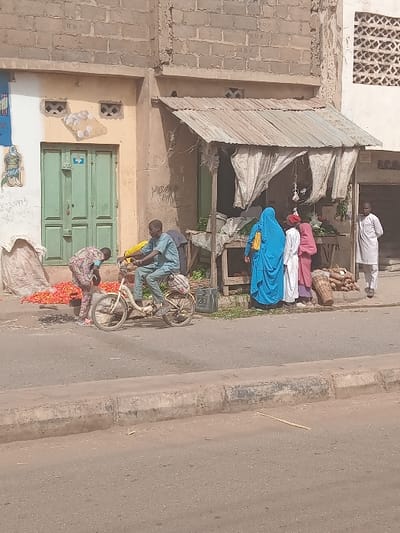
The scene depicts a street market activity in Dogon Nama, Nigeria, viewed from across a two-lane asphalt road with a raised concrete curb. On the dirt-paved area fronting the buildings, seven individuals are present. To the far left, a person in patterned clothing crouches next to a large pile of red produce, presumably tomatoes, laid directly on the ground. A male cyclist, wearing a light-colored long-sleeved shirt and trousers, rides a cream-colored bicycle from left to right in the mid-ground. Behind the cyclist, a market stall with a corrugated metal roof supported by wooden posts and draped with white fabric is set up. This stall displays various green leafy vegetables and other produce. Three individuals, including an adult female in a vibrant blue full veil carrying a yellow bag, and two smaller individuals in white and pink garments respectively, stand facing the stall, appearing to examine the goods. To the far right of the stall, an adult male in a white traditional garment stands observing the scene. The background consists of multi-story buildings constructed with unpainted concrete blocks on the upper levels and painted stucco on the lower levels, featuring a green double door, ventilation blocks, and some faded markings or graffiti. Piles of brown root vegetables are visible near the right side of the market stall.
Dogon Nama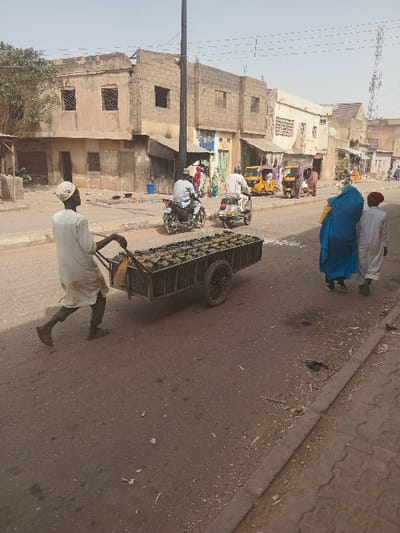
The image depicts a street scene in Dogon Nama, Nigeria, under a hazy, light-blue sky. In the immediate foreground on the left, a male individual, dressed in a light-colored long tunic and white skullcap, pushes a two-wheeled wooden handcart loaded with numerous dark, possibly rectangular items arranged in rows. He walks towards the right side of the frame. On the right foreground, two individuals walk along a dirt and concrete sidewalk. One wears a vibrant blue, full-body garment and appears to carry a yellow object on their back; the other, to their right, wears a light-colored tunic and a red cap. The paved road in the midground features two motorcycles with riders and two yellow tricycle taxis (keke napep), all moving or positioned away from the camera. The background consists of a row of two-story buildings constructed from concrete blocks or rendered earth, primarily light brown or beige, with multiple windows, some open and dark, others with grates. Utility poles and overhead wires are visible, and a lattice telecommunications tower stands in the distant right. The road surface and sidewalk show scattered debris and dirt.
Dogon Nama
The image shows a close-up of a textile, likely denim, with a visible twill weave pattern. The fabric has a muted, cool tone, appearing as a blend of blues and grays. The texture is soft and slightly blurred, suggesting the image was taken at a close range and potentially out of focus. The lighting is uneven, with darker areas fading to lighter areas.
Dogon Nama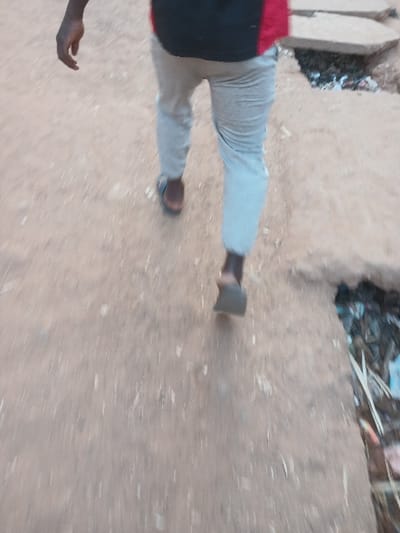
The image, taken in Dogon Nama, Nigeria, depicts a person walking on an unpaved, light brown dirt path or ground. The photograph appears to be rotated 90 degrees clockwise, placing the walking individual diagonally across the frame. The main subject is a person, partially visible from the torso down. They are wearing light-colored trousers, likely grey or light blue, and a dark top with a red section visible on the upper left side of their body. On their feet, they wear simple, dark-colored sandals. The person is in motion, captured mid-stride, with one foot on the ground and the other lifted, indicating they are walking. A dark-skinned hand, with fingers slightly curled, is visible in the lower left portion of the image. The setting is an outdoor area characterized by loose, sandy or dusty ground. Small pebbles or debris are scattered across the path. In the background, particularly towards the upper right (if the image were oriented vertically), there is a cluttered area containing dark refuse, possibly garbage or organic debris, piled against what seems to be a low wall or raised bank. The activity taking place is simply walking. The lighting suggests it is daytime, with soft, diffused light, as there are no distinct shadows. No specific weather conditions are discernible, but the dry, dusty ground implies fair weather. There is no visible text in the image, and no specific emotions can be discerned from the partial view of the person. The overall scene presents an everyday moment in what appears to be a natural or semi-urban outdoor environment.
Dogon Nama