Dulce Nombre de Jesús, Costa Rica
8 memories from Dulce Nombre de Jesús, Costa Rica
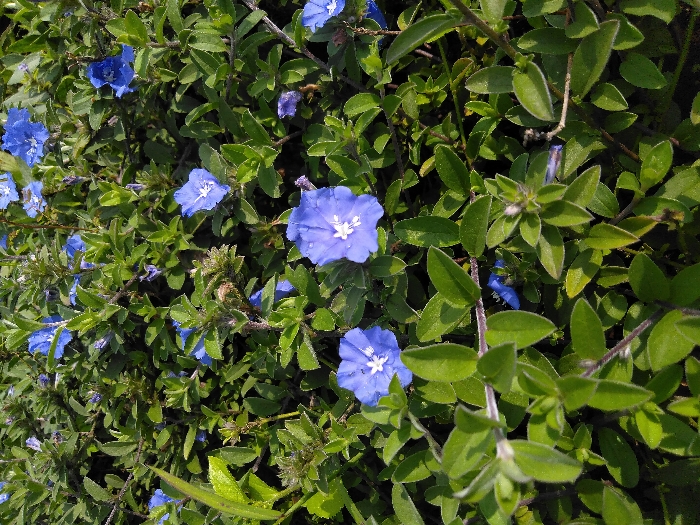
The image depicts a dense, close-up view of a flowering plant, presumably located in Dulce Nombre de Jesús, Costa Rica, though no specific city landmarks are visible. The scene is dominated by vibrant green foliage and numerous small, trumpet-shaped flowers. The flowers are a consistent blue-purple coloration with a distinct white or pale center, typically displaying five fused petals and measuring approximately 2-3 centimeters in diameter. The leaves are ovate to elliptical, bright green, and densely cover thin, branching stems that exhibit a reddish-brown to greenish-brown hue and some visible hair-like texture. The lighting is bright and natural, indicating an outdoor environment. No people, animals, man-made structures, or other discernible objects are present in the frame. The primary action observed is the natural growth and blooming of the plant species.
Dulce Nombre de Jesús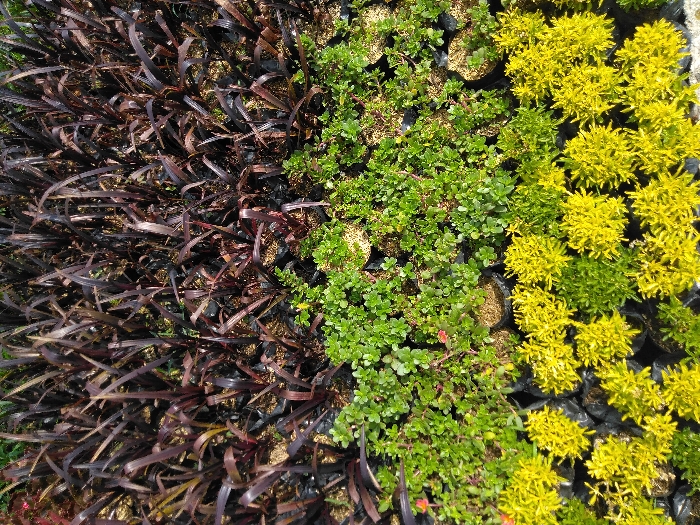
The image depicts an outdoor horticultural scene in Dulce Nombre de Jesús, Costa Rica, featuring multiple rows of potted ornamental plants. The top section displays a dense arrangement of dark reddish-brown, strap-leafed plants, individually contained in black plastic nursery bags. Directly below, a middle section consists of smaller, vibrant green, broad-leafed plants, some exhibiting small red flowers, similarly potted in black plastic bags with visible soil. The bottom section presents a uniform grouping of bright yellow-green, fine-leafed bushy plants, also individually potted in black plastic nursery bags. All plants are static, arranged in distinct horizontal bands, suggesting a nursery or garden center setting under natural light. No individuals are present in the frame, and no specific actions or interactions are occurring.
Dulce Nombre de Jesús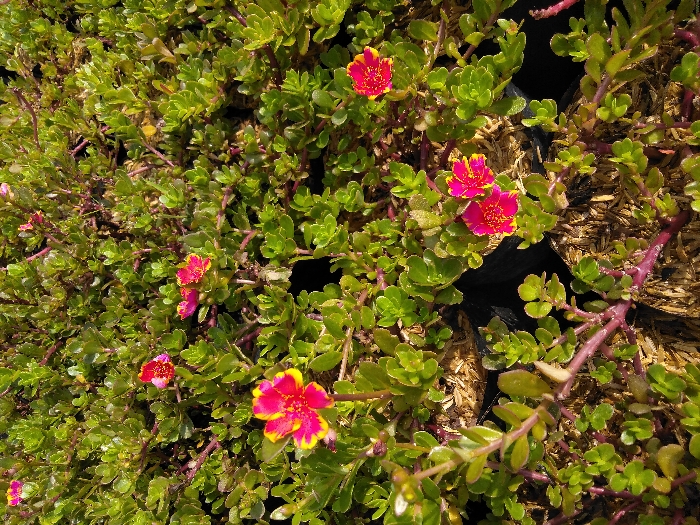
The image displays a close-up, high-angle view of multiple flowering plants in Dulce Nombre de Jesús, Costa Rica. The scene features a dense aggregation of plants with small, green, succulent-like leaves and reddish-purple stems. Numerous bi-colored flowers, primarily magenta or hot pink with distinct yellow margins and yellow centers, are visible across the foliage. These flowers are characteristic of Portulaca species. Partially obscured black plastic nursery pots are present beneath the dense plant growth, containing a light-brown, fibrous substrate resembling wood chips or rice hulls. The environment is well-lit by natural sunlight, indicating an outdoor setting. No individuals or animals are present.
Dulce Nombre de Jesús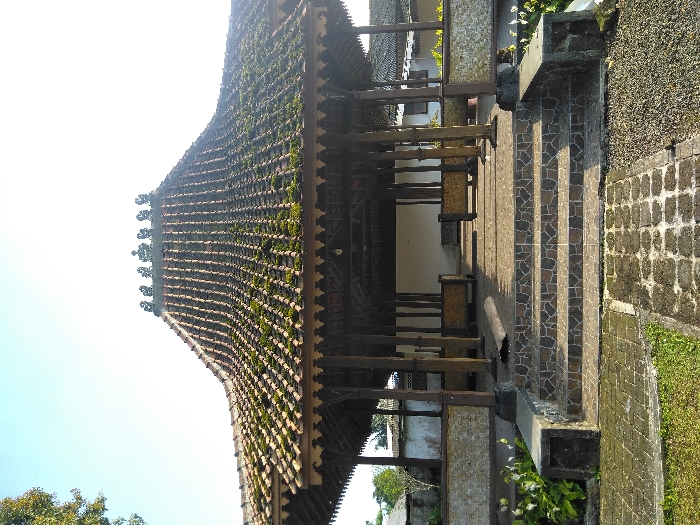
An outdoor pavilion, located in Dulce Nombre de Jesús, Costa Rica, is depicted in a full frontal, eye-level view under a clear, bright sky. The structure features a prominent multi-tiered, brown tiled roof, extensively covered in patches of green moss, with a series of eight ornamental finials along the central ridge. Intricately carved or cut wooden eaves are visible beneath the roofline. The roof is supported by numerous dark-stained wooden posts. The pavilion is elevated on a concrete platform, accessed by a central set of four steps surfaced with brown and grey mosaic-patterned tiles, flanked by low, dark-colored concrete or stone retaining walls. A low, textured, light-colored wall or railing encloses the perimeter of the elevated platform. Inside the pavilion, a plain white wall is visible at the rear, with two low, horizontal benches or platforms, possibly woven or bamboo, situated on a paved floor. No individuals are present in the scene. In the immediate foreground, a rectangular paved pathway, partially covered in moss and grime, leads towards the steps. To the right of this pathway is an area of small gravel, and to the left is an area of mowed grass. Green foliage, including bushes and other plants, is visible on either side of the steps and around the base of the pavilion. A tree trunk and green leaves are visible in the upper left corner of the frame. In the background, beyond the pavilion, other residential-style buildings with light-colored walls and corrugated roofs are partially visible, alongside additional distant trees. The scene is illuminated by natural sunlight, casting shadows.
Dulce Nombre de Jesús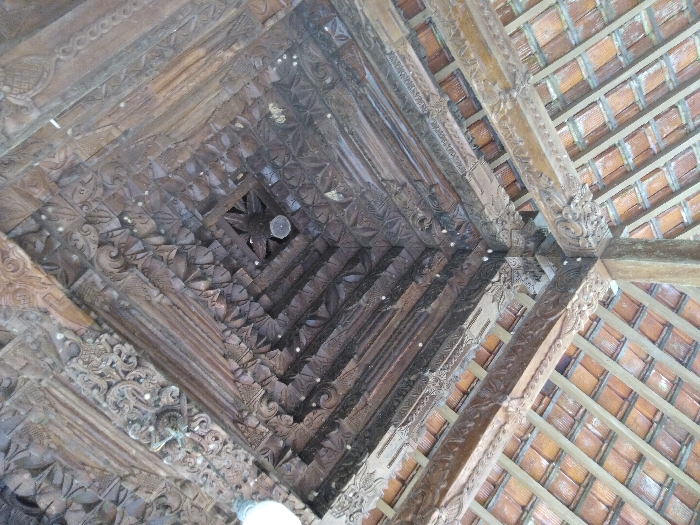
An upward-angled view captures a richly carved, dark-stained wooden ceiling within a structure in Dulce Nombre de Jesús, Costa Rica. The ceiling features a complex coffered or pyramidal design composed of multiple layers of wooden beams and panels, all intricately carved with floral, geometric, and scrollwork motifs. A central square opening is present at the apex, containing a small, light-colored circular object, likely a vent or fixture. White specks, consistent with dust or mildew, are visible across the dark wood surfaces. A partial view of a white, opaque light fixture is visible in the upper-left quadrant. On the lower sides of the image, sections of a sloped roof constructed from overlapping terracotta tiles and supported by wooden rafters are visible. Heavy, carved wooden beams and a structural pillar are also visible, connecting the roofline to the ornate ceiling.
Dulce Nombre de Jesús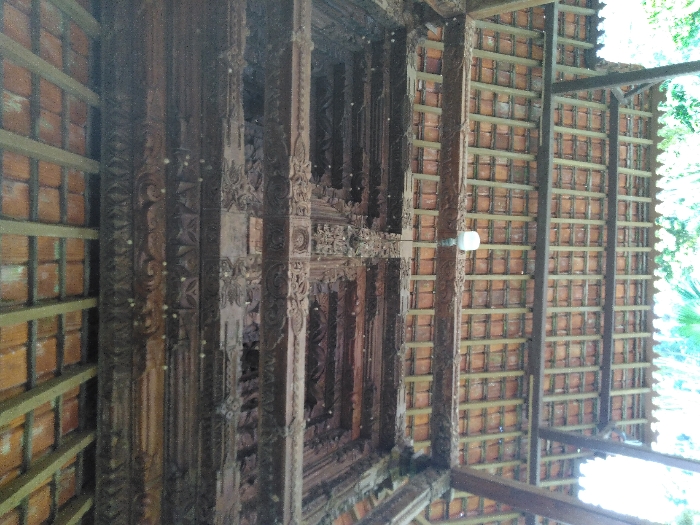
This image depicts the underside of an elaborate, multi-layered wooden and tiled roof structure located in Dulce Nombre de Jesús, Costa Rica. The ceiling is characterized by dark, heavily carved wooden beams and panels displaying intricate patterns and decorative elements. Multiple horizontal wooden beams span the view, featuring geometric and organic carvings. Above these carved sections, rows of exposed terracotta roof tiles are visible, supported by lighter-colored wooden or metal battens. A single white, bulb-shaped light fixture hangs from a wire in the lower-central portion of the image, suspended from one of the carved wooden beams. Towards the bottom of the frame, out-of-focus green foliage is visible, suggesting an outdoor or semi-outdoor setting beneath the structure. No individuals are present in the scene.
Dulce Nombre de Jesús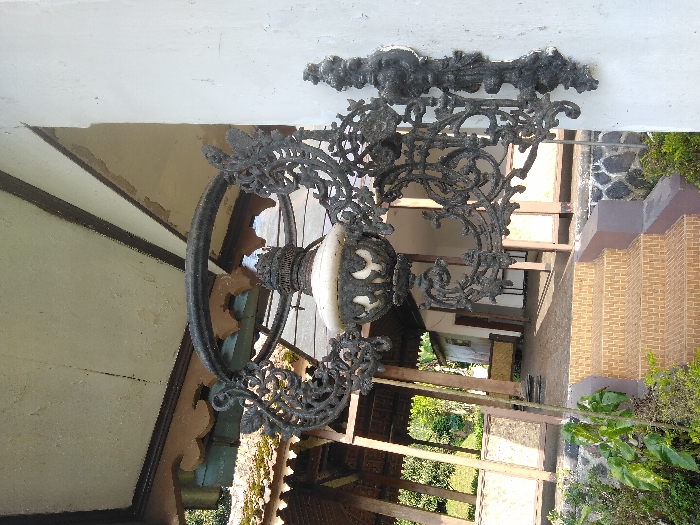
A large, ornate, black cast-iron wall-mounted lantern fixture is affixed to a white, weathered concrete pillar or wall in Dulce Nombre de Jesús, Costa Rica. The fixture, positioned prominently in the foreground, features intricate scrollwork surrounding a central opaque, light-colored glass globe with a textured, dark metal cap. Above the lantern, a light-colored soffit with peeling paint and dark brown trim is visible, supported by decorative wooden eaves in light brown and teal. Below the lantern, a set of three tiled steps, patterned in light brown squares, ascends towards a covered patio or veranda. This structure, partially visible in the midground, has dark wooden posts, a dark roof, and a visible concrete or tiled floor. To the left of the steps, green foliage and bushes are present, bordering a dark, rough-hewn stone base or wall. No individuals, actions, or specific interactions are depicted. The scene is illuminated by natural daylight.
Dulce Nombre de Jesús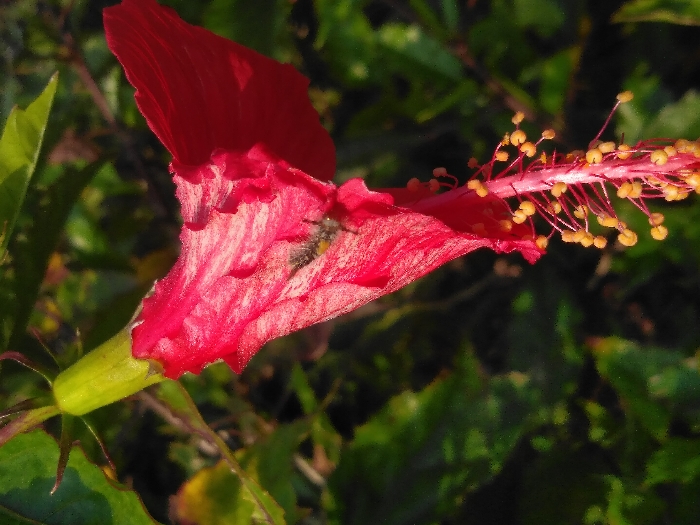
An image taken in Dulce Nombre de Jesús, Costa Rica, displays a close-up view of a vibrant red hibiscus flower, likely a Hibiscus rosa-sinensis type, positioned downwards. The flower's petals are a rich red, exhibiting a slightly textured or crinkled surface. A small, dark-bodied, fuzzy insect is observed situated within the interior of the flower's corolla, near the base of the central red staminal column. This column extends downwards, densely covered with numerous small, yellow-orange anthers. The flower is attached to a robust green pedicel, with a green calyx visible at the base of the petals. The background consists of blurred green foliage, indicative of an outdoor, natural environment under ambient daylight.
Dulce Nombre de Jesús