Dura, Palestinian Territory
28 memories from Dura, Palestinian Territory
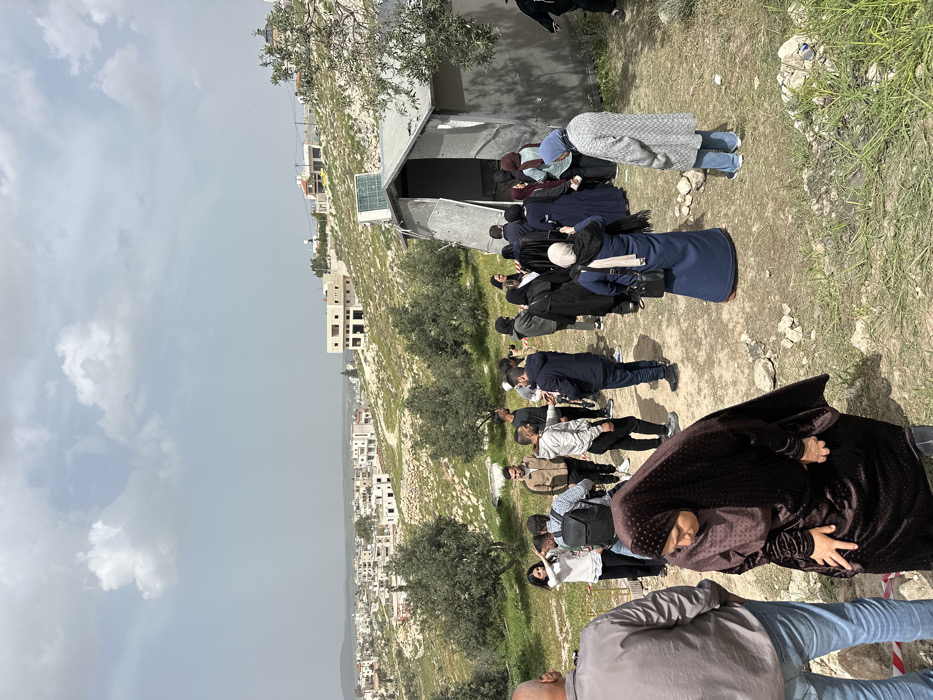
The image depicts an outdoor scene in Dura, Palestinian Territory, on a partly cloudy day. In the foreground, a woman in a dark brown abaya and hijab walks from left to right, partially obscured. A man in a grey shirt and blue jeans stands to her left, facing away. Red and white striped tape is visible on the ground near his feet. The midground features a gathering of approximately 20-30 individuals, predominantly adults, on an unpaved, uneven dirt path with sparse green vegetation and rocks. The group comprises men in casual clothing (jeans, jackets, shirts) and women, many of whom wear hijabs and long modest clothing (abayas, dresses) in various colors, including dark hues, blue, and grey. Individuals are standing in small clusters, some appearing to be engaged in conversation or observing a point of interest. One woman in a blue abaya and black hijab holds a smartphone, appearing to photograph or record. To the right midground, a grey, temporary or makeshift structure with a rectangular opening is visible. A small solar panel is mounted on its roof. Scattered olive trees with green foliage are present across the hillside behind the gathering. The background reveals a panoramic view of the city of Dura, extending across a valley and up several hillsides. Numerous light-colored, multi-story buildings, some appearing unfinished, are visible. Patches of green vegetation are interspersed among the structures and across the hilly terrain. Distant hills mark the horizon under a sky with scattered white clouds.
Dura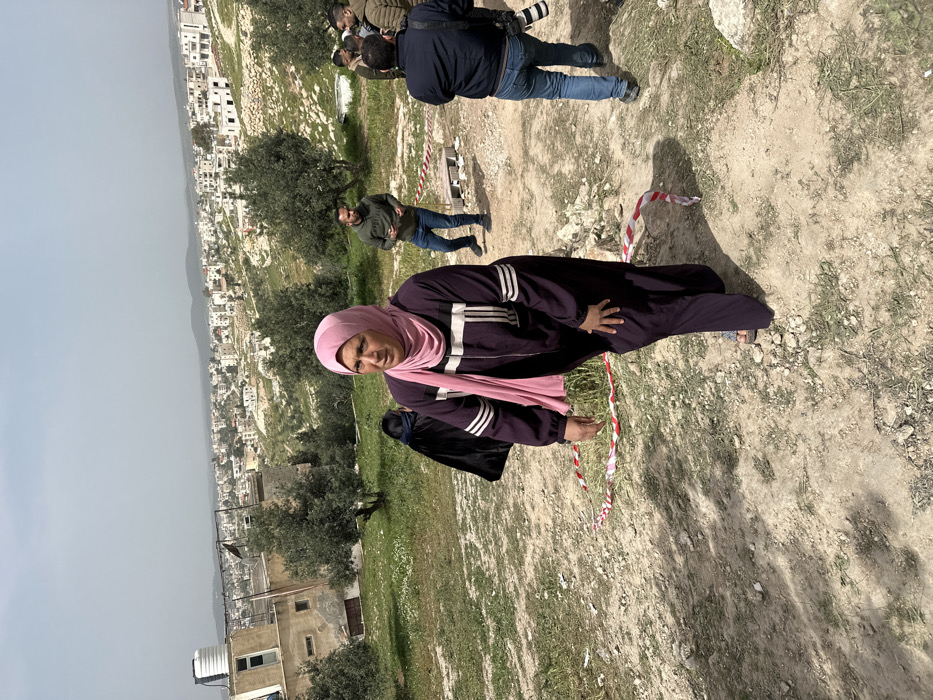
The image depicts an outdoor scene in Dura, Palestinian Territory, on a dry, uneven hillside with sparse grass and scattered olive trees. In the foreground, a woman in her 40s-50s, wearing a pink hijab and a dark purple, full-length tracksuit with white stripes, walks or stands, looking towards the viewer's left with a serious expression. Red and white striped barrier tape is visible on the ground around her feet. Behind her, to the left, a person in a black, full-length garment is partially visible from the back. To the right, a man in a dark blue jacket and jeans is seen from behind, holding a camera with a telephoto lens. Further back, another man in a dark green hooded sweatshirt and blue jeans stands, looking at a mobile phone. Several other individuals are present in the mid-ground, partially obscured. In the background, an urban settlement with numerous residential buildings, consistent with the town of Dura, spreads across a valley and up an opposing hillside. A multi-story building with a white rooftop water tank is visible on the left side of the mid-ground. A small structure made of concrete blocks is present on the ground within the area marked by the barrier tape. The sky is hazy.
Dura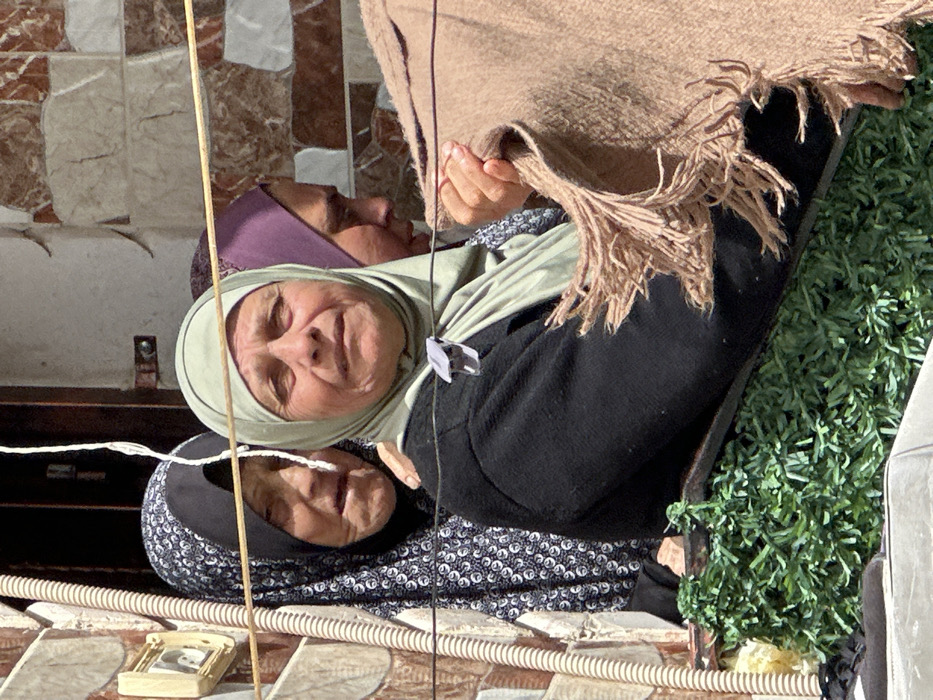
Three women are observed from an elevated perspective in Dura, Palestinian Territory, looking out at an unseen event. The central figure, a middle-aged woman, wears a light olive-green hijab and a dark long-sleeved top. Her eyes are red-rimmed and appear moist, and her mouth is slightly ajar, suggesting distress. A small white clip is fastened to her top near her right shoulder. Her right hand holds a corner of a thick, light brown, fringed woven fabric. To her left and slightly behind, an older woman with visible facial wrinkles wears a black hijab patterned with white elements; her expression is similarly distressed, and her right hand rests lightly on the central woman's left shoulder. To the central woman's right and rear, a younger woman in a purple hijab is partially visible in profile, facing towards the right with a downward gaze; her right hand also grips the fringed fabric. Below the women, a band of dense green artificial foliage is present. The background consists of a wall constructed from light tan and reddish-brown rectangular tiles in a staggered pattern. A tan corrugated conduit runs vertically on the left side of the wall, alongside a small, rectangular, light-colored electrical box. Two thin, dark horizontal wires traverse the scene across the mid-ground. A single thin, white twisted cord hangs vertically in the upper left quadrant of the frame. The scene is illuminated by bright daylight.
Dura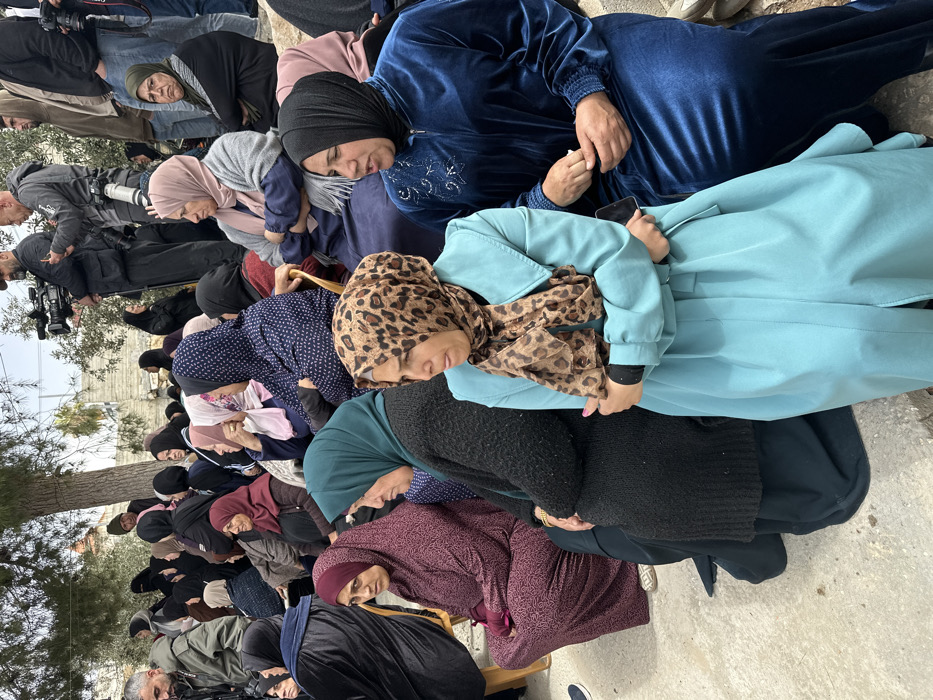
The image depicts an outdoor gathering in Dura, Palestinian Territory. The foreground and midground are densely populated by numerous individuals, predominantly women, many of whom are seated. Women are dressed in long, modest clothing and head coverings (hijabs) of various colors, including burgundy, dark teal, black, light blue, grey, and a leopard print pattern. In the immediate foreground, a woman wearing a light blue coat and a leopard print hijab shows an expression consistent with distress or crying, with tears visible on her face; she holds a dark cell phone in her left hand. To her right, another woman in a dark blue velvet abaya and black hijab is speaking, with her mouth open. In the background, several men are standing, some operating professional video cameras with attached lenses and possibly tripods, indicating a media presence. The ground is a light-colored concrete surface. Trees and distant building structures are visible under an overcast sky. Yellow-gold chairs are partially visible where some women are seated. The overall atmosphere appears somber.
Dura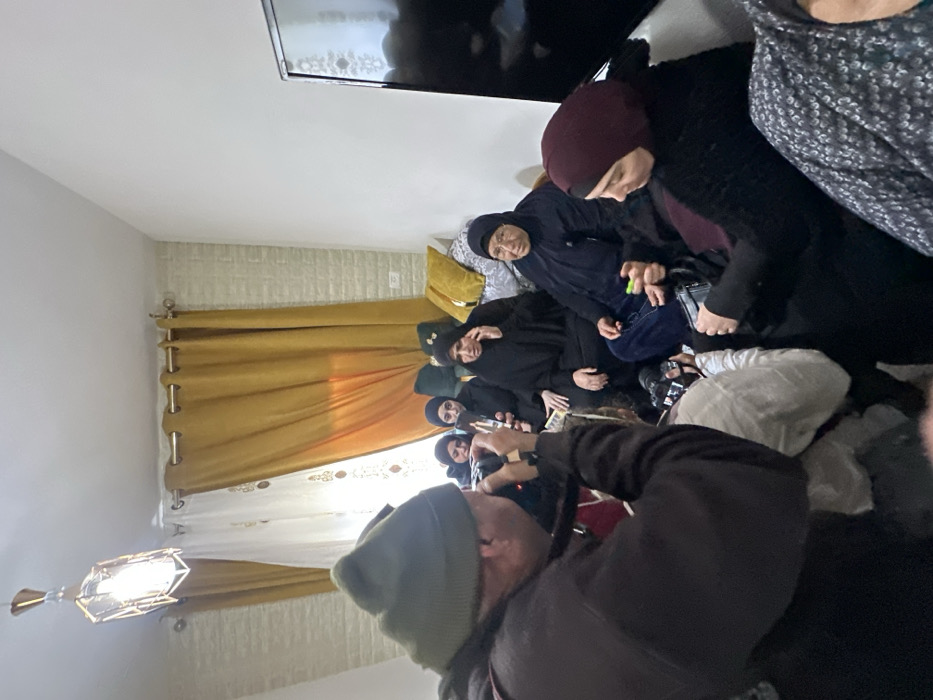
The image captures an indoor gathering in Dura, Palestinian Territory. In the foreground, a male individual, seen from behind, wearing a dark coat and a dark green knit cap, holds a camera device to his eye, appearing to film or photograph a group of women. Seven women are visible, seated on a light-colored sofa in the mid-ground and background. They are predominantly dressed in dark clothing and head coverings. One woman in black, central to the seated group, has her left hand raised to her face, indicating potential distress. An older woman with glasses, seated to her right, holds a small, bright green object in her right hand. Another woman to the left holds a smartphone vertically. The room features a textured light-colored brick-patterned wall on the left, partially covered by yellow and white curtains, and a plain white wall on the right with a mounted dark flat-screen television. A geometric pendant light fixture hangs from the ceiling.
Dura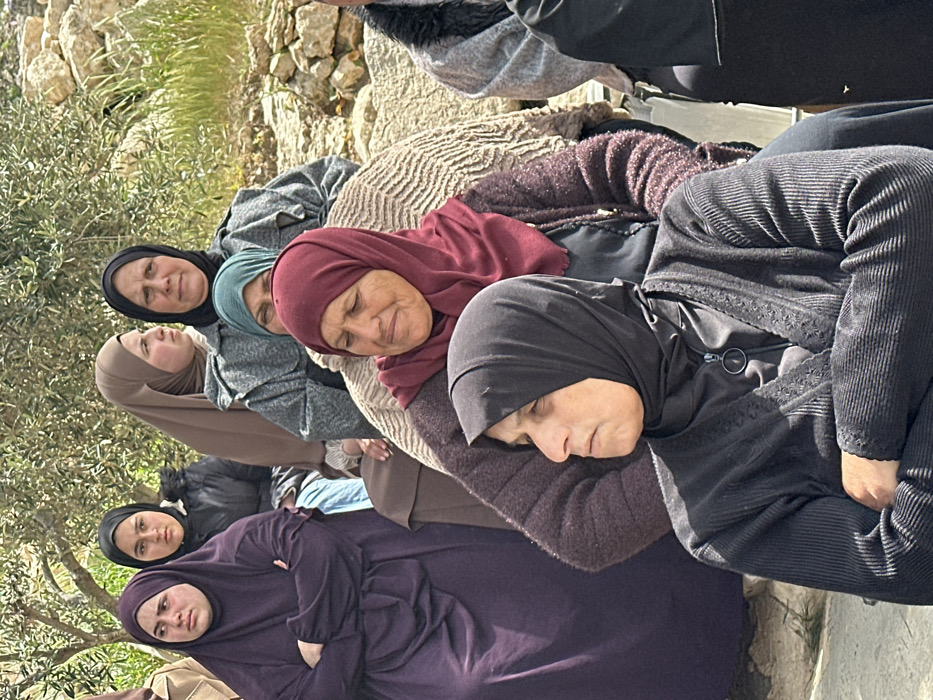
The image depicts a group of at least seven women gathered outdoors in Dura, Palestinian Territory. The women are dressed in traditional Islamic attire, including various colored hijabs (head coverings) and modest clothing. In the immediate foreground, a woman with a black hijab and ribbed black cardigan is seen in profile, looking left with her arms crossed. Directly behind her, an older woman with a dark red hijab and textured maroon top looks downwards and slightly right. To the far left, a woman in a dark purple abaya and hijab stands with crossed arms, looking towards the left foreground. Behind her, a younger woman in a black jacket and black hijab looks forward. To her right, a woman in a brown hijab and a grey patterned jacket looks right, while an older woman next to her, wearing a black hijab and a similar grey patterned jacket, looks forward. A partial view of a woman with a teal hijab is visible behind these two. The background features rocky terrain with sparse green vegetation and what appears to be olive trees under daylight conditions. The women appear to be observing something off-camera, with varied expressions and postures.
Dura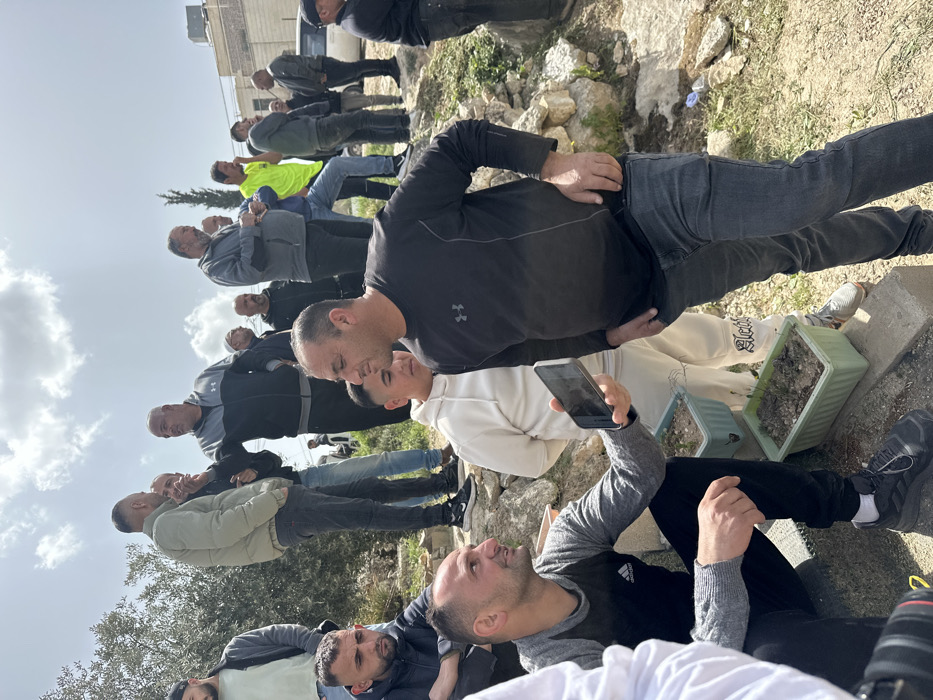
The scene depicts an outdoor gathering of approximately 15-20 adult males in the city of Dura, Palestinian Territory, under a partially cloudy sky. In the mid-right foreground, a man in a black long-sleeved shirt with an Under Armour logo and dark jeans stands, facing left with his left hand in his pocket. To his immediate left and slightly behind, a younger man in a white hooded sweatshirt and light-colored pants is partially visible, facing forward. In the lower left, a man in a grey and black long-sleeved shirt with an Adidas logo and black pants is crouching, holding a black smartphone horizontally in his right hand, pointed towards the standing man. Behind these individuals, numerous other men are dispersed across uneven, rocky terrain. They are casually dressed in a variety of jackets, hoodies, and jeans. Notable figures include a man in a light green puffer jacket interacting with another in a grey and black hoodie in the mid-left background, and a man in a bright neon yellow shirt further back on the right. The ground consists of dirt patches, scattered stones, and sparse green vegetation. Two light green rectangular planters containing soil and minimal plant growth are positioned on the ground between the crouching man and the standing men. A leafy green tree or bush is visible on the far left. In the far background, light-colored buildings, possibly residential structures, and a slender evergreen tree are present under the open sky.
Dura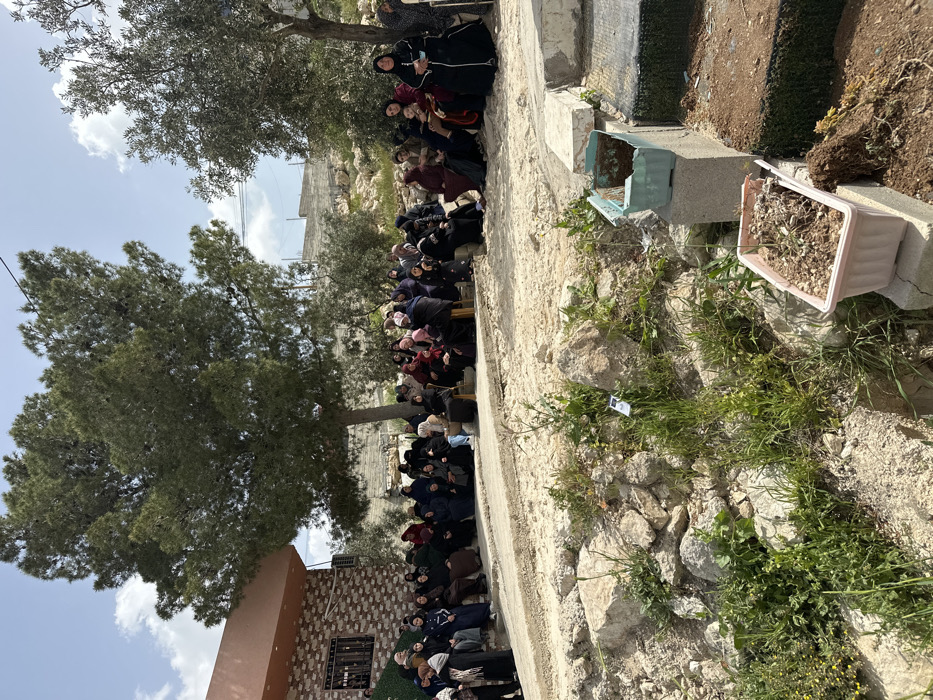
The image depicts an outdoor gathering of approximately 50-70 individuals, predominantly women and children, in the city of Dura, Palestinian Territory, under a partly cloudy sky. In the foreground, an uneven patch of ground shows rocks, sparse soil, and various green plants and weeds. Two plastic planters, one light green and one light pink, rest on concrete blocks on the right side of this area, containing soil and minimal plant growth. The midground features a large group of people seated on a slightly elevated, light-colored dirt or paved surface. Most individuals are women, wearing traditional attire including headscarves and long garments, primarily in dark colors such as black, brown, and navy, with some accents of red or lighter shades. Several children are present, some held by adults. The group appears to be observing or listening, with their attention generally directed towards the left side of the frame. The background includes a two-story building on the left with a patterned brick-like facade and a light orange roof overhang, featuring an externally mounted air conditioning unit. A large, dense evergreen tree stands centrally, providing shade over a portion of the gathering. To the right, another olive tree is visible. Beyond the gathering and trees, additional residential structures and rocky, uncultivated hills extend towards the horizon. Utility lines are visible traversing the upper portion of the sky.
Dura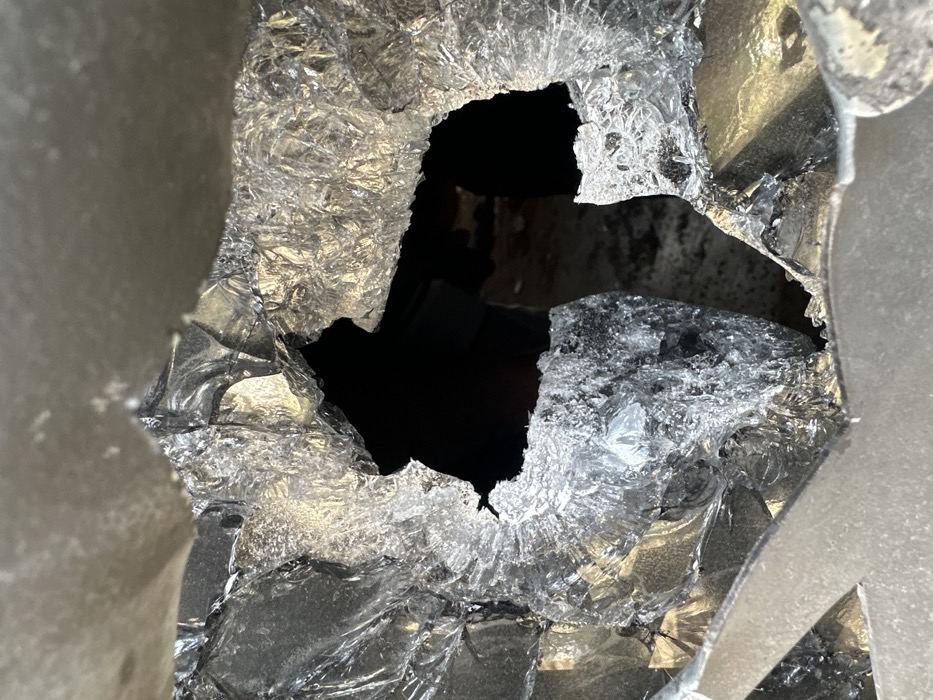
The image displays a close-up, top-down view of a large, irregular hole in a shattered, translucent panel, consistent with broken tempered glass. The fragmentation pattern exhibits numerous small, interconnected, crystalline-like shards with sharp, jagged edges, heavily refracting and reflecting light. The central aperture, roughly amoeboid in shape, reveals a dark, indistinct void or interior space beyond. Portions of a lighter, opaque structural frame or mounting surface are visible at the periphery of the shattered material, particularly at the top and bottom of the frame. No individuals, discernible objects, or specific actions are present within the immediate scene. This damage is located in the city of Dura, Palestinian Territory.
Dura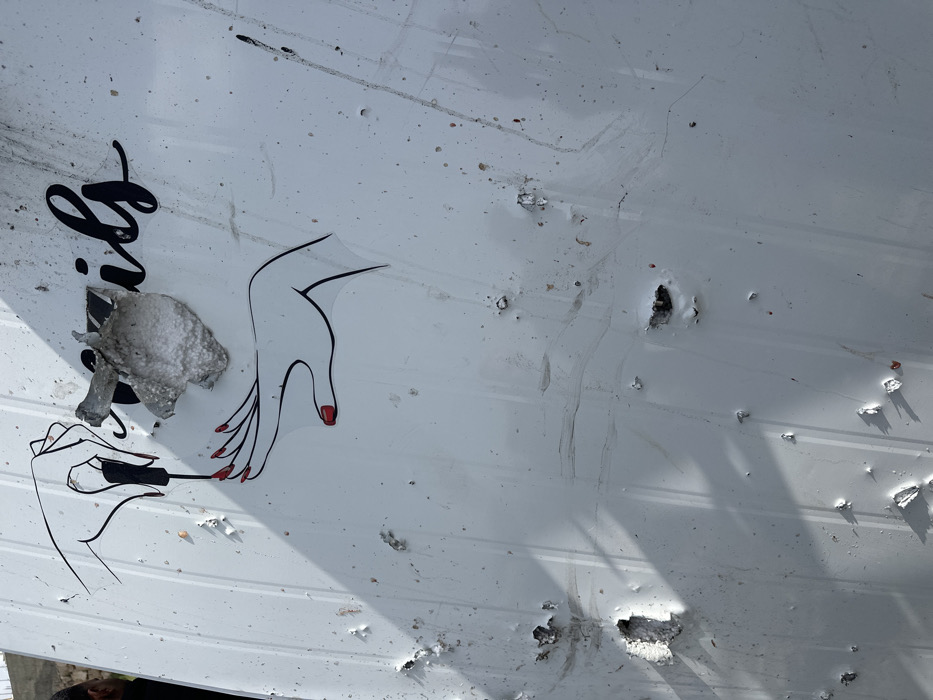
A white corrugated metal or panel surface, located in Dura, Palestinian Territory, is extensively damaged with numerous impact points. The upper section features a graphic of two stylized hands: one hand holds a red nail polish brush, appearing to apply polish to the nails of the second hand. Both hands have red-painted nails. The partial word "ils" from "Nails" is visible in black cursive script in the upper right. The surface exhibits a multitude of small indentations, perforations, and larger pockmarks where the white outer layer is chipped away, revealing a white, crumbly interior material. One significant impact near the word "ils" has torn and warped the surface, leaving a jagged, upward-curling piece of material. The scene is illuminated by strong daylight, casting distinct shadows from the irregularities in the damaged surface and a series of parallel vertical shadows along the left side. No individuals are present.
Dura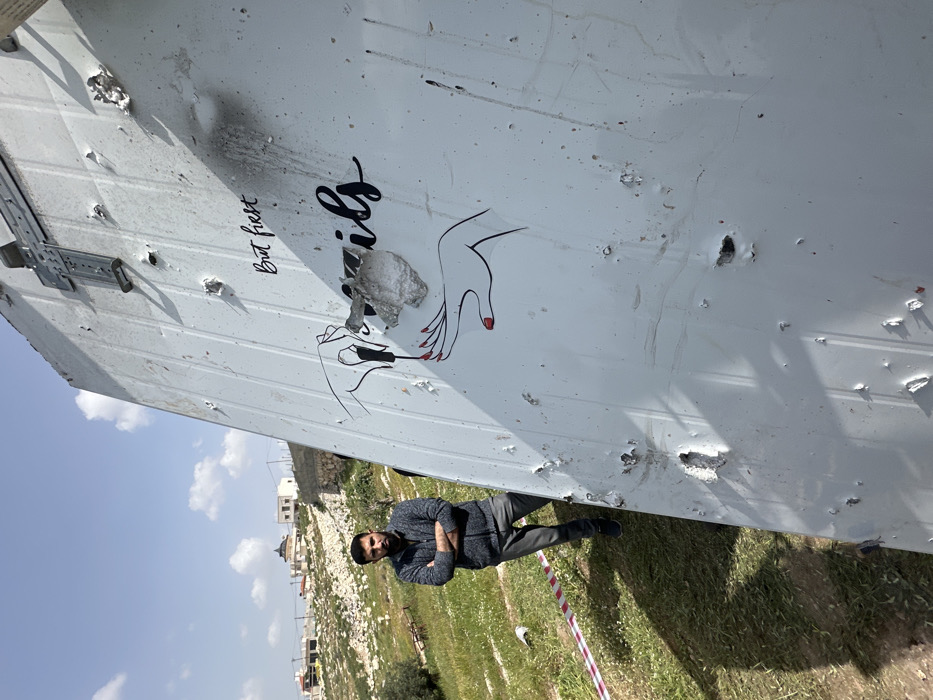
The image captures a scene in Dura, Palestinian Territory, centered on a damaged, light-colored metal panel positioned outdoors. The panel displays numerous indentations, perforations, and torn metallic edges, consistent with projectile or impact damage. A piece of crumpled metallic debris is affixed to its surface. A black line art illustration on the panel depicts one hand applying red nail polish to the nails of another hand. Above this artwork, the cursive text "But first" is legible, with the word "nails" partially obscured below. A metal fixture is attached to the panel's upper section. To the left of the panel, a bearded male subject stands with his arms crossed, wearing a dark patterned sweater and dark trousers, looking towards the camera. He is situated on uneven ground covered with grass and sparse vegetation, where a red-and-white striped barrier tape is visible in the foreground. The background features a sloping landscape with scattered rocks and several residential buildings, one of which includes a dark, domed architectural feature. The sky is clear blue with a few white clouds, and the scene is brightly lit by natural sunlight.
Dura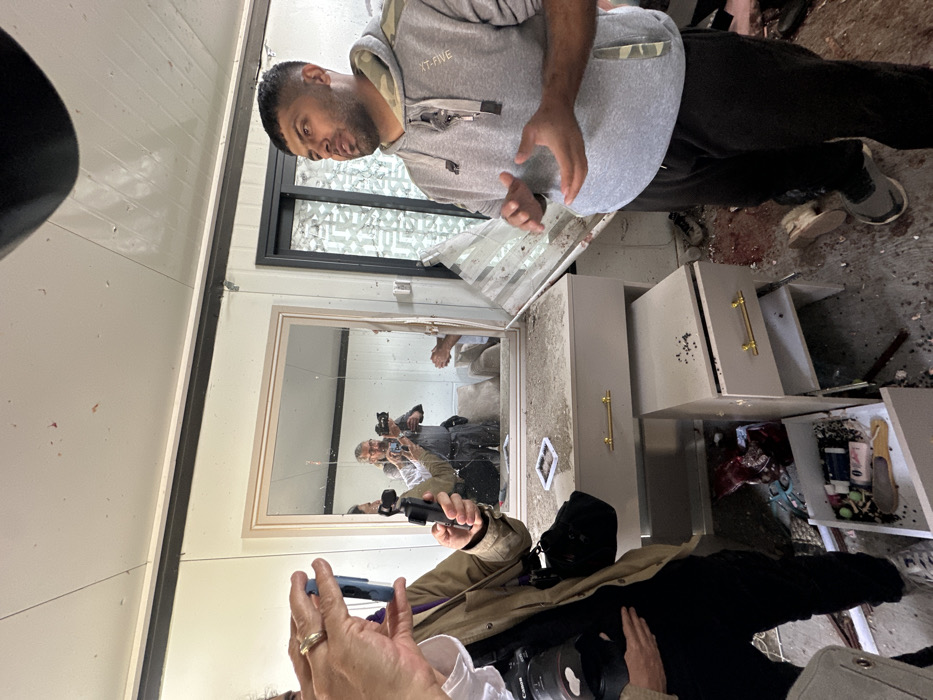
The scene is an interior room exhibiting significant damage, located in Dura, Palestinian Territory. In the mid-ground right, a man with a dark beard and short hair, wearing a grey hooded sweatshirt with "XT-FIVE" branding and black track pants, gestures with open palms as he speaks; a small microphone is clipped to his sweatshirt. To the foreground left, another individual, partially visible, holds a blue smartphone oriented vertically, appearing to record or photograph the scene. This person also wears a light brown jacket and has a professional Canon camera with a large lens slung over their shoulder; a gold wedding band is visible on their right ring finger. Centrally positioned is a light-colored vanity or dresser with several drawers, its surface and drawers covered in dust and debris. One lower drawer is open, revealing various items including what appear to be cosmetics and a small stack of currency notes. Above the vanity, a rectangular mirror with a light-colored frame is cracked and reflects multiple individuals, including a person holding a professional camera with a flash, and other indistinct figures. The floor throughout the room is strewn with widespread debris, including shattered glass, fragments of what appears to be a window frame or blinds, dark granular material, and distinct reddish stains. A pair of shoes, one light-colored and one dark, lie among the debris near the gesturing man. In the background right, a doorway or window opening shows severely damaged and shattered panes, further indicating structural damage to the environment. The walls and ceiling are composed of light-colored panels, with dark structural beams visible along the ceiling line.
Dura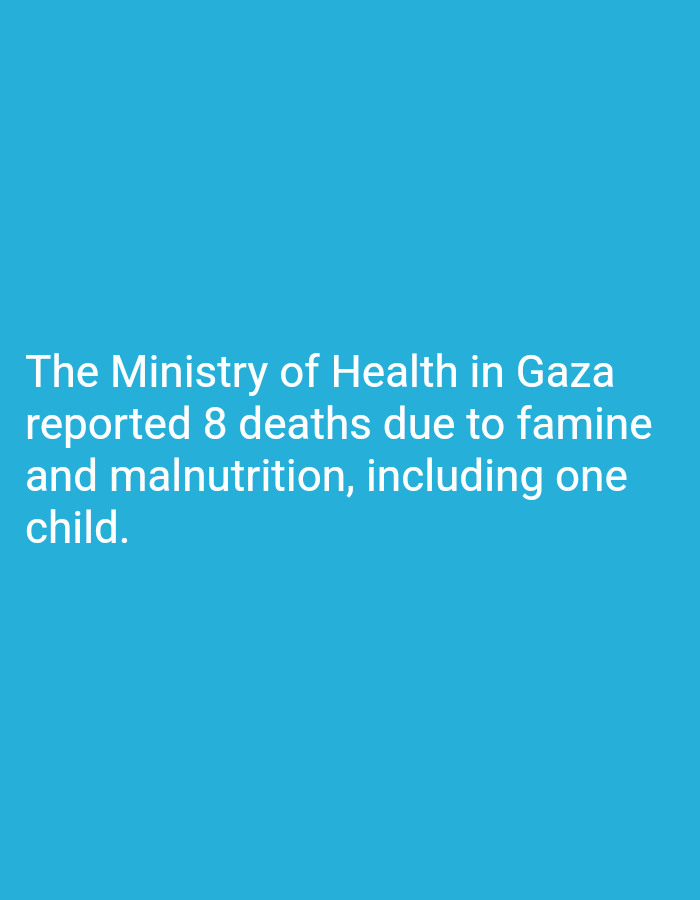
The image is a digital graphic featuring a solid, uniform blue background. White, sans-serif text is centrally aligned within the lower half of the frame. The text states: "The Ministry of Health in Gaza reported 8 deaths due to famine and malnutrition, including one child." The graphic does not visually depict any physical location, including the city of Dura, Palestinian Territory, nor does it show any people, objects, actions, or interactions within an environment. The content is purely textual information.
Dura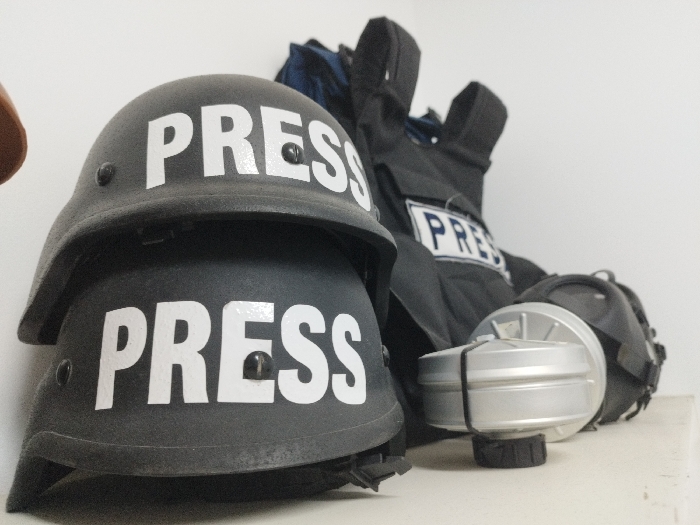
In Dura, Palestinian Territory, a forensic examination of the scene reveals journalistic protective equipment displayed indoors on a light-colored, flat surface against a plain, light wall. In the foreground, two matte black helmets are stacked vertically, each bearing the white, capitalized word "PRESS" on its front. To the right and slightly behind the helmets, a black protective vest is visible, showing a blue and white "PRESS" patch. Adjacent to the vest, a silver cylindrical gas mask filter with a black base rests on the surface, positioned in front of a partially obscured black gas mask or its storage case. No individuals are present in the scene.
Dura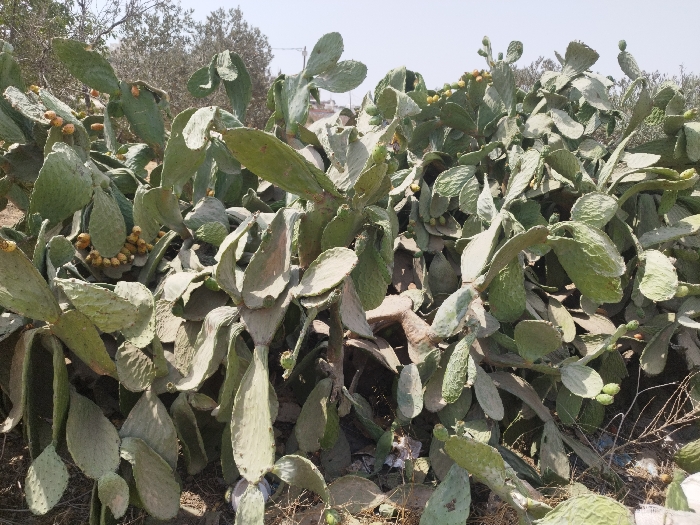
A dense cluster of prickly pear cacti (Opuntia species) dominates the foreground and midground in Dura, Palestinian Territory. The cacti feature numerous paddle-shaped, green to light-green pads, many of which bear ripe and developing fruits, primarily yellowish-orange. The ground beneath the cacti is dry, consisting of bare earth and scattered dead plant matter. In the background, indistinct green foliage of trees or large shrubs is visible under a clear, bright sky. No human subjects or discernible activity are present in the scene.
Dura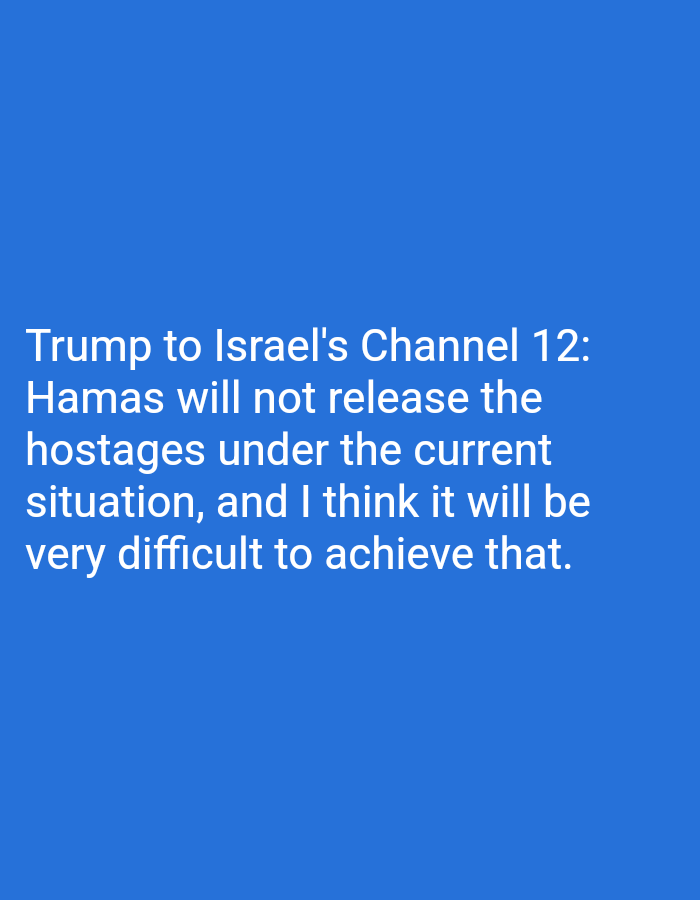
The image is a digital graphic, presented in the context of the city of Dura, Palestinian Territory. It consists solely of white, sans-serif text displayed against a uniform, solid blue background. The text is left-aligned and occupies the upper-central portion of the frame. It reads: "Trump to Israel's Channel 12: Hamas will not release the hostages under the current situation, and I think it will be very difficult to achieve that." No individuals, objects, or discernible environmental features are visible within the image beyond the text and its background.
Dura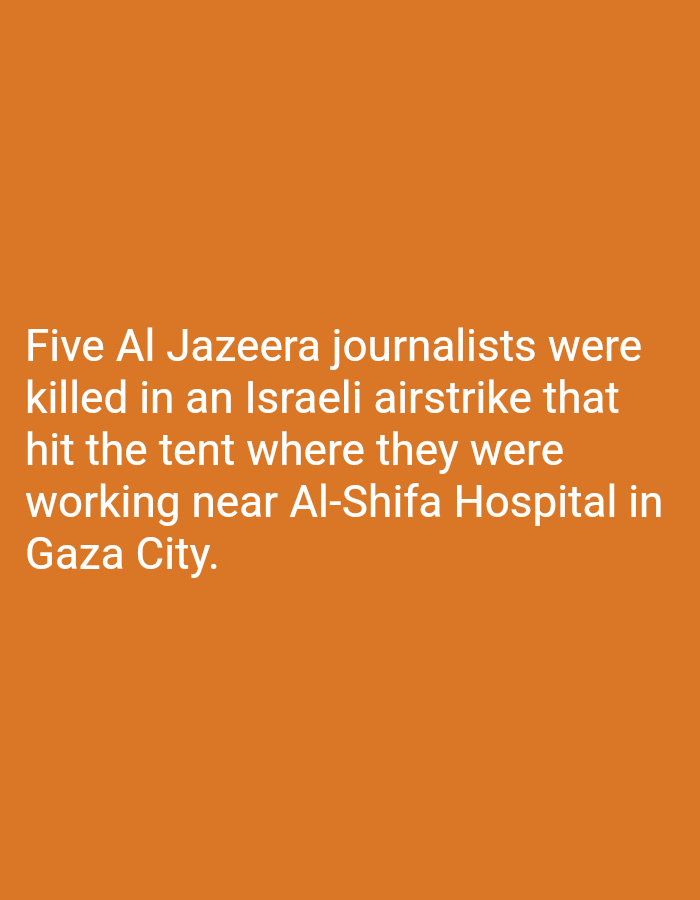
The image displays white sans-serif text centered on a solid orange background. The text reads: "Five Al Jazeera journalists were killed in an Israeli airstrike that hit the tent where they were working near Al-Shifa Hospital in Gaza City." The scene described within the text involves five Al Jazeera journalists as subjects. The primary action is their killing in an Israeli airstrike. The object hit is identified as a tent. The journalists' activity prior to the event was working. The environmental detail provided is proximity to Al-Shifa Hospital in Gaza City. No location within the city of Dura, Palestinian Territory, is depicted or mentioned in the image.
Dura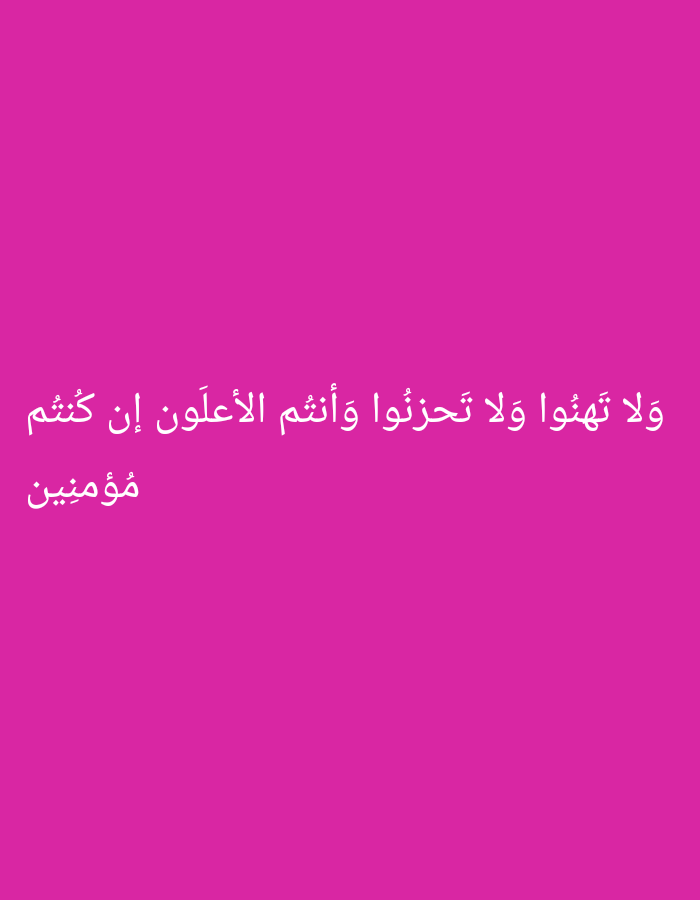
The scene, presented in the city of Dura, Palestinian Territory, depicts a digital display featuring white Arabic text against a uniform magenta background. The text, centered in the upper portion of the frame, consists of a single line that reads: "وَلَا تَهِنُوا وَلَا تَحْزَنُوا وَأَنتُمُ الْأَعْلَوْنَ إِن كُنتُم مُّؤْمِنِينَ". No individuals, physical objects, or environmental elements of the city are visually present within the image itself. The composition is static, with no discernible actions, interactions, or movement.
Dura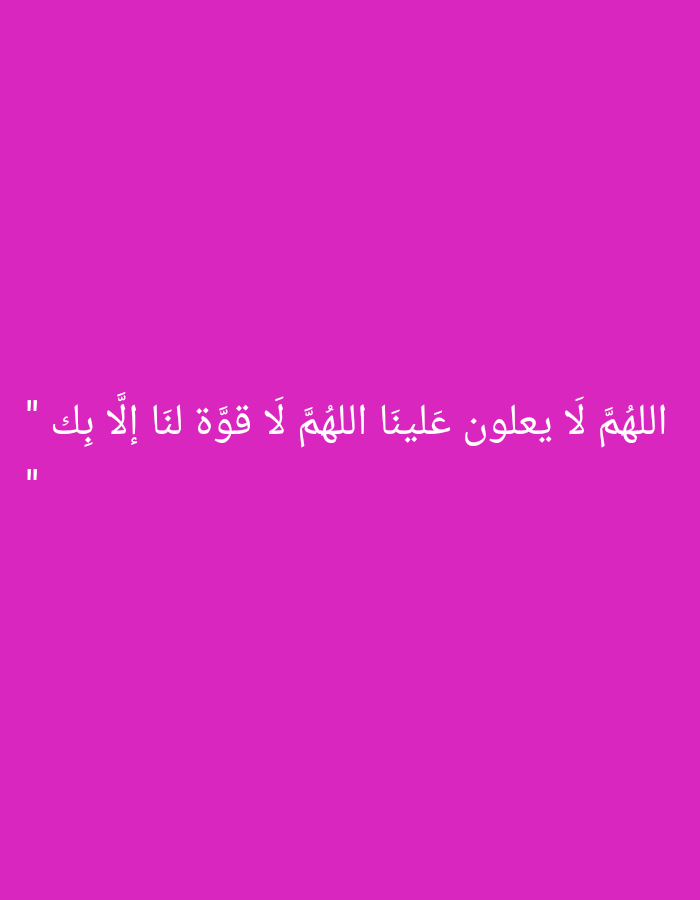
The image displays white Arabic text positioned horizontally across a solid magenta background. The text reads from right to left, "اللهم لا يعلون علينا اللهم لا قوة لنا إلا بك" (Oh Allah, do not let them overcome us, Oh Allah, we have no power except with You), and is enclosed by double quotation marks or prime symbols. No people, additional subjects, physical objects, actions, or interactions are visible within the frame. The environment is limited to the digital display of text on a monochrome background. This digital graphic is associated with the city of Dura, Palestinian Territory.
Dura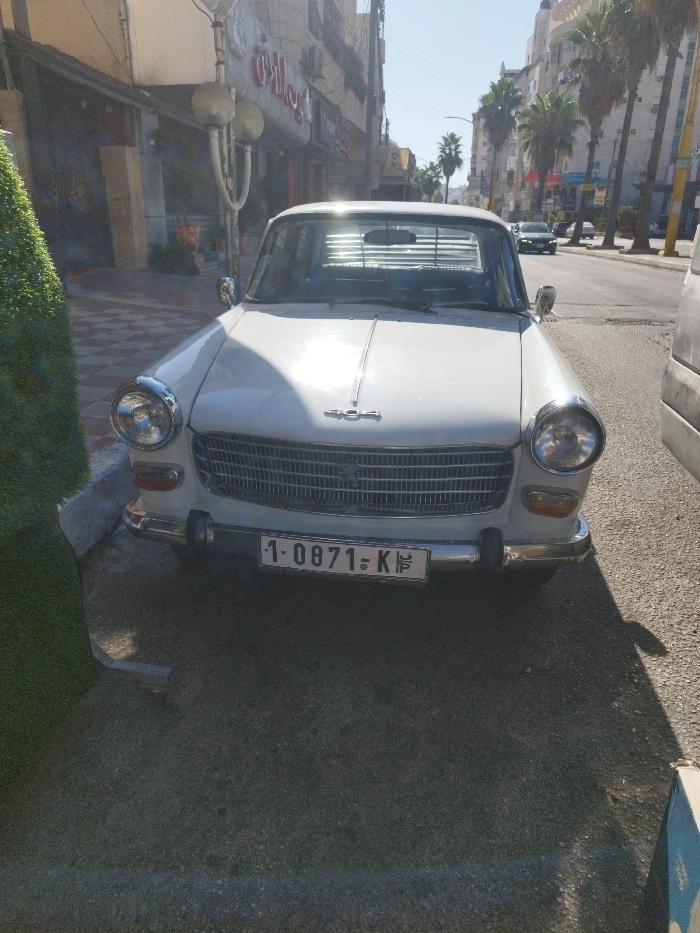
The image presents a frontal view of a white vintage Peugeot 404 sedan parked on an urban street in Dura, Palestinian Territory, under direct sunlight. The vehicle features a prominent chrome grille, circular headlights, and a front license plate displaying "1-0871-K" followed by Arabic script, consistent with Palestinian registration. The car's rear window is equipped with horizontal louvers. To the left of the vehicle, a green, conical artificial plant is situated on a paved surface. The immediate ground beneath the car is asphalt, transitioning to patterned light-colored tiles near the sidewalk and an adjacent multi-story building. This building on the left side of the street houses a ground-level commercial establishment with red Arabic signage and is illuminated by a street lamp featuring two spherical globes extending from its facade. To the right, an asphalt road stretches into the background, with other vehicles visible in the distance. The right side of the street is characterized by a line of mature palm trees and additional multi-story buildings, one of which exhibits a distinct rounded architectural top. No individuals are visible in the scene. Strong sunlight casts clear shadows on the ground and vehicle.
Dura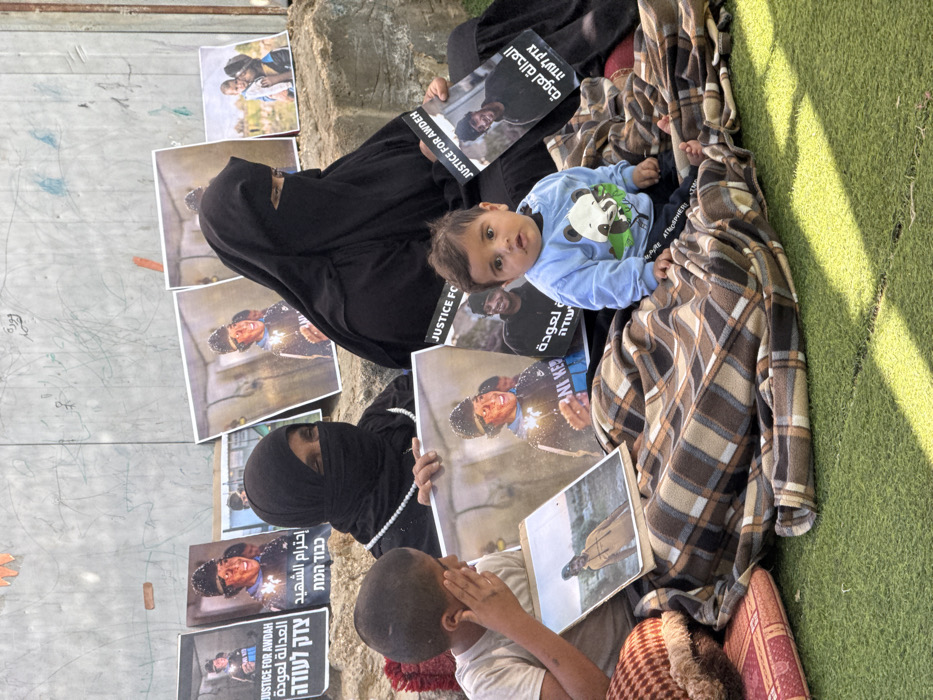
This image, captured in Dura, Palestinian Territory, depicts four individuals seated outdoors on artificial green turf, with a light-colored concrete wall in the background. A brown and beige plaid blanket covers a significant portion of the foreground. On the left, a young boy in a light-colored t-shirt holds a portrait of a young man in a yellow hoodie. In the center foreground, an infant wearing a light blue long-sleeved shirt with a panda graphic sits upright, looking directly at the camera. Behind them, two adult women, both wearing black niqabs that obscure their faces except for their eyes, are seated. The woman on the left holds a large portrait of a young man in a red cap and glasses, holding a lit sparkler. The woman on the right holds a different portrait of a young man, featuring the text "JUSTICE FOR AWDEH" in English and "צדק לעודה" (Justice for Awdeh) in Hebrew. Several additional copies of the portrait showing the young man with the sparkler are propped against the concrete wall in the background. Some of these posters bear text in English ("JUSTICE FOR AWDAH"), Arabic ("احترام الشهيد" - Respect the martyr), and Hebrew ("כבוד המת" - Honor the dead, and "צדק לעודה"). A smaller portrait of an adult holding a child is also visible against the wall. The wall itself has faint markings and Arabic script, including the word "Dura". Two patterned pillows are visible on the far left, partially covered by the blanket. Natural daylight illuminates the scene.
Dura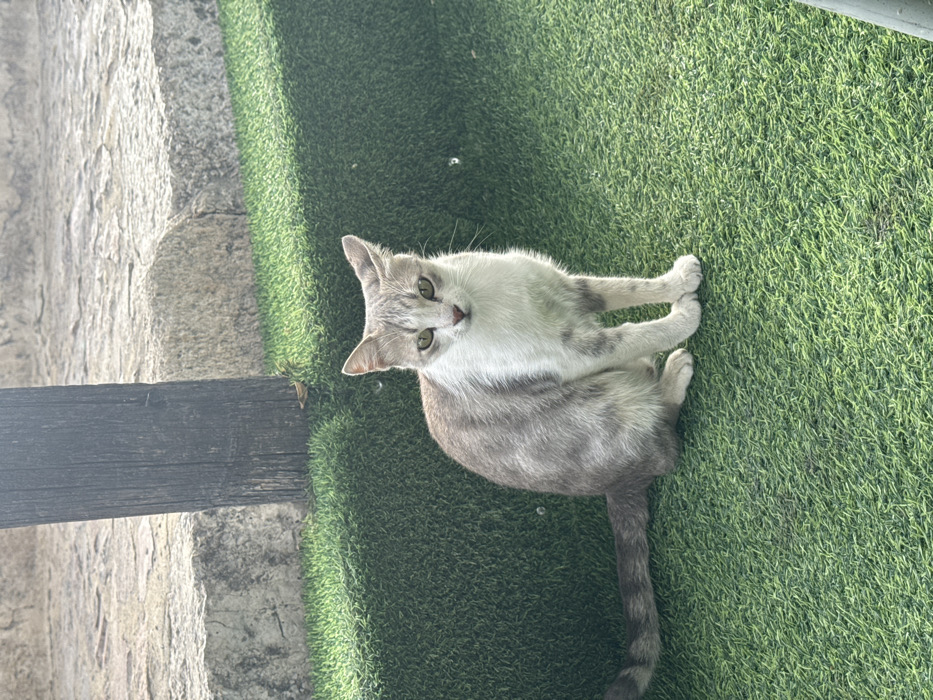
A domestic cat, exhibiting a grey tabby pattern on its back and tail and white fur on its chest and forelegs, is seated upright on a vibrant green artificial turf surface. The cat faces forward, its greenish-yellow eyes directed towards the viewer. Its right ear (viewer's left) appears slightly folded or notched at the tip. In the background, a dark, weathered wooden post stands vertically to the left, adjacent to a structured wall composed of large, irregular grey stone blocks. Above the stone wall, an indistinct lighter-colored, possibly paved, surface is visible. The scene is illuminated by natural light, suggesting an outdoor environment in the city of Dura, Palestinian Territory.
Dura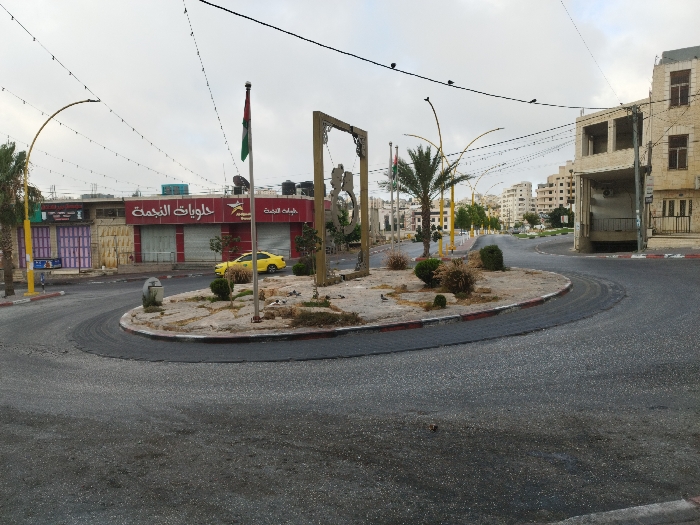
This image presents an elevated view of a traffic roundabout in the city of Dura, Palestinian Territory, under an overcast sky. The central, oval-shaped median is sparsely vegetated with low bushes and dry ground cover, featuring a small palm tree. A flagpole prominently displays a Palestinian flag (horizontal stripes of black, white, and green, with a red triangle at the hoist). Adjacent to the flag is a large, light-colored archway structure with intricate carvings or relief work. Several pigeons are visible on the median's surface. The asphalt roadway surrounding the median appears damp in sections, with red and white painted curbs delineating its edges. Overhead, numerous string lights are strung across the intersection, connecting to yellow, curved street lamp poles; several small birds are perched on these wires. Surrounding the roundabout are multiple urban structures. To the left, a single-story commercial building with a red facade features a large sign in Arabic, "حلويات النجمة" (Halawiyat Al-Najma), translated as "Star Sweets" or "Al-Najma Sweet," alongside a smaller English translation. Its windows are secured by closed metal shutters, and black water tanks are visible on its roof. A yellow sedan is parked or stationary near this building, partially obscured by the flagpole. To the right, a multi-story building constructed of light-colored stone exhibits multiple windows and a large, dark, ground-level opening consistent with a garage or loading bay, adjacent to a smaller arched entrance. In the background, numerous multi-story buildings of similar construction recede into the distance along the streets, characterizing an urban landscape. No human subjects are visible in the scene.
Dura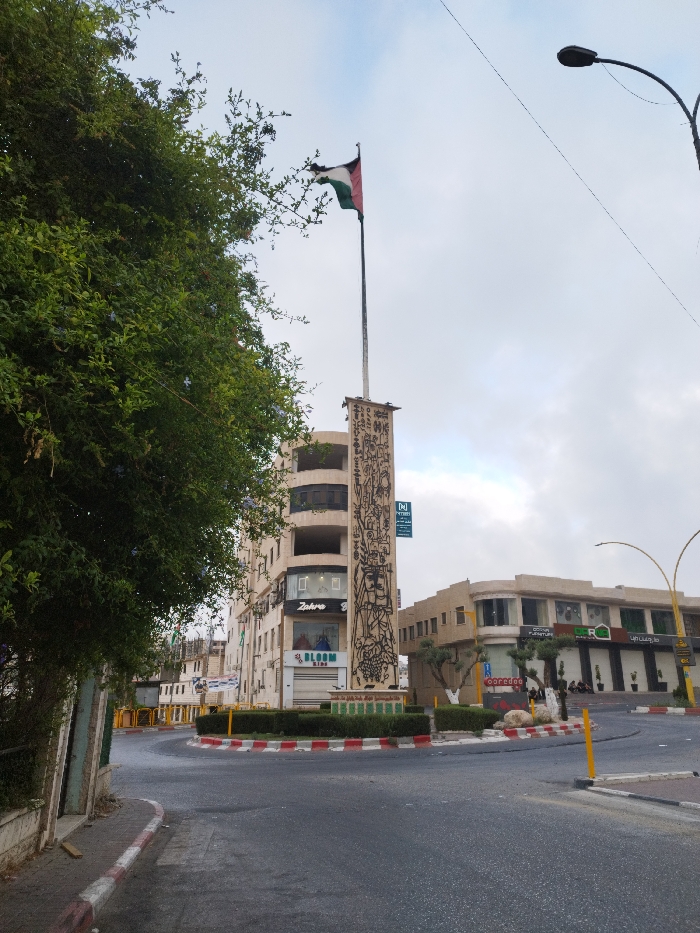
A street scene in Dura, Palestinian Territory, depicts a central roundabout under an overcast sky. At its core, a tall flagpole prominently displays a Palestinian flag, exhibiting wear and tearing along its edges. The flag's design includes horizontal stripes of black, white, and green, with a red triangle at the hoist. The flagpole's base is a rectangular monument with vertical, intricate carvings featuring abstract figures, faces, and what appear to be grapevines. The roundabout island is bordered by a red and white curb, landscaped with green hedges, small trees, and rocks. Surrounding the asphalt roadway are buildings. To the left, a multi-story, light-colored building with a rounded facade houses ground-floor shops, including 'Zahra Boutique' and 'BLOOM kids'. A large, leafy green tree with small purplish flowers partially obscures this view. To the right, a lower, light-colored building with a curved corner features retail spaces, including a shop with a green sign and an 'Ooredoo' sign. Pruned trees are positioned in front of this structure. Overhead, utility wires and a streetlamp are visible against the cloudy sky. Yellow bollards mark the road's edge on the right, and a sidewalk with a red and white curb is present on the left. No individuals are visible.
Dura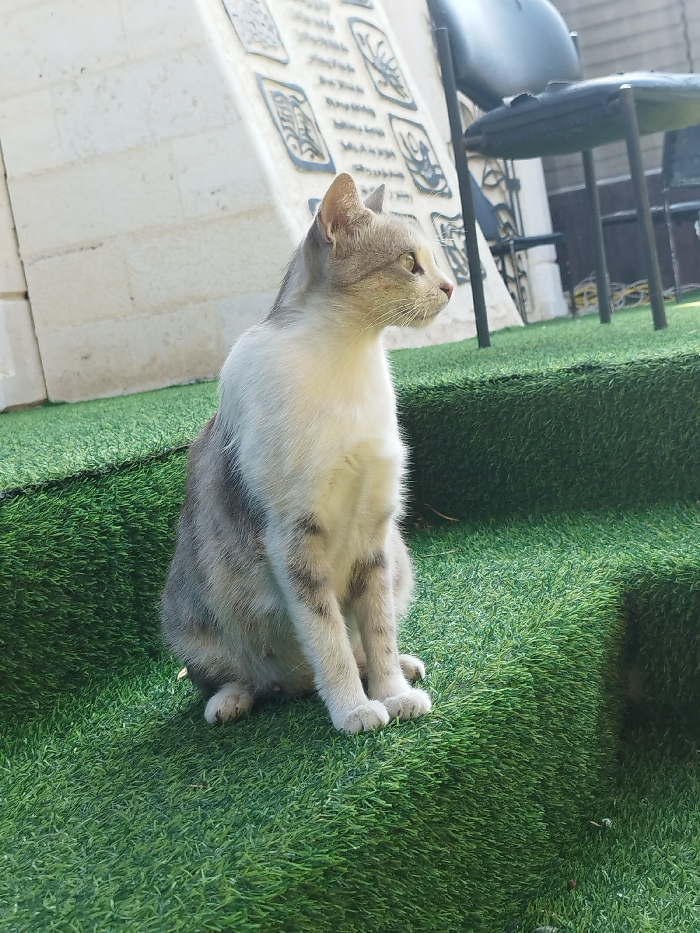
The image displays a domestic cat situated outdoors in the city of Dura, Palestinian Territory. The cat, characterized by a white chest and belly, transitions to greyish-brown tabby markings across its back, head, and limbs. Its eyes are light greenish-yellow. It is captured in a seated posture on an artificial green turf surface, facing the right side of the frame with its head turned to look into the distance. Its front paws are positioned together, and its hind legs are tucked beneath its body. A slight distention is visible on its lower abdomen. The artificial turf forms a terraced surface with visible steps or elevations. In the background, to the left of the cat, a light-colored, possibly stone or concrete, wall structure is present, featuring multiple recessed rectangular panels with darker, textured inserts. To the right and behind the cat, a dark-colored, four-legged outdoor chair is partially visible. The scene is illuminated by strong sunlight, casting distinct shadows.
Dura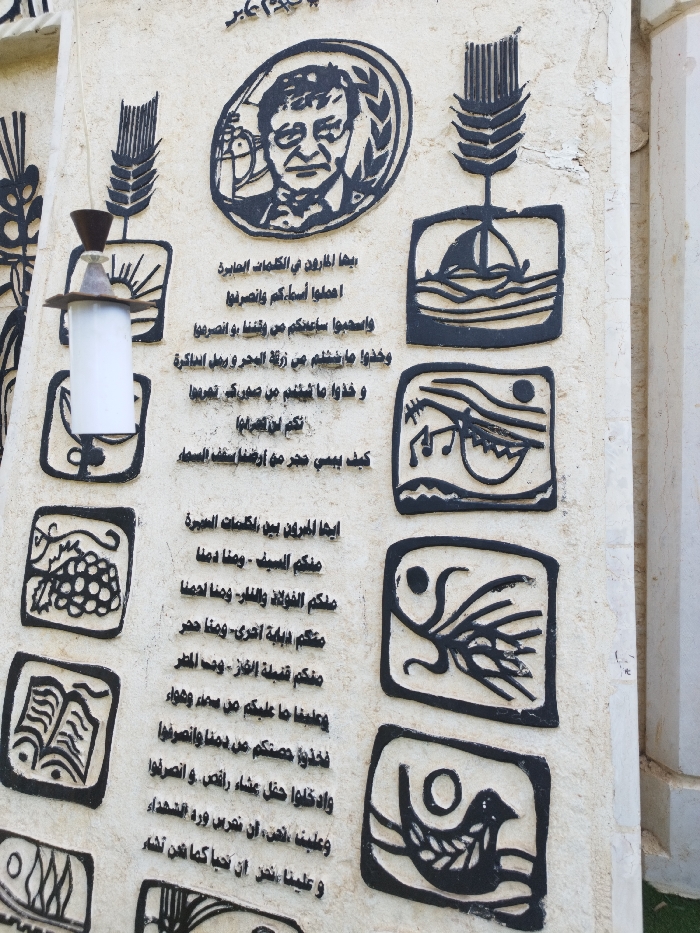
The image shows a wall plaque or monument featuring a portrait of a man surrounded by a wreath. Several stylized symbols appear throughout the monument, including wheat, a boat, musical notes, a bird, and a book. Arabic text is inscribed between the symbols, seemingly a poem or commemorative inscription. The overall style is artistic and memorial. A small light fixture is mounted on the monument.
Dura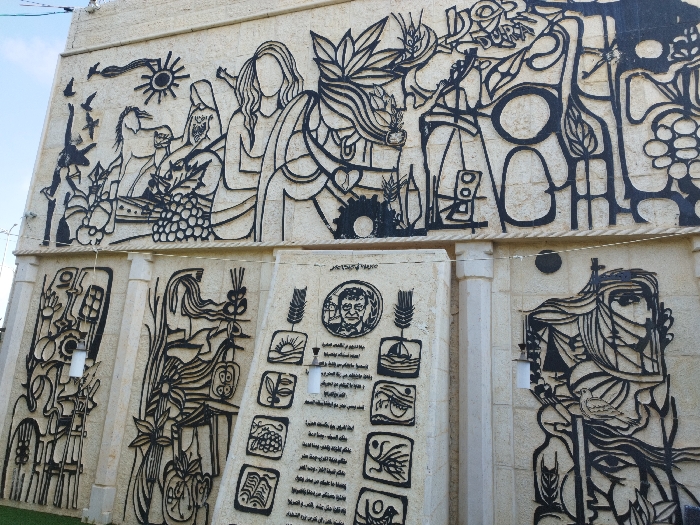
This image captures a large public monument situated in Dura, Palestinian Territory, under a clear daytime sky. The monument consists of a light-colored stone wall extensively decorated with black metal cutouts, forming a multi-panel mural. The upper section presents a continuous frieze with stylized, flat-profile figures and natural elements. On the left, a sun, multiple birds in flight, a horse, a robed figure with a head covering, and a large cluster of grapes are visible. Adjacent to these are prominent figures, including one with flowing hair. The right portion of the upper frieze integrates geometric shapes, grapevines, a cluster of grapes, and a stylized human figure holding an object aloft. The word "DURA" is incorporated into the design in the upper right quadrant. The lower section of the monument is composed of several distinct vertical panels, separated by vertical stone pillars. The central panel, positioned at a slight angle, features a circular portrait at its apex. Below the portrait, Arabic text is displayed alongside a series of square vignettes depicting symbolic images such as a sunrise over water, leaves, grapes, and an open book. A white cylindrical lantern is suspended in front of this panel. The panel to the left of the central one exhibits abstract black metal cutouts, with another white cylindrical lantern hanging in front. The panel to the right of the central one portrays a large, stylized female face or head adorned with a traditional scarf, accompanied by a dove and elements resembling wheat stalks. The monument is erected on a patch of green grass at its base. Utility wires are visible across the top and along the sides of the structure.
Dura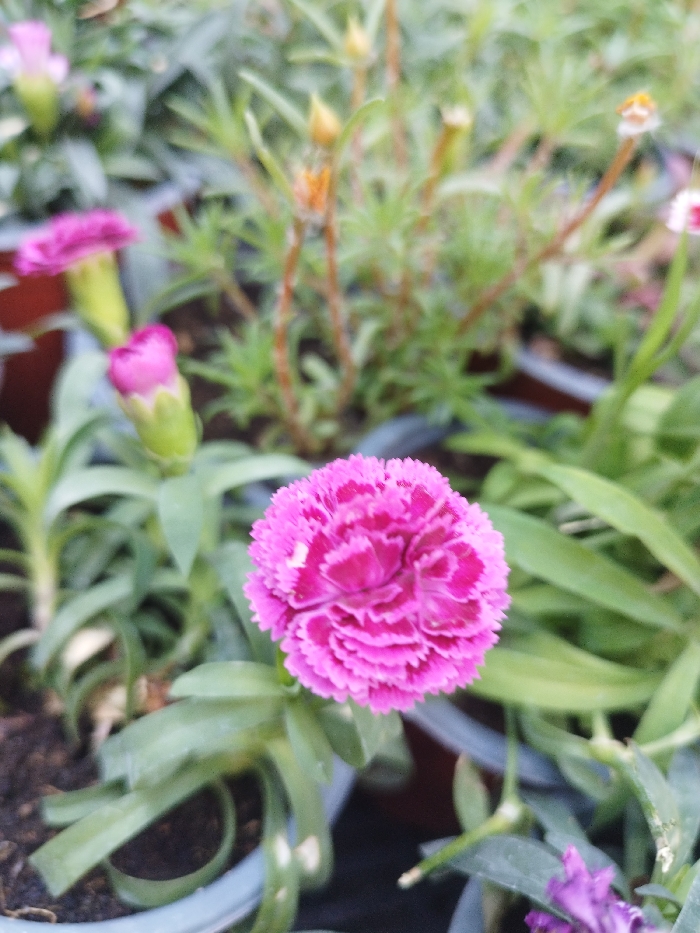
The image displays a detailed close-up of multiple potted plants, located in Dura, Palestinian Territory. The central subject is a vibrant fuchsia-magenta flower, approximately 5-7 cm in diameter, positioned slightly right of the frame's center and in sharp focus. This flower exhibits numerous densely packed, serrated petals, giving it a ruffled appearance. To the immediate left of this flower, a closed fuchsia-magenta bud, encased in a green calyx, is visible and also in focus. Surrounding these are multiple green leaves, appearing narrow and elongated, characteristic of the plant species. The plants are situated within dark, likely plastic, nursery pots, with dark soil visible. The background consists of a blurred arrangement of additional green foliage, slender stems, and several out-of-focus light-colored buds, some with a yellowish-orange tint, and hints of other blurry pink or purple flowers. The lighting suggests natural, diffused illumination, likely in a greenhouse or outdoor nursery setting. No individuals or specific actions are depicted.
Dura