Ebiya, Nigeria
30 memories from Ebiya, Nigeria
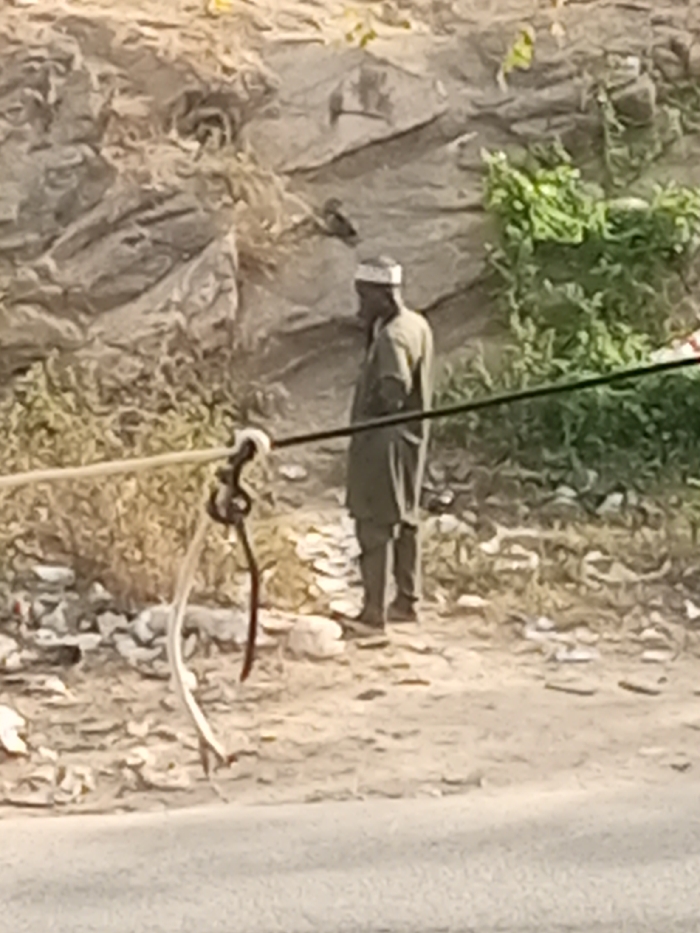
The image displays an outdoor scene in Ebiya, Nigeria. A single male individual stands in the mid-ground, positioned in profile and facing towards the right side of the frame. He wears a muted olive-green, long-sleeved, knee-length garment, dark-colored trousers, dark footwear, and a white cap on his head. His right hand appears to be raised towards his face or chin. In the foreground, two primary horizontal cables, one black and one light beige/off-white, stretch across the lower-mid portion of the frame. These cables are joined by a dark, possibly metallic, connection point. From this connection, two additional wires or cables, one dark brown and one white, hang vertically downwards. A segment of dark grey asphalt road is partially visible at the very bottom of the frame. The ground beneath the individual and in the immediate vicinity is light brown, dusty, and uneven, with scattered small rocks and debris. The background is dominated by a substantial, steep rocky incline or cliff face, characterized by varied textures and shades of light brown and grey. Sparse green vegetation is visible growing on parts of this rocky terrain, particularly towards the right side.
Ebiya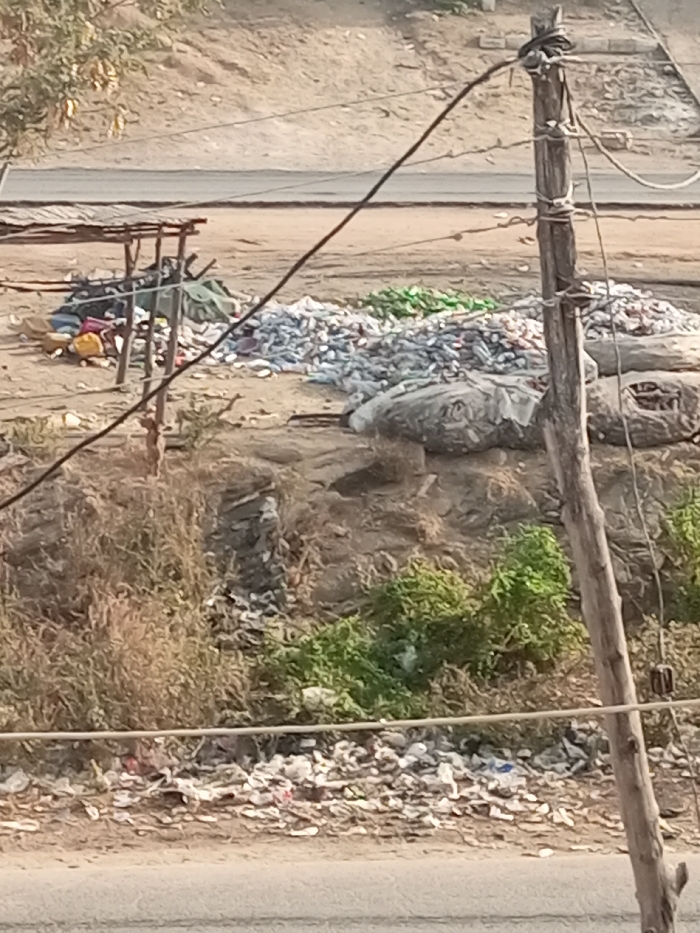
This image depicts an outdoor collection or recycling area within Ebiya, Nigeria. The scene is characterized by a dry, sandy terrain, partially covered with sparse, dry brown vegetation and some green shrubs. In the mid-ground, large, unsorted piles of plastic bottles are visible, predominantly clear or white, with a smaller accumulation of green bottles. Adjacent to these piles are several large, grey or black bags, appearing to contain sorted materials. To the left, a rudimentary wooden shelter with a corrugated roof stands over an accumulation of miscellaneous items. A wooden utility pole with multiple black wires strung across the frame occupies the right foreground. In the background, a paved road stretches horizontally, with a barren, light-brown dirt embankment rising behind it. No individuals, direct actions, or interactions are visible in the frame. Scattered debris, including various pieces of trash, is present across the ground.
Ebiya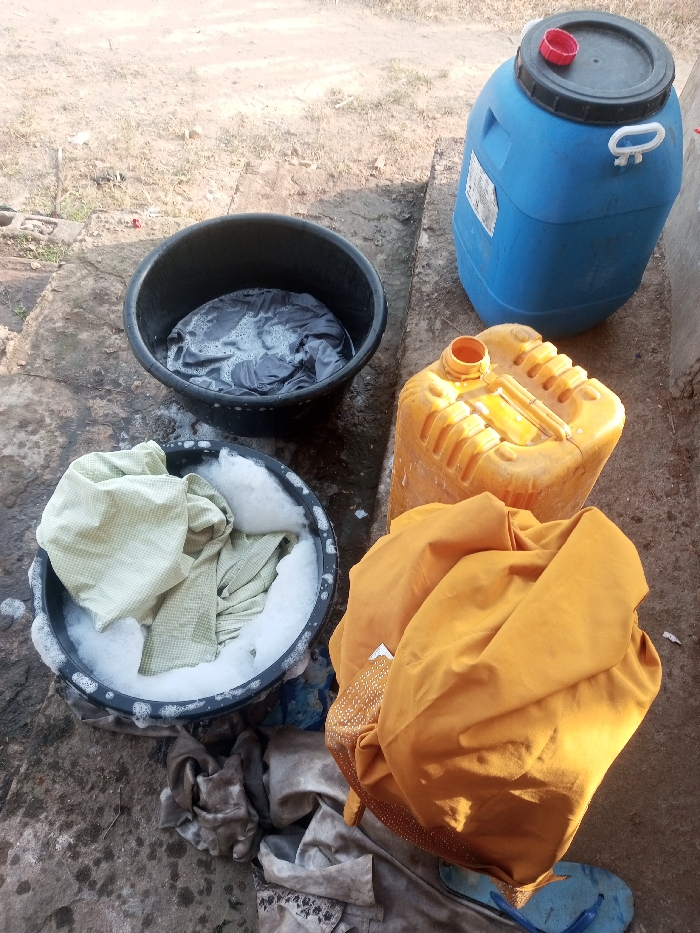
The image captures an outdoor laundry setup in Ebiya, Nigeria, under natural daylight. The scene is set on an uneven ground surface composed of concrete and dirt, with visible wet patches. Two black plastic washbasins are central to the foreground; the upper basin contains dark grey fabric submerged in white soapy water, while the lower basin holds light green checkered and solid light green fabrics also soaking in sudsy water. To the right, a blue plastic barrel with a black lid and a red cap is positioned upright next to an uncapped yellow plastic jerrycan. A large, crumpled piece of mustard yellow fabric rests on the ground near the lower right, partially covering a pair of light blue flip-flops. Several additional pieces of dull brown or grey fabric are scattered on the ground near the lower washbasin, one with a discernible dark pattern. No individuals are present in the frame.
Ebiya
The image displays a digital graphic on a solid royal blue background. White text in a sans-serif font is centrally positioned, reading: "don't tulk too much 😊 😃 an 🤏 tulk less 🤏 🤏 😊". The word "tulk" appears to be a misspelling of "talk". Following "much" are two yellow emoji faces: a smiling face with smiling eyes, and a grinning face with big eyes. After "an" is a yellow emoji depicting a hand gesture with thumb and index finger nearly touching, indicating "pinch" or "small amount". After "less" are two more of these pinch-gesture hand emojis, followed by a yellow smiling face with smiling eyes emoji. No physical location, including Ebiya, Nigeria, can be determined from the content of this digital image.
Ebiya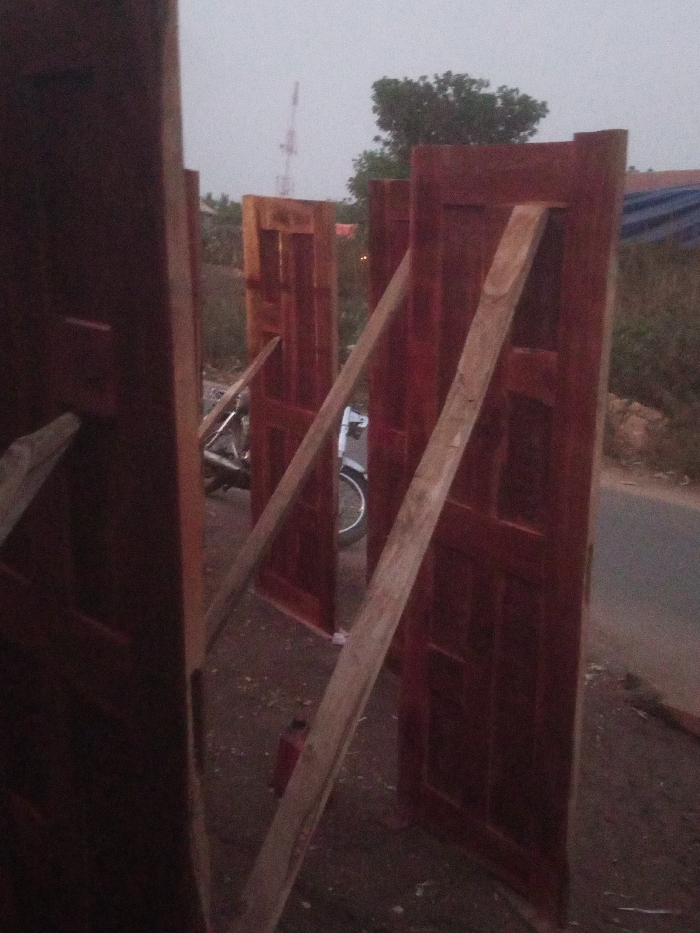
Multiple dark reddish-brown paneled wooden doors are observed standing upright in an outdoor environment in Ebiya, Nigeria, under an overcast sky. Each door is individually propped by one or more light-colored wooden planks leaning diagonally against its surface. Approximately five doors are visible in various stages of presentation across the foreground and mid-ground. Behind the central doors, a white motorcycle is partially discernible. The immediate ground consists of uneven, reddish-brown soil with scattered light-colored debris. A small red cylindrical object rests on the ground near the base of a central door. To the right of the doors, a dark asphalt road is visible. In the distant background, green foliage and a red and white lattice communication tower are present against the light grey sky. No individuals are visible.
Ebiya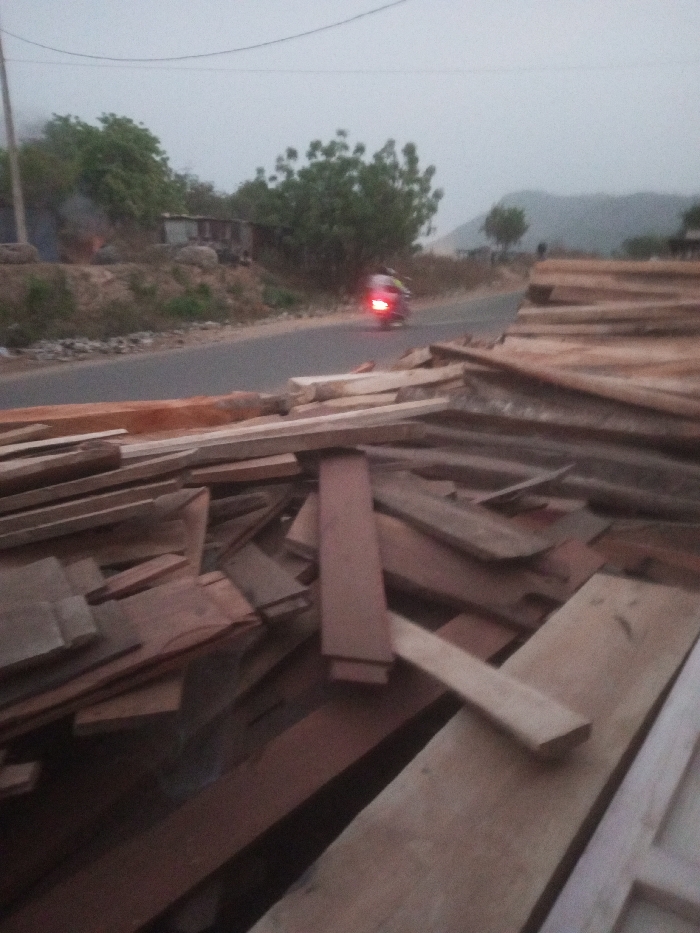
This image captures a scene in Ebiya, Nigeria, under an overcast sky. In the immediate foreground, a substantial, uneven pile of various lengths and widths of sawn timber planks dominates the lower half of the frame. The timber displays shades of light brown and reddish-brown, indicative of different wood types and weathering. Behind this pile, a paved road extends horizontally across the midground. A blurred motorcycle, its red taillight illuminated, is visible traveling from right to left on this road. To the left of the road, an elevated, unpaved embankment supports sparse green foliage and a small structure with a light-colored roof, possibly corrugated metal, from which a plume of light smoke rises. A utility pole is partially visible on the far left. On the right side of the road, further stacks of timber are visible extending into the background. Distant hills are faintly discernible under the hazy sky.
Ebiya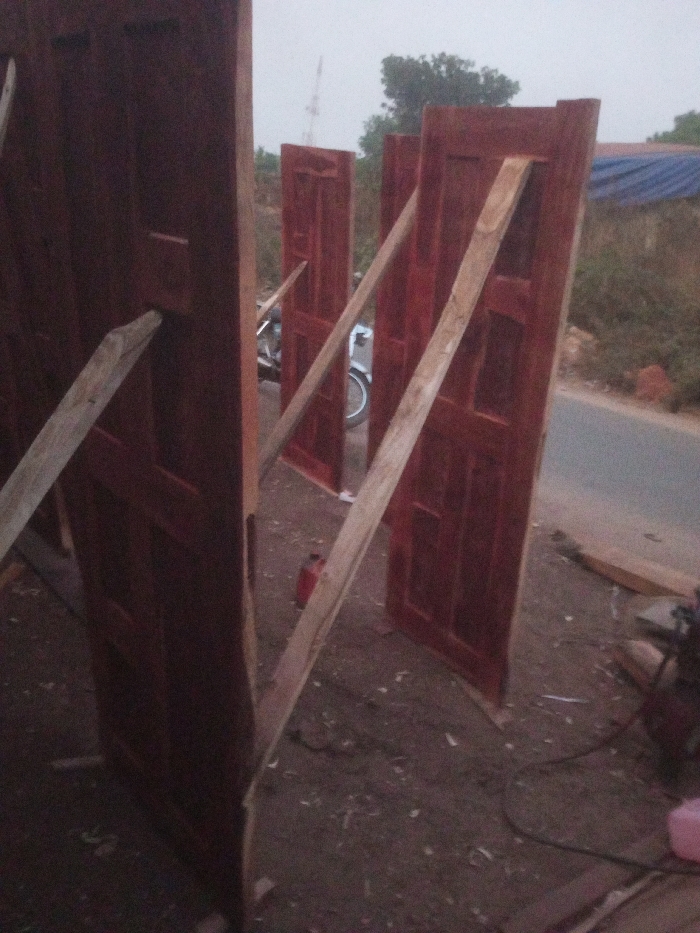
This image captures an outdoor scene in Ebiya, Nigeria, depicting several newly finished or processed wooden panel doors standing upright. There are at least four reddish-brown doors, each supported by light-colored wooden planks angled as braces. The foreground ground is composed of dark, disturbed earth mixed with wood shavings and debris. In the mid-ground, a paved road or pathway is visible to the right. A motorcycle or bicycle is partially discernible behind one of the central doors, near the road. Further in the background, sparse green vegetation and a tall, thin antenna-like structure are visible. A blue tarp-covered object is also present behind the doors on the right side. On the ground, a red cylindrical container and other indeterminate items, including a pink container, are present. No individuals are visible in the scene. The lighting suggests overcast conditions or low light.
Ebiya
The scene depicts an outdoor environment in Ebiya, Nigeria, under a clear, hazy sky. In the immediate foreground, a substantial, irregularly stacked pile of rough-hewn wooden planks and logs occupies the lower frame, varying in color from light tan to reddish-brown. Behind this lumber, centrally positioned, a person is visible carrying a large, bundled load on their head. The individual wears a dark shirt and a red head covering, with the load appearing to consist of multiple items contained within blue sacks or tarpaulins. The ground beneath them is uneven, reddish-brown earth. In the midground and background, a series of informal structures constructed from various materials, including corrugated metal and wood, are present. Several vehicles are parked among these structures, including a dark-colored sedan and a red vehicle. Sparse, dry vegetation is scattered throughout the area, particularly on the right. A prominent, rocky hill is discernible on the horizon in the distance, against the light blue sky, which also shows a utility pole on the far left.
Ebiya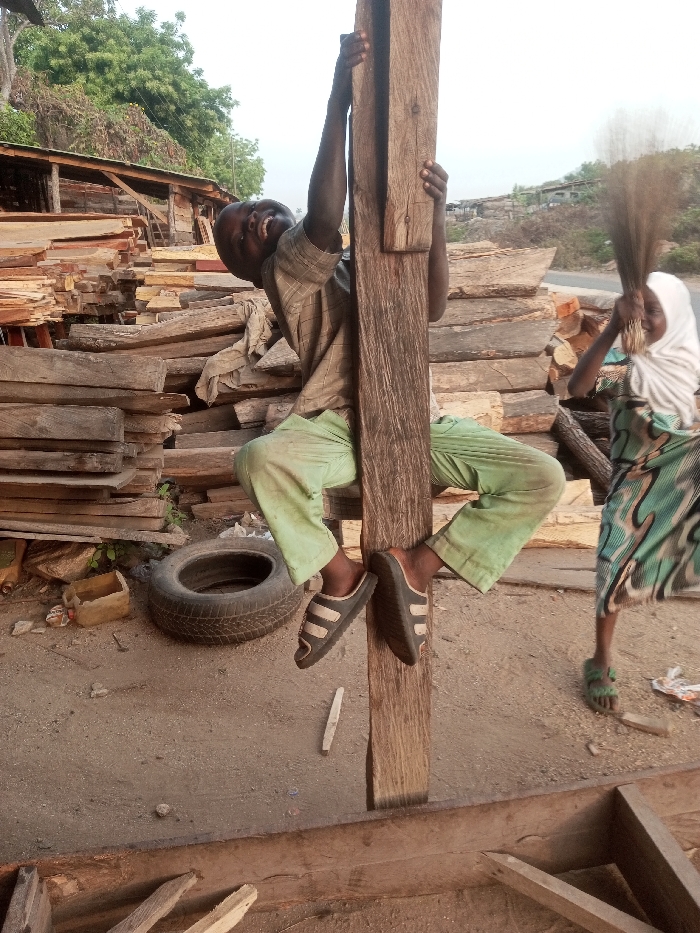
A boy in green pants, a striped shirt, and sandals hangs from a wooden post, smiling and looking up. His arms are extended above his head, gripping the post. A girl in a white headscarf and patterned skirt stands nearby, holding a bundle of sticks resembling a broom. Wood piles, a tire, and various containers surround them. The setting appears to be a dusty outdoor area with some buildings visible in the background.
Ebiya
A young girl smiles while holding onto a wooden post. Her arms are raised, one clutching a bundle of sticks. She wears a patterned dress and a light-colored headscarf. Behind her is a stack of wooden planks and logs. A tire rests on the ground near the post. The background shows a road and some distant buildings, suggesting an outdoor setting perhaps near a lumberyard. The lighting appears soft and natural.
Ebiya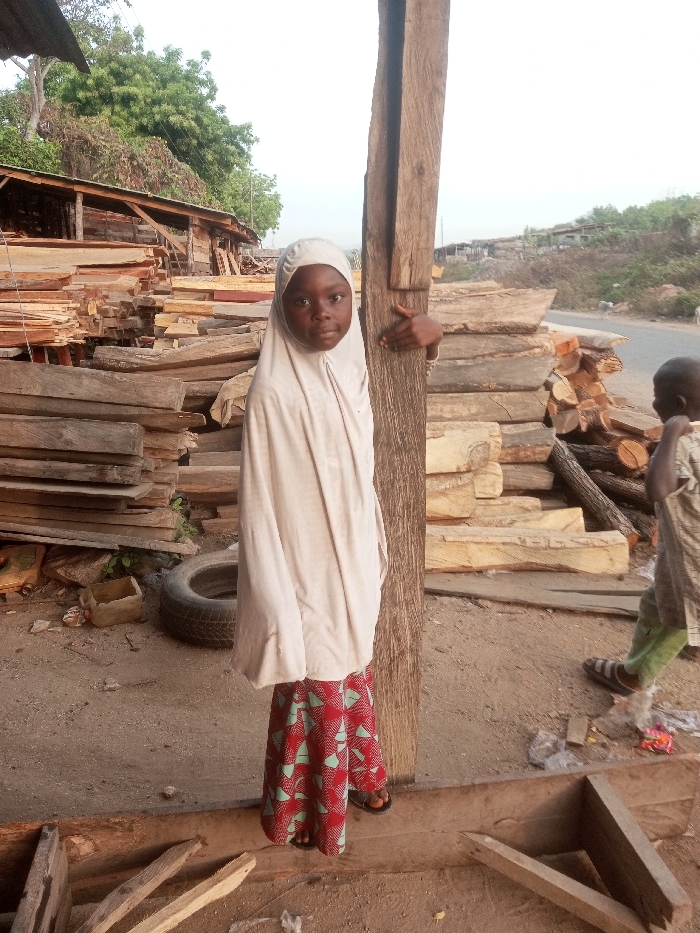
A young girl in a cream-colored hijab and a red and turquoise patterned skirt stands next to a wooden post. Her hand is holding the post. Behind her are stacks of lumber, a tire, and a wooden structure. To the right, a young boy in green pants and a patterned shirt is seen from the back. A road and a grassy hillside are in the background. The ground is dirt.
Ebiya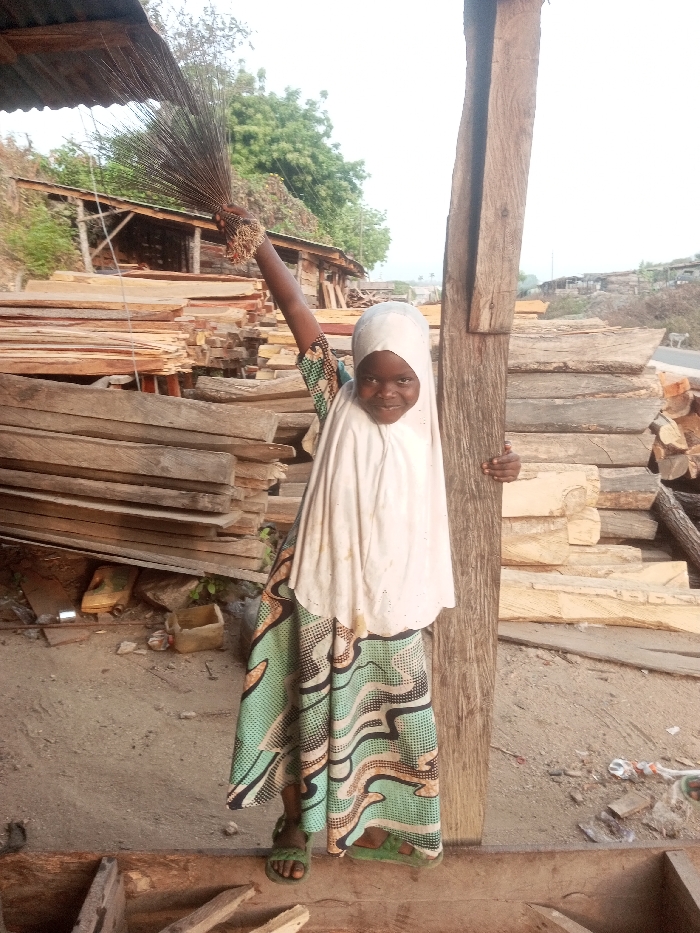
A young girl wearing a light-colored hijab and patterned dress stands amidst stacks of lumber. She holds a bundle of sticks above her head with one arm raised, while the other hand rests on a wooden post. The setting appears to be a woodyard or construction site, with a partly visible structure behind the wood stacks and greenery in the distance. The scene is captured in daylight.
Ebiya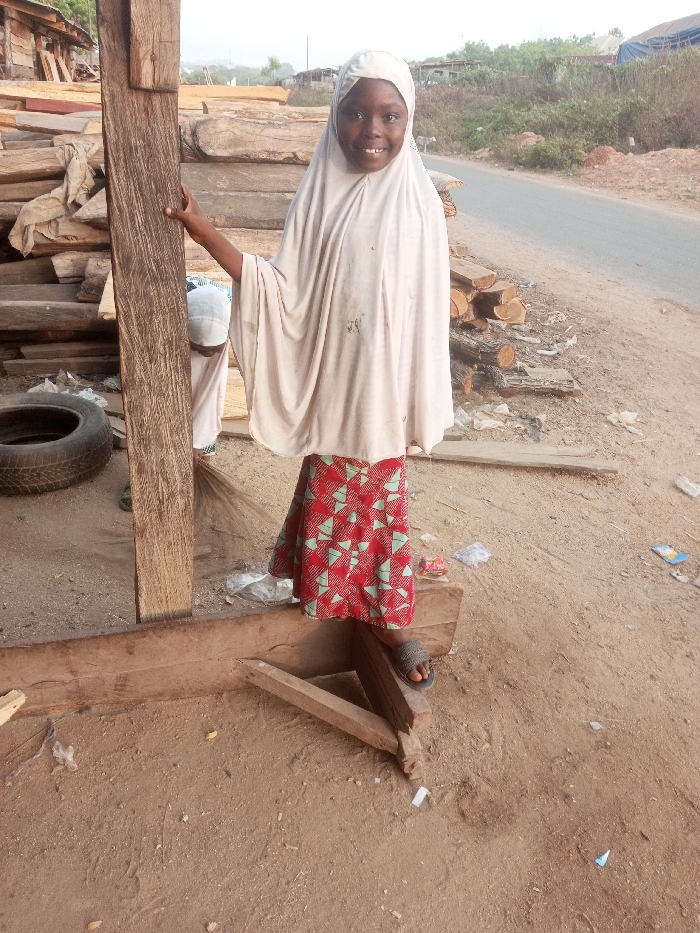
This full-shot photograph, taken in Ebiya, Nigeria, features a smiling young girl standing outdoors in what appears to be a timber yard or a similar setting where wood is stored. The girl, of African descent, stands on a wooden structure, holding onto a thick, dark wooden post to her left with her right hand. She is wearing a light-colored (possibly off-white or cream) hijab or head covering that drapes over her shoulders, and a vibrant red skirt adorned with a pattern of light green geometric shapes. She wears dark, open-toed sandals on her feet. Her face is turned towards the camera, displaying a wide, cheerful smile. In the background, large quantities of rough-hewn wooden planks and logs are stacked, suggesting the primary activity of the area. To the immediate left, an old tire rests on the sandy ground. Partially visible behind the wooden post and the girl is another person, seen only from the back of their head (wearing a white cap) and their feet, near which a small broom is visible, indicating some activity like sweeping. To the right of the girl, a paved road or dirt track runs alongside more stacked logs and a sandy embankment leading up to dry, sparse vegetation and hills in the distance. The ground throughout the scene is sandy and appears somewhat cluttered with small pieces of litter and debris. The lighting suggests it is daytime, possibly late morning or afternoon, with soft illumination and no harsh shadows, indicating clear, dry weather. The girl's modest attire aligns with cultural practices in the region. The image primarily captures a moment of cheerful interaction with the camera amidst an active, utilitarian environment. There is no visible text in the photograph.
Ebiya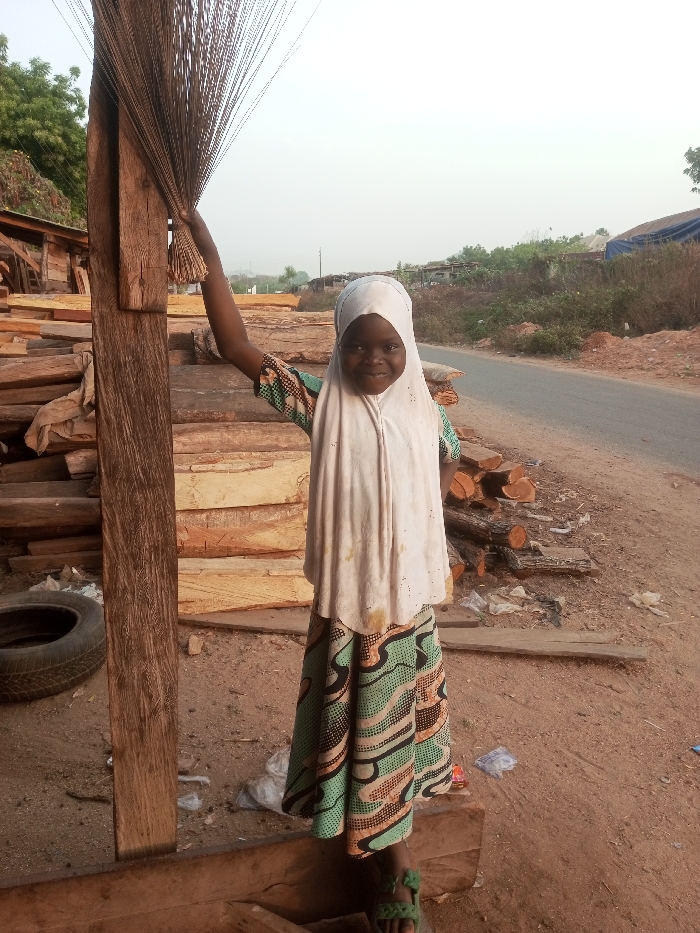
A young girl wearing a white hijab and a patterned green and brown dress smiles while standing next to a wooden structure. She holds a bundle of twigs resembling a broom. Behind her, a stack of lumber and a black tire are visible. The background includes a road, some logs, and distant buildings under a hazy sky. The ground is dirt and small debris.
Ebiya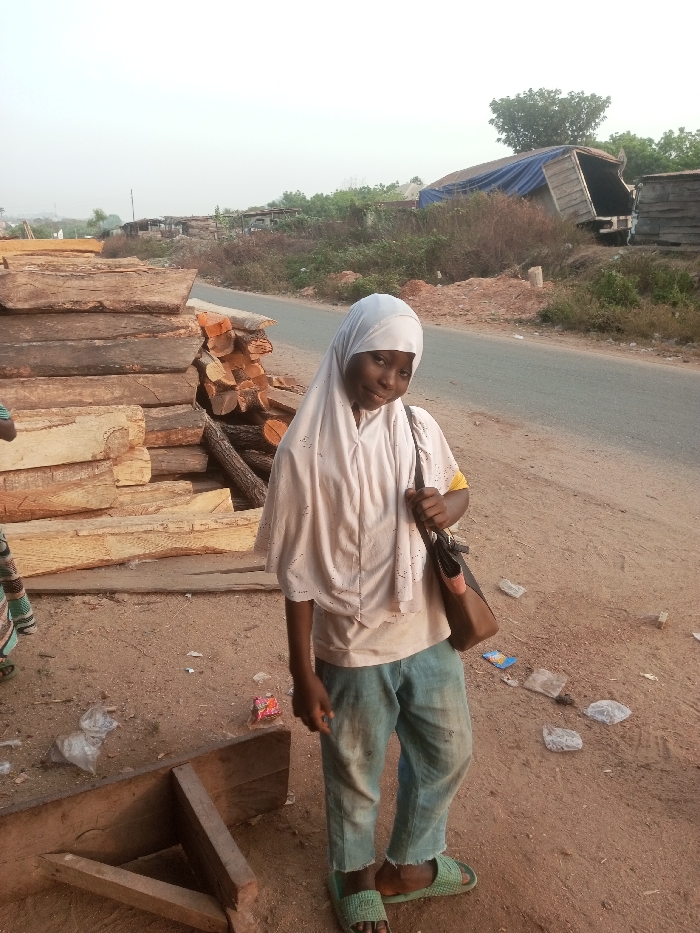
A young girl with brown skin, wearing a white hijab and casual clothes, stands on a dusty patch of ground. She is holding a brown bag. Behind her, a stack of logs is visible, and a road runs alongside the area. Trash litters the ground, including plastic bags and wrappers. In the background, a dilapidated structure with a blue tarp can be seen, adding to the overall impoverished setting.
Ebiya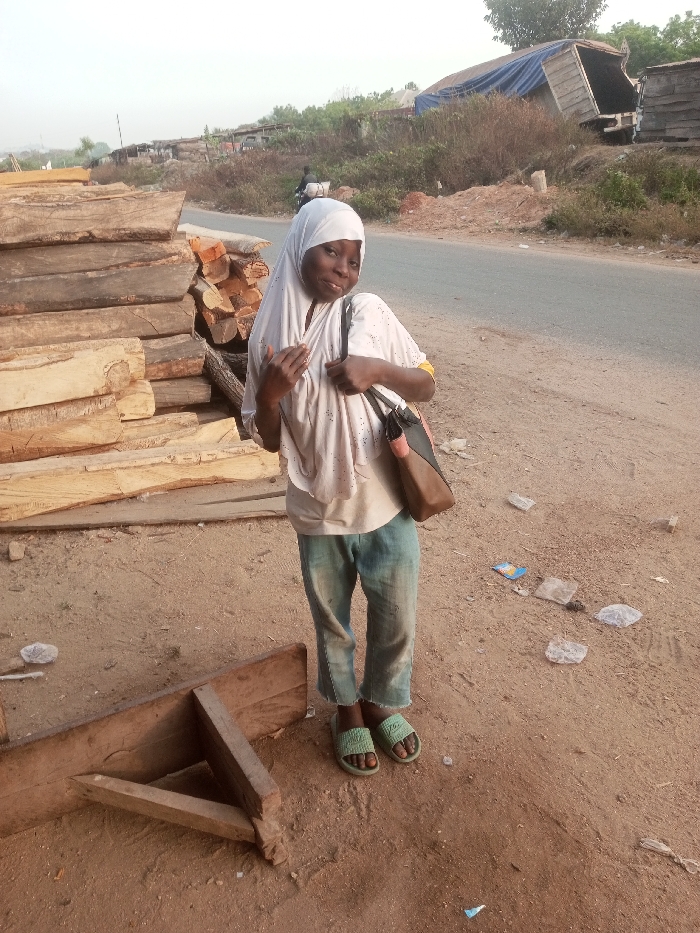
A young Black person stands posing for the camera on a dusty roadside in Ebiya, Nigeria. They are wearing a white hijab, a light-colored patterned long-sleeved top, light blue cropped jeans, and light green slides with a visible text or logo on them. A brown and black shoulder bag hangs over their left shoulder. The person has a subtle smile and their head is slightly tilted, conveying a playful or shy expression. To the left, a large stack of raw timber and cut planks forms a prominent feature, suggesting a lumberyard or sawmill nearby. A rough wooden structure lies partially on the ground in the bottom left corner. The setting includes a dirt shoulder alongside a paved road, which stretches into the background. Scattered plastic litter is visible on the dirt. In the mid-ground, a person on a motorcycle can be seen on the road. Further back, a partially overturned or abandoned truck trailer covered with a blue tarp is visible on a rise, amidst sparse vegetation and distant makeshift structures. The soft, diffused light suggests either early morning or late afternoon, and the weather appears dry. The scene captures a moment of daily life in a semi-rural or peri-urban environment.
Ebiya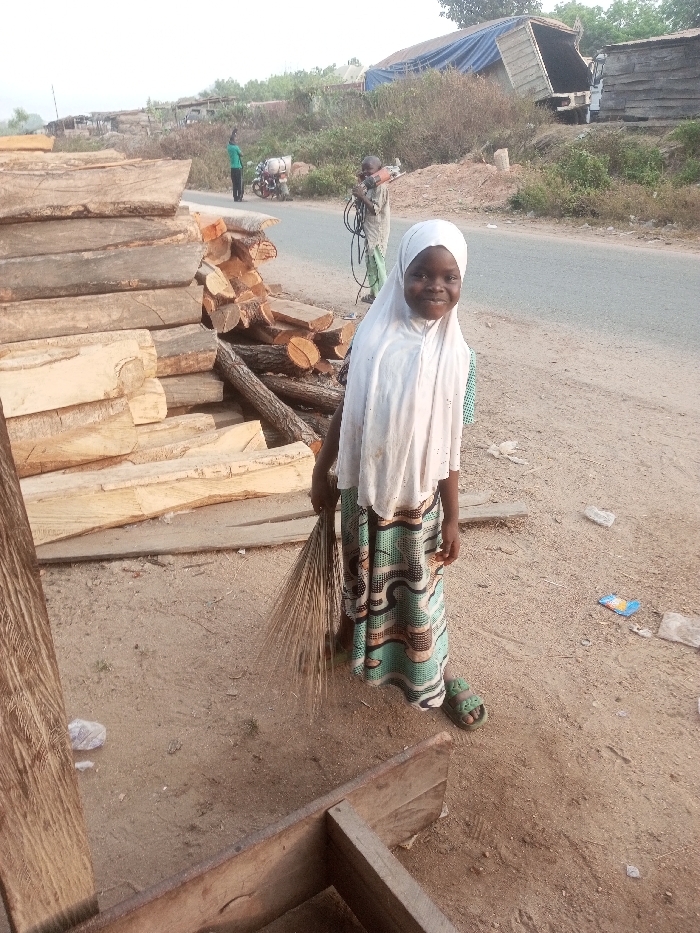
A young girl in a white headscarf and patterned dress stands on a dirt path, holding a broom. Stacks of lumber are to her left. Behind her, two figures stand near a road. One figure is on a motorcycle, while the other carries equipment. A large truck with a tarp covering the bed is visible in the background. The girl is smiling at the camera.
Ebiya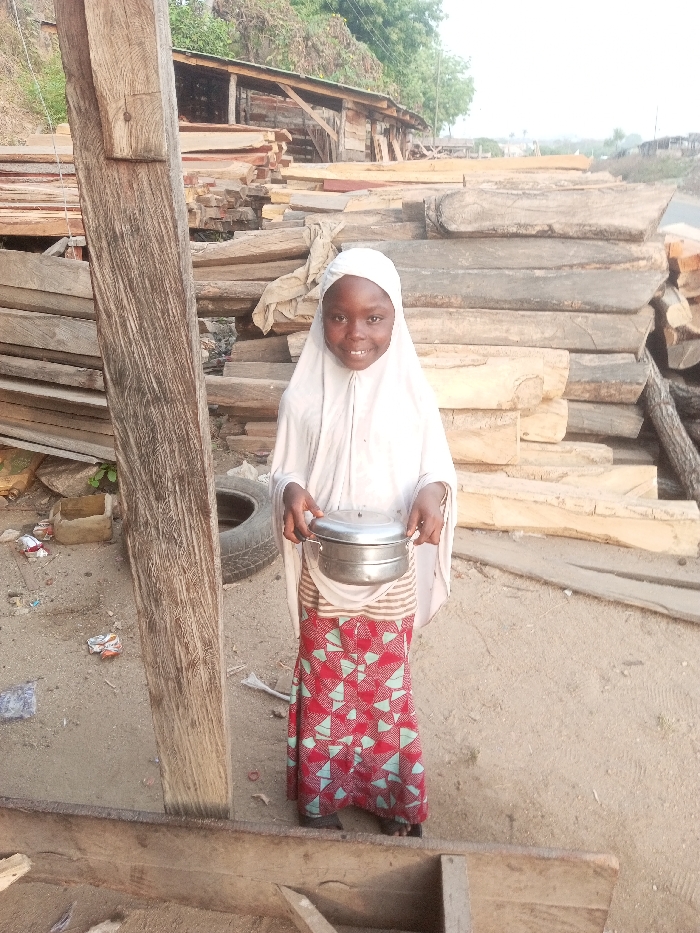
A young girl, likely of Muslim faith, stands smiling in a cluttered outdoor area. She wears a white hijab and a vibrant red and blue patterned skirt. She holds a metal container with handles. Behind her, stacks of lumber are visible, and a weathered wooden structure is in the background. The scene seems to be a working area, possibly a sawmill, with a mix of wood, dirt, and discarded items scattered around.
Ebiya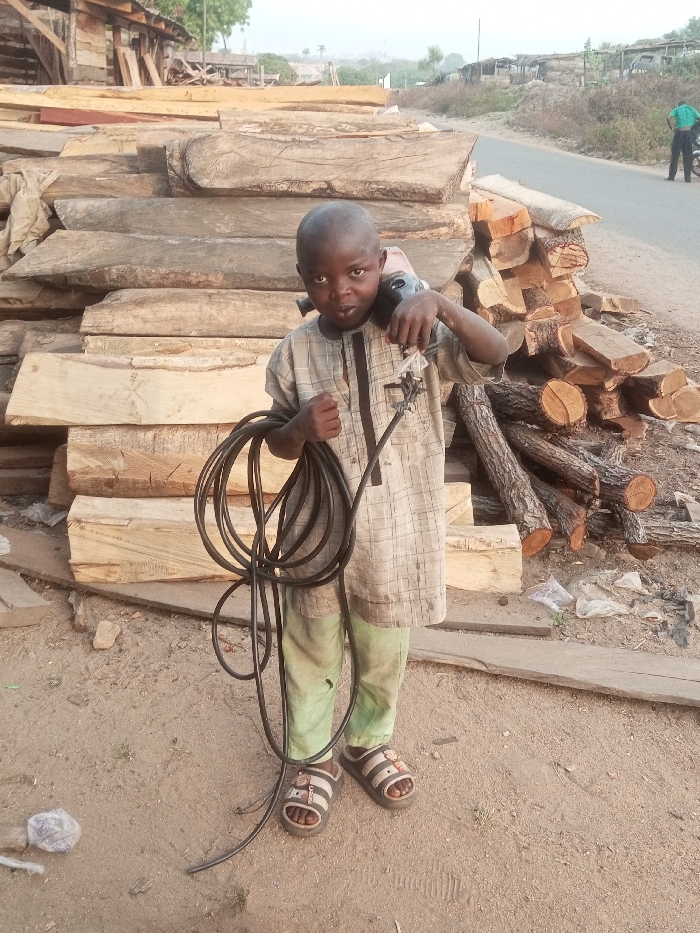
The image features a young child, appearing to be a boy, standing in an outdoor setting in Ebiya, Nigeria. The child is positioned centrally in the foreground, wearing a light-colored patterned tunic, light green trousers, and open-toed sandals. He holds a large coil of black cable in his left arm and has a black power tool, resembling an angle grinder or sander, resting on his right shoulder/back. He looks directly at the camera with a neutral expression. Behind the child, substantial stacks of raw logs and roughly sawn timber planks dominate the scene. To the child's right, additional cut logs are neatly piled. In the background, a dirt road is visible, on which a man in a green shirt and dark trousers walks away from the camera. Further beyond the road, there are hints of simple wooden structures and sparse vegetation under what appears to be a clear, bright sky. The lighting suggests it is daytime, likely late morning or afternoon, given the soft illumination and lack of harsh shadows. There is no visible text in the image. The scene conveys a working environment, possibly a timber market or processing area.
Ebiya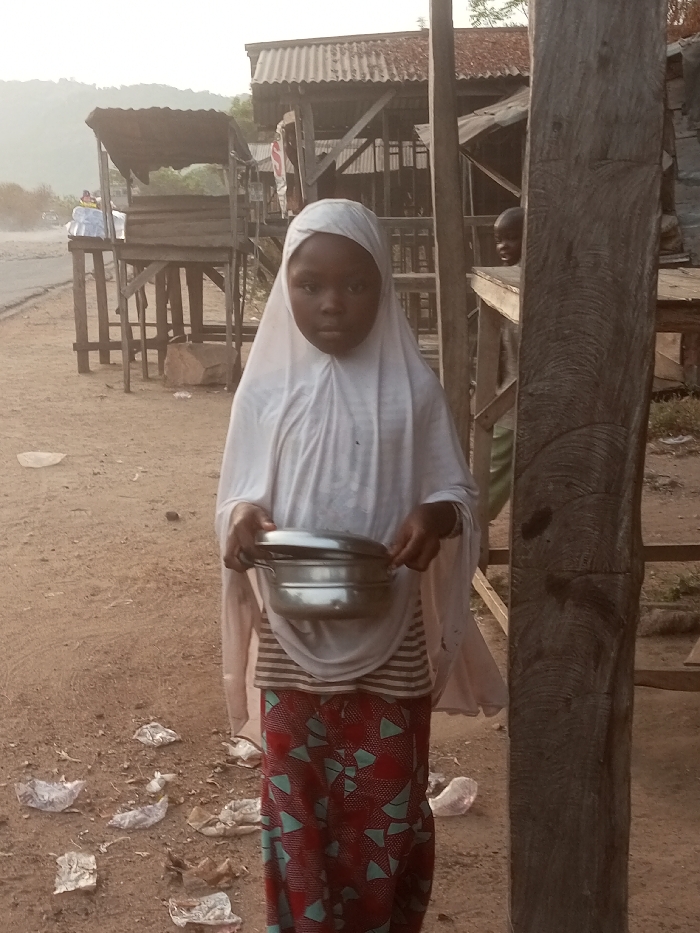
A young girl in a white hijab stands in a dusty, impoverished setting. She wears a striped shirt and a long skirt with a red and blue pattern. She holds a small, shiny metal container, possibly for food. Litter is scattered on the ground around her. Behind her are makeshift wooden structures, including market stalls. In the background, a road and distant hills can be seen under a hazy sky. The overall impression is one of poverty and hardship.
Ebiya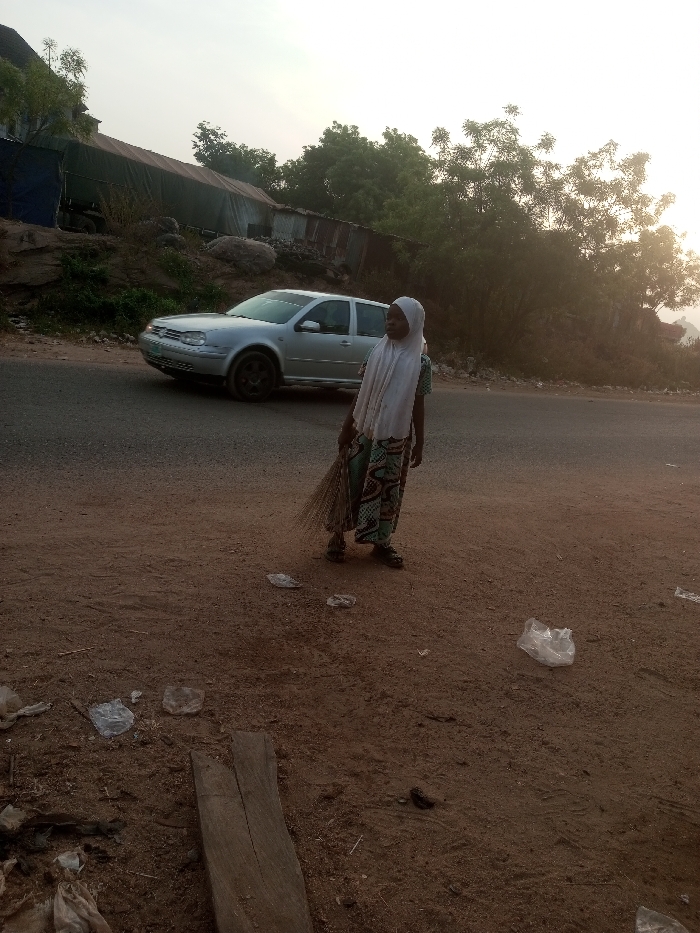
A woman in a headscarf stands on a dirt shoulder next to a paved road, holding a broom. A silver car is parked on the road behind her. Litter is scattered on the ground near the woman. In the background, there are trees and some buildings on a hillside, obscured by haze. The lighting suggests it is early morning or late afternoon.
Ebiya
The image captures a woman bending over on the dirt shoulder of an asphalt road in what appears to be a rural or semi-urban setting, identified as Ebiya, Nigeria. She is wearing a light-colored headscarf, possibly white, and a long, patterned dress with shades of light blue, green, and brown. Her feet are clad in dark sandals. Her posture suggests she is engaged in an activity close to the ground, possibly picking something up or tending to something on the dirt. In the immediate foreground, a crumpled, translucent plastic bag lies on the reddish-brown earth, and other smaller pieces of debris are scattered nearby. The background shows sparse vegetation, including trees and bushes, on a slightly elevated or hilly terrain. Along the edge of the road and nestled within the background foliage, a considerable amount of litter and discarded materials are visible, indicating an issue with waste accumulation. The lighting is soft and hazy, with a warm glow that suggests either early morning or late afternoon sun, diffused and creating a slight glare in the upper part of the image. The general atmosphere is somewhat dusty. There is no visible text in the image, and the woman's face is obscured, preventing any clear emotional cues.
Ebiya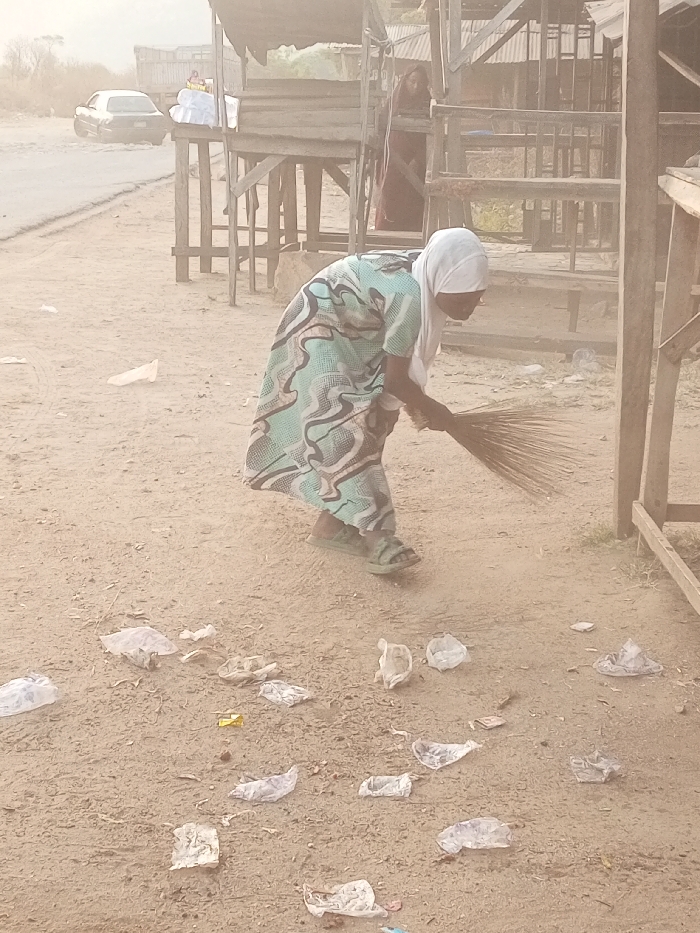
The image depicts an outdoor scene in a dusty, unpaved area, likely a roadside market or vendor space in Ebiya, Nigeria. In the foreground, a woman is actively sweeping the ground with a broom made of natural fibers. She wears a white head covering (hijab or scarf), a long, patterned dress in shades of teal/mint green and dark brown/black, and green sandals. The ground around her is heavily littered with numerous crumpled plastic bags and other small pieces of refuse. Behind the sweeping woman, several rustic wooden structures, resembling market stalls or shelters, are visible. Inside one of these structures, a second woman, dressed in a dark red garment, is partially visible. Further in the background, a hazy road can be seen, with a dark-colored sedan car on it. The overall atmosphere is characterized by a significant amount of haze or dust, which blurs the background elements. The scene portrays a routine cleaning activity in a functional, open-air setting. No text is visible in the image.
Ebiya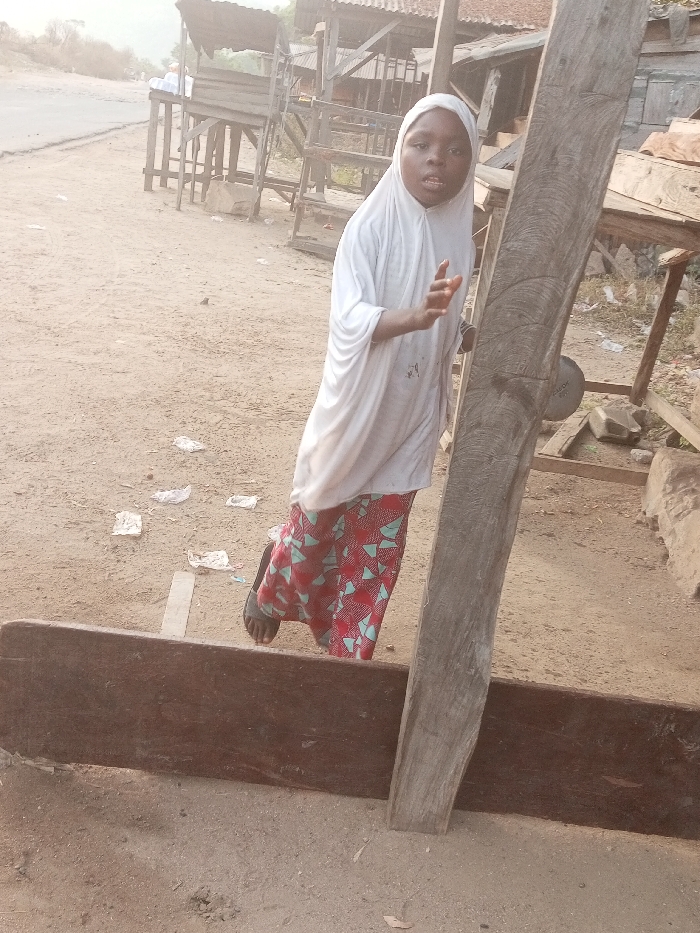
A young person, likely a girl, stands in the foreground, wearing a white hijab that covers her head and shoulders, and a patterned skirt with red, blue, and white geometric shapes. She has dark skin and is wearing dark sandals. Her mouth is slightly open, and she looks directly at the camera with her right hand raised and partially open, as if speaking or gesturing. The setting appears to be a dirt-covered outdoor area, possibly a roadside or marketplace, consistent with Ebiya, Nigeria. The ground is unpaved and dusty, with scattered pieces of white litter, possibly paper or plastic. In the immediate foreground, a long, dark horizontal wooden plank lies on the ground, and a thick, rough-hewn vertical wooden beam stands upright to the right of the person, partially obscuring the scene. A circular, metallic object is attached to this vertical beam, with the text "MADISON" and "50 KG" faintly visible on its surface. In the mid-ground and background, several simple wooden structures, resembling stalls or shelters, are visible. Some have corrugated metal roofs. A dirt road stretches into the distance on the left side of the image, where a figure, appearing to be an adult man in light clothing, can be seen further down the road. The lighting indicates it is daytime, with a warm, bright tone. The overall scene conveys a candid moment in a semi-urban or rural environment.
Ebiya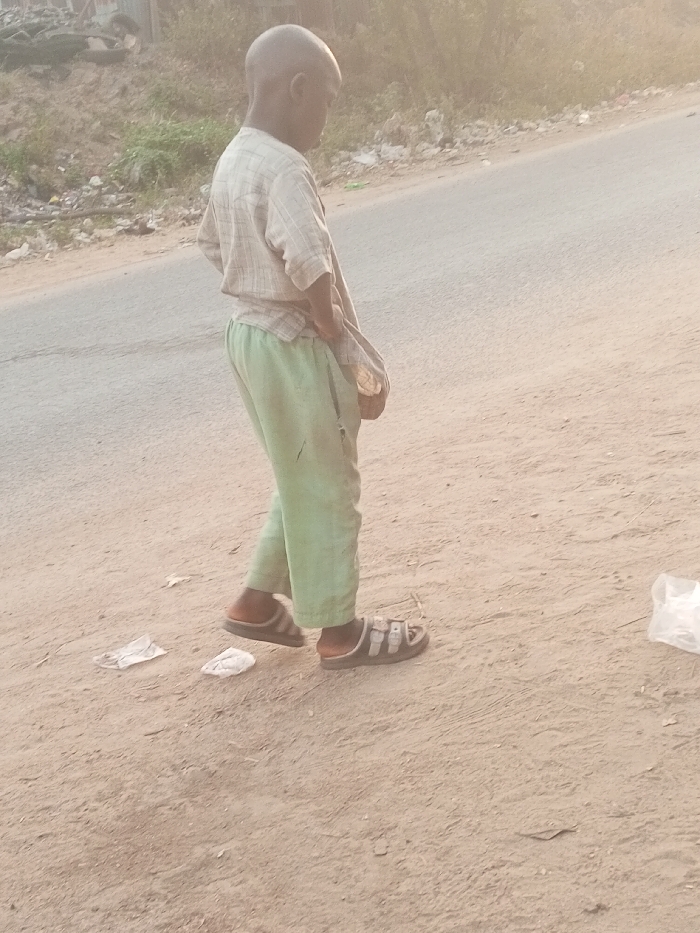
A young child, viewed from behind and slightly to the right, walks on a dusty path adjacent to a paved road. The child has short, dark hair and is wearing a light-colored, possibly striped, short-sleeved shirt and loose-fitting, light green trousers that appear somewhat worn. On their feet, the child wears two different styles of dark sandals: a slip-on sandal on the left foot and a double-strap sandal on the right. The child's head is slightly bowed, suggesting they are looking downwards or thoughtfully ahead. One hand is positioned near the hip, possibly holding or adjusting something. The ground is dry, light brown earth or gravel, with a few small pieces of white debris scattered near the child's feet and a clear plastic bag visible on the far right. Beyond the paved road in the background, there are hints of vegetation and more scattered debris. The lighting in the scene is soft and warm, characteristic of early morning or late afternoon, with a gentle, somewhat hazy glow that minimizes harsh shadows. The overall atmosphere suggests an outdoor, possibly semi-urban or rural setting. No text is visible in the image. The scene depicts an ordinary moment in the provided location context of Ebiya, Nigeria.
Ebiya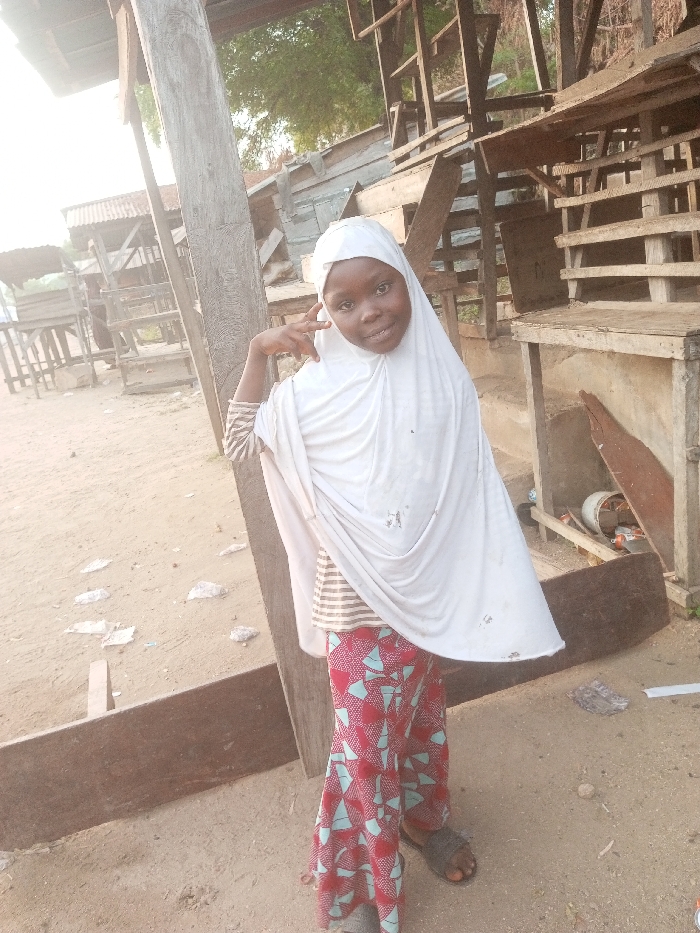
A young child, possibly a girl, with dark skin and a smiling expression, is the central subject of the portrait-oriented image. She wears a white hijab that covers her head and drapes over her shoulders and torso. Beneath the hijab, a horizontally striped long-sleeve shirt is visible. She also wears vibrant patterned trousers, primarily red with light blue and white geometric shapes, and dark sandals on her feet. Her left hand is raised, with her index and middle fingers extended in a "peace" sign or similar gesture, while her other fingers are curled. The child is standing outdoors on what appears to be a sandy or dirt ground. The lighting suggests it is daytime, likely sunny, casting a bright glow on the scene. In the background, there are various wooden structures that look like makeshift stalls, unfinished buildings, or scaffolding. These structures are irregular and appear weathered, suggesting a rural or semi-urban setting. To the far left, a structure with a corrugated metal roof is visible. Green foliage can be seen in the distant background, hinting at vegetation. There is no visible text in the image. The child's pose and smile convey a sense of happiness and playfulness. The location context indicates this scene is in Ebiya, Nigeria.
Ebiya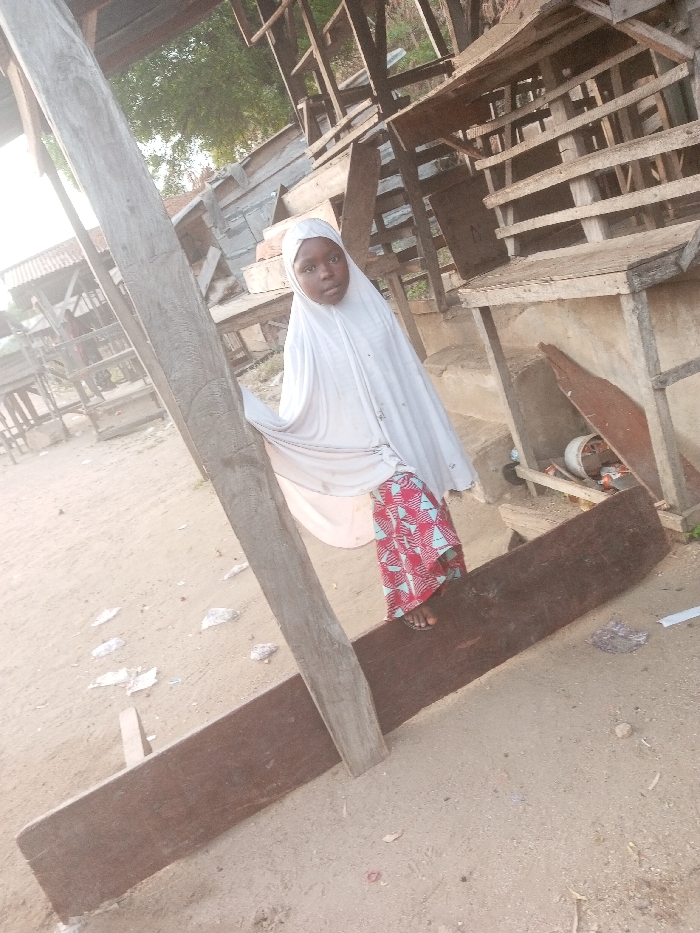
A young person wearing a white hijab and a patterned skirt stands near weathered wooden structures. One foot rests on a dark, elongated wooden plank. The scene is outdoors, with sandy ground and hints of foliage in the background. The wooden construction is exposed and seemingly unfinished, adding a rustic and somewhat derelict feel to the setting. The overall impression is one of a modest environment.
Ebiya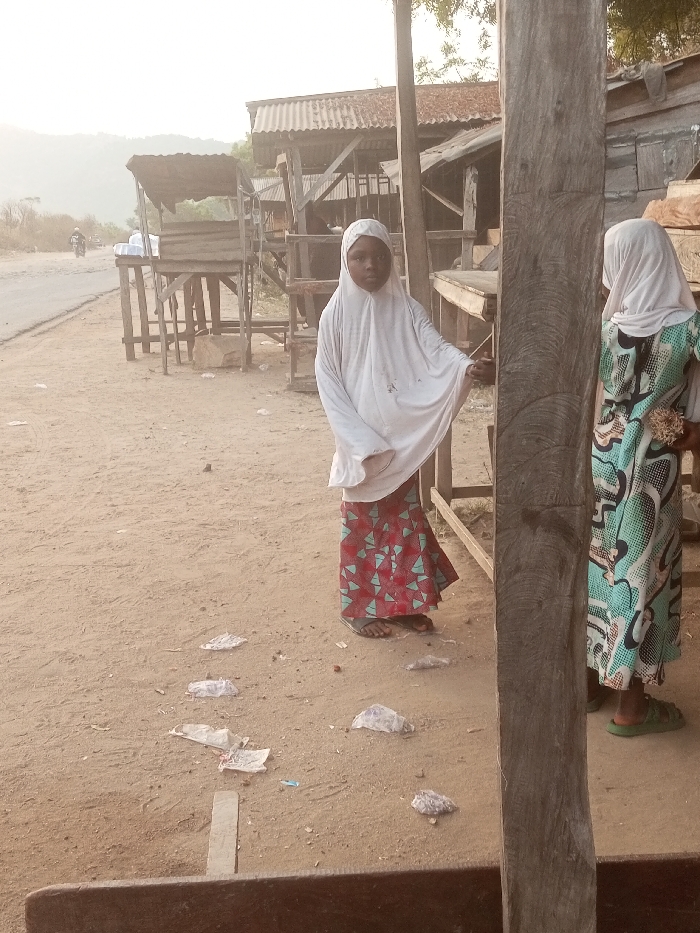
Two young girls wearing hijabs stand outside. One wears a white hijab with a red and green patterned skirt, while the other has a similar white hijab and a teal patterned dress. Trash litters the ground around them. Behind them are wooden structures, possibly market stalls, and a glimpse of a road with a motorcycle. The scene appears to be a rural or developing area.
Ebiya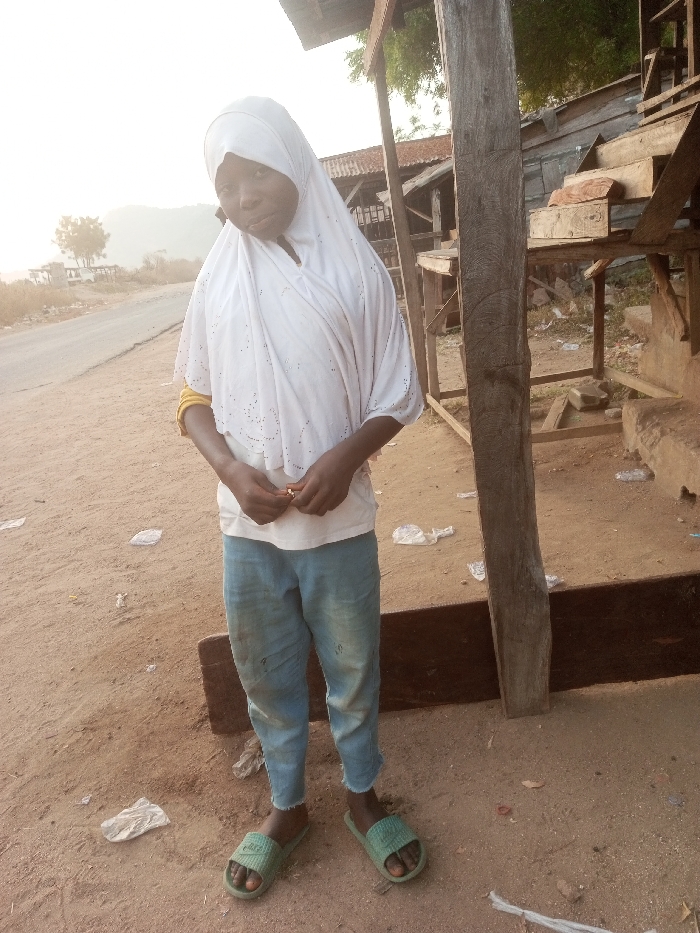
This full-length portrait captures a young person, likely a child or pre-teen, standing outdoors in what appears to be a rural or semi-urban setting in Ebiya, Nigeria. The subject has dark skin and is dressed in a modest white hijab that covers their head and shoulders, a white short-sleeved top, and light blue, worn jeans. They wear green slide sandals on their feet. Their hands are clasped in front, holding a small, light-colored object. The person is looking towards the camera with a neutral, slightly thoughtful expression. The scene depicts a dusty, unpaved ground littered with crumpled plastic bags and debris. To the left, a paved road stretches into the background, with sparse trees, distant hills, and structures under a bright, somewhat hazy sky, suggesting early morning or late afternoon light. To the right of the subject, there are simple, rustic wooden structures, possibly part of a market stall or an outbuilding, with a prominent wooden pole standing vertically near the center-right of the frame. The overall environment conveys a sense of everyday life in a modest, outdoor location. There is no visible text in the image.
Ebiya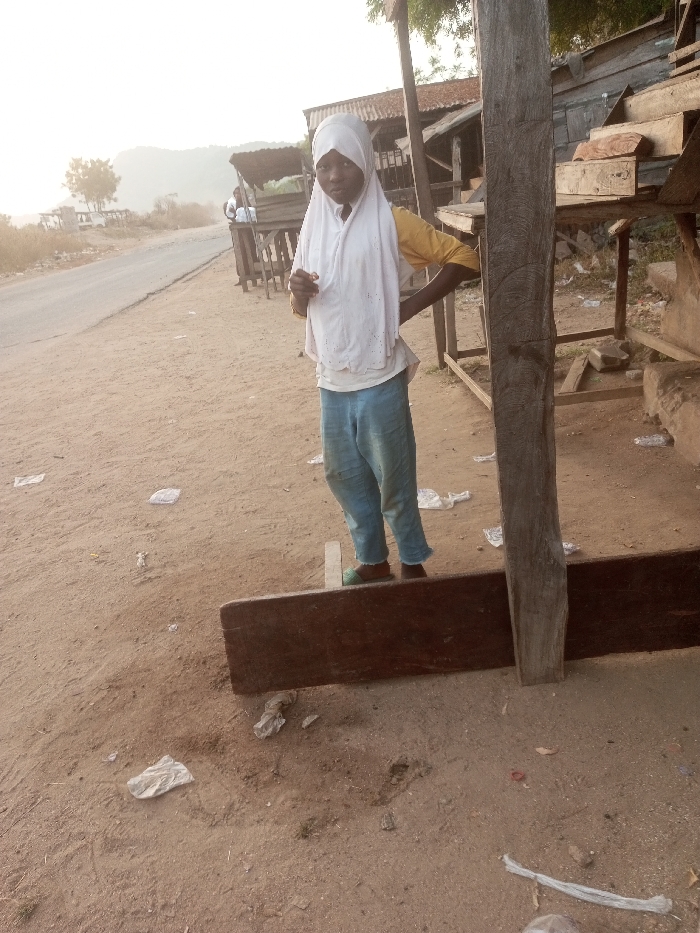
A girl in a white headscarf, yellow shirt, and blue pants stands outdoors. She has one hand on her hip and faces forward. She is near a wooden structure with tables, possibly a market stall, and a large wooden post. The ground is dirt with scattered trash. A road is visible in the background along with other people and buildings.
Ebiya