El Rincón de Monagas, Venezuela
18 memories from El Rincón de Monagas, Venezuela
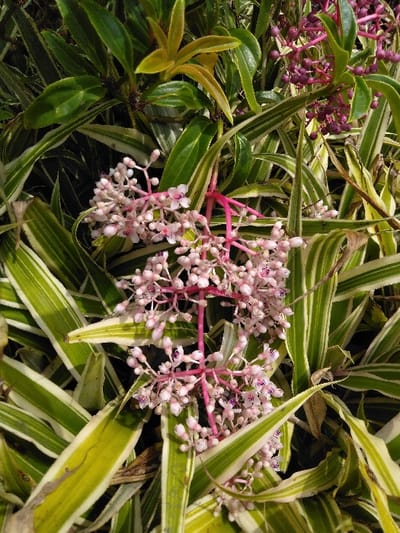
The image presents a close-up, high-angle view of dense plant foliage located in El Rincón de Monagas, Venezuela. The central focus is on multiple clusters of small, spherical flower buds and partially opened florets, predominantly pale pink to white in color, with some exhibiting darker pink or purple centers. These clusters are supported by thin, vibrant fuchsia-pink peduncles and stems. Surrounding and partially obscuring the floral elements are numerous elongated, lanceolate leaves characterized by prominent green and creamy-white longitudinal variegation. In the upper and background areas, solid dark green, ovate leaves are visible, some with a yellowish tint, alongside a cluster of small, dark purple, spherical berry-like structures or mature inflorescences. Natural light illuminates the scene from above, casting subtle shadows among the dense growth. No human subjects, animals, or man-made objects are present.
El Rincón de Monagas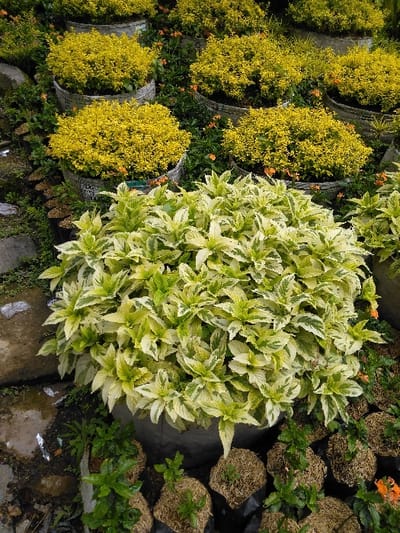
This image captures a cultivated outdoor plant area in El Rincón de Monagas, Venezuela. The central foreground features a large, dark grey planter containing a dense, rounded variegated plant with prominent light green and cream-white leaves. Behind this, and extending into the mid-ground, are multiple rows of repurposed tire planters, each holding a compact, spherical bush composed of small, bright yellow-green foliage. Scattered orange flowers are visible amongst these yellow bushes. In the lower foreground, to the left and right of the main variegated plant, numerous smaller plants are displayed in black plastic nursery bags, some topped with a light-colored mulch material. The ground consists of damp earth, scattered small stones, and sections of concrete or paved pathway visible in the lower left. No individuals or discernible actions are depicted.
El Rincón de Monagas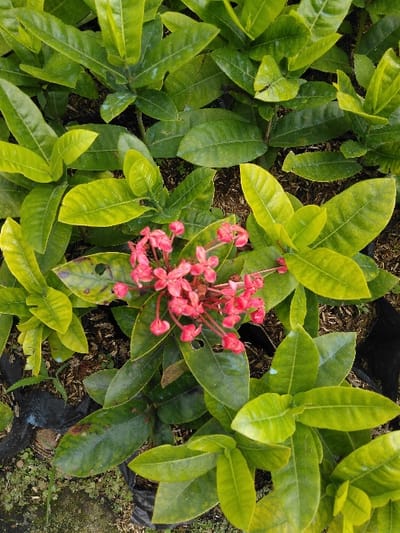
An overhead, close-up photograph depicts a dense cluster of flowering plants, identified as Ixora coccinea, situated in El Rincón de Monagas, Venezuela. The primary subject is a central inflorescence of numerous small, tubular, four-petaled flowers, uniformly vibrant red-pink in color. Surrounding the flower cluster and filling the frame are ovate to elliptical leaves, varying in hue from light yellowish-green to darker green. Several leaves exhibit minor damage, including small perforations and localized brown discoloration. The plants appear to be cultivated, with dark brown soil or mulch visible between the foliage and hints of black plastic nursery bags in the lower left and right quadrants. No human subjects or discernible actions are present.
El Rincón de Monagas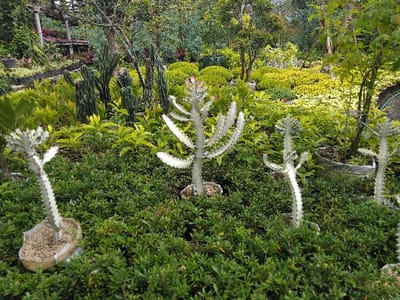
The image displays an outdoor plant nursery or garden area located in El Rincón de Monagas, Venezuela. The scene is densely populated with diverse plant life under ambient daylight. In the immediate foreground, a bed of low-growing, small-leaved green plants covers the ground. Within this bed, four prominent white-stemmed, columnar succulent plants, consistent with *Euphorbia lactea 'White Ghost'*, are visible. The plant on the far left is rooted in a beige, cut plastic bottle acting as a planter, filled with light-colored substrate. The other three white succulents are situated in dark pots, with the central specimen exhibiting a reddish growth tip. Beyond the foreground, the nursery features organized rows and beds of various plants. Lighter green, broad-leaved plants are arranged in distinct sections, while further back, areas of yellowish-green foliage are evident. The mid-ground to background includes several tall, dark green columnar cacti and a variety of trees with lush green foliage, suggesting a verdant, tropical or subtropical environment. A partial wooden or metal trellis structure is discernible in the far left background. No human figures or discernible animal life are present.
El Rincón de Monagas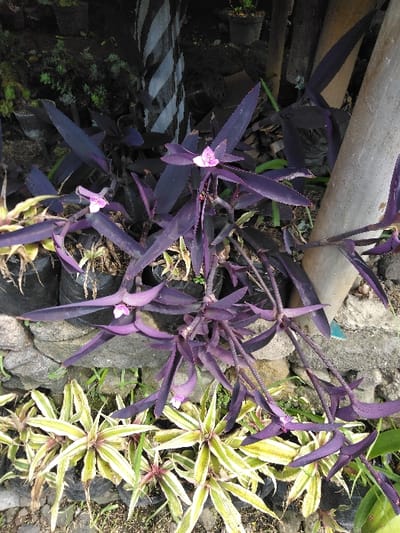
The image depicts an outdoor garden scene in El Rincón de Monagas, Venezuela. The primary subject is a cluster of *Tradescantia pallida* 'Purpurea' (Purple Heart plant) with dark purple, elongated leaves and small, three-petaled pink flowers. At least four distinct flowers are visible on trailing stems. Below this plant, several smaller plants with green and yellow variegated leaves, possibly a type of Bromeliad, are visible, many contained within black plastic nursery bags. The ground consists of soil, with irregular grey stones and patches of green grass or weeds. In the background on the left, a vertical post with black and white diagonal stripes is visible, alongside other potted plants in a darker area. On the right background, a light-colored, cylindrical post extends vertically. No individuals are present in the scene.
El Rincón de Monagas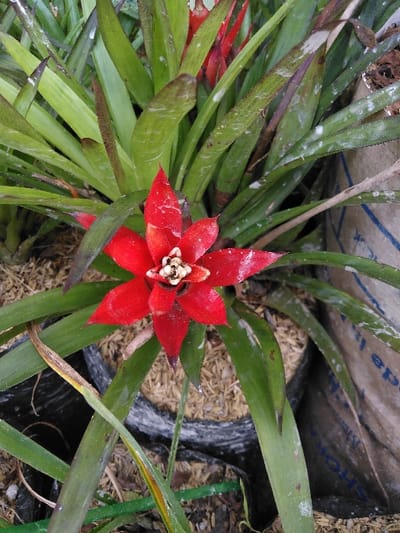
The image depicts a close-up, top-down view of a flowering bromeliad plant located in El Rincón de Monagas, Venezuela. The central subject is a bromeliad with a vibrant red inflorescence composed of approximately six prominent, star-shaped bracts. At the core of the inflorescence, a cluster of small, cream-colored florets is visible. The plant features numerous green, strap-like leaves radiating outwards; some leaves exhibit minor discoloration, possible white residue, or dried tips. The plant is contained within a dark, possibly plastic, grow bag filled with a light brown, granular growing medium, resembling wood chips or rice hulls. In the background, additional green foliage and other dark-colored plant containers are partially visible. To the right, a lighter-colored, repurposed sack with faint blue text is discernible. The ground surface beneath the plants consists of dark soil and scattered organic matter. No people are present, and no actions or interactions are depicted.
El Rincón de Monagas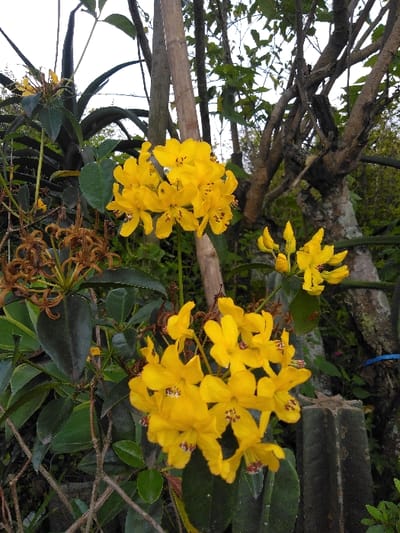
This image captures a static, close-up view of vibrant yellow flowers within a verdant outdoor setting in El Rincón de Monagas, Venezuela. The primary subjects are two prominent clusters of five-petaled, bright yellow flowers, each displaying reddish-brown stamens. These flowers are affixed to a plant characterized by dark green, ovate leaves. To the immediate left of the central flower clusters, several dried, brown, star-shaped botanical structures or withered seed pods are visible. The background consists of dense foliage and woody elements. Vertical, slender, light brown stalks, possibly bamboo, are situated behind the flowers. Further to the right, a gnarled tree trunk with several intertwined branches and textured, light-colored bark is present. In the lower right quadrant, a weathered, grey, columnar structure, possibly concrete or stone, is partially visible. A segment of blue string or rope is discernible tied around a branch or stem near this structure. The environment suggests a natural or cultivated garden. The sky, visible at the top, is bright and diffused, indicating an overcast condition or indirect sunlight. No human subjects, animals, or specific actions are depicted.
El Rincón de Monagas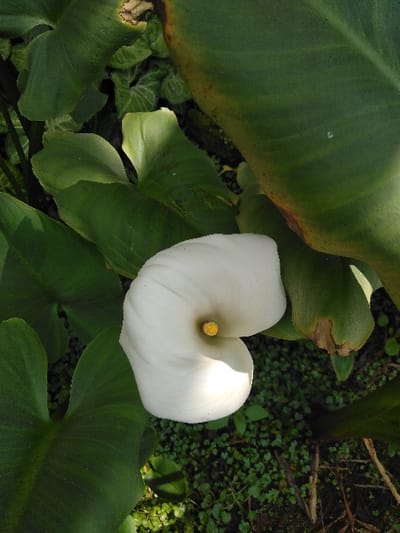
A single white Calla Lily (Zantedeschia aethiopica) is prominently featured, slightly off-center, within a dense natural environment. The flower's spathe is a pure white, curled inward to form a trumpet-like shape, with a visible bright yellow spadix at its center. The top-right portion of the spathe is illuminated by direct sunlight, casting a subtle shadow on its lower-left curve. Surrounding the flower are multiple large, dark green, heart-shaped or sagittate leaves, characteristic of the Calla Lily plant. Several of these leaves exhibit brown discoloration and irregular edges, indicative of age or minor damage. One large leaf in the upper right quadrant shows significant browning along its edge. The ground beneath and around the plants is covered with a dense mat of small-leafed green ground cover, possibly clover or a similar creeping plant, with some darker soil or organic matter visible. The scene is located in El Rincón de Monagas, Venezuela.
El Rincón de Monagas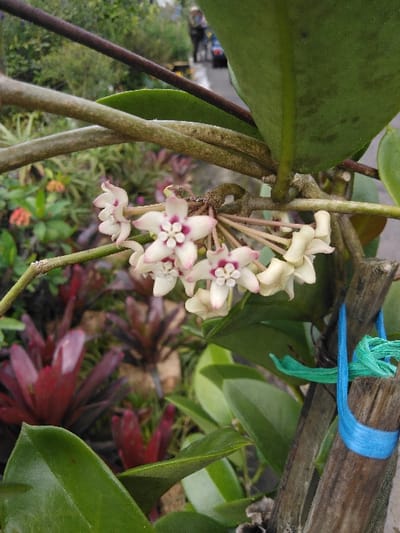
A close-up, vertical photograph depicts a cluster of Hoya flowers in bloom within a garden environment in El Rincón de Monagas, Venezuela. The primary subject is a spherical arrangement of approximately ten to twelve small, star-shaped flowers, each possessing white to pale pink petals and a distinct dark pink or reddish central corona. These flowers are attached to an herbaceous plant characterized by intertwining, light brown stems and dark green, ovate leaves visible throughout the frame. To the right, a weathered wooden stake supports the plant, secured by a bright blue plastic strap and a partially unraveled green plastic strap. The mid-ground features blurred red or burgundy broad-leaved plants, possibly Bromeliads, and a hint of smaller orange-red flowers. The far background shows a blurred paved surface, indicative of a street or sidewalk, occupied by several indistinct human figures, at least one bicycle, and distant green foliage.
El Rincón de Monagas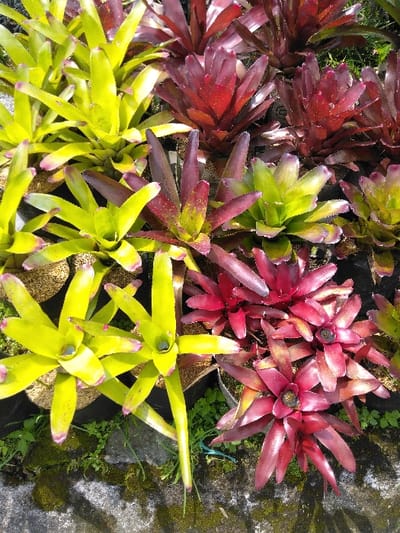
The image displays a dense cultivation of approximately two dozen bromeliad plants, observed outdoors in El Rincón de Monagas, Venezuela. The plants exhibit two primary colorations: a vibrant chartreuse green and a range of reds to maroons. In the upper left quadrant and extending downwards, several chartreuse green bromeliads are visible. These plants feature broad, pointed leaves, some with pale pinkish tips, forming a central rosette. Individual plants are situated in containers, with visible granular substrate within. The right side and central portions of the image are dominated by bromeliads displaying various shades of red, burgundy, and maroon. Some of these red plants have lighter green centers or speckled patterns on their leaves. These plants also form rosettes and are contained in individual pots, largely obscured by their foliage. The ground surface in the lower half of the frame consists of a concrete or paved area, partially covered by patches of green moss and small herbaceous plants. A thin blue cord is faintly visible on the ground near the bottom center. The scene is illuminated by natural sunlight, casting subtle shadows and highlighting the varied textures and colors of the plant leaves. No human subjects, animals, or specific actions are depicted.
El Rincón de Monagas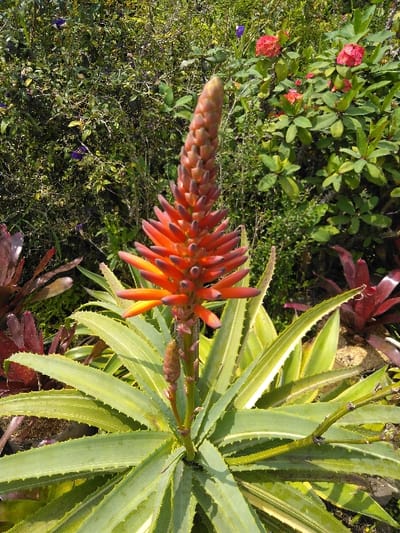
This image presents a detailed view of a botanical scene in El Rincón de Monagas, Venezuela. The central subject is a succulent plant, consistent with an Aloe species, featuring a basal rosette of numerous lanceolate, serrated leaves. These leaves exhibit a green coloration with distinct yellowish-white variegation along their margins. An erect, unbranched scape rises vertically from the center of the rosette, bearing a dense, conical raceme composed of numerous tubular florets or buds, which display a gradient of orange and red hues. A secondary, smaller, undeveloped inflorescence bud is visible lower on this central scape. The background consists of dense mixed vegetation. To the immediate left, dark green foliage is present, interspersed with plants featuring reddish-brown leaves and small, scattered purple flowers. To the right of the central plant, a shrub with dark green leaves and clusters of bright red flowers, consistent with *Euphorbia milii* (Crown of Thorns), is visible against further green foliage. The scene is brightly illuminated by direct natural sunlight, creating clear contrasts and highlighting the textures and colors of the plants. No human or animal subjects are present, and no actions or interactions are depicted within the static environment.
El Rincón de Monagas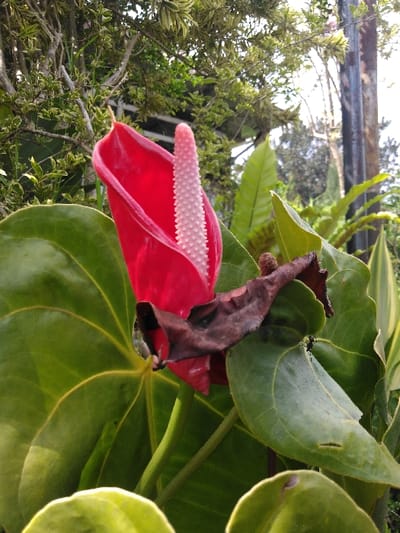
The scene is an outdoor botanical setting, located in El Rincón de Monagas, Venezuela. The primary subject is a single Anthurium flower, specifically a red spathe with a prominent, erect, light pink spadix displaying a granular texture. The flower is positioned centrally and slightly to the left. Surrounding the flower are multiple large, ovate, dark green leaves exhibiting visible venation. A single desiccated leaf, brown and shriveled, is observed resting on a larger green leaf directly below and to the right of the red flower. Additional green foliage, some with variegated lighter green and yellow patterns, forms the midground and blurred background. A vertical, dark-colored pole is visible on the right side of the frame, extending upwards. The lighting suggests natural daylight conditions. No human figures or discernible animal life are present.
El Rincón de Monagas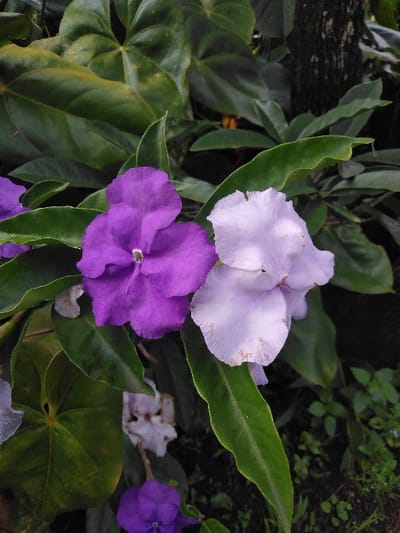
The image depicts a close-up, vertical view of flowering vegetation located in El Rincón de Monagas, Venezuela. The central focus features two five-petaled flowers characteristic of the *Brunfelsia* genus. The flower on the left is a vibrant deep purple with a small white-yellow pistil visible in its center. The flower to its right is a lighter, faded lavender to off-white, exhibiting minor brownish discoloration on its petals. These flowers are embedded within dense green foliage. Numerous leaves of varying shades of green, from deep emerald to lighter hues, are visible. Some leaves are broad and ovate, displaying prominent venation, particularly in the upper left, while others are more elongated. In the upper right quadrant, a portion of a dark brown, textured tree trunk is discernible amidst the leaves. The lower section of the image shows additional smaller flowers, both purple and pale, along with more green leaves, indicating a larger plant or shrub. No human, animal, or man-made objects are present.
El Rincón de Monagas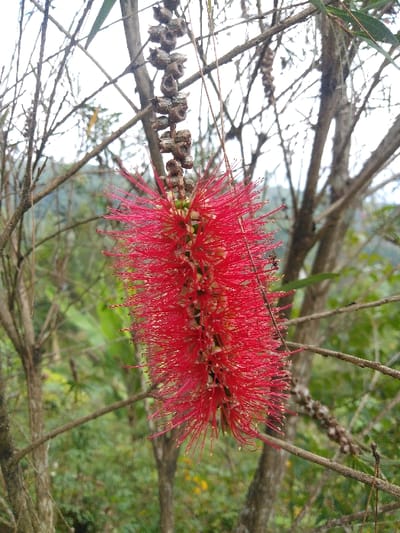
The image depicts a close-up, vertical view of a vibrant red bottlebrush flower, likely a species of *Callistemon* or *Melaleuca*, situated outdoors in El Rincón de Monagas, Venezuela. The flower, centrally positioned, is elongated and cylindrical, composed of numerous slender, crimson stamens with visible yellow anthers at their tips. Directly above the flower, a woody stem bears a tight cluster of approximately 15-20 dark brown, woody seed capsules, each segment resembling a small cup. The foreground and midground are characterized by an intricate network of thin, bare, gnarled tree branches of varying thickness. The background consists of blurred green foliage, suggesting dense vegetation or woodland, with indistinct lighter green and yellow patches, under a bright, possibly overcast or hazy sky. No individuals or specific actions are depicted.
El Rincón de Monagas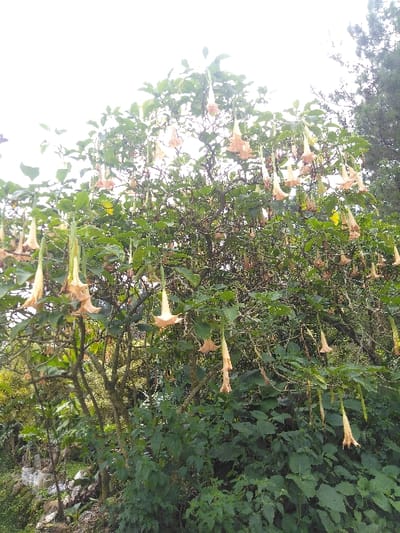
A large Brugmansia (Angel's Trumpet) plant is depicted in an outdoor setting within El Rincón de Monagas, Venezuela. The plant is heavily covered with numerous pendulous, trumpet-shaped flowers, predominantly pale yellow to light peach, interspersed among its dense green foliage. The upper portion of the frame shows an overcast, bright white sky. To the right, the darker green foliage of a taller evergreen tree is partially visible. The lower left foreground contains additional green undergrowth and indistinct lighter-colored ground elements, possibly rocks or exposed earth. No individuals or specific actions are observed within the scene.
El Rincón de Monagas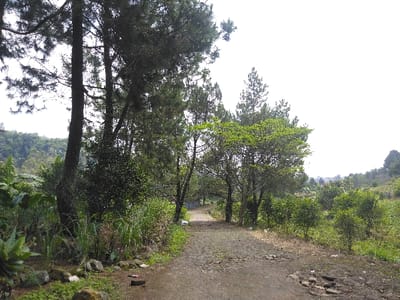
This image captures an unpaved, dirt road or path situated in El Rincón de Monagas, Venezuela, under bright daylight conditions. The path, composed of compacted earth and scattered small stones, shows an uneven, worn surface and recedes into the distance, making a slight curve to the right. To the left of the path, a dense array of vegetation is present, featuring several tall coniferous trees with dark trunks, various broad-leafed plants, grasses, and smaller bushes; an aloe vera plant is prominently visible in the immediate foreground. The ground in this area also contains rocks and minor debris. On the right side of the path, the landscape consists of smaller, round-leafed bushes and trees, interspersed with grasses and sections of dry soil. A distant, forested hillside is visible on the far left of the background. The sky, occupying the upper and central-right portions of the frame, is bright white, indicative of ambient daylight. No human figures, animals, or discernible actions are present within the scene.
El Rincón de Monagas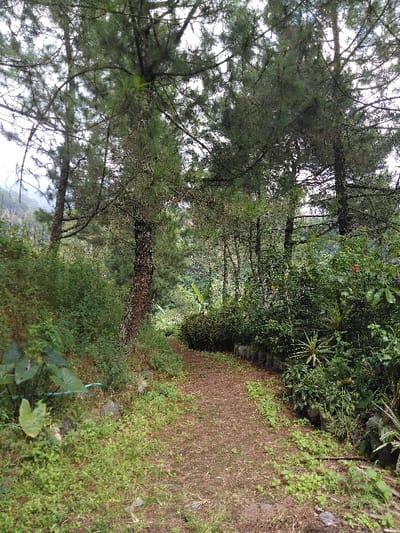
The image displays an unpaved, reddish-brown dirt path traversing a heavily vegetated area identified as El Rincón de Monagas, Venezuela. The path originates in the foreground, extends towards the center, and curves slightly left as it recedes into dense foliage. Dominating the scene are numerous mature pine trees with dark green needles, their rough-barked trunks rising vertically on both sides and extending beyond the frame, creating a partial canopy against an overcast, light grey sky. On the left side of the path, the ground slopes gently upward, covered in dense green undergrowth, small plants, and a prominent large-leafed plant in the lower-left quadrant. A segment of a blue PVC pipe is partially visible horizontally within the foliage near the bottom-left. On the right side of the path, a low linear arrangement of dark-colored barriers or planters defines the edge. Behind these barriers, a diverse array of dense tropical vegetation is present, including various broad-leafed plants, some exhibiting red hues, and several smaller plants in black containers or nursery pots. In the background, especially to the far left, faint outlines of distant hills or mountainous terrain are discernible through a slight atmospheric haze. The scene is illuminated by diffused natural light. No human figures, animals, or specific actions are depicted.
El Rincón de Monagas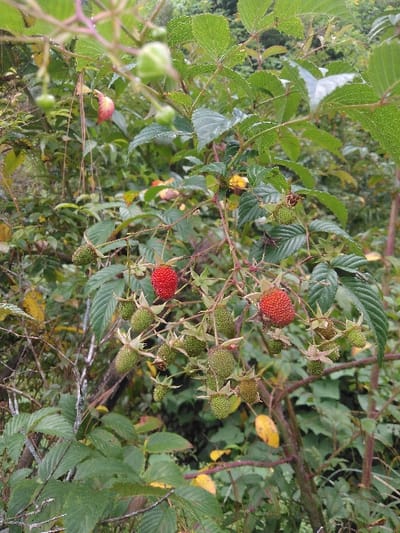
This image depicts a vertical, close-up view of a fruiting plant, identified as a bramble or similar berry-producing species, located in the city of El Rincón de Monagas, Venezuela. The central subject is a cluster of developing and ripe berries. Approximately two dozen berries are visible, predominantly unripe, exhibiting a vivid green coloration and a segmented, aggregated structure. Two prominent berries, situated towards the upper-middle and middle-right of the frame, are fully ripe, distinguished by their bright red hue and similar segmented morphology. These berries are individually attached to slender, reddish-brown pedicels. The surrounding foliage consists of serrated, ovate green leaves on woody stems. The background presents dense, out-of-focus natural vegetation, primarily green, with scattered yellowed leaves and darker woody elements, indicative of an uncultivated outdoor environment. No human or animal subjects, or explicit actions or interactions, are present in the scene.
El Rincón de Monagas