CM:

ATTN

Get the app

Fátima, Portugal

30 memories from Fátima, Portugal
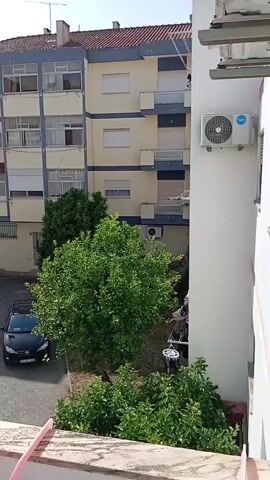
The video pans across an urban environment, showing multiple apartment buildings, parked cars, trees, and a clear sky. In the foreground, a portion of a balcony railing is visible. The camera moves from right to left, revealing a black car parked on a paved area, a large green tree, and the facade of a yellow and blue apartment building. Further left, another building with a corrugated roof is seen. The camera continues to pan, showing more apartment buildings in the background and a fence along a narrow pathway. A bird is seen flying in the distance. The overall impression is that of a residential area on a sunny day.

The video pans across an urban environment, showing multiple apartment buildings, parked cars, trees, and a clear sky. In the foreground, a portion of a balcony railing is visible. The camera moves from right to left, revealing a black car parked on a paved area, a large green tree, and the facade of a yellow and blue apartment building. Further left, another building with a corrugated roof is seen. The camera continues to pan, showing more apartment buildings in the background and a fence along a narrow pathway. A bird is seen flying in the distance. The overall impression is that of a residential area on a sunny day.

Fátima

A black cat with light-colored eyes is curled up on a light-colored rug. The cat is facing to the left and looking towards the camera. Behind the cat is a white wall with a white pipe running diagonally across the top of the frame. A dark red baseboard runs along the bottom of the wall, separating it from the rug. The scene appears to be indoors, possibly in a home. There is no discernible information in the image to indicate a specific location within the city of Fátima, Portugal.

A black cat with light-colored eyes is curled up on a light-colored rug. The cat is facing to the left and looking towards the camera. Behind the cat is a white wall with a white pipe running diagonally across the top of the frame. A dark red baseboard runs along the bottom of the wall, separating it from the rug. The scene appears to be indoors, possibly in a home. There is no discernible information in the image to indicate a specific location within the city of Fátima, Portugal.

Fátima
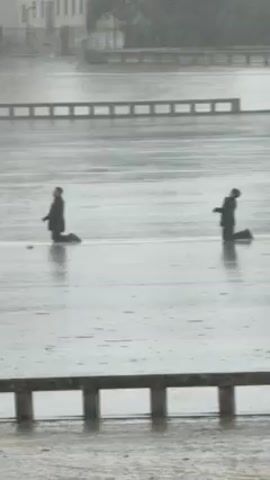
The video depicts a rain-soaked outdoor area. Two people are kneeling on the ground, seemingly searching for something. The person on the left is wearing a dark suit, and the person on the right is also dressed in dark clothing. A small white object is visible near the person on the left. In the background, there's a building and a barrier with horizontal bars. The rain is heavy, and the ground is covered in water.

The video depicts a rain-soaked outdoor area. Two people are kneeling on the ground, seemingly searching for something. The person on the left is wearing a dark suit, and the person on the right is also dressed in dark clothing. A small white object is visible near the person on the left. In the background, there's a building and a barrier with horizontal bars. The rain is heavy, and the ground is covered in water.

Fátima
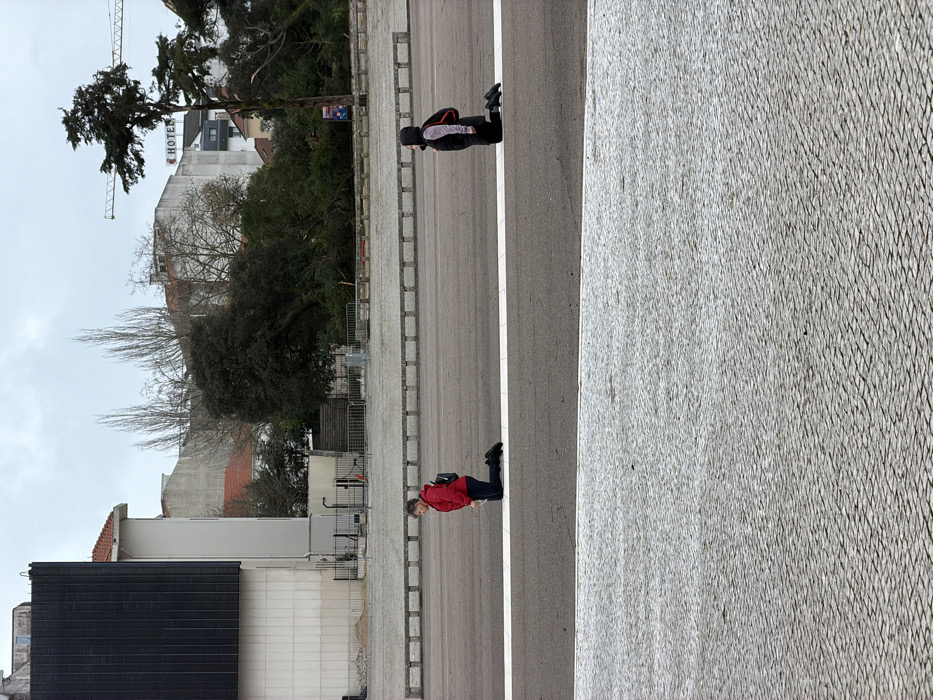
The image depicts an outdoor scene at the Sanctuary of Fátima, Portugal, under an overcast sky. Two individuals are kneeling on a dark asphalt esplanade, positioned on or near a distinct white line that runs horizontally across the midground.

The individual on the left, an adult female, wears a red jacket, dark trousers, and dark shoes, with a black backpack on her shoulders. She is kneeling on her right knee, facing slightly to the right of the frame. The individual on the right, smaller in stature, wears a dark hooded top, a dark vest, dark trousers, and dark shoes, with an orange backpack. This person is kneeling on both knees, facing the same direction as the first individual.

The immediate foreground consists of a textured, light-colored cobblestone pavement. In the background, various urban and natural elements are visible. To the left, a large modern building with a dark, vertically ribbed facade stands adjacent to a white building featuring a red-tiled roof. Further right, a multi-story grey building displays a red "HOTEL" sign. Scattered trees, some appearing sparse or with broken branches, are situated between the esplanade and the background structures, separated by low metal barriers. A construction crane is partially visible above the "HOTEL" building on the horizon.

The image depicts an outdoor scene at the Sanctuary of Fátima, Portugal, under an overcast sky. Two individuals are kneeling on a dark asphalt esplanade, positioned on or near a distinct white line that runs horizontally across the midground. The individual on the left, an adult female, wears a red jacket, dark trousers, and dark shoes, with a black backpack on her shoulders. She is kneeling on her right knee, facing slightly to the right of the frame. The individual on the right, smaller in stature, wears a dark hooded top, a dark vest, dark trousers, and dark shoes, with an orange backpack. This person is kneeling on both knees, facing the same direction as the first individual. The immediate foreground consists of a textured, light-colored cobblestone pavement. In the background, various urban and natural elements are visible. To the left, a large modern building with a dark, vertically ribbed facade stands adjacent to a white building featuring a red-tiled roof. Further right, a multi-story grey building displays a red "HOTEL" sign. Scattered trees, some appearing sparse or with broken branches, are situated between the esplanade and the background structures, separated by low metal barriers. A construction crane is partially visible above the "HOTEL" building on the horizon.

Fátima
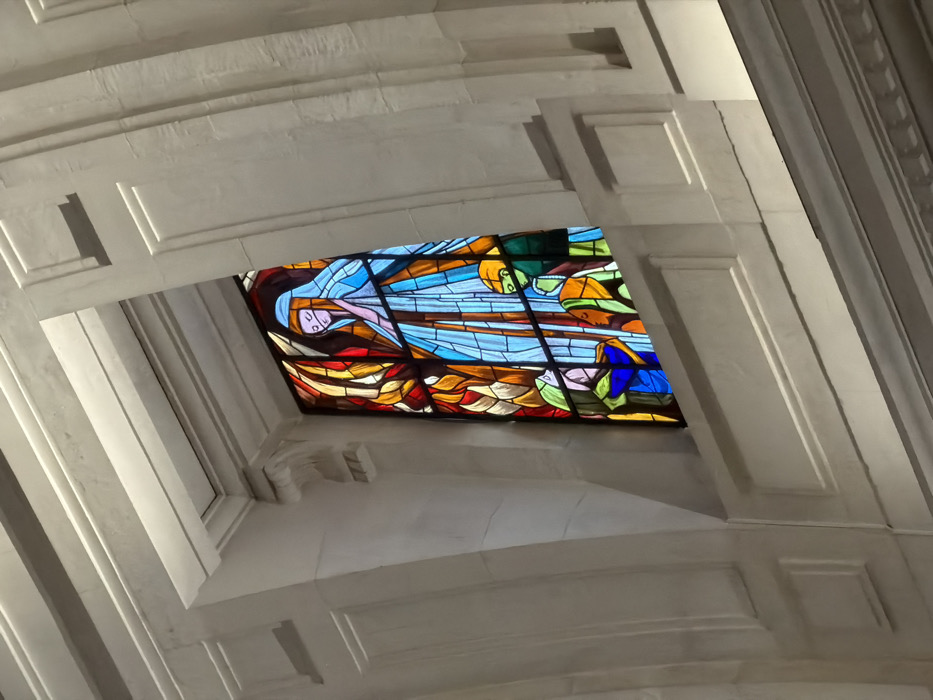
A vertical rectangular stained glass window is centrally displayed within a deep, light-colored architectural recess. The window is located within a religious structure at the Sanctuary of Fátima, Fátima, Portugal, consistent with the interior of the Basilica of Our Lady of the Rosary. The surrounding architectural elements are composed of uniform light-toned stone or plaster, featuring prominent cornices, a decorative corbel on the upper left, and vertical fluted details on the right side of the window opening.

The stained glass depicts a religious scene. A tall, veiled female figure, rendered in shades of light blue and white, dominates the upper and central portion, with her hands appearing pressed together. Behind this figure, predominantly to the left, are abstract forms in red, orange, and yellow, suggestive of flames or emanating light. In the lower section of the window, three smaller figures are portrayed, appearing as children. Two figures on the lower right, in green and orange attire, are depicted in a bent posture, suggesting kneeling or bowing, with their gazes directed upwards. A third figure on the lower left, dressed in blue and green, also looks upwards towards the central figure. Dark leading defines the figures and segmented glass shapes, which consist of a vibrant palette including blues, whites, reds, oranges, yellows, and greens.

A vertical rectangular stained glass window is centrally displayed within a deep, light-colored architectural recess. The window is located within a religious structure at the Sanctuary of Fátima, Fátima, Portugal, consistent with the interior of the Basilica of Our Lady of the Rosary. The surrounding architectural elements are composed of uniform light-toned stone or plaster, featuring prominent cornices, a decorative corbel on the upper left, and vertical fluted details on the right side of the window opening. The stained glass depicts a religious scene. A tall, veiled female figure, rendered in shades of light blue and white, dominates the upper and central portion, with her hands appearing pressed together. Behind this figure, predominantly to the left, are abstract forms in red, orange, and yellow, suggestive of flames or emanating light. In the lower section of the window, three smaller figures are portrayed, appearing as children. Two figures on the lower right, in green and orange attire, are depicted in a bent posture, suggesting kneeling or bowing, with their gazes directed upwards. A third figure on the lower left, dressed in blue and green, also looks upwards towards the central figure. Dark leading defines the figures and segmented glass shapes, which consist of a vibrant palette including blues, whites, reds, oranges, yellows, and greens.

Fátima
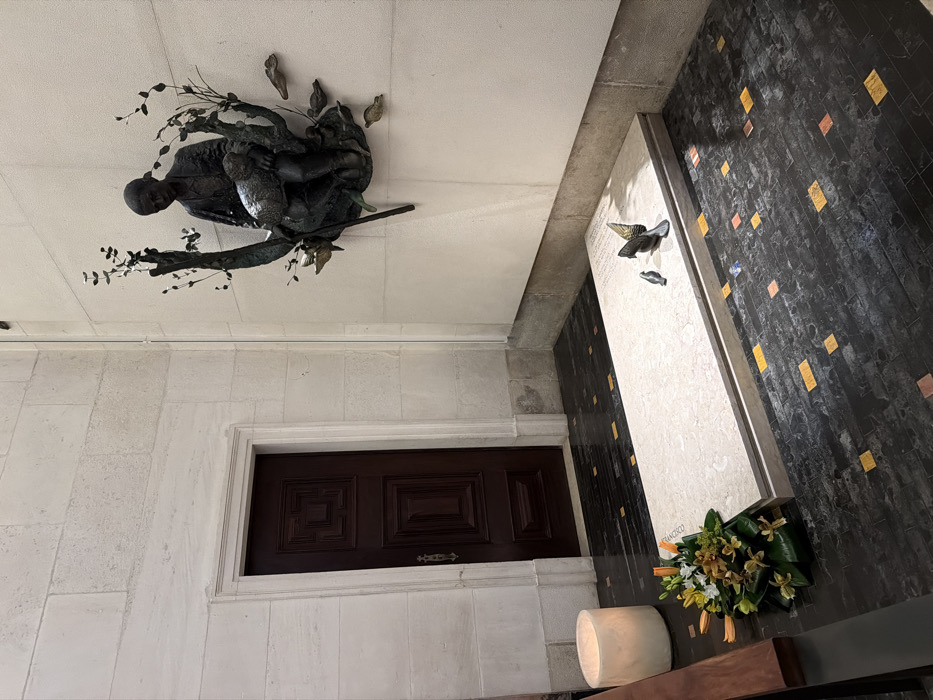
The image depicts an interior corner of the Basilica of Our Lady of the Rosary, located within the Sanctuary of Fátima in Fátima, Portugal.

The scene features the tomb of Saint Francisco Marto. This rectangular, light-colored marble slab, inscribed with text (partially showing "FRANCISCO"), rests on a dark, polished stone floor with scattered, irregular square inlays of yellow-orange and reddish-brown hues. On the tomb slab are two small, dark-colored metallic bird figurines; one larger with spread wings, the other smaller and stationary. At the left end of the tomb, a floral arrangement consisting of orange lilies and green foliage rests on the floor. Adjacent to the flowers, a large, cylindrical, translucent object, possibly a stone lantern or candle holder, emits a soft, warm light against the light-colored wall.

To the left, a dark brown wooden door with recessed, carved geometric panels and a vertical metal handle is set within a plain, light-colored stone doorway. The walls throughout the scene are constructed from large, uniformly cut, light-colored stone blocks. Mounted on the right-hand wall, above the tomb, is a bronze sculpture depicting a young shepherd boy seated amidst stylized tree branches and leaves, cradling a lamb. The sculpture includes a shepherd's staff and smaller bird and leaf elements. No individuals are present in the immediate scene.

The image depicts an interior corner of the Basilica of Our Lady of the Rosary, located within the Sanctuary of Fátima in Fátima, Portugal. The scene features the tomb of Saint Francisco Marto. This rectangular, light-colored marble slab, inscribed with text (partially showing "FRANCISCO"), rests on a dark, polished stone floor with scattered, irregular square inlays of yellow-orange and reddish-brown hues. On the tomb slab are two small, dark-colored metallic bird figurines; one larger with spread wings, the other smaller and stationary. At the left end of the tomb, a floral arrangement consisting of orange lilies and green foliage rests on the floor. Adjacent to the flowers, a large, cylindrical, translucent object, possibly a stone lantern or candle holder, emits a soft, warm light against the light-colored wall. To the left, a dark brown wooden door with recessed, carved geometric panels and a vertical metal handle is set within a plain, light-colored stone doorway. The walls throughout the scene are constructed from large, uniformly cut, light-colored stone blocks. Mounted on the right-hand wall, above the tomb, is a bronze sculpture depicting a young shepherd boy seated amidst stylized tree branches and leaves, cradling a lamb. The sculpture includes a shepherd's staff and smaller bird and leaf elements. No individuals are present in the immediate scene.

Fátima
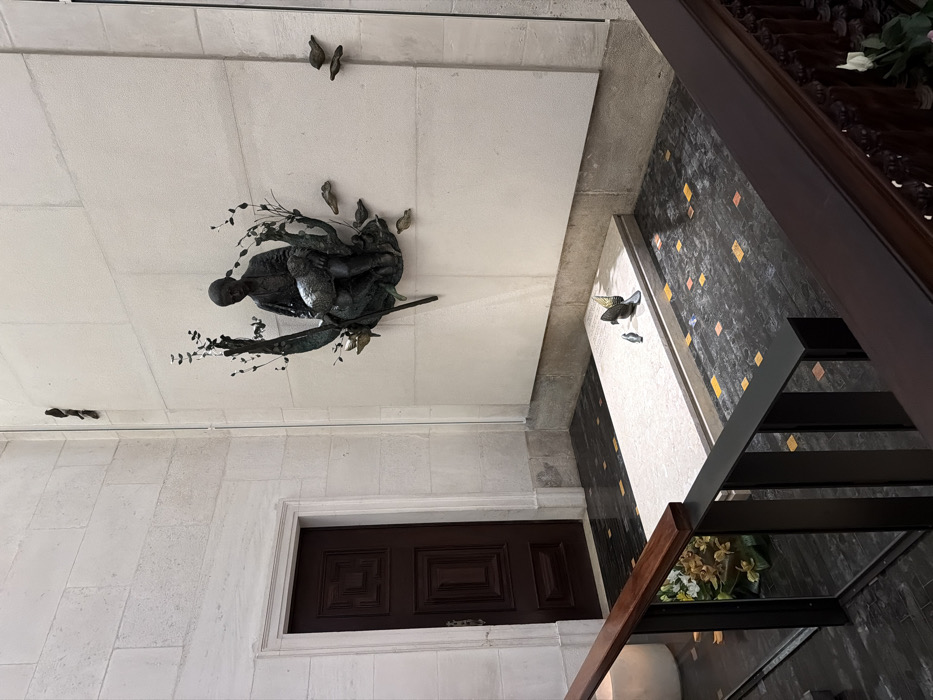
The image displays an interior view of the tomb of Francisco Marto, located within the Basilica of Our Lady of the Rosary of Fátima in Fátima, Portugal.

The scene is observed from a slight elevation, looking into a recessed area. A large, light-colored stone wall, composed of rectangular blocks, dominates the background. Centrally mounted on this wall is a bronze sculpture depicting a young boy, seated and holding a lamb. Stylized bronze branches with leaves extend from the sculpture, and additional bronze leaf motifs are affixed to the wall to the right.

Below the wall sculpture, a raised, rectangular slab of light-colored stone forms the tomb, positioned on a dark tiled floor. Two small bronze bird sculptures, one larger than the other, rest on this tomb slab. The floor surrounding the tomb features dark square tiles interspersed with smaller, scattered square tiles in shades of yellow, orange, and pink.

To the left, a dark brown wooden door with multiple panels and a light-colored frame is set into a wall of similar stone blocks. A dark brown wooden handrail and a black metal railing with vertical slats are prominent in the foreground, partially obscuring the lower left. Behind the railing on the far left, a white cylindrical object and yellow floral arrangements are partially visible. The lighting is even, suggesting an indoor, reverent environment.

The image displays an interior view of the tomb of Francisco Marto, located within the Basilica of Our Lady of the Rosary of Fátima in Fátima, Portugal. The scene is observed from a slight elevation, looking into a recessed area. A large, light-colored stone wall, composed of rectangular blocks, dominates the background. Centrally mounted on this wall is a bronze sculpture depicting a young boy, seated and holding a lamb. Stylized bronze branches with leaves extend from the sculpture, and additional bronze leaf motifs are affixed to the wall to the right. Below the wall sculpture, a raised, rectangular slab of light-colored stone forms the tomb, positioned on a dark tiled floor. Two small bronze bird sculptures, one larger than the other, rest on this tomb slab. The floor surrounding the tomb features dark square tiles interspersed with smaller, scattered square tiles in shades of yellow, orange, and pink. To the left, a dark brown wooden door with multiple panels and a light-colored frame is set into a wall of similar stone blocks. A dark brown wooden handrail and a black metal railing with vertical slats are prominent in the foreground, partially obscuring the lower left. Behind the railing on the far left, a white cylindrical object and yellow floral arrangements are partially visible. The lighting is even, suggesting an indoor, reverent environment.

Fátima
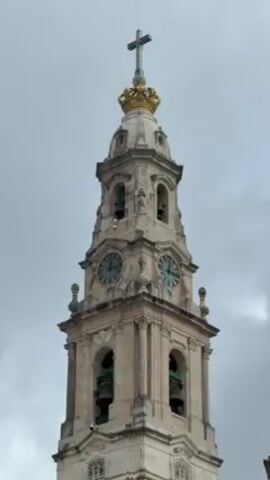
The video shows a close-up of a tall, ornate clock tower against a cloudy sky. The tower is made of light-colored stone and features multiple levels. It has arched openings with bells visible inside. There are two clocks with turquoise faces. The top of the tower is adorned with a golden crown and a cross. Religious chanting or singing is heard in the background.

The video shows a close-up of a tall, ornate clock tower against a cloudy sky. The tower is made of light-colored stone and features multiple levels. It has arched openings with bells visible inside. There are two clocks with turquoise faces. The top of the tower is adorned with a golden crown and a cross. Religious chanting or singing is heard in the background.

Fátima
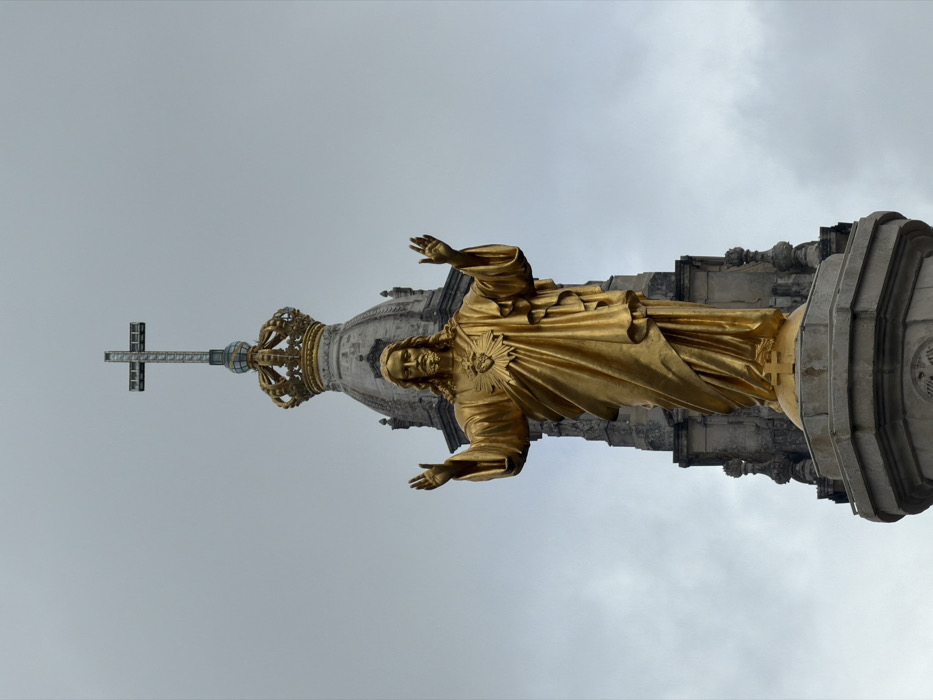
A low-angle, eye-level shot captures a golden statue of Jesus Christ against an overcast sky and the upper portion of a grey stone church tower. The statue depicts Jesus standing, facing forward, with long hair, a beard, and a mustache. Both arms are raised and slightly bent at the elbows, with palms open and fingers slightly splayed upwards. A detailed Sacred Heart emblem, featuring flames, a cross, and thorns, is visible on the statue's chest. The figure is clad in a flowing, draped robe. The statue rests on a multi-tiered, grey stone pedestal. Directly behind and above the statue, the ornate grey stone tower of the Basilica of Our Lady of the Rosary of Fátima rises, topped by a large golden crown, and further above, a simple metal cross. The background consists of a uniformly cloudy, light grey sky. The scene is located within the city of Fátima, Portugal, specifically at the Sanctuary of Fátima.

A low-angle, eye-level shot captures a golden statue of Jesus Christ against an overcast sky and the upper portion of a grey stone church tower. The statue depicts Jesus standing, facing forward, with long hair, a beard, and a mustache. Both arms are raised and slightly bent at the elbows, with palms open and fingers slightly splayed upwards. A detailed Sacred Heart emblem, featuring flames, a cross, and thorns, is visible on the statue's chest. The figure is clad in a flowing, draped robe. The statue rests on a multi-tiered, grey stone pedestal. Directly behind and above the statue, the ornate grey stone tower of the Basilica of Our Lady of the Rosary of Fátima rises, topped by a large golden crown, and further above, a simple metal cross. The background consists of a uniformly cloudy, light grey sky. The scene is located within the city of Fátima, Portugal, specifically at the Sanctuary of Fátima.

Fátima
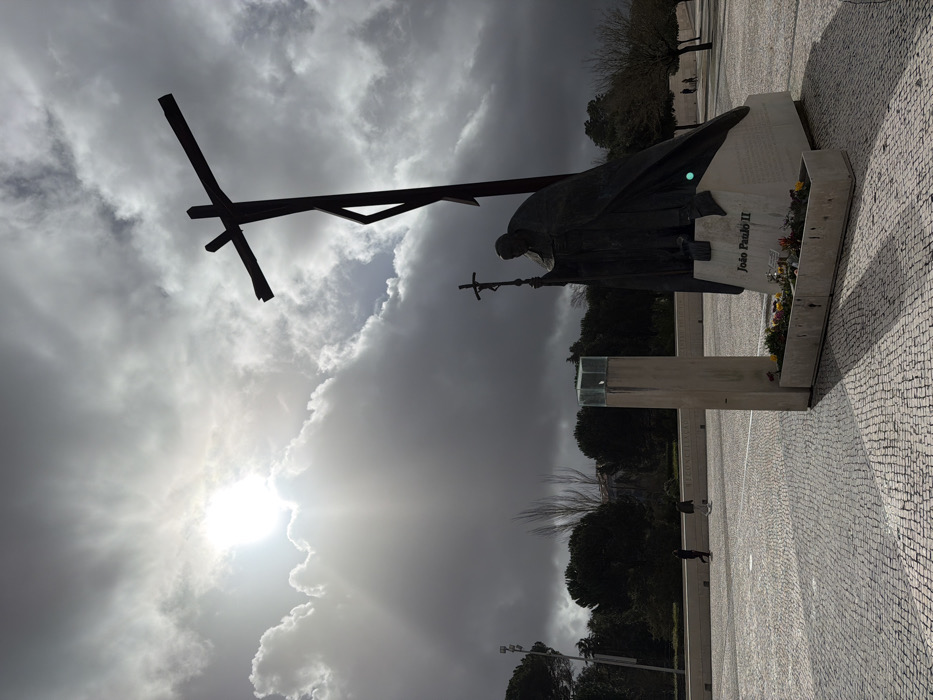
The image displays the Monument to Pope John Paul II and an accompanying large cross within the Sanctuary of Fátima, Portugal. In the foreground-midground, a dark-patinated bronze statue of Pope John Paul II stands, depicted in papal vestments, holding a crucifix in his raised right hand. The statue rests on a light-colored stone pedestal, which bears the inscription "João Paulo II." A flower box containing a small assortment of colorful blooms is positioned at the base of the pedestal. Immediately behind the statue, a tall, dark, stylized cross, constructed from what appears to be wood or metal, is erected, its form partially silhouetted. The ground is paved with light-colored, irregularly shaped cobblestones, and pronounced shadows from the monuments extend towards the viewer, indicative of strong directional light. In the mid-ground, to the left of the statue, a light-colored, rectangular pillar topped with a clear, square receptacle is visible. The background features a horizontal line of dark green coniferous trees and several lighter-toned, deciduous trees, with indistinct architectural structures partially visible beyond. Several small, dark, human figures are observed walking across the paved plaza in the mid-ground. The sky is predominantly covered by dense, dark grey clouds, with a brilliant sun breaking through a distinct clearing in the upper left quadrant, casting bright rays across the cloud cover and illuminating portions of the scene.

The image displays the Monument to Pope John Paul II and an accompanying large cross within the Sanctuary of Fátima, Portugal. In the foreground-midground, a dark-patinated bronze statue of Pope John Paul II stands, depicted in papal vestments, holding a crucifix in his raised right hand. The statue rests on a light-colored stone pedestal, which bears the inscription "João Paulo II." A flower box containing a small assortment of colorful blooms is positioned at the base of the pedestal. Immediately behind the statue, a tall, dark, stylized cross, constructed from what appears to be wood or metal, is erected, its form partially silhouetted. The ground is paved with light-colored, irregularly shaped cobblestones, and pronounced shadows from the monuments extend towards the viewer, indicative of strong directional light. In the mid-ground, to the left of the statue, a light-colored, rectangular pillar topped with a clear, square receptacle is visible. The background features a horizontal line of dark green coniferous trees and several lighter-toned, deciduous trees, with indistinct architectural structures partially visible beyond. Several small, dark, human figures are observed walking across the paved plaza in the mid-ground. The sky is predominantly covered by dense, dark grey clouds, with a brilliant sun breaking through a distinct clearing in the upper left quadrant, casting bright rays across the cloud cover and illuminating portions of the scene.

Fátima
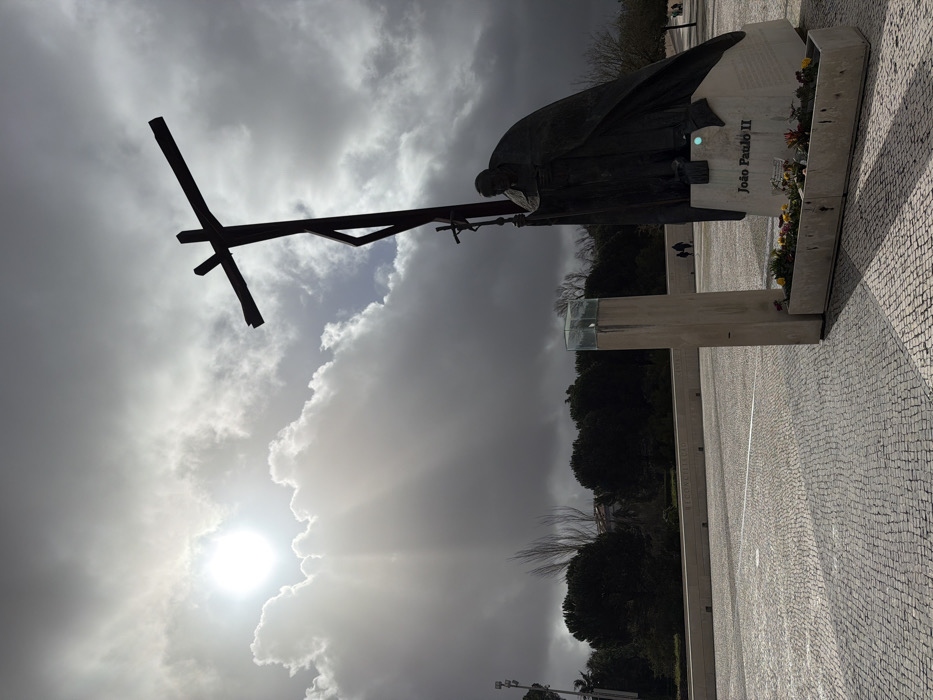
The image depicts the Sanctuary of Fátima in Fátima, Portugal. Central to the foreground is a dark bronze statue of Pope John Paul II, shown kneeling while holding a small crucifix. The inscription "João Paulo II" is visible on the statue's light-colored stone base. Behind and slightly to the left of the Pope's statue stands a taller, dark brown, stylized cross. Both monuments cast prominent shadows onto the expansive, light grey cobblestone plaza. To the left of the Pope's statue, a light concrete pillar with a translucent glass top is present. At the base of the pillar and extending towards the statue are planter boxes containing red, yellow, and purple flowers. In the mid-ground, a low, light-colored concrete wall spans horizontally, with two small, dark human figures walking along it in the distance. A dense line of dark green trees and some bare deciduous trees form the background. The sky is largely covered by substantial grey clouds; however, the sun, positioned in the upper left quadrant, emits intense white light and visible rays through a break in the clouds, creating strong illumination and contrast across the scene.

The image depicts the Sanctuary of Fátima in Fátima, Portugal. Central to the foreground is a dark bronze statue of Pope John Paul II, shown kneeling while holding a small crucifix. The inscription "João Paulo II" is visible on the statue's light-colored stone base. Behind and slightly to the left of the Pope's statue stands a taller, dark brown, stylized cross. Both monuments cast prominent shadows onto the expansive, light grey cobblestone plaza. To the left of the Pope's statue, a light concrete pillar with a translucent glass top is present. At the base of the pillar and extending towards the statue are planter boxes containing red, yellow, and purple flowers. In the mid-ground, a low, light-colored concrete wall spans horizontally, with two small, dark human figures walking along it in the distance. A dense line of dark green trees and some bare deciduous trees form the background. The sky is largely covered by substantial grey clouds; however, the sun, positioned in the upper left quadrant, emits intense white light and visible rays through a break in the clouds, creating strong illumination and contrast across the scene.

Fátima
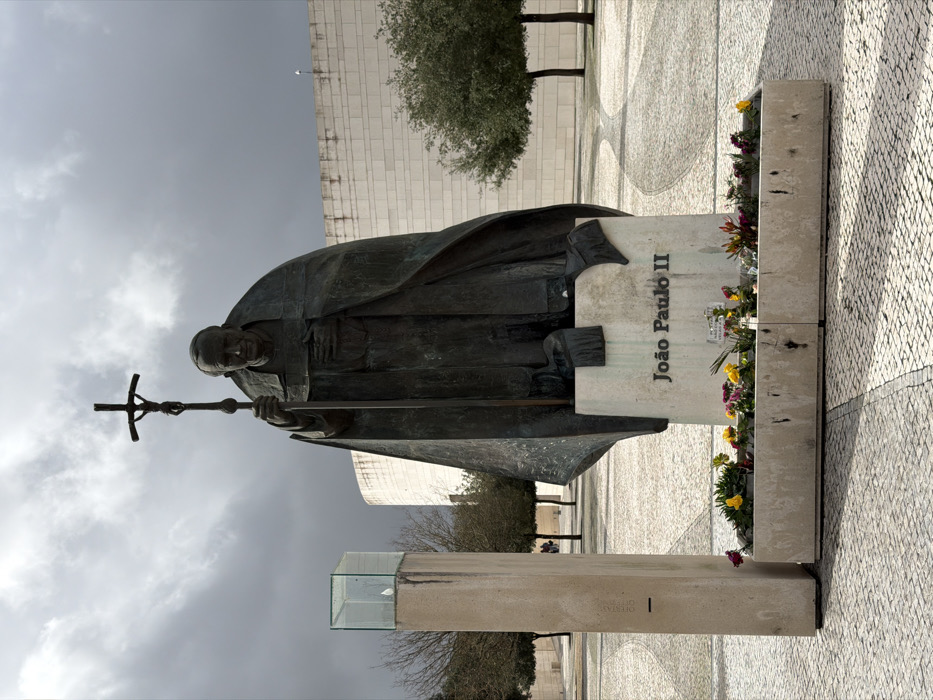
A large bronze statue of Pope John Paul II (João Paulo II) stands prominently in an outdoor paved plaza within the city of Fátima, Portugal, likely at the Sanctuary of Fátima. The statue depicts the Pope cloaked in vestments, holding a tall processional cross with a crucified figure in his right hand, while his left hand rests on his chest. The statue is mounted on a light-colored stone pedestal inscribed with "João Paulo II." In front of the pedestal, two connected rectangular stone planters hold an assortment of colorful flowers (yellow, purple, red) and green foliage, with small notes or offerings placed among them.

To the left of the statue, a tall, slender light-colored stone pillar is visible, topped with a transparent glass enclosure containing a white, possibly avian, object. Further left, several bare-branched trees are sparsely distributed, with two indistinct human figures visible in the distant background. To the right and behind the statue, a substantial, modern building with light-colored, horizontally segmented stone walls and a curved section occupies the background. Several trees with green foliage are positioned between the statue and the building. The entire visible ground is paved with light-colored cobblestones forming subtle patterns. The sky overhead is heavily overcast with dark clouds.

A large bronze statue of Pope John Paul II (João Paulo II) stands prominently in an outdoor paved plaza within the city of Fátima, Portugal, likely at the Sanctuary of Fátima. The statue depicts the Pope cloaked in vestments, holding a tall processional cross with a crucified figure in his right hand, while his left hand rests on his chest. The statue is mounted on a light-colored stone pedestal inscribed with "João Paulo II." In front of the pedestal, two connected rectangular stone planters hold an assortment of colorful flowers (yellow, purple, red) and green foliage, with small notes or offerings placed among them. To the left of the statue, a tall, slender light-colored stone pillar is visible, topped with a transparent glass enclosure containing a white, possibly avian, object. Further left, several bare-branched trees are sparsely distributed, with two indistinct human figures visible in the distant background. To the right and behind the statue, a substantial, modern building with light-colored, horizontally segmented stone walls and a curved section occupies the background. Several trees with green foliage are positioned between the statue and the building. The entire visible ground is paved with light-colored cobblestones forming subtle patterns. The sky overhead is heavily overcast with dark clouds.

Fátima
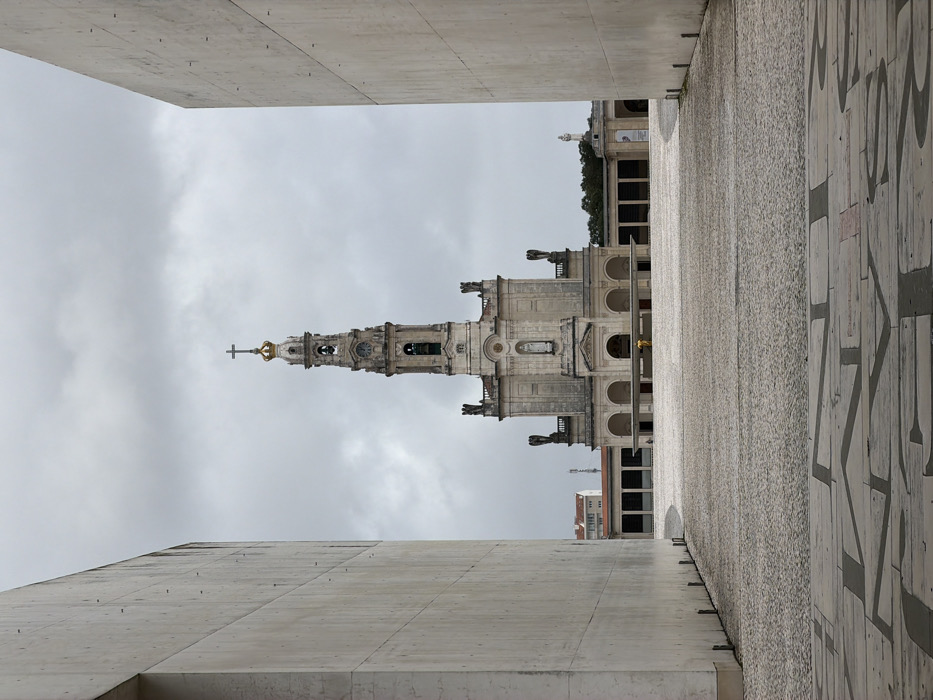
The image captures a long-distance view of the Sanctuary of Fátima in Fátima, Portugal, specifically the Basilica of Our Lady of the Rosary, under an overcast sky. The scene is framed by two prominent, smooth, light-colored concrete walls on the immediate left and right, creating a narrow, symmetrical aperture.

In the foreground, the ground is paved with large, irregularly shaped light-grey flagstones featuring dark, abstract, geometric patterns. This transitions into a vast, open plaza paved with uniform light-grey cobblestones, extending towards the basilica.

The Basilica of Our Lady of the Rosary stands centrally in the middle ground, a grand stone edifice with a dominant central bell tower. The tower is multi-tiered, features a clock face, and is topped with a gilded crown-like structure surmounted by a Latin cross. The main façade of the basilica below the tower includes a central statue of the Virgin Mary in a niche, flanked by architectural details and additional statues. The basilica's base incorporates a series of open arches forming a loggia. To the left and right of the basilica, extending horizontally, are colonnaded walkways or buildings, part of the broader sanctuary complex. A smaller, modern building with an orange-tiled roof is visible behind the left colonnade. To the far right, beyond the right colonnade, a white statue on a pedestal is discernible.

A single individual, dressed in a bright yellow or lime green garment, is observed standing on the cobblestone plaza directly in front of the basilica's arched entrance, appearing to face away from the viewer. No other individuals are distinctly visible. The sky is entirely covered with thick, light grey clouds, suggesting an overcast day with diffused lighting.

The image captures a long-distance view of the Sanctuary of Fátima in Fátima, Portugal, specifically the Basilica of Our Lady of the Rosary, under an overcast sky. The scene is framed by two prominent, smooth, light-colored concrete walls on the immediate left and right, creating a narrow, symmetrical aperture. In the foreground, the ground is paved with large, irregularly shaped light-grey flagstones featuring dark, abstract, geometric patterns. This transitions into a vast, open plaza paved with uniform light-grey cobblestones, extending towards the basilica. The Basilica of Our Lady of the Rosary stands centrally in the middle ground, a grand stone edifice with a dominant central bell tower. The tower is multi-tiered, features a clock face, and is topped with a gilded crown-like structure surmounted by a Latin cross. The main façade of the basilica below the tower includes a central statue of the Virgin Mary in a niche, flanked by architectural details and additional statues. The basilica's base incorporates a series of open arches forming a loggia. To the left and right of the basilica, extending horizontally, are colonnaded walkways or buildings, part of the broader sanctuary complex. A smaller, modern building with an orange-tiled roof is visible behind the left colonnade. To the far right, beyond the right colonnade, a white statue on a pedestal is discernible. A single individual, dressed in a bright yellow or lime green garment, is observed standing on the cobblestone plaza directly in front of the basilica's arched entrance, appearing to face away from the viewer. No other individuals are distinctly visible. The sky is entirely covered with thick, light grey clouds, suggesting an overcast day with diffused lighting.

Fátima
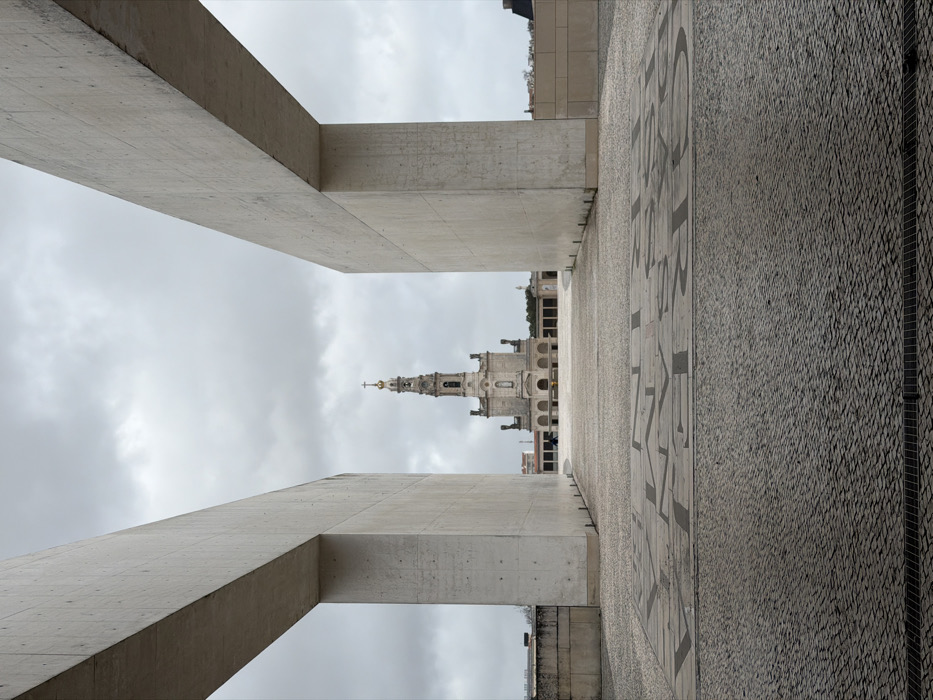
The image depicts an exterior view within the Sanctuary of Fátima, Portugal, looking directly towards the Basilica of Our Lady of the Rosary. The scene is framed by two large, raw concrete vertical structures, possibly architectural elements of the modern Basilica of the Holy Trinity or an adjacent colonnade, creating a narrow visual corridor.

The foreground consists of dark grey cobblestone paving (calçada portuguesa) with a horizontal metal drainage grate at the very bottom. Immediately beyond this, a lighter-colored section of pavement features intricate, dark geometric patterns and possibly stylized text. This paving extends into a vast, open plaza leading towards the basilica.

In the midground, the Basilica of Our Lady of the Rosary stands centrally. It is a light-colored, classical-style building featuring a prominent, tall bell tower (campanile) topped with a golden cross and an onion dome. The basilica's facade includes arched entrances, windows, and sculptural details. Large statues flank the main body of the basilica on either side, and colonnaded walkways extend horizontally from its base.

The plaza appears largely empty, with only a few indistinct, small figures visible far in the distance near the basilica. The sky is uniformly overcast with grey clouds. No significant interactions or specific actions are discernible. The overall environment is one of expansive, solemn architectural space under a muted sky.

The image depicts an exterior view within the Sanctuary of Fátima, Portugal, looking directly towards the Basilica of Our Lady of the Rosary. The scene is framed by two large, raw concrete vertical structures, possibly architectural elements of the modern Basilica of the Holy Trinity or an adjacent colonnade, creating a narrow visual corridor. The foreground consists of dark grey cobblestone paving (calçada portuguesa) with a horizontal metal drainage grate at the very bottom. Immediately beyond this, a lighter-colored section of pavement features intricate, dark geometric patterns and possibly stylized text. This paving extends into a vast, open plaza leading towards the basilica. In the midground, the Basilica of Our Lady of the Rosary stands centrally. It is a light-colored, classical-style building featuring a prominent, tall bell tower (campanile) topped with a golden cross and an onion dome. The basilica's facade includes arched entrances, windows, and sculptural details. Large statues flank the main body of the basilica on either side, and colonnaded walkways extend horizontally from its base. The plaza appears largely empty, with only a few indistinct, small figures visible far in the distance near the basilica. The sky is uniformly overcast with grey clouds. No significant interactions or specific actions are discernible. The overall environment is one of expansive, solemn architectural space under a muted sky.

Fátima
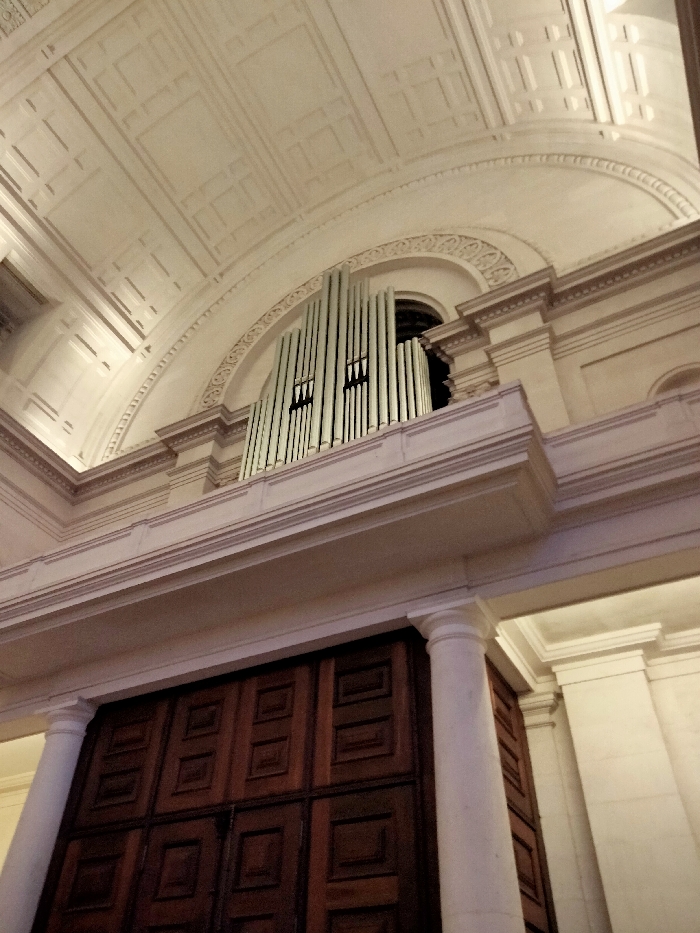
A low-angle shot shows the interior of a grand building. High above is a pipe organ, its pale pipes against an arched window space. Ornate moldings surround the organ. Below, a large, dark wooden door fills the frame. Two white columns, one on each side, flank the door. The ceiling features a textured, patterned design. The overall color palette is dominated by light beige and dark brown.

A low-angle shot shows the interior of a grand building. High above is a pipe organ, its pale pipes against an arched window space. Ornate moldings surround the organ. Below, a large, dark wooden door fills the frame. Two white columns, one on each side, flank the door. The ceiling features a textured, patterned design. The overall color palette is dominated by light beige and dark brown.

Fátima
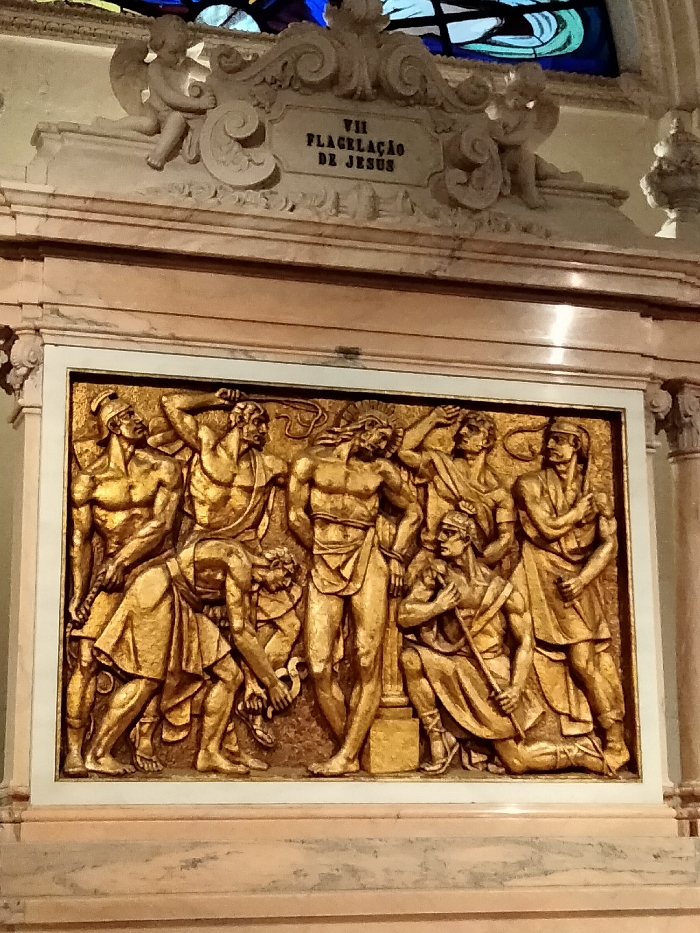
This media file captures a gilded bas-relief sculpture depicting a religious scene, set within a larger architectural context. The central subject is a detailed golden relief featuring numerous figures, framed by what appears to be marble.

The bas-relief portrays the Flagellation of Jesus. In the center, Jesus stands bound to a pillar, looking down in suffering. Around him, several muscular figures, likely Roman soldiers or executioners, are engaged in the act of scourging. One figure on the left raises a whip to strike, while another on the right is also poised for action. Other figures are present, some appearing to prepare tools or observing the scene. The overall composition is dynamic, emphasizing the brutality of the event. The figures are rendered with strong musculature and classical drapery.

Above the bas-relief, an ornate carved marble plaque is visible, flanked by two putti or cherubs. This plaque contains text, identifying the scene. The visible text reads "VII FLAGELLAÇÃO DE JESUS," which translates to "VII Flagellation of Jesus," indicating this is likely one of the Stations of the Cross. In the background, above the marble frame, a glimpse of colored stained glass can be seen, suggesting the setting is a church or religious building.

The entire piece is set against a backdrop of polished, light-colored marble, creating a dignified and solemn atmosphere. The golden material of the relief makes the figures stand out prominently. The image captures a historical religious artwork, likely intended for veneration or instruction within a sacred space like the one found in Fátima, Portugal.

This media file captures a gilded bas-relief sculpture depicting a religious scene, set within a larger architectural context. The central subject is a detailed golden relief featuring numerous figures, framed by what appears to be marble. The bas-relief portrays the Flagellation of Jesus. In the center, Jesus stands bound to a pillar, looking down in suffering. Around him, several muscular figures, likely Roman soldiers or executioners, are engaged in the act of scourging. One figure on the left raises a whip to strike, while another on the right is also poised for action. Other figures are present, some appearing to prepare tools or observing the scene. The overall composition is dynamic, emphasizing the brutality of the event. The figures are rendered with strong musculature and classical drapery. Above the bas-relief, an ornate carved marble plaque is visible, flanked by two putti or cherubs. This plaque contains text, identifying the scene. The visible text reads "VII FLAGELLAÇÃO DE JESUS," which translates to "VII Flagellation of Jesus," indicating this is likely one of the Stations of the Cross. In the background, above the marble frame, a glimpse of colored stained glass can be seen, suggesting the setting is a church or religious building. The entire piece is set against a backdrop of polished, light-colored marble, creating a dignified and solemn atmosphere. The golden material of the relief makes the figures stand out prominently. The image captures a historical religious artwork, likely intended for veneration or instruction within a sacred space like the one found in Fátima, Portugal.

Fátima
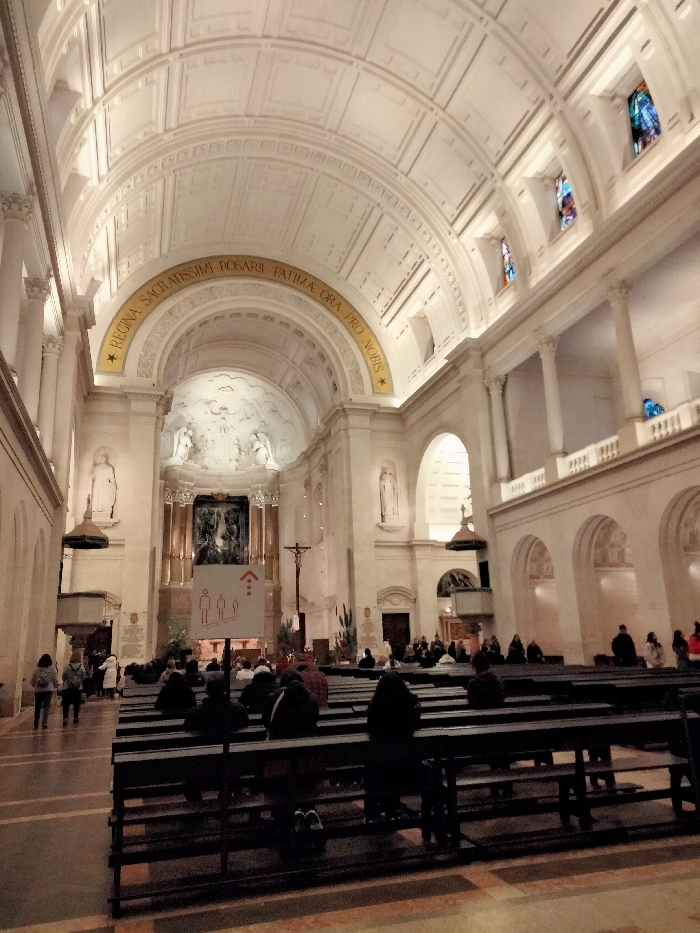
This image offers a wide-angle view of the majestic interior of a grand basilica, likely the Basilica of Our Lady of the Rosary in Fátima, Portugal, as indicated by the prominent inscription. The scene is dominated by impressive classical architecture, featuring a soaring vaulted ceiling with intricate coffering and decorative panels. Tall, ornate columns line the nave, supporting a series of arches and upper galleries.

In the foreground and midground, numerous dark wooden pews are occupied by visitors or congregants, many facing towards the front of the church. They appear to be engaged in prayer, quiet contemplation, or attending a service, creating a serene and reverent atmosphere. A white sign with red pictograms of people and an arrow pointing up is visible in the aisle, potentially guiding movement or indicating social distancing measures.

At the far end, the main altar area is illuminated, showcasing a large, ornate altarpiece with religious sculptures or a mosaic, flanked by statues of saints. A crucifix stands to the right of the altar. High on the right wall, several small, colorful stained-glass windows add subtle hues to the vast interior.

A key detail is the golden inscription arching gracefully above the altar: "REGINA SACRATISSIMI ROSARII FATIMA ORA PRO NOBIS." This Latin phrase translates to "Queen of the Most Holy Rosary, Fátima, pray for us," explicitly confirming the sacred location. The entire space is brightly lit by artificial light sources, enhancing the grandeur of the architecture and the solemnity of the setting. The image captures a moment of quiet devotion within this magnificent religious edifice.

This image offers a wide-angle view of the majestic interior of a grand basilica, likely the Basilica of Our Lady of the Rosary in Fátima, Portugal, as indicated by the prominent inscription. The scene is dominated by impressive classical architecture, featuring a soaring vaulted ceiling with intricate coffering and decorative panels. Tall, ornate columns line the nave, supporting a series of arches and upper galleries. In the foreground and midground, numerous dark wooden pews are occupied by visitors or congregants, many facing towards the front of the church. They appear to be engaged in prayer, quiet contemplation, or attending a service, creating a serene and reverent atmosphere. A white sign with red pictograms of people and an arrow pointing up is visible in the aisle, potentially guiding movement or indicating social distancing measures. At the far end, the main altar area is illuminated, showcasing a large, ornate altarpiece with religious sculptures or a mosaic, flanked by statues of saints. A crucifix stands to the right of the altar. High on the right wall, several small, colorful stained-glass windows add subtle hues to the vast interior. A key detail is the golden inscription arching gracefully above the altar: "REGINA SACRATISSIMI ROSARII FATIMA ORA PRO NOBIS." This Latin phrase translates to "Queen of the Most Holy Rosary, Fátima, pray for us," explicitly confirming the sacred location. The entire space is brightly lit by artificial light sources, enhancing the grandeur of the architecture and the solemnity of the setting. The image captures a moment of quiet devotion within this magnificent religious edifice.

Fátima
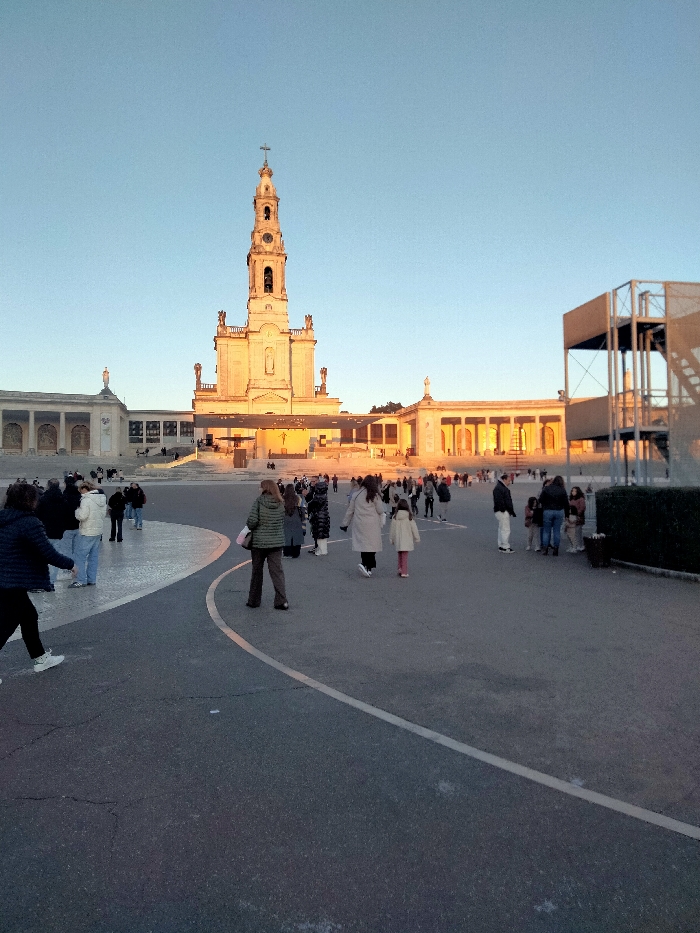
This image depicts a wide view of the Sanctuary of Fátima in Portugal, specifically featuring the Basilica of Our Lady of the Rosary, during the golden hour. The time of day appears to be either sunrise or sunset, as indicated by the warm, golden light illuminating the buildings and casting long shadows. The sky is clear and a bright blue.

The main subject is the grand Basilica of Our Lady of the Rosary, prominent in the background, with its tall, ornate bell tower crowned by a cross. The basilica's facade, adorned with statues, is bathed in the rich, golden sunlight. Flanking the basilica are extensive colonnaded structures, also catching the warm light. On the far right, a modern, multi-level, skeletal structure is visible, providing a contemporary contrast to the historic architecture.

In the midground and foreground, a large, open paved plaza extends, populated by numerous people. They are dressed in casual winter attire, including jackets and coats, suggesting cooler weather conditions. People are seen walking individually or in small groups, moving across the square. Some appear to be observing the basilica, while others are simply traversing the area, indicating a general flow of visitors or pilgrims. The ground is dark gray asphalt with distinct white curving lines, likely marking pathways or boundaries within the expansive square.

The overall scene conveys a sense of calm activity within a significant religious pilgrimage site. No specific event or strong emotions are discernible, but rather the quiet movement of people within the hallowed grounds. No visible text is clearly legible on any structures or signs within the image.

This image depicts a wide view of the Sanctuary of Fátima in Portugal, specifically featuring the Basilica of Our Lady of the Rosary, during the golden hour. The time of day appears to be either sunrise or sunset, as indicated by the warm, golden light illuminating the buildings and casting long shadows. The sky is clear and a bright blue. The main subject is the grand Basilica of Our Lady of the Rosary, prominent in the background, with its tall, ornate bell tower crowned by a cross. The basilica's facade, adorned with statues, is bathed in the rich, golden sunlight. Flanking the basilica are extensive colonnaded structures, also catching the warm light. On the far right, a modern, multi-level, skeletal structure is visible, providing a contemporary contrast to the historic architecture. In the midground and foreground, a large, open paved plaza extends, populated by numerous people. They are dressed in casual winter attire, including jackets and coats, suggesting cooler weather conditions. People are seen walking individually or in small groups, moving across the square. Some appear to be observing the basilica, while others are simply traversing the area, indicating a general flow of visitors or pilgrims. The ground is dark gray asphalt with distinct white curving lines, likely marking pathways or boundaries within the expansive square. The overall scene conveys a sense of calm activity within a significant religious pilgrimage site. No specific event or strong emotions are discernible, but rather the quiet movement of people within the hallowed grounds. No visible text is clearly legible on any structures or signs within the image.

Fátima
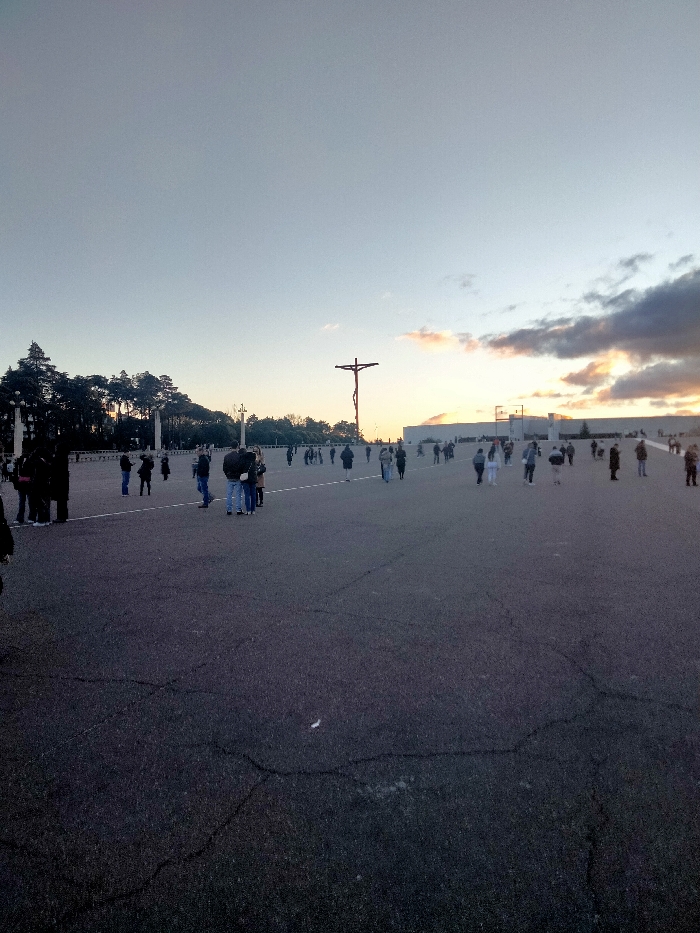
A large open paved area is filled with many people. In the background are trees and various buildings, including a modern rectangular building. A tall, thin crucifix stands prominently in the center of the scene. The sky above is a mix of blue and orange, suggesting either sunrise or sunset, with clouds present on the right side of the image. The light is soft, giving the scene a peaceful and contemplative atmosphere.

A large open paved area is filled with many people. In the background are trees and various buildings, including a modern rectangular building. A tall, thin crucifix stands prominently in the center of the scene. The sky above is a mix of blue and orange, suggesting either sunrise or sunset, with clouds present on the right side of the image. The light is soft, giving the scene a peaceful and contemplative atmosphere.

Fátima
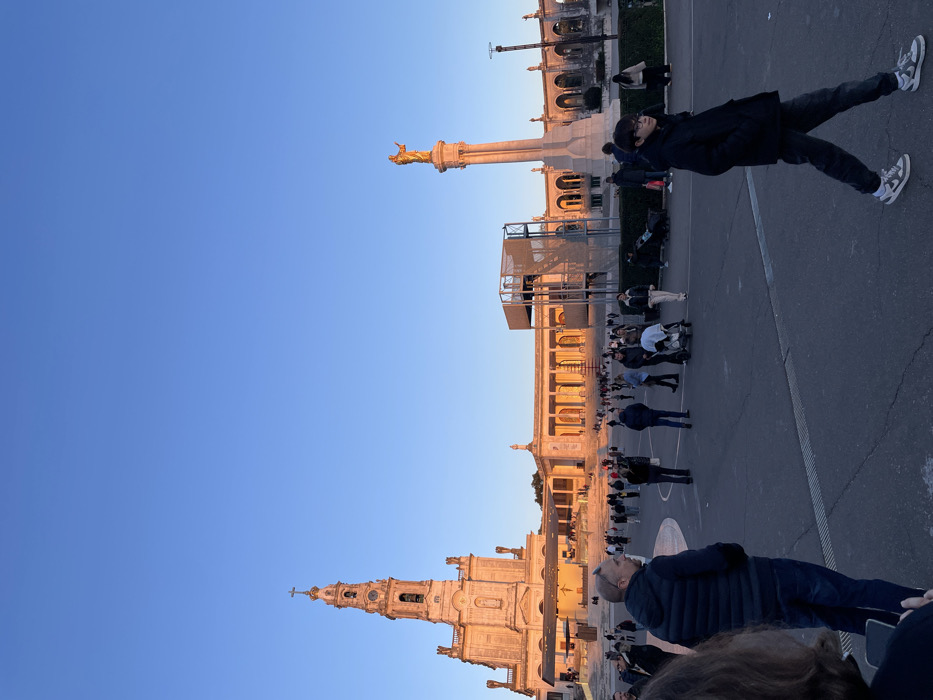
A vertical shot depicts a clear blue sky and the Sanctuary of Fátima at golden hour. The basilica, with its tall spire, and the colonnade building are prominently displayed. People are scattered on the paved area in front. A golden statue stands on a pillar. A person in a black coat and sneakers walks by. The image seems to be taken at ground level, looking up at the buildings and the sky.

A vertical shot depicts a clear blue sky and the Sanctuary of Fátima at golden hour. The basilica, with its tall spire, and the colonnade building are prominently displayed. People are scattered on the paved area in front. A golden statue stands on a pillar. A person in a black coat and sneakers walks by. The image seems to be taken at ground level, looking up at the buildings and the sky.

Fátima
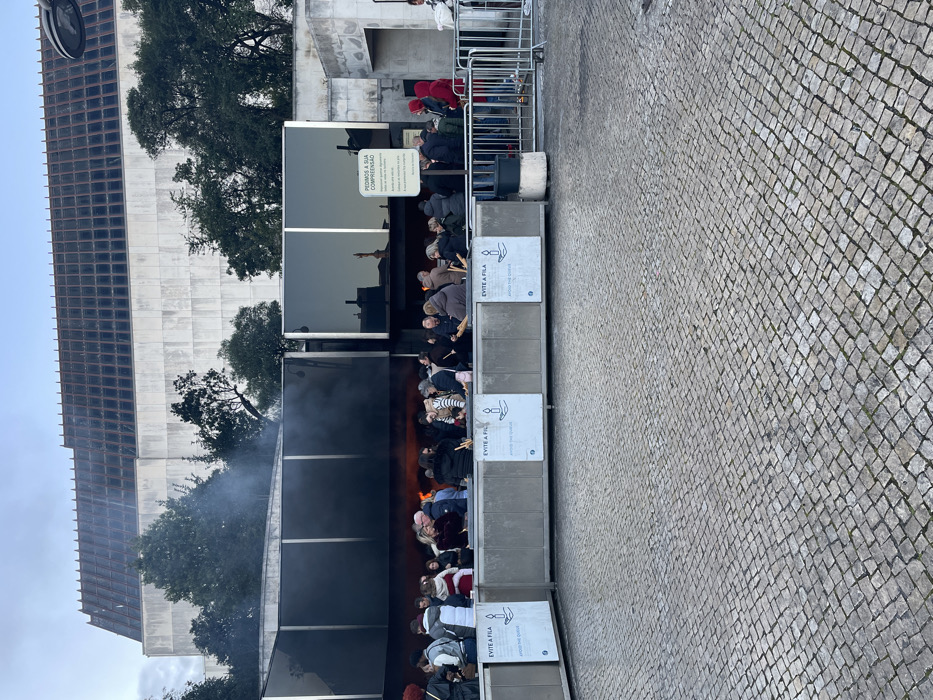
A gathering of people are standing behind metal barriers. Smoke fills the background. The barriers are marked with signs in a foreign language and candle icons. A large building is visible on the left with trees positioned between it and the crowd. The ground appears to be stone. Some individuals stand near a sign that says "PEDIMOS A SUA COMPREENSÃO." The scene suggests an event or place where candles are burned, potentially a memorial or religious site.

A gathering of people are standing behind metal barriers. Smoke fills the background. The barriers are marked with signs in a foreign language and candle icons. A large building is visible on the left with trees positioned between it and the crowd. The ground appears to be stone. Some individuals stand near a sign that says "PEDIMOS A SUA COMPREENSÃO." The scene suggests an event or place where candles are burned, potentially a memorial or religious site.

Fátima
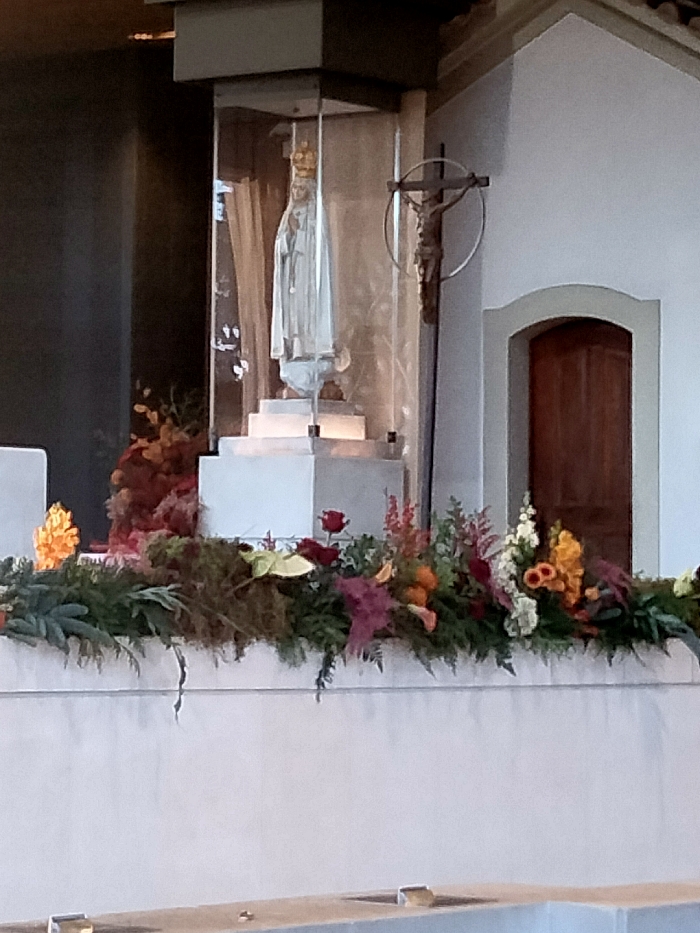
The image depicts an interior scene within the Sanctuary of Fátima in Fátima, Portugal. The central focus is a white, crowned statue of the Virgin Mary, consistent with Our Lady of Fátima, enclosed within a rectangular glass display case. This statue stands on a tiered white rectangular pedestal. To the immediate right of the glass enclosure, a wooden crucifix featuring the figure of Christ is mounted on a light-colored wall, framed by a circular metal ring. Below and to the right of the crucifix, a simple arched wooden door is set into the same wall. The foreground is dominated by a long, white rectangular structure, likely an altar or barrier, adorned with an extensive floral arrangement. This arrangement comprises various green foliage, red roses, white flowers, orange and yellow blooms, and reddish-purple leaves. Additional reddish-brown and orange foliage is visible behind the statue's pedestal. No individuals are present in the frame.

The image depicts an interior scene within the Sanctuary of Fátima in Fátima, Portugal. The central focus is a white, crowned statue of the Virgin Mary, consistent with Our Lady of Fátima, enclosed within a rectangular glass display case. This statue stands on a tiered white rectangular pedestal. To the immediate right of the glass enclosure, a wooden crucifix featuring the figure of Christ is mounted on a light-colored wall, framed by a circular metal ring. Below and to the right of the crucifix, a simple arched wooden door is set into the same wall. The foreground is dominated by a long, white rectangular structure, likely an altar or barrier, adorned with an extensive floral arrangement. This arrangement comprises various green foliage, red roses, white flowers, orange and yellow blooms, and reddish-purple leaves. Additional reddish-brown and orange foliage is visible behind the statue's pedestal. No individuals are present in the frame.

Fátima
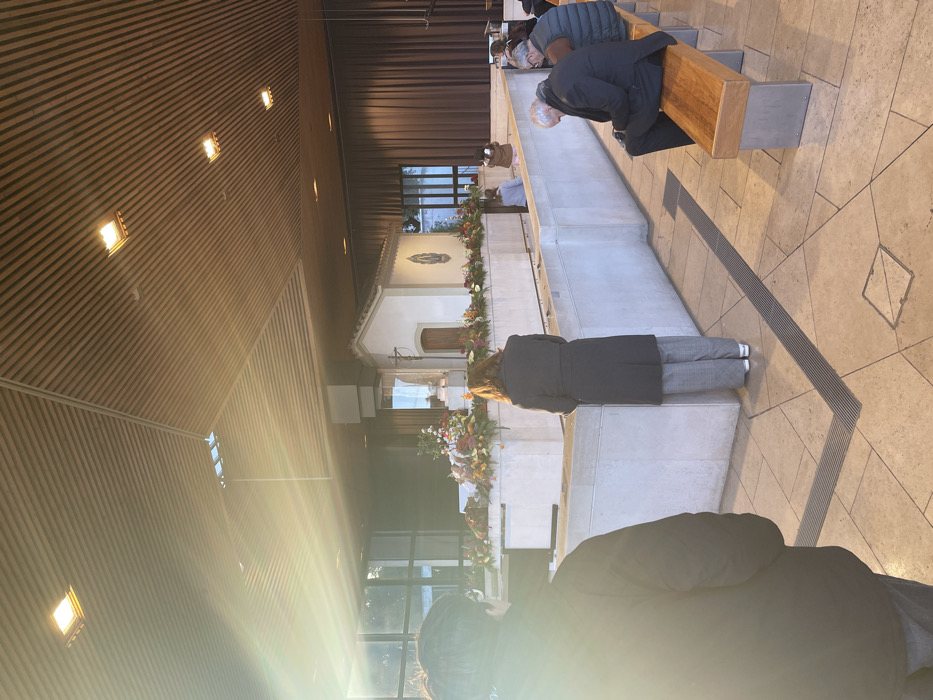
The image displays the interior of a modern religious building, specifically identified as the Chapel of the Apparitions within the Sanctuary of Fátima, located in Fátima, Portugal.

The central feature is a white, gabled chapel-like structure, reminiscent of the original Chapel of the Apparitions, positioned behind a low, light-colored concrete barrier. This barrier is extensively decorated with vibrant floral arrangements in red, orange, yellow, and green. Inside the chapel structure, a white statue of the Virgin Mary is visible, and a crucifix is mounted on its exterior. Further to the right on the chapel's exterior wall, a blue and white depiction of the Virgin Mary is present.

The building's interior features a modern design with a light-colored wooden slatted ceiling containing square recessed lighting fixtures. Large windows on the left side admit significant natural light, creating a prominent lens flare in the foreground. The floor consists of light-toned tiles arranged in geometric patterns, with linear metal grates embedded. Dark brown drapes cover a wall section in the background to the right.

Approximately six individuals are present. In the mid-ground, a woman with reddish-brown hair, wearing a dark long coat and light grey wide-leg trousers with white sneakers, stands facing the central chapel, seemingly in prayer or contemplation. To her left, partially obscured by the lens flare, another person wearing a dark jacket is visible from the back. On the right side of the image, two men are seated on a wooden bench with metal supports: an older man with grey hair in a dark suit is leaning forward, looking down, while another man in a grey puffer vest sits beside him. Two other individuals are partially visible behind the concrete barrier in the mid-ground. No direct interactions between individuals are observed; all appear to be in quiet reverence.

The image displays the interior of a modern religious building, specifically identified as the Chapel of the Apparitions within the Sanctuary of Fátima, located in Fátima, Portugal. The central feature is a white, gabled chapel-like structure, reminiscent of the original Chapel of the Apparitions, positioned behind a low, light-colored concrete barrier. This barrier is extensively decorated with vibrant floral arrangements in red, orange, yellow, and green. Inside the chapel structure, a white statue of the Virgin Mary is visible, and a crucifix is mounted on its exterior. Further to the right on the chapel's exterior wall, a blue and white depiction of the Virgin Mary is present. The building's interior features a modern design with a light-colored wooden slatted ceiling containing square recessed lighting fixtures. Large windows on the left side admit significant natural light, creating a prominent lens flare in the foreground. The floor consists of light-toned tiles arranged in geometric patterns, with linear metal grates embedded. Dark brown drapes cover a wall section in the background to the right. Approximately six individuals are present. In the mid-ground, a woman with reddish-brown hair, wearing a dark long coat and light grey wide-leg trousers with white sneakers, stands facing the central chapel, seemingly in prayer or contemplation. To her left, partially obscured by the lens flare, another person wearing a dark jacket is visible from the back. On the right side of the image, two men are seated on a wooden bench with metal supports: an older man with grey hair in a dark suit is leaning forward, looking down, while another man in a grey puffer vest sits beside him. Two other individuals are partially visible behind the concrete barrier in the mid-ground. No direct interactions between individuals are observed; all appear to be in quiet reverence.

Fátima
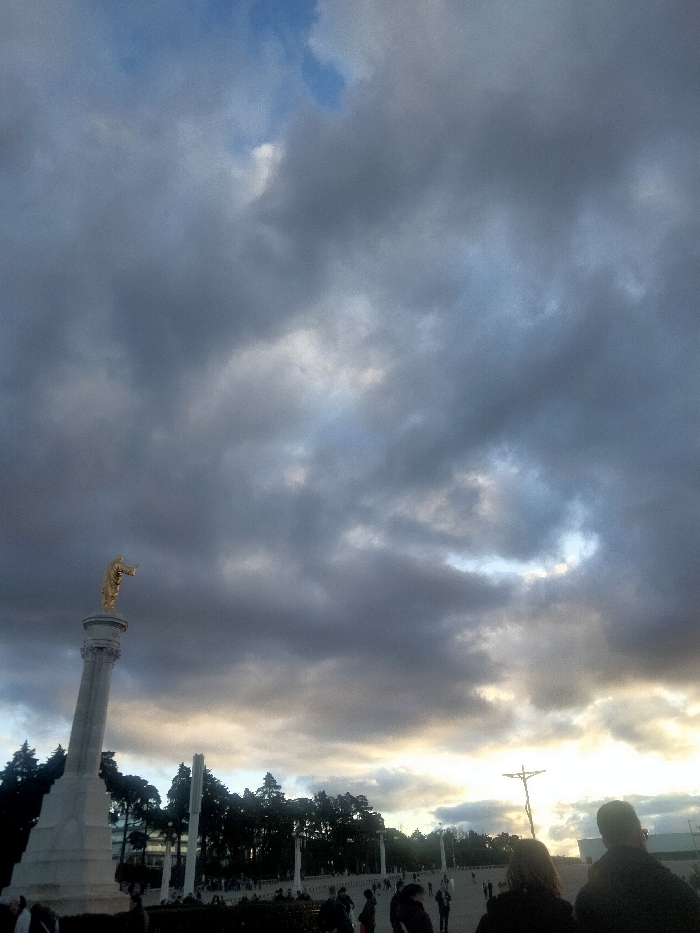
The image depicts an outdoor scene within the Sanctuary of Our Lady of Fátima, Portugal, specifically the Esplanade of the Sanctuary. The upper two-thirds of the frame are dominated by an overcast sky with dense, dark grey clouds interspersed with patches of lighter grey and a small area of blue sky in the upper left. A band of brighter, illuminated clouds is visible along the horizon, suggesting dawn or dusk.

In the lower left quadrant, a tall, white stone column rises, topped with a golden statue, likely representing the Sacred Heart of Jesus. The figure faces right, with its right arm extended and hand pointing outwards. To the right, in the mid-ground, a large, dark-colored, modern crucifix is silhouetted against the brighter horizon.

The ground level features a vast, open paved area, the Esplanade, populated by numerous small, indistinct figures of people scattered across the space, appearing to walk or stand. A line of dark green trees forms a boundary behind the Esplanade, partially obscuring distant white buildings and several tall, slender white columns. In the immediate lower right foreground, the backs of two individuals are partially visible, facing away from the camera and towards the scene.

The image depicts an outdoor scene within the Sanctuary of Our Lady of Fátima, Portugal, specifically the Esplanade of the Sanctuary. The upper two-thirds of the frame are dominated by an overcast sky with dense, dark grey clouds interspersed with patches of lighter grey and a small area of blue sky in the upper left. A band of brighter, illuminated clouds is visible along the horizon, suggesting dawn or dusk. In the lower left quadrant, a tall, white stone column rises, topped with a golden statue, likely representing the Sacred Heart of Jesus. The figure faces right, with its right arm extended and hand pointing outwards. To the right, in the mid-ground, a large, dark-colored, modern crucifix is silhouetted against the brighter horizon. The ground level features a vast, open paved area, the Esplanade, populated by numerous small, indistinct figures of people scattered across the space, appearing to walk or stand. A line of dark green trees forms a boundary behind the Esplanade, partially obscuring distant white buildings and several tall, slender white columns. In the immediate lower right foreground, the backs of two individuals are partially visible, facing away from the camera and towards the scene.

Fátima
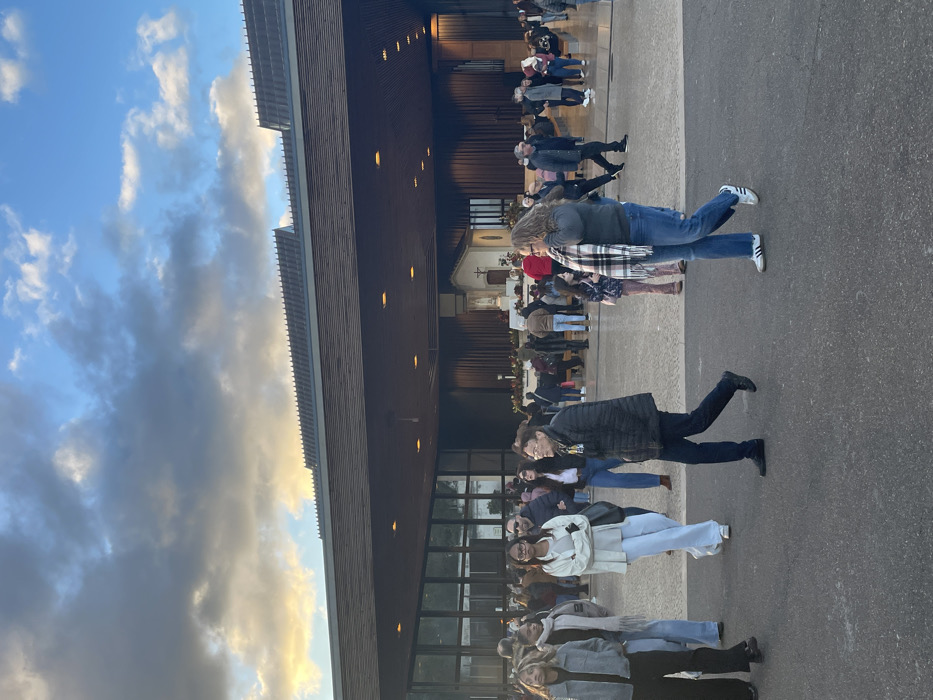
The image captures an outdoor area in front of the Basilica of the Holy Trinity at the Sanctuary of Fátima, Portugal, during what appears to be late afternoon or early evening. The sky above is partially cloudy, featuring patches of blue interspersed with grey and white clouds, some exhibiting a golden hue on their undersides.

The dominant structure is the modern basilica, visible in the background, characterized by a broad, dark-colored roof with a distinctive serrated or ridged edge, extending forward as a deep canopy over the main entrance. The building's facade includes large sections of dark-framed glass panels on the left, reflecting a muted environment. To the right, beneath the canopy, a recessed entrance area reveals a visible interior featuring a small, light-colored structure resembling a chapel or shrine with a statue (likely of the Virgin Mary), decorated with floral arrangements. Benches and individuals are discernible within this interior space.

Numerous people are present across the paved ground in front of the basilica, indicating a moderately crowded scene. Most individuals are in motion, walking in various directions. In the immediate foreground, from left to right:
1.  A person with long, light-colored hair, wearing a grey jacket and dark pants, walks towards the right.
2.  Next to them, a person with dark hair, wearing a light grey scarf and light-colored clothing, is partially visible.
3.  A woman with dark hair, wearing a light-colored jacket over a lighter top and light blue wide-leg pants, walks towards the right.
4.  A man wearing a dark puffer jacket, dark pants, and glasses, with a small yellow pin on his jacket, walks towards the right.
5.  A woman with long, curly dark hair, wearing a dark top, blue jeans, and a black, white, and pink/red checkered scarf, walks towards the left. She wears white sneakers with black stripes. A child is partially obscured next to her.

Further back, more individuals are scattered across the paved area and gathered closer to the basilica entrance, some seated on benches within the building. The overall scene depicts a public gathering in a religious site.

The image captures an outdoor area in front of the Basilica of the Holy Trinity at the Sanctuary of Fátima, Portugal, during what appears to be late afternoon or early evening. The sky above is partially cloudy, featuring patches of blue interspersed with grey and white clouds, some exhibiting a golden hue on their undersides. The dominant structure is the modern basilica, visible in the background, characterized by a broad, dark-colored roof with a distinctive serrated or ridged edge, extending forward as a deep canopy over the main entrance. The building's facade includes large sections of dark-framed glass panels on the left, reflecting a muted environment. To the right, beneath the canopy, a recessed entrance area reveals a visible interior featuring a small, light-colored structure resembling a chapel or shrine with a statue (likely of the Virgin Mary), decorated with floral arrangements. Benches and individuals are discernible within this interior space. Numerous people are present across the paved ground in front of the basilica, indicating a moderately crowded scene. Most individuals are in motion, walking in various directions. In the immediate foreground, from left to right: 1. A person with long, light-colored hair, wearing a grey jacket and dark pants, walks towards the right. 2. Next to them, a person with dark hair, wearing a light grey scarf and light-colored clothing, is partially visible. 3. A woman with dark hair, wearing a light-colored jacket over a lighter top and light blue wide-leg pants, walks towards the right. 4. A man wearing a dark puffer jacket, dark pants, and glasses, with a small yellow pin on his jacket, walks towards the right. 5. A woman with long, curly dark hair, wearing a dark top, blue jeans, and a black, white, and pink/red checkered scarf, walks towards the left. She wears white sneakers with black stripes. A child is partially obscured next to her. Further back, more individuals are scattered across the paved area and gathered closer to the basilica entrance, some seated on benches within the building. The overall scene depicts a public gathering in a religious site.

Fátima
The image depicts the Sanctuary of Fátima in Fátima, Portugal, at dusk. The central subject is the Basilica of Our Lady of the Rosary of Fátima, a prominent light-colored stone building with a tall, ornate bell tower topped by a cross, visible under a partially cloudy, blue-grey sky. In front of the Basilica, a large, modern, flat-roofed canopy structure extends over an elevated area accessed by wide steps. A large crucifix is visible under this canopy. To the left and right, grand, colonnaded structures, consistent with the sanctuary complex, flank the main basilica. The foreground is a vast, paved esplanade with white demarcation lines.

Numerous individuals are scattered across the scene. In the immediate foreground on the left, three people (two adults and one child) stand together, one adult holding a phone. On the right foreground, two adults and a child are observed standing. A single individual is crouched near a small wheeled object in the mid-ground. Many other people are seated or standing on the steps leading to the main structures and under the canopy, appearing to be visitors or pilgrims. Artificial lights are visible under the canopy and within parts of the surrounding buildings. The overall scene suggests a time of day transitioning from late afternoon to evening, with a moderate number of people present in the sacred space.

The image depicts the Sanctuary of Fátima in Fátima, Portugal, at dusk. The central subject is the Basilica of Our Lady of the Rosary of Fátima, a prominent light-colored stone building with a tall, ornate bell tower topped by a cross, visible under a partially cloudy, blue-grey sky. In front of the Basilica, a large, modern, flat-roofed canopy structure extends over an elevated area accessed by wide steps. A large crucifix is visible under this canopy. To the left and right, grand, colonnaded structures, consistent with the sanctuary complex, flank the main basilica. The foreground is a vast, paved esplanade with white demarcation lines. Numerous individuals are scattered across the scene. In the immediate foreground on the left, three people (two adults and one child) stand together, one adult holding a phone. On the right foreground, two adults and a child are observed standing. A single individual is crouched near a small wheeled object in the mid-ground. Many other people are seated or standing on the steps leading to the main structures and under the canopy, appearing to be visitors or pilgrims. Artificial lights are visible under the canopy and within parts of the surrounding buildings. The overall scene suggests a time of day transitioning from late afternoon to evening, with a moderate number of people present in the sacred space.

Fátima
The image displays the Sanctuary of Fátima in Fátima, Portugal, under a partly cloudy blue sky. The central subject is the Basilica of Our Lady of the Rosary of Fátima, a light-colored stone building with a prominent, ornate bell tower topped by a cross. The tower features a clock face and visible bells. Below the tower, the basilica's facade includes statuary and architectural details. In front of the basilica, a modern, dark-colored canopy structure extends over a wide set of steps, beneath which a large crucifix is visible. To the left and right of the basilica are other colonnaded stone buildings, part of the larger sanctuary complex, with a statue visible on the roofline of the structure on the left.

The foreground is a vast, dark grey paved esplanade with faint white ground markings. Scattered across this area and on the steps are numerous individuals and small groups of people. In the foreground-left, a group of four individuals stands together, three appearing to be engaged in conversation. One person wears a dark coat, another a brown jacket and blue jeans. In the midground-right, a couple stands, one person in a light-colored coat, the other in a dark jacket. Further right, another couple walks away from the camera. A single individual is crouched or kneeling on the paved ground in the center midground. Many more people are visible sitting and standing on the steps leading up to the basilica and the modern canopy structure. The overall scene suggests moderate foot traffic within a large, open religious complex.

The image displays the Sanctuary of Fátima in Fátima, Portugal, under a partly cloudy blue sky. The central subject is the Basilica of Our Lady of the Rosary of Fátima, a light-colored stone building with a prominent, ornate bell tower topped by a cross. The tower features a clock face and visible bells. Below the tower, the basilica's facade includes statuary and architectural details. In front of the basilica, a modern, dark-colored canopy structure extends over a wide set of steps, beneath which a large crucifix is visible. To the left and right of the basilica are other colonnaded stone buildings, part of the larger sanctuary complex, with a statue visible on the roofline of the structure on the left. The foreground is a vast, dark grey paved esplanade with faint white ground markings. Scattered across this area and on the steps are numerous individuals and small groups of people. In the foreground-left, a group of four individuals stands together, three appearing to be engaged in conversation. One person wears a dark coat, another a brown jacket and blue jeans. In the midground-right, a couple stands, one person in a light-colored coat, the other in a dark jacket. Further right, another couple walks away from the camera. A single individual is crouched or kneeling on the paved ground in the center midground. Many more people are visible sitting and standing on the steps leading up to the basilica and the modern canopy structure. The overall scene suggests moderate foot traffic within a large, open religious complex.

Fátima
The image presents a wide-angle view of a vast, paved outdoor plaza within the Sanctuary of Fátima, Portugal, under an overcast sky during late afternoon or early evening. A low sun breaks through the clouds on the horizon, creating a bright, warm backlight that silhouettes many elements and casts long shadows.

In the left mid-ground, a tall, dark concrete crucifix with a minimalist design stands prominently. Further to the left and in the background, a long, white, modern building, likely part of the Sanctuary complex, is visible beneath the bright horizon.

In the right mid-ground, a multi-level, open-framework metallic structure, possibly a temporary platform or viewing area, is erected. A golden statue of a religious figure stands atop a white pedestal on the upper left side of this structure. Adjacent to the right of this structure, a dense cluster of trees is visible, along with a tall, slender pole. Metal barrier fencing is present around the base of the metallic structure.

The foreground is a dark, paved surface, showing minor cracks and textural variations. A distinct white line is painted on the ground, extending from the lower right towards the center.

Numerous individuals are dispersed throughout the plaza. In the immediate foreground, a group of approximately five people are walking from left to right, away from the viewer. Dozens of other individuals and smaller groups are scattered across the mid-ground and background, walking or congregating. Some individuals are visible near the metallic structure, behind the barriers, and in the distant areas of the plaza. All observable actions are consistent with walking or standing in a public outdoor space.

The image presents a wide-angle view of a vast, paved outdoor plaza within the Sanctuary of Fátima, Portugal, under an overcast sky during late afternoon or early evening. A low sun breaks through the clouds on the horizon, creating a bright, warm backlight that silhouettes many elements and casts long shadows. In the left mid-ground, a tall, dark concrete crucifix with a minimalist design stands prominently. Further to the left and in the background, a long, white, modern building, likely part of the Sanctuary complex, is visible beneath the bright horizon. In the right mid-ground, a multi-level, open-framework metallic structure, possibly a temporary platform or viewing area, is erected. A golden statue of a religious figure stands atop a white pedestal on the upper left side of this structure. Adjacent to the right of this structure, a dense cluster of trees is visible, along with a tall, slender pole. Metal barrier fencing is present around the base of the metallic structure. The foreground is a dark, paved surface, showing minor cracks and textural variations. A distinct white line is painted on the ground, extending from the lower right towards the center. Numerous individuals are dispersed throughout the plaza. In the immediate foreground, a group of approximately five people are walking from left to right, away from the viewer. Dozens of other individuals and smaller groups are scattered across the mid-ground and background, walking or congregating. Some individuals are visible near the metallic structure, behind the barriers, and in the distant areas of the plaza. All observable actions are consistent with walking or standing in a public outdoor space.

Fátima
The image depicts the Sanctuary of Fátima in Fátima, Portugal, specifically the Basilica of Our Lady of the Rosary and its surrounding plaza, the Esplanada.

In the background, the Basilica of Our Lady of the Rosary stands centrally. It is a light-colored, ornate stone building topped by a tall bell tower featuring a clock face, arched openings, and a crown and cross at its apex. Below the bell tower, a niche on the basilica's facade contains a white statue. Sculptural elements are visible along the roofline.

In the mid-ground, a large, dark, flat canopy structure extends forward from the basilica's base, covering an elevated stage or altar area. A depiction of a crucifix is visible on the front of this covered stage. Wide, light-colored stone steps lead up from the Esplanada to the basilica and the covered stage. To the right of the basilica, a colonnaded wing extends, also constructed of light-colored stone, with banners visible on its facade.

The foreground is dominated by a vast, dark gray paved square, the Esplanada, which appears largely unadorned.

Several individuals are present within the scene. In the central foreground, two individuals are walking side-by-side, moving away from the viewer. One wears dark clothing, the other a light brown coat. Further to the left on the Esplanada, two additional individuals are walking. Numerous smaller figures are observed ascending and descending the wide stone steps leading to the basilica, and some are visible under the colonnaded structure. One individual is seated on a step near the center.

The sky above features a gradient of pale blue towards the horizon, transitioning into darker, dense cloud formations overhead and towards the right, indicating conditions other than clear skies. The lighting suggests either late afternoon or early morning.

The image depicts the Sanctuary of Fátima in Fátima, Portugal, specifically the Basilica of Our Lady of the Rosary and its surrounding plaza, the Esplanada. In the background, the Basilica of Our Lady of the Rosary stands centrally. It is a light-colored, ornate stone building topped by a tall bell tower featuring a clock face, arched openings, and a crown and cross at its apex. Below the bell tower, a niche on the basilica's facade contains a white statue. Sculptural elements are visible along the roofline. In the mid-ground, a large, dark, flat canopy structure extends forward from the basilica's base, covering an elevated stage or altar area. A depiction of a crucifix is visible on the front of this covered stage. Wide, light-colored stone steps lead up from the Esplanada to the basilica and the covered stage. To the right of the basilica, a colonnaded wing extends, also constructed of light-colored stone, with banners visible on its facade. The foreground is dominated by a vast, dark gray paved square, the Esplanada, which appears largely unadorned. Several individuals are present within the scene. In the central foreground, two individuals are walking side-by-side, moving away from the viewer. One wears dark clothing, the other a light brown coat. Further to the left on the Esplanada, two additional individuals are walking. Numerous smaller figures are observed ascending and descending the wide stone steps leading to the basilica, and some are visible under the colonnaded structure. One individual is seated on a step near the center. The sky above features a gradient of pale blue towards the horizon, transitioning into darker, dense cloud formations overhead and towards the right, indicating conditions other than clear skies. The lighting suggests either late afternoon or early morning.

Fátima
This image displays the Sanctuary of Fátima in Fátima, Portugal, under a partly cloudy, blue sky. The scene is illuminated by natural light, casting long shadows indicative of late afternoon conditions.

In the foreground, the ground is covered with dark gray cobblestone pavement, featuring a circular black manhole cover in the lower left. A curved, light-colored concrete or stone wall partially frames the lower right portion of the image.

The mid-ground and background reveal the architectural complex of the Sanctuary. Dominating the right side is the Basilica of Our Lady of Fátima, a large structure constructed from light-toned stone, featuring a tall, ornate bell tower topped with a cross and equipped with a clock face. To the left of the Basilica, the modern Basilica of the Most Holy Trinity is visible, characterized by its wide, flat-roofed canopy supported by columns, under which an altar is present.

The expansive plaza, known as the Esplanade of the Sanctuary, is bordered by multi-tiered steps and colonnades with arches, also built from light-colored stone. Several statues are positioned atop sections of the buildings and colonnades.

Approximately 20-30 individuals are scattered across the plaza and on the steps, engaged in walking or standing. They are dressed in dark, heavy clothing such as coats and jackets. A distinctive red, conical, multi-level structure, resembling a contemporary Christmas tree, stands in the central plaza area.

This image displays the Sanctuary of Fátima in Fátima, Portugal, under a partly cloudy, blue sky. The scene is illuminated by natural light, casting long shadows indicative of late afternoon conditions. In the foreground, the ground is covered with dark gray cobblestone pavement, featuring a circular black manhole cover in the lower left. A curved, light-colored concrete or stone wall partially frames the lower right portion of the image. The mid-ground and background reveal the architectural complex of the Sanctuary. Dominating the right side is the Basilica of Our Lady of Fátima, a large structure constructed from light-toned stone, featuring a tall, ornate bell tower topped with a cross and equipped with a clock face. To the left of the Basilica, the modern Basilica of the Most Holy Trinity is visible, characterized by its wide, flat-roofed canopy supported by columns, under which an altar is present. The expansive plaza, known as the Esplanade of the Sanctuary, is bordered by multi-tiered steps and colonnades with arches, also built from light-colored stone. Several statues are positioned atop sections of the buildings and colonnades. Approximately 20-30 individuals are scattered across the plaza and on the steps, engaged in walking or standing. They are dressed in dark, heavy clothing such as coats and jackets. A distinctive red, conical, multi-level structure, resembling a contemporary Christmas tree, stands in the central plaza area.

Fátima