Fanisau, Nigeria
30 memories from Fanisau, Nigeria

A close-up, chest-up portrait features a person with dark skin, likely a woman, looking directly into the camera with a neutral expression. She wears a dark headband or head covering that pulls her hair back from her forehead, and a light-colored, possibly pale pink or beige, t-shirt. The background indicates an indoor setting. On the lower left and right, a patterned wall is visible, possibly with tiles or textured wallpaper in earthy tones. The upper background and ceiling are dark and indistinct. The lighting appears to be frontal, illuminating the subject's face, which shows some natural skin texture and subtle highlights. There are hints of slight puffiness or darkness under the eyes. The subject is posing for the photograph; no other activity is depicted. The indoor lighting does not provide cues for the time of day or weather. No visible text is present in the image. The setting is a room in Fanisau, Nigeria.
Fanisau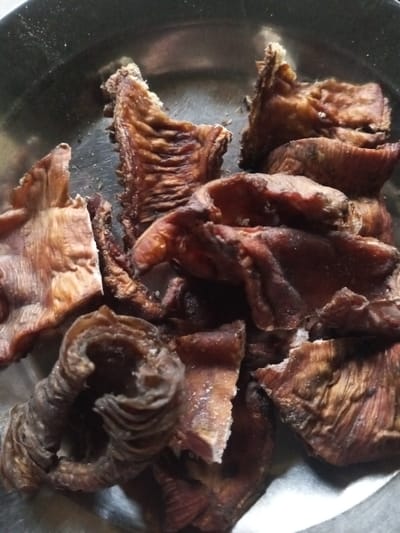
In a metal bowl, there's a pile of cooked or smoked organ meat, potentially intestines. Some pieces are curled, displaying visible ridges or folds. The color ranges from light brown to a darker, reddish-brown. The meat appears slightly dry and crispy in texture, with a few bits of white or light-colored areas possibly being fat or connective tissue. The pieces are irregularly shaped and cut into varying sizes.
Fanisau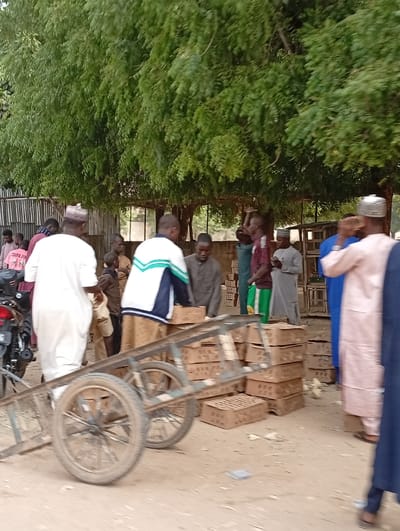
A group of people gather around stacks of cardboard boxes. Some individuals wear traditional attire. A two-wheeled cart stands near the boxes. A motorcycle is visible on the left. The scene takes place outdoors, possibly in a market, with a large tree overhead. The ground appears to be dirt or gravel.
Fanisau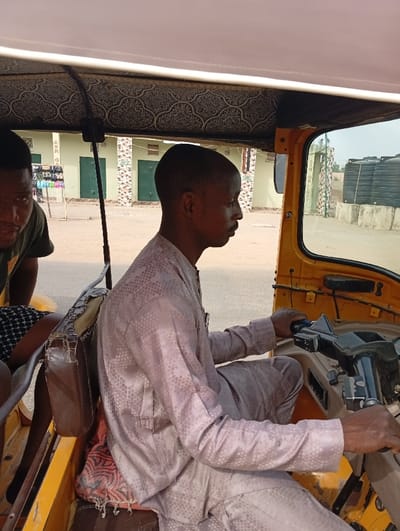
A man drives a yellow auto rickshaw, commonly known as a "keke," on a sunny day. He wears a light-colored, patterned shirt and matching pants. A passenger sits beside him, dressed in a dark shirt and patterned shorts. The rickshaw's interior features a patterned roof. The background shows buildings with green doors and water tanks, suggesting a semi-urban environment.
Fanisau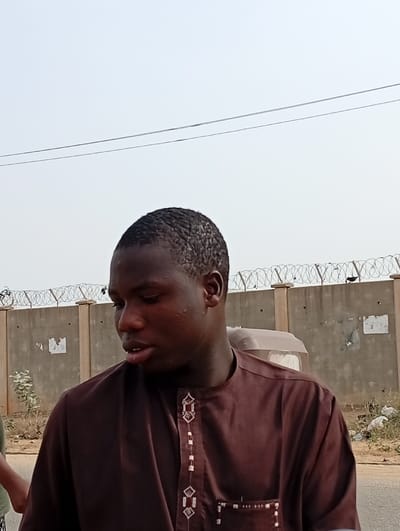
A person wearing a brown shirt with patterned embroidery is standing in front of a beige concrete wall topped with barbed wire. A vehicle is parked behind the person. The sky is overcast and a few trees are visible in the background. The person is looking slightly down and to the left. A bit of greenery is on the left side of the image.
Fanisau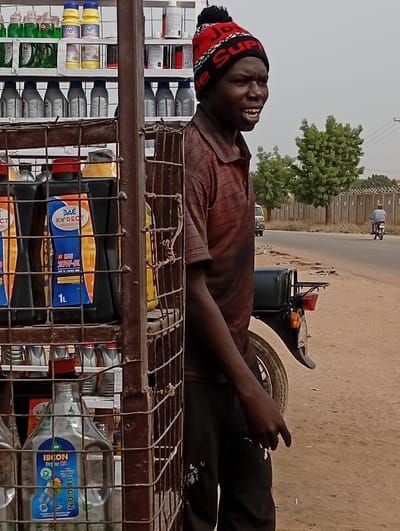
An African man in a red and black hat stands by a metal shelf loaded with motor oil bottles. He is wearing a striped shirt and black pants. The shelf is filled with various brands and types of oil. Behind him, a road is visible with a motorcycle driving on it. The background includes trees and a fence. The man appears to be a roadside vendor.
Fanisau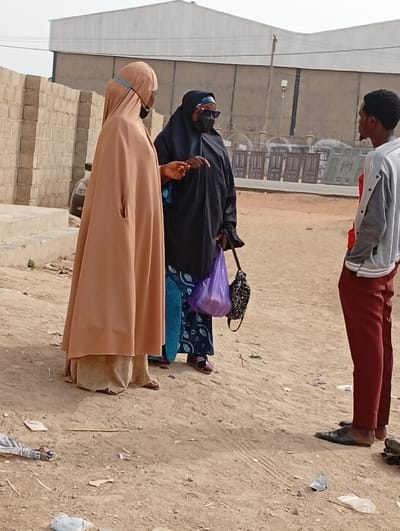
Three people are standing in a dirt lot near a building. Two women wearing face masks and modest clothing are facing a man. The woman on the left is wearing a tan head covering and the other woman is wearing a black head covering and sunglasses. The man is wearing a gray and white sweater and red pants. There are some building supplies and other items in the background.
Fanisau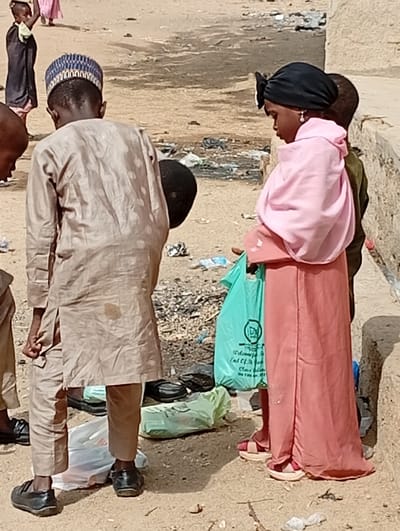
Several children stand outdoors amidst litter. One boy wears a tan outfit with a patterned cap, his back to the camera. A girl beside him is dressed in a long peach gown and a pink headscarf. She holds a green plastic bag. Another boy stands slightly behind her. More children and scattered debris are visible in the background. The ground is sandy and uneven. A wall structure is present on the right.
Fanisau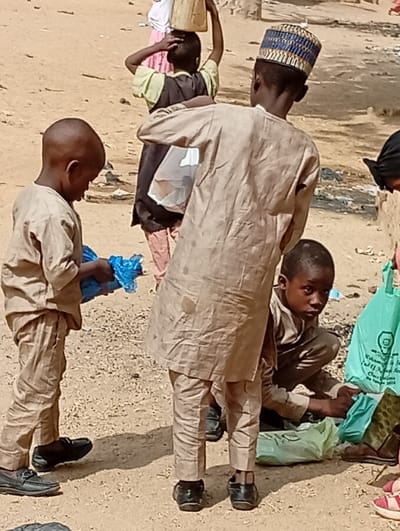
This outdoor image from Fanisau, Nigeria, captures a sunlit scene featuring several children on sandy, dusty ground. The bright daylight suggests it is midday or early afternoon. In the foreground, a young boy with closely cropped hair stands on the left, facing away from the viewer. He wears a light brown tunic and trousers, with black loafers, and holds a crumpled blue plastic bag. To his right, a taller boy, also dressed in a similar light brown tunic and trousers, faces away and wears a blue and beige knitted cap. He has black shoes. On the right side of the foreground, a third boy crouches on the ground, actively looking into a light green plastic bag. He is dressed in light brown attire and gazes towards the camera with a focused expression. Another light green plastic bag rests beside him. Visible text on one of these bags includes "Welcome," and partially discernible words such as "Class" or "Club," and possibly a year like "2023" or "2024," along with a circular logo. Partially visible next to the crouching boy is the lower portion of another person, wearing dark clothing and sandals. In the mid-ground, a child walks away from the viewer, balancing a yellow jerry can on their head. This child wears a light green top, a dark vest, and pink trousers. The scene depicts children engaged in various activities, possibly involving the distribution or collection of items from the plastic bags, while another child carries water, a common daily task in the region. The setting appears to be a rural or semi-urban area, characterized by its dry, unpaved ground.
Fanisau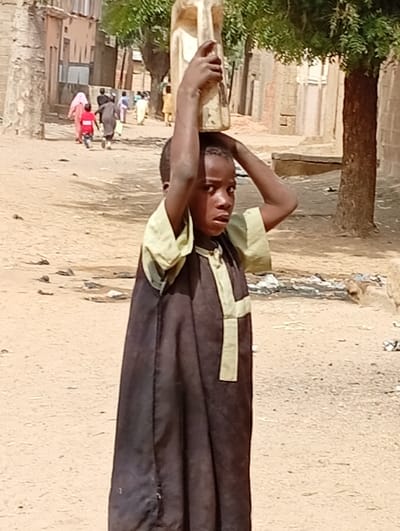
A child in a traditional brown and light green robe carries a large, light-colored plastic container on their head. They are standing on a dirt road in what appears to be a village. In the background, several other people are walking down the road, and there are buildings and trees lining the street. The lighting suggests it is a sunny day. The child has a concerned or serious expression.
Fanisau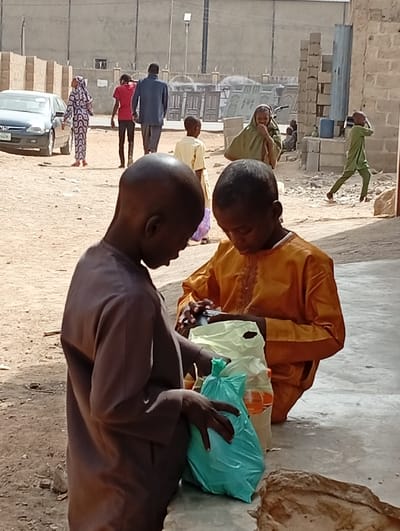
The image portrays an outdoor scene in Fanisau, Nigeria, under bright daylight, characterized by a sandy ground and informal structures. In the foreground, two young boys are the primary subjects, engrossed in examining items held within plastic bags. The boy on the left, dressed in a dark brown long-sleeved garment, is holding a green plastic bag. Next to him, a boy wearing a bright orange long-sleeved garment looks down into a light yellow plastic bag. Both boys have shaved heads and appear focused on their respective tasks. In the midground, several other people are visible, indicating a busy environment. A young boy in a light yellow shirt stands slightly behind the two main subjects. To the right, a woman with a light green head covering and garment appears to be covering her mouth, possibly smiling or reacting to something. A boy in a vibrant green garment is captured in motion, running or quickly walking towards the right side of the frame. The background shows more activity and elements of the setting. A silver sedan car, possibly a Honda, is parked on the left, with a partially visible license plate. A woman in a patterned blue and white outfit and head covering walks away from the car. Further back, two men are walking: one in a red t-shirt and dark pants, and another in a dark blue shirt and dark pants. The ground is unpaved and dusty. In the far background, there are concrete blocks and stacked metal gates or doors against a distant wall, suggesting a mix of residential and industrial or construction areas. The bright sun casts clear shadows, indicating midday or early afternoon. No clearly readable text is discernible.
Fanisau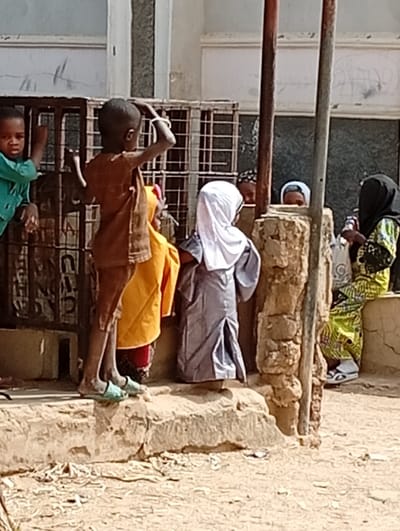
This outdoor scene, set in Fanisau, Nigeria, captures a moment of daily life featuring several children and adults under bright daylight. In the foreground, a young boy with dark skin, wearing a brown shirt and light green sandals, stands with his back to the viewer on a rough, raised stone step. His arms are raised, seemingly adjusting something on his head or hair, which is adorned with a white bracelet. To his left, another young boy in a green shirt peeks out from behind a metal crate, looking directly at the camera. Further to the right, a child in a grey, flowing robe and white head covering stands with their back to the camera, partially obscured by a sturdy stone pillar. Between the two central children, a glimpse of a child in vibrant yellow or orange clothing is visible. Behind the stone pillar, two sets of eyes can be seen peeking out, suggesting other individuals are observing the scene. On the far right, an adult woman with a black head covering and a colorful patterned dress (green, yellow, and black) is seated on a low stone ledge, wearing white sandals. The background features light-colored building walls with window openings covered by metal grates. The ground beneath the stone steps appears dusty or unpaved. The bright, direct sunlight indicates a sunny, dry day. There is no visible text in the image.
Fanisau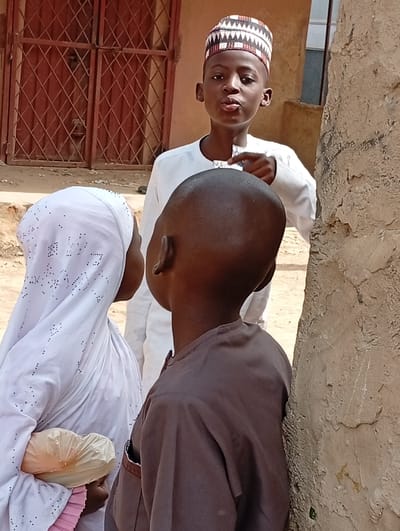
This bright daylight outdoor photograph captures three children interacting in what appears to be a casual setting in Fanisau, Nigeria. The central figure is a young boy, approximately 8-12 years old, facing the camera with a distinct expression. He is wearing a white long-sleeved tunic and a patterned Kufi cap with white, red, and black geometric designs. His lips are puckered in a pout, and he points with his right index finger, seemingly engaging with one of the other children. To his left, partially visible from the back, is a girl wearing a white hijab or headscarf, which has small, subtle embellishments. Her face is turned away from the camera, and she is holding a light-colored, possibly plastic, bag or object. On the right side of the frame, another boy is visible from the back. He has a shaven head and is dressed in a dark brown or grey long-sleeved tunic. He stands close to a textured, possibly stucco or mud, wall or pillar that occupies the right edge of the image. In the background, behind the central boy, there is a building featuring a reddish-brown metal gate or door with a grid-like pattern. The ground appears to be unpaved dirt or sand. The lighting suggests it is daytime. There is no visible text in the image.
Fanisau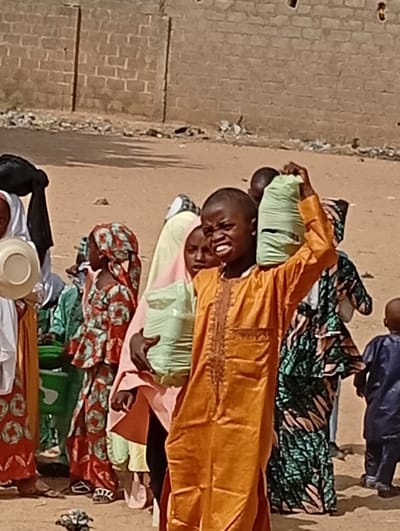
A group of African children, dressed in colorful traditional clothing, are gathered outside a brick building. One boy in the front, wearing an orange robe, carries a green bag on his head. Another child beside him holds a similar bag. Other children wear patterned fabrics and head coverings. The scene suggests a distribution of goods or food, with the children possibly waiting in line.
Fanisau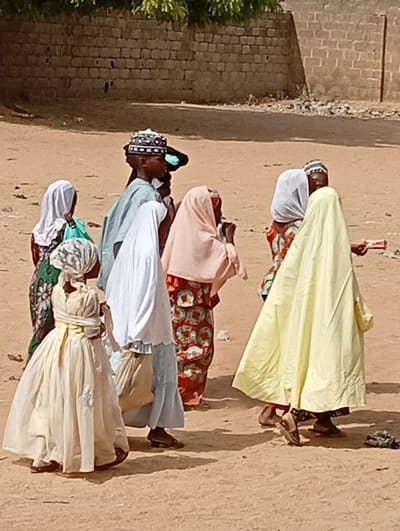
The image displays a group of approximately seven to eight individuals, primarily children and young people, gathered or walking on a sandy, unpaved path in Fanisau, Nigeria. The bright lighting suggests it is midday or early afternoon, with clear shadows cast on the light brown earth. The subjects are dressed in traditional attire. On the far left, a young girl wears a long, light cream-colored dress with a gathered waist and a head covering, facing away from the viewer. Next to her, another individual is in a white head covering and a light blue garment. A young boy in the center sports a dark, intricately patterned Kufi cap and a light blue top. Other figures, mostly girls or women, are seen in various colored hijabs and flowing dresses: one in a pale pink hijab over a patterned red dress, another in a white hijab and a light blue skirt, and a partially obscured person in a green patterned outfit. On the far right, a figure in a bright yellow, full-body covering holds a small, light-colored rectangular object. The background features a low, weathered brick wall made of light-colored blocks, likely part of a building or compound, with sparse green foliage from trees or bushes visible above it. The dusty ground and traditional clothing are consistent with the location context. There is no visible text in the image. The scene captures a casual moment of daily life in an outdoor community setting.
Fanisau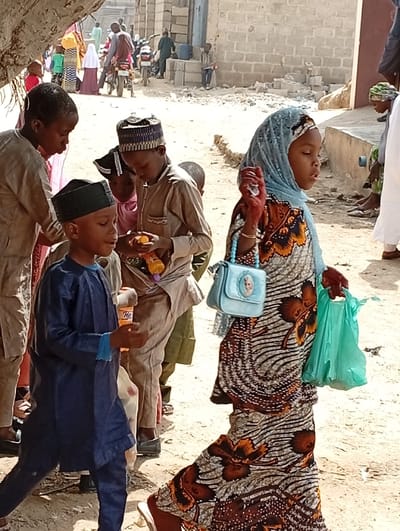
This medium shot captures a lively street scene in Fanisau, Nigeria, bathed in bright daylight. The foreground is dominated by several children, with more people and buildings visible in the dusty background. On the right, a young girl walks towards the right side of the frame. She is dressed in a long, flowing garment with a distinctive brown and orange floral pattern over a lighter background, paired with a light blue hijab. She carries a small, light blue shoulder bag adorned with a "Frozen" character, and a translucent green plastic bag in her right hand. Her left hand is decorated with intricate henna patterns and she holds a small, light-colored item. To her left, a young boy walks in a dark blue traditional outfit, including a top and trousers, and a dark green cap. He holds an orange-labeled bottle, possibly a drink, in his right hand. Another boy, wearing a tan traditional shirt and a patterned cap, is positioned slightly behind him, looking down and holding an orange object, likely a fruit or snack. On the far left, another child in a light-colored top is partially visible. The background reveals a dirt path or road with simple, light-colored buildings, some appearing to be constructed from cinder blocks. Several adults and other children are scattered throughout the scene; some are walking, others are stationary, and a person on a motorcycle is visible further back. A large tree trunk provides shade on the far left. The overall impression is one of everyday activity in a warm, semi-urban or rural setting. The "Frozen" branding on the girl's bag and possibly "HP" on the boy's bottle are the only discernible texts.
Fanisau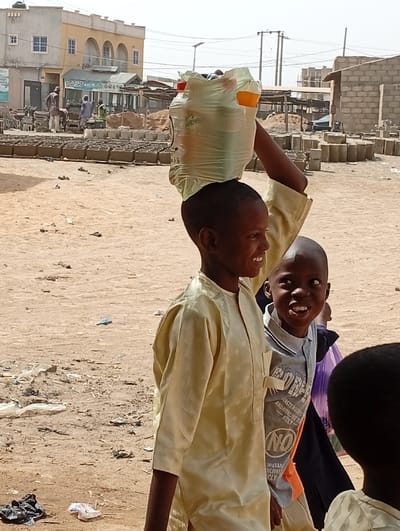
This image, taken in Fanisau, Nigeria, depicts a bright, sunny outdoor scene featuring several young boys. In the foreground, a boy, approximately 8-10 years old, smiles widely as he carries a clear plastic bag, seemingly filled with bottled drinks, balanced on his head. He is dressed in a light yellow, long-sleeved tunic. Beside him, another boy of similar age grins towards the camera, wearing a grey long-sleeved shirt with partially visible English text, including "ANDREW" and "NO". Other children are partially visible in the immediate background. The ground is unpaved, dusty, and strewn with scattered litter and debris. In the mid-ground, numerous grey rectangular blocks, likely concrete or mud bricks, are neatly arranged, indicating a construction material site or an area for brick production. The background features various buildings under a clear sky. On the left, a two-story building with arched windows stands next to a single-story structure with a green sign reading "SABO". On the right, uncompleted structures made of cinder blocks are visible, along with overhead power lines and poles. The strong sunlight suggests it is midday or early afternoon. The children's expressions convey happiness and amusement.
Fanisau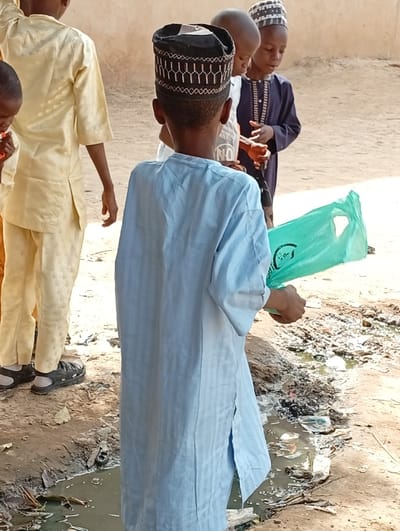
This image captures a group of young boys in an outdoor setting in Fanisau, Nigeria, during what appears to be daytime under bright sunlight. In the foreground, a boy stands with his back to the camera, wearing a light blue, long-sleeved tunic (jalabiya) and a black kufi cap adorned with intricate white embroidery. He holds a green plastic bag in his right hand. To his left, partially visible, another boy also faces away, dressed in a light yellow tunic and trousers, with black sandals on his feet. Further back, two other boys are visible. One, facing right, wears a white shirt with the letters "NO" faintly visible on it, and another boy in a dark purple tunic and a striped cap is facing him. Their expressions are not clearly discernible, but they seem to be focused on something between them or interacting. The ground is unpaved, appearing dusty and uneven, characteristic of a rural or semi-urban environment. A significant detail is the puddle of dirty, stagnant water in the lower part of the frame, filled with various debris including plastic items and leaves. This suggests a drainage issue or unkempt surroundings. The background features a light-colored wall or structure, possibly made of mud or concrete. The general attire of the boys, including the tunics and caps, indicates cultural or religious garments common in the region.
Fanisau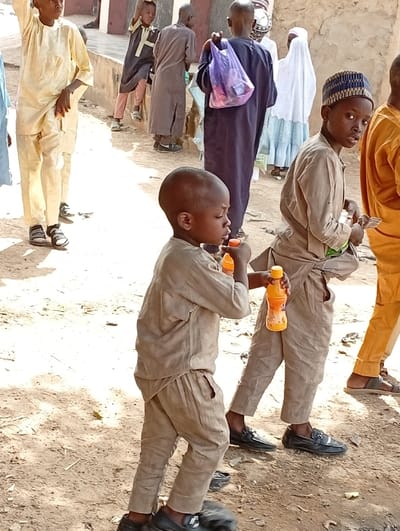
A group of people stand outside. Several are children, dressed in traditional clothing. One child in the foreground drinks from a bottle. Another child wearing a kufi stands beside him, looking toward the camera. People in the background include adults wearing robes and head coverings. The ground is dusty, and a building can be seen in the background.
Fanisau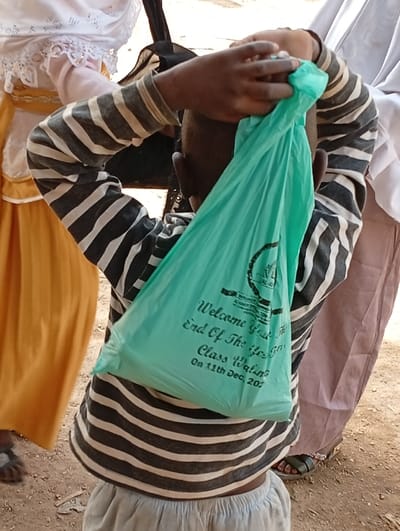
The image, taken in Fanisau, Nigeria, shows a young child from behind, wearing a grey and white striped long-sleeved shirt and light-colored shorts. The child is holding a light green plastic bag with both hands, raised towards the back of their head. Partial views of other individuals are visible around the child. To the left, a person is dressed in a white top with lace trim over a yellow or orange skirt. To the right, another person wears a white garment and what appears to be a light brown or purple lower garment, with a foot visible wearing a dark sandal. The scene is set outdoors on a dirt ground, under bright, clear daylight conditions, suggesting a sunny day. The activity appears to be part of a gathering or event, possibly where items are being distributed or received. A notable detail is the text printed in black on the light green plastic bag. It includes a logo at the top and the following words: "Welcome Your" "End Of The Year" (interpreting "Ifo" as "Year") "Class Walimah" (interpreting "Waling" as "Walimah," an Islamic celebratory gathering) "On 11th Dec, 2023" (interpreting "202" as "2023") This text indicates the bag is likely a party favor or gift from an "End of the Year Class Walimah" held on December 11th, 2023. The overall impression is that of a community or school celebration.
Fanisau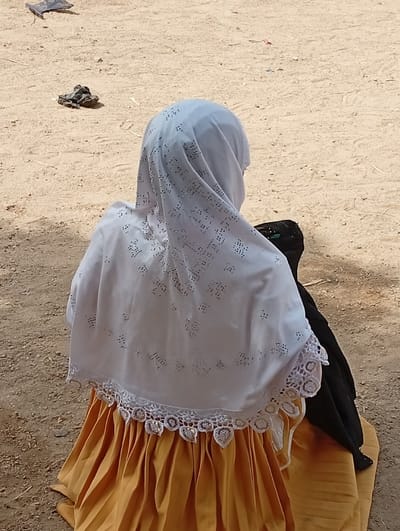
The image shows a person from behind, kneeling or sitting on dry, sandy ground in an outdoor setting in Fanisau, Nigeria. The individual is wearing a white hijab that features delicate perforated patterns and a decorative white crocheted lace trim along its lower edge. Beneath the hijab, a bright, pleated orange-yellow skirt is visible. A dark, possibly black, piece of fabric or garment is positioned on the ground next to the person's right side, under the edge of the hijab. The ground is light brown and appears dusty, with a few scattered dark, unidentifiable objects in the background, possibly debris or small rocks. The bright lighting suggests it is daytime and likely sunny. No faces or specific emotional expressions are visible. There is no visible text in the frame.
Fanisau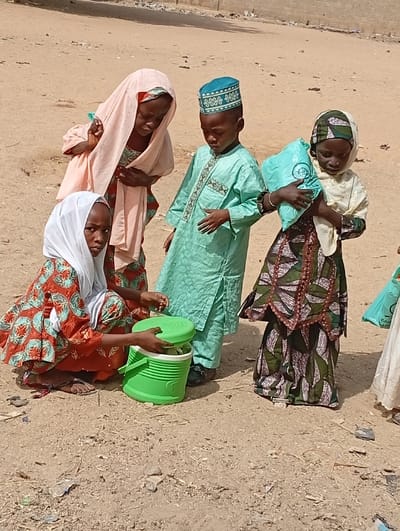
This outdoor photograph features four young children gathered on unpaved, sandy ground under bright daylight. A girl on the left, wearing a white headscarf and a patterned red, orange, and green dress, squats down, holding open a vibrant green portable cooler with a ribbed texture. Behind her, another girl in a light peach headscarf and a patterned dress, and a boy in a light green tunic (boubou) and a blue kufi (cap), lean in, looking intently into the cooler. On the right, a fourth girl, dressed in a patterned headscarf and long dress, stands holding a light blue plastic bag with an indistinct white logo or text. The children appear to be engaged in an activity centered around the cooler, possibly sharing or preparing to distribute its contents, which are not clearly visible. Their expressions are focused and attentive. The scene is set on dry, sandy terrain, scattered with small debris, indicative of a warm, possibly arid environment. The bright sunlight casts strong shadows, suggesting it is midday or early afternoon. The traditional attire worn by the children and the natural surroundings align with the provided location context of Fanisau, Nigeria. Parts of another child in a white dress are visible on the far right.
Fanisau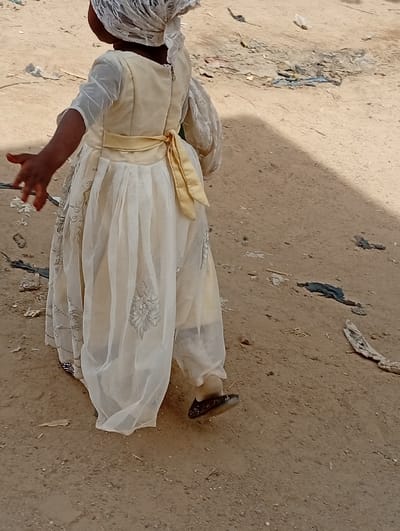
A young child, viewed from behind and slightly to the side, walks across a dirt or sandy ground in an outdoor setting in Fanisau, Nigeria. The child is dressed in a light-colored, possibly cream or pale yellow, dress. A golden sash is tied in a bow at the back of the waist. The dress has sheer white sleeves and a sheer overlay on the skirt, which is decorated with silver embroidered patterns. A white lace head covering is worn. The child's right arm is extended slightly forward with fingers splayed, suggesting movement. A dark shoe with light dot patterns is visible on the child's left foot. The ground is scattered with debris, including small pieces of plastic, fabric scraps, and organic matter. A shadow falls across the ground on the right side of the frame. The bright, clear lighting indicates it is daytime and likely sunny. No text is visible in the image.
Fanisau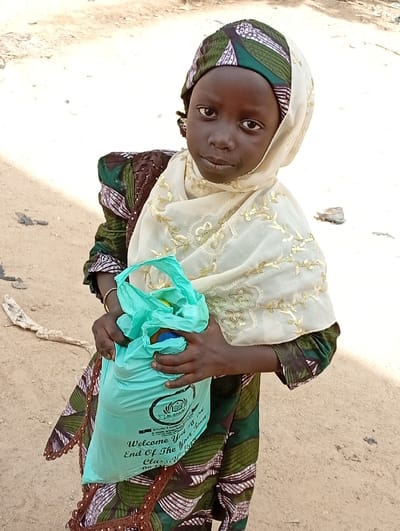
A young girl stands outdoors, holding a teal plastic bag. She wears a patterned green and brown dress with lace trim, and a white hijab adorned with gold embroidery. Her head is covered with a green and white patterned headscarf. The bag in her hands features the words "Welcome You! End Of The Year Class..." along with a logo. The background consists of a sandy terrain.
Fanisau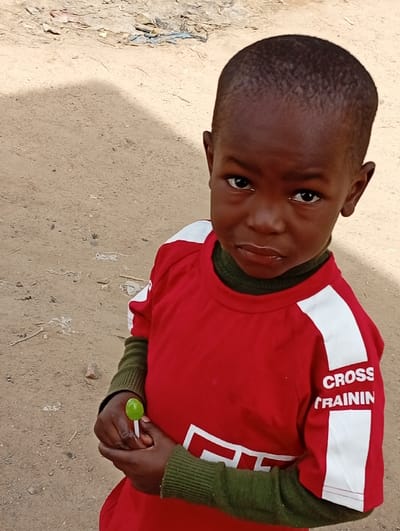
A young child with dark skin and a shaved head is depicted from the waist up, standing outdoors in Fanisau, Nigeria. The child wears a bright red short-sleeved t-shirt with white stripes on the shoulders and arms, layered over a green, long-sleeved shirt or turtleneck. The red t-shirt has white text on the right sleeve that reads "CROSS TRAININ", likely an abbreviation for "CROSS TRAINING". The child holds a small, round, green lollipop in both hands, positioned in front of their chest. The child's expression is serious and direct, with large, dark eyes looking straight ahead at the viewer. There's a slight pout to the lips, conveying a contemplative or perhaps slightly somber mood. The setting appears to be an unpaved outdoor area with light brown, dusty ground. In the background, there's some scattered debris and what looks like dried vegetation or waste materials, suggesting a less manicured environment. Natural daylight illuminates the scene, creating soft shadows, indicating it is daytime. The overall impression is one of a candid moment captured in a humble outdoor setting.
Fanisau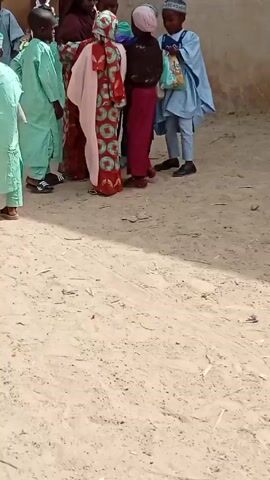
The video shows a group of children, most in traditional attire, standing on a sandy area outside a building. Some children are wearing light green robes and caps, while others have patterned dresses and headscarves. A few are carrying items like a green bucket and a white plate. One child is eating something wrapped in fabric. The environment appears to be a village or rural area with modest buildings in the background.
Fanisau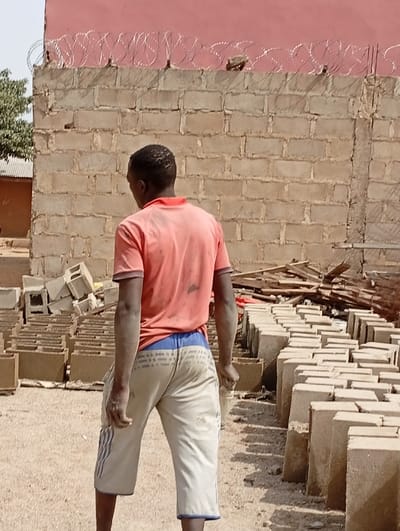
A man in a red t-shirt and khaki shorts stands with his back to the viewer. He is surrounded by rows of rectangular, light-colored bricks or blocks on the ground. Behind him is a brick wall topped with coiled barbed wire, and a red building is partially visible above the wall. A small pile of lumber rests near the bricks. The ground is covered in light-colored gravel.
Fanisau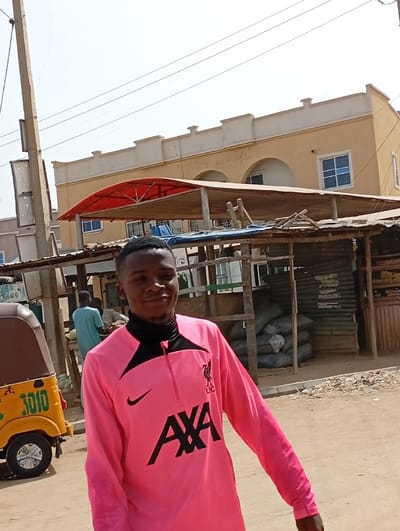
The image captures a vibrant street scene in Fanisau, Nigeria, under bright daylight. The main subject is a young man, likely in his late teens or early twenties, positioned prominently in the foreground, slightly to the left of the center. He is looking directly towards the viewer with a subtle, pleasant smile or smirk. He is wearing a distinctive bright pink long-sleeved athletic shirt, which features black panels on the upper chest and collar, a black zipper, and a black stand-up collar. Visible logos on his shirt include a black Nike swoosh on the right chest, the "LFC" (Liverpool Football Club) crest on the left chest, and the prominent "AXA" sponsorship logo in large black letters across the torso. To the left of the man, the front portion of a yellow motorized tricycle, commonly known as a Keke Napep or auto-rickshaw, is partially visible. The number "3010" is clearly printed on its side. In the background, behind the man and the tricycle, are several makeshift market stalls or shelters constructed from wooden poles and topped with corrugated metal or fabric roofs. Within one of these stalls, several large, dark sacks are stacked. Another individual, dressed in a light blue garment, can be seen in the deeper background, near the market structures. Further beyond the market stalls, a light yellow or beige two-story building with a flat roof is visible. It features arched windows on the lower level and rectangular windows with white frames on the upper level. The sky above is clear and bright, indicating a sunny day. The ground in the foreground and visible street areas appears to be unpaved and dusty. The overall scene suggests a bustling, everyday environment in an urban or semi-urban setting.
Fanisau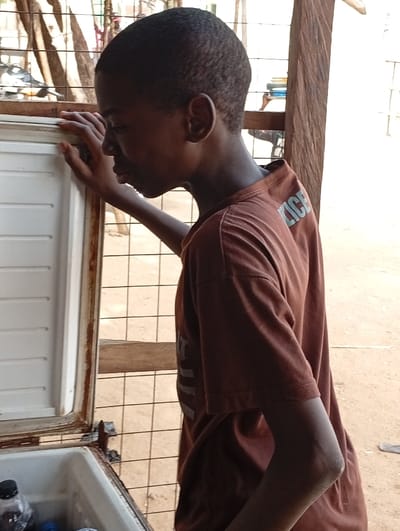
A young Black person, appearing to be a child or teenager, is captured in profile looking into an open chest freezer in Fanisau, Nigeria. They are wearing a plain brown short-sleeved t-shirt, on the back of which the word "POLICE" is partially visible in light-colored text. Their right hand rests on the edge of the freezer opening. Inside the freezer, several bottles are visible, some containing dark liquids. The freezer's edges show signs of wear and some rust. The scene appears to be an outdoor or semi-outdoor vendor stall or shop, characterized by a metal grid fence or wall in the background and sturdy wooden posts. The ground beneath is light-colored, possibly sand or packed earth. The bright, natural lighting indicates it is daytime, likely a clear and warm day. The person's expression is neutral and focused on the contents of the freezer, suggesting they are either choosing an item or inspecting the inventory. The image provides a glimpse into a moment of daily activity in this local Nigerian setting.
Fanisau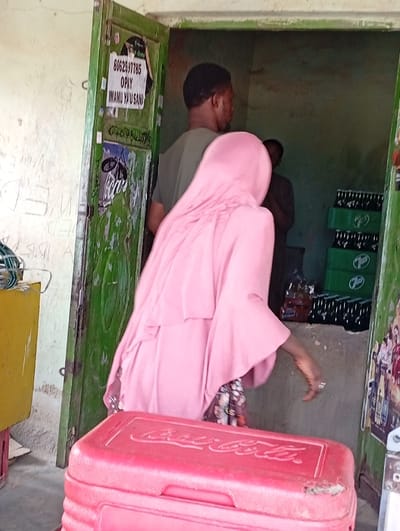
The image depicts a scene at the entrance of a modest shop or stall in Fanisau, Nigeria, during daylight. In the foreground, a woman in a pink hijab or layered garment stands with her back to the camera, facing into the interior. Beyond her, a man wearing a green t-shirt is visible inside the doorway, also with his back mostly to the viewer. A third person is partially obscured deeper within the shop. A prominent red cooler with the "Coca-Cola" brand embossed on its lid is positioned in the immediate foreground. To the left, a portion of a yellow container is visible. Inside the shop, green crates stacked with bottled beverages are discernible on the right side. The overall activity suggests a customer or vendor interaction within a retail setting. The shop entrance features a worn, green wooden doorframe and door. The door serves as an informal advertising space, displaying several pieces of text. Visible details include a phone number "8062597785," the name of a mobile payment service "OPAY," and the phrase "IMAMU Y'U SAN," likely a name or local language phrase. Another partial phone number, "070...", is also written on the door, along with smaller stickers featuring the "Coca-Cola" logo. The scene portrays a functional, local business environment.
Fanisau