CM:

ATTN

Get the app

Ferrara, Italy

30 memories from Ferrara, Italy

A white and brown cat is shown on a dark gray sofa, lying partially on a person's lap. The person's left hand is visible, petting the cat's head. The cat is facing downwards, and its head is nestled into the person's hand. The person's legs are also visible, with one leg bent and the other extended slightly. The cat then moves its head and looks up at the person, and the person's hand moves away from the cat. The cat then stands up and walks away, with its tail held high. The scene is indoors, with a white wall visible in the background. The lighting is soft and natural.

A white and brown cat is shown on a dark gray sofa, lying partially on a person's lap. The person's left hand is visible, petting the cat's head. The cat is facing downwards, and its head is nestled into the person's hand. The person's legs are also visible, with one leg bent and the other extended slightly. The cat then moves its head and looks up at the person, and the person's hand moves away from the cat. The cat then stands up and walks away, with its tail held high. The scene is indoors, with a white wall visible in the background. The lighting is soft and natural.

Ferrara

A close-up video shows a cat with green eyes and white and brown fur. The cat is lying down and looking to the right. The background is blurred. The video is 4 seconds long.

A close-up video shows a cat with green eyes and white and brown fur. The cat is lying down and looking to the right. The background is blurred. The video is 4 seconds long.

Ferrara
The image captures a modern living room interior, likely in an apartment. The scene is dominated by a large flat-screen television displaying a sports broadcast, possibly cycling given the text "Ciclismo" and information about the Tour de France. The television is mounted above a white media console. To the left of the console is a tall, white shelf unit with geometric patterns, holding various items. On top of the media console, there are a few decorative objects including a teddy bear, a glass jar with gold-colored contents, and a small black figurine. A white plastic bag and a framed picture are also visible on the console. To the right of the television, a section of glossy white cabinetry is present, reflecting light. In the foreground, a round, light-colored coffee table with wooden legs sits on a grey rug. The overall impression is one of a clean, contemporary living space. There is no information in the image that would allow for definitive identification of the location as Ferrara, Italy.

The image captures a modern living room interior, likely in an apartment. The scene is dominated by a large flat-screen television displaying a sports broadcast, possibly cycling given the text "Ciclismo" and information about the Tour de France. The television is mounted above a white media console. To the left of the console is a tall, white shelf unit with geometric patterns, holding various items. On top of the media console, there are a few decorative objects including a teddy bear, a glass jar with gold-colored contents, and a small black figurine. A white plastic bag and a framed picture are also visible on the console. To the right of the television, a section of glossy white cabinetry is present, reflecting light. In the foreground, a round, light-colored coffee table with wooden legs sits on a grey rug. The overall impression is one of a clean, contemporary living space. There is no information in the image that would allow for definitive identification of the location as Ferrara, Italy.

Ferrara
The image depicts a bright, sunny day at an outdoor swimming pool. The perspective is from someone lying on a lounge chair, facing towards the pool. The scene is populated with several people enjoying the water. In the foreground, a person's legs and feet are visible, along with a white towel draped over a lounge chair.

Further into the pool, two individuals are seen, one partially submerged and the other with her head above water. In the background, there are more people in the pool and on the poolside. One person is standing near a green umbrella, wearing a red shirt and dark shorts. A white building with multiple windows and arched details stands behind the pool area, suggesting a hotel or resort. Lush green hedges and trees line the edge of the pool, adding to the serene atmosphere. The clear blue sky with scattered white clouds indicates pleasant weather, likely midday given the strong shadows. The overall mood appears relaxed and recreational, with people enjoying a summer day by the pool. No visible text is present in the image.

The image depicts a bright, sunny day at an outdoor swimming pool. The perspective is from someone lying on a lounge chair, facing towards the pool. The scene is populated with several people enjoying the water. In the foreground, a person's legs and feet are visible, along with a white towel draped over a lounge chair. Further into the pool, two individuals are seen, one partially submerged and the other with her head above water. In the background, there are more people in the pool and on the poolside. One person is standing near a green umbrella, wearing a red shirt and dark shorts. A white building with multiple windows and arched details stands behind the pool area, suggesting a hotel or resort. Lush green hedges and trees line the edge of the pool, adding to the serene atmosphere. The clear blue sky with scattered white clouds indicates pleasant weather, likely midday given the strong shadows. The overall mood appears relaxed and recreational, with people enjoying a summer day by the pool. No visible text is present in the image.

Ferrara

The video shows a train platform on a slightly overcast day. People are waiting with luggage, including rolling suitcases, backpacks, and shopping bags. The platform has tiled flooring and is covered by a canopy. Railway tracks run parallel to the platform. A brick building with windows stands across the tracks. There are signposts indicating track numbers. Some people are standing alone, while others are in small groups, some appear to be talking. One person rolls a suitcase, others are looking at their phones.

The video shows a train platform on a slightly overcast day. People are waiting with luggage, including rolling suitcases, backpacks, and shopping bags. The platform has tiled flooring and is covered by a canopy. Railway tracks run parallel to the platform. A brick building with windows stands across the tracks. There are signposts indicating track numbers. Some people are standing alone, while others are in small groups, some appear to be talking. One person rolls a suitcase, others are looking at their phones.

Ferrara
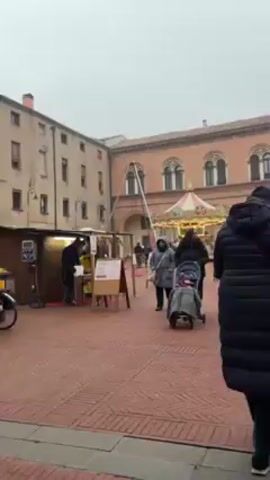
The video shows a plaza on a foggy day. People are walking around a small Christmas market. There is a carousel in the middle of the plaza. There are vendor booths set up along the side of the plaza. There are several buildings surrounding the plaza. The plaza is paved with brick. Some of the buildings are brick and others are yellow. A restaurant with tables and chairs can be seen next to the yellow building.

The video shows a plaza on a foggy day. People are walking around a small Christmas market. There is a carousel in the middle of the plaza. There are vendor booths set up along the side of the plaza. There are several buildings surrounding the plaza. The plaza is paved with brick. Some of the buildings are brick and others are yellow. A restaurant with tables and chairs can be seen next to the yellow building.

Ferrara
This image depicts the interior of the Cathedral of Saint George Martire in Ferrara, Italy, viewed from the nave looking towards the high altar and apse. The scene is illuminated by dim, ambient light.

The floor in the foreground and mid-ground is covered by a red carpet featuring a repetitive floral pattern in cream, green, and gold. To the immediate left in the foreground, a golden nativity scene holds a statue of the infant Jesus. Several poinsettia plants in gold foil pots and other green potted plants are placed on the carpet in the foreground.

In the mid-ground, a rectangular wooden altar table, draped with a white lace-edged cloth, is positioned centrally. It is flanked by two golden cherub statues, each supporting a candelabra. The table is adorned with floral arrangements containing white lilies and red flowers. Two human figures, indistinct due to distance and lighting, are visible standing behind this altar, facing the apse.

The sanctuary area features a richly decorated high altar with multiple golden candlesticks, a prominent cross, and religious busts. Additional floral arrangements of white lilies and red flowers are present on the high altar. Ornate golden pulpits or choir stalls are situated on either side of the sanctuary. Behind the high altar, multiple stained-glass windows displaying religious imagery are visible. The apse walls are extensively ornamented with gilded stucco reliefs and architectural elements.

The dominant architectural feature is the apse dome, which contains a large, vibrant fresco depicting a multi-figure celestial scene, identified as Bastianino's "Universal Judgment." Above this fresco, a smaller, circular painting of the Agnus Dei (Lamb of God) is visible on the main vault. Two large, multi-tiered crystal chandeliers with illuminated bulbs are suspended from the nave ceiling in the mid-ground, contributing to the ambient lighting. The overall architectural style is elaborate, characterized by extensive gilding, detailed ornamentation, and a grand scale.

This image depicts the interior of the Cathedral of Saint George Martire in Ferrara, Italy, viewed from the nave looking towards the high altar and apse. The scene is illuminated by dim, ambient light. The floor in the foreground and mid-ground is covered by a red carpet featuring a repetitive floral pattern in cream, green, and gold. To the immediate left in the foreground, a golden nativity scene holds a statue of the infant Jesus. Several poinsettia plants in gold foil pots and other green potted plants are placed on the carpet in the foreground. In the mid-ground, a rectangular wooden altar table, draped with a white lace-edged cloth, is positioned centrally. It is flanked by two golden cherub statues, each supporting a candelabra. The table is adorned with floral arrangements containing white lilies and red flowers. Two human figures, indistinct due to distance and lighting, are visible standing behind this altar, facing the apse. The sanctuary area features a richly decorated high altar with multiple golden candlesticks, a prominent cross, and religious busts. Additional floral arrangements of white lilies and red flowers are present on the high altar. Ornate golden pulpits or choir stalls are situated on either side of the sanctuary. Behind the high altar, multiple stained-glass windows displaying religious imagery are visible. The apse walls are extensively ornamented with gilded stucco reliefs and architectural elements. The dominant architectural feature is the apse dome, which contains a large, vibrant fresco depicting a multi-figure celestial scene, identified as Bastianino's "Universal Judgment." Above this fresco, a smaller, circular painting of the Agnus Dei (Lamb of God) is visible on the main vault. Two large, multi-tiered crystal chandeliers with illuminated bulbs are suspended from the nave ceiling in the mid-ground, contributing to the ambient lighting. The overall architectural style is elaborate, characterized by extensive gilding, detailed ornamentation, and a grand scale.

Ferrara
The video shows the interior of a large, ornate church, likely in Europe, based on the architectural style. The camera pans around to show the high ceilings, a large dome with a painted fresco, and stained glass windows. Several people are seen walking around the church, including a priest near the altar. The church is decorated with poinsettias and golden ornaments, possibly for Christmas. The overall atmosphere is one of reverence and grandeur.

The video shows the interior of a large, ornate church, likely in Europe, based on the architectural style. The camera pans around to show the high ceilings, a large dome with a painted fresco, and stained glass windows. Several people are seen walking around the church, including a priest near the altar. The church is decorated with poinsettias and golden ornaments, possibly for Christmas. The overall atmosphere is one of reverence and grandeur.

Ferrara
The image depicts the interior of the Ferrara Cathedral (Cattedrale di San Giorgio Martire) in Ferrara, Italy. The scene is a dimly lit, grand architectural space with individuals observing the surroundings.

Architectural features include high, vaulted ceilings, ornate fluted columns with intricate, gilded carvings, and arched doorways leading to various sections. Natural light enters from a high rectangular window on the right wall and a smaller, distinct blue stained-glass window high on the left. The floor consists of large, polished light-colored marble or stone tiles.

A prominent, multi-tiered crystal chandelier with numerous lit candles hangs in the mid-ground. Directly behind it, a large altarpiece features a painting depicting multiple figures within an ornate architectural frame. To the right, a side altar or niche contains a gilded, arched shrine housing an illuminated statue, likely a Madonna and Child. Golden candlesticks and arrangements of red poinsettias are visible on altars and other decorative surfaces. In the foreground, a long, dark red leather bench is present, fronted by a red velvet barrier with gold trim.

Approximately 10-15 individuals are dispersed throughout the visible area, standing and observing. Most are dressed in winter attire, including heavy coats and hats. A man in a dark jacket and beanie stands on the left, looking forward. A person in a bright red jacket and light-colored trousers stands in the mid-right foreground, facing away from the camera, holding a white smartphone or device at eye level, possibly photographing or recording. No direct interactions between individuals are discernible.

The image depicts the interior of the Ferrara Cathedral (Cattedrale di San Giorgio Martire) in Ferrara, Italy. The scene is a dimly lit, grand architectural space with individuals observing the surroundings. Architectural features include high, vaulted ceilings, ornate fluted columns with intricate, gilded carvings, and arched doorways leading to various sections. Natural light enters from a high rectangular window on the right wall and a smaller, distinct blue stained-glass window high on the left. The floor consists of large, polished light-colored marble or stone tiles. A prominent, multi-tiered crystal chandelier with numerous lit candles hangs in the mid-ground. Directly behind it, a large altarpiece features a painting depicting multiple figures within an ornate architectural frame. To the right, a side altar or niche contains a gilded, arched shrine housing an illuminated statue, likely a Madonna and Child. Golden candlesticks and arrangements of red poinsettias are visible on altars and other decorative surfaces. In the foreground, a long, dark red leather bench is present, fronted by a red velvet barrier with gold trim. Approximately 10-15 individuals are dispersed throughout the visible area, standing and observing. Most are dressed in winter attire, including heavy coats and hats. A man in a dark jacket and beanie stands on the left, looking forward. A person in a bright red jacket and light-colored trousers stands in the mid-right foreground, facing away from the camera, holding a white smartphone or device at eye level, possibly photographing or recording. No direct interactions between individuals are discernible.

Ferrara
This image depicts the main altar area of the Basilica Cattedrale di San Giorgio Martire in Ferrara, Italy.

The foreground features a wide, multi-tiered red carpeted staircase with gold trim, ascending towards the altar. On the lowest visible step, a potted Poinsettia plant with red bracts is positioned, enclosed in gold foil wrapping. To the far right, partial foliage of another green potted plant is visible.

The midground is dominated by the elaborate main altar. The altar front is draped with a light-colored, possibly beige, embroidered cloth featuring scrolling patterns and a central, stylized motif. The altar structure itself is constructed from polished stone, exhibiting reddish-brown and lighter veining. Above this, the altar surface holds a rich display of religious objects and floral arrangements. This includes multiple tall, white candles in ornate gold and silver candelabra, several of which are lit. Interspersed are busts of figures, some entirely gold-toned, others silver with gold accents. The altar is extensively decorated with white and red floral arrangements, along with green foliage. A small, framed devotional image or reliquary is centrally positioned on the altar table.

The background reveals the grandeur of the church interior. To the upper left, a large pipe organ with metallic vertical pipes is visible, framed by ornate gold and light-toned stucco work. Above the altar, the wall is adorned with intricate Baroque-style relief carvings and architectural details in gold and light shades. Two arched stained-glass windows, emitting blue and red light, are set into the wall. Higher up, a fresco or painting depicting numerous figures can be seen on the curved upper wall or ceiling.

No individuals are present in the scene. The lighting is subdued, with illumination primarily from the burning candles and the light transmitted through the stained-glass windows.

This image depicts the main altar area of the Basilica Cattedrale di San Giorgio Martire in Ferrara, Italy. The foreground features a wide, multi-tiered red carpeted staircase with gold trim, ascending towards the altar. On the lowest visible step, a potted Poinsettia plant with red bracts is positioned, enclosed in gold foil wrapping. To the far right, partial foliage of another green potted plant is visible. The midground is dominated by the elaborate main altar. The altar front is draped with a light-colored, possibly beige, embroidered cloth featuring scrolling patterns and a central, stylized motif. The altar structure itself is constructed from polished stone, exhibiting reddish-brown and lighter veining. Above this, the altar surface holds a rich display of religious objects and floral arrangements. This includes multiple tall, white candles in ornate gold and silver candelabra, several of which are lit. Interspersed are busts of figures, some entirely gold-toned, others silver with gold accents. The altar is extensively decorated with white and red floral arrangements, along with green foliage. A small, framed devotional image or reliquary is centrally positioned on the altar table. The background reveals the grandeur of the church interior. To the upper left, a large pipe organ with metallic vertical pipes is visible, framed by ornate gold and light-toned stucco work. Above the altar, the wall is adorned with intricate Baroque-style relief carvings and architectural details in gold and light shades. Two arched stained-glass windows, emitting blue and red light, are set into the wall. Higher up, a fresco or painting depicting numerous figures can be seen on the curved upper wall or ceiling. No individuals are present in the scene. The lighting is subdued, with illumination primarily from the burning candles and the light transmitted through the stained-glass windows.

Ferrara
This image depicts the interior of the Basilica Cattedrale di San Giorgio Martire (Ferrara Cathedral) in Ferrara, Italy, specifically facing the main altar and apse from the nave. The scene is illuminated by dim ambient light, supplemented by artificial spotlights and lit candles.

In the foreground, five red carpeted steps with gold trim descend from a raised platform. Two potted plants with red flowers, wrapped in gold foil, flank the steps. The visible floor is patterned marble.

At the center, the main altar stands on a platform, featuring a white, carved altar frontal. It is adorned with ornate gold and silver candelabras holding tall white candles, some actively lit. Behind the altar, the apse wall is richly decorated with gold relief work and multiple stained-glass windows displaying figures in blue, red, and yellow tones. Above the apse, a large, detailed fresco, likely depicting the Last Judgment, covers a significant portion of the curved wall, featuring numerous figures in a dynamic composition. To the right of this fresco, a large arrangement of white lilies and red flowers rests on a stand.

On the left side of the image, an elaborate pipe organ, predominantly gold and white with visible silver pipes, is mounted on a decorated balcony structure. The surrounding walls feature intricate golden architectural details.

The vaulted ceiling above includes a circular fresco depicting the Agnus Dei (Lamb of God) holding a banner. A large, multi-tiered crystal chandelier hangs from the ceiling towards the right side of the frame. No individuals are present in the scene.

This image depicts the interior of the Basilica Cattedrale di San Giorgio Martire (Ferrara Cathedral) in Ferrara, Italy, specifically facing the main altar and apse from the nave. The scene is illuminated by dim ambient light, supplemented by artificial spotlights and lit candles. In the foreground, five red carpeted steps with gold trim descend from a raised platform. Two potted plants with red flowers, wrapped in gold foil, flank the steps. The visible floor is patterned marble. At the center, the main altar stands on a platform, featuring a white, carved altar frontal. It is adorned with ornate gold and silver candelabras holding tall white candles, some actively lit. Behind the altar, the apse wall is richly decorated with gold relief work and multiple stained-glass windows displaying figures in blue, red, and yellow tones. Above the apse, a large, detailed fresco, likely depicting the Last Judgment, covers a significant portion of the curved wall, featuring numerous figures in a dynamic composition. To the right of this fresco, a large arrangement of white lilies and red flowers rests on a stand. On the left side of the image, an elaborate pipe organ, predominantly gold and white with visible silver pipes, is mounted on a decorated balcony structure. The surrounding walls feature intricate golden architectural details. The vaulted ceiling above includes a circular fresco depicting the Agnus Dei (Lamb of God) holding a banner. A large, multi-tiered crystal chandelier hangs from the ceiling towards the right side of the frame. No individuals are present in the scene.

Ferrara
The image depicts the interior of the Basilica di San Francesco in Ferrara, Italy. The scene shows a grand, ornate Baroque church nave with a high, dark, vaulted ceiling adorned with faded frescoes. Two large, multi-tiered crystal chandeliers, brightly illuminated, hang prominently from the ceiling, with the upper chandelier catching natural light from an unseen window. The walls feature dark paneling or paint, accented by extensive gilded molding, decorative relief sculptures, and large fluted pilasters with Corinthian capitals.

In the center, a brightly lit side altar or shrine is visible, featuring a golden niche housing a light-colored statue, flanked by twisted, ornate columns. Red fabrics, white flowers, and candle holders are arranged at the base of this shrine, above which hangs a smaller chandelier. To the left of the shrine, a dark wooden stand holds several white candles and flowers. To the right, a tall, narrow structure draped in white fabric with a decorative wooden pediment stands.

In the foreground, a dark wooden partition or pews are present. Three individuals are visible: one male, center-left, seen from the back, wearing a dark winter coat and trousers, standing with hands clasped behind his back, observing the shrine; one female, center-right, with long blonde hair, wearing a dark jacket and a light-colored long skirt, also observing the shrine; and one male, far right, in profile, with short, curly dark hair and a dark patterned jacket, looking towards the right side of the image. Indistinct figures are visible further in the background near the central shrine. The overall atmosphere is quiet and observant.

The image depicts the interior of the Basilica di San Francesco in Ferrara, Italy. The scene shows a grand, ornate Baroque church nave with a high, dark, vaulted ceiling adorned with faded frescoes. Two large, multi-tiered crystal chandeliers, brightly illuminated, hang prominently from the ceiling, with the upper chandelier catching natural light from an unseen window. The walls feature dark paneling or paint, accented by extensive gilded molding, decorative relief sculptures, and large fluted pilasters with Corinthian capitals. In the center, a brightly lit side altar or shrine is visible, featuring a golden niche housing a light-colored statue, flanked by twisted, ornate columns. Red fabrics, white flowers, and candle holders are arranged at the base of this shrine, above which hangs a smaller chandelier. To the left of the shrine, a dark wooden stand holds several white candles and flowers. To the right, a tall, narrow structure draped in white fabric with a decorative wooden pediment stands. In the foreground, a dark wooden partition or pews are present. Three individuals are visible: one male, center-left, seen from the back, wearing a dark winter coat and trousers, standing with hands clasped behind his back, observing the shrine; one female, center-right, with long blonde hair, wearing a dark jacket and a light-colored long skirt, also observing the shrine; and one male, far right, in profile, with short, curly dark hair and a dark patterned jacket, looking towards the right side of the image. Indistinct figures are visible further in the background near the central shrine. The overall atmosphere is quiet and observant.

Ferrara
A detailed, multi-tiered diorama depicts a bustling scene of human activity, featuring numerous figurines arranged across various levels. The bottom tier includes figures sitting, standing, and interacting around a table laden with food, along with a pig and piglets. Above this, more figures are positioned on a structure resembling a building, engaging in various activities. Higher up, the diorama transitions into a rocky, mountainous landscape populated by more figures, some appearing to climb or gesture. Angels are positioned atop a small building, adding a religious element to the scene. The entire diorama is displayed behind glass.

A detailed, multi-tiered diorama depicts a bustling scene of human activity, featuring numerous figurines arranged across various levels. The bottom tier includes figures sitting, standing, and interacting around a table laden with food, along with a pig and piglets. Above this, more figures are positioned on a structure resembling a building, engaging in various activities. Higher up, the diorama transitions into a rocky, mountainous landscape populated by more figures, some appearing to climb or gesture. Angels are positioned atop a small building, adding a religious element to the scene. The entire diorama is displayed behind glass.

Ferrara
The image captures the interior of the Church of Santa Maria in Vado, Ferrara, Italy, focusing on a prominent Baroque altar structure. The central element is a large altarpiece featuring an oil painting, "The Martyrdom of Saint Maurelius" by Guercino, depicting a multi-figure scene of martyrdom, with soldiers and a bound figure in the foreground and cherubs in the sky above. This painting is set within an elaborate architectural frame composed of pairs of fluted, reddish-brown marble columns, white marble sections, and gilded decorative elements. Above the painting, the altarpiece features a curved pediment adorned with numerous white marble or stucco sculptures of angels and cherubs, with a bust of a saint in a circular medallion at its apex.

Below the painting, the altar table is covered with a white lace cloth. On the altar, multiple tall white candles are positioned in ornate brass candlesticks, accompanied by small potted plants and a white decorative vase. The altar frontal is paneled with ornate marble inlays. To the left of the main altar, a wall niche displays a relief bust labeled "S. PETRUS." The surrounding walls feature stucco reliefs and gold trim.

In the foreground, slightly right of center, a bald male with glasses, a dark puffer jacket, and a patterned scarf is depicted in profile, facing towards the right side of the altar. To his immediate left, a person wearing a dark, possibly glossy, jacket is partially visible. On the far right, another individual with gray hair, wearing a dark jacket, is partially visible from behind. A modern-looking, dark-framed glass structure is present on the far right edge of the frame.

The image captures the interior of the Church of Santa Maria in Vado, Ferrara, Italy, focusing on a prominent Baroque altar structure. The central element is a large altarpiece featuring an oil painting, "The Martyrdom of Saint Maurelius" by Guercino, depicting a multi-figure scene of martyrdom, with soldiers and a bound figure in the foreground and cherubs in the sky above. This painting is set within an elaborate architectural frame composed of pairs of fluted, reddish-brown marble columns, white marble sections, and gilded decorative elements. Above the painting, the altarpiece features a curved pediment adorned with numerous white marble or stucco sculptures of angels and cherubs, with a bust of a saint in a circular medallion at its apex. Below the painting, the altar table is covered with a white lace cloth. On the altar, multiple tall white candles are positioned in ornate brass candlesticks, accompanied by small potted plants and a white decorative vase. The altar frontal is paneled with ornate marble inlays. To the left of the main altar, a wall niche displays a relief bust labeled "S. PETRUS." The surrounding walls feature stucco reliefs and gold trim. In the foreground, slightly right of center, a bald male with glasses, a dark puffer jacket, and a patterned scarf is depicted in profile, facing towards the right side of the altar. To his immediate left, a person wearing a dark, possibly glossy, jacket is partially visible. On the far right, another individual with gray hair, wearing a dark jacket, is partially visible from behind. A modern-looking, dark-framed glass structure is present on the far right edge of the frame.

Ferrara
This image depicts the ornate interior of the Cattedrale di San Giorgio Martire (Ferrara Cathedral) in Ferrara, Italy. The scene shows a dimly lit, expansive religious space characterized by grand architecture.

In the foreground, a woman with dark hair, wearing a dark coat and a light-colored plaid scarf, is positioned slightly to the left of the center, looking directly at the viewer with a neutral expression. To her left, partially obscured, is a bald man wearing a dark jacket, facing away from the camera. A dark metal barrier or railing is visible in the lower left.

The midground and background reveal the cathedral's intricate details and other visitors. On the right midground, a woman with dark hair, wearing a dark coat, is seen from behind, walking away from the camera and carrying a dark handbag. Nearby, a stand holds multiple lit votive candles, with several individuals gathered around it. Further into the background, groups of people are dispersed throughout the large space, generally appearing to observe or move through the area.

Architecturally, the interior features tall, ornate pilasters lining the walls, each adorned with sculpted niches housing statues of robed figures. High arches lead into deeper sections of the cathedral, showcasing more elaborate decorations and recessed areas. The vaulted ceiling is visible, featuring decorative medallions and intricate plasterwork. On the far left, a prominent red glow emanates from what appears to be an altar or shrine, near which a figure in white vestments is discernible. The floor is covered with patterned tiles, likely marble or stone. The overall environment suggests a quiet, contemplative atmosphere typical of a historic cathedral interior.

This image depicts the ornate interior of the Cattedrale di San Giorgio Martire (Ferrara Cathedral) in Ferrara, Italy. The scene shows a dimly lit, expansive religious space characterized by grand architecture. In the foreground, a woman with dark hair, wearing a dark coat and a light-colored plaid scarf, is positioned slightly to the left of the center, looking directly at the viewer with a neutral expression. To her left, partially obscured, is a bald man wearing a dark jacket, facing away from the camera. A dark metal barrier or railing is visible in the lower left. The midground and background reveal the cathedral's intricate details and other visitors. On the right midground, a woman with dark hair, wearing a dark coat, is seen from behind, walking away from the camera and carrying a dark handbag. Nearby, a stand holds multiple lit votive candles, with several individuals gathered around it. Further into the background, groups of people are dispersed throughout the large space, generally appearing to observe or move through the area. Architecturally, the interior features tall, ornate pilasters lining the walls, each adorned with sculpted niches housing statues of robed figures. High arches lead into deeper sections of the cathedral, showcasing more elaborate decorations and recessed areas. The vaulted ceiling is visible, featuring decorative medallions and intricate plasterwork. On the far left, a prominent red glow emanates from what appears to be an altar or shrine, near which a figure in white vestments is discernible. The floor is covered with patterned tiles, likely marble or stone. The overall environment suggests a quiet, contemplative atmosphere typical of a historic cathedral interior.

Ferrara
This image depicts the main altar inside the Cattedrale di San Giorgio Martire (Ferrara Cathedral) in Ferrara, Italy.

The scene is dominated by a grand altar, centrally featuring a large, gilded bronze crucifix with the figure of Christ. Below the crucifix, four life-sized bronze statues stand on individual pedestals: from left to right, a robed bishop holding a staff, a robed female figure, a robed male figure, and an armored male figure wielding a spear. These statues are positioned within an elaborate architectural framework comprising marble columns, pilasters, and intricate classical carvings with gold accents. Above the crucifix, a semi-circular arch contains a Latin inscription: "PRO DEO, REGE, ET LEGE, ET CHRISTO". Further decorative elements, including sculpted angels and cherubs, adorn the walls above and to the sides of the main structure.

To the left and right of the central altar, integrated into the wall decoration, are two circular gilded frames each containing a red-toned bust. The frame on the left is labeled "S. THOMAS". Below the main statues, a white marble base serves as an altar or tomb, with a visible inscription plate mentioning "BONAVIA ROLLI ARCHIEPISCOPUS FERRARIAE PASTOR ET DEFENS". A small wooden table on the right of this base holds a framed image of a crucifix.

In the foreground, several individuals observe the altar. On the left, a balding man in a red puffer jacket stands with his back mostly to the camera, looking towards the altar. Adjacent to him, a person in a dark jacket is partially visible. Behind them, two women, one with dark hair in a light coat and another in a black beanie, are also facing the altar. On the right, a man with a dark beard, wearing a mustard yellow puffer jacket, is seen in profile, looking towards the right side of the frame, partially obscuring the lower right portion of the altar. The overall environment is dimly lit, characteristic of a large cathedral interior.

This image depicts the main altar inside the Cattedrale di San Giorgio Martire (Ferrara Cathedral) in Ferrara, Italy. The scene is dominated by a grand altar, centrally featuring a large, gilded bronze crucifix with the figure of Christ. Below the crucifix, four life-sized bronze statues stand on individual pedestals: from left to right, a robed bishop holding a staff, a robed female figure, a robed male figure, and an armored male figure wielding a spear. These statues are positioned within an elaborate architectural framework comprising marble columns, pilasters, and intricate classical carvings with gold accents. Above the crucifix, a semi-circular arch contains a Latin inscription: "PRO DEO, REGE, ET LEGE, ET CHRISTO". Further decorative elements, including sculpted angels and cherubs, adorn the walls above and to the sides of the main structure. To the left and right of the central altar, integrated into the wall decoration, are two circular gilded frames each containing a red-toned bust. The frame on the left is labeled "S. THOMAS". Below the main statues, a white marble base serves as an altar or tomb, with a visible inscription plate mentioning "BONAVIA ROLLI ARCHIEPISCOPUS FERRARIAE PASTOR ET DEFENS". A small wooden table on the right of this base holds a framed image of a crucifix. In the foreground, several individuals observe the altar. On the left, a balding man in a red puffer jacket stands with his back mostly to the camera, looking towards the altar. Adjacent to him, a person in a dark jacket is partially visible. Behind them, two women, one with dark hair in a light coat and another in a black beanie, are also facing the altar. On the right, a man with a dark beard, wearing a mustard yellow puffer jacket, is seen in profile, looking towards the right side of the frame, partially obscuring the lower right portion of the altar. The overall environment is dimly lit, characteristic of a large cathedral interior.

Ferrara
The video shows a large Nativity scene with a two-story building facade. The scene is enclosed by a blue velvet barrier with green pine needles in front. The structure’s lower level contains the traditional figures of Mary, Joseph, and an angel, with a baby in a manger. A figure with a red skirt and a jug on her shoulder stands outside the building beside a lamb. The upper level has a balcony with figures. The building’s walls appear weathered with exposed brick. The ground is covered in straw. The video pans upward to show the interior of the lower level where the manger is located.

The video shows a large Nativity scene with a two-story building facade. The scene is enclosed by a blue velvet barrier with green pine needles in front. The structure’s lower level contains the traditional figures of Mary, Joseph, and an angel, with a baby in a manger. A figure with a red skirt and a jug on her shoulder stands outside the building beside a lamb. The upper level has a balcony with figures. The building’s walls appear weathered with exposed brick. The ground is covered in straw. The video pans upward to show the interior of the lower level where the manger is located.

Ferrara
The image depicts the interior of the Ferrara Cathedral, Ferrara, Italy. The scene is characterized by dim illumination, with natural light entering from a high, arched window visible in the upper right quadrant, casting a blue hue.

In the left foreground, a dark stained wooden confessional booth is present, featuring carved ornamentation along its upper edge, a recessed archway, and a small white circular object affixed above the arch. A printed paper displaying a cross symbol is attached to the left side of the confessional.

Vertically aligned above the confessional, a light-toned marble statue occupies an ornate recessed niche within a structural pilaster. This statue portrays a robed male figure with an outstretched right arm, palm open, and his left hand grasping an unidentifiable object. A smaller, nude putto figure is positioned at the base of the male figure, gazing upwards. An inscribed pedestal supports the main statue, though the text is illegible.

To the right, a large, illuminated Nativity scene (presepio) is visible. It comprises a multi-story architectural model with a straw-covered roof and windows emitting a warm yellow light. Within the scene, multiple figures, including human and animal forms, are arranged. A low blue-colored barrier delineates the perimeter of the Nativity scene from the patterned floor. The background features additional ornate architectural details, including decorative pilasters, arched alcoves, and what appears to be a dark painting within one such alcove.

The image depicts the interior of the Ferrara Cathedral, Ferrara, Italy. The scene is characterized by dim illumination, with natural light entering from a high, arched window visible in the upper right quadrant, casting a blue hue. In the left foreground, a dark stained wooden confessional booth is present, featuring carved ornamentation along its upper edge, a recessed archway, and a small white circular object affixed above the arch. A printed paper displaying a cross symbol is attached to the left side of the confessional. Vertically aligned above the confessional, a light-toned marble statue occupies an ornate recessed niche within a structural pilaster. This statue portrays a robed male figure with an outstretched right arm, palm open, and his left hand grasping an unidentifiable object. A smaller, nude putto figure is positioned at the base of the male figure, gazing upwards. An inscribed pedestal supports the main statue, though the text is illegible. To the right, a large, illuminated Nativity scene (presepio) is visible. It comprises a multi-story architectural model with a straw-covered roof and windows emitting a warm yellow light. Within the scene, multiple figures, including human and animal forms, are arranged. A low blue-colored barrier delineates the perimeter of the Nativity scene from the patterned floor. The background features additional ornate architectural details, including decorative pilasters, arched alcoves, and what appears to be a dark painting within one such alcove.

Ferrara
This image depicts the interior of the Chiesa di San Martino (Church of Saint Martin) in Ferrara, Italy, viewed from a nave or side aisle looking towards the main altar.

The central focal point is a large, ornate altarpiece featuring an arched-top oil painting, *The Vision of Saint Bruno* by Guercino, set within a prominent golden frame. The painting shows multiple figures, including angels and a saint, illuminated by a light source depicted in the upper left. Below the painting, a marble altar table is covered with a white cloth over a dark red frontal. Four tall, golden candlesticks with white candles and one shorter candlestick are arranged on the altar table. A dark wooden lectern or stand is positioned directly in front of the altar table.

The church interior is characterized by tall, dark-toned walls adorned with pilasters and moldings. Above the altarpiece, an octagonal stained-glass window displaying blues, reds, and yellows is set high in the arched wall. Protective netting is visible across the vaulted ceiling above. On either side of the altarpiece, vertical niches house statuary. Gold trim highlights architectural elements and frames. To the far right, a four-lobed decorative element is visible on the wall.

In the left foreground, a dark wooden confessional booth or large pew partially obscures the view, featuring carved details and a rectangular panel. Above and to the left of this structure, a white marble sculpture of a cherub or putto is mounted on the wall. The floor is covered with a geometric pattern of light and dark tiles. On the right side of the image, several dark wooden chairs are arranged along a wall, and two lower, red-draped wooden structures flank the main altar. The scene is dimly lit, with specific illumination on the altarpiece and the stained-glass window. No individuals are present.

This image depicts the interior of the Chiesa di San Martino (Church of Saint Martin) in Ferrara, Italy, viewed from a nave or side aisle looking towards the main altar. The central focal point is a large, ornate altarpiece featuring an arched-top oil painting, *The Vision of Saint Bruno* by Guercino, set within a prominent golden frame. The painting shows multiple figures, including angels and a saint, illuminated by a light source depicted in the upper left. Below the painting, a marble altar table is covered with a white cloth over a dark red frontal. Four tall, golden candlesticks with white candles and one shorter candlestick are arranged on the altar table. A dark wooden lectern or stand is positioned directly in front of the altar table. The church interior is characterized by tall, dark-toned walls adorned with pilasters and moldings. Above the altarpiece, an octagonal stained-glass window displaying blues, reds, and yellows is set high in the arched wall. Protective netting is visible across the vaulted ceiling above. On either side of the altarpiece, vertical niches house statuary. Gold trim highlights architectural elements and frames. To the far right, a four-lobed decorative element is visible on the wall. In the left foreground, a dark wooden confessional booth or large pew partially obscures the view, featuring carved details and a rectangular panel. Above and to the left of this structure, a white marble sculpture of a cherub or putto is mounted on the wall. The floor is covered with a geometric pattern of light and dark tiles. On the right side of the image, several dark wooden chairs are arranged along a wall, and two lower, red-draped wooden structures flank the main altar. The scene is dimly lit, with specific illumination on the altarpiece and the stained-glass window. No individuals are present.

Ferrara
The image displays the interior of the Cattedrale di San Giorgio Martire in Ferrara, Italy, viewed from the nave towards the chancel and altar area. The scene is illuminated by ambient artificial lighting and flickering candlelight.

In the foreground, two freestanding, dark-stained wooden votive candle stands are positioned on a geometrically patterned marble floor composed of reddish-brown, white, and light-brown tiles. Each stand features horizontal wooden bars with metal pegs designed to hold candles. The left stand holds seven lit white votive candles, while the right stand holds two lit white votive candles. Below the candle racks, both stands contain cardboard boxes filled with unlit, dark grey/black pellet-form "anti-smoke" votive candles. A pink sign on the right stand reads "CANDELE VOTIVE ANTIFUMO €1" (Anti-smoke votive candles €1). Between the stands, a dark columnar device with a red digital display showing "01" is present, likely a payment terminal.

The midground features a dark wooden balustrade with turned spindles, separating the foreground from rows of dark wooden pews. Beyond the pews, an ornate side altar, partially draped in red fabric with small lit candles, is visible.

The background reveals the cathedral's architectural details. On the left wall, ornate bas-relief panels with figures and decorative motifs are visible, alongside a tall, dark grey speaker unit. A large, decorated paschal candle on a golden stand is positioned here, with a small lit candle at its base. High above, a vibrant stained-glass window and a large religious painting depicting multiple figures are visible. To the right, a rectangular painting of "S. PIVS V. PONTIFEX MAXIMVS" (Saint Pius V, Supreme Pontiff) hangs above a marble inscribed plaque. Multiple ornate chandeliers, including golden fixtures with red lights and a crystal chandelier, suspend from the high ceiling. An ornate altar area on the far right is adorned with red cloths, gold ornamentation, poinsettia plants, and several small lit candles. No individuals are present in the scene.

The image displays the interior of the Cattedrale di San Giorgio Martire in Ferrara, Italy, viewed from the nave towards the chancel and altar area. The scene is illuminated by ambient artificial lighting and flickering candlelight. In the foreground, two freestanding, dark-stained wooden votive candle stands are positioned on a geometrically patterned marble floor composed of reddish-brown, white, and light-brown tiles. Each stand features horizontal wooden bars with metal pegs designed to hold candles. The left stand holds seven lit white votive candles, while the right stand holds two lit white votive candles. Below the candle racks, both stands contain cardboard boxes filled with unlit, dark grey/black pellet-form "anti-smoke" votive candles. A pink sign on the right stand reads "CANDELE VOTIVE ANTIFUMO €1" (Anti-smoke votive candles €1). Between the stands, a dark columnar device with a red digital display showing "01" is present, likely a payment terminal. The midground features a dark wooden balustrade with turned spindles, separating the foreground from rows of dark wooden pews. Beyond the pews, an ornate side altar, partially draped in red fabric with small lit candles, is visible. The background reveals the cathedral's architectural details. On the left wall, ornate bas-relief panels with figures and decorative motifs are visible, alongside a tall, dark grey speaker unit. A large, decorated paschal candle on a golden stand is positioned here, with a small lit candle at its base. High above, a vibrant stained-glass window and a large religious painting depicting multiple figures are visible. To the right, a rectangular painting of "S. PIVS V. PONTIFEX MAXIMVS" (Saint Pius V, Supreme Pontiff) hangs above a marble inscribed plaque. Multiple ornate chandeliers, including golden fixtures with red lights and a crystal chandelier, suspend from the high ceiling. An ornate altar area on the far right is adorned with red cloths, gold ornamentation, poinsettia plants, and several small lit candles. No individuals are present in the scene.

Ferrara
The image depicts the interior of a large, ornate church, identified as the Cattedrale di San Giorgio Martire (Ferrara Cathedral) in Ferrara, Italy. The perspective is from a slightly low angle, looking down a nave or side aisle towards the altar area in the distance.

**Environment:**
The cathedral features towering, massive columns or pilasters with elaborate relief carvings and decorative elements, including niches with statues. At least one light-colored statue of a draped figure is visible in a niche on a column to the left. The high, vaulted ceiling is partially obscured by a light-colored safety netting, stretching horizontally across the upper sections, indicating ongoing restoration or structural protection. Multiple ornate, multi-tiered chandeliers with clear glass or crystal components and numerous light bulbs hang from the ceiling, providing illumination. The floor in the foreground is a checkerboard pattern of alternating light (cream/white) and reddish-brown square tiles, appearing somewhat reflective. In the background, beyond more chandeliers and architectural features, stained-glass windows in shades of blue and yellow are visible at the far end of the nave, where rows of dark pews or chairs are arranged, suggesting an active worship space.

**People:**
Five individuals are clearly visible in the mid-ground. One person, wearing a dark blue puffy coat, black trousers, and a bright pink scarf or hat, walks towards the viewer, slightly right of center. Three other individuals are walking away from the viewer, further into the cathedral: one in a light beige coat, light blue jeans, and a green scarf; and two others in dark coats. An additional indistinct figure is visible further in the background. All individuals are dressed in winter-appropriate outer clothing. No direct interactions between the visible individuals are discernible; they appear to be moving through the space independently.

The image depicts the interior of a large, ornate church, identified as the Cattedrale di San Giorgio Martire (Ferrara Cathedral) in Ferrara, Italy. The perspective is from a slightly low angle, looking down a nave or side aisle towards the altar area in the distance. **Environment:** The cathedral features towering, massive columns or pilasters with elaborate relief carvings and decorative elements, including niches with statues. At least one light-colored statue of a draped figure is visible in a niche on a column to the left. The high, vaulted ceiling is partially obscured by a light-colored safety netting, stretching horizontally across the upper sections, indicating ongoing restoration or structural protection. Multiple ornate, multi-tiered chandeliers with clear glass or crystal components and numerous light bulbs hang from the ceiling, providing illumination. The floor in the foreground is a checkerboard pattern of alternating light (cream/white) and reddish-brown square tiles, appearing somewhat reflective. In the background, beyond more chandeliers and architectural features, stained-glass windows in shades of blue and yellow are visible at the far end of the nave, where rows of dark pews or chairs are arranged, suggesting an active worship space. **People:** Five individuals are clearly visible in the mid-ground. One person, wearing a dark blue puffy coat, black trousers, and a bright pink scarf or hat, walks towards the viewer, slightly right of center. Three other individuals are walking away from the viewer, further into the cathedral: one in a light beige coat, light blue jeans, and a green scarf; and two others in dark coats. An additional indistinct figure is visible further in the background. All individuals are dressed in winter-appropriate outer clothing. No direct interactions between the visible individuals are discernible; they appear to be moving through the space independently.

Ferrara
This image depicts the ornate Baroque interior of the Oratory of the Immaculate Conception, located within the Basilica di San Francesco in Ferrara, Italy. The central focus is a grand altar constructed from veined marble columns and gilded architectural elements, featuring a richly decorated central niche containing a venerated, glowing yellow icon or reliquary.

The altar is adorned with multiple candelabra holding unlit candles, smaller votive candles, and red floral arrangements, likely poinsettias, on a red altar cloth. Above the central niche, white marble sculptures of cherubs and two seated figures flank a cartouche. To the left of the altar, a wall painting depicts the Madonna and Child, with partially legible text below. To the right, another painting portrays a seated saint, explicitly identified by the inscription "S. ALPHONSUS DE LIG. EP. DOCT." (Saint Alphonsus Liguori, Bishop and Doctor), with an illegible dedication plaque below.

The high ceilings are dimly lit, illuminated primarily by two large, multi-tiered crystal chandeliers with unlit candles, one prominently hanging in the upper left foreground. Walls are decorated with pilasters and architectural details. Hanging brass lamps with red glass elements are positioned on either side of the altar.

In the foreground, five individuals are observed from behind, standing and facing the altar. All are dressed in winter attire, including puffer coats and knit hats. From left to right: one wears a dark green coat with a fur-lined hood and a purple hat; another wears a red puffer coat and an orange hat; a third wears a dark blue puffer coat and a blue hat; a fourth wears a purple puffer coat and a purple fur hat; and the fifth wears a maroon/purple puffer coat with a fur-lined hood. Two individuals carry shoulder bags: one brown bag on the far left, and another brown bag on the central figure. Wooden pews are partially visible in the lower left.

This image depicts the ornate Baroque interior of the Oratory of the Immaculate Conception, located within the Basilica di San Francesco in Ferrara, Italy. The central focus is a grand altar constructed from veined marble columns and gilded architectural elements, featuring a richly decorated central niche containing a venerated, glowing yellow icon or reliquary. The altar is adorned with multiple candelabra holding unlit candles, smaller votive candles, and red floral arrangements, likely poinsettias, on a red altar cloth. Above the central niche, white marble sculptures of cherubs and two seated figures flank a cartouche. To the left of the altar, a wall painting depicts the Madonna and Child, with partially legible text below. To the right, another painting portrays a seated saint, explicitly identified by the inscription "S. ALPHONSUS DE LIG. EP. DOCT." (Saint Alphonsus Liguori, Bishop and Doctor), with an illegible dedication plaque below. The high ceilings are dimly lit, illuminated primarily by two large, multi-tiered crystal chandeliers with unlit candles, one prominently hanging in the upper left foreground. Walls are decorated with pilasters and architectural details. Hanging brass lamps with red glass elements are positioned on either side of the altar. In the foreground, five individuals are observed from behind, standing and facing the altar. All are dressed in winter attire, including puffer coats and knit hats. From left to right: one wears a dark green coat with a fur-lined hood and a purple hat; another wears a red puffer coat and an orange hat; a third wears a dark blue puffer coat and a blue hat; a fourth wears a purple puffer coat and a purple fur hat; and the fifth wears a maroon/purple puffer coat with a fur-lined hood. Two individuals carry shoulder bags: one brown bag on the far left, and another brown bag on the central figure. Wooden pews are partially visible in the lower left.

Ferrara
The image displays a sculpted stone ensemble located within the Museo della Cattedrale di Ferrara, in Ferrara, Italy. Central to the frame is a reddish-brown stone lion figure, depicted in a prone position, facing right with its mouth agape, resting on a textured stone base. Above the lion, a light reddish-brown stone figure of a male (an Atlante) is carved in a crouched stance, supporting the circular base of a pinkish-red column with both hands. His right leg is bent, and his left leg is extended.

To the immediate left foreground, several light-gray stone steps ascend. A dark metal stanchion featuring a brass-colored horizontal rod extends diagonally from the lower left, acting as a barrier in front of the sculpture. The floor is composed of polished, reddish-brown and off-white checkered tiles.

In the mid-ground to the right of the lion, a large, rectangular, light-colored stone sarcophagus or tomb is visible, adorned with intricate bas-relief carvings. The background features a light-beige architectural wall detailed with classical moldings, pilasters, and recessed panels. A dark green information board with several white papers affixed to it is partially visible in the far right background. The scene is lit by ambient indoor illumination.

The image displays a sculpted stone ensemble located within the Museo della Cattedrale di Ferrara, in Ferrara, Italy. Central to the frame is a reddish-brown stone lion figure, depicted in a prone position, facing right with its mouth agape, resting on a textured stone base. Above the lion, a light reddish-brown stone figure of a male (an Atlante) is carved in a crouched stance, supporting the circular base of a pinkish-red column with both hands. His right leg is bent, and his left leg is extended. To the immediate left foreground, several light-gray stone steps ascend. A dark metal stanchion featuring a brass-colored horizontal rod extends diagonally from the lower left, acting as a barrier in front of the sculpture. The floor is composed of polished, reddish-brown and off-white checkered tiles. In the mid-ground to the right of the lion, a large, rectangular, light-colored stone sarcophagus or tomb is visible, adorned with intricate bas-relief carvings. The background features a light-beige architectural wall detailed with classical moldings, pilasters, and recessed panels. A dark green information board with several white papers affixed to it is partially visible in the far right background. The scene is lit by ambient indoor illumination.

Ferrara
The video shows a walk through a European city square in overcast weather. There's a Christmas tree to the left of the camera in the beginning. The architecture is old, with buildings made of red brick or painted white. The square is paved with cobblestones. There are people walking around, some with bicycles. A small, blue and white train-like vehicle passes by, likely for tourist rides. There are some wooden barriers in place. There appears to be a Christmas market or gathering in the square.

The video shows a walk through a European city square in overcast weather. There's a Christmas tree to the left of the camera in the beginning. The architecture is old, with buildings made of red brick or painted white. The square is paved with cobblestones. There are people walking around, some with bicycles. A small, blue and white train-like vehicle passes by, likely for tourist rides. There are some wooden barriers in place. There appears to be a Christmas market or gathering in the square.

Ferrara
A small, blue and white tourist train drives over a brick-paved road. The train has a wreath on the front and is pulling two passenger cars.  There are people walking in the background and buildings on either side of the road.  The weather looks overcast. A dog runs in front of the camera at the beginning of the video.

A small, blue and white tourist train drives over a brick-paved road. The train has a wreath on the front and is pulling two passenger cars. There are people walking in the background and buildings on either side of the road. The weather looks overcast. A dog runs in front of the camera at the beginning of the video.

Ferrara
The scene depicts a public square in Ferrara, Italy, situated directly in front of the Ferrara Cathedral (Cattedrale di San Giorgio) under an overcast sky. A large, conical evergreen Christmas tree, heavily adorned with small white lights and numerous gold and white spherical ornaments, stands centrally, surrounded by a low, light-colored wooden picket fence. The cathedral, a multi-tiered stone edifice showcasing Romanesque-Gothic architecture with elaborate arches and columns, forms the primary background. Its left section is partially obscured by white construction scaffolding. The ground is paved with dark, patterned cobblestones. Approximately fifteen individuals are visible. Several people, clad in winter coats, puffer jackets, and beanies, are congregated near the Christmas tree, some observing it. In the right foreground, a person wearing a green vest over a dark hoodie, jeans, and a dark beanie is actively riding a black bicycle from left to right across the cobblestone surface. Other pedestrians are distributed throughout the square, walking in various directions.

The scene depicts a public square in Ferrara, Italy, situated directly in front of the Ferrara Cathedral (Cattedrale di San Giorgio) under an overcast sky. A large, conical evergreen Christmas tree, heavily adorned with small white lights and numerous gold and white spherical ornaments, stands centrally, surrounded by a low, light-colored wooden picket fence. The cathedral, a multi-tiered stone edifice showcasing Romanesque-Gothic architecture with elaborate arches and columns, forms the primary background. Its left section is partially obscured by white construction scaffolding. The ground is paved with dark, patterned cobblestones. Approximately fifteen individuals are visible. Several people, clad in winter coats, puffer jackets, and beanies, are congregated near the Christmas tree, some observing it. In the right foreground, a person wearing a green vest over a dark hoodie, jeans, and a dark beanie is actively riding a black bicycle from left to right across the cobblestone surface. Other pedestrians are distributed throughout the square, walking in various directions.

Ferrara
The video shows a town square in Italy, with a large Christmas tree decorated with gold balls as the central focus. There are several people walking around the square, most wearing dark winter clothing. Buildings surround the square, with an older stone building under scaffolding, and a more modern red brick building, which appears to house a McDonald's. The sky is overcast and grey, suggesting a cold day. A woman in a black coat and jeans walks towards the camera, then stops and looks to the left. A song is playing in the background.

The video shows a town square in Italy, with a large Christmas tree decorated with gold balls as the central focus. There are several people walking around the square, most wearing dark winter clothing. Buildings surround the square, with an older stone building under scaffolding, and a more modern red brick building, which appears to house a McDonald's. The sky is overcast and grey, suggesting a cold day. A woman in a black coat and jeans walks towards the camera, then stops and looks to the left. A song is playing in the background.

Ferrara
This close-up image depicts a partially consumed pizza on a white round plate, situated on a light blue textured tablecloth, within a dining establishment in Ferrara, Italy. The pizza features a well-baked, golden-brown crust with some charred spots, a red tomato sauce base, melted white cheese, and is generously topped with numerous slices of light pink cured ham (prosciutto) and a vibrant green pesto sauce drizzled in parallel lines across its surface. A silver four-tined fork is visible in the upper-left quadrant, partially embedded in a pizza slice. Above the pizza, the hands of an individual, with a gray knitted garment visible on the left arm, are positioned, indicating the ongoing act of eating.

This close-up image depicts a partially consumed pizza on a white round plate, situated on a light blue textured tablecloth, within a dining establishment in Ferrara, Italy. The pizza features a well-baked, golden-brown crust with some charred spots, a red tomato sauce base, melted white cheese, and is generously topped with numerous slices of light pink cured ham (prosciutto) and a vibrant green pesto sauce drizzled in parallel lines across its surface. A silver four-tined fork is visible in the upper-left quadrant, partially embedded in a pizza slice. Above the pizza, the hands of an individual, with a gray knitted garment visible on the left arm, are positioned, indicating the ongoing act of eating.

Ferrara
Here is a description of the video:
A close-up shot shows a person cutting a pizza with a knife and fork. The pizza has a thick crust and is topped with cheese, tomato sauce, sausage, red onions, and peppers. The person is wearing a gray long-sleeved shirt and a wedding band on their left ring finger. The pizza is on a white plate, which sits on a blue and white patterned tablecloth. The background is slightly blurred but appears to be an indoor setting.

Here is a description of the video: A close-up shot shows a person cutting a pizza with a knife and fork. The pizza has a thick crust and is topped with cheese, tomato sauce, sausage, red onions, and peppers. The person is wearing a gray long-sleeved shirt and a wedding band on their left ring finger. The pizza is on a white plate, which sits on a blue and white patterned tablecloth. The background is slightly blurred but appears to be an indoor setting.

Ferrara
A close-up, high-angle shot depicts a freshly baked pizza served on a white round plate, resting on a light blue textured tablecloth. The pizza features a golden-brown, well-risen crust with localized charring. Its surface is covered with a melted white cheese and tomato sauce base, topped with numerous slices of red onion, irregular chunks of cooked sausage, roasted red pepper pieces, and some scattered yellow pepper segments. In the upper background, the hands of an individual are visible, positioned above the pizza. The left hand displays a gold band on the ring finger. The individual is wearing a dark, possibly grey, long-sleeved garment. The scene takes place indoors, likely within a restaurant or pizzeria in Ferrara, Italy.

A close-up, high-angle shot depicts a freshly baked pizza served on a white round plate, resting on a light blue textured tablecloth. The pizza features a golden-brown, well-risen crust with localized charring. Its surface is covered with a melted white cheese and tomato sauce base, topped with numerous slices of red onion, irregular chunks of cooked sausage, roasted red pepper pieces, and some scattered yellow pepper segments. In the upper background, the hands of an individual are visible, positioned above the pizza. The left hand displays a gold band on the ring finger. The individual is wearing a dark, possibly grey, long-sleeved garment. The scene takes place indoors, likely within a restaurant or pizzeria in Ferrara, Italy.

Ferrara