Fiesole, Italy
30 memories from Fiesole, Italy
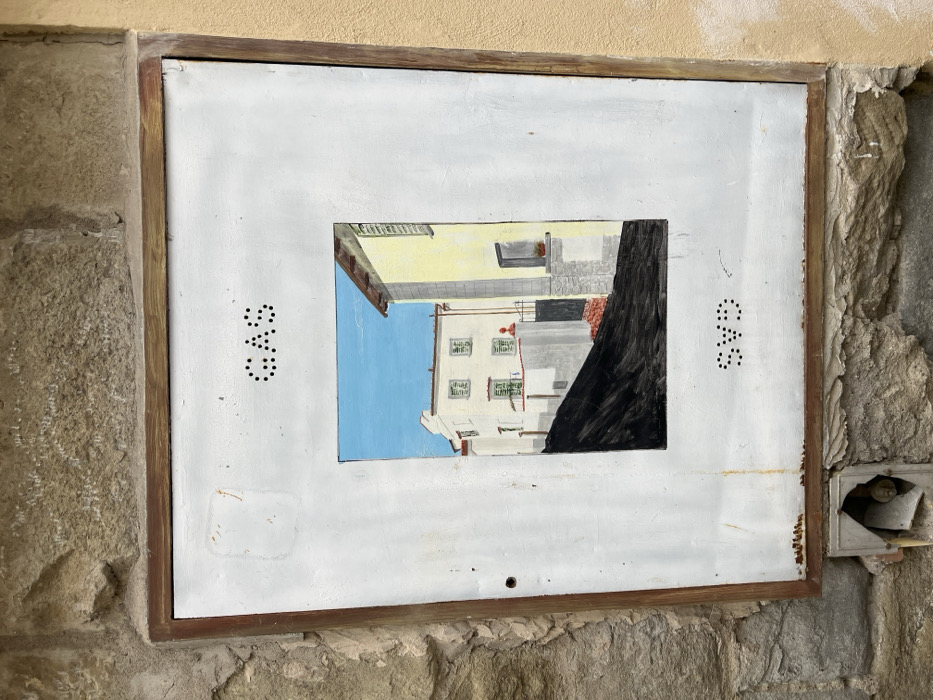
A white, rectangular metal utility access panel, framed by worn reddish-brown trim, is recessed into a building wall in Fiesole, Italy. The panel's front surface is painted with an urban street scene, depicting a narrow, upward-sloping road flanked by buildings under a clear blue sky. On the right side of the painted scene, a light yellow building with a single closed green shutter and a small window box containing a red plant is visible. On the left, a white multi-story building features several windows with light green shutters. A low white wall and a dark metal gate appear in the mid-ground. The street itself is painted in dark tones, with patches of reddish paving near the base of the yellow building. Above the painted scene, the word "GAS" is perforated into the metal panel; below the scene, "SVS" is similarly perforated. To the left of the utility panel, the building wall consists of large, roughly mortared stone blocks. To its right, the wall is finished with smooth, light tan stucco. Directly below the panel, integrated into the stone wall, is a small, damaged grey metal enclosure with broken components, consistent with a speaker or intercom unit. No people or animals are present in the image.
Fiesole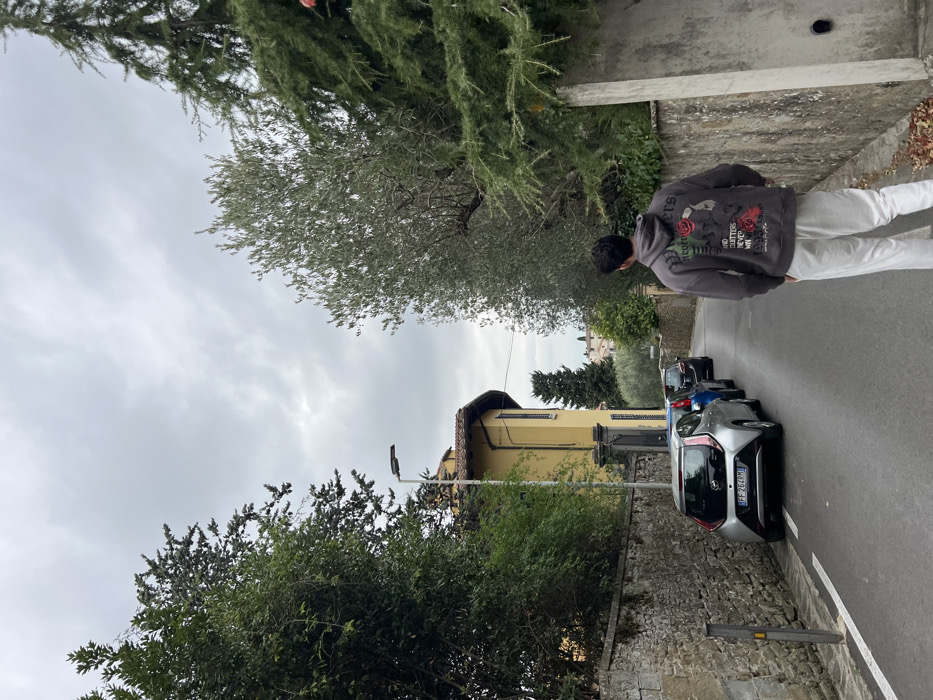
A male individual is observed from behind, walking down a narrow, paved road in Fiesole, Italy, under an overcast sky. He wears a dark gray hooded sweatshirt featuring a graphic design of roses, text, and a stylized face or skull on the back, paired with white pants. His hands are in his pockets. The asphalt road curves gently to the left and has a white line marking its left edge. Three cars are parked sequentially along the left side: a silver compact hatchback (license plate FF 264RM) closest to the viewer, followed by a blue compact car, and a darker vehicle further back. A stone wall, partially overgrown with green foliage, lines the left side of the road. Above this wall and behind the foliage, a two-story building with yellow stucco walls, dark window frames, and a tiled roof is visible. A streetlamp on a pole extends over the road near this building. On the right side, another stone wall supports a large olive tree and taller conifer-type trees. In the distant background, more buildings with red tiled roofs are visible on a hillside.
Fiesole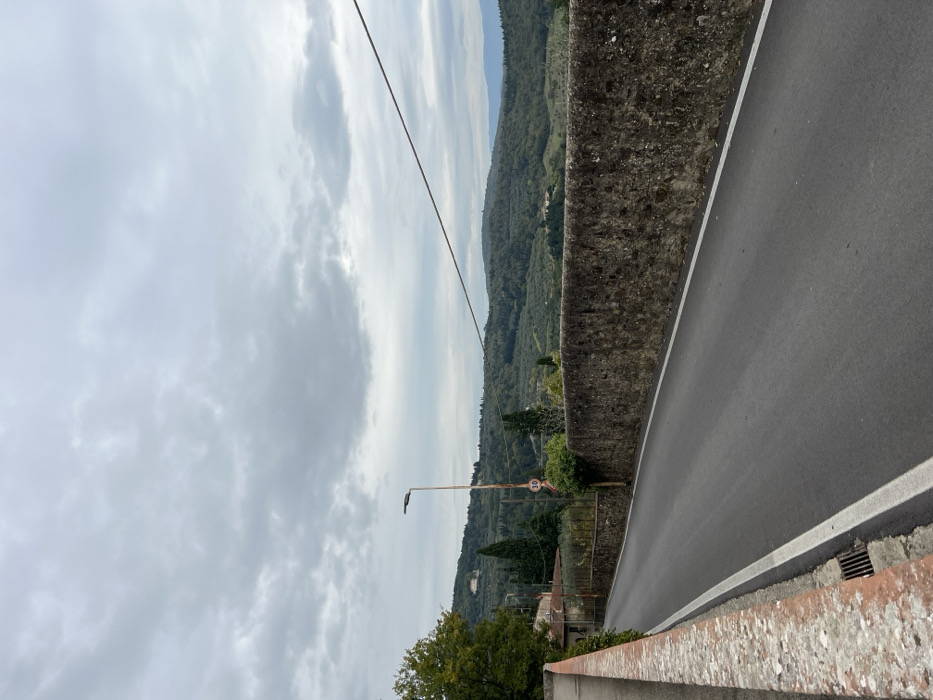
The image displays a panoramic view of a rural road in Fiesole, Italy, under an overcast sky. The asphalt road, dark gray, features a solid white line along its right edge and descends gently towards the left, where it begins a subtle curve. On the immediate left, a weathered reddish-brown stone or brick parapet acts as a retaining wall, with a metal grate drain visible at its base. Further left, green foliage and portions of residential structures are discernible. On the right side, a substantial dark gray, rough-hewn stone wall lines the road. Beyond this wall, a tall, light-colored streetlamp post is visible, with a circular speed limit sign showing "30" affixed below its head. A single utility cable extends diagonally across the upper right portion of the sky. The background consists of rolling green hills, densely covered with varied vegetation, including numerous trees and what appear to be olive groves, stretching into the distance under a uniformly gray, cloudy sky. No people or vehicles are present in the scene.
Fiesole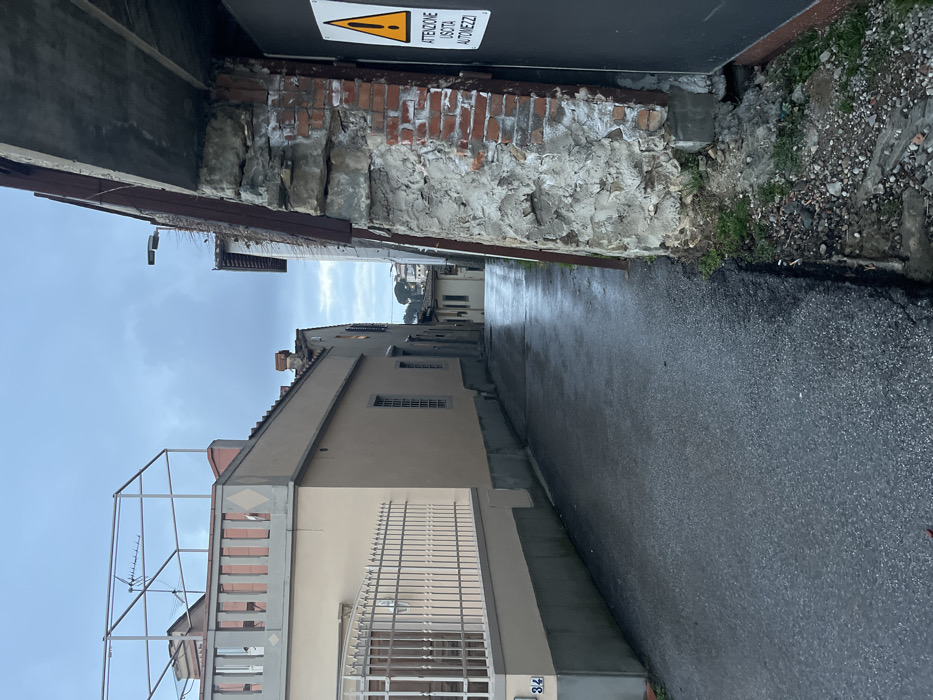
The image captures a narrow, wet alleyway or street in Fiesole, Italy, under an overcast sky. No people or specific activities are visible, presenting a quiet scene. On the left side of the alley, a building with a light-colored, possibly stucco, facade stands. It features windows with security grilles and a decorative balcony with a slatted railing. An antenna structure is visible on its rooftop. Near the base of this building, the number "34" is inscribed. The right side of the alley is bordered by an older, more rustic wall. This wall displays a mixture of materials, including exposed red brickwork in its upper section and rough, textured stone or plaster further down, with some overgrown vegetation peeking out. Above this wall, mounted against a dark surface, is a yellow warning sign with a black exclamation mark, containing Italian text: "ATTENZIONE USCITA AUTOMEZZI," which translates to "Attention, Vehicle Exit." The paved road surface is dark and visibly wet, suggesting recent rain or damp conditions. The diffuse light from the overcast sky illuminates the scene evenly. The alley extends into the distance, revealing more traditional-style buildings further down the street under the cloudy sky. The overall impression is that of an authentic European town lane on a subdued, possibly rainy, day.
Fiesole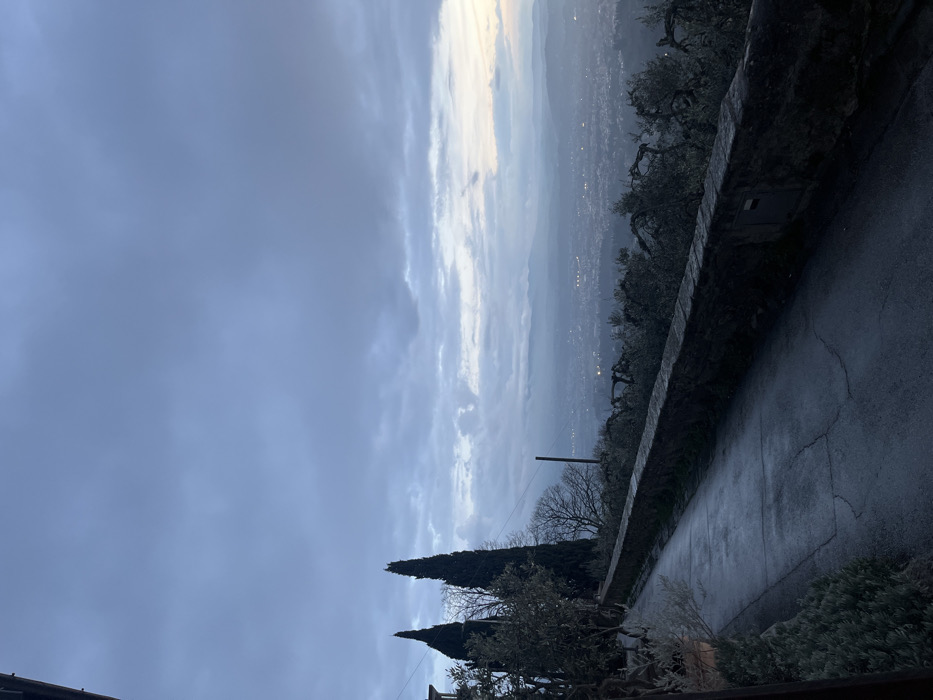
This media file presents a serene, elevated landscape view, likely captured from Fiesole, Italy, during late afternoon or early evening. The scene is dominated by a cool, muted color palette of blues, grays, and dark greens, suggesting either dusk or an overcast day. The sky occupies the upper portion of the image, displaying a vast expanse of blue-gray clouds with brighter, almost white, patches on the right where diffused light breaks through. In the mid-ground, a broad valley or plain stretches into the distance, dotted with numerous small, twinkling artificial lights that indicate a city or towns below. Faint outlines of distant hills or mountains are visible through a soft haze. The foreground on the right features a robust stone wall that borders a paved road. The road surface appears damp, suggesting recent rain or high humidity. Beyond the wall, several dark, gnarled olive trees with distinctive, twisted trunks are prominent. A wooden utility pole also stands near the wall. On the lower left side, dense, dark green trees, possibly cypresses, and various shrubs line the edge, contributing to the natural, somewhat rugged environment. The image conveys a quiet, contemplative atmosphere with no visible human activity or specific event taking place. The contrasting natural light of the sky with the artificial lights of the distant city, coupled with the damp road and ancient trees, evokes a sense of tranquil beauty at the end of the day. There is no visible text in the image.
Fiesole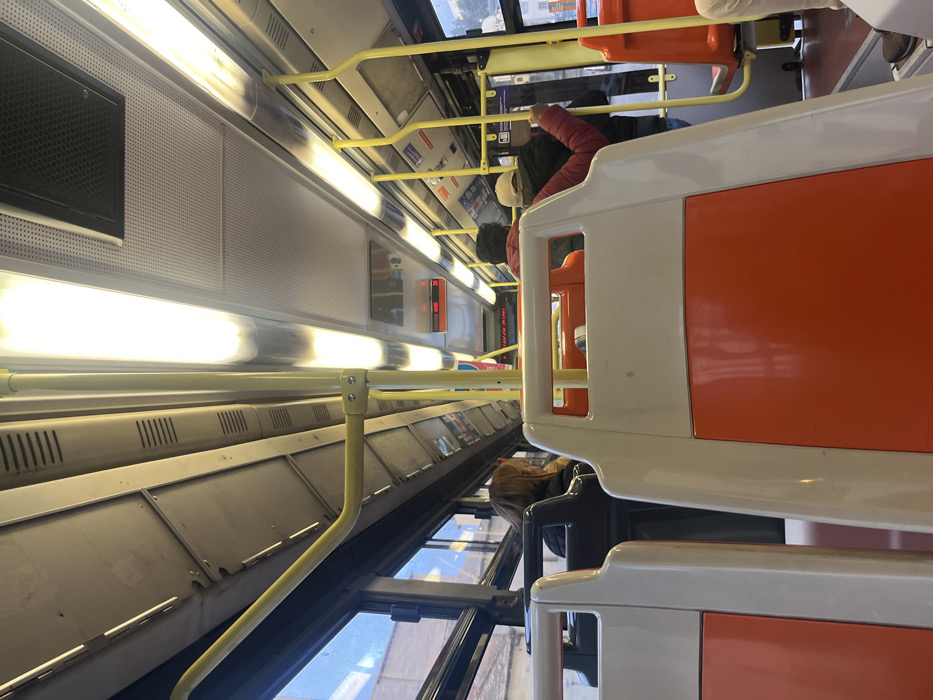
This image depicts the interior of a public transport vehicle, likely a bus or tram, viewed from a slightly elevated perspective looking down its length. The scene is brightly illuminated by numerous horizontal fluorescent light fixtures running along the ceiling. The primary subjects are the vehicle's interior and a few passengers. Distinctive orange and white molded plastic seats are visible, arranged along the side of the vehicle, with the backs of several seats appearing in the foreground. A network of bright yellow metal handrails and grab bars crisscrosses the interior, providing support for standing passengers. One individual, wearing a red jacket and a light-colored baseball cap, is visible standing further down the aisle, holding onto an overhead yellow handrail. Another person with dark hair is partially visible seated closer to the front. Through the large side windows, glimpses of what appear to be buildings and an urban or semi-urban landscape can be seen outside, consistent with the location context of Fiesole, Italy. The interior also features white perforated ceiling panels, side panels with ventilation grilles above the windows, and a black speaker or vent cover on the upper left side. In the distance, a digital display is partially visible, showing what appears to be a number, possibly "205," which could indicate a route number or destination. The activity taking place is routine public transportation, with passengers traveling inside the vehicle. The interior appears clean and functional, well-lit by both artificial light and ambient daylight. No specific emotions are discernible from the visible passengers, who appear to be engaged in standard commuting.
Fiesole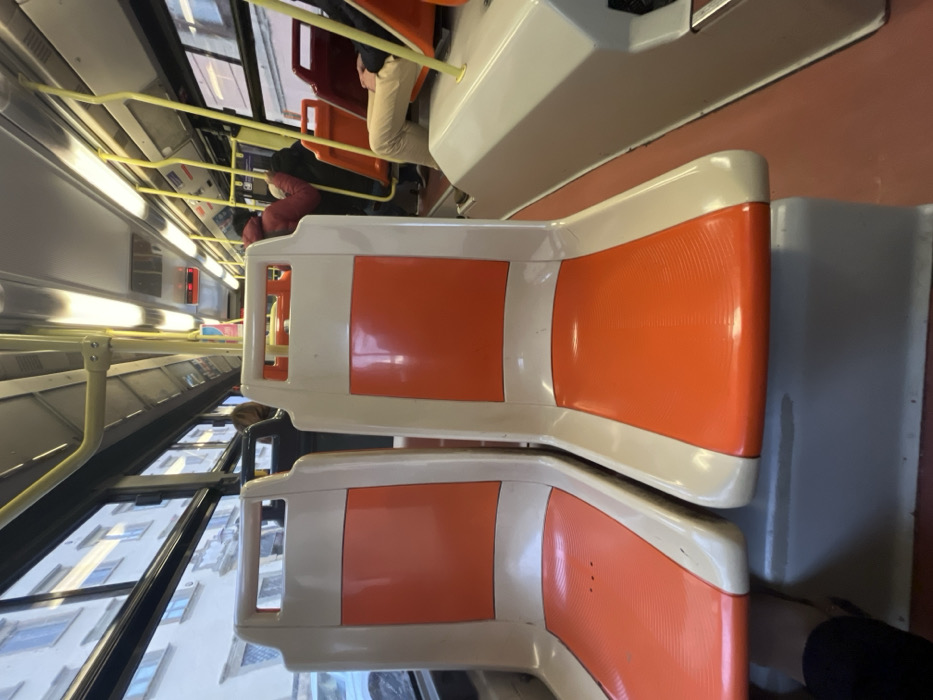
The image displays the interior of a public transport vehicle, likely a bus or tram, rotated 90 degrees clockwise. The perspective is low, looking forward along the aisle. Dominating the foreground and middle ground are multiple rows of plastic seats, characterized by bright orange, ribbed inserts set within off-white frames. Yellow handrails and grab bars run along the ceiling and above the windows. Overhead lights are illuminated, casting light across the interior. Through the windows, multi-story buildings with numerous windows are visible, indicating an urban or suburban environment consistent with European architecture, supporting the given location context of Fiesole, Italy. Several passengers are visible. In the mid-ground, a person wearing light-colored pants is seated in a red seat. Further down the aisle, another individual is seen wearing a dark jacket and a red hood, appearing to lean over. A dark bag is near this person. In the bottom right corner of the foreground, a person's hand is visible, resting near one of the seats. A red digital display or light is visible further down the aisle, but no legible text can be discerned. The time of day appears to be daytime, possibly overcast or late afternoon, given the combination of interior lighting and natural light outside.
Fiesole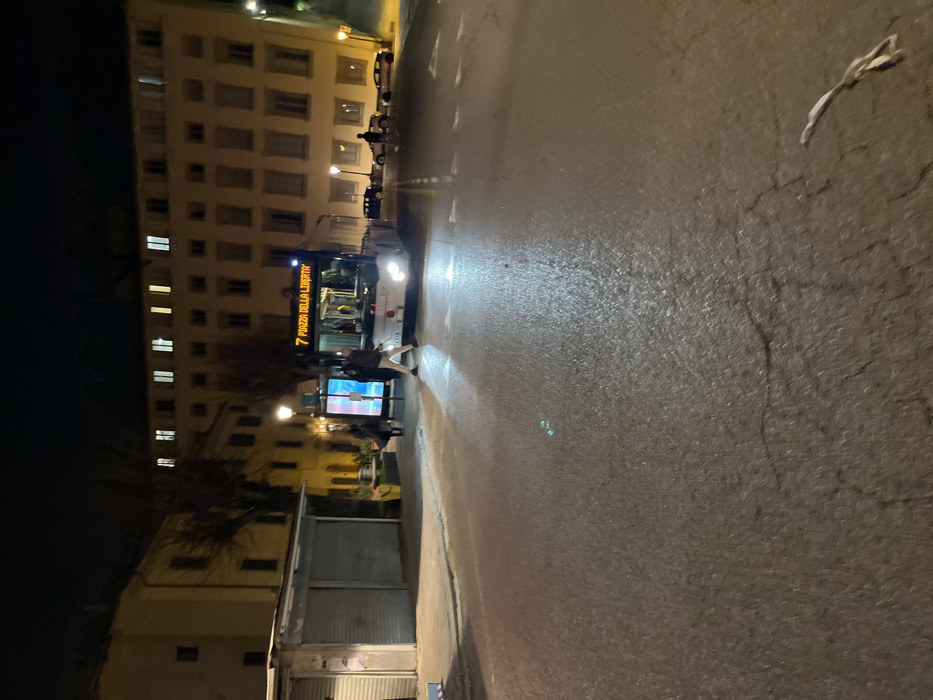
This nighttime street scene, viewed from a slightly elevated perspective, captures a public bus stopped at a bus stop on a paved road. The bus, predominantly white, has its bright headlights illuminated, casting a strong light onto the wet or reflective asphalt road surface. Its front digital display clearly shows "7" as the line number and "PIAZZA DELLA LIBERTA'" as its destination. Several people are gathered near the bus. One individual wearing a light-colored jacket stands prominently near the bus door, appearing to wait or board. Other figures are visible at a bus shelter, which features an illuminated advertisement panel. In the background, across the street, a multi-story building with numerous windows, some brightly lit, dominates the view. Further down the road, streetlights cast a warm glow, and what appear to be parked cars and other pedestrians can be seen. The road surface shows reflections from the lights and some visible cracks, indicating wear. On the sidewalk in the foreground, there are some low-lying structures or closed kiosks, and behind the bus stop, bare trees are discernible. The overall atmosphere is characteristic of an urban setting after dark, with artificial lights providing illumination. The visible text and provided location context of Fiesole, Italy, suggest this is a public transport service, likely connecting Fiesole to Piazza della Libertà in Florence.
Fiesole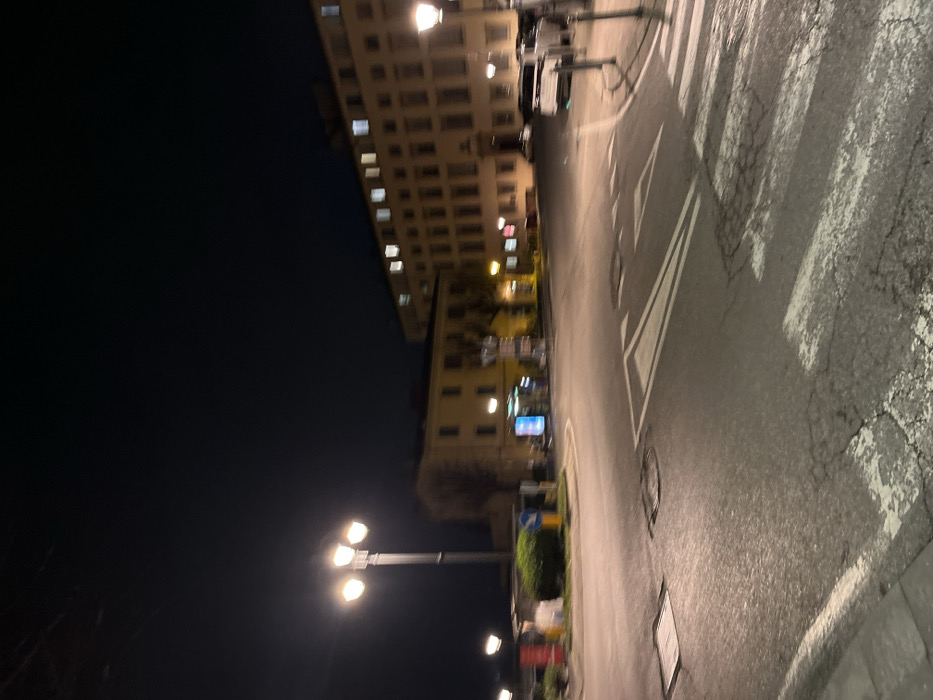
The image captures a quiet street scene at night in Fiesole, Italy. The view is dominated by a paved road on the right, illuminated by artificial light, and a dark night sky on the left. Multi-story buildings with numerous windows, some of which are lit, line the right side of the street, suggesting residential or commercial activity, though the street itself appears deserted. The architecture features multiple rectangular windows and a generally uniform facade. The street features clear white road markings, including a crosswalk, double solid lines, and a triangular yield or stop marking. The asphalt shows signs of wear and cracking. Several streetlights are visible, with a prominent three-globe lamp positioned on the left edge of the road, casting bright, warm light. Other streetlights extend into the background, illuminating segments of the street and buildings. A small median strip with some vegetation and a blue circular sign with a white arrow is also present on the street. A few dark shapes suggesting parked cars are dimly visible along the curb. Two manhole covers are discernible on the road surface. No people or active events are visible, emphasizing the stillness and quiet of the night. The time of day is clearly night, with a dark, clear sky. The scene conveys a sense of peaceful solitude in a European urban environment. No legible text is visible.
Fiesole
The image presents a dimly lit, weathered stone or masonry wall, indicative of an ancient building or structure. The wall is constructed from light-colored, irregular blocks, showing textures and variations characteristic of age. Running horizontally across the mid-section of the wall is a dark, thin line, possibly an exposed pipe, cable, or conduit. Above this line, slightly to the left of the center, a rectangular opening or vent is carved into the stonework. Further up and to the right, another smaller, square-shaped detail, which could be a vent or a decorative element, displays a repeating four-leaf clover-like pattern. At the bottom of the frame, a broader, multi-tiered horizontal structure made of similar stone material is visible, suggesting a lower part of the building, a roof, or an adjacent platform. The far-right edge of the image reveals dark, possibly metal, vertical and horizontal elements that could be utility poles, structural supports, or wiring. The scene is captured in very low light, strongly suggesting it is nighttime or heavily shadowed, with only ambient light illuminating the surfaces. No individuals, animals, or specific activities are visible. The architectural style and stone masonry are consistent with historical buildings found in Europe, aligning with the provided location context of Fiesole, Italy. No visible text is present in the image.
Fiesole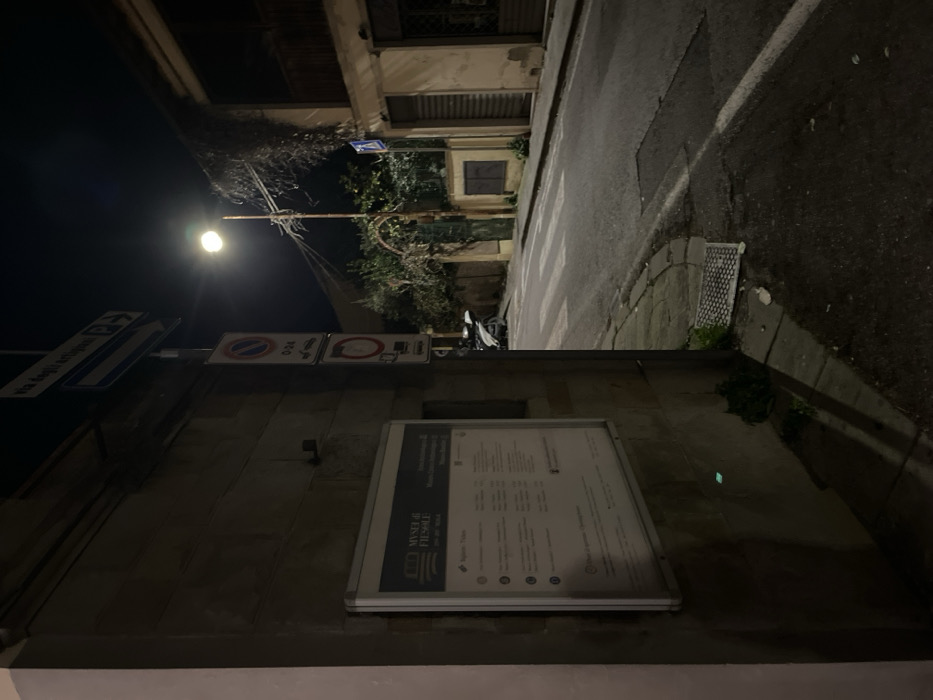
The image, captured at night, displays a quiet street scene in Fiesole, Italy, illuminated primarily by a bright streetlight. The perspective is rotated 90 degrees counter-clockwise. In the foreground, a stone wall features a large, rectangular, illuminated display board. Clearly visible text on this board includes "MUSEI DI FIESOLE" (Museums of Fiesole) and sections like "Orari - Tariffe" (Hours - Tariffs), accompanied by various informational icons suggesting details about opening times, ticket prices, and accessibility. Above the display board, several street signs are mounted on a pole. A blue rectangular sign reads "VIA degli Artigiani P", indicating a street name and possibly parking. Adjacent to it are two circular regulatory signs: one displaying "0-24" (likely signifying 24-hour restrictions), and another red circular sign with a diagonal line, typically indicating 'no parking' or 'no stopping'. The paved street runs from the middle right to the background, featuring a marked pedestrian crossing (zebra stripes) further down. A small scooter or motorcycle is parked on the side of the road near the curb. Old, light-colored buildings with traditional shutters line the street, hinting at the historic character of the town. Sparse vegetation, including some bare trees and shrubs, is visible along the street and against the buildings. A metal grate drain is visible on the sidewalk. The dark sky confirms it is nighttime, and no people are present, lending a tranquil atmosphere to the scene.
Fiesole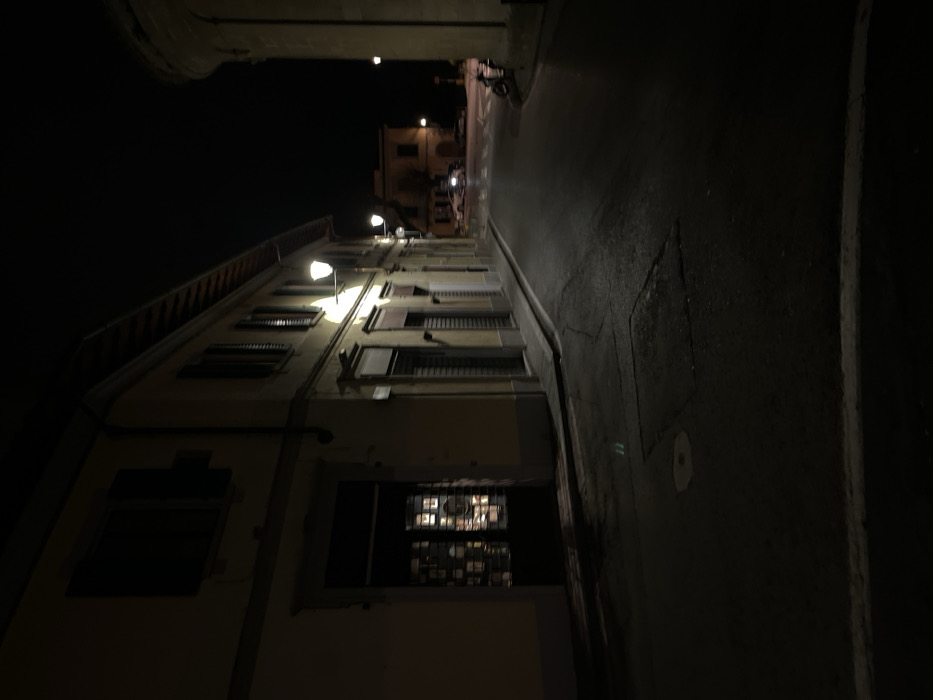
This media file depicts a dimly lit, narrow street or alleyway in Fiesole, Italy, at night. The scene is quiet and devoid of people or apparent activity. On the left side of the frame, a multi-story building with a light-colored facade stands, illuminated by several wall-mounted streetlights. Its multiple windows feature dark shutters, some closed and some partially open. A ground-floor window displays interior lights and is covered by a metal grate, while another window higher up also shows light from within. Directly above the building, a dark, possibly covered, structure is visible, suggesting an architectural feature or another part of an adjacent building. To the right, a dark, textured wall, possibly of stone or concrete, runs parallel to the street. The asphalt street itself is dark, appearing slightly reflective in areas and showing some cracks in the pavement. Further down the street, in the distance, another building with illuminated windows can be seen, and a faint outline of a two-wheeled vehicle, possibly a bicycle or motorcycle, is discernable against the dark background. The time of day is clearly night, with the primary illumination provided by artificial streetlights and interior building lights, creating deep shadows and highlights. The overall atmosphere is one of peaceful solitude. No discernible text is visible anywhere in the image.
Fiesole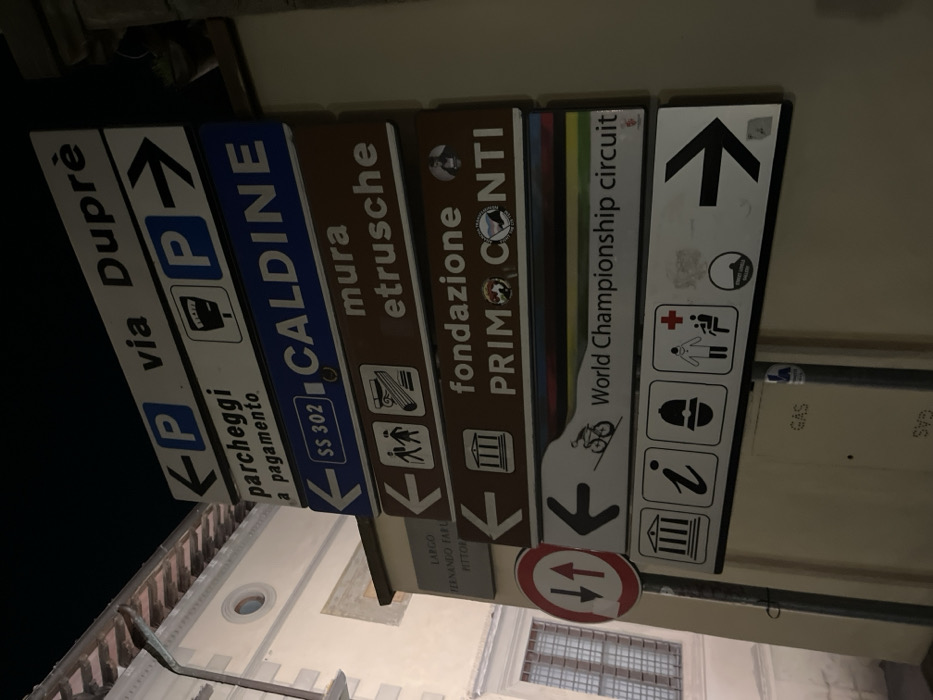
The media file displays a stack of vertically oriented road signs, illuminated at night, likely in Fiesole, Italy. The image is rotated 90 degrees clockwise. The main subjects are numerous directional signs attached to a pole or wall, set against a dark sky on the left and a building facade on the right. The building shows architectural details like a patterned cornice and a small, round window (oculus). No direct activity is taking place; the signs serve to guide travelers. The time of day is night, indicated by the dark sky and artificial lighting on the signs and building. Visible text and notable details on the signs include: - A white sign for "P via Duprè" with a right arrow. - Another white sign showing a "P" (parking) symbol, a right arrow, and a symbol resembling a wallet or payment card reader. - A white sign for "parcheggi a pagamento" (paid parking) with a left arrow and "P" symbol. - A blue sign indicating "SS 302 CALDINE" with a left arrow. - A brown sign pointing to "mura etrusche" (Etruscan walls) with a left arrow and a symbol of steps or a ramp. - Another brown sign for "fondazione PRIMO CONTI" (Primo Conti Foundation) with a left arrow and a building/museum symbol. Below these brown signs, partially visible text reads "LARGO FERNANDO FARU PITTOR." - A colorful sign with a bicycle symbol indicating a "World Championship circuit" with a downward arrow. - A stack of white signs on the far right, from top to bottom: an upward arrow, a water fountain symbol, a red cross with a person (medical assistance/first aid), a hard hat/helmet symbol, an "i" for information, and a building/museum symbol. - A round red traffic sign with two vertical black arrows, typically indicating two-way traffic, is visible below the colorful sign. - On a utility box or panel on the far right, "GAS" and "SVS" are partially visible.
Fiesole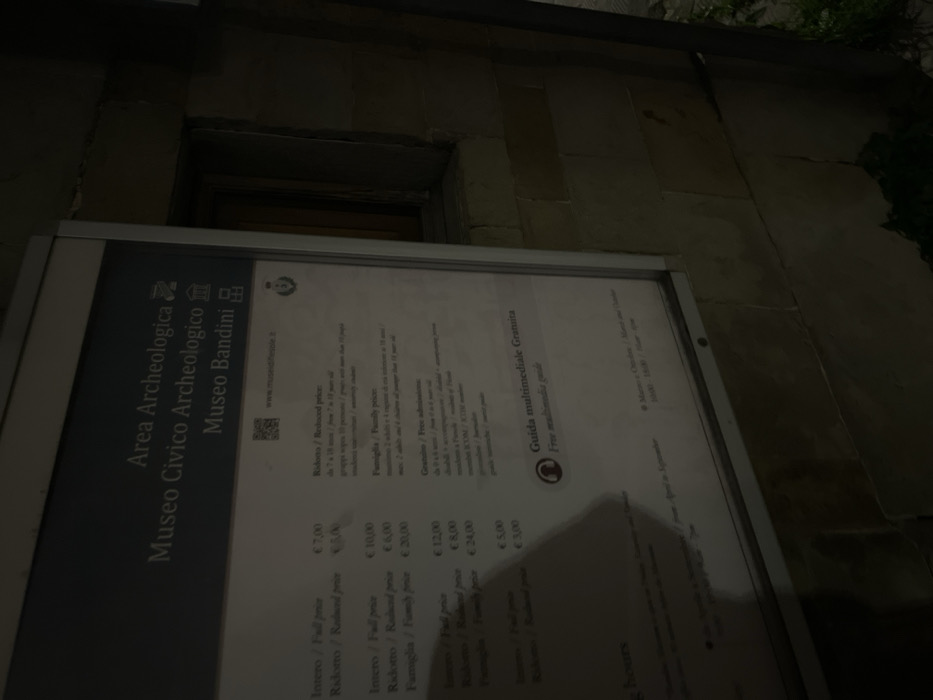
The image captures a vertically oriented view of a museum information sign illuminated at night, set against the rough stone wall of a building in Fiesole, Italy. The scene is dark, suggesting late evening or nighttime, with minimal ambient light. The primary subject is a large, rectangular display case containing information about local museums. Visible text on the sign indicates "Area Archeologica," "Museo Civico Archeologico," and "Museo Bandini," along with the website "www.museidifesole.it" and a QR code. The sign provides detailed pricing for various ticket types in both Italian and English: "Intero / Full price" at €7, €10, €12, €5; "Ridotto / Reduced price" at €5, €6, €8, €3; and "Famiglia / Family price" at €20, €24. It specifies criteria for reduced prices (e.g., ages 7 to 18, over 65, groups of 10+) and family tickets, as well as categories for "Gratuito / Free admissions" (e.g., under 7, disabled persons, journalists). The sign also advertises a "Guida multimediale Gratuita / Free multimedia guide." Partial opening hours, "10:00 - 18:00," are visible at the bottom right. The background consists of an old, textured stone wall, likely part of a historic building. A dark, recessed window or opening is visible in the upper left portion of the wall, above the sign. No people or activities are explicitly depicted, focusing solely on the static informational display. The overall impression is one of quietude and historical context, typical of a cultural site.
Fiesole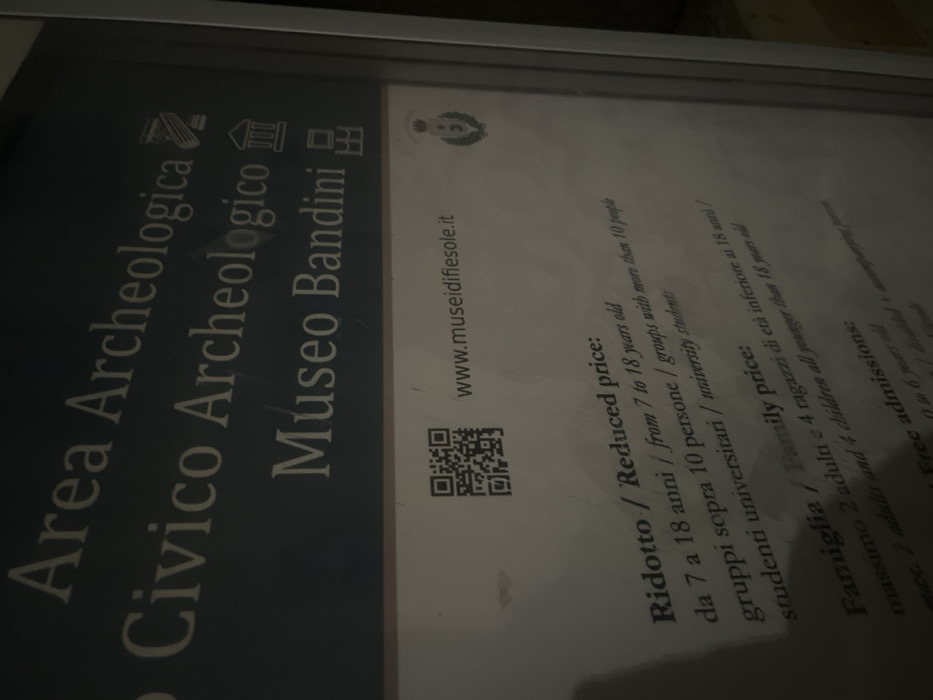
The media file displays an informational sign, likely situated at the entrance of a museum or archaeological site in Fiesole, Italy. No people or specific activities are visible. The sign, set against a dark, indistinct background, is presented diagonally, suggesting it was photographed from an angle or rotated. The lighting is somewhat dim, with reflections on the sign's surface. Visible text on the sign indicates: * "Area Archeologica" (Archaeological Area) * "Civico Archeologico" (Civic Archaeological) * "Museo Bandini" (Bandini Museum) * The website "www.museidifiesole.it" with a QR code below it. * Pricing information in Italian and English: * "Ridotto / Reduced price:" for "da 7 a 18 anni / from 7 to 18 years old," "gruppi sopra 10 persone / groups with more than 10 people," and "studenti universitari / university students." * "Famiglia / Family price:" for "massimo 2 adulti e 4 ragazzi di età inferiore ai 18 anni / max. 2 adults and 4 children all younger than 18 years old." * "Free admissions:" for "0 to 6 years old."
Fiesole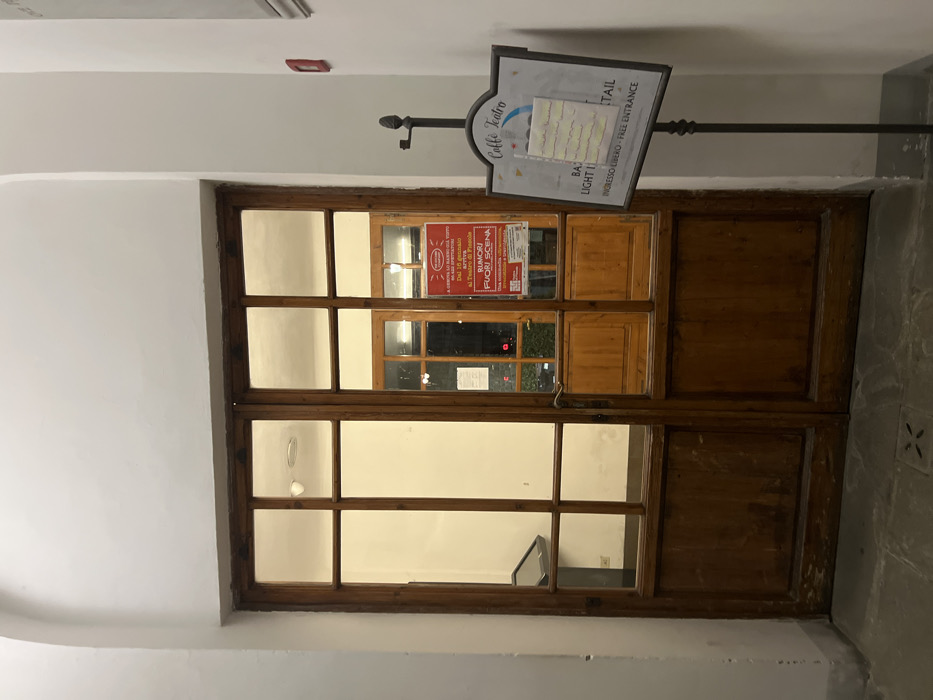
This image depicts the entrance to a building, likely a café or bar associated with a theatre, situated in Fiesole, Italy. The setting appears to be an indoor or covered corridor with light-colored walls and a stone or concrete floor. The main subject is a substantial wooden double door, featuring numerous rectangular glass panes that allow a view into a brightly lit interior. The lighting inside suggests it is evening or night outside, with reflections on the glass hinting at streetlights or external activity. Through the lower-right pane, a dark object, possibly a piece of furniture, is partially visible. To the right of the door, a dark metal stand holds a white rectangular sign. The sign prominently displays "Caffè Teatro" at the top, followed by "BAR LIGHT COCKTAIL" and "INGRESSO LIBERO - FREE ENTRANCE" (Free Entrance). A red poster is affixed to one of the upper glass panes of the door. This poster advertises an event, stating: "Dal 16 gennaio arriva al Teatro di Fiesole RUMORI FUORI SCENA," which translates to "From January 16th, 'Noises Off Stage' arrives at the Fiesole Theatre." The visible text and the overall appearance suggest an inviting entrance to a cultural venue, combining a café/bar service with theatrical performances, active during the evening hours.
Fiesole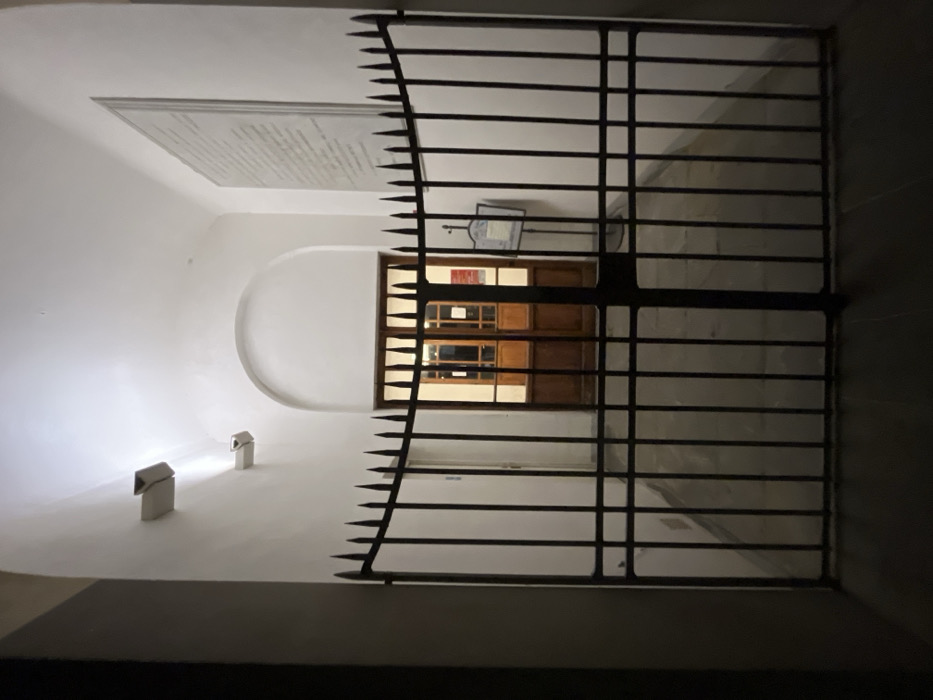
The image, when viewed upright, depicts a perspective looking through a large, closed, black wrought-iron gate into a brightly lit, white-walled hallway. The gate dominates the foreground, featuring a grid of horizontal and vertical bars, with the top edge adorned by numerous sharp, pointed spikes. Beyond the gate, a pristine white corridor stretches into the distance. On the lower left wall of the hallway, two modern-looking wall-mounted lights cast upward glows. An elegant arched alcove is carved into the left wall. The floor visible through the gate bars appears to be light-colored stone or tile. At the far end of the hallway, a wooden double door with multiple glass panes is visible, emitting a warm, inviting light from the room beyond. Above and to the left of these doors, a small, framed sign is mounted on the wall, though its text is illegible. High on the left wall (which would be the ceiling if the image were properly oriented), a large, rectangular white plaque is affixed, bearing several lines of faint, inscribed text that is too indistinct to read but suggests historical or commemorative content. No people are present, and no particular activity is taking place. The scene, illuminated exclusively by artificial light, indicates that it is likely evening or night. The architectural style, including the robust gate, arched features, and historical plaque, aligns with the context of an old European building, such as those found in Fiesole, Italy. The overall impression is one of secure yet accessible institutional or historical premises.
Fiesole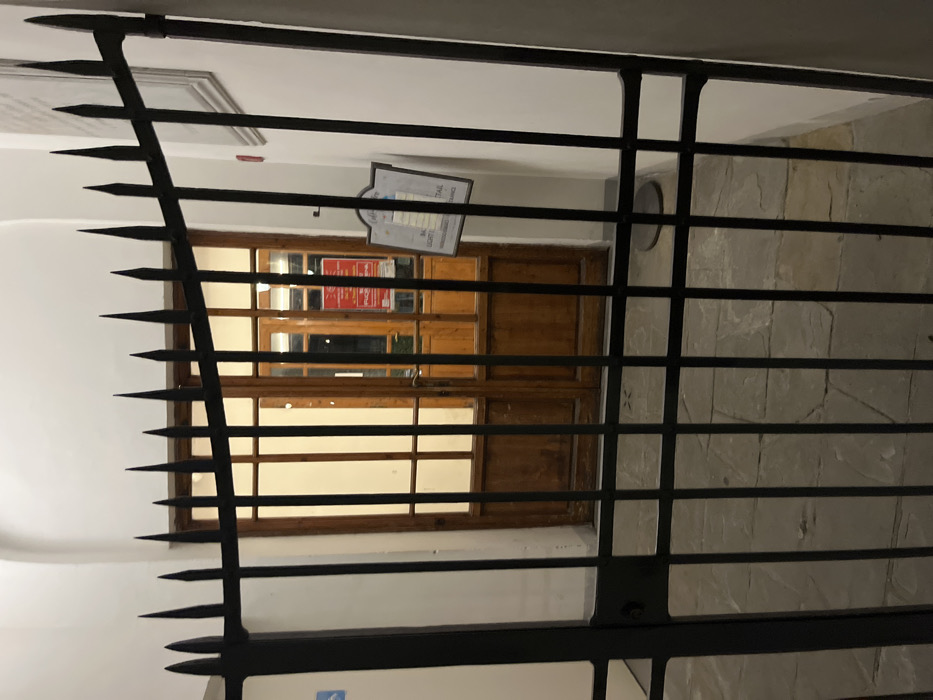
The image, rotated counter-clockwise, presents an indoor scene viewed through a black metal gate. The gate features sturdy horizontal bars and a decorative section with vertical, pointed spikes, suggesting a barrier or security measure. Beyond the gate, a pair of wooden double doors with numerous glass panels is visible, acting as an entrance. On the glass panels of these doors, several red notices or posters are affixed. One of these notices clearly displays the Italian word "AVVISO," meaning "NOTICE." The text on the other red notices is indistinguishable. To the left of the wooden doors, on a light-colored wall, a sign is hanging. Portions of the sign are obscured by the gate, but the text "MUNICIPAL COUNCIL" is clearly visible. Below this, the words "BAD LIGHTS" can be read, followed by several lines that appear to be for additional information or a directory. The immediate surroundings include light-colored walls and a floor with a patterned, possibly stone or tiled, surface. To the right of the wooden doors, a wall with a distinct stone texture is also visible. No individuals are present, and no activity is occurring in the static scene. The environment suggests an institutional or public building, consistent with the "MUNICIPAL COUNCIL" sign. The lighting indicates an indoor setting, likely illuminated by artificial light. The location context provided places this scene in Fiesole, Italy.
Fiesole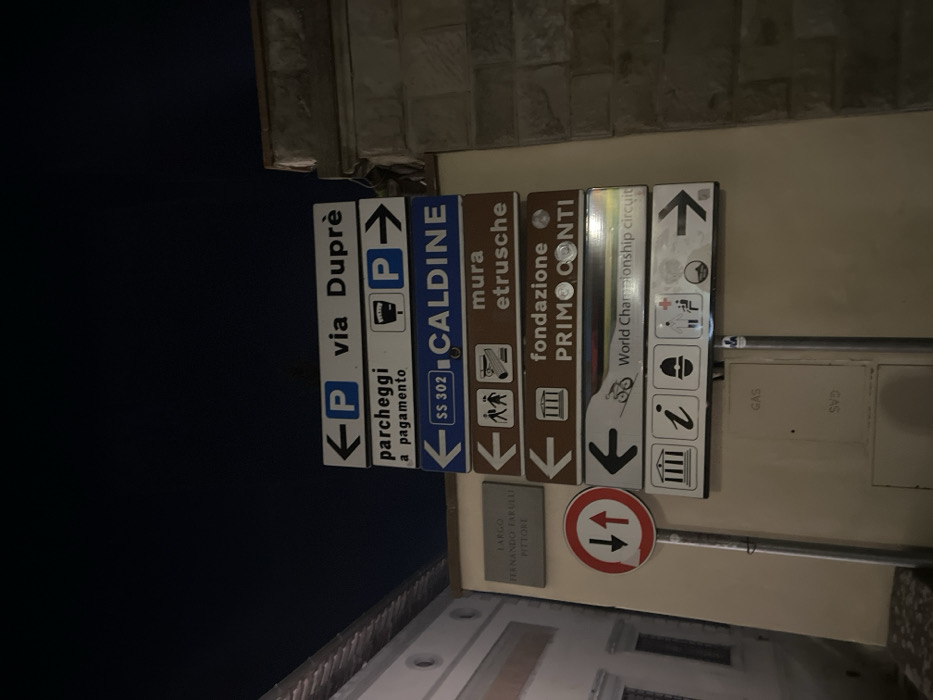
The image shows a series of stacked directional road signs mounted on a pole or wall, set against a dark background, suggesting nighttime. The signs are artificially lit, casting light on the adjacent building wall. The signs, primarily in Italian, guide visitors to various locations. From left to right (as the image is rotated), a white sign points left to "P via Duprè" and another indicates "P parcheggi a pagamento" (paid parking), also pointing left. A blue sign directs to "SS 302 CALDINE," with an arrow pointing left. Further signs, in brown, point right to "mura etrusche" (Etruscan walls) and left to "fondazione PRIMO CONTI" (Primo Conti Foundation). A white sign with a bicycle icon indicates "World Championship circuit" with a downward arrow. Additional white signs feature icons for a hospital/first aid, general information, and a historical building, with arrows pointing right, right, and downwards, respectively. Below the main cluster of signs, a metal plaque is affixed to the wall, bearing the inscription "LARGO FERNANDO FARULLI PITTORE." A red circular sign with two opposing arrows, indicating two-way traffic, is also visible. On the beige building wall, a utility box labeled "GAS" is present. The overall scene suggests an urban or town setting, likely in Fiesole, Italy, given the location context.
Fiesole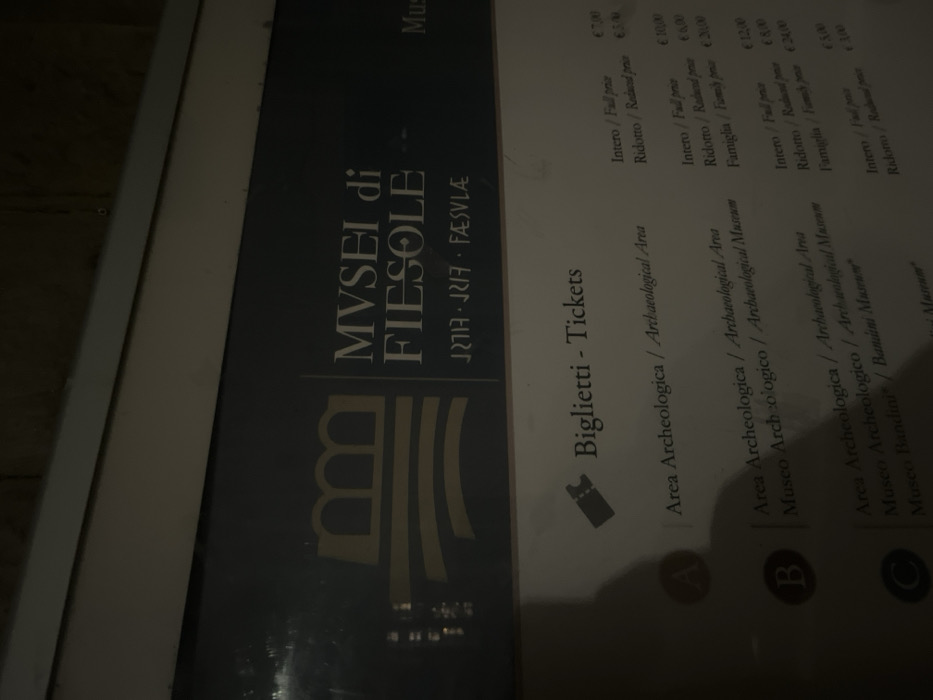
The image displays a dark blue sign or poster, likely illuminated, detailing information about the "MVSEI di FIESOLE" (Museums of Fiesole). The setting appears to be nighttime or an indoor space with artificial lighting, as the background is dark and the sign stands out. The main subject of the sign is a list of "Biglietti - Tickets" for various archaeological areas and museums in Fiesole. The visible text includes: * "MVSEI di FIESOLE" with what appears to be historical dates or stylistic elements "1217-1217 FÆSVLÆ" (referencing Faesulae, the ancient name for Fiesole). * A stylized logo resembling an 'm' or a multi-layered building is on the left side of the sign. * Ticket categories are listed with corresponding prices in Euros: * "Area Archeologica / Archaeological Area": Intero (Full price) €7.00, Ridotto (Reduced price) €5.00. * "Area Archeologica / Archaeological Area Museo Archeologico / Archaeological Museum": Intero €10.00, Ridotto €8.00, Famiglia (Family price) €20.00. * Another combination of "Area Archeologica / Archaeological Area Museo Archeologico / Archaeological Museum" with slightly different prices: Intero €12.00, Ridotto €8.00, Famiglia €24.00. * "Area Archeologica / Archaeological Area Museo Archeologico / Archaeological Museum Museo Bandini / Bandini Museum": Intero €5.00, Ridotto €3.00. The sign is a practical guide for visitors, detailing access and pricing for the cultural sites in Fiesole. The slightly angled perspective suggests it's a photograph of an informational board or kiosk.
Fiesole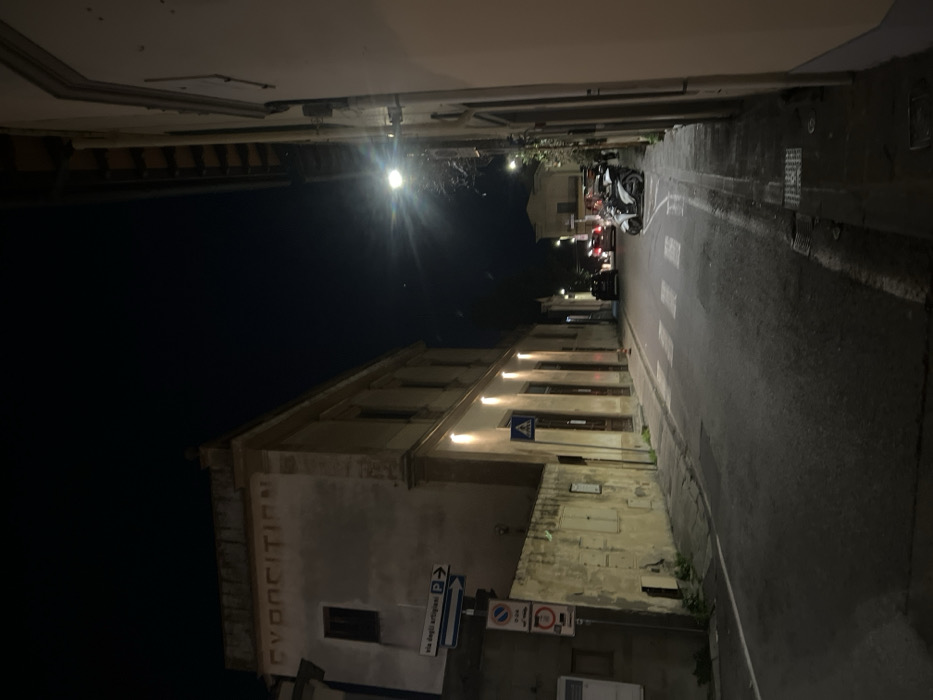
A nighttime street scene in Fiesole, Italy, shows a narrow, quiet street illuminated by artificial lights. The image is taken from a perspective looking down the street, with buildings flanking both sides and a dark sky above. On the left, a multi-story building with a light-colored facade is prominent. The word "EXPOSITION" is painted vertically on its side. Warm, upward-facing lights illuminate the building's facade and several windows on its upper floors. A blue triangular sign, likely indicating a pedestrian crossing, is mounted on this building. The paved street occupies the right side of the frame, featuring white road markings that include a solid line and dashed lines, possibly for a pedestrian crossing. Several motorcycles or scooters are parked along the right curb, and further down the street, the red tail lights of vehicles are visible. A bright streetlight in the mid-ground emits a strong, starburst-like glare. Various Italian road signs are visible on the left side of the street near the building. These include a blue rectangular sign with an arrow pointing right, bearing the text "Via degli Artigiani" and a "P" (parking symbol). Below it are two circular signs: one red with a white horizontal bar (likely a no-entry or restricted access sign) and another with the word "STOP" in red. The dark sky suggests clear weather, possibly with a few faint stars. The scene conveys a calm and serene atmosphere typical of a European town after dusk.
Fiesole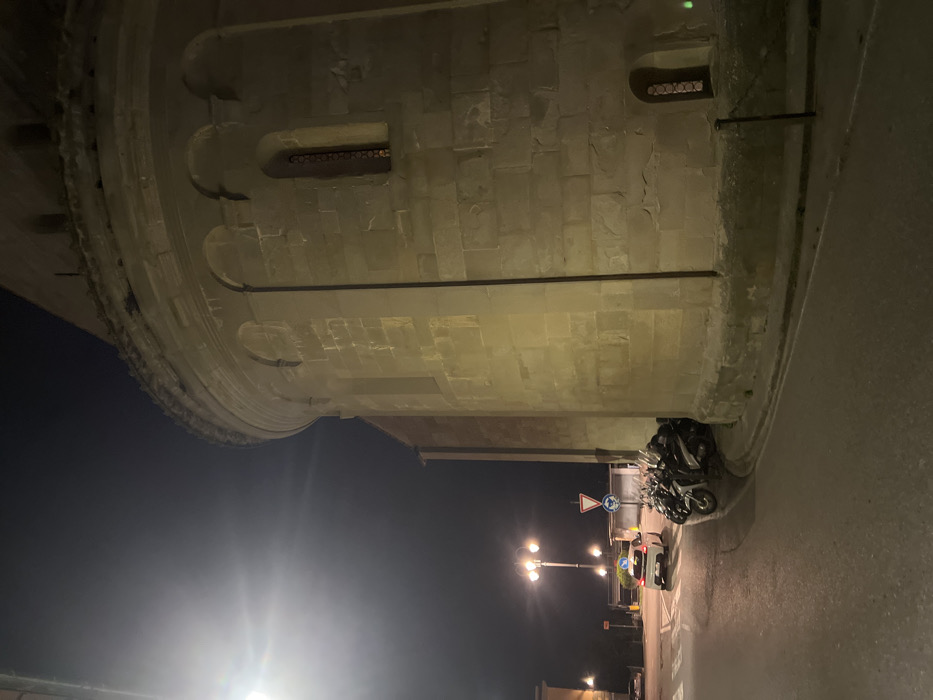
The nighttime image captures a historic stone building or archway in Fiesole, Italy, illuminated by streetlights. The dominant subject is the massive, light-colored stone structure, which shows signs of age and wear with its textured blocks and rounded architectural elements. Visible in the upper part are arched recesses and small, rectangular windows fitted with grates or decorative patterns. A flat, solid section of the structure forms the base of this wall. Below the stone structure, a street scene unfolds at night. The asphalt road appears reflective, possibly from recent rain or the glare of lights. On the right side of the road, a white car is partially visible, either parked or driving away, and a cluster of motorcycles or scooters is parked tightly against the base of the stone wall. Several streetlights emit a warm, bright glow, with one particularly intense light source in the lower left corner creating a distinct lens flare. Road signs, including a white triangular yield sign with a red border and a blue circular sign, are visible near the vehicles. The sky is dark, confirming the nighttime setting. There are no people visible in the image.
Fiesole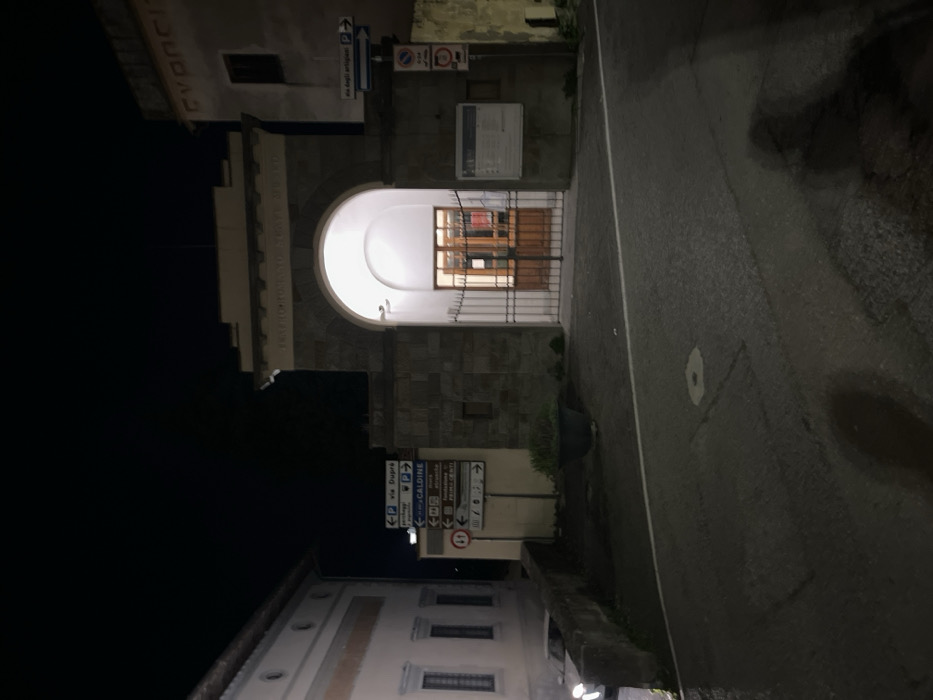
A nighttime view captures a quiet street scene in Fiesole, Italy, centered around an illuminated stone archway. The arch, likely part of an ancient structure or city gate, is constructed from grey stone blocks and emits a soft, bright light from within. Through the arch, a wooden door secured by a metal gate is visible. Above the arch, carved into the stone, is the text "PIEVE DI SAN FRANCESCO," indicating a church or historical site. Higher up on the building to the left, partial text "EVANGELISTI" can be discerned. To the right of the arch, an asphalt road stretches into the distance, appearing wet with visible reflections, suggesting recent rainfall. A faint white line marks the edge of the road, and patches of repair or uneven surfaces are scattered across it. Multiple blue and white street signs are mounted on poles to the left and right of the arch. The signs indicate directions and destinations, including "P Via degli Arcipreti" (arrow right), "P Via Dupre" (arrow left), "P CALDINE" (arrow right), "P FIRENZE CENTRO" (arrow right), and "P FALCIANO" (arrow right). A red circular sign below the main cluster displays "6 t," likely indicating a 6-ton weight restriction. An information board with unreadable text is affixed to the wall to the right of the arch. A dark potted plant sits at the base of the arch on the right. Buildings are partially visible on either side of the archway; one at the top left shows a window and the "EVANGELISTI" text, while another at the bottom left features multiple small, barred windows. No people are present, lending a serene and historic atmosphere to the dark, damp scene.
Fiesole
The image presents a view through a perforated screen, which dominates the foreground and creates a highly pixelated and abstract perception of the background. The screen consists of dark, vertical bars separating panels covered in a uniform pattern of small, opaque white dots on a black surface, allowing light and blurred shapes to pass through. Behind this visual filter, an interior space is dimly discernible. In the central-left area, a rectangular object is visible, appearing as a light-colored outline (possibly golden or yellowish) around a darker inner section, suggesting a framed display, a screen, or artwork. Directly below this rectangle, a distinct blue, somewhat rounded or rectangular shape can be observed. The surrounding background features further indistinct shapes and forms, primarily in warm, muted tones of yellow, brown, and hints of darker areas, indicative of furniture, walls, or other architectural elements within the room. The scene depicts a static, obscured view of an interior, possibly a public space, gallery, or a room with modern architectural features. No specific activity is taking place, and no individuals are clearly visible. The lighting appears to be ambient indoor illumination. There is no visible text. While the image itself does not provide specific location cues, it is contextualized as being in Fiesole, Italy.
Fiesole
The media file presents a dark, blurry, and tilted nocturnal view of architectural structures. The low light and significant motion blur make details indistinct. On the left side of the frame, a substantial building, possibly made of light-colored stone or masonry, rises against a dark night sky. Despite the blur, architectural features such as layered sections, ledges, and what appears to be a small, dark, rectangular opening or window are vaguely visible in the upper part of this structure. Its silhouette is irregular, suggesting a roofline or upper stories. The right side of the image is occupied by a large, flat, lighter-toned wall, likely part of another building, extending from the top to the bottom of the frame. This wall is largely featureless due to the blur and darkness. The ground level or immediate foreground also shows indistinct blurred architectural elements. The scene is captured at night, with the sky appearing uniformly dark. No specific weather conditions can be determined. There are no people visible, nor any discernible activities taking place. The overall impression is static, though the camera's movement or a long exposure contributes to the strong blur effect. No text is visible anywhere in the image. The stone construction of the building on the left hints at historical European architecture, aligning with the specified location context of Fiesole, Italy.
Fiesole
This image captures the interior of what appears to be a cafe or small eatery in Fiesole, Italy. The scene is static, showing an arrangement of furniture and a display area, possibly during quiet hours. In the foreground and midground, several tables and chairs are visible. Some chairs feature dark frames with distinctive circular cushions in a bright chartreuse or lime green color, while others are simpler dark wooden chairs. A tall, dark-framed bar stool with a circular base is prominent on the right side. On the floor nearby, a light-colored wooden crate is present, displaying faint, unreadable text. The floor features a pattern of light and dark grey checkered tiles, which transitions into a plain light grey section. Shadows cast by the furniture are visible on the tiled floor. In the background, a long counter or display case extends across the width of the room. Behind its glass, various items, likely food products such as pastries or packaged goods, are arranged. A person wearing a white top, possibly a staff uniform, is partially visible behind the counter. The overall lighting is artificial and somewhat subdued, contributing to a calm atmosphere. A large, light-colored vertical beam or wall element occupies the left side of the frame, with reflections of stacked items visible beyond it. A green plant in a pot is barely visible in the bottom left corner. No discernible activity is taking place. Apart from the faint text on the crate, no other text is clearly legible, including on a partially visible sign at the very bottom left.
Fiesole
The image presents a nighttime scene of a quiet street in Fiesole, Italy. The photograph is oriented vertically, but upon rotation to a horizontal perspective, it depicts a paved road on the right and a row of buildings with an adjacent sidewalk or pedestrian area on the left. On the left side of the street, several traditional, light-colored buildings (possibly cream or yellow) stand illuminated, with windows reflecting ambient light. One building, towards the top-left, has faint, blurry text on its facade, possibly indicating a shop name like "gelateria" or a similar establishment. In front of these buildings, an outdoor seating area is visible, furnished with numerous tables and chairs, many of which are stacked or neatly arranged, suggesting that businesses are closed for the evening. Several bare-branched trees with thick trunks are prominent on the left, partially obscuring the buildings and adding depth to the scene. Smaller, bushy plants in planters line the outdoor seating area. A single streetlamp with an illuminated bulb casts a warm glow from the lower-left corner, lighting a portion of the sidewalk and a building facade. The right side of the image is dominated by a dark, asphalt road. White painted lines are clearly visible on its surface: a set of double solid lines runs along what appears to be the center of the road, and a single solid line marks its edge. Faint, perpendicular white markings further up the street suggest the presence of a pedestrian crossing. The absence of people and the appearance of closed businesses contribute to a serene and peaceful atmosphere, characteristic of a quiet town street after dark. The artificial lighting creates a gentle and contemplative mood.
Fiesole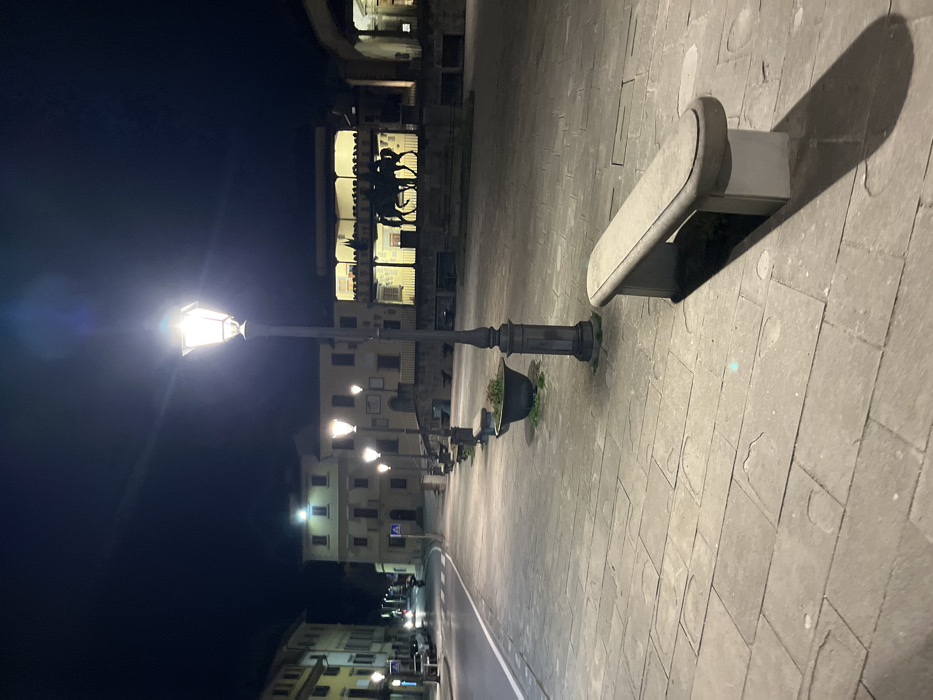
The image captures a quiet, illuminated street or plaza in Fiesole, Italy, at night. The perspective looks down a paved area towards a street lined with historic-looking buildings. In the foreground on the right, a smooth, light-colored stone bench casts a long, distinct shadow onto the patterned stone paving. To the left of the bench, a traditional black lamppost with an ornate base and a planter containing sparse greenery emits a bright white light, causing a lens flare effect. The lamppost also casts a noticeable shadow. A series of similar lampposts extends into the background, providing consistent street lighting. On the left side of the frame, a road or thoroughfare is visible, bordered by more buildings. Across this road, multi-story buildings with various illuminated windows can be seen. A prominent building in the mid-background features an architectural structure, possibly a loggia or balcony, on which a dark silhouette resembling a statue of an equestrian figure or a chariot is visible. The sky is dark, confirming the nighttime setting. The ground is paved with light-colored, rectangular stone slabs. The scene is devoid of people, suggesting a late or early hour, and conveys a serene atmosphere. No legible text is visible.
Fiesole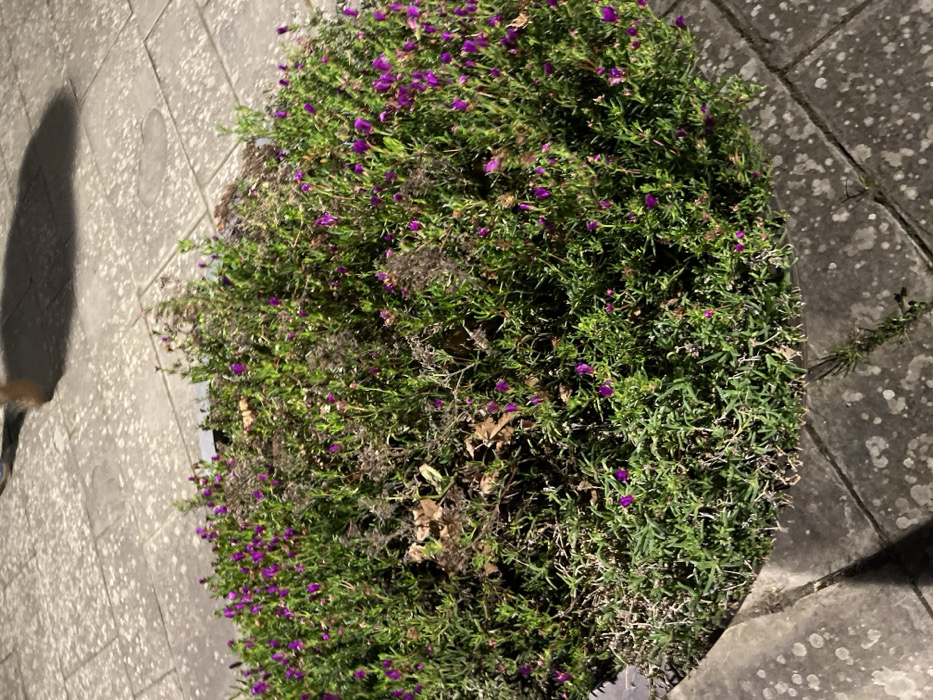
This overhead image captures an oval-shaped plant bed or large planter set into a paved surface, likely a sidewalk or outdoor path in Fiesole, Italy. The planter is densely filled with lush green foliage and numerous small, vibrant purple flowers, though some areas of the plant bed show signs of drier or browning vegetation. The ground surrounding the planter is paved with light-colored, textured stones. A prominent, long, dark shadow of a person or an object stretches diagonally across the pavement to the left of the planter, suggesting artificial light is illuminating the scene. The lighting and the distinct shadow indicate the photograph was taken during the evening or night. No specific activity is taking place, and no people are visible, only the shadow. The image presents a quiet, natural scene focusing on the plant life in an urban or garden setting. There is no visible text in the image.
Fiesole
The image and its crops depict a highly motion-blurred scene, primarily featuring a dense green bush adorned with numerous small purple flowers. The significant motion blur suggests that the photograph was taken while the camera or subject was in motion. The main subject is a large, rounded green plant or bush, with small, vibrant purple blooms scattered throughout its foliage. A paved surface, possibly a sidewalk or path, runs along the edge of the bush on the left side of the frame and in the background. In the lower right corner of the original image, a person's foot is partially visible, wearing a white sneaker and blue pants or jeans, indicating the presence of an individual moving past the bush. The activity taking place is implied to be walking or moving, which is the cause of the extensive motion blur. The perspective is from above, looking down at the bush and the paved ground. The lighting appears somewhat dim, making it challenging to determine the exact time of day, but it does not seem to be bright daylight. No specific location cues are discernible within the image itself, apart from the general appearance of an outdoor, possibly urban or garden setting. There is no visible text.
Fiesole