Galatina, Italy
30 memories from Galatina, Italy
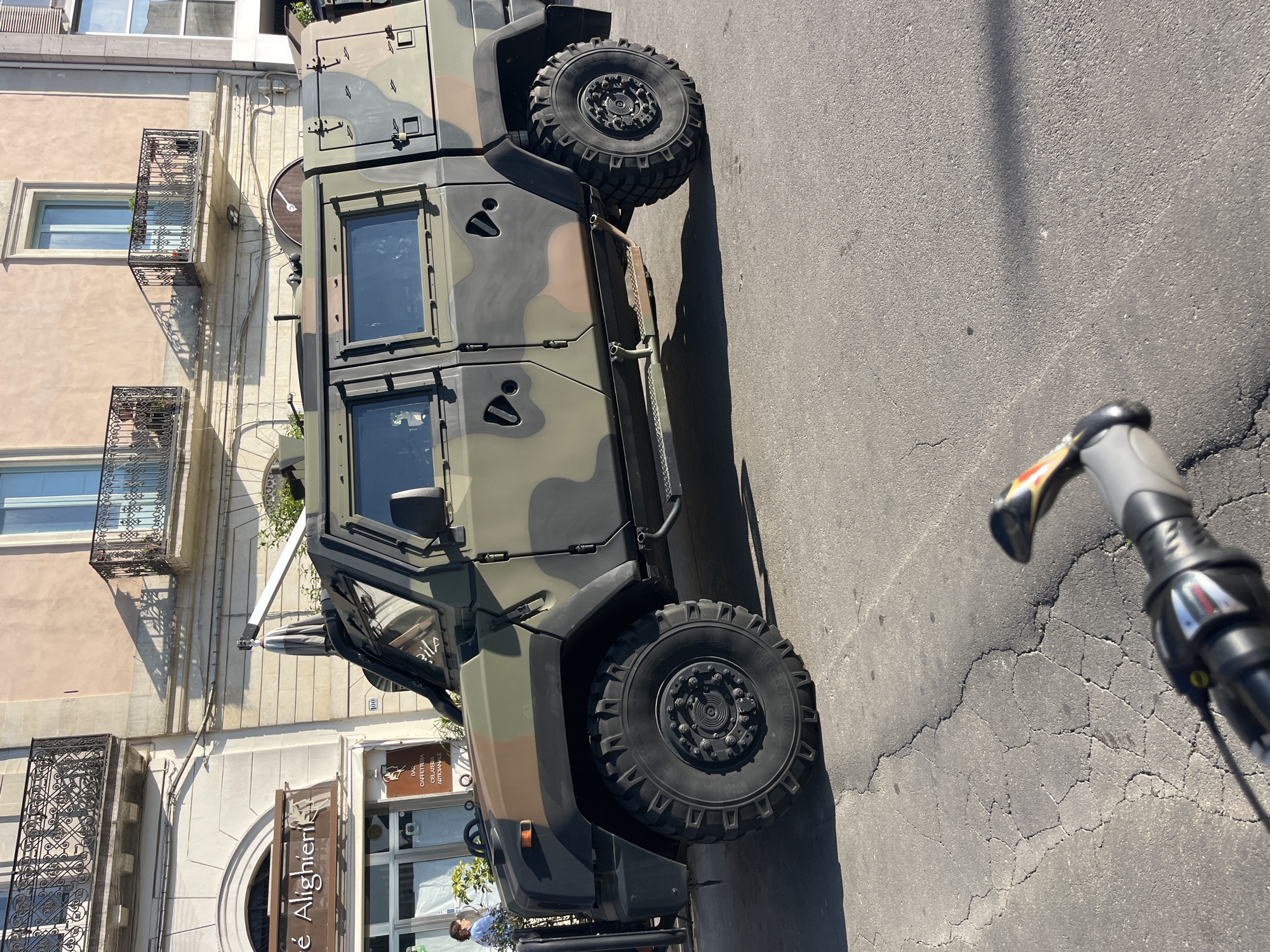
The image depicts a camouflaged military vehicle parked on a city street. The vehicle is positioned in front of a building with wrought iron balconies and a cafe called "Caffè Alighieri." A bicycle handlebar is visible in the foreground. The location is Galatina, Italy, as identified by the cafe name. A person in a blue shirt is standing near the front of the vehicle. The surrounding environment appears to be an urban setting with typical European architecture.
Galatina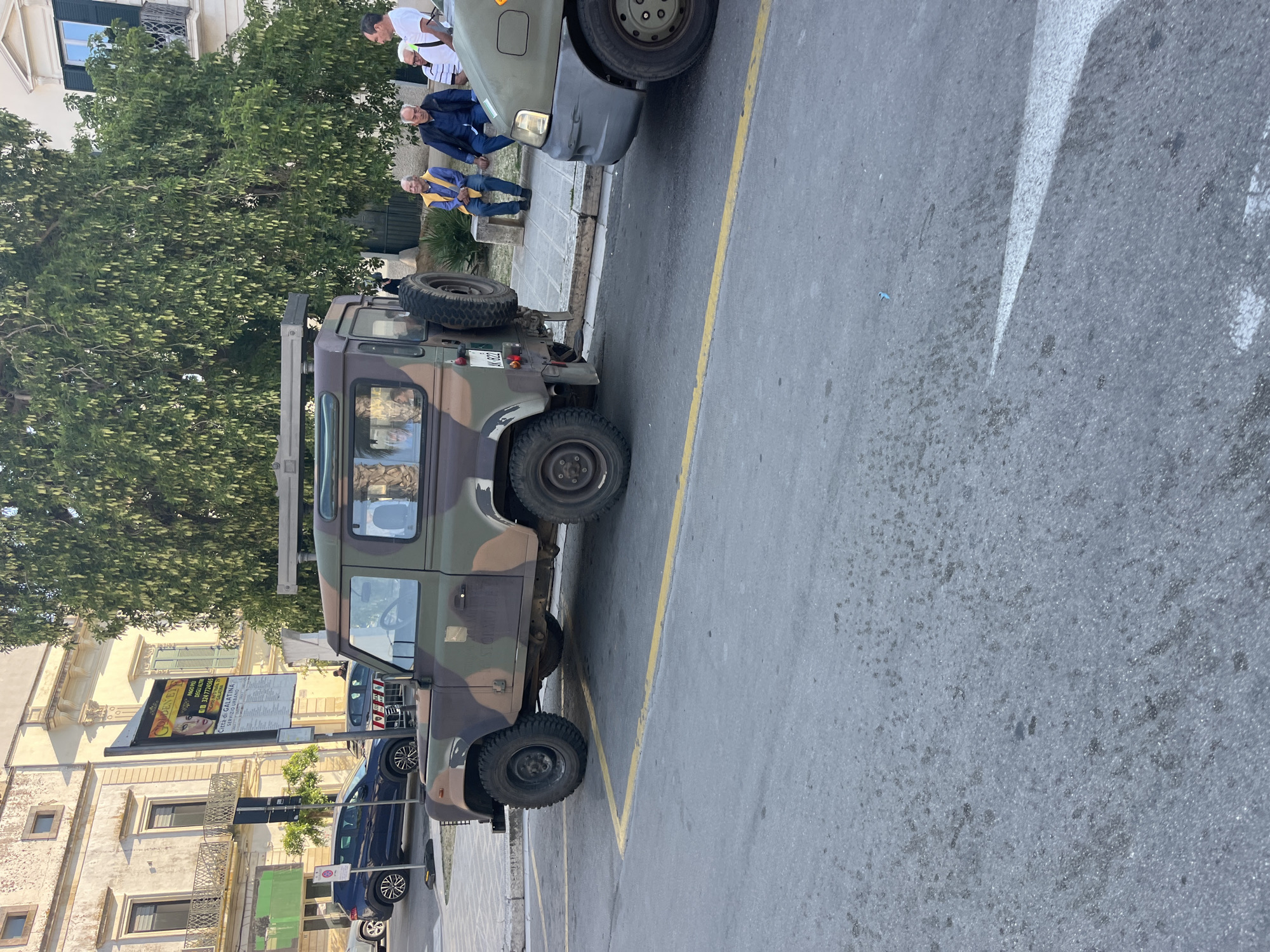
The image shows a military vehicle parked on a street in Galatina, Italy. The vehicle is camouflage-colored and has a spare tire mounted on the back. Several people are seated and standing nearby. The location is in the city center and is bordered by buildings with advertisements on them, and trees. There are also other cars parked along the street. The street surface is asphalt, marked with yellow and white lines for parking spaces and traffic direction.
Galatina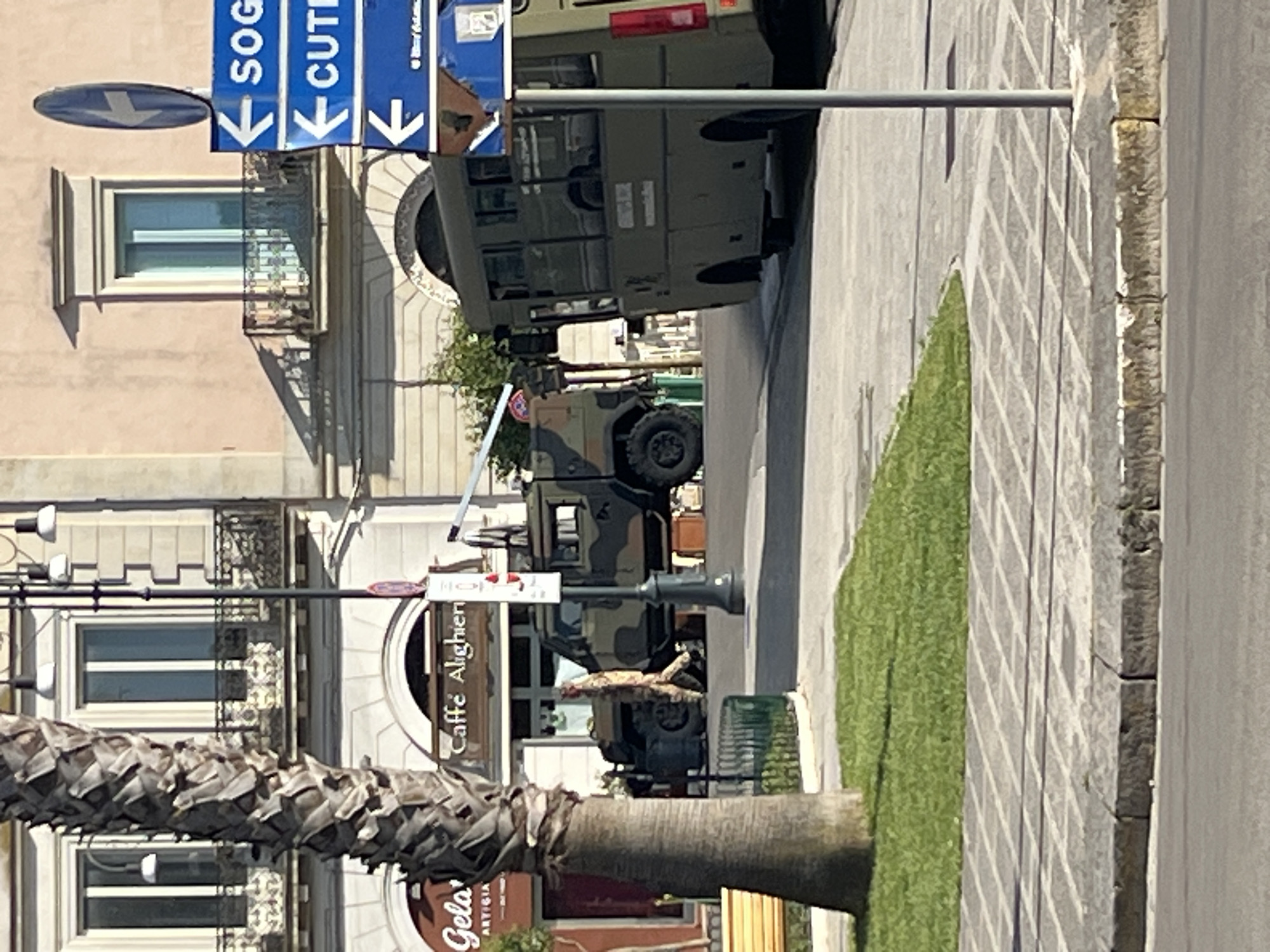
The image depicts a street scene in Galatina, Italy. Three military vehicles are parked along the street, in front of a building housing the "Caffe Alighieri" and "Gelateria Artigianale." A palm tree is visible to the left. A street sign points towards "Sogliano" and "Cutrofiano." A narrow strip of green grass separates the sidewalk from the road. The buildings have windows with white trim.
Galatina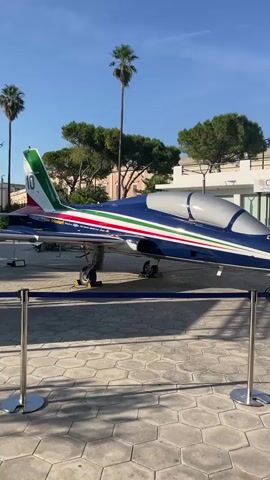
The video shows a small public square in an Italian town on a sunny day. In the first shot, a blue and white model jet is on display, cordoned off by blue rope. The next shot shows people walking across the square, past benches. Two men in green shirts are walking together, while a woman follows behind. In the next shot, people are seen sitting on benches, talking, and waiting. Finally, the video pans over a small green tree with thick foliage, growing from a circular bed.
Galatina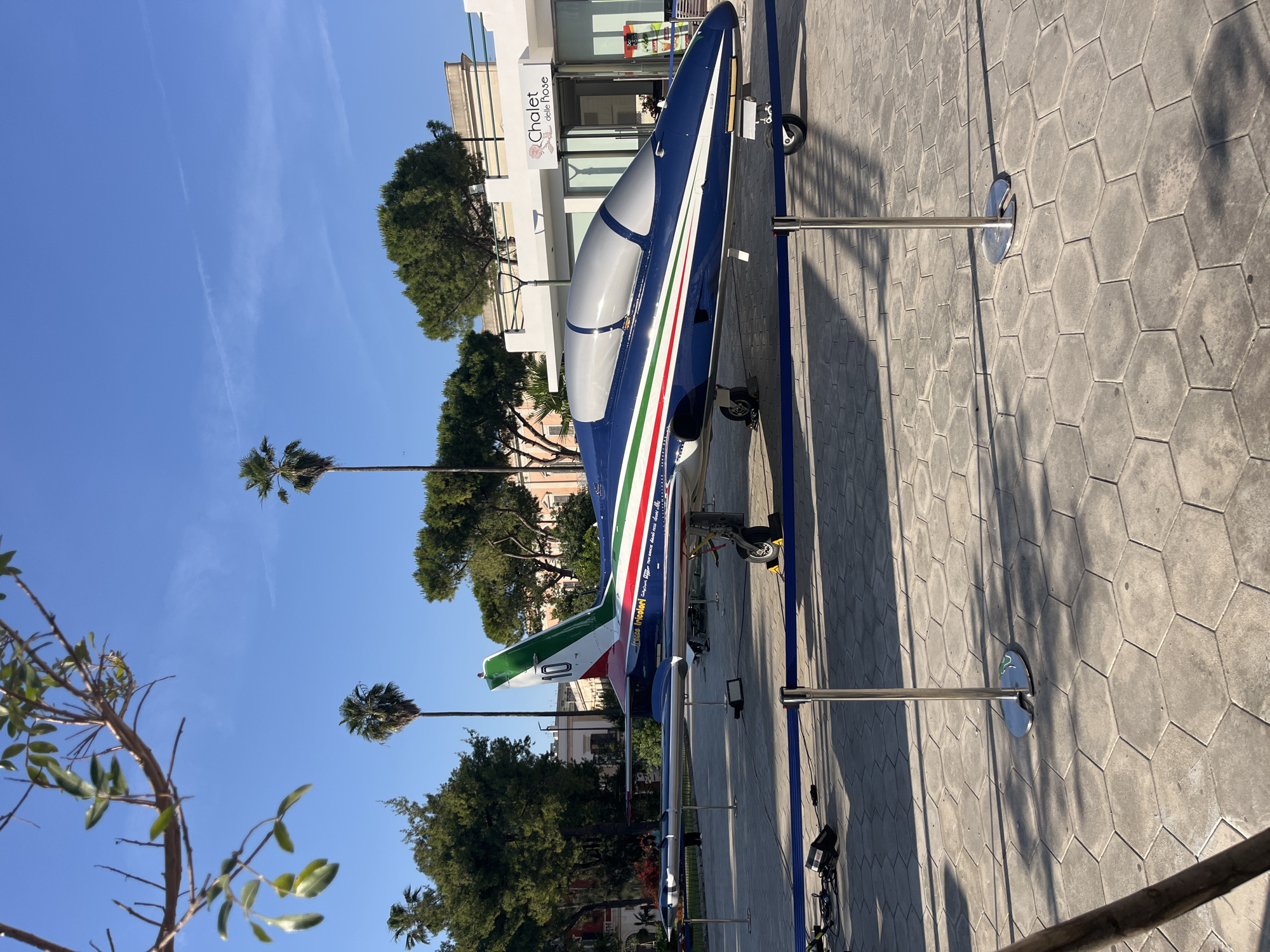
The image captures an Aermacchi MB-339PAN, a jet aircraft used by the Frecce Tricolori, the aerobatic demonstration team of the Italian Air Force, displayed on a hexagonal-patterned paved area in Galatina, Italy. The aircraft is painted in the Frecce Tricolori's distinctive blue, white, and green livery. It is mounted on metal stands, and a blue rope barrier surrounds it. Behind the aircraft, there are trees, a building with a sign that reads "Chalet delle Rose", and clear blue sky with palm trees. The scene is bathed in sunlight, casting shadows across the pavement.
Galatina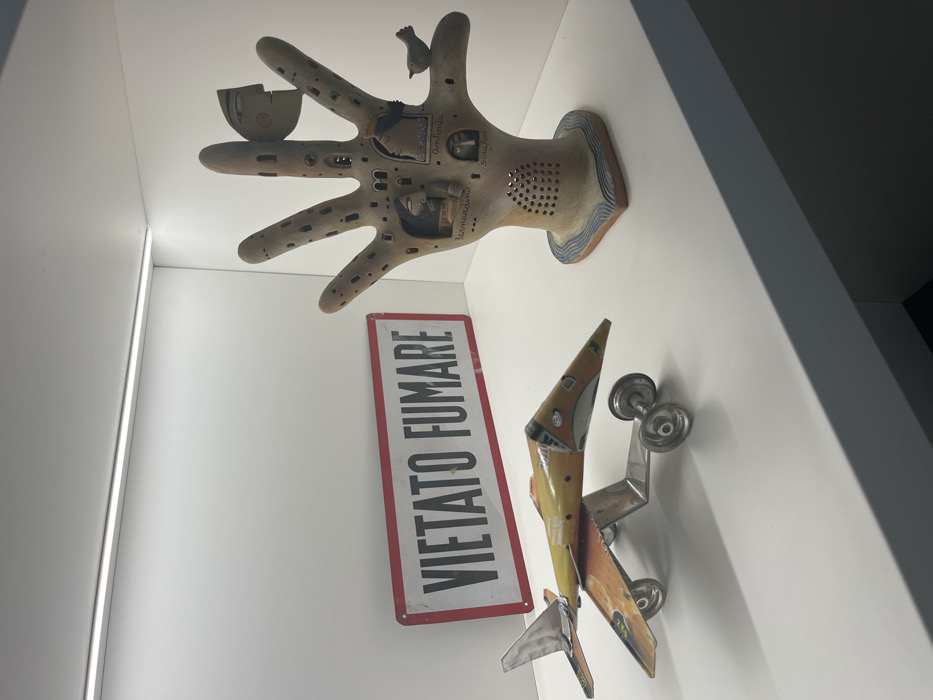
The scene, located in the city of Galatina, Italy, presents three static objects displayed on a white, flat shelf within a white-walled recess. An overhead linear LED light fixture illuminates the area. Positioned on the left, a multi-colored metallic toy airplane, predominantly orange and yellow with silver wings and tail, rests on four silver wheels, facing to the right. Behind the airplane and centrally located is a rectangular, white metallic sign with a red border, bearing the black uppercase inscription 'VIETATO FUMARE'. To the right, a ceramic sculpture depicts an upright, open human hand with an earthy, reddish-brown tone. The palm and fingers of the sculpture feature integrated miniature architectural elements, including windows and sculpted faces. A small bird figure is perched on the sculpture's outermost finger, and a separate facial element is partially integrated near the top of another finger. The sculpture stands on a base decorated with blue wavy patterns.
Galatina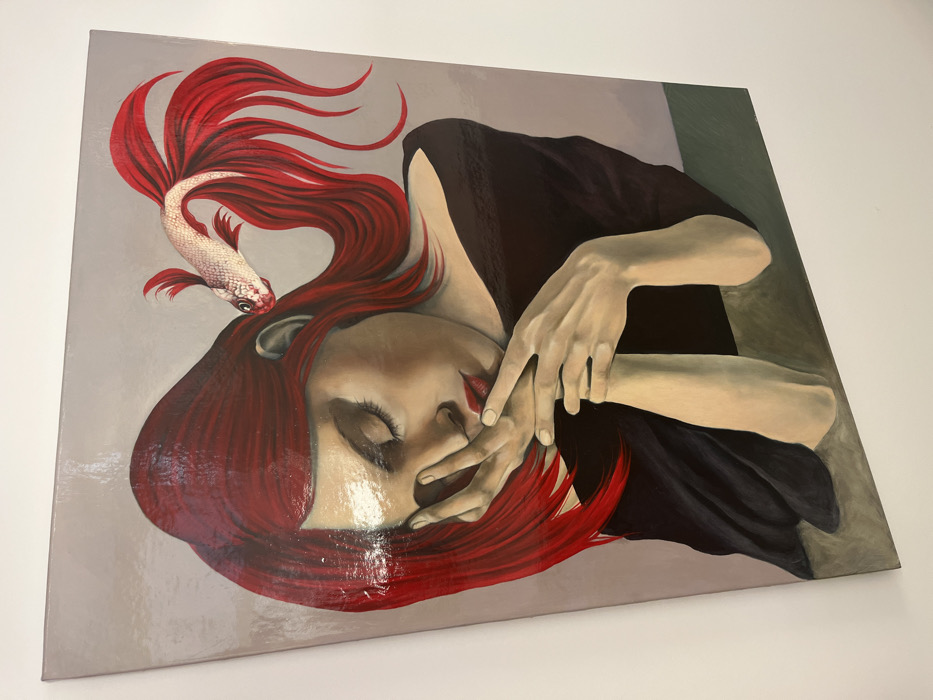
This image is a photograph of a vertically oriented painting, physically located in Galatina, Italy, displayed against a plain, light-colored wall. The painting depicts a woman from the chest up, with her eyes closed and her head slightly tilted downwards. She has vibrant, flowing red hair that extends upwards and to the right. Her left hand, with fingers slightly splayed, covers the lower part of her face, from just below the nose to her chin, and rests upon her right hand. Her right hand is positioned beneath her left, with fingers interlocked or crossed. She exhibits fair skin and visible red lips beneath her left hand. She wears a dark, off-the-shoulder garment. Above and to the right of the woman's head, a white-bodied fish with large, flowing red fins, resembling a Siamese fighting fish, is depicted. Its fins appear to be integrated with or emerging from the woman's red hair. The background of the painting is a solid light gray-lavender color in the upper half, transitioning to a dark green or brown horizontal band in the lower portion, suggesting a surface. The painting has a glossy, reflective finish, indicated by visible light reflections on its surface.
Galatina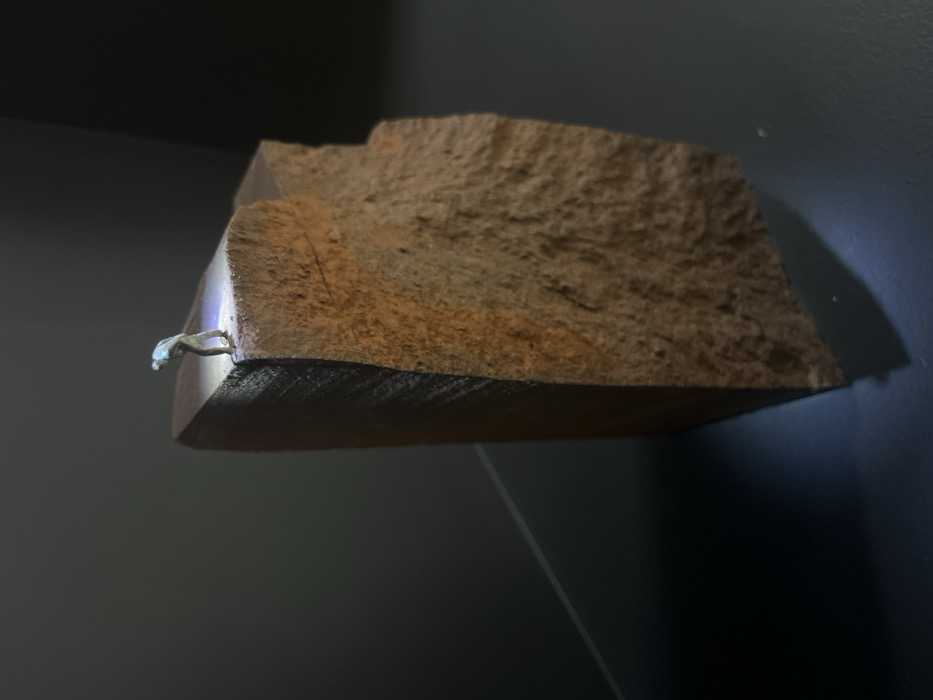
The image presents a studio-lit miniature diorama, conceptually set in the city of Galatina, Italy. The central subject is a single, small human figurine, approximately 2-3 cm tall, wearing light-colored attire. The figure is positioned on the uppermost edge of a large, vertically oriented block of rough, reddish-brown material, resembling coarse-grained wood or sandstone. The figure is bent forward, with its head and torso angled downwards, appearing to observe or investigate the immediate area below its feet on the block's surface. A localized, intense white light source, emanating from the figure's upper body, illuminates this specific point. The block exhibits a textured, uneven front face and a smoother, darker, striated left side. It rests on a flat, dark surface, casting a defined shadow. The background is uniformly dark gray, with a faint diagonal line visible in the lower-left, suggesting a controlled photographic environment.
Galatina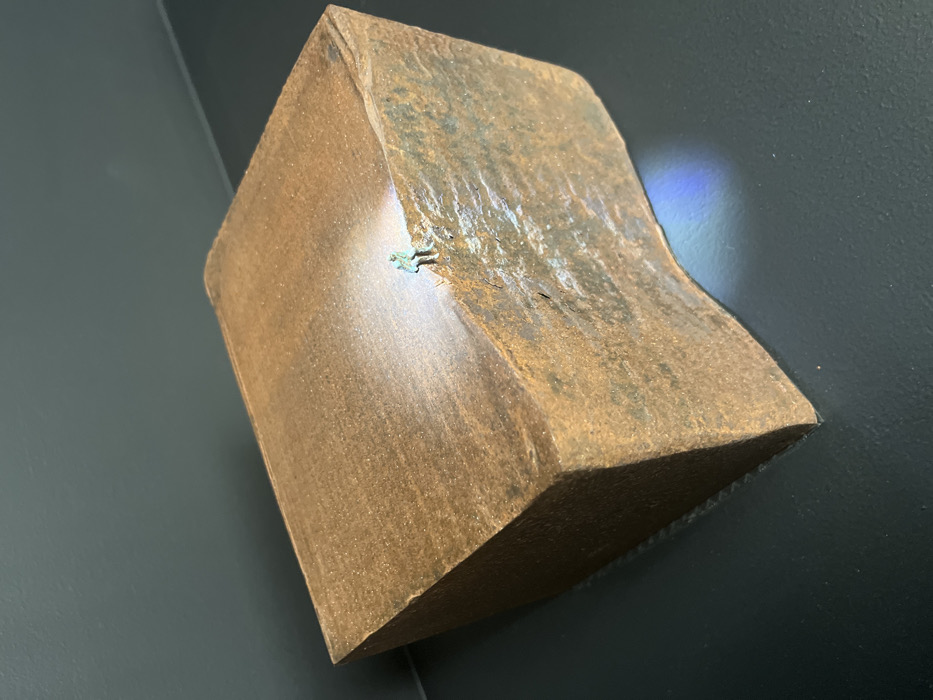
The image displays a miniature sculpture or diorama situated on a flat, dark grey surface against a dark grey wall background. The central object is a rectangular block, appearing to be composed of a coarse, oxidized material resembling rusted metal or weathered earth, characterized by a predominantly reddish-brown coloration with variations in texture and tone. One corner of the block features a deeply carved, undulating depression, mimicking an eroded cliff face or natural cavern opening. At the upper edge of this depression, a single miniature human figure, rendered in teal-green attire, is positioned, appearing to look down into the void. A focused beam of white light emanates from the figure's vicinity, illuminating a section of the block's top surface and the upper part of the sculpted depression. Below the main block, within the shadowed area at the base of the depression, a faint, diffuse blue light is visible on the dark supporting surface. The scene, an art piece or model, is located in the city of Galatina, Italy.
Galatina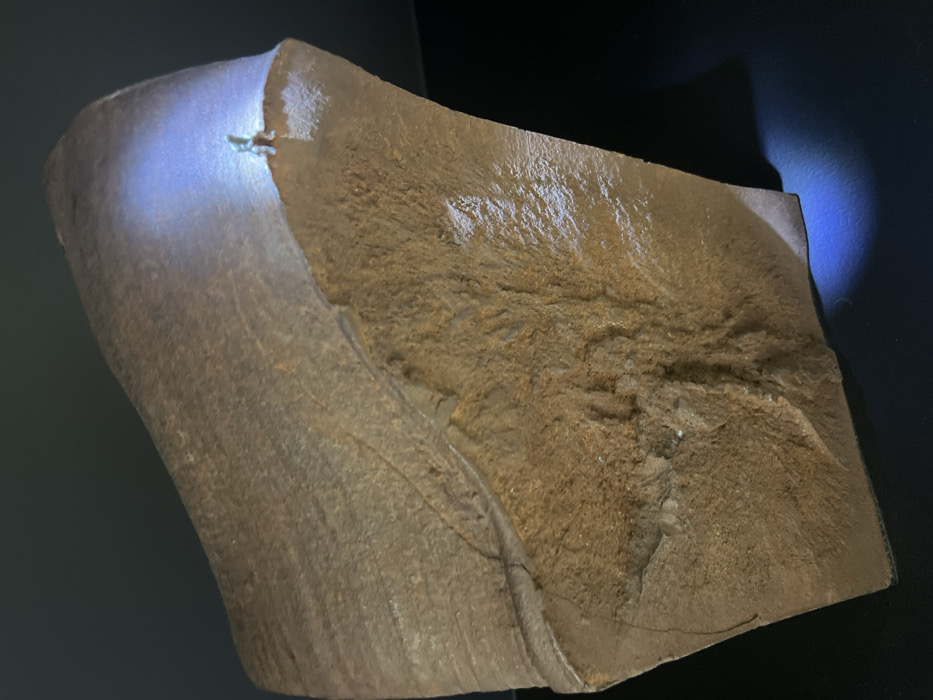
The image displays a large, irregularly fractured geological specimen, presented within an exhibit in Galatina, Italy. The specimen, predominantly brown, features a rough, granular primary surface with a distinct fracture pattern, while an upper segment exhibits a smoother, linearly striated texture. A concentrated blue-white light source illuminates the upper edge, highlighting a miniature, light-colored human-like figure positioned as if ascending the peak. A secondary blue light source is visible beneath the specimen's lower right edge. The object rests on a dark, flat surface against a uniformly dark background.
Galatina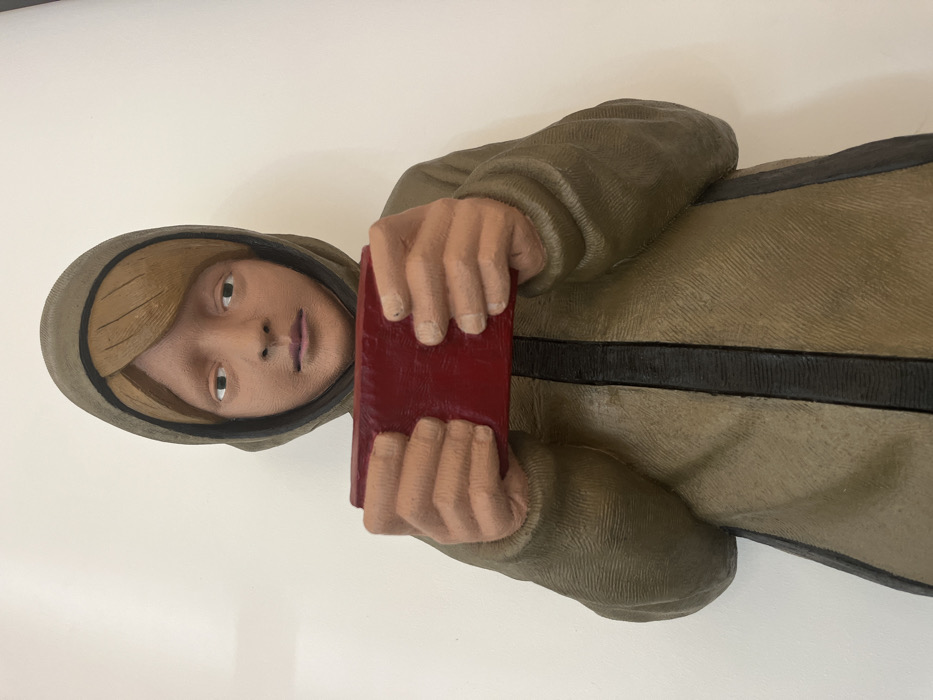
The image displays a sculpted figure, located in Galatina, Italy, depicting a youthful individual from the upper torso upwards. The subject possesses light brown hair visible beneath an olive-green hooded garment. The face exhibits a neutral expression, with painted eyes and lips. Both hands are sculpted holding a rectangular, deep red object horizontally at chest height. The olive-green garment features a distinct dark vertical stripe down its center. The figure is presented against an unadorned, light-colored wall, suggesting an indoor setting.
Galatina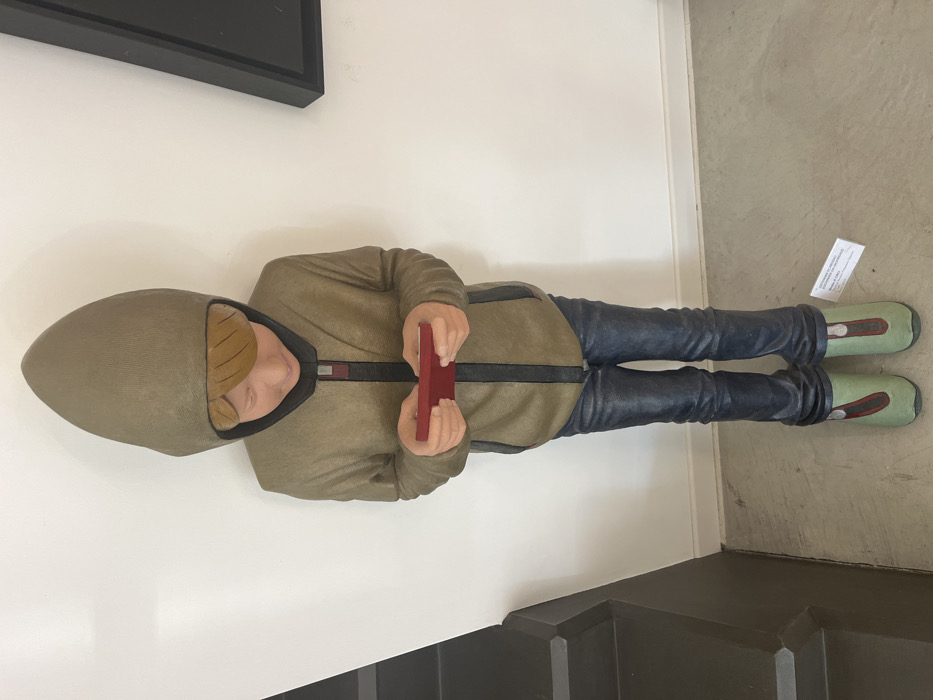
A full-body sculpture of a young boy is presented standing indoors against a plain white wall in Galatina, Italy. The sculpture depicts a boy with blond hair, wearing an olive green hooded jacket with dark grey and black trim, blue jeans, and light green shoes with dark accents. His head is bowed, and he holds a small, rectangular red object, resembling a smartphone, with both hands, positioned as if interacting with its screen. To the left, dark-colored, multi-tiered stairs are partially visible. To the right, a corner of a black-framed, dark triangular artwork hangs on the wall. The floor is light-colored. A white rectangular label, bearing text including 'GALATINA D'APRILE', 'SGUARDI E LUOGHI', and 'MOSTRA FOTO', rests on the floor near the sculpture's feet.
Galatina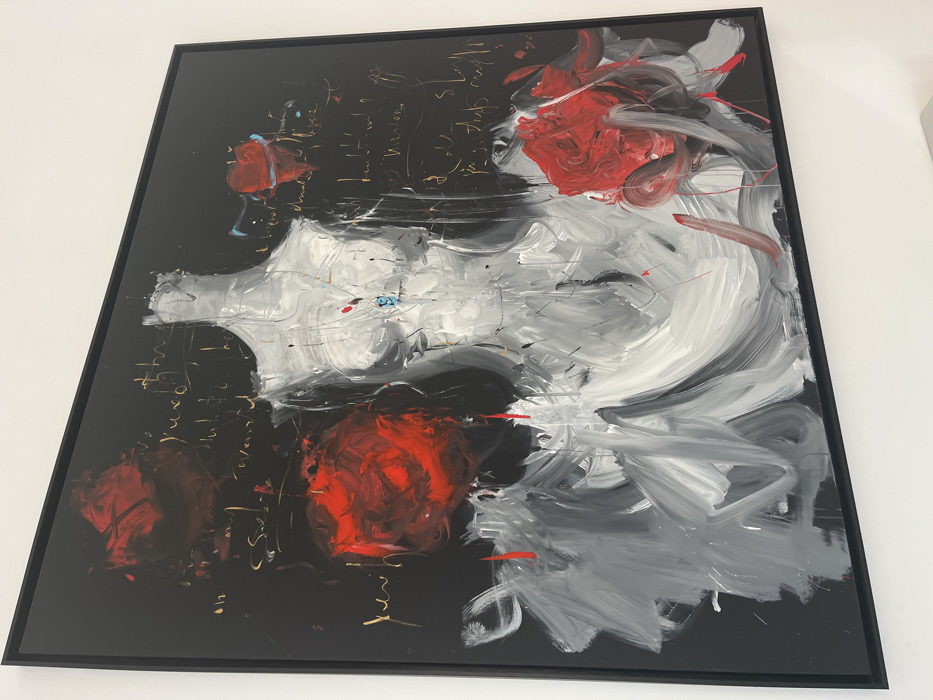
This image depicts an abstract expressionist painting, mounted on a plain white wall, located within a building in Galatina, Italy. The painting features a dark, predominantly black background, overlaid with broad, visible brushstrokes. A central, headless, and armless dressmaker's mannequin or dress form is rendered in white and gray tones, occupying the central and lower-mid sections of the canvas, depicted with an implied garment. A small blue pendant or detail is visible near the chest area of the mannequin. Three abstract, textured red forms, resembling roses or floral elements, are prominently placed: one in the upper left quadrant, one in the mid-left, and one in the lower right. Illegible script or scribbled markings in a golden or yellow hue are scattered across the dark background. The artwork is enclosed within a thin, black frame.
Galatina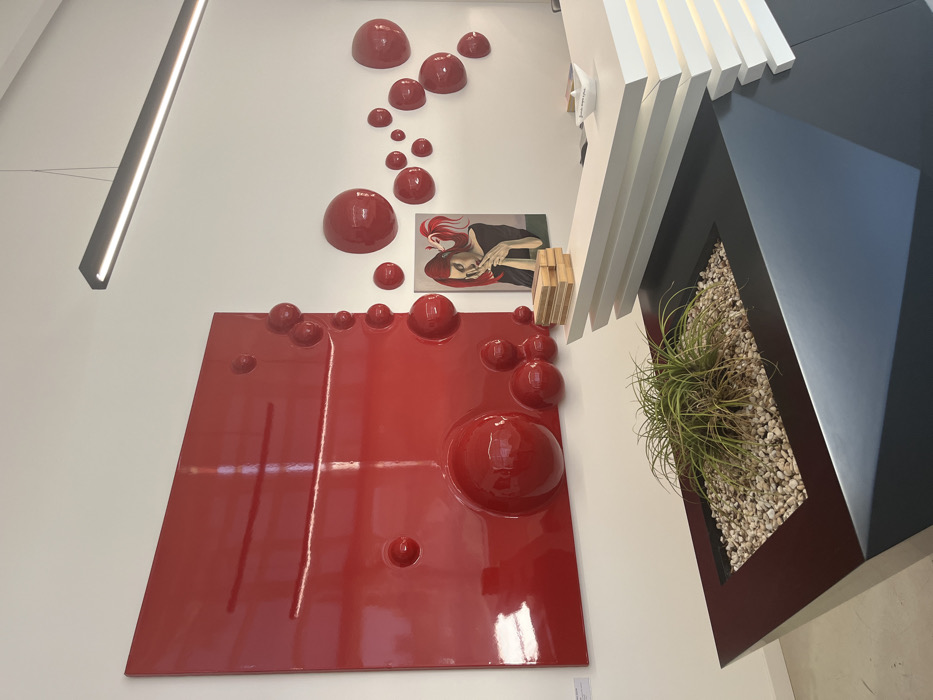
This image presents a modern interior scene of what appears to be a reception or office area located in Galatina, Italy, with no individuals present. The walls are uniformly white. On the left wall, a large, rectangular, highly glossy red panel is mounted vertically. This panel features multiple embedded or affixed red spherical elements of various sizes, with one large sphere near the bottom-center and smaller ones predominantly along its right edge. Two subtle, horizontal indented lines are also present on the panel's surface. Adjacent to this, on the right wall section, a series of smaller, glossy red hemispherical forms are directly affixed to the wall in an arcing pattern. Below these, a framed portrait-oriented painting depicts a woman with vibrant red hair styled in an updo, wearing a dark top, with her right hand raised to her mouth holding what appears to be a lit cigarette or similar slender object, from which a wisp of smoke emanates. A single, elongated, black linear LED light fixture is suspended horizontally from the white ceiling. In the foreground, a white, multi-tiered, angular reception desk occupies the lower right portion of the image. Its design incorporates several horizontally stacked panels that appear to be internally illuminated. On the desk's top surface, a small white ceramic bowl containing light-colored, irregularly shaped objects is positioned next to a stack of rectangular, light-toned wooden blocks. A small white paper boat, inscribed with the text "Crescita, sempre e solo," also rests on the desk. Directly in front of the reception desk, a dark, angular planter box, likely black or dark gray, contains a bed of small, light-colored pebbles, from which a green, grass-like plant grows.
Galatina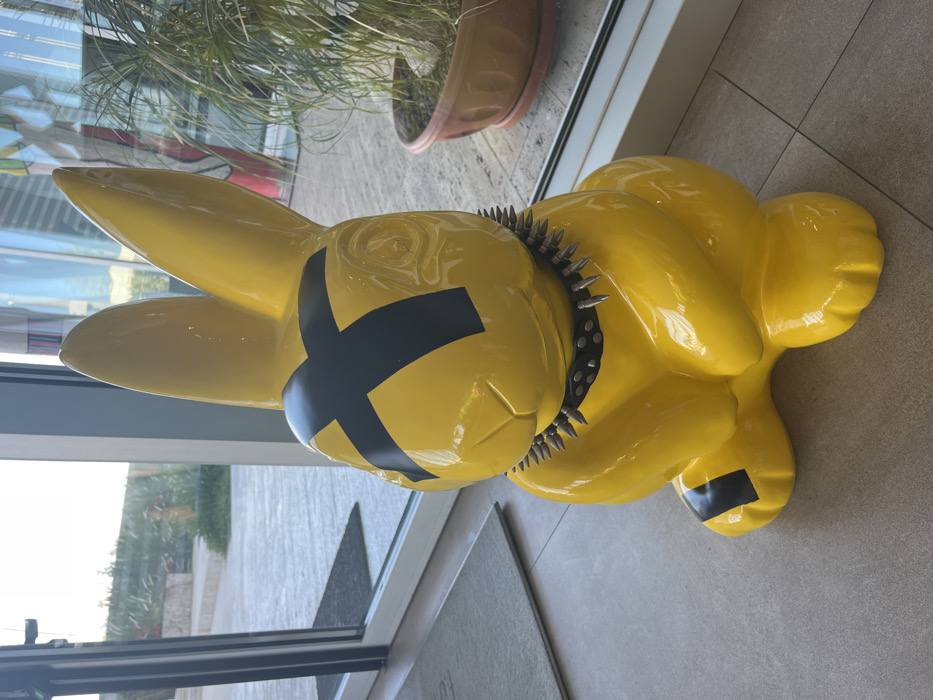
The scene is an interior view from the A. S. Hotel & Residence in Galatina, Italy, featuring a large, glossy yellow rabbit sculpture. The sculpture is positioned on a light-colored tiled floor, facing slightly right, directly adjacent to a glass exterior wall. It exhibits a black 'X' mark across its face where eyes would typically be and wears a black collar adorned with silver-colored spikes around its neck. A black band is visible on its left foot. To the immediate left of the sculpture, a grey rectangular mat lies on the floor next to a glass door frame. To the right, a potted plant with green foliage, contained within a terracotta-colored pot and saucer, is situated beside the glass paneling. Through the glass, an outdoor paved area, landscaped sections with green vegetation, and distant building structures are visible under bright daylight. No individuals are present in the image.
Galatina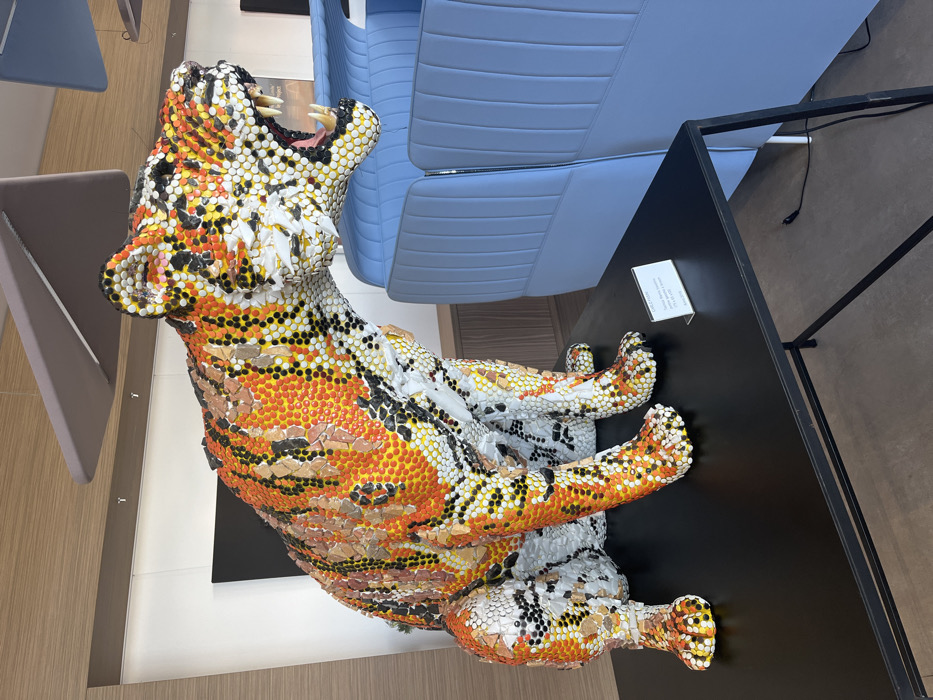
A modern interior in Galatina, Italy, showcases a large, crouching tiger sculpture constructed from a mosaic of numerous small, circular components in orange, yellow, white, and black, forming a striped pattern. The tiger's mouth is open, revealing white teeth. This sculpture rests on a black rectangular display table with thin metal legs. A small white informational plaque, partially visible and titled "CERO D'ARIA," is positioned on the table in front of the sculpture's right paw. To the right and behind the table are light blue, vertically-stitched, upholstered booth-style seating units. The background features light-colored walls, some with horizontal wood paneling, a light brown floor, and a ceiling equipped with suspended grey acoustic panels. An electrical cord is visible on the floor near the blue seating. No individuals are present.
Galatina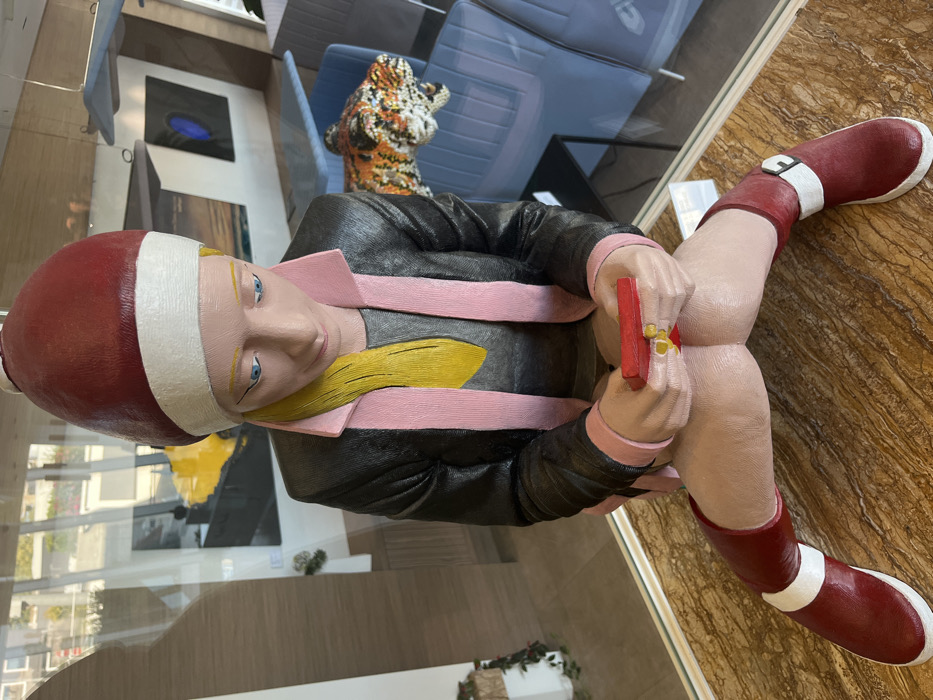
This image presents a brightly painted, full-body sculpture of a blonde female figure, positioned in a seated posture on a polished, light brown surface with a marbled pattern. The figure wears a red Santa hat with a white brim, a black blazer featuring pink lapels, a gray shirt, and red knee-high boots with white cuffs. Her light blue eyes are directed downward, focusing intently on a small, red, rectangular object held in both hands, resembling a smartphone, with yellow polish visible on her thumbs. The background, viewed through a reflective glass surface, reveals an indoor commercial or gallery setting located in Galatina, Italy. Visible environmental elements include light blue upholstered chairs, a dark table, and various wall-mounted artworks, specifically a large yellow abstract painting, a dark blue circular piece, and a black and white landscape. A mosaic-style sculpture of a tiger's head is prominently displayed on or near a blue chair. Additionally, small models, including a light blue airplane, are suspended from the ceiling. A white informational label is situated on the surface to the right of the sculpture's knee.
Galatina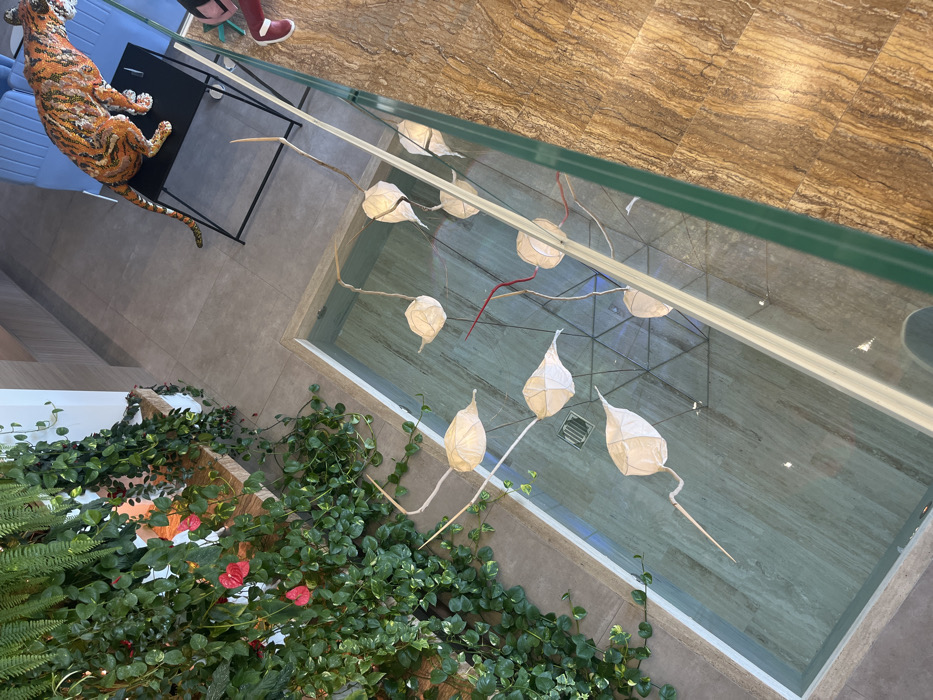
This high-angle, overhead image depicts an indoor environment in Galatina, Italy. The scene features a long, rectangular, shallow water feature integrated into the floor, containing a geometric arrangement of approximately ten white, abstract, leaf-like or pod-like objects suspended on thin, pale stems, with some incorporating thin red elements. Reflections are visible on the water's surface. To the left of the water feature, a wall is extensively covered with lush green foliage, including cascading vines (resembling Pothos) and vibrant red Anthurium flowers. Some fern-like plants are also visible. This vegetation is arranged on a light-colored, stepped planter or shelf structure. To the right of the water feature, separated by a clear glass barrier, is a textured, light-brown tiled floor. Further back on the right, an orange and black striped tiger sculpture is positioned on a small, black, rectangular table. Behind the tiger, light blue upholstered seating is visible. At the far right edge of the frame, the lower leg and foot of a person, wearing a red shoe, are partially visible. The overall environment appears to be a modern interior space.
Galatina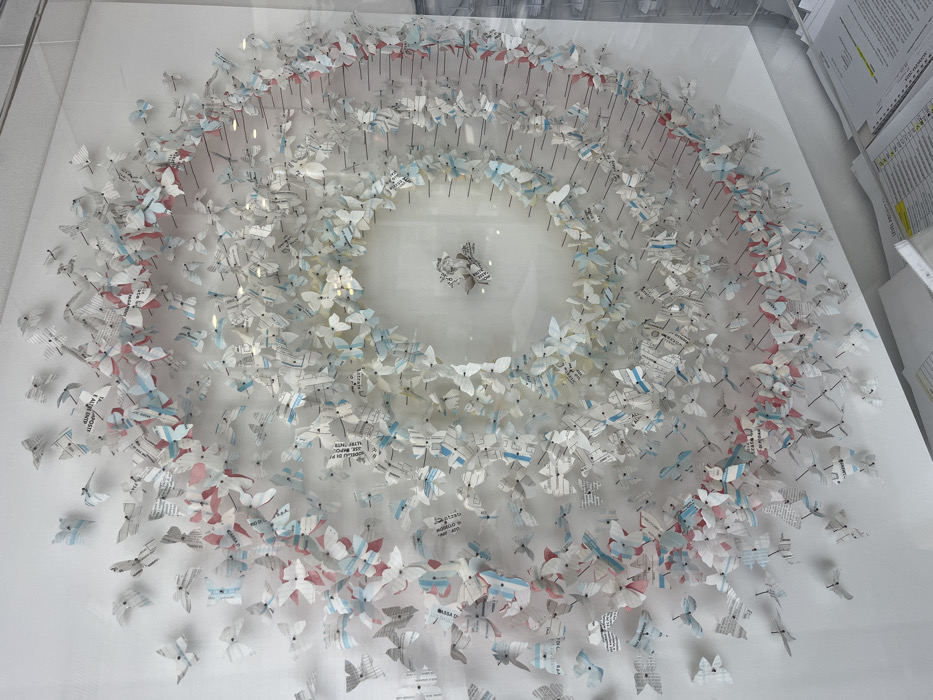
A large, three-dimensional artwork composed of numerous folded paper butterflies is centrally displayed on a plain white wall in an indoor environment, located in the city of Galatina, Italy. The artwork is contained within a protective, reflective clear enclosure, likely glass or acrylic. The butterflies are arranged in an expansive, approximately circular or spiral pattern, expanding outwards from a denser central cluster. Each butterfly is crafted from cut sections of printed paper, exhibiting patterns of black text on white, interspersed with areas of light blue and light pink. They are individually affixed to the white background with small, dark-colored pins, which create subtle shadows. The overall composition presents a dynamic, swirling effect, with the butterflies appearing to emanate from the center. Below the artwork, on a surface resembling a desk or counter, several stacks of documents are visible. These papers are predominantly white with black printed text and lines, suggesting administrative or official paperwork. No individuals are present in the scene. The lighting appears to be artificial, reflected in the enclosure's surface.
Galatina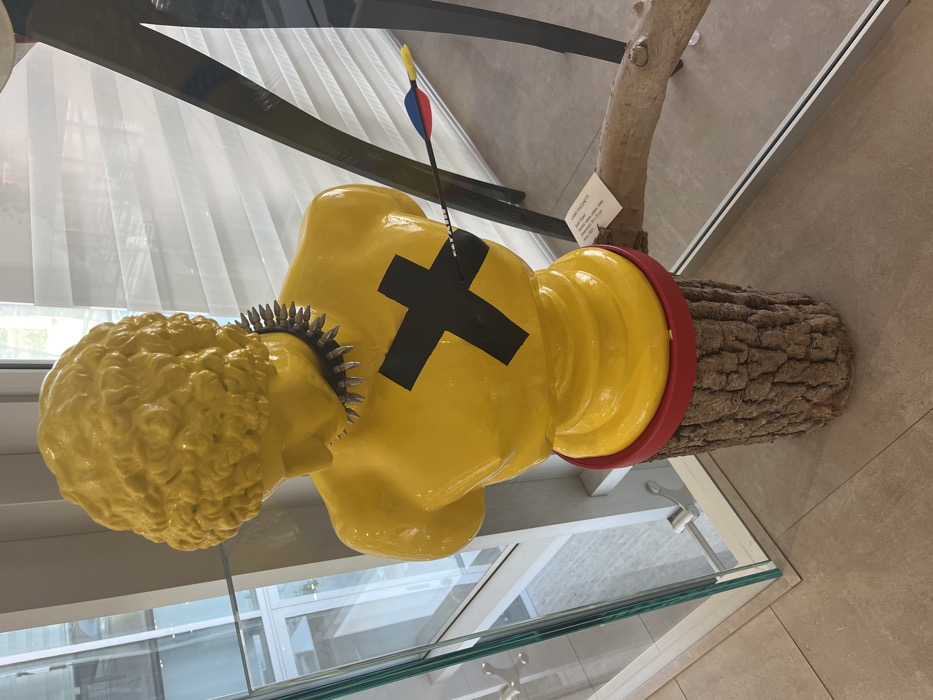
An upward-angled, eye-level shot captures a bright yellow, stylized bust of a male figure with curly hair, positioned in an indoor setting. The bust wears a black choker adorned with silver-colored spikes. A prominent black 'X' symbol is affixed to the center of its chest. An arrow, featuring a black shaft and red, blue, and yellow fletchings, is embedded into the bust's chest to the right of the 'X'. The bust rests on a red circular base, which in turn sits atop a cylindrical pedestal crafted from textured tree bark. The floor is a light-colored, possibly tiled, surface. To the left, a clear glass barrier reflects elements of the surrounding environment, including a white structural beam. In the background, a window with horizontal white blinds is visible, and to the right, a dark, angular display support is partially present. A light-colored wooden branch with an identification label, partially obscuring the text "LINO PALADETTI", extends from the right foreground towards the base of the pedestal. This scene is located in the city of Galatina, Italy.
Galatina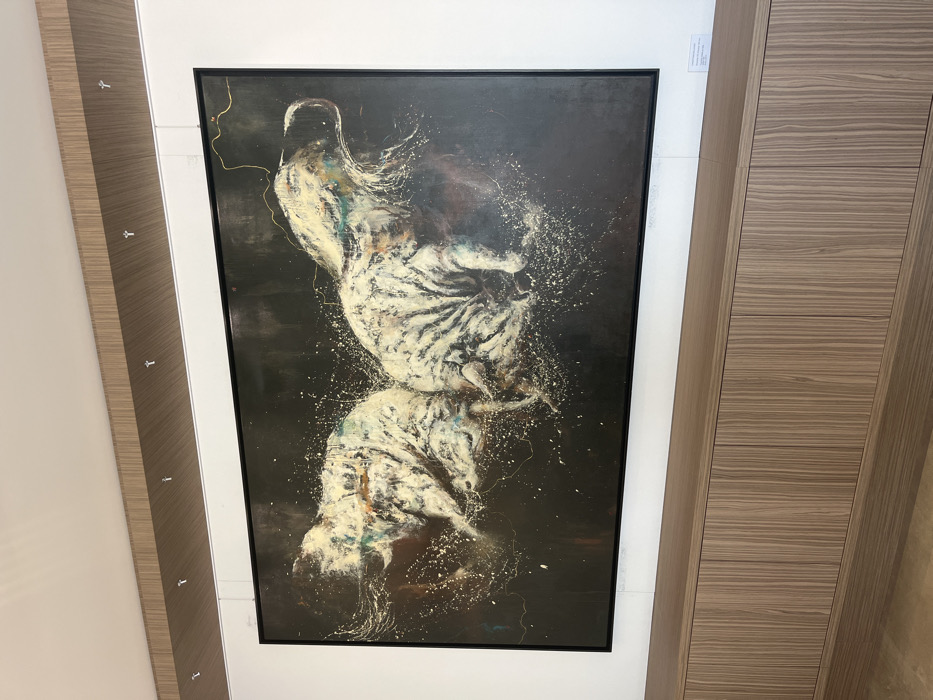
A large, horizontally oriented contemporary painting is displayed on a white wall in an interior space within the city of Galatina, Italy. The artwork, framed in black, features two dynamic, stylized figures resembling elephants, rendered primarily in white, cream, and pale yellow with visible brushstrokes and underlying tones of blue, green, and brown, against a dark, almost black background. White paint splatters emanate from the figures, suggesting movement or energy. A thin, winding gold line is present in the upper right quadrant of the painting. The artwork is suspended by thin wires from silver-colored hooks attached to a horizontal white strip situated below a light-brown wooden panel on the upper wall. Directly beneath the painting, a long, low cabinet or credenza constructed of light-brown wood with distinct vertical grain patterns extends horizontally across the wall. The top surface of the cabinet is flat. A light-colored floor is visible at the base of the image.
Galatina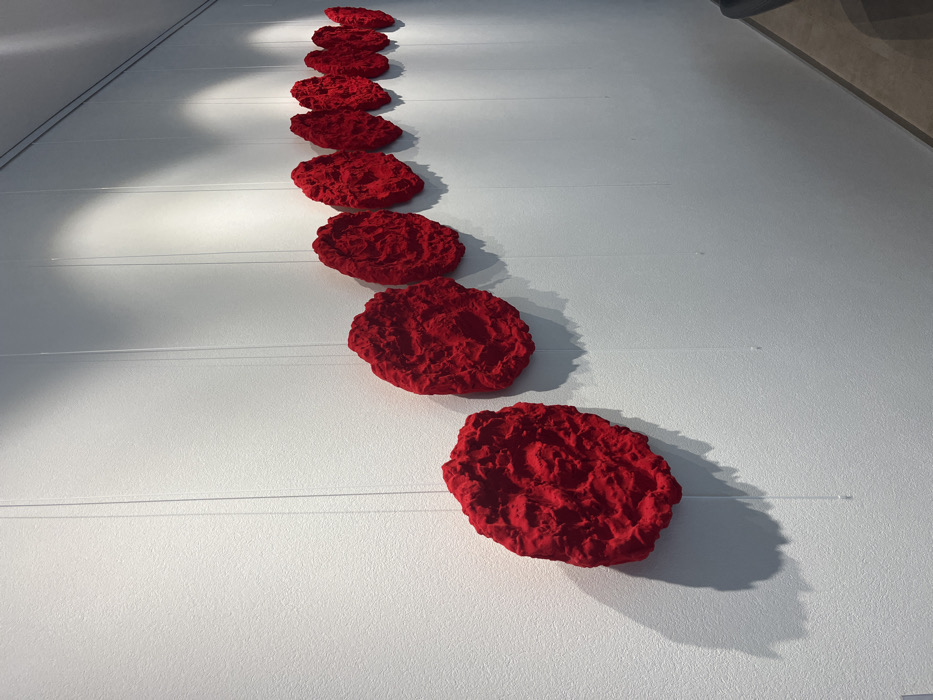
The scene depicts an art installation within an indoor gallery in Galatina, Italy. Eleven roughly oval-shaped, textured objects, colored vivid red, are arranged in an ascending diagonal line against a light grey, textured wall. Each object exhibits an irregular, crumpled surface texture, and their sizes diminish progressively from the largest on the far left to the smallest on the far right. Individual objects are suspended by a pair of thin, translucent lines. Overhead lighting casts pronounced shadows from the objects onto the wall, with vertical streaks of light visible on the upper wall. A dark floor surface is partially visible in the lower right frame. No individuals are present in the image.
Galatina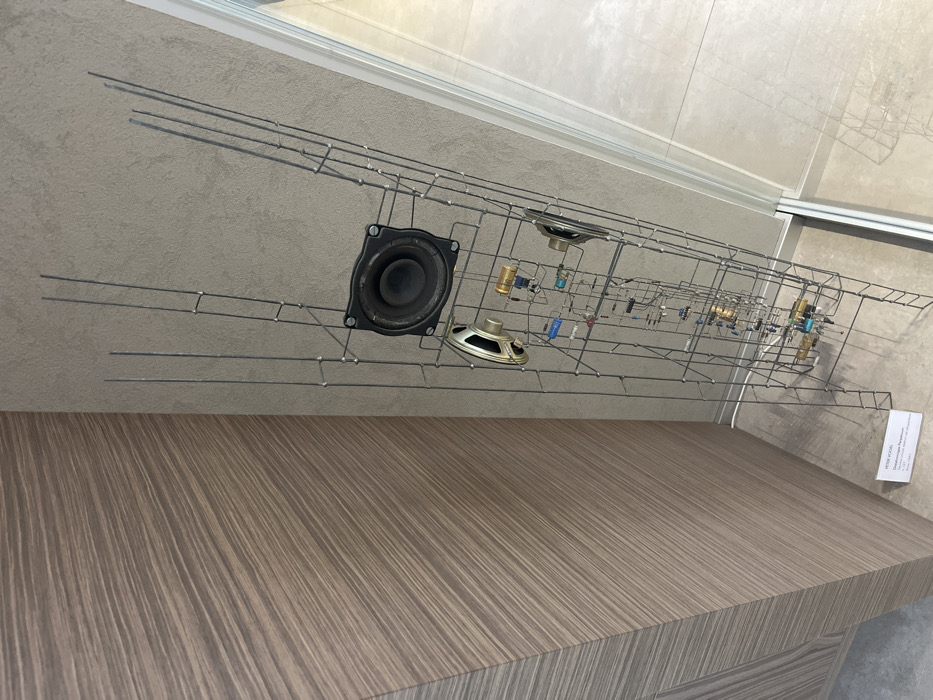
The image displays an art installation in an indoor setting in Galatina, Italy. The central subject is a tall, slender, open-frame sculpture constructed from dark grey metal rods forming a grid-like structure. Embedded within this framework are various exposed electronic components. A prominent black-coned speaker in a square frame is positioned near the top, while two smaller, round speakers with metallic gold-colored cones are located below it. Numerous cylindrical capacitors, rectangular resistors, and other small electronic elements are visibly interconnected by thin wires throughout the metal grid, creating an intricate circuit-like arrangement. The sculpture rests on a light grey, smooth floor. To its immediate left, a vertical wall or panel features a horizontal wood grain pattern in shades of brown and grey. The background wall behind the sculpture is a plain, light beige or grey. To the right, a clear glass partition is visible, reflecting a portion of the sculpture and revealing the continuation of the light grey floor beyond. At the base of the sculpture, on the left, a small white rectangular plaque with black text reads "PETER VOGEL" and "Klangezeugungs-Parallelform." No individuals are present in the scene.
Galatina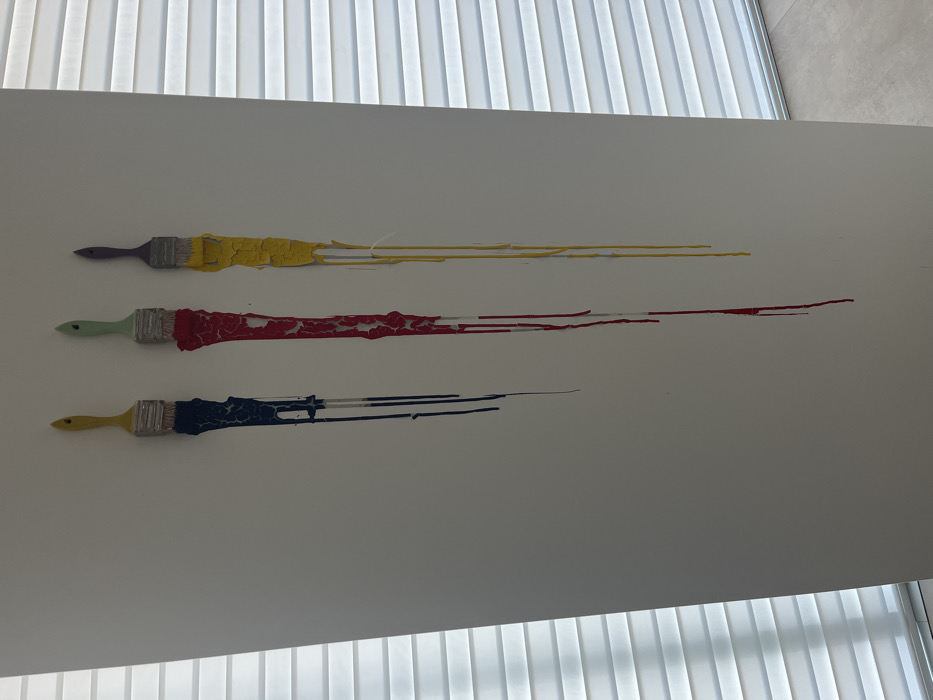
The image displays an indoor scene featuring three paintbrushes mounted vertically on a light-colored wall. From left to right, the paintbrushes are adorned with dried, dripping paint in dark blue, red, and yellow. The dark blue paint on the left brush exhibits a cracked texture with multiple thin drips extending downwards. The central brush features red paint with significant cracking and peeling along its extensive drips. The rightmost brush displays yellow paint with a smoother, yet dried and dripping, appearance. The handles of the brushes are distinct: the leftmost is yellow, the middle is light green, and the rightmost is light purple. Horizontal window blinds are visible along the left edge of the frame and partially along the right edge, indicating windows or openings providing light. Light-colored floor tiles are present in the bottom right corner. No individuals are depicted. The specific location within Galatina, Italy, cannot be determined from the image provided.
Galatina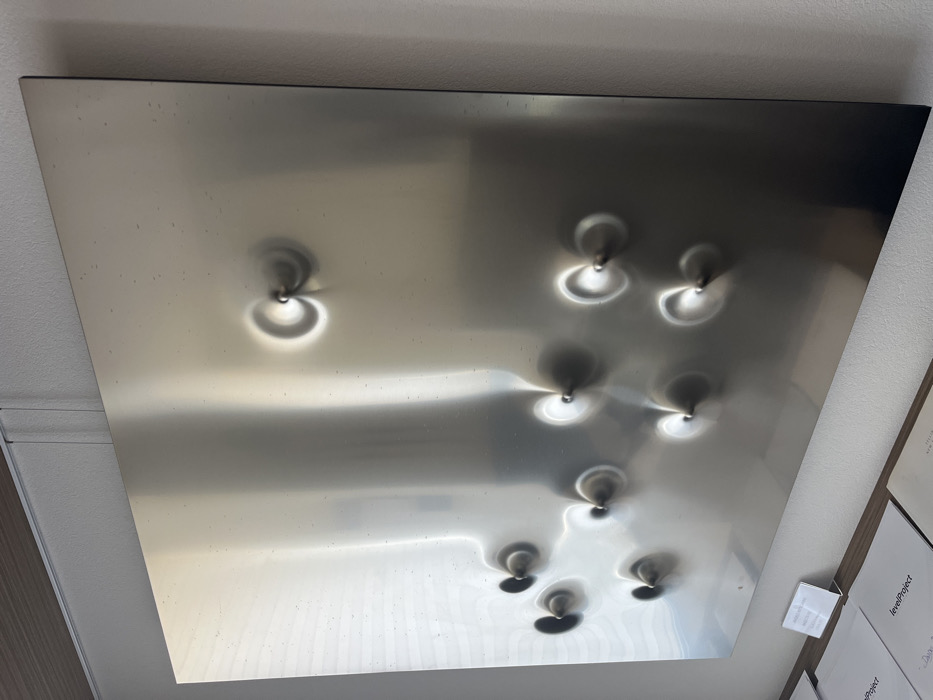
An art installation is documented within an interior space located in Galatina, Italy. The image features a large, vertically oriented, rectangular panel of brushed or semi-polished metallic material, affixed to a plain, light-colored wall. The panel exhibits approximately ten distinct, irregularly spaced conical indentations or protrusions across its surface. Each such feature is centered by a small, dark metallic pin, generating localized reflective light patterns. The panel is suspended from a ceiling-mounted track system by thin cables. Below the panel, on a light-toned surface, are multiple white, softcover booklets; one visible cover reads "levelProject." Adjacent to the booklets, a small, clear acrylic display stand holds text, which is not legible. The ceiling above the artwork is a light brown, possibly wood-grained material.
Galatina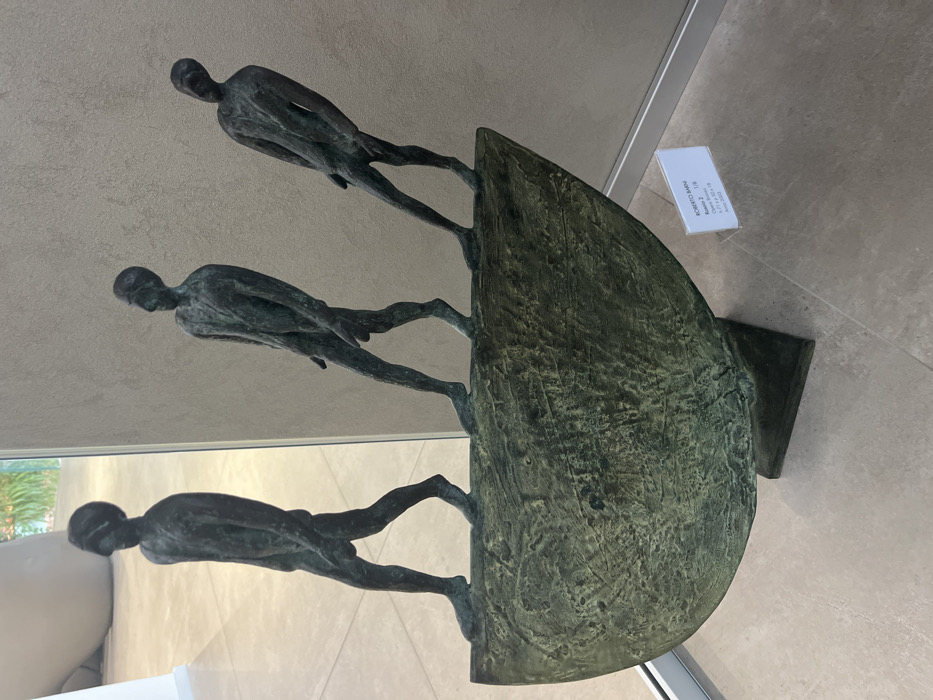
A bronze sculpture by Roberto Barni, titled "Bianco 2" (2002, edition 1/9, 97.5 x 72 x 18 cm, lost-wax technique), is displayed indoors. The sculpture features three elongated, nude male figures with simplified anatomical details, including visible genitalia, cast with a dark greenish patina. They are positioned in a forward-leaning, walking progression atop a textured, semi-circular, boat-like bronze base. The figures face towards the right side of the frame. The leftmost figure is fully reflected in a large, vertical mirror or reflective glass panel positioned adjacent to the sculpture. The sculpture rests on a light-colored, tiled floor. A light brown, subtly textured wall forms the background to the right. An informational label detailing the artwork is placed on the floor to the right of the sculpture. This scene is an indoor art exhibition space, such as a modern gallery or museum hall, located in the city of Galatina, Italy.
Galatina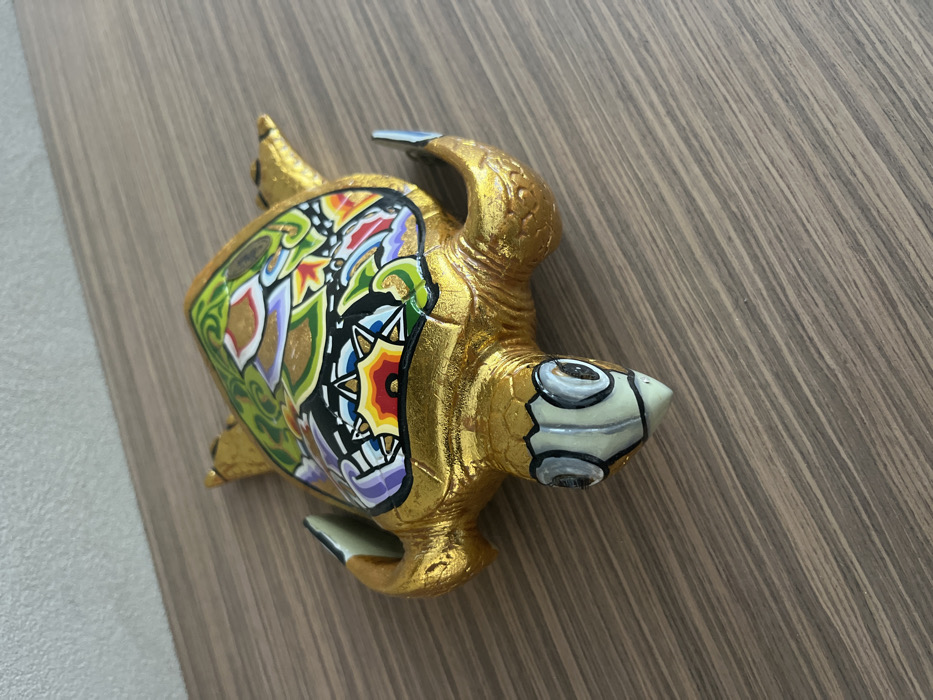
A single decorative turtle figurine is situated on a wooden surface, oriented with its head facing towards the lower left of the frame, in an indoor setting in Galatina, Italy. The figurine is primarily golden, featuring a textured, slightly wrinkled appearance across its body, flippers, and head. Its carapace is intricately decorated with a mosaic of colorful patterns, including vibrant greens, blacks, reds, yellows, purples, and whites, interspersed with gold accents and outlined details. These patterns combine geometric shapes with stylized organic and floral motifs. The turtle's head is a lighter, pale beige color with distinct dark grey and white painted eyes. The underlying wooden surface exhibits prominent parallel grain lines, and a plain, light-colored wall serves as the background. No people, active movements, or direct interactions are visible.
Galatina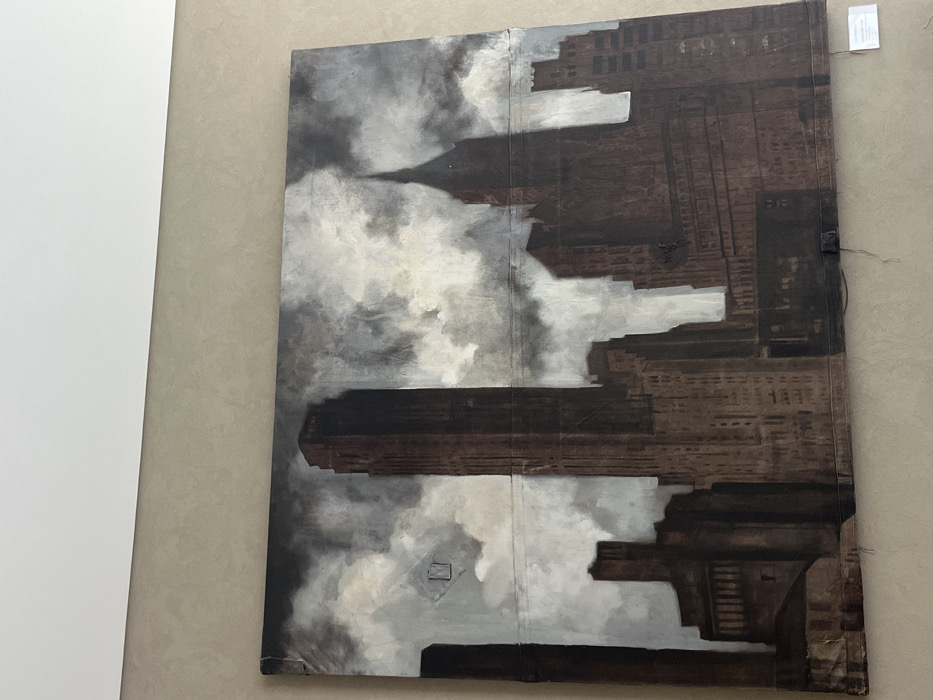
A large, rectangular painting depicting a dark, stylized cityscape is centrally displayed on a light beige textured wall. The artwork, characterized by a muted palette of dark browns, greys, and whites, portrays a dense cluster of tall buildings under a heavily clouded, ominous sky. Prominent features include a slender, dark brown skyscraper in the central-left and a building with a pointed spire-like roof to its right, reminiscent of early 20th-century metropolitan architecture. Visible horizontal and vertical seams across the canvas suggest the artwork may be composed of multiple panels or sections. Staples or fasteners are visible along the upper-left edge of the canvas. A dark, thin wire extends from the lower-right edge of the painting. Below the artwork, a small white label with black text is affixed to the wall. The wall meets a clean white ceiling or trim line at the top of the frame. This scene is located in the city of Galatina, Italy.
Galatina
The image displays a solid, uniform teal-blue background. White, sans-serif text is horizontally centered and vertically positioned in the lower third of the frame. The text reads: "real vibes need no edits. just us. #together #unfiltered". No people, subjects, objects other than the text, actions, or interactions are present. The environment is an abstract, untextured color field. The image contains no visual elements depicting a physical location; therefore, no specific location in the city of Galatina, Italy, can be identified from the content.
Galatina
The scene depicts an indoor environment, specifically an office or conference room in Galatina, Italy. A white table surface occupies the majority of the frame. In the bottom right quadrant, a black computer keyboard is partially visible, angled towards the viewer. Notable keys include 'Esc' with a blue padlock icon, 'F1' with a blue crescent moon icon, 'F2', 'F3', '1', '2', '3' (with '£'), and '4' (with '$'). Positioned centrally on the table, between the keyboard and a tray, is a small, bronze-colored humanoid figurine. The figurine appears to be a stylized, armored figure, possibly a character from popular culture, facing away from the keyboard towards the background. In the upper-middle portion of the table, a black rectangular tray holds an assortment of individually wrapped candies. The candies are primarily in green and yellow/orange wrappers. Identifiable branding on the green wrappers includes "SAILA," and on the yellow/orange wrappers, "Gelées." To the far left, a document with green graphics is partially visible on the white table. A faint glimpse of a person's arm or sleeve is discernable at the extreme top edge of the image.
Galatina