Gayawa, Nigeria
30 memories from Gayawa, Nigeria

The image shows a man sitting in a shop in Gayawa, Nigeria, looking at his phone. He is wearing a light green traditional outfit. The shop shelves are stocked with various products, including cleaning supplies, food items, and personal care products. A pair of scissors is visible on the white table in the foreground. The overall impression is of a small business in a commercial setting.
Gayawa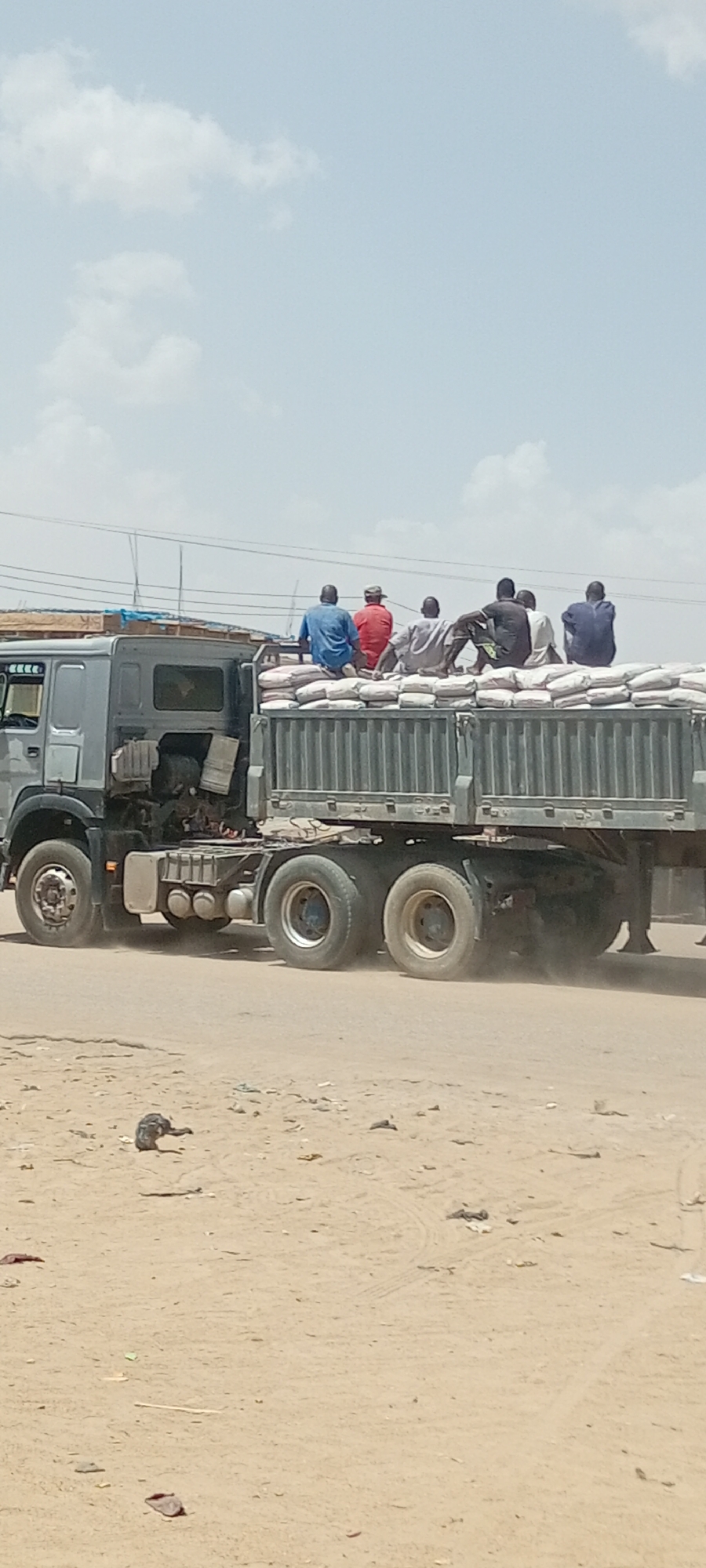
A gray, flatbed truck is transporting a load of what appears to be bags of cement. Six people are sitting atop the bags. The truck is driving on a dirt road in what appears to be a built-up area, with utility lines in the background. There are several pieces of litter on the road in the foreground. The sky is blue with scattered clouds. The location is Gayawa, Nigeria.
Gayawa
In a small, brightly lit convenience store in Gayawa, Nigeria, a woman with red/brown dreadlocks, wearing a dark blue top and an olive green apron, is seated on a wooden stool. She is actively mixing something in a white bowl with a utensil. The shop is densely packed with various products. Shelves along the back and right walls are fully stocked with packaged goods, including food items, drinks, and what appear to be toiletries, with many items also hanging from the ceiling. On the floor near the woman, two pairs of flip-flops are visible, along with a blue plastic bag containing small white objects and some scattered debris. A red Coca-Cola crate and a carton of eggs are also present. To the left, a metal counter or table is visible. The woman appears focused on her task. The blue plastic bag has "JEAN" printed on it.
Gayawa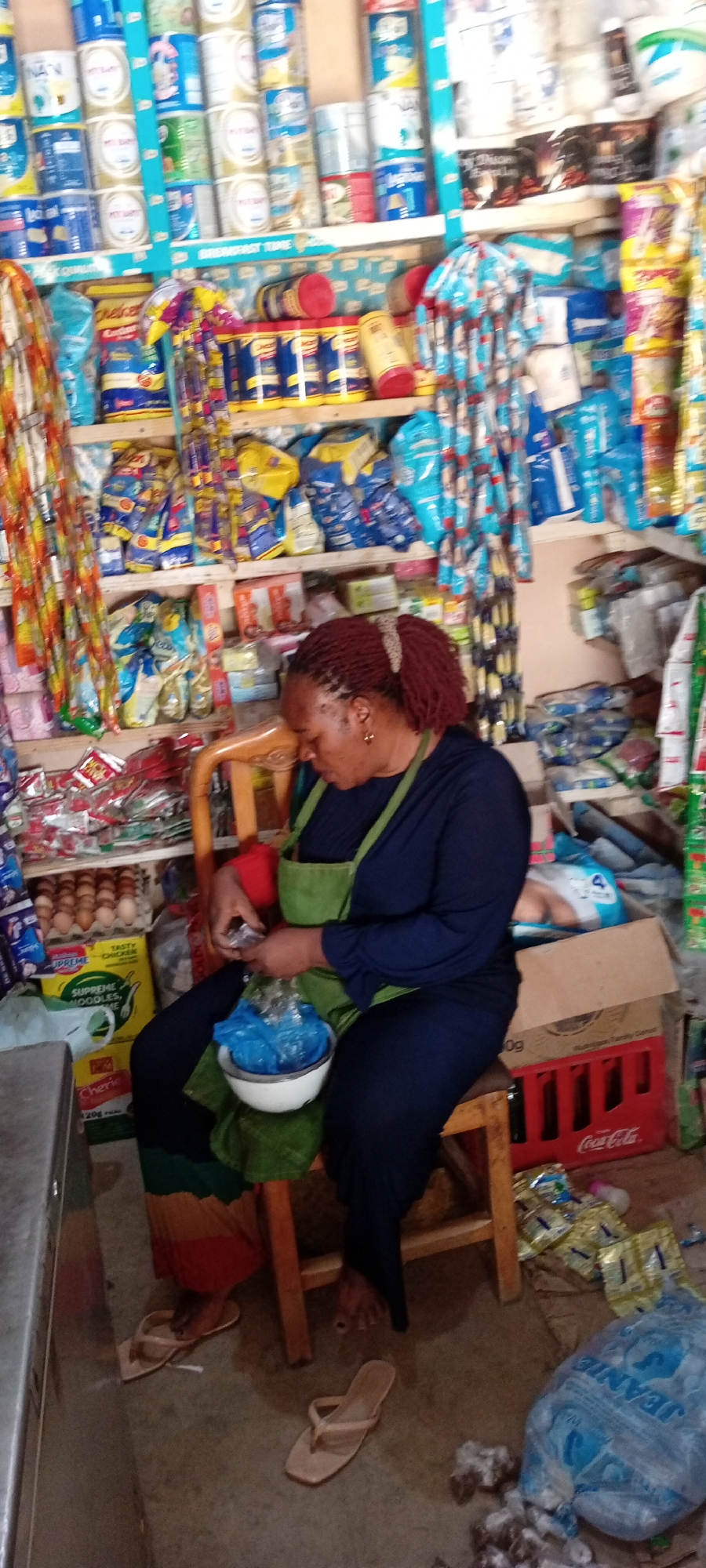
This image captures the interior of a small, well-stocked shop, likely a local convenience store, in Gayawa, Nigeria. The scene is dominated by a woman, appearing to be middle-aged, with red dreadlocks tied in a ponytail. She is wearing a dark blue long-sleeved top and a green apron, and is seated on a simple wooden stool. The woman is actively engaged, looking down at her hands, where she holds a small item over a white bowl that contains a blue plastic bag. This suggests she might be weighing or packaging goods for a customer. Her light-colored flip-flops are visible on the concrete floor beside her. The shop itself is densely packed with various products arranged on wooden shelves. The top shelves are filled with numerous tins of milk powder, identifiable by brands such as "NAN" and "PUREMILK." A shelf divider prominently displays the text "BREMFAST TIME." Lower shelves showcase an array of packaged items, including yellow bags of "Chelsea" sugar, "SUPREME NOODLES" with "TASTY CHICKEN" flavor, and other household goods. Bundles of sachets hang from strings, adding to the cluttered yet functional appearance. On the left side of the frame, a tray of eggs is visible, along with a package labeled "CHERIE 20g." The floor on the right features a red "Coca-Cola" crate and a large blue plastic bag with the brand name "JEANIE," surrounded by some scattered wrappers. The overall impression is that of a bustling, essential local business. The lighting is ambient, with no distinct time of day or weather indicated.
Gayawa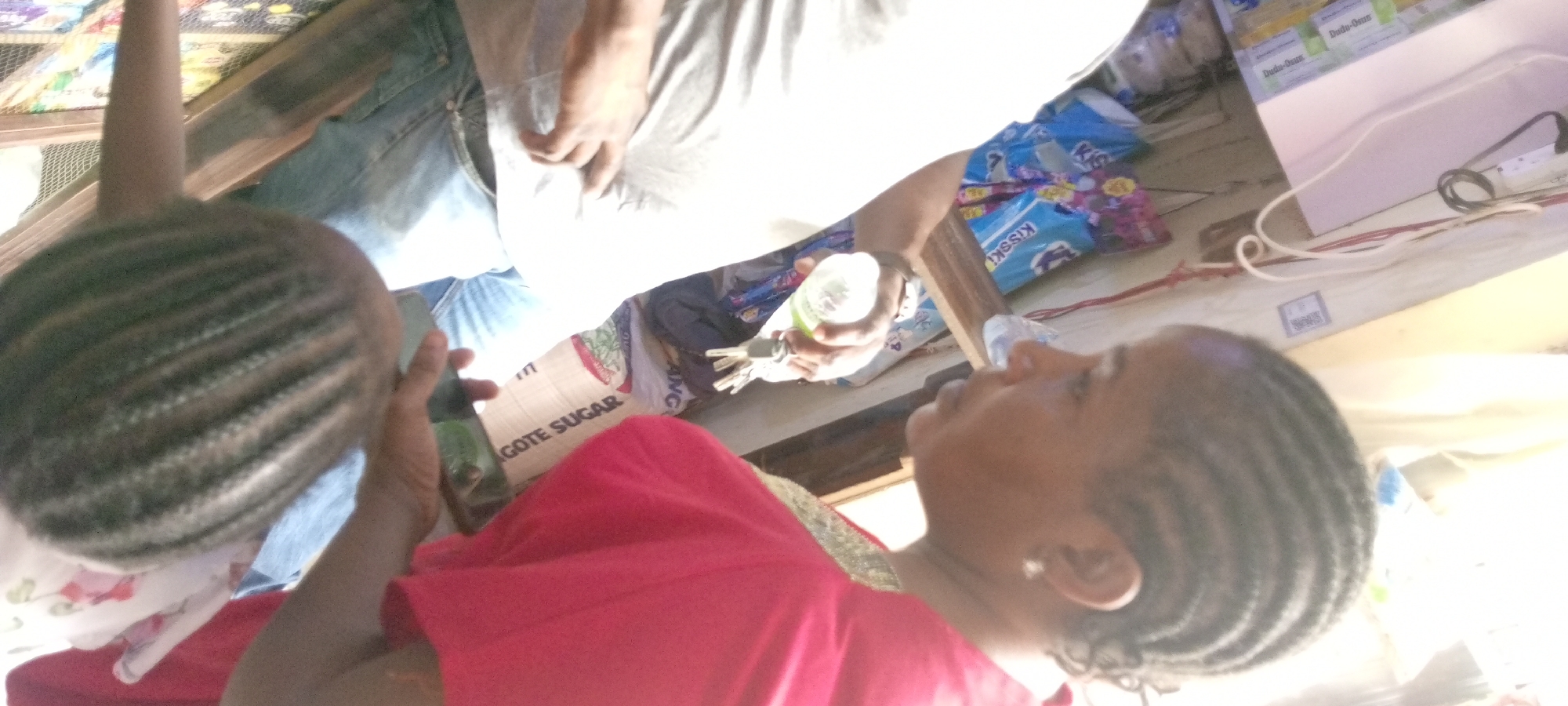
The image, taken in Gayawa, Nigeria, captures a sideways view of an indoor or semi-outdoor setting, likely a small shop or market stall. The scene features three individuals and various packaged goods. In the foreground on the left, a child's head is visible, adorned with dark cornrow braids. The child wears a light-colored top with a floral pattern. To the right, an adult female is seen in profile, looking towards the left. She also has cornrow braids and is dressed in a vibrant red garment, possibly with green trim. A small earring is visible on her right ear. Towards the center, partially obscured by the woman, another individual (likely male) is visible from the waist down, wearing blue jeans and a light-colored t-shirt. This person holds a small, clear plastic bottle with a white cap in one hand and a bunch of keys in the other. The setting includes several commercial products. A large white bag prominently features the text "DANGOTE SUGAR". Nearby, blue packages with "KISSKISS" branding are visible. On a white surface or shelf to the right, small boxes are stacked, bearing the label "Dudu-Osun". White and red electrical cables are also visible on a surface in the background, alongside some wooden structures that may be shelving. The activity appears to be an everyday interaction or transaction taking place within the shop. The bright lighting suggests it is daytime. The presence of specific branded products like Dangote Sugar, Kisskiss, and Dudu-Osun serves as a strong location cue, consistent with the Nigerian context. Emotions are not clearly discernible from the partial views of the individuals.
Gayawa
An indoor, slightly tilted medium shot captures a man standing in what appears to be a small shop or store in Gayawa, Nigeria. The man has a dark complexion, a beard, and short dark hair. He is wearing a light grey short-sleeved t-shirt, blue jeans, and a watch on his left wrist. In his left hand, he holds a clear plastic bottle containing a bright green liquid, likely a beverage, along with a small bunch of keys. He is looking towards his right, out of the frame. His expression is calm. The background is somewhat blurred but shows shelves stacked with various items, suggesting merchandise in a retail setting. On the far right side of the image, there is a wooden structure, possibly a doorframe or counter. Beyond this, a person in a red garment is partially visible. Further back, a red and white poster or packaging can be seen on a wall or surface, with the word "MILO" faintly visible in white text on a red background. The floor beneath him appears to be tiled. The lighting is bright, indicating it is likely daytime.
Gayawa
The image shows a close-up of a stack of unripe watermelons arranged in a pyramid shape. The watermelons are predominantly green with light streaks and a slightly dirty appearance. They are stacked on top of each other and appear to be resting on a wooden surface. In the background, indistinct items possibly related to a shop or store are visible. The location is assumed to be within the city of Gayawa, Nigeria.
Gayawa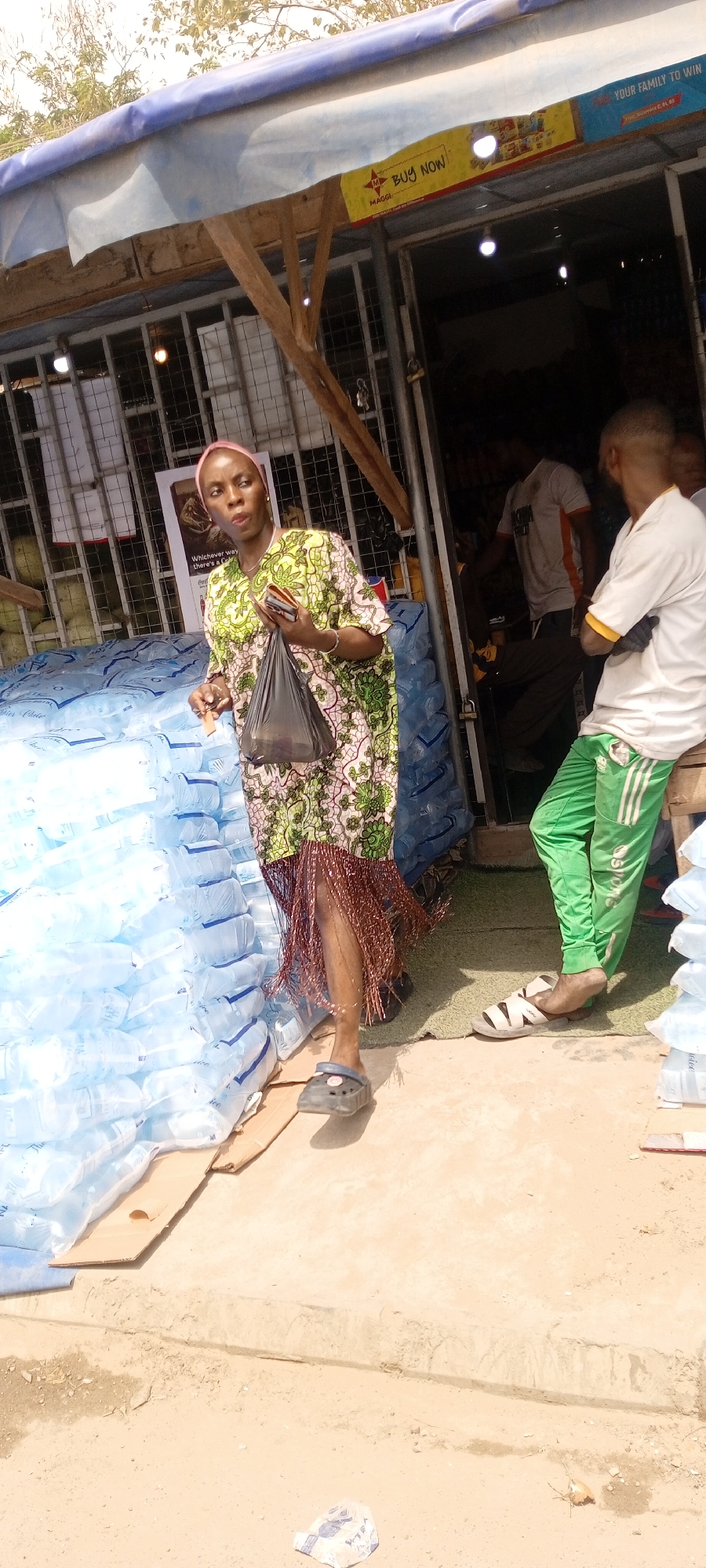
Outside a shop in Gayawa, Nigeria, a woman with a pink head wrap wearing a green and white patterned dress, brown fringed hem, and black Crocs stands next to a stack of bottled water. She is carrying a black plastic bag and a wallet or phone. To her right, a man in a white shirt and green Adidas pants leans against the shop’s entrance. Inside the shop, other people are visible. Signs are displayed, including a yellow Maggi advertisement and a blue sign with the phrase "YOUR FAMILY TO WIN." The ground is sandy and there's a piece of trash.
Gayawa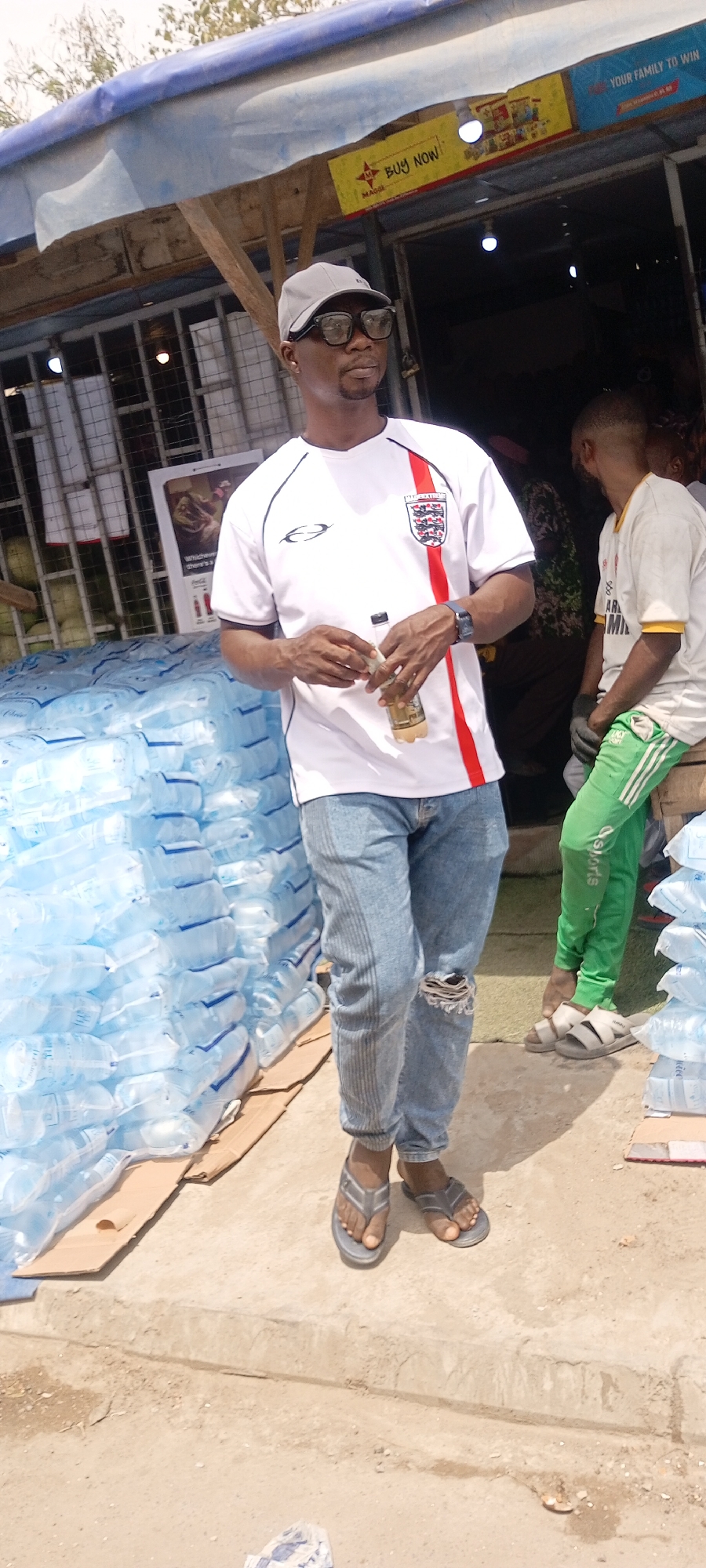
The image shows a man standing in front of what appears to be a retail establishment or market stall. The location can be identified as the city of Gayawa, Nigeria. The man is wearing a white t-shirt with a red stripe on the side and an England football crest on the chest, light blue jeans with a rip at the knee, a gray baseball cap, and dark sunglasses. He is holding a small bottle in his hands. To his left is a large stack of bottled water. In the background, there's another person wearing a white t-shirt and green pants, seated, with more stacks of bottled water nearby. There are signs above the stall, some featuring advertising and brand names. The stall appears to be constructed with a corrugated metal roof. The ground is a light-colored concrete or paved surface.
Gayawa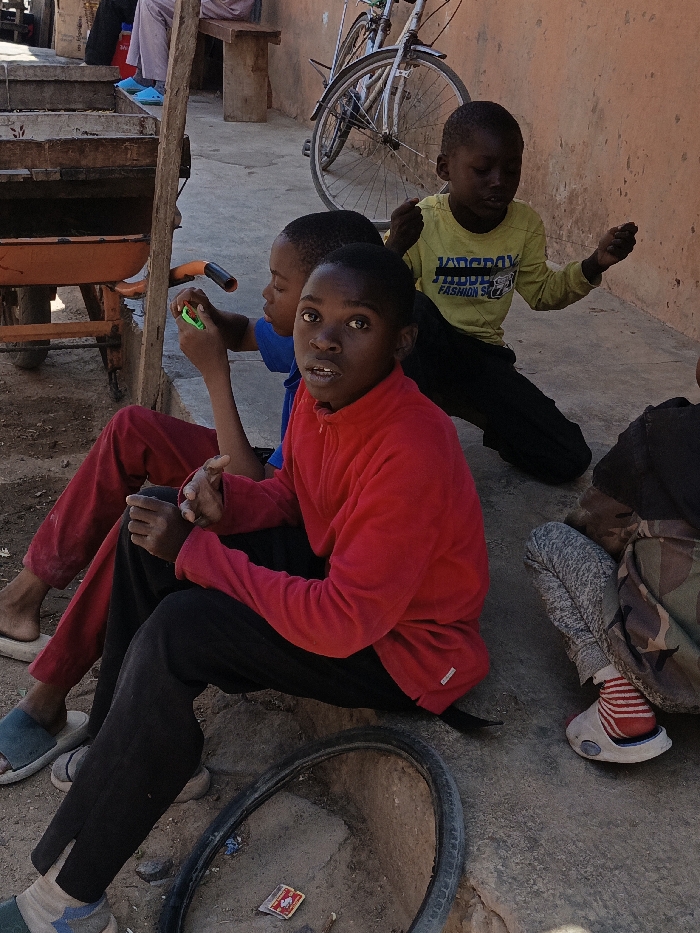
This image depicts an outdoor scene in the city of Gayawa, Nigeria, featuring multiple individuals, primarily children, in varying states of repose on a concrete and dirt ground. In the foreground and central to the image, a young male, appearing to be a child, is seated, facing forward with a direct gaze toward the observer. He wears a red, long-sleeved top with a quarter-zip collar and black trousers. To his left, another young male, also a child, is seated, wearing a blue short-sleeved top and red trousers. He holds a bright green, cylindrical object in his right hand. Directly behind this second child, a wooden structure, possibly part of a cart or stand, is visible, featuring an orange handle. Further to the right, a third young male child is seated, dressed in a yellow long-sleeved shirt with "JADEDAY FASHION S" text and black trousers; he holds thin, light-colored strings in both hands. The lower body of a fourth individual, partially obscured on the far right, shows camouflage-patterned trousers and feet clad in red and white striped socks within white sandals. In the immediate foreground, a detached black bicycle tire rests on the ground, near a small, red, rectangular object, possibly a wrapper or matchbox. The ground surface transitions from rough concrete to packed dirt. In the background, leaning against a light orange-brown wall, a bicycle with a silver frame and black tires is visible. To the far left in the background, a person's lower legs are visible, seated on a wooden bench, wearing light blue sandals.
Gayawa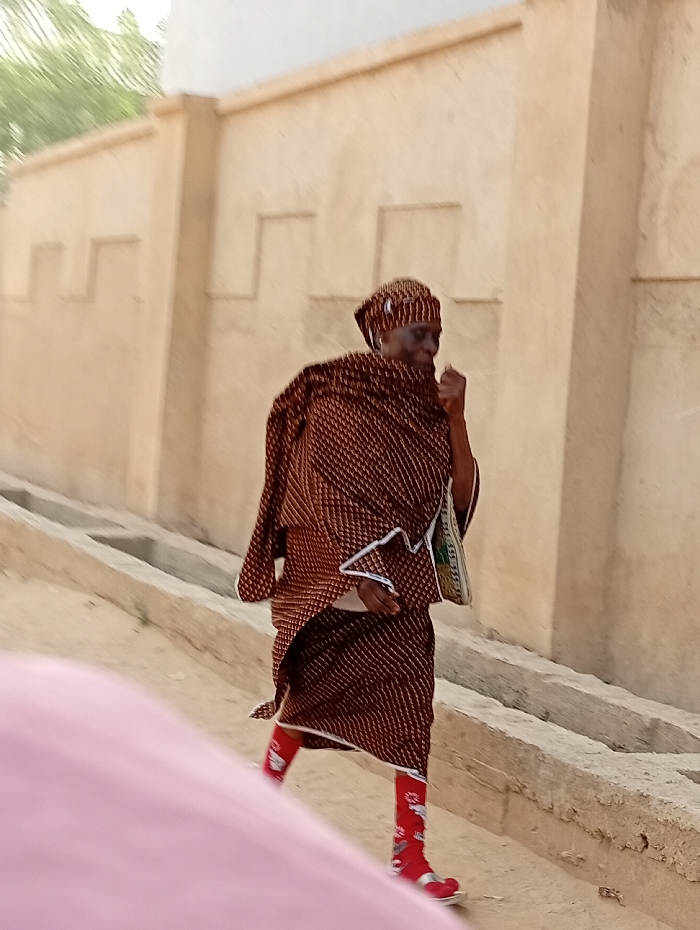
The scene is set in Gayawa, Nigeria, depicting an individual walking on a dirt path alongside a building. The person, an adult, is dressed in a brown patterned head covering and a matching draped garment with white trim. Bright red socks adorned with white patterns are worn beneath silver open-toed sandals. A patterned fabric bag is carried on the left side, and the right hand is raised towards the face. To the right of the path, a light-colored building wall featuring rectangular relief patterns extends horizontally, parallel to a concrete drainage channel. The ground consists of light brown exposed earth. Blurred green foliage and a bright sky are visible in the upper background. A soft pink, out-of-focus object occupies the lower-left foreground.
Gayawa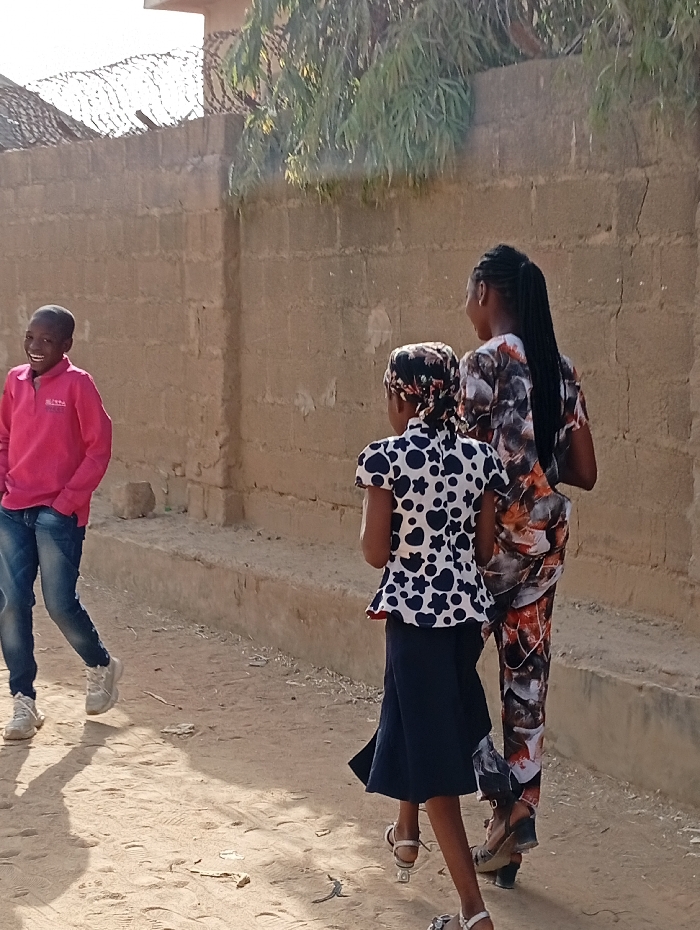
The scene depicts an outdoor setting on a dirt path in Gayawa, Nigeria. A tan concrete block wall, topped with barbed wire and overhung by green foliage, forms the background. The ground is light brown dirt, showing strong shadows indicative of bright daylight. Three individuals are present. On the left, a young male with dark skin and short hair walks towards the right, smiling broadly with an open mouth. He wears a pink long-sleeved polo shirt, blue jeans, and white athletic shoes, with both hands in his pockets. In the center, a young female with dark skin walks away from the viewer. She wears a patterned headscarf, a white short-sleeved top with dark blue heart and flower patterns, a dark blue pleated skirt, and light-colored open-toed sandals. To her right and slightly behind her, another young female with dark skin also walks away from the viewer. She has long dark braided hair and wears a multi-colored patterned t-shirt and matching patterned pants, along with dark wedge sandals. Both females are in motion, walking in the same direction, away from the camera's perspective.
Gayawa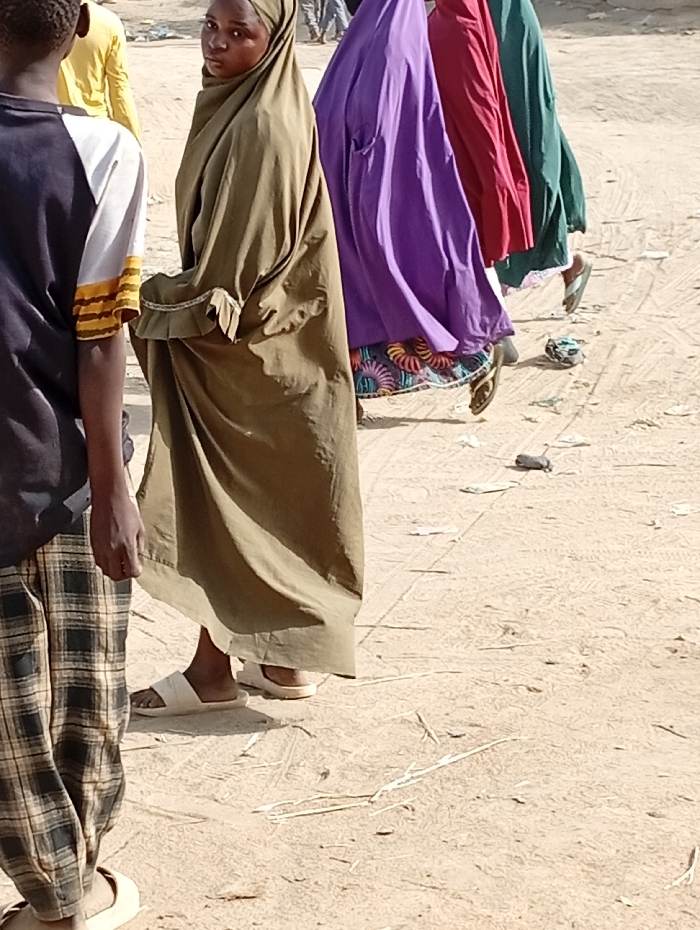
The image depicts a dusty, unpaved outdoor environment in Gayawa, Nigeria, under bright daylight conditions. Five individuals are present. In the left foreground, the back and left side of a person wearing a dark and white short-sleeved top with a yellow stripe, and brown and black plaid trousers, are visible. This person wears light-colored slip-on shoes. To their right, a young female, dressed in a full olive-green hijab/khimar with a ruffled trim near the waist, looks directly at the camera, slightly over her left shoulder. She wears white sandals. Behind her, a line of three additional individuals walk away from the camera. The first in this line wears a purple full-body covering over a patterned dress and flip-flops. The second wears a red full-body covering, and the third wears a dark green full-body covering. Scattered debris, including small white fragments and dried grass, is present on the ground. Vehicle tracks are discernible in the dust.
Gayawa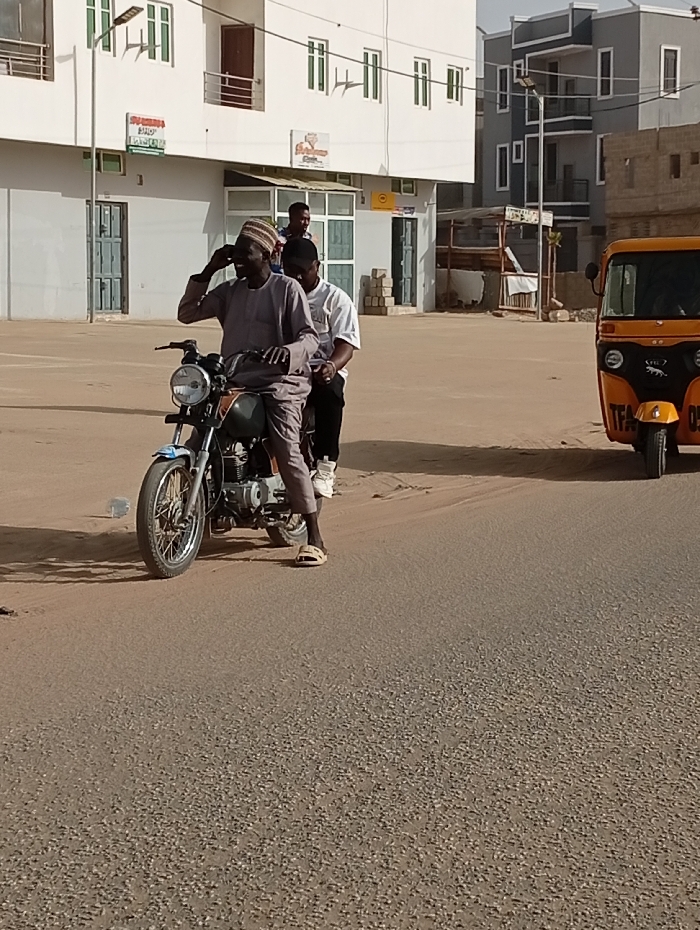
In the city of Gayawa, Nigeria, a daylight street scene shows two males on a dark-colored motorcycle positioned on a paved road. The driver, wearing a grey agbada-style garment and a patterned cap, has his right hand raised to his ear, smiling. He wears light-colored sandals. Seated directly behind him is a male passenger in a white t-shirt and dark pants. A third male, wearing a red shirt, is visible standing behind the motorcycle. To the right, an orange three-wheeled auto-rickshaw (Keke Napep) with "TFA 05" partially legible on its front is present. The road surface is granular and appears slightly dusty. In the background, a multi-story white building with green-framed windows and a visible sign reading "SUKIYA SHOP" stands to the left. Further right in the background, another multi-story building with a grey facade and white trim is visible. The scene is brightly lit by natural sunlight, casting sharp shadows.
Gayawa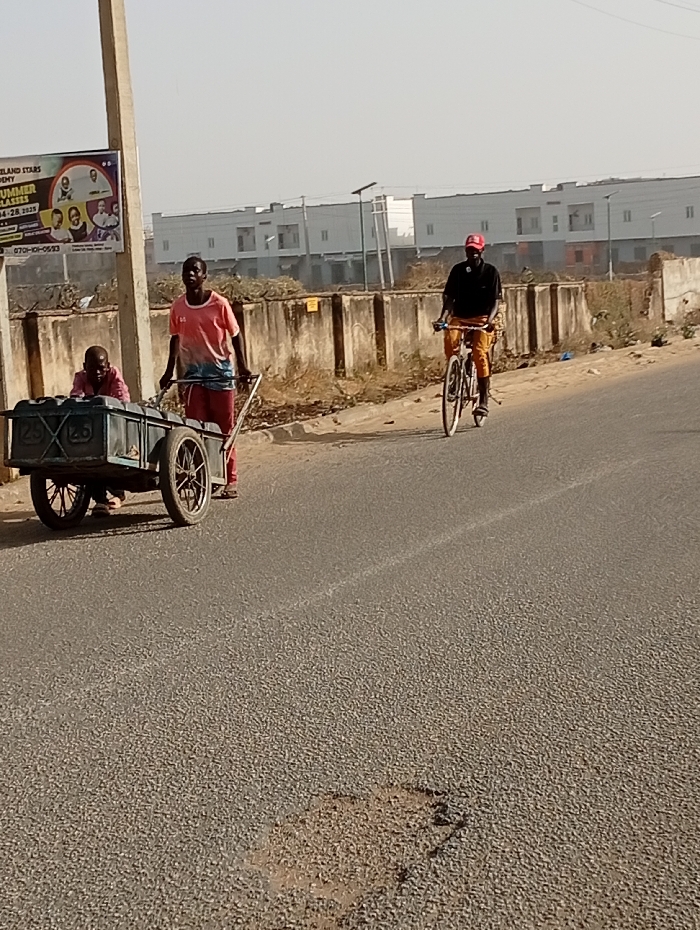
The image depicts a street scene in Gayawa, Nigeria, during daylight hours under a clear, bright sky. Three males are positioned on and alongside an asphalt road. On the left, a male wearing a pink and blue short-sleeved shirt with the number "10" on the chest pushes a two-wheeled, dark-colored metal handcart. Inside the handcart, a second male, wearing a red shirt, is seated low. To the right, a third male, wearing a black long-sleeved shirt, brown trousers, a red baseball cap, and a black object around his neck, rides a bicycle. All three individuals are moving in the same general direction, towards the left of the frame. The asphalt road surface exhibits minor wear and a prominent brown pothole in the foreground. A light-colored utility pole on the far left partially obscures a colorful billboard. The billboard displays text including "LAND STARS ACADEMY," "SUMMER CLASSES," "04-28-2023," and a phone number "0701-101-0593." A low, concrete barrier runs parallel to the road, behind which are piles of dry vegetation and several light-colored, multi-story buildings in the distance. Small, dark-colored street lights are visible along the distant barrier.
Gayawa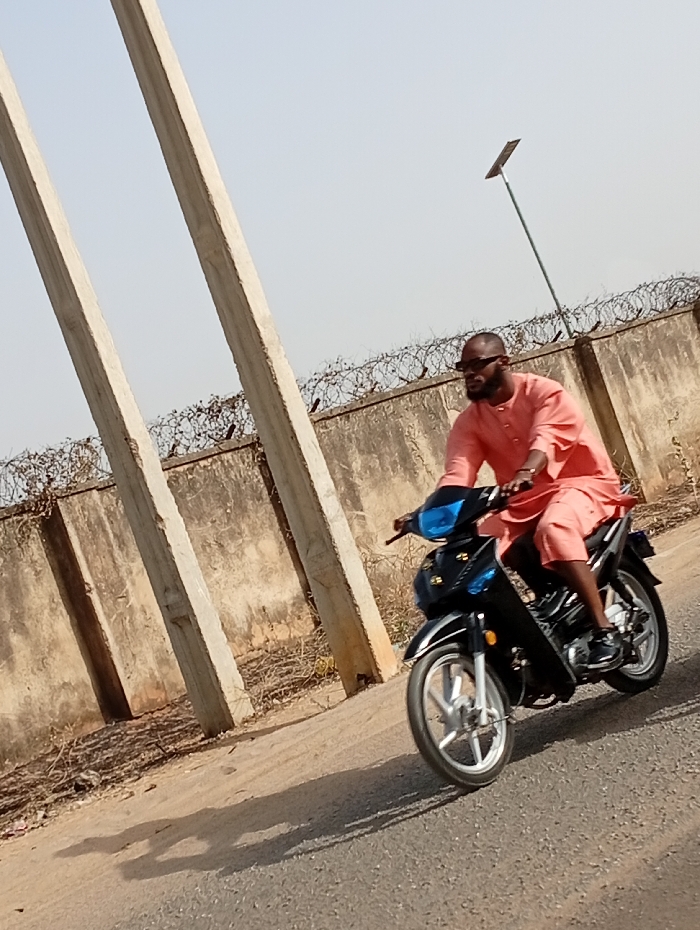
A male individual is observed riding a black step-through motorcycle on an asphalt road in Gayawa, Nigeria. The rider, who is bald with a short beard, wears dark sunglasses and a long-sleeved, knee-length, peach-colored traditional garment. The motorcycle features silver-colored five-spoke wheels. In the background, two light-colored concrete utility poles lean diagonally, originating from the left foreground. Behind these, a textured concrete wall runs horizontally across the midground, topped with multiple coils of barbed wire. Further back and to the right, a slender pole topped with a solar panel is visible above the wall. The sky is clear and light-colored, indicating daylight, and distinct shadows are cast onto the road surface, suggesting a high sun angle.
Gayawa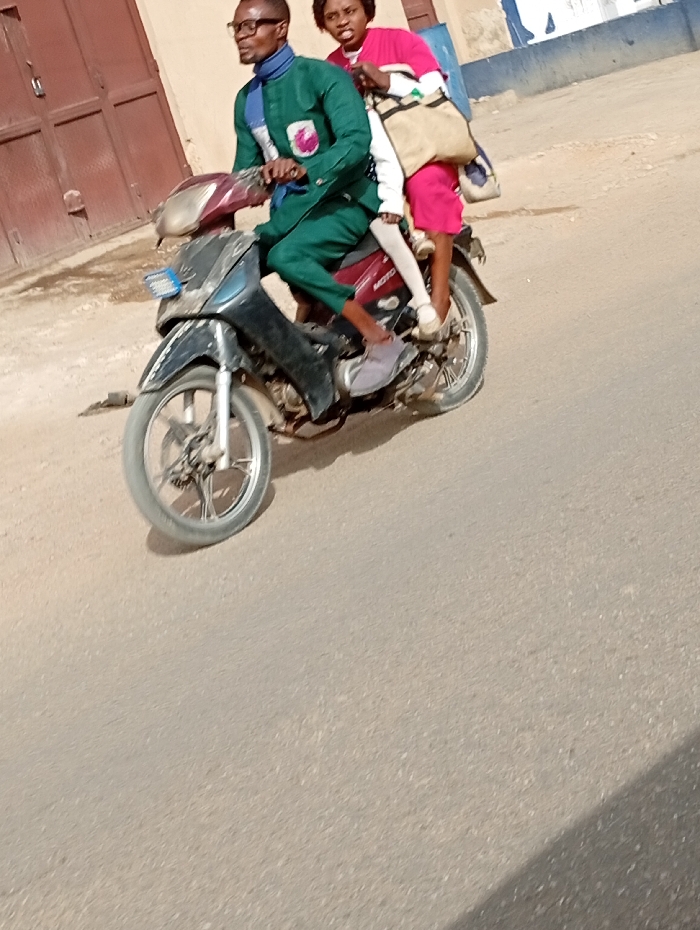
An image captured in Gayawa, Nigeria, depicts two individuals riding a single motorcycle on a paved road under daylight conditions. The motorcycle, dark-colored with a maroon rear section and visible "MOTO" branding, is in motion, evidenced by the slight blur of its front wheel. The driver is a male individual, appearing to be in his 20s or 30s, wearing eyeglasses, a dark green long-sleeved tunic with a light-colored design on the chest, a blue and white patterned scarf or neck wrap, and dark green trousers. He has light-colored footwear on his right foot and appears barefoot on his left foot, which is positioned on the motorcycle's footrest. His gaze is directed forward and slightly to the left. Seated behind the driver is a female individual, also appearing to be in her 20s or 30s. She wears a bright pink long-sleeved top with a white stripe pattern on the sleeves, bright pink trousers or capris, and light-colored closed-toe shoes. She carries a light-colored shoulder bag with dark straps, positioned over her right shoulder. Her expression is neutral, and she looks towards the right side of the frame. Her legs are positioned over the motorcycle's rear seat, with her feet on the passenger footrests. The background shows a light brown or tan building with a closed brown metal door on the left. Further to the right, portions of a light-colored wall with blue markings are visible. The road surface is light grey asphalt. Shadows are cast from the left side, indicating the sun's position.
Gayawa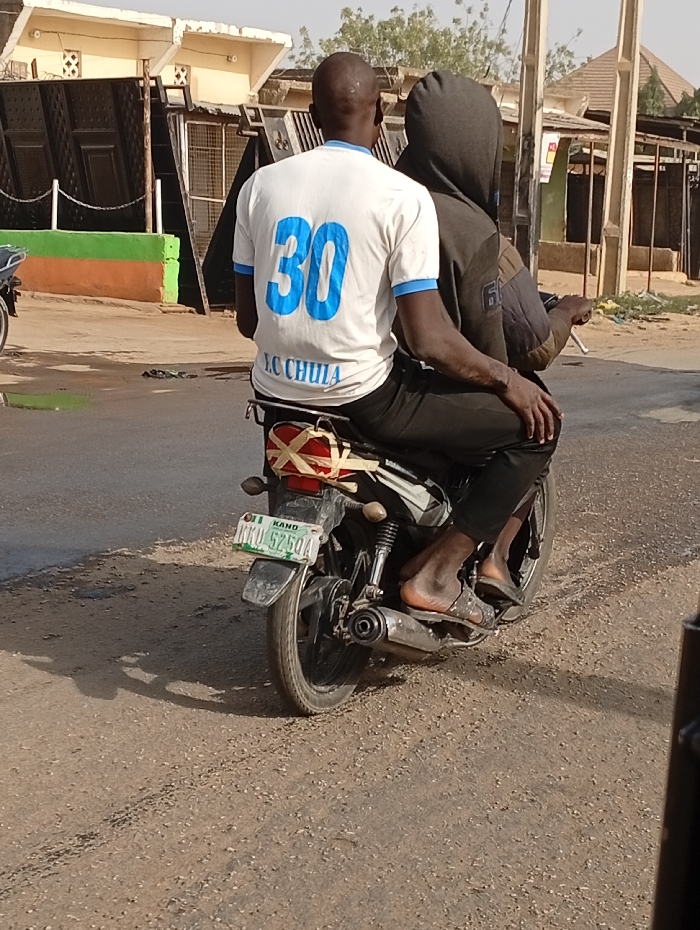
Two males are observed from behind, riding a dark-colored motorcycle on a light brown, unpaved road in Gayawa, Nigeria. The driver, with a bald head and dark skin, wears a white short-sleeved t-shirt featuring a large blue number "30" and "J.C. CHULA" printed below it, along with black trousers and sandals. His left arm is extended forward, presumably operating the motorcycle. Seated directly behind him is a passenger, clad in a dark grey hooded jacket with the hood up, black trousers, and sandals. The passenger's right hand rests on the driver's left hip. The motorcycle has a visible Nigerian license plate from Kano state, reading "01I KANO KNU 525QA", and a reddish-brown patterned item is strapped to its rear seat. The background features several light-colored buildings with dark metal doors and gates, some exhibiting green and orange painted sections on their lower walls. Sparse vegetation and dry trees are visible further in the background under bright daylight, casting shadows on the road surface.
Gayawa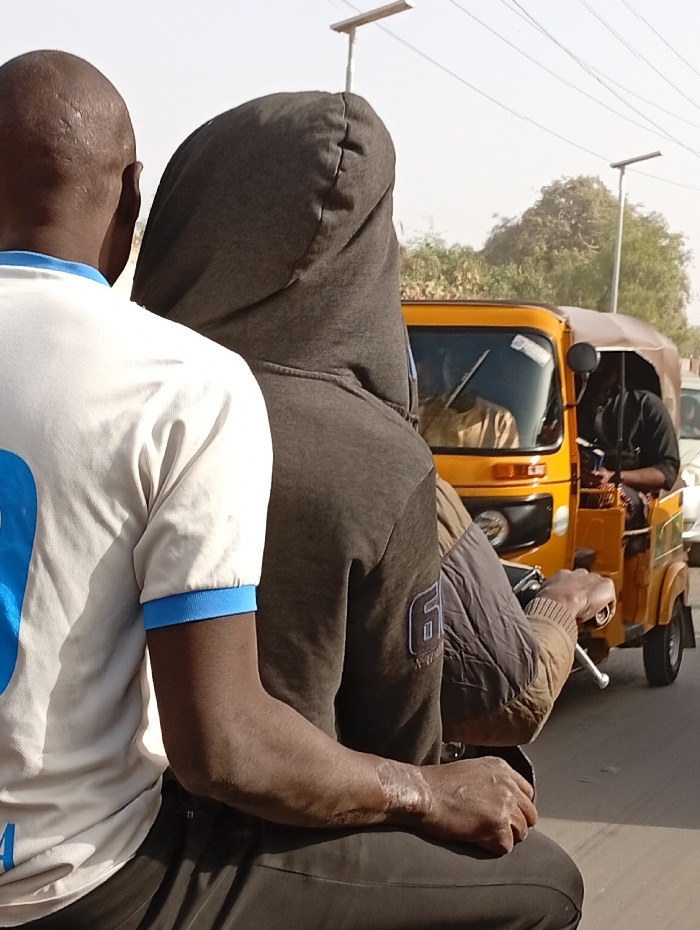
The image depicts an outdoor street scene in Gayawa, Nigeria. In the foreground, two dark-skinned individuals are seated on a vehicle, viewed from behind. The person in front wears a dark grey hooded sweatshirt with the hood up and a "6" insignia on the right sleeve. Scars are visible on their left forearm, and their right hand grips a handlebar, suggesting they are operating the vehicle. The person seated directly behind them has a bald head and wears a white t-shirt with blue sleeve trim. In the midground, a yellow three-wheeled auto-rickshaw (commonly known as a Keke Napep) is partially visible, appearing to be in motion or stopped in traffic. It contains a driver wearing light-colored attire and a passenger in dark clothing. The background includes green foliage, utility poles topped with what appear to be solar street lights, under a bright, clear sky.
Gayawa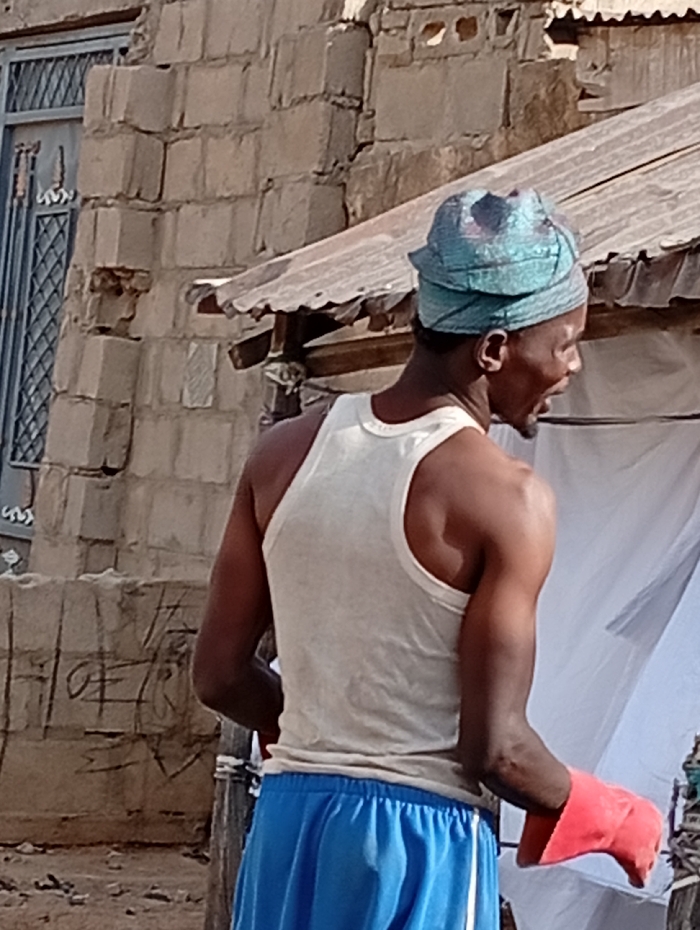
In Gayawa, Nigeria, an adult male stands in profile, facing right. He wears a light-colored sleeveless tank top, blue shorts with a white stripe, and a teal patterned headwrap. His left hand, visible at the lower right, is covered by a bright red glove. His mouth is slightly ajar. Behind him, a corrugated metal roof is visible, along with white fabric, possibly a canopy or curtain, to the right. To the left, a building constructed of light-colored bricks features a window with a dark metal security griller. The ground consists of compacted earth.
Gayawa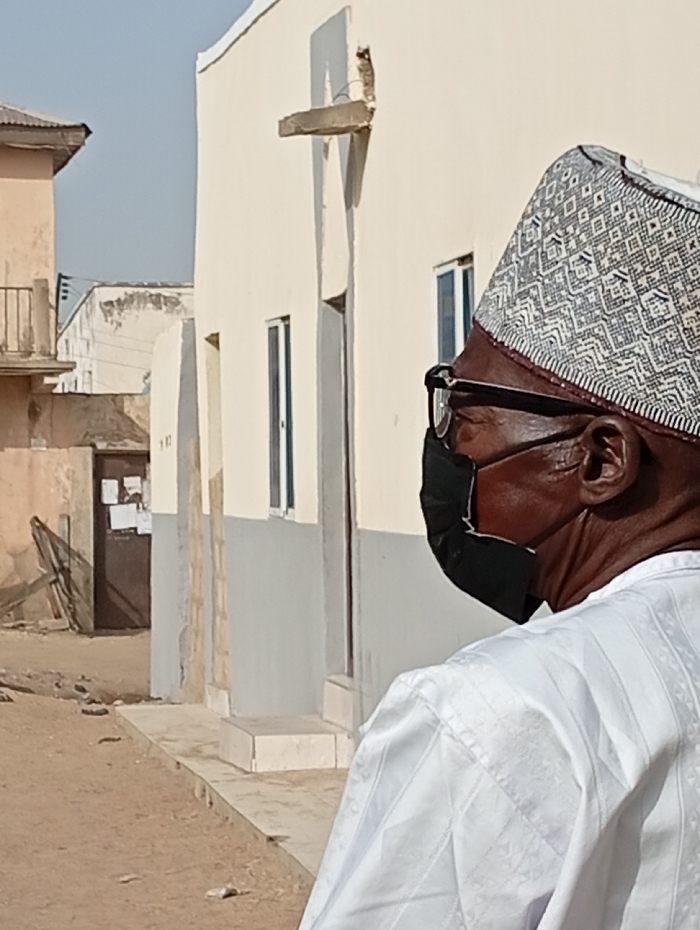
An individual is depicted in a right-profile view, positioned on a dirt path in Gayawa, Nigeria. The subject, a man with dark skin, wears a black face mask covering his mouth and nose, black-framed glasses, and a white and grey patterned cap. His attire includes a white long-sleeved garment featuring subtle striped and patterned textures. In the mid-ground, a light beige building with a grey lower section and two dark-framed windows is visible. A damaged concrete protrusion extends from its upper wall. Further back on the left, a light brown building with a sloped metal roof and a balcony with a metal railing is present. Adjacent to this, another off-white building with a dark wooden door covered in papers is discernible. The ground consists of uneven dirt and sand. The sky is clear blue.
Gayawa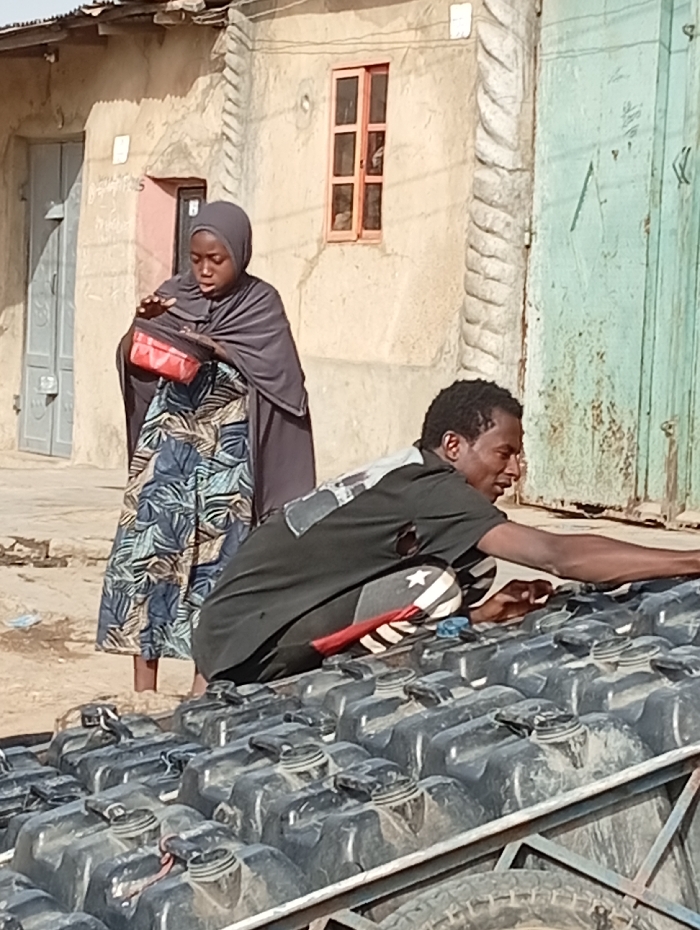
A daylight street scene in Gayawa, Nigeria, depicts two individuals in the foreground and mid-ground. An adult male, wearing a black t-shirt and dark trousers with a patterned stripe on the left leg, crouches over numerous black, rectangular plastic containers with screw-on caps, which are tightly packed on a metal-framed transport structure. He extends his right arm across the containers, while his left hand is also near them, and he looks towards the right. To his left and slightly behind, a young female, clad in a dark grey hijab and a long dark dress over a patterned garment, stands barefoot. She looks down at a red rectangular object held open in her hands. The background consists of a light-colored building featuring a grey wooden door on the left and a small reddish-orange framed window. To the right, a segment of a light green door/gate is visible, along with a decorative, twisted column on the building facade. The ground is unpaved, composed of light brown dirt.
Gayawa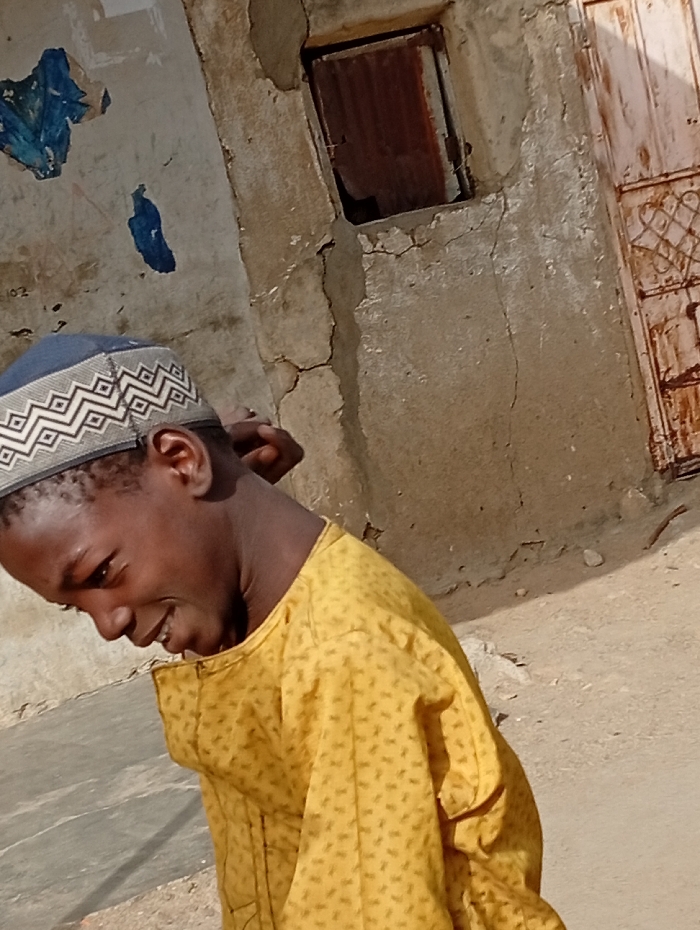
The scene, set in Gayawa, Nigeria, depicts a young male subject outdoors under direct sunlight. The individual has dark skin and is wearing a blue and white geometric-patterned kufi and a yellow long-sleeved garment with a subtle repeating pattern. His head is tilted downwards and to his left, revealing a smiling expression. His right hand is positioned behind his head. The background features a weathered, light-colored building wall exhibiting significant cracks and peeling paint. In the upper-right section of the wall, a small, square window opening is covered by a piece of rusted corrugated metal. To the far right, a portion of a heavily rusted door with embossed decorative elements is visible. The ground surface is dry, consistent with packed earth or sand.
Gayawa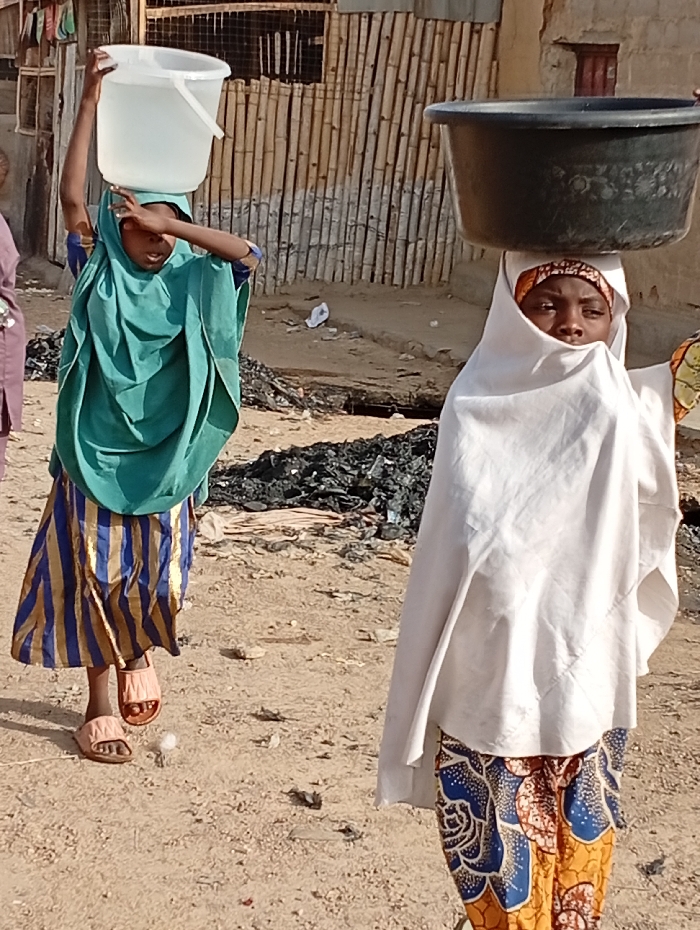
Two individuals are depicted walking on a dirt path in Gayawa, Nigeria, under bright daylight. The person on the left wears a teal head covering, a blue and gold striped skirt, and light pink sandals. This individual carries a white plastic bucket filled with water on their head, stabilizing it with their right hand, while their left hand shields their eyes. Their face is partially obscured. The person on the right wears a white head covering that conceals most of their face, exposing only their eyes and forehead, and a patterned skirt with blue, orange, and brown motifs. This individual carries a dark-colored, possibly black, basin or tub on their head. Their gaze is directed forward. The immediate ground is uneven dirt with scattered small debris. In the middle ground, a pile of dark, charred material is visible. The background features a light-colored structure with a vertical bamboo-slat fence or wall behind the left individual, and a wall with a dark rectangular opening further back on the right.
Gayawa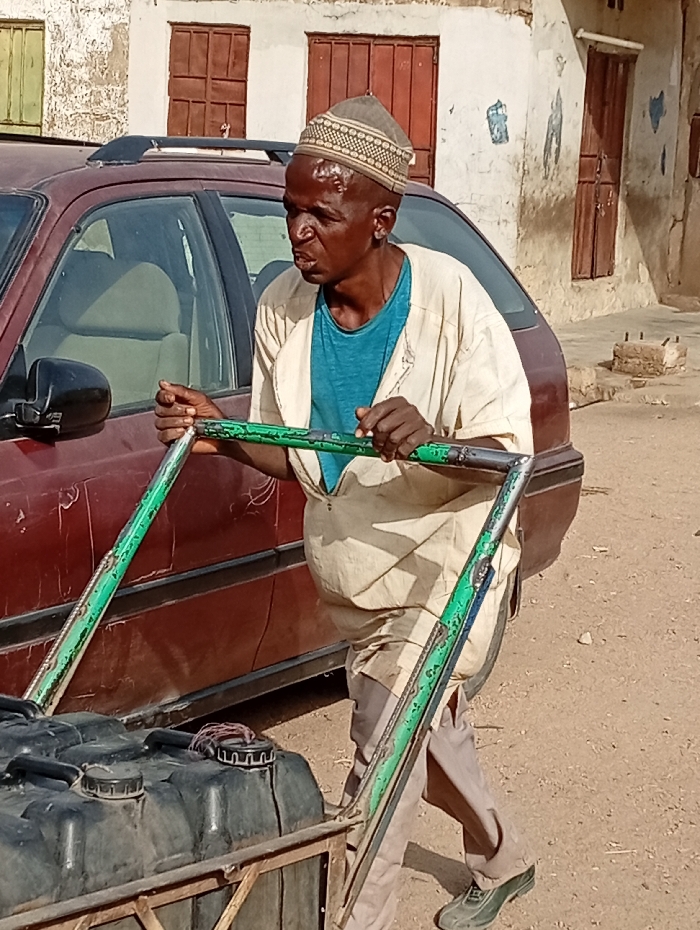
An adult male is depicted in a daytime street scene in Gayawa, Nigeria. He possesses dark skin, a shaved head covered by a light-patterned skullcap, and a visible lesion or scar on his forehead. He is wearing a light-colored tunic over a teal t-shirt, light trousers, and dark footwear. His expression is strained, mouth slightly open, as he grasps the green-painted metal handles of a two-wheeled pushcart. The cart carries at least two black plastic containers, likely jerrycans, one of which has a reddish-brown cord wrapped around its cap. Behind the man and cart, a maroon sedan with a roof rack is parked. In the background, two weathered, light-colored buildings with brown window frames and some faded markings are visible. The ground is unpaved, appearing as dry earth.
Gayawa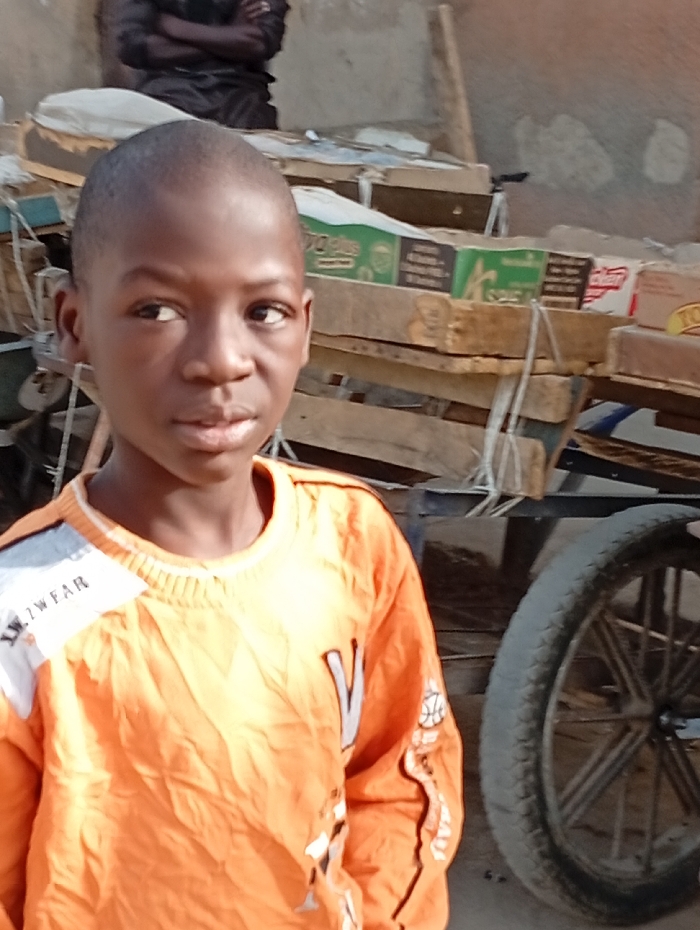
This image depicts an outdoor scene in Gayawa, Nigeria. A young male subject, approximately 8-12 years of age, with dark skin and a close-cropped haircut, occupies the foreground, looking slightly towards the viewer's right with a neutral expression. He wears an orange long-sleeved shirt featuring white and grey accents on the shoulders and sleeves, including a basketball motif on the right sleeve. In the upper left background, a portion of an adult male in dark attire is visible, appearing to be seated or crouched with arms crossed. The midground contains a structure composed of stacked wooden pallets or planks, upon which various cardboard boxes are placed. Identifiable text on one box reads 'M-PLUS' on a green background. To the far right, a spoked wheel with a dark tire is visible, consistent with a cart or bicycle. The immediate environment includes an uneven ground surface and a light-colored, weathered wall in the distant background. The scene is under natural daylight conditions.
Gayawa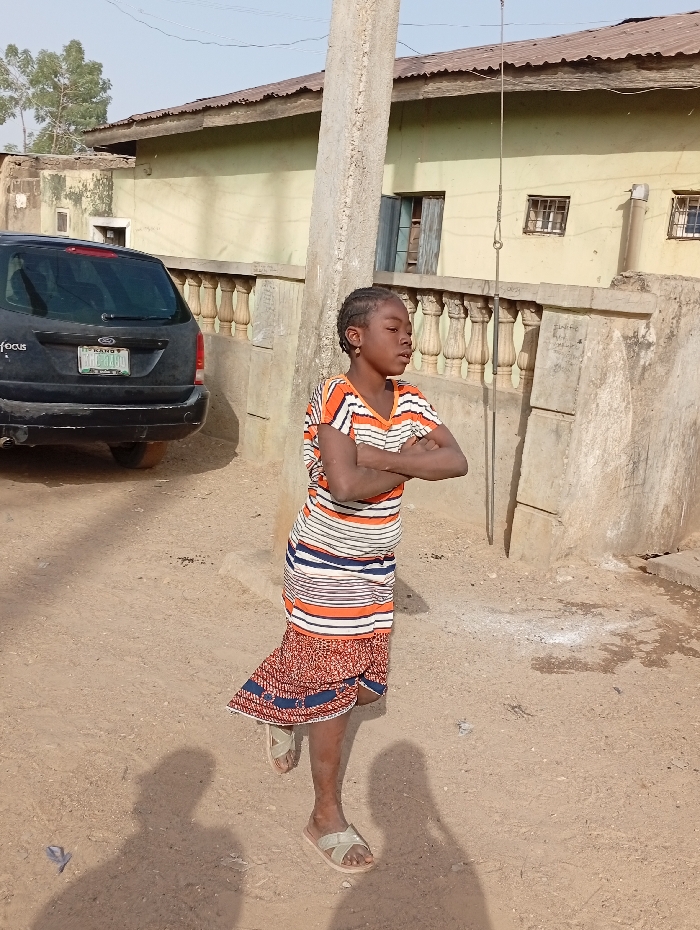
An outdoor scene in Gayawa, Nigeria, depicts a young person standing on an unpaved, reddish-brown dirt surface under a clear sky. The individual, identified as a girl with braided hair, wears a horizontally striped short-sleeved top (orange, white, blue) and a patterned reddish-brown skirt with blue accents, along with light-colored sandals. She stands with her arms crossed, facing slightly right. Her shadow is cast on the ground to her left. To the left, a black Ford Focus station wagon is parked, facing away from the viewer, displaying a Nigerian license plate "KANO GADU." In the background, a light green single-story building with a corrugated metal roof and multiple windows, one featuring a blue shutter, is visible behind a concrete balustrade. A tall, grey concrete utility pole stands to the right of the person, with a metallic rod attached and extending downwards. Another building is partially visible on the far left, and a tree with green foliage is present in the upper left background. The environment appears dusty, indicative of an unpaved urban or semi-urban area, illuminated by sunlight.
Gayawa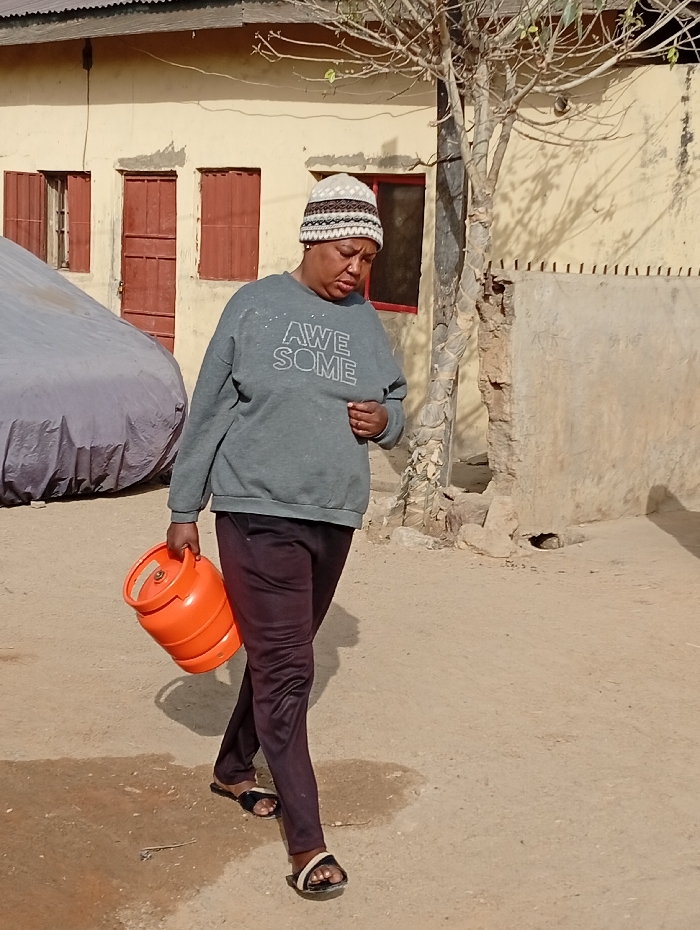
In Gayawa, Nigeria, a single individual walks rightward across a dry, dusty dirt path. The person wears a multi-patterned knit beanie, a grey long-sleeved sweatshirt with "AWE SOME" printed on the front, dark purple trousers, and black and white open-toed sandals. An orange gas cylinder is carried in the subject's right hand. The background features a light-yellow building with a flat roof, displaying multiple windows fitted with red shutters and frames; some shutters are open, others closed. A vehicle covered with a grey tarp is parked to the left of the building. To the right, a bare-branched tree stands, casting distinct shadows on a partially damaged wall section. The scene is outdoors under natural sunlight.
Gayawa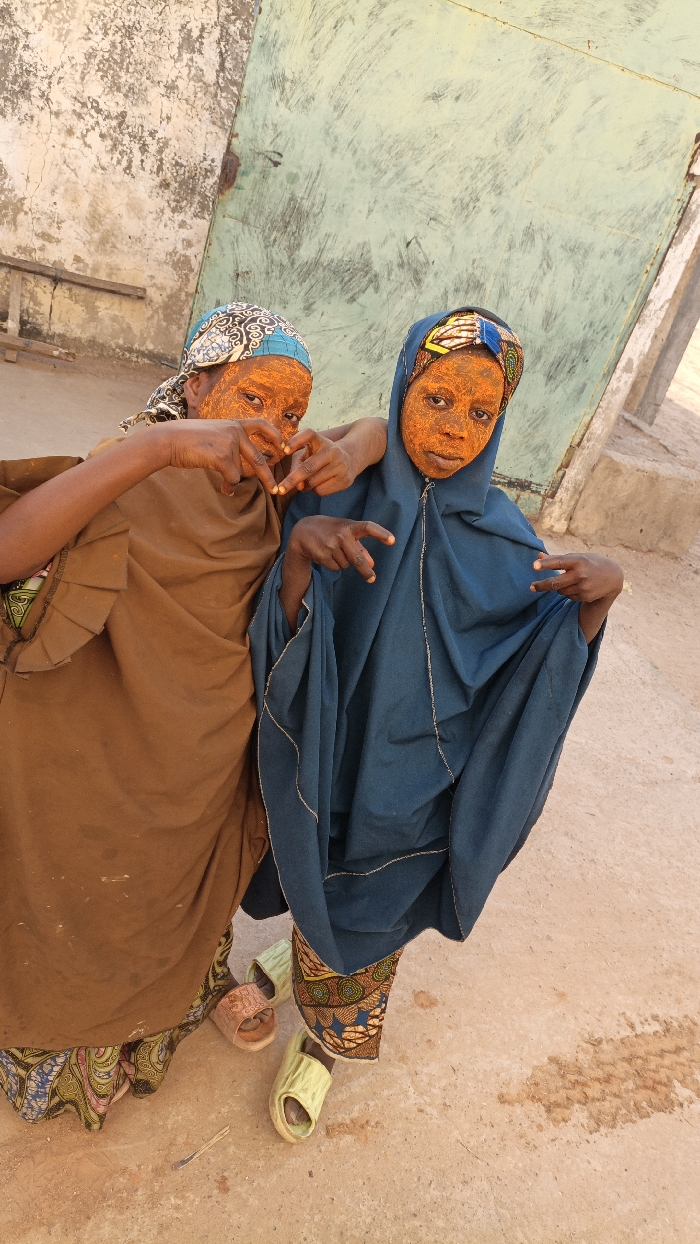
Two young individuals are captured in a vertical, eye-level shot, posing playfully outdoors during what appears to be daylight. Both have their faces, and possibly parts of their necks and hands, covered in a vibrant, granular orange substance, possibly a cosmetic mask or a traditional preparation like turmeric paste. Their eyes are clearly visible through the orange covering. The person on the left wears a light blue head covering with a black and white patterned design. They are dressed in a loose-fitting, earthy brown garment, possibly an abaya or robe, which extends down to their ankles. A colorful, patterned fabric, possibly an underskirt or sarong with blues, greens, and browns, is visible beneath the brown garment. Their hands are clasped together in front of their chest, forming a shape that resembles a heart or a similar gesture, and one arm is draped around the shoulder of the person on the right. The person on the right wears a dark blue head covering that appears to be part of a larger, flowing dark blue garment, likely a khimar or hijab, which covers most of their body. A distinct, colorful patterned fabric in oranges, blues, and browns is visible at the hem of their blue garment. They hold both hands up, forming a "peace" sign or V-shape with their fingers. Both individuals are looking towards the camera with a neutral to slightly smiling expression, though their expressions are somewhat obscured by the facial covering. Their footwear consists of open-toed slide sandals. The person on the left wears light brown sandals, while the person on the right wears light green sandals. The background features a textured wall on the left, which is off-white or light beige, exhibiting signs of wear, cracks, and discoloration. A wooden plank or piece of timber rests against this wall. On the right, there is a large, flat, light green or mint-colored surface, possibly a weathered metal door or gate, showing scratches and some rust. The ground is a light brown or beige, dusty surface, possibly dirt or concrete. The overall setting suggests a rustic or aged outdoor environment. The lighting is bright and even, indicating either an overcast sky or diffuse daylight.
Gayawa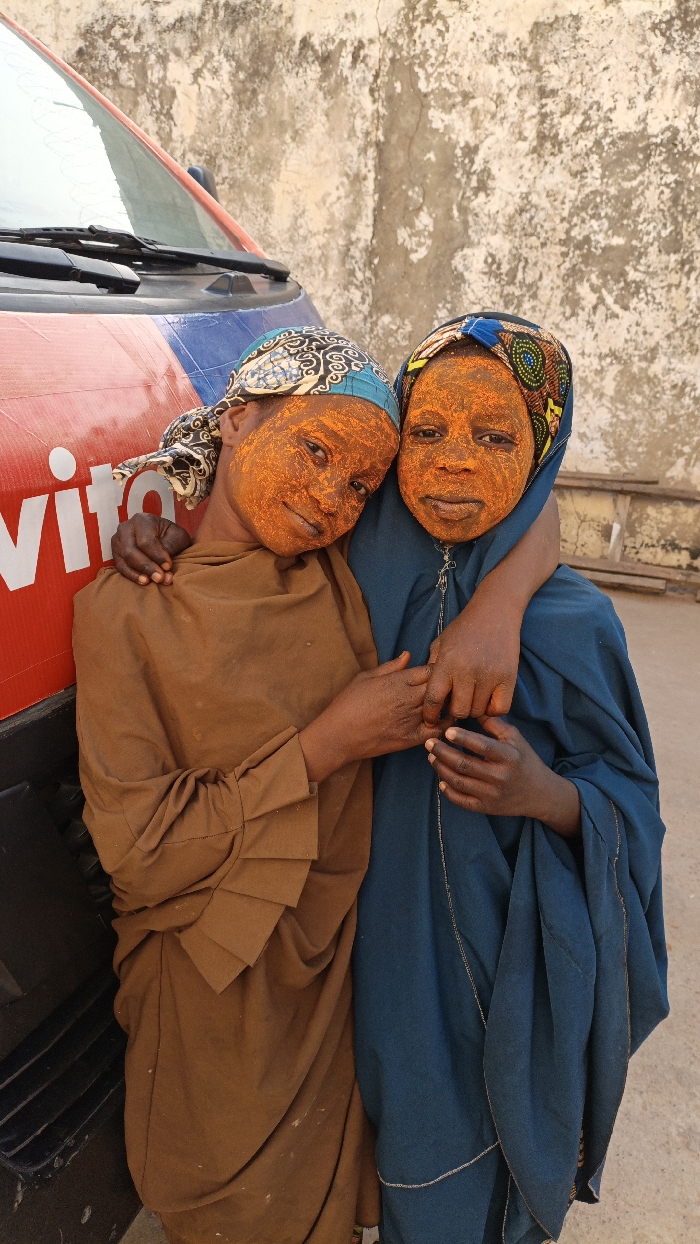
Two young individuals, likely girls, are captured in a portrait-style photograph, standing close together in an affectionate embrace. They are positioned in front of a red and blue vehicle, possibly a van or truck, which has white lettering on its side, partially revealing "vito" or "vita". The background behind them is a light-colored, textured wall, possibly stucco or concrete, showing signs of wear and age. Both individuals have their faces, ears, and parts of their neck covered in a striking, coarse, orange substance, possibly a ceremonial paste or pigment. This substance gives their skin a distinct, vibrant hue and textured appearance. The individual on the left wears a light brown, flowing garment, possibly a modest traditional dress or abaya, with distinctive layered or pleated sleeves. She also wears a patterned head covering, predominantly blue and white with black details, which frames her face. Her right arm is wrapped around the shoulder of the person on the right, and her left hand is clasped with the other person's left hand. She looks directly at the camera with a soft, gentle smile. The individual on the right wears a dark teal or dark blue, flowing garment, also likely a traditional dress, with a visible zipper down the front. Her head is covered by a colorful patterned fabric featuring shades of blue, yellow, orange, and black. Her left arm is wrapped around the waist or side of the person on the left, and her left hand is clasped with the other person's left hand. Her right hand is visible, resting near her lower torso. She also looks at the camera with a gentle, slightly smiling expression. The overall impression is one of companionship and cultural significance, highlighted by the unique facial decoration. The setting appears to be outdoors during daylight, with diffused lighting, suggesting either an overcast day or shade.
Gayawa