Gobirawa, Nigeria
30 memories from Gobirawa, Nigeria
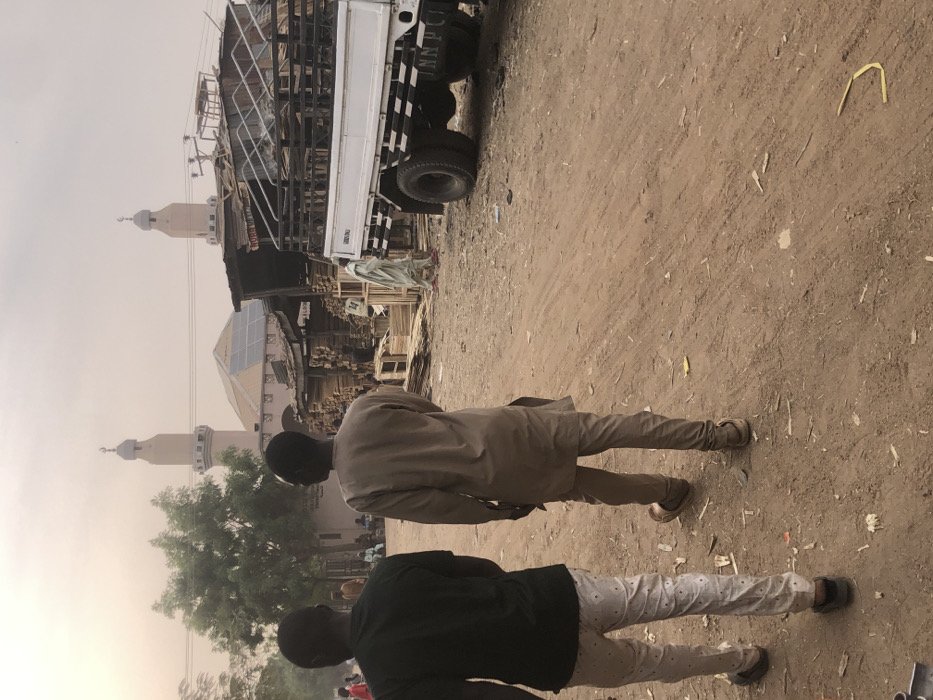
The image depicts an outdoor, unpaved street scene in Gobirawa, Nigeria, under a hazy, light-colored sky, indicative of a dusty atmosphere. In the foreground, two men walk away from the camera. The man on the left wears a dark green t-shirt, light-colored speckled pants, and dark sandals. The man on the right wears a light tan long-sleeved tunic and matching pants with brown open-toed footwear. The ground is reddish-brown dirt, uneven, with visible tire tracks and scattered small debris. In the midground, to the right of the walking men, a series of rustic, open-front stalls or shops are constructed from wood planks and corrugated metal roofing. These structures contain substantial stacks of cut lumber, wood planks, and wooden crates. Further right, a white truck is parked, featuring a wooden slatted bed frame and dual rear wheels. The letters "NMPC" are visible on its rear mudflap. Transparent panels, consistent with glass or plastic sheets, are stacked within the truck's bed. A person in a light-colored traditional garment is walking from left to right in front of the truck and behind the wood stalls. To the left in the midground, behind a green-leafed tree, a group of individuals are gathered near a building. The background is dominated by a light tan mosque featuring a multi-faceted roof covered with numerous solar panels. Two identical minarets, each capped with a crescent moon symbol, flank the main mosque structure.
Gobirawa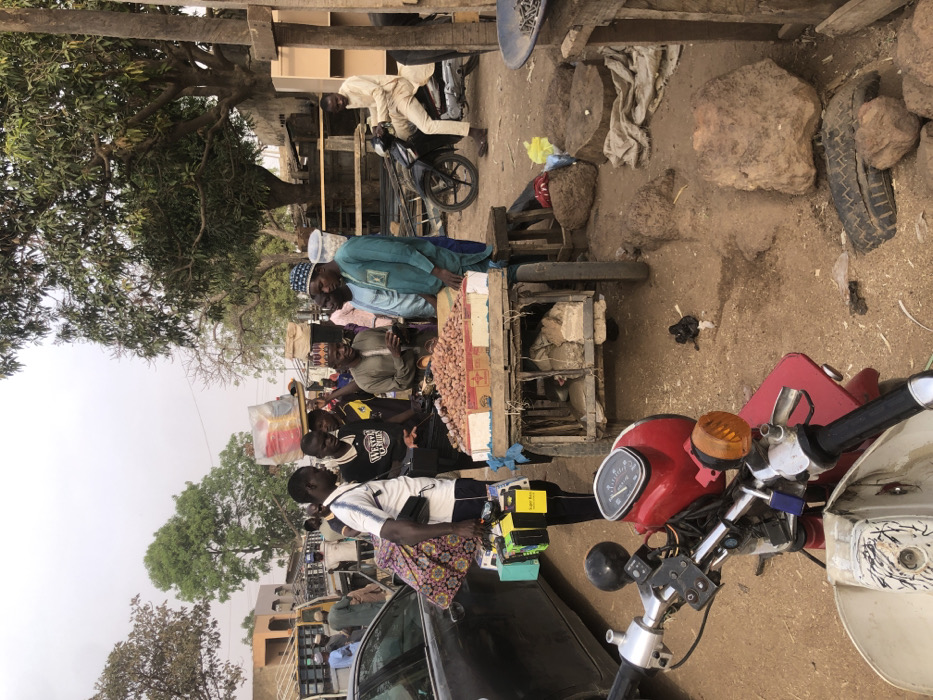
A bustling outdoor market scene unfolds under the shade of lush trees. Several people are gathered around a cart laden with produce. To the right, a red and white motorbike is parked, its handlebars dominating the foreground. In the background, another man sits on a motorcycle. The ground is a mix of dirt, rocks, and debris.
Gobirawa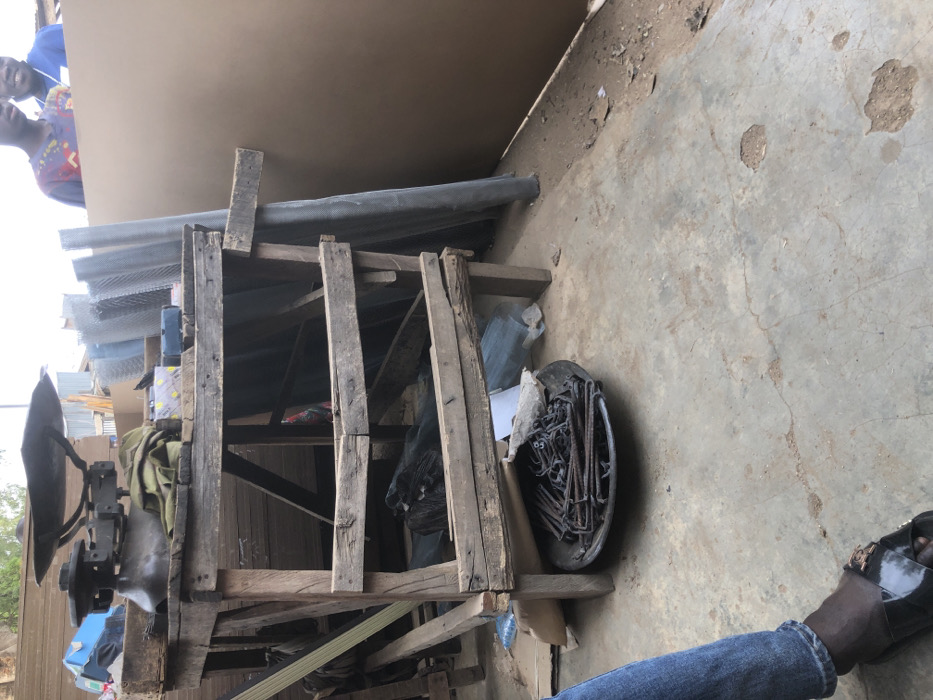
A wooden structure supports a large sheet of material, possibly drywall, with pipes and wire mesh piled on top. Tools and equipment are stored within the structure, including what appears to be a metalworking tool with a large disc. A bucket filled with metal rods sits nearby. The scene unfolds on a weathered concrete surface, with a person wearing jeans and sandals visible in the lower right corner.
Gobirawa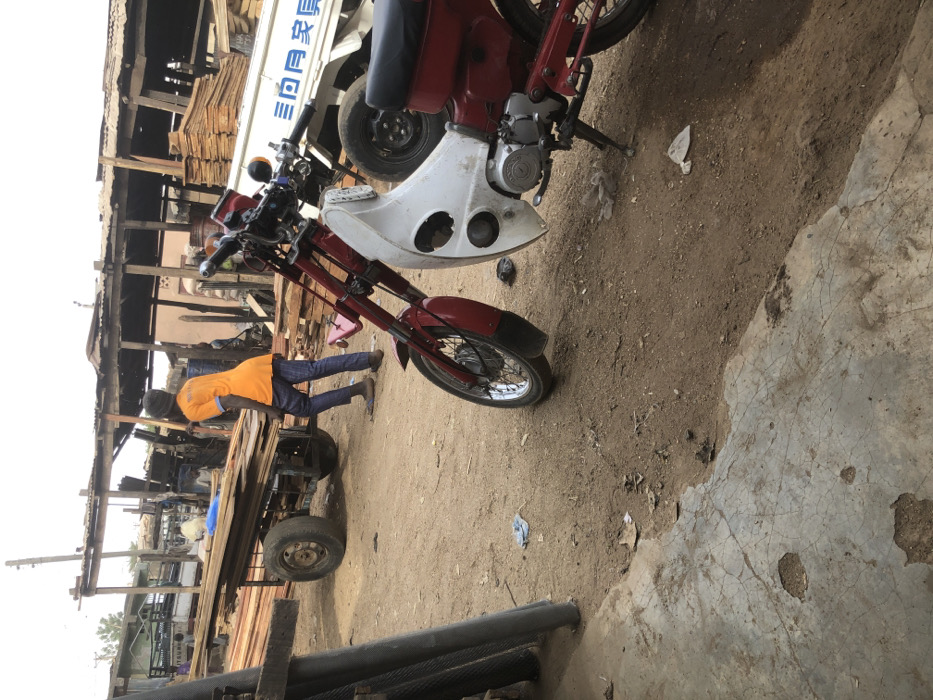
A red and white motorcycle stands on a dirt and concrete surface near a building with lumber. A person wearing an orange shirt and blue pants pushes a wooden cart laden with lumber. A truck with Chinese characters is visible in the background. Tubes or pipes are in the lower left corner. The scene appears to be outdoors, potentially a marketplace or industrial area.
Gobirawa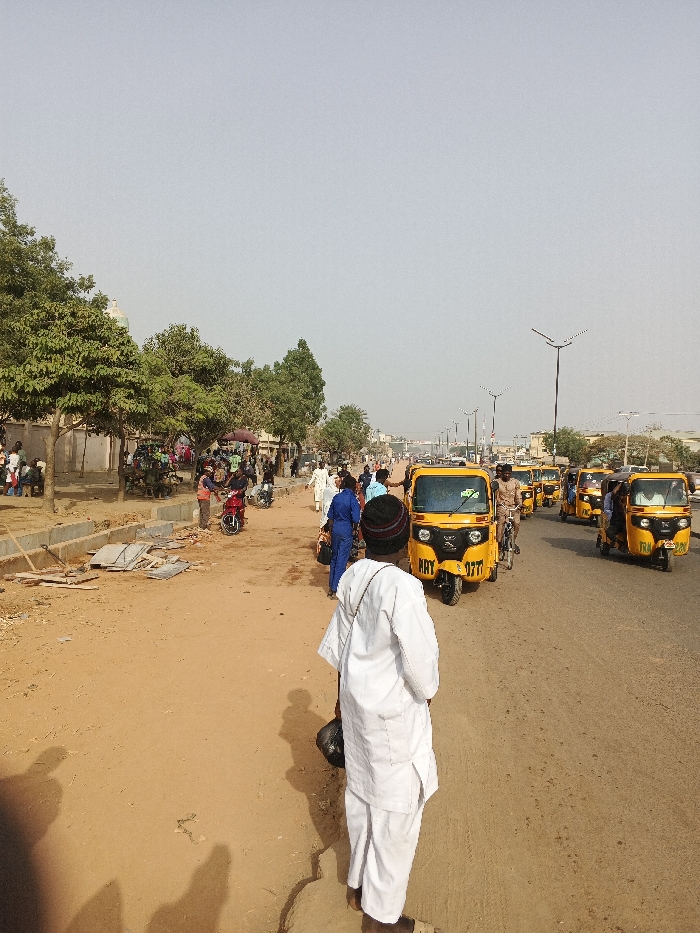
The image depicts a daytime street scene in Gobirawa, Nigeria. In the immediate foreground, a person is observed from behind, wearing a white traditional tunic and trousers, with a dark knitted cap and a dark bag slung over their left shoulder. They stand on an unpaved, reddish-brown dirt shoulder. To the left, the dirt shoulder features scattered construction debris, including concrete slabs and wooden planks. Further back, several green-leafed trees line a low wall or barrier. Beyond these trees, a cluster of individuals is visible, some standing, some seated, near what appears to be market stalls or informal structures. A red motorcycle is parked near the shoulder, with a person in an orange safety vest nearby. To the right, a multi-lane paved road extends into the distance. A procession of yellow three-wheeled vehicles, commonly known as keke-napep or autorickshaws, occupies the right side of the road. The closest vehicle displays the license plate "MAY 0777". Several individuals are present on or near the paved road, including a person in blue overalls and another riding a bicycle. The background shows the road receding, flanked by modern streetlights with dark poles and multi-fixture heads. The sky is a pale, hazy blue-grey. The overall environment suggests a busy urban or semi-urban area with ongoing activity and a mix of pedestrian and vehicular traffic.
Gobirawa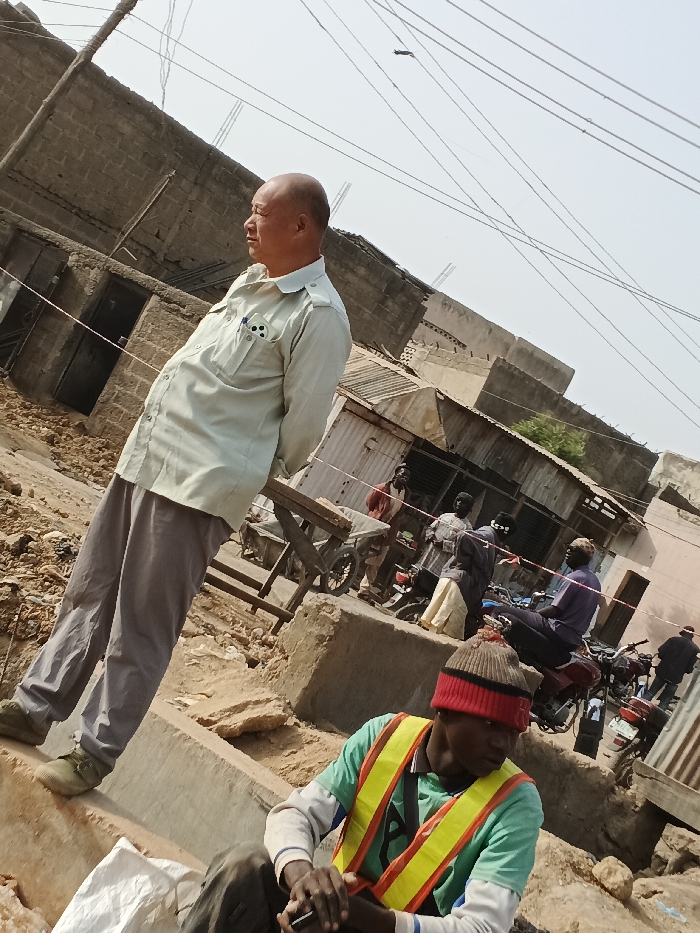
The image depicts an outdoor scene in Gobirawa, Nigeria, under a bright, clear sky. In the foreground, positioned to the left, an East Asian male with a bald head stands facing right, his hands clasped behind his back. He wears a light khaki-green collared shirt with two breast pockets, one containing pens, grey trousers, and olive-green shoes. To the lower right, an African male sits on a concrete block, wearing a red and black knitted beanie hat, a light green long-sleeved shirt, and a yellow reflective safety vest. He is looking down, holding a dark object, possibly a mobile phone. The background features multiple rudimentary buildings constructed from concrete blocks, some appearing unfinished or partially dilapidated, with exposed rebar in one structure on the far left. Corrugated metal roofing is visible on some smaller structures. The ground is unpaved, uneven, and appears dusty with scattered debris. Several other individuals, all appearing to be of African descent, are present in the mid-ground. One person stands near a wooden handcart, while another sits on a red motorcycle. Multiple motorcycles are parked or being operated in the distance. Overhead wires, likely electrical or communication cables, crisscross the upper portion of the frame.
Gobirawa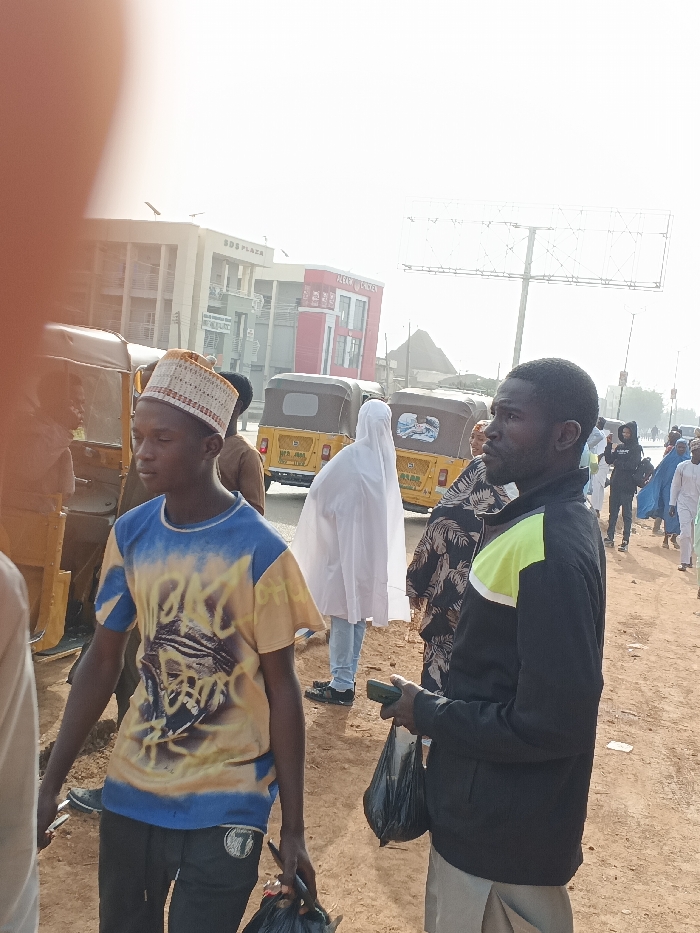
The scene depicts an outdoor urban or semi-urban environment in Gobirawa, Nigeria, observed during daylight. The immediate foreground is a reddish-brown dirt ground. The top-left corner is partially obscured by a light-colored object, possibly a finger or arm. A young man with dark skin occupies the left mid-foreground, wearing a patterned beige and brown kufi cap, a blue and yellow graphic t-shirt, and dark trousers. He faces slightly left. To his right, another man with dark skin and a short beard wears a black jacket with a lime green and white shoulder stripe over light trousers. He holds a small dark object in his left hand and a black plastic bag in his right, looking right. A person in a brown garment is partially visible behind the young man. In the midground, a person in a white flowing garment and light blue jeans stands with their back to the camera, positioned between two yellow motorized tricycles (auto-rickshaws). At least three such tricycles are visible on a paved or unpaved road. One tricycle has "ASAN" printed on its side. Further back on the right, additional indistinct figures are present, including one in a dark hoodie. The background features multiple buildings under a bright, clear sky. A multi-story, light-colored structure labeled "SDS PLAZA" is on the left. To its right, a red and white building displays "ALHAM... CHICKEN." An empty metal billboard stands further right, and a conical roof structure is visible in the distance behind the buildings.
Gobirawa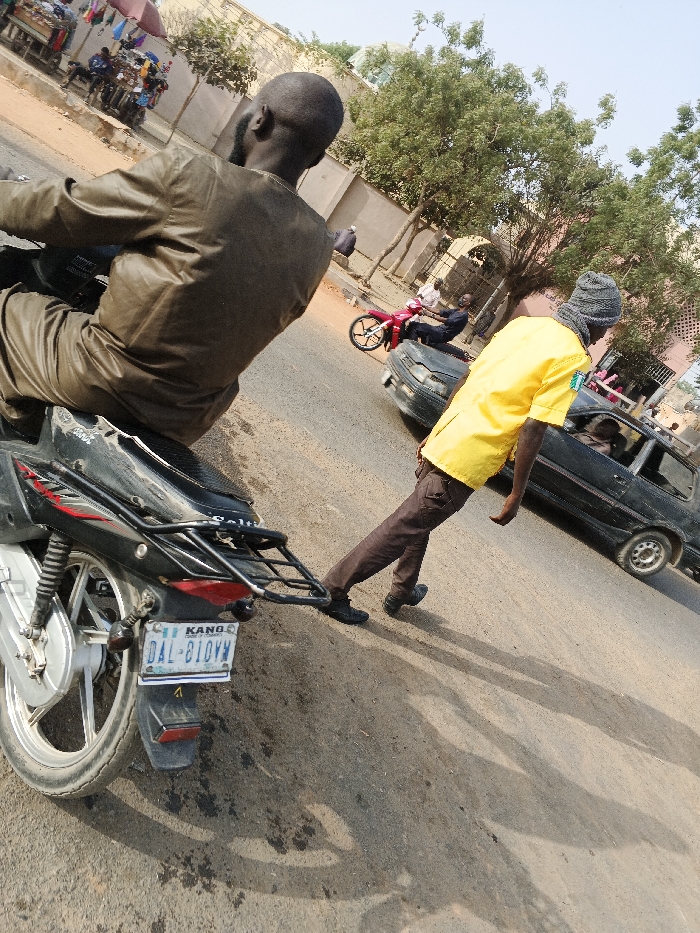
The image displays a street scene in Gobirawa, Nigeria, under clear, sunny conditions. In the immediate foreground, a dark-skinned male with a bald head and beard, dressed in a brown full-length garment, is seated on a black motorcycle. The motorcycle's rear fender features a black cargo rack and a visible license plate reading "KANO DAL-810WM". To the right of the motorcycle, a dark-skinned male wearing a yellow short-sleeved shirt, dark brown cargo pants, black shoes, and a grey knitted beanie is walking forward, his left foot extended. In the mid-ground, a dark-colored sedan is partially visible, moving from right to left across the frame. Further in the background, a red motorcycle with two occupants is visible. The environment includes light-colored buildings with arched openings, green deciduous trees lining the street, and on the far left, market stalls with colorful canopies and various goods. Long shadows are cast by individuals and objects onto the asphalt and dirt road surfaces.
Gobirawa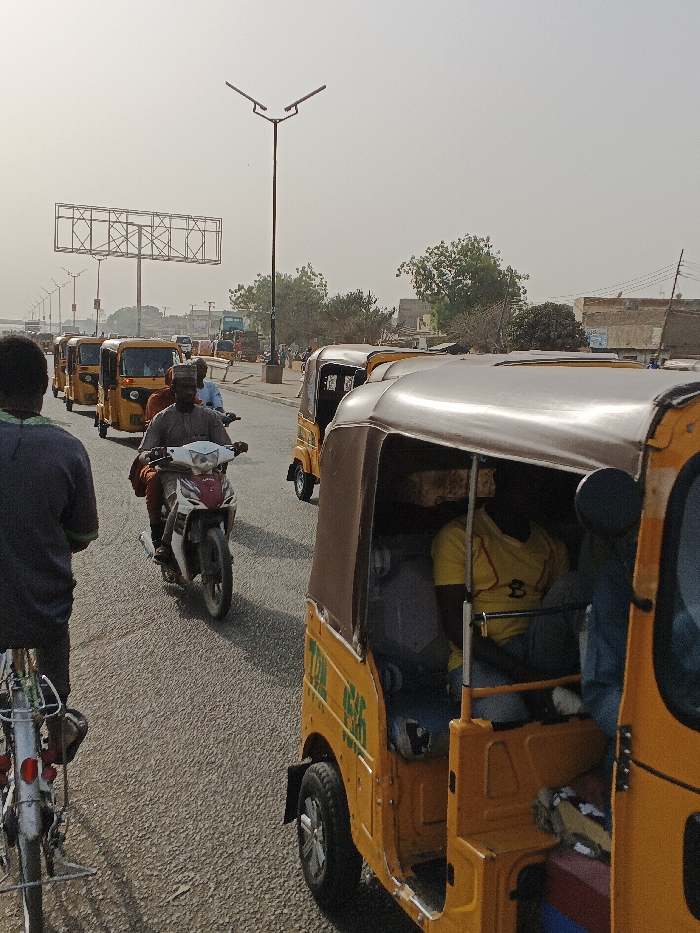
This image captures a street scene in Gobirawa, Nigeria, depicting traffic flow under hazy daylight conditions. In the immediate foreground on the left, the rear wheel and frame of a bicycle are visible, with a person wearing a dark shirt astride it, facing away from the camera. To the right, the front-side of a yellow motorized tricycle (keke Napep) is prominent, featuring a brown canvas roof and showing a male passenger in a yellow shirt seated within. In the midground, a white and red motorcycle is centrally positioned, ridden by a male wearing a brown garment, with a second person seated directly behind the driver. Behind this motorcycle, a queue of identical yellow tricycles extends down the asphalt road. The background reveals a hazy, light grey sky. Along the right side of the road, several single-story structures, possibly commercial or residential, are interspersed with green trees. A tall, black street light pole with a dual, angled fixture stands prominently on the left side of the road. Further into the distance on the left, a large, empty metal framework of a billboard structure is visible against the sky. The road surface appears to be asphalt.
Gobirawa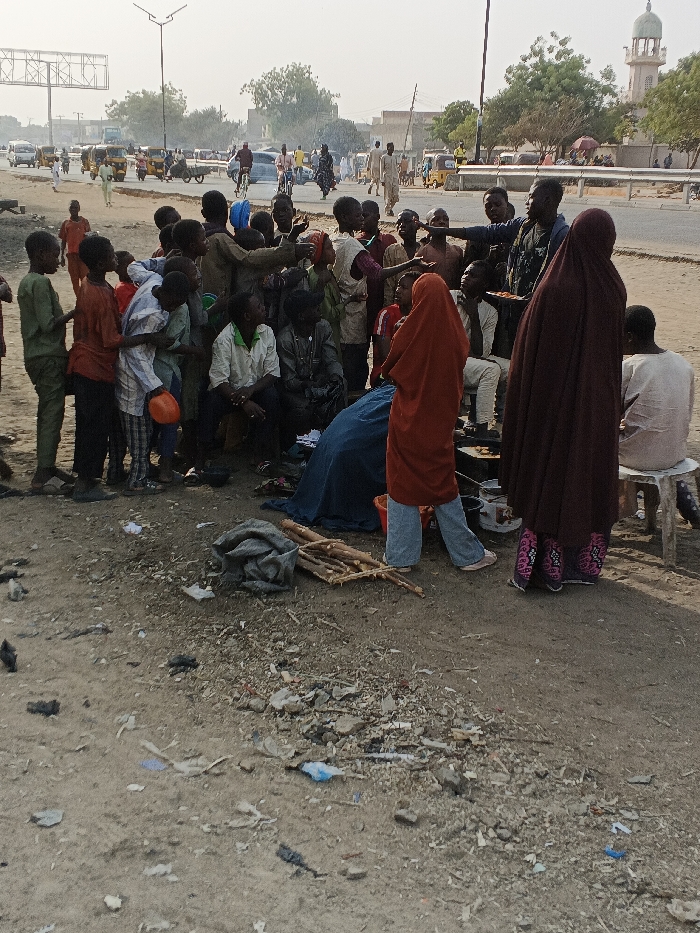
The image captures an outdoor scene in Gobirawa, Nigeria, on dusty, unpaved ground adjacent to a paved road. Approximately 20-25 individuals are visible, primarily children and young males, with several adults. In the midground, a dense crowd of mostly children and youths gathers around a central point of interaction. A young male in a dark shirt holds a plate with what appears to be food, extending it towards the surrounding group, many of whom have hands outstretched, indicating receipt or anticipation. Another individual near him is also actively engaging with the crowd. To the right, two women are positioned: one wears a red head covering and light blue trousers, standing near a small pot on the ground; the other wears a dark brown full-length garment with pink patterned footwear, her back mostly to the viewer. A man in a white tunic sits on a low white stool on the far right. A blue tarp or fabric is spread on the ground in the center, and a bundle of dark cloth with a pile of wooden sticks or firewood lies on the dusty surface in the lower-middle foreground. The ground is scattered with small debris, including plastic pieces and refuse. The background features a busy paved street with various vehicles, including cars, motorcycles, and auto-rickshaws, along with pedestrians. Buildings and trees line the thoroughfare, and an overhead metal sign structure is visible on the left. A light-colored mosque with a prominent minaret stands in the far-right background. The sky is bright and slightly hazy, suggesting daylight conditions.
Gobirawa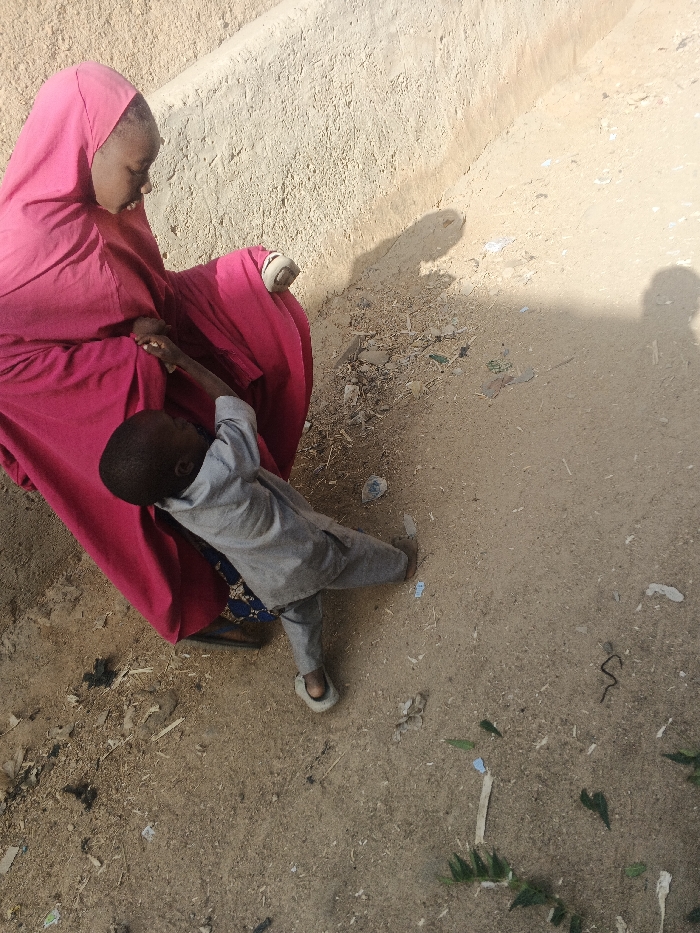
This image depicts two individuals outdoors in Gobirawa, Nigeria, near a light-colored, textured earthen wall. An adult female, partially visible, is seated or crouched, wearing a vibrant red or magenta full-body garment and a patterned blue fabric beneath. Her right arm shows a light-colored wrist accessory. A young child, wearing a light grey tunic and trousers with light-colored open-toed footwear, stands leaning towards the female and holds onto her red garment with their right hand. The female is looking downwards and to her left, towards the child or an unseen point. The ground is exposed light brown soil or sand, covered with scattered debris including paper scraps, plastic fragments, and organic matter. Shadows of individuals are visible on the ground, indicating direct sunlight.
Gobirawa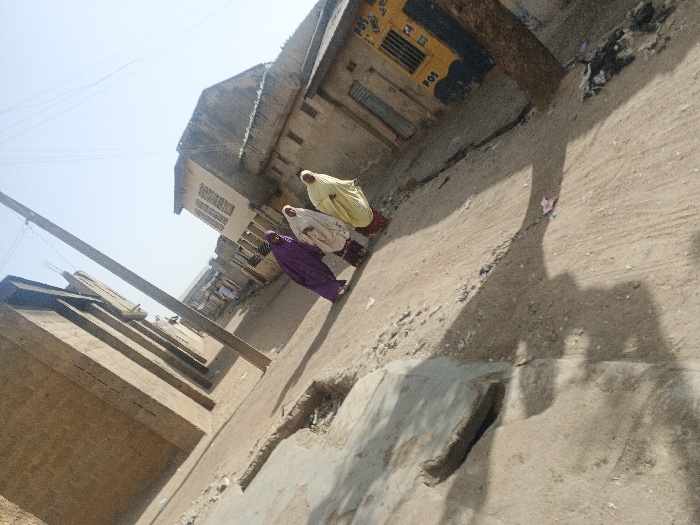
The image displays a daytime street scene in Gobirawa, Nigeria, captured from an elevated, oblique perspective looking down a thoroughfare. Three individuals, likely adult females, walk away from the camera along a dusty, uneven ground surface that appears to be cracked pavement or packed earth. The individual closest to the viewer wears a purple full-length garment; the middle individual wears a white full-length garment, and the furthest individual wears a yellow full-length garment. All three wear head coverings. Strong sunlight from the upper left casts prominent shadows of the individuals and a utility pole onto the ground. Buildings line both sides of the street. On the right, structures include a light-colored multi-story building with multiple windows, and further down, a building featuring a yellow and black painted section with the number "101" visible. On the left, a wooden utility pole stands with overhead wires, and simpler, low-rise buildings with unpainted brick walls are present. The ground shows signs of wear, cracks, and scattered debris.
Gobirawa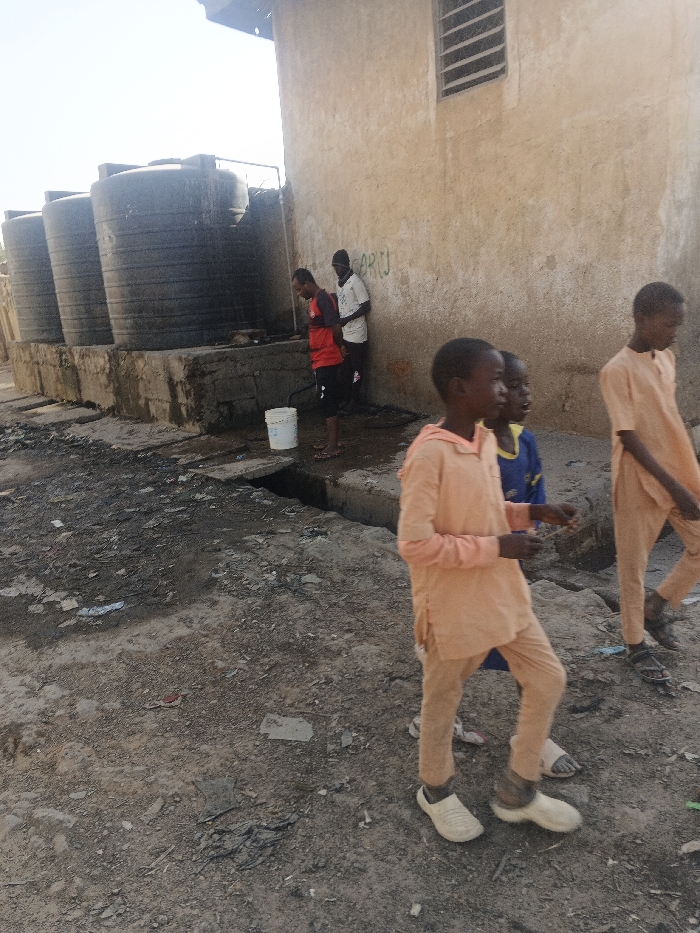
This image depicts a dusty street scene in Gobirawa, Nigeria, under bright daylight. In the mid-ground, a row of at least four large, black cylindrical water storage tanks stands on a raised concrete platform. Adjacent to these tanks is a light-colored building with a single rectangular window fitted with horizontal bars. Three adult males are positioned near the water tanks. One male, wearing a red short-sleeved shirt and dark shorts, stands next to a white bucket, appearing to be engaged with a water tap connected to the tanks, suggesting water collection. To his right, another male in a white short-sleeved shirt and a dark beanie leans against the building wall. A third male, partially obscured, stands behind the individual in the white shirt, also near the wall. In the foreground and mid-ground, three children are walking from right to left across the frame. The most prominent child, positioned centrally, wears a light orange long-sleeved tunic and matching trousers, with light-colored slip-on shoes. To his immediate left and slightly behind him, a second child is partially visible, wearing a blue shirt. Further to the right, a third child, also dressed in a light orange tunic and trousers, walks with dark sandals on his feet. The ground is unpaved, consisting of dry earth and scattered debris, including plastic and paper. A partially covered concrete drainage ditch or gutter runs across the mid-ground, separating the walking children from the adults and water tanks. The scene suggests daily activities related to water access and pedestrian movement in the community.
Gobirawa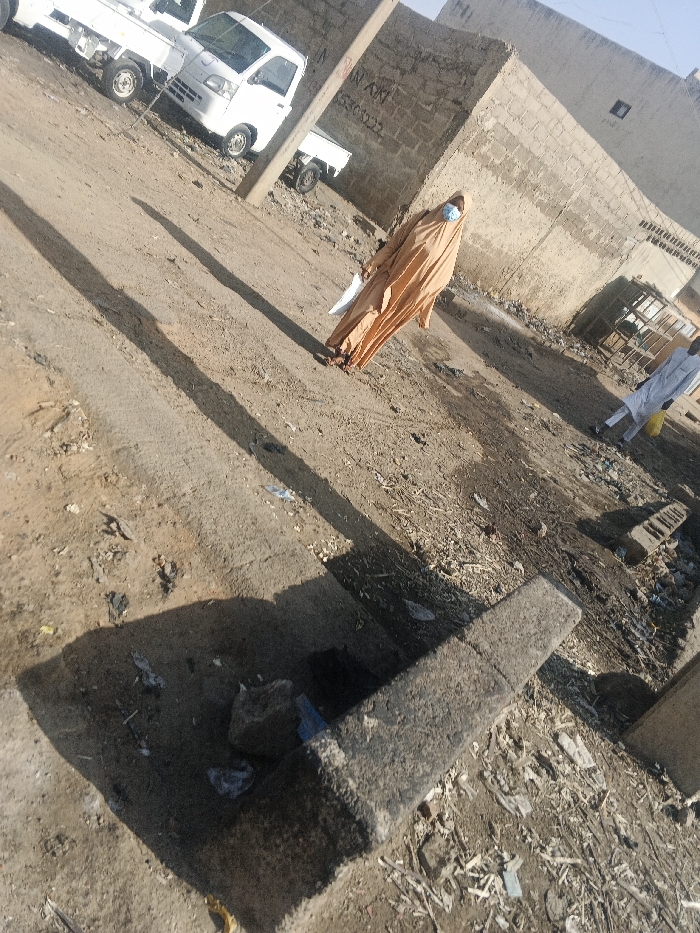
This image depicts a dusty, unpaved street or open area in Gobirawa, Nigeria, under bright daylight with strong shadows indicating an angled sun. In the midground, slightly left of center, a person stands facing towards the right foreground. This individual wears a light tan full-body garment and a light blue surgical face mask, covering their head and face except for the eyes. They hold a white, rectangular object in their left hand, resting it against their body. Their feet are visible in open-toed sandals. Behind this person and to their left, a utility pole casts a long shadow diagonally across the ground towards the right foreground. The pole has red markings. Further to the right and slightly behind, a second person is partially visible, dressed in a long white garment, facing away from the camera. A yellow object is visible on the ground near their feet. The ground is predominantly packed dirt and dust, uneven, and littered with various pieces of refuse including plastic bags, paper, and small debris. In the immediate foreground, a broken concrete structure, possibly part of a curb or drain, contains more debris. In the background, on the left, several white compact pickup trucks are parked on the unpaved surface. Beyond them and across the entire background are buildings constructed of unplastered cinder blocks. One prominent wall displays graffiti, including "AN AKI" and the sequence "5303222". To the far right background, near another block building, rudimentary wooden shelving or structures are visible. The sky is clear and bright at the top of the frame.
Gobirawa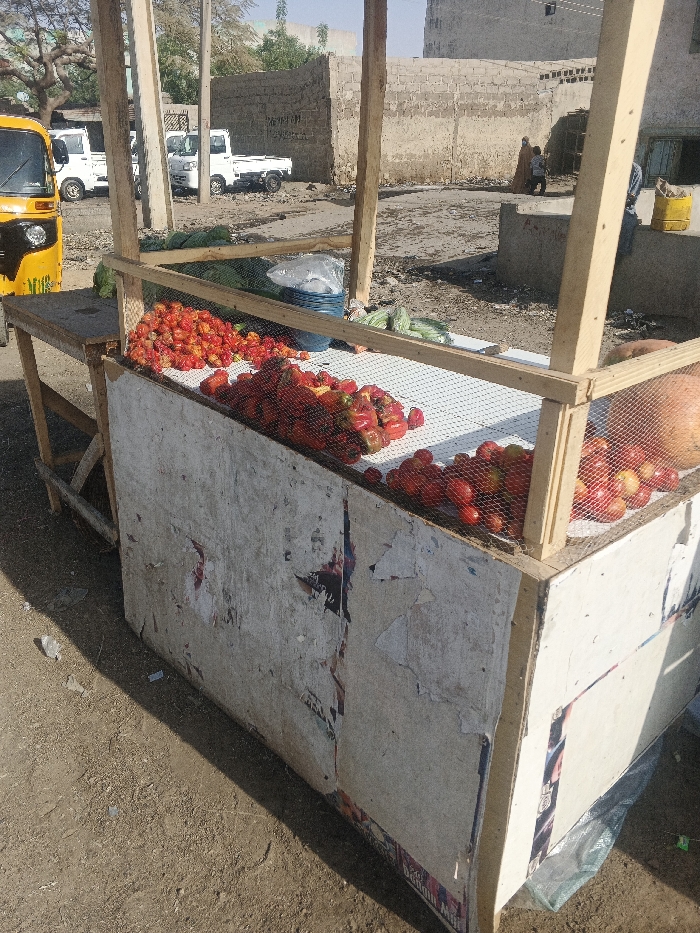
The scene depicts an outdoor market or roadside stall in Gobirawa, Nigeria, under natural daylight. In the foreground, a roughly constructed produce stall is visible. It features a worn, light-colored wooden or particle board base, partially covered with torn paper and adhesive remnants. Four untreated wooden posts support a rectangular frame, topped with a white mesh surface displaying various produce. On the left, numerous small, bright red peppers are piled. Adjacent to them, larger red peppers are arranged, some contained within red mesh bags. Further right, a quantity of red tomatoes is visible, along with a large, yellowish-orange gourd, possibly a pumpkin or squash. A blue plastic basin holding clear plastic bags rests on the stall surface behind the peppers, and green vegetables are visible further back. A smaller, unadorned wooden table extends from the left side of the main stall. The ground is an unpaved, uneven dirt surface with scattered debris. In the mid-ground, a yellow auto-rickshaw is partially visible on the far left. Two white mini-trucks are parked on the dirt surface behind the stall. The background consists of weathered, unpainted concrete block walls and facades of multi-story buildings, one with a green-framed window section on the far right. Sparse trees are visible in the distance on the left. Two individuals, an adult in a light-colored garment and a child, are observed walking away from the viewer near a concrete wall in the mid-ground right. A third person is partially visible behind a wooden post on the far right, standing near a yellow container. No direct interactions with the produce stall are discernable. Strong sunlight casts distinct shadows.
Gobirawa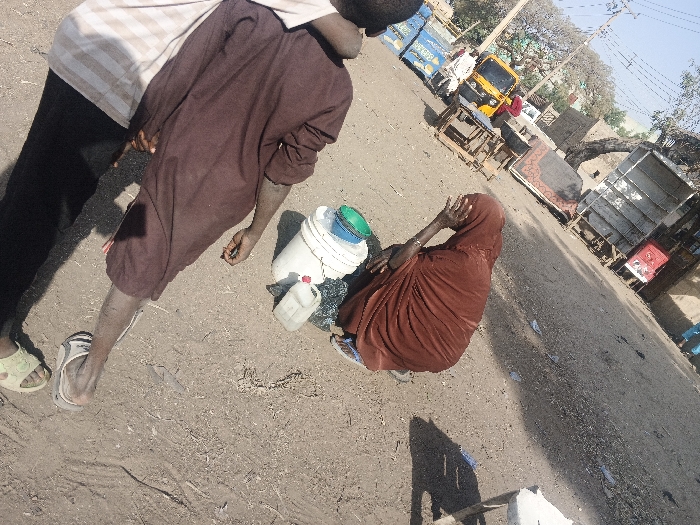
The image depicts an unpaved street scene in Gobirawa, Nigeria, under bright daylight. In the immediate foreground, two individuals are standing on dry, dusty ground, casting prominent shadows. One person on the left is partially visible, wearing a light-colored striped shirt, dark pants, and light-green sandals. Adjacent to them, another individual stands, seen from the back, wearing a long-sleeved brown garment and light-colored flip-flops. To the right and slightly forward of the standing figures, a third individual is seated directly on the ground. This person is draped in a reddish-brown garment or hijab, with their right hand raised, covering their face. Next to the seated individual are a white bucket with a blue and green lid and a small, translucent white plastic container. The background shows an unpaved road extending into the distance, bordered by various objects and structures. A yellow motorized tricycle (Keke Napep) is visible on the road, alongside several blue-colored vehicles. Scattered wooden structures, possibly market stalls or discarded items, are present. A reddish-patterned rug or mattress lies on the ground to the right. Utility poles with overhead wires and sparse trees are visible against a clear sky.
Gobirawa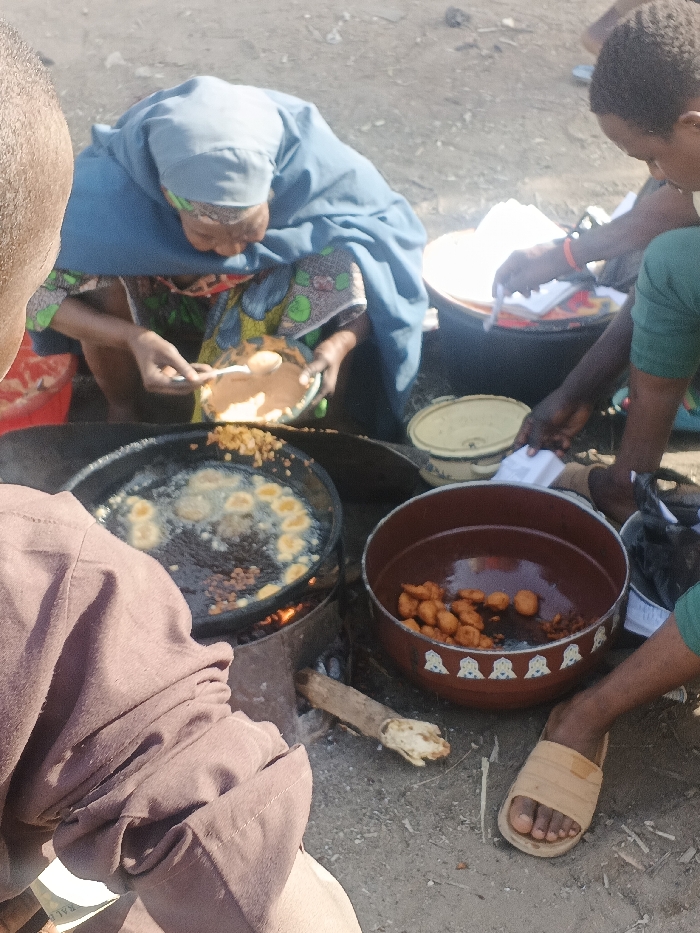
The scene depicts an outdoor food preparation area in Gobirawa, Nigeria. A woman, wearing a blue head covering and a colorful patterned dress, crouches, using a spoon to transfer a light-colored batter from a small bowl into a large black frying pan. The pan is actively heating over an open fire, fueled by visible firewood within a makeshift metal stove, and contains numerous round, golden-brown food items frying in oil. To the right, a large reddish-brown bowl with white decorative patterns holds several already fried, golden-brown items. The lower right arm and hand of another individual, wearing a green garment, are visible near this bowl, handling white paper or packaging. In the foreground, the back and left arm of a third person, dressed in a brown garment, are visible. The ground is unpaved and dusty. A yellow lidded pot and a black bucket containing white items are visible in the background.
Gobirawa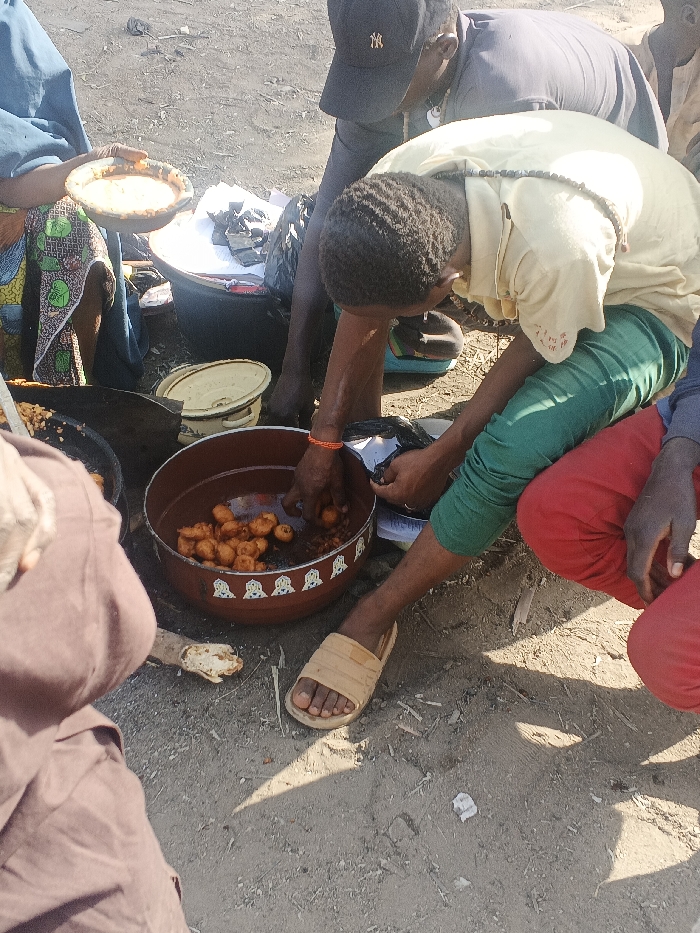
The image portrays an outdoor scene in Gobirawa, Nigeria, featuring multiple individuals gathered around food items on unpaved dirt ground under bright sunlight. In the central foreground, a person with short, dark hair, wearing a light yellow short-sleeved shirt, green trousers, and beige sandals on their left foot, squats. This individual's hands are inside a large brown bowl with a white decorative pattern around its rim, actively handling numerous small, round, golden-brown fried dough balls and some darker, smaller items, possibly beans or seeds. An orange wristband is visible on their left wrist, and a dark beaded necklace hangs around their neck. They also interact with a black plastic bag or container held in their right hand. To the immediate left of the central person, a black cooking pot or pan containing similar fried items is visible, along with a yellow enamel pot with a lid resting on the ground. Further left, a partially obscured individual, dressed in a blue garment over a colorful patterned fabric, holds a metal bowl containing a light, creamy substance. Behind the central figure, another individual, wearing a dark baseball cap with a white "NY" logo and a dark grey shirt, is partially visible, leaning over the scene. To the far right, the lower body of a person wearing red trousers is visible. The ground is characterized by light brown, dry earth with scattered small debris and prominent shadows cast by the subjects, indicating strong overhead sunlight. In the background, a black plastic basin contains other items, including dark, possibly dried, food pieces wrapped in paper or plastic.
Gobirawa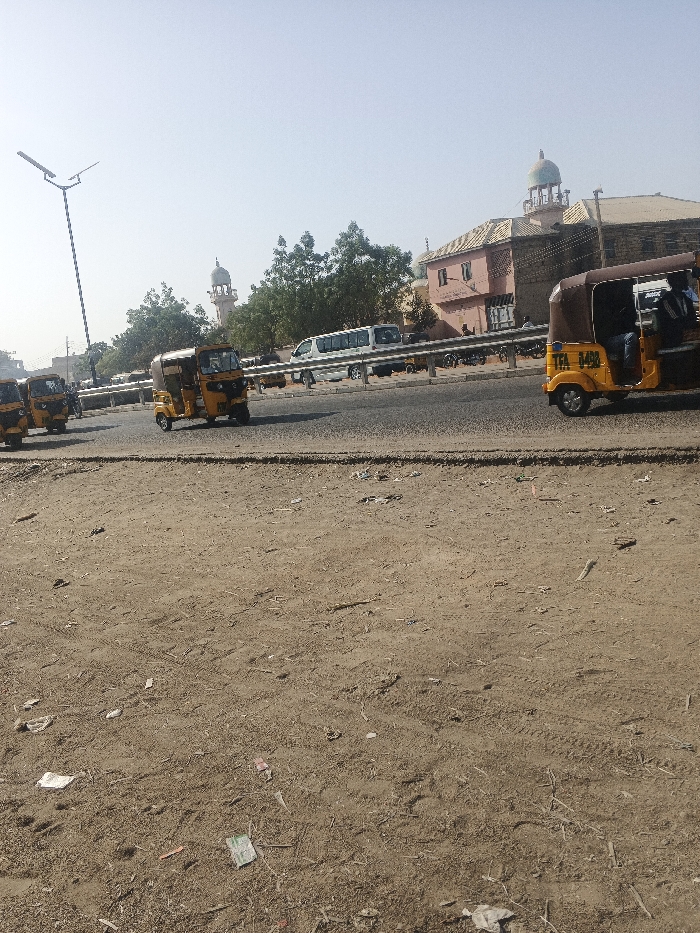
The image portrays an urban street scene in Gobirawa, Nigeria, under a bright, clear sky. The foreground is an unpaved expanse of dry, reddish-brown earth, marked with tire tracks, footprints, and scattered debris including plastic and paper. A paved asphalt road, separated by a concrete curb, traverses the midground. On this road, multiple yellow and brown auto-rickshaws (Keke Napep) are present; one on the right displays "TFA 04B" and contains a driver, while another in the center faces the viewer. To the left, a tall grey street light pole equipped with a dual solar panel array rises. A metal guardrail runs parallel to the road's far side, behind which a white passenger van and several motorcycles are visible. Green trees are interspersed along this section. In the background, a multi-story building with pink and light brown architectural elements is prominent, capped by a large green dome. To its left, a light-colored mosque minaret topped with a smaller dome is discernible.
Gobirawa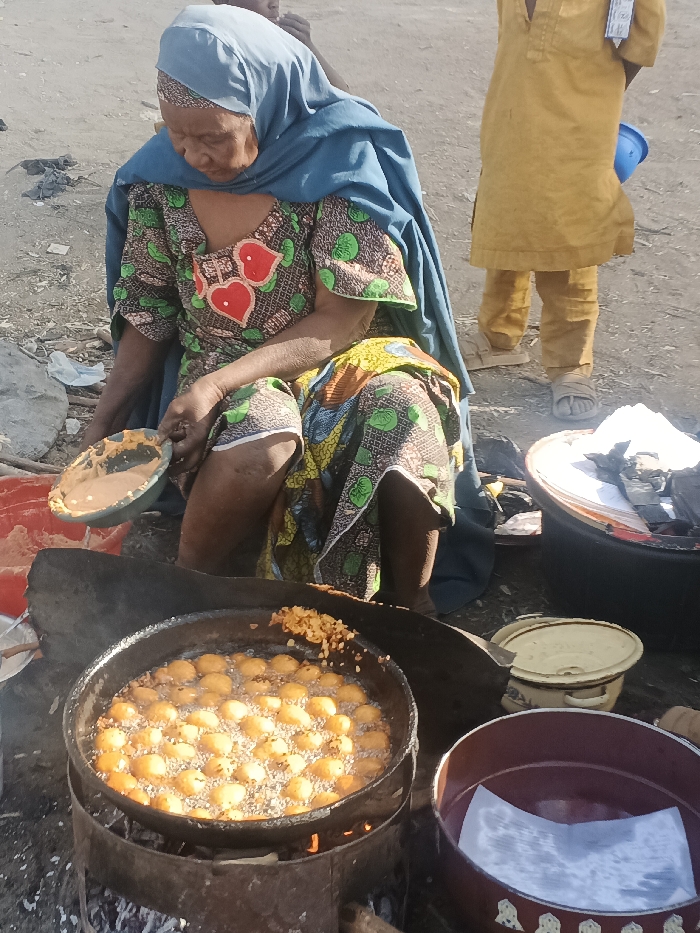
An outdoor scene in Gobirawa, Nigeria, depicts an elderly woman frying food. She is positioned low to the ground, wearing a blue head covering and a patterned dress featuring red hearts and green leaves. Her right hand holds a green bowl containing a light-colored batter, from which she appears to be depositing portions into a large, dark frying pan. The pan rests on a makeshift metal drum over an open fire, actively frying numerous spherical, golden-brown food items in oil; smaller, irregular fried pieces are also visible on the pan's edge. To the right of the cooking setup, a light-colored enamel pot with a lid and a dark reddish-brown plastic basin containing white paper are present. In the background, a person wearing a light brown garment and sandals stands to the right, holding a small blue bucket and with items hanging from their neck. Another individual's head is partially visible behind the cooking woman. The ground consists of unpaved earth with scattered debris.
Gobirawa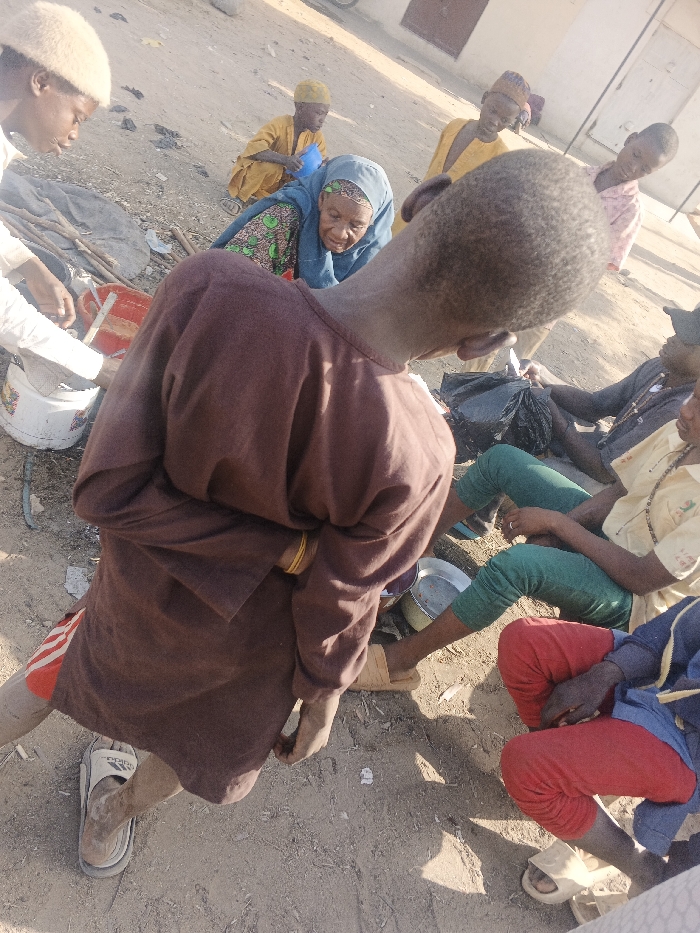
An outdoor scene in Gobirawa, Nigeria, depicts approximately nine individuals gathered on a dusty, unpaved ground surface. The foreground is dominated by the back of a light-skinned individual wearing a long-sleeved, brown tunic, a gold-colored bracelet on the right wrist, and a single white Adidas slide on the left foot. This person's head is cropped above the eyes, showing short, dark hair. To the left, another individual in a white garment and light-colored cap attends to a white plastic container, near which a red plastic container and a bundle of sticks are visible. Further left and center, an elderly woman with dark skin, wearing a blue headscarf and a green patterned garment, crouches, looking towards the left with a faint smile. In the mid-ground and background, several other individuals are present. One person in a yellow garment and cap crouches, holding a blue plastic item. Another person in a yellow garment stands partially obscured. Two individuals sit on the ground to the right: one in a light-colored shirt with green details and green pants, with a silver metal bowl nearby; the other in a blue garment over red pants. Both are wearing light-colored slides. A black plastic bag is positioned between them. The environment includes distant light-colored building structures with minimal architectural detail. The ground is dry earth, suggesting an arid climate. Strong shadows indicate bright daylight conditions. There are no clear actions of direct interaction between all individuals, but they are positioned in close proximity, suggesting a communal gathering.
Gobirawa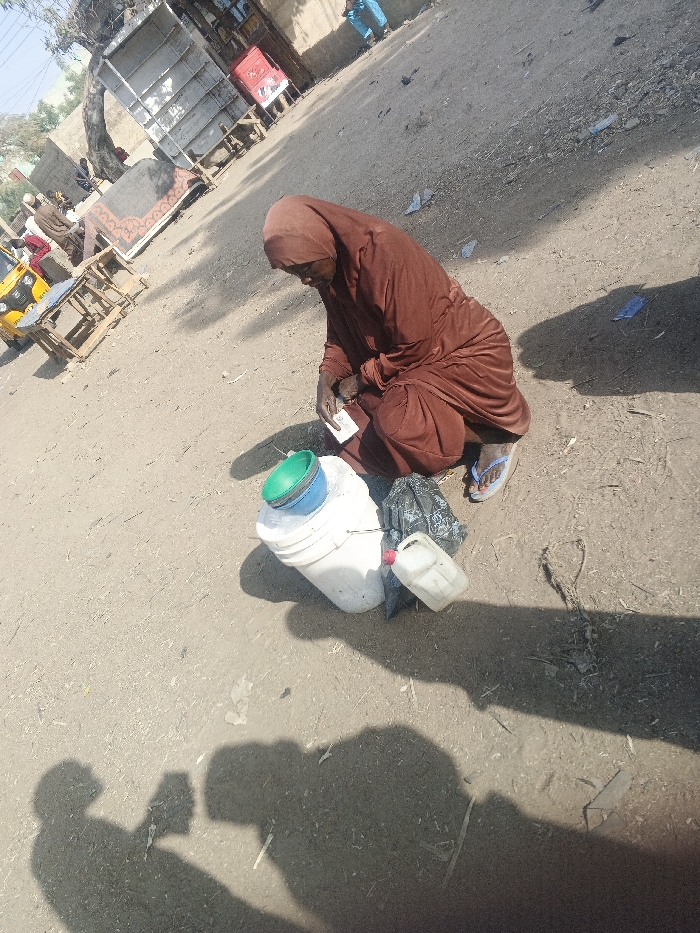
The image depicts an outdoor scene in Gobirawa, Nigeria, centered on an elderly individual, likely female, squatting on unpaved dirt ground. This individual wears a brown head covering and a matching loose-fitting brown garment, with blue flip-flops visible on their feet. Their hands are positioned over a small, light-colored rectangular object. Adjacent to the individual, on the ground, are a white plastic bucket with a green lid and a blue bowl stacked on top, a crumpled black plastic bag, and a translucent white plastic jerrycan with a red cap. Multiple distinct shadows are cast on the ground. In the mid-ground, a yellow and black three-wheeled vehicle is partially visible, along with various wooden market stalls or shelving units, including a large, empty white-painted structure. A patterned rug is leaned against one of these structures. Other individuals in traditional attire and parts of buildings with light-colored walls are visible in the background. The ground is uneven dirt, strewn with small pieces of debris. The scene suggests a busy market or street area under direct sunlight.
Gobirawa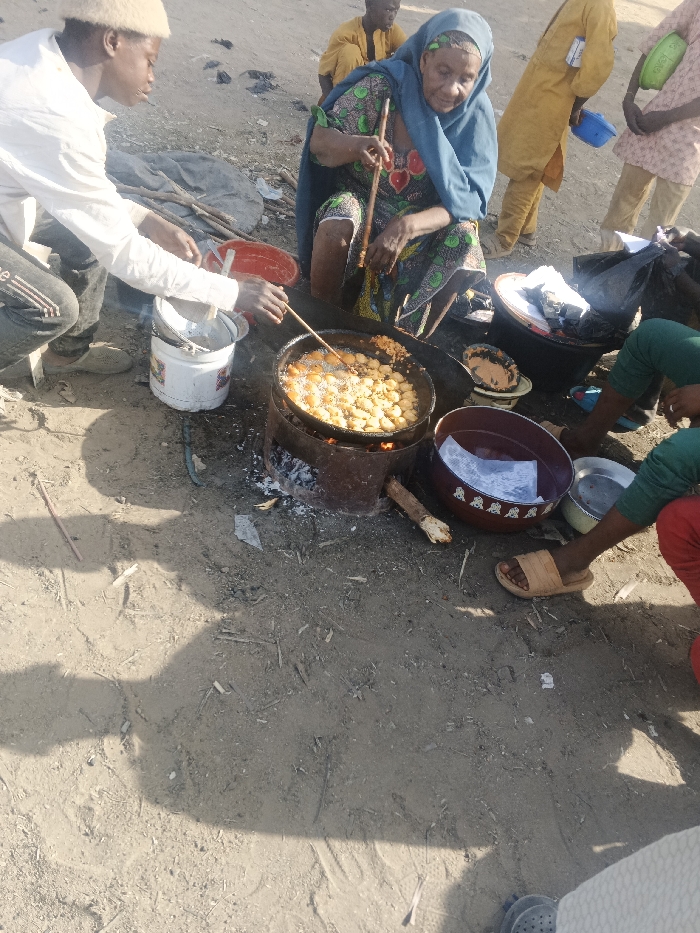
The image captures an outdoor food preparation scene in Gobirawa, Nigeria, under bright daylight. In the foreground, an elderly woman, dressed in a patterned garment and blue headscarf, squats on the ground, actively stirring spherical food items frying in a large metal pan filled with bubbling oil. The pan is positioned on an improvised metal drum stove, fueled by an active wood or charcoal fire. To her left, a young male in a white shirt, dark trousers, and a light-colored cap, kneels, holding a utensil over the pan and tending to a white plastic bucket. Scattered around the central activity on the unpaved, dusty ground are various containers including a red plastic bowl, a dark red patterned bowl, and a smaller metal bowl. In the background, three additional individuals are present: one seated wearing a yellow traditional garment, another standing in light brown attire holding a blue bowl, and a third with only their legs visible in green trousers and light brown sandals. The ground is dry earth with scattered debris and prominent shadows.
Gobirawa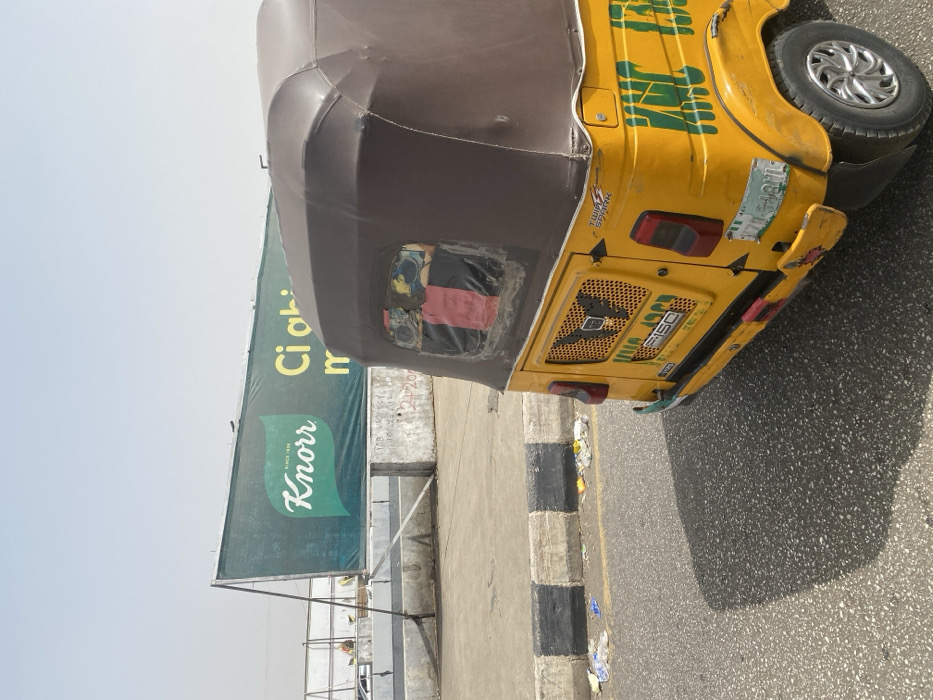
The scene depicts a static, outdoor environment in Gobirawa, Nigeria, under a bright, hazy sky. In the foreground, the rear three-quarter view of a yellow, three-wheeled passenger vehicle, commonly known as a Keke Napep, occupies the right side of the frame. The vehicle features a brown canopy top, a rear gridded panel with the text "F150" and "KEKE NAPEP" visible, two red rectangular taillights, and a partially obscured Nigerian license plate with "UGA-541YL". The rear window is a clear plastic panel, appearing worn, with colorful fabric or items visible through it. The vehicle casts a distinct, dark shadow onto the asphalt road surface. To the left of the Keke Napep, a black and white striped curb runs parallel to the road, bordering a concrete elevated area. Scattered white and colorful plastic litter is visible on this concrete surface. Further back, a large rectangular billboard stands prominently. The billboard has a dark green background with a white "Knorr" logo (including "SINCE 1838") on the left side, and partially visible white text "Ci obi m" on the right. Behind the billboard and concrete area, indistinct structures and a hazy, light-colored sky complete the background. No individuals are present in the image.
Gobirawa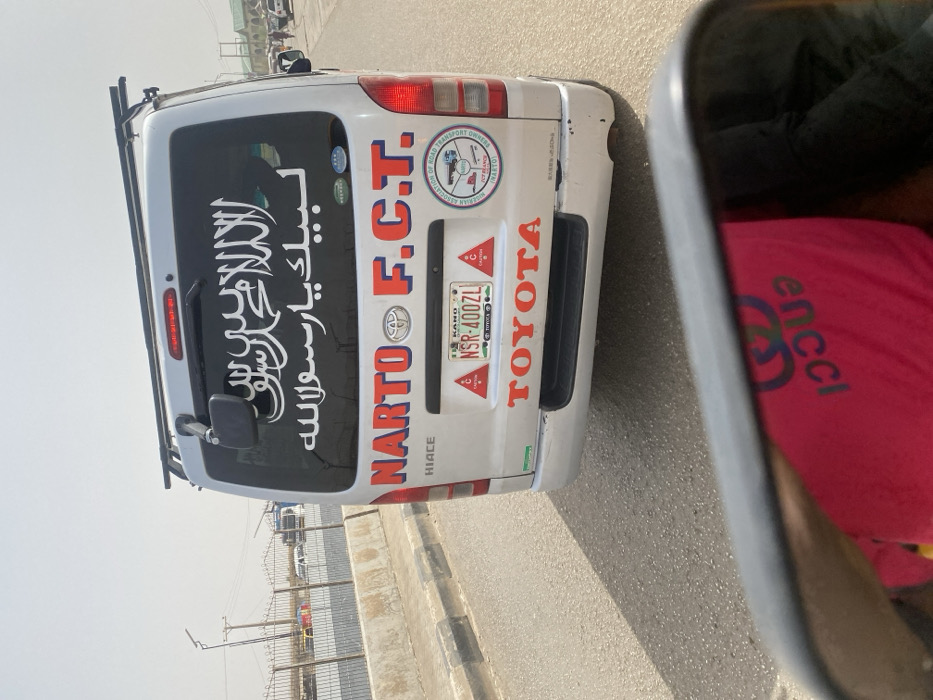
The image depicts the rear of a silver Toyota Hiace passenger van (mini-bus) on a paved road in Gobirawa, Nigeria, under bright daylight conditions. The van features a roof rack and a large white Arabic calligraphy decal on its black rear window, reading "لَا إِلَٰهَ إِلَّا ٱللَّٰهُ مُحَمَّدٌ رَسُولُ ٱللَّٰهِ" (There is no god but Allah, Muhammad is the messenger of Allah) and "لبيك يا رسول الله" (Here I am, O Messenger of Allah). Below the window, "NARTO F.C.T." is emblazoned in red letters, with a circular emblem to the right indicating the "NATIONAL ASSOCIATION OF ROAD TRANSPORT WORKERS (NARTO) FCT BRANCH". The vehicle's license plate, located centrally, reads "KANO NSR-400ZL". Three red triangular "CAUTION" stickers are affixed around the license plate. The word "TOYOTA" is prominent in red below the license plate. The lower rear bumper shows minor scuff marks. To the left of the van, a concrete road barrier is visible, and the background reveals a wire fence, utility poles, and distant structures, indicating an urban environment. The photograph is taken from a low perspective, with a partial reflection in a mirror at the bottom of the frame showing a person wearing a pink garment with the reversed "GUCCI" logo. No specific individuals are discernible inside or immediately outside the van.
Gobirawa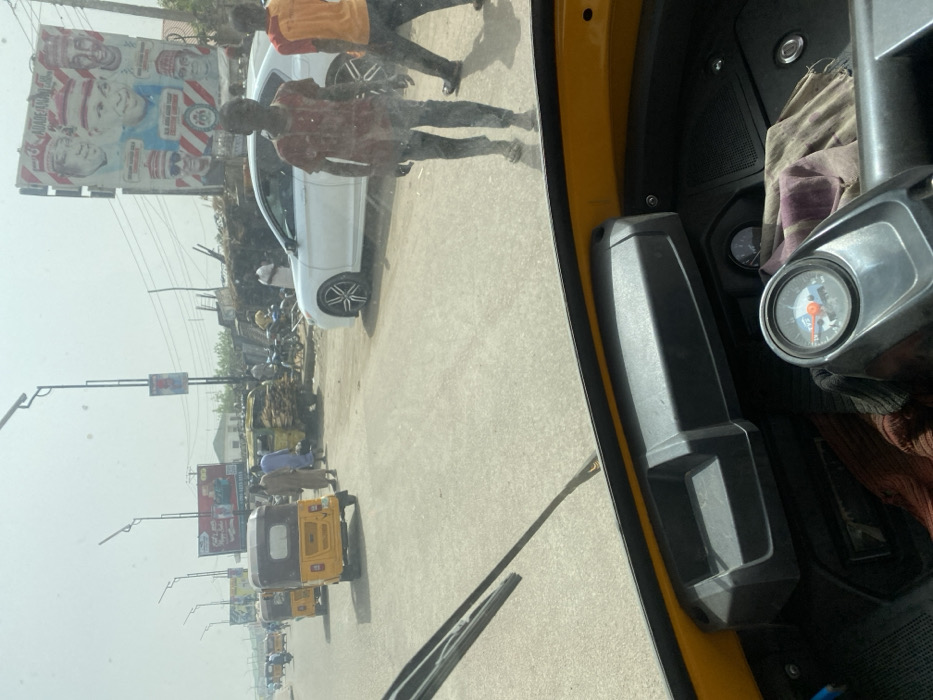
The image presents a daytime street scene in Gobirawa, Nigeria, captured from the driver's perspective inside a yellow motorized tricycle. The lower foreground shows the tricycle's dashboard, including a circular gauge on the steering column, a crumpled cloth, and the base of a windshield wiper. Beyond the windshield, a paved, multi-lane road extends into the distance under a clear sky. On the left side of the road, several other yellow tricycles are present, some appearing to be in motion or parked. In the mid-ground on the right, a white sedan, resembling a Honda Accord with black and silver multi-spoke rims, is stationary or parked. Adjacent to it, a light-colored utility vehicle, heavily loaded with bundled wood or similar materials, is parked alongside several motorcycles. Multiple individuals, all male, are visible on and near the roadway. Two men are prominent in the mid-right, walking away from the camera; one wears a faded red shirt, dark trousers, and sandals, while the other wears an orange shirt and dark trousers. Other men, some in traditional attire, are gathered near the loaded utility vehicle and further down the street. The background on the right features a large billboard displaying portraits of five political figures and partial text including "ADAREANAU" and "PDP." Numerous streetlights equipped with solar panels line the road. Smaller billboards, utility poles, and distant buildings are also visible.
Gobirawa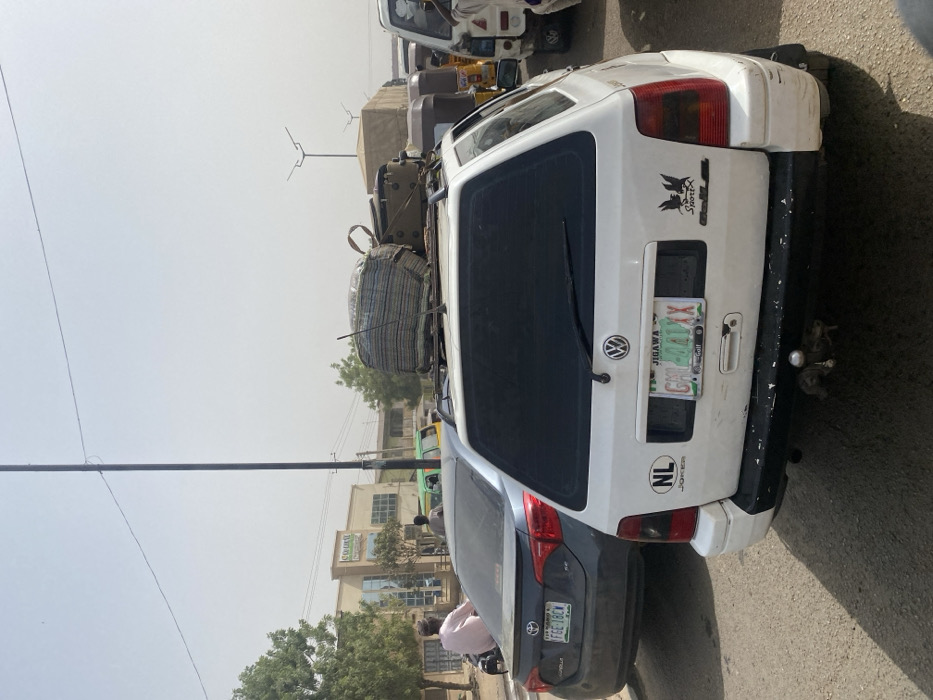
The scene depicts a congested street in Gobirawa, Nigeria, under a hazy daylight sky. In the foreground, a white Volkswagen Golf station wagon is observed from the rear, displaying a Jigawa state license plate "GH 404 XX". The vehicle has dark-tinted rear windows, "NL" and "Joker" stickers to the left of the license plate, and a "SportX" decal with a winged creature on the right. A prominent roof rack carries a striped fabric bag and a green hard-shell case, among other indistinct items. A trailer hitch is visible below the rear bumper. Directly behind the white Volkswagen is a dark grey Toyota Corolla sedan, bearing a Jigawa state license plate "FGE 18CW". A person in a light-colored shirt is seated on a motorcycle positioned behind the Toyota Corolla, facing away from the camera. To the right, a queue of vehicles includes multiple yellow and black commercial tricycles. On the left side of the frame, a green small bus or van is partially visible. In the background on the left, a multi-story building with "CRONIL Hotel" visible on its facade stands amidst sparse trees. A tall, dark utility pole occupies the mid-ground, with power lines traversing the upper portion of the frame. Distinctive streetlights with horizontal cross-arms are visible in the distant background on the right.
Gobirawa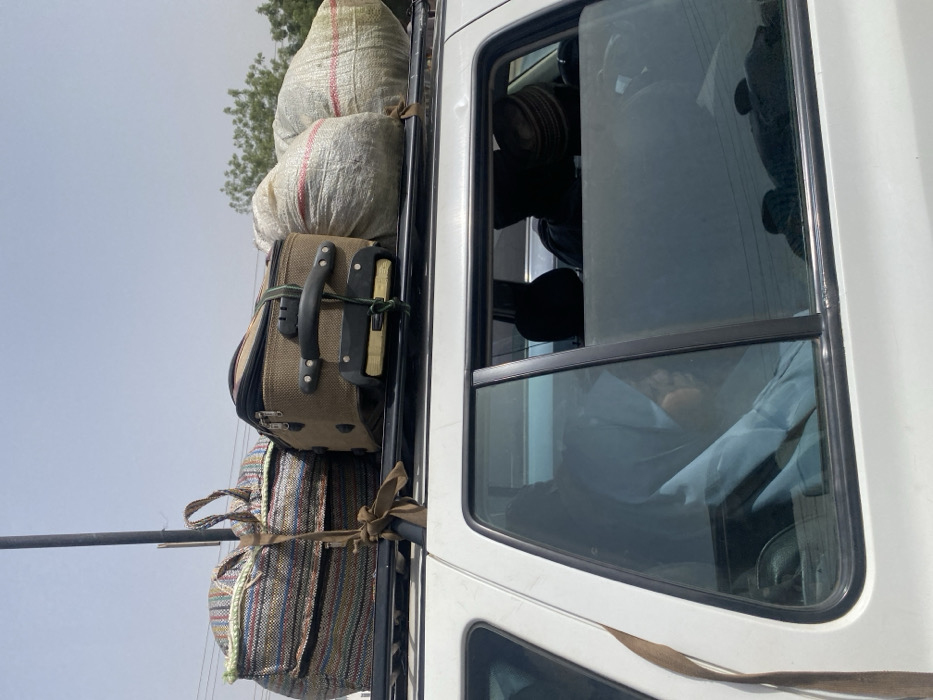
This image depicts the side view of a white vehicle, likely an SUV, with a loaded roof rack, situated in Gobirawa, Nigeria, under clear, bright daylight. **Objects:** * **Vehicle:** A white four-door SUV is positioned with its right side facing the viewer. The rear side windows are tinted but allow for partial visibility of occupants. * **Roof Rack Contents:** * A large, multi-colored striped fabric bag, secured with a brown fabric strap, is positioned on the front left of the roof rack. * A brown wheeled suitcase, with its handle retracted, is secured with a green strap or bungee cord next to the striped bag. * Two white woven sacks, each featuring red stripes, are placed behind the suitcase, towards the rear of the roof rack. All items are firmly affixed to a black roof rack structure. * **Environment:** The sky is a light blue, almost white, suggesting an intense sun. In the upper left, a dark, thin vertical pole extends upwards. In the distant background on the right, sparse green foliage from trees is visible against the light sky. **People:** * **Rear Left Passenger:** A person is visible through the tinted rear left passenger window. They appear to be wearing a light-colored garment, possibly a head covering, and are seated, with their face partially obscured. * **Rear Right Passenger:** Another individual is visible through the rear right passenger window, wearing a dark cap or traditional headwear and dark clothing. Their face is also largely indistinct. * Other occupants may be present but are not clearly discernible through the vehicle's windows. **Actions:** The vehicle appears to be stationary or in transit, laden with luggage on its roof rack, indicating travel or preparation for travel. The people are seated within the vehicle.
Gobirawa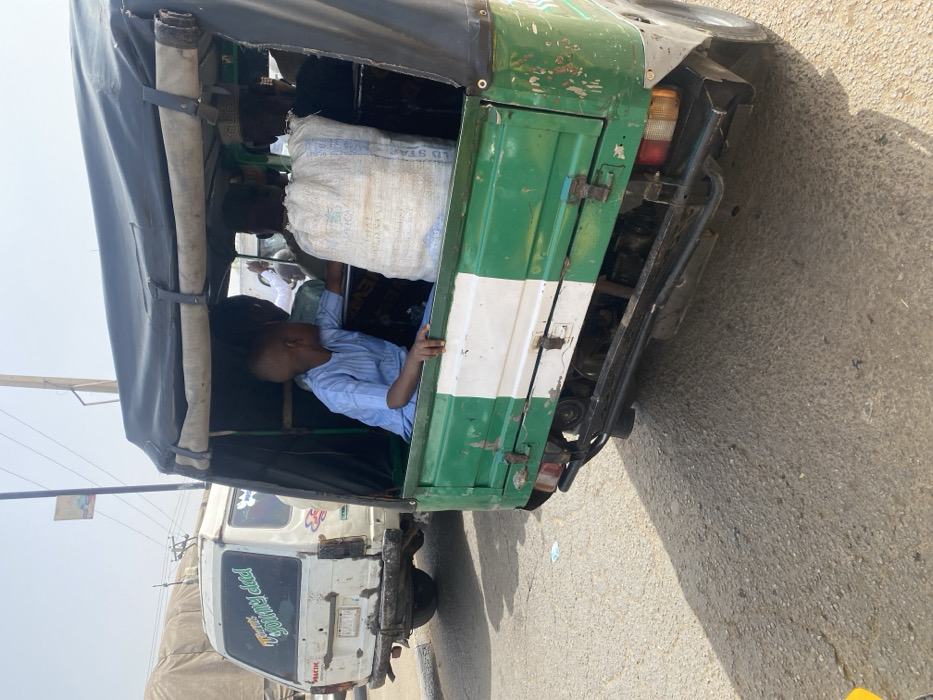
An image captured in Gobirawa, Nigeria, depicts a daytime street scene featuring a green and white three-wheeled commercial vehicle, commonly known as a keke napep, positioned prominently in the foreground. The vehicle has a black canvas roof and a rear cargo/passenger compartment painted with vertical green and white stripes. Inside, a young male child, approximately 5-7 years old, with a shaved head and wearing a light blue striped tunic, is seated on the left, looking to his right, with his hands resting on the side rail. A large white sack, bearing partial text "GOLD STAR" and "US," is centrally placed in the compartment. At least three other adult individuals are partially visible further inside the vehicle. Behind the three-wheeler, a heavily worn white van or minibus is parked or moving slowly, displaying a sticker that reads "Yummy dad" on its rear window. The vehicles are situated on an asphalt road under clear daylight conditions, casting discernible shadows. Power lines and a distant billboard are visible in the upper background.
Gobirawa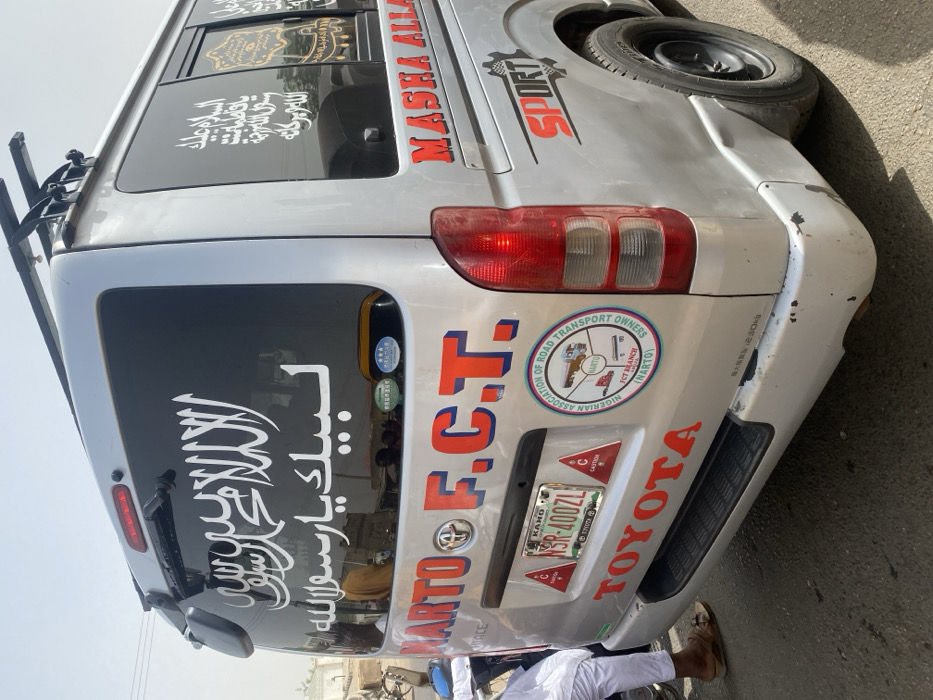
A silver Toyota Hiace commercial van is depicted from its rear three-quarter aspect, parked on an asphalt road in Gobirawa, Nigeria, under daylight conditions. The van features extensive religious and organizational decals. The rear window is darkly tinted, displaying large white Arabic calligraphy including "لا إله إلا الله محمد رسول الله" (There is no god but Allah, Muhammad is the messenger of Allah) and "لبيك يا رسول الله" (At your service, O Messenger of Allah). The rear-right side window also contains white and gold Arabic calligraphy. The van's body displays "NARTO F.C.T." in large red and blue letters on the left rear, signifying the Nigerian Association of Road Transport Owners, Federal Capital Territory branch. A circular "NARTO FCT BRANCH" sticker is positioned below this text. The license plate, "KANO NSR-400ZL," is centrally mounted on the tailgate, flanked by three red triangular "CAUTION" stickers. The word "TOYOTA" is emblazoned in red on the lower part of the silver bumper, which exhibits scuffs and black marks on its lower right section. Further along the right side of the van, "MASHA ALLAH" and "SPORT" are visible in red and black lettering. A black roof rack is mounted atop the vehicle. The rear right wheel with a black rim is visible. A person's lower legs and feet, clad in white attire and brown sandals, are partially visible on the left side of the frame, standing close to the van. The immediate environment consists of a paved road surface, with a hazy, bright background suggesting a dusty or distant urban landscape.
Gobirawa