Godang-ri, South Korea
30 memories from Godang-ri, South Korea
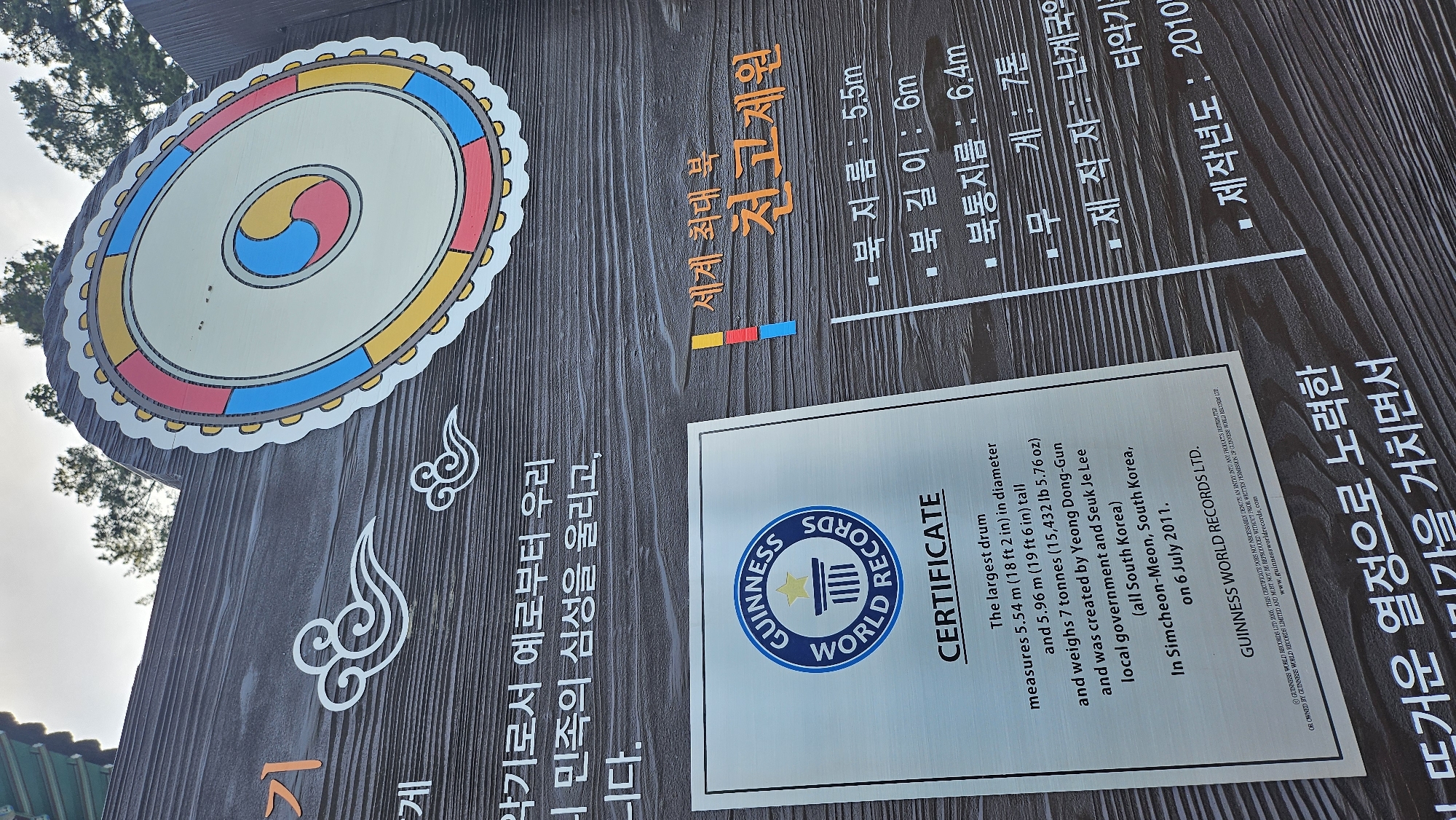
This image displays a wooden sign in Godang-ri, South Korea, featuring Korean text, a Guinness World Records certificate, and a colorful drum graphic. The sign is oriented horizontally and appears to be outdoors, with a glimpse of trees and sky in the background. The upper portion of the sign shows a large, circular graphic of a drum with a red, blue, and yellow Taeguk symbol in the center, surrounded by segments of red, blue, and yellow, all within a scalloped white border. Below this graphic, Korean text in white and orange lettering is visible. The lower left portion of the sign prominently features a Guinness World Records certificate. The certificate is silver and has the Guinness World Records logo, which includes a globe, a pedestal with a statue, and the text "GUINNESS WORLD RECORDS." Below the logo, the text "CERTIFICATE" is centered. The certificate details that the largest drum measures 5.54 m (18 ft 2 in) in diameter and 5.96 m (19 ft 6 in) tall, weighing 7 tonnes (15,432 lb 5.76 oz). It also states that it was created by Yeong Dong-Gun, the local government, and Seuk Je Lee from Simcheon-Meon, South Korea, on July 6, 2011. Below this, "GUINNESS WORLD RECORDS LTD." is printed. To the right of the certificate, more Korean text is visible, indicating specifications for a drum. This section lists "북 지름 : 5.5m" (drum diameter: 5.5m), "북 길이 : 6m" (drum length: 6m), "북통 지름 : 6.4m" (drum body diameter: 6.4m), "무 게 : 7톤" (weight: 7 tonnes), "제작 자 : 난계국악" (creator: Nangye Gugak), and "제작 년도 : 2010" (year of creation: 2010). There are also small colored rectangular markers (yellow, red, blue) to the left of this Korean text. The bottom portion of the sign has Korean text in large white font that reads "또 뜨거운 열정으로 노력한" and "해가 가 거치면서". The scene appears to be focused on the historical and cultural significance of a large drum, as indicated by the Guinness World Records entry and the descriptive text. No people are visible in the image.
Godang-ri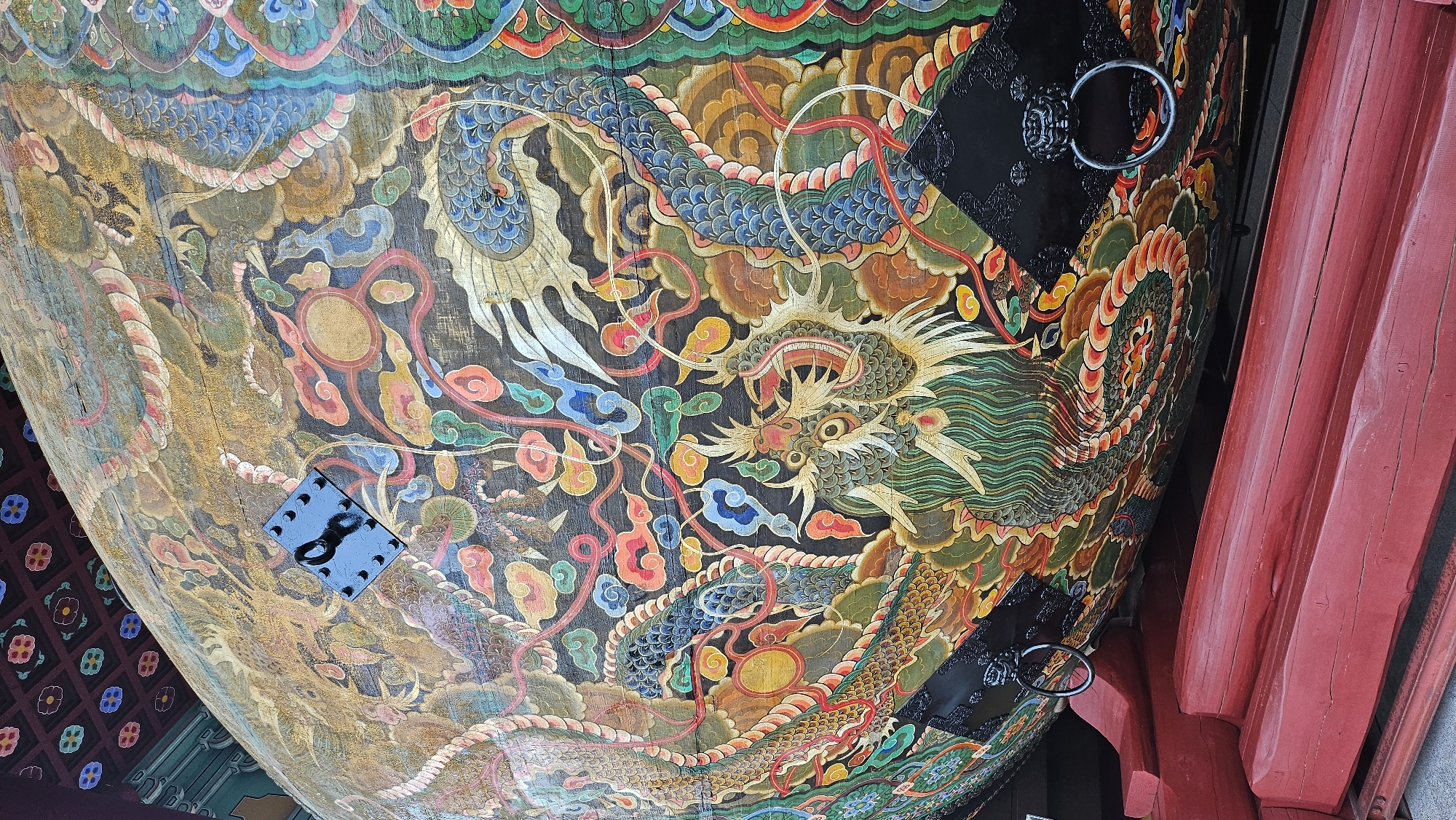
The image displays a close-up view of a large, ornately painted drum situated in Godang-ri, South Korea. The drum is adorned with vibrant, traditional Korean artwork featuring dragons, clouds, and floral motifs. The colors are rich and varied, including gold, red, blue, green, and black. Two black metal rings, each with a lion head design, are attached to the drum, presumably for handling or support. The drum rests on a weathered, red wooden stand. In the background, a portion of a decorated ceiling with patterned tiles is visible. The overall scene suggests a cultural or historical artifact displayed in an outdoor or semi-outdoor setting.
Godang-ri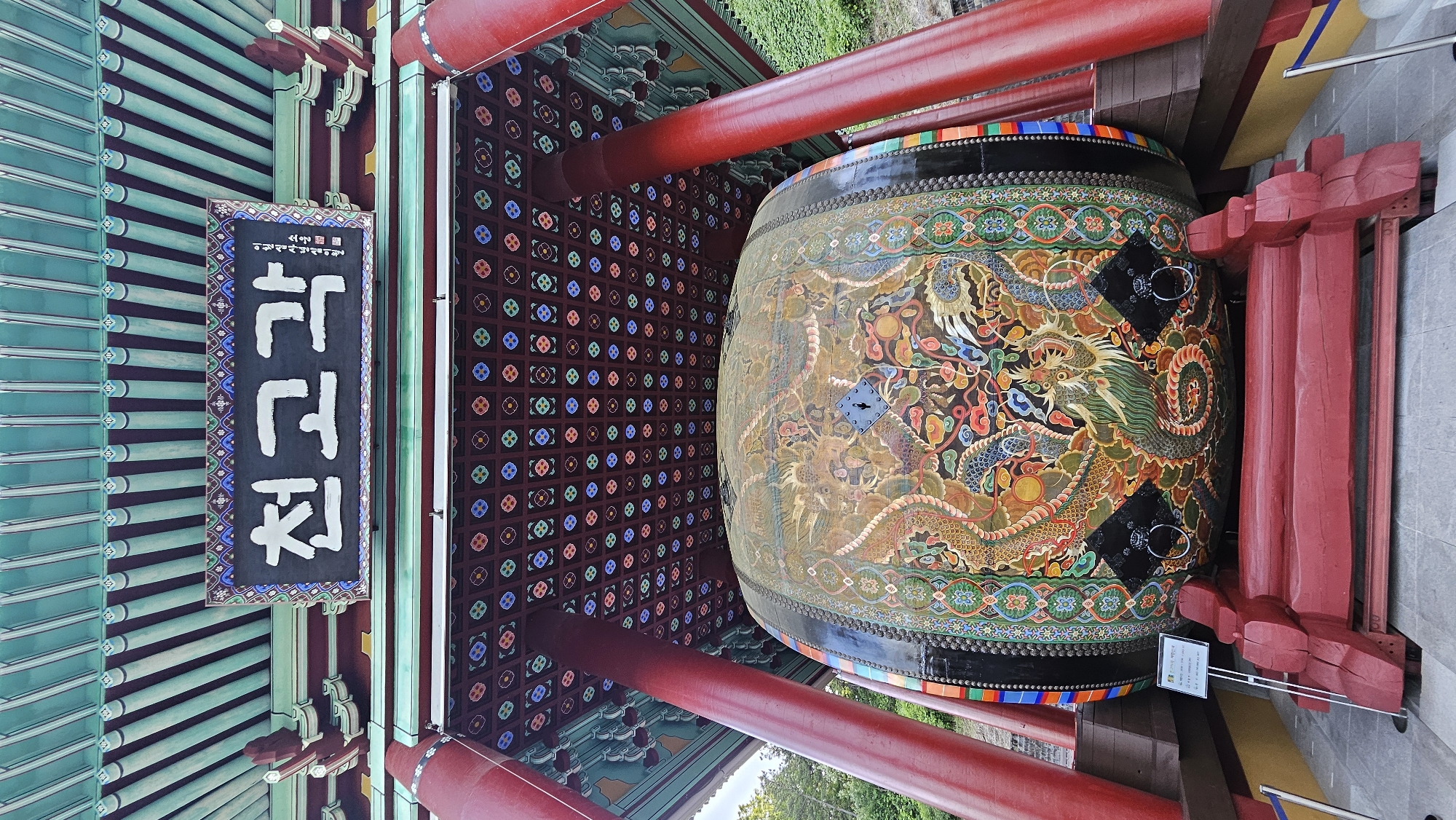
A low-angle, full shot captures a large, elaborately decorated drum situated outdoors under a traditional Korean pavilion structure. The pavilion features a teal-colored, tiered roof with dark brown eaves and red beams supporting it. The ceiling of the pavilion is adorned with a repeating pattern of small, colorful floral motifs in red, blue, green, and yellow against a dark brown background. A black sign with white Korean characters, "천고각", is prominently displayed above the drum. The drum itself is immense, painted with vibrant depictions of dragons, clouds, and intricate patterns in shades of green, gold, red, blue, and orange. Two black ring handles are attached to the sides of the drum. The drum is supported by a red wooden base. To the left of the drum, a white sign with Korean text and a blue rope barrier are visible. The background shows a green, grassy hillside.
Godang-ri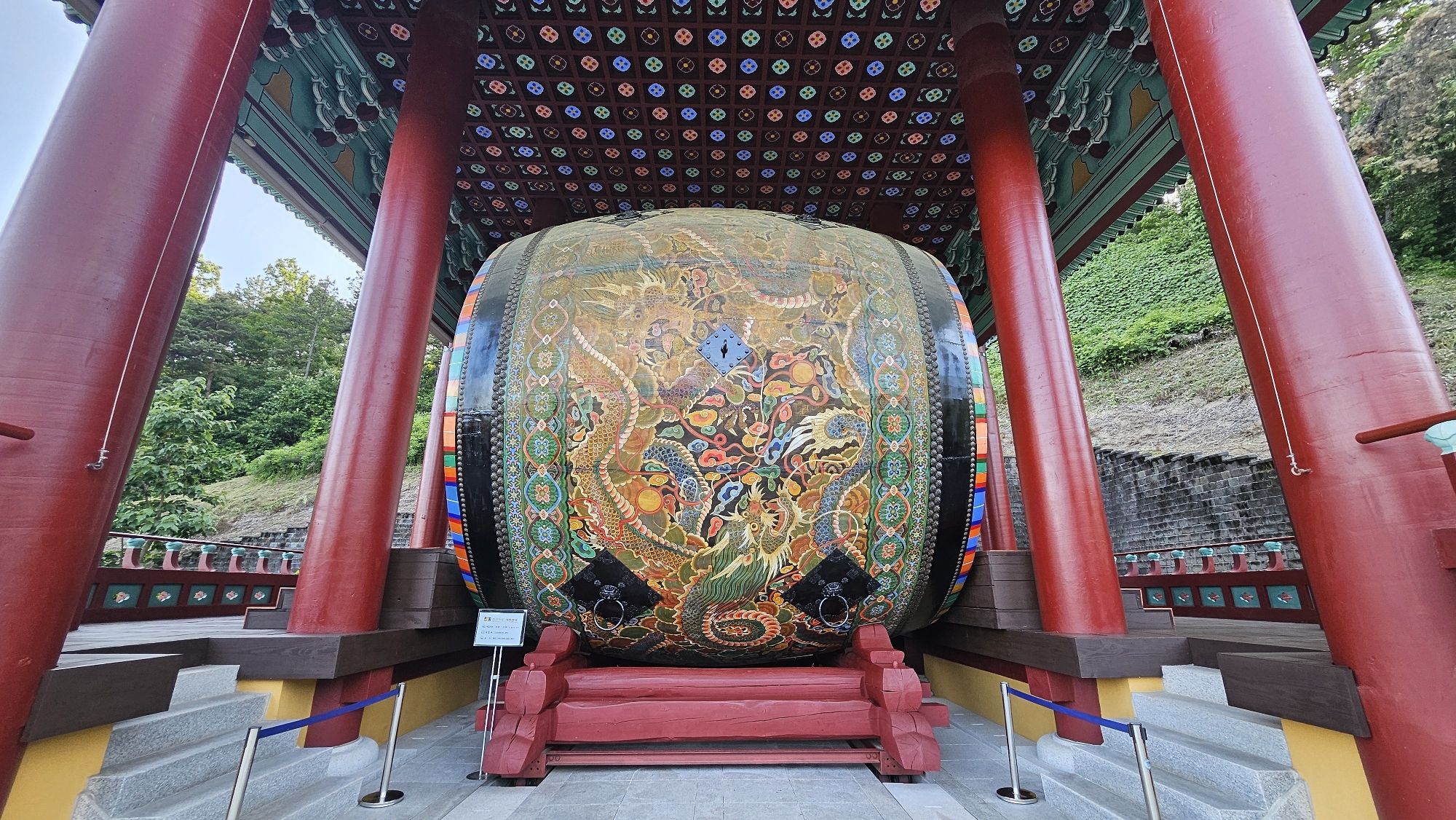
The image shows a large, elaborately decorated drum housed within a traditional Korean pavilion in Godang-ri, South Korea. The pavilion features vibrant red pillars and a patterned ceiling with circular motifs. The drum itself is the central focus, adorned with intricate paintings of dragons and floral designs in a rich palette of colors. It rests on a wooden platform, supported by red wooden braces. Steps lead up to the pavilion, and a blue rope barrier is visible, indicating a public viewing area. The background consists of a green hillside with scattered trees and a stone wall. The scene is brightly lit, suggesting it was taken during the daytime. There are no people visible in the image.
Godang-ri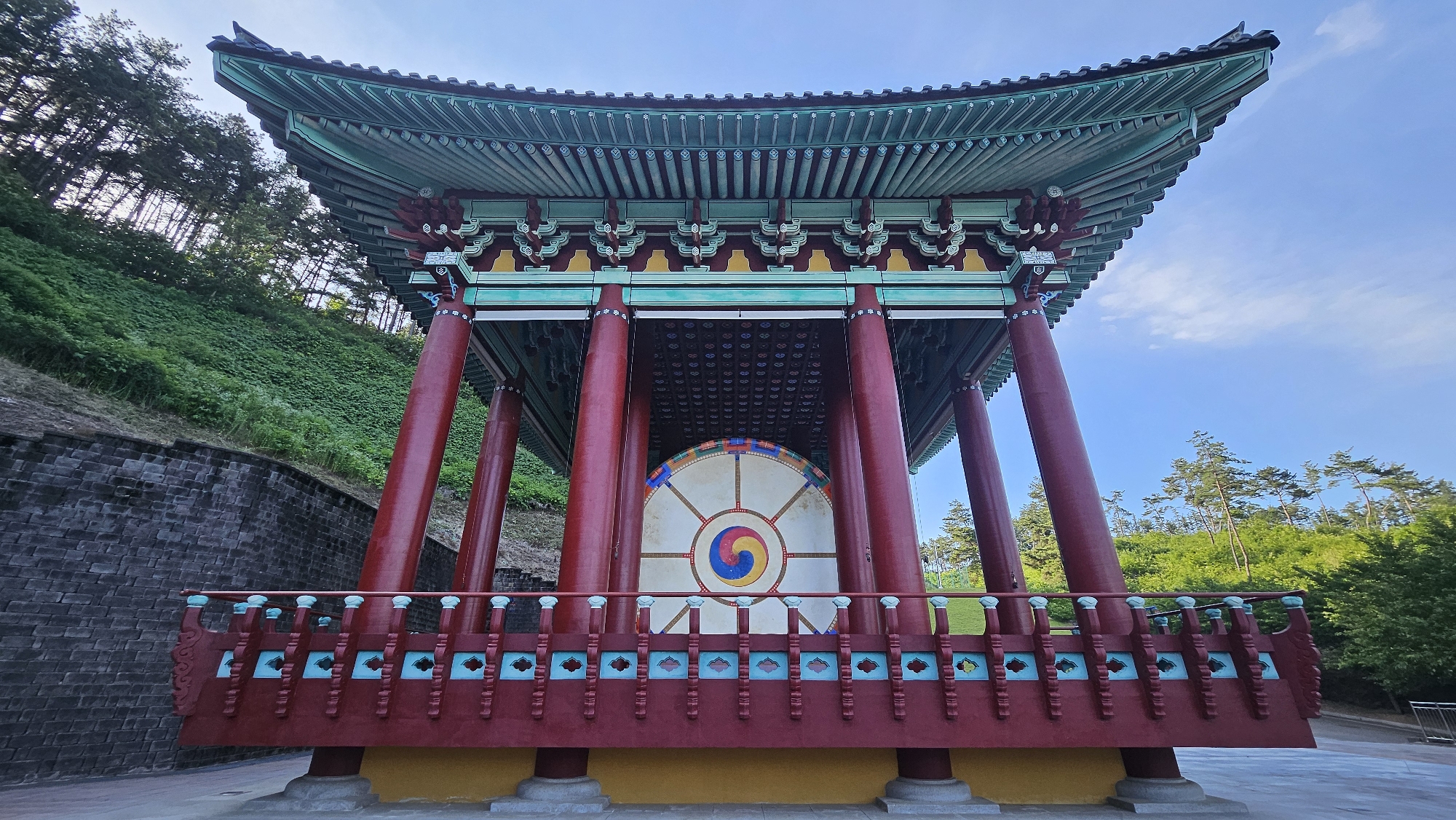
A traditional Korean pavilion with a large drum is pictured in Godang-ri, South Korea. The pavilion has a multi-tiered, green tiled roof with ornate red and teal trim. Red pillars support the roof and surround a large, circular drum with a white face and a colorful taegeuk symbol in the center. A decorative red railing with teal accents encloses the platform of the pavilion. The pavilion is situated on a hillside covered in lush green vegetation. A stone wall is visible to the left of the pavilion. Pine trees and other green foliage form the background, under a bright blue sky with scattered white clouds. No people are visible in the image.
Godang-ri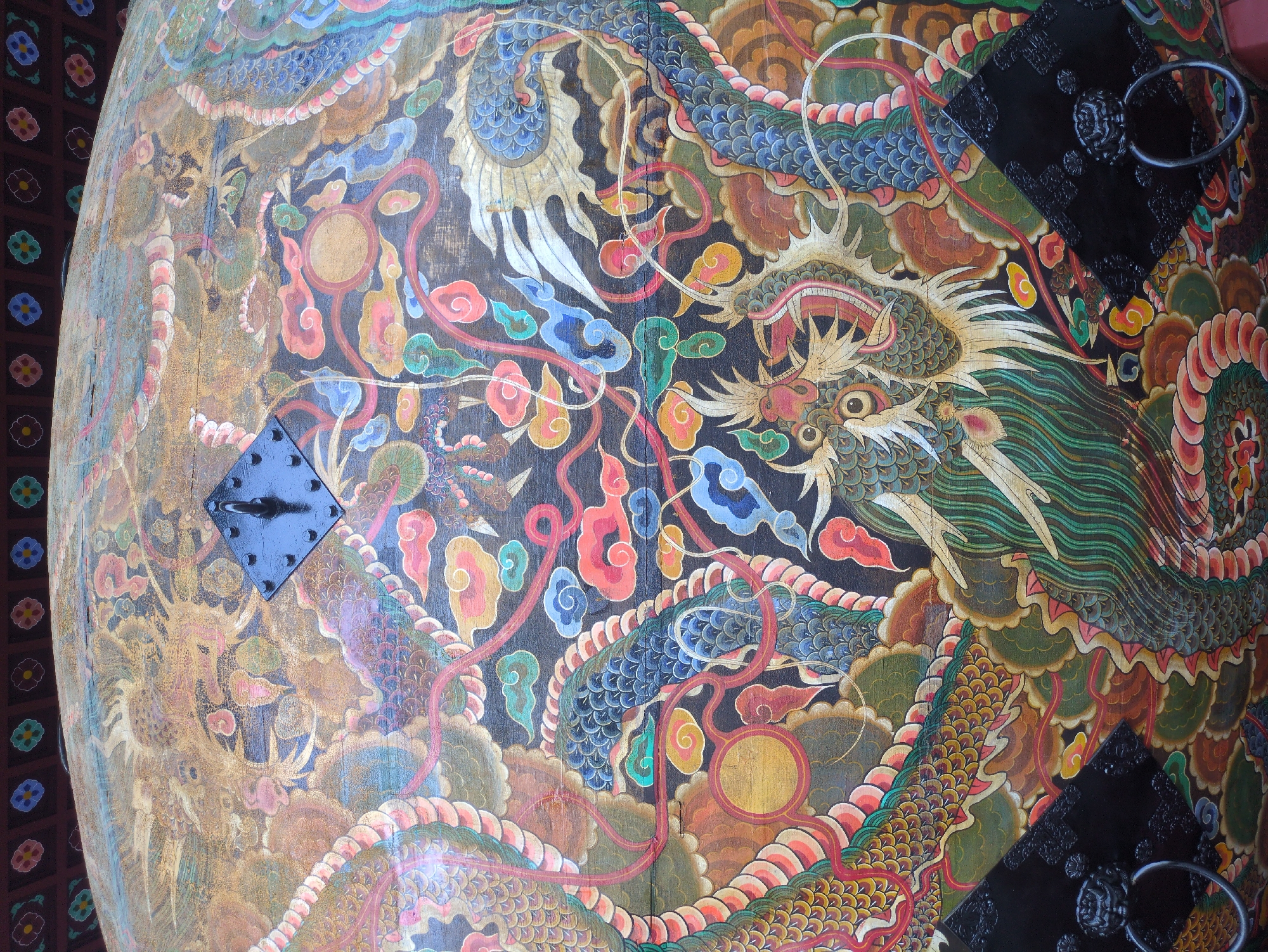
This image presents a close-up, upward-angled view of a large, curved, wooden surface, identified as a traditional Korean drum (beopgo), located in Godang-ri, South Korea. The drum is extensively decorated with vibrant, traditional polychrome artwork. The primary subjects of the artwork are multiple stylized dragons. Their bodies are rendered with intricate scales in shades of blue, green, and gold, accented with red. The dragons coil and intertwine across a deep black background. Their heads feature prominent eyes, sharp facial features, and flowing manes. One dragon's head is clearly visible in the lower right, another partially visible in the lower left, and a faded representation in the upper left. Interspersed among the dragon forms are numerous stylized cloud motifs in various colors, including red, blue, green, orange, and yellow. Several golden orbs, or "cintamani" pearls, are strategically placed within the composition, notably one in the lower-middle left and a faded one in the upper left. Affixed to the drum's surface are three distinct pieces of black metal hardware. The uppermost piece is a diamond-shaped plate secured by four rivets, featuring a single, upward-curving metal loop or handle. The two lower pieces are also diamond-shaped plates, each adorned with a sculpted lion's head or beast's head from which a circular metal ring handle is suspended. These plates are also secured with decorative studs. The paintwork, while still vibrant, shows signs of age and weathering, particularly in the upper sections where colors appear somewhat faded and the underlying wood texture is more visible. In the uppermost background, a section of a dark red-brown architectural element is visible, likely an eave or ceiling beam of a traditional Korean building. This element features a repeating pattern of square panels, each containing a distinct, stylized floral motif rendered in multiple colors, including red, blue, green, and yellow. No people are present in the scene, and no actions are depicted.
Godang-ri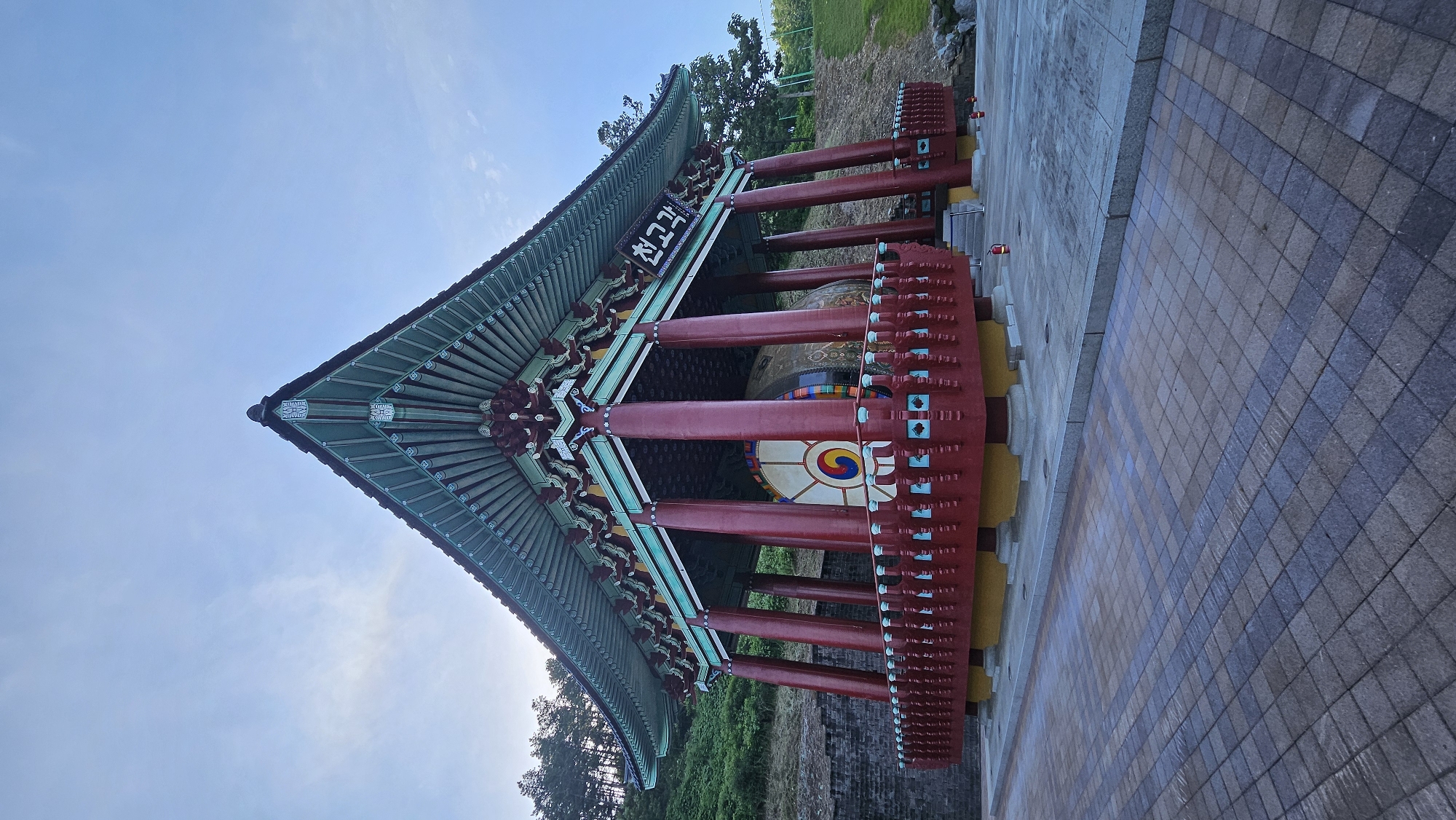
The image depicts a traditional Korean building with a distinctive green, multi-tiered roof and red cylindrical pillars. The building appears to be a pavilion or a gateway. A large drum is visible inside, adorned with a Taegeuk symbol, indicating a cultural or ceremonial purpose. The architecture features intricate details, including decorative carvings on the eaves and ornate brackets supporting the roof. The ground in front of the structure is paved with interlocking tiles, forming a pathway. The surrounding environment includes a grassy slope with trees on the left and a stone wall on the right. The sky is visible above, with some wispy clouds, suggesting it is daytime, possibly morning or late afternoon due to the soft lighting. There is visible text on a dark plaque attached to the building. The characters are Korean and appear to read "천고각" (Cheongogak). The overall scene evokes a sense of cultural heritage and tranquility. No people are visible in the image. The photograph is taken from a low angle, emphasizing the grandeur of the structure against the sky. The location is identified as Godang-ri, South Korea, reinforcing the Korean architectural context.
Godang-ri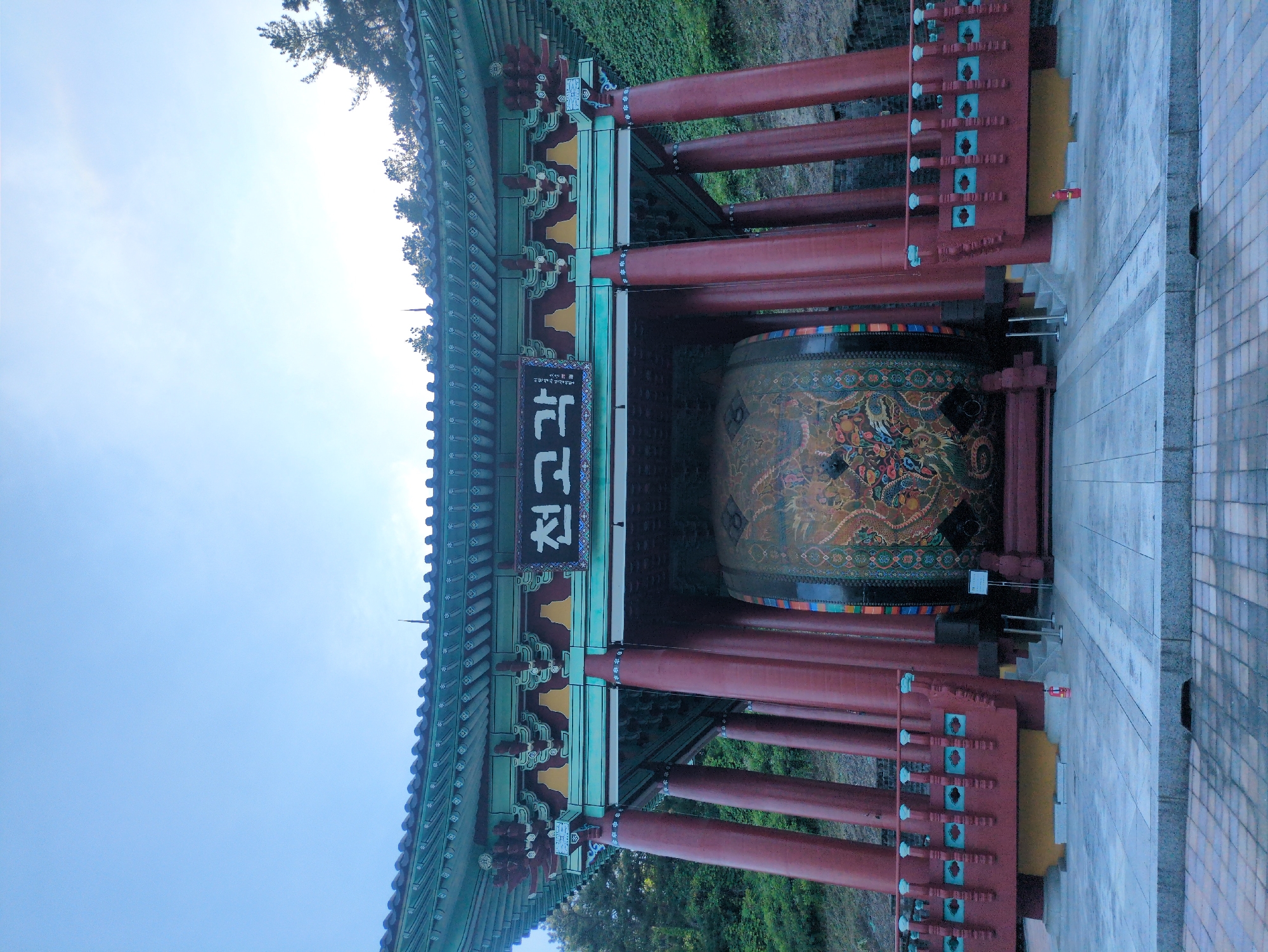
This image depicts the Cheongogak (Heavenly Drum Pavilion), a traditional Korean structure, located in Godang-ri, South Korea. The pavilion is constructed with multiple dark red cylindrical pillars supporting an elaborately decorated, multi-tiered roof featuring green and blue tiles and intricate Dancheong patterns. A black sign with white Korean characters reading "천고각" (Cheongogak) is mounted centrally above the drum within the pavilion. Inside the pavilion, a very large, cylindrical drum is prominently displayed. The visible face of the drum is adorned with complex, colorful artwork, likely depicting a mythical creature such as a dragon amidst ornate patterns. A decorative wooden railing, painted in red with blue accents, spans the front lower section of the pavilion. The immediate foreground consists of a light-colored, paved stone plaza, with a visible step leading to a darker, patterned paved area in the far foreground. On the raised platform directly in front of the pavilion, a red fire extinguisher is positioned, along with two silver stanchions. Behind and to the sides of the pavilion, a steep hillside is densely covered with green trees and foliage. The sky above is a clear, light blue. No individuals are present in the frame.
Godang-ri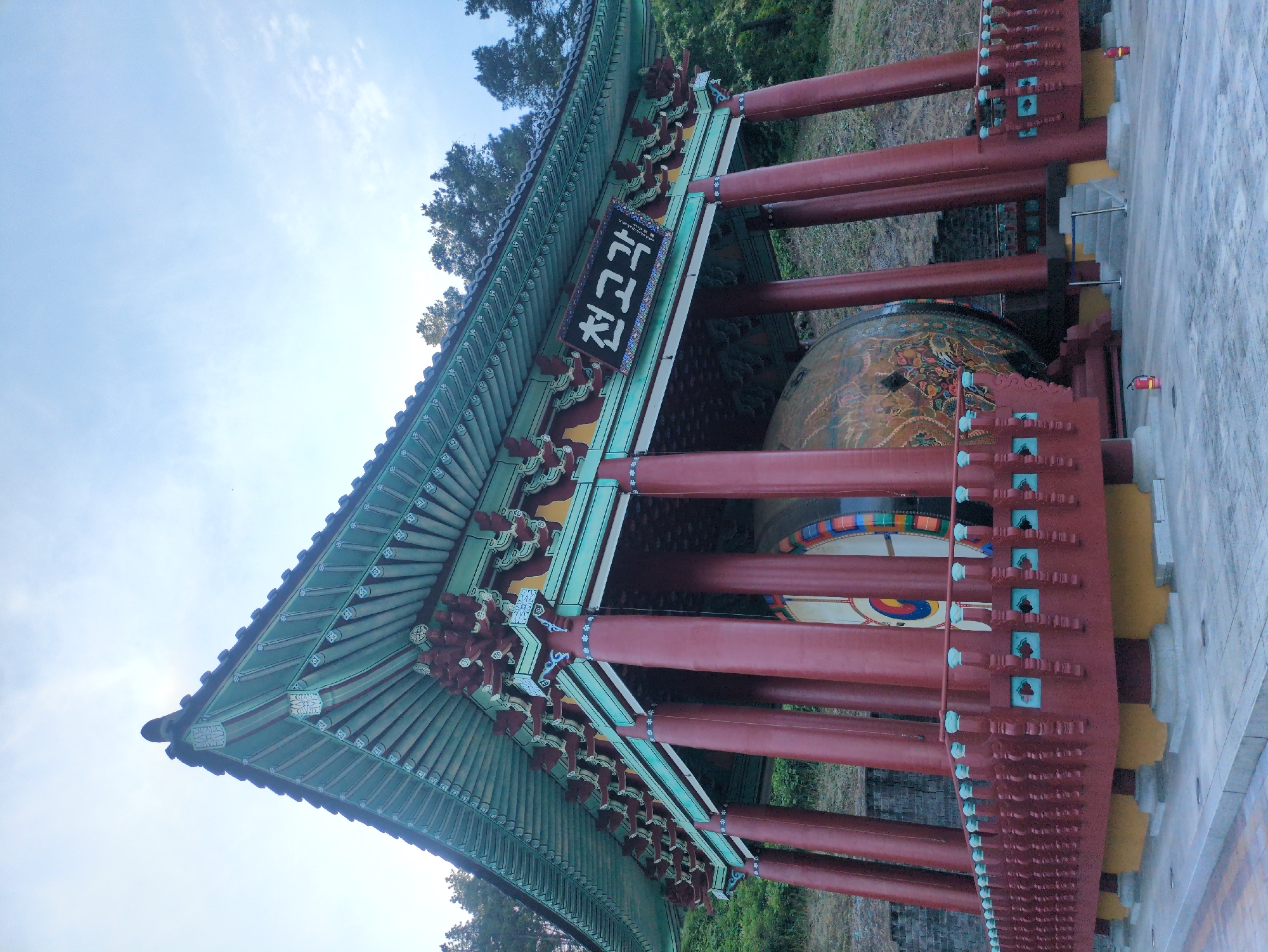
A traditional Korean drum pavilion, identified by a black sign with white Korean characters reading "천고각" (Cheongogak), stands in Godang-ri, South Korea. The pavilion features a complex, multi-tiered dark-tiled roof with prominently curved eaves. The underside of the eaves is painted in light blue-green with maroon and white decorative patterns, supported by a layered system of maroon-red brackets with white and blue accents. Eight visible thick, cylindrical pillars, painted deep maroon-red, support the main structure. A low, ornate railing system, also in maroon-red with light blue-green patterned panels, surrounds the base of the pavilion. The structure rests on a yellow-gold base, which is situated on a light grey concrete or stone platform. Inside the pavilion, a very large traditional drum is housed. The left visible side of the drum features a concentric circle design with a central red and blue taegeuk symbol, surrounded by colorful rings. The right visible side is adorned with intricate, multi-colored traditional Korean artwork, possibly depicting mythological creatures and clouds. The pavilion is set against a natural backdrop of a sloping hill covered in green foliage and numerous dark green coniferous trees. The sky above is a pale blue with scattered faint white clouds. The foreground consists of a clean, light grey paved area. Two red fire extinguishers are positioned on the paved ground, one on the left and one on the right side of the pavilion's base. Low grey steps are visible on the right, leading towards the drum entrance. No people are present in the scene.
Godang-ri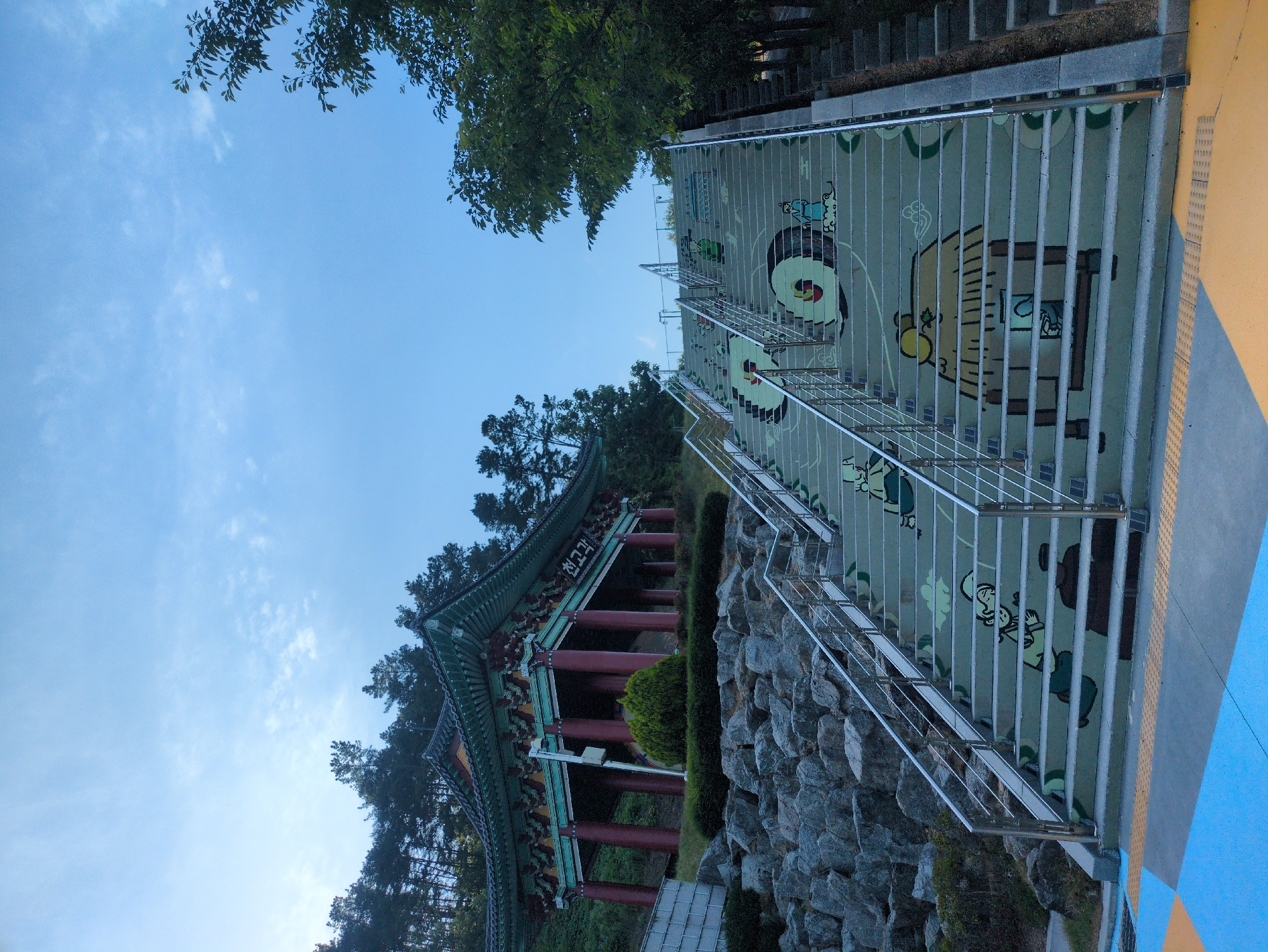
This image captures a wide-angle view of a traditional Korean pavilion, identified by the Korean text "천고각" (Cheongogak) on its facade, situated on an elevated, rocky embankment in Godang-ri, South Korea. The pavilion features a green-tiled, multi-tiered roof with ornate eaves, supported by numerous red pillars. Lush pine trees densely cover the hill behind the structure. In the foreground, a prominent, wide staircase ascends towards the pavilion. The risers of these concrete stairs are painted with a series of colorful, cartoon-like illustrations depicting traditional Korean figures, drums, and cloud motifs, primarily in shades of green, yellow, and red on a light grey background. Polished silver-colored metal handrails with multiple horizontal bars line both sides of the staircase. To the far right, a narrower, undecorated set of stone stairs runs parallel to the main painted staircase. The base of the hill beneath the pavilion is composed of various sizes of grey rocks, with a small, rounded green bush directly in front of the pavilion's center. The sky overhead is a clear, light blue with sparse, wispy white clouds scattered across it. On the right side of the image, the branches of a deciduous tree with green leaves are visible, extending into the frame. The ground at the bottom of the stairs features a geometric pattern of blue, yellow, and dark grey pavement sections, with the yellow areas incorporating tactile paving for accessibility. No individuals are present in the scene.
Godang-ri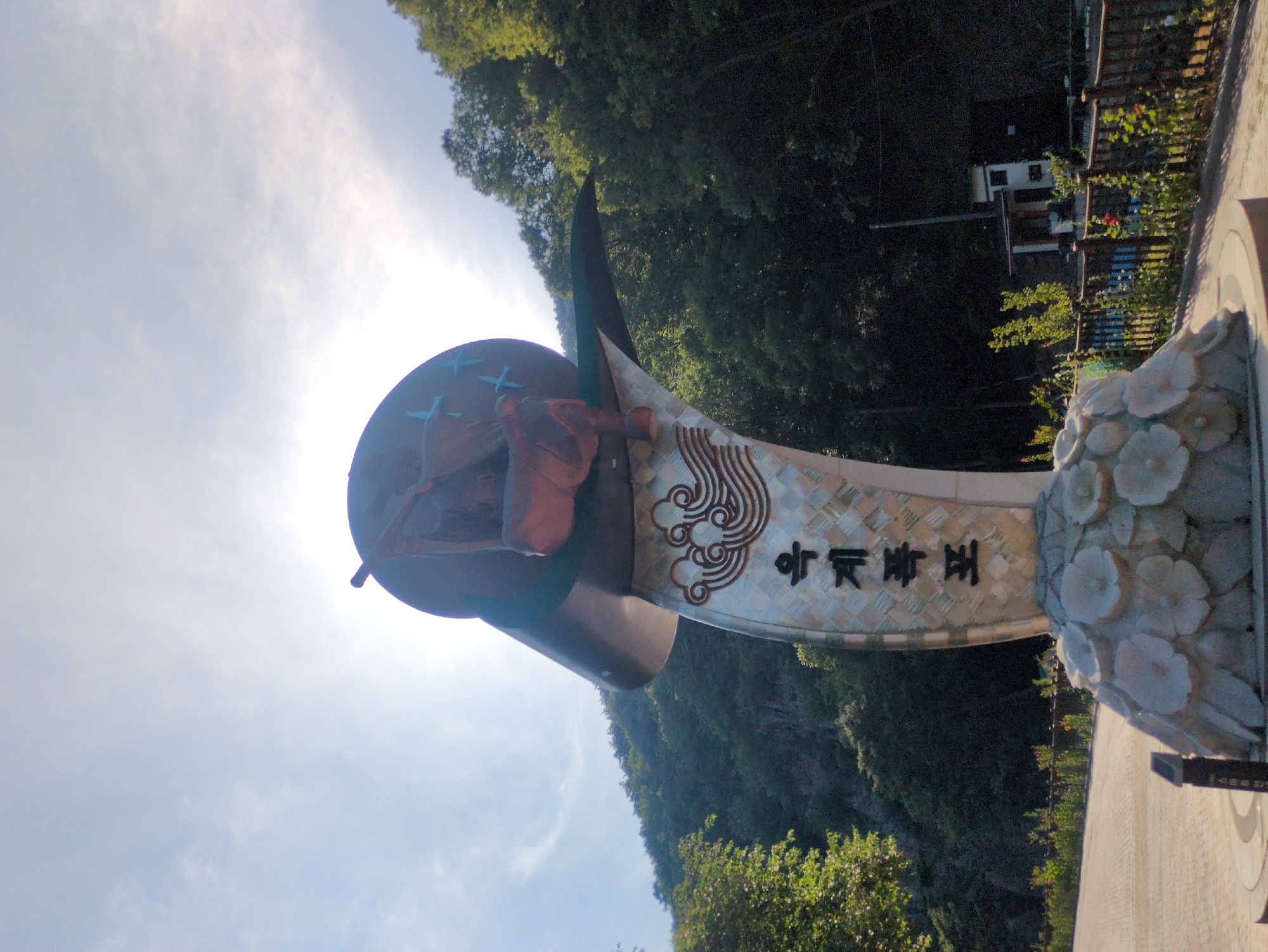
A tall, ornate monument stands prominently in the center of the frame, set against a backdrop of densely forested mountains under a bright, partly cloudy sky. Strong sunlight emanates from the upper right, causing a lens flare and backlighting the top of the structure. The monument's base is adorned with multiple light-colored, stylized floral or leaf-like shapes. Rising from this base is a tall, silver-toned column featuring a textured, possibly woven or checkered, pattern. On this column, a large, stylized brown cloud motif is visible, below which are prominent black Korean characters reading "옥계폭포" (Okgye-pokpo), identifying the site as Okgye Waterfall. The upper section of the monument comprises a dark, circular disk with several light blue cross-shaped symbols, supporting a dark, stylized figure that appears to be holding a staff or instrument. The monument rests on a paved pathway or plaza. To the left, a portion of a tree with green leaves is visible. The background is dominated by steep, lush green mountains covered in dense foliage. To the right of the monument, a low, dark wooden fence runs parallel to the path, with scattered green plants and a few red flowers behind it. Further in the background on the right, a small, white building with a brown roof and a porch is partially visible amidst the trees. No people are present in the scene, which is located in the vicinity of Godang-ri, South Korea.
Godang-ri
A close-up shot from a high angle shows a group of tadpoles swimming in murky green water. The water is covered with green algae and some floating debris. The tadpoles are small and light brown, with visible tails. They are swimming around in different directions, some individually and others in small clusters. The water reflects a clear blue sky and some surrounding trees.
Godang-ri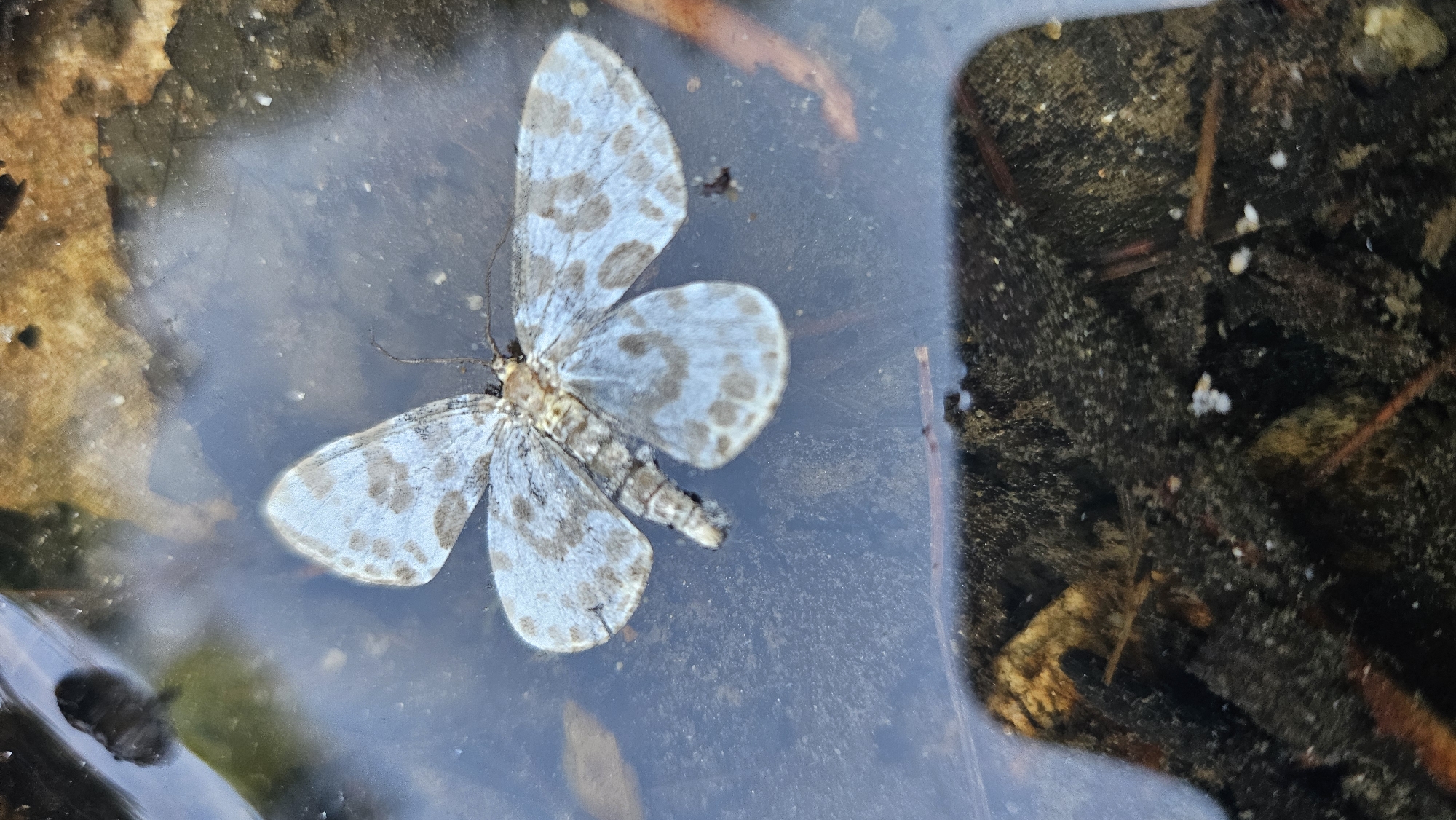
A dead moth rests on the surface of shallow, muddy water. The moth, predominantly light gray with darker gray, irregular spots, has its wings spread. Its body is segmented and appears light brown. The water is partially covering dark, organic matter, likely soil and decaying leaves, visible in the foreground. The background shows reflections of foliage and what appears to be a dark, solid object submerged in the water. The scene is likely outdoors in Godang-ri, South Korea.
Godang-ri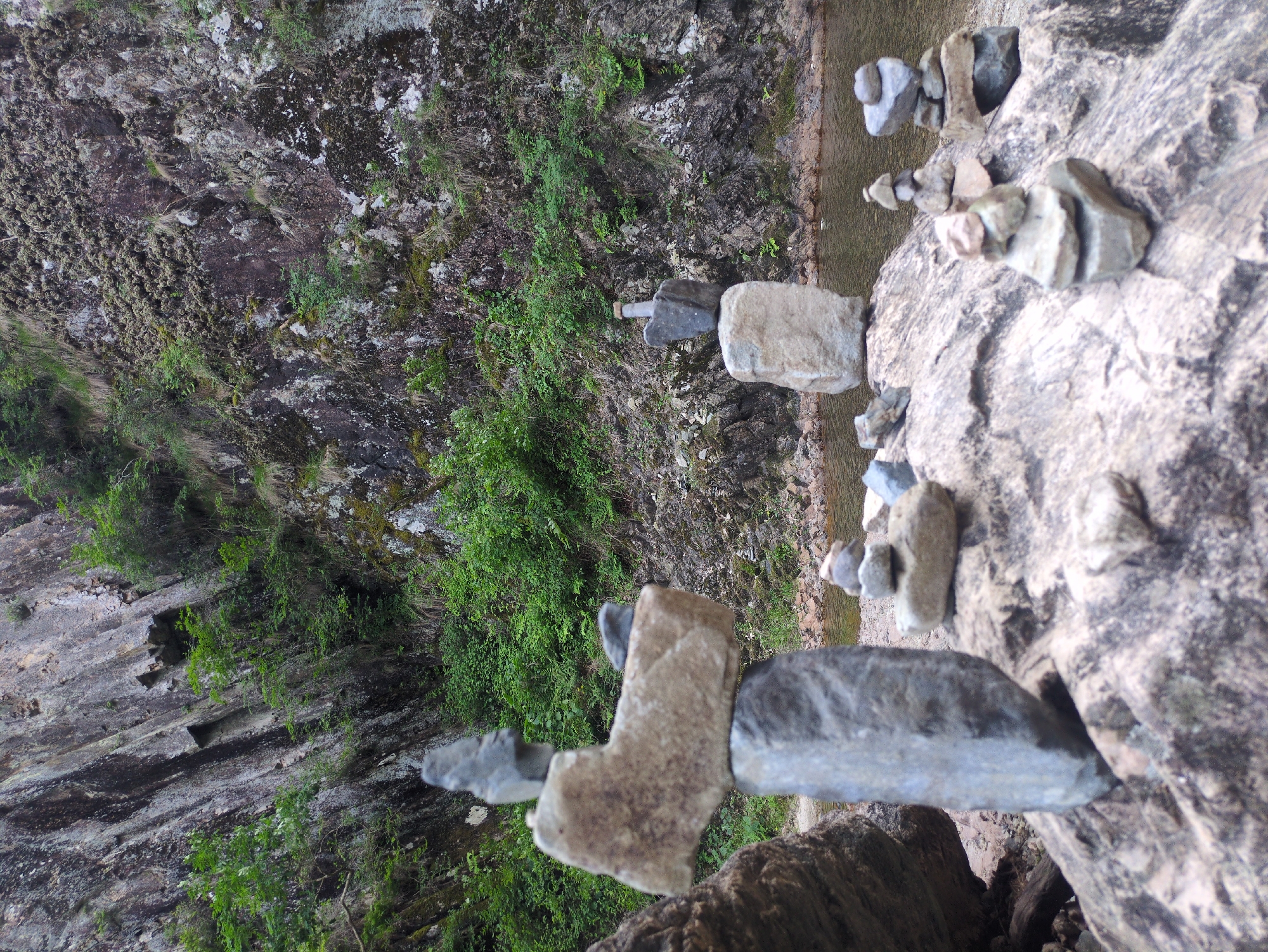
This image depicts a natural outdoor scene in Godang-ri, South Korea, characterized by a steep, vegetated rock face and a body of water. In the immediate foreground, a large, irregularly shaped rock surface occupies the lower half of the frame. This rock is predominantly light gray with darker striations and patches. Positioned on this surface are multiple cairns, or stacks of balanced stones, varying in size and composition. The most prominent cairn is located on the left, constructed from a dark gray, elongated base stone, supporting a lighter, broad, horizontal stone, which in turn supports several smaller, dark gray stones at its apex. To the right of this, several smaller cairns are visible, typically comprising three to five irregularly shaped stones stacked vertically. One notable cairn in the mid-right consists of a light-colored base stone topped by a dark, somewhat bottle-shaped stone, further topped by a smaller, rounded stone. In the midground, a narrow, calm body of water, likely a river or stream, extends horizontally across the frame. The water exhibits a murky, brownish-green hue, with reflections visible on its surface. The banks appear to be composed of small stones and earth. The background is dominated by a very steep, massive rock cliff face. This cliff displays varied textures, with prominent vertical and diagonal fissures and crevices. The rock itself is a mix of dark gray, brown, and lighter weathered patches. Abundant vegetation covers large portions of the cliff; this includes dense clusters of bright green bushes and smaller trees primarily at the base and in the lower crevices. Higher up, patches of light green moss, lichen, and scattered tufts of dry, straw-colored grass cling to the rock surface. The overall lighting suggests daylight, with no harsh shadows, indicating potentially overcast conditions. No people or animals are visible in the scene.
Godang-ri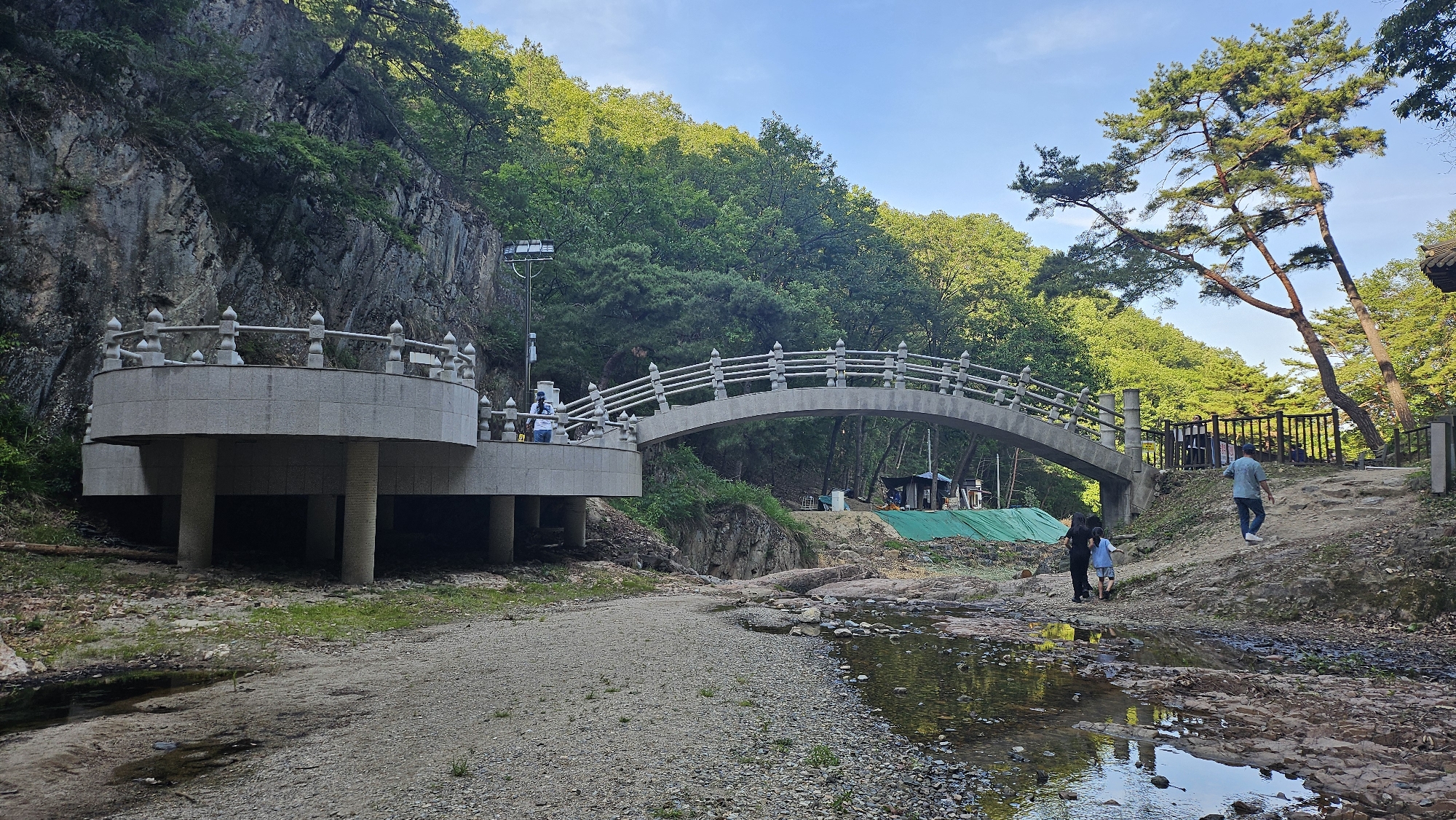
The image depicts a scenic outdoor location in Godang-ri, South Korea, featuring a pedestrian bridge spanning a shallow, rocky stream. To the left, a circular, elevated concrete platform with decorative railings overlooks the stream. Behind the platform, a steep, rocky cliff face is covered in lush green foliage. The bridge itself is arched and constructed from stone, with ornate railings matching those on the platform. On the right side of the image, a dirt path with some stone steps leads uphill towards a wooden fence. A large, mature pine tree with distinctive branches leans dramatically over the scene from the upper right. Several people are visible: one person stands on the circular platform, another walks across the bridge, and a third individual, wearing a blue shirt, walks up the path on the right. Two young children, one in black and one in a light blue top, walk along the streambed in the foreground. In the background, beyond the bridge, there are some temporary structures and green tarps, suggesting ongoing construction or maintenance. The overall environment is a natural landscape characterized by trees, rocks, and water, under a clear blue sky.
Godang-ri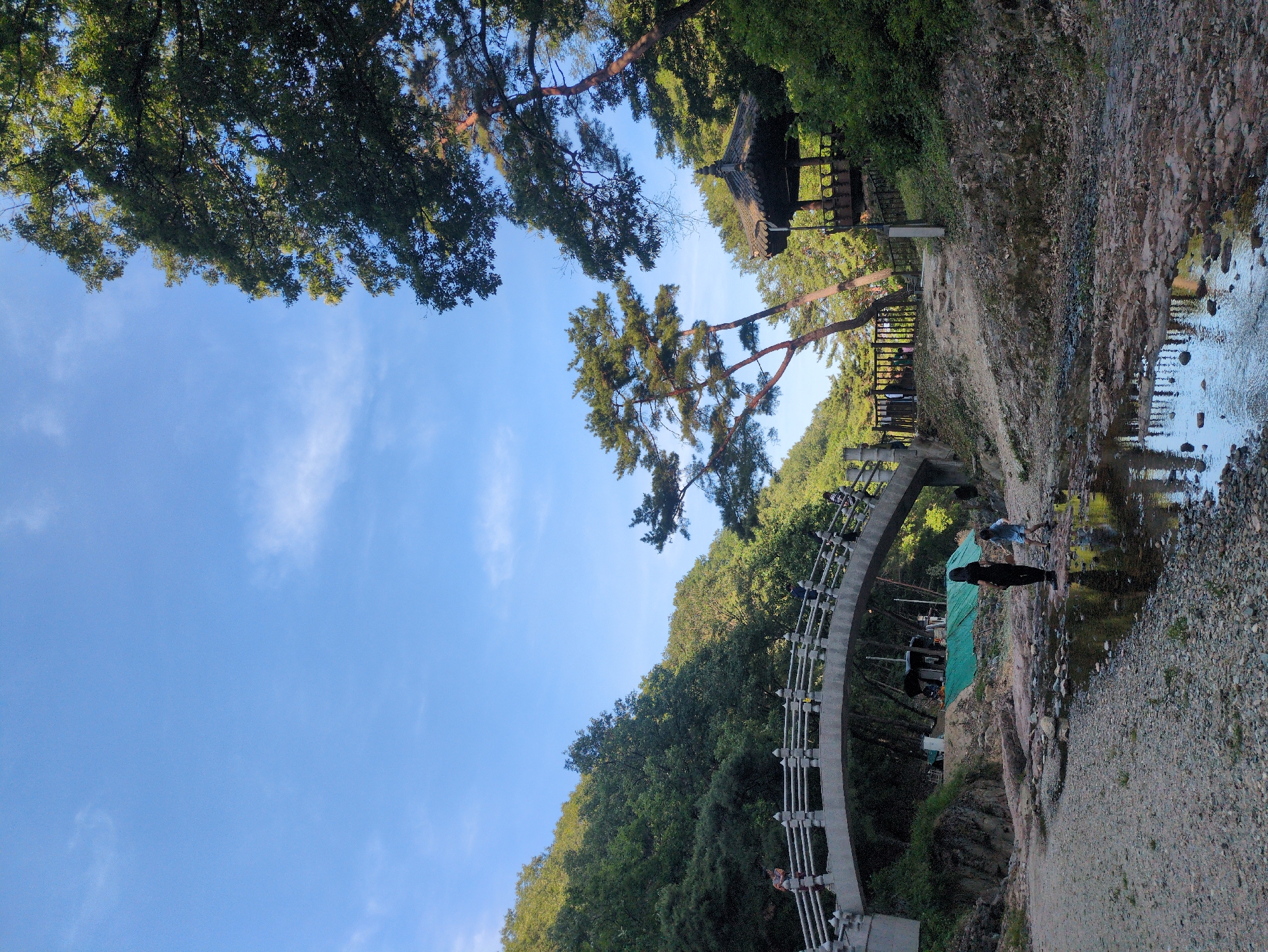
This image depicts a natural outdoor environment in Godang-ri, South Korea, under a clear blue sky with minimal scattered cirrus clouds. A light-colored, arched bridge with ornate railings spans a wide riverbed composed primarily of light-colored gravel and rocks. A shallow stream of water flows through the center of the riverbed, reflecting the sky. On the left side of the frame, hills densely covered with green deciduous trees rise. On the right, a steep bank features similar dense foliage and several distinct pine trees with reddish trunks. A traditional Korean-style pavilion, characterized by a dark, multi-tiered roof and a raised wooden structure, is situated on this bank, partially obscured by trees. In the riverbed, two individuals are present: an adult in dark clothing stands near the center of the stream, while a child in light shorts and a top actively wades nearby. On the bridge, at least three individuals are visible; one person in an orange-red shirt leans on the railing on the left side, and two other figures are positioned further along the bridge. Behind the pavilion, a wooden fence is partially visible, with faint human figures beyond it. Beneath the bridge on the left bank, some temporary structures or materials, including green tarpaulins, are present.
Godang-ri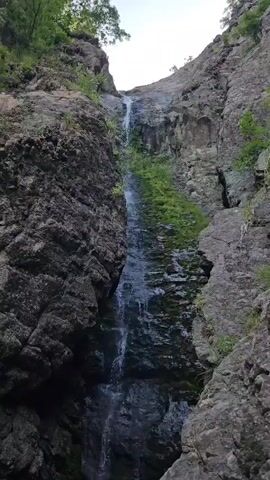
The video shows a narrow, vertical waterfall cascading down a rocky gorge. The rocks are rough and textured, with patches of green moss or vegetation growing on them. The water is clear and flows in a thin stream, breaking into smaller streams and droplets as it falls. The surrounding environment appears to be natural and wild, with trees visible at the top of the gorge. The lighting suggests it is daytime, possibly overcast or late in the day. There are no people or man-made objects visible in the frame.
Godang-ri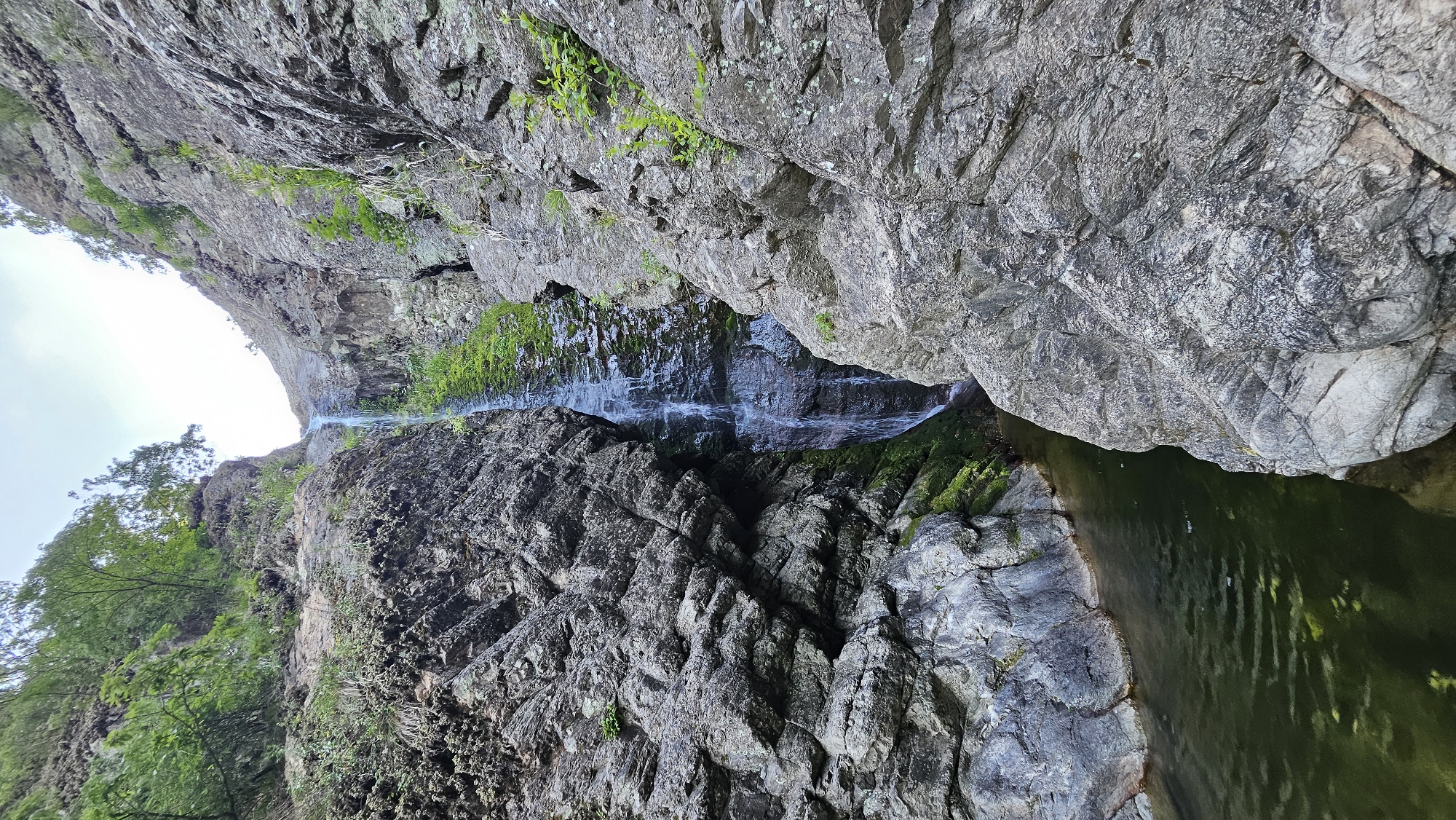
This is a vertical, eye-level, full shot of a narrow waterfall cascading down a rocky gorge. The water flows down a steep, moss-covered rock face, creating a thin stream. At the bottom of the waterfall, a dark green pool of water is visible, surrounded by large, gray rocks. The gorge walls are steep and rough, with sparse vegetation growing from cracks and ledges. The sky is visible at the top, with a slightly overcast appearance. The scene is natural and appears to be in a remote, undeveloped area, possibly a hiking trail or natural park. The image does not contain any people or identifiable man-made structures, aside from the natural formations and water flow.
Godang-ri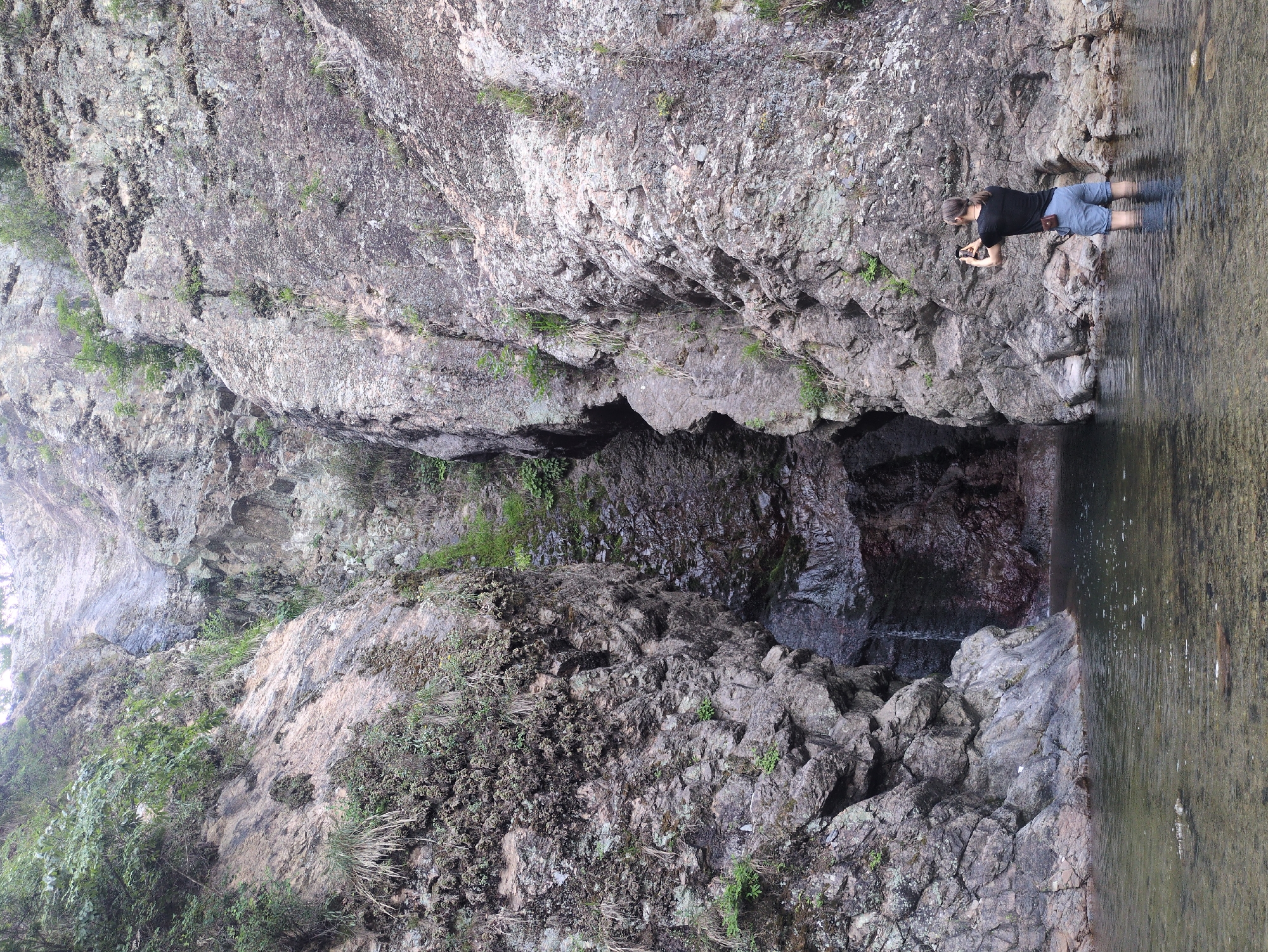
An outdoor scene in Godang-ri, South Korea, displays a deep, natural gorge featuring steep, rugged rock faces that rise vertically on both sides of a shallow, clear body of water. The rock surfaces are predominantly grey and brown, exhibiting varied textures and geological strata, with sparse patches of green vegetation, including moss, grasses, and small shrubs, clinging to cracks and ledges. On the left side of the frame, at water level, a dark, cavernous opening is visible, with a small waterfall flowing into it. The water at the bottom reveals a rocky bed through its transparency and shows minor surface ripples and some foam. In the lower right quadrant, a male individual stands in the water, which reaches his mid-thigh. He is facing the left side of the gorge, wearing a black t-shirt and light blue shorts. He holds a dark electronic device, resembling a smartphone or small camera, with both hands, positioned as if capturing an image or video of the cave and waterfall area. A small, brown leather pouch is affixed to his right hip.
Godang-ri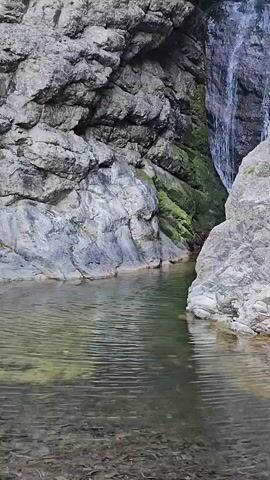
The video shows a narrow canyon with a waterfall cascading down a rocky cliff face. The water flows into a clear pool at the bottom. The canyon walls are made of grey rock with patches of green moss growing on them. The water is clear and reflects the surrounding rocks and vegetation. The camera pans upwards to follow the waterfall.
Godang-ri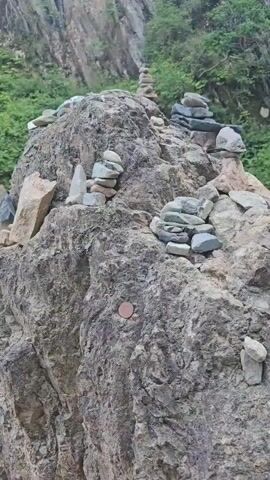
This is a vertical video of a rocky embankment next to a body of water. There are several cairns, which are stacks of stones, placed on the rocks. The rocks are various shades of gray and brown, and some have moss growing on them. The water appears clear and shallow, with a rocky bottom visible. The background consists of a steep, vegetated cliff face. The video is shot from a close-up perspective, focusing on the details of the rocks and cairns. There are no people or animals visible in the video. The lighting suggests it is daytime, possibly overcast.
Godang-ri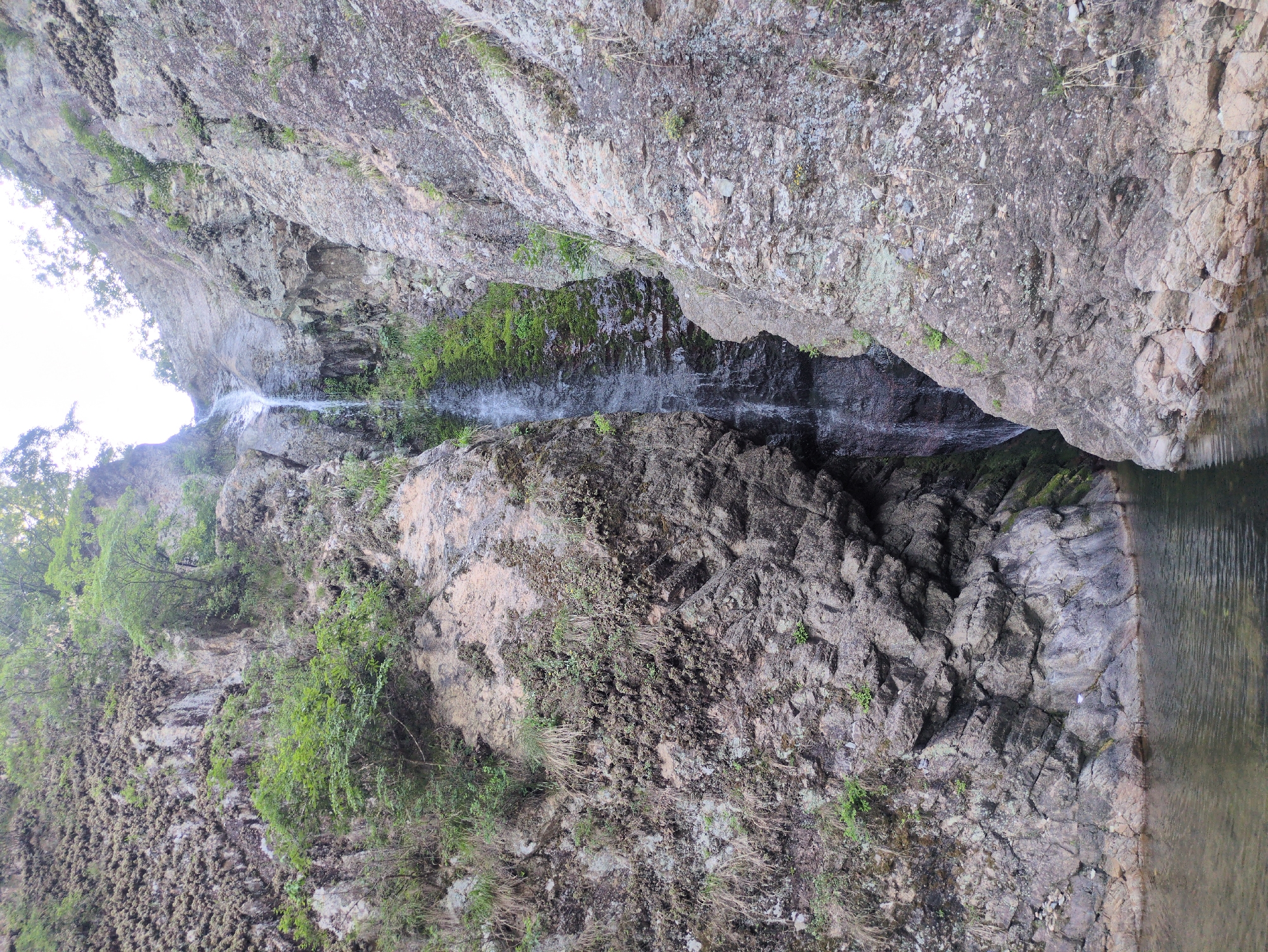
The image displays a natural waterfall within a steep, rocky gorge located in Godang-ri, South Korea. A stream of water cascades vertically down the center-right rock face, collecting in a calm, clear pool of water in the lower foreground. The pool's surface shows minor ripples and reflects the surrounding rock formations. The gorge walls are composed of grey and tan-colored fractured rock, with significant portions covered by vegetation. The left cliff face features extensive patches of dense, dark, textured growth, possibly a type of moss or lichen, particularly prominent in the upper and mid-sections. Various green plants, including small trees, shrubs, and mosses, cling to crevices and wet surfaces along both sides of the gorge, becoming denser near the water's edge and adjacent to the waterfall's path. A bright, overcast sky is partially visible at the very top of the narrow gorge. No human figures, animals, or man-made objects are present.
Godang-ri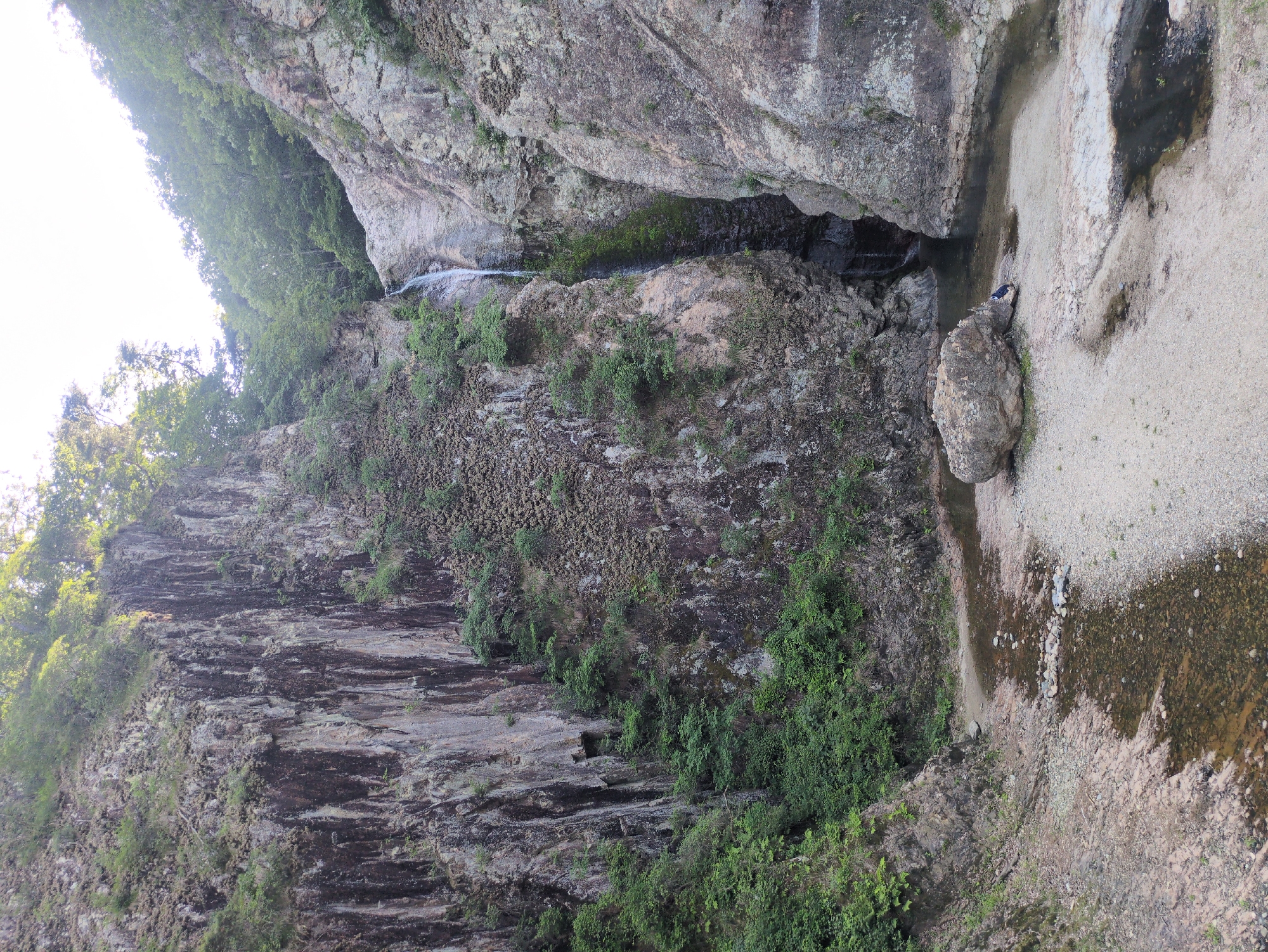
A vertical photograph captures a rugged natural gorge located in Godang-ri, South Korea. The scene is dominated by steep, rocky cliffs on both sides, with a narrow waterfall and a shallow riverbed at its base. The left side of the frame features a dark, weathered rock face exhibiting prominent vertical striations and patches of green moss and sparse vegetation. The cliff rises sharply towards the top, where dense green foliage is visible against a bright, hazy sky. The right side presents a lighter-toned, rugged rock face, also covered with green vegetation. A narrow waterfall descends from the upper-right portion of this cliff, cascading into a shadowed, crevice-like pool at its base. More dense green trees line the top edge of this cliff against the bright sky. At the bottom of the gorge, a wide, shallow riverbed is composed of light-colored sand, gravel, and scattered pebbles. A clear, shallow stream flows through the center of this bed, reflecting light from the sky. Darker, possibly stagnant, pools of water are present in the lower right. A large, irregular, greyish-brown boulder is situated prominently on the sandy bank in the lower-center-right of the image. Adjacent to this boulder, a single individual is observed in a seated or crouching position, dressed in dark clothing, facing towards the water and the waterfall. The individual's activity is not explicitly discernible. The overall environment is natural and rugged, illuminated by bright daylight, which highlights the upper sections of the cliffs and foliage.
Godang-ri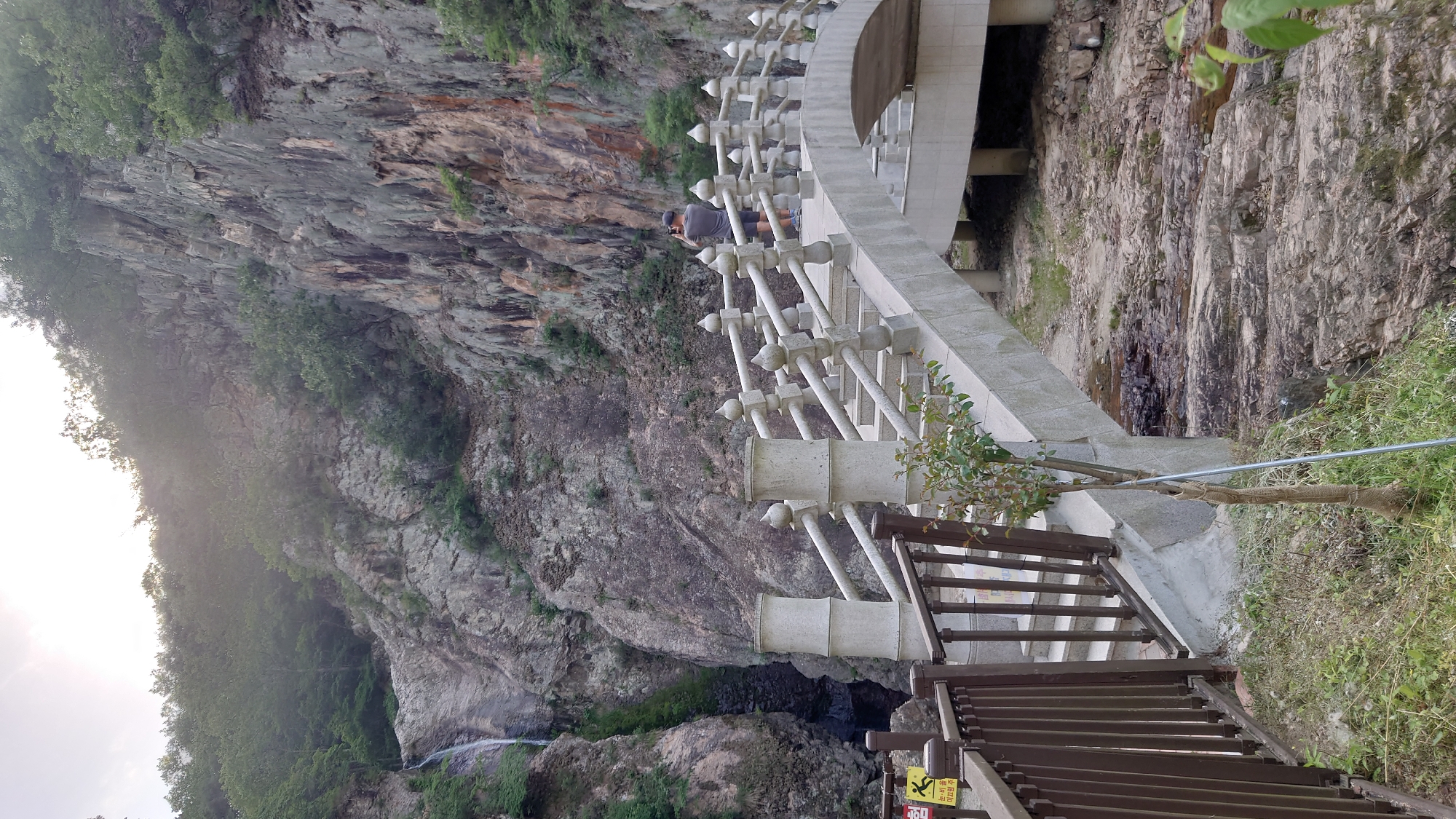
The image depicts a scenic natural landscape in Godang-ri, South Korea, featuring a waterfall, rocky cliffs, and a man-made stone bridge. In the upper left quadrant, a narrow waterfall cascades down a steep, grey and brown striated rock face. The surrounding terrain consists of large, rugged cliffs, sparsely covered with deciduous green trees and shrubs, particularly along the upper ridges and in crevices. A prominent light grey stone or concrete arch bridge spans the foreground, extending from the lower left towards the upper right. The bridge features ornate balustrades composed of cylindrical posts topped with spherical finials, connected by horizontal bars. One adult male, seen from behind, stands on the right side of the bridge, wearing a dark grey t-shirt, dark shorts, and a baseball cap. He is holding a camera or smartphone with both hands, pointed towards the waterfall and canyon area, actively taking a photograph. Below the bridge, a wide, relatively dry riverbed is visible, characterized by flat, layered grey and brown rocks. Small patches of dark, possibly wet, material are present on the riverbed. In the lower left foreground, a brown wooden railing with vertical slats delineates the pathway leading to the bridge. A small tree with its lower trunk wrapped in burlap is planted next to this railing, supported by a metal stake. Partially visible behind the wooden railing is a yellow and black warning sign with Korean text "눈.비 올 때 미끄러움 주의" (Caution: Slippery when snowing or raining) and a pictogram of a slipping person. The sky above is bright but hazy, suggesting an overcast day or diffused sunlight.
Godang-ri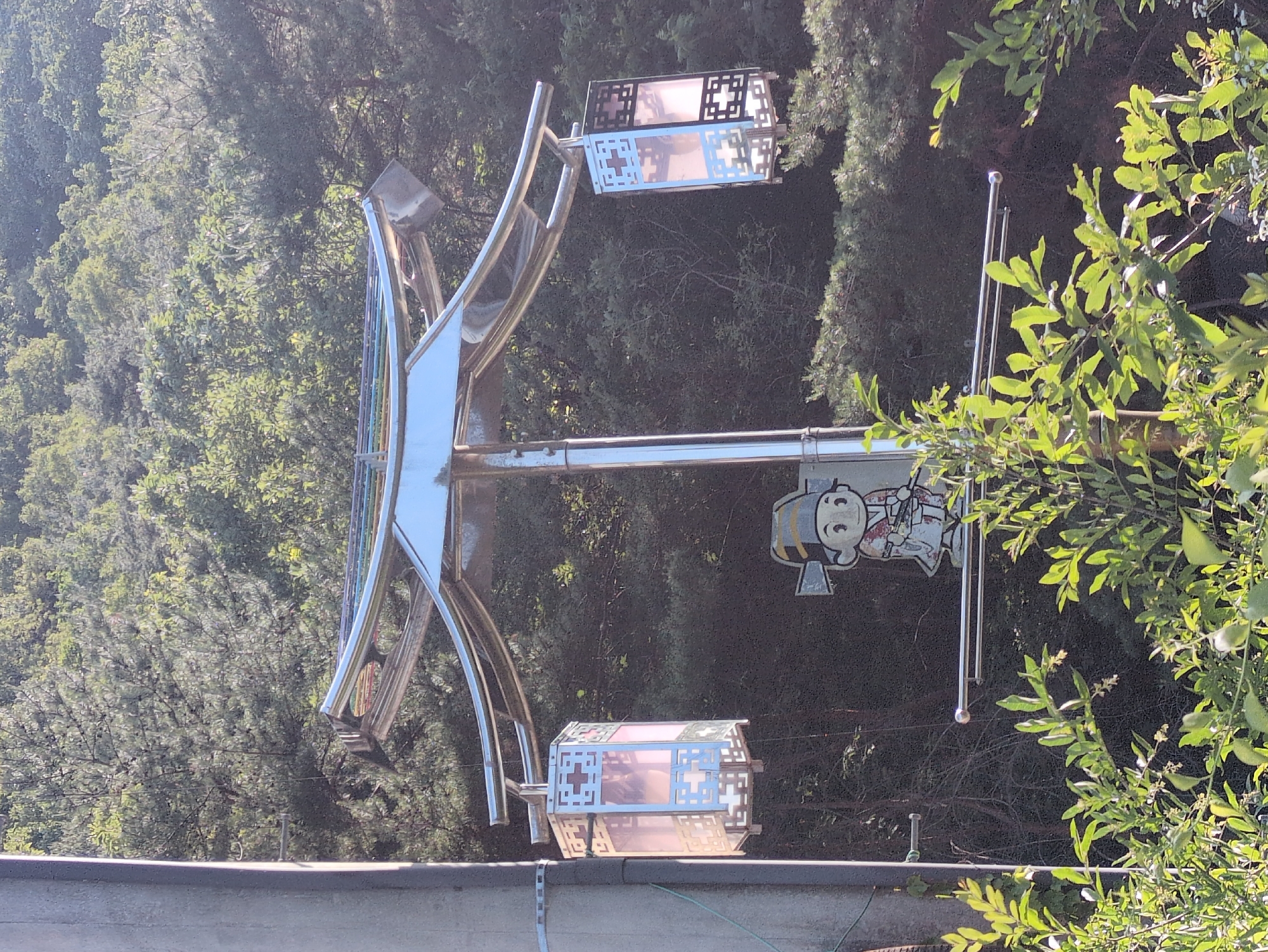
In Godang-ri, South Korea, a modern, highly reflective metallic street light or decorative pole stands against a backdrop of dense green foliage. The structure features a central vertical pole supporting a stylized, double-tiered curved canopy reminiscent of traditional Korean architectural roofs. Two rectangular lanterns, suspended from either side of the main pole, display metallic frames with intricate geometric cutout patterns and translucent, light-diffusing panels. Below the main lighting elements, a cutout figure of a cartoon boy is attached to the pole. The character wears traditional Korean attire, including a striped hat and a white robe with colored accents, and holds a slender stick or brush. A concrete utility pole is partially visible on the far left. The scene is illuminated by natural daylight, highlighting the metallic surfaces, with lush green trees and undergrowth forming the background and foreground.
Godang-ri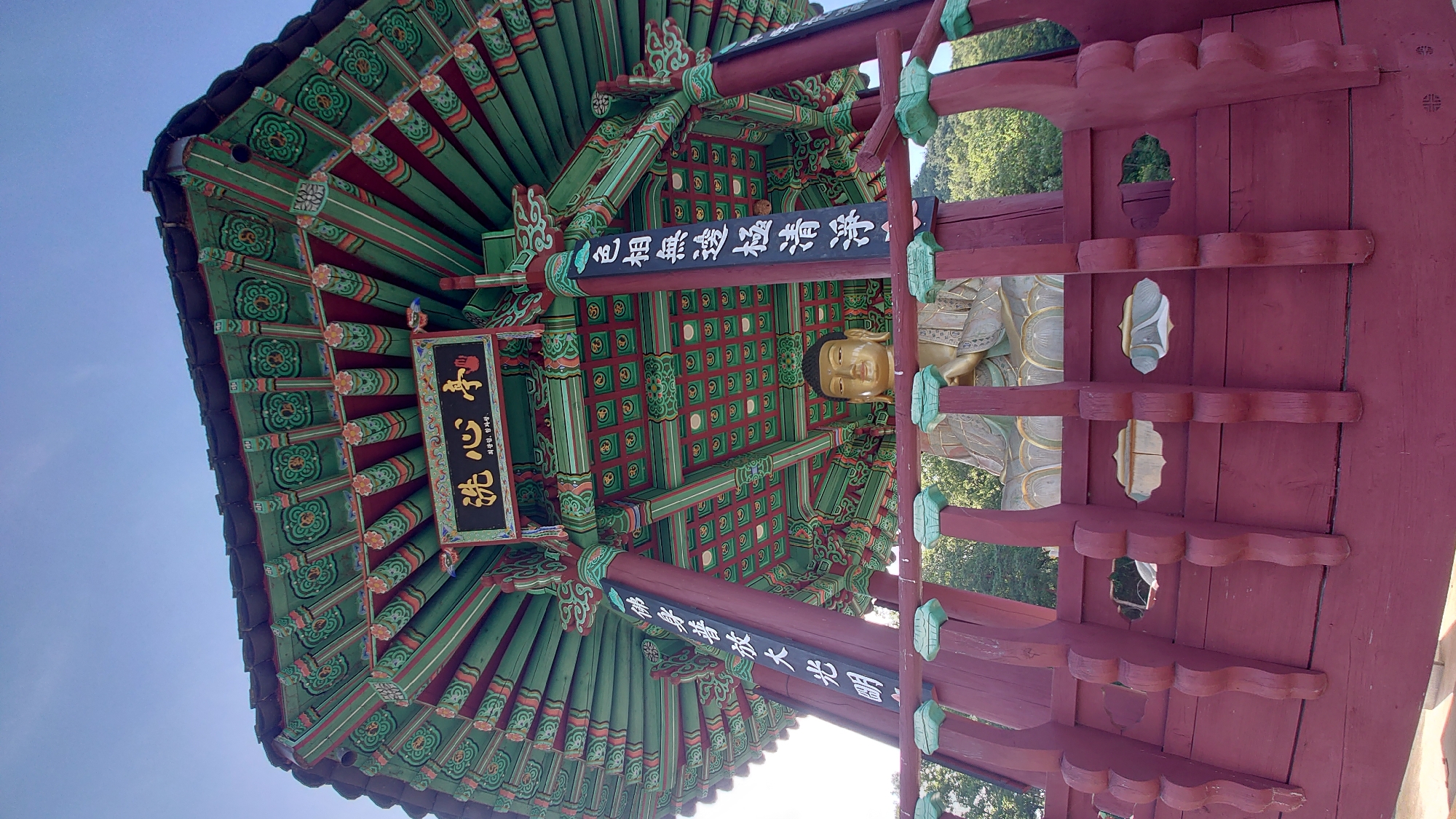
A low-angle, upward-facing shot captures a traditional Korean pavilion, specifically the "Wash Heart Pavilion" (洗心亭, Sesimjeong) as indicated by the central horizontal sign, housing a large Buddha statue. The scene is located in Godang-ri, South Korea. The pavilion features a multi-tiered roof adorned with intricate 'dancheong' (traditional Korean ornamental painting) in patterns of green, red, and gold, supported by dark red pillars also decorated with similar motifs. Visible through the pavilion's structure is a bright blue sky. Centered within the pavilion, a Buddha statue is depicted in a meditative posture, partially obscured by a dark red wooden balustrade or railing in the foreground. The Buddha's face and visible hand are golden, while its robes are rendered in muted tones of green, gray, and white, seated on a large lotus-petal base. The railing features decorative cut-outs and light green cap details. Two vertical signs are present on the pavilion's pillars: the left sign reads "佛身普放大光明" (Buddha's body universally emits great light), and the right sign reads "色相無邊極清淨" (Form and appearance are boundless and extremely pure), both in white characters on a black background. The main sign also includes smaller Korean text: "최광암, 함자상" (Choi Gwang-am, Hamjasang). Lush green trees are visible in the background, appearing through and behind the pavilion's railing and structure, suggesting a natural, possibly elevated, setting. The scene is brightly lit by natural sunlight, indicating daytime.
Godang-ri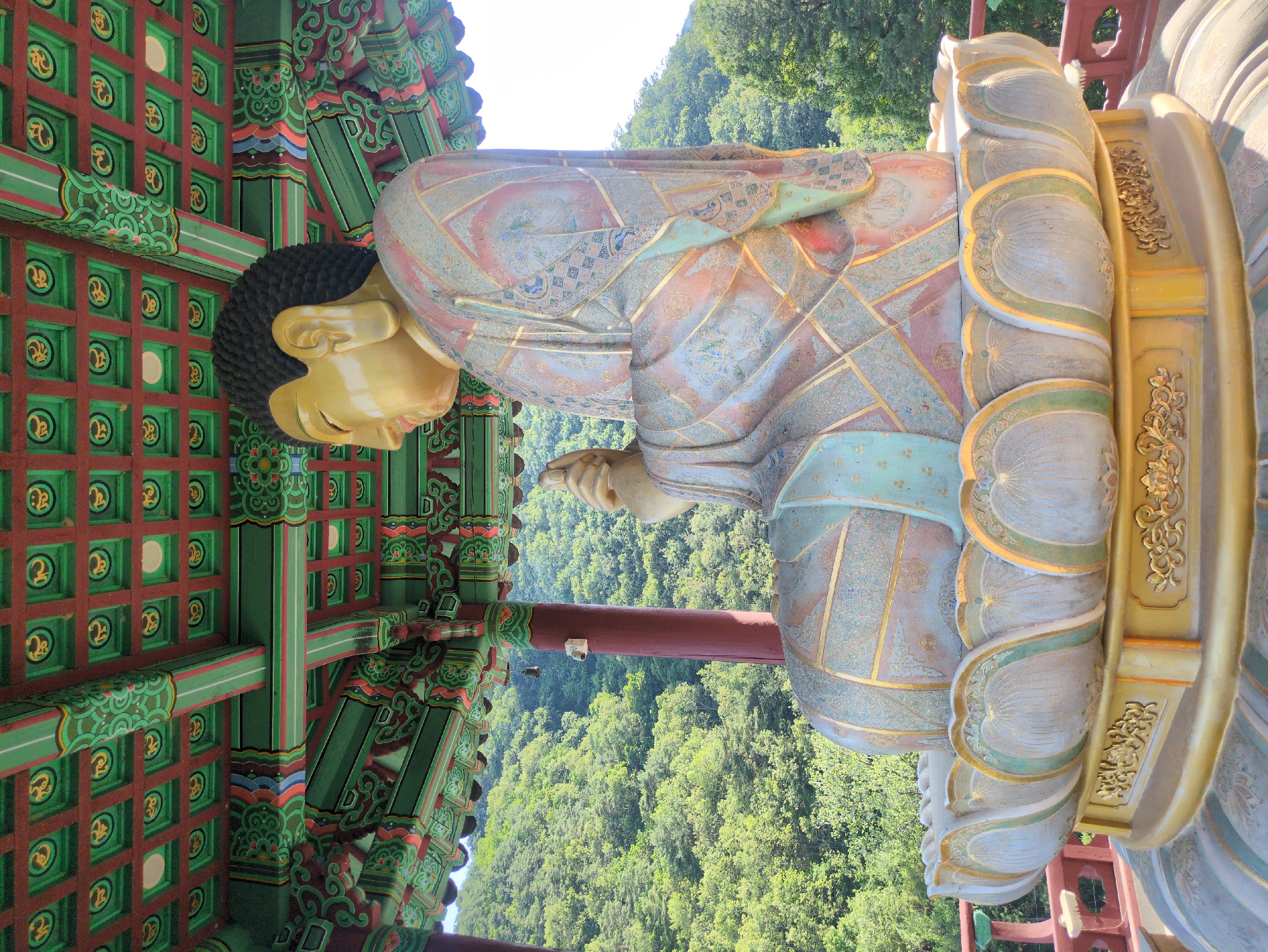
The image displays a large, seated Buddha statue situated outdoors under a traditional Korean pavilion in Godang-ri, South Korea. The Buddha, rendered in a light yellow-gold hue with tightly curled dark hair, is depicted in a meditative posture with hands clasped in front. Its robes feature intricate geometric and floral patterns in muted tones of blue, pink, green, and gold, appearing somewhat weathered. The statue rests upon a multi-tiered lotus base, similarly decorated with pale blue-green and gold accents. Above the statue, the pavilion's ceiling and beams exhibit elaborate "dancheong" style painting. The ceiling features a grid of reddish-brown beams with green recessed panels, each containing a yellow circular motif. Supporting beams are predominantly green with red, blue, and black striped accents and detailed scrollwork. A red structural pillar is visible to the left of the statue, with a small brass bell and a white electrical device attached. Partially visible on the lower right is a red balustrade or railing. The background consists of dense, verdant forested mountains or hills, indicating a natural, elevated setting. The scene is illuminated by bright daylight, casting subtle shadows and highlighting the intricate details of the Buddha statue and the pavilion.
Godang-ri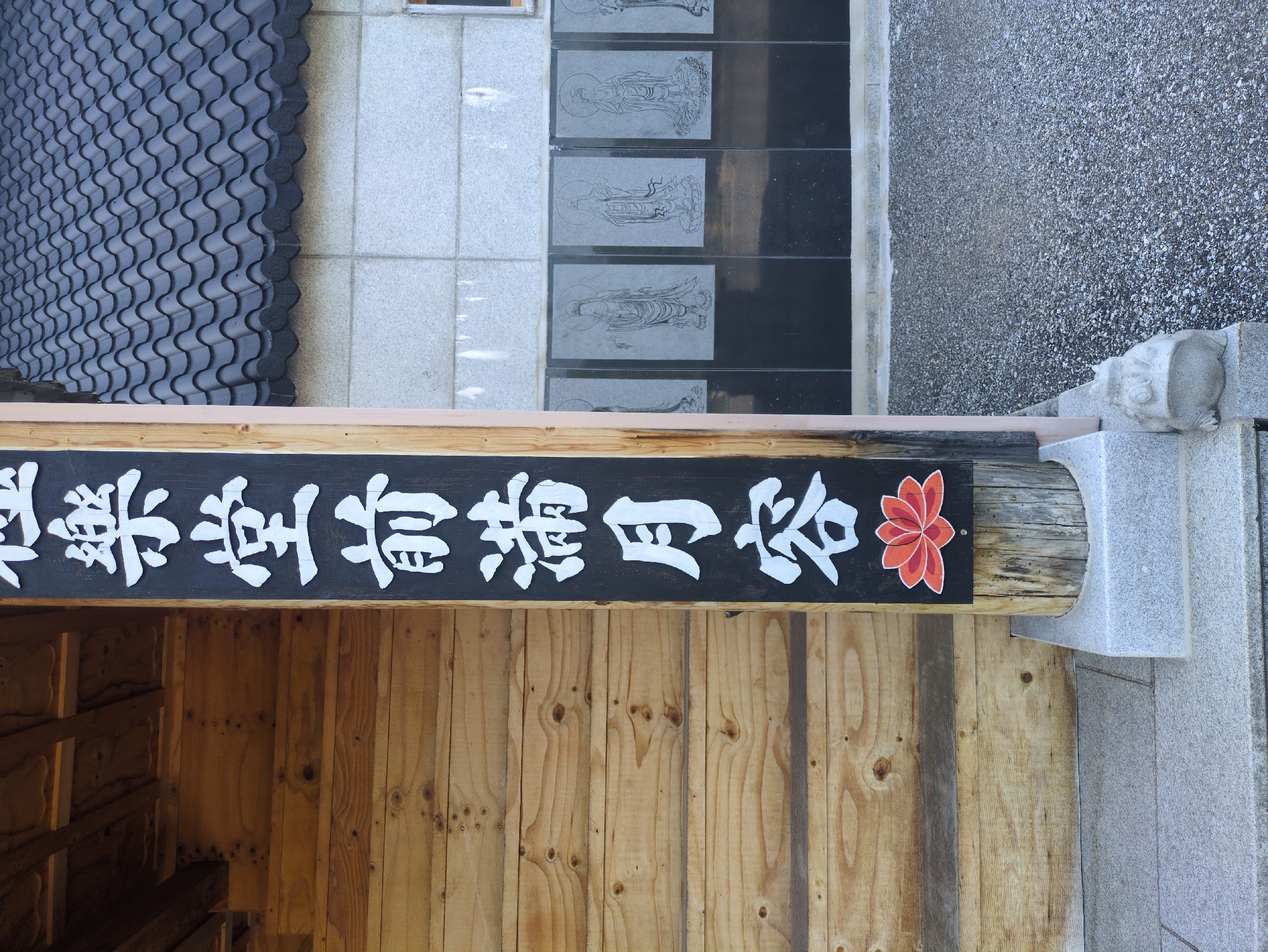
This forensic description details an outdoor scene within a Buddhist temple complex, specified as being located in Godang-ri, South Korea. The image is captured at eye-level, under bright daylight, revealing architectural elements and signage. In the left foreground, a substantial vertical wooden post stands, exhibiting a weathered texture and visible wood grain. Attached to the post is a prominent black rectangular sign, oriented vertically, featuring large white Japanese characters. The characters read from top to bottom as "極楽堂前満月容" (Gokurakudō-mae Mangetsu-yō), which translates to "In front of Pure Land Hall, Full Moon Countenance/Appearance." Below the inscription, a stylized red lotus flower with lighter red and orange accents is depicted. The base of the wooden post is set into a light grey, polished granite foundation. Immediately to the left of the signpost, a wooden building facade is visible. It is constructed from horizontal planks of light-colored wood, displaying natural grain patterns and various knots. The underside of a dark, exposed roof structure is discernible at the top left edge of the frame, above the wooden facade. To the right of the signpost, another building is present, characterized by a dark, corrugated or wave-patterned tiled roof that extends across the upper right portion of the image. Below the roofline, a wall section is composed of light grey, square or rectangular stone panels, showing slight discoloration or marks. Further down, directly below this lighter wall, a series of darker, vertical rectangular panels are affixed. These black panels feature engraved or etched images of standing Buddhist figures, each with a halo and detailed robes. Four such figures are clearly visible across the frame. The wall concludes with a dark, low-lying stone base at ground level. The ground surface in the middle and right foreground consists of a speckled, dark grey aggregate paving, suggesting gravel or textured concrete. Adjacent to the signpost's base, a smoother, lighter grey stone slab forms a walkway. A small, light grey stone statue of a frog is situated on the edge of this stone slab in the bottom right corner, facing towards the left. There are no people present in the scene.
Godang-ri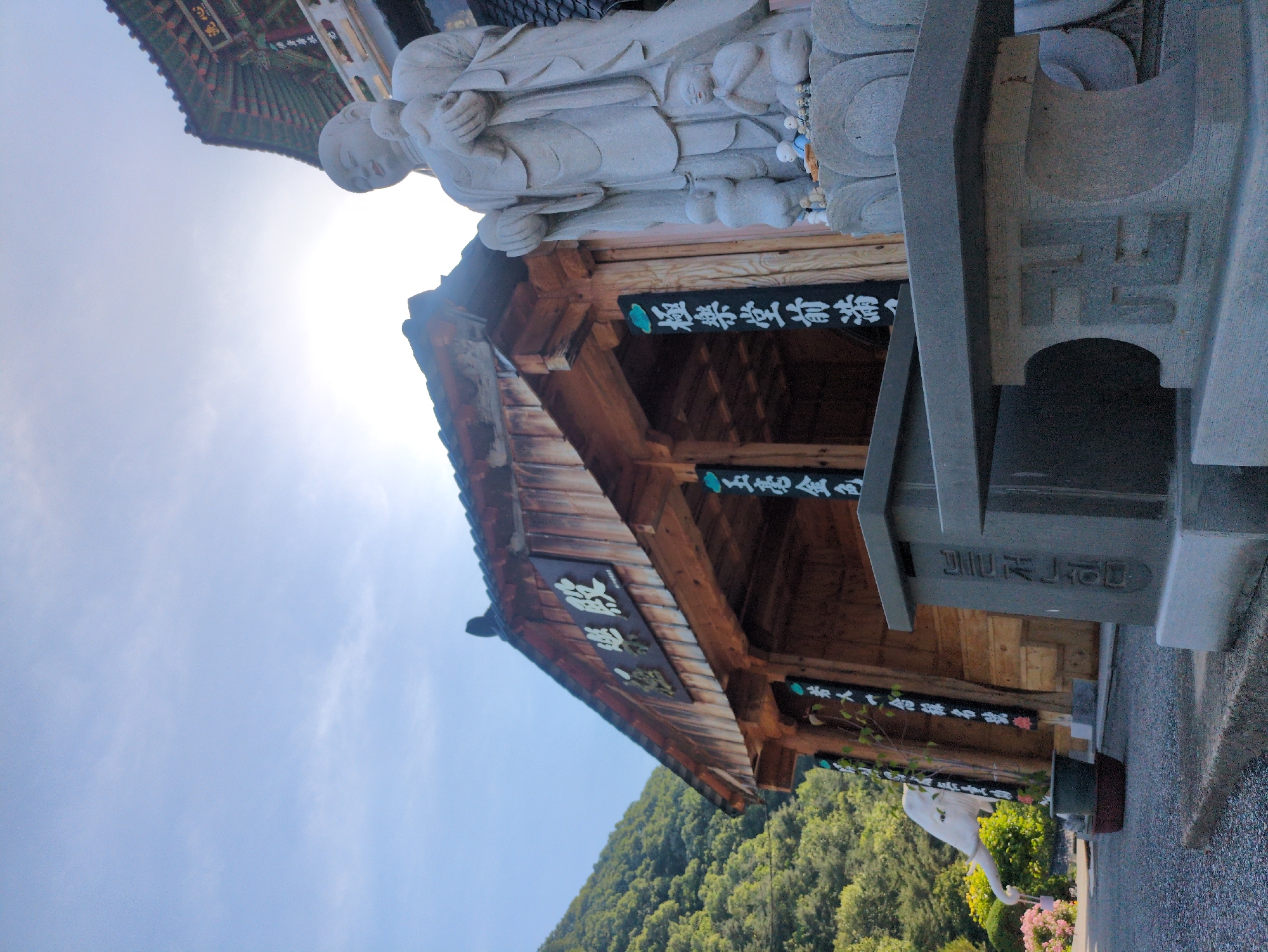
The image displays a Buddhist temple complex located in Godang-ri, South Korea, under a bright, partially cloudy blue sky. A dense, verdant mountain range covered with trees forms the background. In the immediate foreground on the right, a large, light-colored stone statue of a standing Buddha figure holds a smaller infant figure. Two smaller, adolescent-like figures are seated at the base of the main statue; one is prostrate, and the other kneels with hands together. Multiple miniature, doll-like figures are arranged on the base platform in front of the larger statue. To the left of this statue, a gray stone table-like structure features a carved Buddhist swastika symbol on its front support. Adjacent to this, a taller, rectangular gray stone pillar displays vertically carved Korean characters. In the midground, a traditional Korean wooden building with an open porch and a dark, multi-tiered tiled roof is prominent. A rectangular dark sign with three large Korean characters, identified as '極樂殿' (Geungnakjeon, meaning "Hall of Supreme Bliss"), is mounted above the building's entrance. Two vertical black banners with white Korean characters hang from the facade; the banner closer to the Buddha statue reads '極樂堂前滿' (Geungnakdang Jeonman), and a partially visible banner further left reads '五臺金山' (Odae Geumsan). A potted plant containing a sapling is placed on the ground in front of the building. Further left, a large white statue of an elephant with an uplifted trunk is partially visible behind green foliage and pink flowering bushes. The ground surface in the foreground and midground is composed of gravel. Bright sunlight is evident, creating a prominent lens flare in the upper right quadrant of the image and causing some overexposure in the sky. No active human subjects are visible within the frame.
Godang-ri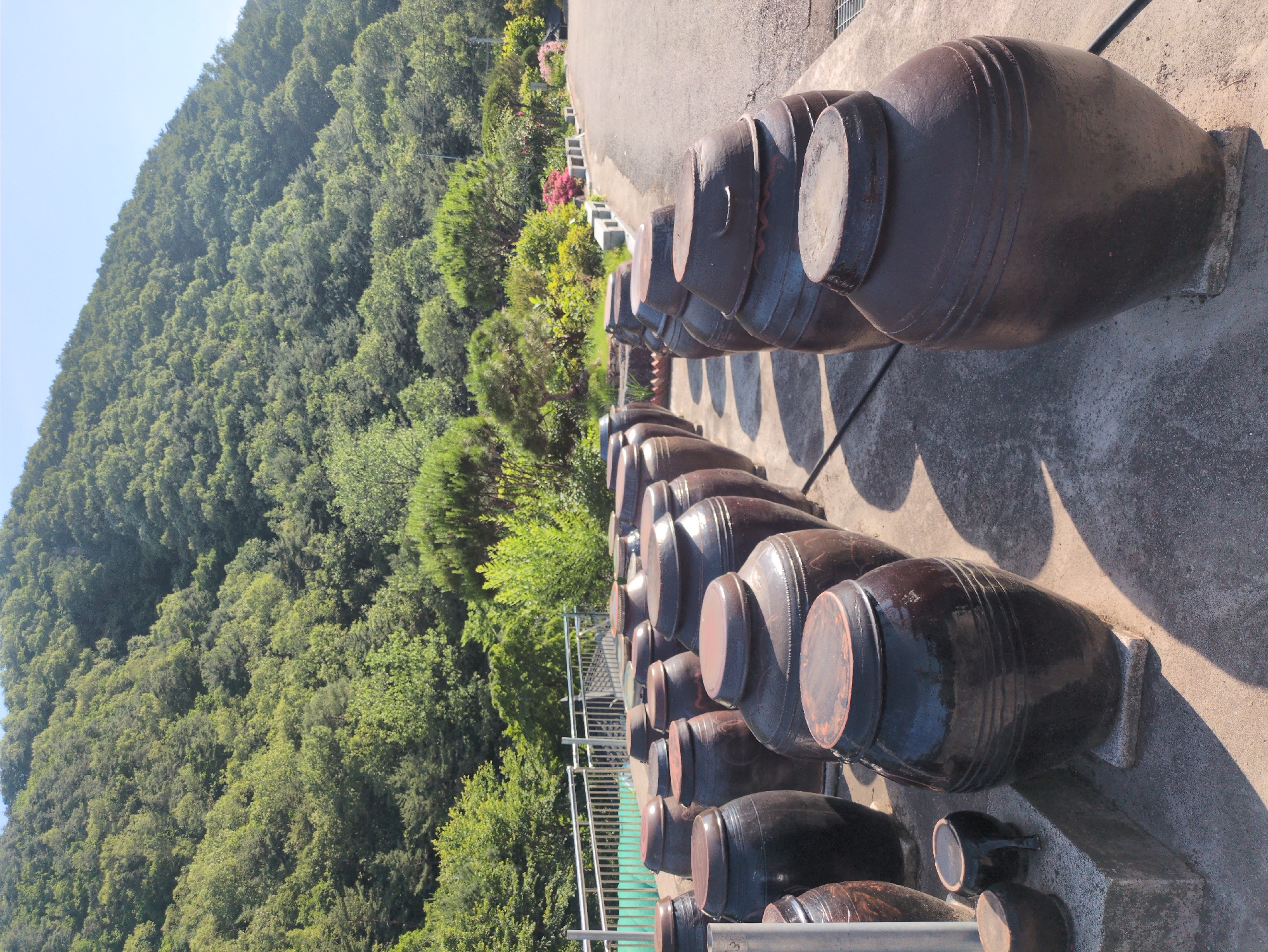
The image depicts an outdoor scene in Godang-ri, South Korea, dominated by a large, tree-covered mountain under a clear blue sky. In the foreground and midground, numerous large, dark brown, earthenware fermentation jars, known as onggi, are arranged in parallel rows on a concrete surface. These jars are typically ovoid or cylindrical, topped with flat, circular lids, and many rest on small, rectangular stone bases. Strong sunlight from the left casts distinct shadows of the jars to their right. To the left behind the jars, a silver metal railing runs along an elevated concrete area overlooking a lower, green-covered section. To the right of the jars, a paved asphalt road or path curves into the distance, bordered by a low stone curb and various green shrubs, including some with pink blossoms. No individuals are present in the scene.
Godang-ri