Greenwich, United States
17 memories from Greenwich, United States

The image shows a wooden table in a restaurant. There is a brown paper bag in a wire holder, a small yellow bowl with brown liquid, a white plate with a spoon, a crumpled napkin, three glasses, and a hand on the right side of the frame. The glasses are empty and one has a straw in it. The hand is partially visible and appears to be reaching for the napkin. The coordinates provided (41.021, -73.635) indicate that the location is in the city of Greenwich, United States. The table is covered with a brown wooden surface. The scene appears to be a typical post-meal situation in a restaurant.
Greenwich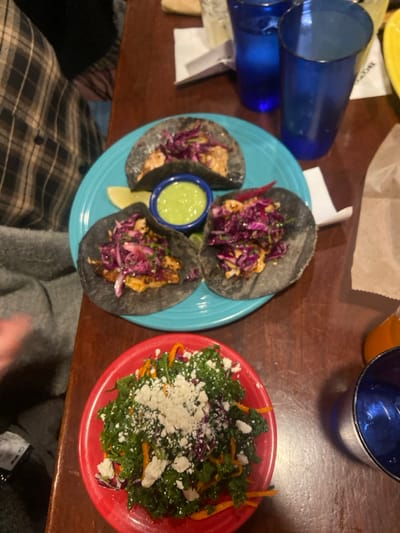
The image shows a table in a restaurant with three black tacos, a bowl of salad, two blue glasses, and a partly visible person wearing a plaid shirt. The tacos are on a blue plate and contain red cabbage, fish, and white sauce. The salad consists of leafy greens, grated cheese, red cabbage, and orange shavings, and is served in a red bowl. The glasses appear to be empty and are placed next to a white napkin on the table. The table appears to be made of wood. The location of this image is most likely Greenwich, United States.
Greenwich
The image shows a table in a restaurant with two plates of food on it. The first plate is orange and contains two folded quesadillas, one of which has been partially eaten. The second plate is blue and contains a larger quesadilla, black beans, spinach, tomatoes, and a small dish of white sauce. A silver fork and a silver knife are on the table. A brown paper napkin is on the table to the right of the plates. The coordinates (latitude: 41.021, longitude: -73.635) correspond to a location in Greenwich, Connecticut, United States, but the image does not provide any information about the restaurant's location.
Greenwich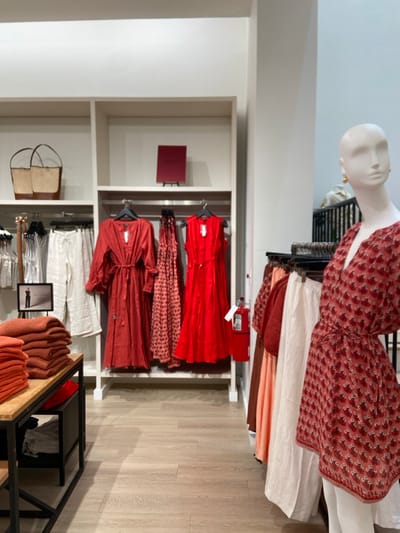
The image shows the interior of a clothing store in Greenwich, Connecticut. The location's coordinates are latitude: 41.029, longitude: -73.626. The store is brightly lit and has white walls and wooden floors. Several racks of clothing are displayed, with a variety of dresses and other items for sale. One mannequin is on display wearing a red, printed dress with a white background. The mannequin's face is painted white. The other dresses on the rack are all red. There is a large wicker bag in the top shelf of the left-hand rack, which is also white. The space is organized, and many garments are on display. The clothes are displayed in a modern and stylish way, with a focus on color and texture. The image suggests a high-end clothing store that caters to a discerning clientele.
Greenwich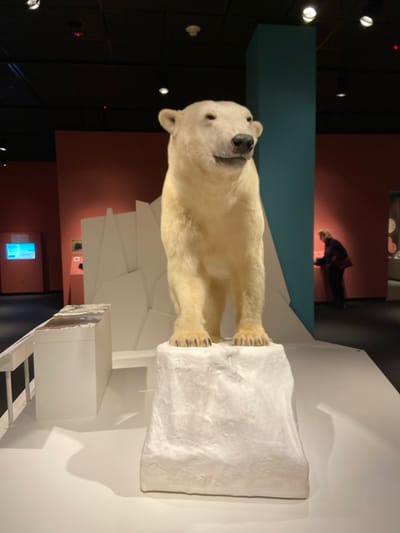
A taxidermied polar bear stands on a white platform shaped like a mound of snow, in a museum setting. The polar bear is facing forward with its paws planted firmly on the platform. The museum floor is white and the walls are a pale pink and light blue. A woman is in the background on the right side of the image, wearing a dark coat and looking toward the left. The museum has various exhibits and a white, rectangular pedestal to the left of the polar bear. This image was taken at the New York Hall of Science, located at 47-01 111th St, Queens, NY 11368.
Greenwich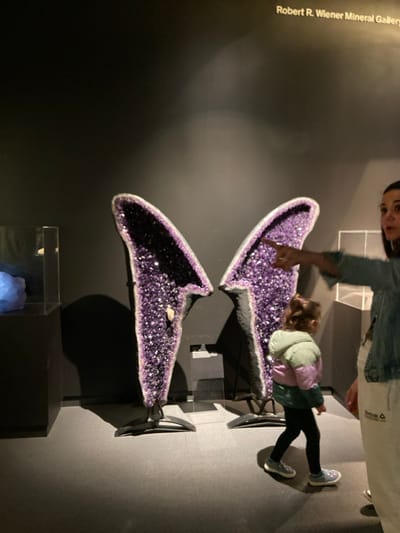
Two large amethyst geodes, shaped like wings, are on display in a museum. The geodes are mounted on black metal stands. A woman in a blue denim jacket points towards the amethyst geodes. A young girl in a green, purple, and white jacket stands near the geodes, looking at them. The scene is lit by overhead lights, casting a warm, yellow glow. The room is otherwise dark and the walls are painted grey. The sign above the geodes reads "Robert R. Wiener Mineral Gallery." The coordinates provided place this scene in the American Museum of Natural History in New York City, which houses the Robert R. Wiener Mineral Gallery.
Greenwich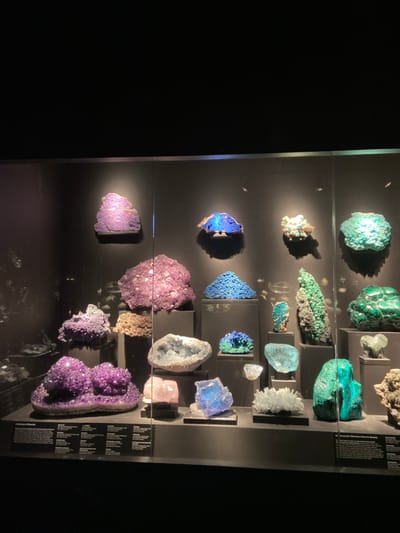
The image shows a glass display case containing 15 mineral specimens in a museum at the American Museum of Natural History located in New York City at the coordinates 41.02, -73.623. The display case is lit from above and contains several different types of minerals, including amethyst, malachite, azurite, and fluorite. The specimens are arranged in a random pattern, and are separated by black velvet-lined shelves. The glass case has a dark background, which makes the minerals stand out. The minerals are all brightly colored and have a variety of shapes and sizes. Some of the minerals have been polished, while others have not. The image was taken with a phone camera, and the image is of medium quality. The scene is lit by artificial light. There are no people or other animals in the image.
Greenwich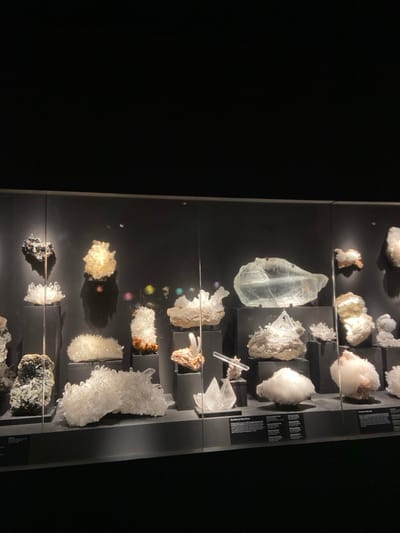
A display case in a dimly lit room, containing various mineral specimens, including several clear quartz crystals. The display is lit from above, and the specimens are on dark, rectangular pedestals, and are arranged in a grid-like pattern. The specimens are mostly white, but there is one specimen in the bottom left corner that is a dark grey. There are three small, multi-colored specks in the middle of the case. There is also a small label at the bottom of the case on the right. The location is a museum in Greenwich, Connecticut. There are no people in the image.
Greenwich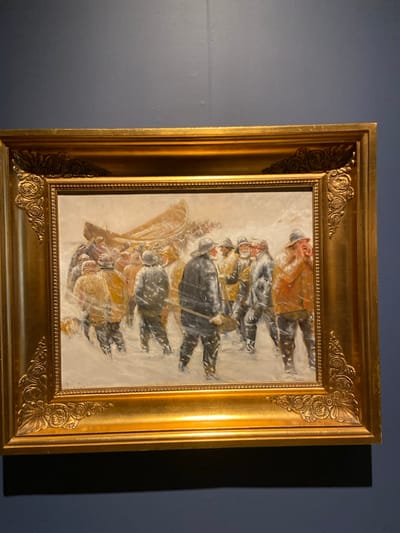
The image is of a painting in a gold frame. The painting depicts a group of men in winter clothing standing in a snowy field. There is a boat in the background. The painting is hanging on a blue wall. The coordinates provided correspond to a location in Greenwich, Connecticut. The image is of an art exhibit in the Bruce Museum. There are 15 people in the painting, all men. They are all wearing winter clothing. The men are standing in a snowy field and appear to be waiting for something. There are some houses in the background. It is snowing in the painting. The boat is in the upper left-hand corner of the painting and is half submerged in the snow. The painting is an oil on canvas, likely painted in the 19th century. The painting appears to be depicting the arrival of a boat in a snowy winter scene, with the men likely being awaiting the arrival of the boat. There is a sense of anticipation in the painting. The men are standing close together, and their bodies are turned towards the boat. The snow is falling softly and covering the ground. The painting is well-executed and the details are very realistic. The scene in the painting is peaceful and calming.
Greenwich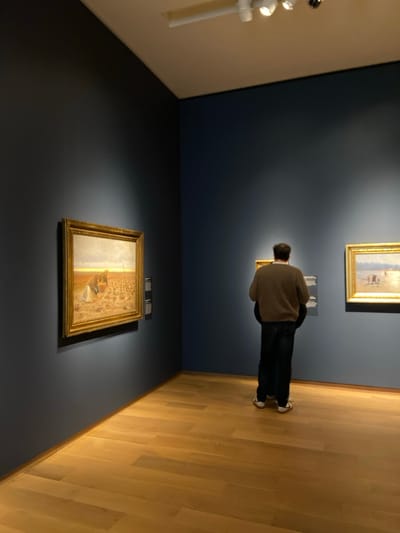
The image shows a man standing in a gallery room. He is wearing a brown sweater and blue jeans, looking at a painting that is hanging on the wall to his right. The painting is a landscape scene and has a golden frame. The man has a woman standing to his left who is partially obscured. The gallery has blue walls, a white ceiling with recessed lighting, and a wood floor. There are two other paintings hanging on the wall opposite the man. The gallery appears to be located in Greenwich, Connecticut, United States. The room is dimly lit. The man is the only person visible in the image. The environment is serene and quiet. The lighting is soft and even. The overall impression is one of contemplation and quiet appreciation for art.
Greenwich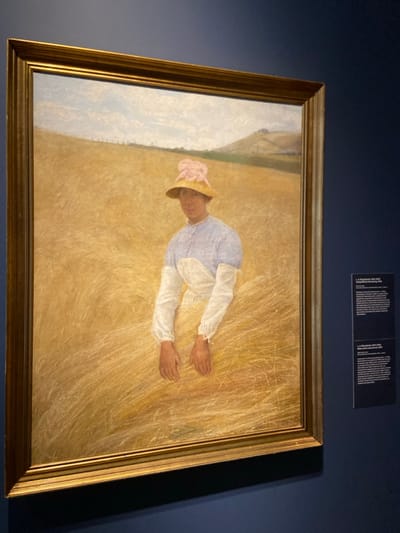
The image is a painting of a woman wearing a straw hat and a white dress with a blue jacket, resting in a field of wheat. The painting is framed in a gold frame and hangs on a blue wall. It is located in a museum in Greenwich, Connecticut, United States. The coordinates provided (latitude: 41.02, longitude: -73.623) are close to the Bruce Museum, which is known to have a collection of paintings.
Greenwich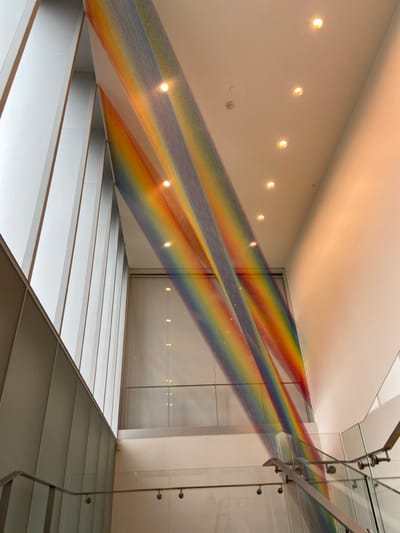
The image shows the interior of a modern building, likely a museum or art gallery. There are two large strips of rainbow-colored string art hanging from the ceiling, which is white and contains multiple recessed lighting fixtures. There is a glass railing and a staircase to the right, and a large window on the left, through which more string art is visible. The image is taken from a low angle, looking up at the ceiling. The location is likely in the United States, based on the building's architecture and the presence of string art, a popular art form in the country. The image is a representation of the string art installation, "Rainbow," by artist Olafur Eliasson, and the building is the The Shed in New York City.
Greenwich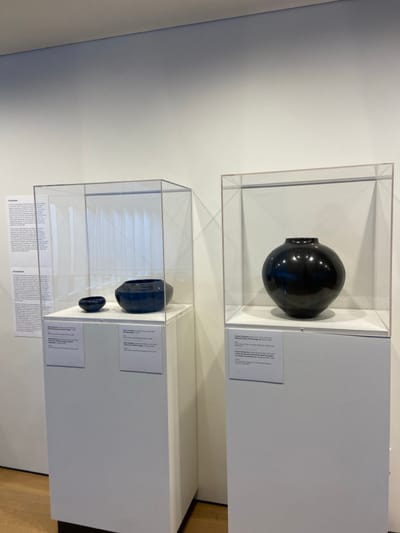
The image shows two ceramic pieces on display at the Bruce Museum in Greenwich, Connecticut. The pieces are displayed in two separate, clear acrylic cases, each resting on a white pedestal. The case on the left contains two pieces. The smaller piece is a black bowl and the larger piece is a black vase. The case on the right contains a single piece, a larger black vase. All three pieces appear to be made of black pottery, and each has an inscription next to it providing more details about the pieces. The museum walls are white, and the floor appears to be made of wood. There are no people in the scene.
Greenwich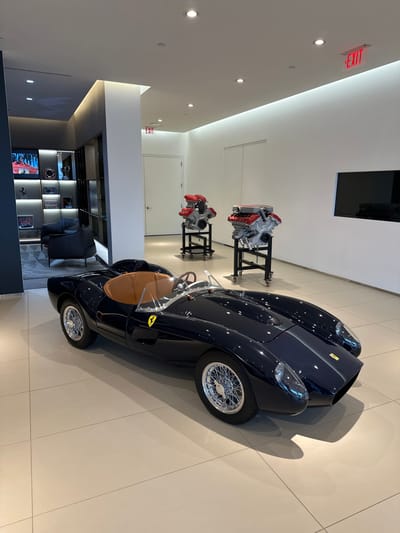
This image depicts a pristine, brightly lit showroom or exhibition space in Greenwich, United States, dedicated to automotive display. The central subject is a dark blue, vintage-style convertible sports car, resting on a light-colored tiled floor. The car exhibits classic features including a wooden steering wheel, a tan interior, and elegant chrome wire-spoke wheels. A distinctive yellow Ferrari shield emblem is visible on the side of the vehicle, indicating its heritage or inspiration. In the background, two impressive automotive engines are showcased on black stands. These engines are characterized by their prominent red-colored tops, clearly displaying the "Ferrari" name, and highlight the brand's engineering. The showroom itself boasts clean white walls and ceiling, illuminated by multiple recessed spotlights and linear strip lighting, contributing to a modern and sophisticated atmosphere. A red "EXIT" sign is affixed to the ceiling in the upper left of the frame. Towards the left and further into the room, a contemporary lounge area can be seen, furnished with a dark armchair, a low table, and a stylish shelving unit. This unit displays an assortment of automotive memorabilia, including trophies, scale models, and framed artwork. A small television screen within the shelving unit appears to show racing footage. The entire scene suggests a high-end environment for the appreciation of luxury automobiles, likely a Ferrari dealership, museum, or an exclusive private collection. No individuals are present in the image.
Greenwich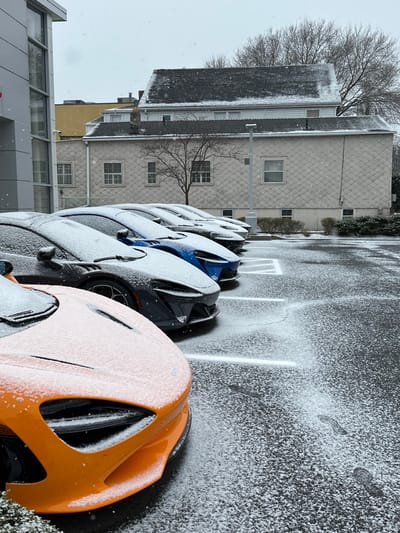
The image captures an outdoor scene in Greenwich, United States, during a light snowfall. A row of high-end sports cars, including one prominent orange vehicle in the foreground, are parked in an asphalt lot and lightly dusted with snow. The cars behind the orange one are primarily dark-colored (blue, gray, black), also showing a layer of fresh snow. White parking lines are visible on the asphalt, partially obscured by the snow, and some footprints can be seen on the ground. In the background, two buildings are prominent. The larger building features a light-colored, possibly shingled or scaled, exterior and a dark, snow-covered roof. It has multiple rectangular windows. To its left, another building with a more modern, glass facade is partially visible. Bare trees, indicative of winter, stand between and behind the buildings, their branches outlined against the overcast sky. Snowflakes are still visible in the air, suggesting ongoing or very recent snowfall. The overall lighting is even, typical of an overcast daytime. No discernible text is visible in the image.
Greenwich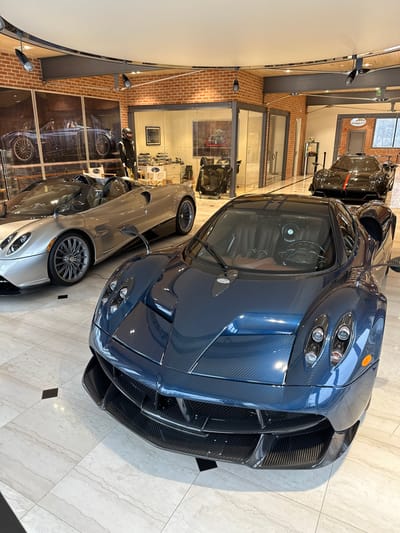
An indoor, vertically oriented image captures a luxurious car showroom in Greenwich, United States, featuring multiple Pagani supercars. The prominent subject in the foreground is a stunning dark blue Pagani Huayra, showcasing its intricate carbon fiber body panels, quad headlight design, and aggressive front splitter. Its cockpit is partially visible through the windshield, revealing the detailed interior. Behind the dark blue Huayra, a silver or light grey Pagani Huayra is partially visible, displaying its unique wheel design and sleek profile. Further into the background, another dark-colored car, likely another Pagani, is also on display. The setting is a high-end showroom with a clean, modern aesthetic. Features include light-colored tiled flooring, exposed brick walls, and large glass partitions separating different display areas. Overhead lighting illuminates the space, creating a polished ambiance. The cars are static, positioned for display or storage, suggesting an exhibition or private collection. Notable details include the widespread use of visible carbon fiber on the main Pagani, highlighting its lightweight construction and exotic nature. The overall scene exudes luxury and automotive excellence. In the background, on a brick wall, a circular logo or sign is visible, potentially bearing the "PAGANI" name, though difficult to read clearly due to distance and image orientation. The scene suggests a specialized dealership or a collector's garage dedicated to hypercars.
Greenwich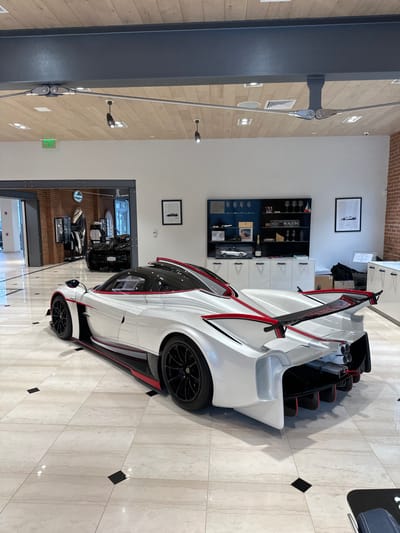
The image displays a high-performance Pagani hypercar within a luxurious showroom environment, likely located in Greenwich, United States. The central subject is a pristine white Pagani, possibly a Huayra or Zonda model, distinguished by its intricate red and black aerodynamic detailing. The car's unique gullwing doors are open, revealing a glimpse of its dark interior. It rests on a polished, light-colored marble tiled floor, which includes sporadic dark square inlays. To the left, the flooring transitions to light-toned wooden planks. The setting is a sophisticated dealership or showroom with clean white walls. Two framed monochrome artworks depicting car designs are visible on the wall. Behind the car, a display cabinet showcases various luxury items, including what appears to be a bottle of champagne, car models, and other merchandise. The brand name "PAGANI" is clearly visible on one of these displays, along with the partially discernible word "TRAGON" or "RAGON." A prominent dark grey structural beam with attached metal tension cables runs vertically on the left side of the frame. The area is well-lit by recessed ceiling lights and subtle wall-mounted fixtures. In the background, a large doorway opens to another section of the facility, where more vehicles are faintly visible. A green "EXIT" sign is present above this doorway. The scene conveys a sense of luxury and exclusivity, with the car presented as a centerpiece of automotive artistry. There are no people visible in the image.
Greenwich