Guanajuato City, Mexico
30 memories from Guanajuato City, Mexico

Two women pose for a selfie. One woman is in the foreground, sticking out her tongue. The other woman is in the background, making a kissy face and holding up two fingers in a peace sign. The woman's fingers are adorned with rings. Behind them is a wooden ceiling with string lights and a wall decorated with tiles depicting religious figures and scenes. A black speaker is also visible on the wall. The image is rotated counterclockwise.
Guanajuato City
A photograph displays a sunset sky filled with clouds, transitioning from soft blues and grays to vibrant oranges. The sky meets a dark, indistinguishable mass on the right side, possibly representing land or trees. The picture is taken at an angle, suggesting it is an image of a screen or a framed print. The surrounding area is predominantly black, emphasizing the luminosity of the sunset.
Guanajuato City
A bright blue sky dominates the view, punctuated by a few scattered clouds. Along the right side, a rugged, brown mountain range stretches upwards, its peak partially obscured by a line of puffy white clouds. The photo is taken from inside a vehicle, as indicated by the presence of a blurred black vertical line, potentially a car frame or window pillar.
Guanajuato City
An upward, angled view shows a light-colored building with a red roof, adorned with hanging decorations. Adjacent is a church steeple against a pale blue sky. A red car is partially visible on the right, alongside a black car parked in front of the building. The perspective gives a distorted impression of the scene.
Guanajuato City
Pink-tinted clouds fill the sky, framed by silhouetted trees. A yellow sign is visible through a gap in the trees above a road fading into the distance. The warm light of sunset illuminates the scene. The perspective appears to be from within a vehicle, with a dark frame bordering the right side of the image.
Guanajuato City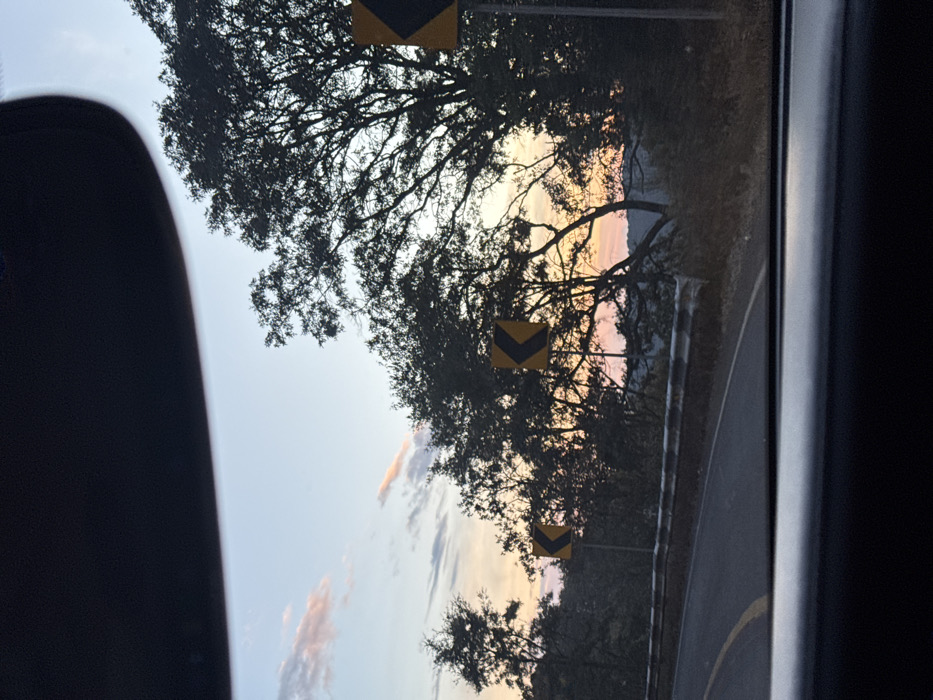
A view from inside a vehicle shows a winding road with roadside markers featuring black downward arrows on a yellow background. Silhouetted trees frame a sunset sky with soft pink and orange hues. The road has a yellow stripe. The interior of the vehicle is visible on the sides and includes the rear-view mirror. The scene evokes a sense of travel and picturesque scenery.
Guanajuato City
The image displays an indoor gathering occurring within a venue in Guanajuato City, Mexico, characterized by warm, dim lighting and historic architectural features including arches and stuccoed walls. In the left foreground, a man wearing a light-colored cowboy hat and a plaid shirt looks towards the left with a slight smile. Directly to his right, in the center foreground, a woman with long dark hair, also wearing a white cowboy hat, stands in profile facing right. She holds a bouquet of vibrant orange flowers, consistent with marigolds (cempasúchil), tied with an orange ribbon. Her dark long-sleeved top and blue jeans are visible. The midground contains multiple individuals. A man in a gray t-shirt stands with his back partially to the camera, appearing to engage in conversation with another man to his right. Other figures, some also wearing hats, are present in the crowded space. The background reveals architectural details: a large black wrought-iron chandelier with five spherical white light fixtures hangs from the ceiling. Multiple arched passageways are visible, illuminated by upward-directed lights that highlight their contours. Two large screens display indistinct imagery; one is behind the man in the plaid shirt, and another is partially visible to the right. On a surface in the lower right foreground, a dark patterned handbag, a blue-capped bottle, and glassware are arranged. Additional orange flowers are present as decoration in the background, particularly beneath an illuminated arch.
Guanajuato City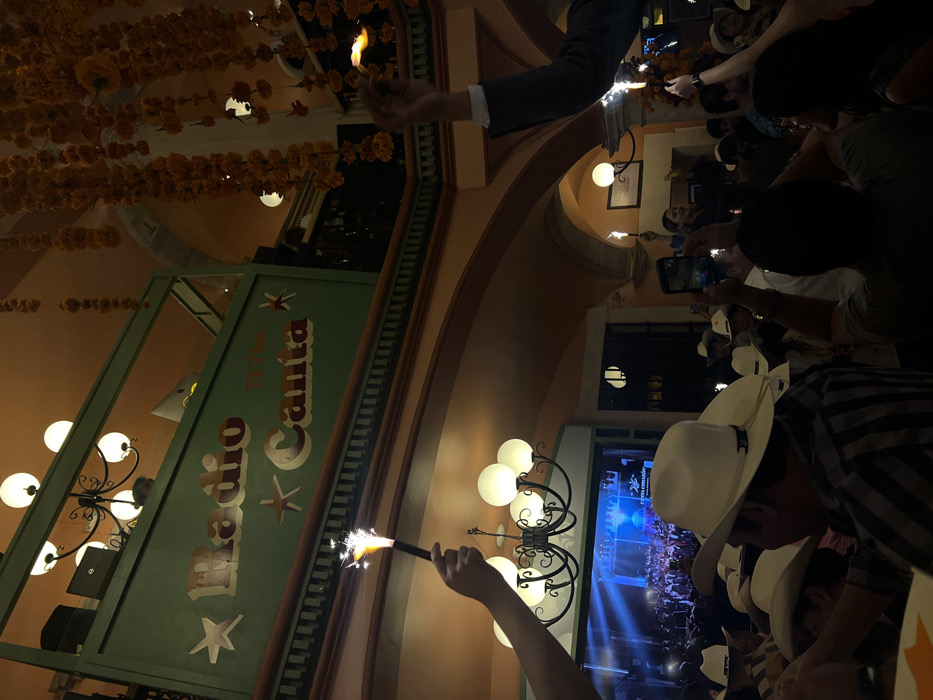
This image depicts an interior scene at the Radio Canta Bar in Guanajuato City, Mexico, during an evening event. The multi-level venue features warm-toned arched architecture and a green-painted balcony bearing the sign "Radio Canta" with "DJ The" text and star embellishments. Numerous strands of orange marigold-like flowers hang from the ceiling as decor. A dense crowd occupies the lower level, with many attendees wearing white cowboy hats. Multiple individuals are holding active sparklers aloft, and several others are recording the scene with smartphones. A large screen in the background displays an event on a stage. A DJ setup, including a laptop, is visible on the upper balcony. Illumination is provided by globe chandeliers, the sparklers, and the screen, creating a festive atmosphere.
Guanajuato City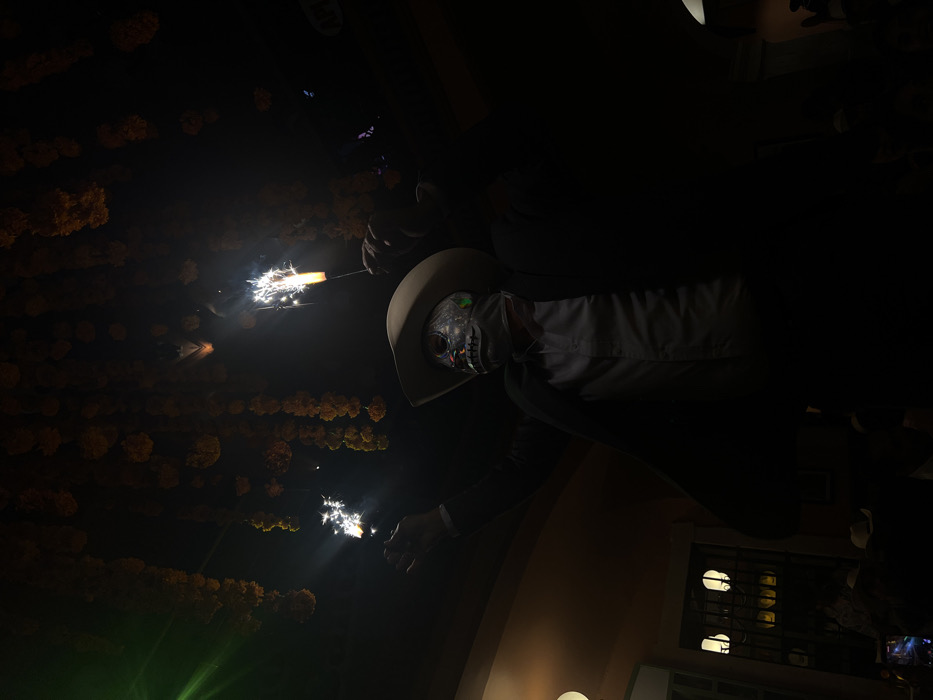
The image depicts an individual in a dark, interior setting within Guanajuato City, Mexico. The subject, viewed from the chest up, wears a light-colored cowboy hat and a metallic, reflective skull-face mask covering the entirety of their face. They are dressed in a dark suit jacket over a lighter-colored collared shirt. Both arms are raised, with each hand holding an active sparkler emitting bright white and yellow sparks. Overhead, numerous garlands composed of orange-yellow flowers, consistent with marigolds, are suspended from the ceiling. A green light source or beam is visible in the upper-left quadrant of the frame. In the lower-left background, architectural elements include a wall-mounted spherical light fixture and a dark opening resembling a barred window or doorway.
Guanajuato City
The image depicts an indoor nighttime or dimly lit event within a multi-level establishment, identifiable by a partial illuminated sign reading "CANTA," consistent with a cantina or venue in Guanajuato City, Mexico. The architecture features arched ceilings, large pillars, and a mezzanine level with dark railings, where two large dark speakers are visible. Illumination is provided by wall-mounted globular lamps and recessed lighting. In the foreground, a performance involves two adult males. One male, wearing a light pink button-up shirt and a white cowboy hat, stands on the shoulders of a second male, also in a similar shirt. The top male holds a dark bottle from which two sparkler-like devices emit bright light and sparks. He is extending this bottle towards the second male below him. To the left, a prominent floral arrangement composed of orange flowers is visible next to a dark-clothed individual. To the right, a dark shelving unit displays bottles and small decorative items, above which a large screen displays abstract blue and purple imagery. Multiple patrons are present, some of whom are in festive attire or costumes, including at least one individual with skull-like face paint and another with a large orange headdress, suggesting a themed celebration. The lower portion of the image shows indistinct dark forms of the audience.
Guanajuato City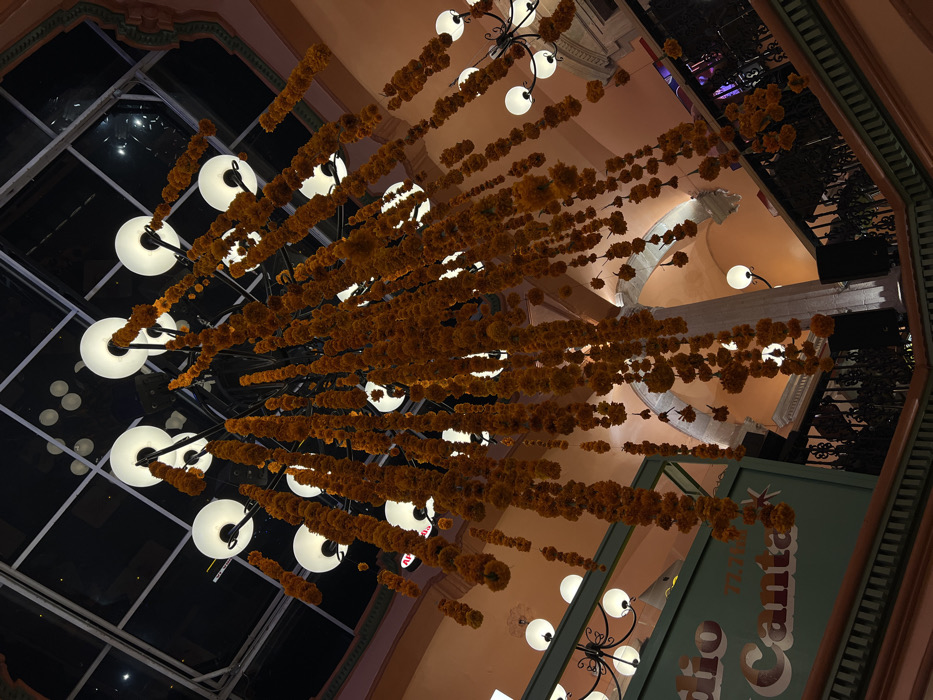
This image captures the interior of a multi-level building in Guanajuato City, Mexico, specifically an area associated with "Radio Canta 77.7 FM," as indicated by a prominent sign on an elevated green panel to the left. The central focus is a large, ornate black metal chandelier suspended from a glass-paned ceiling or skylight. The chandelier features numerous spherical white light fixtures and is extensively adorned with cascading strands of bright orange marigold flowers, varying in length and creating a dense, floral curtain effect. These marigold decorations are consistent with Día de Muertos cultural observances. The surrounding architecture features pale orange/peach-colored walls, vaulted ceilings, and white stone columns and arches. Dark, ornate metal railings delineate at least two visible levels of the interior space. Additional smaller chandeliers or wall-mounted sconces with spherical white lights are visible throughout the lower and upper levels. Two dark, rectangular speakers are positioned near the railings on a lower level. No individuals are present in the scene. The overall lighting is artificial and warm, emanating from the various fixtures, contrasting with the dark exterior visible through the glass ceiling.
Guanajuato City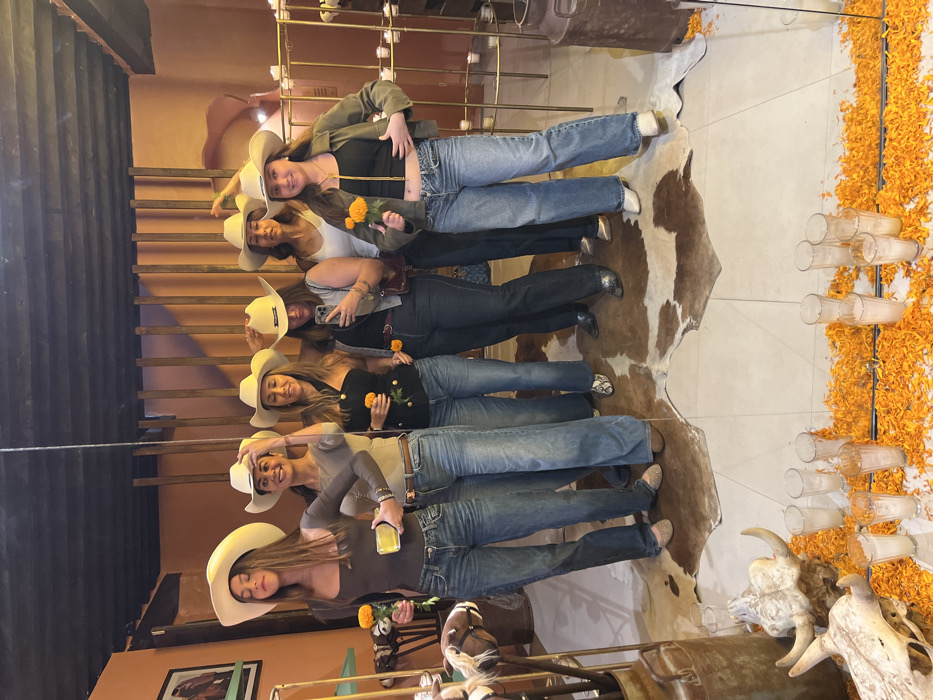
Six adult females, all wearing cowboy hats and jeans, are depicted indoors in Guanajuato City, Mexico, posing for a photograph. The setting features a rustic, western-themed decor with elements suggestive of a cultural celebration. From left to right, the women are dressed in varying tops: a dark brown long-sleeve top, a grey long-sleeve top, a black halter-neck top, a black top with a grey vest, a white tank top, and a black top with an olive-green short jacket. All wear blue jeans of different washes and styles, with footwear ranging from flats to white cowboy boots. Three of the women hold single orange marigold flowers. One woman on the left holds a small rectangular object, possibly a phone. Another woman near the center right holds a white smartphone to her face. The room features orange-toned walls, a dark ceiling with visible beams, and a prominent wooden slatted wall feature in the background. The floor is light-colored tile, partially covered by cowhide rugs. Decorative elements include: a multi-tiered metal stand holding multiple lit candles in glass holders on the right; two large, rusted metal milk cans (one on the far left, one on the far right); and a framed picture on the left wall. In the immediate foreground, separated by a clear barrier, two animal skulls with horns are arranged on the floor amidst a dense scattering of orange marigold petals and several empty clear drinking glasses. A large mirror or reflective surface is present, reflecting portions of the scene.
Guanajuato City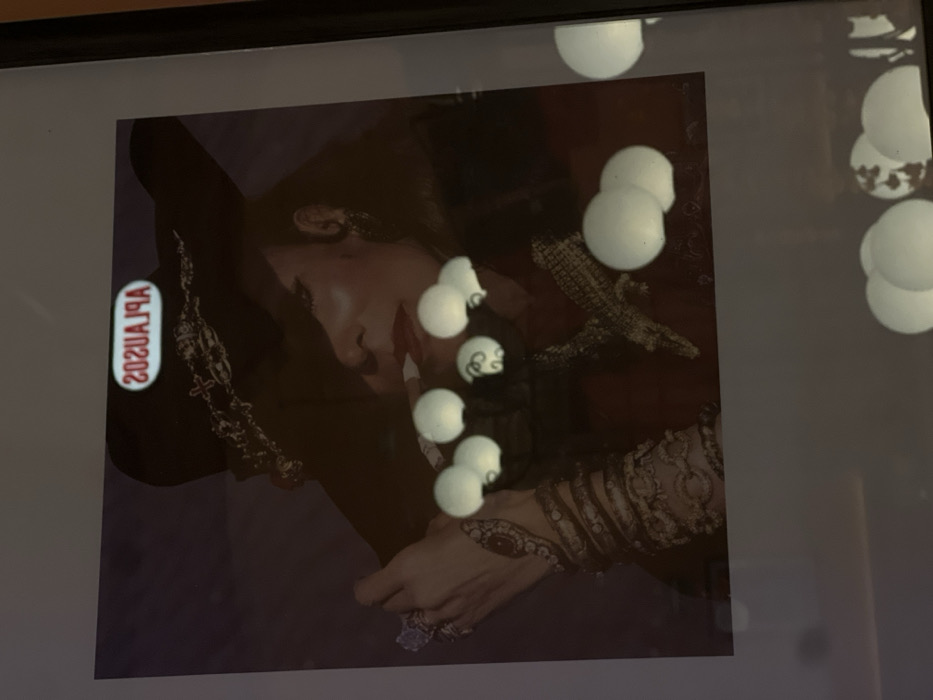
A framed, dark-toned portrait of a woman is depicted, viewed at an angle in an interior setting in Guanajuato City, Mexico. The woman, positioned centrally, wears a large-brimmed, dark hat with metallic or ornate trim, casting a shadow over her upper face. Her visible features include red-painted lips and an earring on her right ear. A cigarette is present in her mouth. Her left hand, adorned with multiple rings and a sleeve featuring intricate, possibly embroidered, patterns or stacked bracelets, is raised towards her face. Her attire also includes a distinct, small reptilian figure, resembling an alligator, positioned on the lower right side of her garment. The glass surface of the framed artwork exhibits reflections: numerous glowing, spherical lights, indicative of decorative string lights, and an inverted red sign that reads "APLAUSOS" (appearing as "SOZUAJLA" in reflection) positioned over the woman's hat. The environmental lighting is subdued, highlighting the reflections on the artwork.
Guanajuato City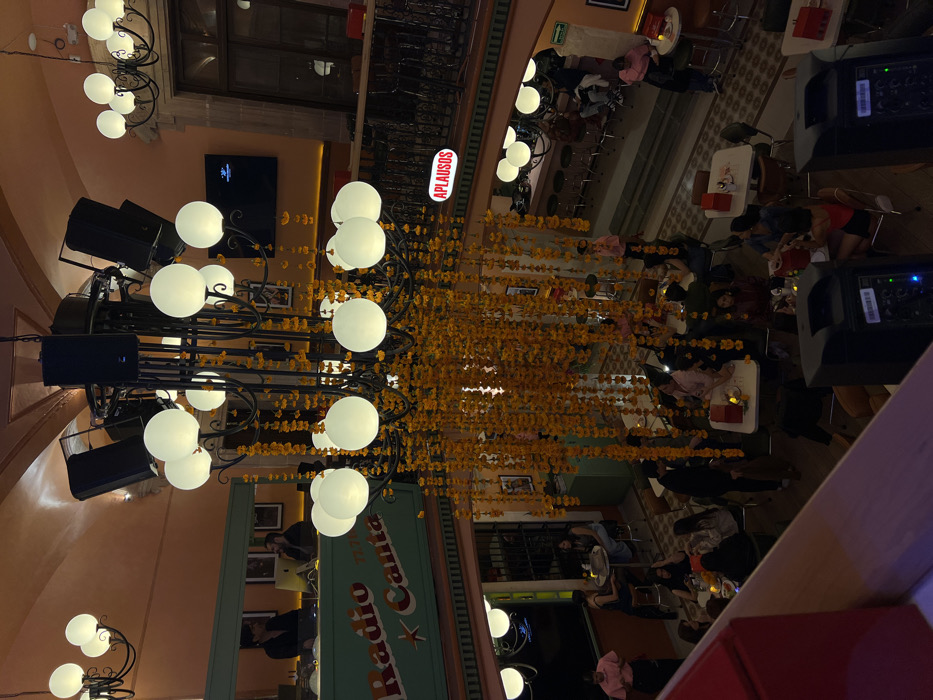
The image depicts the multi-level interior of a festive restaurant or entertainment venue located in Guanajuato City, Mexico. A dominant, large black metal chandelier with numerous spherical white light fixtures and integrated black PA speakers hangs centrally, heavily adorned with long strings of yellow-orange flowers, possibly marigolds. On the upper level, to the left, a green booth labeled "Radio Canta" with a star logo hosts two male individuals; one appears to be operating audio equipment, while the other observes an Apple iMac. The background wall features framed pictures. To the right of the chandelier, an upper balcony with a black ornate iron railing displays a red rectangular sign with white text reading "APLAUSOS." A wall-mounted flat-screen television is visible above this railing, and another smaller chandelier with spherical lights is present. The mid- and lower levels are filled with patrons seated at various square and round tables, engaged in dining and conversation. Several tables feature small candles or lamps. Waitstaff, identifiable by pink shirts, are present, attending to tables. A bar area with stools is visible on the mid-level right. The floor exhibits patterned tiling. In the foreground, two black PA speakers are visible, positioned below the observer's viewpoint. The venue's walls are painted a warm orange-peach tone.
Guanajuato City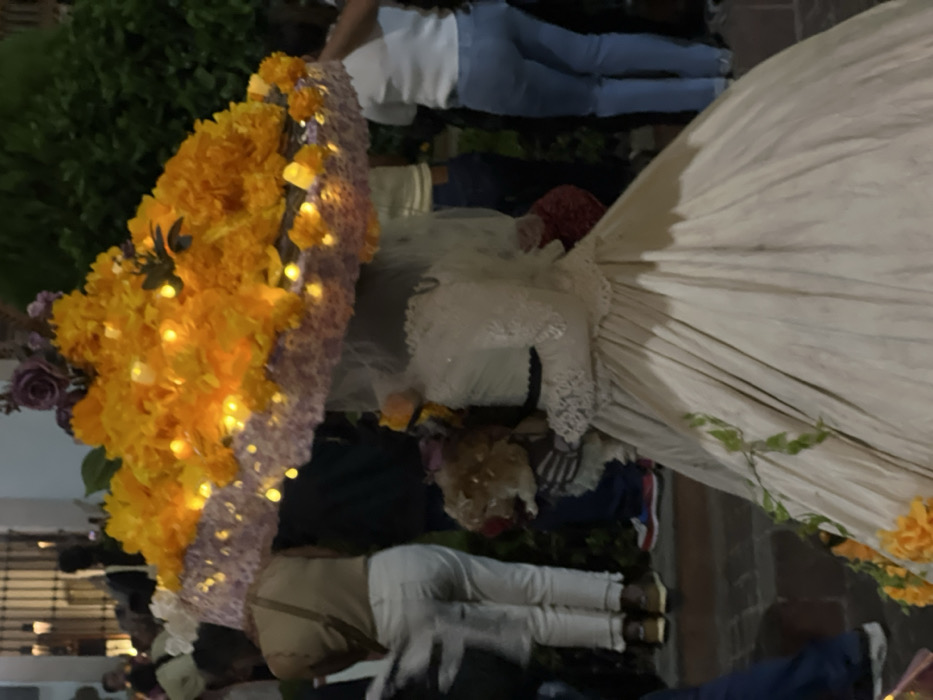
An evening scene in Guanajuato City, Mexico, depicts a central figure in an elaborate costume, viewed from a slightly elevated rear-left perspective, surrounded by a public gathering. The primary subject is adorned in a long, off-white, Victorian-style dress featuring a full skirt and lace detailing on the sleeves. A black band cinches the waist. The individual wears a wide-brimmed hat covered densely with numerous orange marigold-like flowers and illuminated by small, warm-toned LED lights along its brim. The underside of the hat's brim is light purple with additional small lights. A green vine trails down the front of the dress. The figure holds a small, fluffy, light brown dog with dark eyes in their left arm, while a small, red, textured bag is held in their right hand. The person's face is obscured by the hat and a veil. In the out-of-focus background, other individuals are present, indicating a crowd. To the left, a person wears a tan top and white pants. To the right, another person wears a white top and blue jeans. The ground is paved, and distant, dimly lit buildings with barred windows and foliage are visible, suggesting an urban outdoor setting at night.
Guanajuato City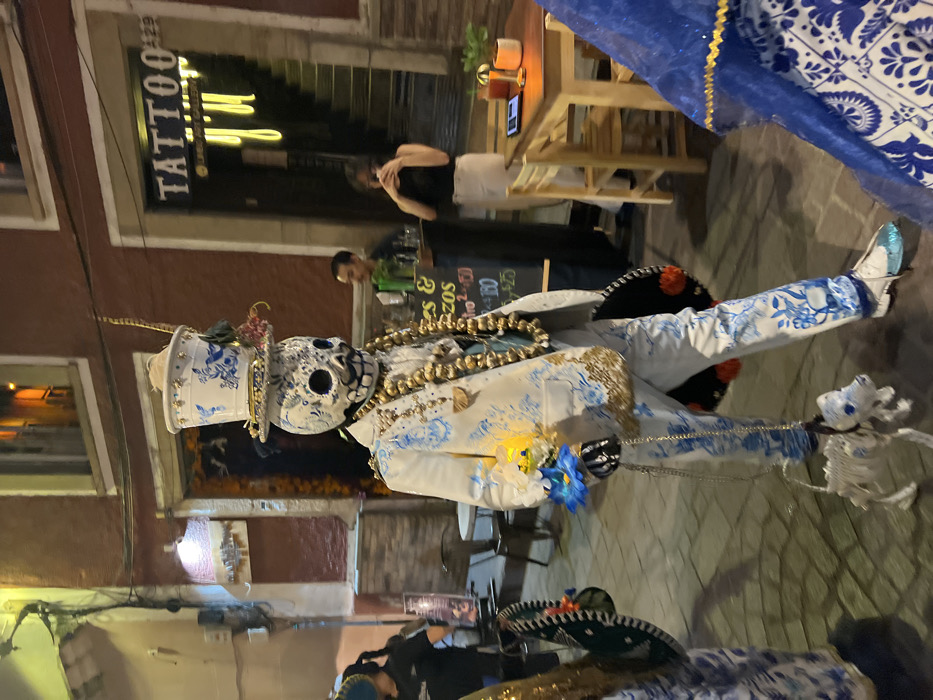
The image depicts a nighttime street scene in Guanajuato City, Mexico. The foreground is dominated by a person in an elaborate skeletal costume, consistent with a Catrín figure for Día de Muertos. This central figure wears a white skull mask with black facial features, a tall white top hat adorned with blue floral patterns, gold trim, a feather, and small decorative elements. The costume includes a white suit with extensive blue floral patterns and gold accents on the lapels, cuffs, and pant legs. Multiple strands of large, gold-colored bead necklaces are worn, and a black sombrero with red poms is attached to the left hip. The figure holds a small bouquet of artificial blue and yellow flowers in the right hand and a silver chain leash in the left, which is attached to a small, white skeletal dog figure with blue accents and a red collar. The figure's shoes are white with metallic blue pointed tips. To the immediate left, a second costumed individual is partially visible, showing a blue and white patterned garment and a green, fan-like accessory with gold trim. Both costumed figures appear to be walking forward, suggesting a procession or parade. The background features a narrow street or alleyway lined with buildings with reddish-brown facades. On the right, a business entrance is visible with a "TATTOO" sign and "Urbano Art Gallery" below it, featuring a distinctive neon "J'LL" or similar glowing sign inside. Adjacent to this, an outdoor dining area is present with two wooden tables and chairs. One table holds a smartphone, a small potted plant, and a drink. Behind this area, a male individual, possibly a server, stands near a dark counter or bar, holding a tray with green bottles. A chalkboard sign nearby displays text including "Es & RZOS" and prices "180" and "25." A female individual, wearing a dark top and light pants, stands near the outdoor tables, holding a smartphone up as if taking a photograph. The street is paved with flagstones or cobblestones, illuminated by overhead and building lights.
Guanajuato City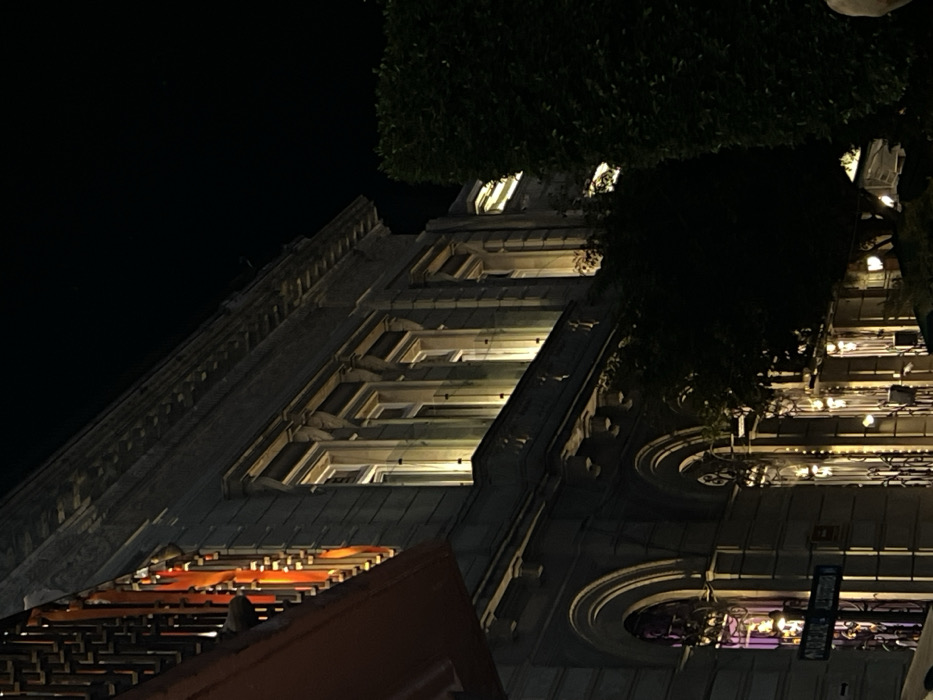
An upward-angled nighttime view captures a multi-story, classically-styled building at the intersection of Plaza de la Paz and Calle Allende in Guanajuato City, Mexico. The building's upper facade displays at least five uniformly spaced rectangular windows, each emitting a warm, yellowish internal light. These windows are situated below a prominent, ornate cornice and above a continuous, shallow balcony supported by decorative corbels. The lower visible floor features a series of arched windows, two of which are clearly visible, adorned with intricate metal grates and illuminated internally with hues of purple and yellowish light. To the far left, a distinct orange-red light shines through a patterned screen, partially obscured by a dark, angled overhead structure. A white rectangular street sign, affixed low on the building, clearly reads "PLAZA DE LA PAZ" on its upper line and "ALLENDE" on its partially visible lower line. A dense, dark green mass of foliage, likely a large tree or hedge, occupies the right side of the frame, obscuring part of the building's right section. The sky is uniformly dark black, indicative of night. No individuals are present in the scene.
Guanajuato City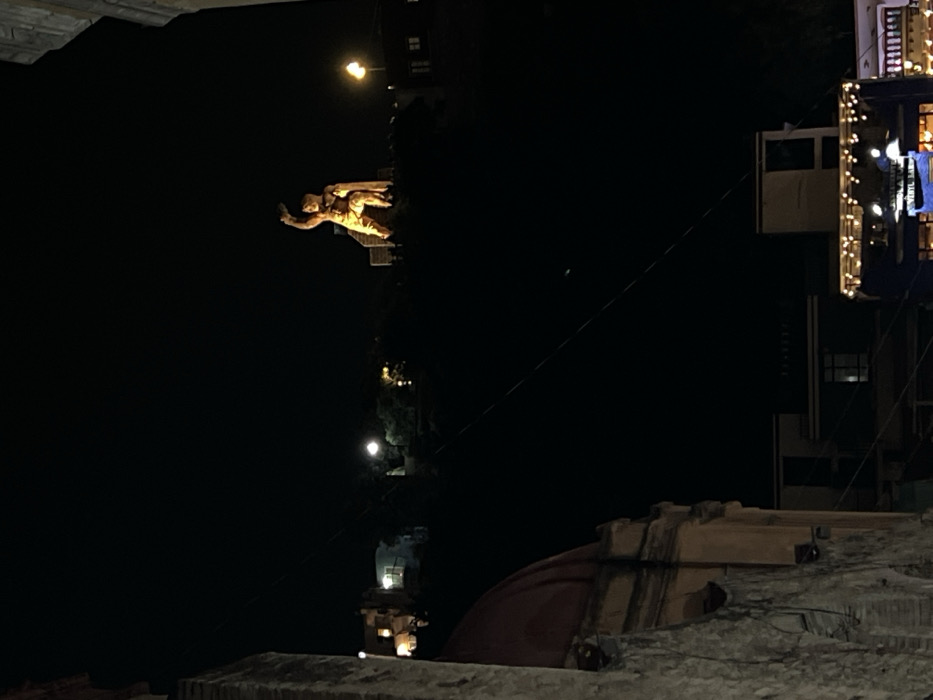
The image displays a nighttime urban scene in Guanajuato City, Mexico, centered on the illuminated El Pípila monument positioned atop a distant hill. The large statue, rendered in a golden hue by external lighting, depicts a male figure with a raised right arm holding an object resembling a torch or club. Below the monument, the hillside features scattered lights and subtle indications of other structures. In the lower left foreground, a section of an aged stone building is visible, characterized by a weathered facade and a reddish-brown domed roof. Adjacent to this structure, extending into the midground, are various multi-story city buildings with flat roofs and illuminated windows. One such building in the lower right portion of the frame features a string of decorative white lights and a partially visible commercial sign that reads "VINYL BAR." A thin, dark diagonal wire traverses the central upper section of the image. The sky is dark and clear, without visible celestial bodies or atmospheric phenomena. No discernible human figures are present or engaged in specific actions.
Guanajuato City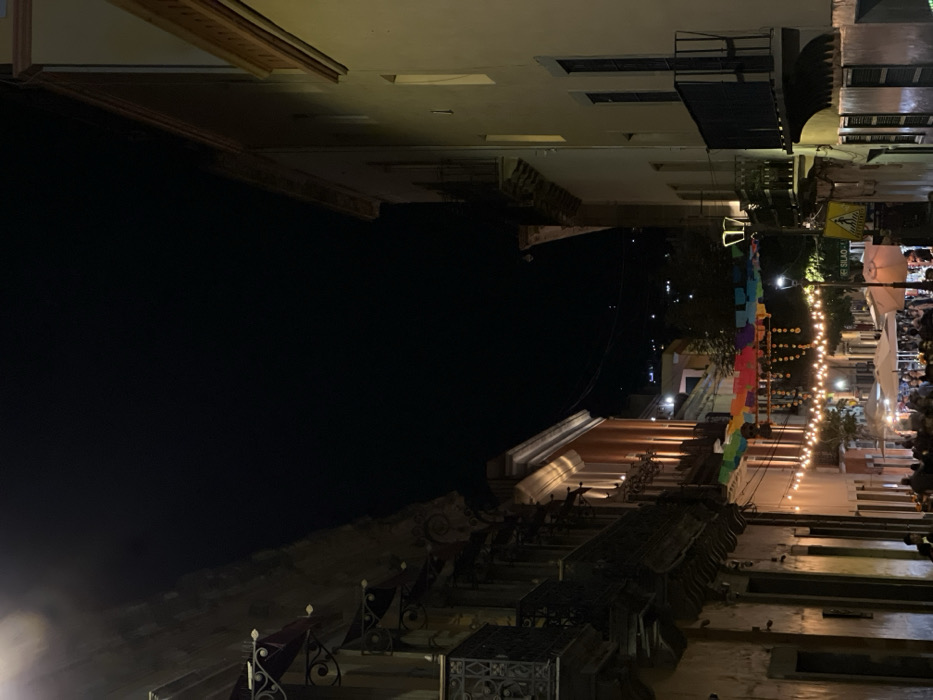
This image depicts a narrow, bustling pedestrian street at night in Guanajuato City, Mexico. The street is flanked by multi-story colonial-style buildings; the left structure features an aged, textured facade with several ornate wrought-iron balconies, while the right building has a smoother, lighter-toned facade with simpler balconies. The dark night sky is visible above, with distant city lights illuminating hills in the background. The street is extensively illuminated by multiple strings of warm-toned bulb lights suspended across its width, supplemented by street lamps, one clearly visible on the right. Multi-colored 'papel picado' banners, in shades of red, orange, yellow, green, and blue, are strung above the string lights. A dense crowd of people occupies the lower section of the street, indicating active pedestrian traffic. Within the crowd, several large, light-colored patio umbrellas or canopies are visible, suggesting outdoor dining establishments or vendor stalls. A white street sign with blue text, partially reading "SALAO," and a yellow pedestrian crossing sign are visible on the right side of the street. Electrical or communication wires traverse the sky between buildings.
Guanajuato City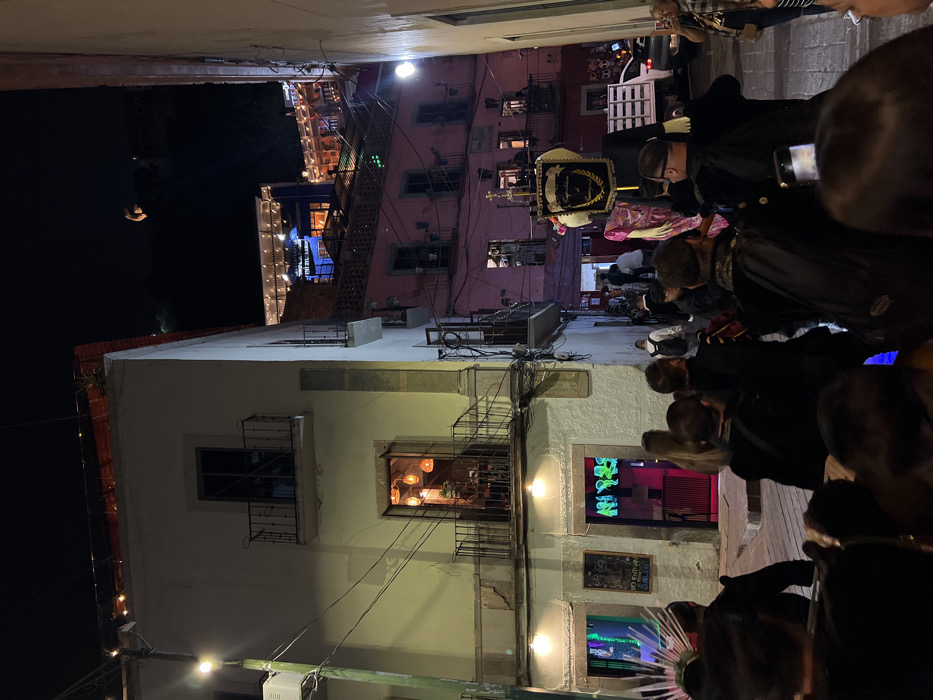
The image captures a nighttime street scene within a narrow callejón in Guanajuato City, Mexico. In the mid-ground, a crowd of approximately twenty individuals, largely dressed in dark clothing, occupies the street. Prominently featured among them are two large mojiganga figures: a male figure dressed in a black suit with a large, elaborate headpiece featuring a black banner with gold trim, an insignia, and a cross, and a partially visible female figure in a pink dress to its left. To the left of the frame, a multi-story white building features two iron-railed balconies on its upper floors; the lower balcony's door is open, revealing interior lighting from multiple hanging fixtures. Below, at street level, is a commercial establishment with green and pink neon signage spelling "NIRAS" and a small chalkboard sign. A street lamp is mounted on this building. To the right, a multi-story pink building with several balconies extends into the background. Overhead utility wires are visible across the upper portion of the scene. In the far background, on a dark hillside, several illuminated structures with string lights are visible, with the faint outline of the Pípila monument discernible against the night sky. A white pickup truck is partially visible on the far right in the background.
Guanajuato City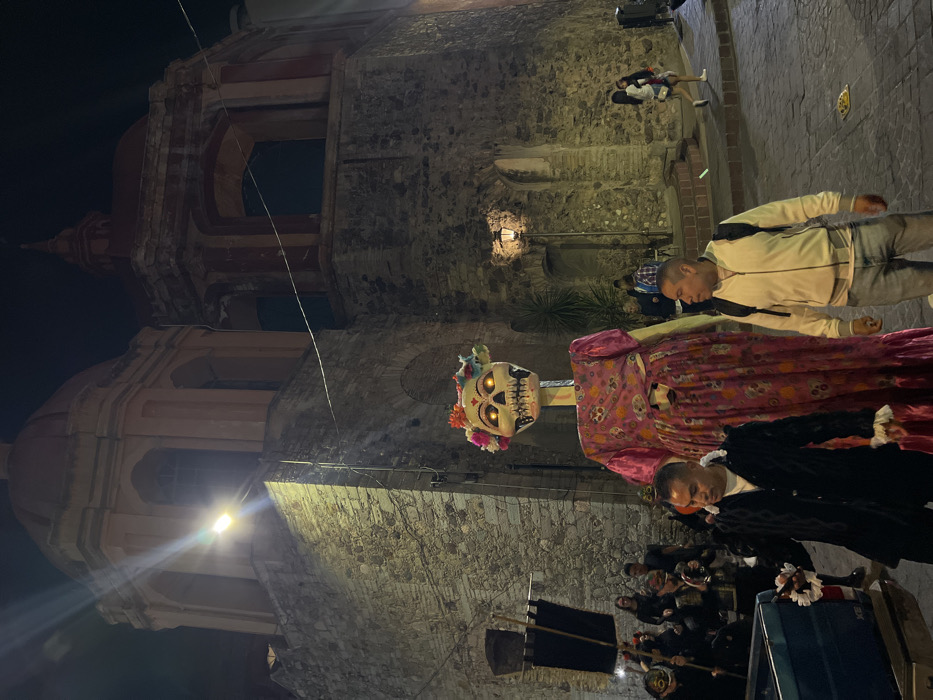
This nighttime image depicts a street scene in Guanajuato City, Mexico, likely during a Day of the Dead celebration. The primary subject is a tall Catrina figure, a traditional Mexican skeletal representation, positioned centrally in a procession. The Catrina figure features a skull face with illuminated eye sockets glowing orange, and a floral headpiece with red, white, and pink elements. It wears a long, pink, patterned dress with visible seams and a smaller face-like ornament on the torso. The figure stands significantly taller than the surrounding individuals. In the immediate foreground, two men walk past the Catrina. On the left, a man in a black velvet jacket with white ruffled cuffs holds an indeterminate object in his right hand. On the right, a man in a light-colored zip-up jacket, blue jeans, and a dark backpack walks towards the left, looking toward the Catrina. Behind the Catrina figure, a group of people is visible on the left, some partially obscured. One person carries a black banner on a pole. Further back on the right, a woman carries a child, walking away from the camera. Other indistinct figures are present throughout the background. The environment consists of tall, stone-faced buildings that define a narrow street. The building on the left features a light-colored octagonal dome with arched windows. Adjacent to it, another building section features a reddish dome with a small spire. A bright streetlamp emits a strong light bloom near the left dome. A more traditional, antique-style street lantern is affixed to the stone wall further down the street on the right. Thin power lines cross the upper portion of the frame. A portion of a light blue pickup truck bed is visible on the far left. The street appears paved and slightly uneven.
Guanajuato City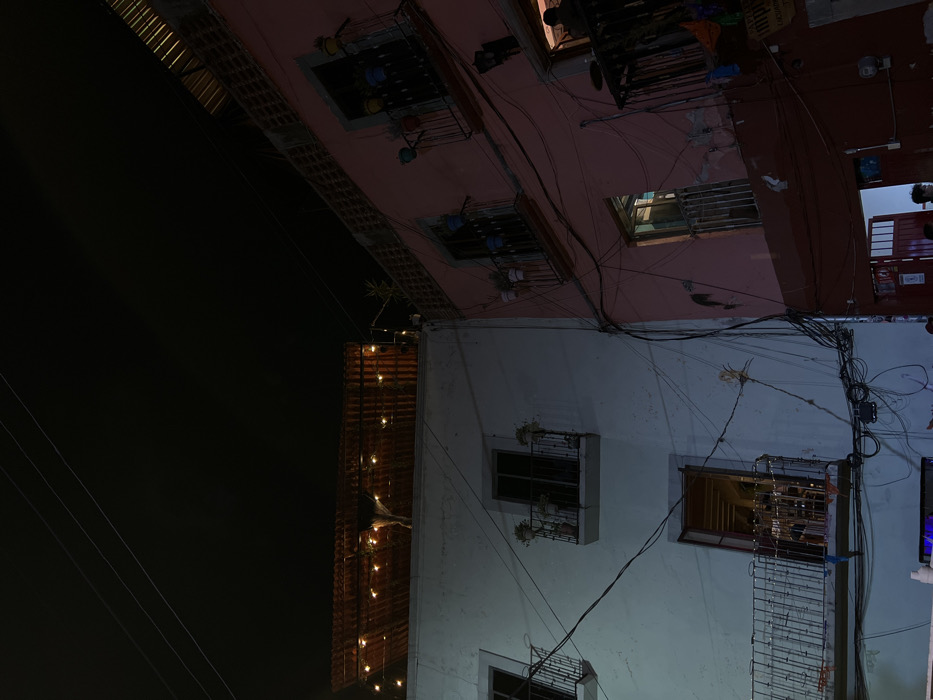
This image displays a nighttime street scene in Guanajuato City, Mexico, featuring two multi-story buildings. The structure on the left is light-colored (white/pale grey), while the adjacent building on the right is pink with a darker red lower facade. The light-colored building presents three visible balconies with black iron railings; the top two balconies contain small white potted plants. A lower open doorway on this building reveals an illuminated interior, where string lights and several indistinct human figures are visible. Above this building, a corrugated metal roof structure is present, illuminated by string lights. Below the lowest balcony, a white dispenser is mounted on a ledge. The pink building on the right features two balconies with black iron railings, adorned with colorful potted plants in blue, yellow, and white containers. Multiple windows are visible, some fitted with vertical metal grates. In an upper-level window of the pink building, the dark silhouette of a human figure is discernible. The ground level of this building includes a partially visible entrance with a red gate. Numerous black electrical and communication wires are extensively strung and bundled across the foreground and between both buildings. The sky above is dark and cloudless.
Guanajuato City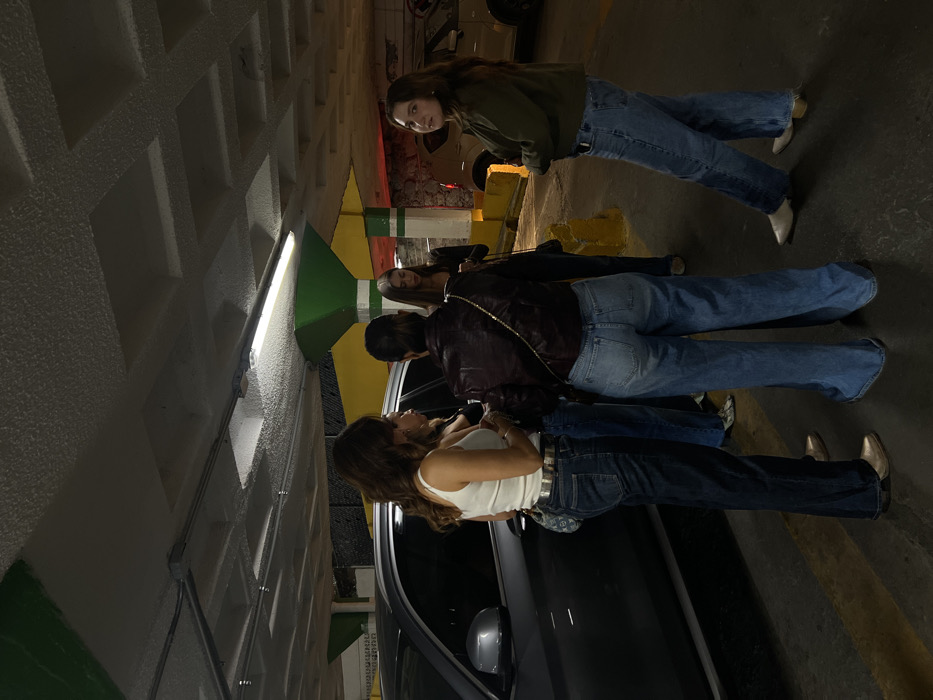
The scene depicts five females gathered within an illuminated section of a concrete parking garage in Guanajuato City, Mexico. **Environment:** The overhead concrete ceiling features recessed square panels and exposed conduits, with multiple fluorescent light fixtures providing illumination. Large pillars, painted with green and white horizontal stripes, punctuate the space. One pillar also exhibits a yellow section. The ground is paved, possibly asphalt, with faded yellow markings. A dark grey SUV is parked on the left, partially obscuring the leftmost individual. In the far background, a lighter-colored vehicle is partially visible near a stone wall, which shows a reddish glow. **Individuals:** 1. **Leftmost:** Partially visible from behind, presenting long dark hair and a dark top. 2. **Second from left:** Standing with her back to the camera, she wears a white tank top, dark blue jeans, a metallic silver belt, and gold-toned shoes. A light-colored shoulder bag with a distinct pattern is slung across her body. 3. **Center:** Positioned with her back to the camera, she wears a dark reddish-brown leather-like jacket, light blue wide-leg jeans, and gold-toned shoes or boots. A delicate gold chain or strap crosses her upper back. 4. **Fourth from left:** Mostly obscured by the person in the center, she has long dark hair and wears dark attire. 5. **Rightmost:** Facing the camera, she has long brown hair and wears a dark olive-green jacket, blue jeans, and white pointed-toe boots with a low heel. She looks directly towards the camera with a neutral expression. **Actions/Interactions:** The individuals appear to be conversing or waiting, standing in close proximity to one another. Three individuals face away from the camera, seemingly engaged with each other, while the individual on the far right directly observes the camera. No overt physical interactions are observed.
Guanajuato City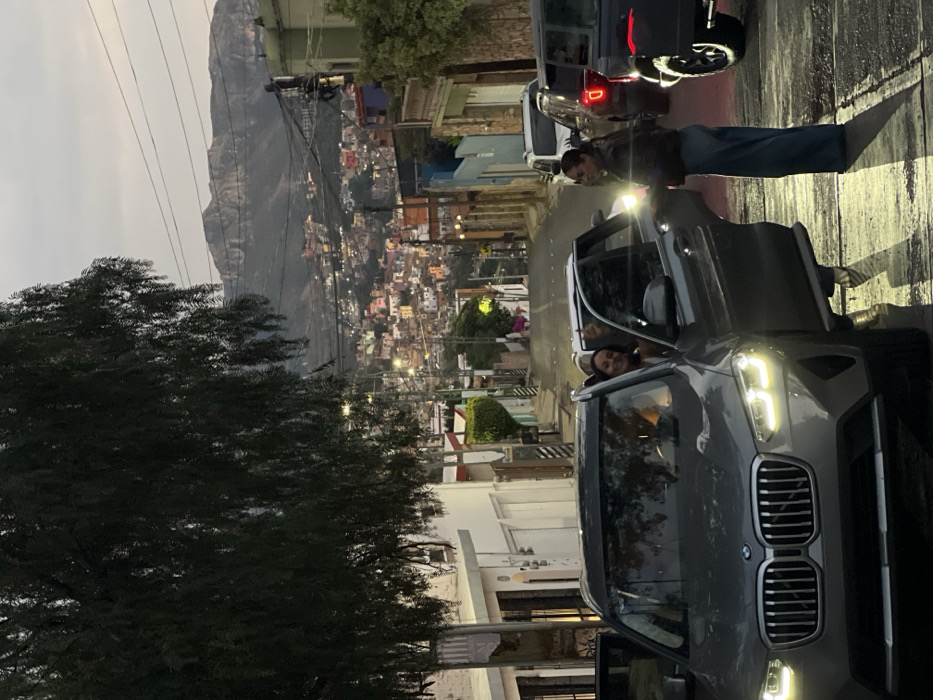
This image captures an urban street scene at twilight in Guanajuato City, Mexico. In the foreground, a dark grey BMW X3 SUV is stationary on a wet asphalt street, facing the viewer at a slight angle, with its headlights active. The front passenger door is open. A female occupant is seated inside, smiling and gesturing with her raised right hand towards the camera. A second female subject is partially depicted exiting the open passenger door, wearing a dark jacket and blue wide-leg jeans, with her right leg visible on the pavement. A third female subject stands immediately to the right of the vehicle, also in a dark jacket and blue jeans, facing towards the SUV. The street, lined with residential structures, descends into a valley. The midground and background reveal a densely packed cityscape of colorful buildings, illuminated by numerous streetlights and interior lights, extending up surrounding hillsides. A rugged mountain range is visible on the distant horizon beneath a pale, overcast sky. Utility lines are present overhead. Additional vehicles, including a white car and a dark pickup truck, are parked or stopped further down the street. A large tree with dark, dense foliage partially obstructs the upper left portion of the frame.
Guanajuato City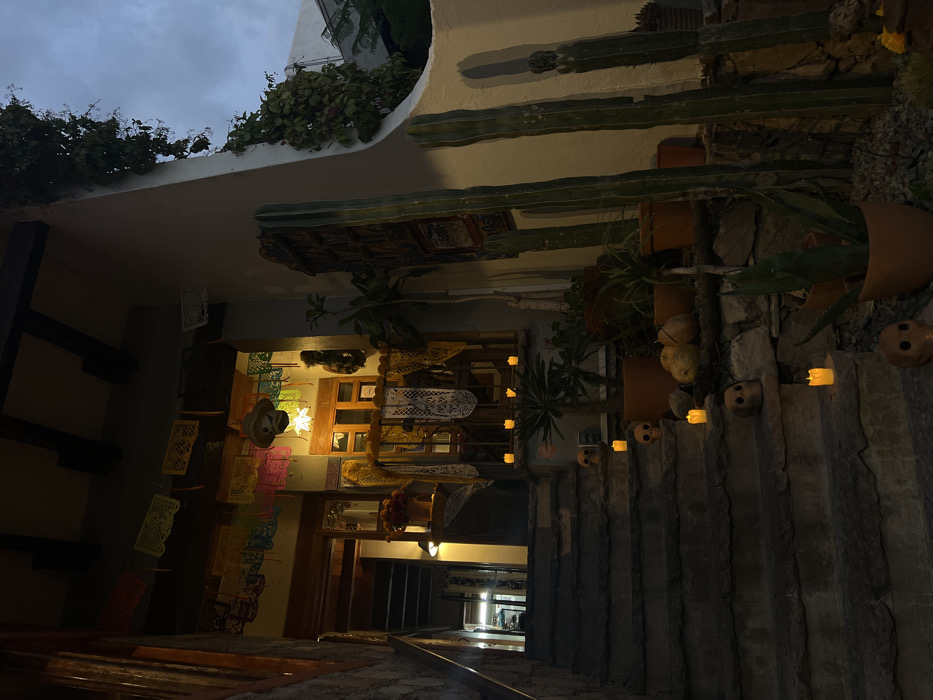
The image displays an outdoor stone staircase ascending towards a decorated building entrance in Guanajuato City, Mexico, captured during twilight or night. Eight visible stone steps rise towards a landing where the entrance is situated. The left wall of the stairway is composed of rough-hewn stone, while the right wall is a smooth, light-colored stucco surface, partially covered by climbing green vines. The building entrance features a wooden door frame and a window with wooden panes, illuminated by warm yellow light from within. Above the entrance, multi-colored "papel picado" banners are strung, alongside a hanging straw hat adorned with a painted skull face and a white star-shaped lantern. A balcony railing is draped with white lace fabric, and a pot containing orange flowers is visible on a surface behind it. Faux yellow LED candles and small, light-colored skull figures are systematically placed on various stair treads and on a ledge near the entrance. Numerous potted plants, including tall columnar cacti and various succulents, are arranged in terracotta pots along the right side of the staircase and on ledges. Three light-colored gourds or small pumpkins are situated amongst these plants. A tall, dark, decorative panel is mounted on the stucco wall to the right of the entrance. The sky, visible at the top right, shows the muted light of dusk. No individuals are present in the scene.
Guanajuato City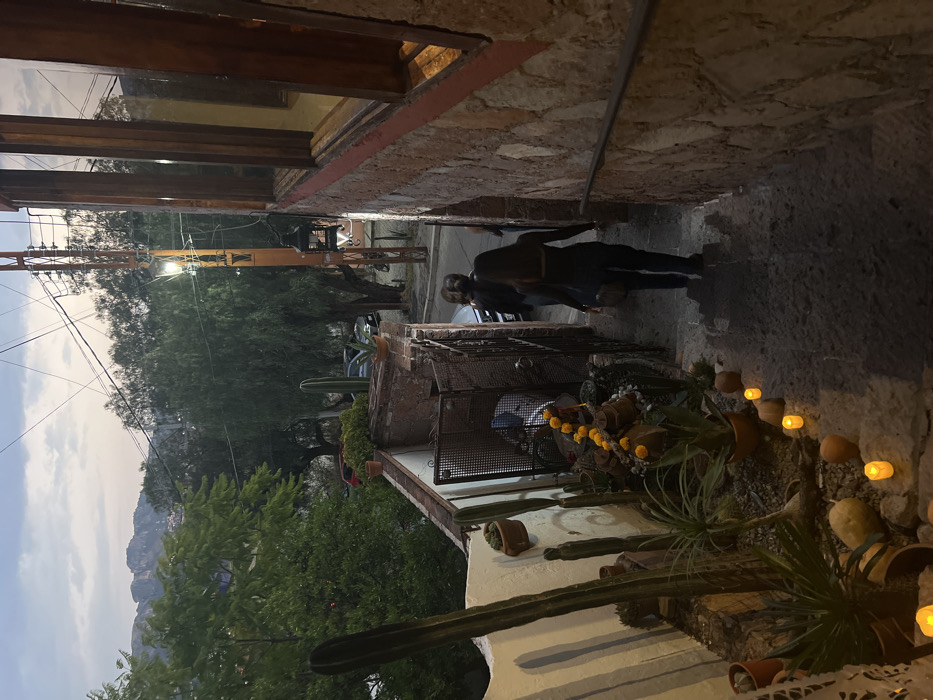
The image depicts an outdoor, descending stone staircase in Guanajuato City, Mexico, during twilight or early night. Two individuals, both appearing female, are walking down the stairs, facing away from the camera. The foreground individual wears a dark, long-sleeved top and dark pants, with a dark shoulder bag. The second individual is partially visible behind the first. To the left of the staircase, a white-painted wall with vertical stripes supports a terraced garden area. This area contains multiple cacti of varying heights, agave plants, and other potted succulents. A line of small, orange-glowing lights (likely LED candles) illuminates the edge of the steps alongside the garden. A dark metal gate is visible mid-left, leading into a recessed space, above which hangs a garland of orange, marigold-like flowers. To the right of the staircase, a stone wall, possibly constructed from local cantera stone, features a red-painted trim line. Several vertical wooden-framed windows or doors with glass panes reflect interior light. A dark metal handrail runs down the right side of the stairs. At the bottom of the stairs, a narrow paved street is visible, with dark-colored parked vehicles. The background reveals dense green foliage from trees, a prominent utility pole with numerous overhead wires and a bright street light, and distant mountains under a pale, overcast sky. The overall scene suggests an evening descent through a residential or mixed-use urban area characterized by dense construction and natural elements.
Guanajuato City
This image, captured in Guanajuato City, Mexico, presents a close-up, eye-level view of a decorative ceramic vase holding a dense floral arrangement. The bouquet consists primarily of ruffled, deep magenta/burgundy cockscomb flowers and bright yellow marigolds, interspersed with green foliage. The vase is a sizable, glazed ceramic object, predominantly white or cream, adorned with intricate blue hand-painted designs. These designs include a continuous horizontal landscape scene depicting multiple colonial-style buildings with windows and balconies, along with stylized trees and small, indistinct human figures in the lower portion. Vertical decorative panels featuring blue geometric or scroll-like patterns are visible on the vase's right side, and its neck and upper shoulder are banded in blue. The scene is dimly lit, with reflections from an unseen light source apparent on the vase's glossy surface. In the lower left foreground, a section of a white, fluted plate and a woven mat are visible. To the lower right, a cylindrical, light-colored object, consistent with a candle, is partially depicted. The background is dark and indistinct. No specific landmark or outdoor scene within Guanajuato City is discernible from the image content.
Guanajuato City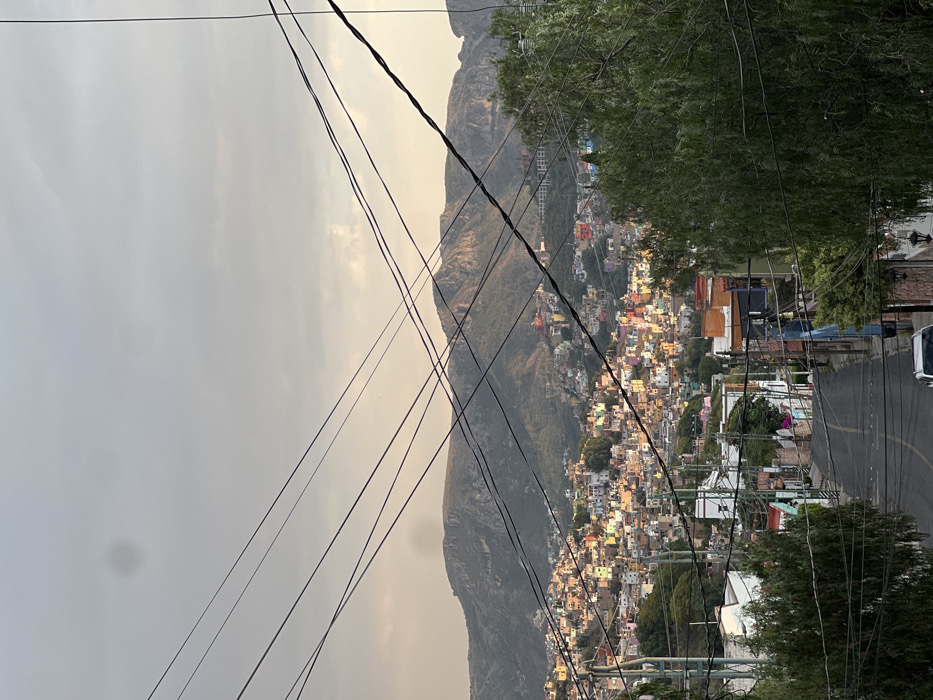
The image depicts an elevated panoramic view of Guanajuato City, Mexico, under a largely overcast sky with hints of pale light. The foreground features a downward-sloping, asphalt street flanked by buildings and verdant trees. Numerous black electrical and communication lines crisscross the upper two-thirds of the frame, converging and diverging. A white vehicle is partially visible at the bottom of the street. In the midground, the city unfolds with a dense arrangement of residential and commercial structures, notable for their varied and vibrant color palette, including shades of orange, pink, yellow, blue, and green, built into the natural hillside terrain. The background is dominated by large, rugged mountains covered in sparse vegetation, rising against the pale sky. No people, specific actions, or interactions are discernible within the frame.
Guanajuato City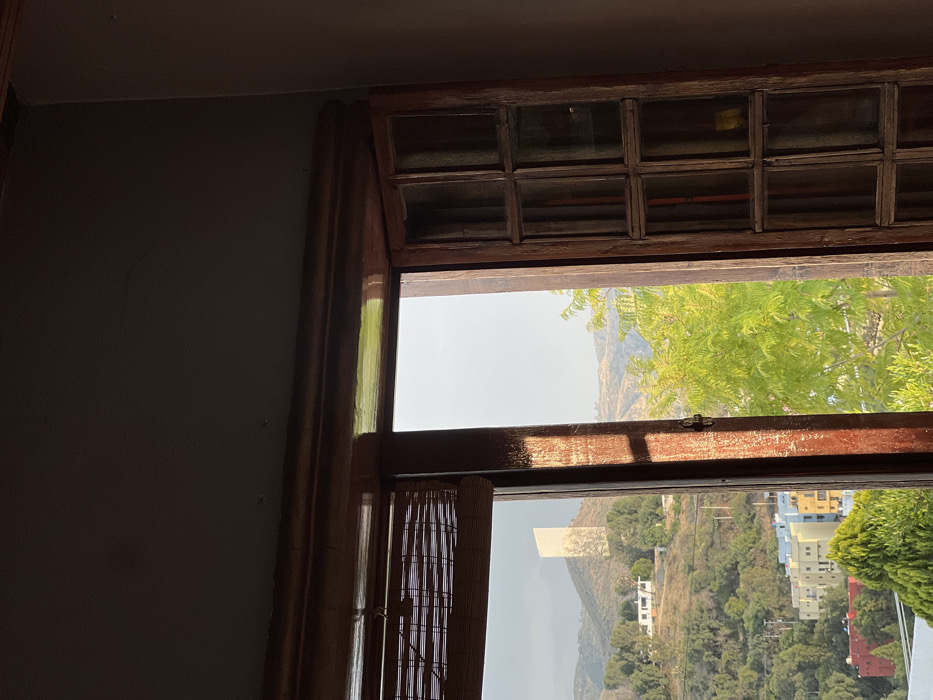
A view from inside a room looks out through a dark wood-framed window onto a hillside cityscape in Guanajuato City, Mexico. The upper section of the image shows the dark interior ceiling and wall. The window frame, consisting of a lintel, sill, and vertical mullions, is dark wood, with direct sunlight illuminating its left vertical and horizontal elements. A horizontal slat-style blind is partially lowered over the left pane of the window. The right side of the window is open, with a multi-paned wooden shutter or door swung inwards to the right. Beyond the window, a bright, hazy sky is visible above a landscape of rolling hills covered in dense green foliage. In the mid-ground, a cluster of brightly colored buildings—yellow, blue, and red—are visible below the tree line. Further back, on a more distant hill, a distinct, tall, light-colored rectangular monument, identified as the Monumento al Pípila, stands prominently. A white house is situated on a closer, vegetated hillside to the left of the monument. No individuals, specific actions, or interactions are present in the scene.
Guanajuato City
The image displays a partially consumed meal served in a dining setting within Guanajuato City, Mexico. The central subject is a black, round ceramic bowl containing a dish primarily consisting of a large portion of shredded cooked meat, possibly lamb or poultry, with visible bone fragments. This meat is submerged in a reddish-brown, semi-liquid sauce that contains dark, bean-like particles and lighter, soft vegetable matter. The dish is garnished with small green herb sprigs and several vibrant pink flower petals scattered on the sauce. The inner rim of the bowl exhibits dried residue from the sauce. The bowl rests on a light brown woven placemat. In the upper left background, a clear glass holds a pink beverage. To the right, a white fabric with a dark patterned border is visible, and further back, a portion of a light brown ceramic plate with a wrapped food item and a silver fork can be seen.
Guanajuato City