Gwagwarwa, Nigeria
30 memories from Gwagwarwa, Nigeria
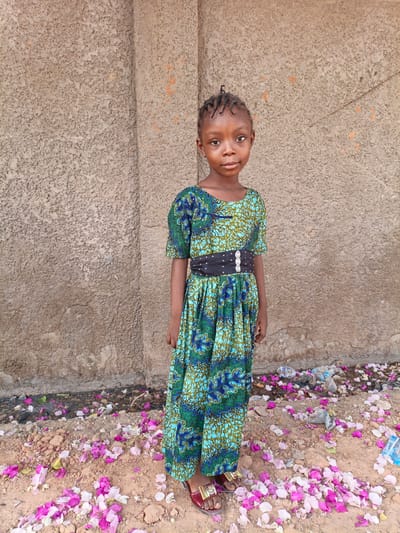
A young girl stands facing the camera in Gwagwarwa, Nigeria. She wears a floor-length, green and blue patterned dress with a black belt. The background is a rough, textured wall with a vertical seam. The ground is covered in red dirt and scattered with pink and white flower petals. There is trash visible near the base of the wall. The girl is wearing red sandals and has her hair braided.
Gwagwarwa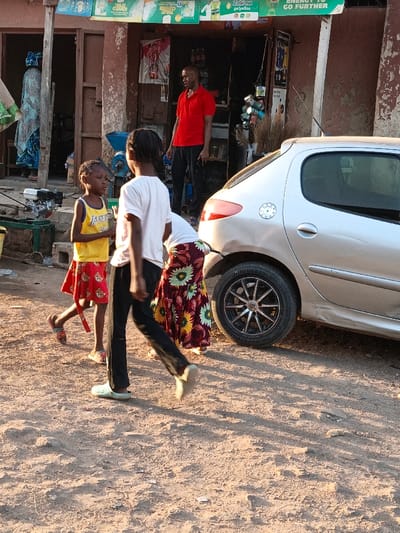
The scene depicts a street in Gwagwarwa, Nigeria, under natural daylight, likely late afternoon. The foreground features dusty, unpaved ground. Five individuals are present. Centrally, two children are in motion or interaction. A child on the left, wearing a yellow sleeveless top with "LAKERS 32" and a red patterned skirt, faces right. Another child, with dark hair, wearing a white t-shirt and dark pants, walks right, passing the first child. An adult, partially obscured by a silver car, is seen bending at the waist near the car's rear, wearing a dark red skirt with prominent yellow and green floral patterns. In the background, an adult male wearing a red polo shirt and dark trousers stands in the entrance of a shop, holding an object in his right hand. Further inside the shop, an adult female in a light blue patterned dress is partially visible from behind. A silver 3-door hatchback car, consistent with a Peugeot 206 model, is parked facing right, with its rear driver's side wheel featuring a black multi-spoke rim and "BRIDGESTONE" visible on the tire. The car shows a slight dent above the rear wheel arch. The background comprises a single-story building, likely a commercial establishment, with reddish-brown walls and open doorways. A green banner with "ENERGY TO GO FURTHER" and other text is stretched across the top of the shop entrance. Various items, including brooms and containers, hang in the doorway. A small engine or piece of machinery on a green stand is visible on the far left.
Gwagwarwa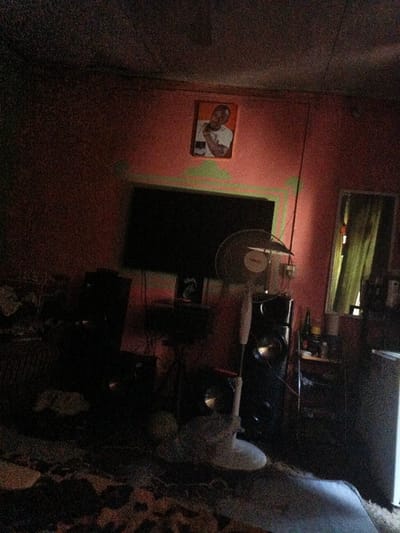
The image depicts a dimly lit indoor residential scene, presumably within the city of Gwagwarwa, Nigeria. The room features reddish-orange painted walls, with visible green paint splashes or markings above a television screen. Centered on the upper portion of the right wall is a framed photograph of a light-skinned man wearing a white t-shirt, looking towards the left and holding his hand to his chest, appearing to smile. Directly beneath this photograph, mounted on the wall, is a dark, rectangular flat-screen television. To the right of the television, a white Binatone stand fan with visible dust on its blades is positioned, partially obstructing a large, dark speaker system located on the floor. Further to the right, a rectangular mirror is affixed to the wall, reflecting a window with light green curtains. Below the mirror, a dark shelf unit holds various indistinct objects. On the far right, a tall, light-colored appliance, possibly a refrigerator or cooler, is visible. The floor is covered with a patterned rug or carpet. The overall lighting is low, contributing to a grainy appearance in the photograph, with shadows obscuring significant detail in the lower left and central foreground. No individuals are present, and no actions or interactions are occurring within the frame. The environment suggests a lived-in space with personal effects and entertainment equipment.
Gwagwarwa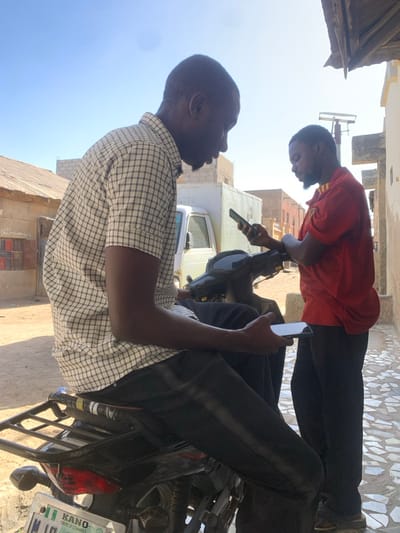
Two adult males are depicted outdoors in Gwagwarwa, Nigeria, under clear daylight. The male on the left, wearing a white and black checkered short-sleeve shirt and dark pants, is seated on a dark motorcycle. He holds a white smartphone horizontally in his left hand, looking downwards at its screen. The motorcycle has a black seat, a rear rack, and a partially visible Nigerian license plate from "KANO CENTRE OF COMMERCE." The male on the right, wearing a red short-sleeve shirt and dark pants, stands alongside the motorcycle. He holds a dark smartphone vertically with both hands, focusing on its screen. In the background, a white boxy vehicle is parked near several buildings, including one constructed from concrete blocks and another with a corrugated metal roof. The ground surface in the immediate foreground right is composed of irregular light-colored paving.
Gwagwarwa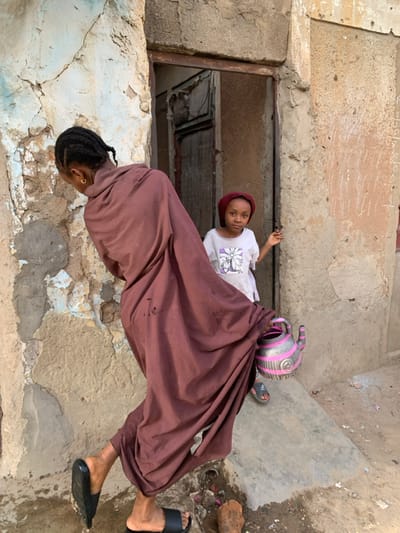
This image depicts an outdoor scene in Gwagwarwa, Nigeria, featuring two females positioned against weathered building exteriors. In the foreground, an adult or older female is captured from the back, in motion, appearing to walk or pivot towards the left. She wears a long, loose-fitting, reddish-brown garment that extends to her ankles. Her hair is dark and styled in braids, and she wears small gold hoop earrings. On her feet are black slide sandals. Her right hand holds a silver metallic teapot adorned with prominent pink horizontal stripes, a pink handle, and a pink spout. In the background, a young female child stands within a recessed doorway, looking directly at the camera with a neutral expression. She wears a white short-sleeved t-shirt featuring a stylized graphic design on the chest. A dark red head covering conceals her hair. Her right arm is slightly raised, with her hand near the door frame. Her feet, visible beneath the doorway, wear sandals with pink straps over striped socks. The immediate environment consists of dilapidated building walls. The wall to the left of the foreground subject exhibits flaking plaster, revealing underlying light blue and brown layers. The wall to the right, forming part of the doorway, is a textured, light brown, with faded vertical white chalk-like markings. The ground is an uneven mixture of dirt and concrete, with scattered small debris including reddish-brown fragments. The doorway itself is framed by rough concrete or stone and contains a dark, possibly wooden, recessed door. The scene is illuminated by natural daylight.
Gwagwarwa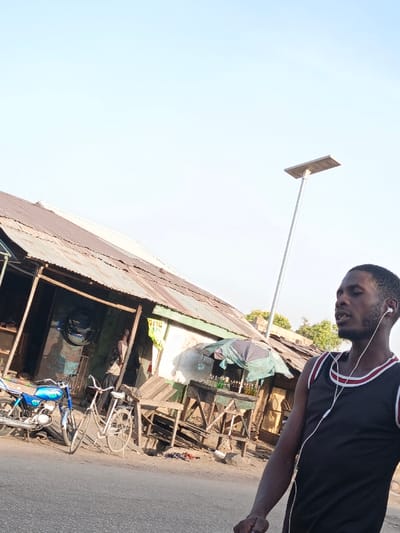
The image depicts an outdoor scene in Gwagwarwa, Nigeria, under a bright, clear sky. In the foreground, a dark-skinned male with a short beard and short hair is visible from the chest up, positioned on the right side of the frame. He wears a black tank top with white and red trim around the collar and armholes, and has white wired earbuds in both ears. His mouth is slightly open, and he appears to be looking towards the left. The background features a street or unpaved road in the lower left, where a blue motorcycle and a white bicycle are parked. Directly behind them and extending across the mid-ground are several single-story structures with weathered, corrugated metal roofs. These buildings appear to be shops or stalls. One structure to the left has an open front with a dark interior, and a person is partially visible inside. A green sign with "OG" text is visible on the wall of one building. To the right of this, a makeshift stall constructed from wooden planks displays multiple small, dark-colored bottles, possibly containing liquids, under a partially collapsed green and black umbrella. Dominating the upper-right background is a tall, slender metal pole topped with a rectangular solar panel and integrated light fixture, indicative of a solar-powered street light. The overall impression is a bustling, informal commercial street.
Gwagwarwa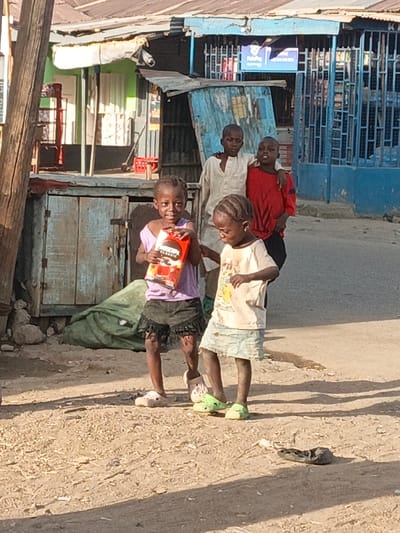
The scene depicts four individuals, likely children, in an unpaved, dusty outdoor area within Gwagwarwa, Nigeria. The ground is light brown soil with scattered small debris. In the foreground, two young females stand facing forward. The girl on the left wears a light purple tank top and a dark, ruffled skirt, with light pink Crocs-style sandals. She holds a red and brown rectangular package, identifiable as "MILO CLASSIC," and looks towards the viewer with a slight smile. Her hair is styled in cornrows. To her right, a shorter girl wears a light-colored t-shirt with a faded graphic and a light blue skirt, with bright green Crocs-style sandals. Her hair is also in cornrows, and she looks downwards and slightly to her right. A single black open-toed sandal lies on the ground in the lower right of the frame. In the mid-ground, two males stand behind the foreground children. The male on the left wears a light-colored, long-sleeved collared shirt and has his left arm over the shoulders of the male beside him. The male on the right wears a red short-sleeved t-shirt and has his right arm over the shoulders of the male next to him. Both look generally towards the viewer. The background features several structures. On the far left, a large wooden pole stands vertically. Behind the foreground children, there is a small, weathered wooden structure with two latched panels, resembling a kiosk or storage unit, next to which a dark green tarp or fabric lies on the ground. Further back, a light green painted building is visible. To its right, a blue building with barred windows or a facade displays a sign with "Painting," "Pharmacy," and partially visible numbers. Red plastic crates are stacked in the mid-background. The scene is illuminated by strong sunlight, casting distinct shadows.
Gwagwarwa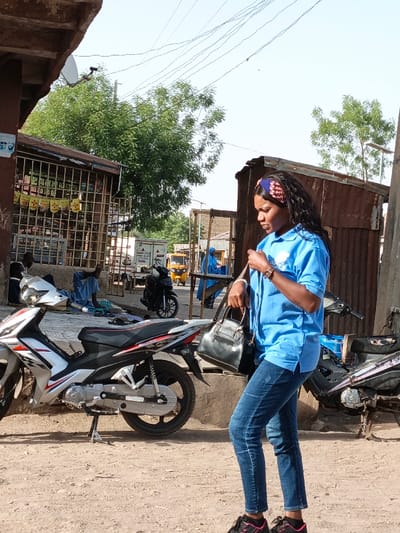
The image depicts an outdoor street scene in Gwagwarwa, Nigeria, under clear daylight. In the foreground, slightly to the right of the center, a woman is positioned in profile, facing right. She has long, dark, wavy hair partially covered by a patterned headband featuring blue, red, and brown hues. She wears a light blue short-sleeved polo shirt with a white logo on the left chest, dark blue jeans, and dark athletic shoes with pink trim. A dark watch is visible on her left wrist. She holds a black structured handbag in her left hand and appears to be adjusting something in that hand. To the woman's left, a silver and black motorcycle with red accents is parked on its kickstand, facing right, on the unpaved, dusty ground. Behind this motorcycle, a building with a brown facade and a heavily grated window or entrance is visible. Several yellow rectangular signs or banners are displayed within the grates. Two men are seated on the ground near this building, one dressed in blue attire. A small white satellite dish is mounted on the upper left section of the structure above this building. Behind the woman and slightly to her right, a weathered structure constructed from rusty corrugated metal sheets is visible. Another parked motorcycle, predominantly dark, is partially visible behind this corrugated structure and to the right of the silver and black motorcycle. In the midground and background, the scene reveals a dusty street. On the left side of the background, a light-colored truck is parked. Further down the street, a yellow auto-rickshaw (Keke Napep) is visible. A person wearing a blue full-body garment is also present further down the street on the right. Additional buildings with varied construction, including some with corrugated roofs, are visible in the distance. Sparse trees with green foliage are present on both the left and right sides of the background. Multiple thin electrical or communication wires crisscross the clear, light blue sky overhead. The ground throughout the visible area is unpaved and appears to be dirt or dusty earth.
Gwagwarwa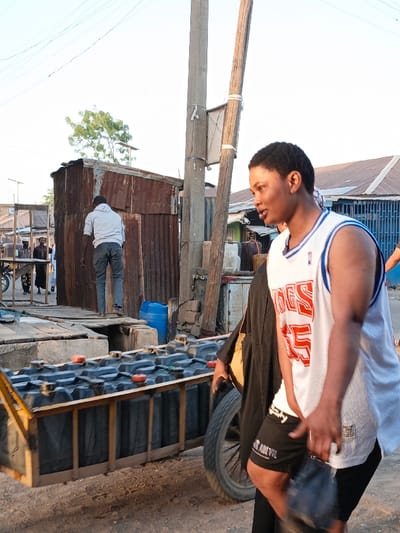
The image depicts an outdoor street scene in Gwagwarwa, Nigeria. In the immediate foreground on the right, a person with short dark hair, wearing a white sleeveless basketball jersey with red "INGS 55" text and an NBA logo, and black shorts, walks from right to left. A black garment is draped over their left arm, and a dark object is held in their left hand. Immediately to the left of this person, a wooden pushcart is positioned, laden with approximately eighteen dark-colored rectangular containers, each featuring an orange cap. In the mid-ground, a male subject wearing a light grey hoodie and dark trousers is observed from behind, stepping onto a raised wooden platform that leads to a structure made of weathered, rusted corrugated metal sheets. A blue plastic barrel is situated near the base of this structure. Two utility poles, one concrete and one wooden, stand vertically in the center-right, supporting overhead wires. The background features various buildings with corrugated metal roofs, additional pedestrians, and a parked motorcycle on the far left. The ground throughout the scene is unpaved dirt. The sky is clear and bright.
Gwagwarwa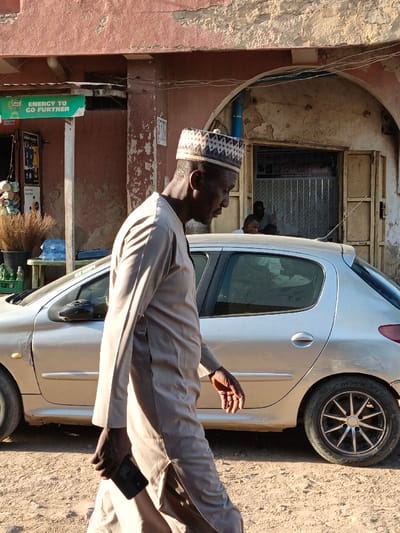
An adult male with dark skin walks left across an unpaved street in Gwagwarwa, Nigeria. He wears a light beige long-sleeved tunic and a white cap with dark geometric patterns. He holds a dark smartphone in his left hand, and his gaze is directed downwards and to the left. Behind the man, a silver five-door hatchback, consistent with a Peugeot 206, is parked parallel to the street. The car shows minor damage or dirt near the rocker panel and has multi-spoke dark rims on the visible rear wheel. In the background, a weathered building features a reddish-brown upper facade with peeling paint and a lighter, off-white lower section. An arched doorway in the building reveals a dark interior, inside which two or three individuals are partially visible; one appears to be a standing dark-skinned male. A blue pipe runs vertically on the building's facade. To the far left, a green sign with white text, partially reading "ENERGY TO GO FURTHER," is mounted above a display of brown bundled objects (possibly brooms) in a black bucket, green plastic crates, and blue jerrycans. The ground is a light brown dirt surface. The scene is illuminated by strong daylight, casting shadows.
Gwagwarwa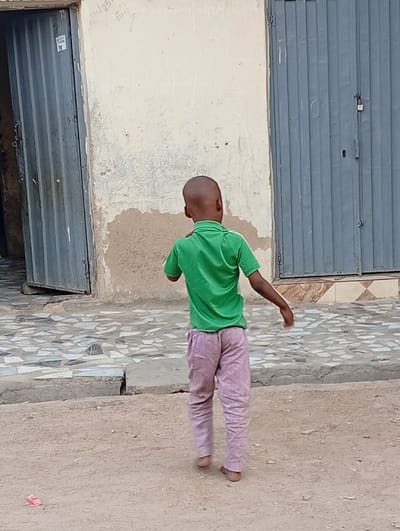
The image depicts an outdoor urban scene in Gwagwarwa, Nigeria, featuring a single, young, dark-skinned individual viewed from behind. The individual, appearing pre-adolescent with a shaved head, wears a bright green short-sleeved polo shirt and light purple/pink long pants, and is barefoot. They are in motion, walking away from the camera, with arms slightly bent and their head turned slightly to the left. The foreground consists of unpaved sandy earth, on which a small, red, rectangular discarded object is visible in the lower-left corner. Immediately behind this, the ground transitions to a sidewalk or pathway paved with irregularly shaped light-colored tiles set in mortar. In the background stands a light-colored building wall, showing significant wear, including peeling paint and darker moisture-related discoloration. Faint light-colored markings and text, resembling graffiti or notes, are present on the upper section of the wall. Two dark gray corrugated metal doors are integrated into this wall: the door on the left is partially open, revealing a dark interior, and has a small sticker on its left edge; the door on the right is closed and secured with a visible padlock. The scene is illuminated by natural daylight.
Gwagwarwa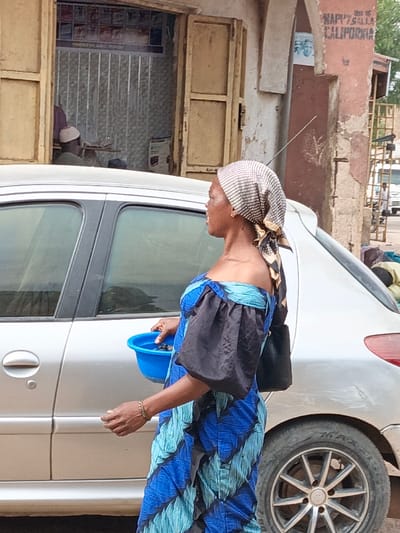
The scene is set in Gwagwarwa, Nigeria. An adult female, positioned centrally and in profile facing left, walks along an unpaved surface next to a parked silver Peugeot 206 sedan. She wears a patterned headscarf, a blue and teal off-the-shoulder dress with black puffed sleeves, and carries a small, dark shoulder bag. Her right hand holds a bright blue plastic bowl containing several dark, irregularly shaped objects. Her mouth is slightly open. A light-colored bracelet adorns her right wrist. To her left, partially obscured by the car, is an open storefront with aged, light-brown wooden double doors. Inside, a person wearing a light-colored cap is seated, facing away from the camera, with shelves displaying packaged goods visible on the back wall. Above the storefront, faded signage is visible. To the right of the woman and car, a deteriorated reddish-brown building facade features peeling paint and partial signage reading "HAPPY SALLA" and "CALIFORNIA." A thin metal antenna protrudes from this wall, and a metal structure resembling scaffolding or a ladder leans against it further right. In the far background, additional indistinct figures and vehicles are visible, including one individual lying or crouching near the ground to the right of the parked car. The ground appears dusty and unpaved. The scene is illuminated by natural daylight.
Gwagwarwa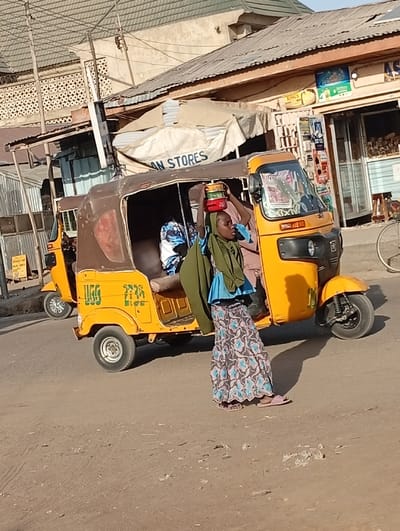
The image depicts a street scene in Gwagwarwa, Nigeria, under direct sunlight, evidenced by shadows cast to the right. A dark-skinned woman walks on a dusty asphalt road, balancing a stack of three lidded containers (red, orange, green) on her head. She wears an olive-green top over a blue garment, a long skirt with a blue, grey, and white floral pattern, and pink sandals. Adjacent to her on the left is a yellow three-wheeled auto-rickshaw, equipped with a brown fabric canopy and displaying "UGG" on its side. A person in a light-colored shirt is visible in the driver's seat of this vehicle. Further to the left and behind, a second yellow three-wheeled auto-rickshaw is partially visible, with a passenger in a blue and white patterned garment seated inside. The background consists of several commercial buildings featuring corrugated metal roofs. One structure includes a beige tarp awning with a partial "AN STORES" label, while another presents a shopfront with a glass door displaying merchandise.
Gwagwarwa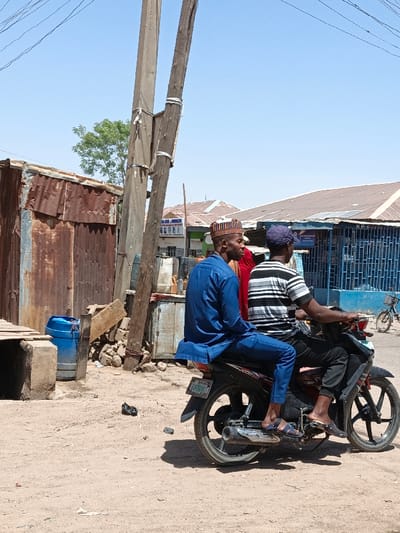
An outdoor scene in Gwagwarwa, Nigeria, depicts two males seated on a black underbone motorcycle on an unpaved, dusty reddish-brown dirt road under a clear blue sky. The motorcycle is stationary. The driver, wearing a blue baseball cap, a black and white striped short-sleeve shirt, and dark pants, occupies the front seat, his feet in dark sandals on the footpegs. A passenger sits behind him, dressed in a blue long-sleeve tunic, matching blue pants, and a multi-colored patterned cap, his feet in blue sandals also on the footpegs. A third individual, partially obscured between the driver and passenger, wears red clothing. To the left, a structure composed of rusted corrugated metal sheets stands next to a blue plastic barrel. Two utility poles, one concrete and one wooden, are strapped together, rising from the left mid-ground, with overhead wires visible. In the background, various buildings with corrugated metal roofs are visible, including one with a blue metal grate facade. Solar panels are mounted on some roofs. A green tree is visible in the distant background to the left. A bicycle is parked further down the road to the right.
Gwagwarwa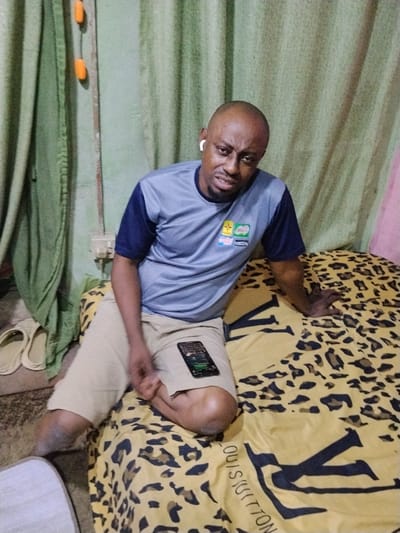
The image depicts an indoor scene in the city of Gwagwarwa, Nigeria. A bald adult male, appearing to be of African descent, with light brown skin, is seated on a bed. He wears a grey short-sleeved t-shirt with dark blue sleeves, featuring a multi-colored logo on the chest, and beige shorts. A white earbud is visible in his right ear. His facial expression displays a frown or grimace, with furrowed eyebrows, as he looks directly at the camera. His left hand is raised slightly near his lap, while his right hand rests on the bed. A black smartphone is placed face-up on his right thigh, displaying an illuminated screen with dark content. The bed is covered with a yellow and black leopard print duvet cover, which also features large black text reading "LOUIS VUITTON". To the man's left, a green curtain hangs, behind which a light-colored wall is partially visible. An electrical outlet with a white plate and two visible plugs is mounted on this wall. Two orange, elongated objects hang vertically against the green curtain. On the floor to the left of the bed, a pair of light-colored slide sandals are present, alongside a partially visible woven item. A sliver of pink fabric or curtain is visible on the far right edge of the frame. The scene is illuminated by artificial light.
Gwagwarwa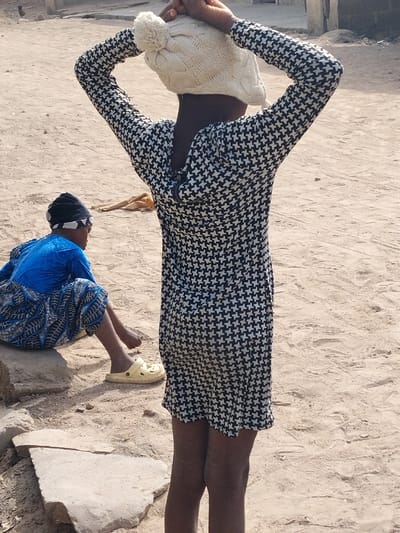
The image depicts a dusty outdoor scene in Gwagwarwa, Nigeria, featuring two individuals. In the foreground, a person, viewed from behind, stands with both hands raised to the top of their head, appearing to adjust a cream-colored knitted beanie with a pompom. This individual wears a long-sleeved dress or tunic with a black and white houndstooth pattern. Dark-skinned legs are visible below the garment's hem. To the left and slightly behind, a second individual sits on a light-colored rock or concrete block. This person wears a blue long-sleeved top, patterned blue and white lower garment, and a dark head covering with a white band. One foot, clad in a light yellow Crocs-style sandal, is visible. The ground is unpaved, consisting of light brown earth and sand with scattered light-colored debris. In the distant background, blurred structures with light-colored walls are visible.
Gwagwarwa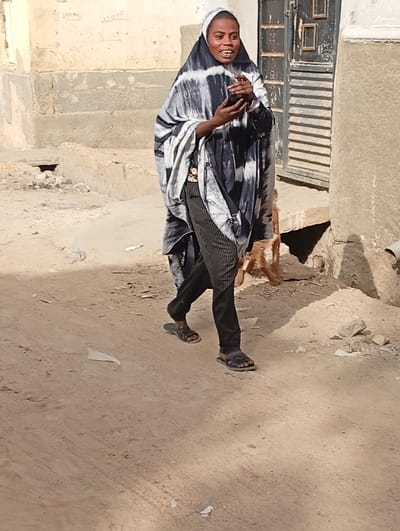
The image depicts an adult female walking outdoors on an unpaved dirt path in Gwagwarwa, Nigeria. The subject, with dark skin, wears a black and white tie-dye patterned head covering and drape, dark pinstriped trousers, and dark open-toed sandals. She holds a dark-colored smartphone in both hands near her upper chest/lower face, displaying a wide smile with an open mouth. A small reddish-brown animal, possibly a goat, is partially visible to her right, near a concrete structure. The background includes a dark, paneled door on the right and a light-colored, weathered wall with faded markings on the left. The ground is composed of light brown dirt/sand with minor scattered debris. The scene is illuminated by strong overhead sunlight, creating distinct shadows.
Gwagwarwa
A black and white image displays a male individual, appearing to be an adult of African descent, seated indoors in Gwagwarwa, Nigeria. The man, positioned with a slight smile and direct gaze towards the camera, has short dark hair and a beard. He wears a light-colored polo shirt with dark stripes on the collar and sleeve cuffs, and dark trousers or jeans. His left hand holds a stemmed glass containing a dark liquid. He is leaning against a striped sofa or cushion. In the background, to his left, is a corner formed by two plain, light-colored walls. A carton, likely a product box with visible branding resembling "Minimie," is situated on a surface behind him, alongside various folded fabric items and a rolled textile object.
Gwagwarwa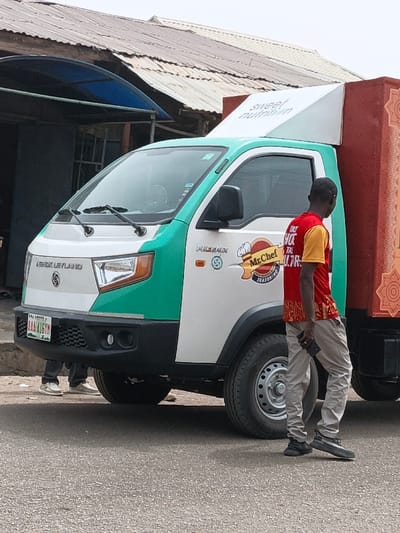
A daytime street scene in Gwagwarwa, Nigeria, depicts a white and green Ashok Leyland Phoenix light commercial truck parked on an asphalt road. The truck's front features the 'Ashok Leyland' logo, headlights, and a black bumper. A Nigerian license plate, registered in Lagos State as "AAA-416YM," is affixed to the front. The side of the truck's cab displays a "Mr. Chef Seasoning" logo, while a white angled panel above the cab reads "Sweet Nutrition." The cargo box behind the cab is reddish-brown with an intricate, darker patterned design. A male subject, walking from right to left, is positioned next to the truck. He wears a red and yellow short-sleeved shirt, light-colored trousers, and dark athletic shoes, holding a dark-colored smartphone in his right hand. The lower legs and feet of another individual, wearing light-colored sneakers, are partially visible beneath the front section of the truck. In the background, structures with corrugated metal roofs (one silvery-grey, another brownish-red) and a blue awning are visible.
Gwagwarwa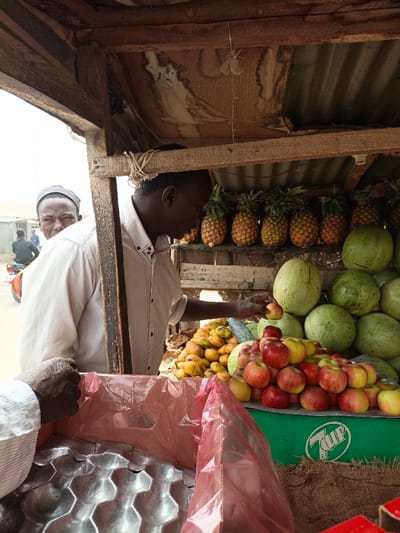
The scene depicts an outdoor fruit stall in Gwagwarwa, Nigeria. The stall is a makeshift structure composed of rough wooden planks and a corrugated metal sheet serving as a roof. A dark-skinned male vendor, wearing a light-colored collared shirt, stands within the stall, reaching with his right hand for a red apple from a prominent pile of red and yellow apples. To the vendor's left, a large mound of yellow-orange mangoes is present. Above and behind the apples and mangoes, a row of eight pineapples hangs from a wooden beam. To the vendor's right, a stack of multiple large green watermelons is visible. In the foreground, the dark-skinned hands of a customer are visible, holding open a translucent red plastic bag inside a gray, molded cardboard egg carton. Behind the vendor, partially obscured by a wooden upright, a second dark-skinned male wearing a dark cap and a light-colored shirt gazes forward. The background shows a dusty, outdoor setting with a blurred street or path, and two distant figures, one on a motorcycle. A green surface bearing a white "7UP" logo is visible beneath the apple display.
Gwagwarwa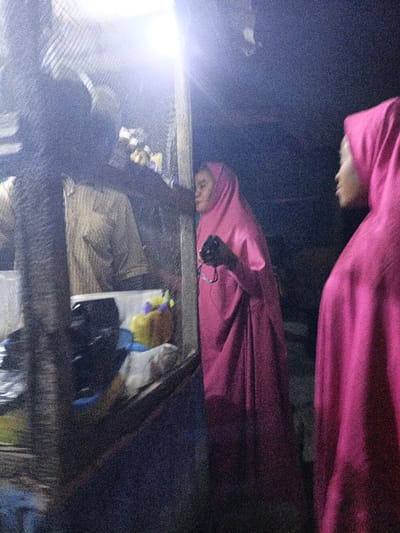
The image depicts a nighttime scene, likely at an outdoor market stall or small shop, characterized by low light conditions and significant graininess. A bright, artificial light source is prominent in the upper center of the frame, casting a strong glare and illuminating a portion of the scene. There are at least three individuals visible. On the far left, mostly obscured by a vertical structure, a person is seen wearing a light-colored, possibly striped, long-sleeved shirt. Their right arm extends forward towards the center of the frame, suggesting they might be interacting with the stall or another person. In the center, a person wearing a bright pink hijab and a long, flowing pink garment (likely an abaya or similar dress) is looking intently towards the left, into the stall. Their face is partially obscured by the angle and shadows, but their focus appears to be on items within the stall. This individual is holding a pair of eyeglasses in their left hand, which dangles downwards. On the far right, partially out of frame, another person is visible, also wearing a bright pink hijab and a matching long garment. This person is facing towards the left, appearing to observe the same activity as the central figure. The stall itself features a vertical support structure on the left and a visible counter or display area. Above the counter, there's a mesh or wire covering. Inside the stall, behind the person in the light shirt, various indistinct items are present, including a yellow object with purple and white details, possibly a small toy or decorative piece. The overall activity suggests browsing or shopping at the stall.
Gwagwarwa
An indoor portrait captures an individual in the city of Gwagwarwa, Nigeria. The subject, an individual with dark skin, is positioned from the chest upwards. Long, small-to-medium sized box braids, predominantly reddish-brown with interwoven darker strands, cascade across the right side of the face, obscuring the right eye, nose, and mouth. The subject's left eye, dark brown, is visible and directed towards the viewer. A dark-skinned left hand rests on the upper forehead/hairline. The subject wears a light lavender spaghetti-strap top. A black wristband featuring inverted yellow text is worn on the left wrist. The background consists of a green-painted wall and a white ceiling with a centrally mounted ceiling fan. Strong, directional light illuminates the left side of the subject's face, hair, and arm, casting the right side into shadow.
Gwagwarwa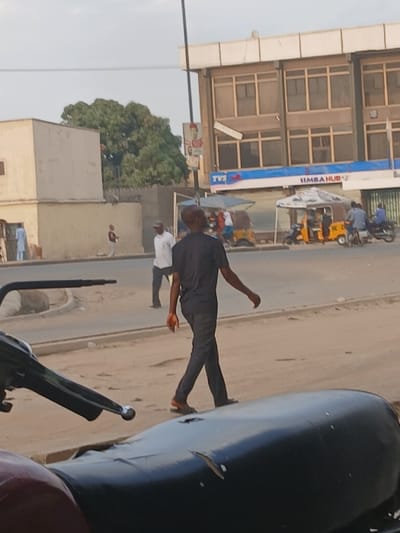
The provided image, originally rotated ninety degrees clockwise, captures a dynamic street scene under bright daylight. The photograph appears to be taken from inside or very close to a vehicle, as a large, dark, curved object (possibly a car's fender or the side of a motorcycle) occupies a significant portion of the right foreground and middle. Part of a handlebar or control mechanism is visible in the bottom right corner, reinforcing the perspective from a moving or parked vehicle. In the midground, a man dressed in dark clothing (dark short-sleeved shirt and trousers) is prominently featured, caught in mid-stride across what appears to be a paved street or pathway. He is barefoot, and his arms are slightly extended, with one hand open and pointing somewhat forward, and the other bent at the elbow. His posture suggests he is in motion, possibly walking or stepping into the street. Behind him, another person wearing a lighter-colored shirt is partially visible, also in motion on the street. The background reveals a bustling urban environment. On the left, a multi-story building with a light-colored facade and multiple windows stands out. Below this building, a prominent blue awning or sign is visible, displaying white text that reads "HIMBA HUB" and the logo "TVS." TVS is a well-known brand, often associated with motorcycles and auto-rickshaws. Indeed, several yellow or orange auto-rickshaws (often called tuk-tuks) and small motorbikes are parked or moving near the base of this building and along the street, suggesting commercial activity. Further to the left, beyond the main building, a large, lush green tree adds a natural element to the urban landscape. Another, less defined building structure with lighter walls is visible in the lower-left background. The sky in the upper left is bright and clear, indicating fair weather, likely during the day, possibly morning or afternoon given the light quality. The overall impression is one of everyday life in a lively street setting, potentially in a region where auto-rickshaws are a common mode of transport.
Gwagwarwa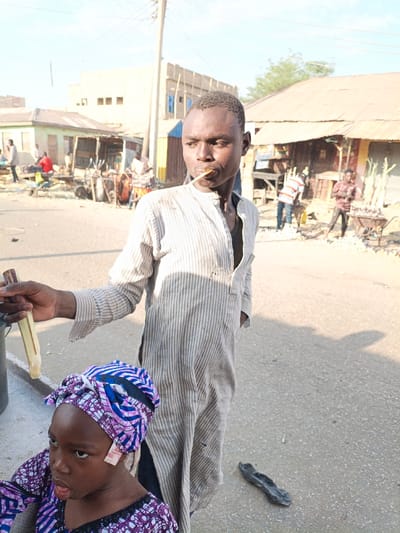
A man stands on a street, sucking on a sugar cane stick. He wears a long-sleeved, vertically striped shirt and holds another sugar cane piece. A young girl, wearing a patterned headwrap and shirt, stands beside him, looking to the side. The street scene includes small shops and people in the background, with scattered items on the ground. Buildings are visible in the distance under a clear sky.
Gwagwarwa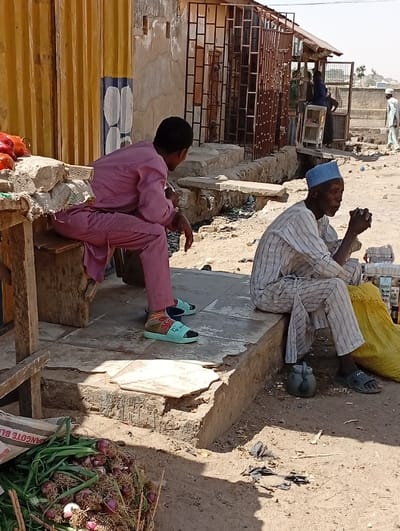
The image depicts an outdoor street scene in Gwagwarwa, Nigeria, under bright daylight. In the immediate foreground, a pile of green-stalked onions rests on the dry, light brown dirt ground, partially obscuring a white sack labeled "DANGOTE BL." To the left, a person wearing a pink, loose-fitting long-sleeved garment sits on a low wooden stool, facing away from the viewer and looking towards the right. This individual wears light blue slide sandals over patterned socks. Adjacent to them, on a rough wooden surface, is a cluster of red vegetables, possibly tomatoes or peppers. To the right, an older male with a dark complexion and a light blue cap is seated on a low concrete ledge. He wears a white-and-grey striped long-sleeved top and matching trousers, with dark open-toed sandals. His hands are clasped in front of him. A yellow bag rests near his left leg, and a small, dark, teapot-like object sits on the ground near his feet. The ground throughout the scene is dry, light brown dirt, with scattered dark debris, including pieces of plastic. In the mid-ground, behind the seated individuals, structures include a corrugated yellow metal wall on the far left, a light-colored, weathered building wall featuring exposed metal grates over window openings, and a small, open-fronted stall-like structure with a corrugated metal roof. Concrete steps and ledges are visible near these structures. Several additional individuals are present in the mid-ground and background; one person is seen standing near a small display shelf, another in a light-colored outfit is partially visible, and a third person in white is walking towards the right in the far background. Distant buildings are vaguely visible under a hazy sky at the horizon.
Gwagwarwa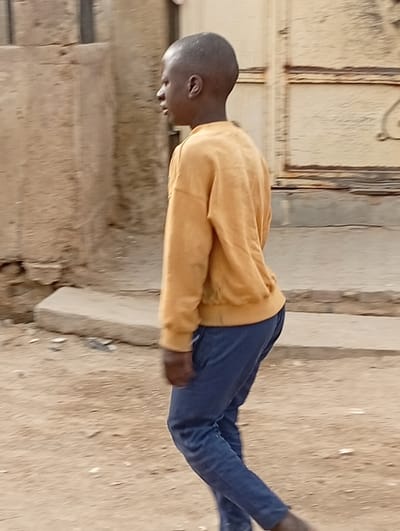
A single young male individual is depicted walking from right to left across an unpaved, dusty area in Gwagwarwa, Nigeria. The individual, appearing to be a boy with dark skin and short-cropped hair, is wearing a loose-fitting, long-sleeved mustard yellow sweatshirt and dark blue trousers. His head is turned slightly to his left, and his bare feet exhibit motion blur, consistent with movement. In the mid-ground, a low, rectangular concrete or stone slab rests on the ground. The background features a weathered, light brown concrete wall to the left and a large, light-colored metallic gate or door with visible structural framing to the right. The scene is illuminated by natural daylight.
Gwagwarwa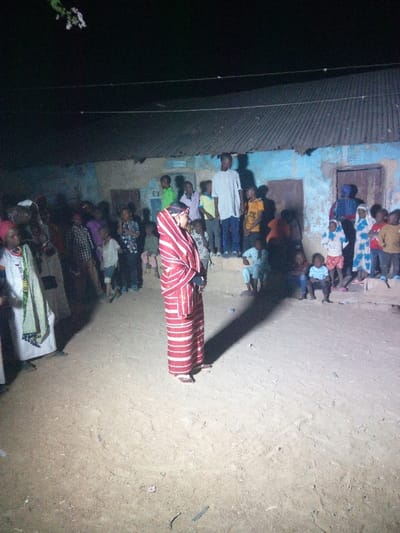
A woman in a red and white striped robe stands in a dirt yard surrounded by a crowd. The crowd includes men, women, and children. The woman is facing right. Behind the crowd is a building with a corrugated metal roof. The scene appears to be at night or in dim light. Some people are standing on the steps or platform of the building, while others are on the ground. The location may be a village or rural area.
Gwagwarwa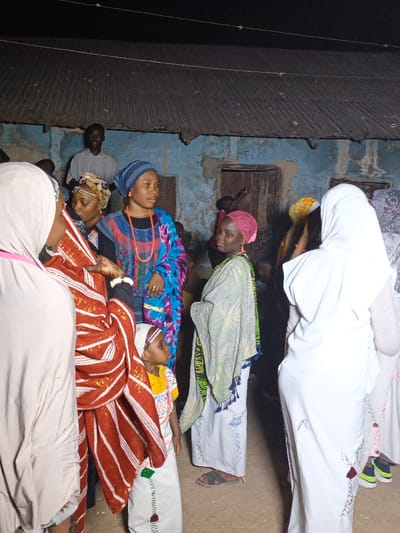
A group of people are gathered outside a building with a corrugated metal roof. Several women are wearing colorful headscarves and wraps, while others are wearing white hijabs. One young girl stands out with a red and white striped garment. A man stands in the background, partially obscured by the building. The overall atmosphere appears to be lively and communal.
Gwagwarwa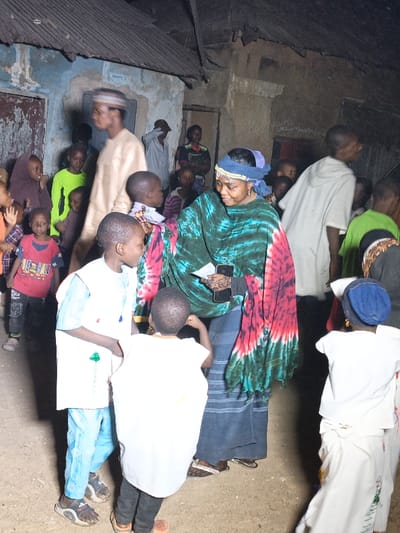
A group of people, mostly children, surround an adult woman outdoors. The woman wears a head wrap and a green, red, and black shawl. She holds a phone in her hand. The children wear colorful clothing, including shirts and pants in shades of blue, green, red, and white. Some individuals stand near buildings with weathered walls and corrugated metal roofs. The lighting suggests it is evening or nighttime.
Gwagwarwa
A man walks away from the camera on a street. He wears a blue and white striped short-sleeved shirt and carries a dark object in his left hand. In the background, there is a group of people standing on the street near a building. The scene appears to be at night or in low light conditions. The street is visible with a muted coloration.
Gwagwarwa