Haría, Spain
30 memories from Haría, Spain
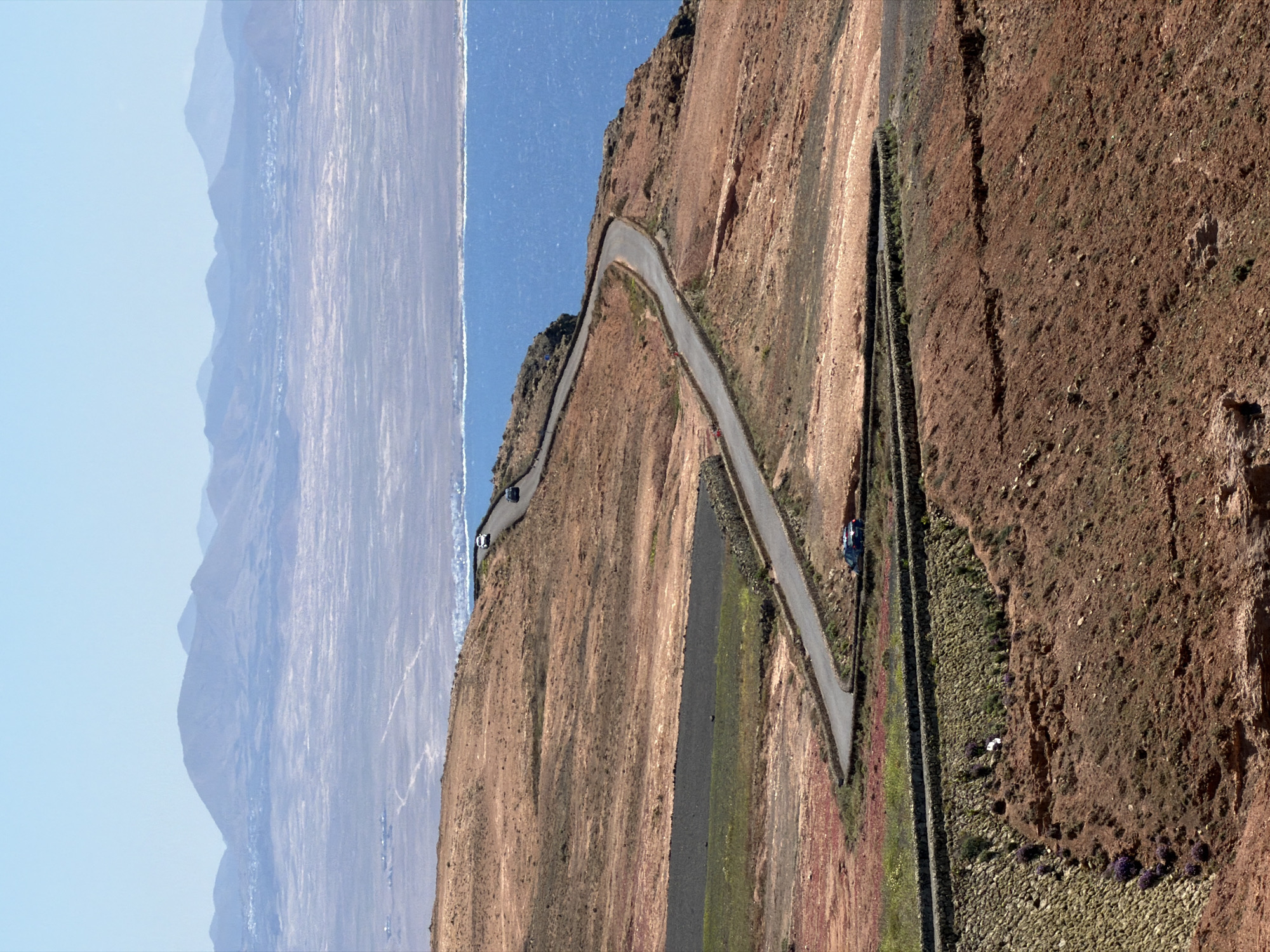
The image presents an aerial or high-vantage view of a winding road traversing a steep, arid hillside, overlooking a vast expanse of ocean and distant land. **Subjects:** The primary subject is a narrow, asphalt road, characterized by several sharp turns, snaking through the rugged, reddish-brown terrain. Two cars are visible: a white car is positioned higher up the road, and a darker vehicle (possibly blue) is on a lower section towards the right. The landscape is dominated by rocky, barren mountain slopes, interspersed with sparse green vegetation and patches of smaller loose rocks. A long, dark, linear feature, resembling a stone wall or track, runs parallel to the road on the right. In the foreground, clusters of purple flowering plants add a touch of color. A wide body of sparkling blue water, likely the ocean, occupies the mid-ground, beyond which faint, hazy silhouettes of distant mountains or landmasses are visible. **Activity or Event:** The scene captures a moment of travel or exploration along a scenic mountain road. The cars indicate ongoing vehicular movement or a stop along this route. No explicit human activity, such as hiking or direct interaction, is clearly depicted. **Notable Details:** The image is set during bright, clear daylight, likely late morning or early afternoon, with strong illumination and a cloudless, light blue sky. The weather is excellent. The rugged, volcanic-like landscape, winding coastal roads, and the presence of a vast ocean are strong location cues consistent with the provided context of Haría, Spain, characteristic of the Canary Islands. The perspective offers a panoramic view, emphasizing the dramatic scale of the natural environment. The color palette features earthy reds and browns, contrasting with the deep blues of the water and sky, and accents of green and purple vegetation. **Visible Text:** There is no visible text in the media file.
Haría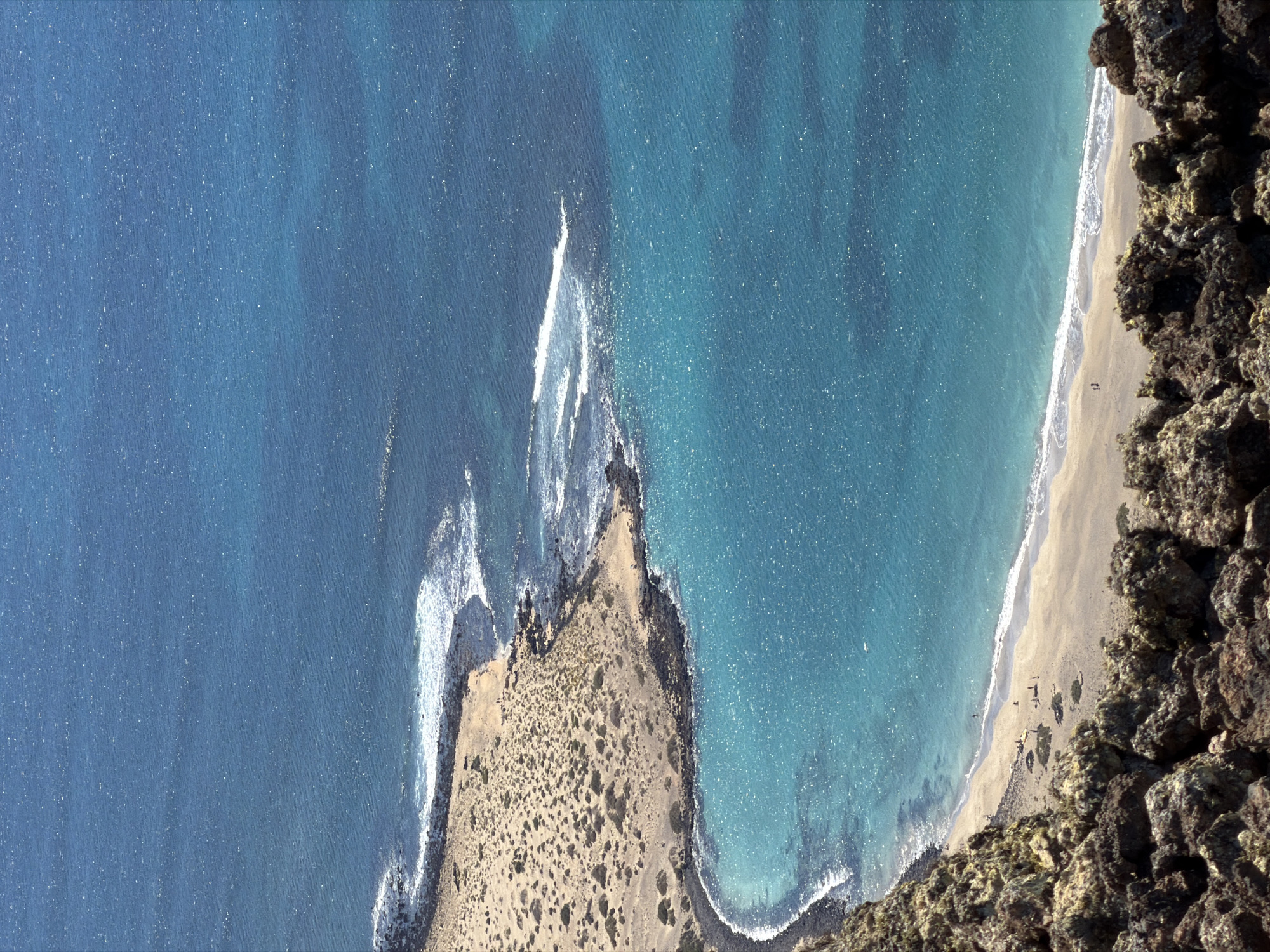
The image shows an aerial view of a coastline in Haría, Spain. A sandy beach stretches along the edge, meeting the turquoise ocean. Waves break along the shore, creating white foam. Rocky cliffs frame the right side of the image, with a sandy peninsula jutting out into the water on the left. Scattered vegetation covers the peninsula. Several people are visible on the beach.
Haría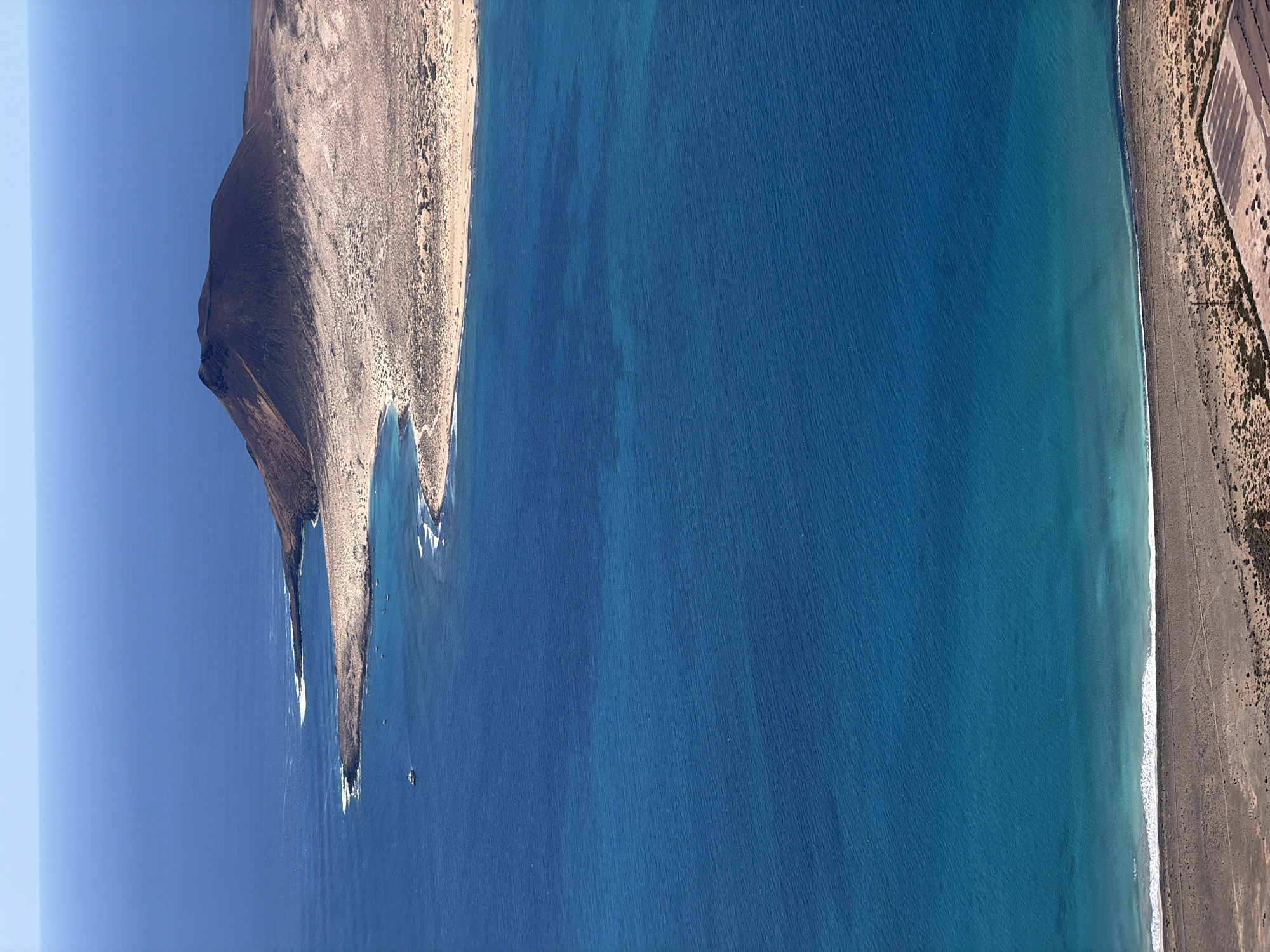
This aerial photograph captures a dramatic and arid coastline under a clear, bright sky. If viewed with the landscape oriented horizontally, the left side is dominated by a rugged, dark, conical mountain or volcanic peak. This landmass slopes down, forming several distinct rocky headlands that jut into the deep blue ocean. To the right, a long stretch of sandy and pebbly beach forms a clear boundary with the water, where gentle waves can be seen breaking into white foam. Beyond the beach, the land continues its arid character, featuring sparse vegetation and a visible pattern of rectangular plots or structures, possibly related to agriculture or human development, further inland. The ocean itself is a vibrant blue, ranging from a darker, deeper hue offshore to a lighter, turquoise shade closer to the coast, indicating varying depths. Several small boats are visible as tiny specks in the water, particularly near the rocky protrusions on the left, suggesting maritime activity. The time of day appears to be mid-day, with strong, clear lighting and no clouds in the sky, indicative of excellent weather. The barren, volcanic terrain, and the intense blue of the ocean are strong geographical cues consistent with the Canary Islands, where Haría, Spain, is located. The scene evokes a sense of natural grandeur and tranquility. There is no visible text in the image.
Haría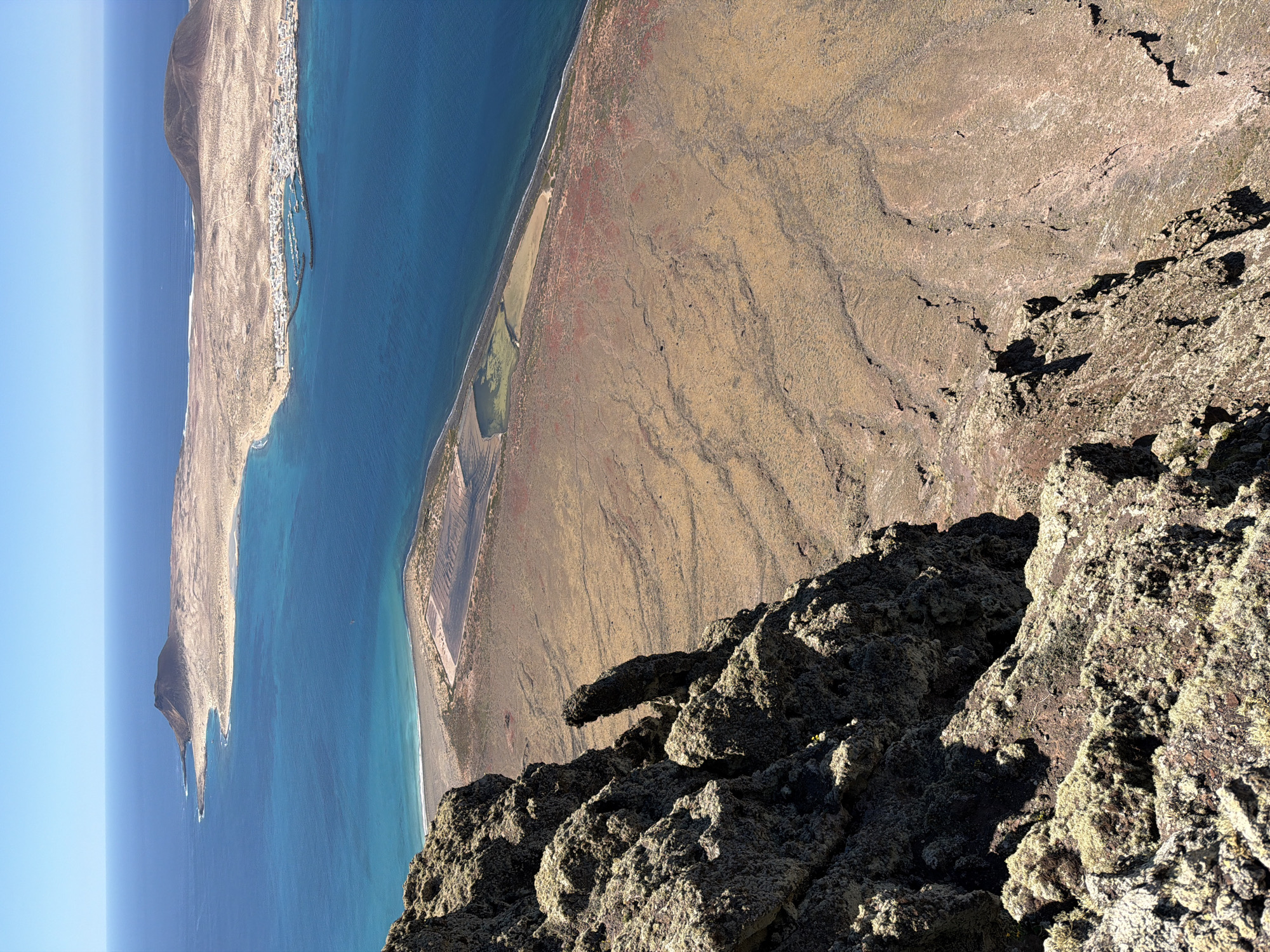
This striking landscape shot, taken from a high vantage point, offers a panoramic view of an arid coastal environment under a clear blue sky. The foreground is dominated by rough, dark volcanic rock formations, some appearing to be covered with light-colored lichen, casting deep shadows that indicate a sunny day, likely mid-morning or late afternoon. Beyond the immediate rocky precipice, a vast expanse of reddish-brown and tan volcanic terrain stretches towards the sea, marked by subtle patterns suggesting ancient lava flows or erosion. Closer to the coastline, rectangular, man-made structures, possibly salt pans or agricultural plots, are visible near a narrow strip of sandy beach. The vibrant turquoise and deep blue waters of the ocean meet this barren land. Along the distant coast, a town with numerous white buildings clusters around a harbor or marina, where several boats can be seen docked. Further out, a distinct landmass, likely an island or a prominent headland, rises from the ocean, characterized by its arid, undulating hills. The image captures the rugged beauty typical of volcanic islands. Given the context, this view is likely from a point in or near Haría, Spain, offering a classic vista of the Lanzarote landscape. There is no visible text in the image.
Haría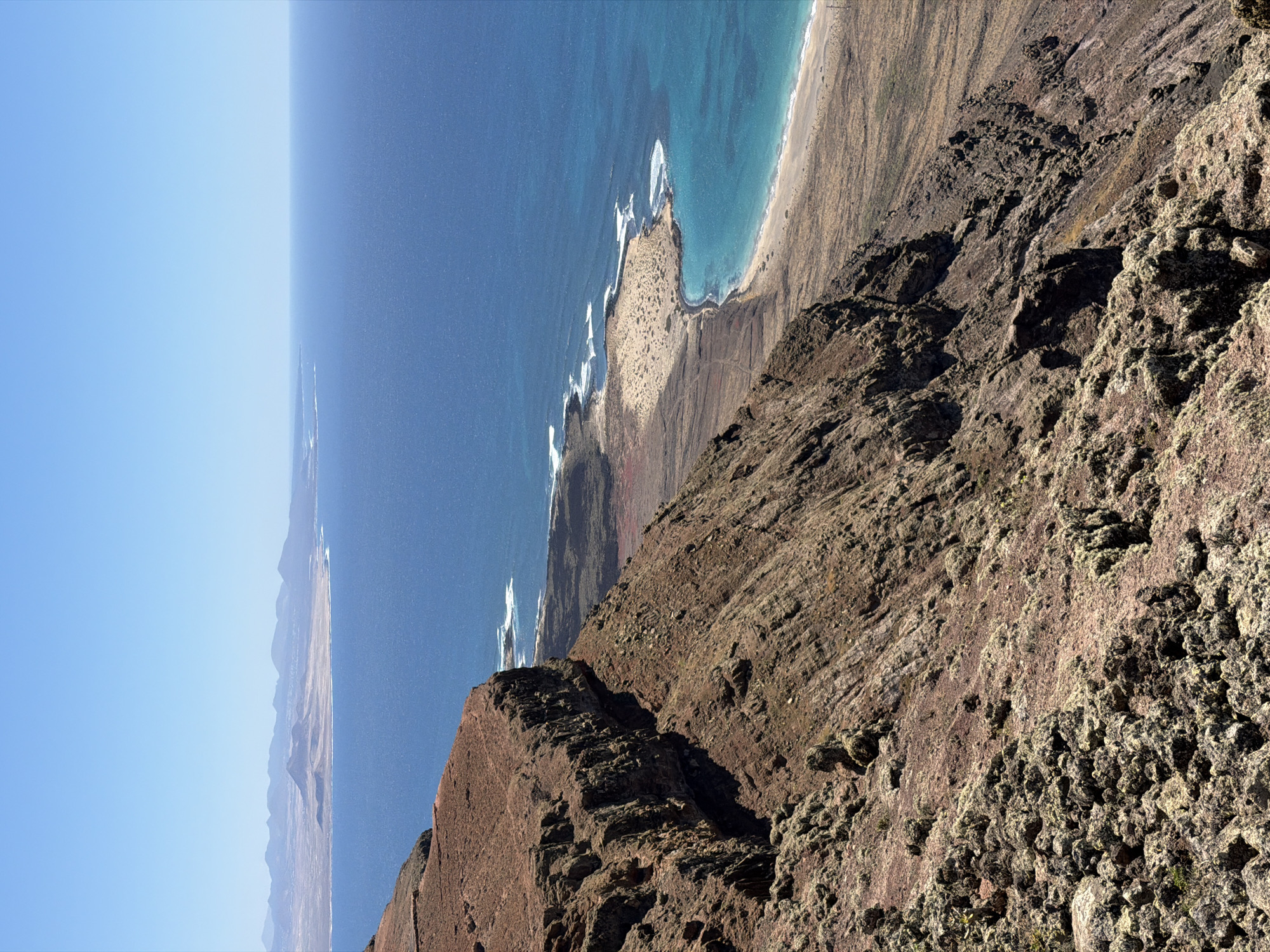
This image captures a dramatic, high-angle view of a volcanic coastline, likely in the Haría region of Lanzarote, Spain. The perspective is from a towering cliff or mountain, looking down towards the ocean and the land's edge. The scene is composed of three main elements: a clear blue sky, the expansive ocean, and rugged landmasses. On the right side of the image, a steep, textured cliff face dominates the foreground. This rock is a deep reddish-brown, characteristic of volcanic rock, with pronounced crags and shadows that highlight its rough, ancient surface. Below and to the left of the cliff, the vibrant blue Atlantic Ocean meets the shore. The water displays varying shades of blue, from a light turquoise near the beaches to a deeper indigo further out. White-capped waves are visible breaking along the coastline, indicating an active sea. The coastline itself is a mix of light sandy beaches and darker, presumably volcanic, rock formations extending into the water. The sky, occupying the upper left portion of the image, is a clear and bright blue, gradually lightening towards the horizon. In the far distance, along the horizon line, additional mountainous landmasses or islands are faintly visible as hazy silhouettes. The bright, clear lighting suggests it is daytime, likely late morning or early afternoon, under sunny weather conditions. No people, man-made objects, or visible text are present, emphasizing the raw, untamed beauty and vastness of the natural landscape.
Haría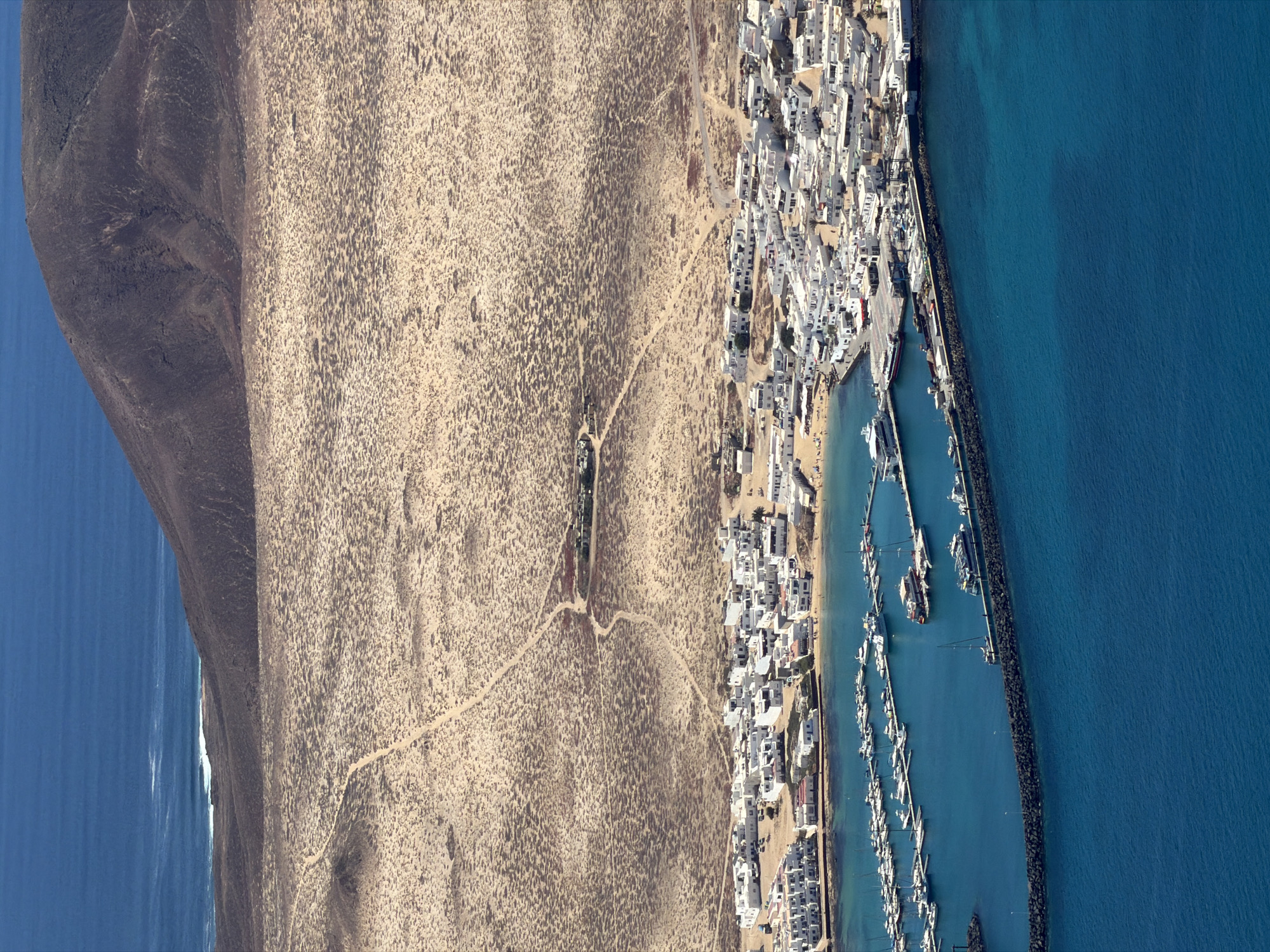
This aerial image presents a striking contrast between an arid, desert-like landscape and a bustling coastal town situated next to a vibrant blue sea. The view is oriented vertically, with the landmass on the left and the ocean on the right. On the far left, a rugged, dark-hued mountainous area slopes down to meet a vast expanse of light brown, arid terrain, characterized by sparse vegetation or rocky textures and crisscrossed by several dirt tracks. This barren land forms a stark boundary with the urban development. To the right of the arid landscape lies a densely built town, composed predominantly of white buildings with flat roofs, indicative of Mediterranean or Canary Island architecture. The town is concentrated along the coastline, featuring a well-developed harbor or marina. Numerous boats, ranging from small vessels to larger yachts, are visible docked at multiple piers within the sheltered waters of the harbor. A sandy beach is also visible adjacent to the town's buildings, with the clear, turquoise water lapping at its edge. A substantial breakwater, appearing as a dark, rocky barrier, extends from the coast, protecting the marina from the open sea. Beyond the breakwater, the deep blue waters of the ocean stretch towards the right edge of the frame. Some gentle white waves are visible on the far left edge of the sea, near the more rugged coastline. The overall scene suggests a sunny day with clear weather. No individual people or visible text can be discerned due to the high aerial perspective. The image captures a dynamic coastal settlement in Haría, Spain, where human development integrates with the natural, contrasting elements of a dry landscape and the open sea.
Haría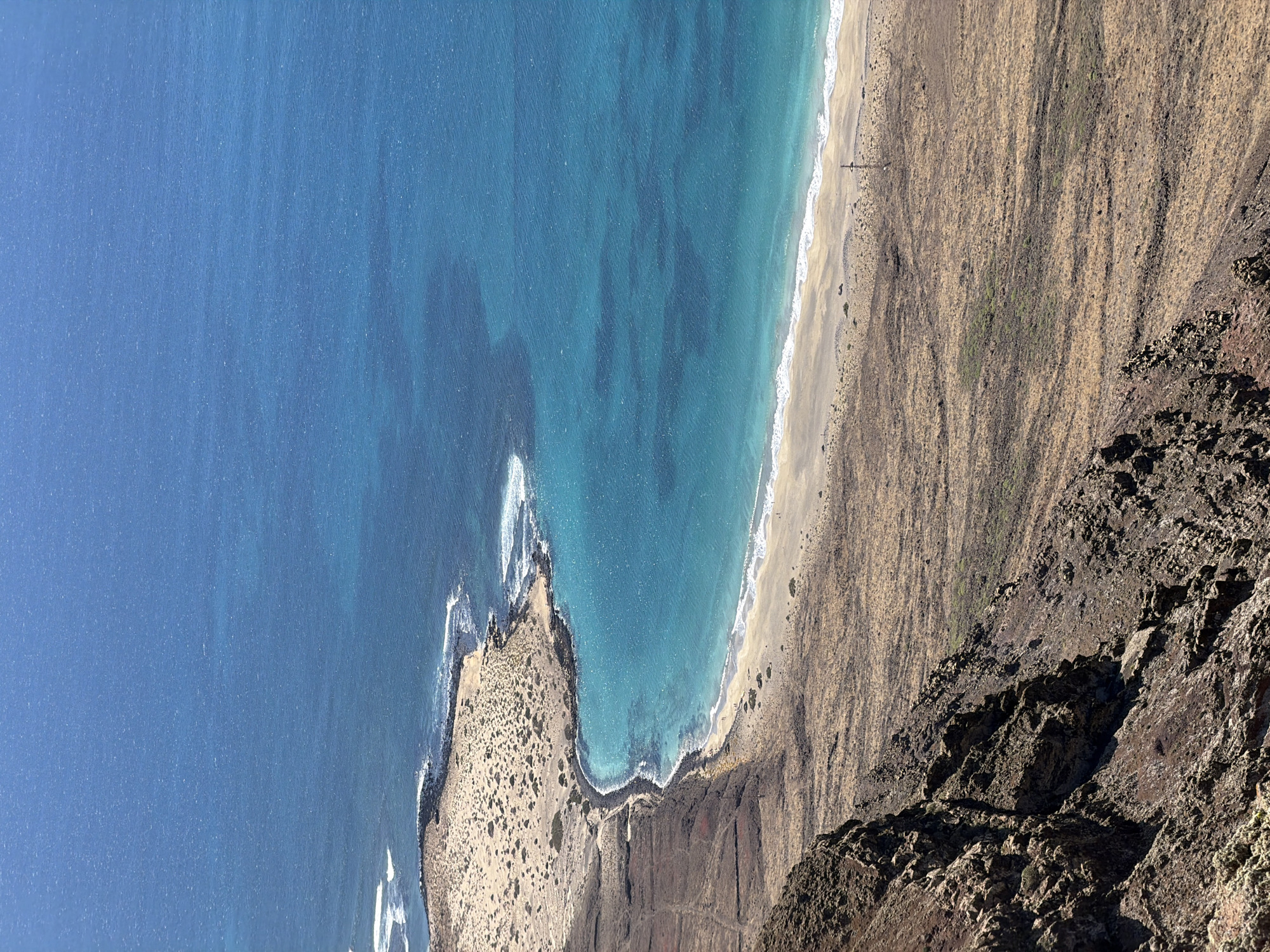
This image shows an aerial view of a beach and surrounding landscape. The location is in Haría, Spain. The ocean is blue and deepens in color further away from the shore. A sandy beach curves along the coastline, transitioning into a rugged, brown landscape with sparse vegetation. A rocky cliff forms the edge of the land, its texture rough and uneven. People are visible on the beach. The perspective is from above, looking down on the scene.
Haría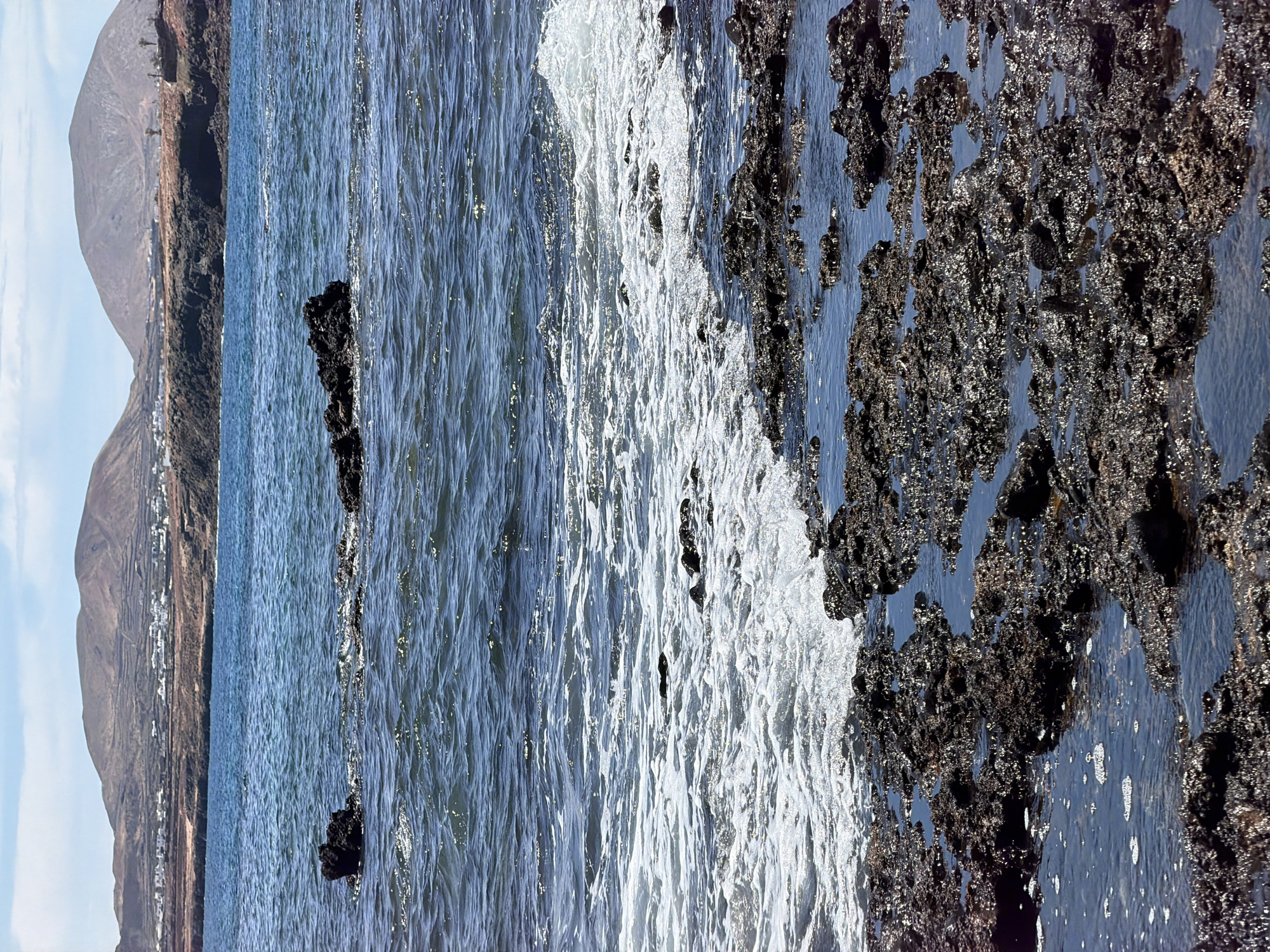
This horizontally oriented image captures a rugged coastal landscape in Haría, Spain, under clear, sunny skies. The foreground features an intricate arrangement of dark, porous volcanic rock formations, characteristic of lava flows, which are partially submerged in the ocean. These rocks are wet and glisten with sunlight, displaying their textured surfaces. White, foamy waves crash against or recede from the rock formations, while calmer sections of water reflect the bright light. The midground consists of the open ocean with gentle ripples and shimmering reflections from the sun. A few isolated, dark rock outcrops are visible within the water further from the shore. In the background, a dry, mountainous coastline rises under a light blue sky dotted with scattered white clouds. The mountains appear barren and brownish-grey. Along their base, a cluster of white buildings indicates a small town or settlement, nestled between the arid land and the sea. The image depicts a bright, peaceful daytime scene, emphasizing the natural beauty and geological features of the volcanic coast. No human activity or visible text is present.
Haría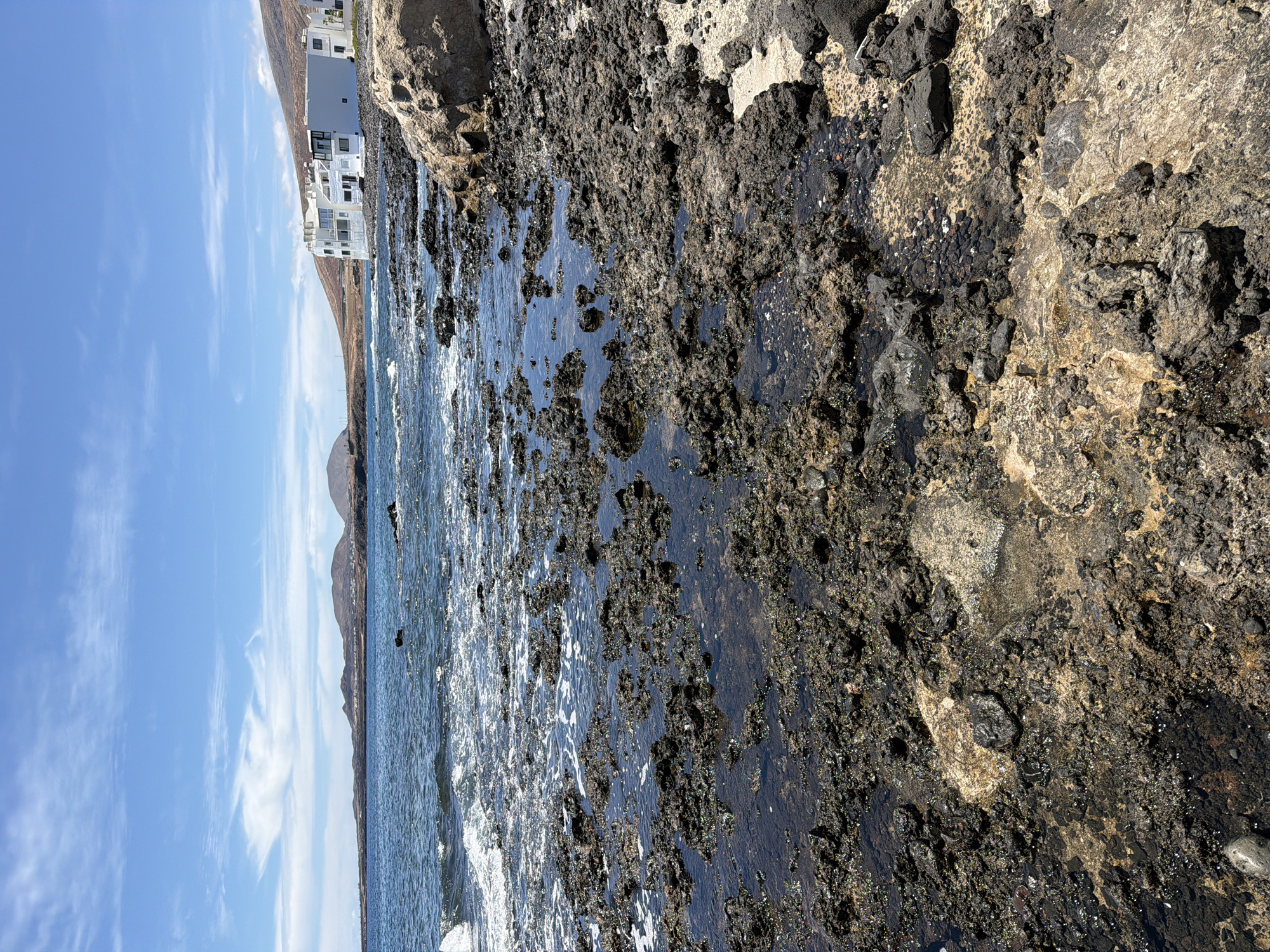
The image presents a bright, sunny coastal landscape in Haría, Spain, featuring a rugged volcanic shoreline, the ocean, distant buildings, and mountains under a clear blue sky. In the foreground, the scene is dominated by dark, porous volcanic rock formations. Many of these rocks are partially submerged, creating shallow, clear tide pools where water reflects the bright sky. The texture of the rocks is rough and uneven, with varying shades of dark grey, black, and some lighter, earthy patches. Small patches of white foam from the receding waves are visible among the rocks. Beyond the immediate shoreline, the ocean extends, characterized by blue water and gentle waves breaking with whitecaps. The water appears dynamic yet calm. In the mid-ground and background, a cluster of modern, whitewashed buildings with multiple levels and windows are visible. These structures are nestled against the lower slopes of arid, brownish mountains that rise gently from the coast. The mountains are low-lying with a dry, sparse appearance, typical of a volcanic landscape. Above the landscape, the sky is a vibrant clear blue, with a few thin, wispy white clouds scattered across it, suggesting a pleasant day. The overall impression is one of a tranquil, sunny day at a rugged and picturesque coastline. There is no visible text in the image.
Haría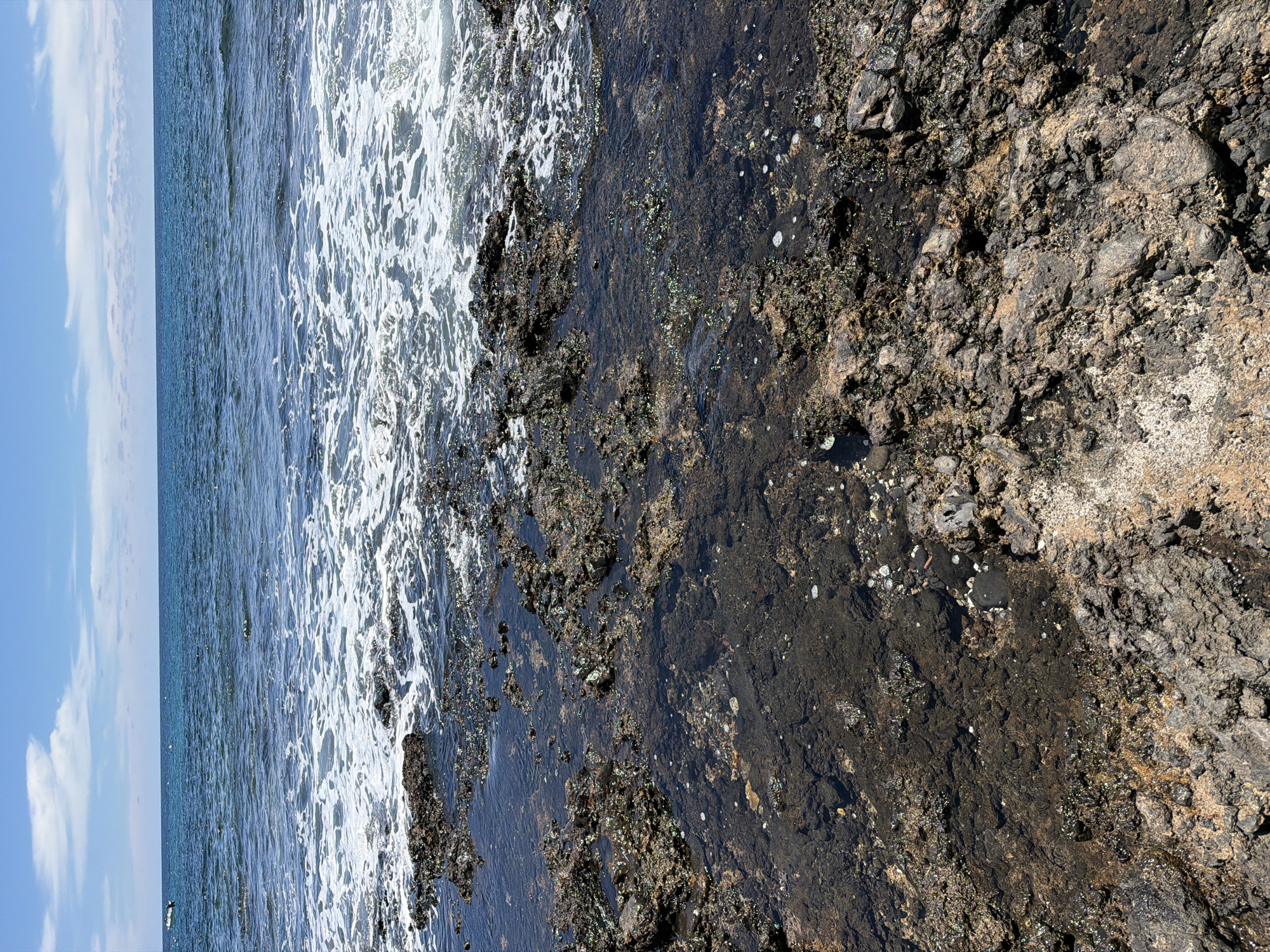
The image displays a rugged coastline where the deep blue ocean meets a dark, textured shore under a clear sky. The scene captures the natural interaction of waves against volcanic rock, characteristic of the Haría region in Spain. On the left, the Atlantic Ocean stretches towards the horizon, exhibiting various textures. Closer to the shore, the water is a frothy white as waves crash and recede over the rocks, creating dynamic patterns. Further out, the ocean appears calmer, with subtle ripples and sparkling reflections of the bright sunlight. The sky above is a vibrant blue, dotted with scattered white, wispy clouds, indicating good weather conditions. The right side of the image is dominated by the volcanic coastline. The rocks are dark, porous, and highly textured, with shades of black, grey, and earthy brown. Portions of the rock surface are visibly wet and glistening from recent wave contact, while other areas are dry. In the shallow water over the rocks, submerged formations are visible, along with small, bright specks that could be reflections or mineral deposits. The overall impression is one of a sun-drenched, natural, and untouched coastal landscape. There are no people, man-made objects, or visible text in the frame. The time of day appears to be bright daytime.
Haría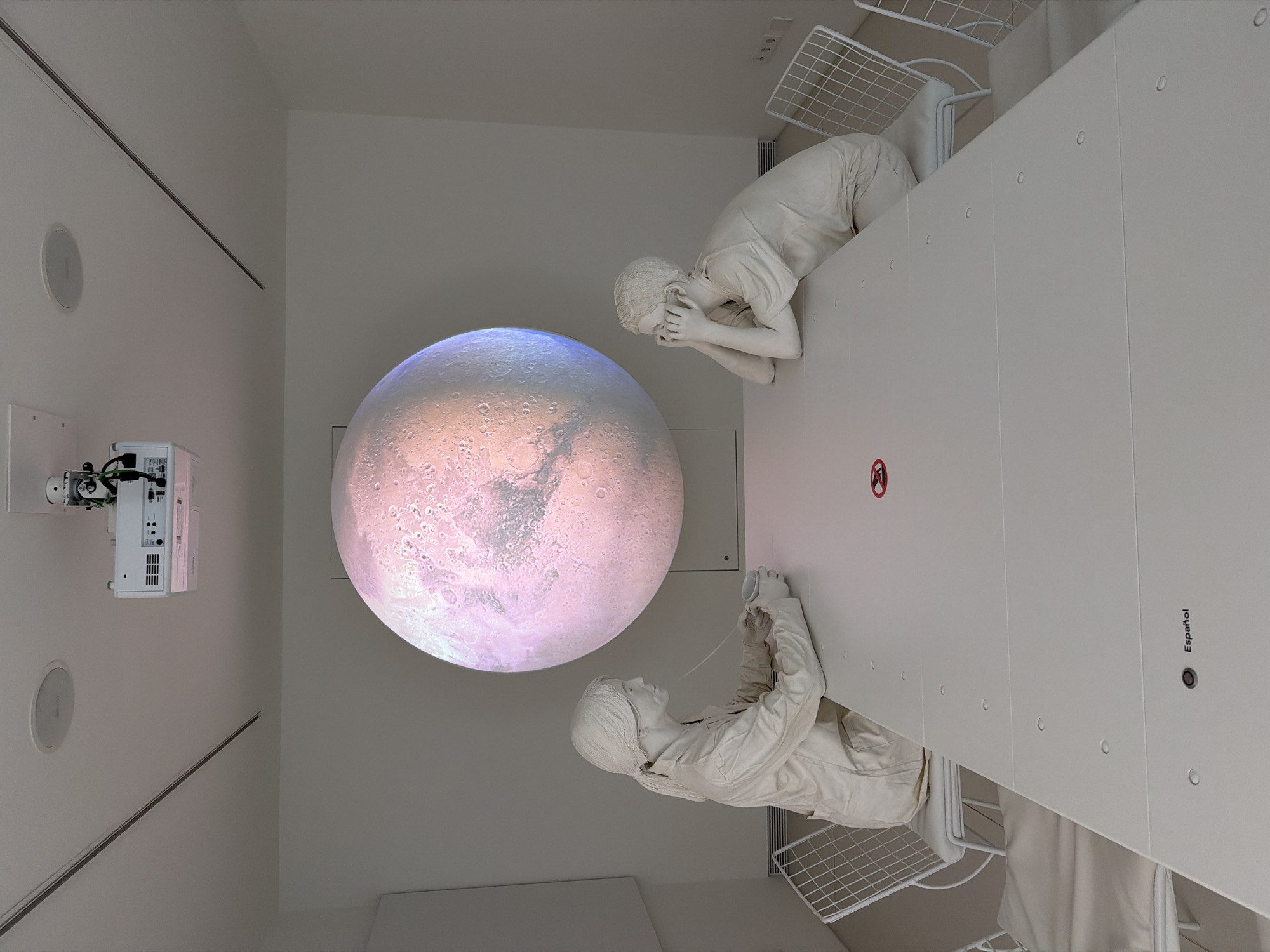
A shot of a room at Casa de los Volcanes in Haría, Spain. The image appears to be rotated. A large illuminated sphere resembling the planet Mars hangs in the center of the room. A white projector is mounted on the wall. Two white mannequin figures are positioned on a white table with wire mesh shelving underneath. One figure rests its face in its hands, while the other reaches forward with one hand holding a small object.
Haría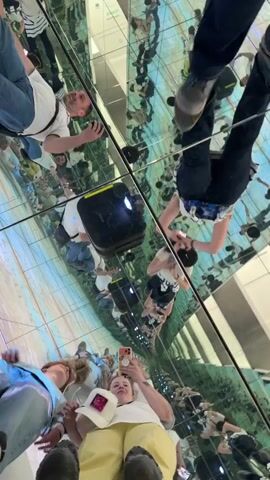
The vertical video captures multiple people moving within an immersive mirrored room, creating an illusion of infinite reflections on all surfaces – floor, walls, and ceiling. The primary focus is on a woman in the foreground wearing yellow pants, a white t-shirt, and a white baseball cap, who is holding a smartphone and appears to be recording the experience. She is smiling and looking towards the camera. Another woman in dark blue jeans and a white and blue striped top is seen walking through the space. Various other individuals are visible in the reflections, some holding phones themselves. A small black device is seen on the mirrored floor. The reflections multiply the figures and the room, creating a disorienting yet captivating visual effect. The scene appears brightly lit, suggesting an indoor exhibit or art installation in Haría, Spain.
Haría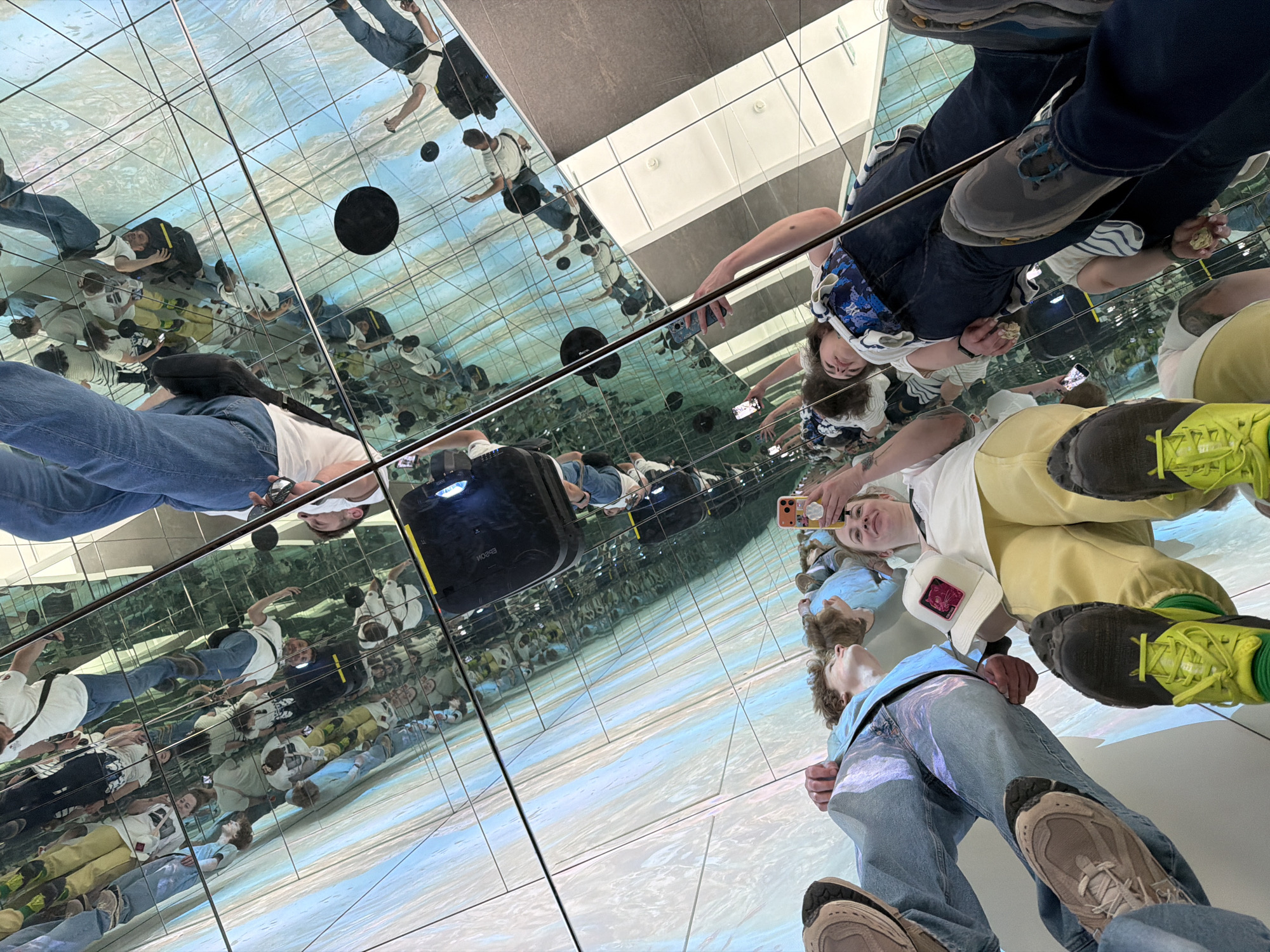
The image shows a group of people in a mirrored installation. The perspective is from the ground, looking upwards. The reflections create a dizzying effect, multiplying the people and the environment. The subjects are dressed in casual clothing, including jeans, T-shirts, and sneakers. Some are holding phones and taking photos. The environment appears to be an art installation with mirrored walls and ceiling, set on a floor with a light blue and white pattern, potentially simulating water or clouds. The location is potentially within a building or structure in Haría, Spain.
Haría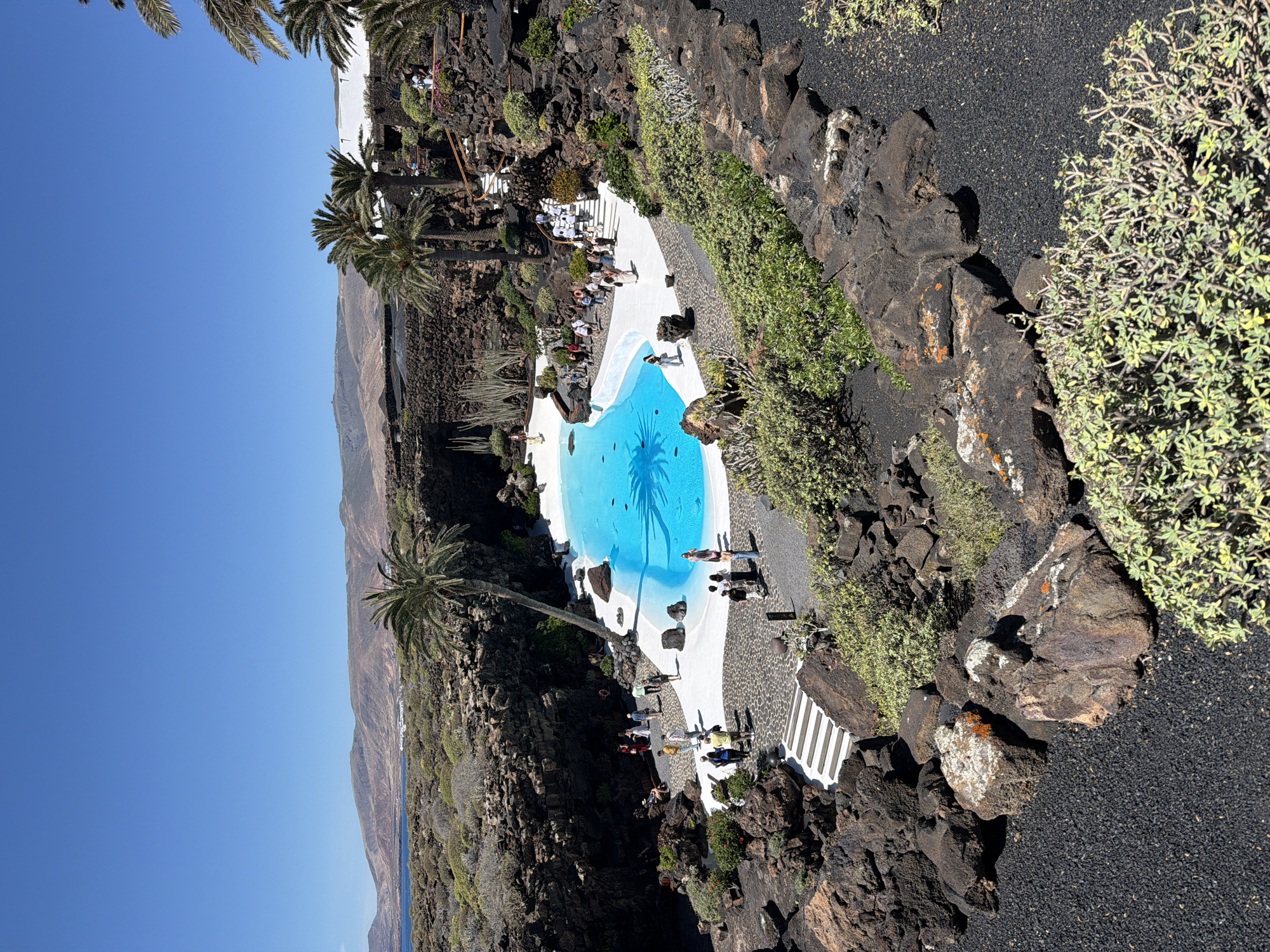
The image depicts an aerial view of the Jameos del Agua in Haría, Lanzarote, Spain. It features a unique swimming pool built into a lava cave. The pool has bright blue water and white walls. Palm trees grow around the pool and cast shadows in the water. People are standing and walking around the pool area. The surrounding landscape is characterized by black volcanic rock, sparse vegetation, and a coastline with mountains visible in the distance. The sky is clear and blue.
Haría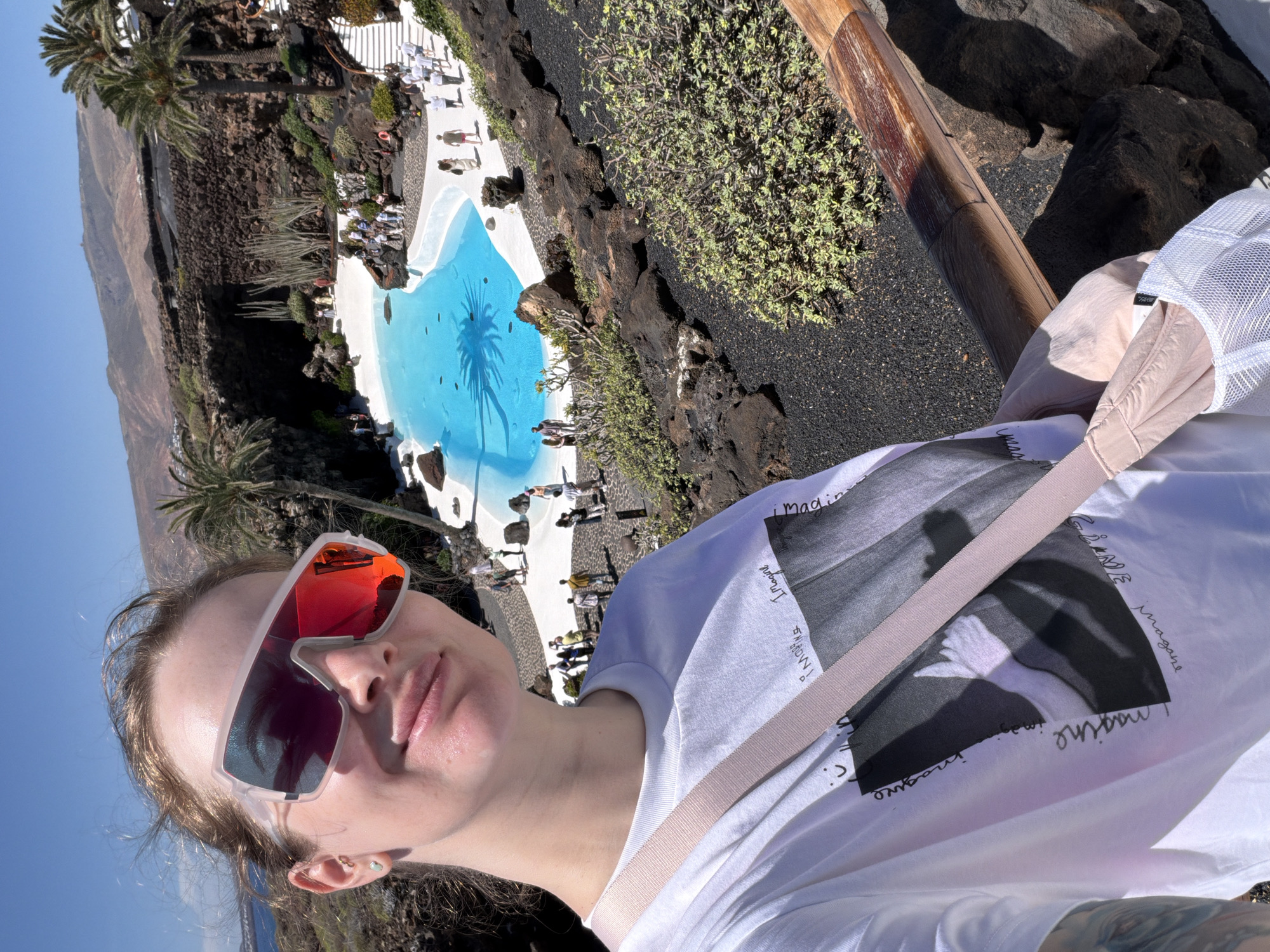
A selfie captures a person wearing sunglasses, a white t-shirt with a graphic print, and a light-colored shoulder strap or bag. The person is positioned to the right in the frame. The background is a complex, scenic landscape, likely in the city of Haría, Spain. There's a bright blue, irregularly-shaped pool with palm tree reflections on its surface. Around the pool, there is a white border and a dark, volcanic rock landscape. In the distance, there is a light brown mountain. People are visible around the pool area, suggesting it is a public or tourist attraction. A wooden railing is on the right side of the frame, slightly out of focus.
Haría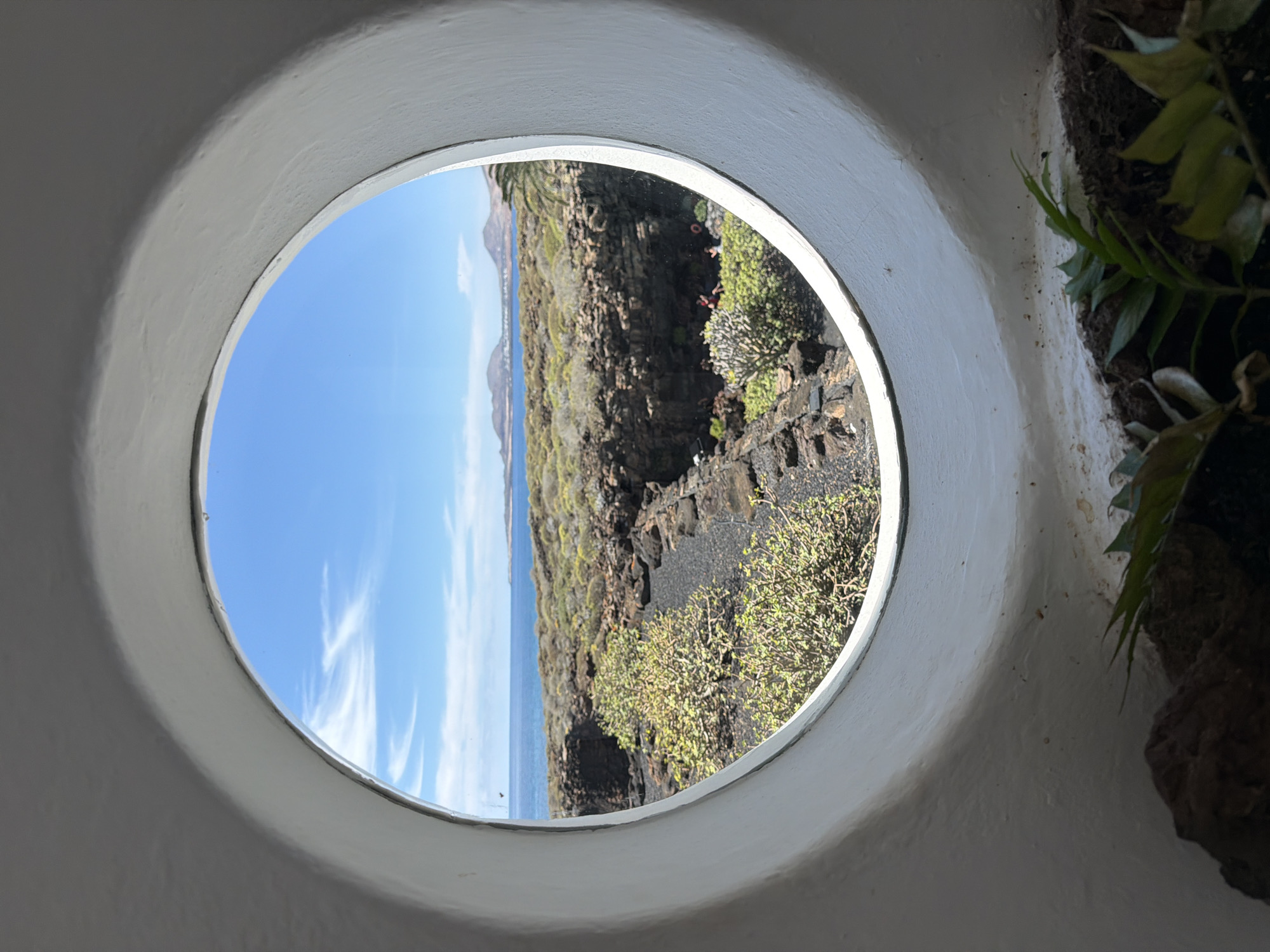
A bright coastal landscape is viewed through a circular, white-framed window. The perspective is from an interior space, with a section of a white, textured wall surrounding the opening. To the immediate right of the window, a green plant with several leaves grows, integrated into the interior wall or a nearby planter. Beyond the circular frame, the scene reveals a clear, bright blue sky with delicate, wispy white clouds in the upper portion. Below the sky, a calm, deep blue body of water, likely the ocean, stretches horizontally towards the horizon. The middle and lower sections of the view are dominated by a rugged, dark, volcanic-looking coastline or cliff face. The terrain is characterized by dark, rocky textures and sparse, resilient green vegetation, appearing as low-lying shrubs or succulent-like plants clinging to the rocks. In the far distance, faint outlines of land formations, possibly mountains or hills, are visible above the sea. The image suggests a sunny and clear day, likely midday or early afternoon, given the strong illumination. The volcanic rock and type of vegetation are strong indicators of a location like Lanzarote, aligning with the Haría, Spain context. No specific activity or event is taking place; it is a static scenic view. There is no visible text.
Haría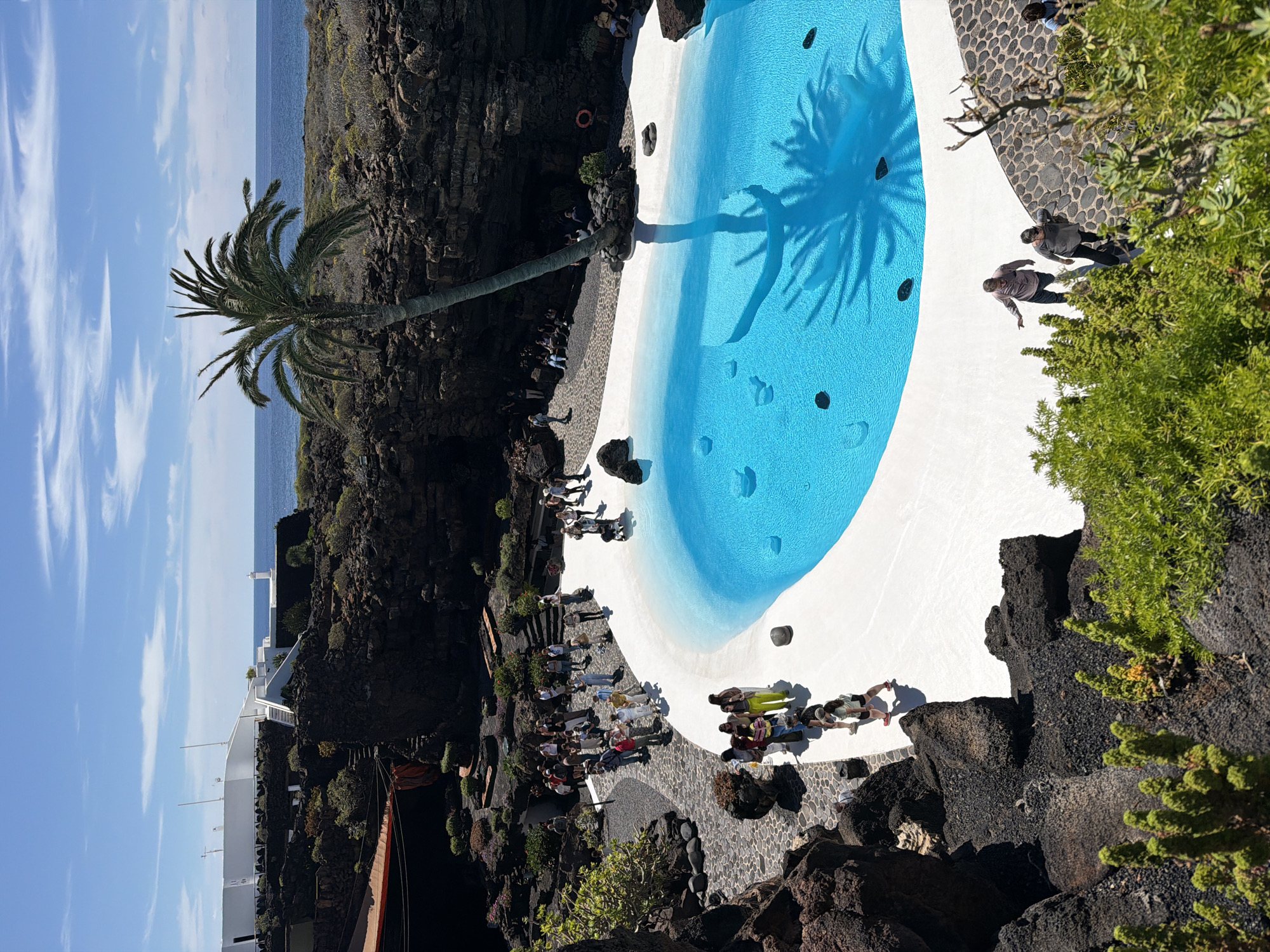
The image captures an elevated view of a unique pool complex at the Casa Museo César Manrique in Haría, Spain. A turquoise blue swimming pool dominates the center, with a prominent shadow of a palm tree stretching across its surface. The pool's perimeter is painted white, blending into the surrounding rock landscape. Several individuals are present. A group stands near a paved area next to the pool, while two people are seen walking near the edge. The environment is characterized by volcanic rock formations, indicative of Lanzarote's geological landscape. The pool is located near the coast, with a glimpse of the ocean visible in the background under a blue sky.
Haría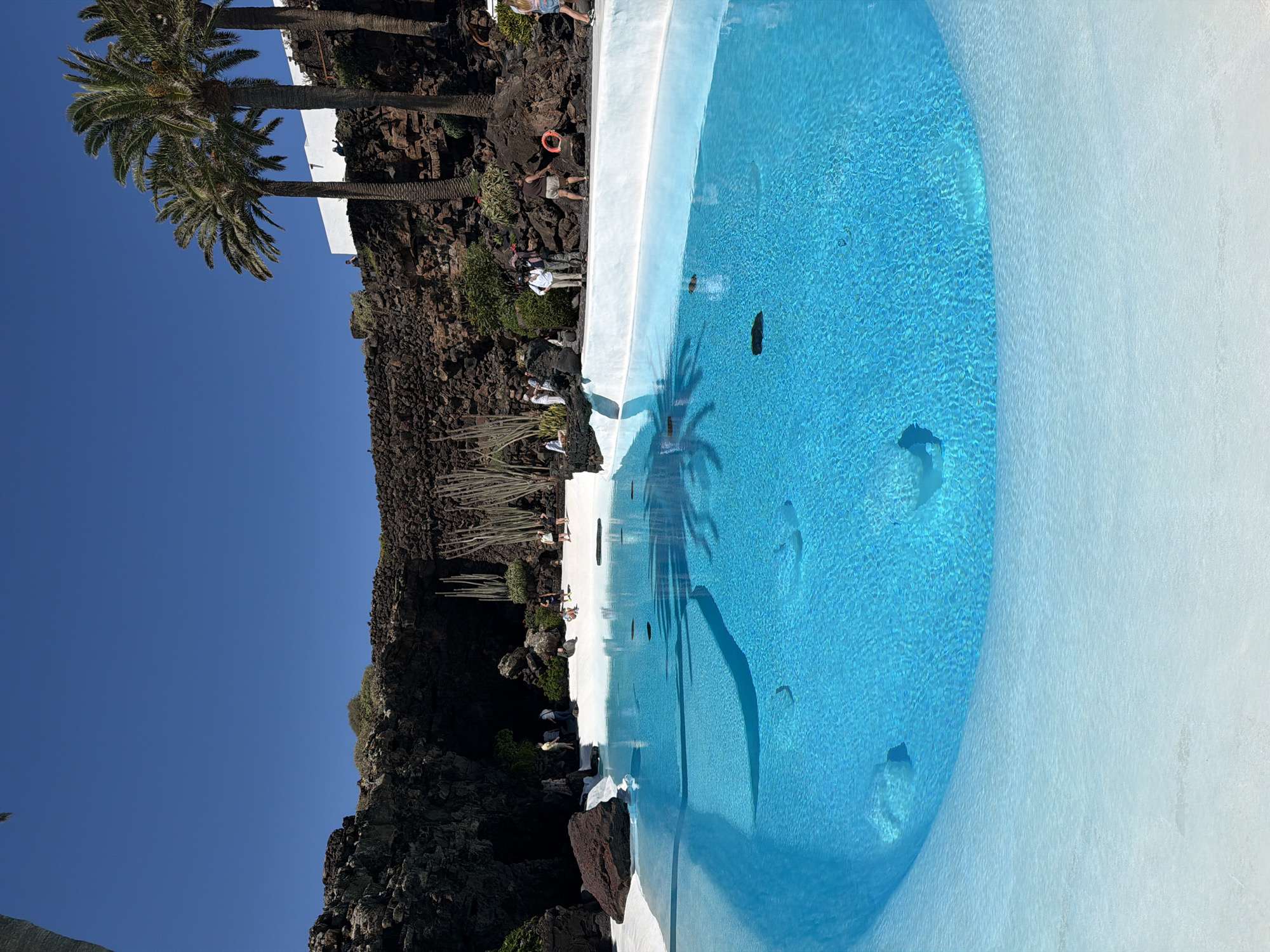
This image captures a beautifully designed swimming pool set within a dramatic volcanic landscape under a clear blue sky. The pool features bright blue water with visible ripples and reflections, including the prominent shadow of a palm tree. Its edges are defined by smooth, pristine white concrete, which contrasts sharply with the dark, rugged volcanic rock formations that surround it. Several palm trees with green fronds stand tall, particularly on the left side of the frame, alongside some cactus-like plants growing among the rocks. Numerous individuals are visible around the pool and on the surrounding rock pathways. They appear to be visitors or tourists, some standing and observing, while others are seated, enjoying the unique environment. One person is seen near a red lifebuoy. The bright, cloudless sky and strong shadows indicate a clear, sunny day. The scene evokes a sense of tranquility and awe, highlighting the harmonious integration of man-made structures with the natural, volcanic terrain. This aesthetic, combining white architecture with dark rock and lush plants, is characteristic of attractions in Lanzarote, Spain, such as Jameos del Agua, which is consistent with the provided location context of Haría. No visible text is present in the image.
Haría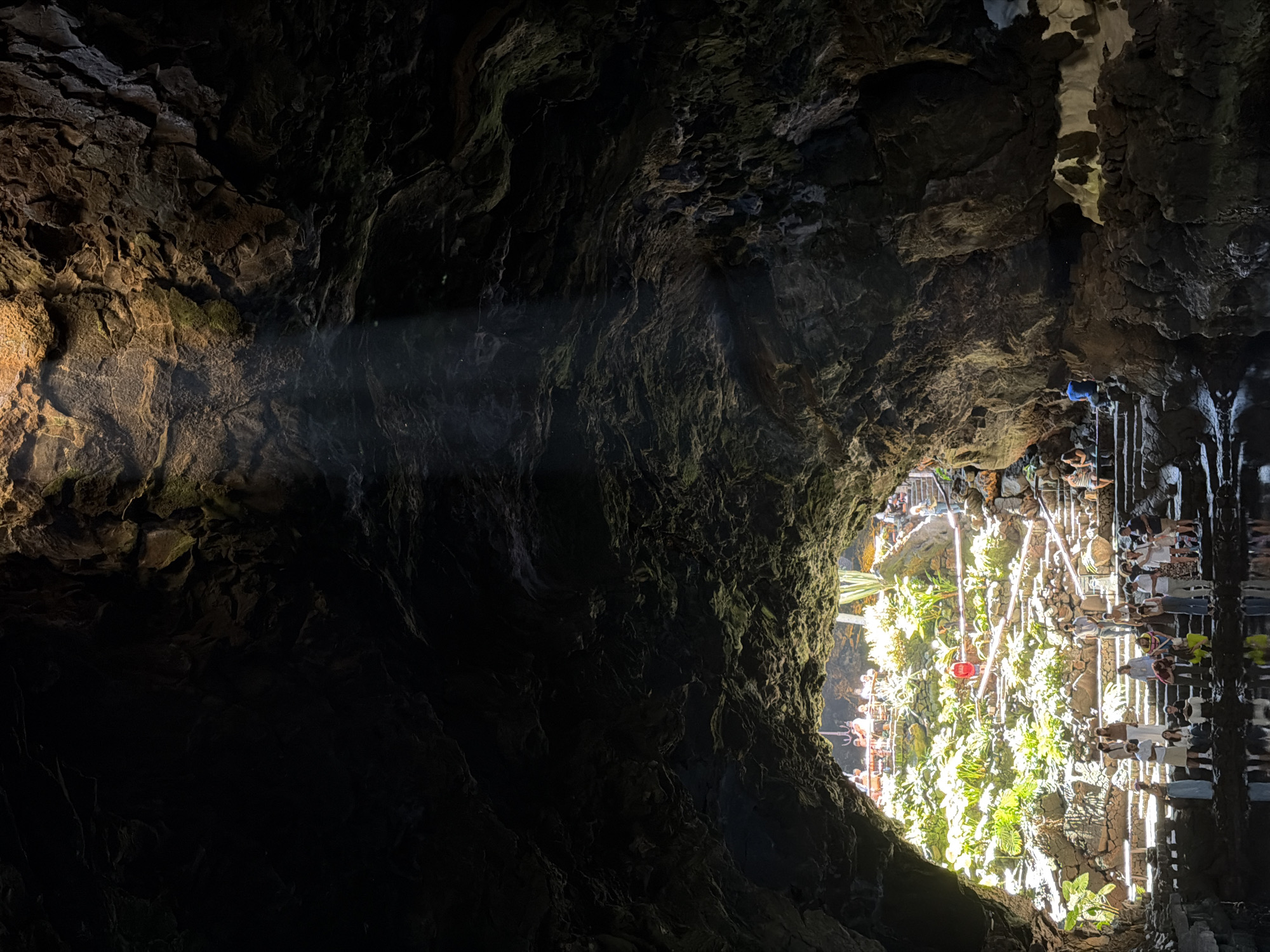
The image shows a view from inside a dark cave toward an illuminated, outdoor scene in Haría, Spain. The cave entrance frames the scene, casting much of the foreground into shadow. A beam of light cuts through the darkness within the cave. Outside, a large group of people are visible, some standing on what appears to be a complex of stone stairs and walkways. The architecture is surrounded by lush green vegetation, including plants and trees. Some reflections are visible on the right side.
Haría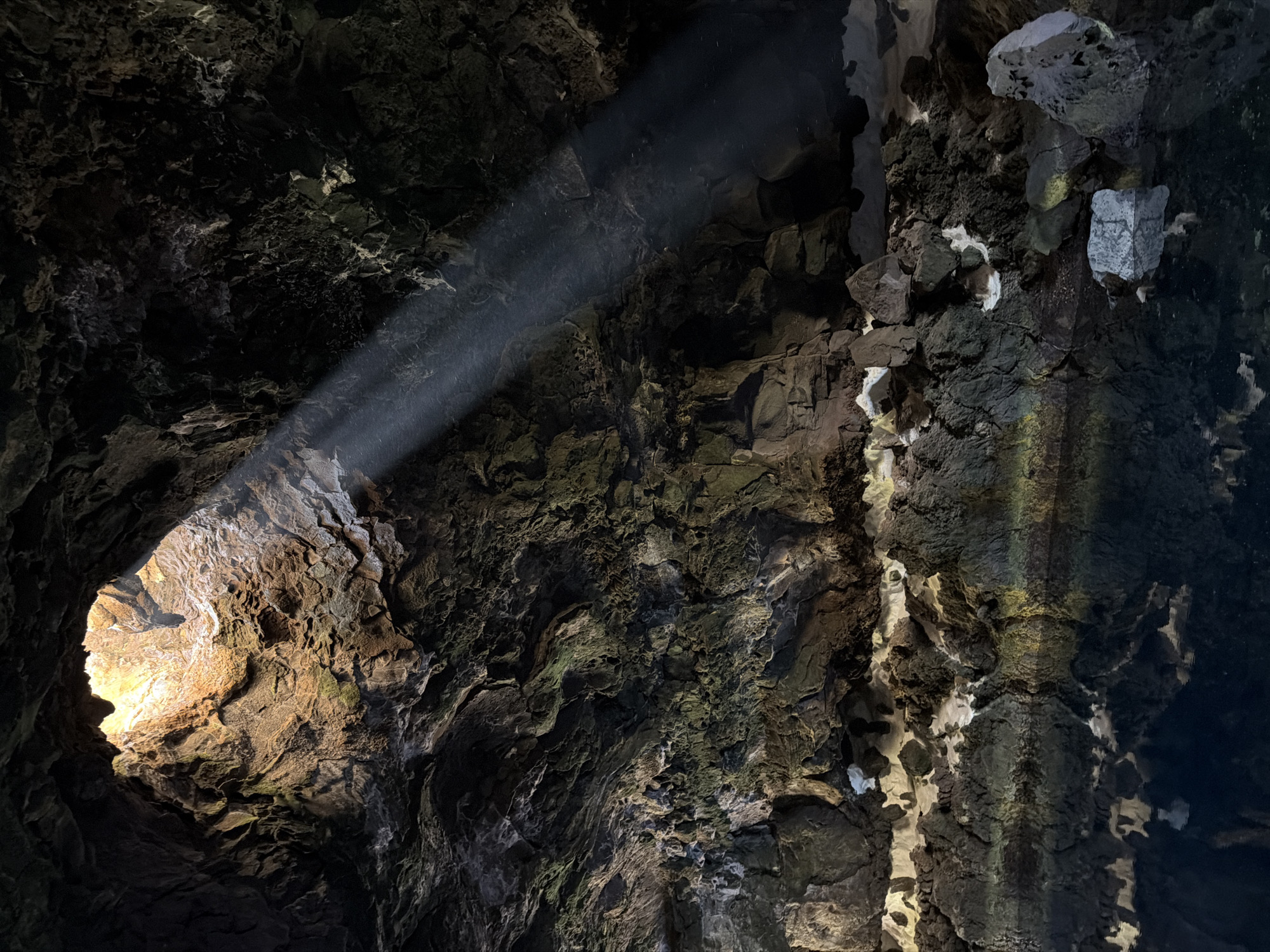
The image shows a view inside Cueva de los Verdes, a lava tube located in Haría, Spain. Light enters the cave through an opening at the left, illuminating the rough rock walls and creating a beam of light. The walls are composed of dark volcanic rock with patches of lighter-colored mineral deposits. The structure of the rock suggests a cave environment.
Haría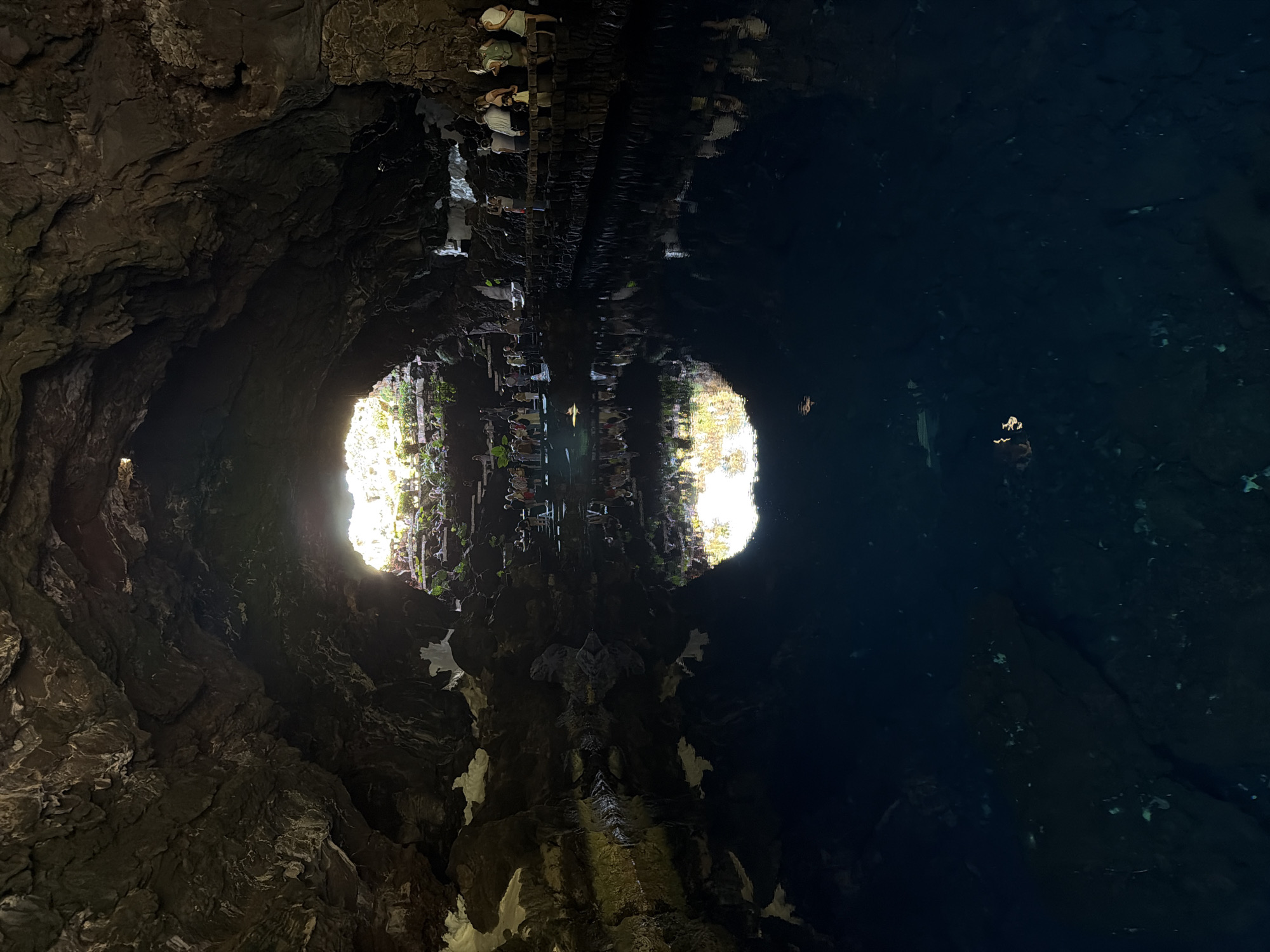
This striking image depicts the interior of a dark, rocky cavern or lava tube, featuring a large, still body of water acting as a prominent reflective surface. The perspective is from within the cavern, looking towards two bright, circular openings in the distance that allow natural light to stream in. On the left side of the frame, the rough, textured walls and ceiling of the cavern are visible, characterized by dark brown, gray, and black rock formations. These formations show intricate patterns and crevices, illuminated subtly by the distant light. The right side of the image is dominated by the calm, deep blue-black water, which perfectly mirrors the scene above and around it. The reflections in the water show the bright openings, appearing as two circular sources of light, and the inverted images of the rocky structures. Most notably, the reflections clearly show numerous silhouettes of people, appearing upright in the water. These individuals are likely standing or seated along a pathway or viewing area opposite the water's edge, outside the immediate frame of the actual scene, with only their reflections being fully captured. Faint green hues from distant vegetation are also discernable around the reflected light sources, suggesting an outdoor area beyond the cavern openings. The time of day appears to be during daylight hours, given the bright natural light. The strong contrast between the dark cavern and the intensely lit openings creates a dramatic and artistic visual. The setting, identified as Haría, Spain, strongly suggests this is a converted volcanic cave system, possibly Jameos del Agua, designed for public visitation. There is no visible text in the image.
Haría
The image shows the entrance to a cave in Haría, Spain. The entrance is dark and surrounded by rocks. A group of people can be seen standing at the top of the entrance. Their feet and shoes are visible at the upper left of the image. Light penetrates the cave interior from the opposite end.
Haría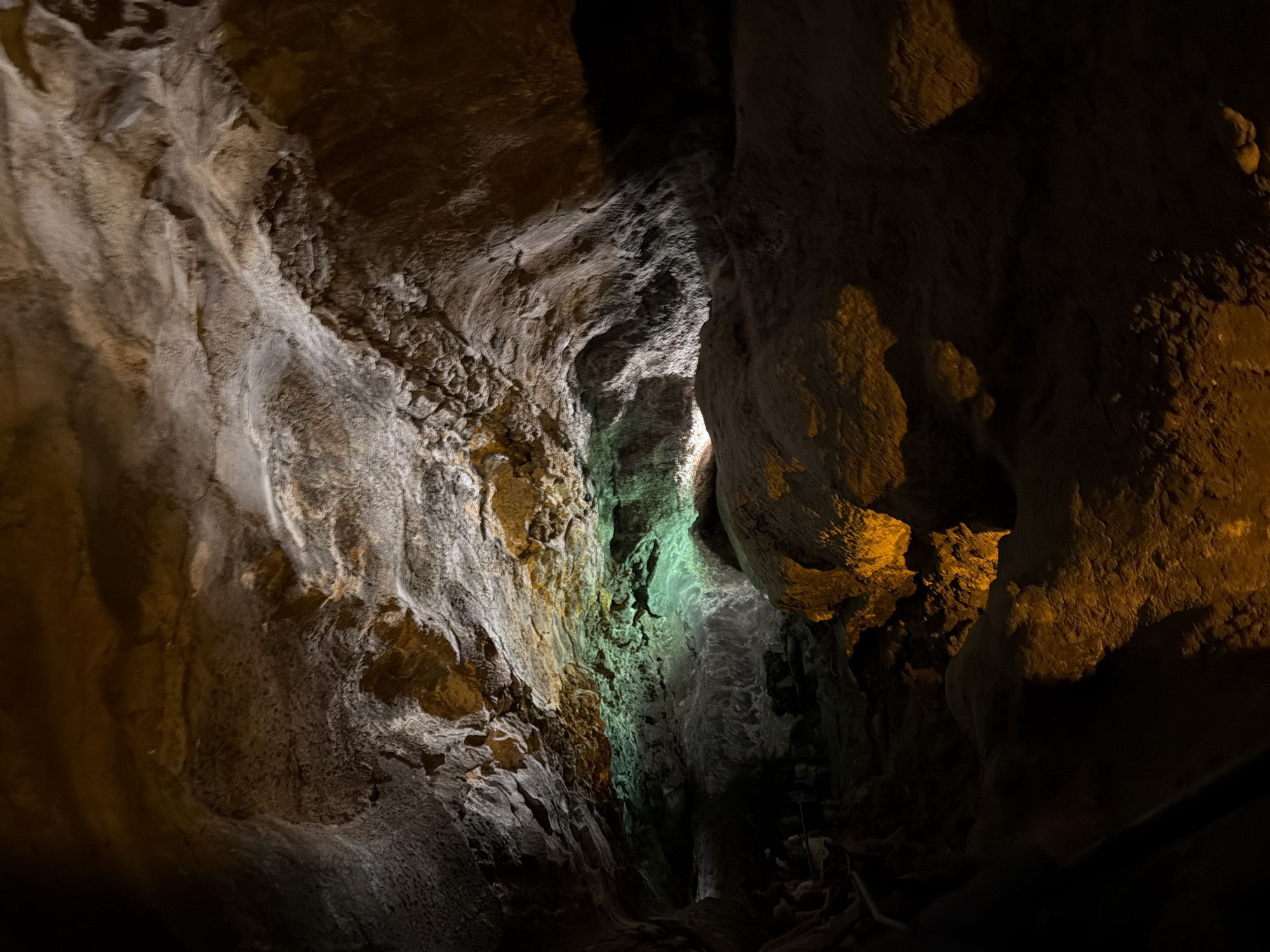
The image shows a dimly lit cave interior in Haría, Spain. The cave walls are rough, textured, and vary in color from light gray to dark brown. A narrow opening lets in a green-tinted light, illuminating a portion of the cave. The floor is dark and rocky. The image contains no visible people, and the focus is on the geological features of the cave.
Haría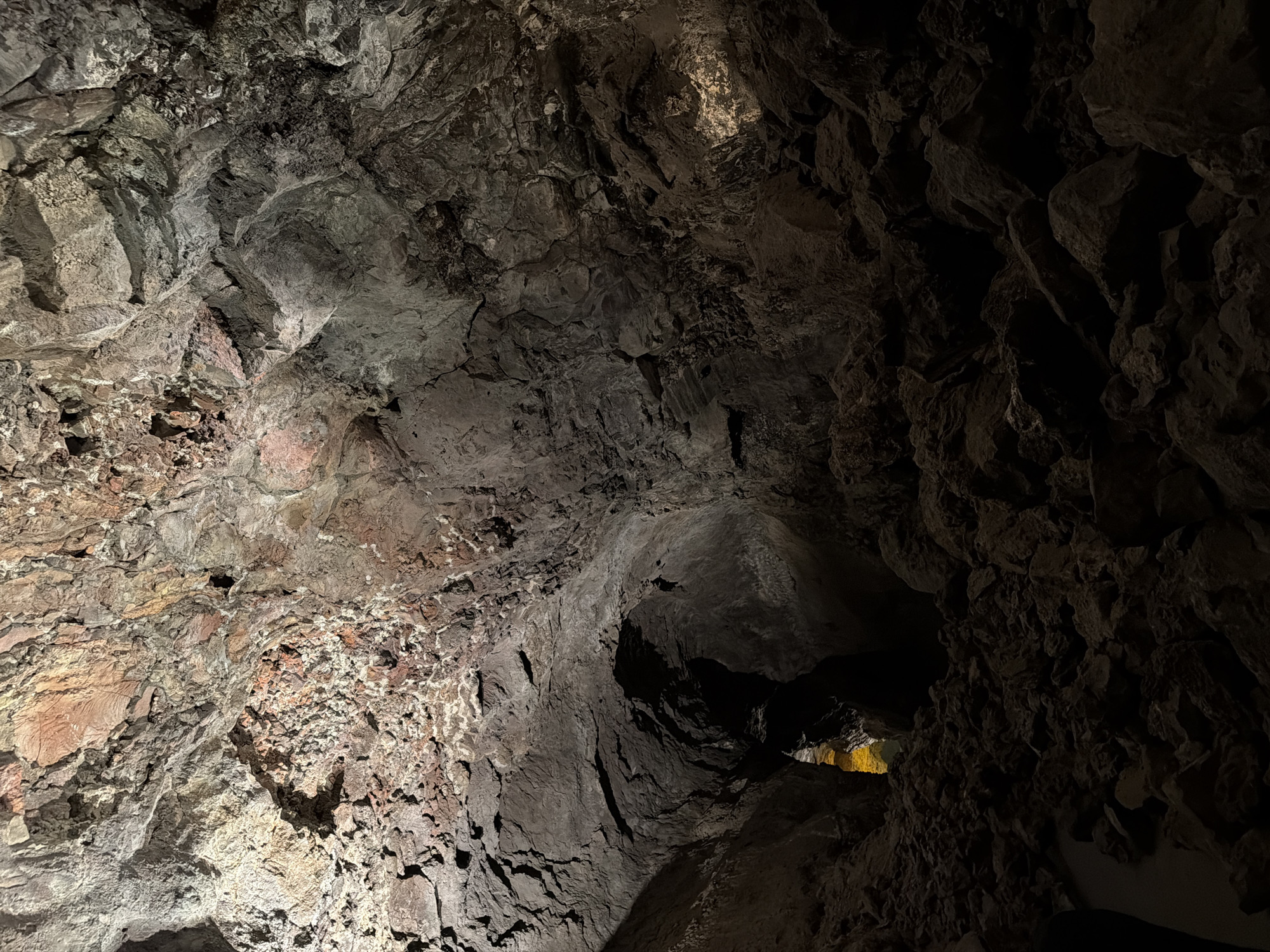
The image depicts the interior of the Cueva de los Verdes, a lava tube located in Haría, Lanzarote, Spain. The scene is largely dominated by the cave's rocky, textured walls, illuminated unevenly by artificial lighting, creating areas of bright exposure and deep shadow. The rock varies in color from reddish-brown to dark gray. In the distance, a small opening glows with artificial light. No people or other specific subjects are visible in the frame.
Haría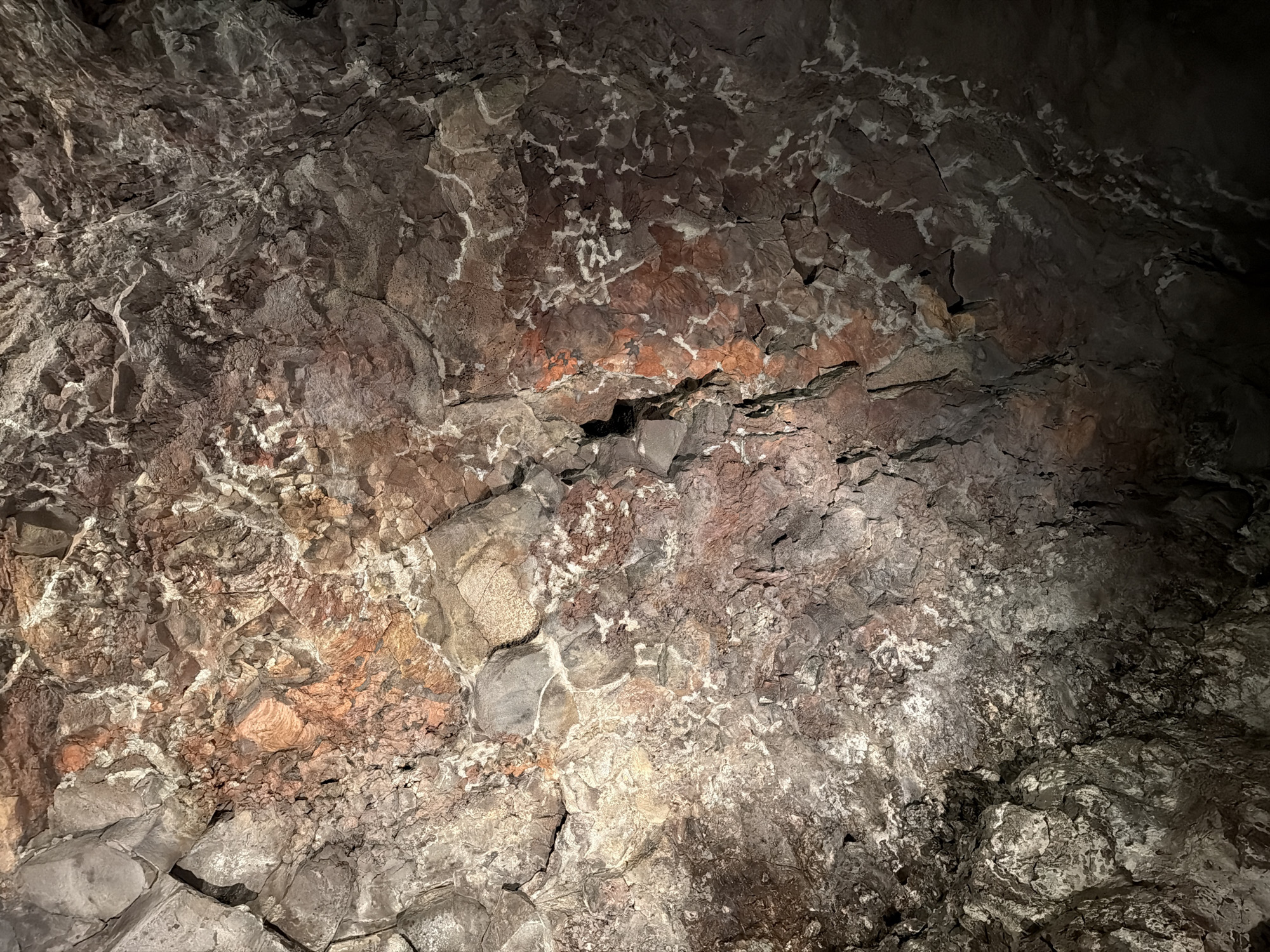
The image captures a detailed view of a textured rock surface, likely within a cave or lava tube, consistent with the volcanic landscape of Haría, Spain. No people or artificial objects are visible. The scene is dominated by rough, uneven rock formations with a fractured and layered appearance. The primary colors of the rock are dark browns, various shades of gray, and reddish-browns, suggesting volcanic origin. Numerous white and off-white streaks, patches, and irregular patterns are prominent across the entire surface, possibly indicating mineral deposits, flowstone, or lighter veins within the rock. Some areas of the rock also exhibit a soft orange or reddish glow, which may be a result of the mineral composition or specific artificial lighting. The lighting is localized and uneven, highlighting the intricate textures and variations in the rock while leaving other areas in deep shadow, reinforcing the impression of an artificially illuminated, dark interior space. The intricate patterns and varying shades create a geological and almost abstract composition. There is no visible text in the image.
Haría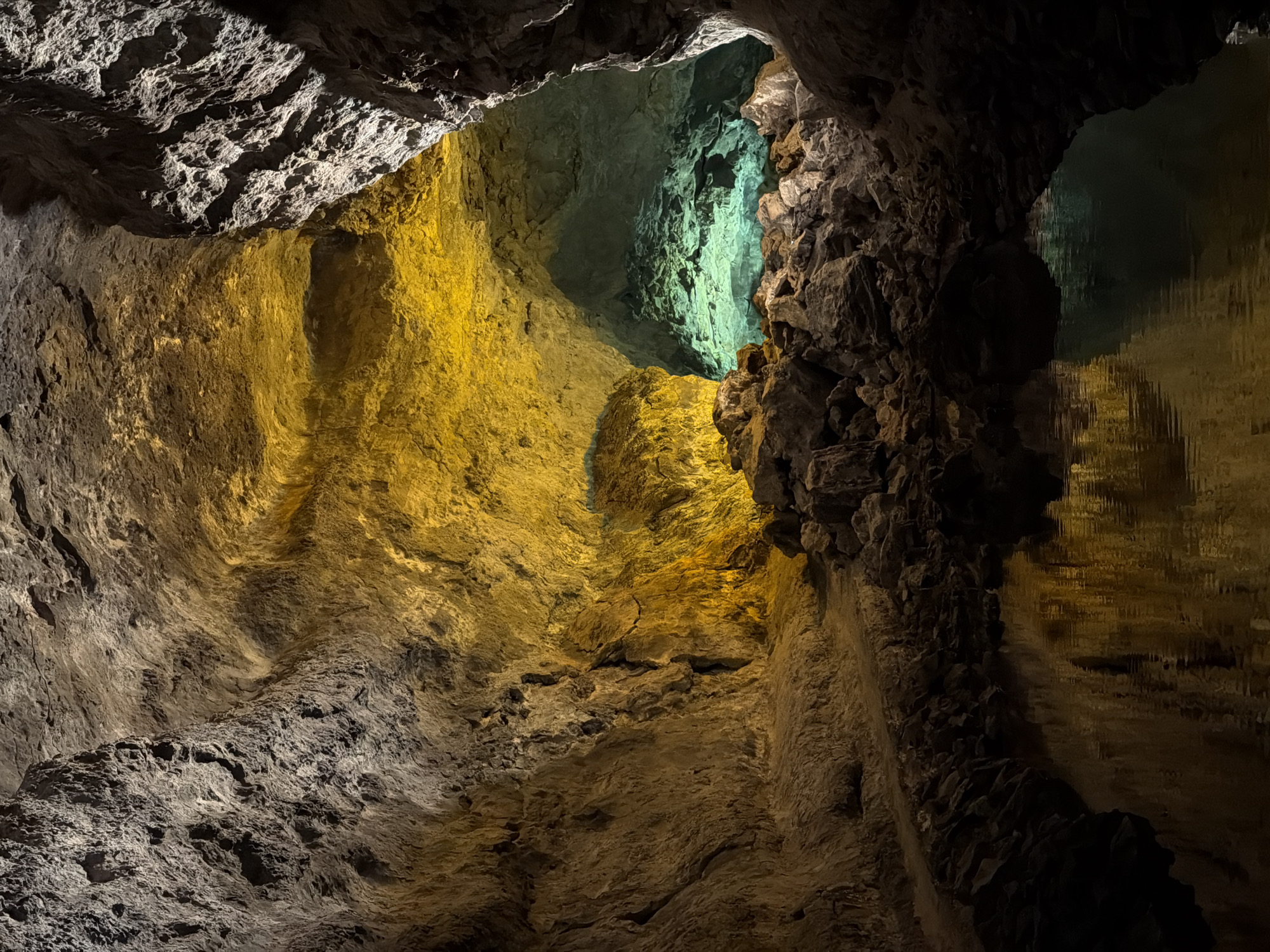
The image presents a dramatic upward view from within a large, illuminated cave or grotto, revealing its rugged rock formations. The scene is characterized by striking artificial lighting that bathes different sections of the cave in vibrant colors. A prominent area on the left and central-upper part of the frame glows with a rich golden-yellow light, emphasizing the intricate textures and vertical contours of the rock walls. Deeper into the cave, towards the upper right, another section is illuminated by an ethereal turquoise-green light, hinting at further passages. On the far right, a calm body of water, likely an underground lake or pool, reflects the golden-yellow light from the opposite wall, creating elongated, shimmering vertical patterns that resemble dripping stalactites or a watery curtain. The ceiling and portions of the lower left remain in natural, darker rock tones, providing a stark contrast to the brightly lit areas. The raw, uneven surfaces of the rock are visible throughout, showcasing the natural geology. No people or explicit activities are depicted, but the deliberate lighting suggests this is a managed site for visitors, such as a show cave. There is no visible text. The image evokes a sense of wonder and awe, capturing the mysterious beauty of a subterranean environment, consistent with cave systems found in areas like Haría, Spain.
Haría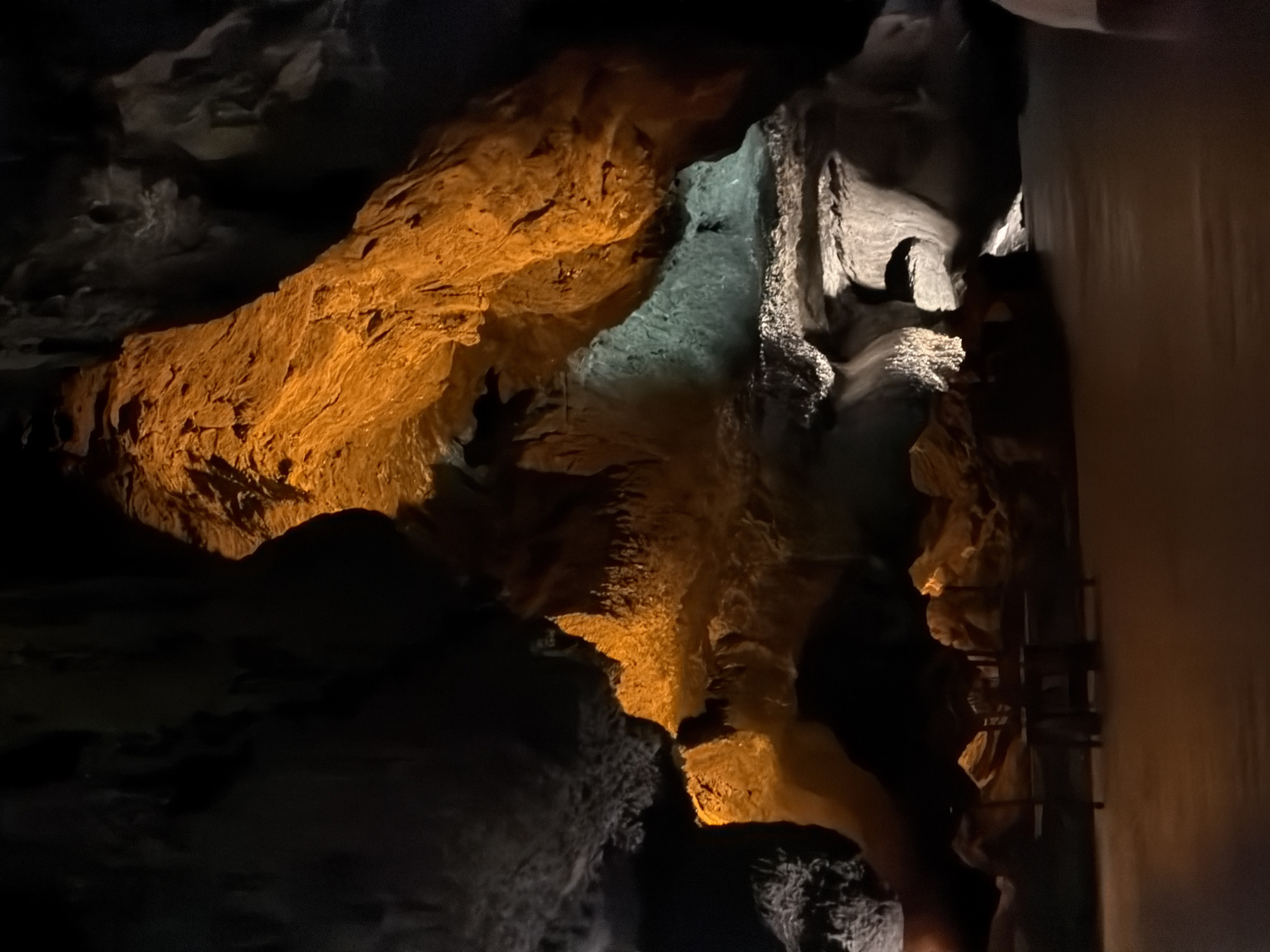
The image captures the dramatic, artificially lit interior of a large cave or grotto, set in Haría, Spain. The scene is dominated by rugged, natural rock formations displaying diverse textures and contours. Strategic artificial lighting plays a crucial role in highlighting the cave's features and creating a high-contrast environment. A prominent, massive rock face on the left and central parts of the image is bathed in a warm, orange or amber light, emphasizing its rough, layered surfaces. In the middle of the frame, a body of water, likely a pool or subterranean river, reflects a cooler, greenish-blue light, contrasting sharply with the warm tones of the adjacent rocks. Other rock formations, particularly towards the right, appear in various shades of grey, with some areas receding into deep, dark shadows. Evidence of human infrastructure for visitor access is visible on the far right. A smooth, light-colored, vertical wall or panel runs along the edge of the frame, suggesting a constructed walkway or barrier. Adjacent to this, a dark, ladder-like structure or safety railing can be discerned, indicating a prepared path for exploration. The absence of natural light, combined with the artificial illumination, creates an atmosphere of mystery and awe, typical of a managed subterranean tourist attraction. No people are visible, and there is no discernible text within the image. The time of day and weather are irrelevant to this indoor scene.
Haría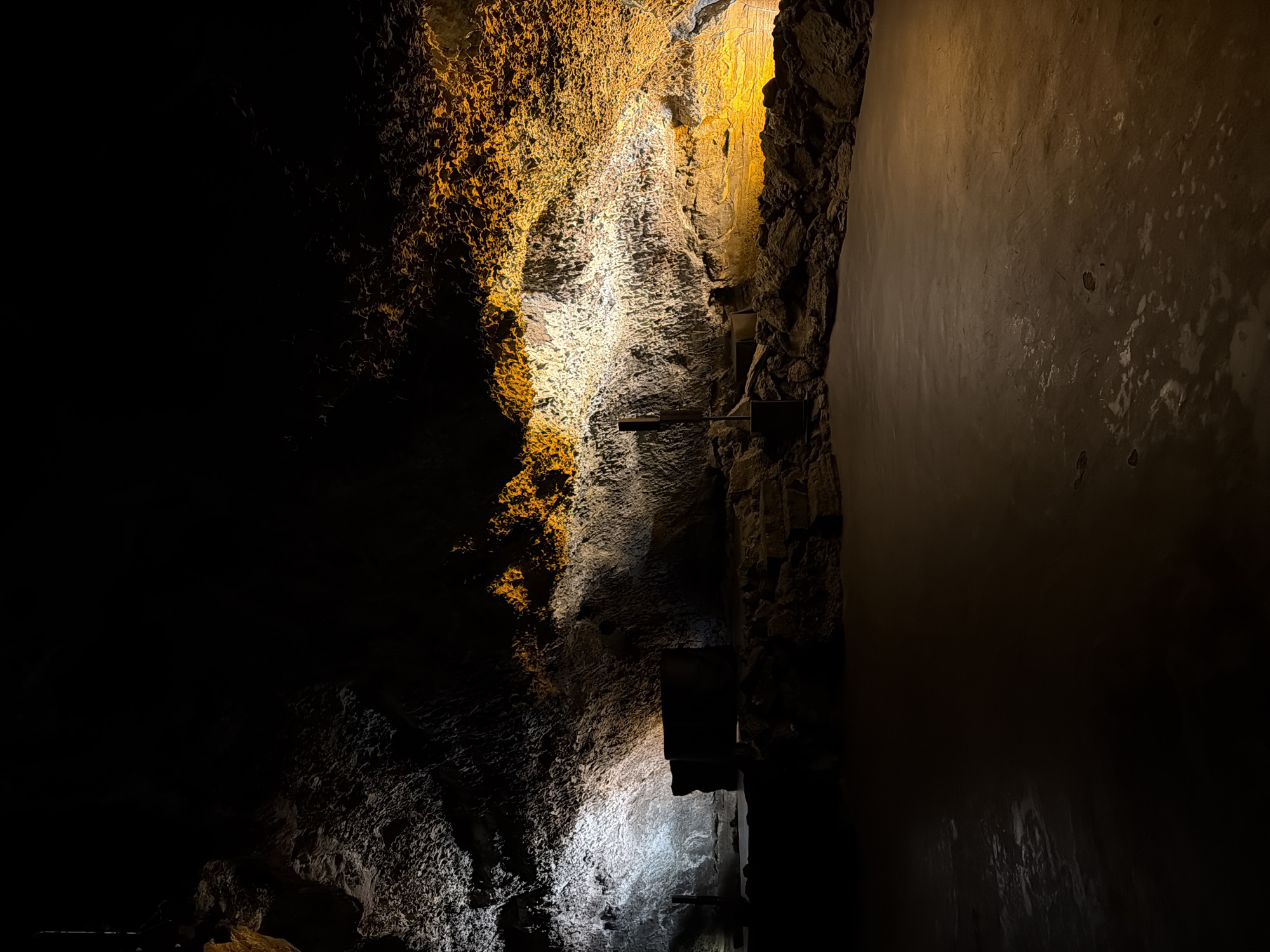
This image depicts a section of the Cueva de los Verdes, a lava tube located in Haría, Spain. The left side of the image features a rugged, textured rock wall illuminated with amber and white light. The right side shows a smooth, flat wall, possibly man-made, in shadow. A series of wooden beams and supports are anchored into the rock wall near the center of the frame. The environment is dark, suggesting the underground location of the cave.
Haría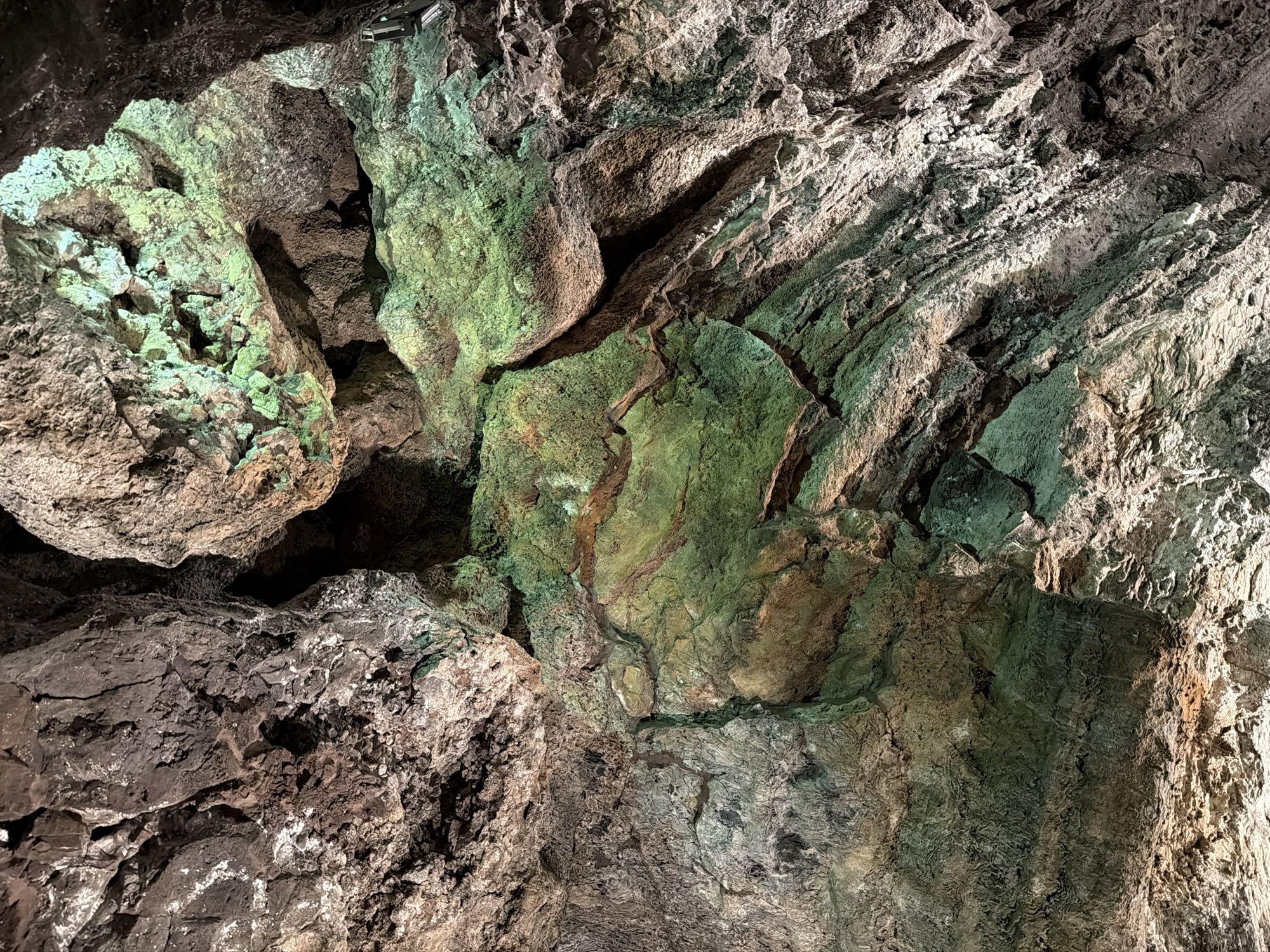
The image shows a close-up of rock formations inside Cueva de los Verdes, a lava tube located in Haría, Lanzarote, Spain. The rocks are various shades of grey, brown, and green, with rough, uneven surfaces. Some areas are lit with artificial green light, highlighting textures and irregularities. The composition fills the frame, giving a sense of depth and complexity to the geological features.
Haría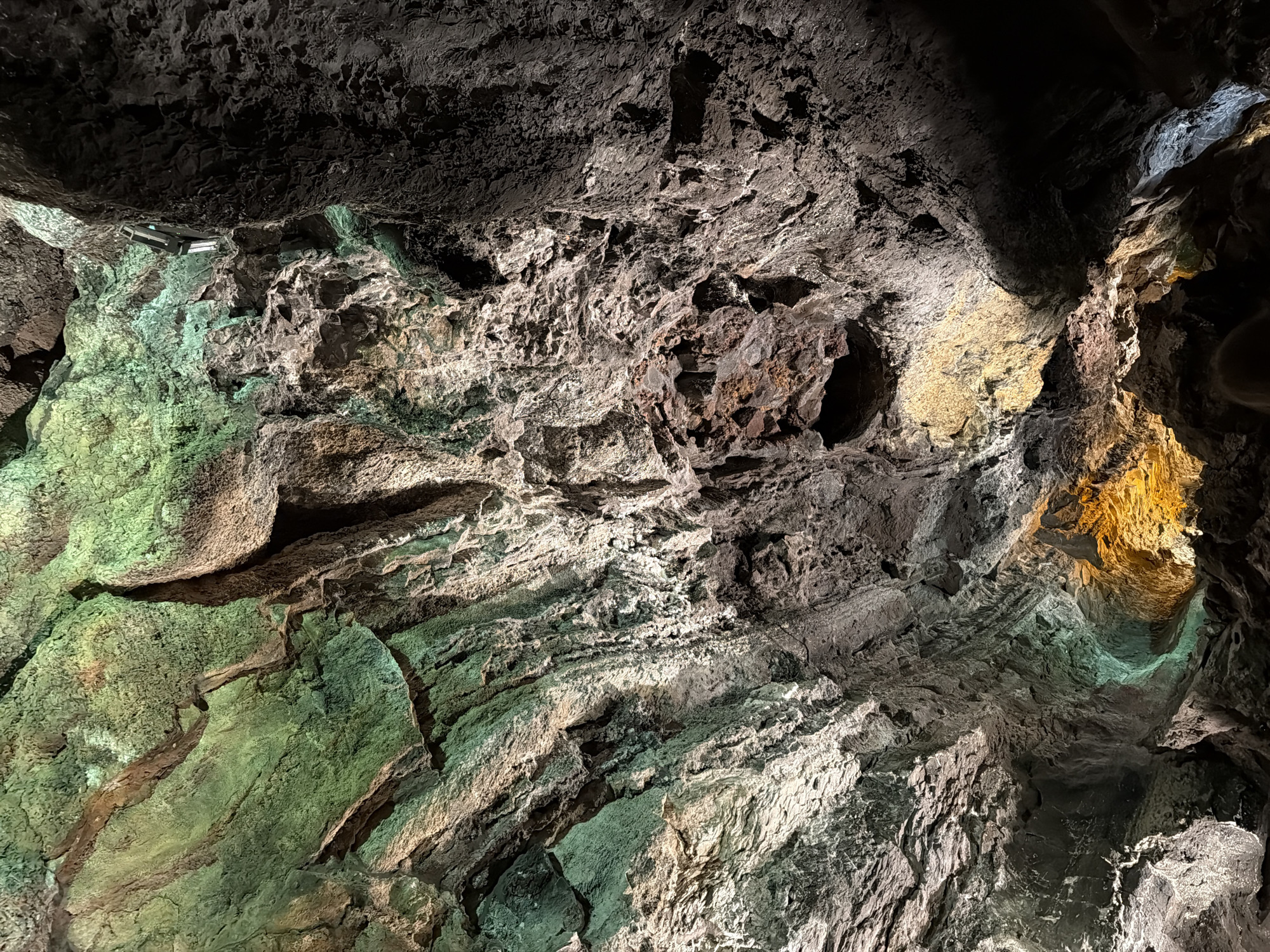
This image shows the interior of the Cueva de los Verdes, a lava tube located in Haría, Lanzarote, Spain. The walls and ceiling of the cave exhibit rugged, volcanic rock formations, illuminated with artificial lighting that casts green and yellow hues. The rock surfaces display variations in texture and color, ranging from dark gray to light green and brown. The lighting highlights the irregular shapes and crevices of the rock formations. There are no people visible.
Haría