Haveli Jhangranwali, Pakistan
30 memories from Haveli Jhangranwali, Pakistan
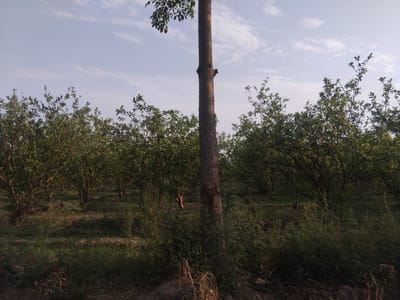
The image depicts an outdoor scene in the city of Haveli Jhangranwali, Pakistan. In the foreground, a tall, rough-barked tree stands prominently. Behind it, a grove of fruit trees, likely citrus, is visible, with their branches laden with foliage and some bearing small fruits. The ground is covered with grass and dry vegetation, suggesting a rural or agricultural setting. The sky is partly cloudy, with wispy white clouds against a light blue backdrop, indicating fair weather. The lighting suggests it is either early morning or late afternoon. There are no people or animals visible in the frame. The overall impression is one of a tranquil orchard.
Haveli Jhangranwali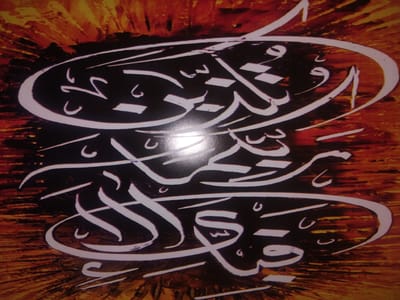
This is a close-up, vertically oriented image of white Arabic calligraphy against a dark background that transitions to a fiery orange and yellow textured pattern, resembling brushstrokes or light rays. The calligraphy is elaborate and flowing, with thick white strokes forming curves and sharp angles. Diacritical marks, small dots, and strokes are visible, adding detail to the letters. The overall design is abstract and artistic, with no discernible figures, objects, or a specific scene. The background evokes a sense of warmth, intensity, or perhaps a sunrise or sunset effect. The calligraphy itself is the primary subject. While the specific text is not definitively translated, the style suggests it could be religious or poetic in nature, common in Islamic art. The visual impression is one of dynamic movement and ornamental beauty. There are no clear indications of a specific time of day, weather conditions, or location cues beyond the artistic style of the calligraphy and the textured background. The emotions evoked are primarily aesthetic appreciation for the art form.
Haveli Jhangranwali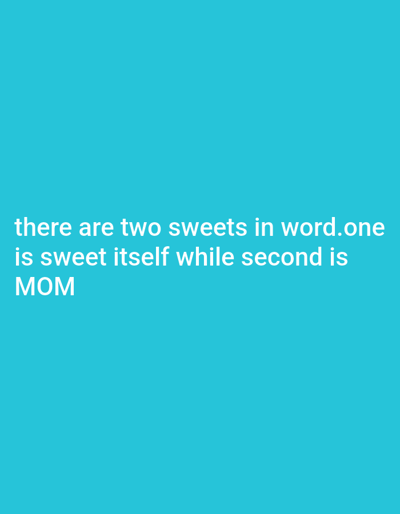
The image displays white text on a bright blue background. The text reads: "there are two sweets in word.one is sweet itself while second is MOM". The text is positioned in the lower half of the image, with the word "MOM" centered below the preceding line. There are no people, objects, or scene elements depicted in the image. The activity is simply the presentation of a textual statement. The background is a solid, vibrant blue, offering no clues about the time of day, weather, or location. The text itself is the sole focus.
Haveli Jhangranwali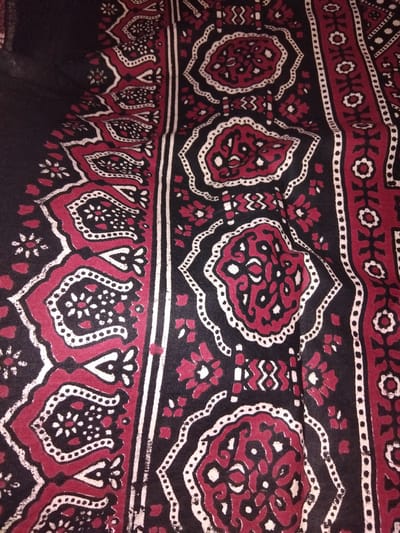
This is a close-up, top-down, eye-level, full-frame shot of a piece of fabric with a traditional block-printed design. The fabric is predominantly black with intricate patterns in deep red and white. The design features repeating geometric and floral motifs arranged in vertical bands. One band consists of a series of stylized floral shapes outlined in white and filled with red and black. Adjacent to this is a wider band with larger, elaborate circular motifs, also outlined in white and filled with red and black, interspersed with smaller white and red floral elements. Another vertical band features a simpler pattern of alternating red and white shapes with black outlines. The fabric appears to be slightly creased, suggesting it is a textile likely used for clothing, upholstery, or as a decorative textile. The image does not depict any people or identifiable landmarks, and therefore no specific location within Haveli Jhangranwali, Pakistan can be determined.
Haveli Jhangranwali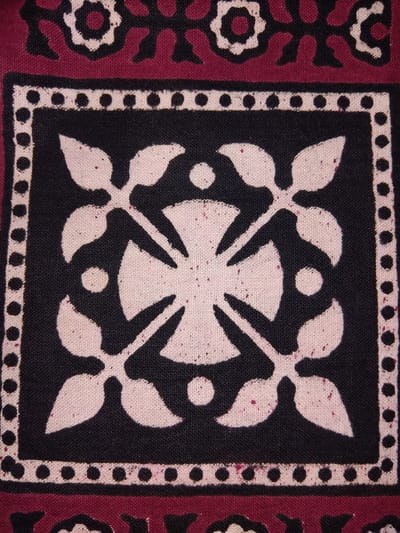
The image shows a close-up of fabric with a repeating pattern. The central design is a square with a black background, outlined by a border of white dots on a white background. Inside the black square, a stylized white design resembles a cross with four leaf-like shapes radiating from the center, each with a small white circle between them. The fabric appears to be a natural material, possibly cotton, with visible texture and small red speckles on the white areas. To the left and right of the central square, the fabric has a maroon background with a black and white pattern of floral or geometric motifs. The overall impression is of a decorative textile, possibly part of a garment, tapestry, or home furnishing. The lighting is consistent, suggesting an indoor setting. No people, animals, or specific activities are depicted. No text is visible. The style of the pattern might suggest traditional South Asian textile art. Given the provided location context, it is plausible this fabric is from Haveli Jhangranwali, Pakistan.
Haveli Jhangranwali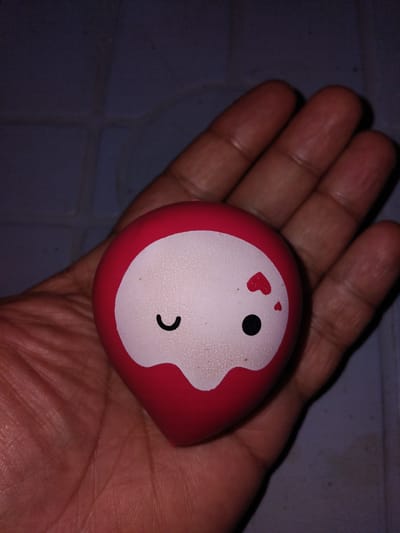
A close-up shot shows a person's hand holding a small, red, egg-shaped toy. The toy has a white face with a winking eye, a black dot for a nose, and two small red hearts above the nose. The background is a dark, textured surface, possibly a wall or floor. The image does not provide any information about the location in Haveli Jhangranwali, Pakistan.
Haveli Jhangranwali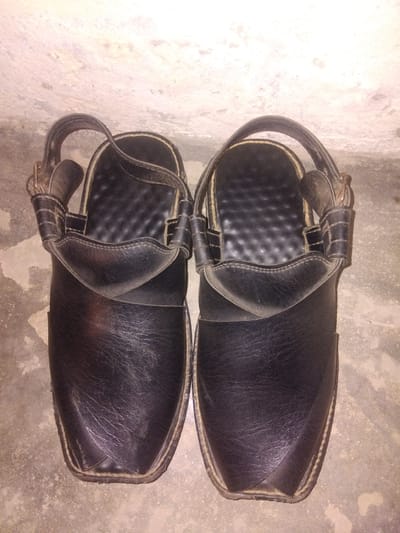
A pair of black leather Peshawari chappals are displayed on a concrete floor. The chappals are positioned side-by-side, with the toe portions facing the viewer. They feature a traditional design with a broad strap across the vamp and a narrower strap that goes over the instep and connects to a heel strap. The soles appear to be made of leather with a visible stitching detail around the edges. The background consists of a textured, light-colored wall with subtle variations in tone. The lighting suggests an indoor setting, possibly during the evening or in a dimly lit area. The image was captured in Haveli Jhangranwali, Pakistan.
Haveli Jhangranwali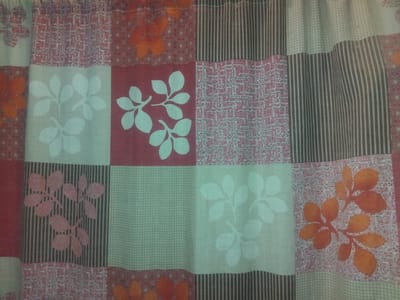
A close-up, overhead shot shows a fabric curtain composed of a patchwork of square and rectangular sections. The fabric is creased and appears to be hanging. The sections feature various patterns and colors: some have a red background with white leaf designs, others have an orange leaf design on a white patterned background, and there are also sections with thin vertical stripes in dark gray and white, and sections with a light green checkered pattern. The overall impression is of a decorative fabric with a variety of textile designs. The image is a flat lay of the fabric, not depicting any environment or specific location within Haveli Jhangranwali, Pakistan.
Haveli Jhangranwali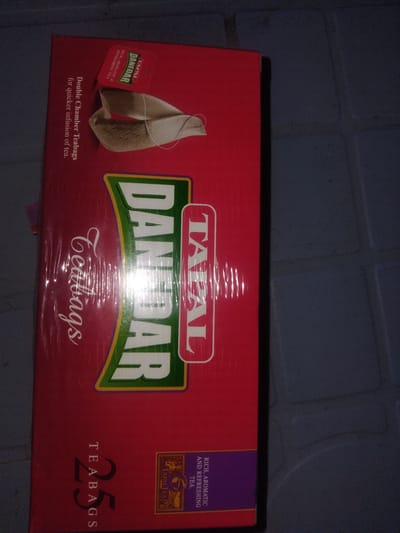
A close-up, horizontal, medium shot captures a red cardboard box of Tapal Danedar tea bags. The box is sealed in clear plastic. The brand name "DANEDAR" is prominently displayed in large white, green, and yellow lettering across the center of the box, with "TAPAL" appearing in a vertical red oval to its right. The phrase "Double Chamber Teabags for quicker infusion of tea" is printed in white text on the left side of the box. Towards the bottom left, the number "25" is printed in large black font, with "TEABAGS" printed vertically next to it. A small purple and gold seal with "TAPAL TEA" is visible on the lower right. The background consists of dark gray, textured floor tiles. The image is likely taken indoors, as indicated by the artificial lighting causing glare on the plastic wrapping and the tiled floor. The location is identified as Haveli Jhangranwali, Pakistan.
Haveli Jhangranwali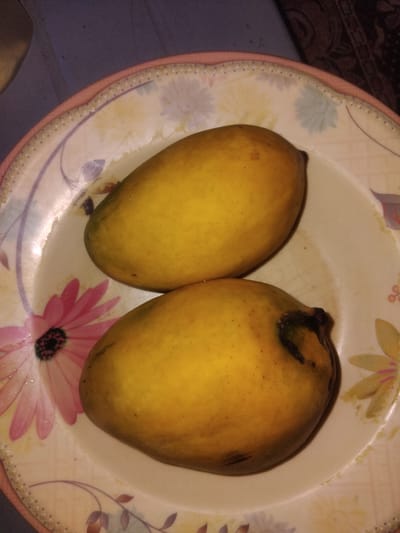
Two ripe mangoes are presented on a decorative plate. The plate has a light-colored base with floral patterns in pink, purple, and light blue. The rim of the plate is decorated with a dotted texture and a thin pink border. The mangoes are a vibrant yellow-orange color, with the lower mango showing some darker, bruised areas near its stem. The background appears to be a dark, textured surface, possibly a table or fabric. The image is a close-up shot, focusing entirely on the mangoes and the plate they are resting on. The setting suggests a domestic environment within Haveli Jhangranwali, Pakistan, likely a kitchen or dining area.
Haveli Jhangranwali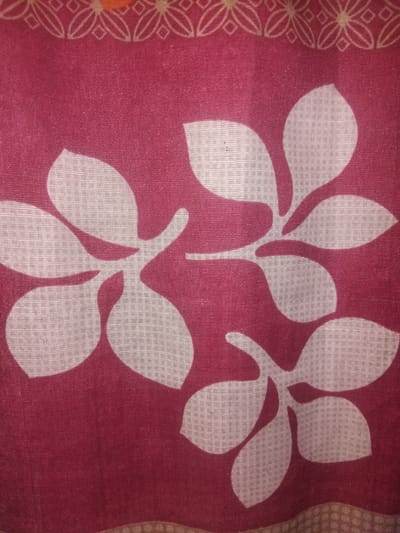
The image shows a close-up of a fabric with a maroon background and a pattern of white floral shapes. The fabric has a textured appearance due to the weave. At the top of the image, there is a border with a decorative pattern of interconnected diamond shapes and curved lines in a light beige or off-white color. The floral motifs are stylized and resemble leaves or petals arranged in a cluster. The lighting suggests the image was taken indoors, possibly in a home environment. There are no people, animals, or specific landmarks visible in the image, and therefore no information can be provided about the location in Haveli Jhangranwali, Pakistan.
Haveli Jhangranwali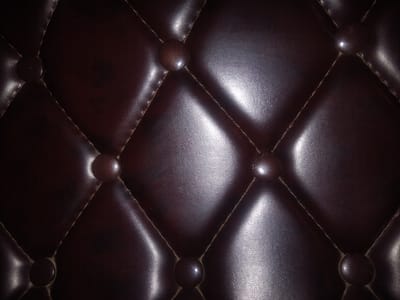
The image displays a close-up, textured view of dark brown, tufted upholstery, likely leather, characterized by diamond-shaped patterns formed by stitching and button accents. The lighting creates strong highlights and shadows, emphasizing the material's sheen and depth. There are no people or identifiable objects other than the upholstery itself. This image is not associated with any specific location in Haveli Jhangranwali, Pakistan, as it is a generic texture shot.
Haveli Jhangranwali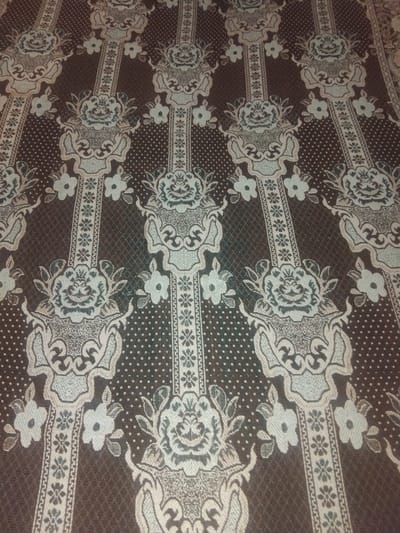
The image displays a close-up, overhead view of a patterned fabric, likely a textile or blanket, with a floral and ornate design. The dominant colors are brown and a light cream or beige. The pattern features repeating vertical bands with floral motifs at the top and bottom, interspersed with smaller floral elements and a dotted background. There are no people or discernible environmental elements that would place this image in a specific city or location like Haveli Jhangranwali, Pakistan. The photograph focuses solely on the texture and design of the fabric.
Haveli Jhangranwali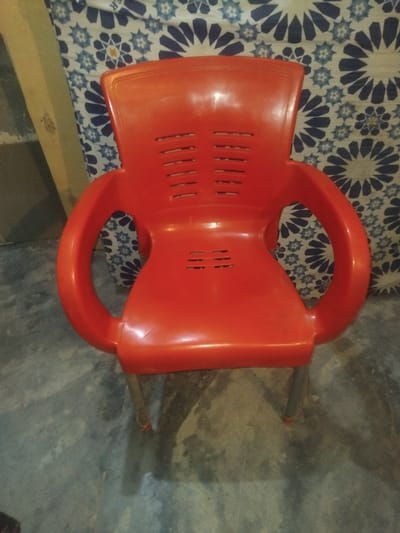
The image shows a bright orange plastic chair placed on a patterned fabric, likely a bedsheet or rug. The fabric features a repeating geometric design of blue and white star-like shapes. The chair has a simple design with a molded seat and back, and armrests that curve downwards. There are slots or vents on the backrest of the chair. The chair is positioned at an angle, casting a shadow on the grey, textured floor. A thin metal rod, possibly a leg of the chair, extends from the side and rests on the floor. The lighting suggests it might be indoors, possibly in a room with natural light from a window or artificial lighting. The setting appears to be simple and perhaps a bit rustic, given the texture of the floor. There is no clear indication of the time of day or weather conditions. No people are visible in the image. The overall impression is a still life composition of a common household object in a domestic setting.
Haveli Jhangranwali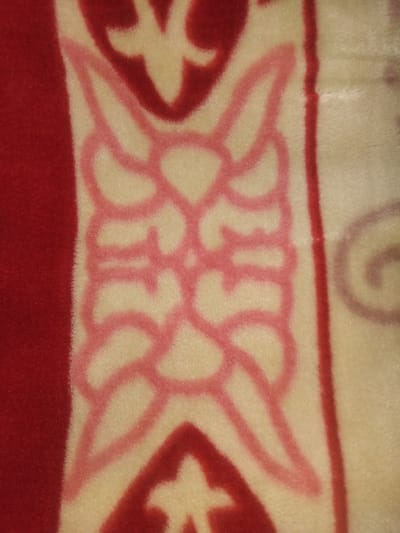
The image is a close-up, high-angle shot of a fuzzy, textured blanket with a pattern. The left side of the blanket is a solid, deep red. To the right of the red band, there is a cream-colored section with a repeating pink and red stylized floral or geometric pattern. The pattern is symmetrical and appears to be woven or printed onto the fabric. The texture of the fabric is evident, with visible fuzziness and light reflecting off the fibers, giving it a slightly glittery appearance in some areas. No people, actions, or specific environmental features beyond the blanket itself are visible. There is no information in the image to suggest a location in Haveli Jhangranwali, Pakistan.
Haveli Jhangranwali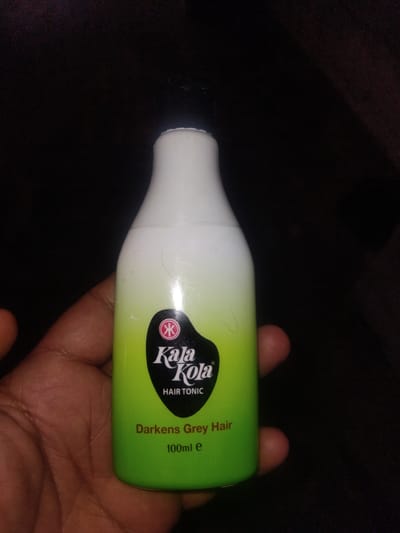
A hand holds a bottle of Kaja Kola hair tonic. The bottle has a white cap and a green body that fades to white at the top. The Kaja Kola logo is visible on the green part of the bottle, along with the text "HAIR TONIC" and "Darkens Grey Hair 100ml e". The background is dark, suggesting low lighting conditions, possibly indoors or at night. The overall scene is simple, focusing on the product. The user's hand is positioned to display the bottle prominently. The location context provided is Haveli Jhangranwali, Pakistan, though there are no specific visual cues in the image to confirm this.
Haveli Jhangranwali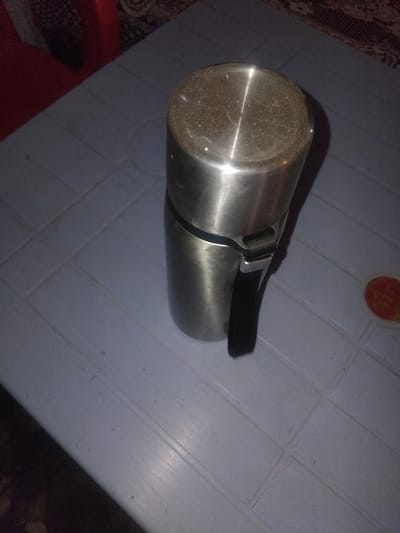
This media file shows a stainless steel thermos with a black handle resting on a light blue plastic surface. The thermos appears to be used, as there is some dust or residue on the top of it. The plastic surface has a grid pattern of indentations, suggesting it might be a table or tray. In the background, on the left side of the image, a patterned textile, possibly a rug or blanket, is visible. On the right side, a dark, out-of-focus area hints at the surrounding environment. There is also a circular object with red and orange colors visible on the plastic surface in the upper right portion of the image, which could be a label or a decorative element. No people are visible in the frame. The lighting appears to be artificial and somewhat dim, casting shadows. There is no indication of the time of day or weather. The overall scene is domestic or indoor.
Haveli Jhangranwali
The image shows a close-up, low-angle view of a ceiling light fixture. The fixture appears to be circular with a translucent cover that diffuses the light. Small, circular patterns or indentations are visible on the cover, some of which are darker and appear to be openings or recesses. A small, dark circular object, possibly a screw or a decorative element, is visible in the center of the fixture. The surrounding ceiling is a plain, light-colored surface. Below the ceiling, horizontal lines suggest the edge of a structure or furniture, and a dark recessed area is visible, possibly indicating a shadowed space or the top of a cabinet. The overall scene is indoor and dimly lit, with the primary light source being the ceiling fixture itself. The location is the city of Haveli Jhangranwali, Pakistan.
Haveli Jhangranwali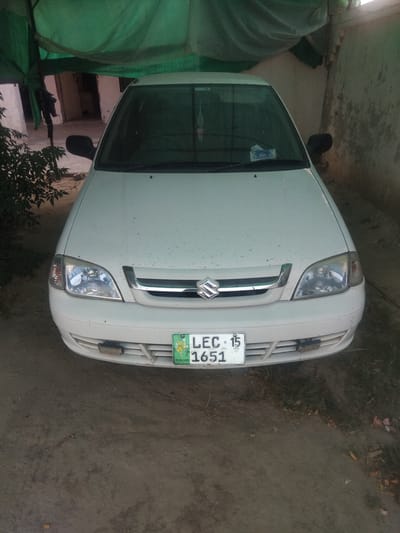
A white Suzuki Cultus car is parked in what appears to be an outdoor setting. The car is the primary object of focus, viewed from a slightly elevated angle, looking down on the front of the vehicle. The car is clean but shows some dust or dirt specks on its surface. The front grille, headlights, and the Suzuki logo are clearly visible. Attached to the front of the car is a license plate with the text "LEC 15 1651" and "PUNJAB" written on it. The car is parked on a dirt or gravel surface, with some dry leaves and sparse vegetation visible around it. To the left of the car, a large section of green tarp or fabric is draped, creating a shaded area. In the background, part of a building with weathered walls is visible. The overall lighting suggests it might be daytime, possibly late afternoon or early morning, given the shadow patterns and the ambient light. There are no people visible in the image, and the scene appears to be static, with the car simply parked. The location context provided is Haveli Jhangranwali, Pakistan. The image has a slightly tilted orientation.
Haveli Jhangranwali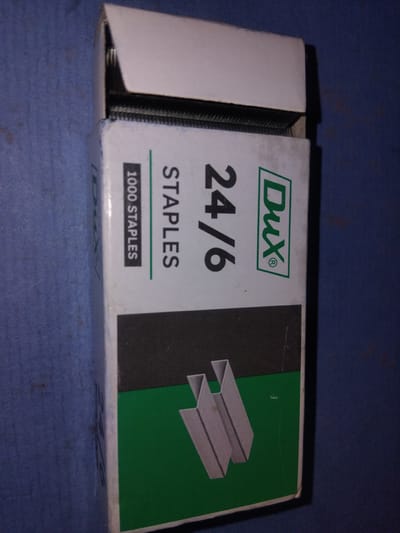
The image displays a box of Dux 24/6 staples, set against a blue textured surface, possibly a tablecloth or bedspread. The box is predominantly white and green, with the "Dux" logo prominently featured in green within a white rectangle. The number "24/6" is printed in large black font below the logo, indicating the staple size. Beneath this, "STAPLES" is written in smaller black font, followed by "1000 STAPLES" in a black rectangle with white text. On the right side of the box, a graphic illustration of two staples is visible on a green background. The staples themselves are partially visible on the left side of the box, showing a stack of metallic staples. The lighting in the image is somewhat dim, with a slight glare on the box. There are no people or animals present in the image. The scene appears to be an indoor setting, with the focus solely on the product packaging. The location context of Haveli Jhangranwali, Pakistan, is provided, but there are no specific visual cues within the image to confirm this location.
Haveli Jhangranwali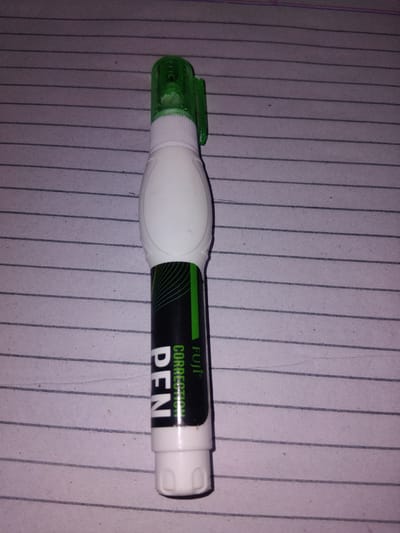
The image shows a white and green correction pen with black text on a paper with horizontal lines. The text on the pen reads "FUJI CORRECTION PEN". The pen is lying horizontally on the paper. The scene is an indoor setting, likely a desk or table, with lined paper serving as the background. There is no specific time of day or weather indicated. No people are present in the image. The object is a common stationery item used for correcting errors in writing. The location context provided is Haveli Jhangranwali, Pakistan, but this is not visually evident from the image itself. The image is a close-up shot of the correction pen, highlighting the product's details and branding.
Haveli Jhangranwali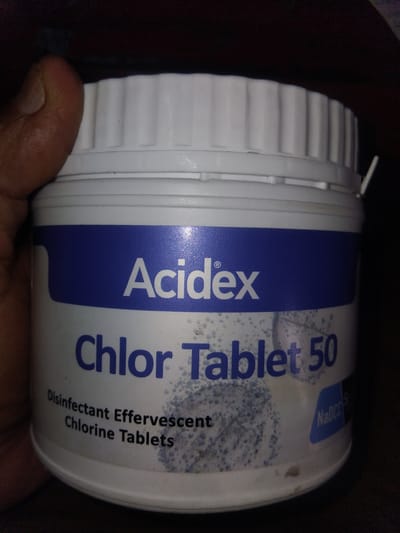
A white plastic container labeled "Acidex Chlor Tablet 50" is held in a person's left hand. The container has a blue label with white text. The text "Disinfectant Effervescent Chlorine Tablets" is visible below "Chlor Tablet 50". A blue rectangular sticker with "NaDCC" is on the lower right side of the container. The background is dark. The image was taken in Haveli Jhangranwali, Pakistan.
Haveli Jhangranwali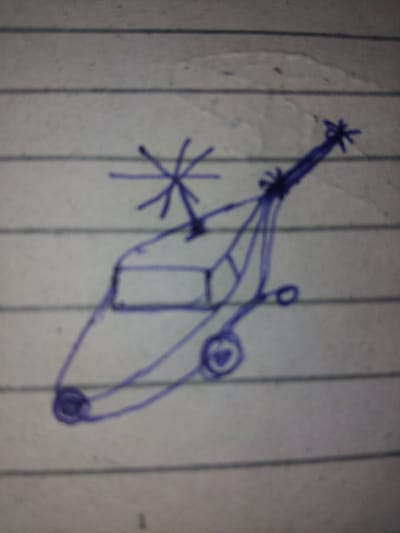
The image shows a child's drawing of a helicopter on lined paper. The helicopter is drawn in blue ink and has a rotor, a cockpit, and a tail. There are no people or other objects in the drawing. The drawing appears to be on a page from a notebook, with horizontal lines visible throughout the image. The background is a light gray, with some slight texture visible, suggesting it is paper. There is no information in the image that relates to the city of Haveli Jhangranwali, Pakistan.
Haveli Jhangranwali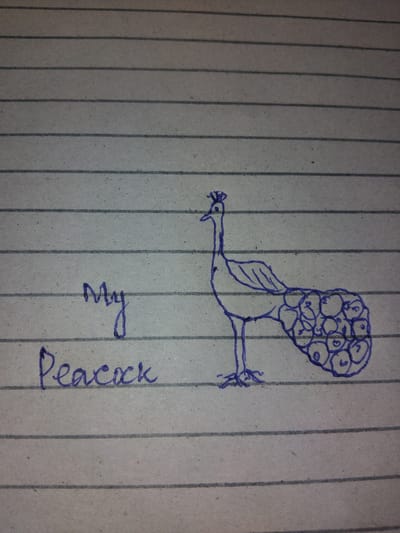
A hand-drawn blue ink illustration of a peacock is depicted on lined paper. The peacock is facing left, with its long neck extended and a crest on its head. Its tail is fanned out and filled with circular patterns representing eyespots. To the left of the peacock, the words "My Peacock" are written in blue ink. The paper is gray and has horizontal lines across it, typical of notebook paper. This image is not located in a specific city in Pakistan.
Haveli Jhangranwali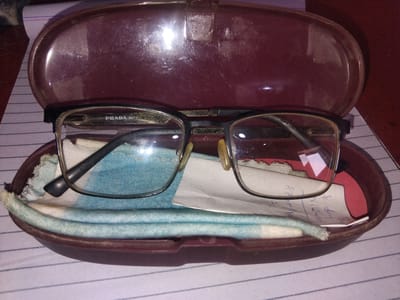
The image shows a pair of eyeglasses in a maroon-colored glasses case. The case is open and resting on a lined paper surface, likely a notebook or journal. Inside the case, the eyeglasses are positioned on top of a light blue cleaning cloth, and a folded piece of paper with writing is also visible. The eyeglasses have thin, metallic frames with what appear to be prescription lenses. The lenses show some smudges and dust. The inside of the glasses case is also lined with a soft material, and there are some scuff marks and scratches on the exterior of the case, indicating use. The lighting suggests an indoor setting, possibly a desk or table. The overall scene is a close-up view of personal belongings, with no indication of a specific location in Haveli Jhangranwali, Pakistan, or any people.
Haveli Jhangranwali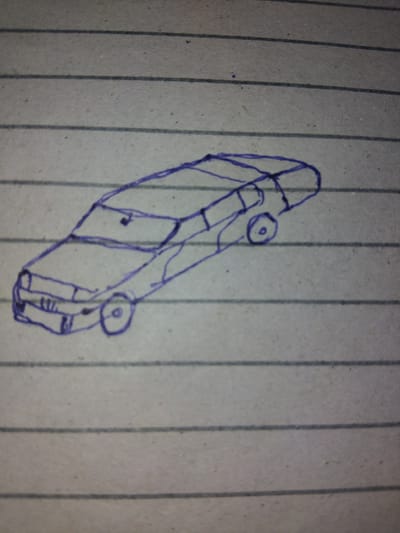
This is a hand-drawn sketch on lined paper. The drawing depicts a hand, rendered in blue ink. The hand appears to be in a fist or grasping position. The fingers are bent and grouped together, with lines indicating knuckles or joints. There are two circular shapes on the back of the hand, possibly representing stylized eyes or joints. The overall style of the drawing is simple and abstract. The lined paper suggests it was drawn in a notebook or on a notepad. No specific environmental details, time of day, weather, or emotional cues are conveyed by the drawing itself. There is no visible text in the image. The context of Haveli Jhangranwali, Pakistan is external information and not derivable from the image content.
Haveli Jhangranwali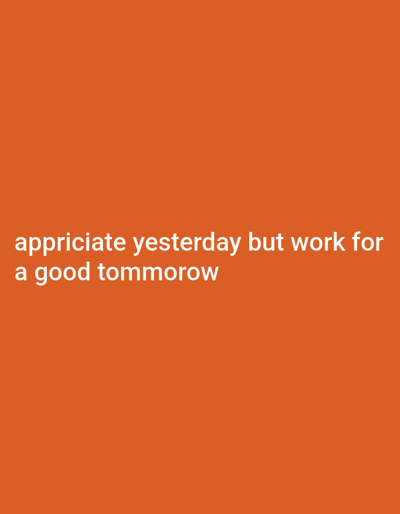
The image is a plain orange background with white text. The text reads "appreciate yesterday but work for a good tommorow". There is no identifiable information related to Haveli Jhangranwali, Pakistan, or any people, subjects, objects, actions, or interactions.
Haveli Jhangranwali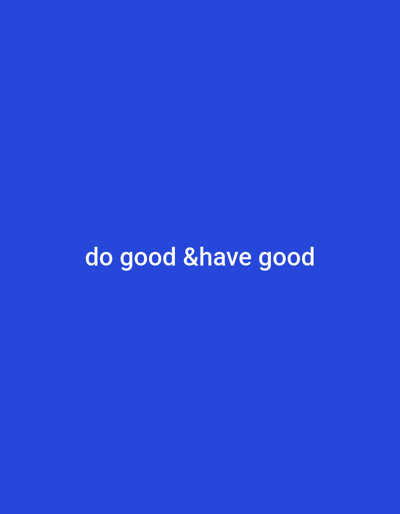
The image is a plain blue background with white text that reads "do good & have good". There are no people, objects, or environmental features present in the image. The text is centered horizontally and vertically on the screen. The location in the city of Haveli Jhangranwali, Pakistan, is not relevant to the image content.
Haveli Jhangranwali
The image is a plain pink background with white text that reads "change the world by being urself." There are no people, objects, actions, interactions, or environmental details present in the image. The location in the city of Haveli Jhangranwali, Pakistan is not depicted in any way.
Haveli Jhangranwali
The image is a plain blue background with white text. The text reads "if u cant do great thing do small things in a great way". There are no people, objects, or any environmental details that can be used to determine a location in the city of Haveli Jhangranwali, Pakistan.
Haveli Jhangranwali