Hebron, Palestinian Territory
12 memories from Hebron, Palestinian Territory
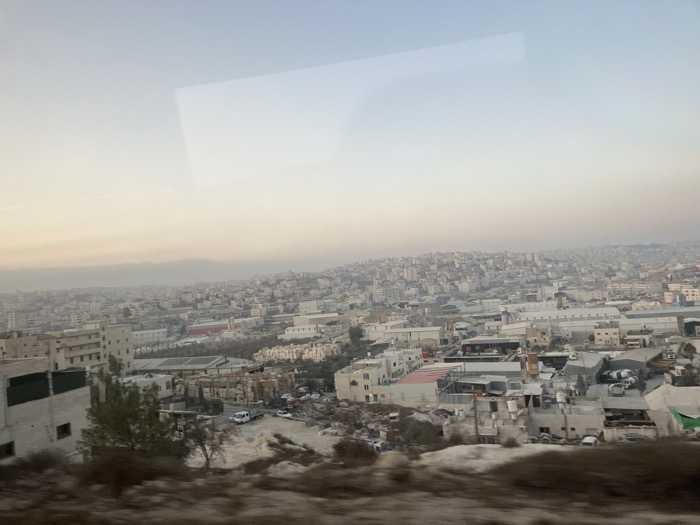
This image captures an elevated, wide-angle view of the city of Hebron, Palestinian Territory, under a hazy sky. The urban landscape features a dense concentration of light-colored, multi-story buildings, predominantly residential and commercial structures, sprawling across undulating terrain and hillsides towards the horizon. In the mid-ground, industrial or warehouse-type buildings with large, flat roofs and some visible solar panels are interspersed within the built environment. The immediate foreground consists of rugged, uncultivated brownish-grey earth and sparse low-lying vegetation. Several vehicles, including a white van and what appears to be a cement mixer truck, are visible on unpaved ground or in parking areas amidst the buildings. Piles of construction materials or debris are also present in several locations. No discernible human figures are clearly visible. The sky is a pale blue-grey, transitioning to a yellowish-pink near the horizon, indicative of an early morning or late afternoon setting. A rectangular reflection is visible in the upper portion of the image, suggesting the photograph was taken through glass.
Hebron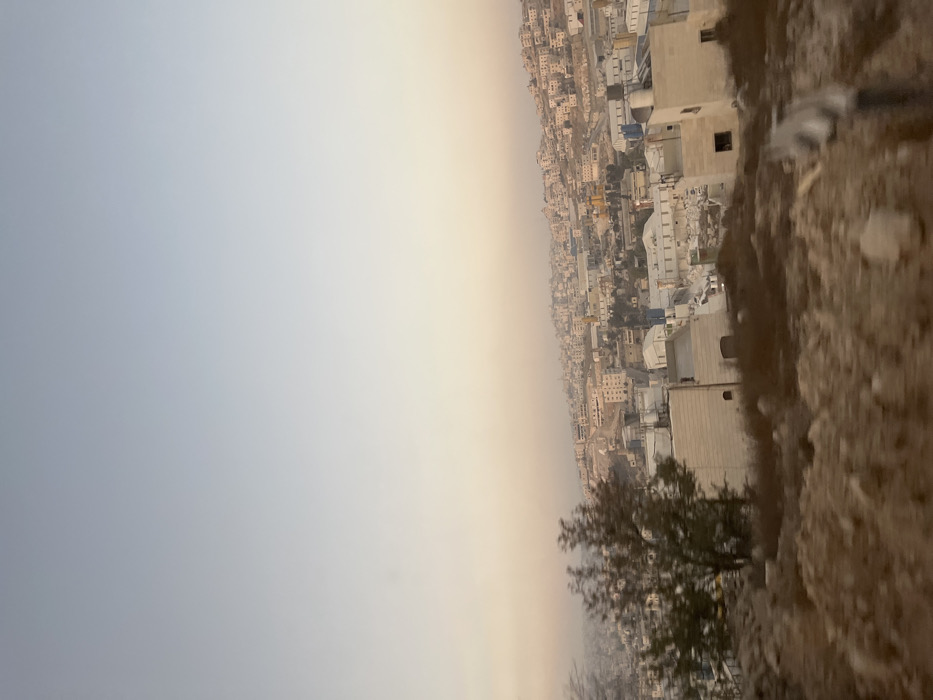
The image displays an elevated panoramic view of the city of Hebron, Palestinian Territory, at what appears to be either dawn or dusk. The sky transitions from a light blue at the top to a pale orange and pink hue near the horizon, indicative of atmospheric haze. The urban landscape is characterized by densely packed, light-colored buildings, predominantly constructed from stone or concrete, extending across undulating hillsides. Numerous flat rooftops feature black or gray cylindrical water tanks. Several minarets are visible throughout the city, with at least two prominent structures featuring golden domes in the central-left midground, suggesting the presence of mosques. Closer to the foreground, some larger, white-roofed structures appear to be industrial or commercial facilities. The immediate foreground consists of dry, rocky soil with sparse brown vegetation, including a partially visible tree on the left. A blurred, dark object in the lower right foreground indicates the image was likely captured from a moving vehicle or platform. No individuals or specific actions are discernible.
Hebron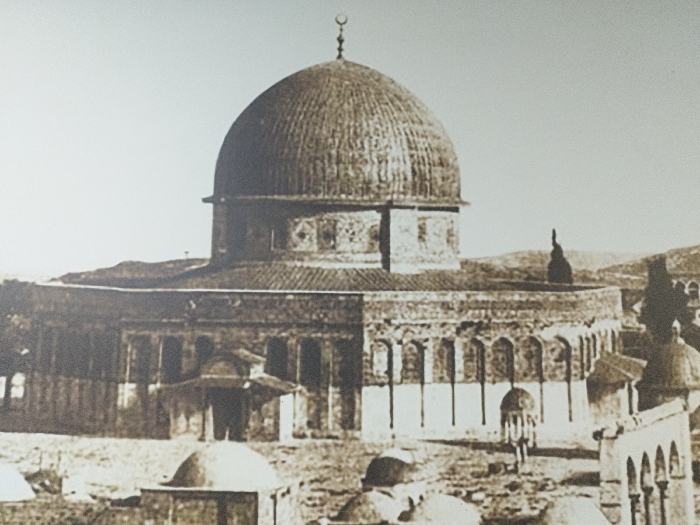
This sepia-toned image presents an exterior view of the Ibrahimi Mosque, also known as the Cave of the Patriarchs, located in the Old City of Hebron, Palestinian Territory. The central and dominant subject is the large, solid-looking stone structure, featuring a prominent, ribbed, dark-colored dome crowned with a crescent moon and star finial. The dome rests on a substantial drum with rectangular window-like openings. Below the dome and drum, the main building exhibits extensive stonework with rows of arched windows or recessed panels along its visible facades. In the foreground and midground, scattered around the main edifice, are several smaller, low-lying structures, including a few with smaller domes and vaulted or arched sections, suggesting tombs or ancillary buildings. The ground is dry, uneven, and appears unpaved. Distant, arid hills delineate the horizon under a clear, bright sky. No individuals, actions, or interactions are visible in the scene.
Hebron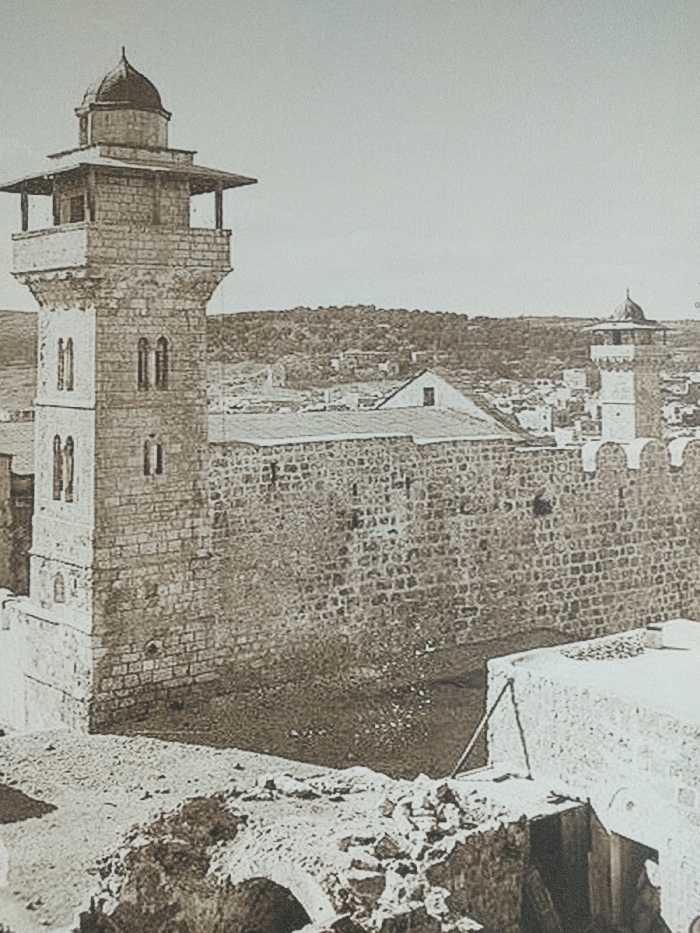
This sepia-toned, historical photograph depicts the Sanctuary of Abraham (Ibrahimi Mosque) in Hebron, Palestinian Territory. The massive stone structure dominates the central and left portions of the image. The prominent feature is the large, multi-story minaret on the left, identified as Al-Jawaliyya Minaret. It is constructed from cut stone blocks, featuring multiple levels with narrow, arched windows. A projecting, open balcony with a railing is visible near its apex, surmounted by a dome. To the right of this minaret, the fortified outer wall of the sanctuary extends, built from large, irregular stone masonry and topped with battlements (crenellations). Further to the right and slightly behind the main wall, a second minaret, Al-Fakhariyya Minaret, is visible, partially obscured but exhibiting a similar domed top and stone construction. Behind the sanctuary walls, the dense urban landscape of Hebron stretches into the mid-ground, showing numerous low-rise buildings with flat and gabled roofs. Beyond the city, a dark, tree-covered hill or elevated terrain forms the distant horizon under a pale, clear sky. In the immediate foreground, the remnants of what appears to be a lower building or wall are visible on the right, constructed of lighter-colored stone with a small, dark opening. The ground in the lower-left foreground is uneven and appears to contain rubble or excavated material. No individuals are discernible in the scene.
Hebron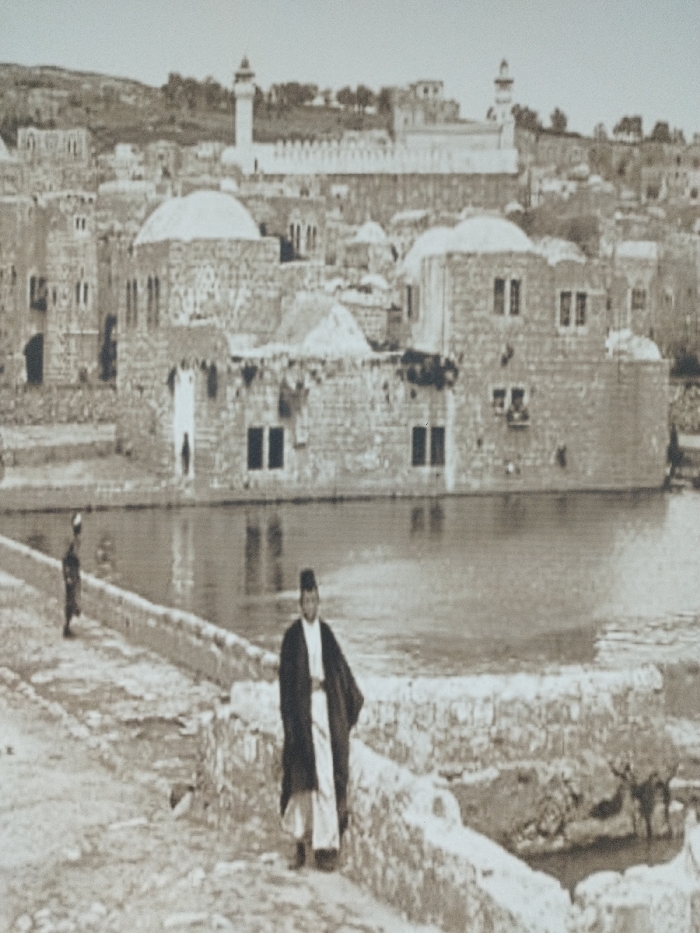
This sepia-toned photograph depicts a historical street-level view within Hebron, Palestinian Territory, centered around one of the city's large water reservoirs, identifiable as either Birket al-Qazzazin or Birket el Sultan. In the foreground, a wide, unpaved stone pathway or embankment extends across the frame, bordered by low stone walls. A prominent male figure stands on this pathway, slightly left of center, facing forward and slightly to the right. He wears traditional attire consisting of a dark outer robe over light-colored garments and a dark, fez-style hat. Further down the pathway to the left, a smaller, less distinct male figure, possibly a child, is seen walking away from the viewer. The midground is dominated by a large, rectangular-shaped water basin, its surface reflecting the sky and surrounding structures. Directly beyond the water, numerous densely packed stone buildings with varying rooflines, including several prominent domes, form the urban landscape. These structures exhibit multiple small, dark rectangular windows. The background reveals the elevated terrain of the city. The fortified walls and two distinct minarets of the Ibrahimi Mosque (Tomb of the Patriarchs) are clearly visible, dominating the skyline on the hill. Additional stone buildings are scattered across the rising ground, interspersed with sparse, indistinct vegetation on the upper slopes. The sky is bright and largely featureless.
Hebron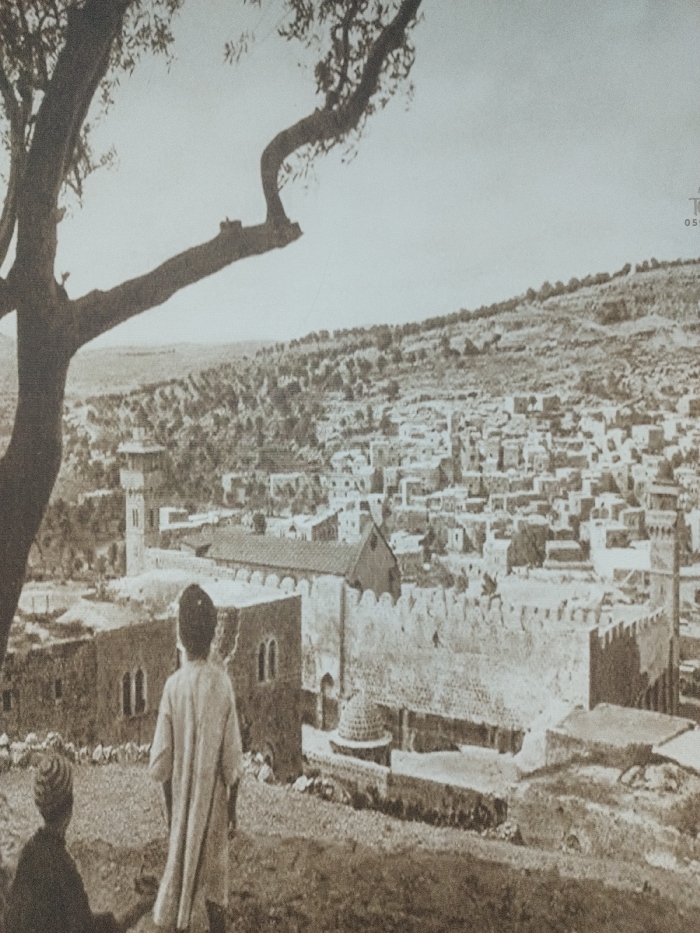
This sepia-toned panoramic photograph depicts a detailed view of Hebron, Palestinian Territory. In the immediate foreground, two individuals are present: a standing person with their back to the viewer, wearing a light-colored long robe and a dark cap, and another person seated or kneeling to the left, also facing away, with a patterned head covering. Both appear to be male. A large, dark tree branch extends from the upper left, framing the scene. The ground beneath them is uneven and sparsely vegetated. The midground is dominated by the Ibrahimi Mosque/Tomb of the Patriarchs, a substantial rectangular stone structure characterized by high, thick, crenellated walls. A tall, multi-tiered minaret with arched windows stands prominently to the left of the main walled complex. Adjacent to the main structure, particularly visible on the lower right outside the main wall, is a smaller, domed architectural feature. Other stone buildings with multiple windows are visible immediately surrounding the main complex. The background reveals a dense cluster of traditional stone buildings with flat roofs, constituting the city of Hebron, which sprawls across a gentle hillside. Beyond the urban area, the landscape consists of terraced hillsides, appearing sparsely vegetated, likely with olive groves. The sky is clear and bright, indicating daylight conditions. No specific interactions are depicted between the two figures, who appear to be observing the city.
Hebron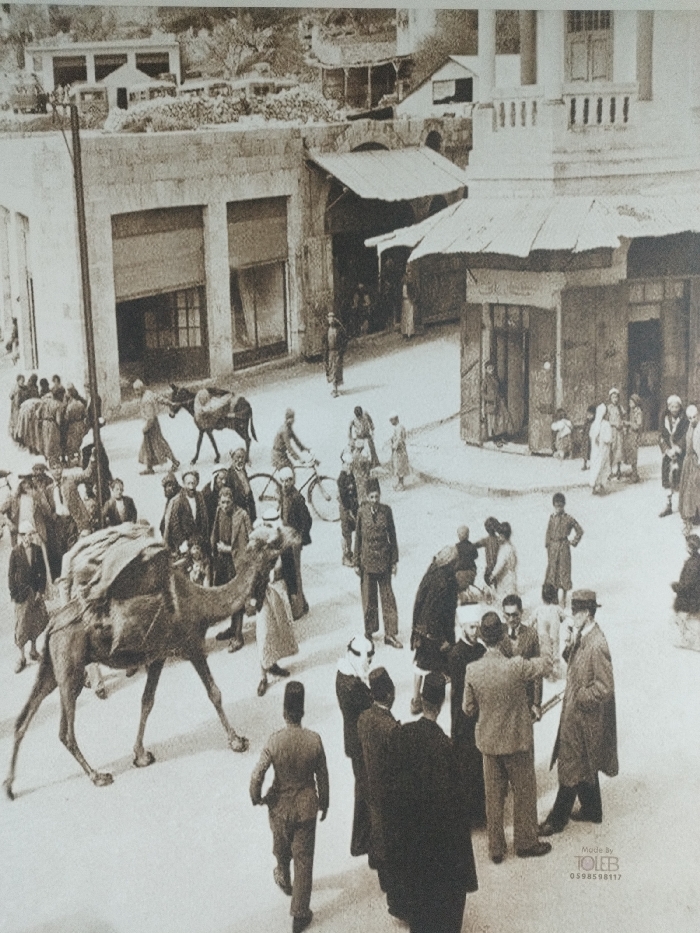
This sepia-toned historical photograph depicts a busy outdoor marketplace or town square in Hebron, Palestinian Territory. The unpaved ground surface is densely populated with individuals, animals, and architectural structures under daylight conditions. Approximately 50 to 60 individuals of varying ages are visible, engaged in transit, congregation, and interaction. Attire is a mix of traditional Middle Eastern garments, including long robes, head coverings such as kaffiyehs and tarbooshes, and early 20th-century Western-style suits, overcoats, and hats (including fedoras) worn by men. In the lower right foreground, a group of men in suits and hats are observed conversing. Key subjects include: * **Animals:** A camel, laden with bundled cargo, walks from the left mid-ground towards the right foreground. A donkey, also carrying a load, is led by a person in the mid-left. * **Vehicles:** A man on a bicycle is present in the mid-ground. * **Structures:** The scene is framed by multi-story stone buildings. A prominent building on the left features large ground-floor window openings, possibly with external shutters. Towards the right, several smaller structures, likely market stalls, feature corrugated metal awnings and open fronts. Further buildings and hilly terrain are discernible in the background. * **Objects:** A tall, dark utility pole stands vertically on the left side of the image. The overall environment suggests a vibrant commercial and social hub, indicative of daily life in the city during the era of the photograph.
Hebron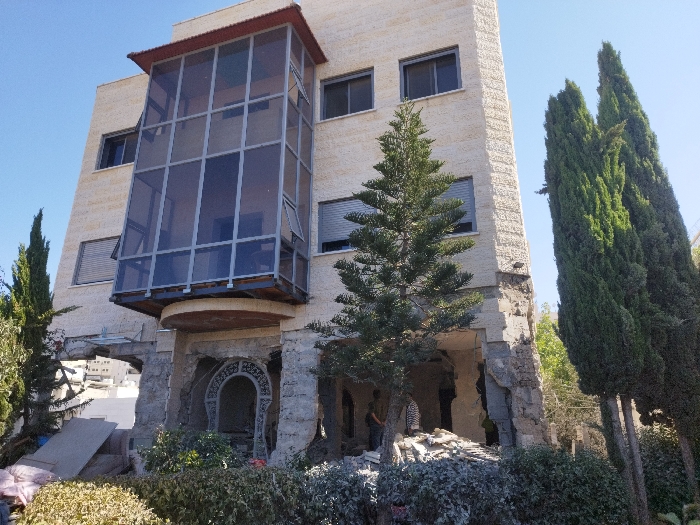
The image displays a four-story, light-colored stone or concrete building, likely a residence, situated in Hebron, Palestinian Territory, under a clear blue sky. The building's facade includes a prominent enclosed balcony with a reddish sloped roof and multiple dark-paned windows, some equipped with external roller shutters. The ground floor of the structure is severely damaged, with large sections of supporting pillars crumbled, exposing rebar and piles of concrete rubble. A decorative, arched entryway is partially visible within the damaged base. Two individuals are faintly discernible within the damaged ground-level area, one in a dark shirt and the other in a light striped shirt, standing amidst the debris. The immediate foreground features a landscaped area containing various green bushes, a central pine-like tree, and two tall, slender cypress trees positioned to the right of the building. Additional construction debris, including flat panels, is present on the left side of the foreground. Other light-colored buildings are visible in the background on a distant hillside.
Hebron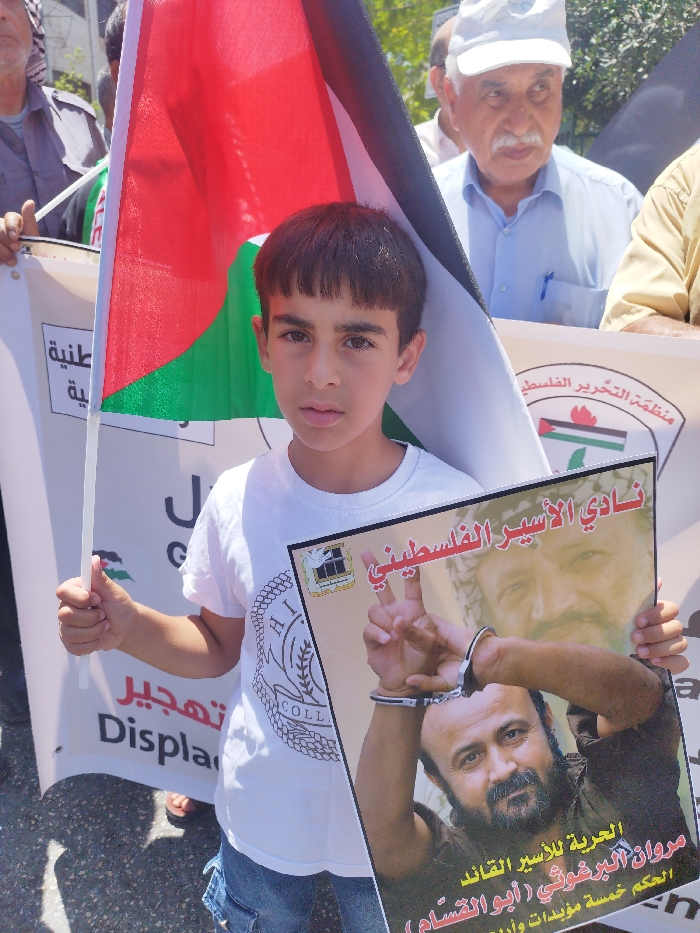
The image captures an outdoor scene in the city of Hebron, Palestinian Territory, featuring a central focus on a young boy. The boy, appearing pre-adolescent, has short dark hair, light-colored eyes, and a neutral expression, looking directly at the viewer. He wears a white short-sleeved t-shirt with a visible "HI COLLEGE" logo and blue denim shorts. The boy holds an upright Palestinian flag with his left hand, the red, black, white, and green flag extending vertically behind his left side. With both hands, he holds a rectangular poster in front of him. The poster features two images of men; a lighter, older man's portrait at the top and a more prominent image below of a bearded man with a mustache, wearing a dark shirt. This man's left hand is visibly cuffed, while his right hand forms a V-sign. Arabic text at the top of the poster reads "Palestinian Prisoner's Club" (نادي الأسير الفلسطيني), and at the bottom, "Freedom for the captive leader Marwan Barghouti (Abu al-Qassam)" (الحرية للأسير القائد مروان البرغوثي (أبو القسام)) followed by "Sentenced to five life terms and forty years" (الحكم خمسة مؤبدات وأربعين عامًا). A small emblem on the top left of the poster depicts a barred window with a dove and an olive branch. In the background, behind the boy, an older man with a white mustache and a white baseball cap is visible, wearing a light blue button-down shirt with a blue pen in its pocket. Other individuals are partially visible on the far left and right. White banners with Arabic text and some English words, including "Displace," are held horizontally across the background. One banner section clearly displays a logo resembling the Palestine Liberation Organization emblem, featuring a map of Palestine with a flame. The scene is illuminated by bright sunlight, suggesting a daytime setting, with some green foliage visible in the upper right. The ground is a dark, paved surface.
Hebron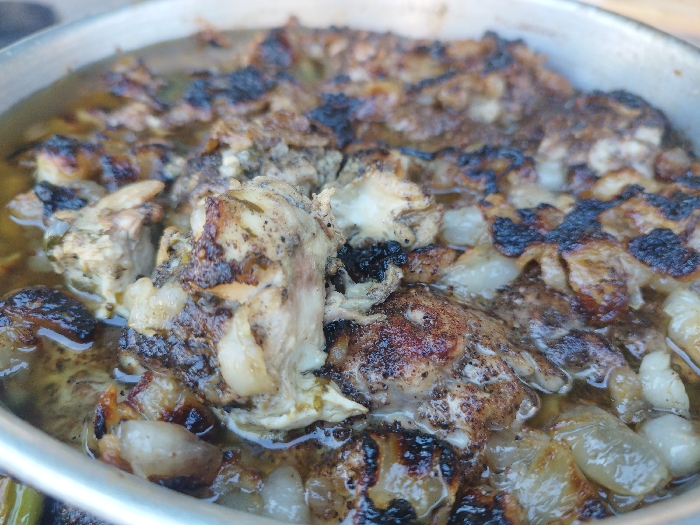
The image displays a close-up, overhead view of cooked food contained within a round, metallic pan. The pan's light grey rim is visible along the edges. The primary components of the dish are numerous irregularly shaped pieces of cooked meat, possibly chicken or lamb, varying in size from approximately 2 to 5 centimeters. These pieces exhibit a range of colors, including off-white, light grey, and brown, with significant portions displaying dark charring or blackening, indicating grilling or roasting. Dark specks, consistent with ground pepper or other seasoning, are visible on many pieces. Interspersed among the meat pieces are translucent, white to pale yellow, amorphous globules and fragments, which appear to be rendered fat or very soft, cooked onions. All components are submerged in a shallow pool of yellowish, oily liquid. No individuals, direct actions, or specific environmental details beyond the immediate pan are discernible within the frame. The location within the city of Hebron, Palestinian Territory, cannot be determined from the visual evidence provided in this image.
Hebron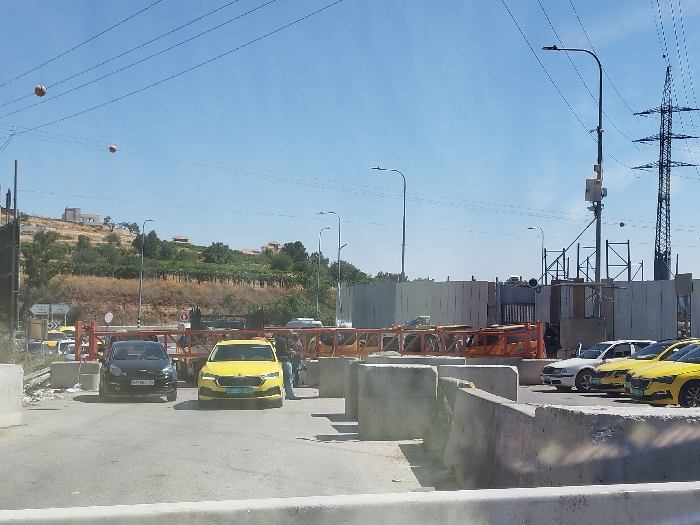
A daytime shot reveals a checkpoint, likely at a border crossing. Several vehicles, including a black car and two distinctive yellow ones, queue to pass. Security personnel are visible. The checkpoint is constructed with concrete barriers and orange metal structures. Power lines with orange markers run overhead. A hillside with vegetation and a few buildings is visible in the background, along with power pylons and streetlights. The sky is clear blue.
Hebron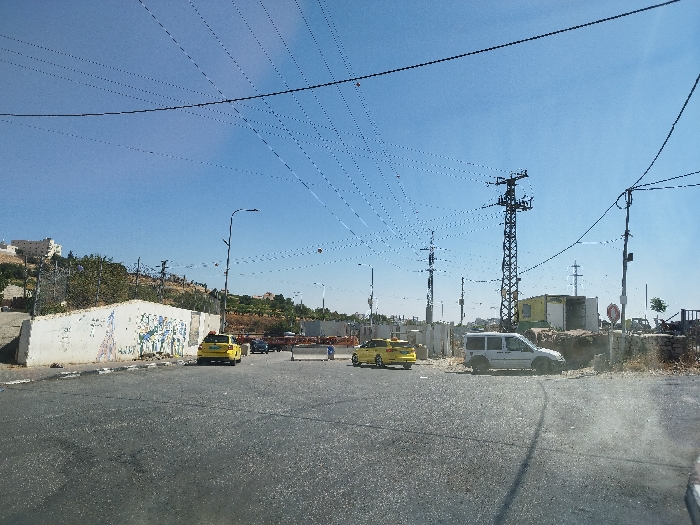
A street scene presents a junction with yellow taxis and a white van positioned near a construction site. Overhead, a web of power lines crisscrosses the clear blue sky. Graffiti adorns a low wall on the left. Utility poles rise along the roadside, supporting the complex network of wires. A building sits atop a hill in the distance. The road surface appears asphalt, and the overall impression suggests an urban or suburban setting.
Hebron