Heraklion, Greece
23 memories from Heraklion, Greece
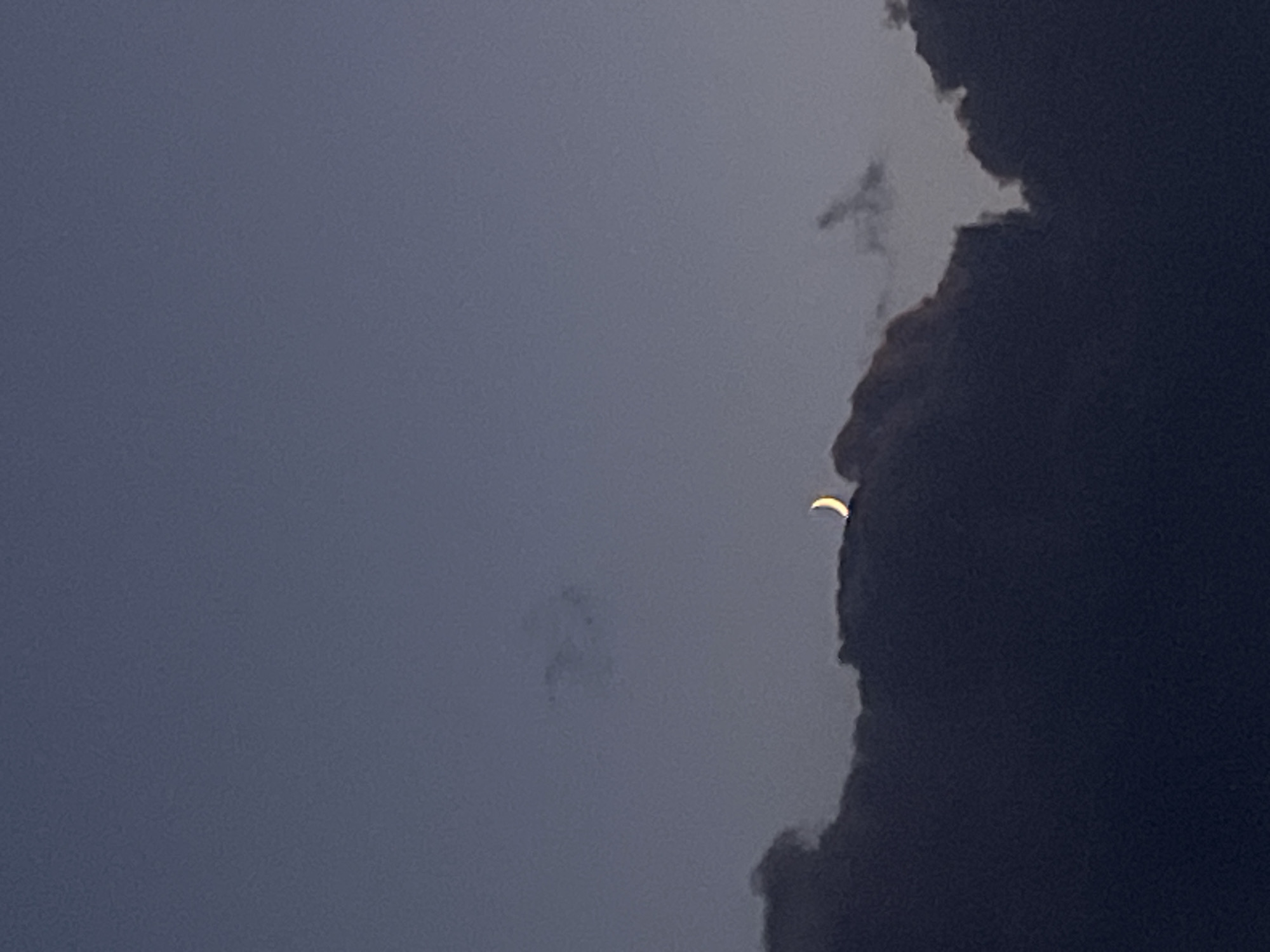
A crescent moon is visible in a dark, cloudy sky over the city of Heraklion, Greece. The moon is a thin sliver of light, appearing to the left of a gap in the dark clouds that occupy the lower portion of the frame. The sky is a deep blue-grey, suggesting it is either early morning or late evening. The clouds are thick and ominous, obscuring much of the sky and creating a dramatic contrast with the illuminated moon. No people or man-made structures are clearly discernible in this image.
Heraklion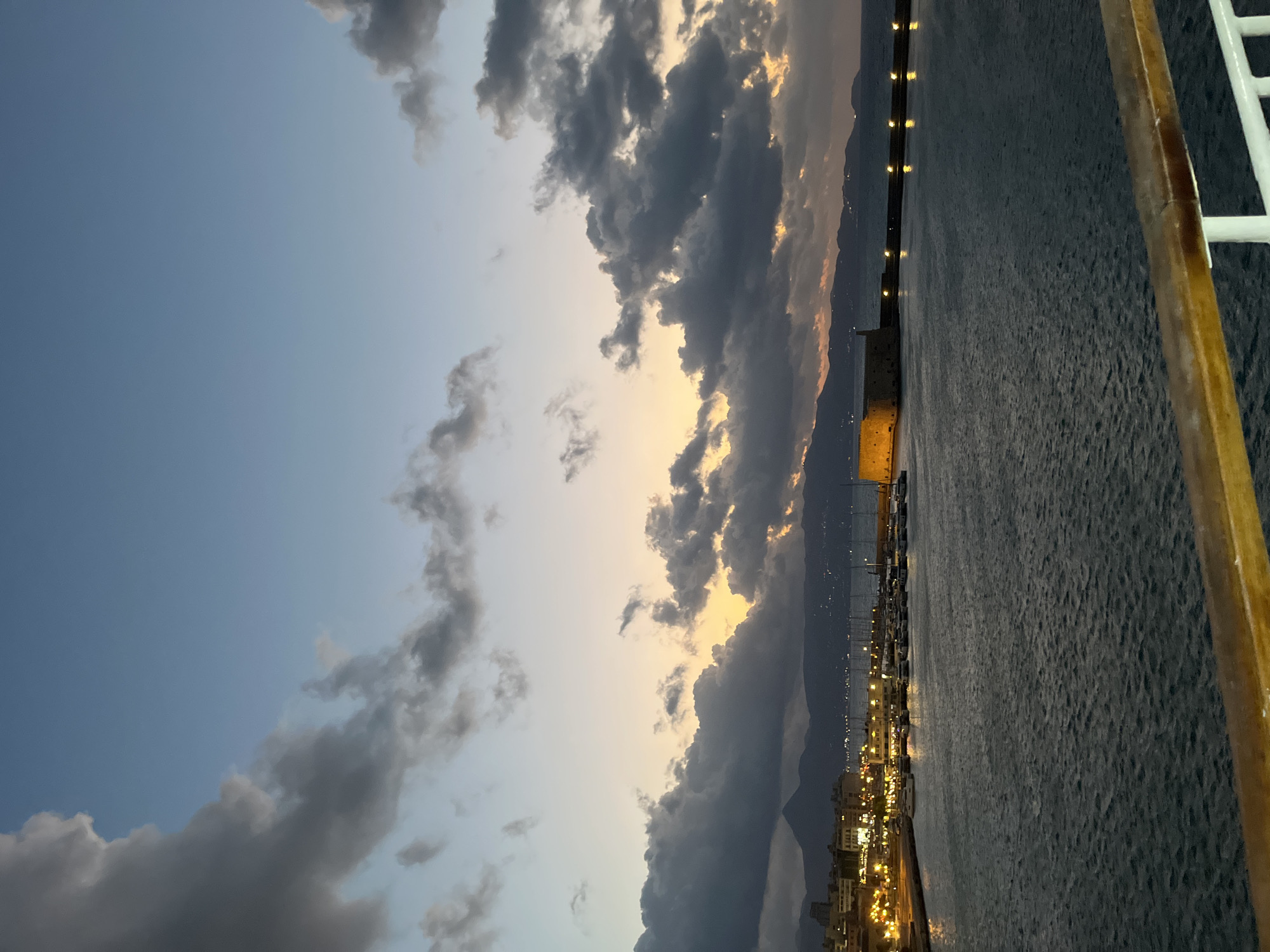
The image captures a twilight view of the Venetian harbor in Heraklion, Crete, Greece. The sky is a gradient of deep blue at the top transitioning to soft yellows and oranges near the horizon, punctuated by dramatic, dark gray clouds. In the foreground, the dark, rippling surface of the sea is visible, with the top of a white railing and a wooden handrail in the lower right corner, suggesting the vantage point is from a boat or ferry. The middle ground features the harbor with numerous boats docked. The waterfront city of Heraklion is illuminated by warm yellow lights, casting a glow on the buildings. Mountains form a dark silhouette in the background. The prominent structure in the harbor is the Koules Fortress, a Venetian fortress at the entrance to the old port, its stone walls lit by exterior lights. A long breakwater, also lined with lights, extends into the sea from the fortress. The overall impression is a serene, picturesque evening scene of a coastal city.
Heraklion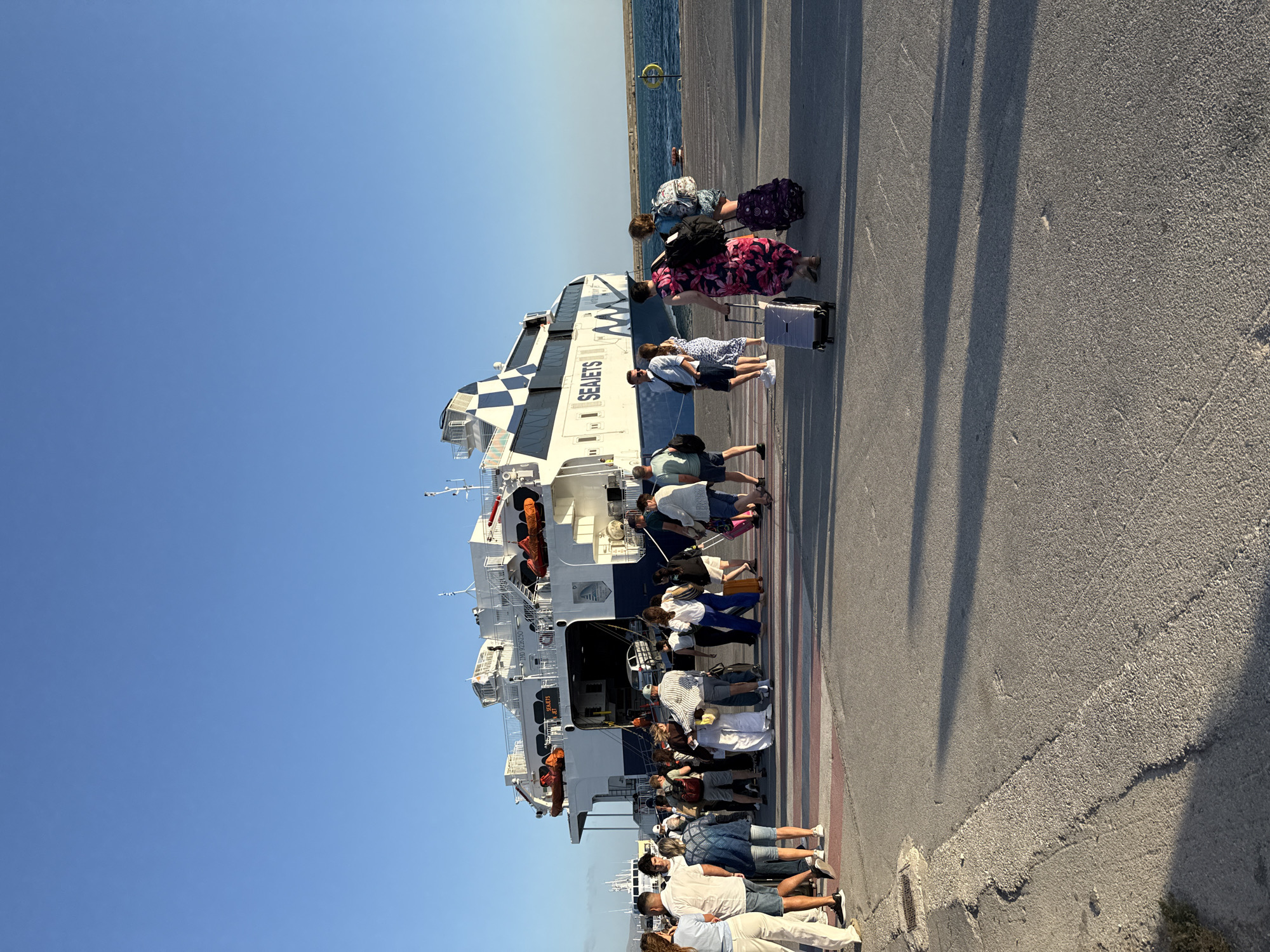
A group of people are disembarking from a large white ferry with the word "SEAJETS" visible on its side. The ferry is docked at a port, and there is a clear blue sky overhead. The people are dressed in casual summer clothing and are carrying luggage, including suitcases and backpacks. Some are walking towards the camera, while others are walking away. The ground is paved and has red and white striped markings, possibly indicating a pedestrian crossing. The ferry has several decks and life rafts are visible along its side. In the background, the sea is visible, and there is another smaller ferry or boat in the distance. The overall scene suggests a busy port at sunset or sunrise, with travelers arriving or departing. The location is the port of Heraklion, Greece, evident from the context provided with the prompt.
Heraklion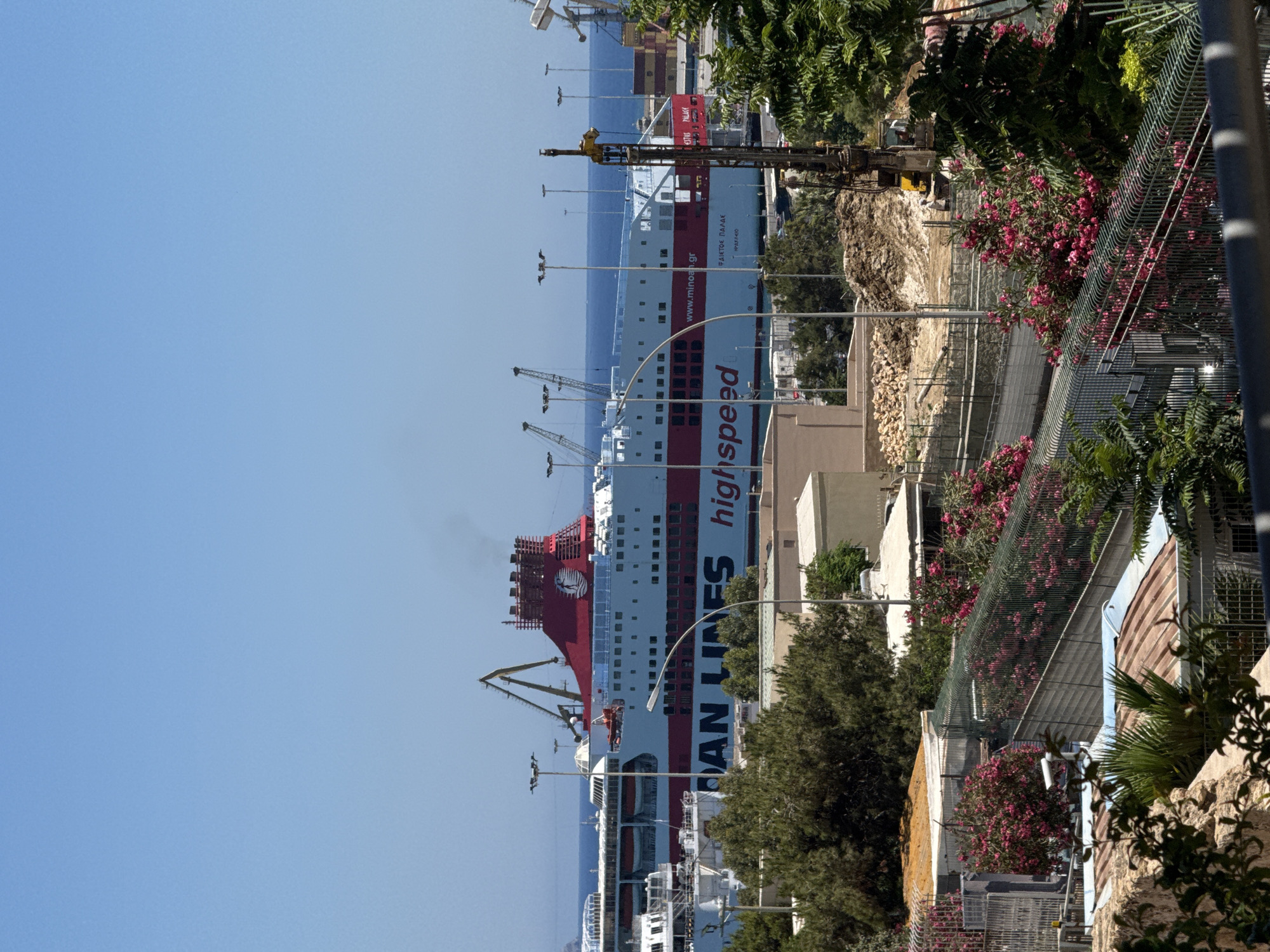
In Heraklion, Greece, a large ferry, identified as "HIGH SPEED" and bearing the Minoan Lines logo, is docked at a port under a clear blue sky. The ferry is predominantly white with a striking red stripe running along its hull and a red superstructure. Smoke emanates from its stack. In the background, industrial cranes are visible, suggesting ongoing port operations. The foreground features lush green trees and flowering bushes, with some metal fencing. A construction site with a pile of dirt and a drilling rig is also present, indicating development or maintenance work. The water is calm and blue, meeting the horizon under the bright sun.
Heraklion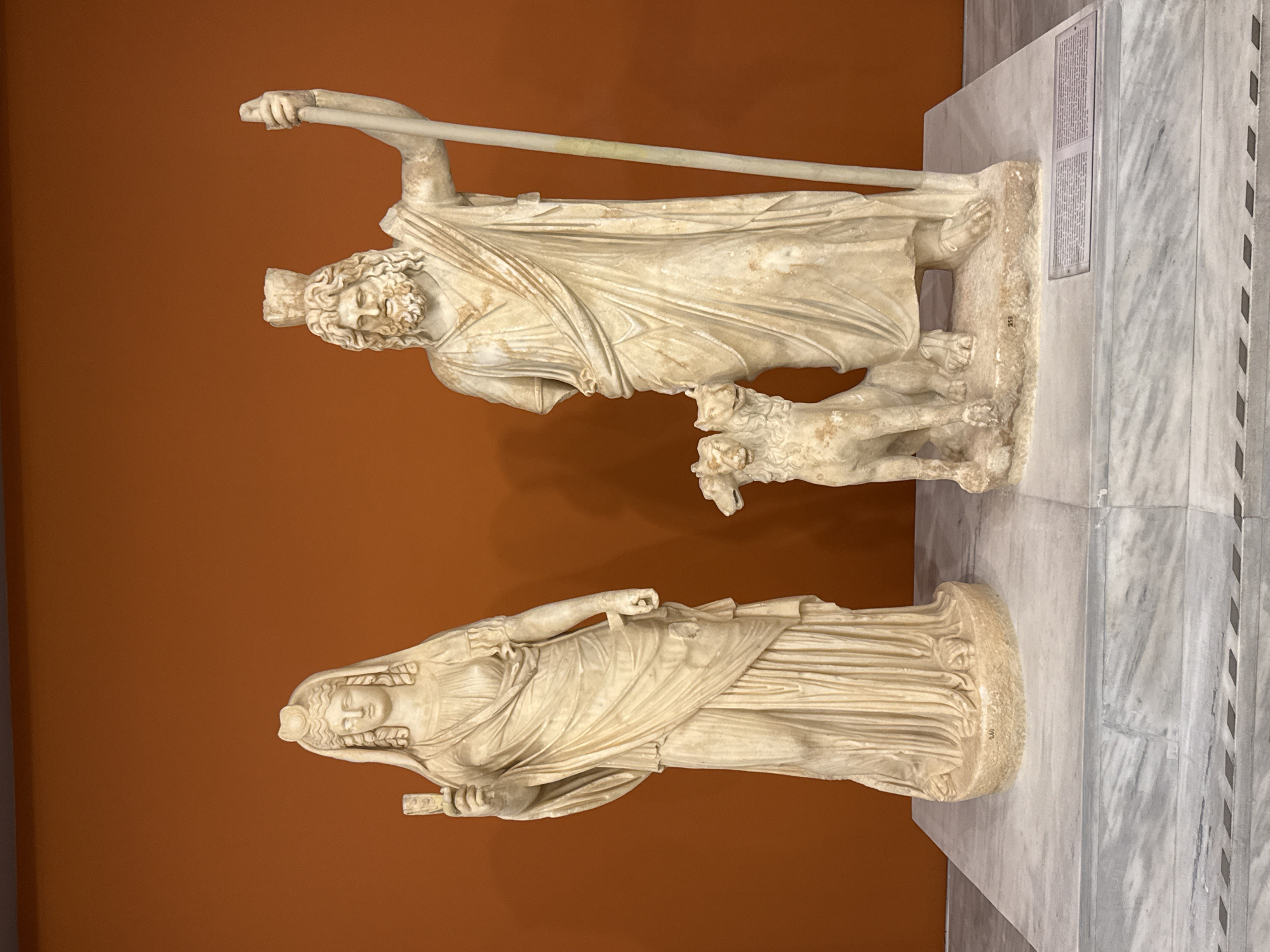
This image shows two marble statues in a museum setting. The statue on the left depicts a female figure wearing a veil and holding a rectangular object in her raised left hand. She is draped in flowing robes. The statue on the right depicts a male figure with a beard and a crown-like headdress, holding a staff in his right hand and standing next to a three-headed dog. He is also draped in flowing robes. Both statues are standing on separate marble bases, which are placed on a larger marble platform. The background is a solid, orange-brown color. A plaque with text is visible on the platform in front of the male statue. This is a photograph of an exhibit at the Heraklion Archaeological Museum in Heraklion, Greece, likely depicting figures from Greek mythology.
Heraklion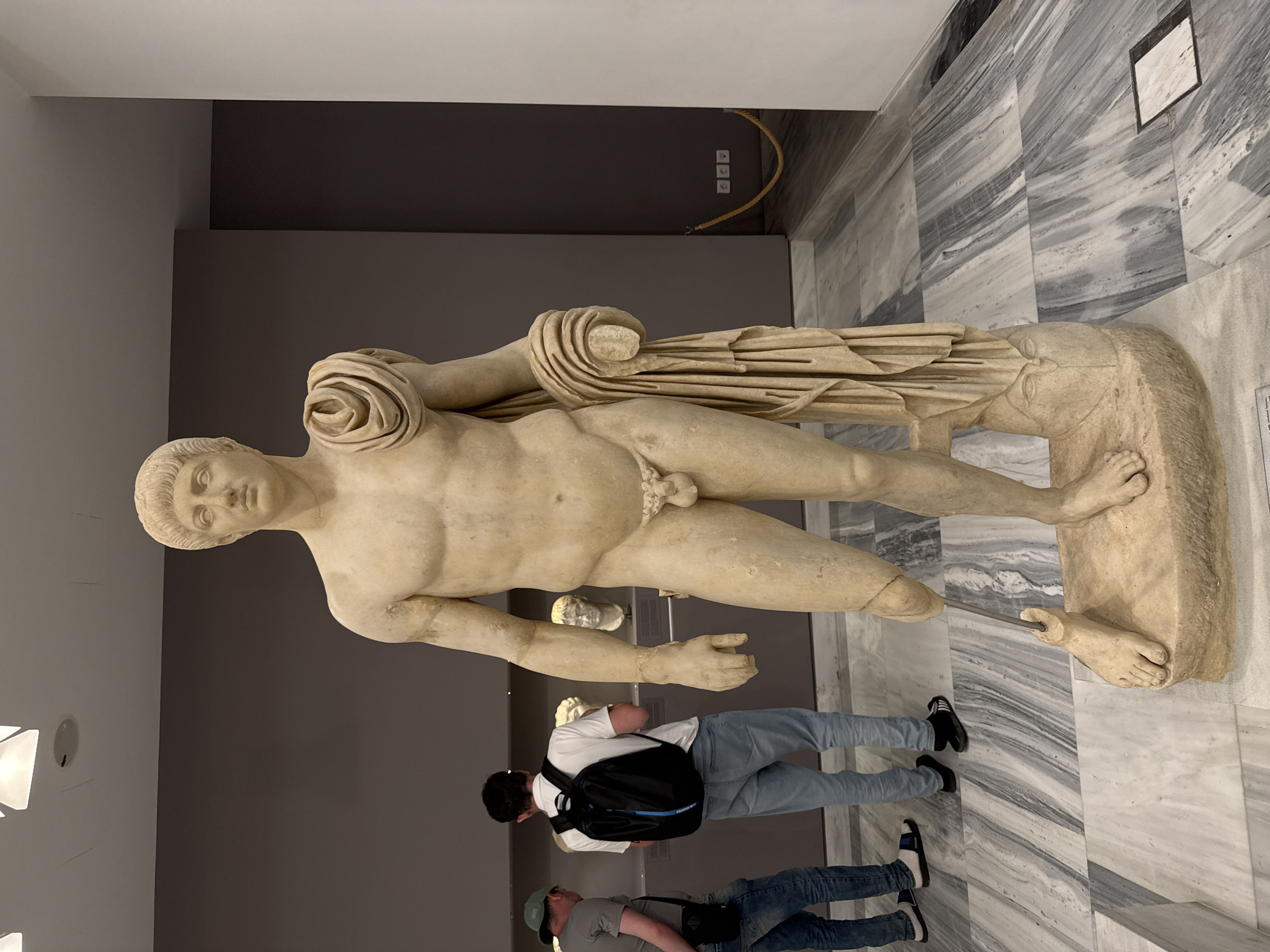
The image depicts a marble statue of a male figure, likely ancient Greek or Roman, displayed in a museum. The statue is life-sized and depicts the man nude, with a drapery draped over his left shoulder and arm, and held in his right hand. The statue is missing its lower legs, with the remaining stumps resting on a stone pedestal. The statue is set against a grey wall with modern lighting fixtures visible on the ceiling. In the background, two men are observing exhibits, one wearing a green cap and the other a white shirt and black backpack. The floor is made of marble tiles with a grey and white veined pattern. The statue is in a well-lit museum setting. The location is the Heraklion Archaeological Museum in Heraklion, Greece, a prominent museum housing artifacts from Minoan civilization and other periods of Cretan history.
Heraklion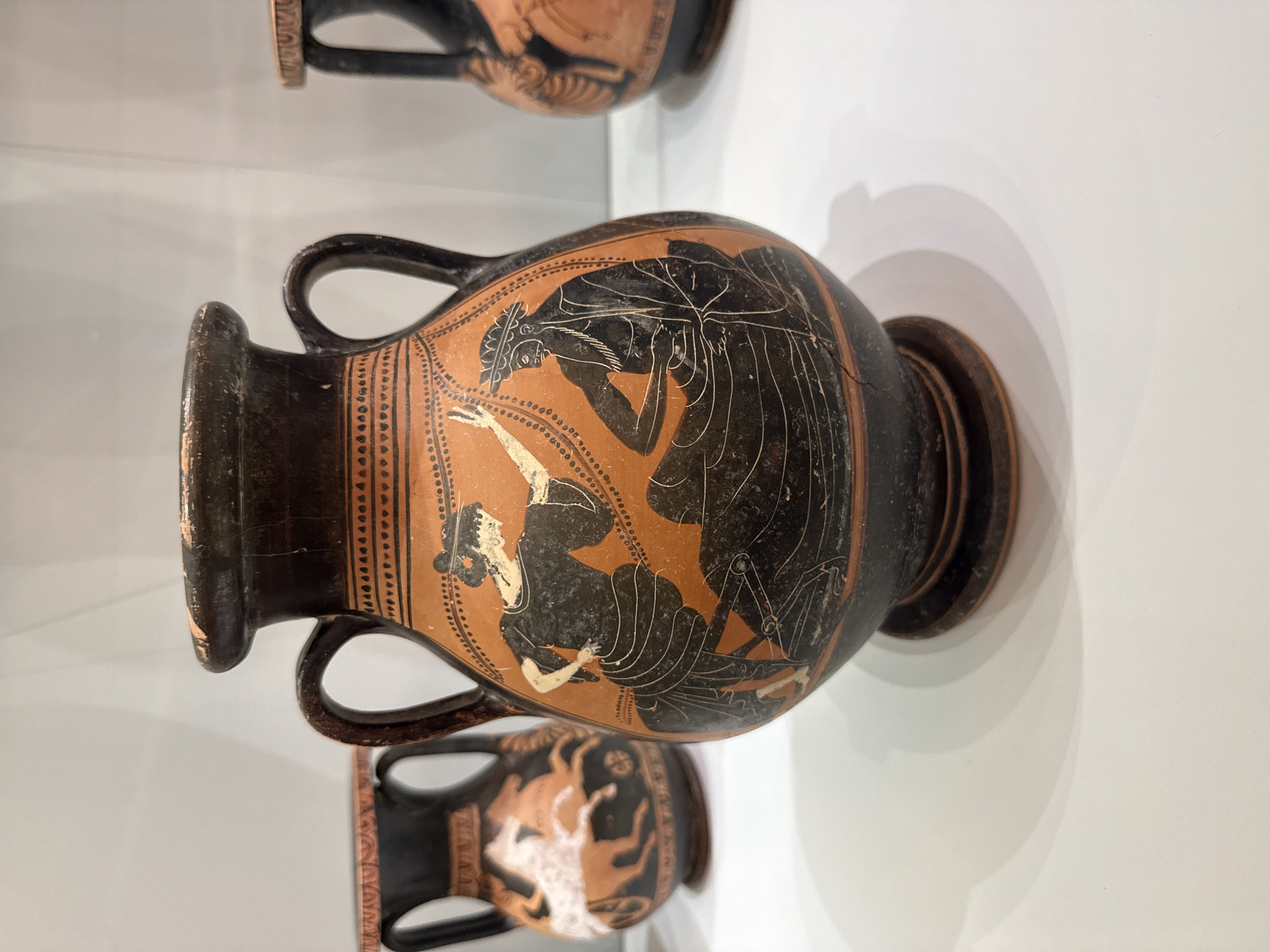
The image shows a reddish-orange ceramic amphora with black painted figures. The amphora has two handles and a narrow neck, widening to a bulbous body that tapers to a footed base. The main decoration on the front of the amphora depicts two figures in black silhouette style. On the left, a standing female figure with her hair in a bun extends her left arm towards a seated male figure on the right. She wears a garment that leaves her right arm bare and a patterned skirt. The seated male figure is bearded and wears a headdress and a draped garment. He holds an object, possibly a lyre, in his lap. Both figures have detailed facial features rendered in thin black lines. The amphora is displayed on a white surface, likely a pedestal in a museum exhibit. To the left and right of the central amphora, other similar ceramic vessels are partially visible, suggesting a collection or display of ancient pottery. The background is a plain, light gray. The location is not discernible from the image alone, but such artifacts are commonly found in museums such as the Archaeological Museum of Heraklion, Greece.
Heraklion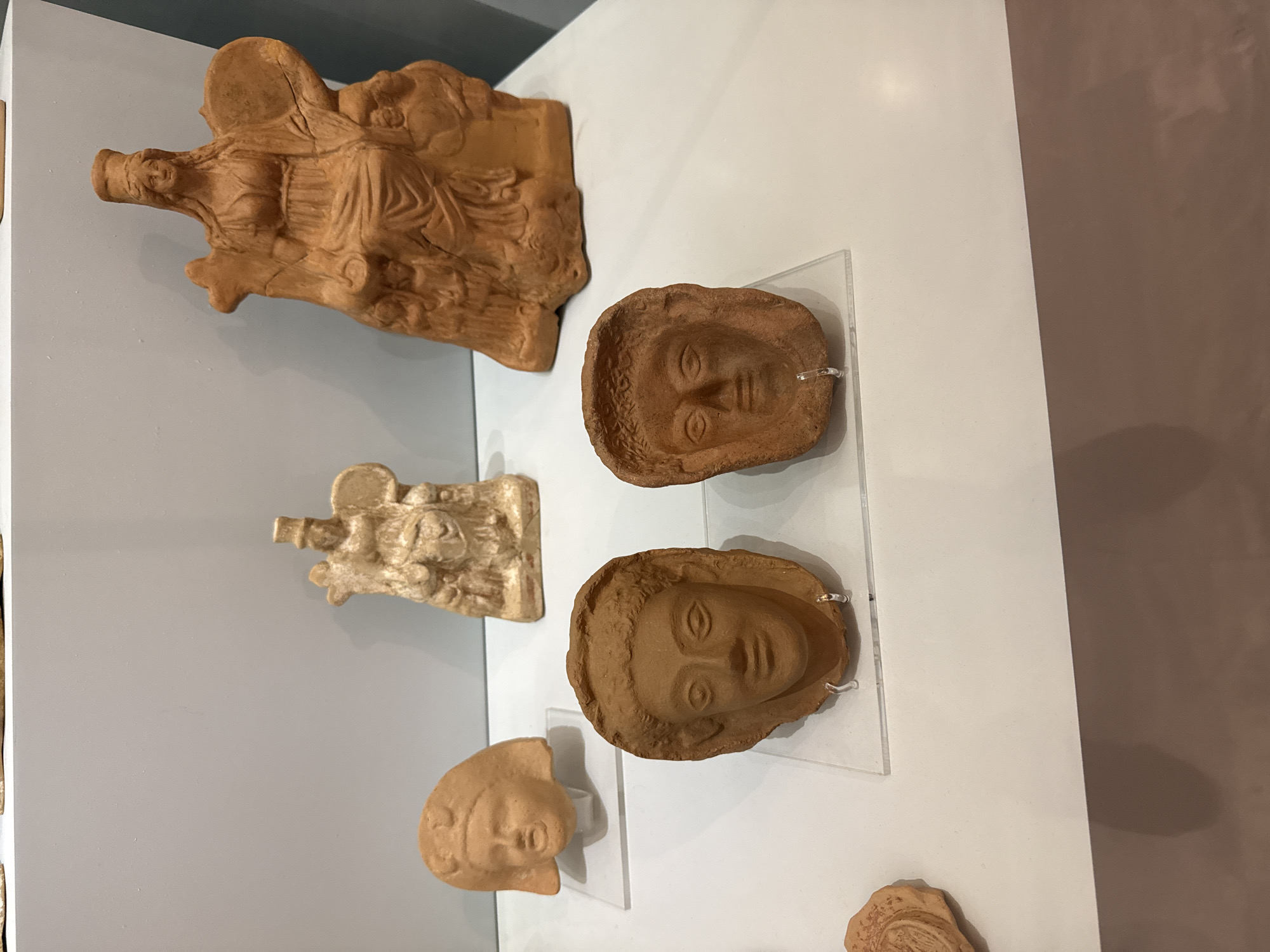
The image displays several ancient terracotta artifacts, likely from a museum exhibition. In the foreground, two terracotta heads are showcased on clear plastic stands. The head on the left is slightly angled, with simplified facial features and a round headdress. The head on the right is facing forward, also with stylized features and curly hair. Behind these, to the left, another terracotta head is visible, less detailed than the two in the foreground. In the middle ground, a small, light-colored terracotta figurine of a seated figure with a circular object in its hands stands on a pedestal. To the right, a larger, darker terracotta sculpture depicts a seated female figure with a headdress, a draped garment, and multiple figures clustered around her base. The objects are arranged on a white surface, with a light grey wall in the background. These artifacts are likely part of the collection at the Heraklion Archaeological Museum in Heraklion, Greece, known for its extensive Minoan and Hellenistic antiquities.
Heraklion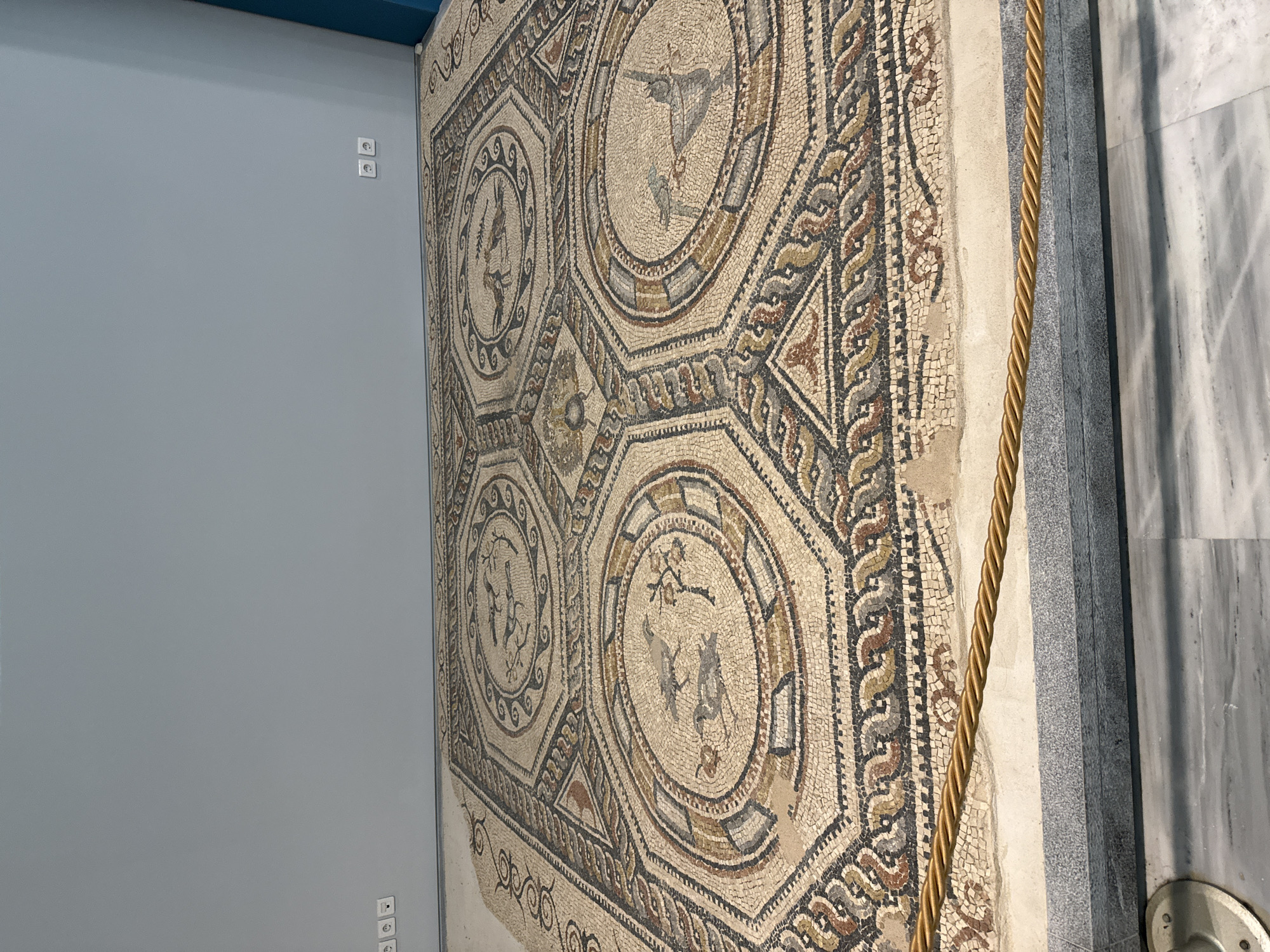
The image shows a large, ancient mosaic floor on display indoors, likely in a museum. The mosaic is octagonal in shape and features several circular medallions containing depictions of birds. The surrounding geometric patterns are intricate and display a variety of colors, including beige, brown, black, gray, and red. The mosaic is laid out on a flat surface, and a golden rope barrier is positioned in front of it, separating it from the viewer. In the background, a light gray wall with several electrical outlets is visible. The floor in front of the mosaic is a polished marble or stone. This mosaic is located in the Heraklion Archaeological Museum in Heraklion, Greece, and is a significant artifact from Roman times.
Heraklion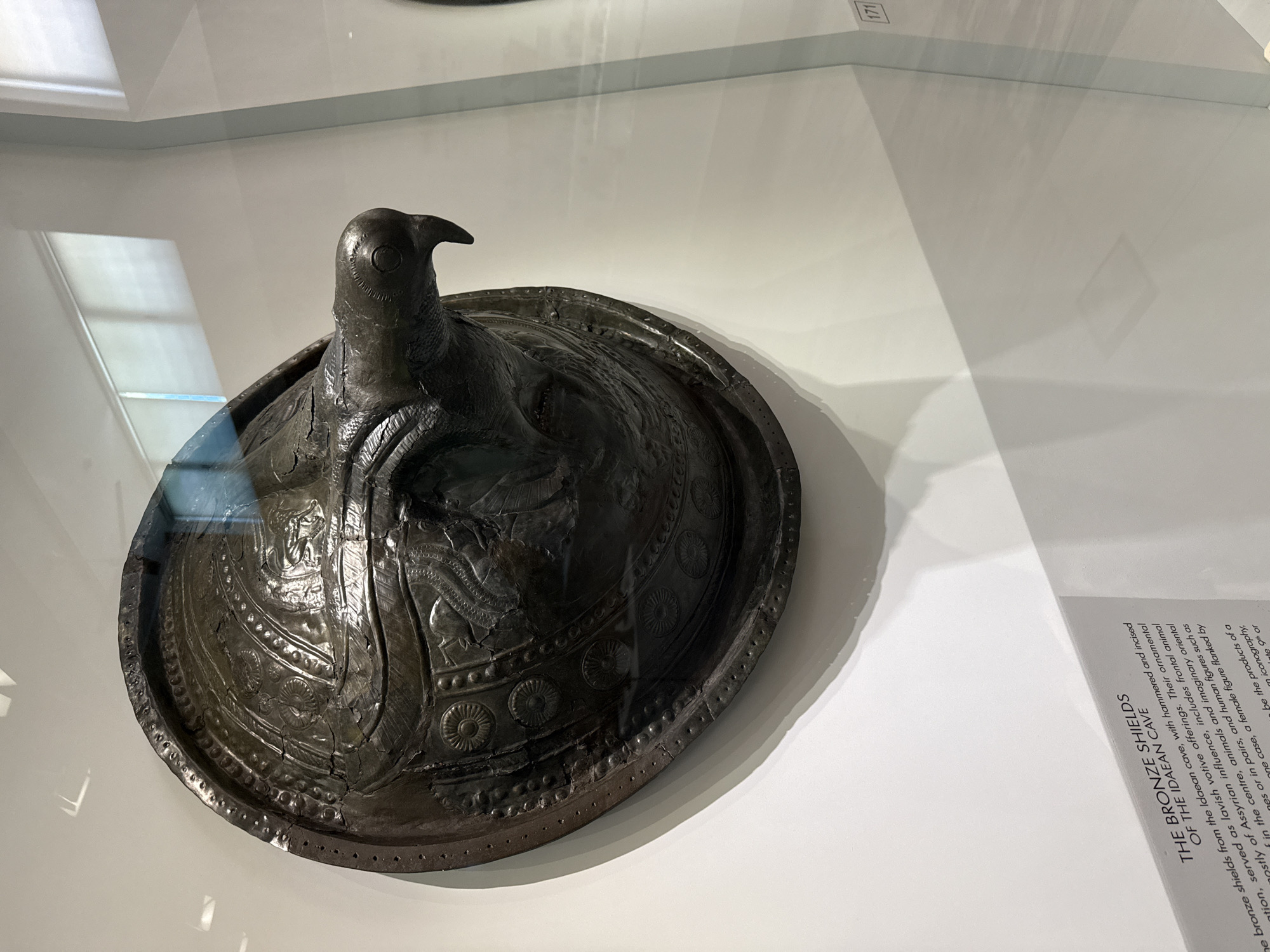
The image shows a close-up view of a large, dark bronze shield with intricate carvings, displayed in a museum case. The shield is convex and has a prominent bird-like projection extending from its center. The surface of the shield is decorated with repeating patterns, including circular motifs and what appear to be stylized animal figures. The bronze exhibits signs of age and wear, with some cracks and imperfections visible. The shield is displayed against a plain white background, which is slightly obscured by the glass of the display case, causing reflections. A label in the lower left corner of the image reads "THE BRONZE SHIELDS OF THE IDAETAN CAVE". The text describes the shields as being from the Idaetan cave, made of bronze, and used as lavish votive offerings. It mentions their ornamental decoration, hammered and incised designs, and inclusion of frontal animal motifs, as well as human figures. The text also hints at the geographical location by referencing the Idaetan cave. While the image is taken within a museum, the specific location in the city of Heraklion, Greece is not explicitly stated. However, given the label mentioning the "Idaetan cave," it is highly probable that this artifact is displayed at the Archaeological Museum of Heraklion, which houses many important Minoan and Mycenaean artifacts, including those from Mount Ida. The presence of a label and the museum display setting suggest that this is a historical artifact being exhibited to the public. No people are visible in the image, and no actions or interactions are occurring. The environment is that of a museum exhibit.
Heraklion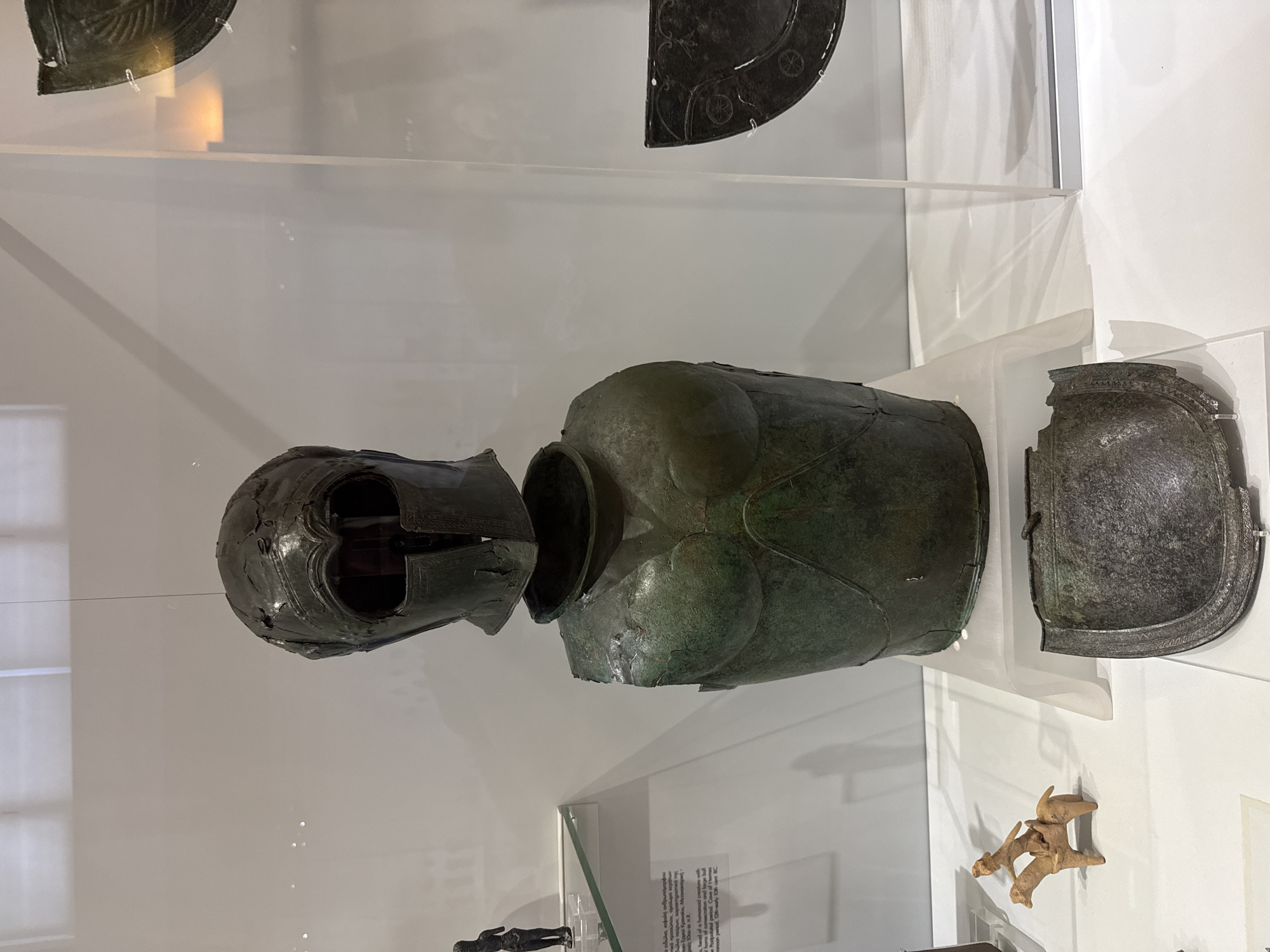
The image displays a museum exhibit in Heraklion, Greece, featuring ancient bronze armor and artifacts. The central subject is a damaged bronze helmet and cuirass, likely from a Greek warrior, positioned on a transparent stand. To the left of the armor, a small, terracotta figurine of a person riding a horse is visible on a lower shelf, next to informational text. In the background, through a glass display case, another section of the museum is visible with a fragment of bronze weaponry. The lighting is soft and diffused, typical of a museum setting, illuminating the aged patina of the bronze objects. The overall scene is one of historical preservation and display.
Heraklion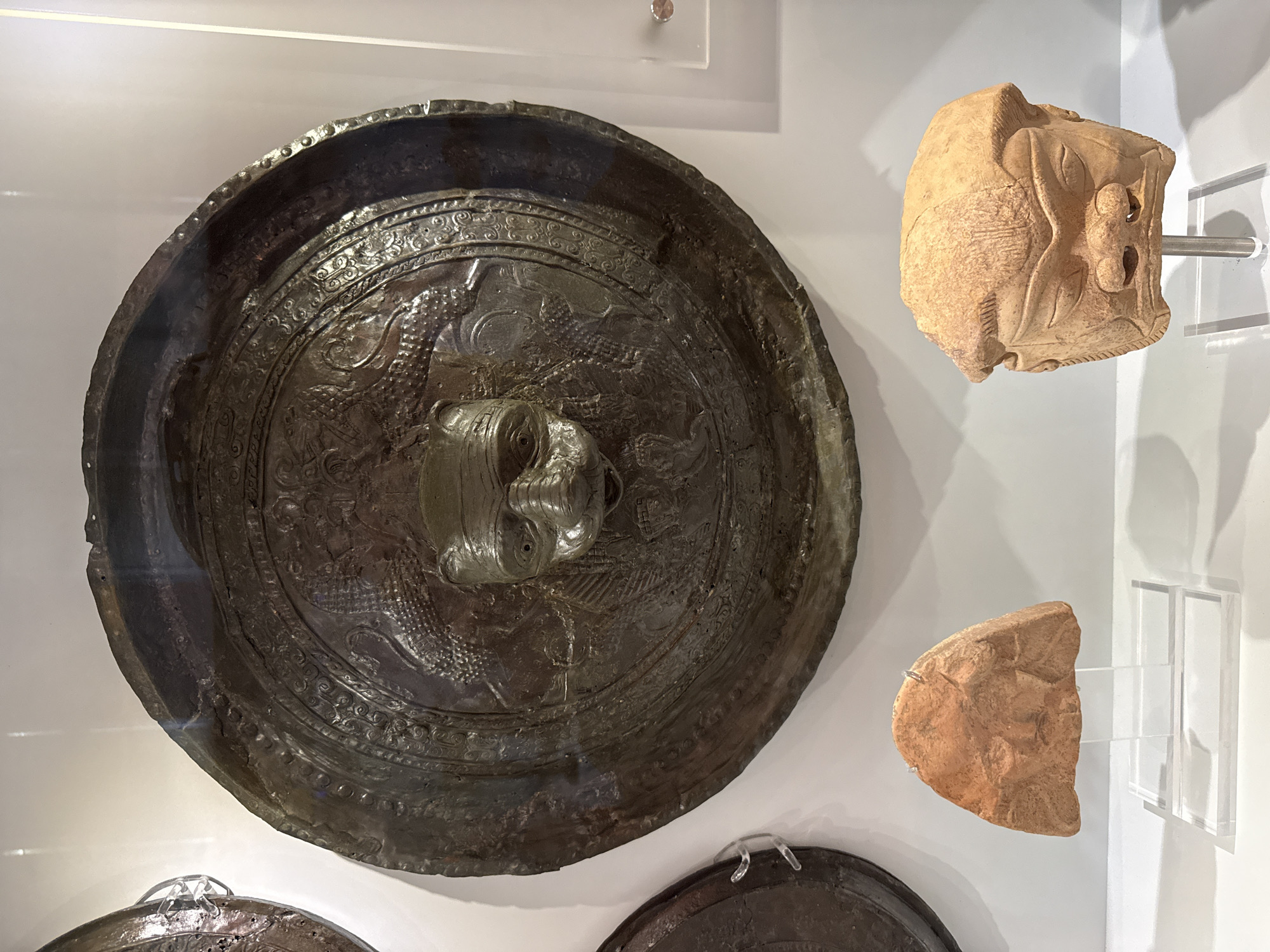
The image depicts an archaeological display within a museum, likely the Heraklion Archaeological Museum in Heraklion, Greece, given the nature of the artifacts. The central and largest object is a circular, dark metallic shield, possibly bronze, with a prominent, raised, grotesque face at its center. The face has wide eyes, a flattened nose, and an open mouth. Surrounding the central face, the shield is intricately decorated with embossed patterns and what appear to be serpentine or draconic figures. The rim of the shield is rough and shows signs of age and wear. To the lower left of the shield, a small, reddish-brown clay fragment is displayed on a clear acrylic stand. This fragment appears to be part of a larger object, possibly a vessel or sculpture, with faint markings suggesting a face or design. To the lower right of the shield, a larger, light brown ceramic mask is mounted on a metal rod within a clear acrylic stand. This mask has a stern, somewhat exaggerated facial expression with deep-set eyes, a broad nose, and prominent cheekbones. The mask is detailed with lines suggesting hair or a headdress and some scarring or texture on its surface. The objects are set against a plain, light-colored wall, indicative of a museum exhibit. The lighting appears to be artificial, illuminating the artifacts clearly. The overall scene conveys a sense of historical significance and the preservation of ancient artifacts.
Heraklion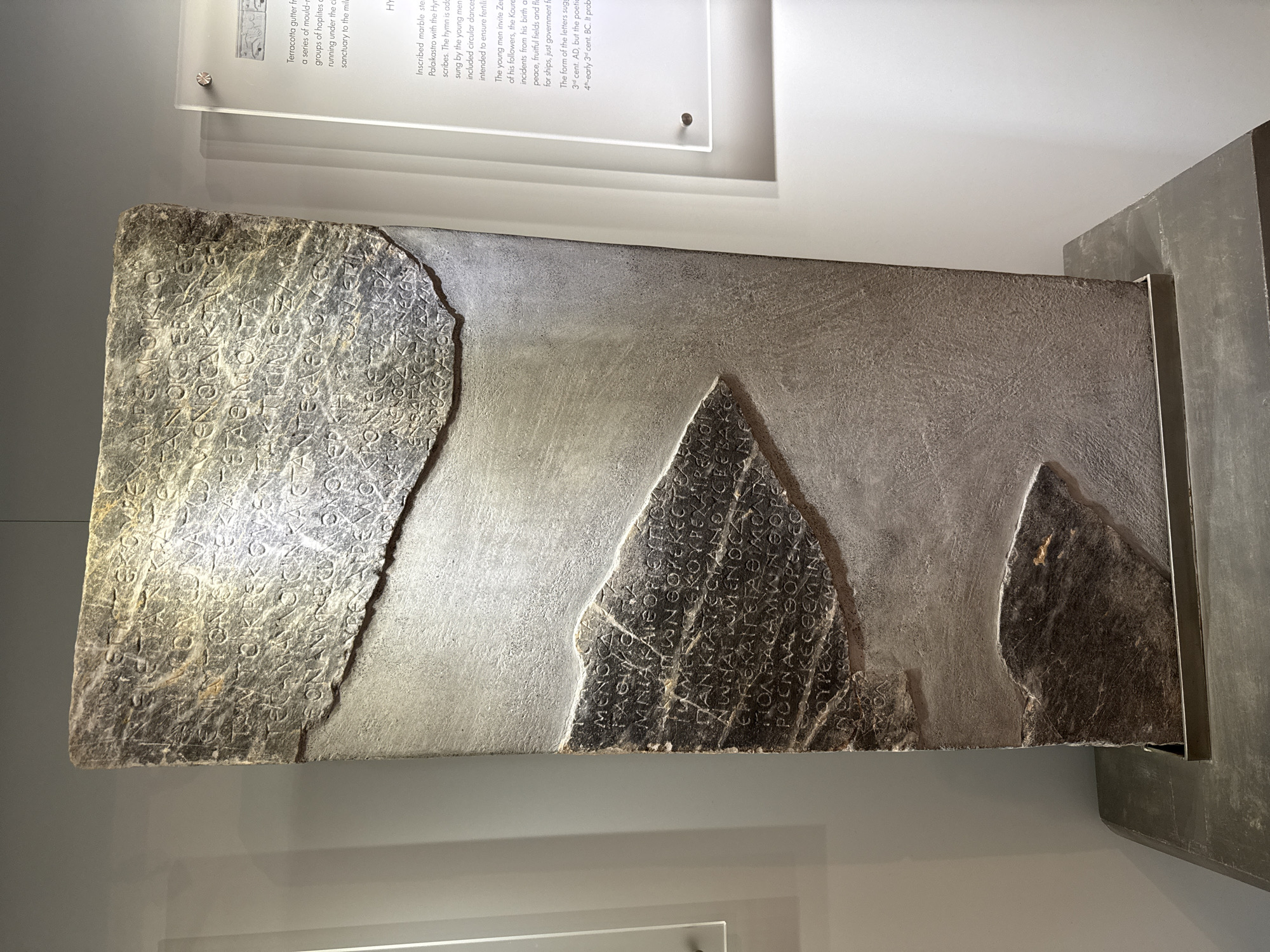
The image shows a large, rectangular stone stele with inscriptions. The stele is dark gray and appears to be made of marble or a similar stone. It is displayed vertically on a stand in what appears to be a museum setting. There are two main sections of inscriptions visible, with a large piece missing from the upper right and a smaller piece missing from the lower right. The text is carved into the stone in an ancient script. To the right of the stele, a small information panel is visible, made of clear acrylic with text printed on it. The panel has a title that reads "Hymn". The text on the panel describes the stele as an "Inscribed marble stele from Palaikastro with the Hymn to Zeus". It mentions that the hymn was sung by young men, included circular dances, and was intended to ensure fertility. It also notes that the young men invite Zeus and his followers to join them, and the hymn is connected to events from Zeus's birth and subsequent life. The panel also mentions the form of the letters suggesting a date of "4th-early 3rd cent. BC". While the city of Heraklion, Greece, is mentioned in the prompt as a potential location, this information cannot be visually confirmed from the image itself. The environment appears to be an indoor exhibition space with neutral-colored walls and subtle lighting. No people are visible in the image.
Heraklion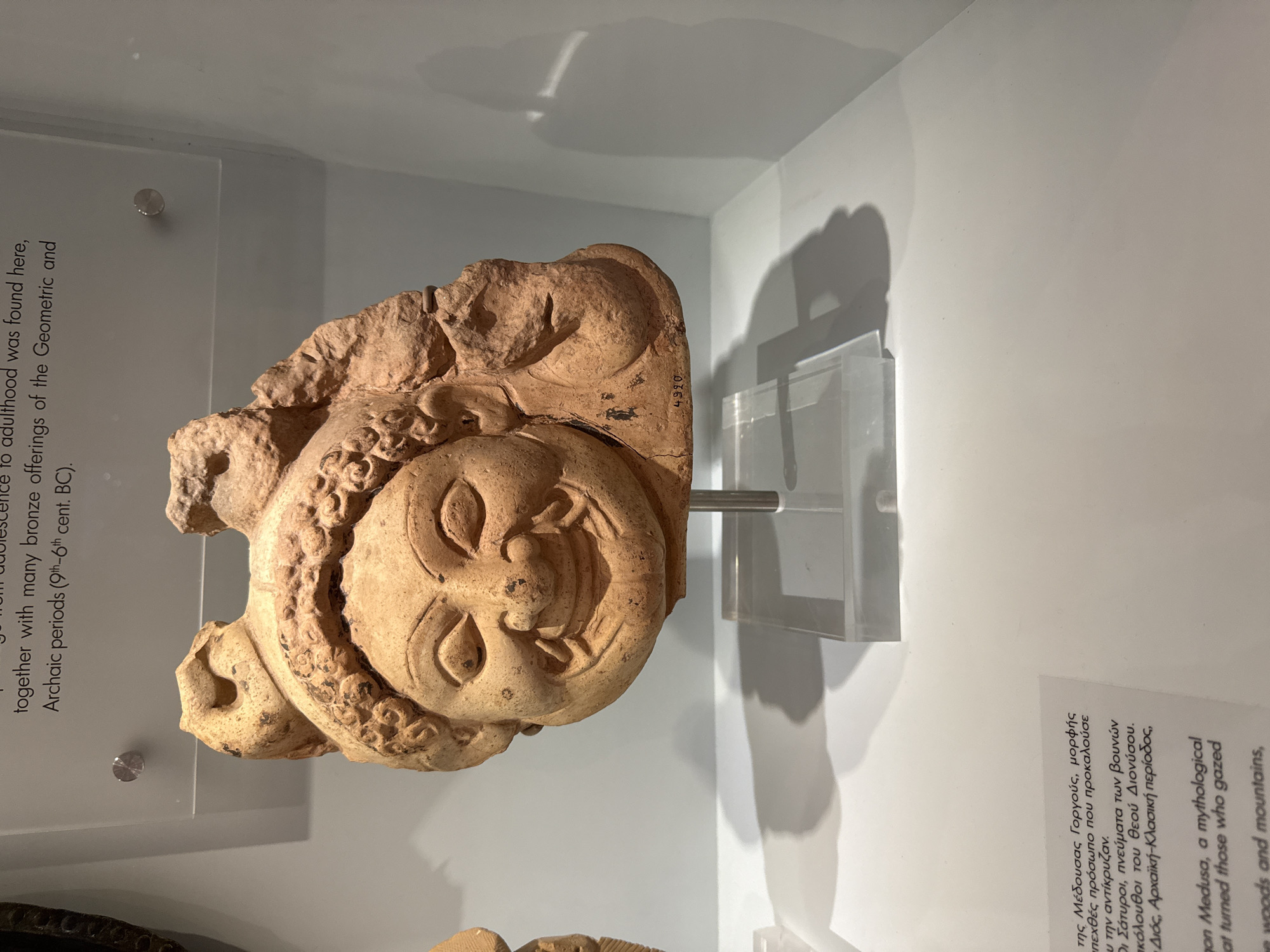
The image displays a terracotta architectural fragment, possibly a gorgoneion, at the Heraklion Archaeological Museum in Heraklion, Greece. The fragment depicts a grotesque, smiling face with wide eyes and elaborate hair or headdress. It is mounted on a clear acrylic stand against a plain, light-colored wall, creating a stark shadow on the surface behind it. Text labels are visible below and to the left of the artifact, indicating it is part of a museum exhibition. The lighting is even, illuminating the artifact and its display. The fragment has a weathered, earthy texture, characteristic of ancient terracotta. A number "4990" is faintly visible on the artifact's lower right side.
Heraklion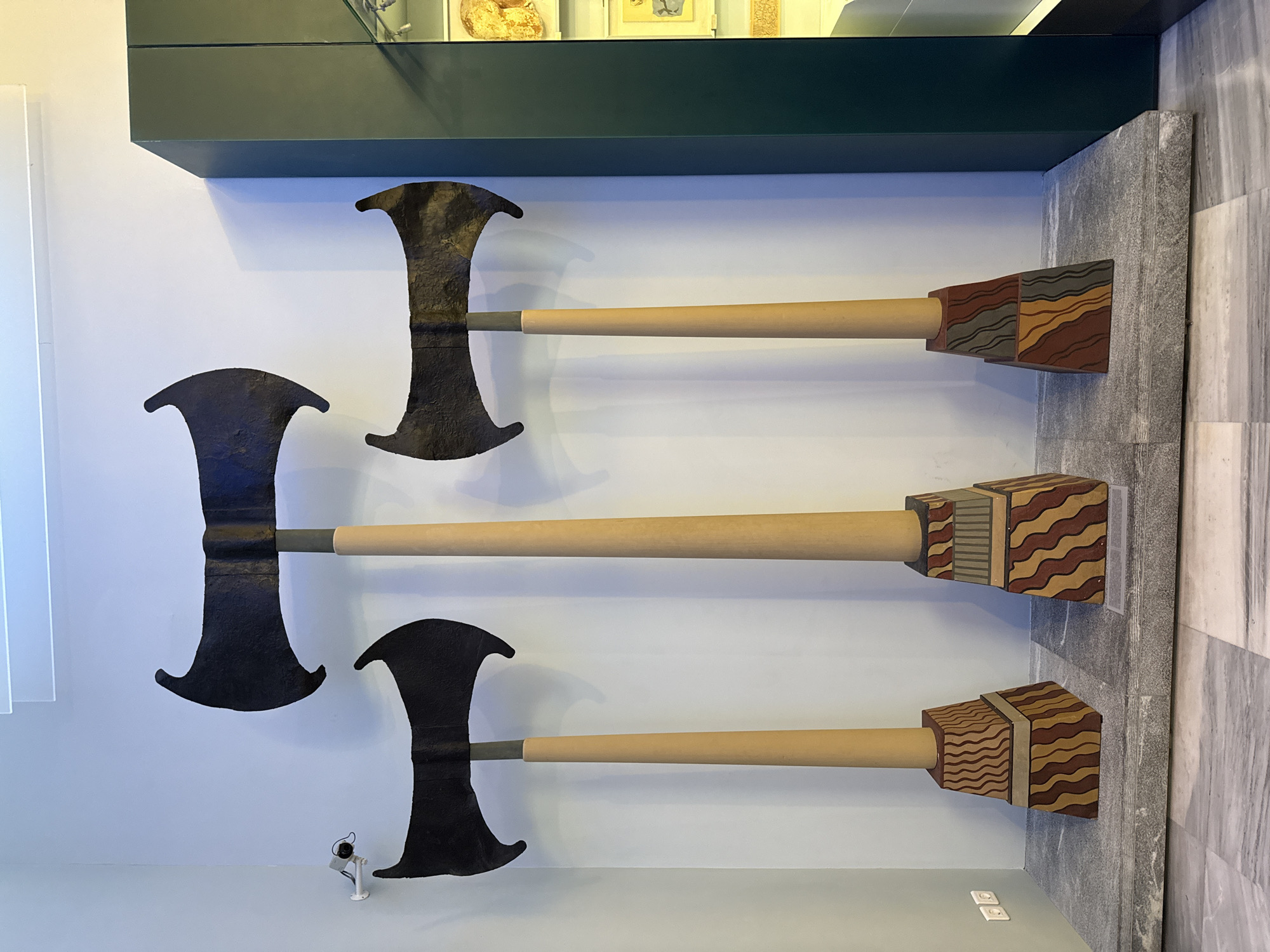
In Heraklion, Greece, within a museum setting, three imposing double-bladed axes are displayed. The axes, each with a dark, textured blade, are mounted on light-colored, cylindrical shafts. These shafts rise from decorative, tiered bases that feature geometric patterns in brown, red, and yellow. The axes are arranged from left to right in decreasing height, with the tallest in the center. They stand on a grey, stone platform that extends across the foreground. The background is a plain, light blue wall, with a security camera visible on the left. To the right, a dark green display cabinet with glass fronts offers a glimpse of artifacts within, including what appears to be pottery or stone objects. The floor is tiled with a marble-like pattern.
Heraklion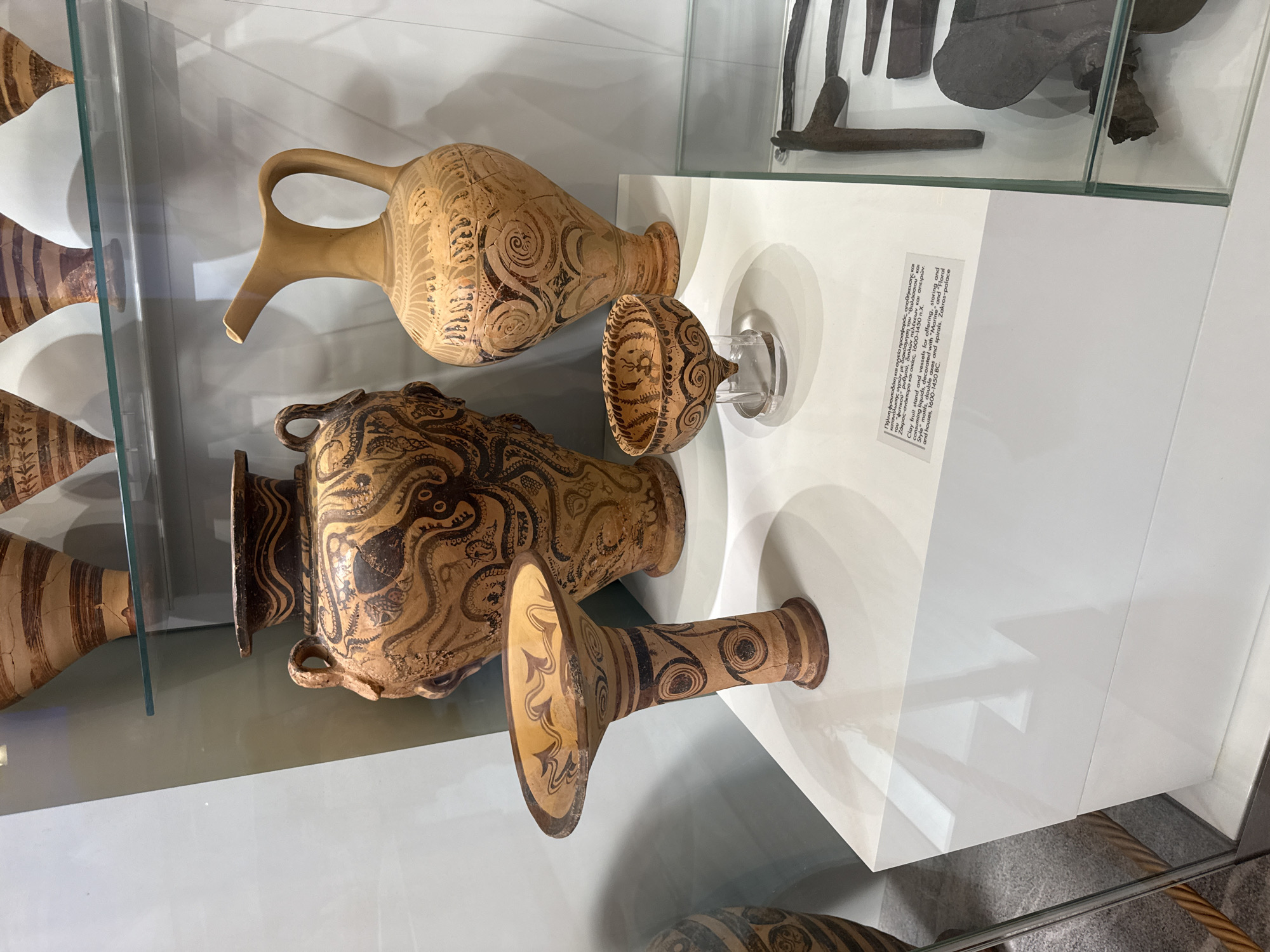
The image displays a museum exhibit featuring ancient Minoan pottery in Heraklion, Greece. In the foreground, on a white pedestal, are several clay vessels. To the left is a tall, flared chalice with intricate dark brown spiral and linear patterns. Next to it is a small, rounded bowl with similar decorative motifs, resting on a clear acrylic stand. Behind these, a large, bulbous amphora dominates the center, adorned with dark brown curvilinear designs resembling octopus tentacles and swirling patterns. To the right of the amphora stands a tall, narrow-necked jug with a handle, also decorated with concentric circles and wave-like designs. The pottery rests on white display surfaces within a glass case. In the background, on a higher shelf, more pottery with banded and geometric patterns is visible. To the right of the display case, part of another exhibit featuring dark metal tools or weapons can be seen. A descriptive label is visible on the white pedestal, providing information about the artifacts. The environment appears to be an indoor museum setting with neutral-colored walls and overhead lighting. No people are present in the frame.
Heraklion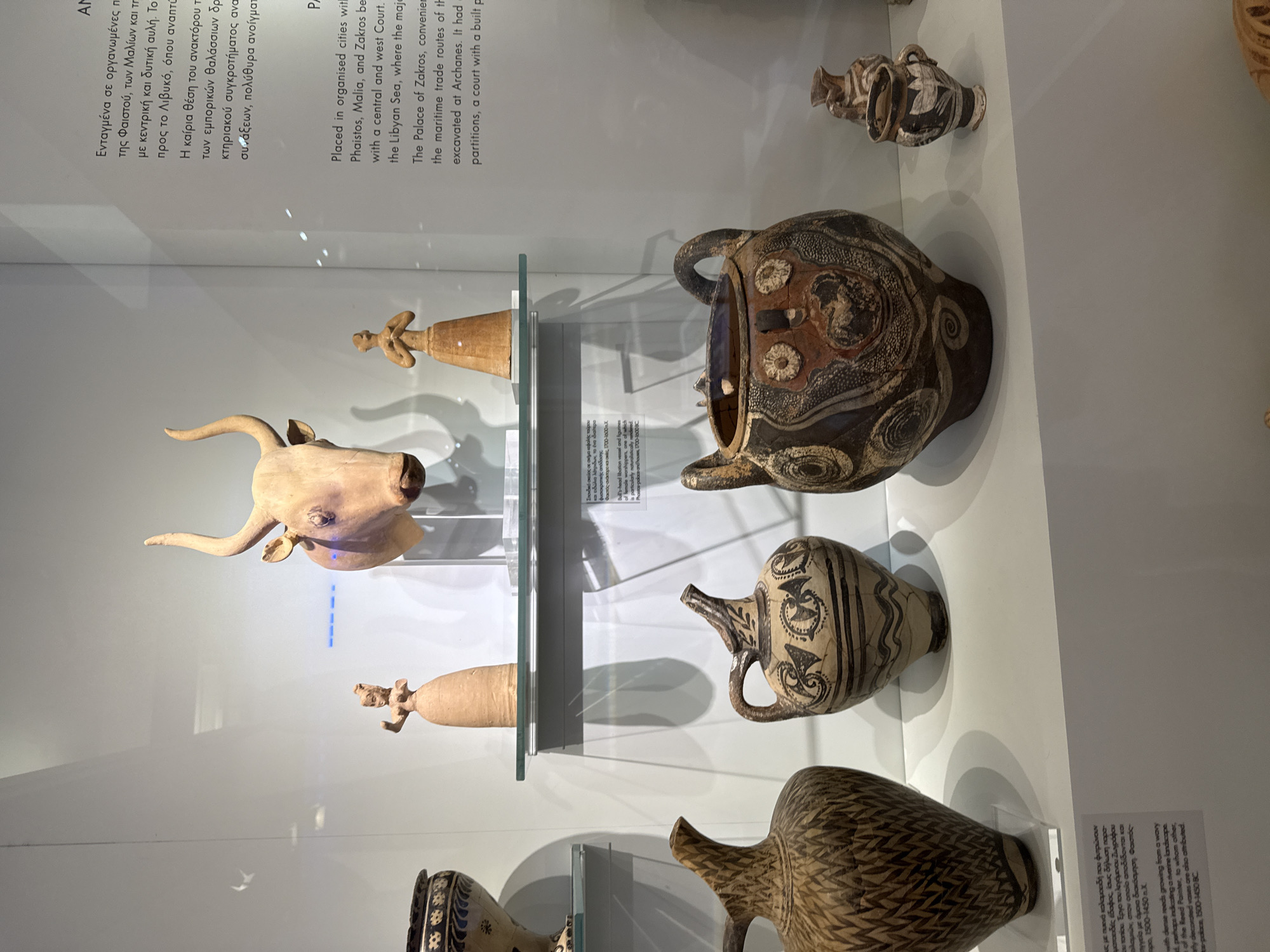
The image shows a display of ancient Minoan artifacts in a museum. The objects are housed in a glass-fronted display case with white walls and shelves. On a top shelf, there is a wooden sculpture of a bull's head and two small clay figurines of women. Below this, on a lower shelf, are several large pottery vessels. The closest vessel on the left is a tall, dark-colored vase with a pattern of intersecting lines. To its right is a lighter-colored jug with black painted decorations. In the center of the lower shelf is a large, bulbous pot with elaborate black and red painted designs, including circular motifs and figures. To the right of this, a smaller, dark-colored jug with white painted decorations is visible. A text panel is partially visible on the right side of the display case, and another text panel with Greek and English descriptions is placed on the lower shelf in front of the pottery. The overall setting suggests an archaeological exhibition. The text panel indicates that the artifacts are from the city of Heraklion, Greece, and are associated with organized cities, palaces, and maritime trade routes.
Heraklion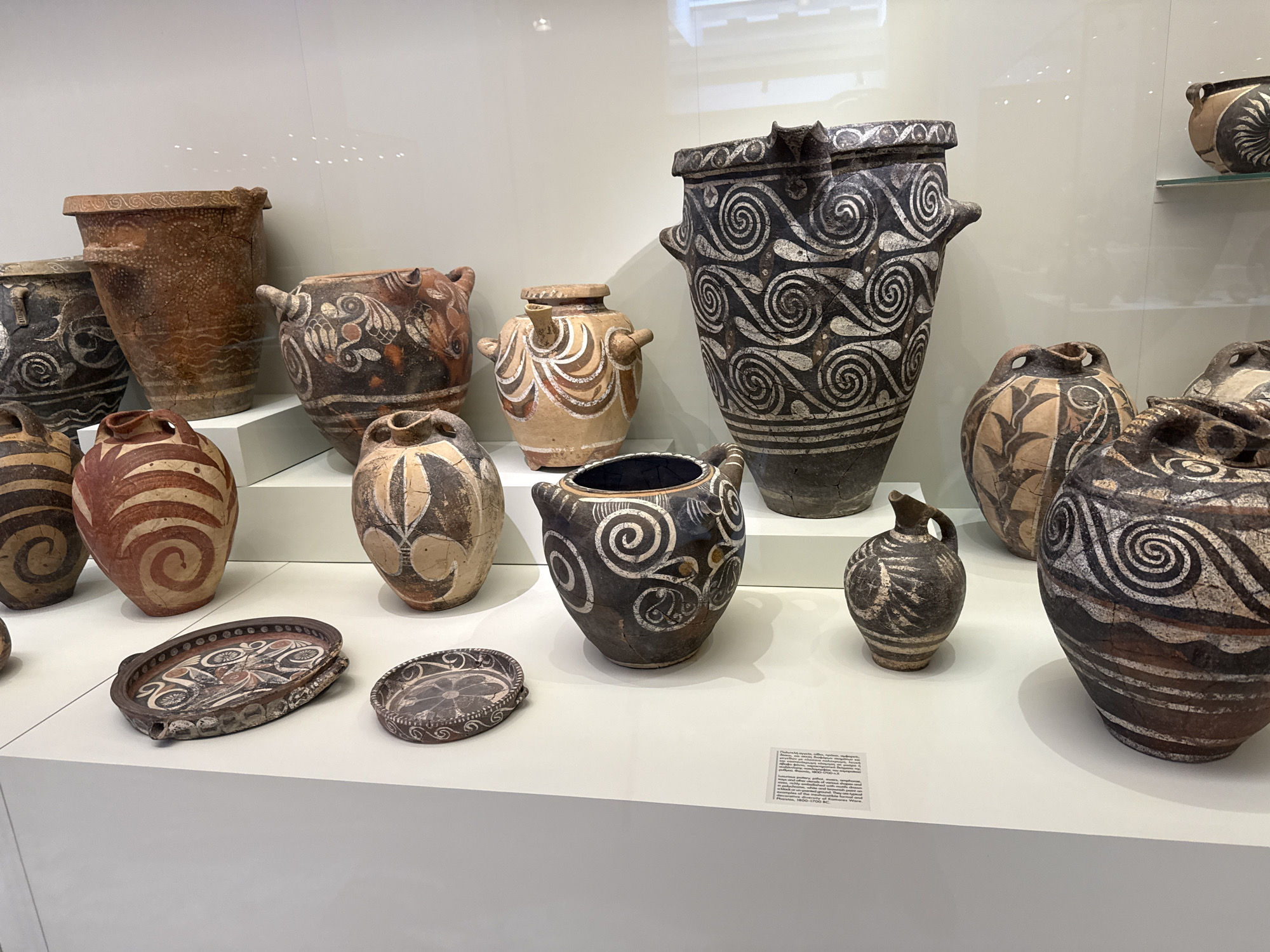
The image shows a display of ancient Minoan pottery at the Heraklion Archaeological Museum in Heraklion, Greece. The pottery is arranged on white shelves against a plain, light-colored background. The artifacts include various vessels such as large amphorae, smaller jugs, and shallow dishes. They are decorated with geometric patterns, spiral motifs, and stylized depictions of plants and marine life in shades of black, red, and white. Some pieces show signs of age, with cracks and chipped surfaces. The lighting highlights the texture and intricate designs of the ceramics. A small informational plaque in Greek and English is visible on the lower right shelf. There are no people visible in the image.
Heraklion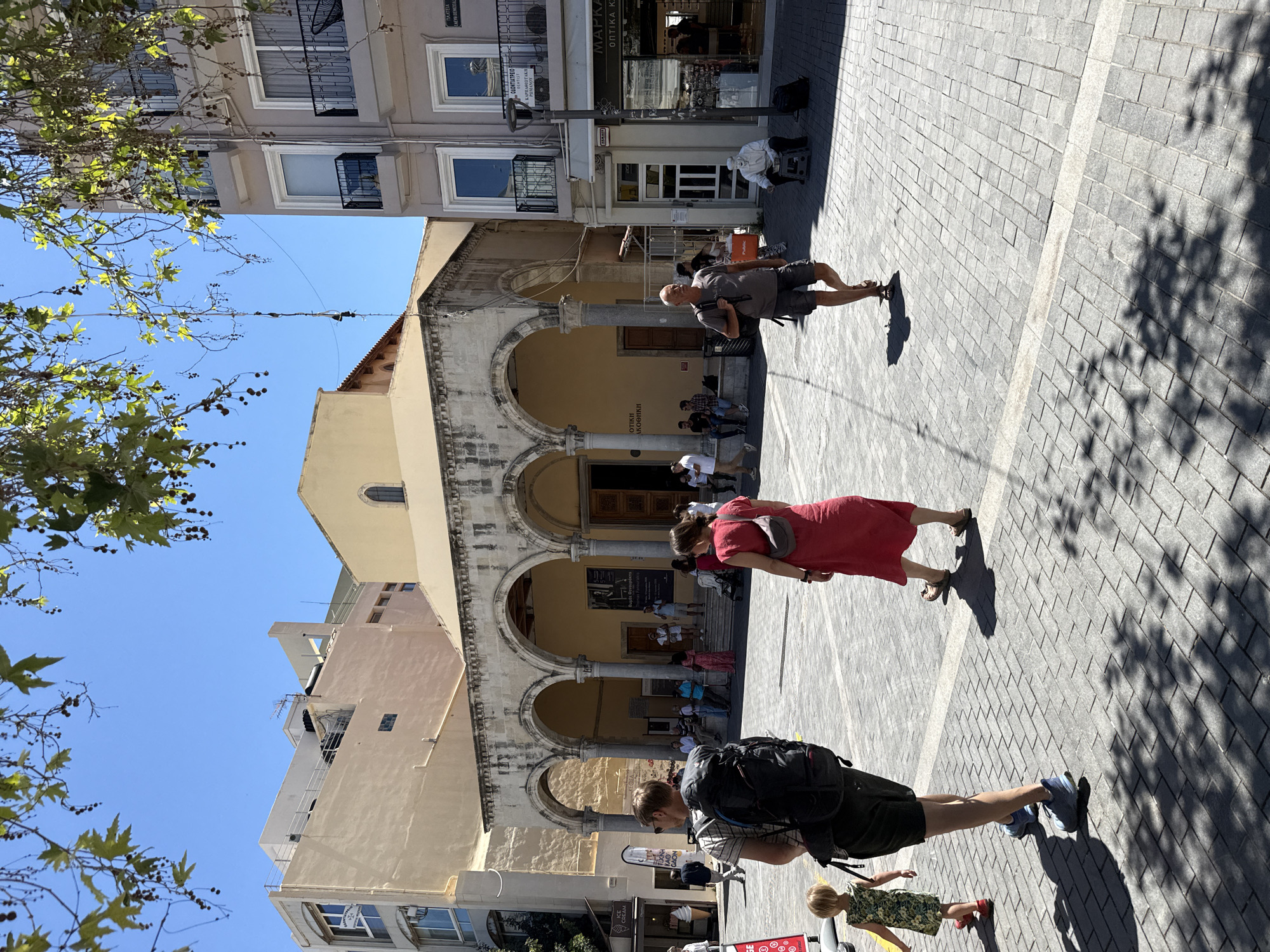
A sunny daytime scene unfolds in a public square paved with light gray stone tiles, likely in Heraklion, Greece. A large building with arched walkways and a pale yellow facade dominates the background, suggesting a historical or religious structure. Adjacent to it is a modern, multi-story building with balconies and windows. In the foreground, several individuals are navigating the square. A man with a large black backpack is walking away from the viewer, accompanied by a young child in a floral dress. To their right, a woman in a vibrant red dress walks past. Further to the right, a man in a grey t-shirt and shorts walks towards the viewer, carrying a shopping bag. Near the building on the right, an elderly person dressed in white is seated on a stool, appearing to be a street performer. The square is shaded in parts by the foliage of trees overhead, casting dappled patterns on the ground. Signs are visible on some of the storefronts, including one for "MARKASI OPTIKA KAO", indicating shops are present. The overall atmosphere suggests a lively urban environment during daylight hours.
Heraklion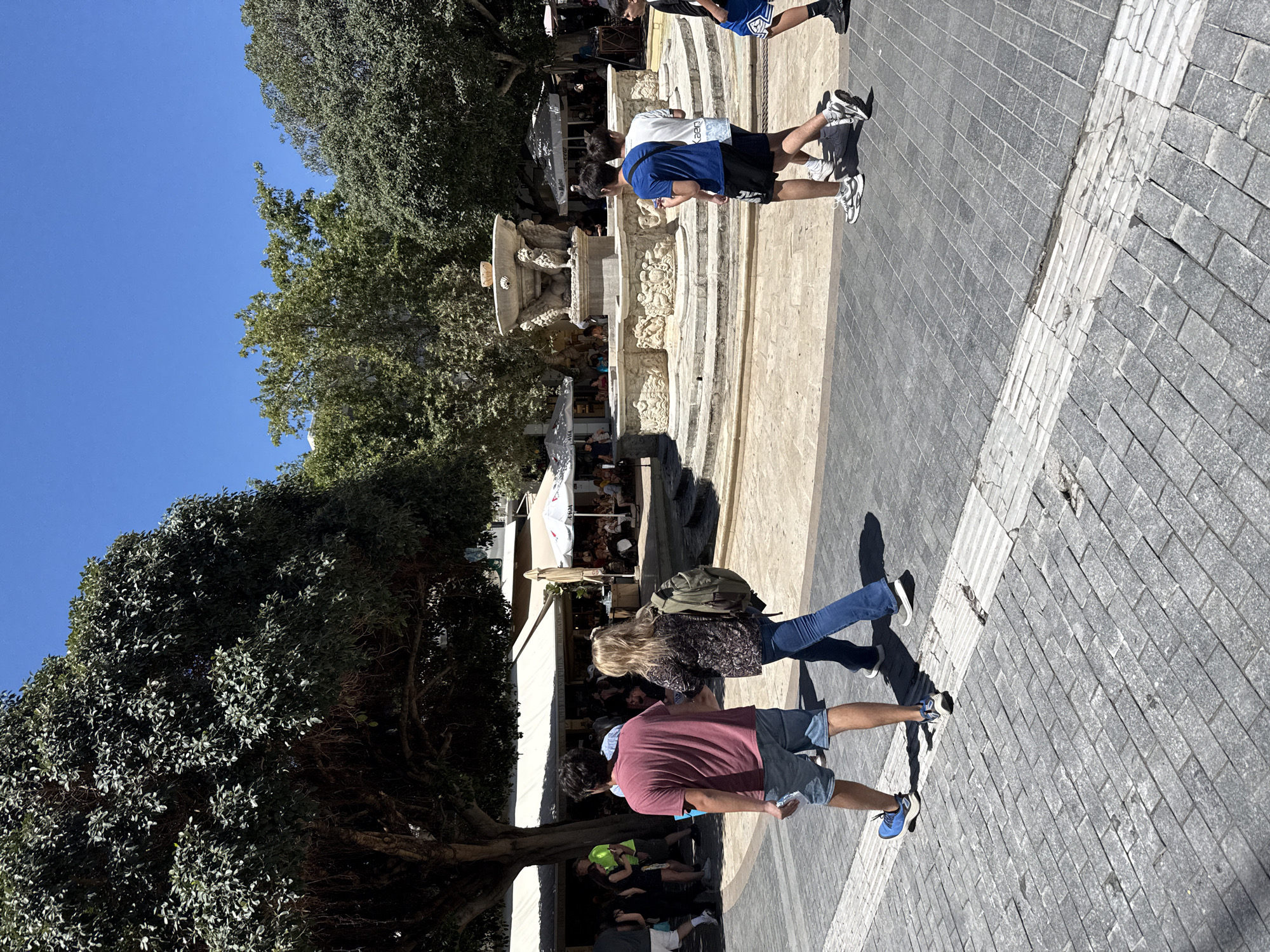
In Heraklion, Greece, a group of people walk on a cobblestone plaza in front of a decorative fountain. A large tree with dense foliage shades a portion of the scene. In the background, outdoor cafes with umbrellas and awnings suggest a lively public space. The sky is clear and blue. The people are dressed casually for warm weather. The fountain features intricate carvings and multiple tiers.
Heraklion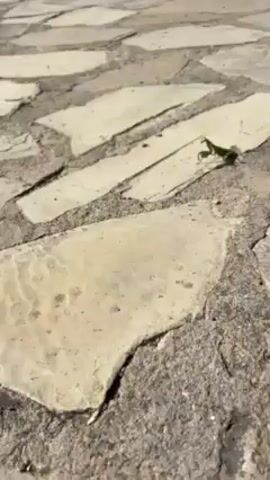
A praying mantis is seen on a paved surface. The mantis is green and moves slowly. The background is blurry. The weather appears to be sunny.
Heraklion
A woman with medium-length brown hair, wearing Ray-Ban sunglasses, a white button-down shirt, and a white t-shirt with a partial image of the word "ANGELES" is shown in a close-up shot. She is outdoors with a blurred background of greenery, an overcast sky, and what appears to be a utility pole. She smiles, then blows on a small object held in her hand. The object appears to be a dandelion seed head on a stick. She looks directly at the camera while blowing on it. She has a small flower tucked behind her ear, and her nails are neatly manicured with a light pink color.
Heraklion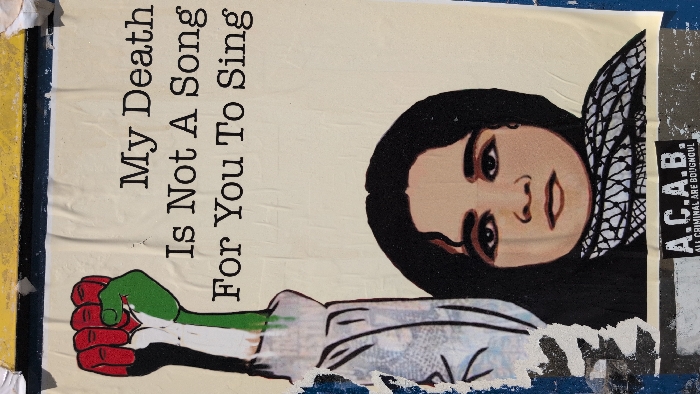
The image depicts a poster with a political message. The text reads "My Death Is Not A Song For You To Sing." The artwork includes a drawing of a woman wearing a black headscarf, and a fist is shown colored with the colors of the Palestinian flag. To the right of the woman is an "A.C.A.B." sticker, an acronym that stands for "All Cops Are Bastards," with the added message "ALL CRIMINAL ARE BOUGNOUL." The poster is adhered to a weathered surface.
Heraklion