Hitiaʻa ʻo te Rā, France
8 memories from Hitiaʻa ʻo te Rā, France
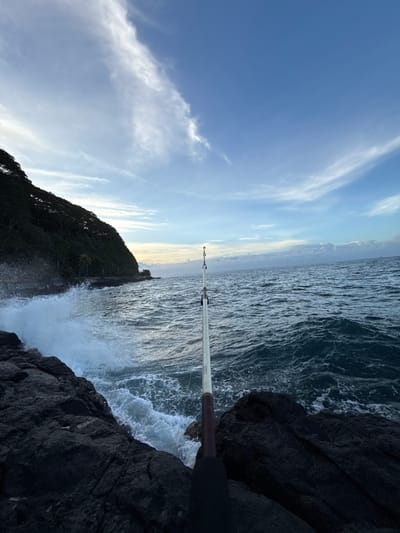
The image captures a coastal rock fishing scene in Hitiaʻa ʻo te Rā, France. In the immediate foreground, dark, rugged volcanic rock formations are visible. A light-colored fishing rod with a dark handle extends diagonally from the lower center-right, with its line cast into the turbulent, deep blue-green ocean water. To the left, large waves forcefully crash against the rocks, generating prominent white spray and foam. Further left, a steep hillside densely covered with dark green vegetation rises sharply from the water's edge; a narrow, dark strip at its base suggests a coastal road or path. The ocean dominates the midground and background to the right, extending to a horizon where faint landmasses or low-lying clouds are discernible. The sky is partly cloudy, transitioning from a lighter blue near the horizon to a deeper blue overhead, with several elongated white clouds present. The lighting conditions suggest either early morning or late afternoon. No individuals are visible in the scene.
Hitiaʻa ʻo te Rā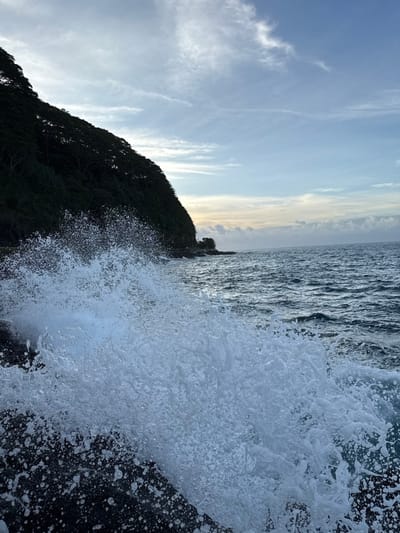
The image displays a dynamic coastal scene located in Hitiaʻa ʻo te Rā, France. In the foreground, a voluminous white spray of ocean water and foam is actively visible, generated by a wave impacting dark, textured rock formations at the water's edge. To the left, a steep, densely forested landmass, characterized by dark green foliage, ascends sharply from the shoreline. The open ocean, exhibiting a dark blue-grey hue and surface ripples, occupies the right and central mid-ground, extending to a distant horizon. The sky is partially obscured by thin, wispy clouds, displaying a light blue color that subtly transitions to faint orange and yellow tones at the horizon line. No individuals or anthropogenic structures are discernible within the frame.
Hitiaʻa ʻo te Rā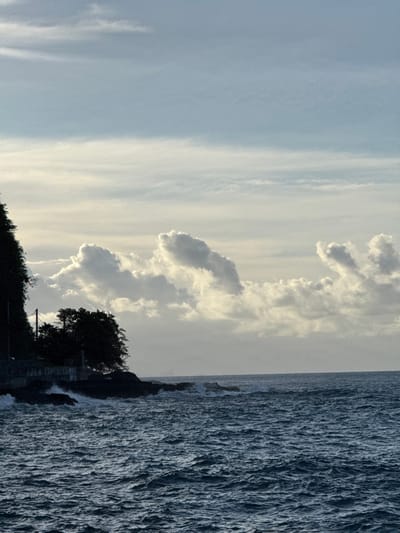
The image displays a coastal environment in Hitiaʻa ʻo te Rā, France. The upper half of the frame is dominated by a mostly overcast sky, featuring layers of pale blue and greyish-white clouds, some with defined cumulus forms and others appearing as stratiform layers. The horizon line is visible across the middle-right portion of the image. The lower half and right side show a turbulent dark blue ocean with numerous visible waves and white foam, indicative of choppy conditions. On the left, a steep, dark green, heavily vegetated landmass descends to meet the sea. Along the base of this landmass, dark rock formations are prominent, against which waves are actively crashing, generating white spray and foam. A utility pole with wires is discernible at the base of the vegetation on the left. A dark, low-lying structure, potentially concrete or stone, runs along the shoreline above the rocks. No individuals, animals, or active vessels are present.
Hitiaʻa ʻo te Rā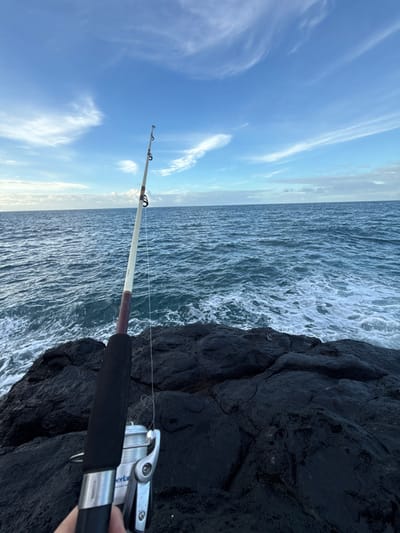
The image displays a first-person perspective of a fishing activity from a dark, rugged, rocky coastline in Hitiaʻa ʻo te Rā, France. A human hand is visible in the bottom left, gripping the black foam handle of a fishing rod. A silver spinning reel is attached to the rod, with fishing line extending up the rod's length. The two-tone fishing rod, primarily light-colored with a brown segment, extends diagonally upwards towards the open ocean. The immediate foreground consists of wet, dark, irregular rock formations. Beyond the rocks, the ocean stretches to the horizon, exhibiting choppy, dark blue water with white foam from breaking waves. The upper half of the image features a bright blue sky with scattered, wispy white cirrus clouds. No other individuals or vessels are visible in the scene.
Hitiaʻa ʻo te Rā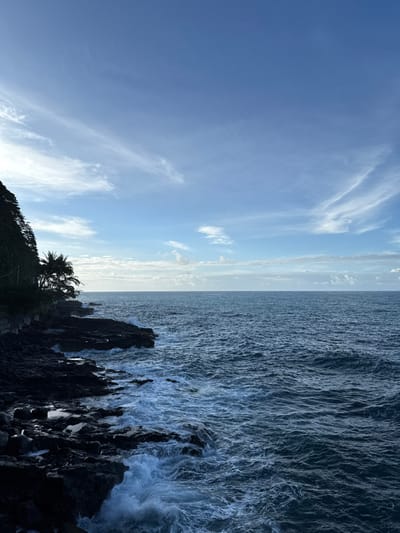
The image displays a coastal scene in Hitiaʻa ʻo te Rā, France, under a partly cloudy blue sky. The dark blue-green ocean, occupying the right two-thirds of the frame, exhibits moderate wave activity with whitecaps, extending to a discernible horizon. Along the left, a rugged shoreline composed of dark, jagged volcanic rocks is visible. Waves are actively crashing against these rocks, generating significant white foam. Above the rocky coast, a steep slope is densely covered with lush green foliage, with several palm trees partially visible among the vegetation. No human figures or discernible man-made structures are present within the frame.
Hitiaʻa ʻo te Rā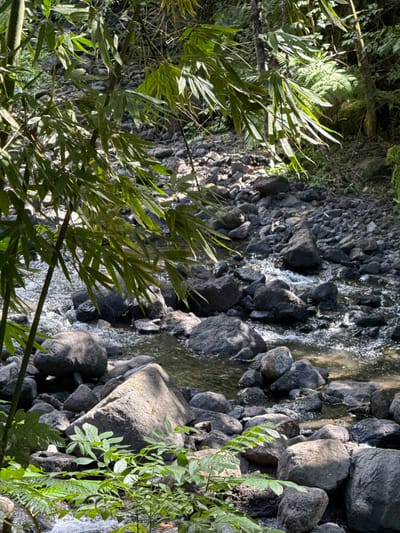
This image captures a natural stream or riverbed located in Hitiaʻa ʻo te Rā, France. The scene features a narrow, clear watercourse flowing over and between a dense accumulation of dark grey to black, irregularly shaped rocks and boulders of various sizes. The water exhibits visible ripples and minor frothing, indicating movement. Bright natural light illuminates sections of the water and the upper surfaces of many rocks, creating strong shadows across the rocky terrain. The immediate foreground and left midground are dominated by several vibrant green bamboo stalks with numerous leaves extending into the frame, partially obscuring the view. Additional lush green foliage, including smaller plants in the foreground and a large fern on the right mid-background, lines the banks, contributing to a dense, verdant natural environment. No individuals, animals, or man-made objects are visible within the frame.
Hitiaʻa ʻo te Rā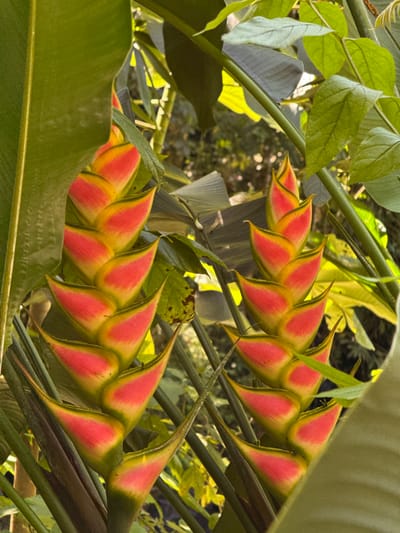
This image displays two prominent, downward-hanging Heliconia inflorescences amidst dense tropical foliage, located in Hitiaʻa ʻo te Rā, France. The left inflorescence is largely visible, composed of approximately eleven vertically stacked, boat-shaped bracts. Each bract is distinctly colored, featuring a vibrant red interior surface that transitions to a sharp yellow-green margin. A second, similar inflorescence is partially visible to the right and slightly behind the first, also exhibiting red and yellow-green bracts in a descending arrangement. Both subjects are surrounded by various broad and narrow green leaves, stalks, and other plant matter, some in sharp focus and others softly blurred in the background. Natural sunlight illuminates the scene from above and behind, creating bright highlights on some leaves and the bracts, and casting soft shadows. No human figures, animals, or man-made objects are present. The scene is static, depicting the plants in their natural, outdoor growing environment.
Hitiaʻa ʻo te Rā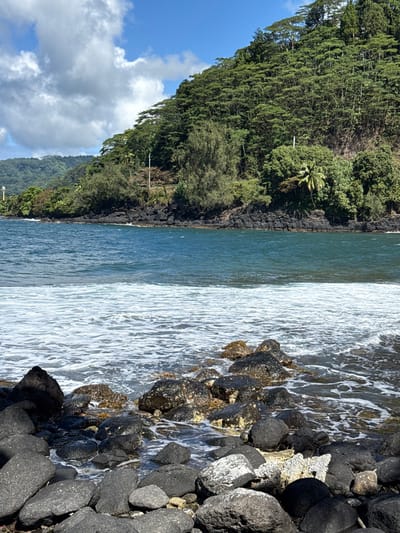
This image depicts a coastal scene in Hitiaʻa ʻo te Rā, France, under a partly cloudy sky. The foreground is dominated by a collection of dark, irregular volcanic rocks of various sizes, some appearing wet and glistening from recent contact with water. Patches of greenish-brown organic material are visible on several rocks. The midground features the ocean, with clear, blue-green water. A line of white, foamy waves actively breaks and recedes over the foreground rocks, extending across the lower-mid portion of the frame. Further out, the water surface shows ripples and less turbulent motion. The background consists of a steep, lushly vegetated mountain or hill rising directly from the rocky coastline. The mountain is densely covered in various types of green trees, many exhibiting broad, flat canopies. The base of the mountain meets the ocean with dark, rugged volcanic rock formations. On the far left, a light-colored, slender structure, possibly a lighthouse or communication tower, is discernible on a distant headland. The sky is bright blue with scattered white cumulus clouds, indicating fair weather. No human subjects are visible in the scene.
Hitiaʻa ʻo te Rā