Horezu, Romania
28 memories from Horezu, Romania
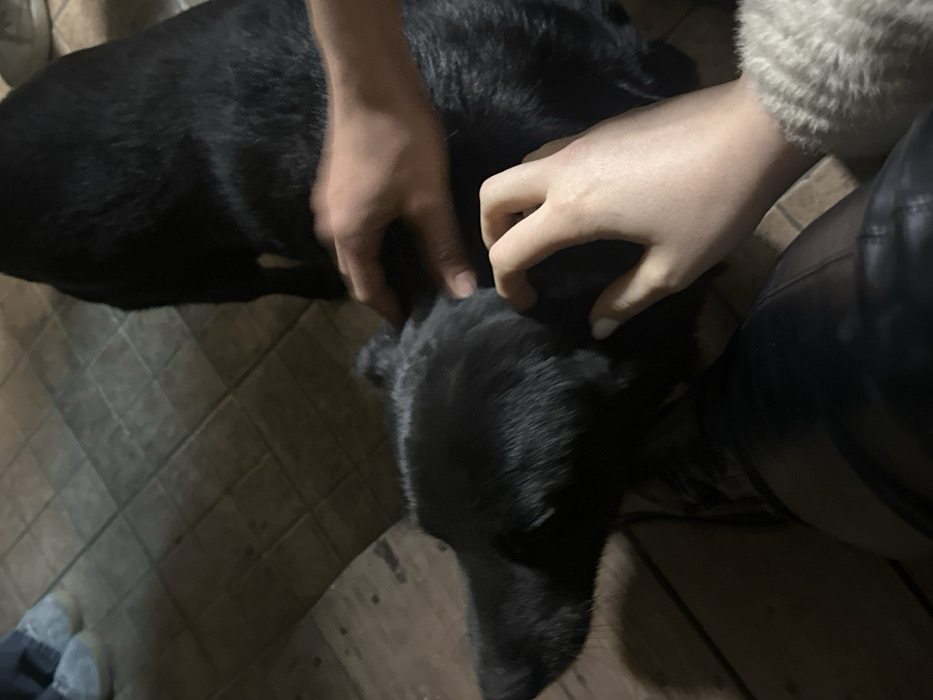
The scene depicts a black dog being petted by two individuals on a tiled floor in Horezu, Romania. A partially visible black dog occupies the center and lower-left portion of the frame, with its head turned left. Two distinct human hands are interacting with the dog: a lighter-skinned hand, with manicured nails, is positioned on the dog's head and neck area towards the lower-left; a darker-skinned hand is visible further back, petting the dog's back and shoulder region. The individual associated with the lighter-skinned hand is wearing dark, possibly leather-like pants or a skirt, and a light-colored, textured garment on the forearm. In the upper-left background, parts of legs and feet are visible, including a foot wearing a light-colored shoe. The subjects are situated on a dark, square-tiled floor with visible grout lines, under dim lighting conditions.
Horezu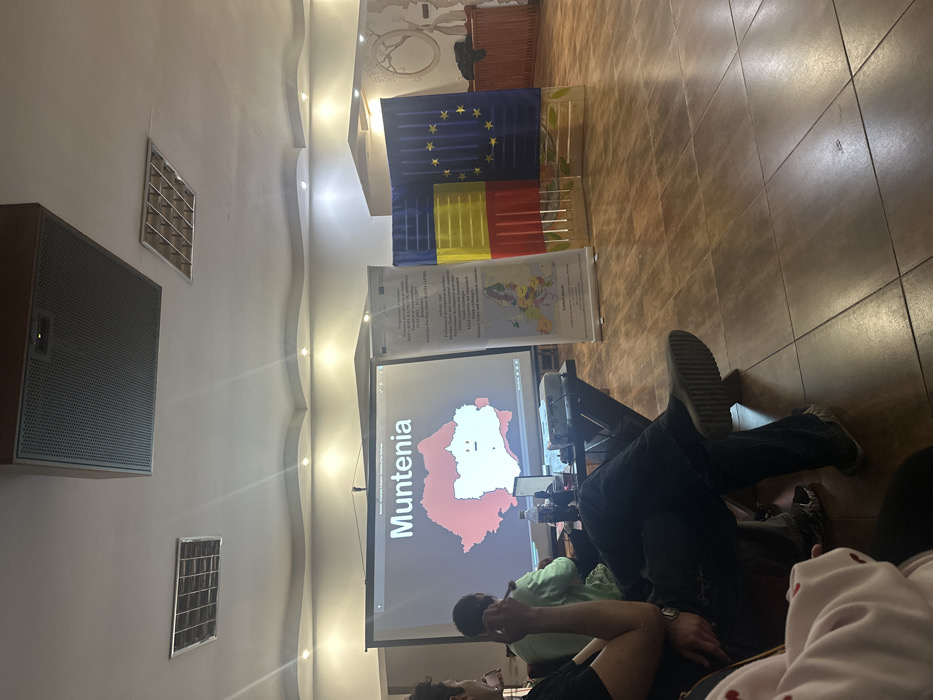
The image depicts an indoor meeting or presentation environment in Horezu, Romania. The precise location within the city is not identifiable from the visual information. The central focus is a large projection screen displaying a map of Romania, with the region labeled "Muntenia" prominently highlighted in red. A small white smiley-face icon is visible within the highlighted Muntenia region. A digital projector and several beverage bottles are situated on a dark wooden table directly in front of the screen. To the right of the screen, a white vertical banner displays text related to a program, including "Erasmus+" and "Youth," along with a map of Europe. Adjacent to this banner, a decorative partition constructed from wooden pallets is painted with the vertical stripes of the Romanian flag (blue, yellow, red) and the blue field with yellow stars of the European Union flag. Further to the right in the background, a wooden cabinet and a stylized tree mural on the wall are visible. In the foreground and midground, parts of at least three individuals are visible, seated and facing the projection screen. One person is seen from behind, wearing a light green shirt. Another individual, partially obscured, wears a dark shirt. The immediate foreground shows the shoulder and arm of a person wearing a light-colored top. No faces are clearly visible. The room features light-colored walls with a decorative curved ceiling detail that incorporates recessed spotlights. Two rectangular ventilation grilles are mounted on the ceiling. The floor is covered with brown tiles patterned to resemble wood grain.
Horezu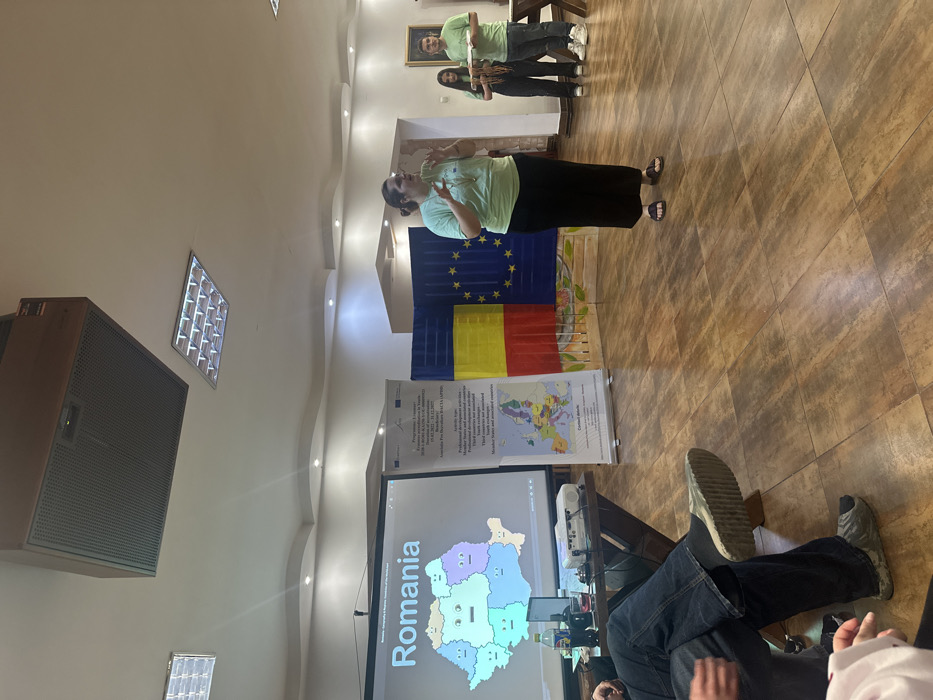
This image depicts an indoor presentation or workshop event in a multi-purpose room located in Horezu, Romania. The room features light-colored walls, a ceiling with recessed lighting and a large overhead ventilation unit, and a brown tiled floor resembling wood. In the center-right of the frame, a woman stands facing left, actively speaking and gesturing with both hands. She is wearing a light green short-sleeved top, a long dark skirt, and dark sandals, with a lanyard around her neck. To her left, a large projector screen displays a colorful map of Romania divided into regions, each with a cartoon face, titled "Romania." Below the map, text identifies it as "Romania – Geography & Administrative Divisions of the World Map." A white projector sits on a dark wooden table in the foreground, adjacent to the screen, alongside a green plastic bottle, a dark bottle, and a glass with dark liquid. Partially visible in the bottom-left foreground is a seated person with crossed legs, wearing blue jeans and dark footwear. In the background, behind the speaker, a display partition features two large flags: the Romanian flag (vertical red, yellow, blue stripes) and the European Union flag (blue with yellow stars). To the left of these flags, a tall white banner displays text related to an "Erasmus+" program, including dates (15.03.2023 – 31.12.2023), details about "Professional development activities" and "Youth exchanges," and a map of Europe. Further to the right, behind the speaker, two additional individuals are standing. One female wears a dark top and trousers and holds a dark object. One male wears a light green t-shirt and light trousers, holding a white rectangular object.
Horezu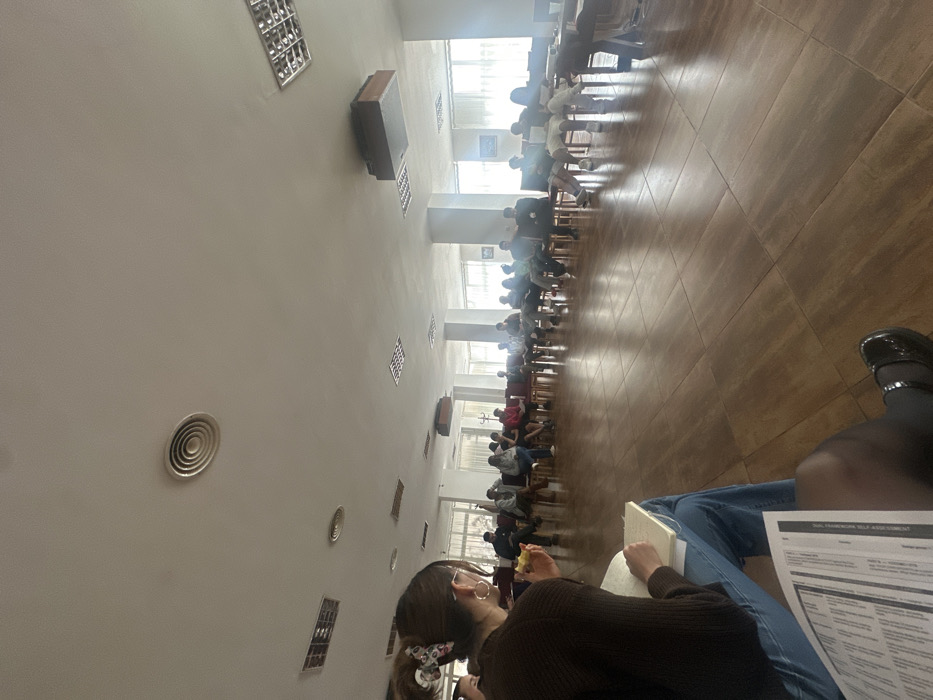
The image depicts an indoor gathering in Horezu, Romania. A group of approximately 20-25 individuals is seated in a semi-circular formation on wooden chairs on a polished brown tiled floor. Most individuals are casually dressed. In the immediate foreground, facing away from the viewer, is a person with brown hair, wearing a dark brown long-sleeved top and blue jeans. This individual is holding an open notebook and a pen in their left hand and a piece of fruit in their right hand. Visible on the bottom right is the lower leg and foot of another person, wearing black tights and a black flat shoe, with a white document resting on their lap. The room features white walls, large windows along the far side providing natural light, and multiple white support pillars. The ceiling is white and includes recessed rectangular light fixtures, circular air vents, and larger rectangular ventilation units. Two framed pictures are visible on the distant wall. A dark wooden table is partially visible on the far right.
Horezu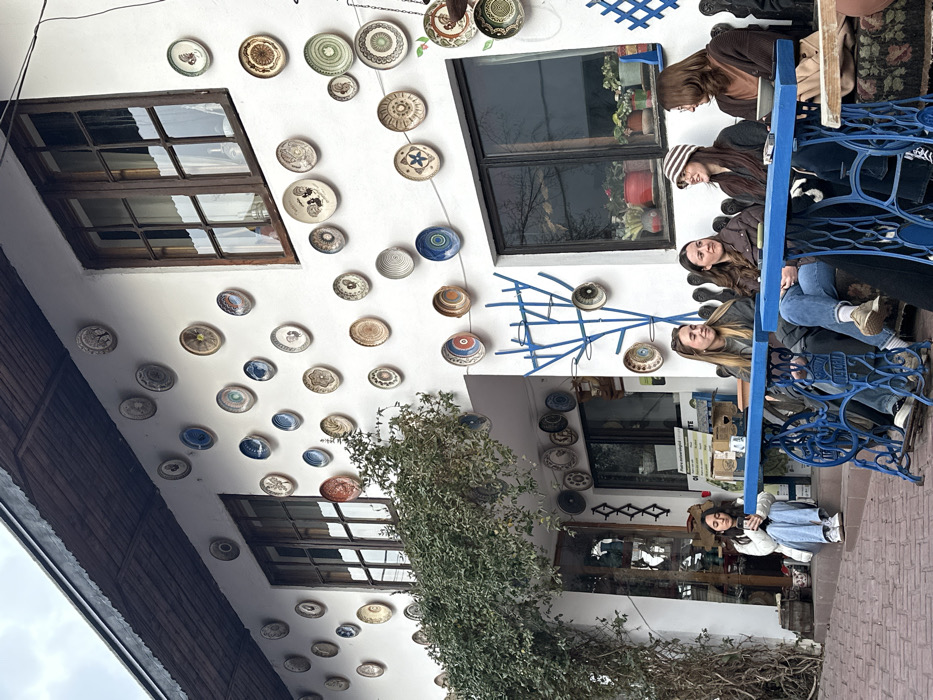
The scene depicts an outdoor setting in Horezu, Romania, featuring a white, two-story building heavily decorated with numerous traditional ceramic plates. These plates, of varying sizes and patterns, including floral, geometric, and rooster motifs, are affixed directly to the building's facade, particularly around and between dark-framed wooden windows. Wooden eaves extend from the roofline. On the left side of the image, a dense green vine cascades over an archway entrance. Below this, a young adult female with dark hair, wearing a white padded jacket and light-wash jeans, is seated on a reddish-brown brick step, looking down at a smartphone held in both hands. To the right of the entrance, four other young adult females are seated at outdoor tables with distinctive blue metal bases, which appear to be repurposed antique sewing machine stands. The tabletops are light-colored. From left to right: * A female with long blonde hair, wearing a dark top, is seated at the first blue table, looking towards the right. * Next to her, a female with brown hair, wearing a dark puffer jacket and blue jeans, is also seated at the first table, looking towards the right. * At the second blue table, a female with dark hair wearing a striped knit beanie and glasses is engaged in conversation, looking towards the right. A pack of cigarettes and a lighter are on her table. * To her right, a female with reddish-brown hair, wearing a brown cardigan, is seated, holding a light-colored bowl, and looking towards the left. The ground surface near the seating area is a mix of brick paving and possibly concrete. A blue, treelike metal sculpture with various small plates attached to its branches is affixed to the building's wall to the right of the archway. Inside a lower window to the right, several potted plants are visible. The sky is overcast. An outdoor sign with Romanian text, likely advertising traditional pottery, is visible near the entrance on the left.
Horezu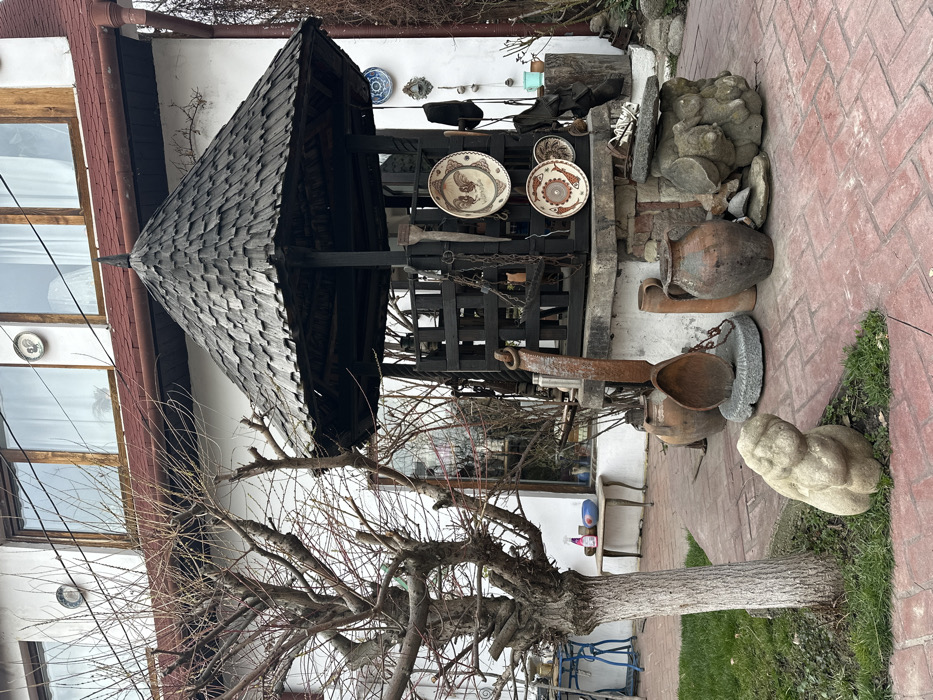
An outdoor scene in Horezu, Romania, depicts a rustic courtyard or garden area adjacent to a white stucco building with a red-tiled roof and multiple wooden-framed windows. The ground is paved with red bricks, with a patch of grass containing a deciduous tree exhibiting bare branches and visible buds, indicative of early spring or late winter. A light-colored, squat stone statue rests on the grass at the base of this tree. The central feature is a decorative well structure with a dark, conical wooden shingle roof supported by a dark wooden lattice frame over a concrete or stone base. Attached to the well frame are several chains and multiple ceramic plates, including two prominent ones displaying a rooster and a stylized fish pattern. An oversized, rustic wooden scoop with an iron handle ring leans against the well base, supported by a circular grindstone. Several earthenware pots and urns of varying sizes are positioned around the well's base, alongside a textured stone object resembling a weathered sculpture or rock formation. In the background, against the building's white wall, two decorative plates are affixed near the windows, and electrical wiring spans horizontally across the upper facade. To the far left, partially obscured by the tree, a small light-blue metal table and chair are visible. Further right, a light-colored wooden table or bench stands against the building, holding a pink spray bottle and a blue bowl. No individuals are present in the scene.
Horezu
The video features a gray-haired man seated at a pottery wheel, shaping a clay object. He is using his hands to mold the clay, which appears to be a candlestick holder. The wheel is spinning as he works. In front of him on a wooden table is a finished vase with a ruffled edge, a sponge, and a tool. To his left, there is a shelf lined with pottery pieces. Behind him, a window provides natural light, illuminating various potted plants and objects in the background. The setting suggests a pottery studio or workshop.
Horezu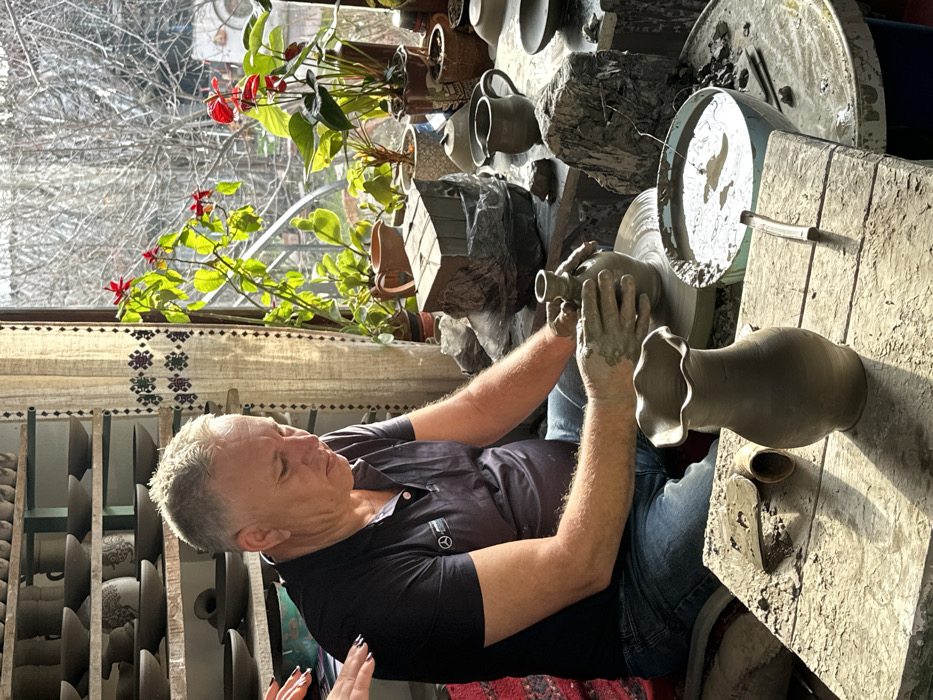
The image presents an active pottery workshop located in Horezu, Romania. A middle-aged male with short, greying hair, wearing a dark polo shirt with a Mercedes logo and blue jeans, is seated on a low cushion or stool, intently forming a narrow-necked clay vase on a potter's wheel. His hands are coated in wet clay as he manipulates the spinning vessel. To the upper left of the potter, the fingers of a female hand, adorned with dark nail polish, are partially visible. In the foreground, on a rough wooden workbench, an unglazed clay vase with a ruffled rim stands upright. A small pottery tool lies next to it. Adjacent to the potter's wheel, a bowl containing water or clay slip is visible. Various lumps of raw clay and partially formed ceramic pieces are distributed across the work surfaces. The workshop is illuminated by abundant natural light entering through a large window on the right, revealing bare tree branches outside and several potted plants with green leaves and red flowers on the windowsill. To the left in the background, wooden shelves are stocked with numerous unfired pottery items, including bowls and plates. A light-colored fabric curtain with a dark embroidered pattern hangs beside the window. The overall environment suggests a functional, hands-on craft setting.
Horezu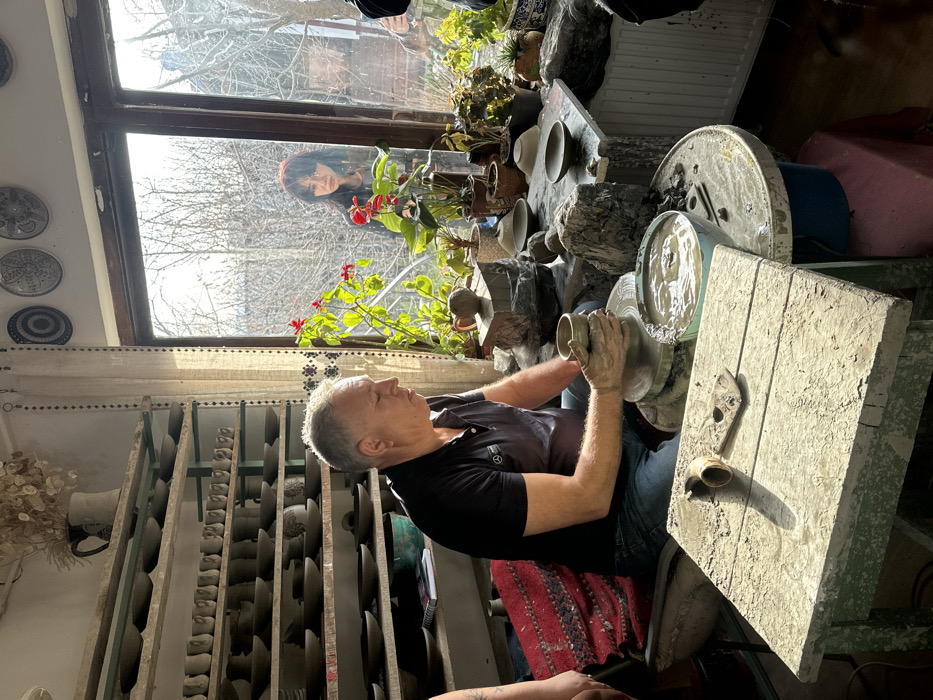
An interior view of a pottery workshop in Horezu, Romania, features an adult male actively engaged in crafting ceramics. The man, with short, graying hair, is seated in the mid-ground, wearing a dark blue polo shirt with a small white logo and blue jeans. His hands are covered in clay as he operates a foot-powered pottery wheel, shaping a small vessel. A light blue basin containing muddy water sits next to the wheel. To the left of the potter, multi-tiered wooden shelves extend from floor to ceiling, densely packed with numerous unglazed, dried clay pots, bowls, and mugs of various sizes. A large, rustic pitcher with dried decorative foliage sits on the top shelf. A red and white patterned rug is visible on the floor beneath the potter. On the right side of the image, a large, multi-pane window allows significant natural light to illuminate the scene. The windowsill is densely populated with various potted plants, including several with red flowers (likely geraniums) and succulents. Beyond the window, a young adult female with dark hair and subtle red highlights, wearing a dark top, is visible, looking directly into the workshop from the exterior. The outdoor view through the window reveals bare tree branches, suggesting a colder season. In the foreground, a distressed wooden table with peeling light green paint on its legs is partially covered in dried clay residue. A pottery tool and a small piece of unglazed ceramic rest on its surface. The wall above the window displays several round, decorated ceramic plates.
Horezu
A man is working at a pottery wheel in a bright, cluttered room filled with pottery. He is wearing a black shirt and blue jeans. He sits at the wheel, shaping a small clay pot with his hands. To his left is a small, worn green table with tools on it. Behind him, to the left, are shelves filled with finished pottery pieces. To his right, a window shows a woman standing and watching him from outside. The window sill is adorned with plants and pottery. The room is filled with natural light. A woman's voice speaks in the background.
Horezu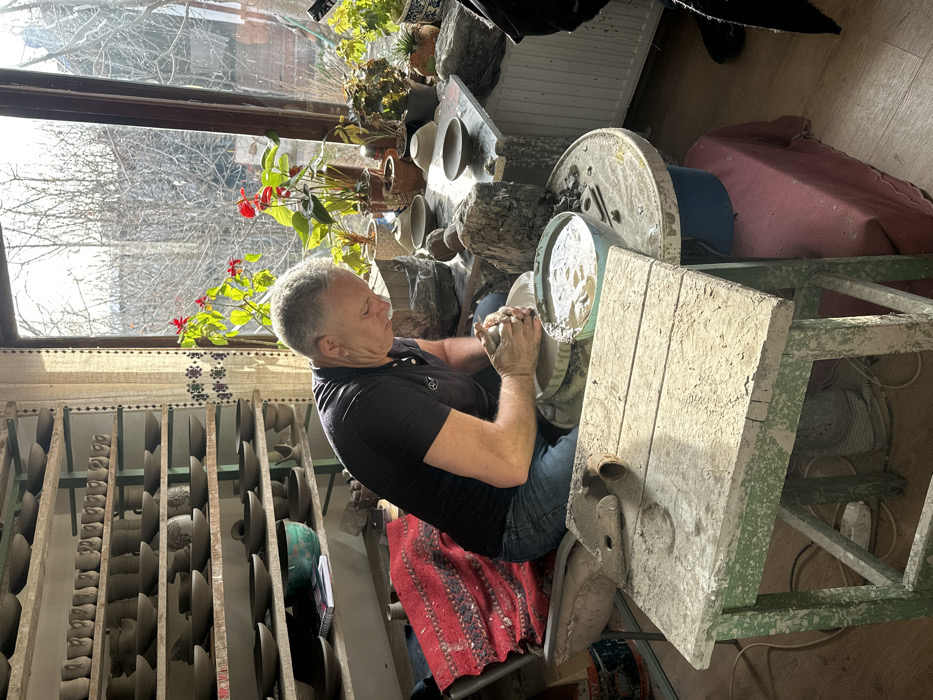
An adult male, with short grey hair, is seated and actively throwing pottery on a potter's wheel inside a workshop in Horezu, Romania. He wears a black short-sleeved polo shirt with a small logo and blue jeans, with his hands visibly covered in clay as he shapes a ceramic piece on the rotating wheel. A light blue basin containing water or clay slip is positioned immediately to the potter's right. The workshop's left wall features a tall, multi-tiered shelving unit displaying numerous unfired or bisque-fired ceramic items, including bowls, plates, and mugs, organized across multiple wooden shelves. A large window on the right side of the frame provides bright natural illumination, revealing a view of trees with bare branches outside. The windowsill and an adjacent counter are densely populated with various potted plants, including several red-flowering Anthuriums, alongside additional unfired pottery bowls and raw clay. In the immediate foreground, a small, distressed wooden stool, painted green with peeling paint and spattered with clay residue, holds a clay-shaping tool. A red patterned textile, possibly a traditional rug, is draped over the potter's seat. The floor is constructed of wood.
Horezu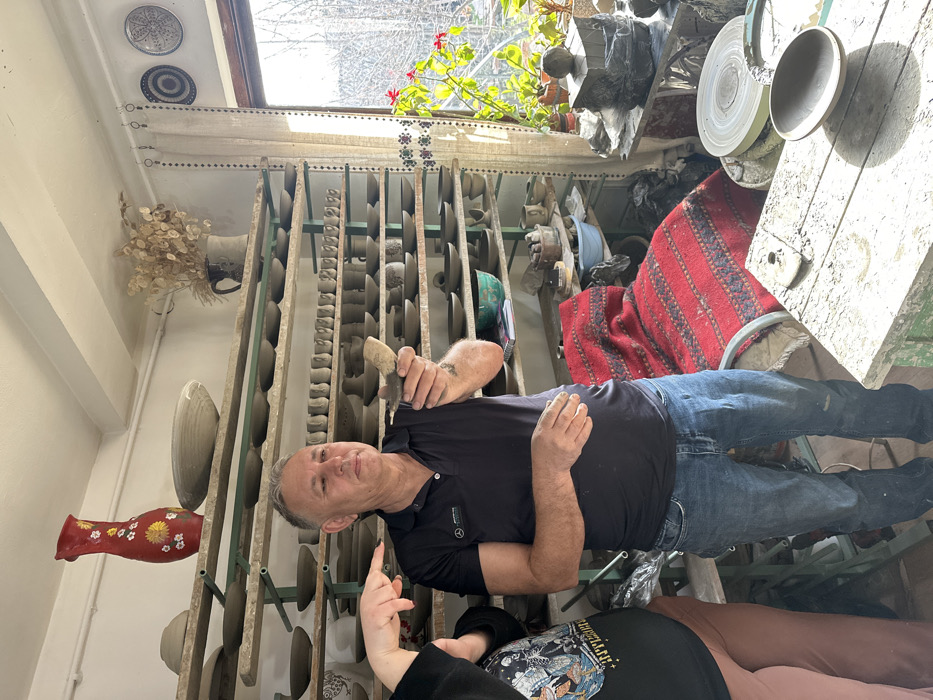
This image depicts an indoor scene within a pottery workshop or studio located in Horezu, Romania. The primary subject is a light-skinned adult male with short grey hair, wearing a dark blue polo shirt with a Mercedes-Benz logo on the left chest, and blue jeans. He stands centrally, holding a small, irregularly shaped, dark grey object in his right hand, which he appears to be examining intently. His left forearm displays a tattoo. To his left, the partial view of a second individual shows a hand with an extended index finger pointing towards the object the man is holding, indicating an interaction or discussion. This second person wears a black long-sleeved top with a white graphic and light brown pants. The background features multiple tall, five-tiered shelving units constructed from metal and wood, laden with numerous unglazed grey ceramic items, including bowls, plates, and mugs. A red vase with yellow floral patterns and a large grey shallow bowl are visible on the top shelf. Near the upper right, a dark pitcher contains dried plants. The right side of the room features a large window, allowing natural light to illuminate the scene. Potted plants with red flowers are on the windowsill. Two decorative plates are mounted on the wall to the left of the window, above a light-colored curtain with a patterned border. Below the window, a metal table holds dark, roughly shaped objects and a round stone. In the foreground, a rustic wooden table displays a dark unglazed bowl and a pottery wheel head. A red patterned rug is draped over a chair or bench to the right of the male subject. The walls are white, and the ceiling features visible wooden beams. The environment suggests an active artisanal workspace.
Horezu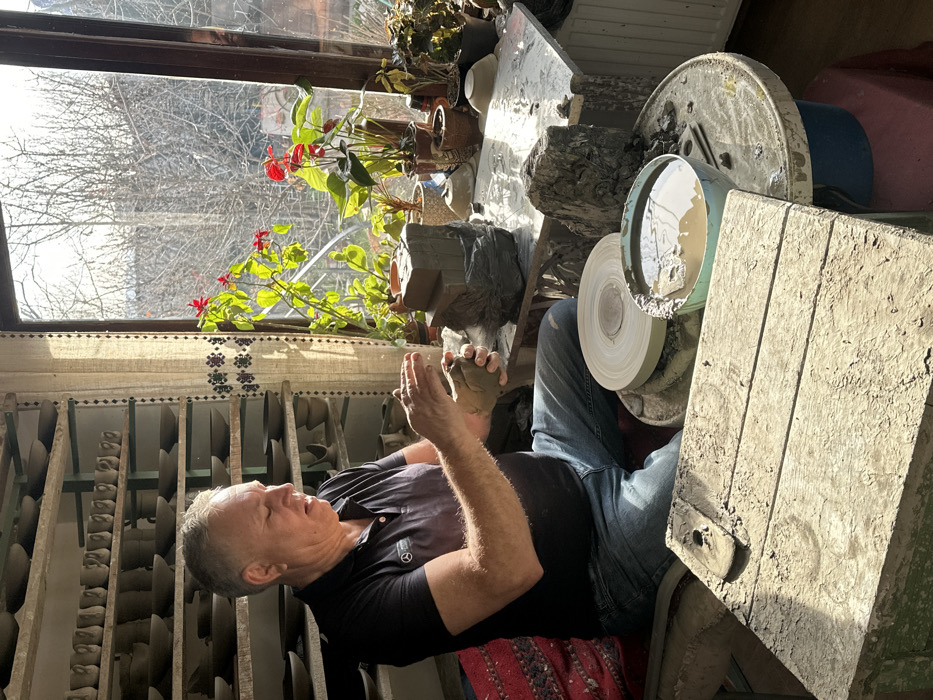
The image depicts an indoor pottery workshop in Horezu, Romania, illuminated by bright natural light from a large window. A single Caucasian male, appearing middle-aged, with short gray hair, is seated and actively manipulating a lump of light-colored clay with both hands. He wears a dark polo shirt with a small white logo on the left chest and blue jeans. To his left, a multi-tiered wooden shelving unit extends vertically, filled with numerous unglazed, unfired pottery items, including bowls and cups. The man is positioned in front of a workbench, which is covered in clay residue. On the workbench, a light-colored pottery wheel is visible, alongside a light blue bowl containing muddy water. Additionally, a stack of rectangular clay blocks and other irregular clay pieces are present on the table surface. The large window on the right side of the frame overlooks an outdoor scene dominated by bare deciduous trees, suggesting a cooler season. Several potted plants, some with vibrant red flowers, are arranged on the windowsill. A light-colored fabric or curtain with dark patterned embroidery hangs vertically along the left edge of the window frame. Sunlight streams through the window, casting distinct shadows on the workbench and the man's lap.
Horezu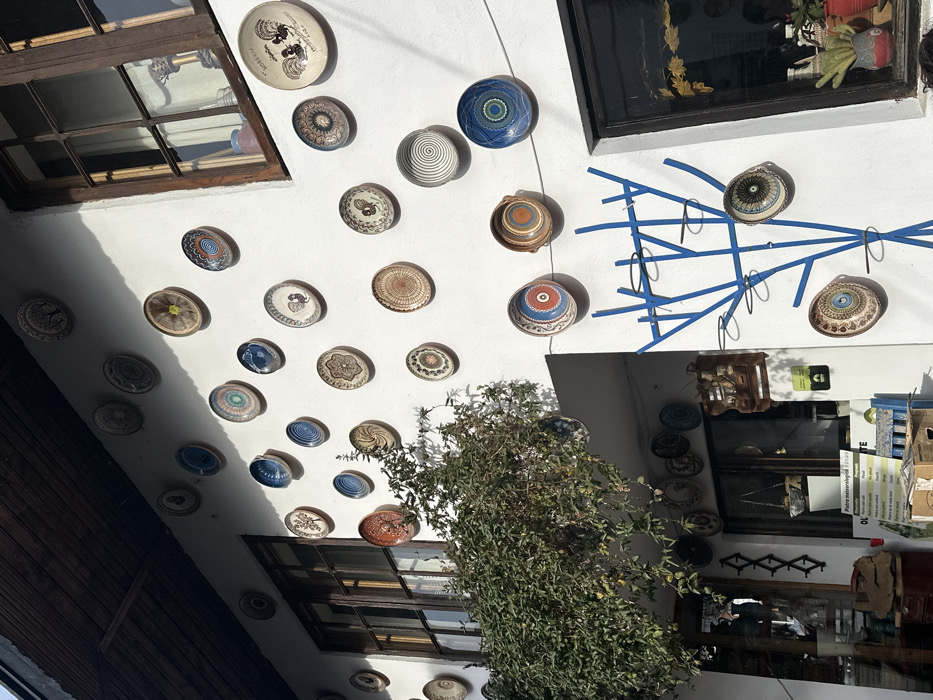
The image displays the sunlit white exterior wall of a building in Horezu, Romania. The wall is extensively adorned with numerous circular ceramic plates of various sizes, mounted individually. These plates feature distinct patterns, including roosters, concentric spirals, and geometric or floral motifs, characteristic of Horezu pottery. Two dark-framed, multi-pane windows are visible; one on the upper left is partially obscured by a dense green hanging plant that cascades from an overhang. The other window is on the upper right. A dark wooden eave structure extends across the top of the building. On the lower right portion of the wall, a blue-painted metal structure resembling a stylized tree is affixed, displaying additional ceramic plates within its circular holders. Below the left window and plant, a recessed entrance or shop display area is visible, containing signs, boxes, and various other objects. Strong sunlight illuminates the scene, casting sharp, distinct shadows from the plates and foliage onto the white wall. No individuals are present in the frame.
Horezu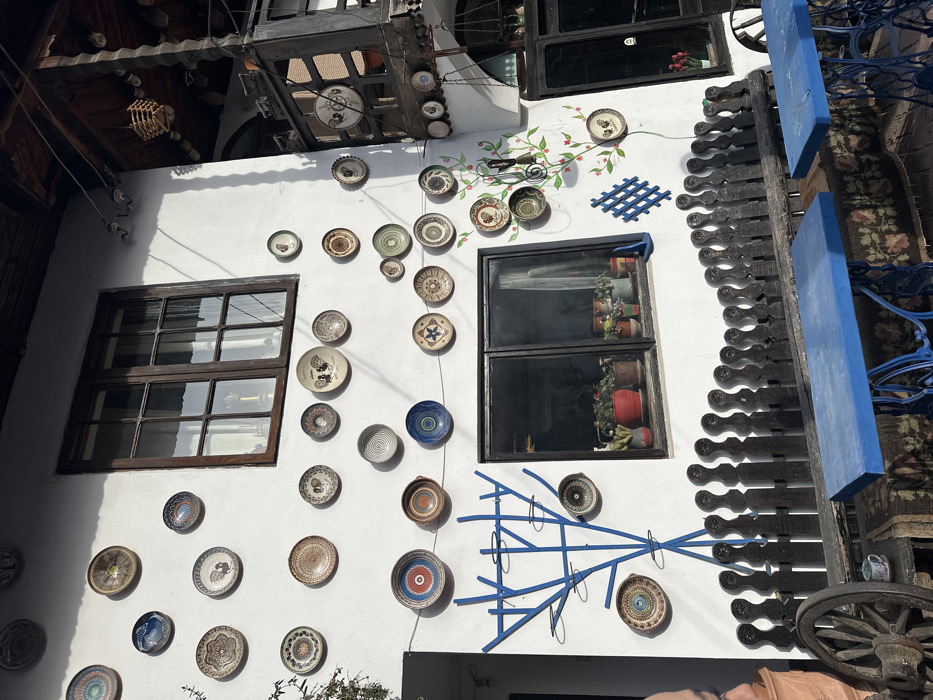
The image depicts an exterior view of a building facade in Horezu, Romania, adorned extensively with traditional pottery. The primary wall is painted white, featuring numerous ceramic plates of various sizes and designs, hung directly on the surface. These plates display motifs such as roosters, geometric patterns, and floral elements in colors including blue, brown, green, and white. An upper rectangular window with a dark brown frame and multiple panes is present on the white wall. Below it, a lower horizontal window with a black frame shows several potted plants on its interior windowsill. To the far right, a dark-framed door is partially visible, also revealing potted plants inside. An ornate dark wooden structure, possibly a balcony or an upper floor extension, projects from the upper right, similarly decorated with ceramic plates and a hanging wooden object. On the lower left wall, a stylized blue metal or painted tree-like structure with circular metal holders is affixed, with one ceramic plate hanging within it. To the right of the lower window, a green vine with red accents is painted directly on the wall, incorporating several plates into its design, alongside a small blue lattice pattern. In the foreground, an outdoor seating area is visible. A dark wooden bench or fence with a scalloped top runs horizontally across the middle. In front of this, two tables are present, each featuring a blue-painted rectangular top supported by ornate cast-iron bases, characteristic of repurposed sewing machines. The ground beneath the tables is covered with a patterned material displaying floral designs. On the far left, a large wooden wagon wheel stands vertically, next to a terracotta pot. A small patterned cup or pot rests on the patterned ground covering near the wagon wheel. A person is partially visible on the far left edge of the frame, showing only the side profile of their head, facing right. The scene is illuminated by bright sunlight, casting distinct shadows of the plates and structures onto the white wall.
Horezu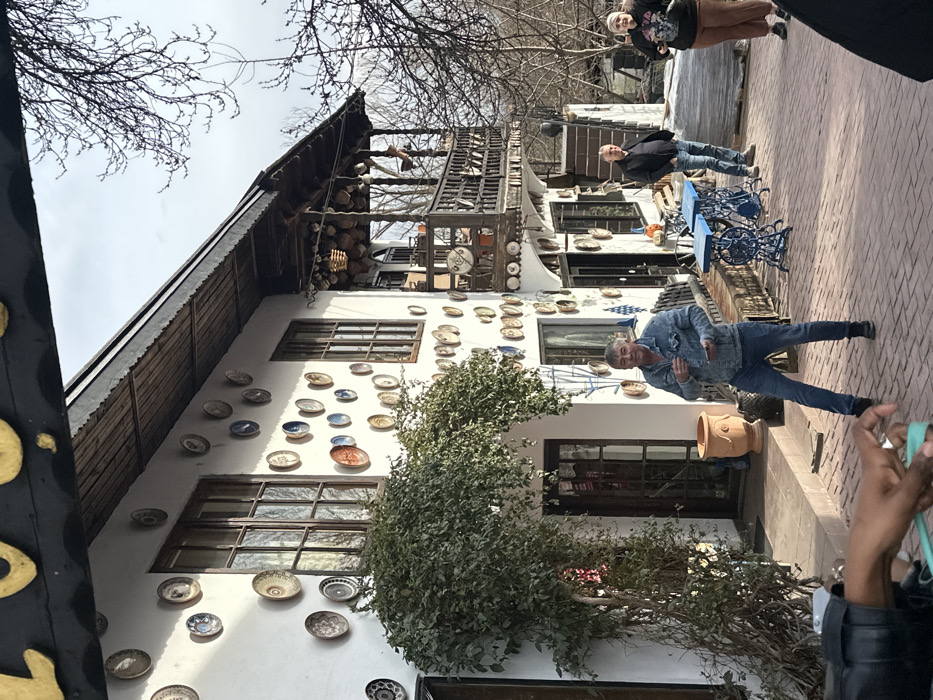
The image displays an outdoor scene in Horezu, Romania, centered on a two-story white building adorned with numerous decorative ceramic plates of various sizes and colors affixed to its facade. The building features dark-framed windows and a prominent wooden balcony on the second floor, which has an ornate wooden railing and displays hanging ceramic objects and baskets. A large green leafy vine partially covers the ground floor entrance on the left. The ground in the foreground is paved with reddish-brown interlocking bricks. Four individuals are visible. In the bottom left foreground, a person's dark-skinned right hand and forearm, clad in a black sleeve, holds a light blue object. Centrally, a man wearing a blue denim jacket and jeans stands, gesturing with his right hand while holding a small item. To his right and further back, another man in a black jacket and blue jeans stands, looking towards the left. Adjacent to him on the right, a woman in a dark hoodie and brown pants stands, holding an object with both hands and also looking left. Two blue metal tables with ornate bases and a long wooden bench are positioned on the paved area to the right of the central man. A large terracotta pot rests near the ground floor entrance on the left. The background reveals bare deciduous trees against a light blue, slightly overcast sky.
Horezu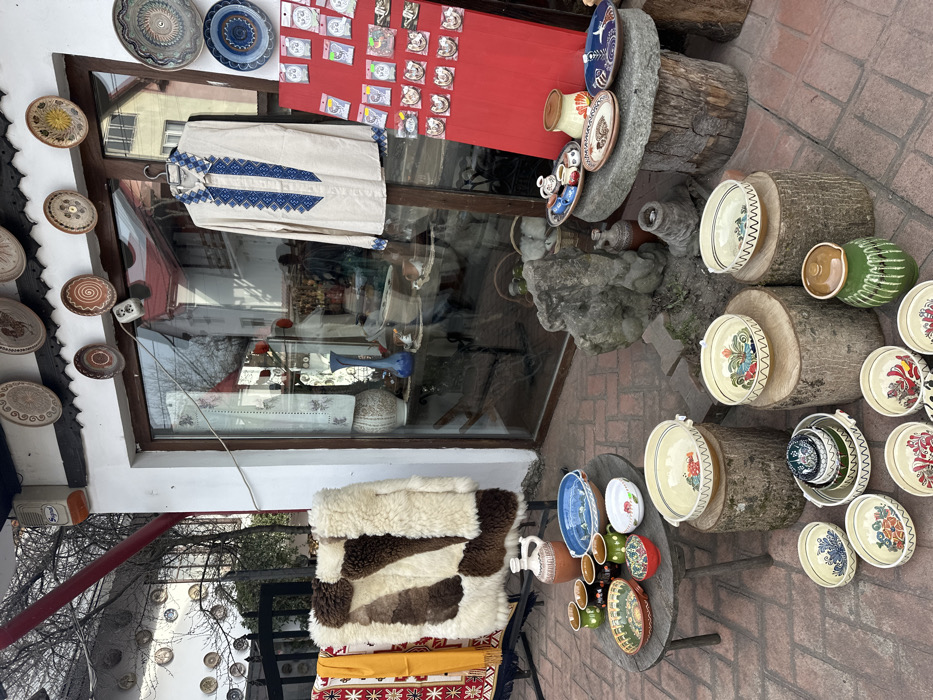
The image depicts an outdoor market stall or shop entrance in Horezu, Romania, showcasing a variety of handcrafted items on a reddish-brown brick pavement. On the left, a vertical metal stand holds folded textiles, primarily a yellow fabric with red patterned borders. In front of this, a multi-toned fur or sheepskin vest, patched in white, light brown, and dark brown, hangs from a display rack. A short, round wooden table nearby holds several ceramic pieces, including a light brown pitcher with a handle, multiple small ceramic mugs (some green, some dark brown), a large oval blue ceramic bowl, and various smaller round bowls with painted floral and geometric designs in colors such as green, red, and white. In the center and foreground, numerous Horezu-style ceramic bowls, both shallow and deep, with colorful floral and geometric patterns, are arranged on the brick ground and atop several cut wooden stumps of varying heights. A green ceramic jar with a lid, featuring vertical stripes, is positioned among these bowls on the right side of this ground display. Two large, weathered gray stone blocks are situated close to the building's glass display window. To the right, two stacked wooden stumps serve as a display stand for a white ceramic pot with a lid, a blue ceramic plate with white designs, a reddish-brown ceramic plate with a central motif, and a miniature set of ceramic cups and a pitcher on a small tray. Adjacent to this, a vertical red display board is densely covered with individually packaged small items, likely magnets or pins, each displaying a cartoonish face. The building's white facade features a large glass display window. Above the window, a dark, scalloped wooden trim is adorned with multiple decorative ceramic plates of various sizes and patterns, primarily in brown, red, and blue tones. More decorative plates are mounted on the wall to the right of the window. A beige long-sleeved shirt with prominent blue embroidered patterns on the front and cuffs hangs from a hanger in the upper right section of the window. A white electrical outlet is affixed to the wall above the left side of the window, with a white cable extending diagonally upwards to an orange "Sigal" security alarm box mounted higher on the wall. Reflections in the window show indistinct elements of the interior shop space, including a tall blue vase and other ceramic items, along with vague reflections of distant structures or figures. Bare tree branches are visible in the upper left background. No individuals are directly present in the foreground.
Horezu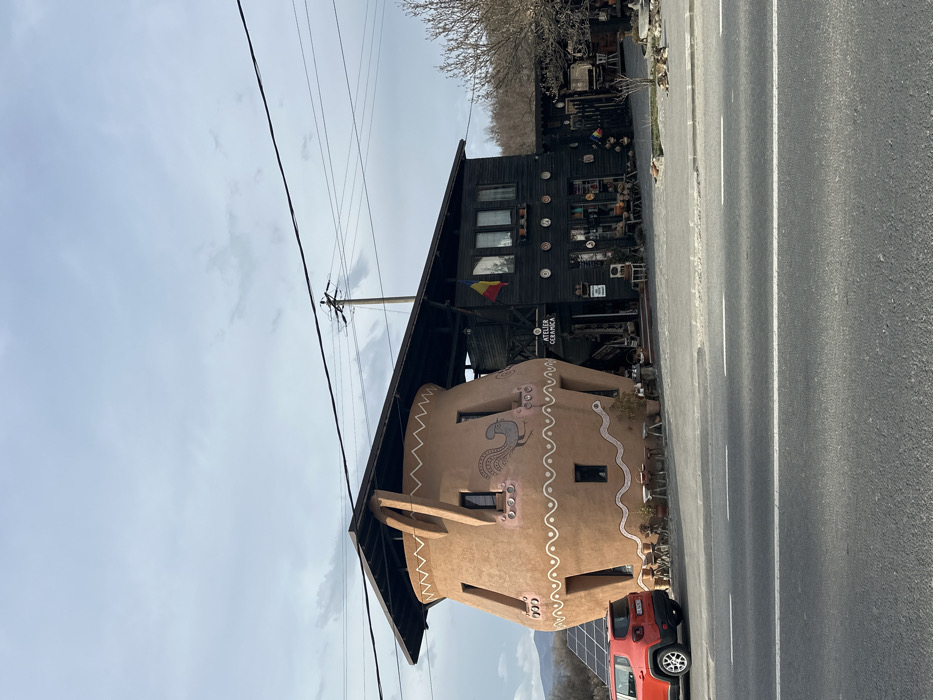
This image captures a roadside scene in Horezu, Romania, featuring two distinctive adjacent structures and their immediate environment under an overcast sky. The prominent building on the left is a large, unique structure shaped like a terracotta pot or jar, colored in an earthy reddish-brown hue. It features two prominent handle-like extensions near its top. The exterior is decorated with white geometric patterns, including zig-zag lines along the rim and wavy lines with dots around the midsection. A stylized grey and white bird motif is painted on its upper facade, with a snake-like pattern appearing lower down. Multiple rectangular windows are visible. Several small terracotta stools or pots are arranged along the base of this building. Solar panels are installed on a roof section behind this structure on the left. A red Jeep SUV, facing left, is parked on the paved shoulder adjacent to the pot-shaped building. To the right, connected to the pot-shaped building by a shared dark roof, is a two-story building constructed from dark-stained or painted wood planks. A sign on the first floor reads "ATELIER CERAMICA," indicating a pottery workshop or retail space. A Romanian flag is displayed on the upper right side of this building. Numerous ceramic items, including plates and pots, are displayed on its exterior walls and shelves, and arranged on the ground leading to an entrance. In the foreground, a paved asphalt road runs horizontally, marked with white double solid lines. A grey paved shoulder separates the road from the buildings. Utility poles and multiple power lines stretch across the upper portion of the frame. The background features bare deciduous trees and shrubs on the right, and distant hills or mountains under a grey, cloudy sky on the left. No individuals are visible in the scene.
Horezu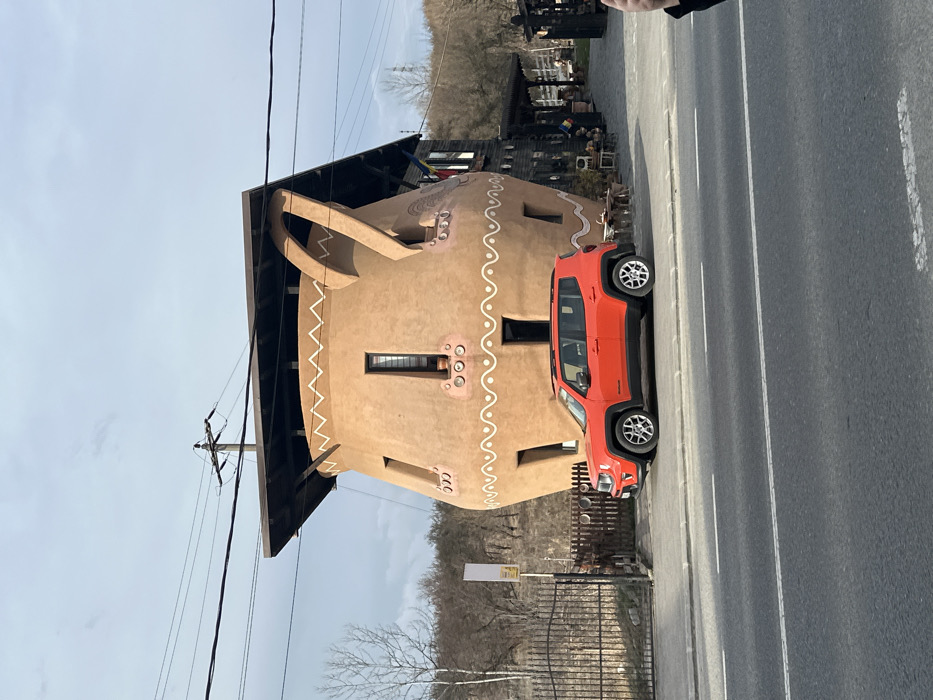
This image captures a unique, pot-shaped building situated roadside in Horezu, Romania. The building is constructed of a light brown, terracotta-colored material, featuring a large handle on its upper right side and a dark, flat roof extending beyond its main structure. The exterior is adorned with white wavy lines and small circular decorative elements. Numerous windows, varying in shape and size (rectangular and rounded), are visible on its facade; one central upper window holds a small potted plant. A stylized rooster design is painted on the right side of the pot's exterior, partially obscured by the handle. Adjoining to the right is a darker, multi-story structure with a visible wooden exterior and two Romanian flags displayed. A bright orange four-door Jeep Renegade SUV is parked on the paved area directly in front of the pot-shaped building, positioned parallel to the adjacent road. The vehicle faces slightly right. The foreground features a two-lane asphalt road marked with a continuous white line and a dashed white center line. To the left of the building, a black ornamental iron fence delineates the property boundary. Behind the building and fence, a hill densely covered with bare deciduous trees rises. Overhead utility poles and multiple power lines traverse the sky, which is partly cloudy with visible patches of blue. A partial human hand is visible on the extreme right edge of the frame.
Horezu
A young man stands in a circle of seated people, holding a length of string. Another person approaches and the two hold the string together, raising and lowering it. The seated people are partially encircled by the string. The room is lit by fluorescent ceiling lights. The floor is brown patterned tiles. There are approximately 15 people, mostly young adults.
Horezu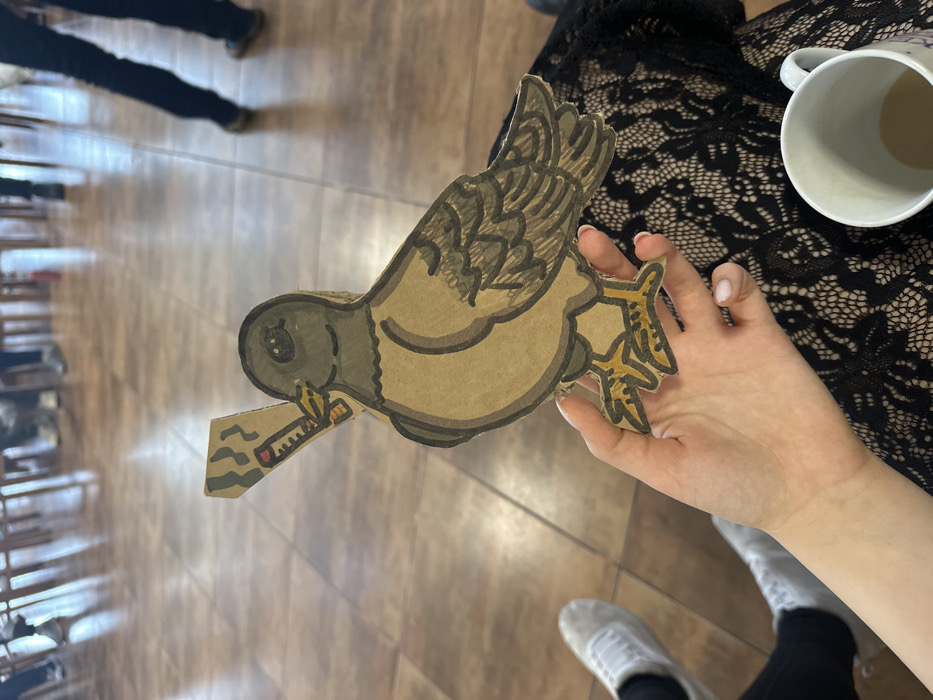
An overhead, slightly angled photograph captures a light-skinned hand, presumably female, holding a corrugated cardboard cutout of a cartoon pigeon. The pigeon is depicted with a dark gray head, light brown body, dark gray feathered wings, and yellow feet. It is drawn with a lit cigarette in its yellow beak, from which smoke lines rise. The hand is positioned over the upper right thigh of a person wearing black lace fabric. In the lower right corner, a white mug containing a light brown liquid rests on the lace material. The background is an out-of-focus indoor environment with a light brown tiled floor. Multiple blurred figures, indicated by their legs and feet, are visible in the mid-ground and background, suggesting other individuals are seated or standing in a communal area. This scene is located in a public indoor setting within the city of Horezu, Romania.
Horezu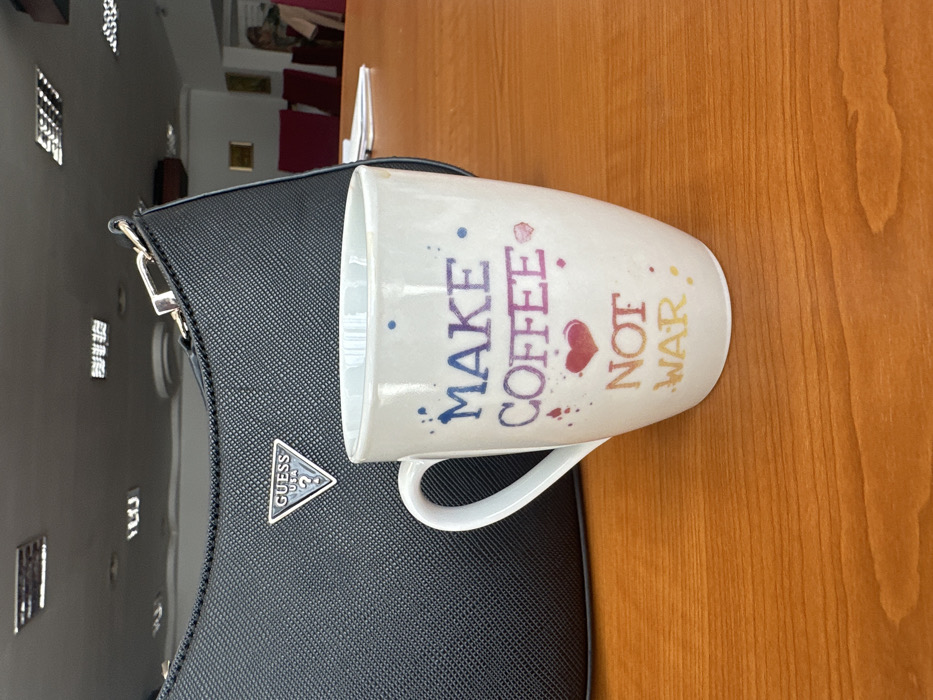
The scene is located in an indoor setting within the city of Horezu, Romania, likely a meeting or office room. A white ceramic mug, emblazoned with the text "MAKE COFFEE" (in blue and purple gradient), a red heart icon, and "NOT WAR" (in orange and yellow gradient), along with colorful paint splatters, rests on a polished, reddish-brown wooden table. Behind the mug and slightly to its left, a black, textured handbag with a metallic "GUESS USA" triangular logo is positioned. Overhead rectangular light fixtures are reflected on the handbag's surface and in the distant background. In the background, red upholstered chairs are partially visible, and a light-colored wall displays at least two framed items. White papers are also present on the table to the right of the mug. A single individual is indistinctly visible in the far right background, partially obscured by the distant furniture. No direct actions or interactions are depicted.
Horezu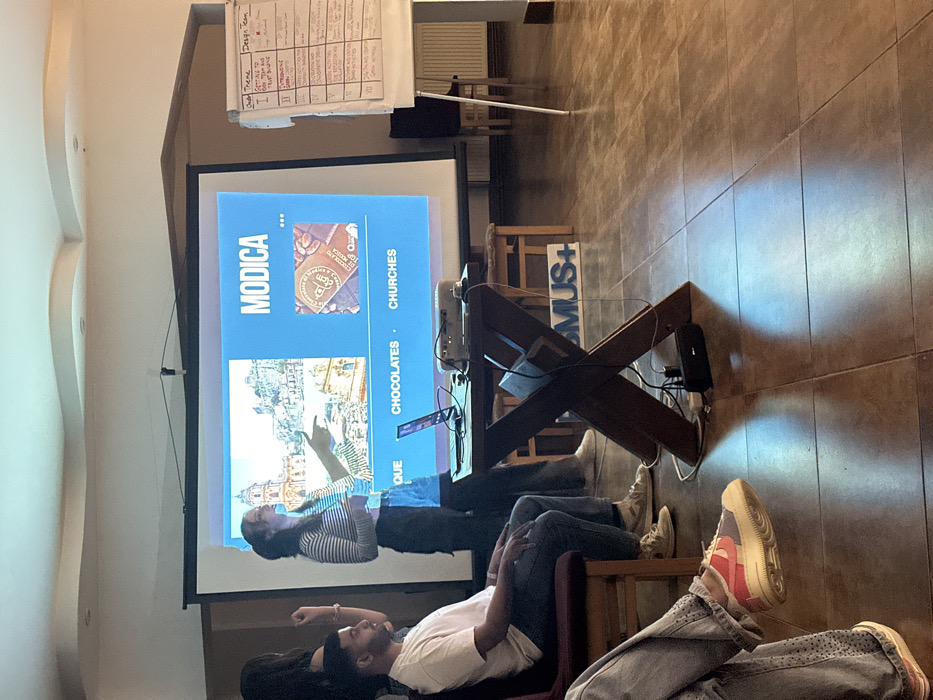
An indoor presentation is underway in a room in Horezu, Romania. A female presenter, wearing a striped long-sleeve top and dark trousers, stands centrally, gesturing with her right hand towards a large white projector screen. She holds a clear bottle in her left hand. The screen displays a slide titled "MODICA," featuring images of a European city (likely Modica) and a chocolate bar labeled "CIOCCOLATO DI MODICA." Text on the slide includes "CHOCOLATES" and "CHURCHES." To the left, a male in a white t-shirt and blue jeans is seated, observing the presentation. Partially visible to the far left is another person standing. In the immediate foreground on the left, a person's legs and feet are visible, wearing blue jeans and distinctive pink and purple sneakers. A white projector rests on a wooden X-shaped table in the center foreground, connected to an open laptop. Beneath the table, a black Bluetooth speaker is on the tiled floor. Behind the table, a white sign with blue letters "ERASMUS+" is visible on the floor. To the right of the screen, a white flipchart displays handwritten notes detailing "Task Theme" and "Design Team." The room has light-colored walls, a decorative ceiling feature, and a brown tiled floor.
Horezu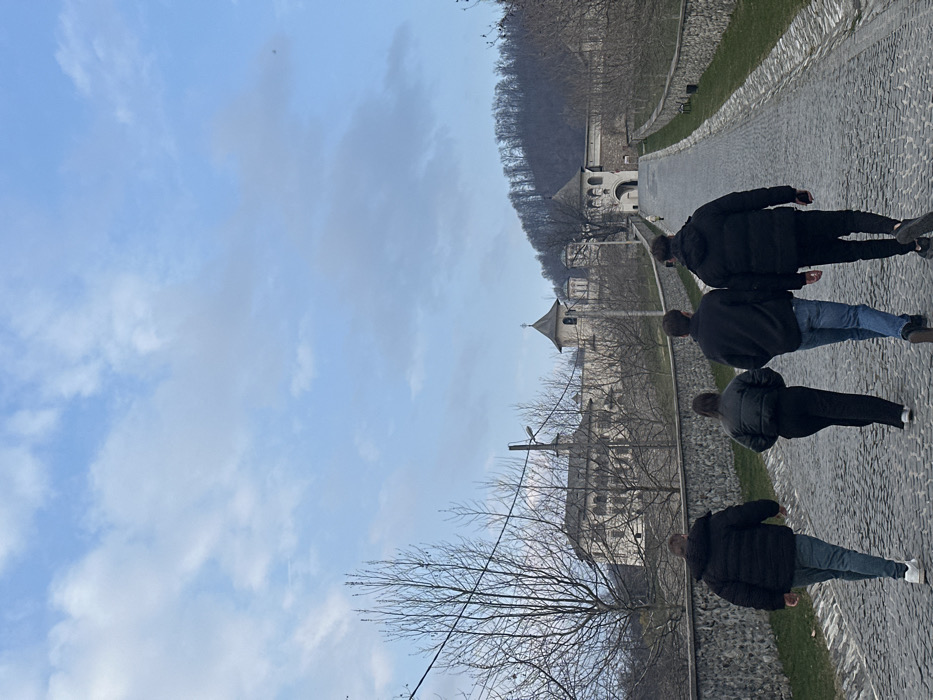
Four individuals are observed from behind, walking uphill on a cobbled pathway towards the Horezu Monastery in Horezu, Romania. The pathway is flanked by stone walls with grass borders. The sky above is light blue with scattered white and grey clouds. Bare deciduous trees are visible on both sides of the path and on the wooded hills surrounding the monastery complex, indicating a late autumn or winter season. The group consists of four persons, all appearing to wear dark, padded jackets, blue or dark trousers, and sneakers. From left to right: 1. An individual in a dark puffer jacket, blue jeans, and white sneakers. 2. An individual in a dark puffer jacket, dark trousers, and white shoes. 3. An individual in a dark jacket, blue jeans, and dark shoes. 4. An individual in a dark puffer jacket, dark trousers, and dark shoes, holding a dark object in their right hand. They are walking in a loose formation, generally centered on the pathway, and appear to be proceeding towards the arched main entrance of the monastery. The monastery complex, characterized by light-colored facades, multiple towers with conical roofs (some topped with crosses), and an arched gateway, dominates the background. A utility pole with wires is visible on the far left side of the image. Another person is faintly visible further up the pathway, closer to the monastery entrance.
Horezu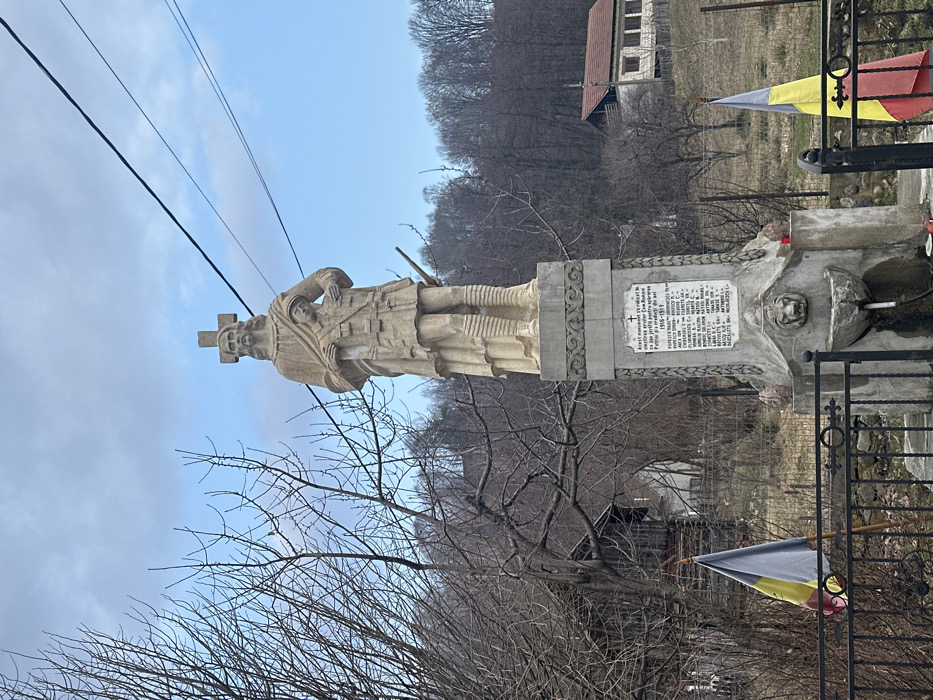
The image displays a stone monument located in a semi-rural area of Horezu, Romania, under a partially cloudy sky. The monument consists of a tall, light-colored stone statue depicting two figures atop a multi-tiered pedestal. The upper figure, representing Jesus Christ, is robed and features a cross halo. He supports a smaller figure, a uniformed soldier wearing puttees, who appears to be injured or deceased and leans against the larger figure. The monument's pedestal is made of stone. Its mid-section features a rectangular plaque with Romanian text, including the years "1916-1919" and a list of names, identifying it as a war memorial. The lower part of the pedestal incorporates decorative lion-head sculptures, with a central lion-head acting as a water spigot over a small basin, suggesting a functional fountain. A small red votive candle is present on the base. In the foreground, a low, dark metal fence with scrollwork runs across the scene. Two Romanian flags, displaying vertical blue, yellow, and red stripes, are positioned on poles behind the fence, flanking the monument. The surrounding environment consists of bare deciduous trees, indicating a colder season. To the left, a rustic wooden building with a dark roof is partially visible through the branches. To the right, a two-story house with light-colored walls and a prominent red-tiled roof is situated on a slight incline, backed by a dense, leafless forested hill. Overhead, two dark electrical power lines stretch across the upper portion of the frame.
Horezu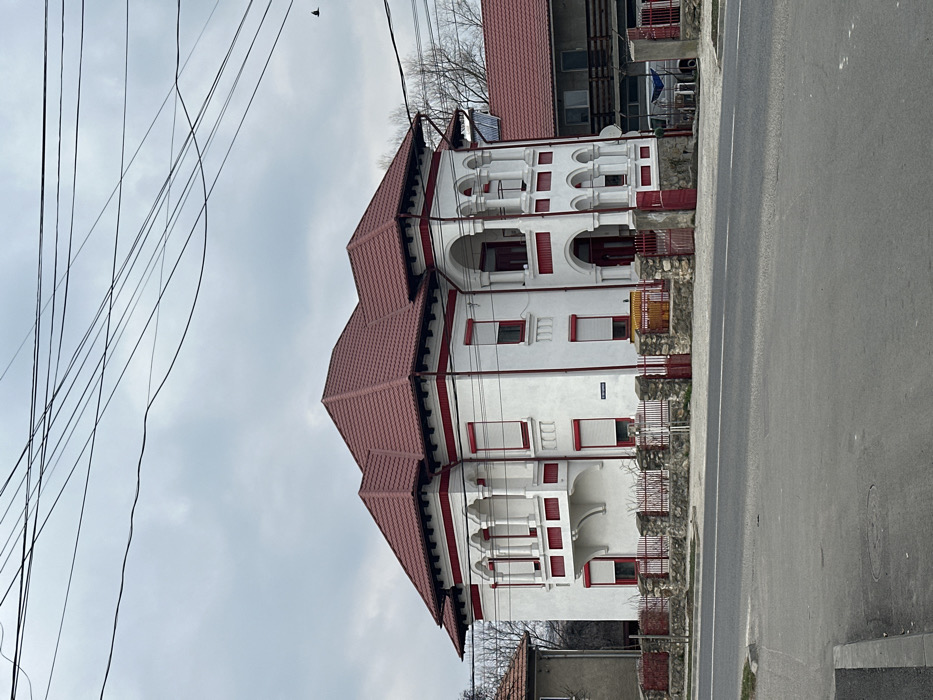
The scene depicts a distinctive two-story building under an overcast sky, located along a paved road in the city of Horezu, Romania. The building features a white stucco facade with prominent red architectural details, including a complex gabled roof system covered in red terracotta tiles. Red trim bands encircle the structure at various levels. On the upper floor, a cantilevered balcony or loggia is present on the left side, characterized by arched openings supported by slender white columns and a red balustrade. All visible windows on both floors are equipped with light-colored, possibly white or grey, roller shutters over red frames. An arched entrance portico is situated on the right side of the main facade. A small white sign bearing the text "Str. Horezu" is affixed to the facade near the ground level. The property is fronted by a low fence consisting of stone pillars and red metal railings, with a red metal gate providing access. In the foreground, an asphalt road extends horizontally across the frame, bordered by a concrete curb and a section of sidewalk on the left, where a circular manhole cover is visible. Numerous black utility lines crisscross the sky overhead. To the left of the main building, a section of an older, simpler structure with a brown-tiled roof is visible. To the right, a second building with a dark facade and a red roof is partially observable behind the main building's fence, with a light-colored van parked in its vicinity. No individuals are present, nor are any actions or interactions depicted.
Horezu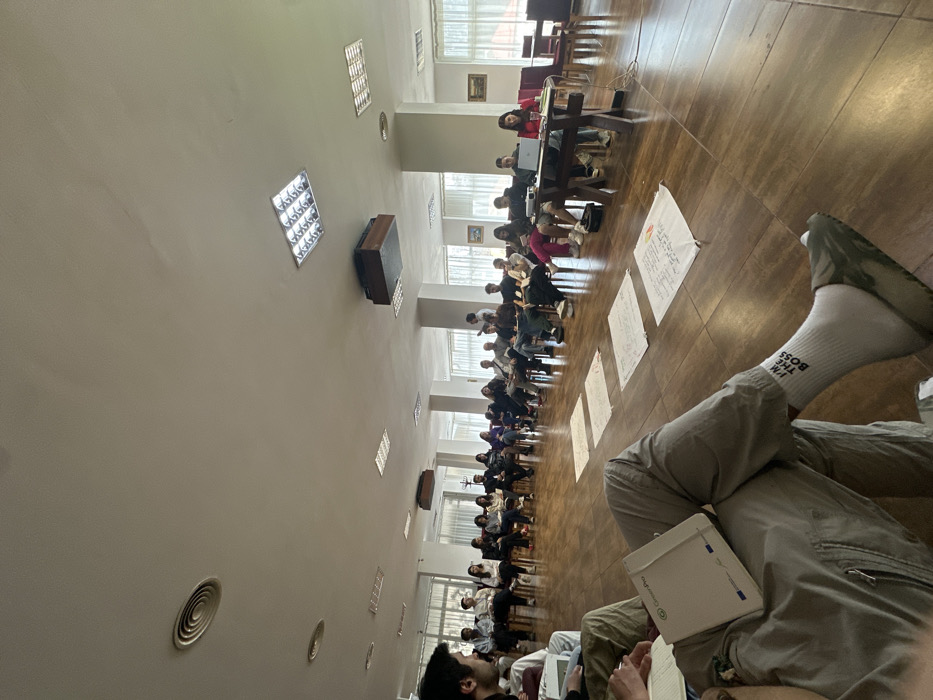
The scene depicts an indoor group gathering in a large, well-lit room located in Horezu, Romania. Approximately 30-35 individuals, predominantly young adults, are seated in a semi-circular configuration on wooden chairs, facing inward towards a central area. In the immediate foreground, the lower body of a person is visible, seated with their legs crossed. They are wearing light beige cargo pants and white socks. The visible right sock bears the phrase "I'M THE BOSS" in black capital letters. A white notebook or binder, branded "CareerPro" and featuring the European Union star emblem, rests on their lap. To the left, a portion of another person, likely seated, is visible. In the mid-ground, a dark-haired woman in a red top is seated at a dark wooden table on the right side of the semi-circle, facing the group. An open laptop and some papers are positioned on the table in front of her. A projector is also present on the table to her left, indicating a presentation setup. A male individual in a white t-shirt stands near the center of the semi-circle, appearing to address the seated group, possibly acting as a facilitator or speaker. The participants are generally attentive, facing the central presentation area. The room features a polished light brown wooden floor. The ceiling is flat and white, equipped with multiple rectangular fluorescent light panels and circular air vents. Several white support columns are spaced throughout the room. Large windows, fitted with sheer white curtains, line the far wall, providing natural illumination. Two framed landscape paintings are mounted on the wall to the right. Additional wooden chairs and tables are visible in the background, suggesting a versatile space.
Horezu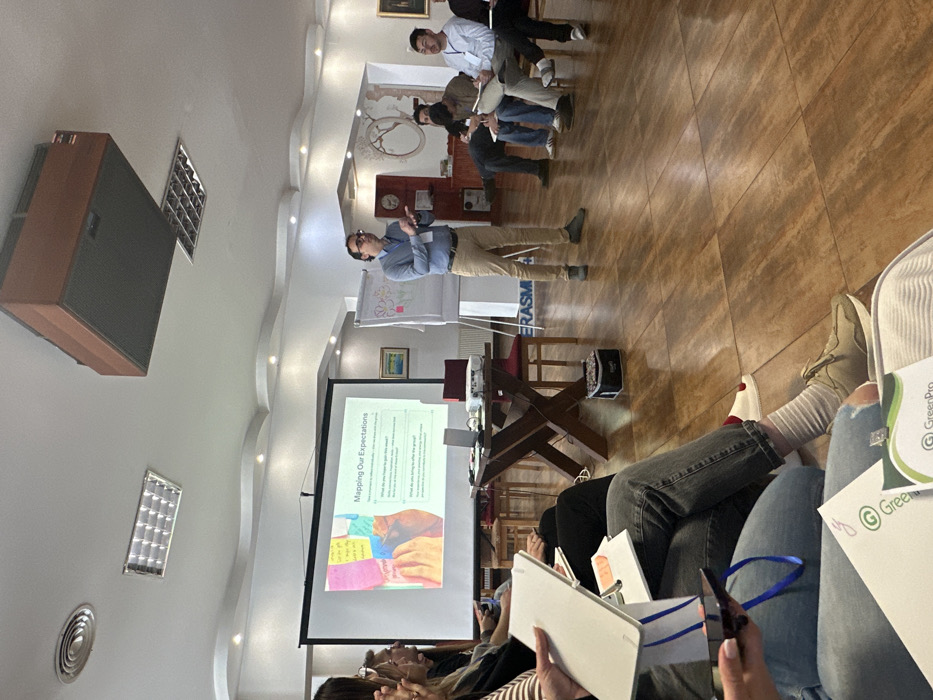
An indoor presentation or workshop is taking place in Horezu, Romania. A male presenter, wearing a light blue button-up shirt, dark glasses, and khaki pants, stands center-right, actively gesturing with both hands. He wears an identification badge on a blue lanyard. Behind him, a large white projection screen displays a slide titled "Mapping Our Expectations," featuring an image of hands with colorful sticky notes and descriptive text. A white projector is positioned on a dark wooden table in front of the screen. To the presenter's right, a white flip chart easel with colorful drawings is visible. A white banner with "ERASMUS" in blue text rests on the floor. Approximately ten individuals comprise the audience, seated and facing the screen and presenter. In the immediate foreground, partial views of two seated individuals are visible on the left; one holds a white tablet and a smartphone with a blue lanyard, while the other holds papers displaying a "GreenPro" logo. In the mid-ground right, several male attendees are seated, some holding notebooks or papers. One individual wears a white identification badge. The room features light-colored walls with decorative elements including a circular tree-motif wall art and framed pictures. The floor is covered in polished brown tiles with a wood-grain pattern. The white ceiling contains recessed spotlights and rectangular fluorescent fixtures.
Horezu