Idlib, Syria
30 memories from Idlib, Syria
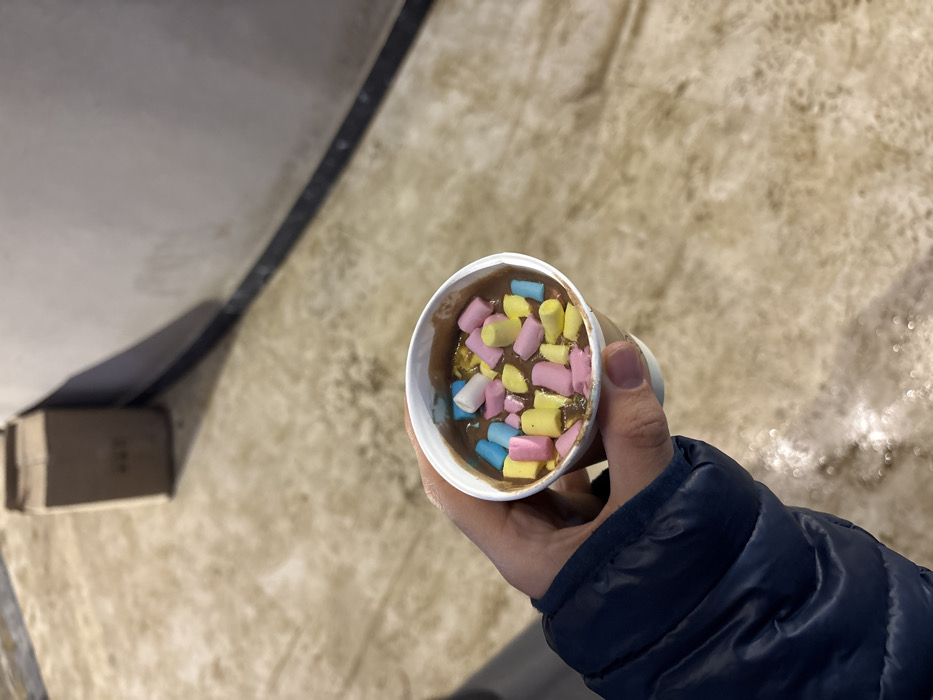
A person holds a white paper cup filled with hot chocolate and colorful marshmallows. The marshmallows are pink, yellow, blue, and white. The person's hand and a portion of their navy blue, puffy jacket are visible. The background consists of a concrete surface with some dark lines and spots, alongside a dark structure to the left. A small cardboard box sits beside the dark structure on the concrete surface.
Idlib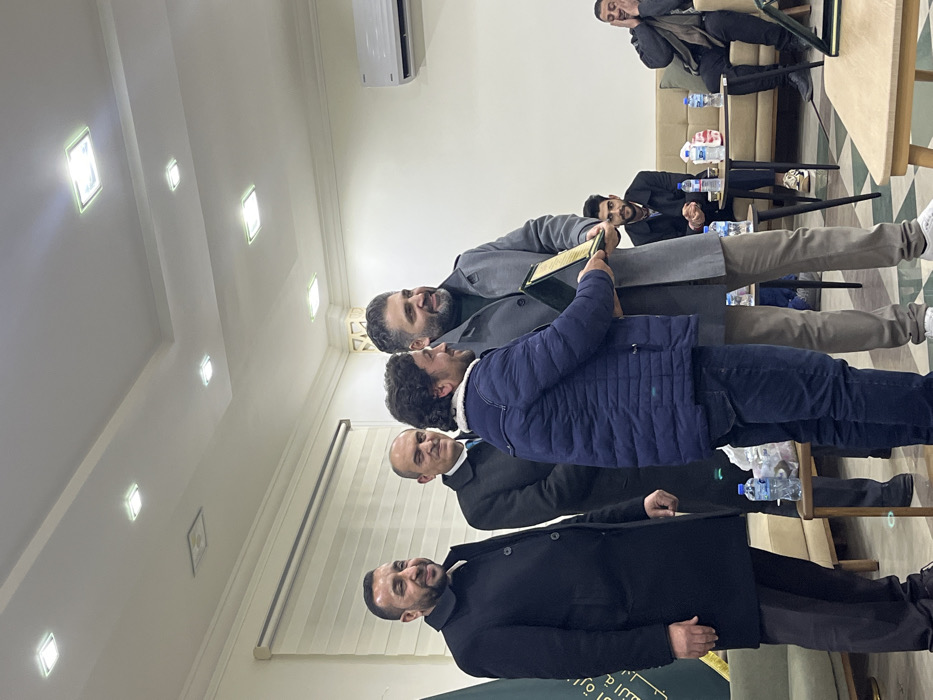
The image captures an indoor awards ceremony or recognition event, with several men present in what appears to be a meeting room or office lounge. The setting features light-colored walls, a ceiling with multiple square recessed lights, and an air conditioning unit mounted high on the wall. A window with horizontal blinds is visible on the left side of the frame. In the foreground, a man wearing a black coat is seen smiling and looking towards the camera. Slightly behind him, another man in a dark suit or coat is also visible. The central activity involves two men: one with a dark beard and gray overcoat is presenting a framed award or certificate to another man who has dark, curly hair and is wearing a blue puffer jacket. Both men are smiling and looking at the award, which has a green frame and a golden interior. Further in the background, to the right, several other men are seated on light-colored sofas around small, dark wooden tables. These tables hold plastic bottles of water and what appear to be disposable cups. One seated man with a beard is looking towards the award presentation. Another man further back is seen with his hands covering part of his face, possibly in amusement or surprise. The atmosphere appears positive and celebratory, indicated by the smiles on the faces of the main participants. The men are dressed in smart casual or semi-formal attire, including coats and jackets. A green banner or sign with some Arabic script, partially obscured, is visible in the bottom left corner of the image; the word "ادارة" (Idara, meaning administration or management) can be faintly discerned. The lighting suggests an indoor setting, likely during the day or evening, relying on artificial illumination.
Idlib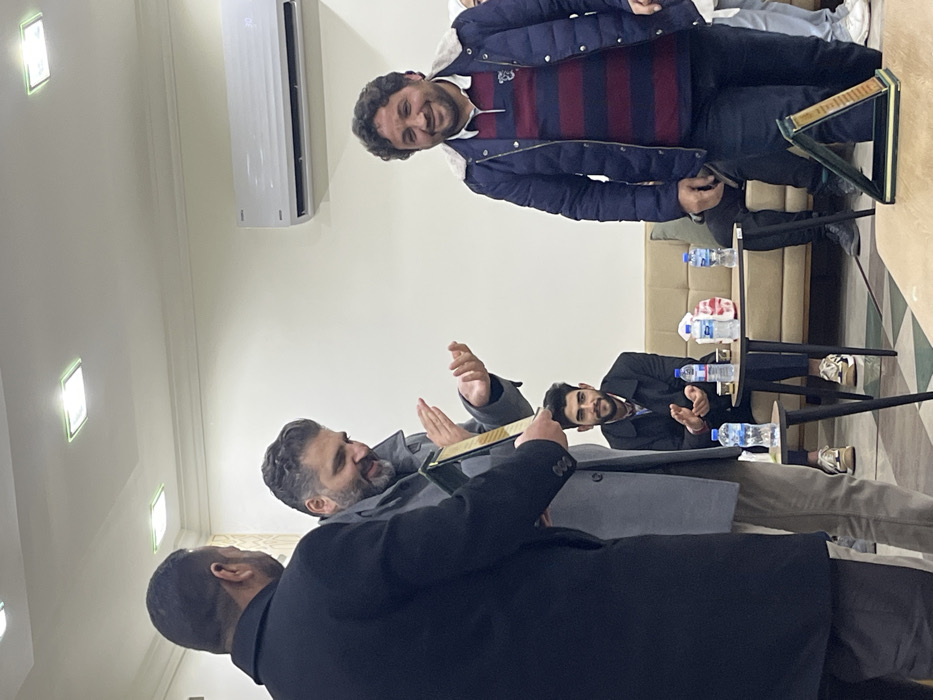
The image depicts an indoor gathering of several men, likely a formal or semi-formal event such as a presentation, meeting, or award ceremony. The overall atmosphere appears positive, with multiple individuals smiling. In the foreground, partially visible from the back on the right side of the frame, is a man wearing a dark jacket. He is looking towards the left side of the scene. To his left, in the mid-ground, a man with a dark beard and dark, curly hair is prominently featured. He is wearing a grey coat and is smiling broadly, looking towards the right. He holds a rectangular, dark green object, possibly a book (such as a Quran) or a plaque/certificate, which features some gold-colored detailing on its cover. His hands are positioned as if he is either receiving or presenting this item. Standing further back and to the right of the man in the grey coat is another man with a dark beard and short dark hair. He is wearing a dark blue puffer jacket over a striped sweater (dark blue and burgundy stripes). He is also smiling and looking towards the left, appearing engaged in the event. Next to him, on a small, dark wooden stand, rests a similar dark green object, suggesting it might be another copy or part of a set. In the background, seated at a small, dark table, is another man with a beard and dark hair, wearing a dark jacket. He is looking towards the left and appears to be smiling, with his hands clasped together, suggesting attentiveness or applause. Behind him, a light-colored sofa is visible. Several plastic water bottles are placed on the small tables in the background, indicating refreshments are available. The room has plain white walls and is brightly illuminated by recessed square ceiling lights. An air conditioning unit is mounted high on the wall in the upper left portion of the image. The setting suggests a modern and functional interior, possibly a meeting room, office lounge, or a private event space. No discernible text is visible on any objects or surfaces within the frame. The collective smiles of the participants convey a mood of happiness, satisfaction, or celebration.
Idlib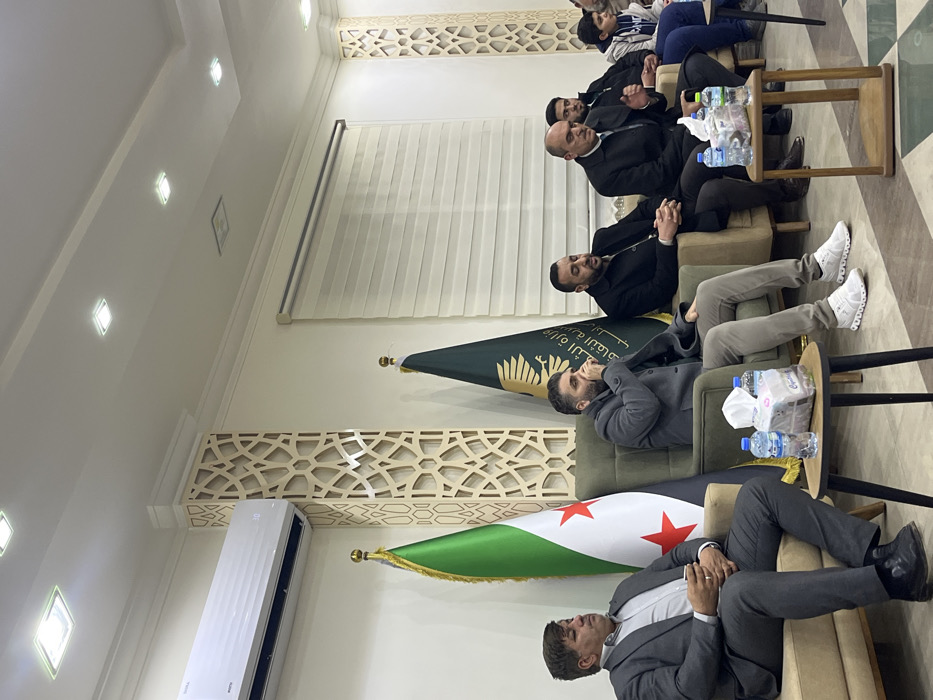
A group of men sits in an office setting. Two flags are visible, one is the Syrian flag. A second green flag is situated in the background. They appear to be engaged in a meeting or discussion, with water bottles and tissues on small tables. The room is brightly lit with ornate wall designs and a modern air conditioning unit. The seated men are wearing formal suits.
Idlib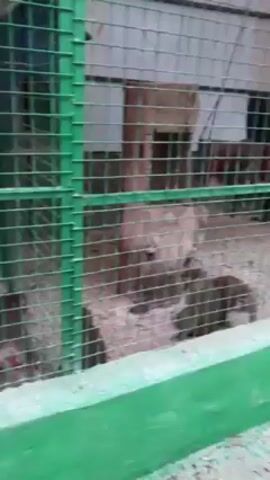
The video shows a green metal cage with several monkeys inside. The monkeys are mostly brown and are moving around inside the cage. The ground of the cage is light-colored and seems to be made of dirt or sand. There is a small red object, possibly a food container, inside the cage. A person's laugh can be heard off-camera.
Idlib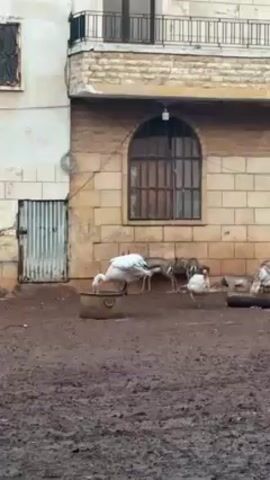
The video shows a muddy yard with several turkeys and two small deer. A white turkey drinks from a metal container. Two deer stand near a brick building with arched windows. Other turkeys are on the ground and near a log. The building is aged, with signs of wear and tear. The ground is dark and muddy. A metal gate is visible on the left side of the frame.
Idlib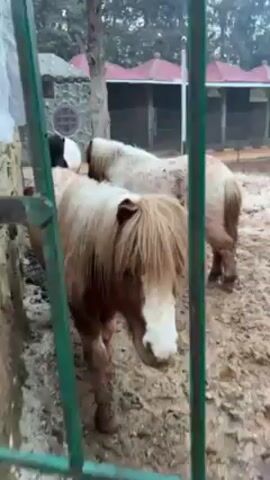
The video shows three small horses, or ponies, in a muddy enclosure viewed through a green metal fence. The pony closest to the camera is brown with a white blaze on its face and a long, light-colored mane. Behind it, two other ponies, appear to be a lighter, off-white color. A person's hand is briefly seen reaching out to touch the brown pony through the fence. The enclosure is surrounded by a stone wall on the left and a building with a red roof in the background. The ground is muddy and there are bare trees in the background, suggesting a cold or wintery season. A plastic sheet is partially visible attached to the fence.
Idlib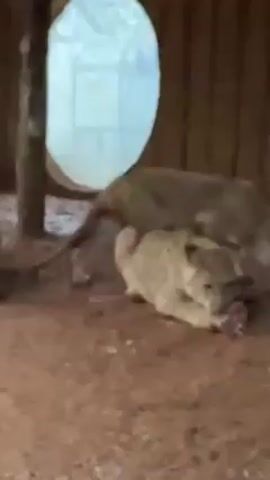
Three lion cubs are inside an enclosure with a brown floor and brown wooden walls. Two cubs are lying together, one appearing to eat something, while a third cub lies apart from the others, also appearing to eat. Circular windows are set into the walls. A tree branch stands next to one of the windows. The walls are topped with a brown wooden roof. The room is illuminated by overhead lighting.
Idlib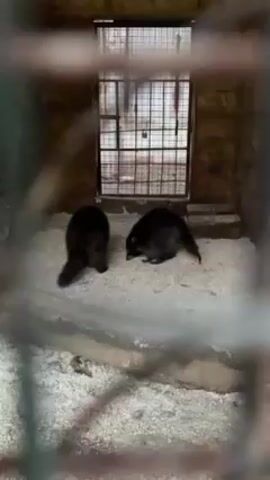
Two tanuki (raccoon dogs) are in an enclosure with a light-colored, grainy substrate. The enclosure is bordered by a low concrete wall, and a metal cage door is visible in the background. One tanuki is facing away from the camera, its tail visible, while the other faces the camera with its head lowered, appearing to investigate the ground. The video is shot through the bars of another barrier. The lighting is dim.
Idlib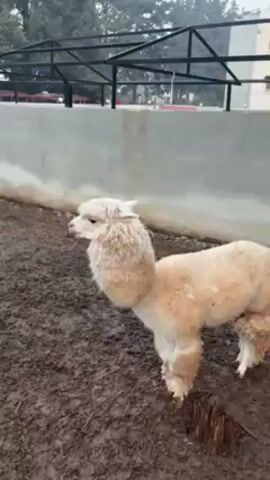
The video shows an alpaca and a goat standing in a muddy enclosure. The alpaca is light brown with a thick, wooly neck. The goat is white with small horns. The enclosure is surrounded by a concrete wall and a metal fence. There are trees in the background. The ground is muddy. The camera pans to the right.
Idlib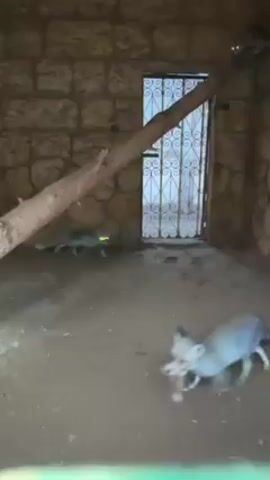
The video shows an indoor enclosure for animals with two ring-tailed coatis. The enclosure has faux-stone walls, a dirt floor, a metal-grilled door, and a large tree branch placed at an angle across the space. One coati is near the branch and the other moves near the doorway and then back. A third coati can be seen partially in the background, near the top of the enclosure. The video is shaky and the view is partially obstructed by the bottom of the frame, perhaps because it was filmed through fencing.
Idlib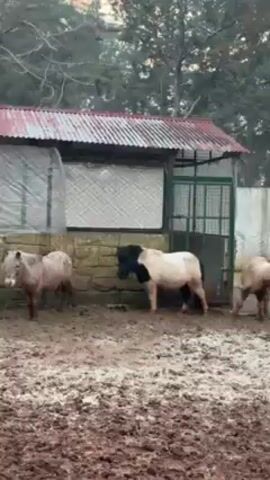
The video shows two small ponies in a muddy enclosure. One pony is mostly brown and gray, while the other has a white body with a black head and neck. They are standing near a low stone wall with a partially covered, red-roofed structure behind it. The enclosure is muddy and appears to be outdoors, possibly at a farm or zoo. Trees can be seen in the background. There is no discernible human presence in the video.
Idlib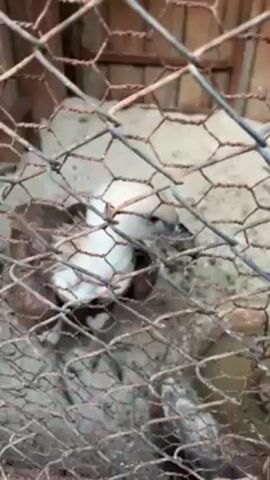
The video shows a vulture in a cage. The cage is made of wire mesh and has a wooden frame. The vulture has brown and white feathers and a long neck. It is standing on a dirt floor. The cage appears to be outdoors.
Idlib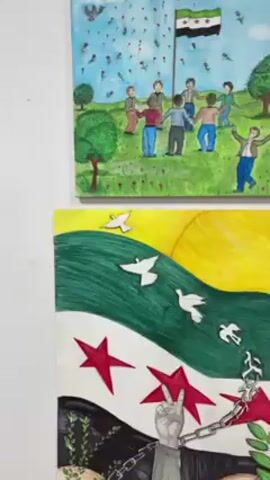
The video shows a selection of artworks hanging on a white wall. The artworks appear to be paintings and drawings made by children, with themes related to Syria. Some artworks depict scenes of destruction and conflict, while others express hope for peace and unity. One painting shows children holding hands in a circle under the Syrian flag, with roses falling from the sky. Another painting depicts a chained hand giving a peace sign in front of a Syrian flag. One shows a boy sleeping within the borders of Syria, which is cracking. The setting suggests an art exhibition or display showcasing children's perspectives on the Syrian conflict.
Idlib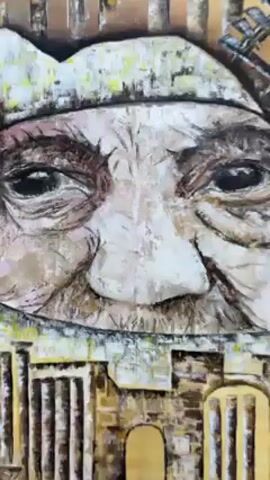
The video features a large, textured painting displayed on a wooden easel. The painting is primarily rendered in earthy tones of yellow, brown, white, and black, with a heavily impastoed or textured surface. The central and dominant feature of the painting is a large, expressive face, possibly of an older person, with deep-set eyes, prominent wrinkles, and a textured nose. The face appears to be wearing a light-colored head covering, possibly a turban or cap, with visible brushstrokes and textures. Integrating with and surrounding the face are architectural elements. To the left, there are vertical structures resembling ancient columns or pillars. To the right, a large circular structure with spokes, characteristic of a traditional water wheel (noria), is depicted. Below the face, the painting shows more architectural details, including stylized arches, rectangular building blocks, and what appears to be fragmented structures or ruins, all rendered with similar rough textures and a limited color palette. As the video pans out, the full scope of the painting on the easel is revealed. In the background, behind the easel, another large artwork is visible on a wall. This background piece is more colorful, featuring a vibrant blue upper section and a green lower section that resembles a stylized map, possibly of a geographical region or country. On the blue section, there are several white shapes, possibly birds or leaves, some with what appears to be black Arabic script written on them. The floor beneath the easel is tiled with a pattern of light and dark brown or beige square tiles. The overall setting suggests an indoor space, possibly an art gallery, studio, or exhibition area. The video slowly zooms out from a close-up of the painting's face to a wider shot, showcasing the entire artwork and its immediate surroundings.
Idlib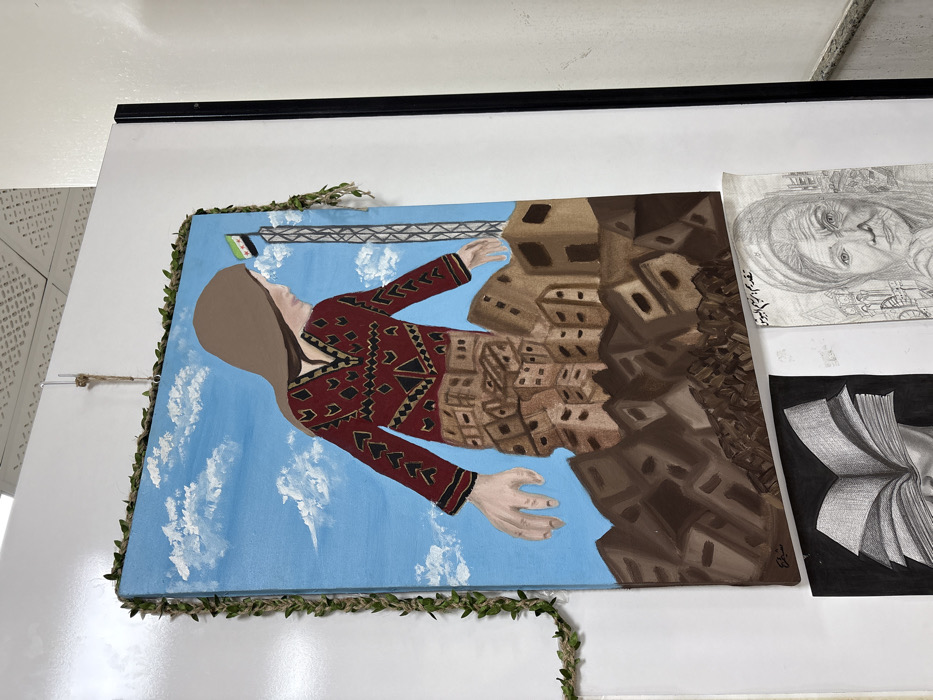
The image displays a wall with several artworks, predominantly featuring a large, colorful painting. This main painting is positioned horizontally on the white wall. The painting depicts a figure, likely a woman, shown from the waist up, with light brown skin. She wears a plain brown head covering (possibly a hijab or hood) and a long-sleeved garment in deep red with intricate black and light-colored geometric patterns, reminiscent of traditional Middle Eastern embroidery. Her left arm is extended upwards and slightly to the left, with her fingers splayed. Her face is turned upwards, looking towards a structure resembling a large metal truss or crane, painted in light blue and grey, positioned in the upper left corner of the painting. From this structure, a small flag hangs, displaying three horizontal stripes (black, white, green from top to bottom) with three red five-pointed stars centered on the white stripe. This is the flag of Syria. The background around the figure and the crane is a light blue sky dotted with fluffy white clouds. The figure's lower body and the right side of the painting are integrated with or emerging from a dense mass of brown, block-like structures, varying in size and shade, resembling buildings or rubble. Some structures show small, dark openings, suggesting windows or doorways. The overall impression of this section is one of urban decay, destruction, or dense settlement. The edges of the large painting are adorned with a green, leafy garland, which is secured to the canvas with visible twine at various points, creating a natural frame around the artwork. To the right of this main painting, two other artworks are partially visible. The top one is a pencil sketch of what appears to be an elderly person's face, possibly a woman, with detailed wrinkles and expressive eyes. Some Arabic script is visible beneath the sketch. The bottom artwork is a black and white drawing depicting an open book with numerous pages fanning out, resembling wings or an abstract, flowing form. The artworks are displayed on a clean white wall. Above them, a black horizontal rail or frame runs along the top of the wall, likely for hanging. On the far left, a white wall with a grid-like pattern or texture is visible, suggesting an interior setting like a gallery, classroom, or public display area.
Idlib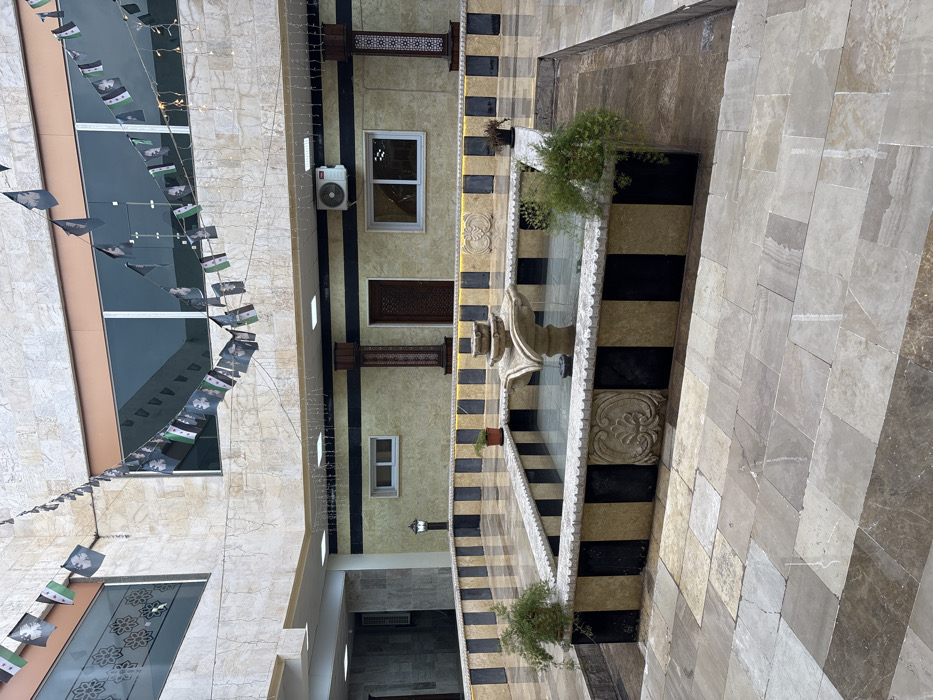
This image depicts an interior courtyard within a building in the city of Idlib, Syria. The scene is devoid of people. In the central foreground, a rectangular stone fountain basin holds clear water, featuring a multi-tiered stone fountain sculpture. The basin's exterior wall is adorned with alternating vertical black and light-colored (likely sandstone) striped panels, interspersed with carved decorative elements, and topped with a scalloped edge. The courtyard floor is paved with multi-toned beige, gray, and brown stone tiles. The surrounding building walls are constructed from light beige, veined stone or tile. A lower section of the wall immediately behind the fountain basin features a dark horizontal stripe above a lighter, yellowish-beige textured segment. Architectural elements include dark wooden decorative pillars with intricate carved patterns, a dark wooden door with a geometric lattice design, and multiple white-framed windows. An outdoor air conditioning condenser unit is mounted on the wall above one window. Small, black-cased light fixtures are attached to the lower walls. Strings of small rectangular flags are suspended across the upper section of the courtyard. These flags alternate between two designs: a black flag displaying a white central emblem or portrait, and a black, white, and green horizontal striped flag with three red stars in the white band (the Syrian revolutionary flag). Additional strings of small decorative lights are draped below the flag lines. A few small potted plants are placed around the fountain basin and on the ground nearby.
Idlib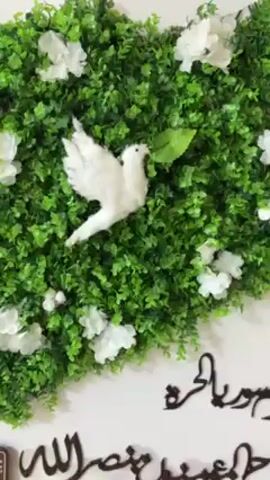
The camera slowly zooms out, revealing a decoration on a white wall. The decoration is in the shape of a map of Syria made of green foliage with white flowers, and a white dove with a green leaf in its beak. Beneath the map are the words "Greetings to free Syria" and “We apologize to the most generous people.” A small sign stands to the left of the words. The decoration is framed by a white wooden frame and rests on a wooden easel. The camera movement slowly reveals the complete decoration on the white wall.
Idlib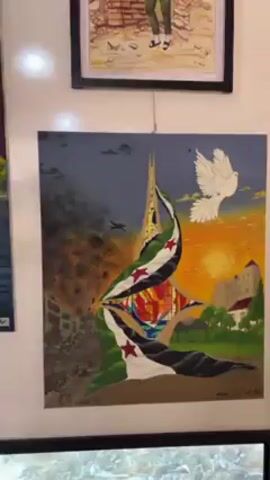
The video shows a close-up of a wall displaying a collection of framed artworks. The paintings vary in style and subject matter. One painting depicts a cityscape with a river, modern buildings, and futuristic elements. Another painting shows a scene of war and destruction on one side, transitioning to a peaceful landscape with a white dove on the other side, bisected by the Syrian flag. Above them are two more paintings, one depicting a person standing near a building and another with a group of people. A miniature version of Van Gogh's "Starry Night" is also visible among the paintings.
Idlib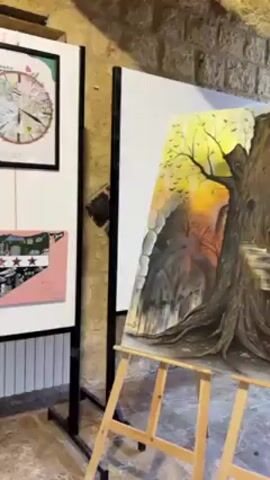
The video showcases an art exhibit displayed in a room with stone walls. The camera pans across various artworks, mainly depicting the theme of Syria. There are several white display boards with framed and unframed artworks. Some of the art features the outline of the Syrian map, with various designs and collages inside. One piece is a clock-like diagram, and another is a painting of a tree against a sunset background on an easel. The lighting is dim, but highlights the art pieces.
Idlib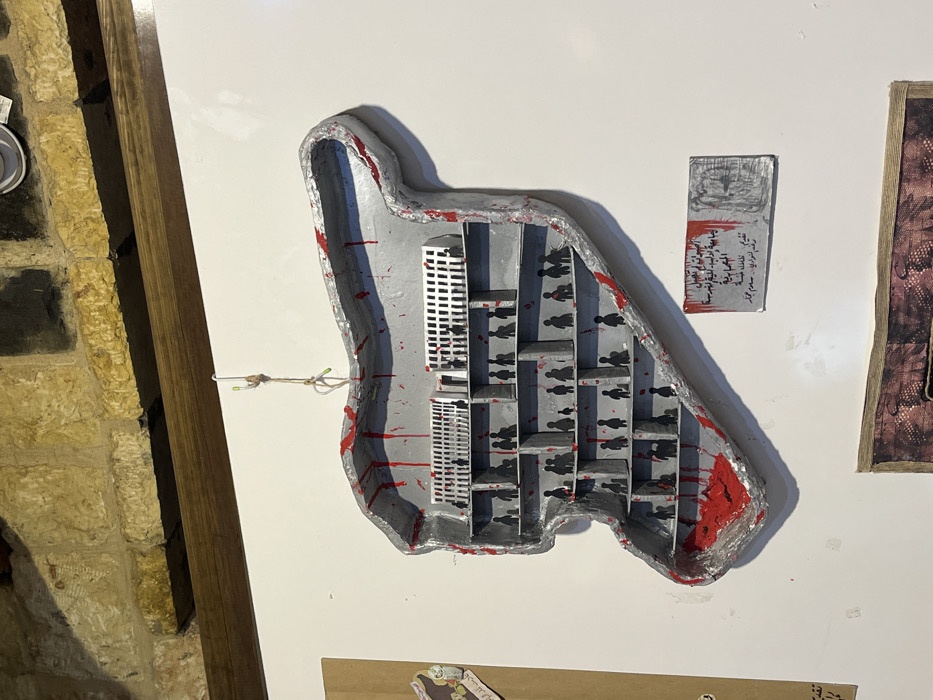
The image displays a three-dimensional, relief-style artwork shaped like the geographical map of Syria, approximately 60-70 cm in height, mounted on a white wall. The artwork is constructed from a rigid material, painted metallic silver, and heavily splattered and streaked with red paint resembling blood, particularly along its exterior edges and within its internal compartments. The interior of the Syrian map is divided into multiple horizontal shelves and vertical partitions, creating a grid of approximately 30-40 individual cells or compartments. Within these cells, numerous small, dark, silhouette-like human figures are positioned. These figures appear solitary, in pairs, or in small family-like groups. In the upper-most compartments, two light-colored, rectangular structures resembling building facades with rows of window-like openings or prison bars are visible, with smaller human figures behind them. The artwork is suspended from the wall by a white hook, from which a twisted twine string descends to attach to the top center of the map. The white wall serves as a backdrop, with an upper section revealing an exposed stone wall constructed from large, irregularly shaped light-brown stones interspersed with horizontal dark wooden beams. To the right and slightly below the main artwork, a small, rectangular plaque, approximately 15x10 cm, is affixed to the white wall. This plaque is also silver-painted with red streaks and features handwritten Arabic text. The text, translated, reads: "Aggression is the action. On the occasion of the Idlib Liberation Revolution. The Struggle. Presented by: Hiba, Rafea Trendi, Adeeb Hamid, Sadam Jabir." This text indicates the artwork is part of an exhibition or event related to the "Idlib Liberation Revolution" in Idlib, Syria. A sliver of a brown, vertically oriented object with Arabic text is partially visible on the white wall to the left of the main artwork. Below the plaque, a portion of another framed artwork or textile with a dark, intricate pattern is visible. The scene is indoors, likely within an art gallery or exhibition space in Idlib, Syria.
Idlib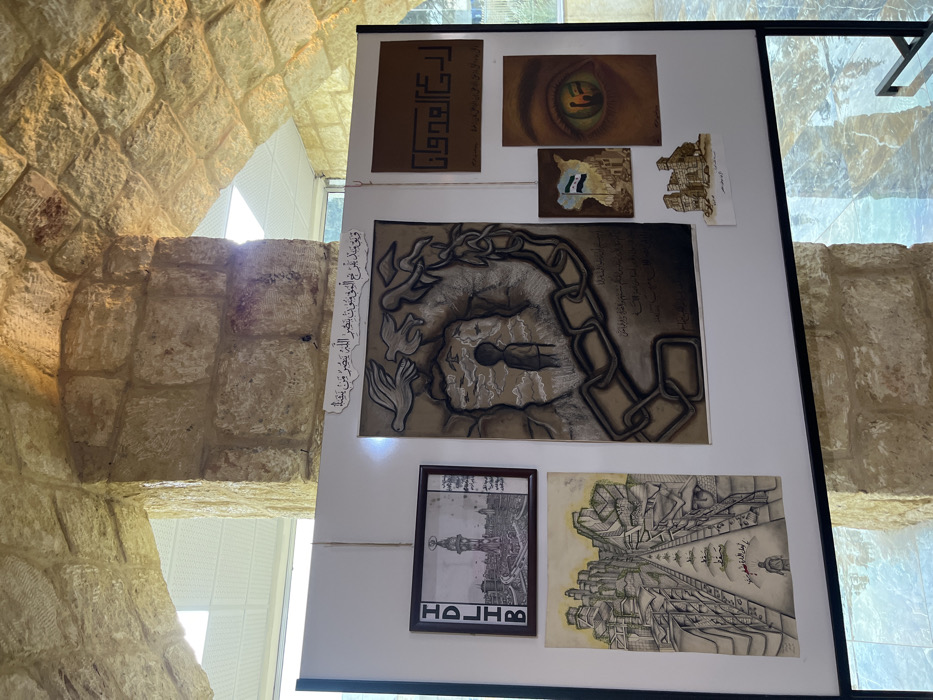
A white, rectangular exhibition board with a black metal frame stands in a building with light-colored, rough-hewn stone arches and a central pillar. The floor is reflective, and natural light enters from the background. The board displays seven artworks of varying sizes. At the top left, a framed, horizontal, black-and-white drawing depicts a cityscape featuring a prominent clock tower or minaret, with the word "IDLIB" written vertically on the left. Below it, a vertical, black-and-white drawing shows a narrow path flanked by tall, angular buildings, with small figures walking along the path, which also contains Arabic text. The central and largest artwork is a vertical drawing in charcoal or a similar medium on a brownish background. It depicts a large, gnarled hand holding open a fissure revealing a child's silhouette within a landscape, surrounded by several flying birds, and a heavy chain across the foreground. Arabic text is written on the lower portion of this artwork. Above the central artwork, a horizontal white banner with black Arabic script reads, "وَيَوْمَئِذٍ يَفْرَحُ الْمُؤْمِنُونَ بِنَصْرِ اللَّهِ يَنصُرُ مَن يَشَاءُ" (And on that day the believers will rejoice in the victory of Allah. He gives victory to whom He wills). To the right of the central artwork, a square brown canvas features white Arabic calligraphy. Below it, a smaller rectangular painting depicts the map of Syria, filled with the Syrian revolution flag and miniature buildings. Further down, another rectangular painting shows a human eye looking right, with a small human figure holding a flag reflected in its pupil. The lowest right artwork is a small drawing of stone building ruins. The scene is an interior art exhibition within the city of Idlib, Syria.
Idlib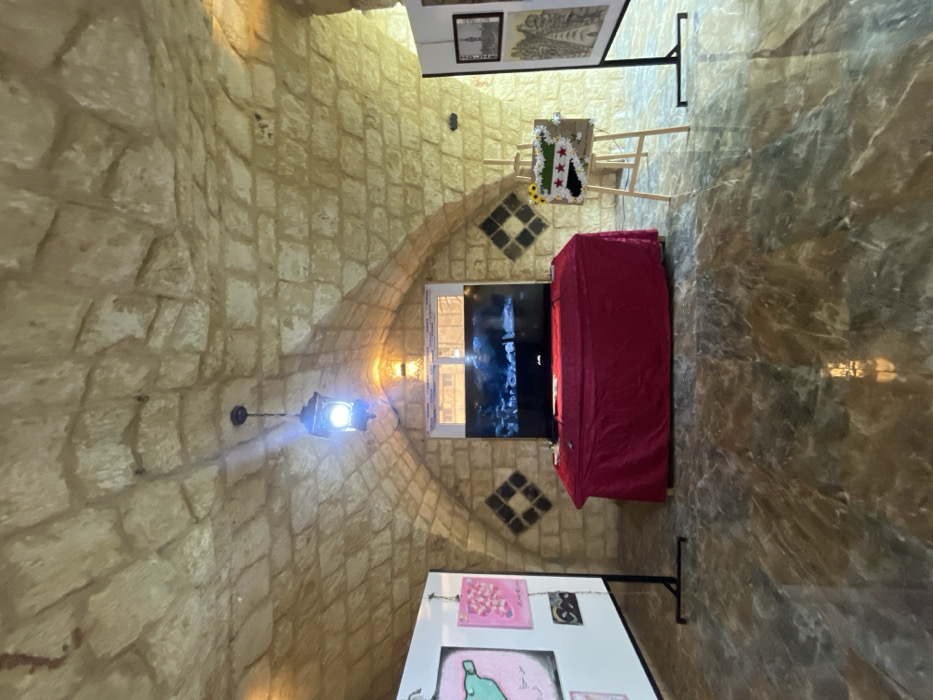
The image displays an indoor exhibition space within a building in Idlib, Syria, characterized by traditional architecture. The room features a vaulted ceiling and walls constructed from light-colored, rough-hewn stone or brickwork. The floor is made of highly reflective, mottled brown and grey polished stone or marble. Centrally located against the back wall, a large flat-screen television is positioned on a table draped with a deep red fabric tablecloth. The television screen displays a dark, indistinct image, possibly a landscape or animal figures. Above the television, a rectangular window with white framing is visible, and above that, a wall-mounted sconce emits an orange glow. Two decorative diamond-shaped patterns, composed of contrasting dark and light stone elements, are present on the back wall, flanking the central window and television setup. A black metal lantern with a bright bulb hangs from the vaulted ceiling, providing central illumination. On the left side of the room, a white display board on a black stand exhibits multiple artworks, including a green abstract shape with Arabic text and a pink patterned piece. On the right side, a wooden easel holds a framed artwork depicting a green-outlined map of Syria, with the three-star flag of the Syrian opposition integrated into the design. Yellow sunflowers and white flowers are arranged along the upper border of this piece, which appears to be on a textured, possibly burlap, background. Further right, a partial view of another white display board on a black stand shows at least two framed black and white artworks, one appearing to be an architectural scene and the other a road or pathway. No individuals are visible in the scene.
Idlib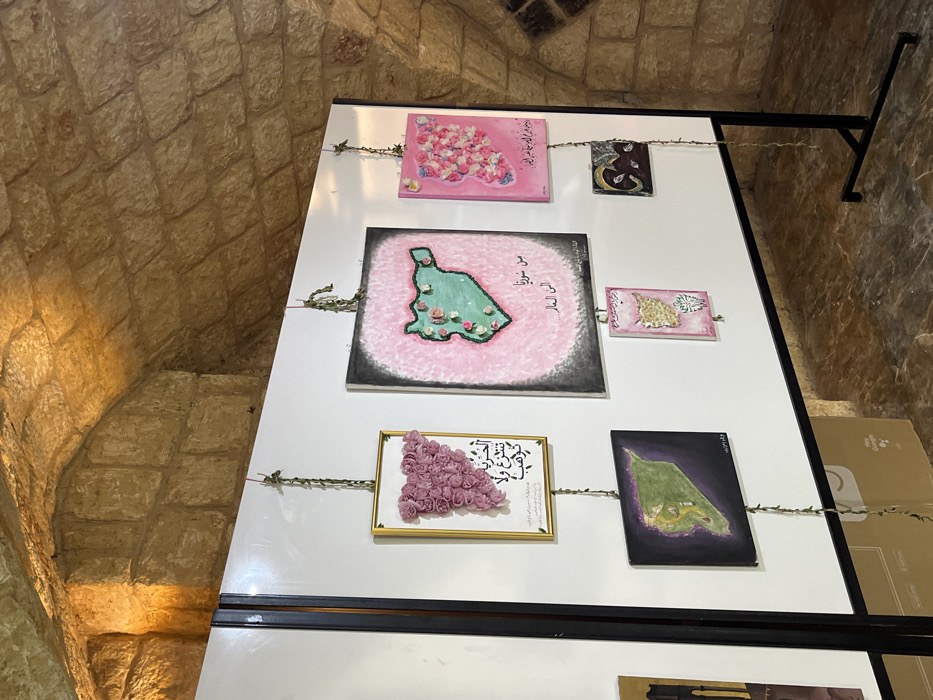
An indoor art exhibition is depicted in a stone-built structure featuring a vaulted ceiling and warm, ambient lighting, located in Idlib, Syria. The scene centers on a white display board with a black metal frame, showcasing six artworks. On the left side of the display board, a gold-framed vertical artwork features a dense, inverted triangular cluster of pink fabric roses above Arabic calligraphy. Below it, a horizontal painting displays a green map of Syria on a dark background, containing a light-colored figure and Arabic text. To the right, a large square painting presents a green outline of the Syrian map, adorned with small, light-colored rose-like elements, against a soft pink background with a dark border. Arabic script is visible beneath the map. Adjacent to this, a vertical pink-background painting is covered with numerous small, scattered light pink and white rose-like embellishments. Below the large square painting, a smaller vertical artwork shows a textured, possibly metallic gold or bronze, map of Syria. A partially visible, dark-toned small square painting with abstract designs is situated further to the right. Artificial green vine-like foliage is decoratively draped along the top edge of the display board and utilized as hanging elements for some of the artworks. A cardboard box rests on the tiled floor beneath the left portion of the display. No individuals are present.
Idlib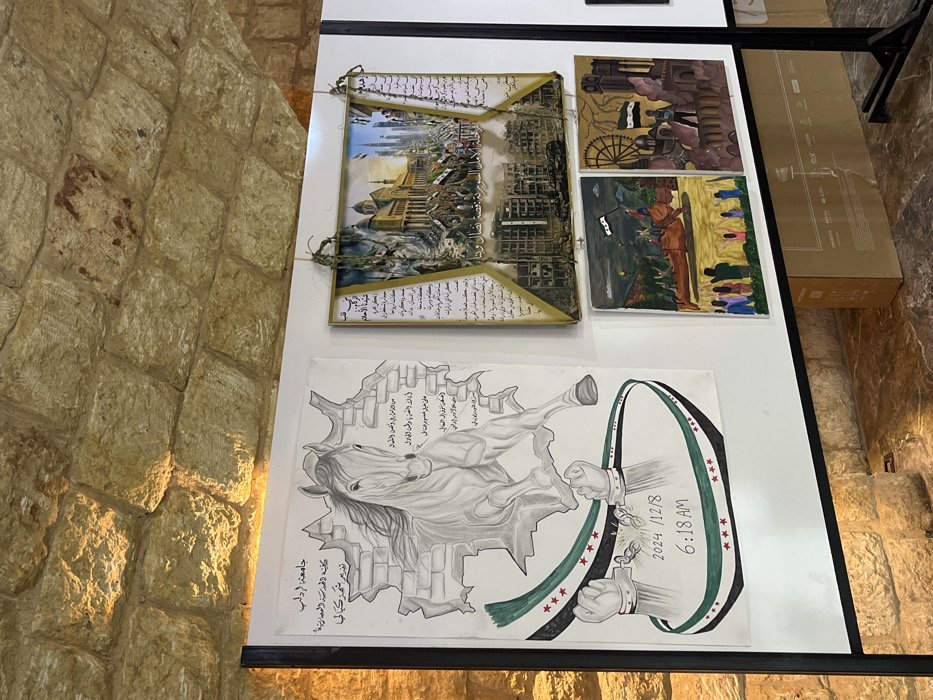
The image displays an indoor art exhibition in Idlib, Syria, characterized by a light-colored, rough-hewn stone vaulted ceiling and walls, suggesting an ancient or historically preserved building, likely associated with the University of Idlib. A large white display panel, supported by a black metal frame, holds four distinct artworks. On the left, a large pencil sketch depicts a white horse mid-stride, seemingly bursting through a crumbling brick wall stylized as a map of Syria. Above the horse, Arabic script identifies "University of Idlib, Faculty of Fine Arts, Department of Graphic Design." Below the horse, two shackled hands are shown with chains breaking apart, intertwined with a ribbon featuring the Syrian opposition flag (green, white, black with three red stars). The date "2024 / 12 / 8" and time "6:18 AM" are inscribed beneath. To the upper right, a mixed-media artwork shaped like a scroll or banner is displayed. Its upper section illustrates a bustling cityscape with ornate buildings, including a prominent dome, and a marching crowd. The lower section portrays a desolate landscape of heavily damaged, bombed-out structures. Arabic text lines the vertical edges, and green foliage is draped over the top corners of the frame. Below this, two smaller, rectangular paintings are visible. The left painting depicts a group of figures in the foreground observing individuals on horseback, some holding flags, against a backdrop of hills or mountains. The right painting shows figures in a ruined, possibly industrial environment with a large gear-like structure and an additional Syrian opposition flag in the background. The floor beneath the display panel is partially visible and appears to be dark-colored stone or tile, with a large cardboard box resting against the wall. No individuals are present in the immediate scene.
Idlib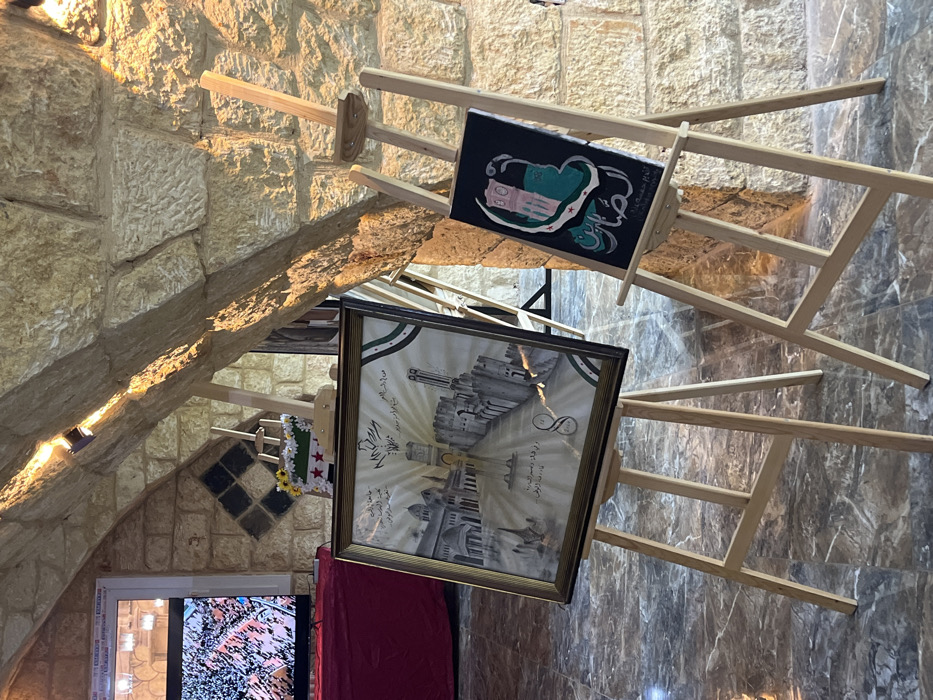
The scene depicts an indoor art exhibition or display located in Idlib, Syria. The environment features traditional Syrian architecture, characterized by light-colored, rough-hewn stone walls and prominent vaulted arches, illuminated by artificial lights positioned above, casting warm highlights and shadows. The floor is covered with polished, mottled dark grey/brown marble or stone tiles. In the foreground, two wooden art easels stand on the tiled floor. The left easel presents a large, framed artwork depicting a monochromatic or sepia-toned panoramic cityscape, possibly of Idlib, with a central clock tower, mosque-like buildings, and other architectural structures, all emanating stylized rays of light. The artwork's border incorporates elements resembling the Syrian opposition flag (green, white, and black with two red stars) and includes Arabic script, with the year "2024" visible. The right easel displays a smaller, dark, rectangular artwork featuring a stylized profile silhouette, embellished with the green, white, and black colors and two red stars of the Syrian opposition flag. Prominent Arabic calligraphy on this piece explicitly reads "إدلب" (Idlib) and "أيام حمص ودمشق" (Days of Homs and Damascus). In the background to the left, a large flat-screen television rests on a red-draped table, displaying a blurred image of a crowd. Above the table, a small, white decorative easel is adorned with sunflowers and a miniature Syrian opposition flag. A section of the wall behind this display exhibits a diamond pattern created with darker stone blocks. No individuals are visible within the frame.
Idlib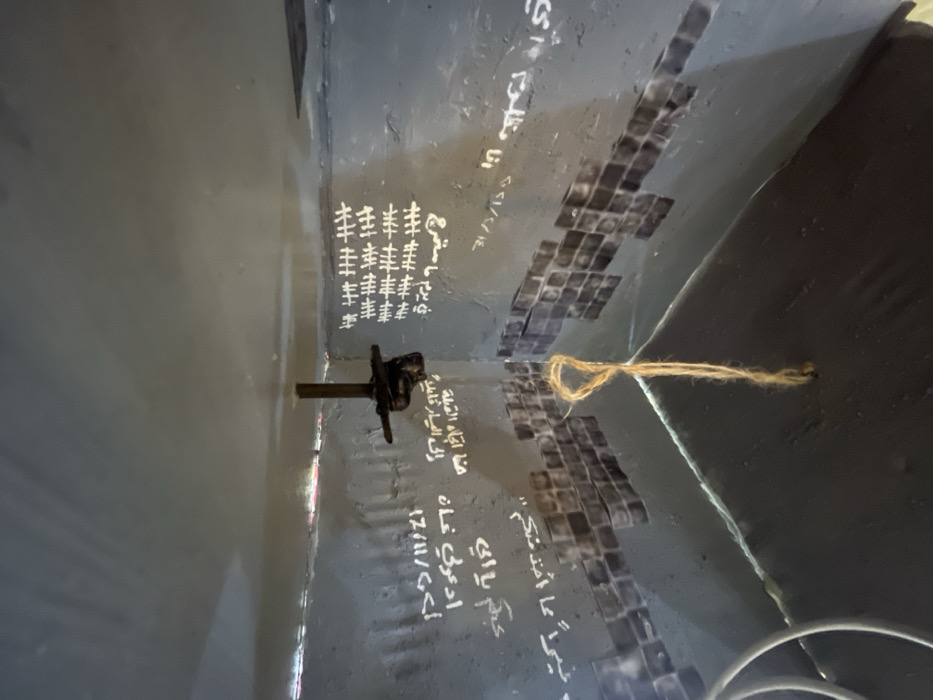
The image depicts an interior scene, likely an exhibit or installation, located in the city of Idlib, Syria. The confined space features dark grey, textured walls and a slightly lighter grey floor. A single, coarse, light brown rope forms a crude noose, suspended from the dark grey ceiling in the upper center of the frame. Directly beneath the noose, a solitary, dark, worn boot or shoe rests on a dark, slender cylindrical pedestal or stand. The walls are adorned with white handwritten Arabic script and symbols. On the left wall, prominent tally marks are etched across several rows, each group consisting of five strokes. Above these marks, Arabic text reads "أنا مظلوم" (I am oppressed/wronged) alongside the date "٢٠١٢/٠٤/١٤". Below the tally marks, additional Arabic text states "في يوم ما سنخرج" (One day we will get out/leave). The right wall also displays white Arabic inscriptions, including text that appears to be "عفواً عما أخذتكم" (Forgive me for what I took from you), "ادعو لي خان إلى اليسار قليلا" (Pray for me, Khan, a little to the left) with the date "٢٠١٢/١١/١٧", and "هنا اتجاه القبلة" (Here is the direction of the Qibla). Sections of the upper walls, particularly near the corners, are decorated with dark grey rectangular patterns, mimicking stacked bricks or blocks. A light-colored, curved pipe or conduit is partially visible in the upper right corner of the room. The overall lighting is dim, casting soft reflections on the floor and lower wall surfaces.
Idlib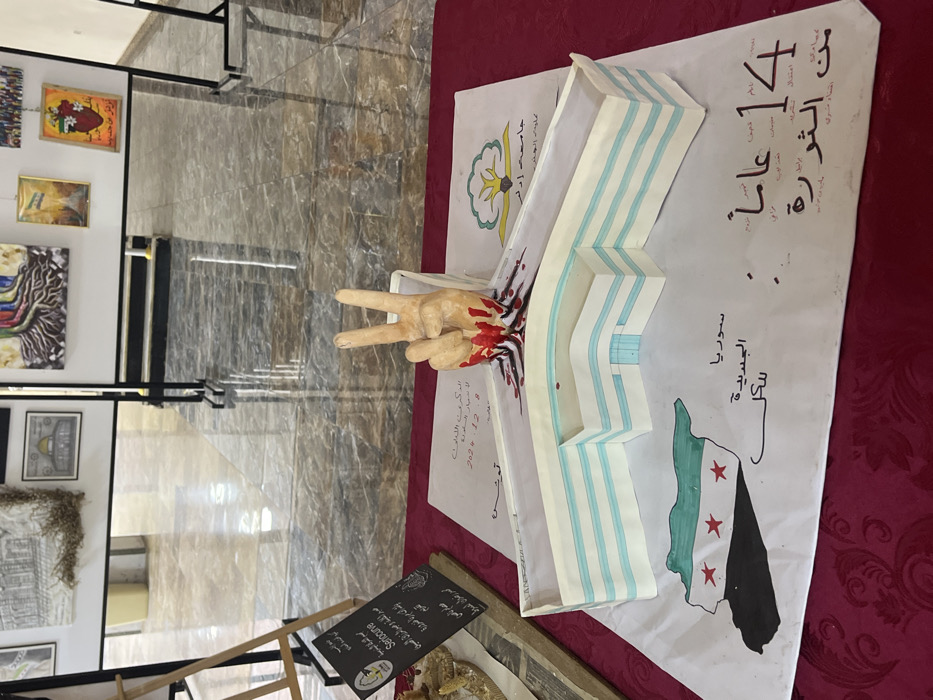
This image depicts an indoor exhibition space, likely a hallway or wide corridor, within the University of Idlib, Faculty of Engineering, Idlib city, Syria. The floor is polished light brown marble or tile, reflecting ambient light. In the background, several framed artworks are displayed on white panels, including a painting of a tree with multicolored roots, a depiction of the Dome of the Rock, and other abstract or landscape pieces. In the foreground, a table covered with a red patterned tablecloth holds a central exhibit arranged on a large white sheet of paper. This exhibit features a 3D paper model of a multi-segmented, curved building structure with light blue horizontal stripes and a light blue door. From the center of this building model, a light-colored, sculpted hand emerges, forming a two-fingered "V for victory" gesture. Red paint resembling blood splatters from the base of the hand onto the building model and the surrounding white paper. The white paper base includes several inscriptions in Arabic. On the left, a map of Syria is drawn, colored with the black, white, and green horizontal stripes and three red stars of the Syrian opposition flag, accompanied by the text "سوريا الجديدة شكل" (New Syria Form). On the right, prominent Arabic text reads "14 عاما من الثورة" (14 years of the Revolution). Other Arabic text on the paper includes "جامعة إدلب" (University of Idlib) and "كلية الهندسة" (Faculty of Engineering), along with dates "2023 - 12 - 8" and "2024 - 12 - 8," and mentions of "الذكرى الثالثة عشرة" (The Thirteenth Anniversary). To the left of the main exhibit, a wooden easel displays a sign with Arabic text and a logo, indicating its origin from the "كلية الهندسة المعمارية" (Faculty of Architecture Engineering), detailing the exhibit or its creators. Other partially visible crafted items are present on the table to the left. No individuals are visible in the immediate foreground.
Idlib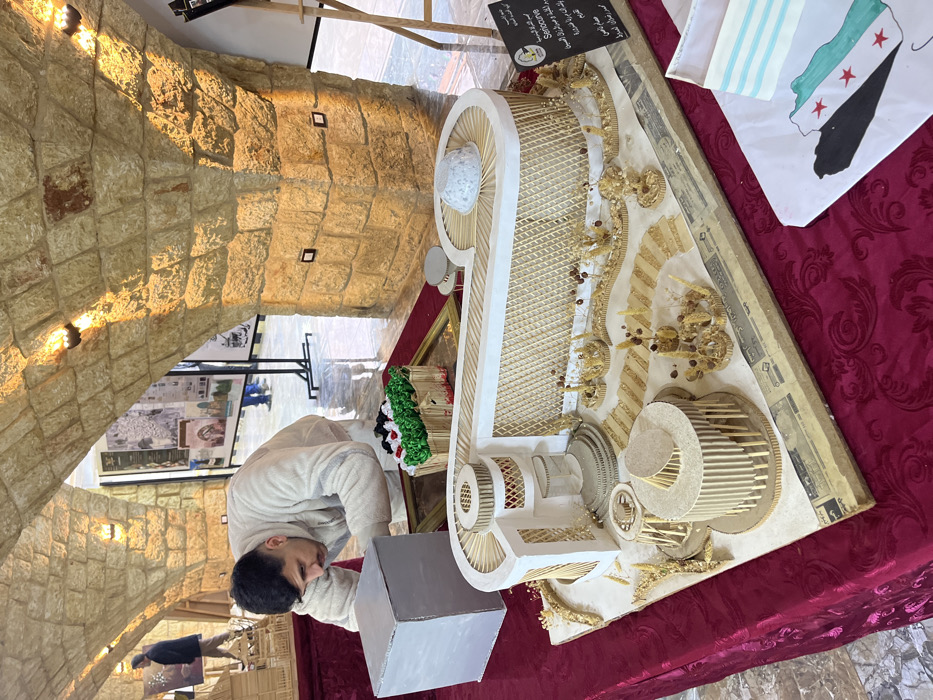
The image depicts an indoor exhibition or cultural event in Idlib, Syria, characterized by stone archways and pillars. In the foreground, a male individual with dark hair and a mustache, wearing a light-colored, possibly fleece, top, leans over a display table covered with a deep red, patterned tablecloth. He is intently focused on an object or detail on the table. On the table in front of him is a large, elaborate architectural model, primarily white and gold, constructed from craft sticks and cardboard. The model features curved structures, vertical slats, and miniature landscaping elements, resting on a white base bordered by newspaper clippings. To the model's left is a gray rectangular box. To its right, a small wooden container holds numerous miniature Palestinian flags. Further right on the table, a black vertical sign with Arabic and English text (including "Senouvre") provides information. Next to this, a white sheet of paper displays a hand-drawn map of Syria colored with the Syrian flag, alongside a small, striped box. In the mid-ground, a series of robust stone arches, illuminated by small sconce lights, span the space. In the background, another male figure in a dark jacket walks away from the viewer. Behind him, several tall black display stands hold various posters or artworks, predominantly black and white, featuring maps and architectural designs. The floor is light-colored and tiled.
Idlib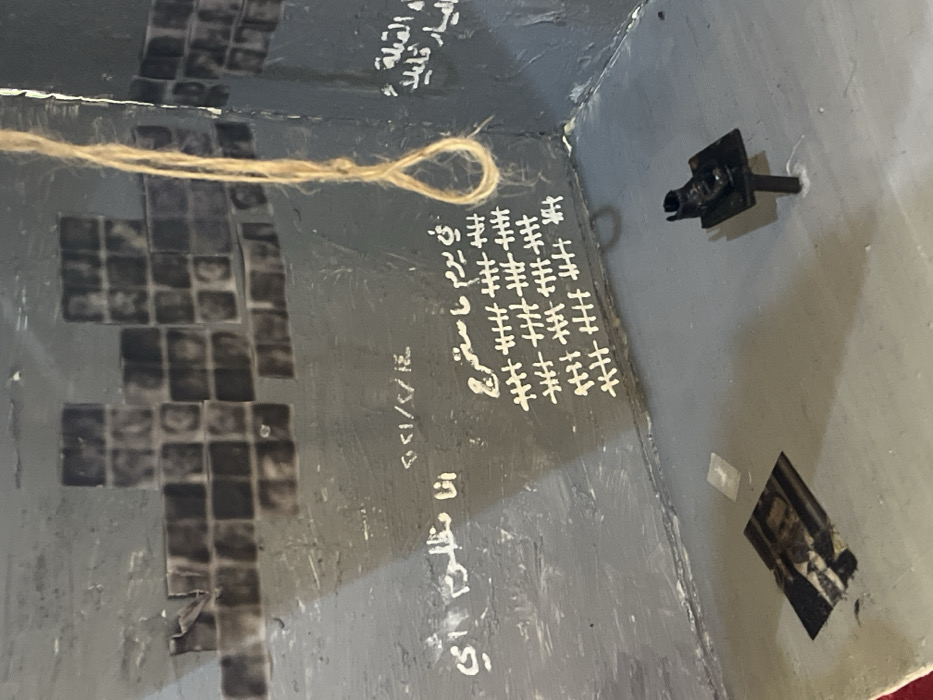
This image depicts a detailed diorama or installation located in the city of Idlib, Syria, simulating a gray, stark prison cell. The scene is illuminated by an overhead light source, casting soft shadows. The walls and floor are painted a uniform, dull gray. The left wall features a grid of multiple small, dark, blurry square images, appearing to be faded photographs of faces. Below these images, white Arabic script reads "I am oppressed any..." followed by the date "14/1/2014". The back wall displays numerous tally marks, grouped into fours with a fifth diagonal stroke, indicating a count, spread across several rows. Above and beside these tally marks, white Arabic script is visible, including "One day I will be released." A rough, thick, light brown rope with a visible noose at its end hangs centrally from an unseen point above the scene. The partially visible right wall also contains white Arabic text. On the gray floor, in the lower-left corner, a small, dark, faded photograph of a person is affixed. To its right, a small white rectangular object lies flat. In the lower-right corner, a miniature black stand, resembling a small pedestal, supports a single, dark, miniature object shaped like a boot or shoe.
Idlib