Iga, Japan
11 memories from Iga, Japan
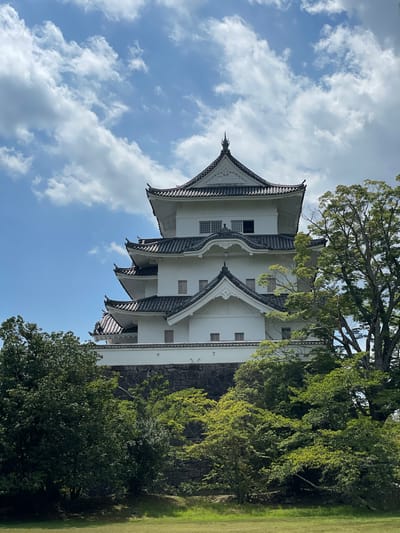
This is a medium-shot, eye-level, outdoor photograph of a white, multi-tiered castle with dark gray tiled roofs against a bright blue sky filled with white, puffy clouds. The castle is perched on a stone embankment and surrounded by lush green trees. The architecture features traditional Japanese castle design with layered roofs that have upturned eaves. Several windows are visible on the white walls. A large, mature tree with dark bark and green leaves stands to the right of the castle, partially obscuring its upper portion. The foreground is a grassy area. The scene is well-lit by natural daylight, suggesting it was taken on a clear day. The location is Iga, Japan.
Iga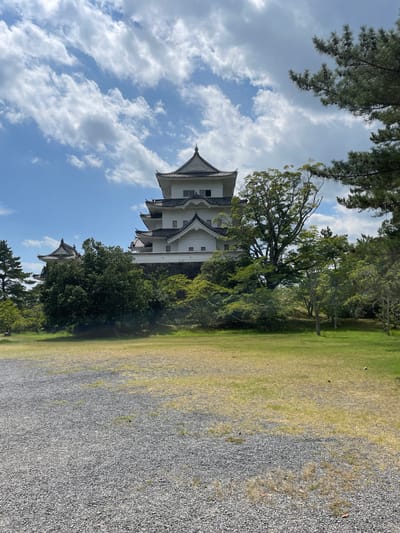
The image shows the Ueno Castle in Iga, Japan, on a sunny day with scattered clouds in a bright blue sky. The castle is a multi-tiered structure with white walls and dark, curved tiled roofs. It is situated on a raised area covered in lush green trees and bushes. In the foreground, there is a wide expanse of green grass that transitions to a gravel path on the left side of the frame. Pine trees are visible on the right, framing the castle and its surroundings. The scene appears to be a peaceful outdoor setting, likely a park or tourist attraction, with no people or animals visible.
Iga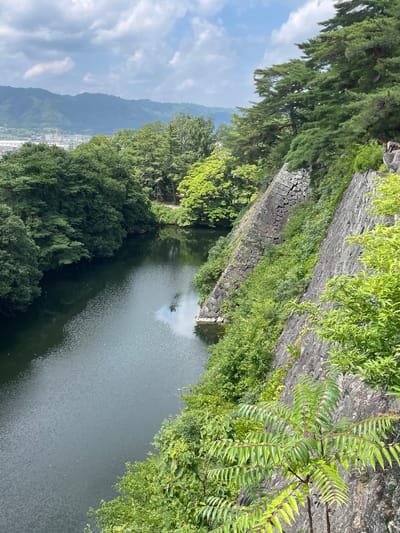
The image captures a serene natural landscape overlooking a moat with a steep, stone-lined embankment covered in lush greenery. The embankment, constructed of rough-hewn stones, rises dramatically from the dark, reflective water, creating a sense of historical fortification. Dense trees with vibrant green foliage frame the scene, with taller pine trees on the right and a variety of deciduous trees on the left. In the background, hazy mountains rise against a partially cloudy sky, with a hint of urban development visible in the distance. This scene is characteristic of the grounds surrounding Iga Ueno Castle in Iga, Japan, known for its impressive stone walls and moats. There are no people or animals visible in the image, and the focus is entirely on the natural and architectural elements of the environment.
Iga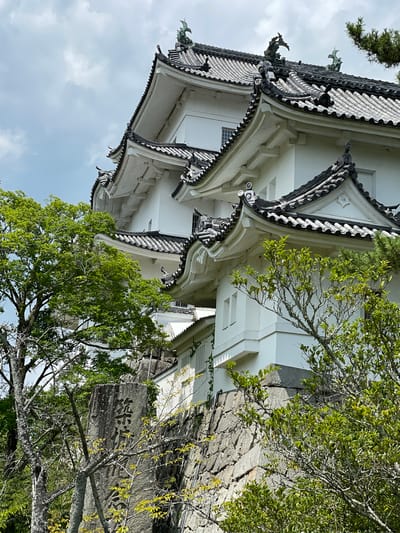
The image captures a view of Iga Ueno Castle in Iga, Japan, on a cloudy day. The castle, a multi-tiered structure with traditional Japanese architectural features such as curved tiled roofs and ornate roof ornaments, is primarily white. It is situated on a stone foundation. Lush green trees partially obscure the lower sections of the castle and its stone wall. A large stone monument with inscribed Japanese characters is visible in the foreground, also partially covered by foliage. The sky is overcast with scattered clouds.
Iga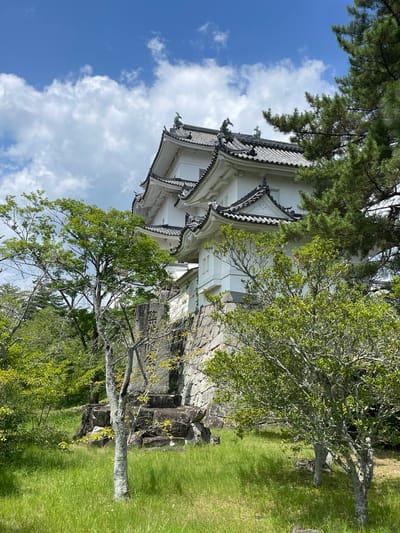
A medium shot captures a white Japanese castle with multiple tiered, dark-tiled roofs under a blue sky with scattered white clouds. The castle's stone foundation is visible, partially obscured by lush green grass and various trees, including a pine tree on the right. The castle's architecture is traditional, with ornate roof details and decorative figures at the corners. The scene is brightly lit, suggesting it is daytime, and the overall impression is one of historical grandeur set within a natural landscape. The image is likely taken from ground level, looking up at the castle. There are no people or animals visible in the frame. This is the Iga Ueno Castle in Iga, Japan.
Iga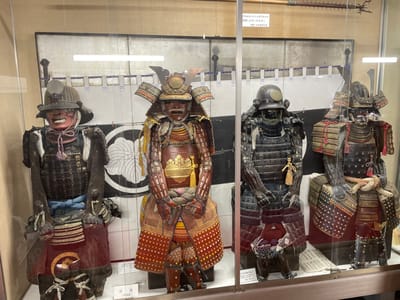
This image displays a museum exhibit in Iga, Japan, featuring four samurai armors, each set in a glass display case. The armors are positioned from left to right, with the first one having a red face mask and a dark helmet with a stylized crest. The second armor is a vibrant red and gold ensemble with a prominent chest plate and elaborate leg coverings. The third armor is primarily black, with a dark helmet and intricate detailing on the chest and arms. The fourth armor, partially visible on the far right, also appears to be dark with red and gold accents. The background of the exhibit consists of a large screen with a black and white circular motif and horizontal bands of blue and white patterns, suggesting a historical or cultural theme. Various labels and descriptive texts are placed around the display, providing information about the artifacts. The lighting within the exhibit is bright, illuminating the armors and their intricate craftsmanship.
Iga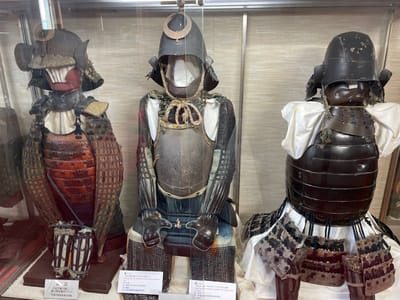
The image displays three suits of traditional Japanese samurai armor displayed in a museum setting. Each suit is mounted on a mannequin, showcasing the intricate craftsmanship and protective elements characteristic of samurai warfare. The armor on the left is a full suit, featuring a distinctive red and black lacquered breastplate and segmented leg guards. The central suit is also complete, with a dark, weathered helmet and a chainmail-like construction on the upper body. The third suit on the right is partially visible, with a dark helmet and a segmented chest plate over white fabric. The background appears to be a neutral, textured wall, possibly designed to highlight the artifacts. Small information cards are visible in front of the mannequins, likely providing details about the armor's origin and historical significance. One card in the foreground mentions "Iga City Education Committee," indicating the location as Iga, Japan.
Iga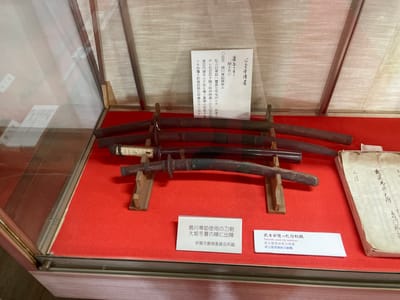
The image shows a display case in the city of Iga, Japan, featuring several antique swords. The swords are laid out on a red felt surface, supported by wooden stands. Two informational plaques are visible; one in Japanese and English, and another solely in Japanese. The Japanese and English plaque reads: "Swords used by warriors", "Swords used by warriors", and "Swords used by warriors". The other Japanese plaque reads: "Swords used by Shimakawa-so-byō\nDeployed at the Battle of Osaka in winter\nCollection of Iga City Board of Education". The display case is made of glass and metal, with a wooden base. The background appears to be a textured wall.
Iga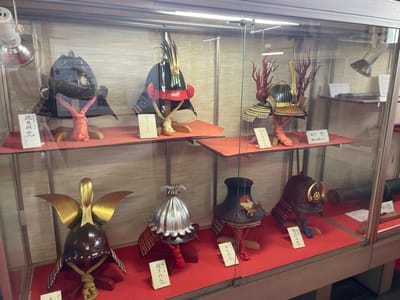
This image captures a display of samurai helmets within a glass-fronted cabinet. The cabinet is situated in what appears to be a museum or historical exhibit. The helmets are varied in design, with some featuring elaborate crests and decorations, while others are more minimalist. Each helmet is mounted on a stand, and many have small explanatory cards in front of them, written in Japanese. The lighting in the cabinet is artificial, with a spotlight visible at the top right, casting illumination on the objects. The background within the cabinet is a textured, light-colored wall. The overall presentation suggests a curated exhibition of cultural artifacts. Based on the presence of samurai artifacts, this display is likely located in a region with significant historical ties to the samurai class. Iga, Japan, is renowned for its association with ninjas and samurai, making it a plausible location for such an exhibition. While no people are visible in the image, the context of a museum suggests a public space.
Iga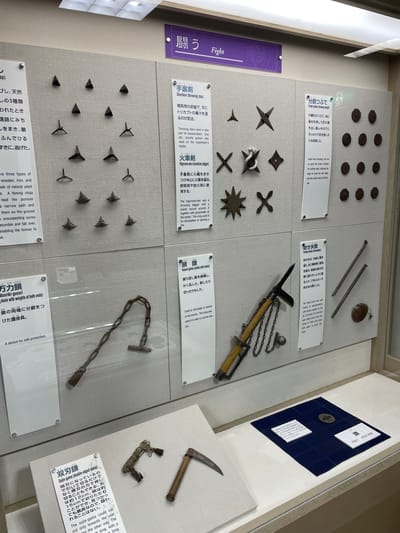
The image shows an exhibit of ninja weapons in the Iga Ninja Museum, located in Iga City, Japan. The display features various historical artifacts, including shuriken (throwing stars) of different designs, a higuruma-ken (incendiary dagger), a funso-tsubute (throwing weight), a kusari-gama (sickle with chain), and a fukiya-duto (blowpipe). The weapons are arranged in a clean, museum setting with informational text panels in Japanese and English describing each item. The overall environment is well-lit and organized, highlighting the historical significance of the ninja artifacts.
Iga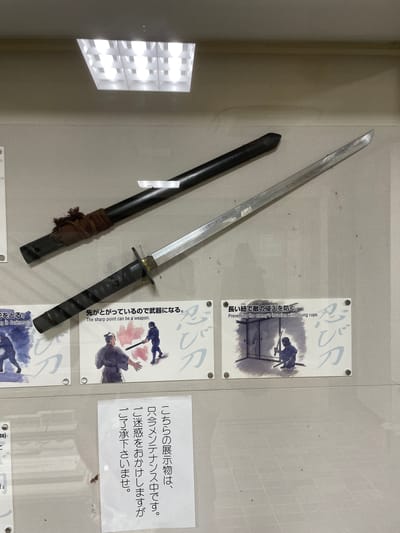
In Iga, Japan, this image captures a display featuring two Japanese swords, likely ninja swords (ninjatō), presented on a textured wall. The swords are positioned diagonally, with the lower sword, the ninjatō itself, extending from the bottom left to the top right of the frame. It has a dark, wrapped handle and a gleaming silver blade. Above and slightly behind it, another darker, cylindrical object, possibly a scabbard or another type of sword, is visible, with a brown fabric wrap near its hilt. Below the swords, three illustrative panels are displayed. The leftmost panel depicts a stylized illustration of figures in motion, with the text "ing in darkness." to its left. The central panel shows two figures, one in traditional Japanese attire and another in what appears to be ninja garb, engaged in combat. The text above this panel reads, "The sharp point can be a weapon." The rightmost panel illustrates a ninja crouching indoors with a sword, and the text above it states, "Preventing the enemy's invasion with a long rope." A separate, white informational sign is placed in the lower right quadrant of the image. It contains Japanese text, likely conveying information about the exhibit or maintenance. The background of the scene is a neutral, textured wall, and a modern fluorescent light fixture is visible on the ceiling in the upper portion of the image. The overall impression is of an educational exhibit about ninja artifacts or history.
Iga