Jabalia, Palestinian Territory
30 memories from Jabalia, Palestinian Territory
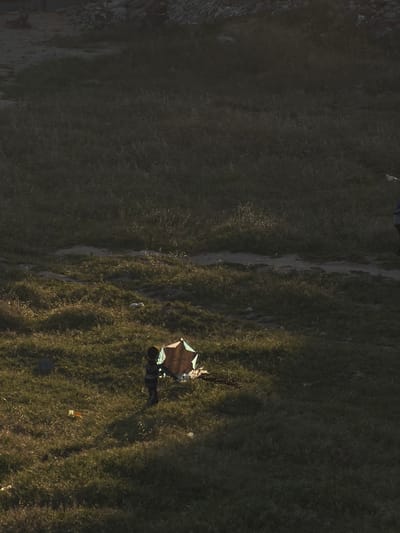
The scene appears to be an aerial view of an open, grassy area near a path. A person stands near a makeshift shelter with what looks like an umbrella-like cover. There are scattered objects nearby. The terrain appears to be uneven. The specific location within Jabalia, Palestinian Territory, is not discernible from the image.
Jabalia
A blurry, close-up photo shows the inside of a washing machine. Several kittens are nestled inside the drum of the washing machine. A gray cloth or garment is also inside the drum, partially obscuring the kittens. The environment suggests an indoor setting, possibly within a residential area in Jabalia, Palestinian Territory.
Jabalia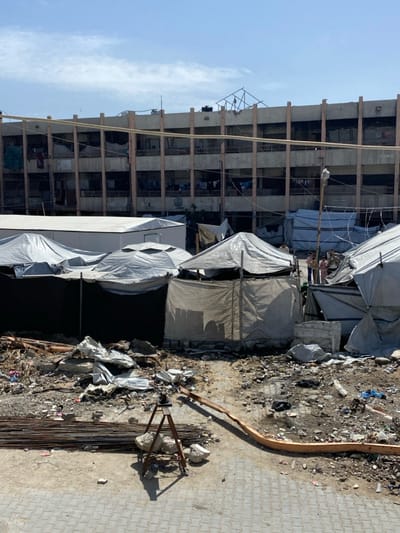
An outdoor scene in Jabalia, Palestinian Territory, captured during daylight under a clear blue sky with scattered white clouds. The foreground features an unpaved, rubble-strewn dirt ground that transitions to a paved surface at the bottom. A pile of rusty rebar lies on the left foreground. A brown tripod stands centrally, stabilized by rocks at its base, casting a shadow. An orange-brown, flattened hose or pipe extends across the dirt from left to right. The midground contains numerous makeshift shelters and tents constructed from gray, white, and tan tarpaulins and fabric sheets, arranged amidst additional debris. Several small figures, possibly children or adults, are visible near the right side of these shelters. The background is dominated by a multi-story concrete building, likely a damaged residential structure, with numerous open window or balcony frames. Laundry hangs from several balconies. A black water tank is visible on the roof, and exposed structural elements or damaged scaffolding are present on the rooftop. A faint emblem or text is discernable on the building's lower-left section.
Jabalia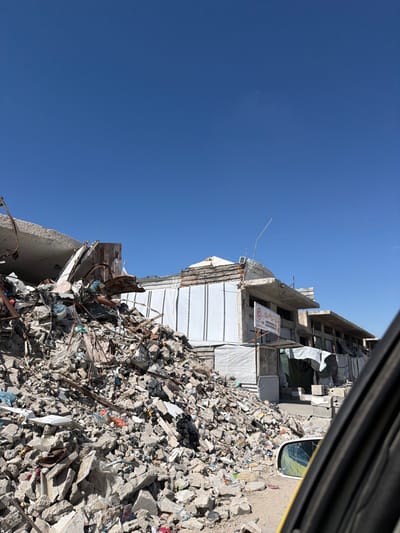
This image captures a scene in Jabalia, Palestinian Territory, depicting extensive urban damage under a clear blue sky. A large pile of concrete rubble, broken masonry, and twisted rebar dominates the left and central foreground, extending towards the right. Interspersed within this debris are various items, including dark and light-colored plastic bags and fabric scraps. To the right of the rubble, a multi-story building stands, showing signs of significant structural damage. Its lower facade is partially covered with white, vertically striped tarpaulin or sheeting. The upper sections of the building reveal exposed concrete and rebar, indicating partial collapse or heavy damage. A red and white sign, featuring Arabic text and a circular logo, is attached to a pole near an entrance at the building's ground level. This entrance area is further obscured by draped white canvas material. A thin, light-colored antenna or rod extends upwards from the building's roof. On the far right, a portion of a yellow vehicle's interior door frame and its exterior side mirror are visible; the mirror displays a crack and a distorted reflection. No individuals are present in the scene.
Jabalia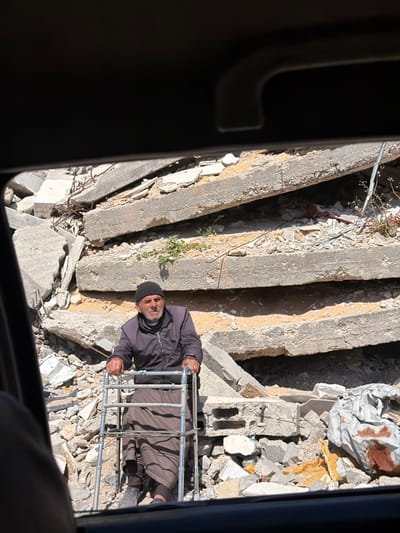
The image, taken from within a vehicle, frames an elderly man standing amidst extensive structural debris in Jabalia, Palestinian Territory. The man, with a weathered face, grey beard, and dark head covering, wears a dark zippered jacket over a long, light brown garment and dark trousers, with dark shoes visible. He is holding a silver-colored, four-wheeled walker with both hands and looks forward with a neutral expression. Behind him and extending throughout the background is a large pile of grey concrete rubble, fractured slabs, and construction debris. Several large, rectangular concrete sections are stacked haphazardly, revealing exposed sand and dirt beneath. Small green plants grow sparsely within the rubble. To the bottom right, a pile of lighter-colored, possibly plastic-wrapped debris is present, showing reddish-brown discoloration. The scene is brightly lit by direct sunlight.
Jabalia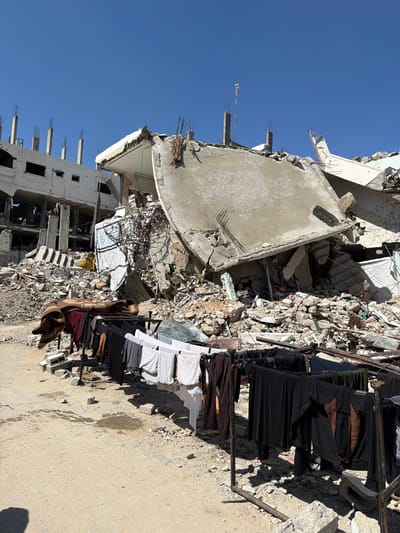
The image depicts a scene of extensive urban devastation in the city of Jabalia, Palestinian Territory, under a clear blue sky. In the foreground, a utilitarian clothesline, fashioned from dark metal bars, spans the lower frame, holding numerous items of recently washed laundry including dark-colored shirts, pants, and lighter-colored shirts and undergarments, hanging to dry. To the left, a folded brown and cream-colored blanket rests on a piece of debris near the ground. The immediate ground consists of compacted dirt and scattered concrete fragments. The midground and background are dominated by the remains of multi-story concrete buildings that have suffered severe structural damage. A prominent, large curved concrete slab, detached and fractured, leans diagonally amidst an extensive pile of rubble in the center-right, exposing internal reinforcing steel bars. To the left, a multi-story building stands partially intact but significantly damaged, with large sections of its facade missing, revealing exposed interior floors, concrete columns, and rebar. No individuals are visible in the scene. The area is illuminated by direct sunlight, casting distinct shadows from the clothesline and debris.
Jabalia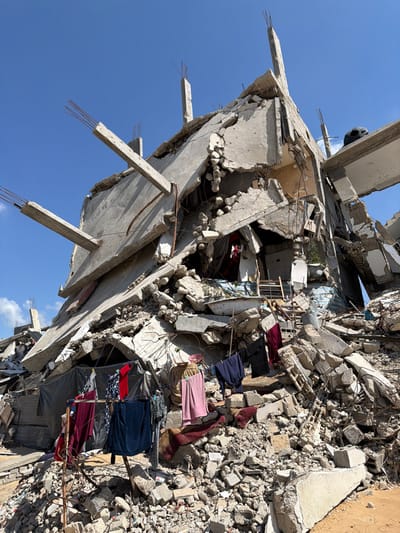
The image displays the severely damaged remains of a multi-story reinforced concrete building in Jabalia, Palestinian Territory, beneath a clear blue sky. The structure exhibits extensive collapse, with concrete slabs and pillars fractured and dislodged at acute angles, exposing twisted rebar. A large volume of pulverized concrete and structural debris forms a substantial rubble pile dominating the foreground and base of the damaged building. In the lower-center, a clothesline is suspended over the rubble, laden with drying garments including dark blue, red, pink, and patterned fabrics. Behind the clothesline, a dark tarp or fabric is visible, attached to the compromised lower section of the building. A white bathtub is observable among the debris near the building's foundation. The overall scene indicates comprehensive structural destruction with evidence of makeshift human adaptation within the immediate environment.
Jabalia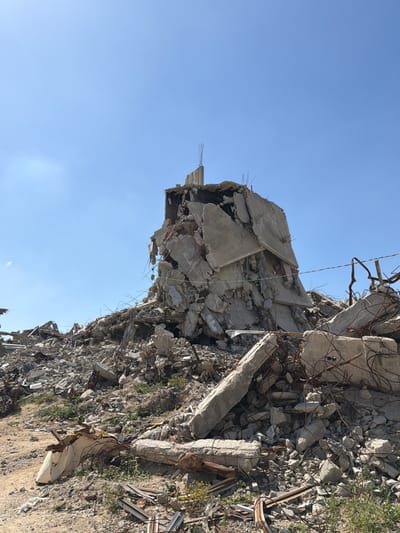
This image depicts a large pile of rubble in the city of Jabalia, Palestinian Territory, under a clear blue sky. The central feature is a substantial, irregularly shaped mound of fragmented concrete, twisted rebar, and other building debris, rising prominently against the horizon. This structure, likely the remains of a multi-story building, shows fractured concrete slabs leaning against each other, exposing internal reinforcement bars. The ground surrounding the main debris pile is also covered in smaller pieces of rubble, dirt, and sparse patches of green and yellow vegetation. No individuals or specific activities are visible in the scene.
Jabalia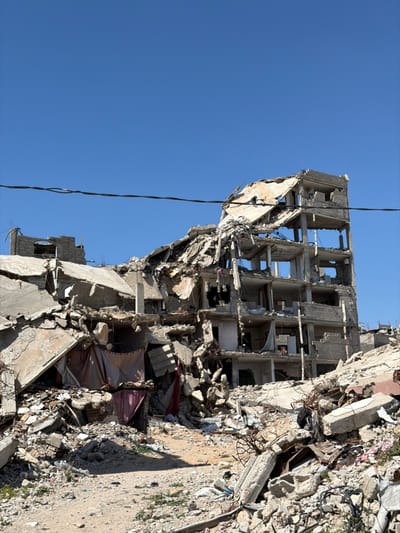
The image displays a scene of widespread destruction in Jabalia, Palestinian Territory, under a clear blue sky. The central focus is a heavily damaged multi-story concrete building, with its upper floors significantly collapsed and structurally compromised. Concrete slabs, rebar, and debris are extensively scattered around and within the remaining framework of the building. Multiple floor levels are visible, with internal rooms exposed to the exterior, indicating severe structural failure. The ground in the foreground and surrounding the central building is covered in a dense field of rubble, composed of broken concrete, twisted metal, and assorted building fragments. A dirt path is visible through the rubble in the immediate foreground, leading towards the base of the damaged structure. Amidst the debris, particularly to the left of the central building, small makeshift structures or coverings made of draped fabric (appears reddish-brown and beige) are present. Overhead, a single black electrical or communication wire stretches horizontally across the upper third of the frame. No individuals or active movements are discernible within the scene. The overall environment suggests a site of extensive demolition or impact.
Jabalia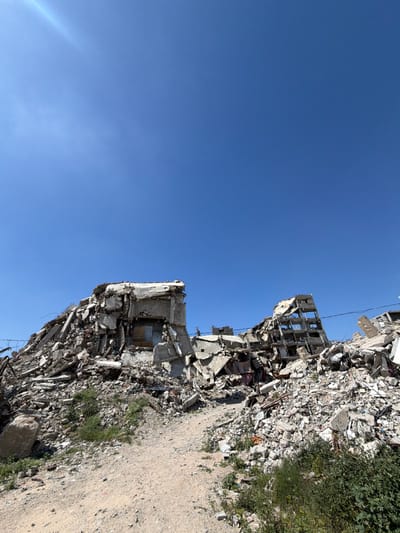
The image depicts a scene of extensive urban destruction in Jabalia, Palestinian Territory, under a clear blue sky with a sun flare visible in the upper left. The foreground features a light-colored dirt path or track, veering slightly to the right, with sparse green vegetation, including weeds and small bushes, growing along its edges and within the surrounding debris. The middle ground and background are dominated by massive piles of rubble, remnants of what appear to be multi-story concrete buildings. On the left, a large mound of pulverized concrete, twisted rebar, and building fragments rises, with a partially intact, possibly internal, room structure visible within the debris. To the right, another significant mound of similar debris features the skeletal remains of a building, showing multiple exposed floor plates and support columns, indicative of severe structural damage and partial collapse. Exposed internal elements, such as damaged walls and fragments of personal belongings (e.g., fabric), are discernable within the shattered structures. The entire landscape is characterized by widespread destruction, with no individuals visible within the frame. The scene is illuminated by strong sunlight, casting minimal shadows due to the overhead sun.
Jabalia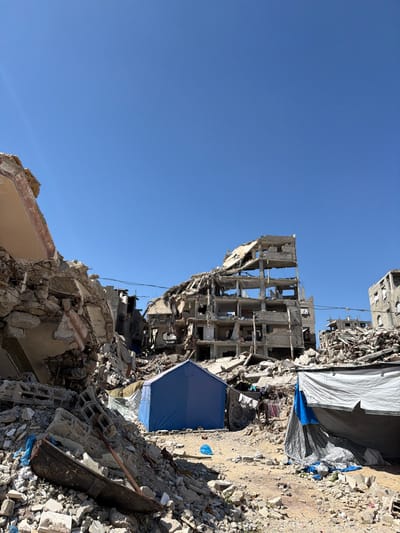
The image depicts a scene of widespread structural devastation in Jabalia, Palestinian Territory. Under a clear, bright blue sky, the foreground and mid-ground are covered in extensive rubble piles composed of fractured concrete, rebar, and fragmented building materials. In the central background, a multi-story concrete building, estimated at five to seven floors, exhibits severe structural damage, with upper sections collapsed, exterior walls largely absent, and internal framework exposed. Additional partially destroyed buildings and large debris mounds are visible in the background and to the right. In the mid-ground, a blue, approximately rectangular tent is erected directly on the rubble-strewn ground. To its right, a larger, improvised shelter constructed from white and blue tarpaulins is present, with articles of clothing hung for drying on a line nearby. To the left of the blue tent, a dark, trough-like object is partially submerged in debris. A small, blue plastic bag lies on the ground near the blue tent. No individuals are visible. Utility lines span between damaged structures in the deeper background.
Jabalia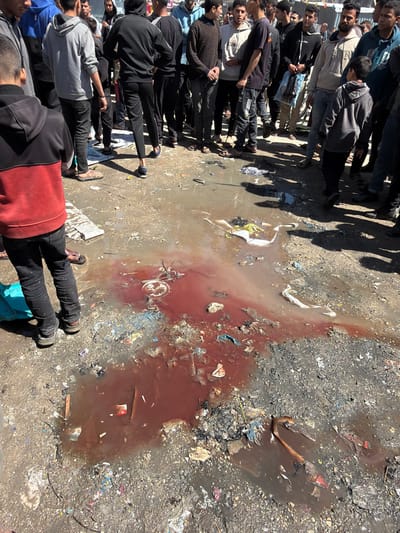
The image portrays an outdoor scene in Jabalia, Palestinian Territory, centered on an unpaved, uneven dirt and mud ground heavily littered with refuse. A significant, irregular-shaped puddle of reddish-brown liquid, consistent with blood mixed with water, dominates the foreground and midground. Within this liquid and surrounding debris, various items of trash are visible, including plastic remnants, fabric scraps, and what appears to be a white, circular object partially submerged in the most concentrated reddish area. Approximately 20-30 males, including adults and several younger individuals, are gathered around the perimeter of the liquid, observing the scene. They are dressed in casual clothing, such as hooded sweatshirts, jackets, and pants. Many are looking downwards towards the ground. In the immediate foreground, a boy wearing a black top with red sleeves and black pants stands with his back to the viewer, facing the puddle. Shadows cast by the individuals suggest bright, direct sunlight. The background shows additional people and indistinct structures, indicating a populated area.
Jabalia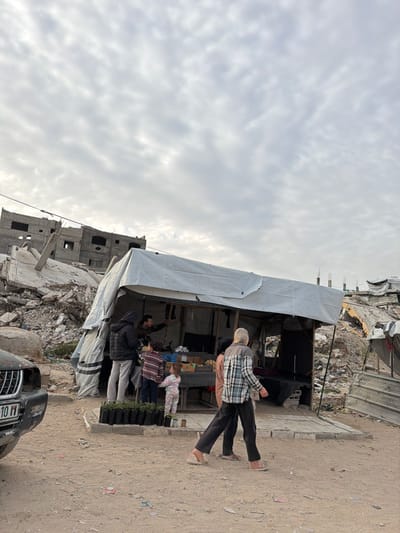
This image depicts an outdoor market scene in Jabalia, Palestinian Territory, set against a backdrop of extensive structural damage. In the foreground, a dark-colored vehicle, possibly a car, with a damaged front bumper and visible license plate "10 11", is parked on the left. The ground is unpaved, consisting of dry, light brown soil and scattered debris. Centrally positioned is a makeshift market stall constructed from a white tarpaulin draped over a frame, likely scaffolding or posts. The stall's interior reveals various items on display, resembling produce, with a man inside looking towards the right and gesturing with his right hand. To the left of the stall's entrance, several black containers holding small green plants are arranged on the ground. In front of the stall, several individuals are present. A person in a dark jacket and light pants stands facing the stall. To their right, two children are visible, one in a striped top and another, younger child in a light-colored, patterned pajama-like outfit, both looking towards the stall's interior. Further to the right, two adults walk away from the stall towards the right side of the frame. One adult wears a light plaid shirt over dark pants and flip-flops, while the other, partially obscured, wears a dark top and lighter pants. The background reveals a landscape of widespread destruction. Directly behind the market stall and extending to the left, a large pile of concrete rubble and twisted rebar indicates a collapsed structure. Beyond this, partially destroyed multi-story buildings with exposed brickwork and missing sections are visible under an overcast sky with scattered clouds. More rubble and damaged structures are visible on the right side of the frame, behind the market stall, suggesting a wide area has been affected.
Jabalia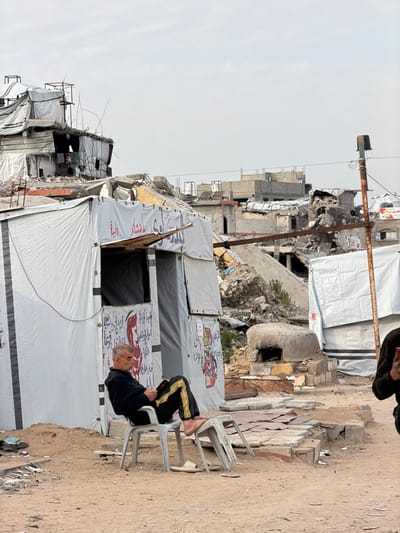
The image captures a scene in Jabalia, Palestinian Territory, characterized by extensive urban destruction and the presence of temporary shelters. In the midground, a middle-aged to elderly man with short grey hair and a beard sits on a light-colored plastic chair, reading an open book or document. He wears a dark long-sleeved top and dark track pants with yellow stripes; his bare feet rest on the inverted seat of a second light-colored plastic chair placed in front of him. To his left, a temporary structure made from white tarpaulin panels features an open dark entryway and visible Arabic script in red and black ink. Another similar white tarp structure is partially visible to the right. Between these structures, a small, dome-shaped concrete or mud-brick structure resembling an outdoor oven stands on a stone base. A tall, rusty metal pole with a dark attachment at its top is positioned on the far right, where a partial view of another person's dark-clothed arm and hand is visible. The foreground consists of uneven light brown dirt and sand with scattered debris, leading to a slightly elevated paved area. The background reveals widespread devastation: multiple multi-story buildings are reduced to rubble and twisted metal, with some structures partially collapsed. The sky is overcast and uniformly light grey.
Jabalia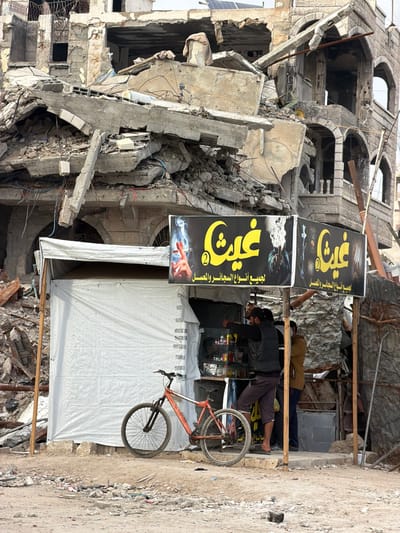
This image captures a street scene in the city of Jabalia, Palestinian Territory, depicting a makeshift retail operation in front of a severely damaged multi-story building. The background is dominated by the remnants of a concrete structure, likely a residential or commercial building, exhibiting extensive destruction. Large sections of concrete slabs, twisted rebar, and general rubble are haphazardly piled, indicating a partial collapse. Visible architectural elements on the right side include arched windows and decorative stonework on a less damaged section of the facade, with a solar panel array mounted on its rooftop. Electrical wiring, including red and blue conduits, hangs loosely from the damaged framework. The ground leading up to the building is covered in debris, dust, and scattered refuse. In the mid-ground, a temporary stall, possibly a kiosk, stands directly in front of the damaged building. This stall is constructed from white tarpaulin or fabric stretched over a simple frame, providing a small, enclosed space. Above the stall, two black banners with yellow Arabic script and imagery are displayed. The text "غيث 2" (Ghaith 2) is prominent. One banner features a hand holding a lit cigarette emitting smoke, while the other shows a dark, smoky image. Below the primary text, the phrase "لجميع أنواع السجائر والمعسل" (For all types of cigarettes and tobacco/ma'assel) is visible. Three males are present around the stall. One male, wearing a dark vest over a dark long-sleeved shirt and dark shorts/trousers, stands slightly inside the stall's opening, leaning forward with his right arm extended towards items displayed on a counter within the stall. He appears to be barefoot or wearing sandals. Behind and to his right, a second male in a brown shirt is partially obscured. A third male is visible further to the right, mostly obscured by the second individual. The stall's counter displays various small bottles, packages, and other merchandise. An orange mountain bicycle with black tires and front suspension is parked upright directly in front of the stall, facing left. The ground in the immediate foreground is uneven, consisting of packed dirt, small stones, and scattered debris. The sky above is overcast.
Jabalia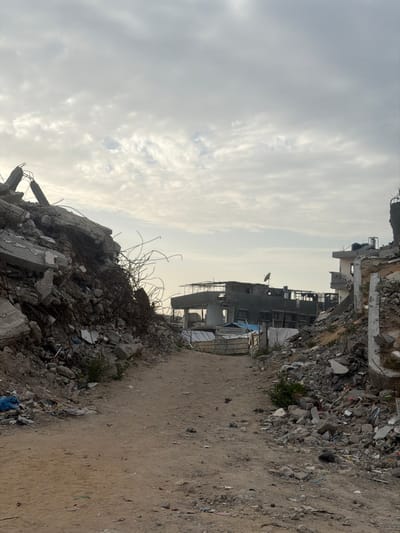
The image depicts a devastated urban landscape in Jabalia, Palestinian Territory, characterized by extensive structural damage and debris. A central, unpaved dirt path, approximately 2-3 meters wide, extends into the distance, narrowing slightly. On both sides of this path are large mounds of rubble, composed of broken concrete, twisted rebar, masonry fragments, and other building materials, indicating collapsed structures. To the left, a substantial pile of debris forms a steep slope, showing exposed rebar protruding upwards and outwards. To the right, similar rubble piles line the path, with some standing, fractured wall sections visible further back. Small patches of sparse vegetation are discernible among the debris. In the mid-distance, several buildings appear heavily damaged or partially destroyed. One building on the left horizon features an exposed framework, while another structure further along the path shows missing sections and exposed interiors. A dark, possibly partially collapsed, multi-story building is visible in the center-right background, with a small satellite dish mounted on its upper level. Minimal, makeshift structures, possibly constructed from corrugated metal, are visible near the distant buildings. The sky above is overcast with scattered clouds, and no individuals or active interactions are present in the scene.
Jabalia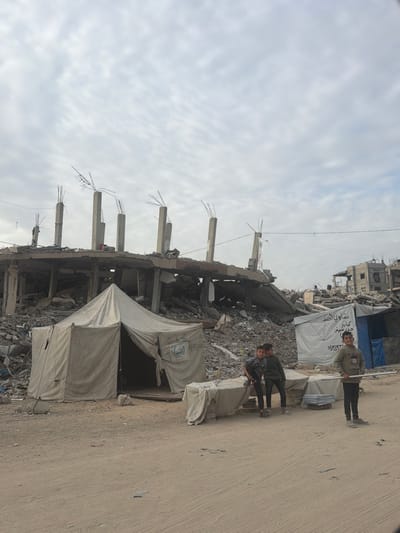
An outdoor scene in Jabalia, Palestinian Territory, depicts an area of extensive structural damage under an overcast sky. In the foreground, an unpaved, light brown dirt or sand surface extends. In the midground, a light-colored canvas tent, bearing a blue circular logo (likely indicating a humanitarian organization), stands with its entrance partially open. To the right of this tent, three young males are positioned. Two boys stand close together, partially obscured by a low, rectangular object covered with light fabric. A third boy stands further right, facing the camera, holding a light-colored pole horizontally. The background is dominated by the severely damaged remains of a multi-story concrete building, collapsed into a large pile of rubble. Exposed concrete columns with protruding rebar stand vertically from the debris. Further to the right in the background, additional damaged structures and another light-colored temporary tent, displaying Arabic text and numbers, are visible. The overall environment indicates significant destruction and makeshift living arrangements.
Jabalia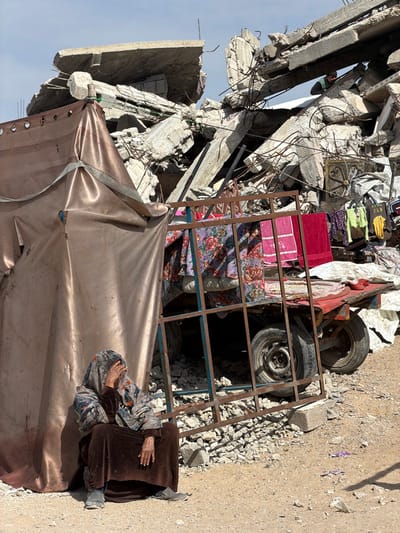
The image depicts a scene of extensive urban destruction in Jabalia, Palestinian Territory, under a clear daytime sky. In the foreground, an elderly individual is seated directly on the barren dirt ground, leaning against a makeshift shelter constructed from a shiny, coppery-brown tarp material secured with straps. This individual wears a multi-patterned head covering and a long, dark brown outer garment over a patterned shirt; their right hand is raised to their forehead, partially obscuring their face, while their left hand rests on their lap. To the immediate right of the seated person, a rusty, rectangular metal frame, possibly from a bed or window grill, stands upright. Behind this frame, a red-framed utility cart with two visible wheels is positioned on uneven ground littered with small concrete debris. The cart is laden with various items, including patterned blankets and a red towel draped over its structure, and several articles of clothing (e.g., t-shirts, bags) hanging on a line or structure behind it. White tarpaulins are visible behind the cart. The background is dominated by a massive pile of shattered concrete slabs and twisted rebar, indicating the remains of a demolished building. Amidst this rubble, a second individual, wearing a greenish top, is partially visible near the upper portion of the debris pile, appearing to be observing or navigating the destruction.
Jabalia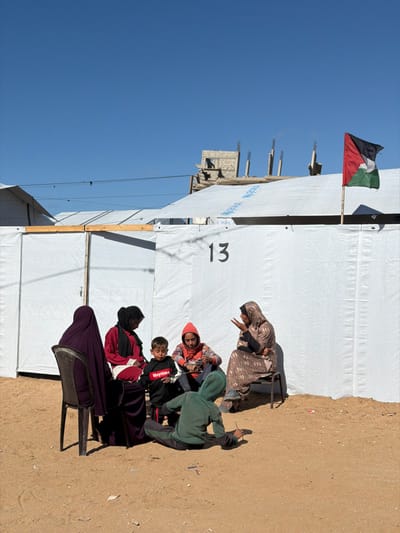
This image, captured in Jabalia, Palestinian Territory, depicts a group of six individuals on sandy ground outside temporary shelters under a clear blue sky. The environment consists of light brown sand and dirt, with scattered small debris. Several white temporary shelters, constructed from tarp-like material over wooden frames, dominate the midground. One prominent shelter features the black numeral "13" centrally on its side. Faint blue "UNICEF" and "UNRWA" logos are visible on the tarp roofs of some shelters. A Palestinian flag, displaying red, black, white, and green, flies from a pole attached to the top right of a shelter. In the background, behind the shelters, partially constructed concrete buildings with exposed rebar are visible. Overhead, thin black electrical wires traverse the scene. Six individuals are present, comprising four adult females and two children, engaged in an informal gathering. 1. An adult female, dressed in a light brown patterned dress and head covering, sits on a dark chair on the right, gesturing with her right hand while facing the group. 2. An adult female, wearing a red top and black head covering, sits on a chair to the left of the first woman, looking downwards. 3. An adult female, clad in a dark purple garment and head covering, sits on a black chair with her back partially to the camera, facing the group. 4. An adult female, wearing an orange hooded top, sits directly on the ground, facing the group, holding a small, light-colored object in her hands. 5. A young boy, wearing a black hoodie with "Noytime" in red text, sits on the ground between the woman in red and the woman in orange, looking downwards at an unseen object. 6. A child, wearing a green hooded top and dark pants, sits on the ground with their back partially to the camera, appearing to interact with the dirt surface.
Jabalia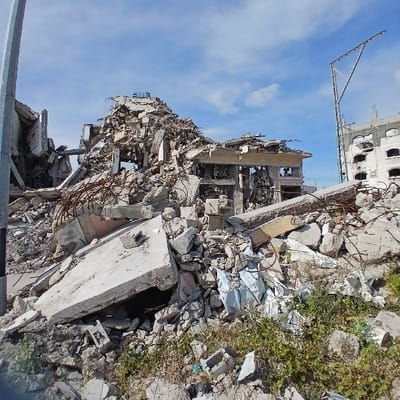
This image presents a scene of extensive structural destruction in Jabalia, Palestinian Territory. The foreground and midground are dominated by a large mound of rubble, consisting primarily of fractured concrete slabs, broken blocks, and twisted steel rebar. This debris appears to be the remnants of collapsed multi-story buildings. In the center-midground, a partial structure with exposed internal elements and empty window or door frames remains somewhat intact amidst the surrounding wreckage. To the far left, a grey utility pole stands vertically. To the right, a partially damaged, multi-story concrete building with numerous dark, empty window openings is visible in the background, alongside a tall, skeletal metal framework that resembles a structural support or pole. The ground in the immediate foreground shows sparse patches of green vegetation growing through the rubble. The sky above is clear blue with minimal scattered white clouds. No individuals are present in the frame.
Jabalia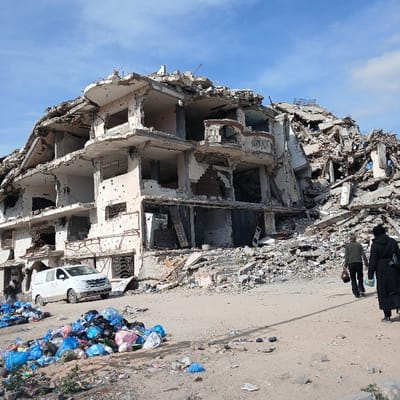
The image depicts a scene of severe urban destruction in Jabalia, Palestinian Territory, under a partially cloudy blue sky. A multi-story concrete building, heavily damaged and partially collapsed, stands in the left-center of the frame. Its upper levels are largely destroyed, revealing fractured concrete and exposed rebar. The exterior walls display numerous small circular perforations consistent with bullet impacts. To the right and behind this structure, a substantial pile of building rubble extends. On the unpaved ground in the left foreground, multiple large accumulations of colorful plastic trash bags are visible, along with scattered refuse. A white commercial van is parked adjacent to the base of the damaged building on the left. Two individuals are observed walking away from the camera on a dirt path: one male wearing dark clothing and carrying an object in his right hand, and one female in a long black garment and head covering.
Jabalia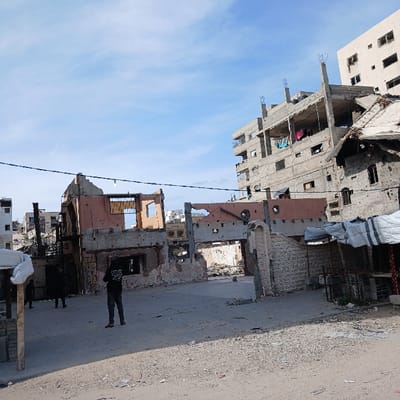
This image captures a scene of extensive urban destruction in Jabalia, Palestinian Territory, under a partly cloudy blue sky. The foreground consists of a dirt and gravel road leading into a wider, flat area of compacted earth scattered with debris. Three individuals are visible: a person in a black hoodie stands centrally, facing away from the camera, observing the damaged environment. Two additional figures are partially obscured in the left background, near a severely damaged building. The midground is dominated by the skeletal remains of multiple structures. A prominent reddish-orange colored concrete building exhibits large missing sections of its facade, exposing interior spaces and structural elements, and bears numerous circular impact holes across its remaining walls. To its right, another building features a partially collapsed roof and extensive wall damage. A partial stone-clad wall with an arched opening stands on the right, also showing damage. In the background, a multi-story concrete building, appearing either under construction or heavily damaged, shows exposed rebar, missing wall sections, and articles of laundry hanging from balconies or exposed floors. Other multi-story buildings are partially visible further in the background. A black utility line with a single light fixture stretches horizontally across the middle ground. On the far right, a makeshift market stall structure covered by white and blue tarpaulins is present.
Jabalia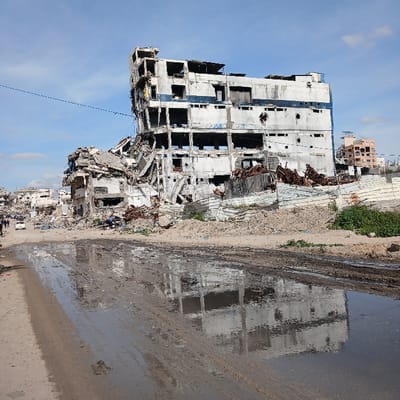
The image depicts a scene of extensive structural destruction in Jabalia, Palestinian Territory, under a partially cloudy blue sky. In the center, a severely damaged multi-story concrete building stands, its facade largely blown out, revealing internal floors and exposed rebar. The building, originally light-colored with blue accents, is heavily soiled and fragmented, with large sections of its walls and roof missing or collapsed. To the left, another collapsed structure is visible, surrounded by immense piles of concrete rubble, twisted metal, and general debris extending into the background, where more damaged buildings are discernible. In the far right background, a less damaged multi-story building with an orange-brown facade is partially visible. The foreground features an unpaved, muddy road with large puddles reflecting the damaged structures and the sky. On the left side of the road, in the midground, several dark figures, likely individuals, are observed near a white sedan. Sparse green vegetation grows amidst the rubble on the right. A thin, dark line, possibly a utility cable, stretches across the upper portion of the frame.
Jabalia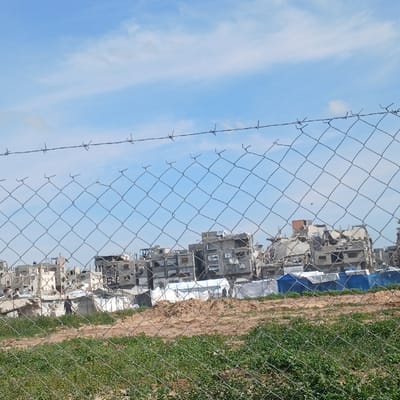
The image depicts a scene in Jabalia, Palestinian Territory, characterized by extensive structural damage and temporary habitation. In the foreground, a chain-link fence with a single strand of barbed wire running horizontally across its top edge spans the width of the frame. Below the fence, green vegetation, likely grass, transitions into an area of reddish-brown, disturbed earth. The mid-ground features several temporary shelters, including at least six white rectangular tents and two blue tents, erected on this ground amidst scattered debris. One dark-clad individual is observed walking from left to right in the lower-left mid-ground, near a white tent and a pile of light-colored rubble. In the background, a dense cluster of multi-story concrete buildings stands in various states of severe destruction, exhibiting missing walls, exposed rebar, and collapsed sections. The sky above is light blue with scattered white clouds.
Jabalia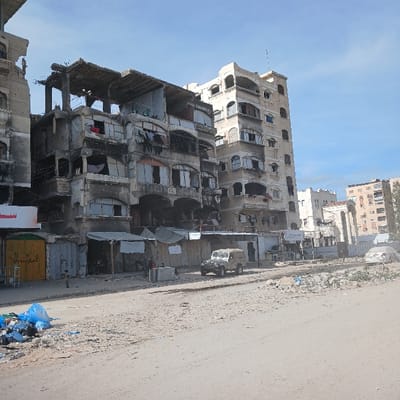
The image captures a street scene in Jabalia, Palestinian Territory, under a clear blue sky with sparse white clouds. The foreground features an unpaved, rubble-strewn road heavily littered with debris, rocks, and refuse, including a prominent pile of blue plastic bags on the left. The left side of the street is lined with multi-story buildings displaying significant structural damage. A central structure shows severe destruction to its upper floors, including exposed rebar, collapsed sections, and missing windows. Laundry is visible hanging from balconies and makeshift lines on various levels. At its ground level, several makeshift stalls or enclosures, covered by tarpaulins and canvas, are present, with several indistinct figures visible within these shaded areas. A small individual stands near a yellow-green door or gate on the far left. To the right, a taller, lighter-colored multi-story building, approximately seven to eight floors high, exhibits signs of facade damage, including discoloration and some broken windows, but appears more structurally sound than its immediate neighbor. Further down the street, additional multi-story buildings are visible in the background, some appearing intact, others with signs of wear. A light-colored 4x4 utility vehicle is positioned on the right side of the road. Further in the mid-ground, a damaged white sedan is partially visible.
Jabalia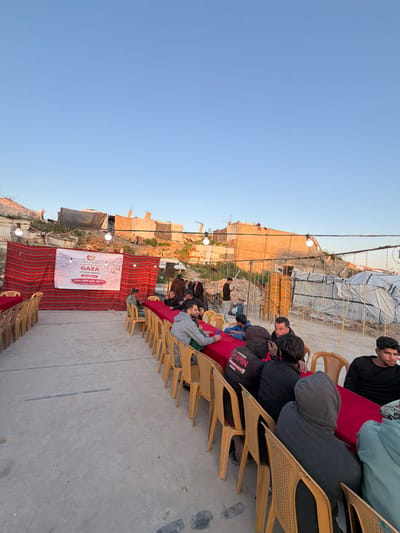
The image depicts an outdoor gathering set on a concrete ground surface in Jabalia, Palestinian Territory, under a clear, light blue sky. In the foreground, multiple long, narrow tables draped with red tablecloths are arranged parallel to each other. Numerous light brown plastic chairs are positioned around these tables. Approximately two dozen men are visible, predominantly seated at the tables, with some standing in the background. To the left, a white banner with a red border and heart logo is prominently displayed against a red and white striped fabric. The banner reads "HELP A NEEDY," "GAZA," "#IFTAR MEALS," and includes a phone number: "Info: 939-636-0672." String lights with exposed white bulbs are suspended overhead, illuminating the area. The background reveals a landscape of severe structural damage and makeshift constructions. Rubble, damaged concrete structures, exposed rebar, and temporary shelters made from tarpaulins and various materials are visible on an elevated, uneven terrain. Additional temporary structures or stacked materials are present on the right side of the frame. The men at the tables appear to be waiting or conversing, while a few individuals in the mid-ground are standing near the damaged structures.
Jabalia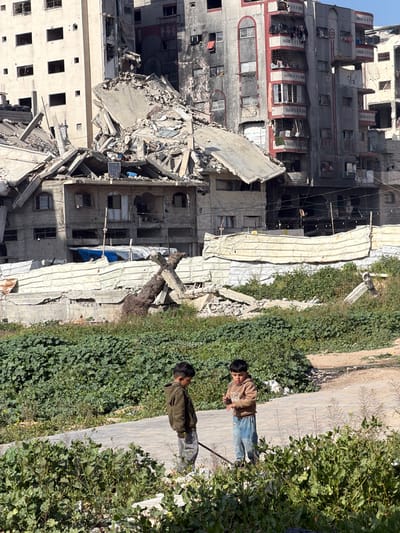
A severely damaged high-rise building stands amidst rubble. Sections are collapsed, and windows are destroyed, revealing a dark, charred interior. Two boys stand on a sidewalk next to dense green bushes. One wears a brown jacket and jeans, while the other is in a green jacket. Debris is visible on the ground near the bushes, and the building's ruins cast a long shadow over the scene. The overall impression is one of devastation and displacement.
Jabalia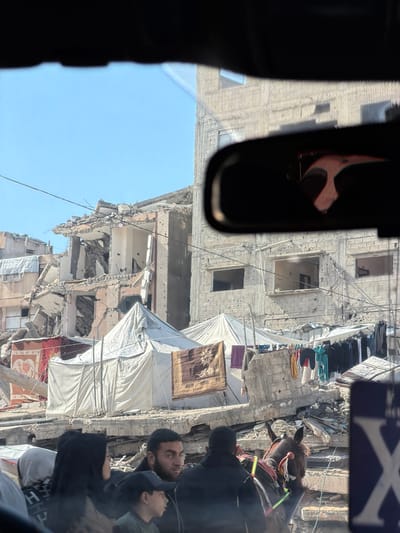
A damaged building, likely from conflict, dominates the view from inside a vehicle. The structure has visible holes and extensive debris. Makeshift coverings of white tarp are stretched across damaged areas. Clothes hang on lines strung between buildings. A group of people, including a man and a child, stand on the side. A dark object resembling a rearview mirror is visible in the foreground of the picture.
Jabalia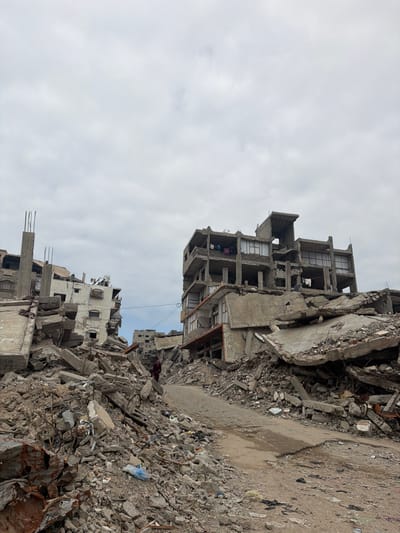
Rubble and collapsed buildings dominate the scene under a cloudy sky. Concrete debris is scattered across the foreground and background, indicating widespread destruction. The skeletal remains of structures rise from the debris, with exposed rooms and floors visible. The destruction suggests a war zone or a disaster area, conveying a sense of devastation.
Jabalia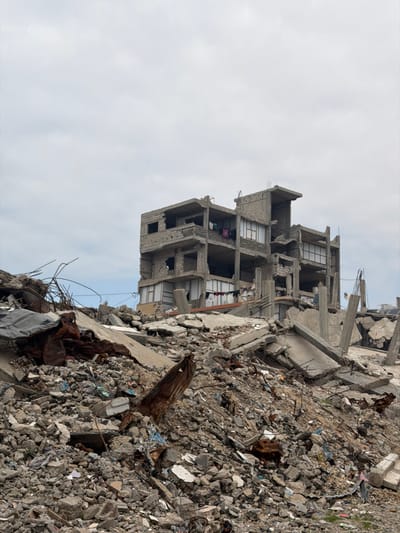
A destroyed building stands amidst rubble under a cloudy sky. The multi-story structure is heavily damaged, revealing exposed rooms. Debris consisting of concrete, metal, and various materials piles up around the building's base, reaching a significant height. The scene conveys devastation and destruction.
Jabalia