Jepara, Indonesia
30 memories from Jepara, Indonesia
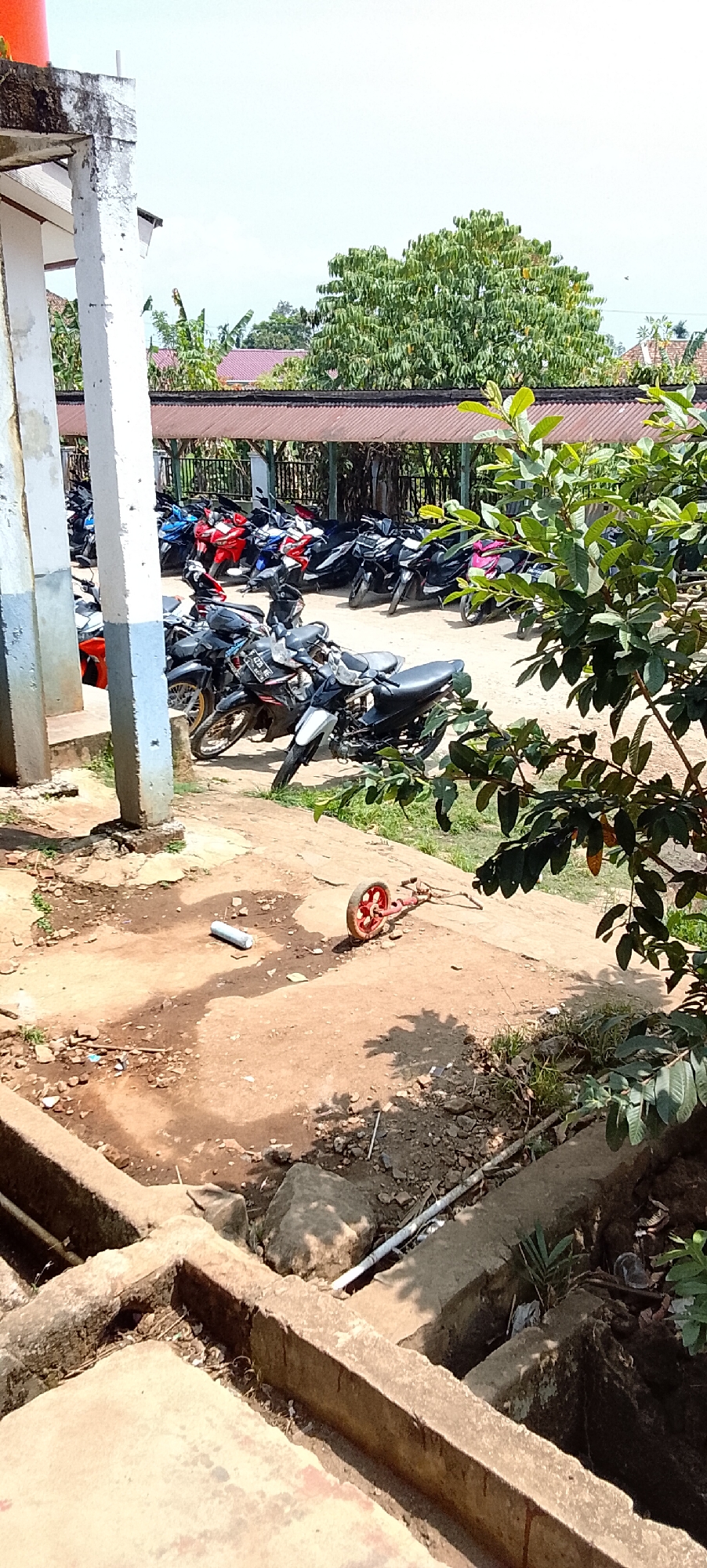
The image shows a parking lot for motorcycles in what appears to be a school or public facility in Jepara, Indonesia. The lot is filled with numerous motorcycles parked closely together under a covered structure with a corrugated metal roof. The structure is supported by concrete pillars, one of which is in the foreground and shows signs of weathering. The ground of the parking lot is a mixture of dirt and concrete. In the foreground, there is a broken red toy with a single wheel and a white cylindrical object lying on the ground. Beyond the parking lot, there are trees and some buildings with red roofs, typical of Indonesian architecture. The sky is bright and overcast, suggesting daytime. There are no people visible in the image. The scene depicts an organized but somewhat cluttered outdoor space, likely a daily scene at a busy location in Jepara.
Jepara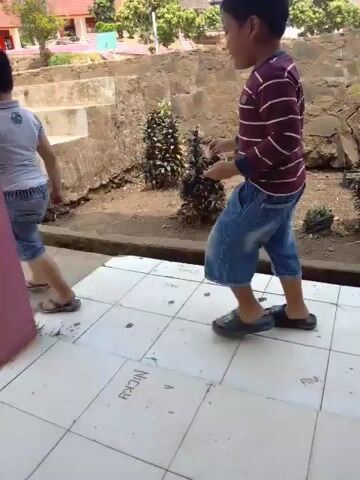
A boy in a striped shirt and blue shorts walks toward a set of concrete stairs. Another child, wearing a light blue shirt and denim shorts, is already walking up the stairs. The boy in the striped shirt follows, and both children ascend the stairs. The scene appears to be outdoors, with buildings and trees visible in the background. The ground is dirt and concrete, and there is a large pink pillar in the foreground.
Jepara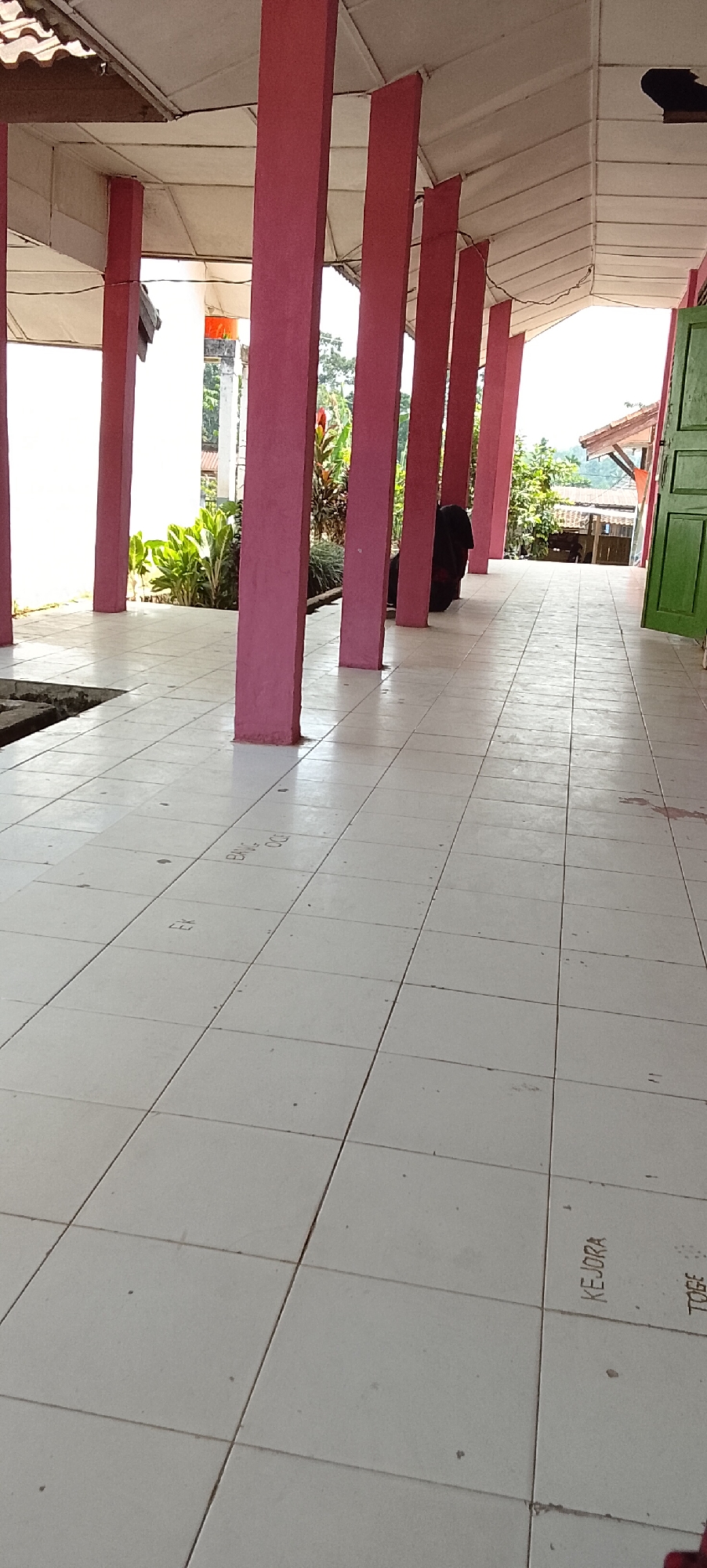
The image shows a covered walkway with a tiled floor in Jepara, Indonesia. Several large, reddish-pink pillars support the roof. Lush green foliage is visible behind the pillars on the left side of the frame, suggesting a tropical environment. A person, dressed in dark clothing, is seated on the ground behind one of the pillars, partially obscured from view. The tiled floor has some faint markings or writings on it. A green door is visible on the right side of the image, and further in the background, glimpses of buildings and trees indicate a residential or community area. The overall scene depicts an outdoor covered space, likely part of a building or facility in Jepara.
Jepara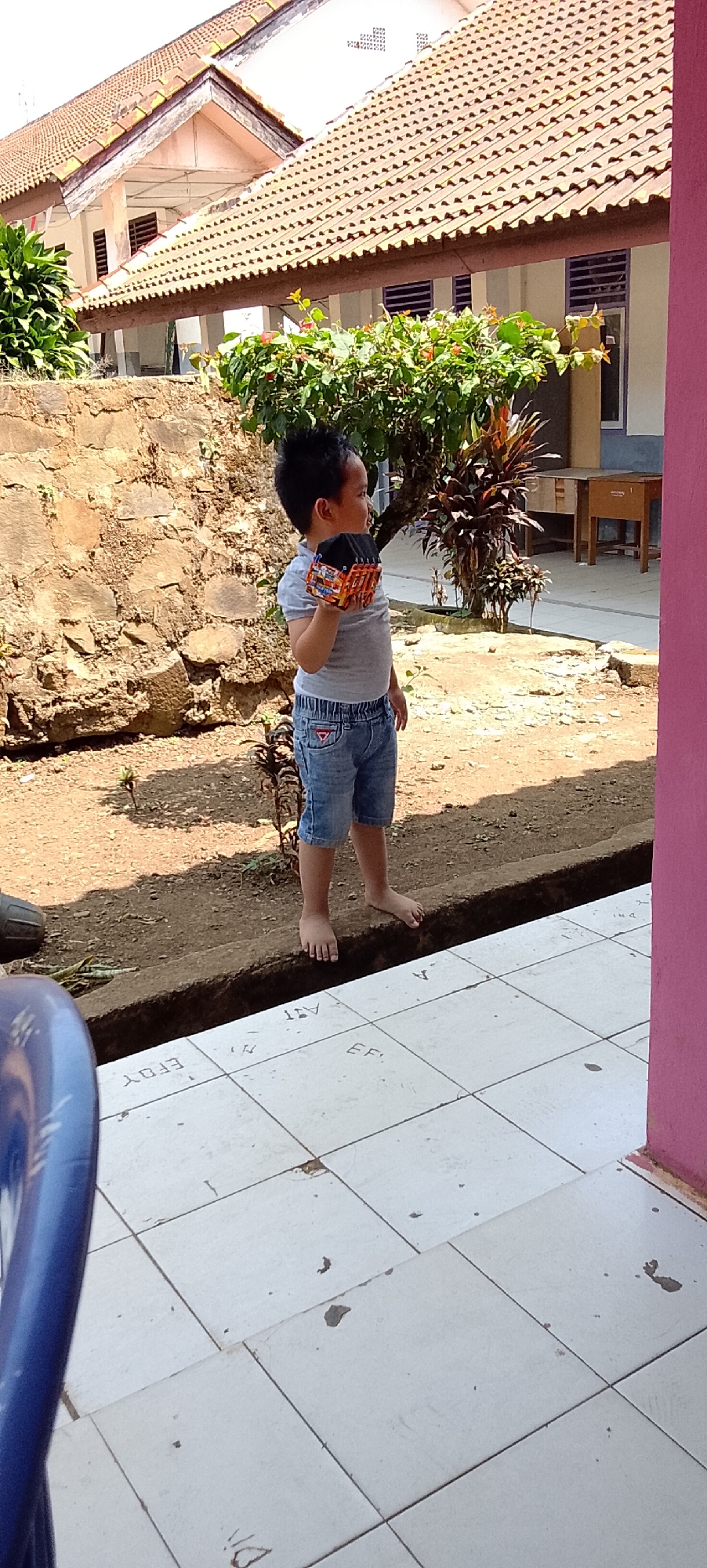
In Jepara, Indonesia, a young boy stands barefoot on a raised dirt border, holding a toy truck. He is wearing a grey t-shirt and denim shorts. Behind him, a stone wall and lush green foliage are visible, with a building featuring a terracotta-tiled roof in the background. The foreground shows white tiled flooring. The scene appears to be outdoors, possibly in a residential area or schoolyard.
Jepara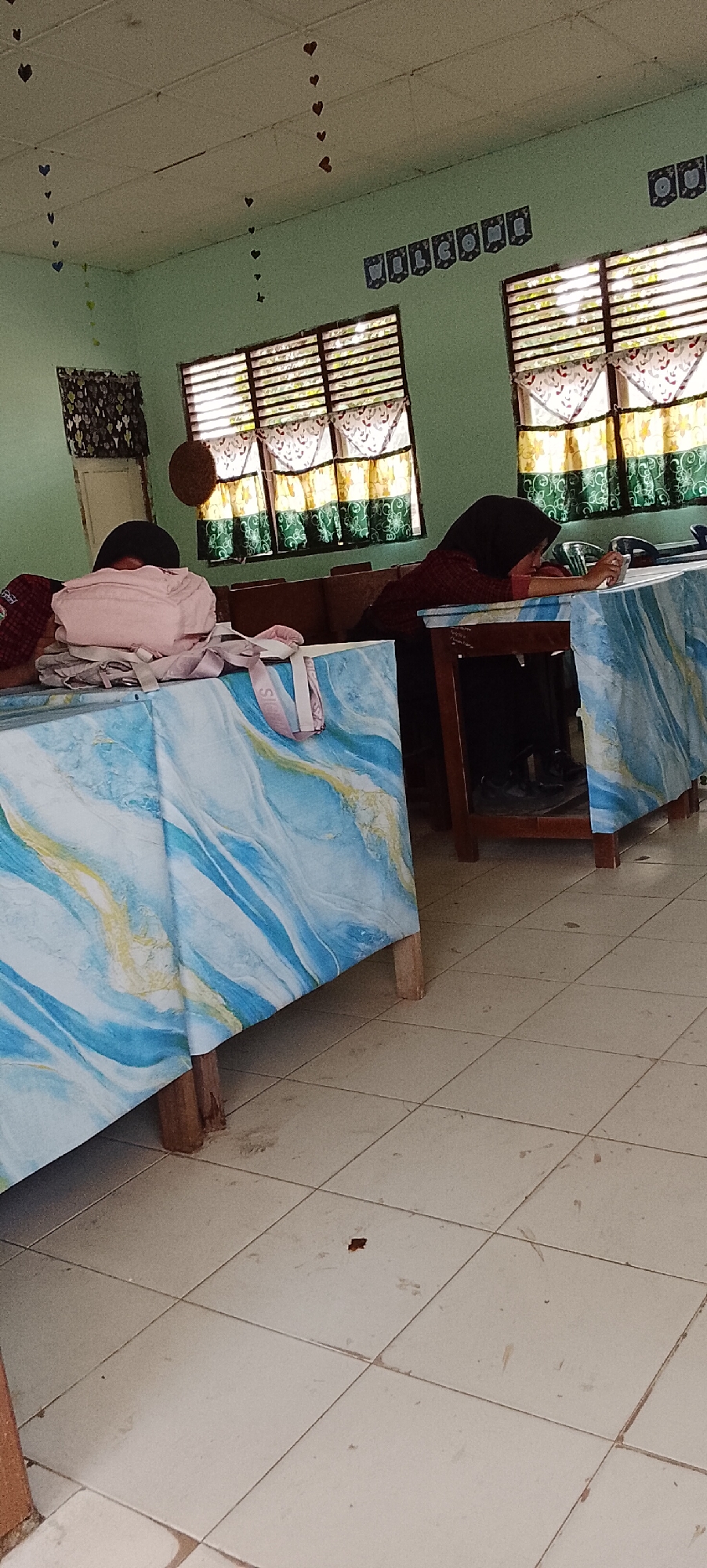
The image depicts the interior of what appears to be a classroom or meeting room in Jepara, Indonesia. Two individuals, likely students, are visible. One is lying face down on a table, head resting on their arms, while the other is leaning forward with their head down on a table, possibly asleep or concentrating. Both individuals are wearing modest clothing, with one wearing a hijab and the other a dark head covering. The room is decorated with heart-shaped ornaments hanging from the ceiling and along the walls. A banner with the word "WELCOME" is also affixed to the wall. Two large windows with slatted blinds are present, revealing glimpses of greenery outside. The windows are adorned with curtains featuring a floral pattern in green, yellow, and white. The tables in the foreground are covered with blue and white patterned cloths, with the pattern resembling marble or swirling waves. The floor is tiled with light-colored square tiles, showing some signs of wear and dust. The overall atmosphere suggests a casual or relaxed setting, possibly during a break or a less formal class session. The lighting appears to be natural, coming from the windows, and possibly supplemented by overhead lighting.
Jepara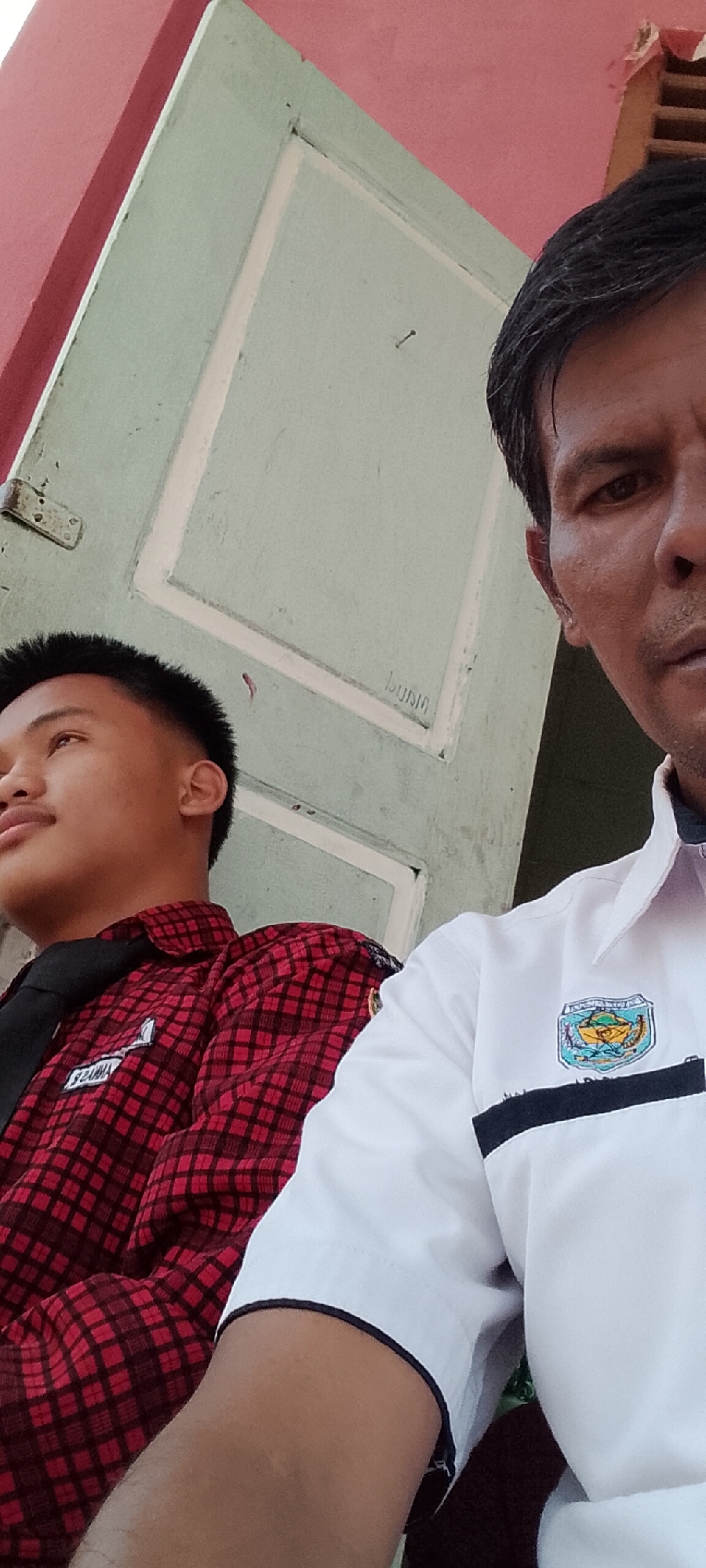
Two males are pictured in a close-up, shoulder-up shot. The male on the left, who appears to be a teenager, is wearing a red and black plaid shirt and a black tie. He is looking off to the left. The male on the right, who appears to be an adult, is wearing a white collared shirt with a dark blue collar and a crest on the left chest. He is looking directly at the camera. They are positioned in front of a light green door or wall. The upper part of the image shows a pink wall. The scene appears to be outdoors.
Jepara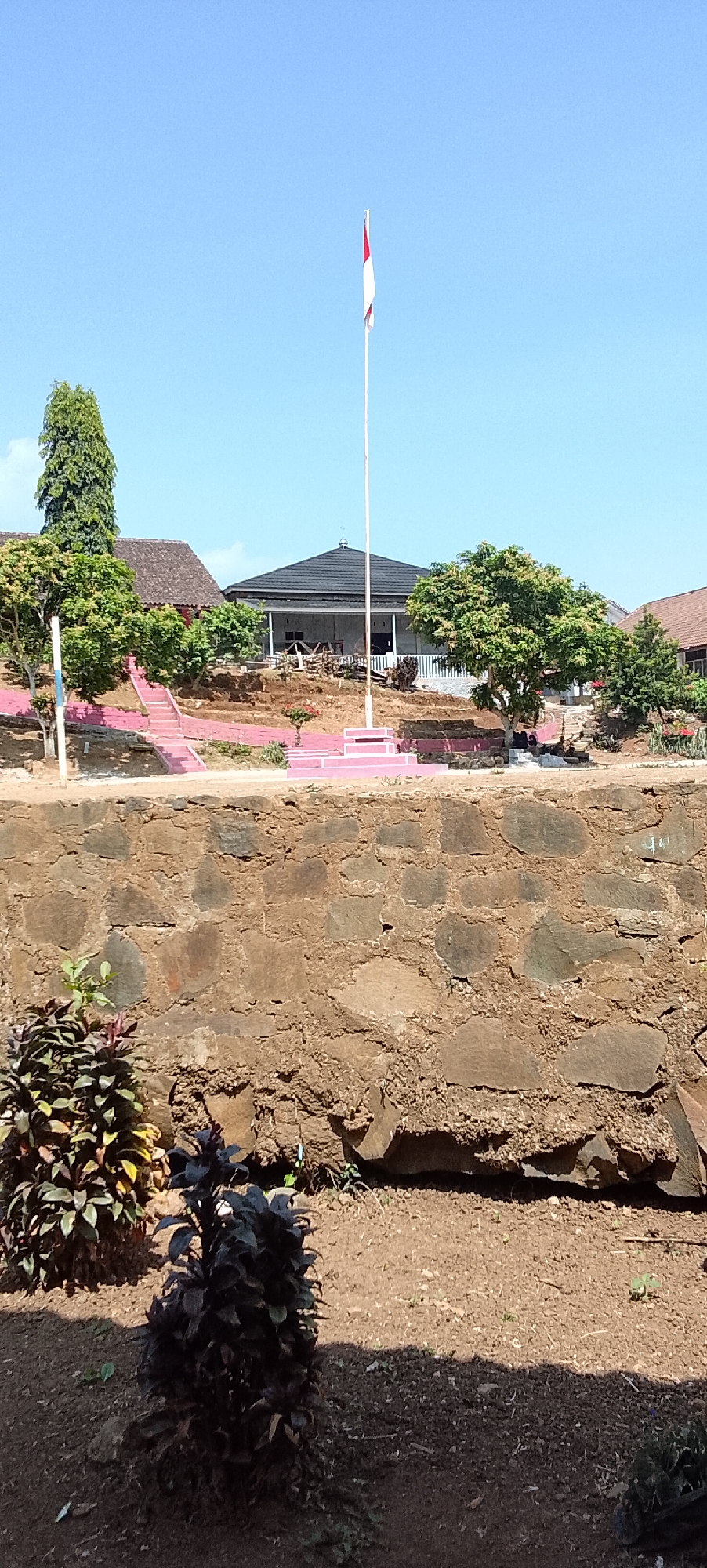
This image captures an outdoor scene in Jepara, Indonesia, under a clear blue sky. In the center, a flagpole stands tall, adorned with the Indonesian flag, white and red. The flagpole is positioned on a tiered platform, bordered by pink accents. To the left, a set of pink stairs ascends a slope, leading towards buildings in the background. These buildings feature traditional Indonesian architecture with dark tiled roofs and open verandas. Lush green trees are interspersed throughout the landscape, providing shade and color. In the foreground, a rough stone wall forms a natural barrier. In front of the wall, several plants with dark green and reddish leaves are visible, adding to the natural beauty of the setting. The ground is covered with soil and a scattering of small plants. The overall atmosphere suggests a serene and well-maintained outdoor space, possibly a school or a public area in Jepara.
Jepara
The video opens with a close-up of a clear plastic bag filled with colorful, rolled-up candies, possibly ice pops or a similar frozen confection. The camera then pans to reveal a room with light pink walls. In the background, two young women are seated on the floor, which is covered by a colorful mat with floral and leaf patterns. One woman, on the left, is wearing a black hijab and a white shirt, and is looking at her phone. The other woman, on the right, is wearing a light brown hijab and a white shirt, and is smiling and looking to her right. The camera then moves to focus on the woman in the light brown hijab, who is wearing glasses and a white shirt. She appears to be holding a phone and looking down at it. A ceiling fan is visible on the wall above and behind the seated women. Further to the right, there is a red shelf unit with various items on it, including what appears to be a laptop and bottles. Next to the shelf unit is a glass display case filled with items, possibly clothing or accessories, and some items are on top of the case. The video ends with a shot of the woman in the light brown hijab, her face partially obscured by her hijab.
Jepara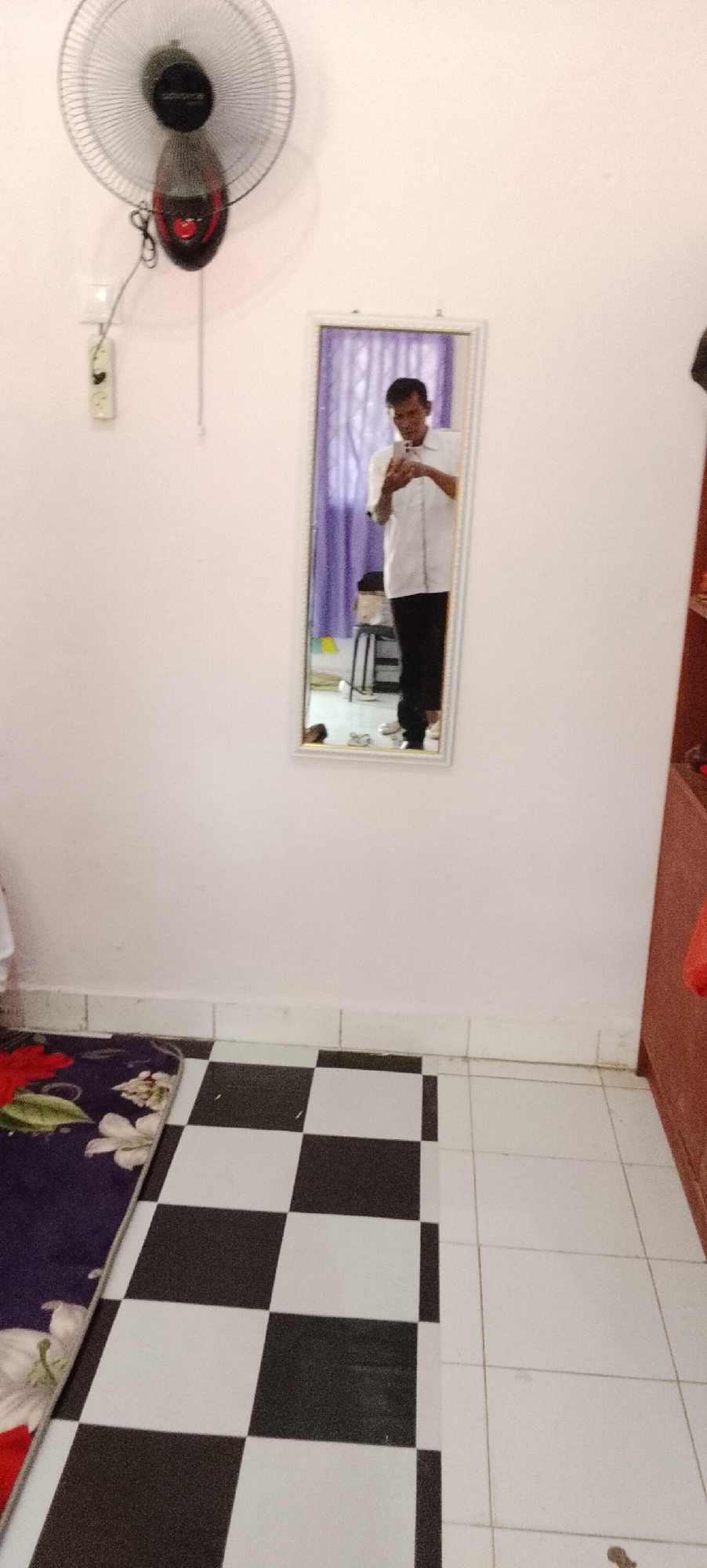
A full-body, vertical mirror selfie is captured indoors, reflecting a man standing in a room. The man is wearing a white button-down shirt and black pants. He is holding a smartphone in his right hand, using it to take the photo. Behind him, a purple curtain is visible, and to the left, a small stool with a black seat and metal legs is partially visible. The room has a light pink wall and a tiled floor. The floor features a checkerboard pattern of black and white tiles in the foreground, transitioning to plain white tiles further back. A portion of a dark-colored rug with a floral pattern is visible on the left side of the frame, partially covering the black and white tiles. Mounted high on the pink wall, to the left of the mirror, is a black and red oscillating fan. Below the fan, a white electrical outlet is mounted on the wall. To the far right of the image, the edge of a dark brown wooden cabinet is visible. The overall impression is that of a simple, lived-in interior space. The presence of the fan, rug, and basic furniture suggests a residential or dormitory-like setting. The lighting appears to be ambient, possibly from the room itself or natural light from outside the frame. There is no indication of the specific location within Jepara, Indonesia, beyond it being an indoor environment.
Jepara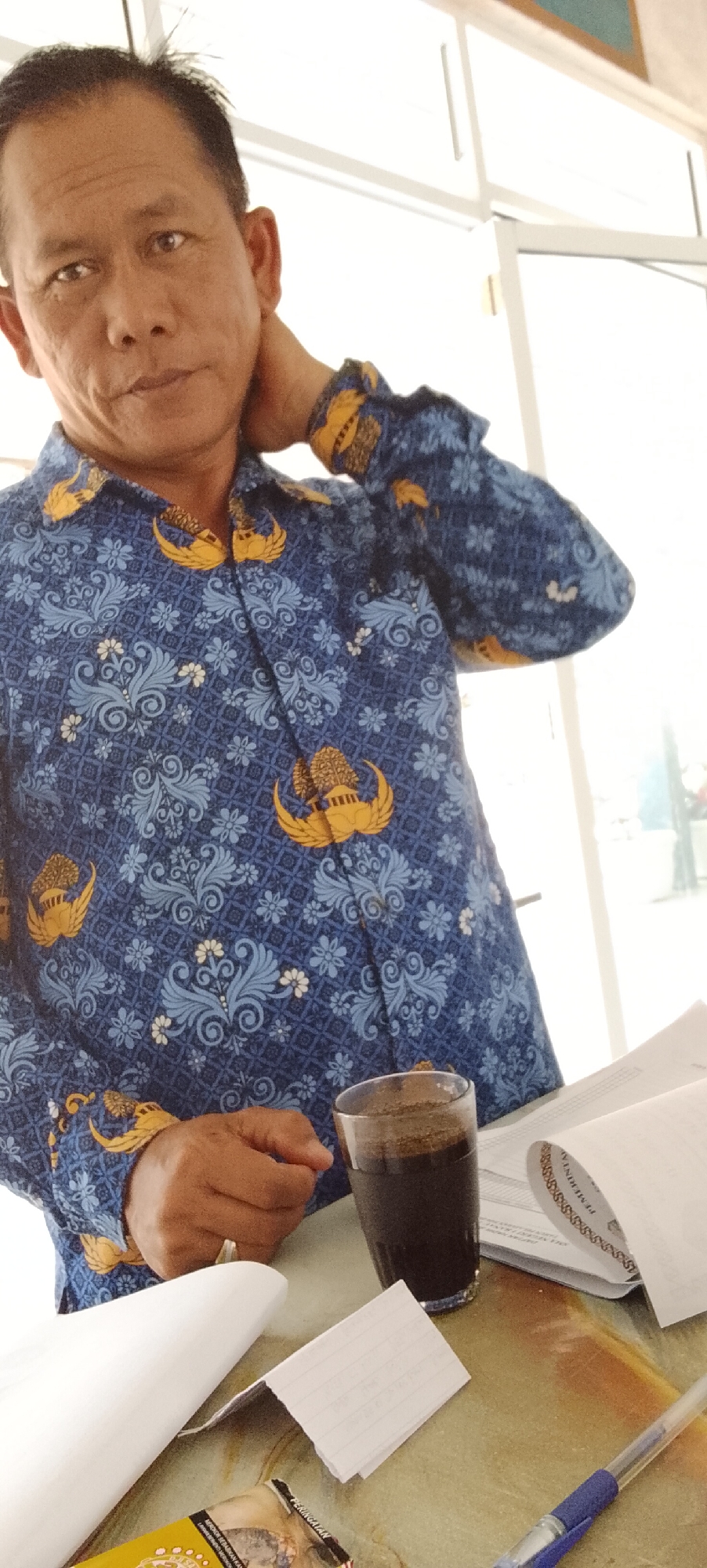
A middle-aged Indonesian man with short, dark hair is pictured from the chest up, indoors. He is wearing a blue batik shirt with yellow emblems and a floral pattern. He is touching the back of his neck with his right hand. In front of him, on a table, is a glass of dark liquid, possibly coffee, some crumpled papers, and an open document. The background shows a window with white frames, suggesting a bright, possibly sunny day. The man's expression is neutral.
Jepara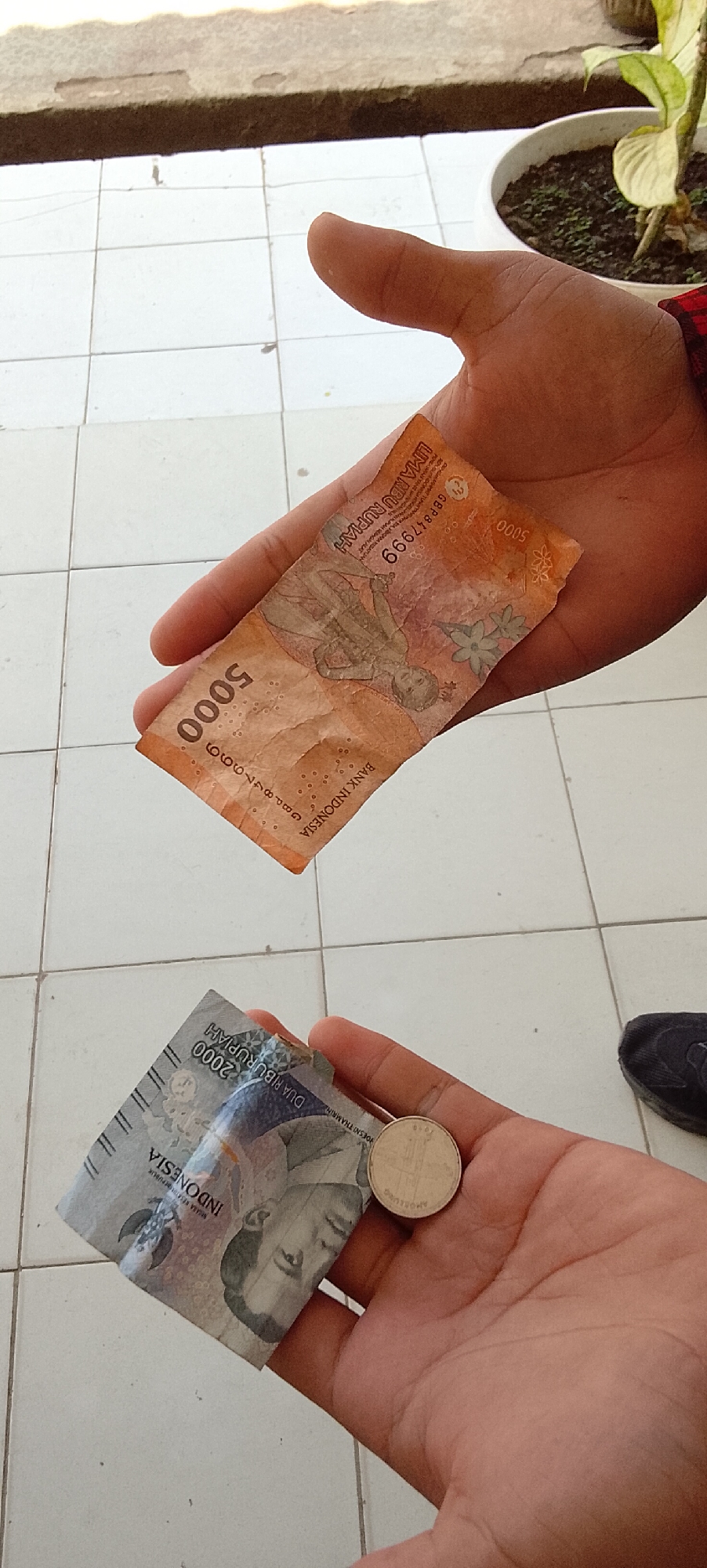
In Jepara, Indonesia, a person's hands are holding two Indonesian Rupiah banknotes and one coin. The top banknote is orange and appears to be a 5,000 Rupiah note, with the number "5000" prominently displayed and the text "BANK INDONESIA" visible. The lower banknote is blue and shows "2000" and "INDONESIA" and "DUA RIBU RUPIAH." A silver coin, possibly of a smaller denomination, is placed on the lower banknote. The hands are positioned over a tiled floor. In the background, a potted plant with green leaves is visible. The scene appears to be outdoors.
Jepara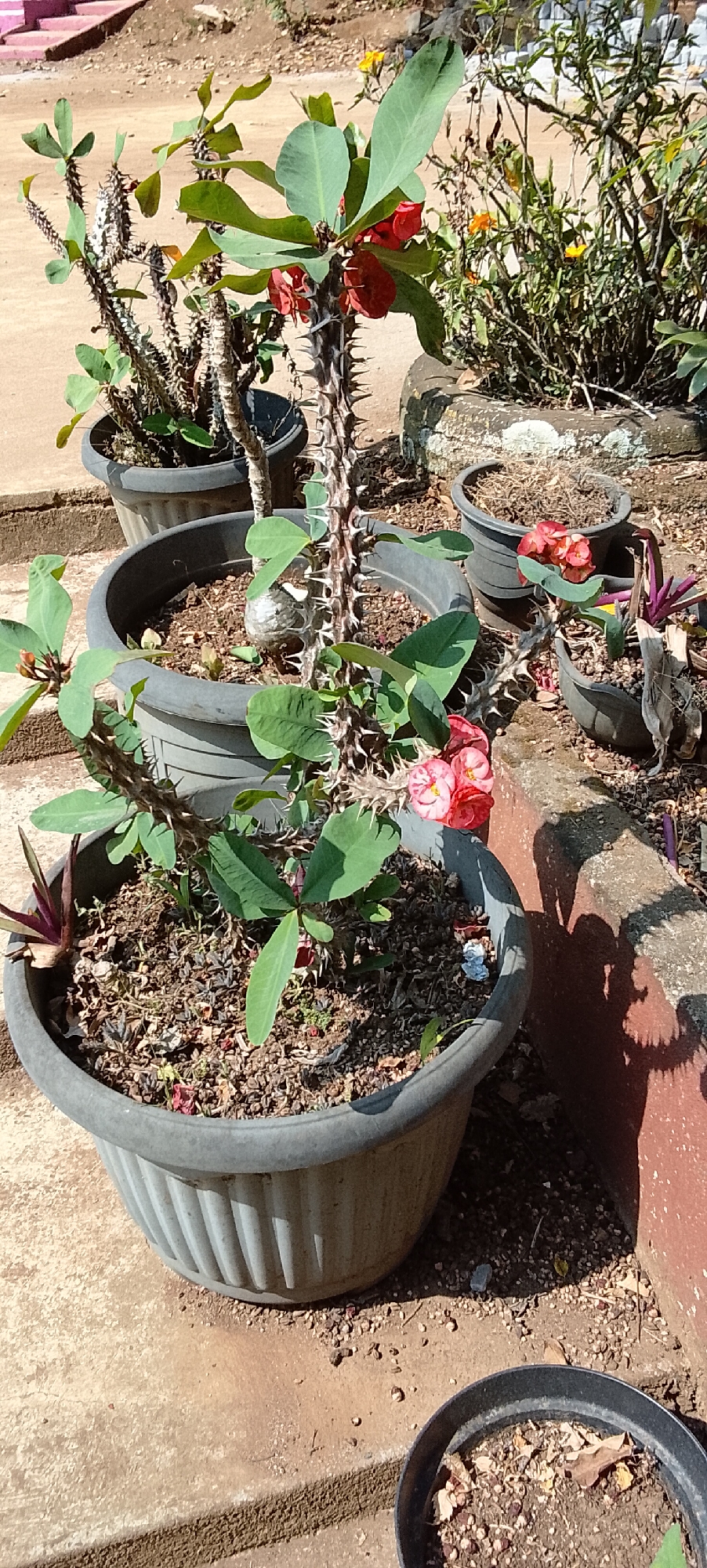
This is a medium-shot, eye-level, outdoor photograph taken on a sunny day, likely in a garden or courtyard in Jepara, Indonesia. The scene features several potted plants, with a prominent thorny succulent plant with red flowers in the foreground, center. The succulent has thick, spiny stems and green leaves. In front of it, a large, grey, fluted plastic pot contains the plant. To the left and behind it, another similar grey pot holds a smaller, less developed thorny plant. Further back and to the right, several other pots of varying sizes are visible, some containing dry soil and dead vegetation, and one with a few small orange flowers. The plants are situated on a rough, concrete-like surface that appears to be a pathway or patio. The background consists of a textured, reddish-brown wall to the right, casting a distinct shadow on the ground, and a blurry sandy area with some vegetation behind the pots. The overall impression is one of a well-maintained, but perhaps somewhat aged, outdoor garden space.
Jepara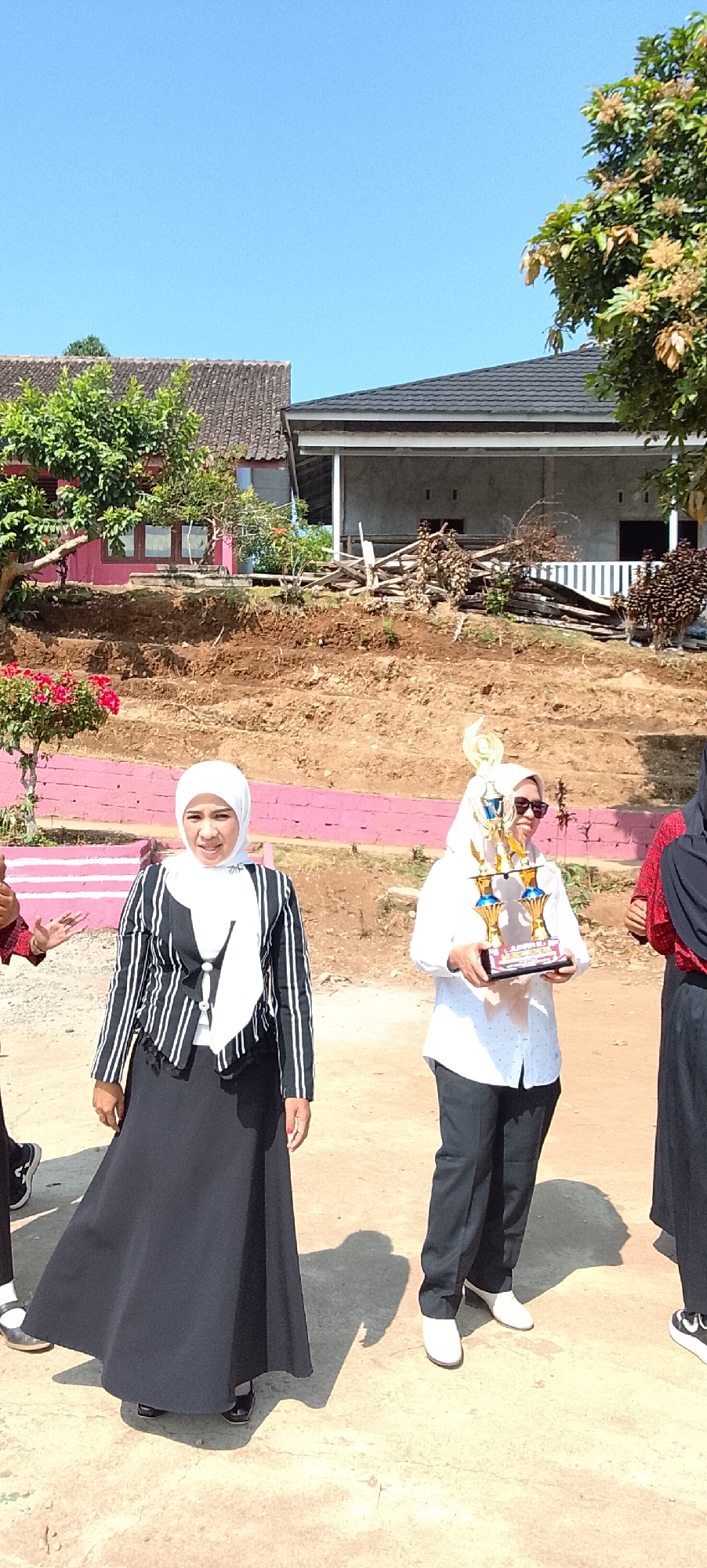
A group of women are standing outdoors in front of a house and a hill. The woman on the left is wearing a black and white striped jacket and a long black skirt. She is smiling and looking at the camera. The woman in the center is wearing a white shirt, black pants, and a white hijab. She is holding a trophy and smiling. The woman on the right is wearing a black hijab and a red and black patterned shirt. She is partially visible. In the background, there is a house with a pink facade and a grey roof. A hill behind the house is covered in dirt and some debris. The sky is clear and blue. The image appears to have been taken during the day. The location is not Jepara, Indonesia.
Jepara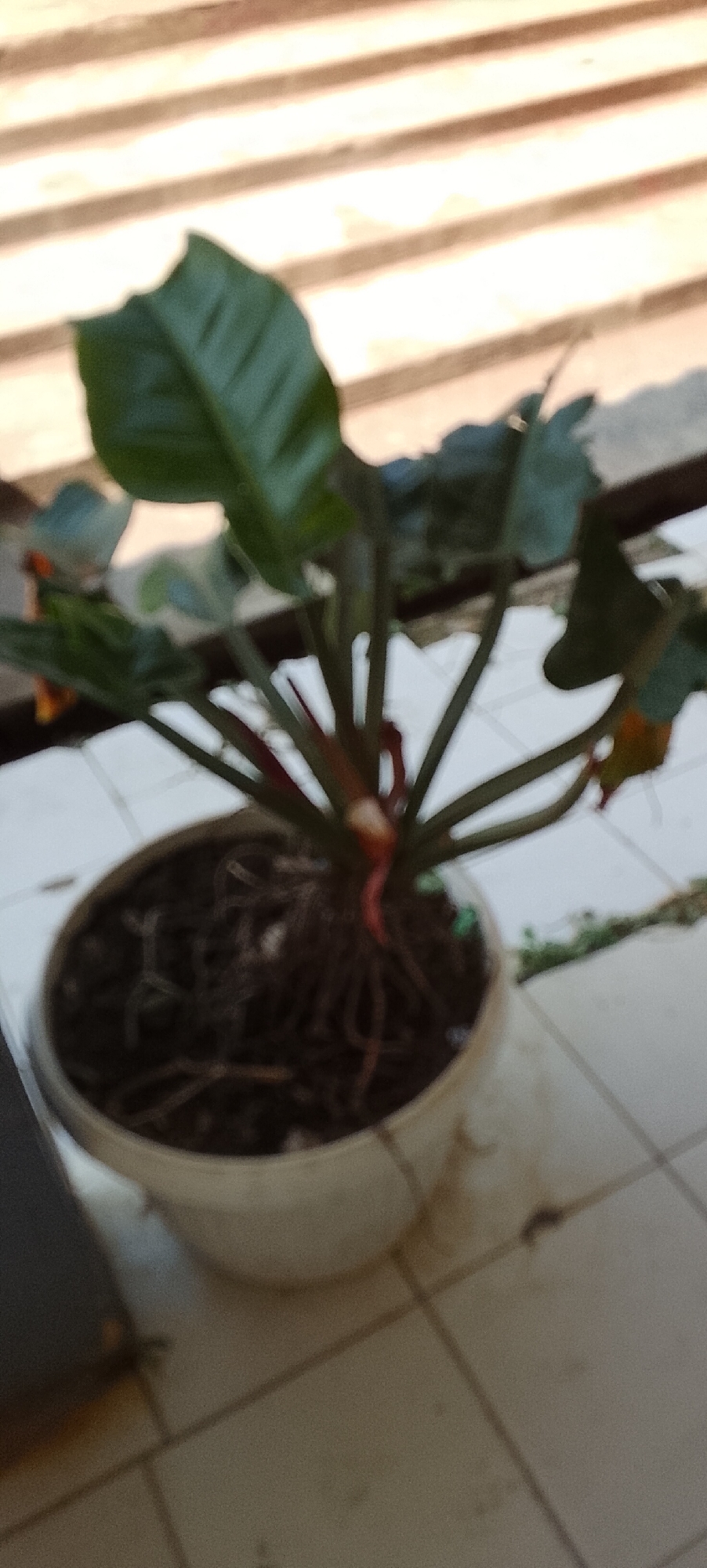
An out-of-focus, medium shot captures a potted plant in a white plastic pot. The plant has large, dark green leaves and red stems, with visible roots near the surface of the soil. The pot rests on a tiled surface, possibly a floor or patio, with a background of horizontal wooden slats. The lighting suggests it is daytime. The scene appears to be an outdoor setting in Jepara, Indonesia, likely a residential area. No people are present.
Jepara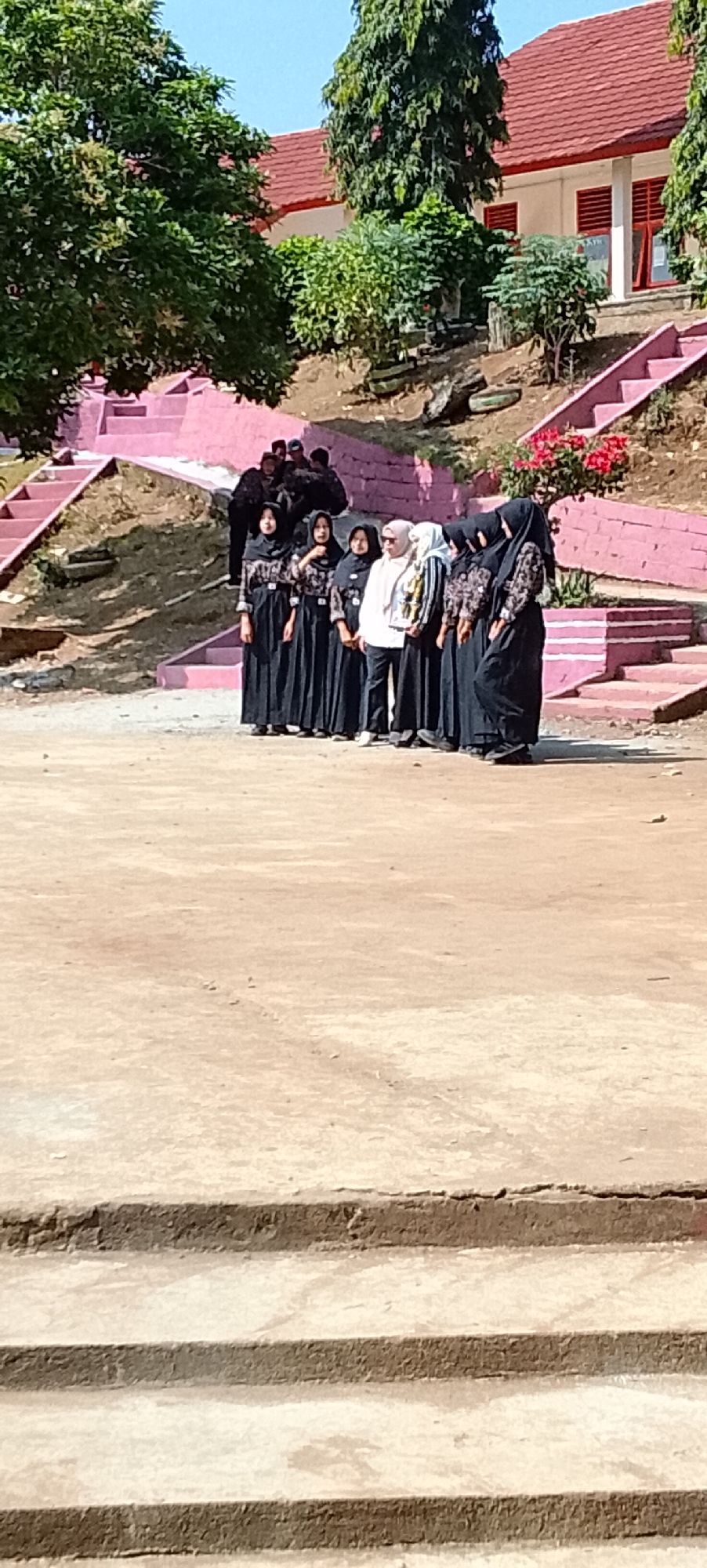
The image shows a group of people, predominantly women wearing hijabs and dark, patterned clothing, standing in what appears to be an outdoor school or public space. They are arranged in a line, facing slightly to the right. Behind them, there are pink stairs leading up to a building with a red roof. Trees and bushes are also visible in the background. The ground in front of the group is a dirt or concrete surface. The scene suggests a formal gathering or event taking place during daylight. The location is identified as Jepara, Indonesia, an area known for its educational institutions and public spaces.
Jepara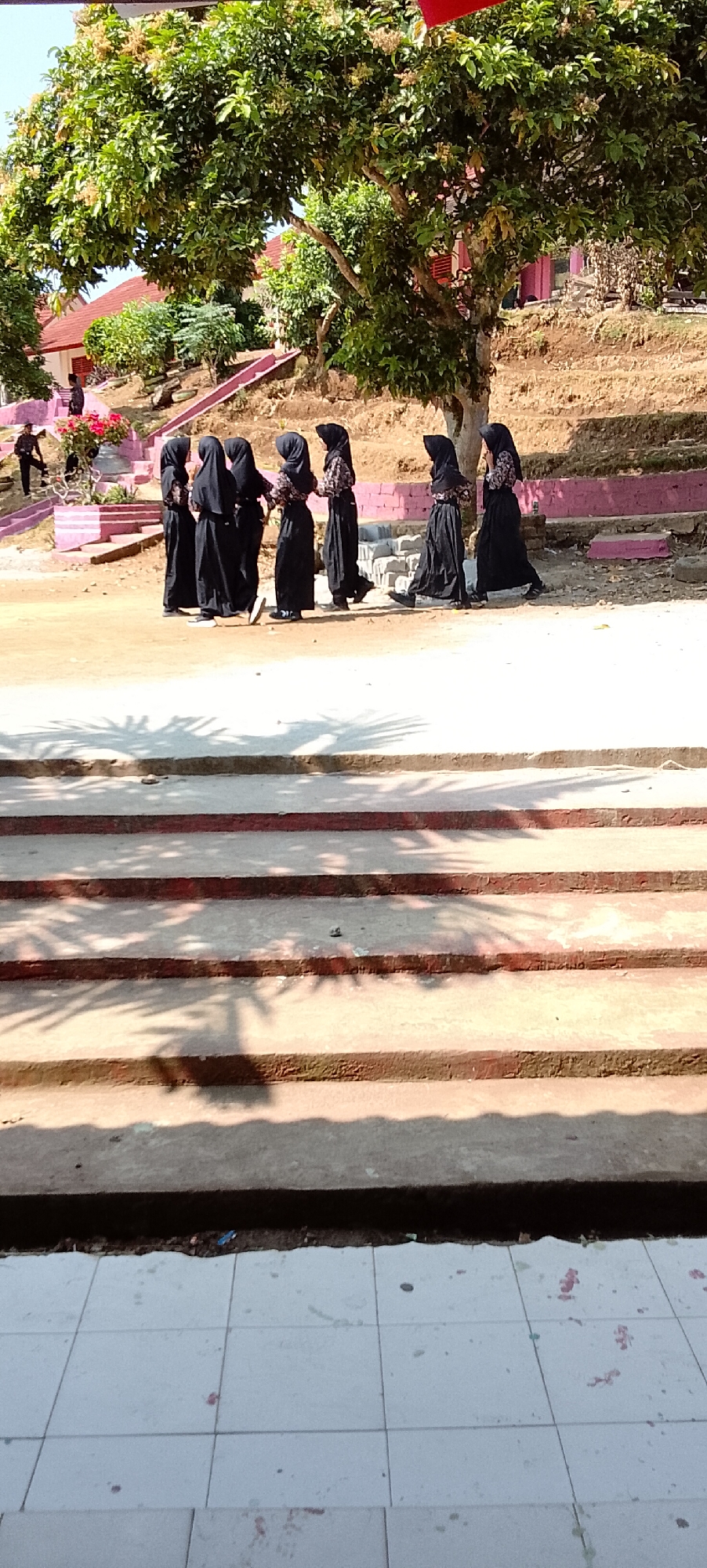
A group of six young girls wearing black hijabs and black dresses are walking in a line on a dirt path. The girls are positioned in the middle ground of the image. Behind them, there are buildings with red roofs and a large tree with green foliage. In the foreground, there are concrete steps with red trim. The overall environment appears to be an outdoor school or religious institution setting. The image was captured in Jepara, Indonesia.
Jepara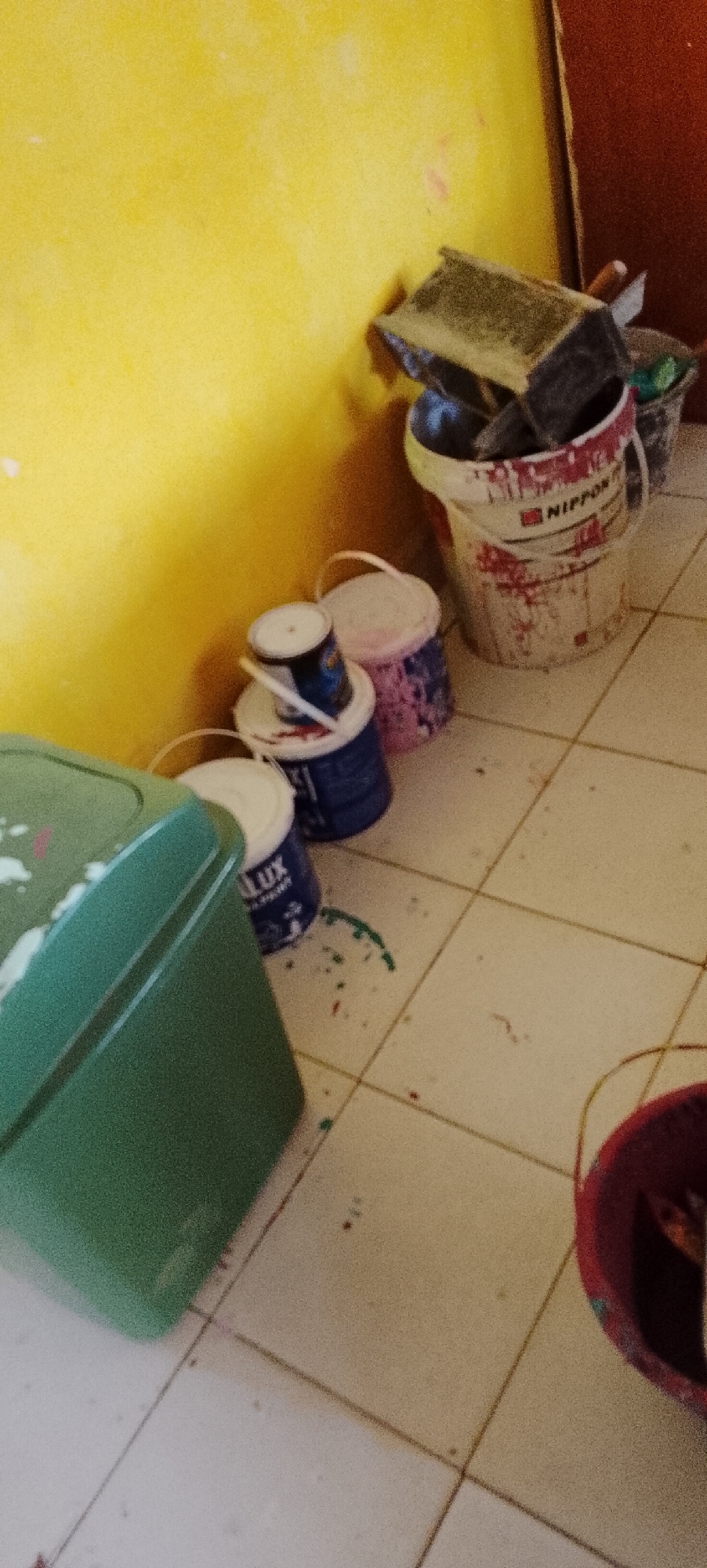
The image depicts a corner of a room with a bright yellow wall and a tiled floor. Several buckets and paint cans are arranged near the wall. In the foreground, a large green plastic container is partially visible on the left. To its right, there are several smaller paint buckets. One is blue with white lettering that appears to say "LUX". Another is pink and patterned. A larger white bucket with red markings and the brand name "NIPPON" is further back, containing some tools like trowels. Splatters of paint, in red and green, are visible on the floor. The overall scene suggests a space where painting or renovation has recently taken place or is in progress. The image was taken in Jepara, Indonesia.
Jepara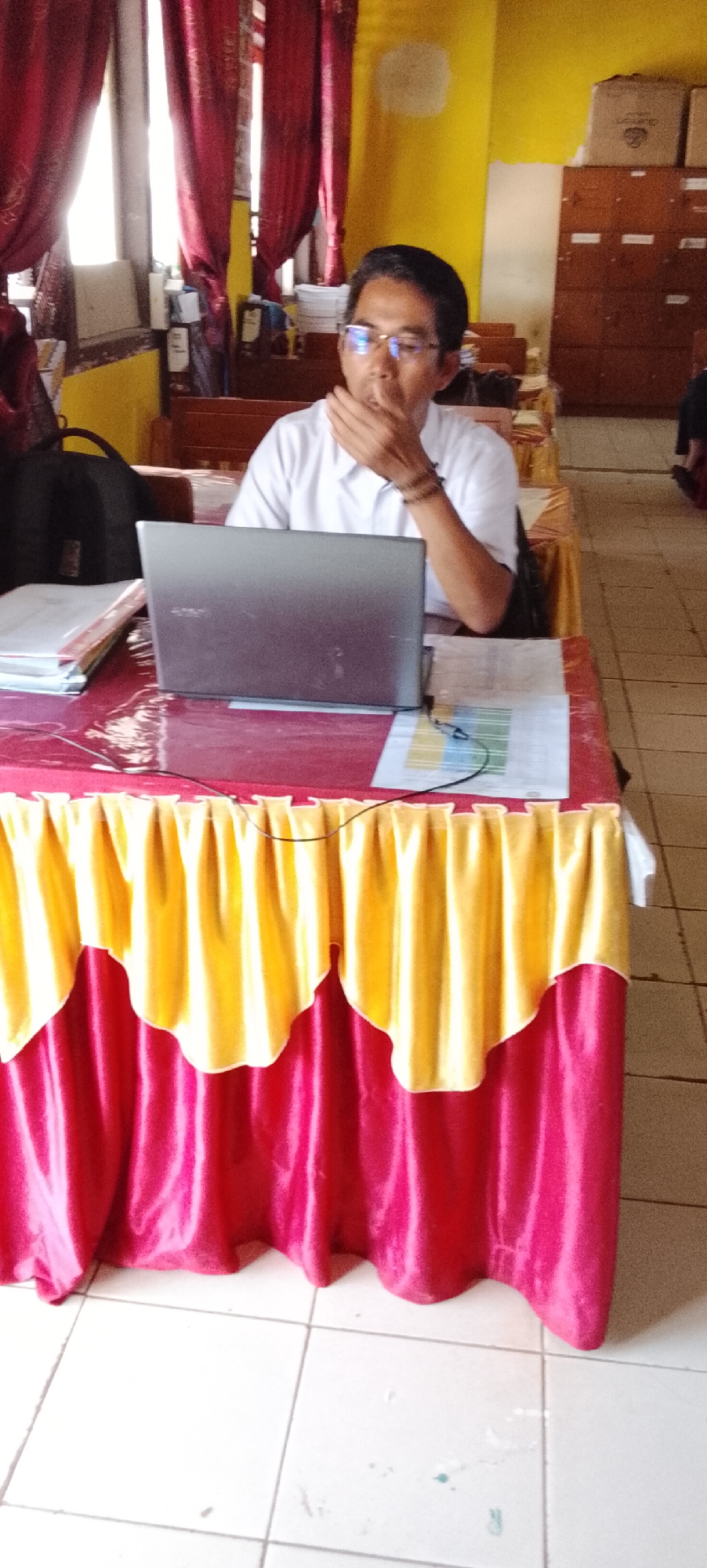
A man wearing glasses and a white collared shirt is seated at a table in what appears to be a classroom or meeting room. He is looking down at a laptop computer in front of him, with his hand covering his mouth. The table is draped with a red cloth that has a yellow valance along the front. Behind the man, there are shelves filled with boxes and papers, and red curtains hang on the wall. The floor is tiled. The scene suggests an educational or professional setting.
Jepara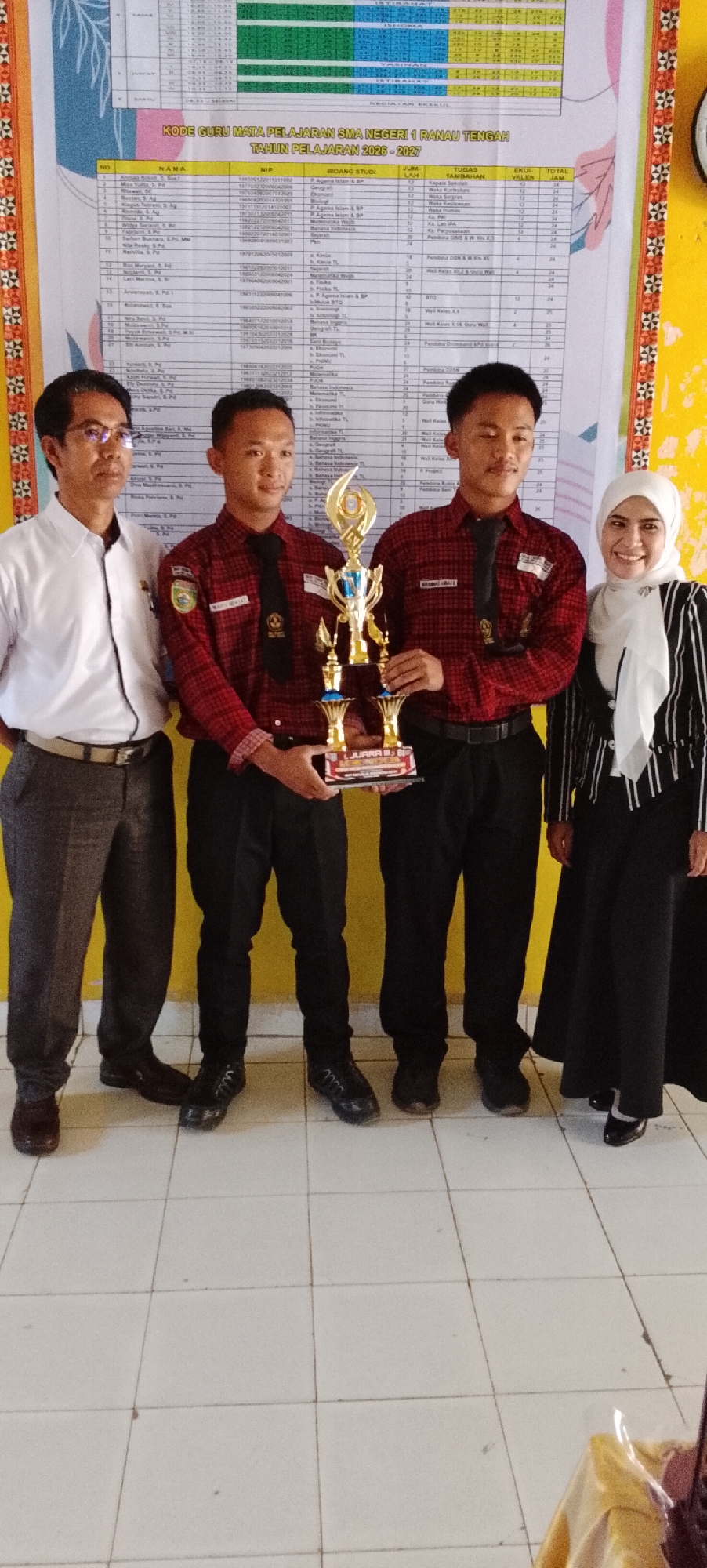
A group of four individuals, two young men and two adults, are posing for a photograph in front of a yellow wall adorned with a large, colorful banner that contains text and charts. The banner appears to be a school-related document, possibly a list of teachers, subjects, or awards. On the left, a man in his late 40s or early 50s, wearing glasses, a white collared shirt, and grey trousers, stands with his hands clasped in front of him. In the center, two young men, likely students, stand side-by-side. They are both wearing red and black checkered shirts with ties and black trousers. The young man on the left is holding a large, ornate trophy with a gold figure at the top. The trophy has a red base with writing on it. The young man on the right is also holding the trophy, his arm around the other young man's shoulder. On the far right, a woman wearing a white hijab and a black and white striped jacket over a black dress stands with a warm smile. The floor is tiled with white square tiles. The lighting suggests an indoor setting. The banner behind them is predominantly yellow and green, with vertical columns of text and numbers. The overall scene depicts a celebratory moment, likely an award ceremony or recognition event. The location is identified as SMA Negeri 1 Ranau Tengah, which is in the city of Jepara, Indonesia.
Jepara
The video shows a schoolyard on a sunny day. In the foreground, there are several potted plants and a tiled walkway. In the background, there is a large, sandy schoolyard with a flagpole and a building with red roofs. Several students in dark attire are walking in the schoolyard. One student appears to be wearing a yellow shirt under a dark garment. The students are spread out and do not seem to be interacting with each other. The overall scene is calm and peaceful.
Jepara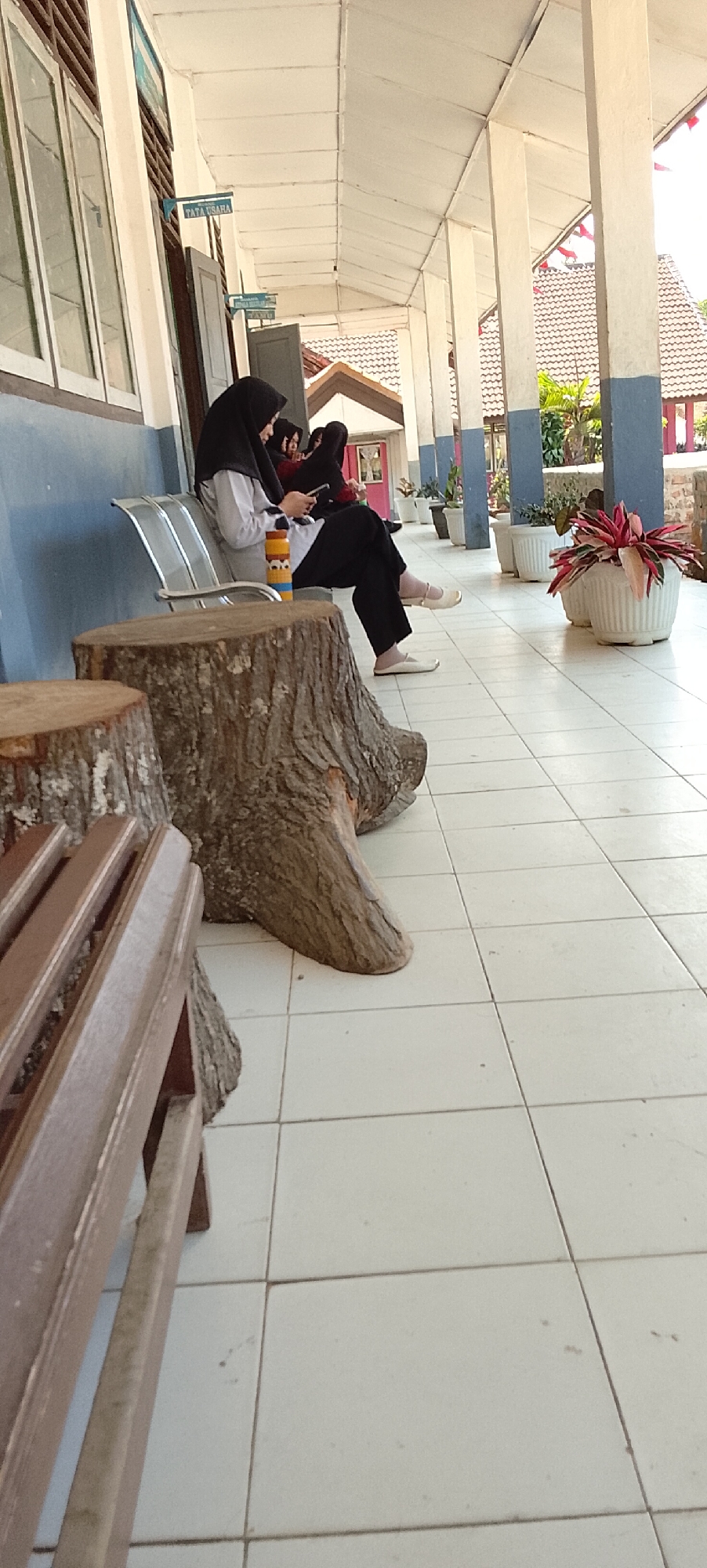
The image captures a scene on a tiled veranda, possibly at an educational institution in Jepara, Indonesia, indicated by a sign that reads "TATA USAHA." Three individuals, two women and one girl, are seated on a metallic bench. The woman in the foreground, wearing a black hijab and light-colored clothing, is looking down at her phone. Beside her, another woman, also in a black hijab, is partially visible. A young girl, seated at the far end of the bench, is partially obscured and appears to be looking in the same direction as the first woman. In front of the bench are two large, rough-hewn tree stumps, serving as makeshift seats or decorative elements. The veranda is supported by white pillars with blue accents at the base, and the ceiling is white and paneled. The tiled floor is light-colored and grid-patterned. Further down the veranda, several white planters contain lush green and red foliage. In the background, the roof of a building with a reddish-brown tile pattern is visible, along with the suggestion of trees and other vegetation. The overall atmosphere suggests a relaxed moment during the daytime, possibly within a school or office complex.
Jepara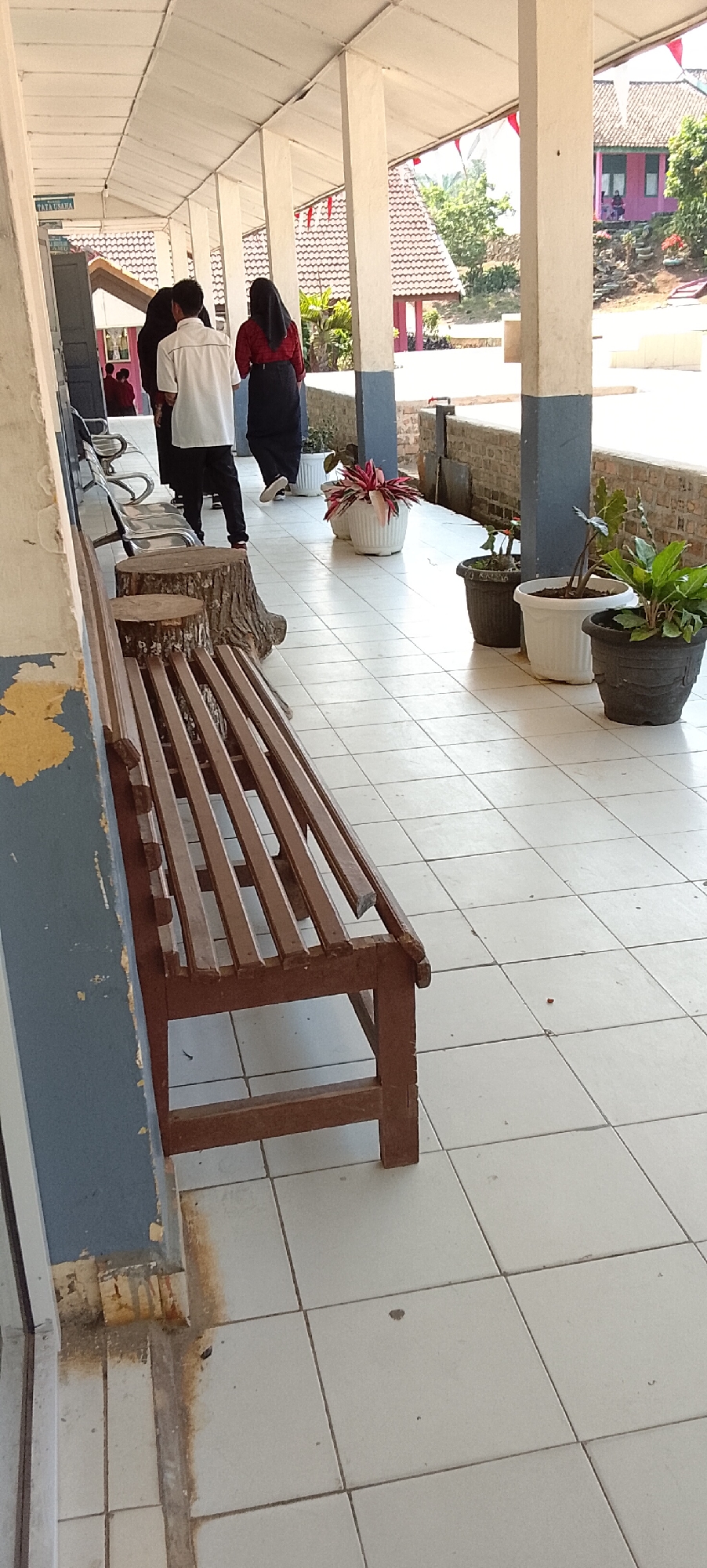
The image depicts a hallway with tiled flooring, featuring a wooden bench in the foreground and several potted plants lining the wall. Three individuals are walking away from the camera down the hallway. The architecture suggests a public building, possibly a school or administrative office, with a red-tiled roof visible in the background. The context of Jepara, Indonesia, implies a tropical climate, which is consistent with the lush greenery seen outside. The overall scene is mundane and captures a moment of everyday life in an outdoor covered walkway.
Jepara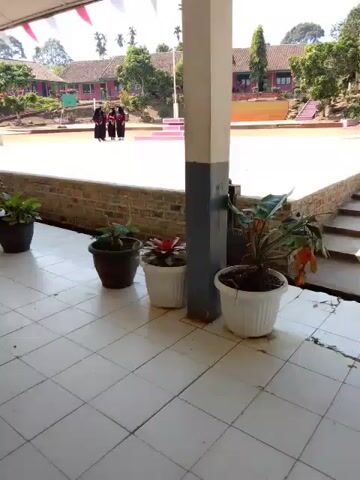
The video shows a view from under a covered walkway with tiled flooring. Several potted plants are lined up along the walkway. In the background, there is an open area, possibly a schoolyard, with a stage or elevated platform. Three individuals, appearing to be young women or girls dressed in dark clothing, are standing on the elevated platform. The environment suggests a daytime setting with clear weather, as indicated by the sunlight. The buildings in the background appear to be school structures.
Jepara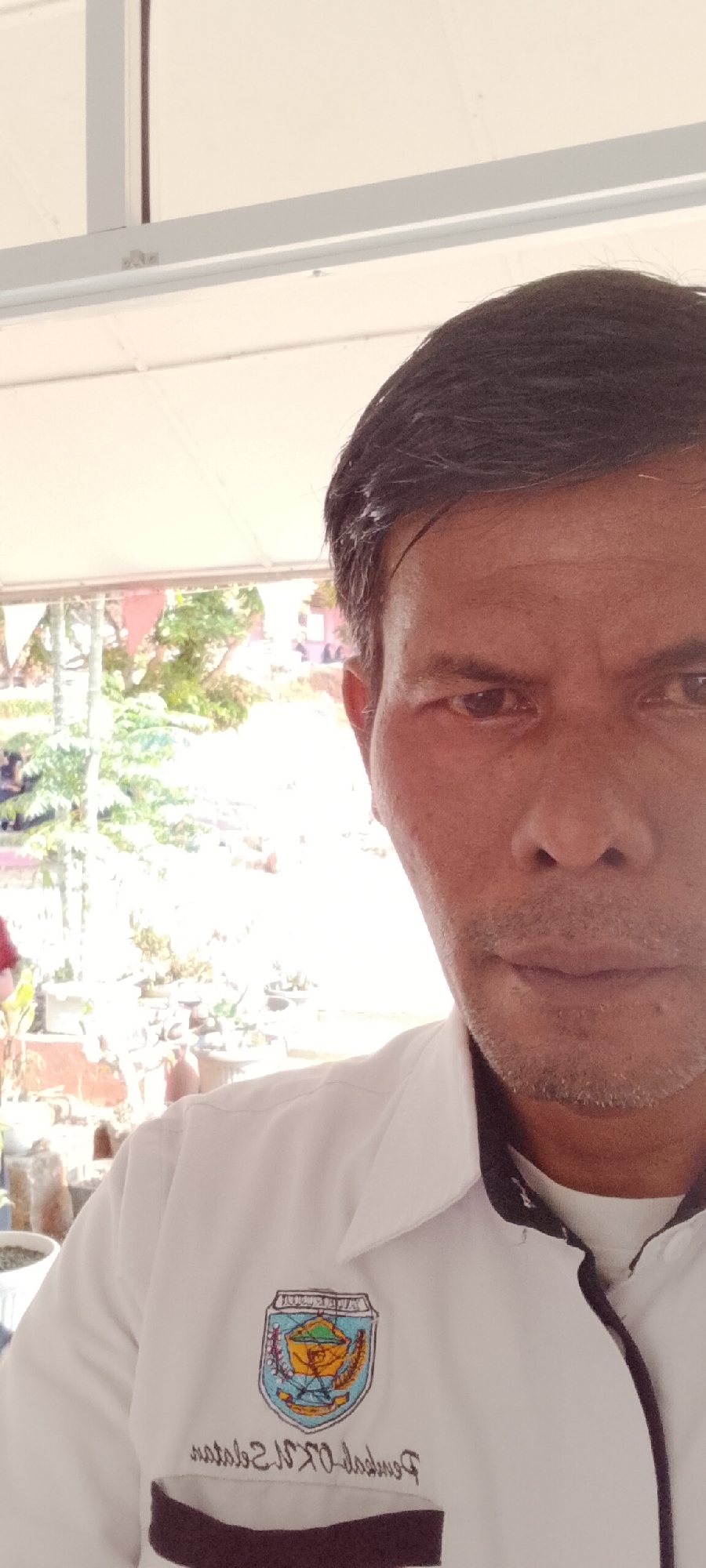
A man's face is captured in a close-up, selfie-style photograph. He has dark hair and is looking directly at the camera with a neutral expression. He is wearing a white collared shirt with a dark trim and a patch on the left side of his chest. The patch is a coat of arms with intricate designs and text below it. The background is blurred, suggesting an outdoor setting with greenery and some structures. The lighting is bright, indicating it may be daytime. The overall scene appears to be casual and personal. There is no visible evidence to indicate this image was taken in the city of Jepara, Indonesia.
Jepara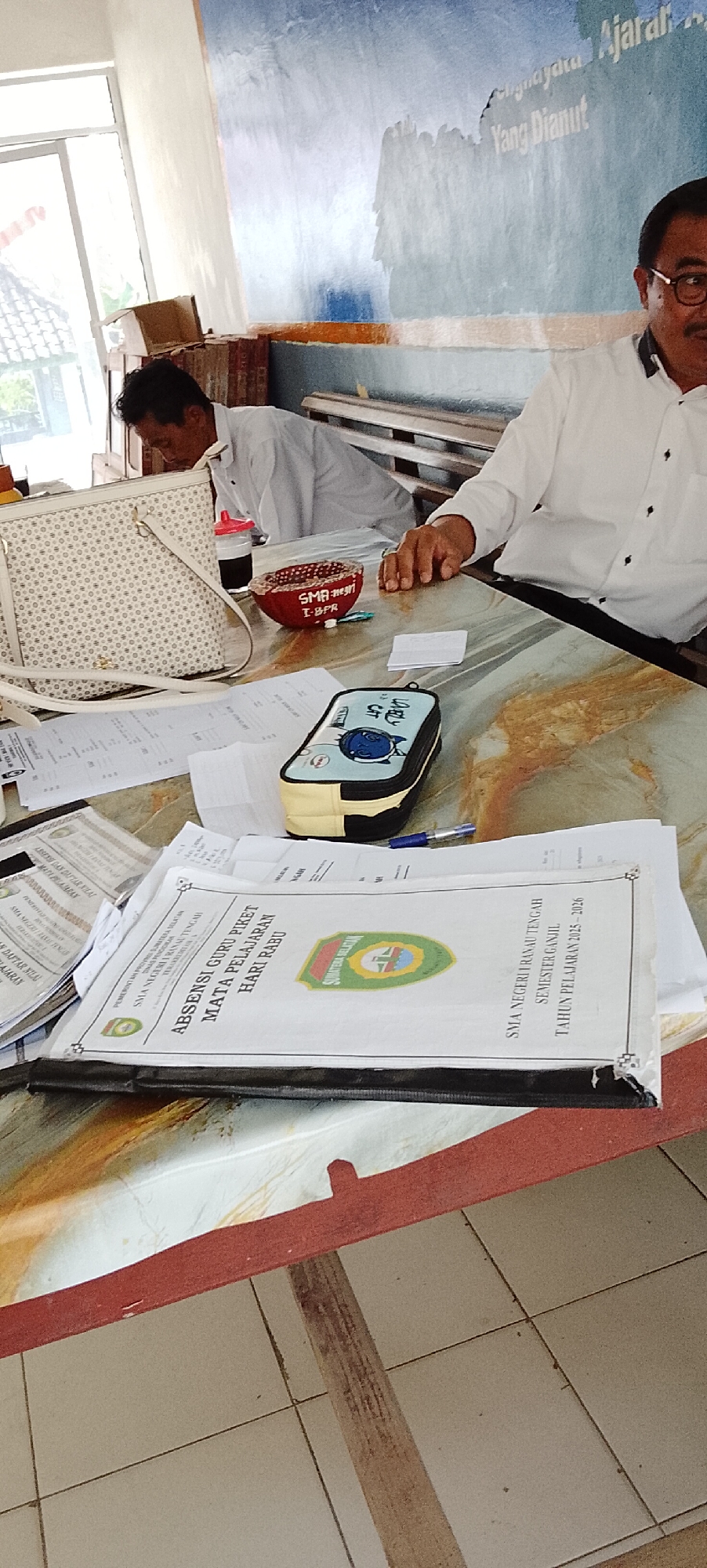
The image shows two men sitting at a table, likely in a school or office setting. One man, wearing glasses and a white collared shirt, is seated on the right, looking towards the camera. The other man, wearing a white shirt, is seated on the left, looking down at the table. On the table, there are several documents, including a binder labeled "ABSENSI GURU PIKET MATA PELAJARAN HARI RABU" which translates to "Teacher's Duty Roster Subject Wednesday". There's also a pencil case with a cartoon character and a red bowl with writing that appears to be "SMA NEGERI I-BPR". A white patterned bag is also visible on the table. The background features a wall with a blue and white mural and a wooden bench. The overall environment suggests an indoor workspace. The image does not contain enough information to determine its specific location within Jepara, Indonesia.
Jepara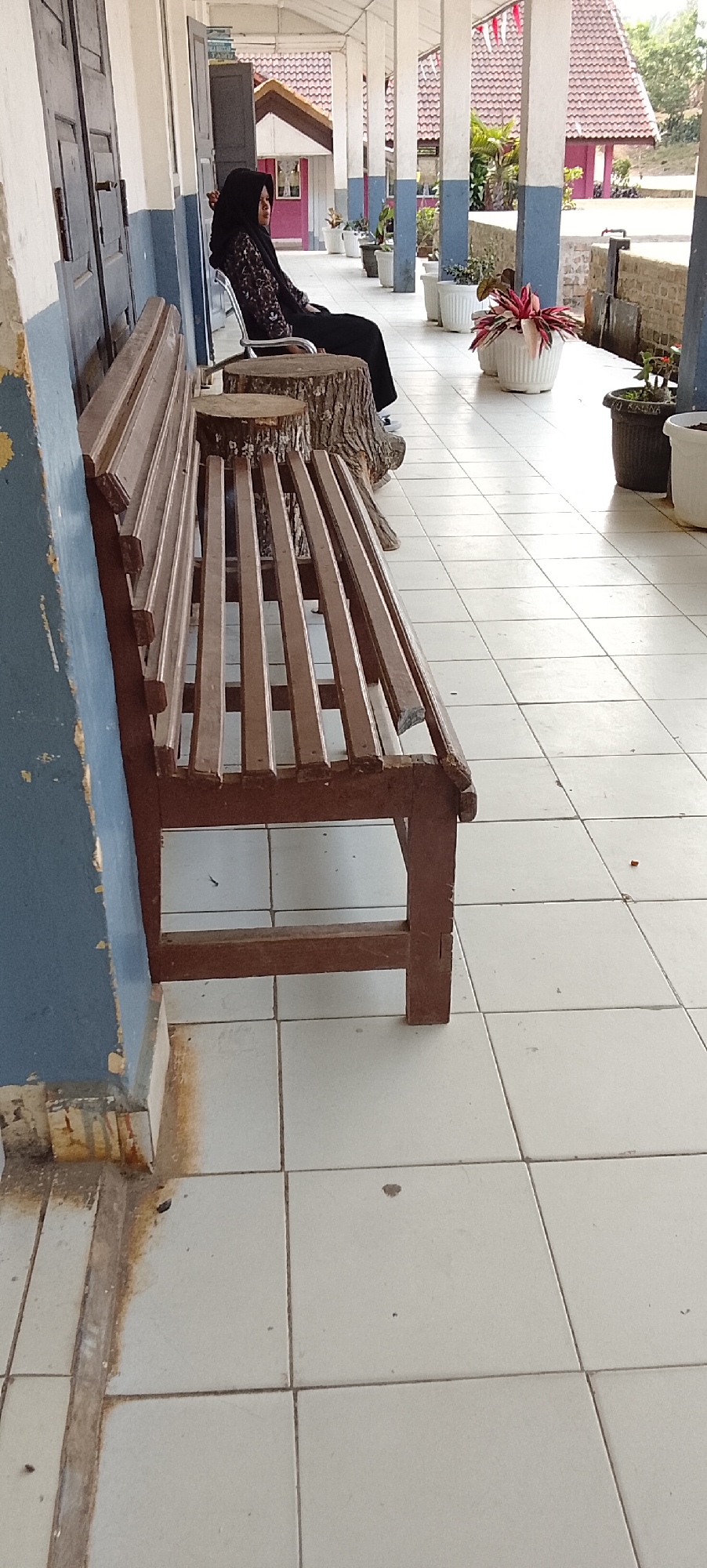
The image captures a view of a tiled walkway with a wooden bench in the foreground. A woman wearing a black hijab and a patterned dress sits on the bench, facing to the right. Next to her on the bench are two tree stumps, one larger than the other. The walkway is lined with white columns and potted plants. In the background, buildings with red tiled roofs are visible. The scene appears to be an outdoor area of a public building, possibly a school or community center, in Jepara, Indonesia, given the architectural style and vegetation. The lighting suggests it is daytime, likely morning or afternoon, with natural sunlight casting shadows. The overall impression is one of a quiet, public space.
Jepara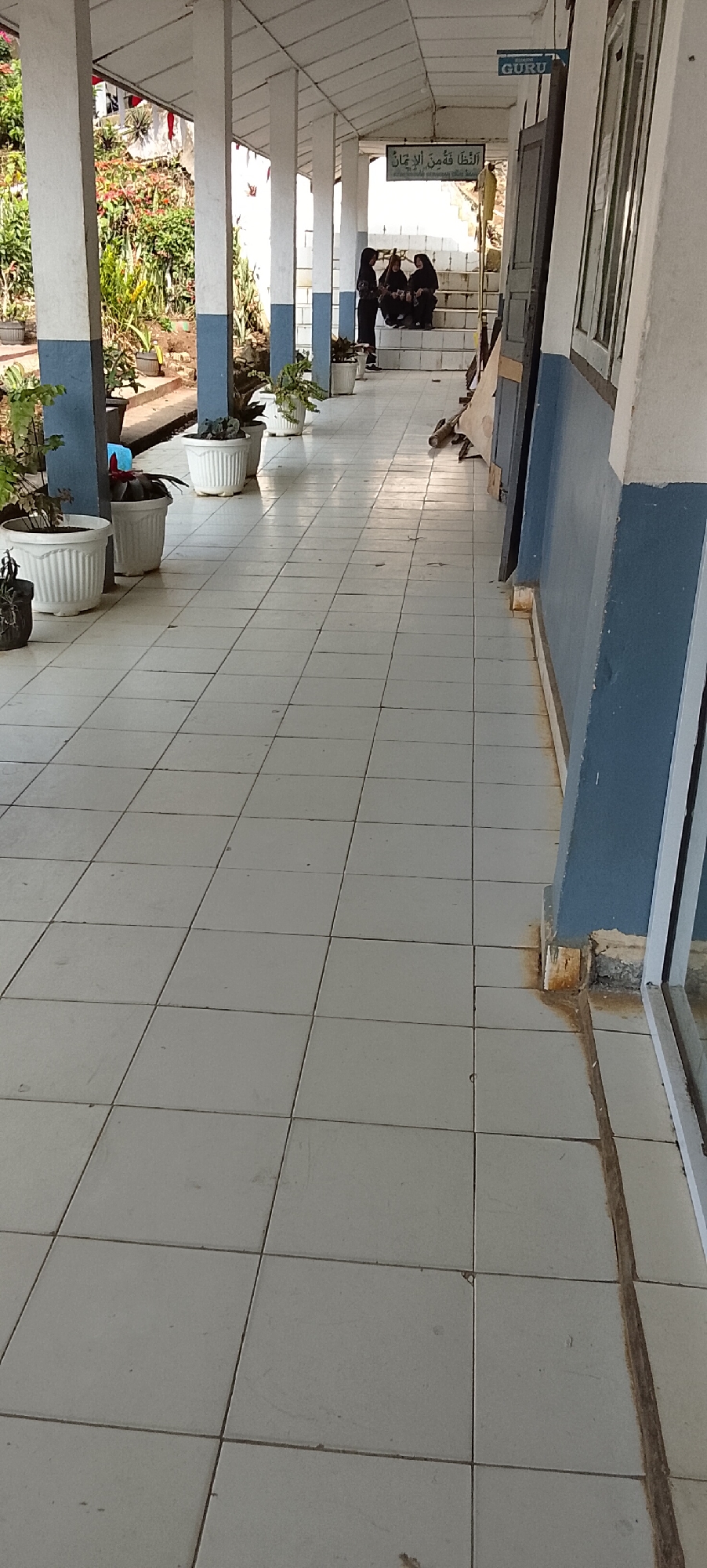
The image shows a covered walkway with white tiled flooring in Jepara, Indonesia. Along the left side of the walkway, several white planters contain green plants. On the right side, a blue and white wall runs along the length of the walkway. Towards the back of the walkway, a set of stairs leads up to a doorway. Three individuals, two women wearing hijabs and one person in a black garment, are seated on the stairs. A sign with Arabic text is visible above the doorway. Another sign with the word "GURU" is mounted on the ceiling near the doorway. The walkway is illuminated by natural light filtering in from the open side.
Jepara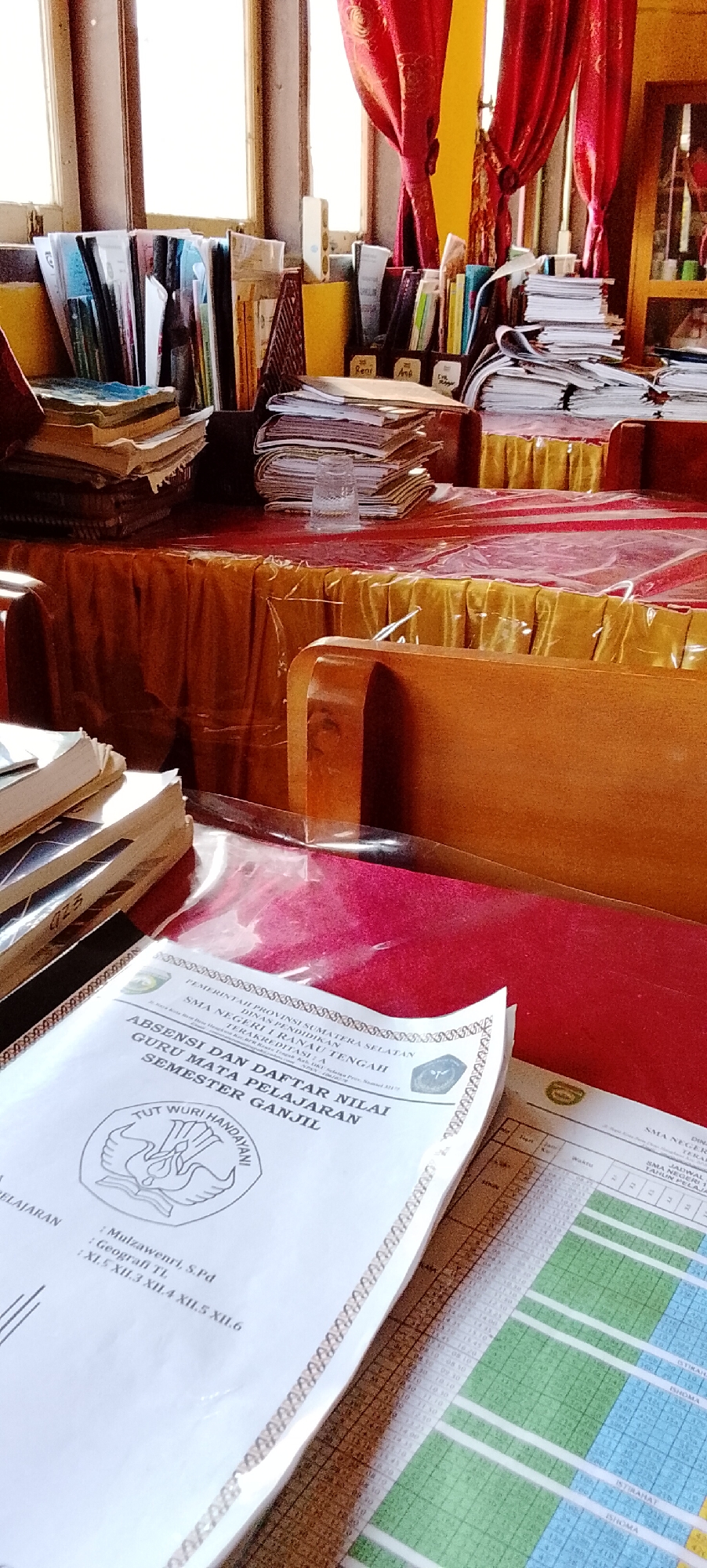
This is a close-up, slightly angled, eye-level shot of a desk or table surface filled with educational materials and furniture. The dominant colors are the warm tones of wood, the deep red of the table cloth, and the white and yellow of papers and curtains. The scene appears to be indoors, likely in an educational institution, given the presence of books, binders, and documents with school-related headings. In the foreground, a white document with "ABSENSI DAN DAFTAR NILAI SEMESTER GANJIL" (Attendance and Grade List, Odd Semester) is prominently displayed, along with the "TUT WURI HANDAYANI" logo, a symbol of Indonesian education. Below this, there are handwritten notes indicating a teacher's name ("Mulzawanri, S.Pd") and subjects ("Geografi TL", "XI.5, XII.3, XII.4, XII.5, XII.6"). To the right of this document, a portion of a timetable or grading sheet is visible, featuring a grid of green and white cells with handwritten entries. The middle ground reveals stacks of books and papers on a red tablecloth that covers the table. A clear glass with some liquid sits atop one stack of papers. Further back, a wooden desk or partition is visible, with more stacks of documents and books arranged on it. The background features a window with wooden frames and red curtains, suggesting natural light is entering the room. The overall impression is one of an organized, yet busy, workspace. The image does not provide specific details or visual cues that would allow for the identification of the city of Jepara, Indonesia.
Jepara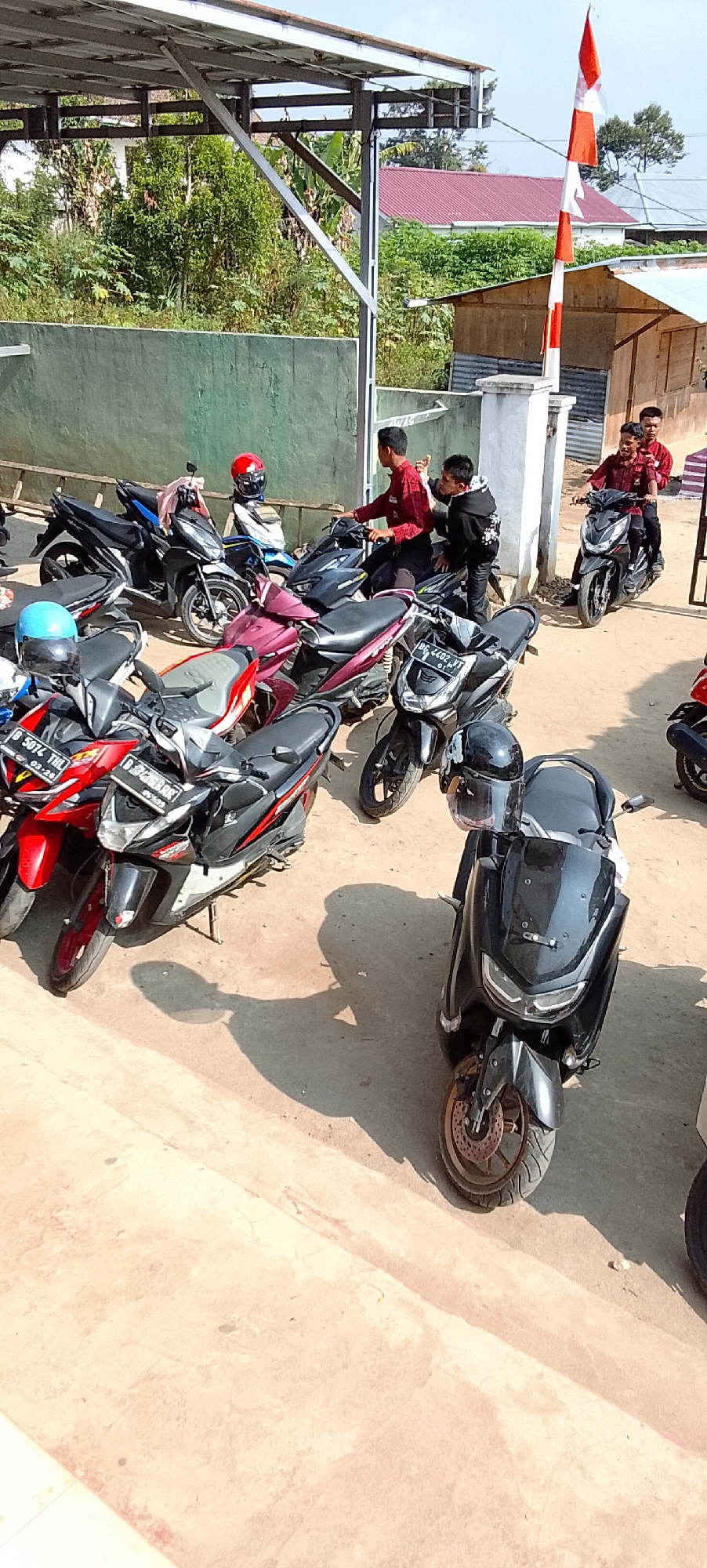
This is a medium-angle, eye-level shot of a collection of parked scooters and motorcycles outside a building in Jepara, Indonesia. The scene appears to be a sunny day, with strong shadows cast on the light-colored ground. Several people are present, some sitting on the scooters, and others standing. The subjects are predominantly young males, dressed in casual clothing, with some wearing red shirts or jackets. In the foreground, a black scooter is parked, with a black helmet resting on its handlebars. To its left, a red and black scooter is visible, followed by a dark red scooter and a black and blue scooter. Several other scooters are parked behind these, creating a dense arrangement. In the mid-ground, a group of young men are gathered. One man in a red shirt is sitting on a black scooter, gesturing with his hand. Another young man in a black hoodie is leaning on the same scooter, looking towards the man in red. Further to the right, two young men in red shirts are on another black scooter, with one appearing to be driving. In the background, a building with a corrugated metal roof is visible. A flagpole with an Indonesian flag is positioned to the right of the frame, with the red and white flag fluttering in the breeze. Lush green vegetation surrounds the building, with trees and bushes clearly discernible. The overall impression is of a casual gathering or a place where people are parking their vehicles before entering the building.
Jepara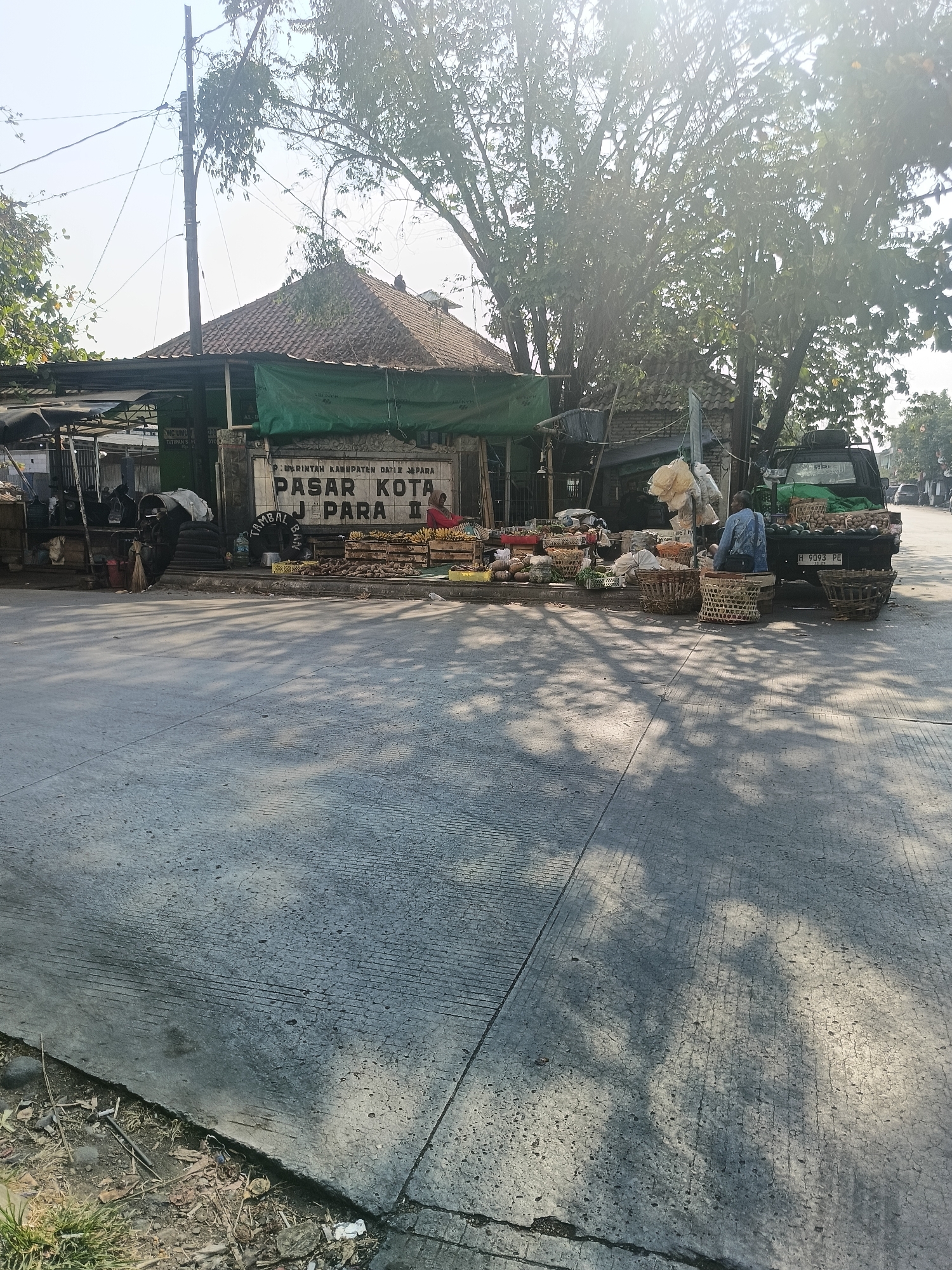
The image depicts an outdoor market scene in Jepara, Indonesia, specifically at "Pasar Kota Jepara II". In the foreground, a concrete road shows tire marks and the dappled shadows of trees. A roadside stall is visible, with a sign that reads "PEMERINTAH KABUPATEN DAERAH JEPARA" and "PASAR KOTA JEPARA II". The stall displays various goods, including baskets of produce like avocados and what appear to be ginger or turmeric roots, alongside other fruits and vegetables. A black pickup truck with license plate "H 9093 PE" is parked at the stall, also laden with goods. Two individuals are present: one person, likely a vendor, is seated next to the pickup truck, and another person is visible inside the stall area, possibly another vendor or customer. In the background, trees with dense foliage cast shadows, and a tiled-roof structure with a green tarp overhang serves as part of the market. Electrical poles and wires are also visible against a bright sky. The overall impression is that of a typical local market operating on the side of a road.
Jepara