Kafrat Nassar, Egypt
30 memories from Kafrat Nassar, Egypt
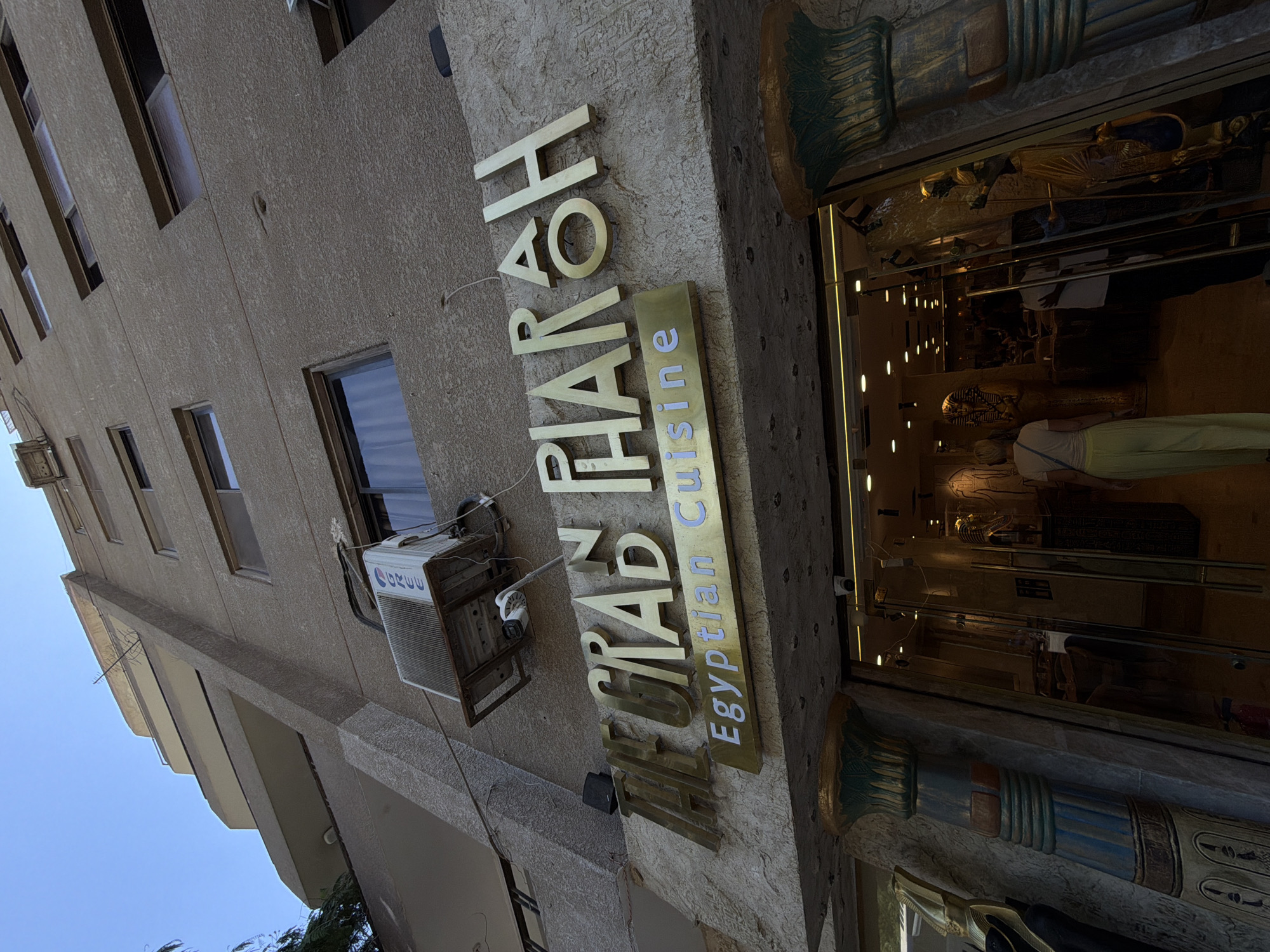
This is a tilted, eye-level, exterior shot of a building in Kafrat Nassar, Egypt. The building has a rough, textured, beige facade. There are multiple windows visible on the building, some with dark frames and others with lighter frames. An air conditioning unit is mounted on the side of the building. A prominent sign made of gold-colored, raised lettering is attached to the building. The sign reads "THE GRAND PHARAOH" vertically, with "Egyptian Cuisine" written horizontally on a gold plaque below. The letters are three-dimensional and appear to be metallic. To the right of the sign, an entrance to a building is visible. It is brightly lit from within and appears to be a store or restaurant, with display cases showcasing Egyptian-themed artifacts, including sarcophagi and statues. A person wearing a white top and light-colored pants is visible inside, looking at the displays. The entrance is flanked by decorative columns that have an Egyptian architectural style, featuring hieroglyphics and motifs. The lighting suggests it is daytime, with natural sunlight illuminating the scene. The sky is a clear blue, indicating fair weather. The overall impression is one of a commercial establishment with an ancient Egyptian theme.
Kafrat Nassar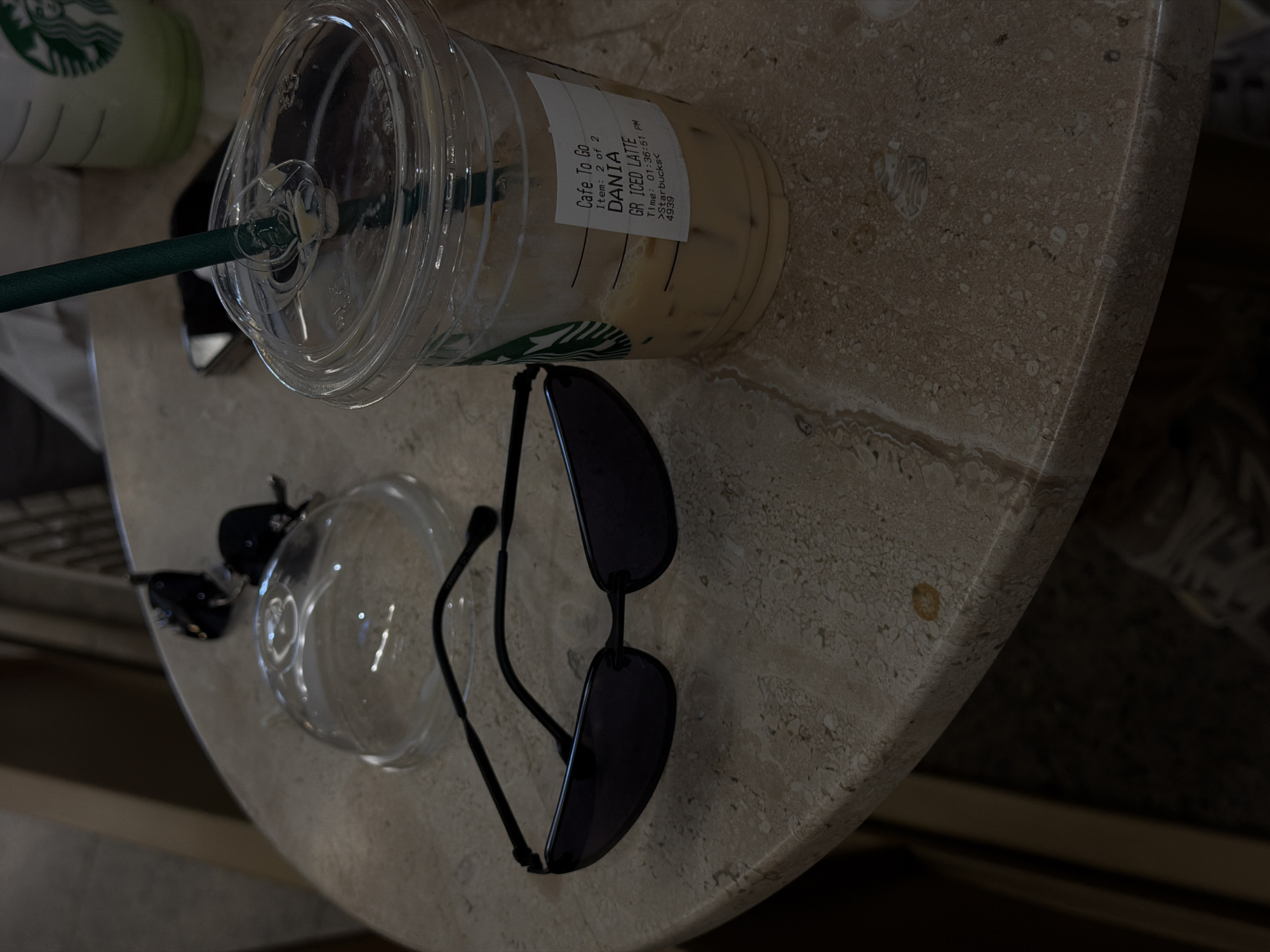
The image shows a close-up, rotated view of a Starbucks cup with an iced latte, a pair of sunglasses, and a small glass jar on a textured, speckled marble surface. The Starbucks cup is partially filled with an iced latte and has a green straw. A white sticker on the cup reads "Cafe To Go," "Item: 2 of 2," "DANIA," "GR ICED LATTE," "Time: 01:36:51 PM," and ">Starbucks< 4939." The sunglasses are black and lie next to the cup, with their lenses facing upwards. The glass jar is small and clear, positioned between the cup and the sunglasses. The marble surface appears to be part of a table. The lighting suggests it is daytime. The scene is indoors, on a table, possibly in a cafe or a home setting. There are no people visible in the image.
Kafrat Nassar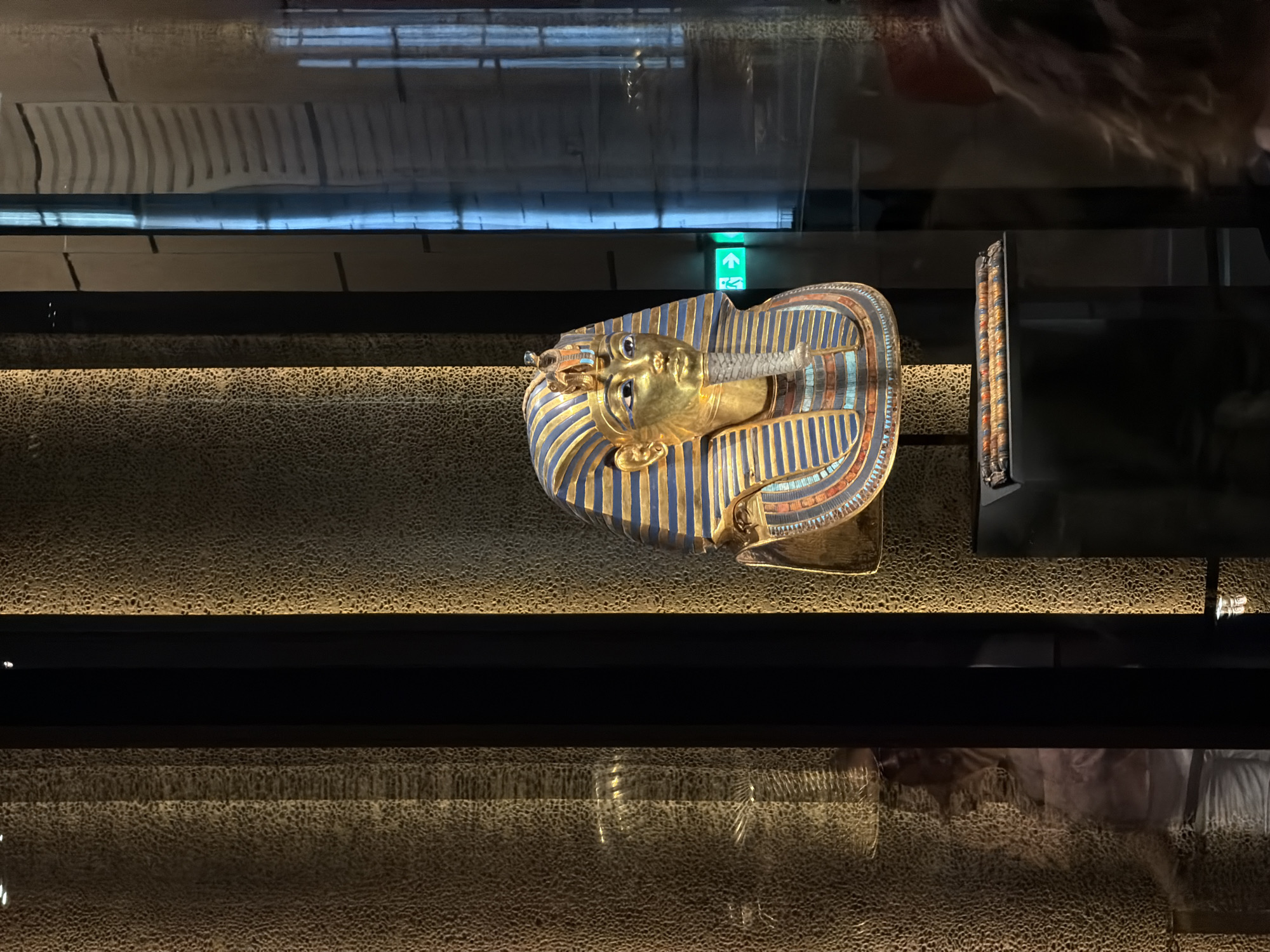
This media file captures a close-up view of an ancient Egyptian sarcophagus, likely a funerary mask of a pharaoh, displayed in a museum setting. The sarcophagus is predominantly gold, adorned with intricate blue and striped patterns, and features detailed facial features, including eyes and a headdress. The object is positioned on a textured, beige surface that is illuminated by warm, directional lighting, creating a spotlight effect. Behind the sarcophagus, a dark, reflective surface suggests a glass enclosure or display case, which also reflects ambient lighting and a distant green exit sign with an upward arrow. The background is dimly lit, with subtle horizontal lines that might indicate architectural elements or further display cases. The overall atmosphere is one of reverence and historical preservation, with the lighting designed to highlight the artifact. The image appears to be taken indoors, likely during daylight hours, given the artificial lighting. There are no explicit people visible as subjects, though reflections in the glass suggest the presence of observers. The location is identified as Kafrat Nassar, Egypt, implying this is an artifact from that region, displayed in a museum.
Kafrat Nassar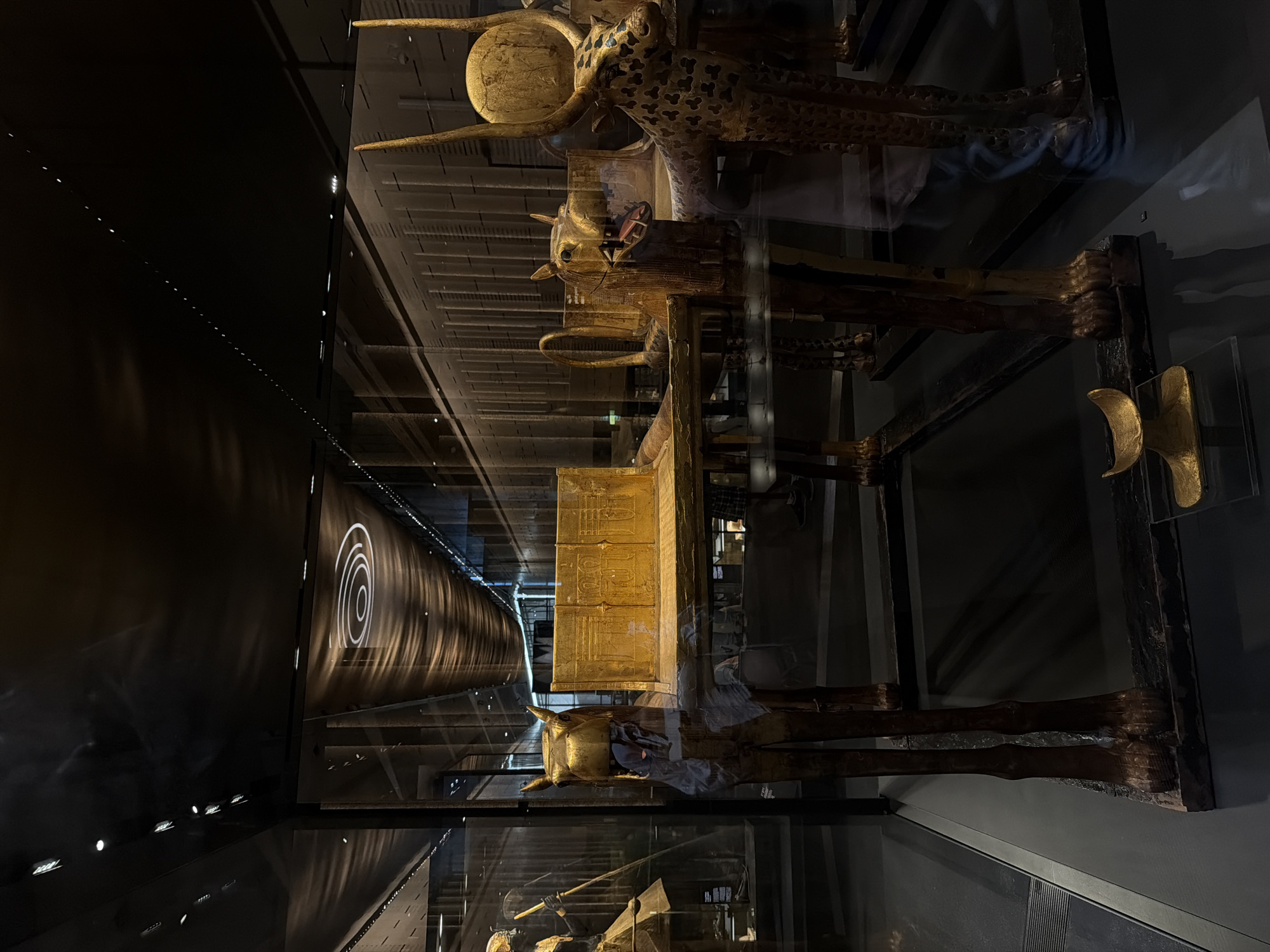
This image shows a display of ancient Egyptian artifacts, likely within a museum or exhibition. The primary subjects are several large, gilded wooden figures, some appearing to be sarcophagi or funerary statues, adorned with intricate carvings and patterns. One prominent object is a golden rectangular chest or coffin, decorated with hieroglyphs. Several figures have animalistic heads, including one with a jackal-like head and another that resembles a cat or lion. These figures are presented in a dimly lit environment, with spotlights highlighting the golden artifacts. The reflections on the glass display cases are visible, creating a layered effect. In the background, a long, dark corridor or exhibit hall is illuminated by a series of small, white lights running along the wall. Further into the distance, a large wall display features a series of concentric white circles, possibly representing a stylized sun or a target. The overall impression is one of reverence and preservation of historical treasures. The scene suggests a curated museum display designed to showcase the opulence and artistry of ancient Egyptian burial practices and beliefs. There is no discernible text in the image, and the time of day and weather are irrelevant given the indoor, controlled environment. The emotions evoked are likely awe and curiosity about the ancient civilization. The artifacts are positioned in a way that suggests a narrative or thematic arrangement within the exhibition space.
Kafrat Nassar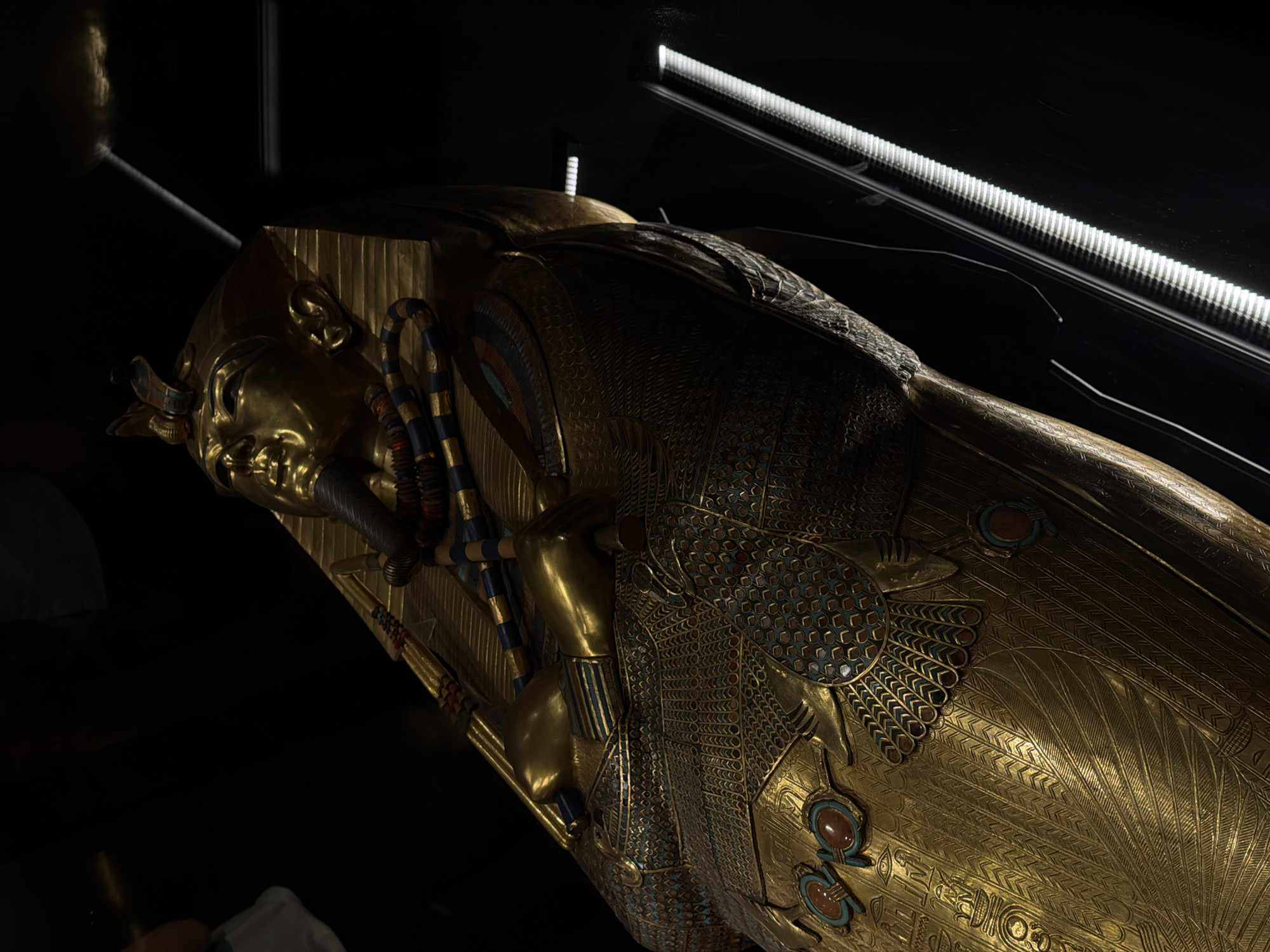
This media file showcases a sarcophagus, likely an ancient Egyptian artifact, made of highly polished gold. The sarcophagus is intricately decorated with detailed carvings and inlaid precious stones in shades of turquoise, red, and blue. A notable feature is the depiction of a human face on the lid, characteristic of pharaonic burial practices. The sarcophagus rests in a dimly lit display setting, with bright artificial lights illuminating it from above, creating dramatic highlights and shadows on the golden surface. The background is predominantly black, emphasizing the artifact. The specific context of Kafrat Nassar, Egypt, suggests this could be an exhibit at a museum or archaeological site in the region, possibly related to a significant discovery or historical figure. No text is visible in the image.
Kafrat Nassar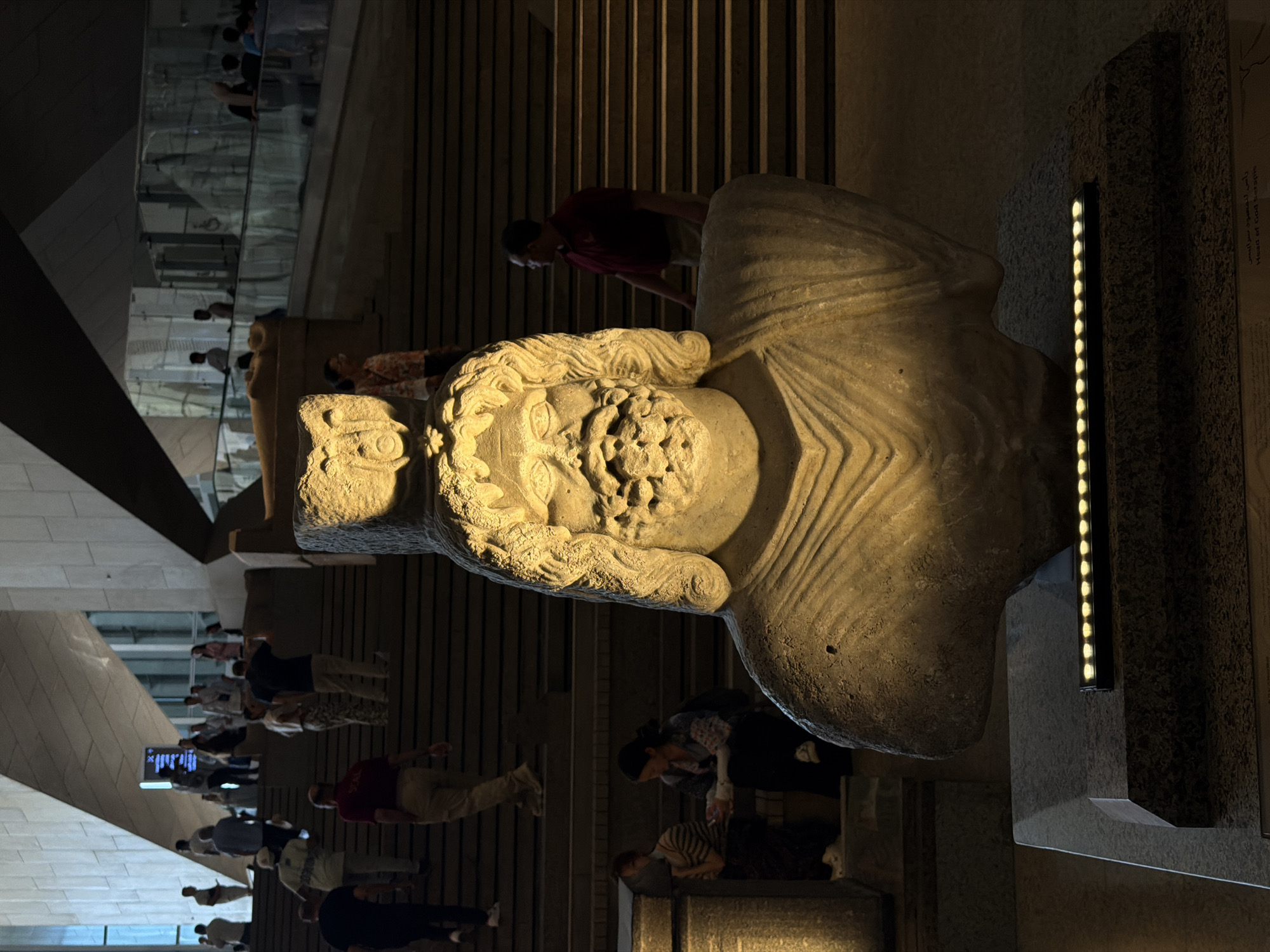
The image shows a large, stone bust of a man with a beard and elaborate headdress, illuminated by spotlights from below. The bust is situated in what appears to be a museum or public space with a large staircase in the background. Several people are visible on the stairs, some walking and some standing. The architecture features large, angular stone structures. The text on a plaque at the bottom of the image reads "Head of God Serapis". This suggests the sculpture is likely housed in a location that exhibits ancient Egyptian artifacts, possibly in or near Cairo, Egypt. The specific location of Kafrat Nassar is not visually confirmed by the image.
Kafrat Nassar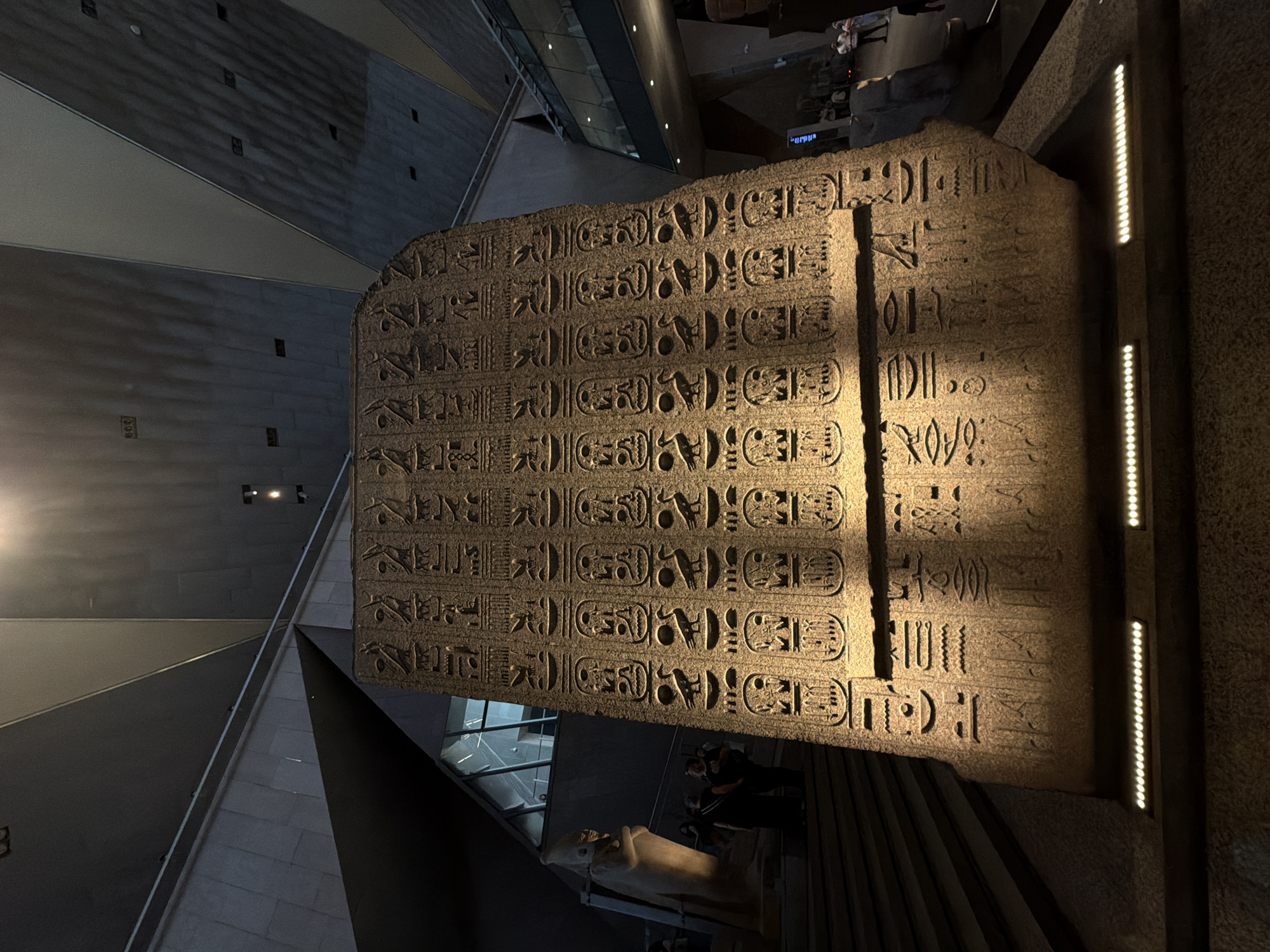
The image displays a large, weathered stone obelisk covered in intricate hieroglyphic carvings. The obelisk stands upright within a dimly lit, modern museum or exhibition space, with angular architectural elements and spotlights illuminating the ancient artifact. The lighting casts shadows across the hieroglyphs, highlighting their texture and depth. In the background, glimpses of a contemporary structure are visible, including angled walls, ceiling elements, and what appear to be staircases or ramps. A faint reflection on a glass surface suggests an indoor environment. Near the base of the obelisk, a light-colored statue of a seated figure, possibly a pharaoh or deity, is partially visible. A few people are also discernible in the background, their presence indicating that this is a public space, likely a museum exhibit. The overall atmosphere is one of historical reverence and modern presentation. The contrast between the ancient obelisk and the contemporary architecture creates a sense of timelessness, juxtaposing past and present. The hieroglyphs, the primary subject, are dense and organized in rows, demonstrating the skill of ancient artisans. The scene appears to be set indoors, as evidenced by the lighting and architectural style, and likely at night or in low-light conditions to emphasize the exhibit. No specific weather or time of day can be determined beyond it being an indoor, lit environment. The location context provided is Kafrat Nassar, Egypt, which would suggest this is an Egyptian artifact displayed within that region. No visible text other than the hieroglyphs on the obelisk is clearly legible.
Kafrat Nassar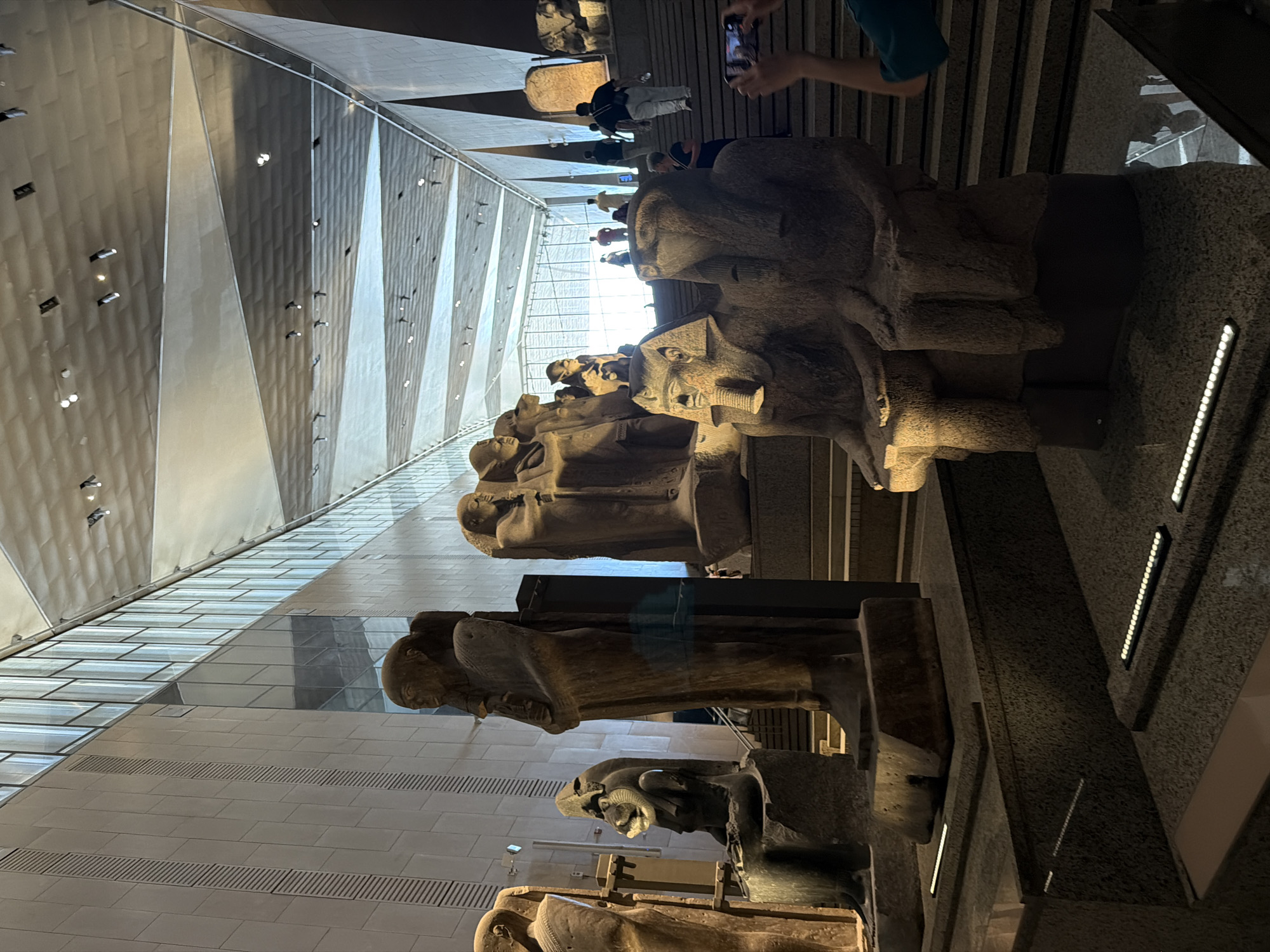
The image depicts an interior view of a large, modern museum or architectural space. The primary subjects are several large, ancient-looking stone sculptures, possibly statues or sarcophagi, arranged vertically in the frame. These sculptures are detailed, with intricate carvings suggesting human or animal forms, and they appear to be made of stone with a weathered texture. In the background, a grand staircase with polished stone steps is visible, leading upwards. Several people are present on the staircase, some looking at the sculptures, others taking photographs with their phones, indicating a public visiting the exhibit. The architecture features a dramatic, angular ceiling with metallic or reflective panels and integrated lighting, creating a sense of scale and grandeur. The lighting suggests it's daytime, with natural light entering from a high point in the ceiling, illuminating the space and the sculptures. The scene conveys a sense of awe and appreciation for the historical artifacts within a contemporary architectural setting. The sculptures are the clear focal point, evoking a connection to ancient history. The presence of visitors engaged with their phones and looking at the exhibits suggests a lively and accessible cultural experience. There is no visible text in the image. The location is contextually identified as Kafrat Nassar, Egypt.
Kafrat Nassar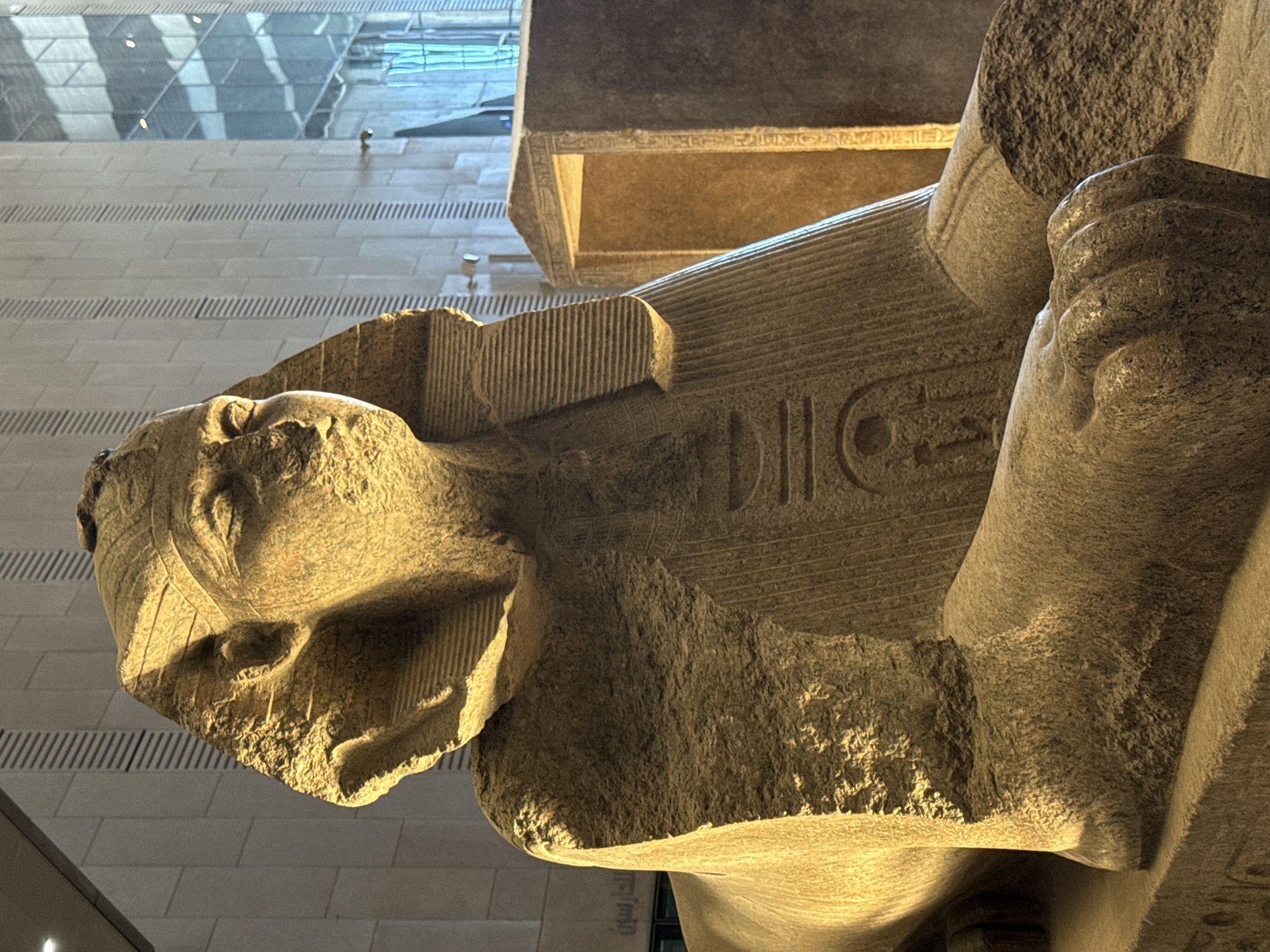
This is a close-up, low-angle shot of a large, ancient Egyptian statue, likely a pharaoh, carved from stone. The statue is massive, with intricate hieroglyphs visible on its chest and arms. The head of the statue is tilted upwards, and its features, though worn by time, are discernible. The statue is lit from the side, creating strong shadows and highlighting the texture of the stone. In the background, modern architecture is visible, suggesting the statue is housed in a museum or is a contemporary display in an archaeological setting. The scene appears to be indoors, with the lighting indicating it could be daytime. There is visible text in Arabic script on the lower right side of the statue. The overall impression is one of grandeur and the passage of time.
Kafrat Nassar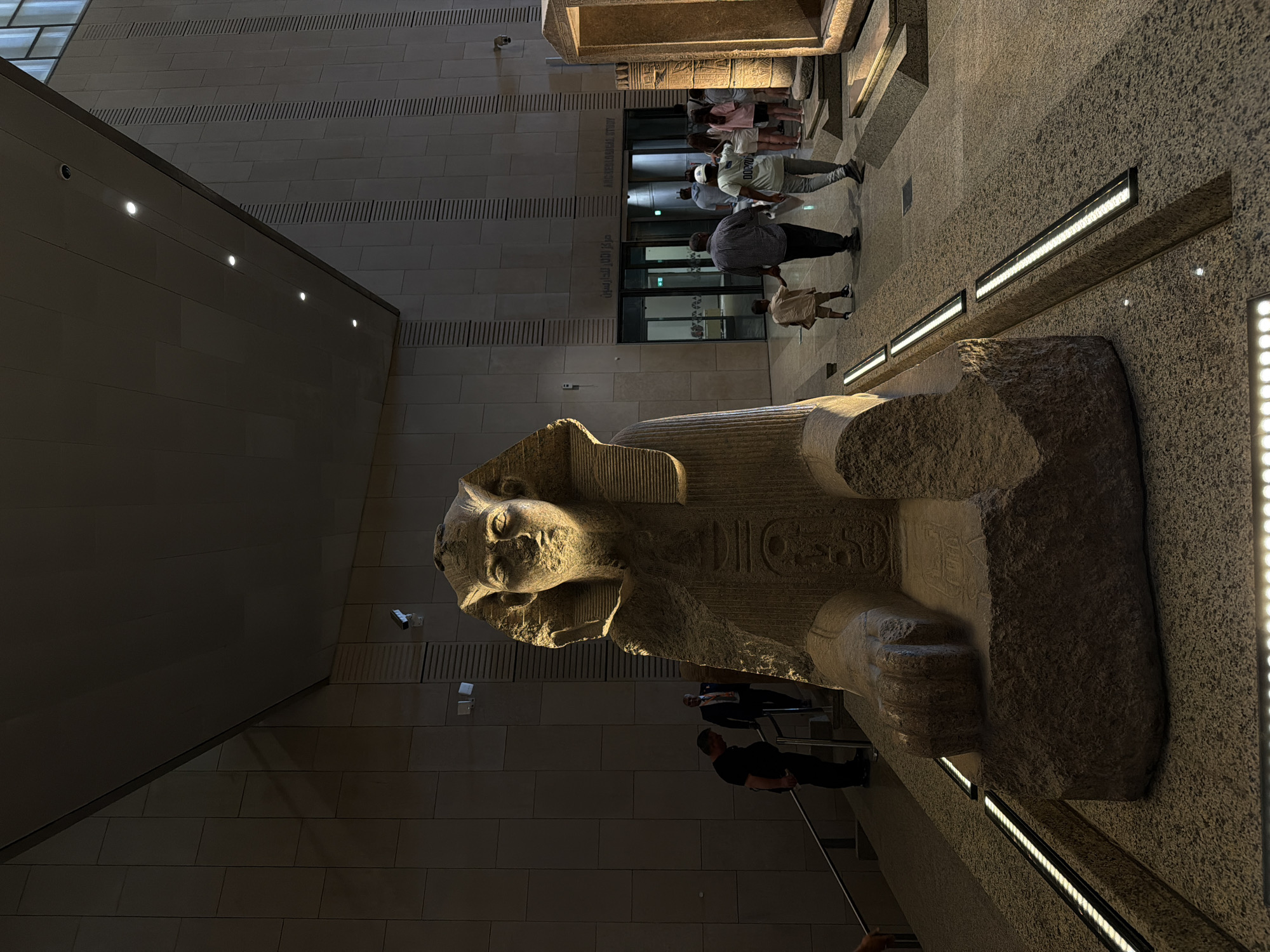
The image shows a large stone sphinx statue in what appears to be a museum or archaeological site. The sphinx is illuminated by spotlights from above, casting dramatic shadows. In the background, several people are walking, including adults and children. There is a set of stairs with a railing to the left of the sphinx, and a doorway with signage that reads "ARCHAEOLOGICAL STUDY" in English and Arabic. The environment appears to be indoors, with tiled walls and a high, angled ceiling. The floor is a speckled granite. Based on the context of the sphinx statue and the "ARCHAEOLOGICAL STUDY" signage, the location is likely within the Grand Egyptian Museum in Giza, Egypt, as Kafrat Nassar is a district within Giza.
Kafrat Nassar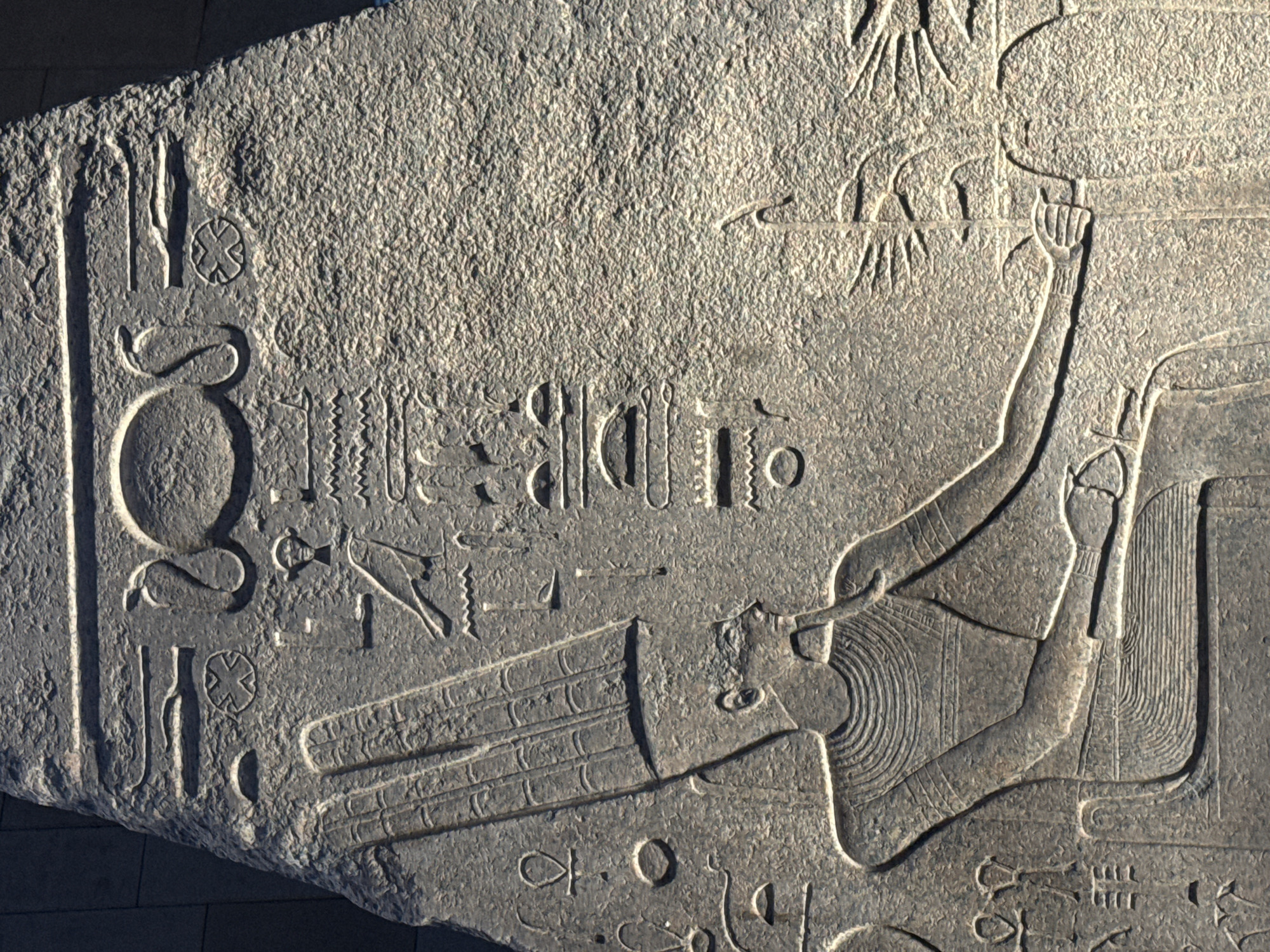
This is a close-up, vertical, eye-level photograph of a relief carving on a large stone slab, likely part of an ancient Egyptian monument. The carving depicts a seated figure wearing a tall, segmented headdress and intricate layered jewelry. The figure's right arm is extended, and their hand appears to be grasping or interacting with something beyond the frame of the image to the right. Hieroglyphs are carved into the stone above and to the left of the figure. The stone surface is textured and weathered, showing signs of age. The lighting creates strong shadows, highlighting the relief work and the granular texture of the stone. The background appears to be a dark, textured surface, possibly a wall or another stone structure. The relief is located in the city of Kafrat Nassar, Egypt.
Kafrat Nassar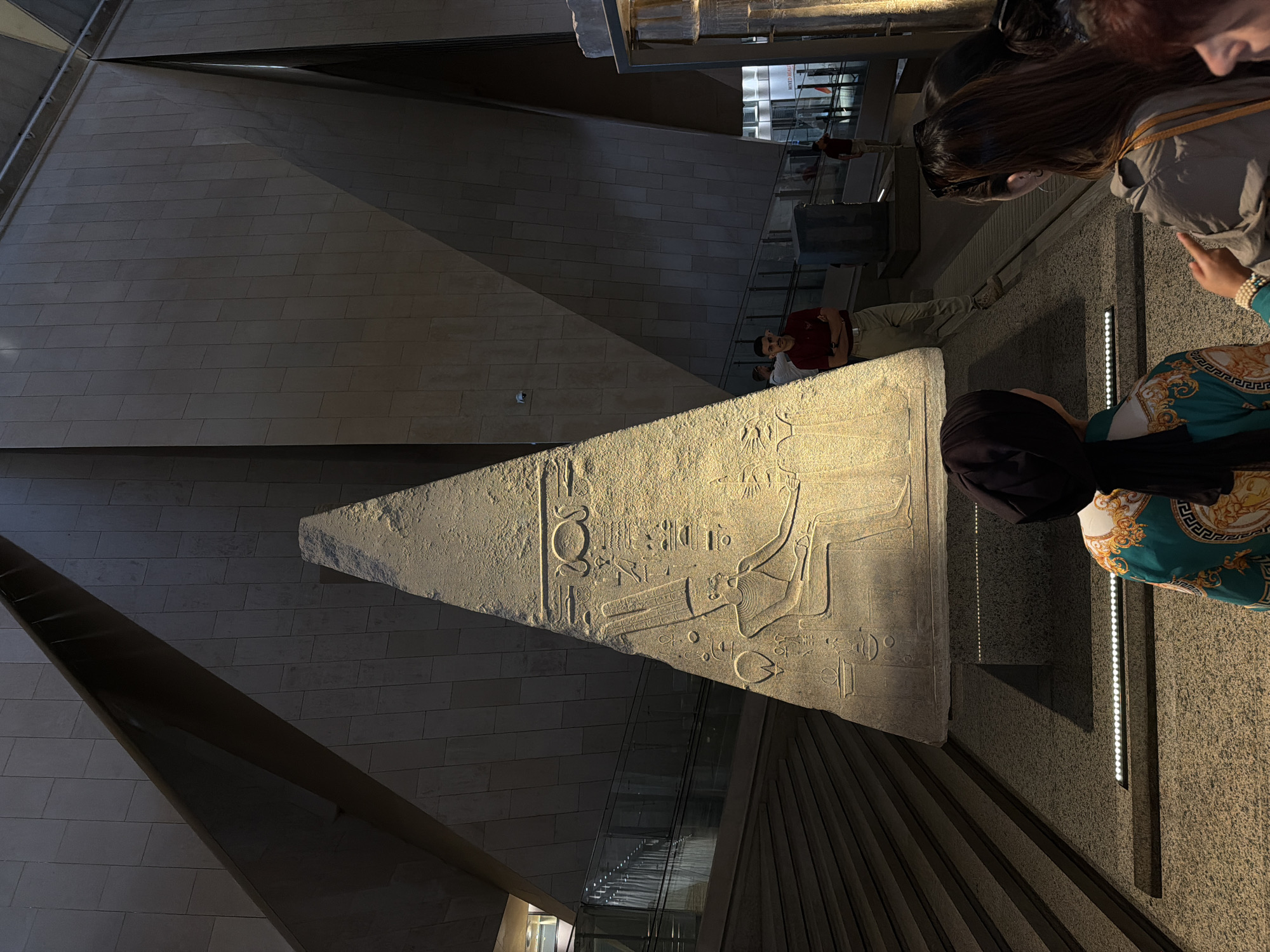
The image shows a group of people in a museum or gallery, likely in Kafrat Nassar, Egypt. The main subject is a large, triangular stone artifact with intricate carvings, resembling an obelisk or stele, illuminated by directional lighting. The artifact features hieroglyphic inscriptions and a relief of a figure, possibly a pharaoh or deity. Several people are visible, some standing and observing the artifact, while others are partially visible at the edges of the frame. One person in the foreground is wearing a green garment with a gold pattern and a black headscarf. Another person in the background is wearing a maroon shirt and khaki pants. The setting appears to be an indoor space with modern architectural elements, including geometric walls, staircases, and glass partitions, suggesting a museum or cultural exhibition. The lighting creates dramatic shadows, highlighting the textures of the stone and the carvings. The time of day is indeterminate due to the indoor setting, but the lighting suggests it could be evening or that artificial illumination is solely used. No specific weather conditions are discernible. The overall mood is one of historical appreciation and quiet observation. There is no visible text in the image.
Kafrat Nassar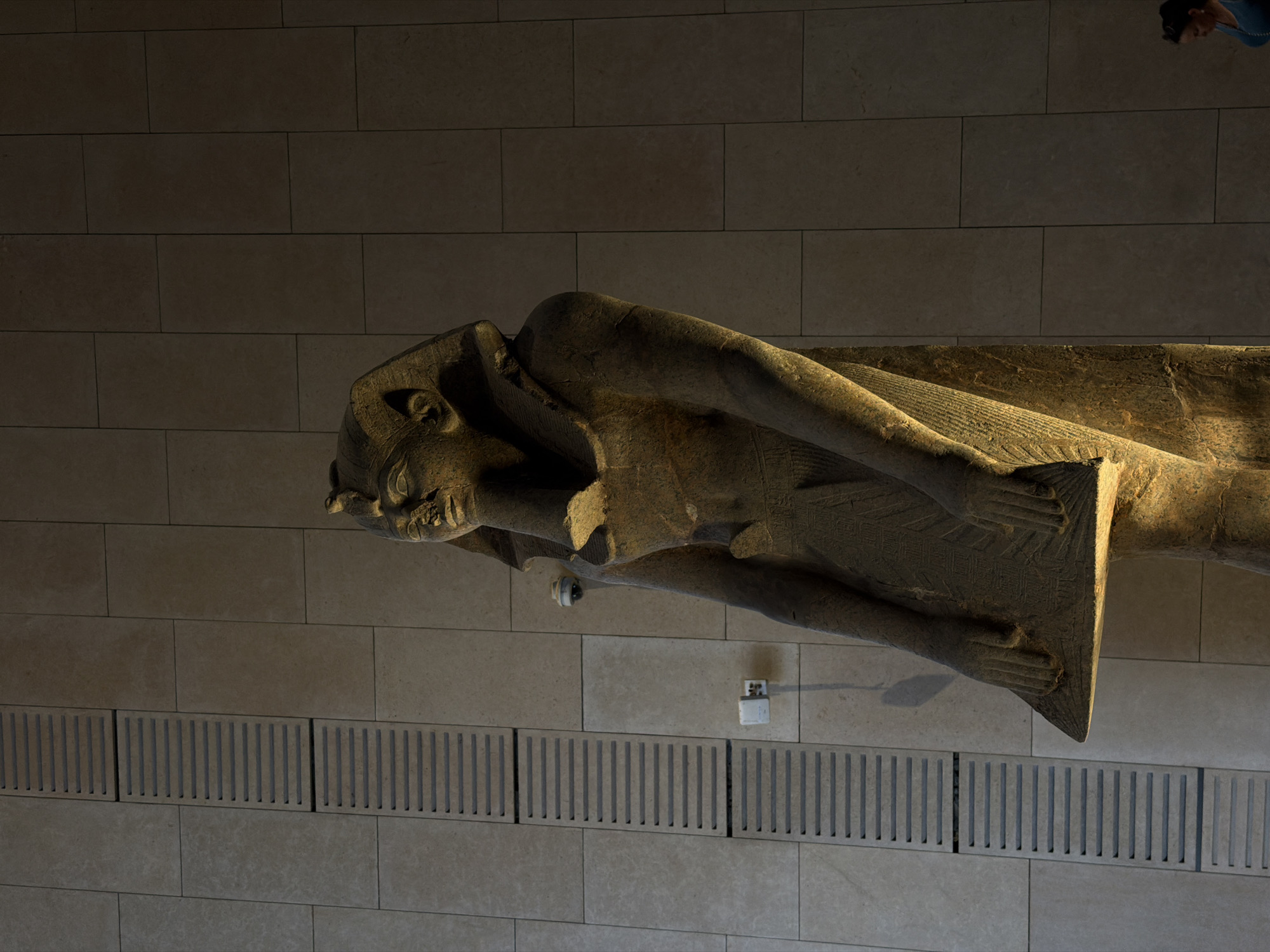
This media file showcases a large, ancient stone sarcophagus lying horizontally against a stone-tiled wall. The sarcophagus depicts a human figure, likely a pharaoh, in a stylized, elongated form. The figure has a distinctly Egyptian headdress and facial features. The stone is weathered, showing intricate carvings and the passage of time. The sarcophagus is illuminated by warm, directional lighting, casting dramatic shadows that highlight the texture and form of the sculpture. The wall behind it is composed of large, rectangular beige tiles, creating a modern and museum-like setting. Below the sarcophagus, a series of rectangular grates or vents are embedded in the wall. Visible in the upper right corner of the image, a person is partially visible, leaning forward and looking at the sarcophagus, suggesting the setting is a museum or historical exhibition. There is no visible text in the media file. The lighting suggests an indoor environment, possibly with controlled lighting for display purposes, rather than natural daylight. The overall impression is one of historical grandeur and preservation within a contemporary exhibition space.
Kafrat Nassar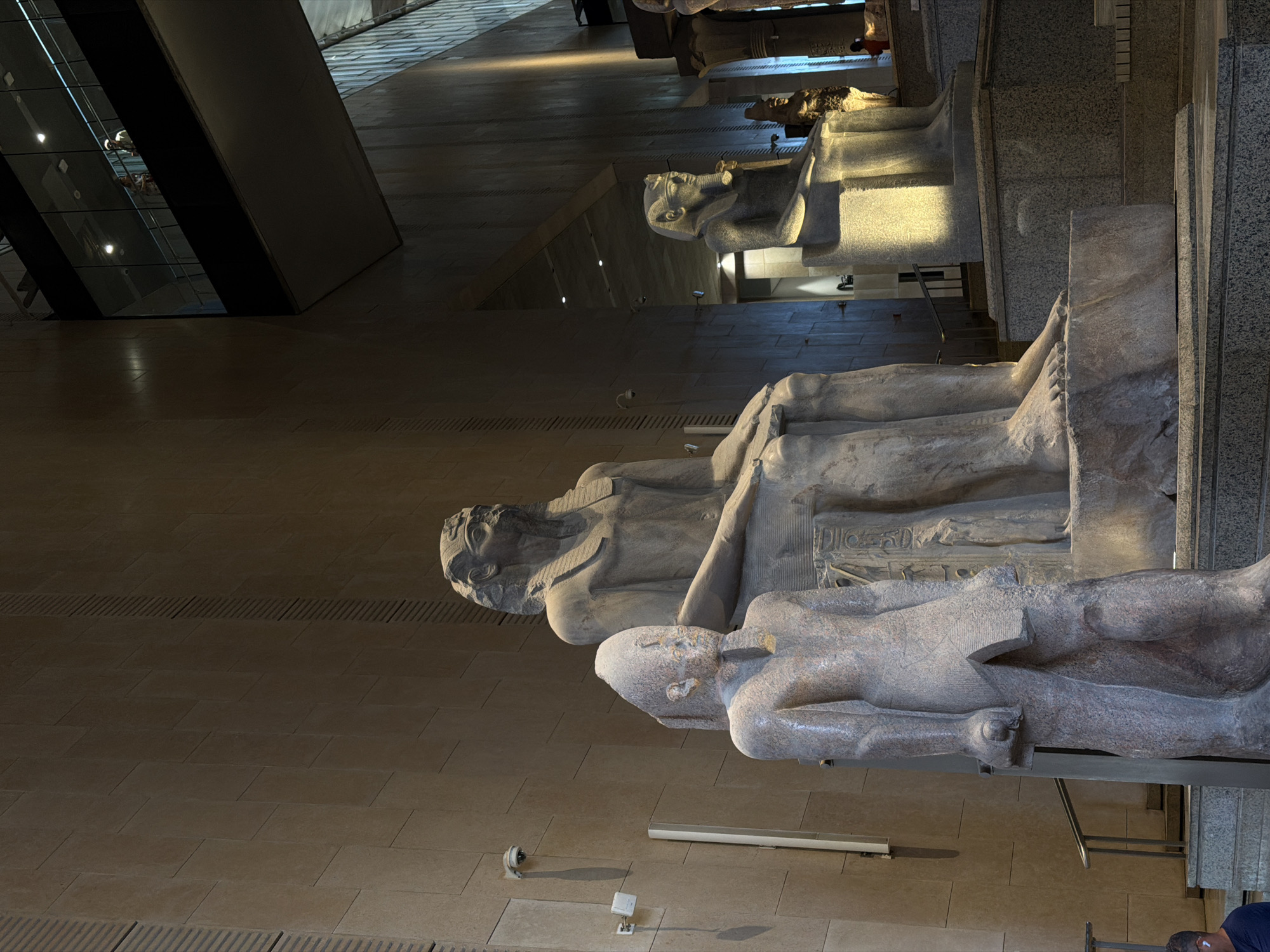
The image depicts an indoor exhibition space featuring several large ancient Egyptian statues. In the foreground, a seated statue of a pharaoh is prominently displayed, with another standing statue to its left. Behind these, a smaller seated statue is illuminated by a spotlight. The background shows a modern building interior with exposed beams and glass walkways, suggesting a museum setting. The statues are made of stone and exhibit classic Egyptian iconography, including headdresses and traditional attire. The overall atmosphere is solemn and historical. The image does not contain any information that would allow its location to be determined as Kafrat Nassar, Egypt.
Kafrat Nassar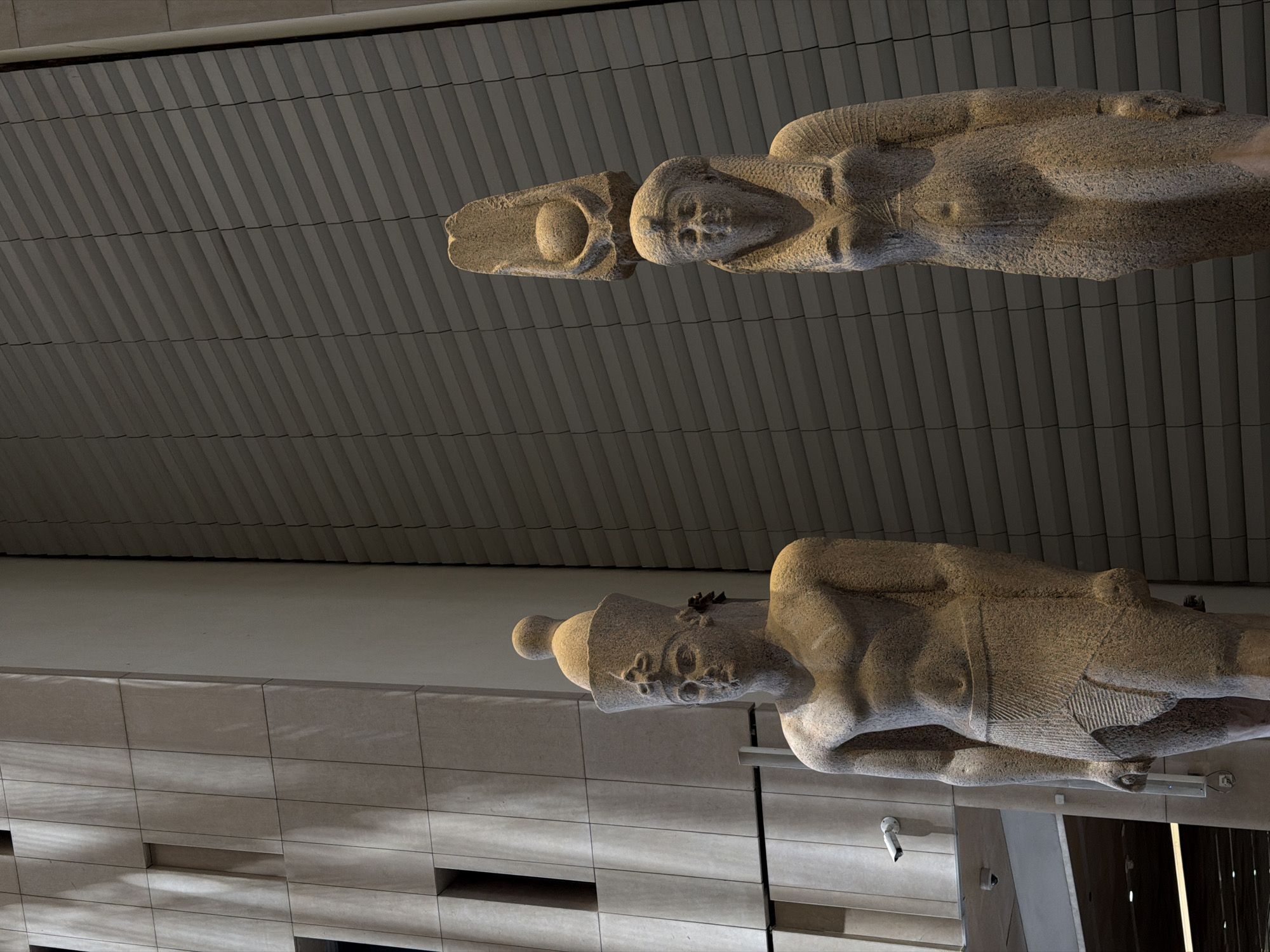
The image shows two large, ancient Egyptian statues within a modern building. The statue on the left depicts a male figure wearing a headdress, a kilt, and a broad collar. The statue on the right appears to be a female figure, also wearing a headdress and jewelry. The statues are made of a speckled stone and have a weathered appearance. They are positioned in front of a wall with a textured, segmented design. To the left of the male statue, there is a contemporary building facade with vertical and horizontal elements, and two visible security cameras. The lighting is dim, with some areas in shadow and others illuminated, creating a dramatic effect. There is no indication of the city of Kafrat Nassar, Egypt.
Kafrat Nassar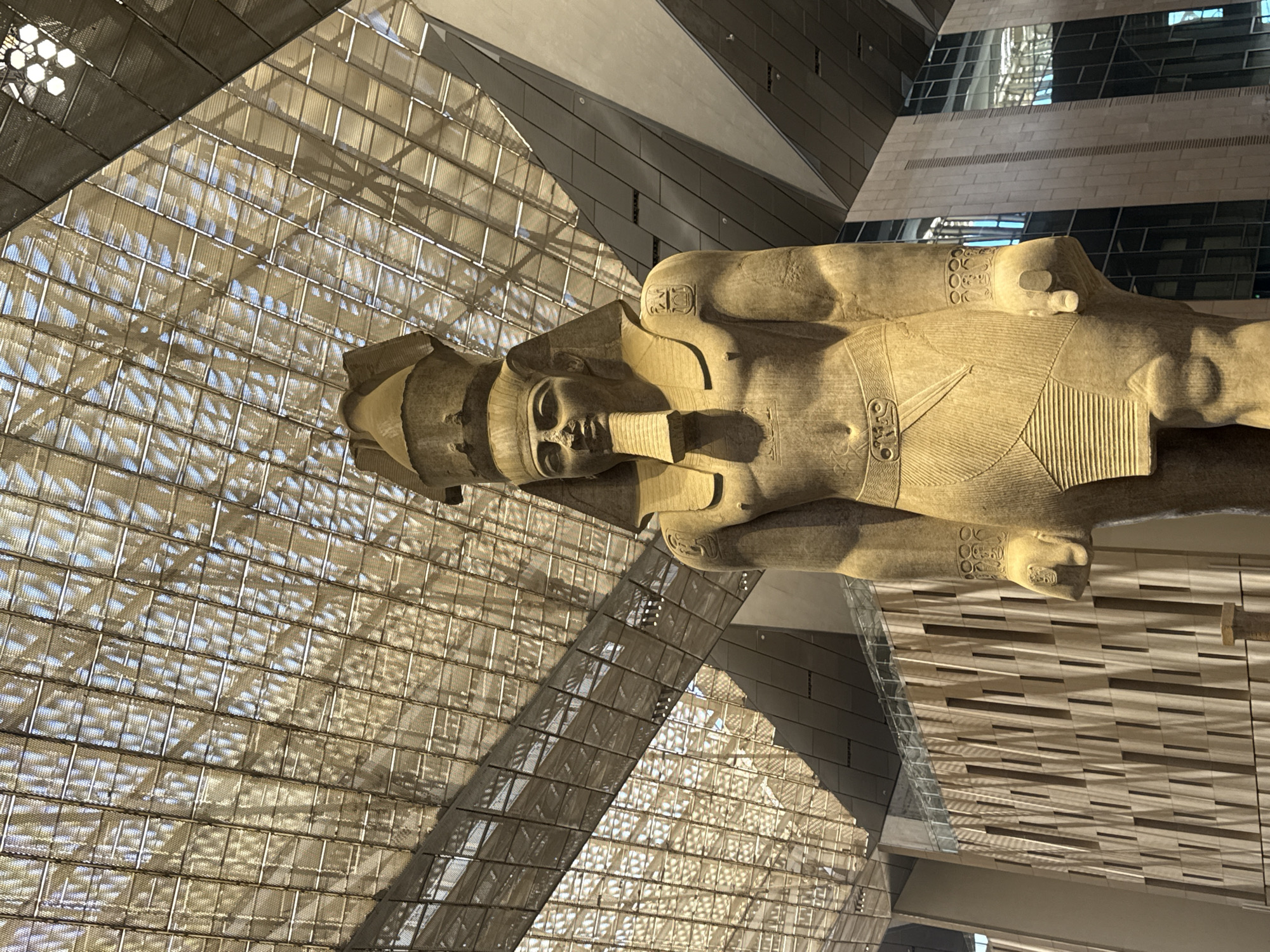
This media file captures a majestic, colossal stone statue of an ancient Egyptian pharaoh, possibly Ramesses II, lying horizontally within a modern architectural space. The statue, carved from light-colored stone, dominates the foreground, with its head, torso, and legs visible. Intricate details are etched into the statue's clothing and headdress, including hieroglyphs and decorative patterns. The setting appears to be an indoor museum or exhibition hall, characterized by a striking contemporary design. A large, geometric, glass-and-metal ceiling structure creates a grid-like pattern of light and shadow across the scene, suggesting it is daytime with sunlight filtering through. In the background, angular walls and facades constructed from metal panels and glass reflect the light and the surrounding architecture. The overall atmosphere is one of grandeur and historical reverence, juxtaposed with modern design. The statue is the primary subject, positioned as if it were recently unearthed or placed for display. There are no other people visible in the frame, emphasizing the solitary presence of the ancient artifact. The lighting suggests a bright, clear day, and the location cues, along with the statue itself, strongly point to a site related to ancient Egyptian history, specifically in Kafrat Nassar, Egypt. No visible text is present in the image.
Kafrat Nassar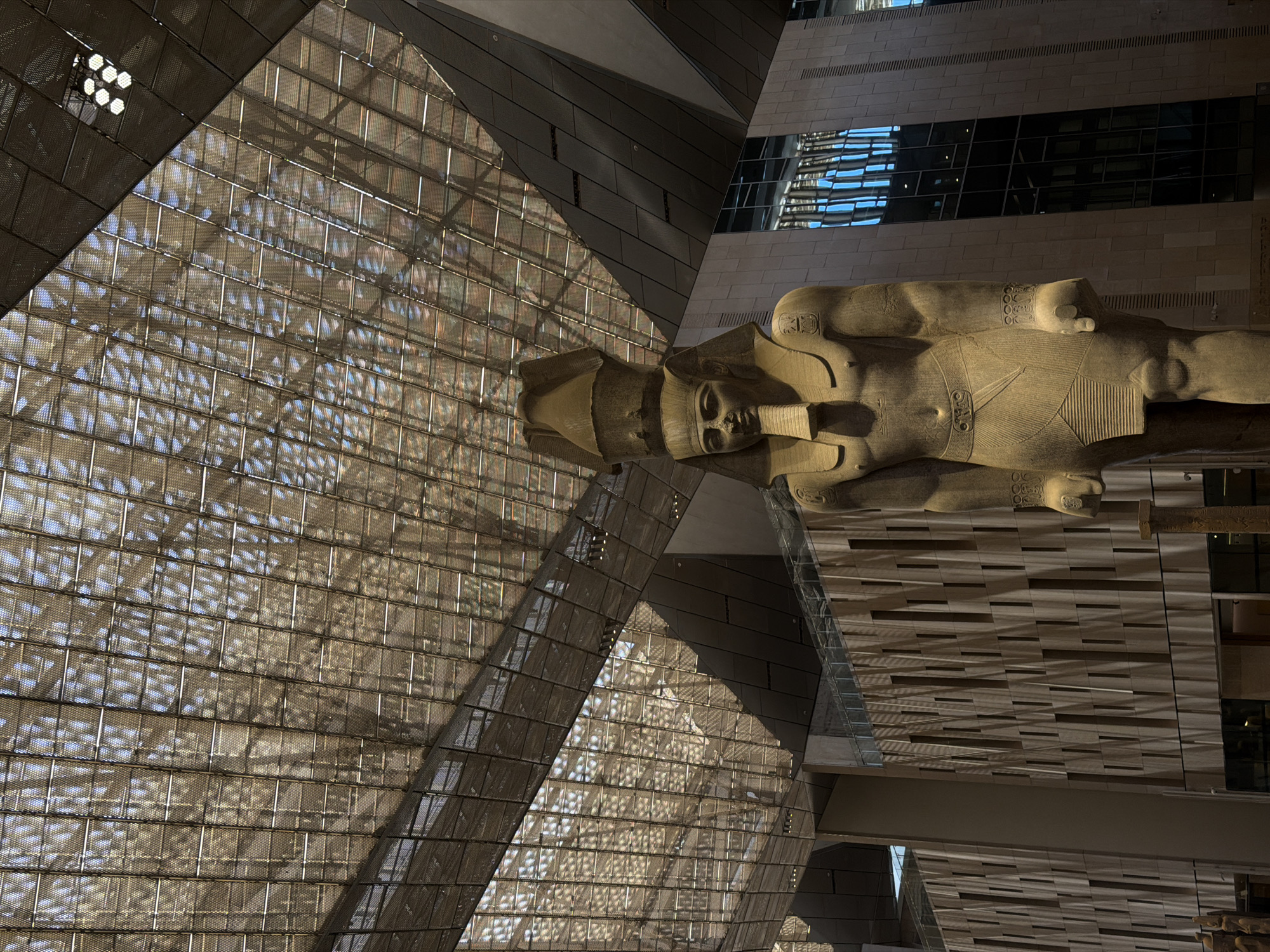
The image shows a large ancient Egyptian statue of a pharaoh, likely Ramses II, positioned in the grand atrium of the Grand Egyptian Museum in Kafrat Nassar, Egypt. The statue, made of granite, stands prominently in the foreground, with its intricate details and regal headdress clearly visible. It is illuminated by natural light filtering through the museum's impressive, geometrically patterned glass roof, which casts dappled shadows onto the surrounding architecture. The museum's interior features modern architectural elements, including a facade of stacked rectangular panels and large glass windows that reflect the sky. In the background, a contemporary building rises, contrasting with the ancient statue. The lighting is a mix of natural sunlight and strategically placed spotlights on the ceiling. There are no people visible in the immediate vicinity of the statue, emphasizing its solitary grandeur within the vast museum space. The scene conveys a sense of awe and historical significance, blending ancient heritage with modern design.
Kafrat Nassar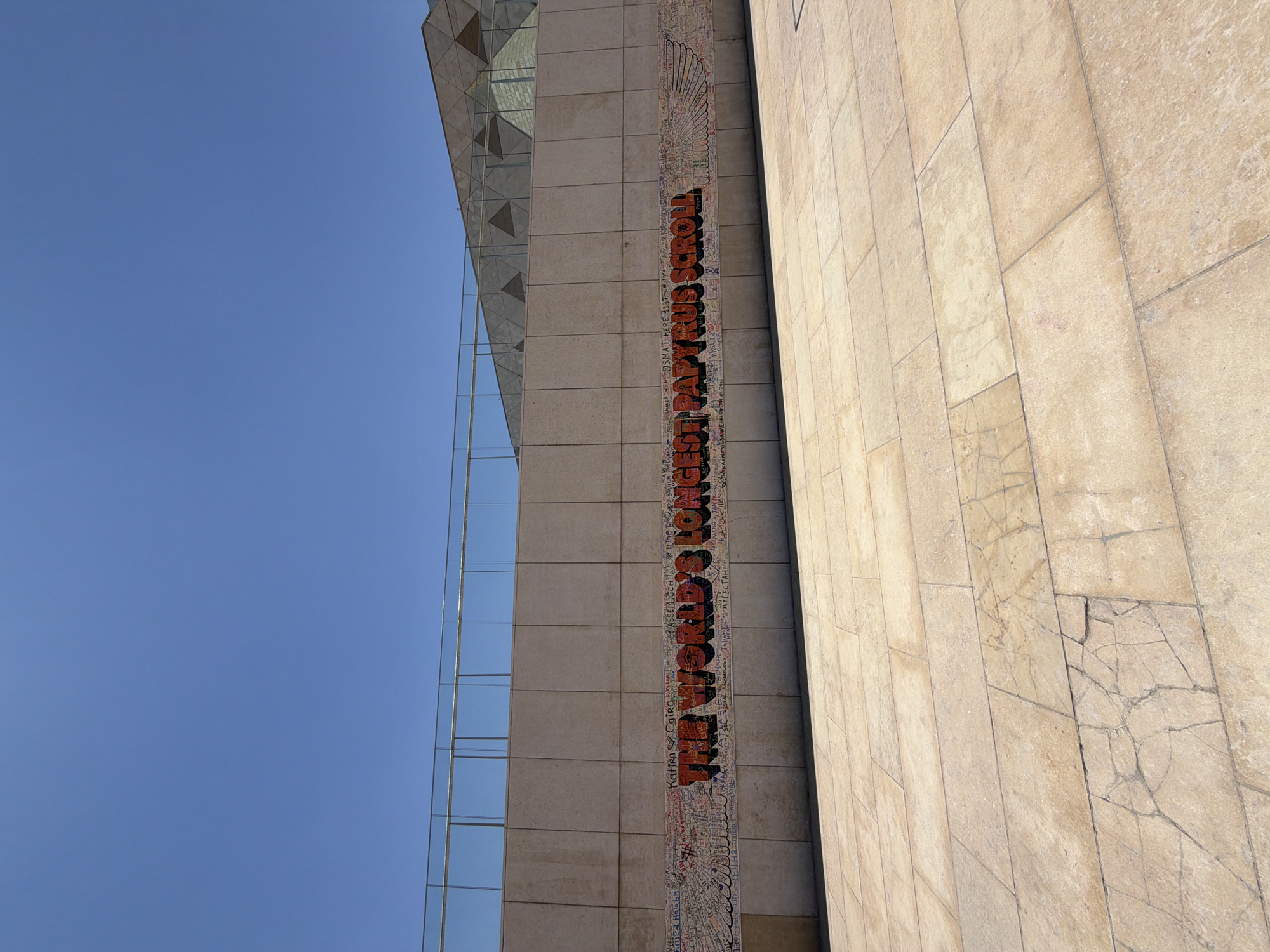
The image shows a close-up, worm's-eye view of a building facade with a clear blue sky above. The building features a section of tiled walls, with the tiles appearing to be made of a light-colored stone and showing some cracks. To the left, a modern glass facade reflects the sky. Dominating the central portion of the tiled wall is a vertical, colorful art installation or mural. Large, three-dimensional orange lettering reads "THE WORLD'S LONGEST PAPYRUS SCROLL." Below this title, the scroll is filled with numerous smaller inscriptions and drawings in various colors, giving the impression of many names, dates, and messages. Some of these smaller inscriptions are legible, including "Katira Cairo," "Ahmet Selim OSMAT HERE 10370204," and "ДАГЕСТАНИС." The angle suggests the photo was taken looking upwards towards the top of the building, possibly on a sunny day, as indicated by the bright sky and shadows. The setting is likely an urban environment, given the architectural style of the building. The overall impression is one of a public space adorned with a significant artistic display. The presence of so many smaller inscriptions suggests a participatory or commemorative aspect to the "scroll."
Kafrat Nassar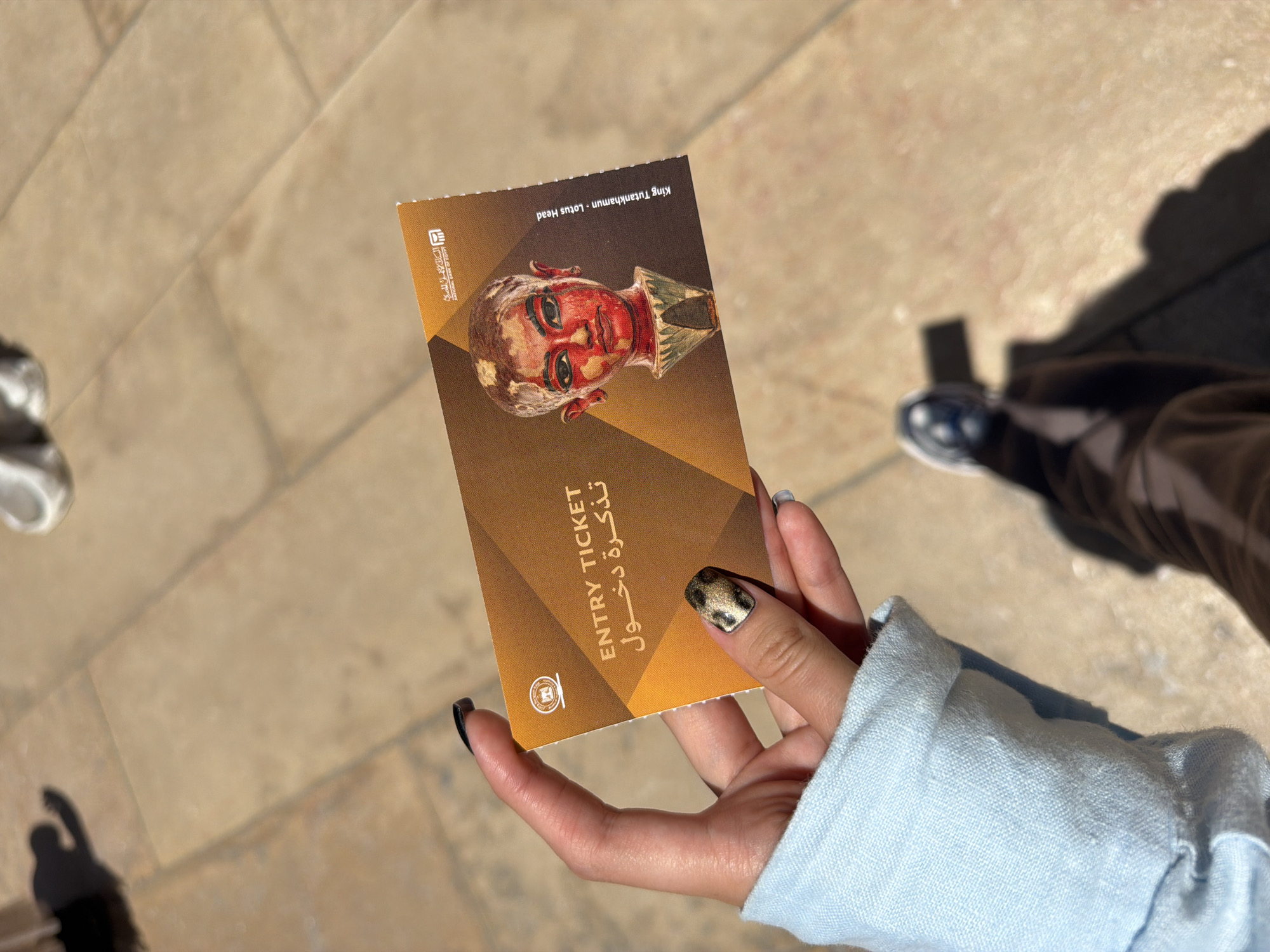
In Kafrat Nassar, Egypt, a hand with patterned fingernails holds an entry ticket. The ticket features an image of a red-faced pharaonic head, possibly King Tutankhamun's Lotus Head, and text in English and Arabic. The background shows a sunlit, tiled ground and shadows cast by people.
Kafrat Nassar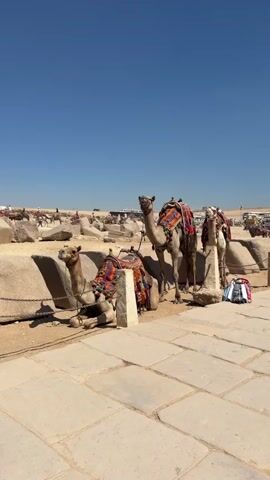
A bright, sunny day unfolds at a historical site in Kafrat Nassar, Egypt. The scene is dominated by several camels, adorned with colorful saddles, resting in the sand. One camel is lying down, while others stand, awaiting riders. In the background, the landscape is dotted with large, rough-hewn stones, suggesting ancient ruins or archaeological remnants. A few people are visible in the distance, some appearing to be tourists interacting with camels, while others are seen walking around the site. The overall atmosphere is one of a tourist attraction, offering camel rides. The sky is a clear, vibrant blue, indicative of a warm, cloudless day. The ground is paved with large, square stone tiles in the foreground, transitioning to sandy terrain where the camels are situated. The sunlight casts distinct shadows, confirming the time of day is likely midday or early afternoon. There is no visible text in the frame. The scene evokes a sense of adventure and historical exploration, typical of a visit to an Egyptian landmark.
Kafrat Nassar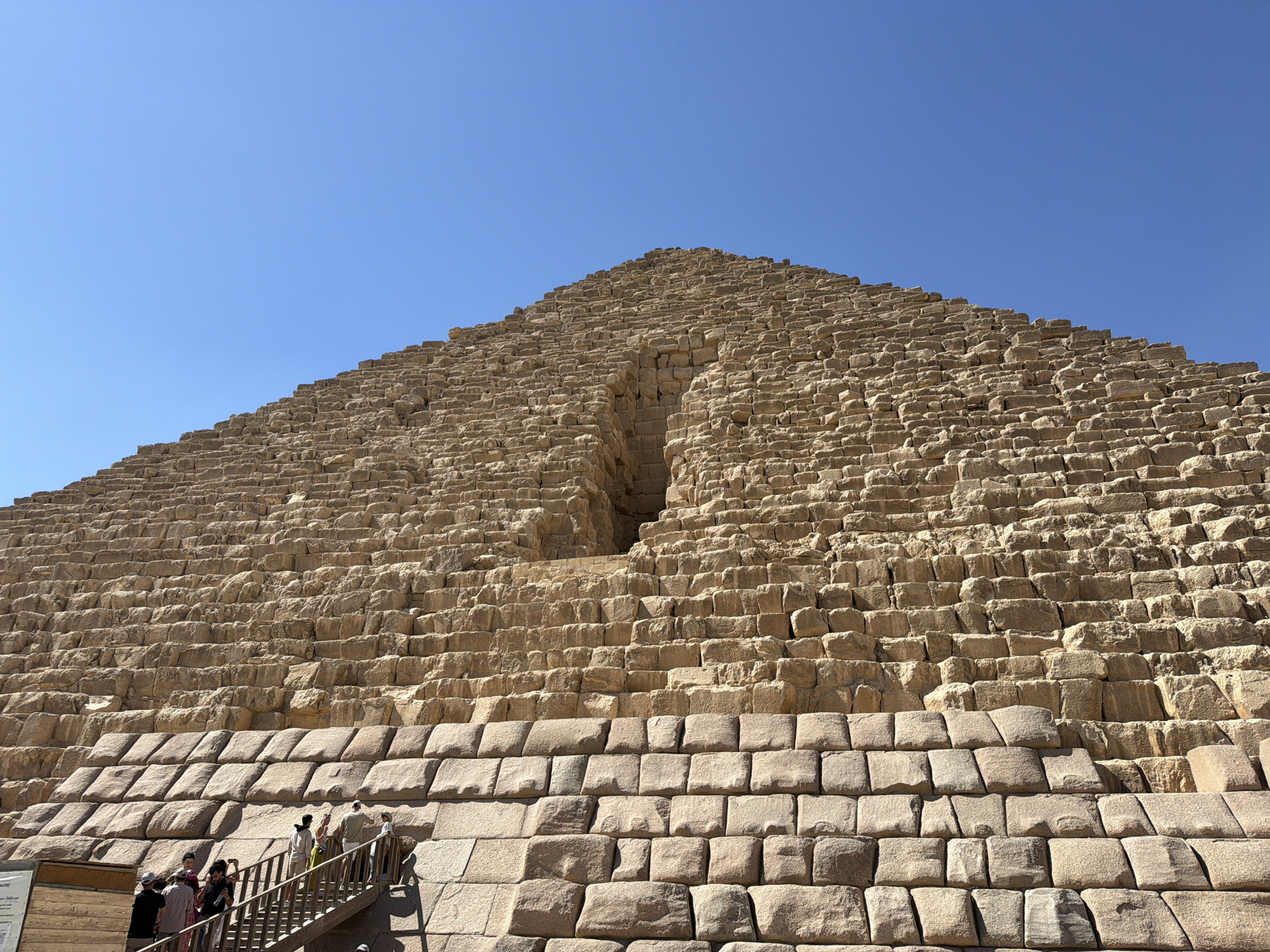
This media file features a low-angle, upward-facing view of a large, ancient stone pyramid under a clear, bright blue sky. The pyramid is constructed from numerous large, rectangular stone blocks, weathered and varying in color from light tan to brown. The surface texture of the pyramid is rough and irregular, with many visible seams between the blocks. A prominent, dark, rectangular opening, likely an entrance or passage, is visible near the top of the pyramid, slightly off-center to the left. In the lower left quadrant of the image, a group of people are visible on and around a wooden staircase leading up the side of the pyramid. There are approximately seven to eight individuals, some of whom appear to be tourists. They are dressed in casual, light-colored clothing. Their presence suggests an archaeological site or tourist attraction. The lighting indicates it is daytime, likely midday or early afternoon, given the strong sunlight casting shadows and illuminating the stone surfaces. The clear blue sky suggests fair weather conditions. The presence of the pyramid itself strongly implies a location of historical significance, consistent with the provided location context of Kafrat Nassar, Egypt, known for its ancient Egyptian monuments. The overall mood is one of awe and historical exploration. There is a small, wooden sign with text in the bottom left corner of the image, but the text is too small and blurry to be legible.
Kafrat Nassar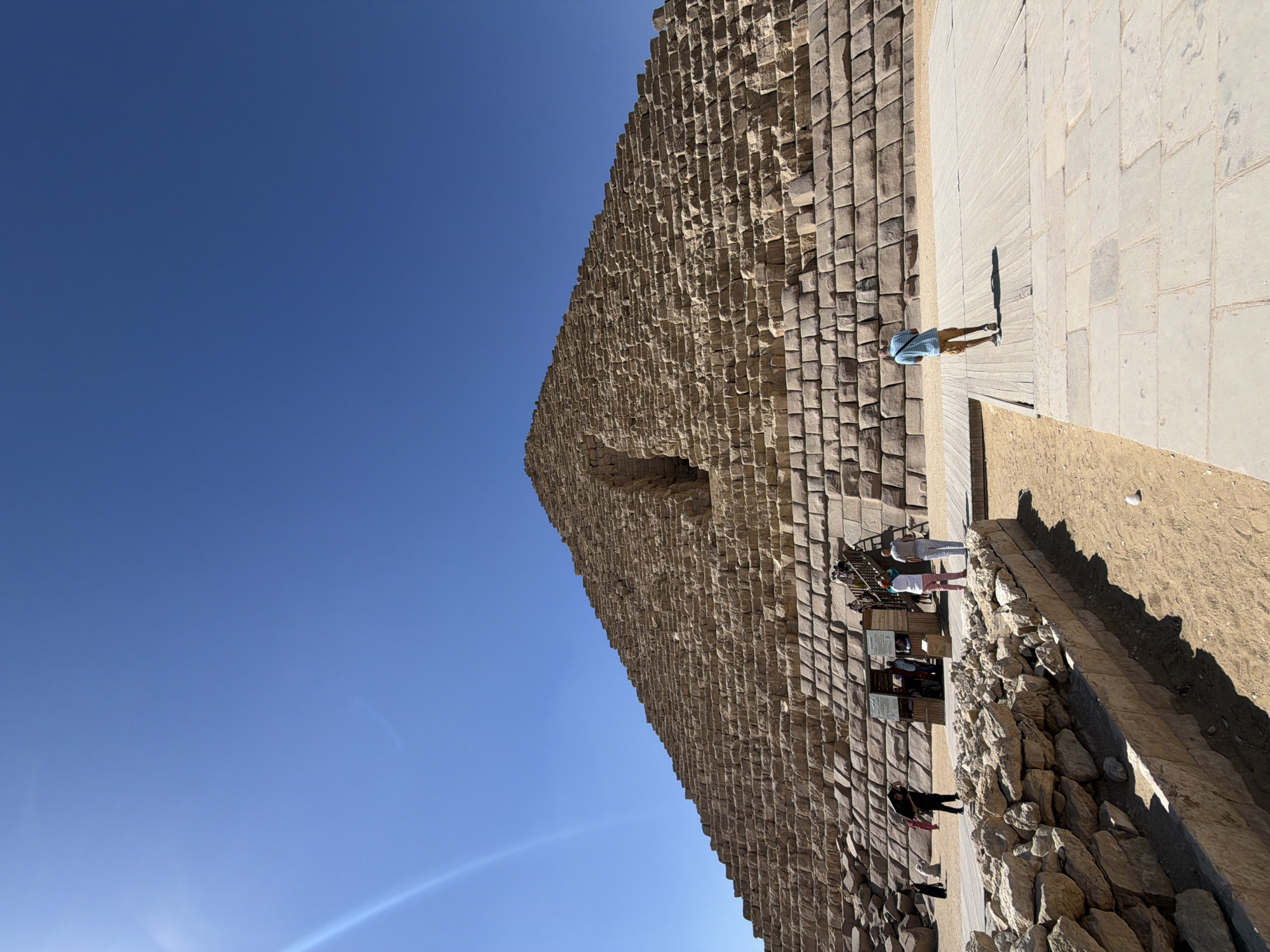
In this vertical, eye-level shot, the massive, rough-hewn stone facade of a pyramid dominates the frame against a clear, bright blue sky. The weathered, tan-colored blocks are stacked in an orderly yet uneven fashion, creating a textured surface that hints at great age. A large, dark rectangular opening interrupts the stonework midway up the pyramid, suggesting an entrance or a void. Along the base of the pyramid, a paved pathway made of lighter, rectangular stones stretches out. Several people are visible on this path, appearing small in comparison to the monumental structure. One person, wearing a light blue checkered shirt and brown shorts, stands alone, casting a long shadow onto the paved area. Further along the path, a small group of people are gathered, some appearing to interact with what might be information booths or ticket stands, indicated by the presence of signs with visible text. The ground bordering the paved area is sandy and uneven, scattered with rocks. The strong sunlight casting sharp shadows indicates a time of day when the sun is high, likely midday. The clear sky suggests fair weather. The overall scene evokes a sense of awe at the scale of the ancient structure and the bustling activity of tourists exploring the historic site. The location is identified as Kafrat Nassar, Egypt, implying this is likely a well-known pyramid complex.
Kafrat Nassar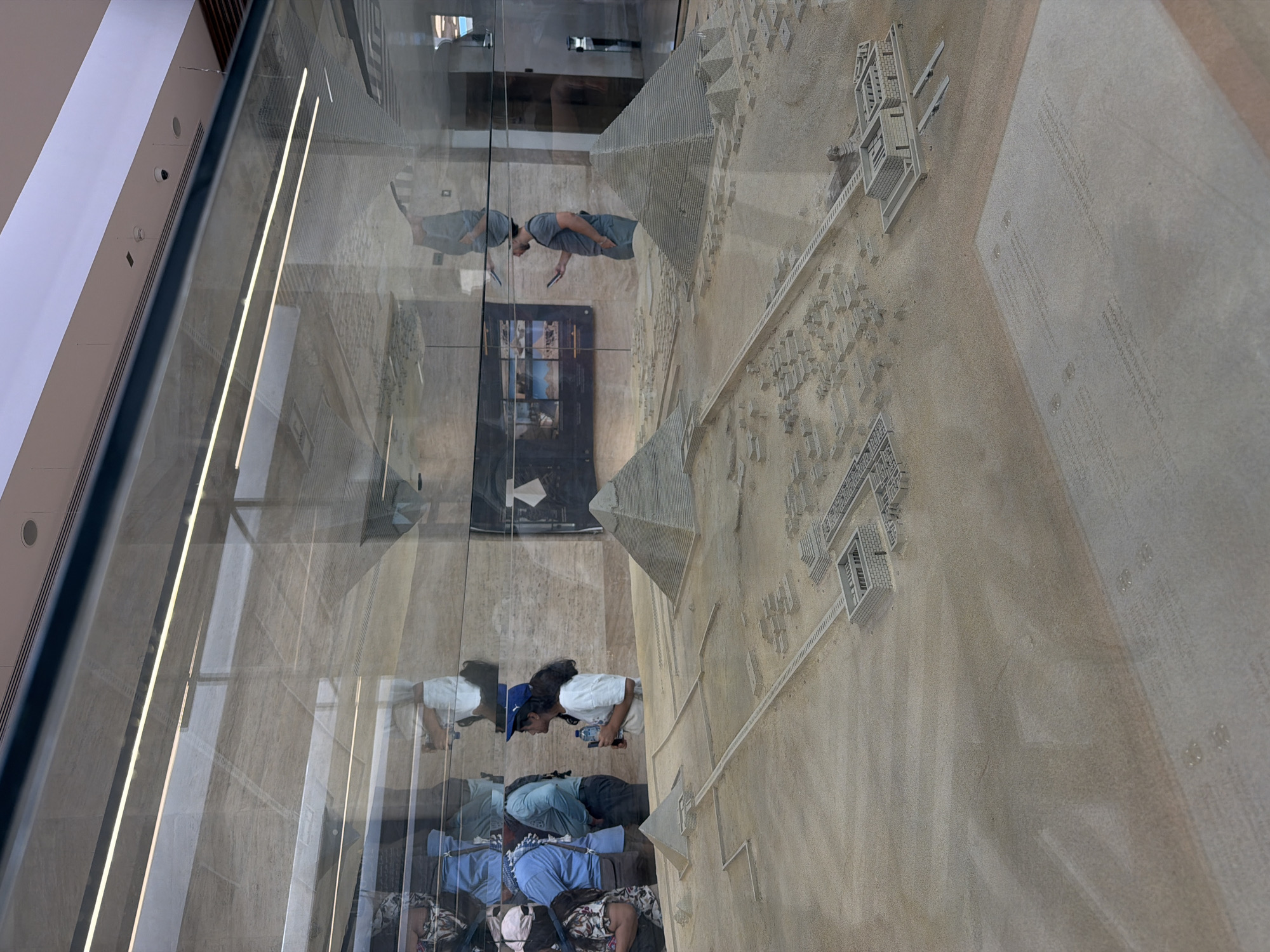
In Kafrat Nassar, Egypt, a detailed architectural model of the Giza pyramid complex is displayed under glass. Three pyramids, representative of those at Giza, are prominent features of the model, which also includes smaller structures and pathways. The sand-colored model is illuminated by overhead lighting, visible as reflections on the glass display case. In the background, several people are reflected in the glass. One person, a woman wearing a blue cap and white shirt, holds a water bottle. Another person, a man in a grey t-shirt and shorts, looks at a tablet. A group of individuals, including a woman in a floral shirt, a man in a blue shirt with a patterned scarf, and another man in a teal shirt, are also visible in the reflection, appearing to be observing the model. The environment behind the glass features light-colored walls and suspended lighting fixtures.
Kafrat Nassar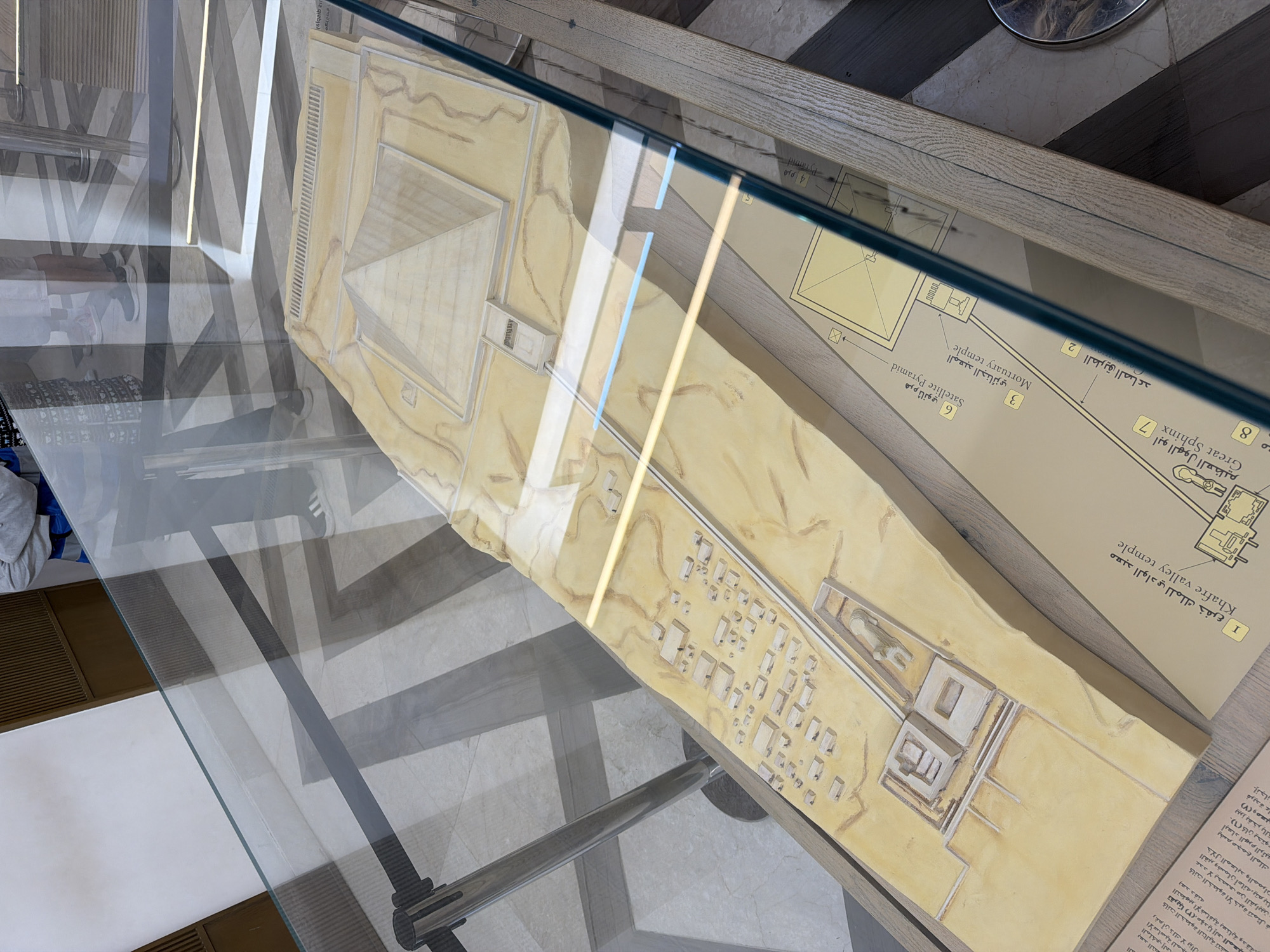
The image shows a museum display featuring a detailed architectural model of the Giza pyramid complex, specifically focusing on the pyramid of Khafre. The model is situated under a glass enclosure, with a wooden frame visible around the base. The Giza complex is located in the city of Kafrat Nassar, Egypt. The model depicts the main pyramid, Khafre's pyramid, along with its associated mortuary temple, valley temple, and causeway. Surrounding these structures are smaller models representing ancillary pyramids and mastaba tombs, arranged in a sandy, desert-like terrain. The model is accompanied by informational diagrams or labels, some of which are partially visible and appear to contain text in both Arabic and English, identifying different components such as the "Mortuary temple," "Valley temple," and "Great Sphinx." In the background, out of focus, are reflections on the glass enclosure, showing people standing and observing the display. The flooring in the reflection appears to be tiled with a geometric pattern of dark and light stripes. The overall environment suggests an indoor museum setting. The lighting appears to be artificial, with strip lights integrated into the display enclosure illuminating the model.
Kafrat Nassar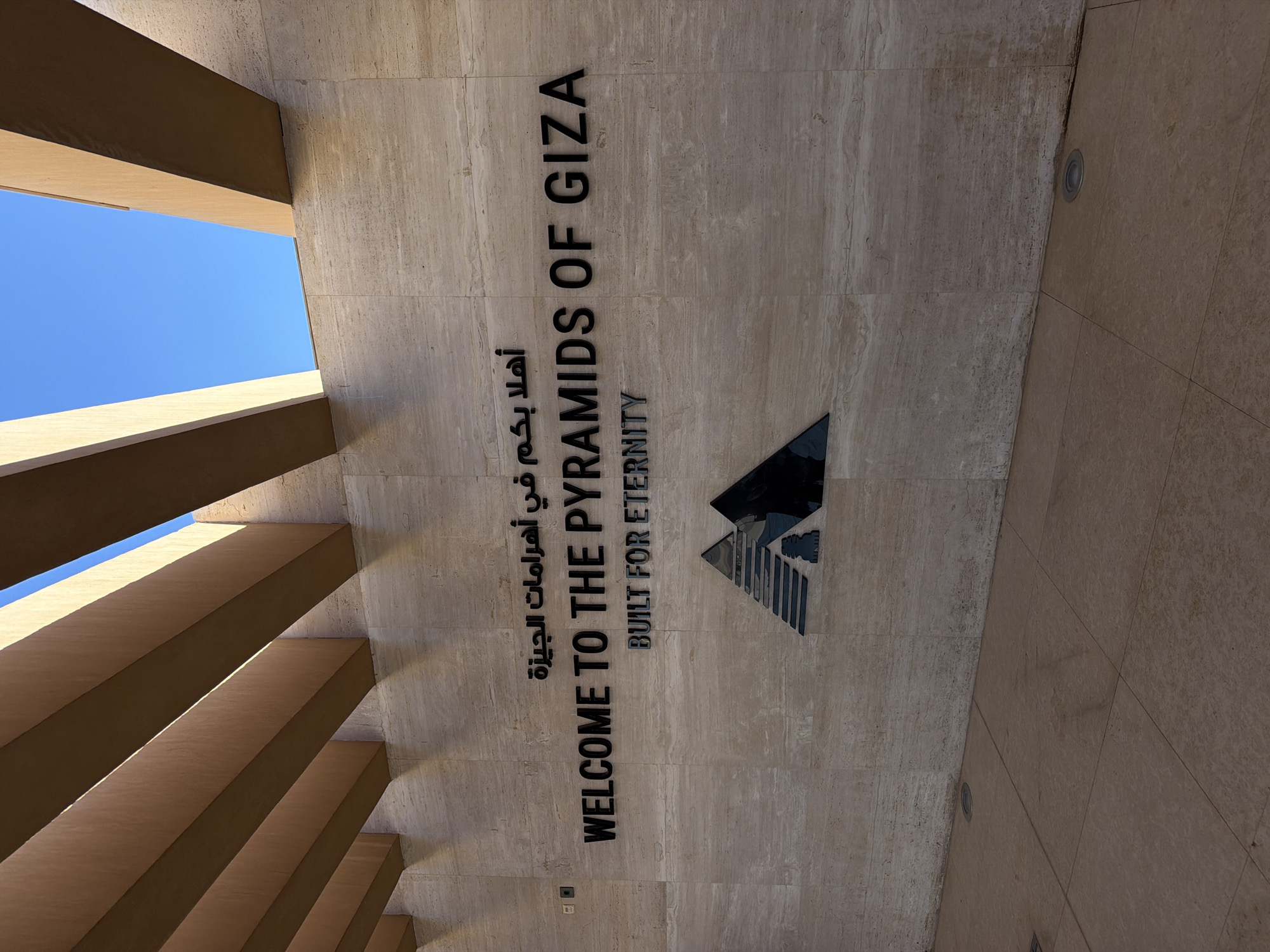
The image shows the entrance to the Pyramids of Giza, located in Kafrat Nassar, Egypt. A modern architectural structure with horizontal wooden beams is visible overhead, casting shadows on a light-colored, stone-tiled wall. The wall features prominent black lettering that reads "WELCOME TO THE PYRAMIDS OF GIZA" in English, and Arabic text above it, "أهلاً بكم في أهرامات الجيزة" which translates to "Welcome to the Pyramids of Giza". Below the English text, smaller dark letters spell out "BUILT FOR ETERNITY". A stylized, dark, triangular logo resembling pyramids is mounted on the wall below the text. The ground in front of the wall is paved with large, square tiles. The sky is a clear blue. No people are visible in the scene.
Kafrat Nassar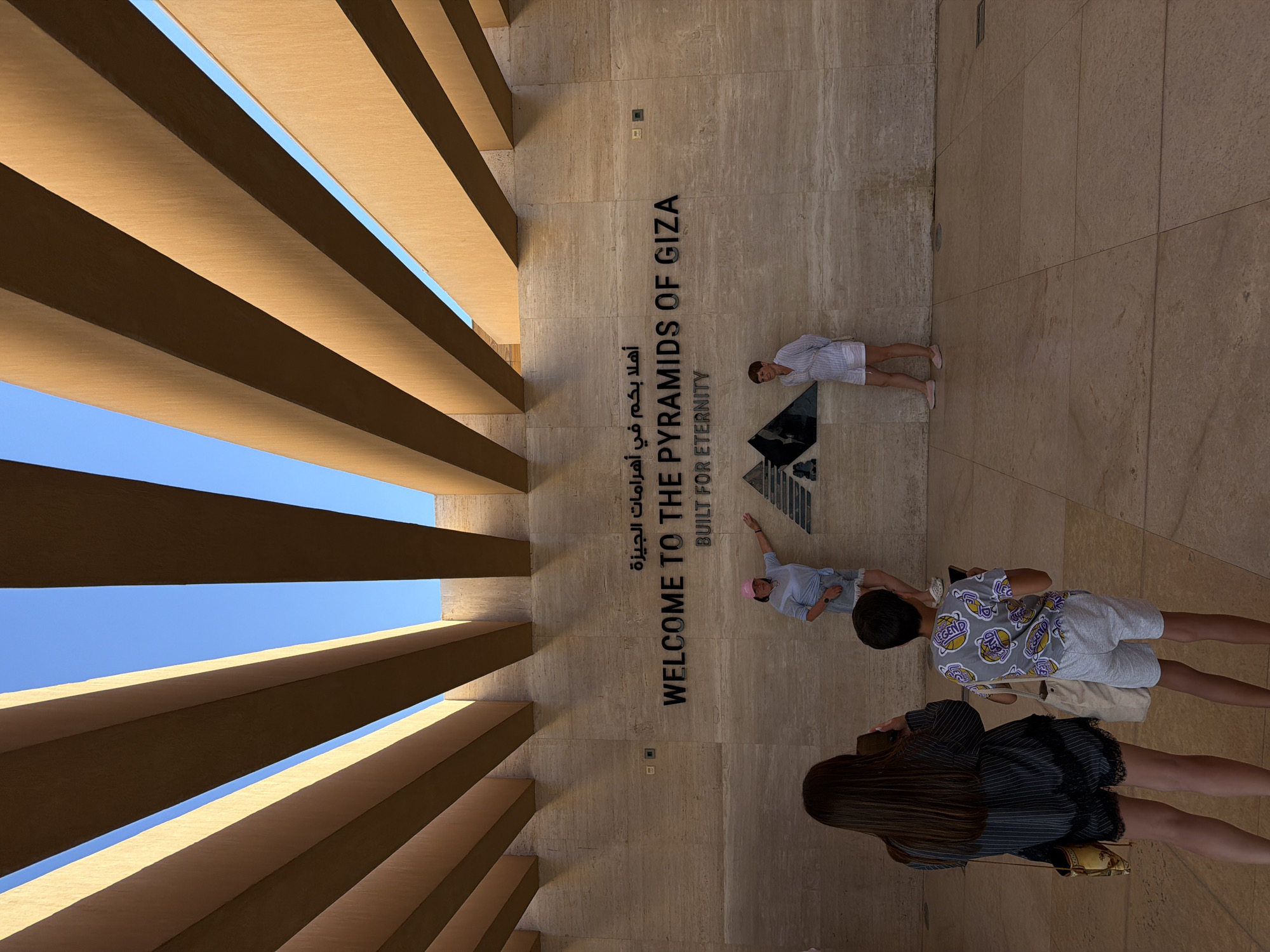
The image depicts the entrance to the Pyramids of Giza, located in Kafrat Nassar, Egypt. The scene is characterized by an overhead structure with parallel wooden beams creating a striped pattern against a clear blue sky. Below this, a beige stone wall displays Arabic text and the English phrase "WELCOME TO THE PYRAMIDS OF GIZA BUILT FOR ETERNITY" in large black lettering. A triangular emblem featuring a pyramid and figures is also visible on the wall. Three individuals are present in the foreground. On the left, a young person with long brown hair is seen from the back, wearing a dark pinstripe outfit with lace trim and holding a yellow purse. They are looking towards the right, seemingly taking a picture with a mobile phone. In the center, a person wearing a light blue top and shorts, with a pink cap, is pointing towards the pyramid emblem on the wall. To the right, another young person is dressed in a white striped shirt and white shorts, standing with their back to the camera, looking at their phone. A younger person, seen from the back in a grey t-shirt with cartoon graphics and light grey shorts, is standing between the two individuals on the left and the person on the right, also holding a mobile phone. The ground is paved with large, light brown square tiles. The overall environment suggests a bright, sunny day at a significant historical site.
Kafrat Nassar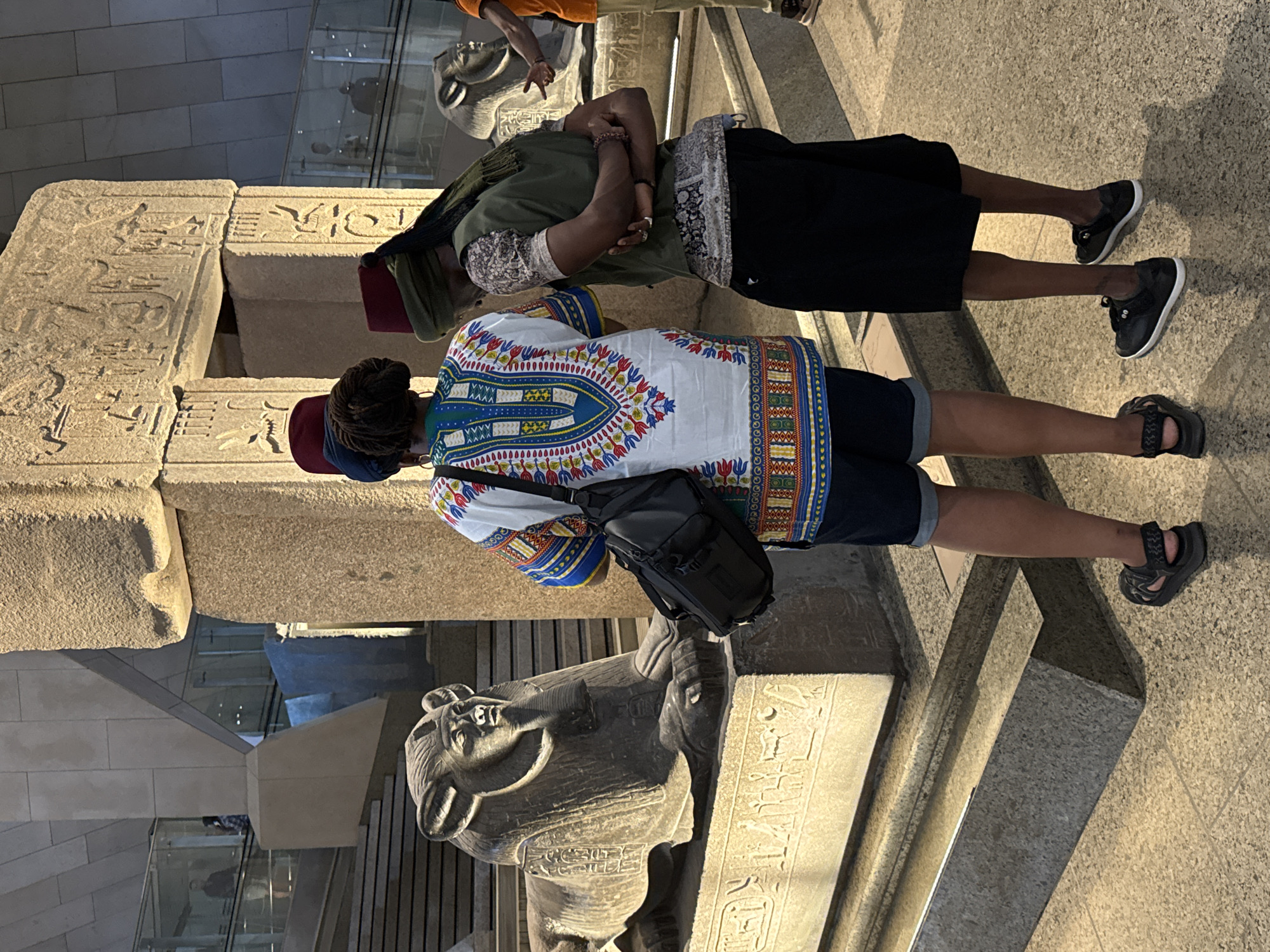
In Kafrat Nassar, Egypt, two individuals, viewed from the back, stand near an ancient Egyptian monument. The person on the left wears a white, colorful dashiki, dark denim shorts, and dark sandals. They carry a black messenger bag over their left shoulder. The person on the right wears a light-colored, patterned shirt, a dark green vest, black shorts, and black sneakers. Both individuals wear red fez hats. They are positioned in front of a stone structure with hieroglyphics, which appears to be part of an ancient Egyptian exhibit, possibly in a museum. A stone sphinx statue is visible to the left of the monument. The environment is indoors, with modern architectural elements like glass railings and escalators visible in the background, suggesting a museum setting.
Kafrat Nassar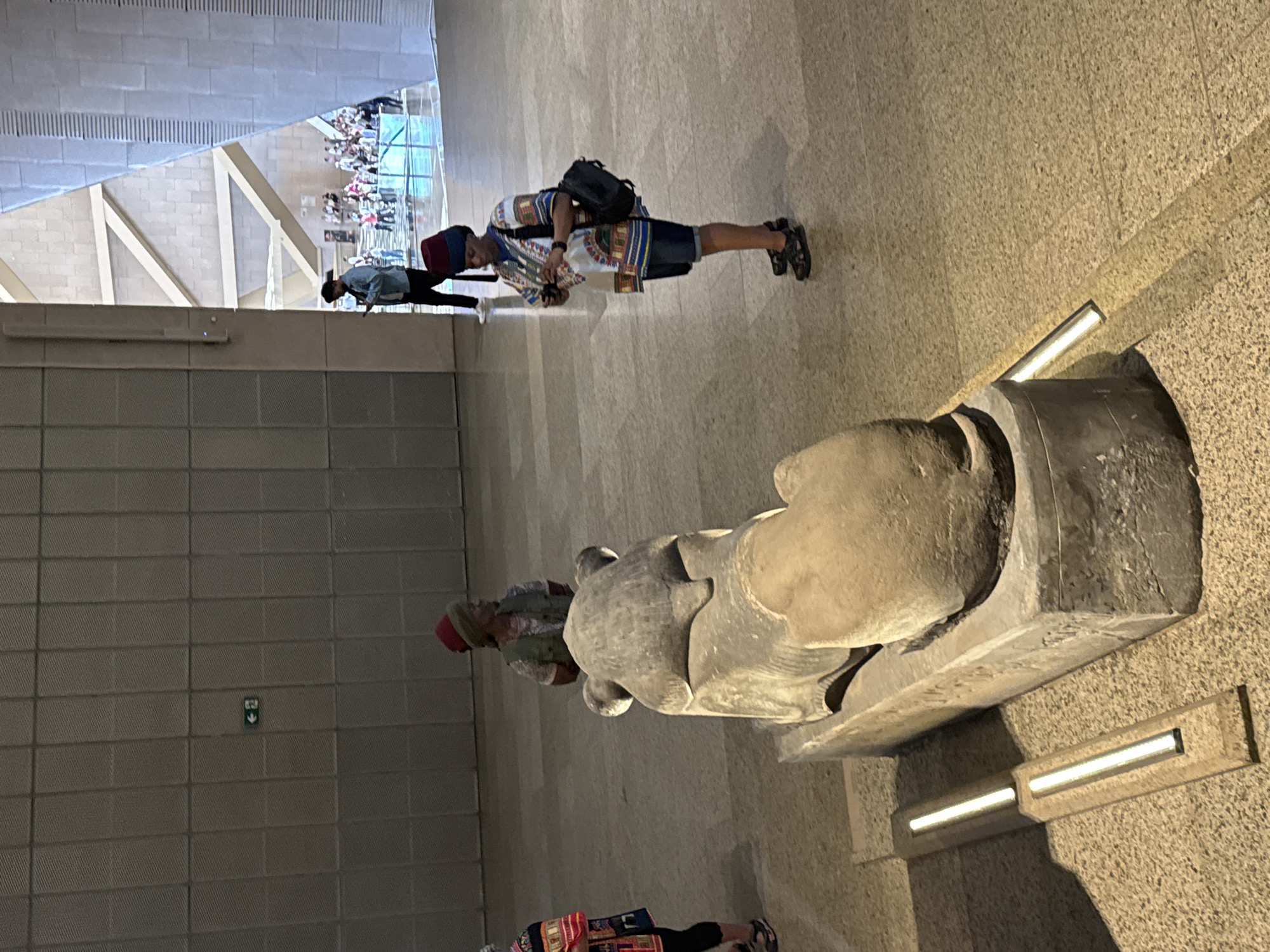
In the dimly lit, modern interior of a museum hall, a stone statue of a seated lion rests on a pedestal. Two individuals are present. In the foreground, slightly to the right, a person wearing a red fez, a patterned tunic, and denim shorts stands looking at a camera, holding it in their hands. To the left and further back, another person also wears a red fez and a traditional vest over a lighter garment. In the background, a man in a light blue jacket is seen looking at his phone, and beyond him, a crowd of people is gathered in a large, open space with angular architecture and high ceilings. The floor is tiled with a speckled pattern, and vertical light fixtures are embedded in the floor near the statue. The overall environment suggests an indoor exhibition space with contemporary design elements. The location is the Grand Egyptian Museum, located near Kafrat Nassar, Egypt.
Kafrat Nassar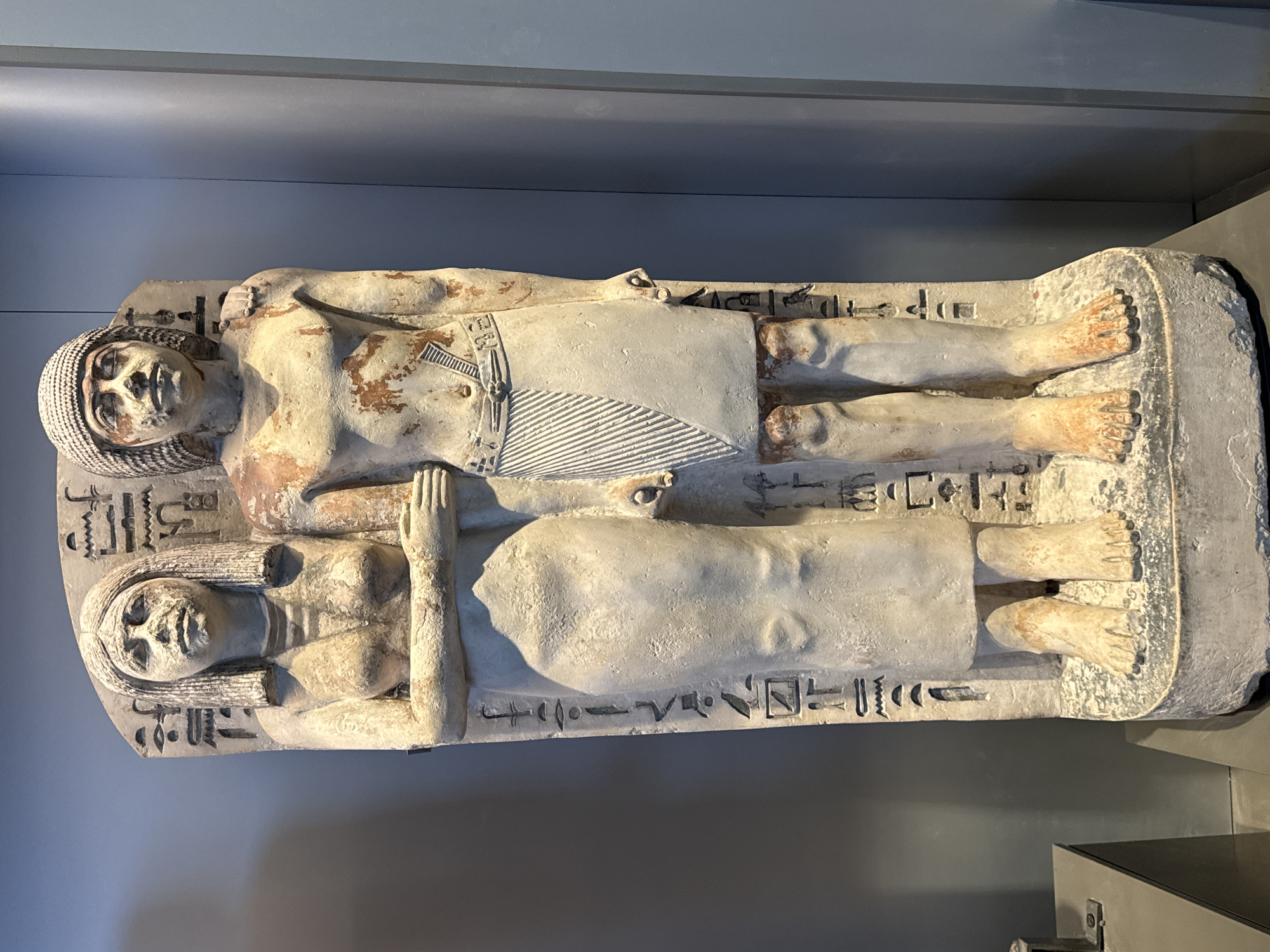
A statue of a standing man and woman is displayed against a grey background. The man is on the right, and the woman is on the left. Both figures are carved from stone and appear to be ancient Egyptian in style. Hieroglyphs are inscribed on the back of the statue. The man wears a kilt and a cap, while the woman wears a long dress. Their arms are linked. The statue is on a pedestal. The overall lighting suggests an indoor display, possibly in a museum. The image does not contain information about the city of Kafrat Nassar, Egypt.
Kafrat Nassar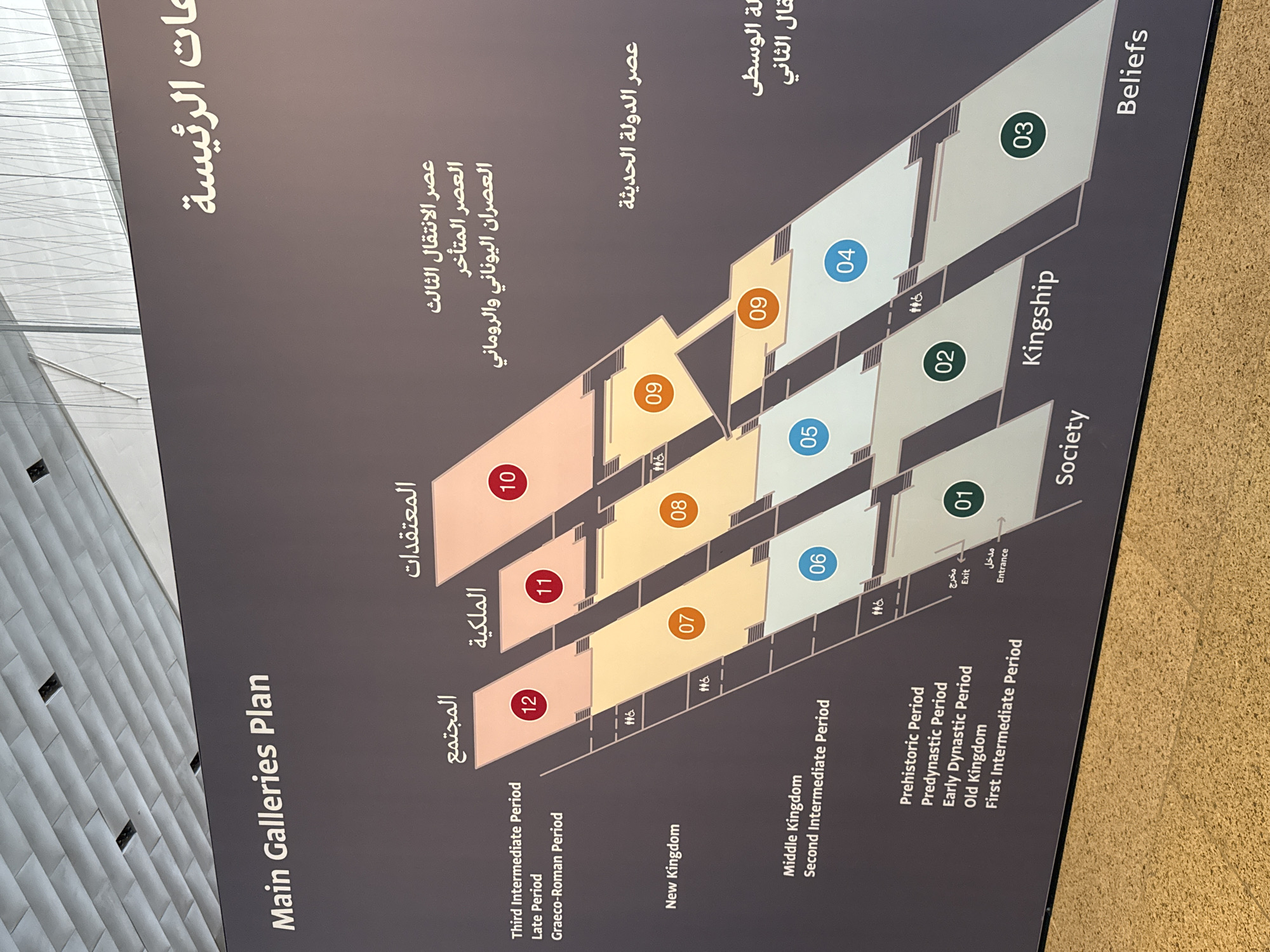
This is an image of a museum exhibit map with English and Arabic text. The map displays the "Main Galleries Plan" and shows various periods of history, such as "Third Intermediate Period," "Late Period," "Graeco-Roman Period," "New Kingdom," "Middle Kingdom," "Second Intermediate Period," "Prehistoric Period," "Predynastic Period," "Early Dynastic Period," "Old Kingdom," and "First Intermediate Period." Different sections of the map are labeled with numbers in circles, including 01, 02, 03, 04, 05, 06, 07, 08, 09, 10, 11, and 12. Arabic labels include "المجتمع" (Society), "الملكية" (Kingship), "المعتقدات" (Beliefs), "عصر الانتقال الثالث," "العصر المتأخر," "العصران اليوناني والروماني," "عصر الدولة الحديثة," "وسطى," and "الثاني." There are also symbols indicating entrances, exits, and accessibility features. The map is displayed on a dark gray background with a lighter gray patterned ceiling visible above. The bottom of the image shows a textured surface, possibly a wall or display stand, with a cork-like appearance. The specific location within Kafrat Nassar, Egypt, is not provided by the image itself.
Kafrat Nassar